Article

Metabolomic and Transcriptomic Analysis Reveal the Impact of Delayed Harvest on the Aroma Profile of ‘Shine Muscat’ Grapes


1
Agricultural Genomics Institute at Shenzhen, Chinese Academy of Agricultural Sciences, Shenzhen 518000, China
2
College of Horticulture, Hunan Agricultural University, Changsha 410128, China
3
Jiujiang Agricultural Technology Extension Center, Jiujiang 332000, China
4
Introduction to Bijie Academy of Agricultural Sciences, Bijie 551700, China
5
Horticultural Sciences, The Islamia University of Bahawalpur, Bahawalpur 62300, Pakistan
6
Quzhou Academy of Agricultural and Forestry Sciences, Quzhou 324000, China
*
Authors to whom correspondence should be addressed.
These authors contributed equally to this work.
Horticulturae 2026, 12(1), 109; https://doi.org/10.3390/horticulturae12010109
Submission received: 10 December 2025 / Revised: 12 January 2026 / Accepted: 14 January 2026 / Published: 19 January 2026

Abstract

Delayed harvesting of grapes can alter fruit quality and plays an important role in alleviating the problem of market saturation during peak seasons, as well as in regulating the supply period of grapes. In this study, by conducting a comparative analysis of fruit quality, metabolomics (aroma compounds) and transcriptome sequencing of ‘Shine Muscat’ grapes harvested at six different on-tree ripening stages after maturity, we found that: (1) delayed harvesting led to dramatic variation in berry color change (light green to yellow) with a significant increase in soluble solids (19.5 to 20.89 Brix); (2) A total of 25 volatile aroma compounds was identified in collected berry samples, while trans-2-hexenal and hexanal exhibited the highest concentrations in all samples, marking them as key volatile compounds in ‘Shine Muscat’ grapes. Notable variation in the concentrations of linalool, n-butanol, benzyl alcohol, phenylethanol, β-citronellol, and propionic anhydride were recorded in selected harvest periods. OAV analysis results show that linalool has the largest OAV among the detected compounds, and its OAV proportion increased from 53% to 95% during the six sampling periods of ‘Shine Muscat’; (3) Transcriptome sequencing of selected samples demonstrated a positive correlation between eight terpene-synthesis-related genes and linalool accumulation. Furthermore, genes within the MEP pathway (specifically VvTPS55, VvTPS59) and several transcription factors were associated with terpenoids metabolism. Based on soluble solids and OAV results, T18–T22 period (18–22 weeks post-flowering) can become good quality on-vine storge berries. The gene expression profile and developmental patterns of metabolites in MEP pathway may helpful in functional characterization of candidate genes related to terpenoid metabolism in future studies.

1. Introduction

The ‘Shine Muscat’ grape variety, known for its large berries, thin skin, crisp texture, and intense aroma, has gained significant popularity among growers and consumers in many regions of Asia. Currently, the cultivation area of ‘Shine Muscat’ exceeds 1 million mu, making it one of the major grape varieties in China, following cultivars such as ‘Kyoho’ ‘Red Globe’ and ‘Summer Black’. In most production regions in China, ‘Shine Muscat’ grapes are primarily harvested between July and September, resulting in seasonal oversupply and variability in berries quality. To address the issue of seasonal oversupply and improve the economic returns of grape production, researchers and growers have leveraged the unique characteristic of grapevines to produce multiple harvests through the utilization of winter and summer buds. This has led to the development of off-season cultivation practices, including techniques such as “early forcing”, “double cropping”, “simultaneous dual-cropping”, and “delayed cultivation” [1,2]. However, these cultivation strategies are technically challenging and place significant demands on vine nutritional reserves. In recent years, an alternative method of on-vine storage with delayed harvesting has been adopted as a practical approach to address these challenges as well, like in Nanjing, Jiangsu Province, some yards can delay harvesting ‘Shine Muscut’ until November (Figure S1), except low temperature storage, on-vine storage might be one of another best way to storage berries. Aroma compounds are important components of grapes, considered as key indicators for assessing grape quality and influencing purchasers’ preferences [3]. Grapes contain hundreds of aromatic compounds, which can be classified into terpenes, ketones, alcohols, esters, phenols, and many other components. The rich floral and fruity components found in grapes is primarily derived from terpenes [4].
Grapes contain hundreds of aromatic substances. Among them, C6 and C9 volatile compounds are abundant in both grapes and wine, reaching concentrations as high as mg/L. These compounds are synthesized from precursor fatty acids (linoleic and linolenic acids) via the lipoxygenase pathway [5]. These aromatic substances, which primarily include terpenoids, ketones, alcohols, esters, and phenols [6], serve as the fundamental material basis for the secondary aroma complex. Based on sensory profiles and volatile compositions, grape aromas are classified into three types: muscat, neutral, and strawberry [6]. ‘Shine Muscat’ is a typical muscat-flavored cultivar characterized by monoterpenes, specifically linalool and its derivatives [7], which impart distinct floral and fruity notes to the fruit. During the ripening of both wine and table grapes, free terpenes contribute significantly to the overall aroma [7,8]. However, the absolute concentration of a volatile compound is not the sole determinant of its aromatic impact; rather, it is determined by both the concentration and the odor activity value (OAV). Some compounds, despite their high concentrations, are difficult to perceive due to their high aroma detection thresholds. Generally, a higher OAV indicates a greater contribution to the grape’s aroma profile. The OAV is widely used to evaluate the contribution of individual volatile compounds to the overall aroma, with an OAV > 1 indicating a significant contribution to the grape’s characteristic scent [9]. Linalool belongs to the class of terpene alcohols, and its primary functional group is the hydroxyl group (-OH). Several factors influence berry aroma compounds, including the maturity of the berry [10], environmental conditions during growth [11], and vineyard management practices [3,12,13]. Grapes are classified as non-climacteric fruits, that makes them susceptible to berry drop, stem browning, and decay post-harvest. Therefore, effective storage techniques are essential for prolonging the supply period to maintain their freshness. Common preservation practices, including physical, chemical [14,15], and biological methods [16], are being used to maintain their quality. These preservation methods can be costly and may lead to a loss of grape aroma, negatively influencing berry quality. Furthermore, chemical preservatives may leave residues on the grape surface, posing potential health risks to consumers. After ripening, grapes can be stored on-vine to delay harvest. If on-vine storage improves the conventional quality and flavor of the delayed harvest fruit or maintains the taste and quality at the level of full ripeness, it can reduce berry storage costs, avoid market oversupply during peak harvest periods, and enhance the berry’s market competitiveness. For example, in the suburban areas of Nanjing, Jiangsu Province, ‘Shine Muscat’ berries can even remain on the vine for delayed harvesting until early December (Figure S1). Research on delayed harvest through on-vine storage have been conducted on citrus fruits [17,18,19], blood oranges [20], and avocados [21]. However, studies specifically focusing on the impact of varying on-vine storage durations on volatile aroma compounds and related gene expression in ‘Shine Muscat’ grapes yet remain unclear.
This study employs ten-year-old ‘Shine Muscat’ grape berry as the experimental material and utilized HS-SPME-GC-MS to analyze the composition and concentration of aromatic compounds in grapes stored on the vine for varying durations. Additionally, transcriptome sequencing was conducted to explore the relationship between volatile aroma compounds and the expression levels of related genes during on-vine hanging storage. Based on the quantitative analysis of volatile aroma compounds, this study provides a practical reference for on-vine storage management and the determination of optimal harvest period across different ripening stages.

2. Materials and Methods

2.1. Experimental Materials and Treatment

The experiment was preformed from April 2022 to October 2022 at the Ganshan research vineyard of Hunan Agricultural University (28°8′10″ N, 113°11′24″ E), Changsha, China. Ten-year-old ‘Shine Muscat’ grapevines exhibiting consistent growth were used as research material. During the period from dormancy to on-vine ripening (January to October), the cumulative growing degree days (GDD, ≥10 °C), average temperature, total sunshine duration, and total precipitation were 4895 °C, 18.9 °C, 1412 h, and 1257 mm, respectively. The plants were grown in red soil in southern China (commercial organic cattle manure and chemical fertilizers were applied annually around November) under rain-shelter with standard cultivation conditions as follows: the vineyard was managed according to conventional viticultural practices using the “Flying Bird” (Asuka-style) trellis system. To prevent fruit drop, primary shoots were topped above the third leaf preceding the inflorescence node approximately two weeks before anthesis (when the diameter of the leaves above the flowering node reached 2 cm). Simultaneously, lateral shoots were managed by pinching, with only a single leaf retained on each. Furthermore, treatments of 20 mg/kg GA3 + 2 mg/kg CPPU were applied (dipping the clusters within 5 s) at full bloom and 15 days post-anthesis, respectively, which help to promote fruit set, stimulate berry expansion, and induce seedlessness. Before anthesis, only the main flower spikes were retained by removing the upper inflorescences. Thinning of excessive berries was performed starting 15 days after full bloom to ensure a uniform number of berries per cluster. Approximately 20 days after fruit set, clusters were encapsulated in white ventilated paper bags. The fertilization regime included the application of bud-burst and cane-strengthening compound fertilizers; nitrogen fertilizer was largely withheld from anthesis until fruit set, after which fruit-expansion period fertilizers were applied bi-weekly. Following the onset of veraison, phosphorus and potassium fertilizers, such as KH2PO4, were gradually introduced. Water management consisted of thorough irrigation during the bud-burst stage and after each fertilization, with strict water control implemented during the fruit ripening stage. Irrigation was performed via a combination of drip tapes and overhead sprinklers. The climate during the delayed harvesting period was characterized by relatively high temperatures and dry conditions. Disease control primarily focused on gray mold (Botrytis cinerea) management around the anthesis stage, supplemented by several applications of conventional fungicides and insecticides throughout the remaining growing season.
Sampling was carried out at maturity stages (13 August 2022–21 October 2022). Samples were collected at 14 weeks post-flowering (wpf), 16 wpf, 18 wpf, 20 wpf, 22 wpf, and 24 wpf and designated as T14, T16, T18, T20, T22, and T24, respectively. During each sampling, berries were collected from both the sunny (east) and shaded (west) sides of the rows and from the upper, middle, and lower sections of the berry clusters using a random sampling approach. A total of 200 berries were harvested during every sampling and transported to the laboratory in ice boxes for quantification of individual berry weight, length, width, color difference, firmness, soluble solids, and titratable acidity. Three biological replicates followed by three technical replicates were used for each sampling. The sample collected for transcriptomic and metabolomic analysis were frozen in liquid nitrogen and transported to the laboratory for further experiments.

2.2. Materials and Reagents

Sodium hydroxide, Sodium chloride, Methanol, Cross-linked polyvinylpyrrolidone, and δ-Gluconolactone are the may regents applied (Table S1).

2.3. Measurement of Berry Physiological Indicators

Thirty berries from the frozen samples were randomly selected for analysis. The individual berry weight was measured using an electronic balance. The length and width of the grapes were assessed with an MNT-150T digital caliper (Mainate, Shanghai, China), while berry shape index was calculated using Formula (1). Berry firmness, including the skin, was measured with a ZP-50 portable hardness tester (unit, N). Titratable acidity (expressed as tartaric acid) was determined in accordance with the China national standard [22]. The soluble solids content was measured using a PAL-1 portable digital refractometer. The soluble solids-to-acid ratio [unit (Brix: (g/L)], which reflects the balance of berry taste, was calculated using Formula (2).
Berry Shape Index = Berry Length/Berry Width
Soluble Solids-to-Acid Ratio = Soluble Solids Content/Titratable Acidity
Color difference was assessed using an NR-110 colorimeter (3nh Global Company, Guangzhou, China) to measure the L*, a*, and b* values of the berry skin. The L* value indicates lightness, with higher values representing a lighter surface. The a* value represents the red or green component, with positive values indicating red and negative values indicating green; the greater the absolute value, the deeper the red or green color. The b* value represents the yellow or blue component, with positive values indicating yellow and negative values indicating blue; the greater the absolute value, the deeper the yellow or blue color.

2.4. Measurement of Volatile Aroma Compounds

2.4.1. Preparation of Standard Solutions

Standard solutions were prepared following the method as described by Zhang [23]. A mixture of 53 standard solutions was prepared as a stock solution (Stock Solution A). A 50.0 μL aliquot of stock solution A was diluted to 1.0 mL with methanol to prepare dilution stock solution B. Subsequently, a 100.0 μL aliquot of dilution stock solution B was further diluted to 5.0 mL with methanol to prepare dilution solution C. This solution was then diluted with ultrapure water to achieve the desired concentration range, resulting in the working standard solutions for constructing calibration curves. All solutions were stored at 4 °C for further experiments.

2.4.2. Extraction of Volatile Aroma Compounds

The extraction of volatile aroma compounds was based on the method described [24], with minor modifications. Approximately 50 g frozen berry was de-stemmed and placed into a mortar. A total of 1 g of polyvinylpolypyrrolidone (PVPP) and 0.5 g of D-gluconolactone were then added and mixed thoroughly. The mixture was ground to a powder in liquid nitrogen and then transferred to a 100 mL centrifuge tube, where it was left to stand at 4 °C for 4 h. Three technical replicates were performed for each sample.

2.4.3. Headspace Solid-Phase Microextraction (SPME) Analysis

Five milliliters of the prepared sample was accurately measured and placed in an extraction vial with 1 g of NaCl. The sample was vortexed for 30 s to ensure thorough mixing. After mixing, the sample was incubated in a 40 °C water bath for 35 min before undergoing headspace SPME (DVB/CAR/PDMS, 50/30 μm, Supelco, Bellefonte, PA, USA) for 50 min. The SPME fiber was then inserted into the GC injection port for a 20 min desorption at 250 °C, followed by GC-MS analysis.
GC-MS Conditions: Analysis was conducted using an Agilent 7890A-Agilent 7000C (GC-MS) triple quadrupole mass spectrometer (Agilent, Santa Clara, CA, USA). The capillary column was DB-WAX IU30 m × 0.25 mm × 0.25 µm (Agilent, Santa Clara, CA, USA). Helium (purity 99.999%) was used as the carrier gas at a flow rate of 1.0 mL/min. Manual injection was performed in split mode with a split ratio of 10:1. The injector temperature was set at 250 °C. The column temperature program was as follows: initial temperature at 35 °C for 10 min, then increased to 70 °C at 2 °C/min and held for 1 min, further increased to 150 °C at 5 °C/min and held for 1 min, and finally increased to 230 °C at 20 °C/min and held for 1 min. The mass spectrometry interface temperature was 230 °C, and the ion source temperature was 230 °C with EI ionization at 70 eV. Full scan mode (Scan) was used for qualitative analysis, and selected ion monitoring (SIM) was applied for accurate quantification of aroma compounds in the grape samples.

2.4.4. Establishment of GC-MS Analysis Method

GC-MS Scan detection was performed using the EI ion source. The primary volatile signals in the samples were identified through the NIST 17 standard mass spectral library. Further confirmation of the volatile compounds was assessed by comparing the retention time and mass spectra of standard compounds.

2.4.5. Construction of Calibration Curves

Different concentrations of mixed standard working solutions were prepared as described and were analyzed by GC-MS (as per conditions described in Section 2.4.1). Calibration curves were constructed by plotting the quantitative ion peak area (Y) against the substance concentration (X, µg/L).

2.4.6. Odor Activity Value (OAV)

OAV was calculated using the formula OAV = C/OT, where C is the detected concentration of the compound while OT is the odor threshold [9], the odor thresholds and thresholds sources was based on several references (Table S2) [25,26,27,28,29].

2.5. RNA-Seq Sequencing

Transcriptome sequencing was conducted by Beijing Biomarker Biotechnology Co., Ltd. (Beijing, China). Total RNA was extracted using Adlai RN40 (Aidlab Biotechnologies Co., Ltd., Beijing, China, Model: RN40) kits following the manufacturer protocol. The RNA concentration was measured using a Nanodrop2000 spectrophotometer (Thermo Scientific, Wilmington, DE, USA, Model: Nanodrop2000), and integrity was assessed using an Agilent 2100 and LabChip GX (PerkinElmer, Hopkinton, MA, USA, Model: LabChip GX). After ensuring samples quality, library construction was carried out with following procedure: mRNA was enriched using Oligo (dT) magnetic beads, fragmented with fragmentation buffer, and used as a template for synthesizing cDNA. The double-stranded cDNA was purified, repaired, adenylated, and ligated with sequencing adapters, followed by size selection with AMPure XP beads and PCR enrichment to obtain the cDNA library. After library construction, quality control and sequencing were performed. Post-sequencing data was analyzed using the BMKCloud platform (accessed on 1 January 2024, www.biocloud.net). Data filtering yielded clean data, which was aligned with the reference genome to obtain mapped data. Subsequent analyses included library quality assessment, structural level analysis, differential expression analysis, gene functional annotation, and functional enrichment. Differentially expressed genes (DEGs) were identified using DESeq2/DEGseq/EdgeR, with Q values (adjusted p-value ≤ 0.05, DEGs with |log2FC| > 1 and Q value ≤ 0.05) considered significantly different.

2.6. Real-Time Quantitative PCR

Real-time quantitative PCR was performed using the Bio-Rad CFX Connect TM Real-Time PCR detection system. Six samples cDNA were diluted to the same concentration. The reaction mixture (10 µL) included 5 µL of 2× SYBR Green qPCR Mix (Qingke Biotechnology Co., Ltd., Beijing, China), 0.2 µL each of forward and reverse primers, 3.6 µL of DNase/RNase Free ddH2O, and 1 µL of cDNA. The reaction was programmed with the following conditions: 95 °C for 3 min of pre-denaturation, followed by 40 cycles of 95 °C for 15 s, 59 °C for 15 s, and 72 °C for 20 s, with fluorescence signals recorded during the extension step. Melt curve analysis was performed from 59 °C to 95 °C, increasing the temperature by 0.5 °C every 5 s to identify primer dimers and non-specific amplification. Three technical replicates were performed for each sample. The primers for the three VvTPS genes used to validate the transcriptome sequencing results are deposited in Table S3.

2.7. Statistical Analysis

Statistical analysis of the experimental data was performed using SPSS v26.0 software, and graphical representation was performed using Origin 2022 software.

3. Results

3.1. Physical and Chemical Characteristics of On-Vine Hanging Storage of ‘Shine Muscat’ Grapes

As the duration of on-vine hanging storage for ‘Shine Muscat’ grapes increased, the berry’s brightness (L*) and yellow–blue (b*) values initially augmented and then declined, while the red–green value (|a*|) continuously decreased. Between 14 and 22 wpf, the L* value increased from 36.90 to 38.24, and the b* value improved from 12.46 to 14.53. The a* value remained negative, with |a*| decreasing from 2.47 to 0.40, indicating that the grape surface progressively brightened and shifted from green to yellow during this period. From 22 to 24 weeks post-flowering, the L* value decreased from 38.24 to 36.41, and the b* value dropped from 14.53 to 13.17, while the a* value transitioned from −0.40 to 0.26, suggesting that the berry surface color changed darker with a reddish tint. This late stage also showed significant berry russeting and the onset of berry decay (Figure 1 and Table 1).
During the on-vine hanging storage period, no significant changes were observed in single berry weight, longitudinal diameter, transverse diameter, or berry shape index, indicating that delayed harvest did not considerably impact on grape size or weight. Berry firmness initially decreased, stabilized temporarily, and then declined. At 18 wpf, berry softening began with a firmness of 9.61 N, which further decreased to 8.46 N by 24 wpf. This result shows negative connection between maturity and mesocarp and berry skin consistency. The soluble solid content increased continuously during the early stages of maturity, peaked at 20.89 Brix at 16 wpf. Titratable acidity initially declined, then increased, and subsequently decreased again, with a maximum value of 2.56 g/L at 14 wpf and a minimum value of 1.96 g/L at 24 wpf. The soluble solid-to-acid ratio followed a pattern of initial increase, subsequent decline, and a final increase, reaching its lowest value of 7.80 at 14 wpf and its highest value of 10.43 at 24 wpf (Table 2).

3.2. Establishment of GC-MS Analysis

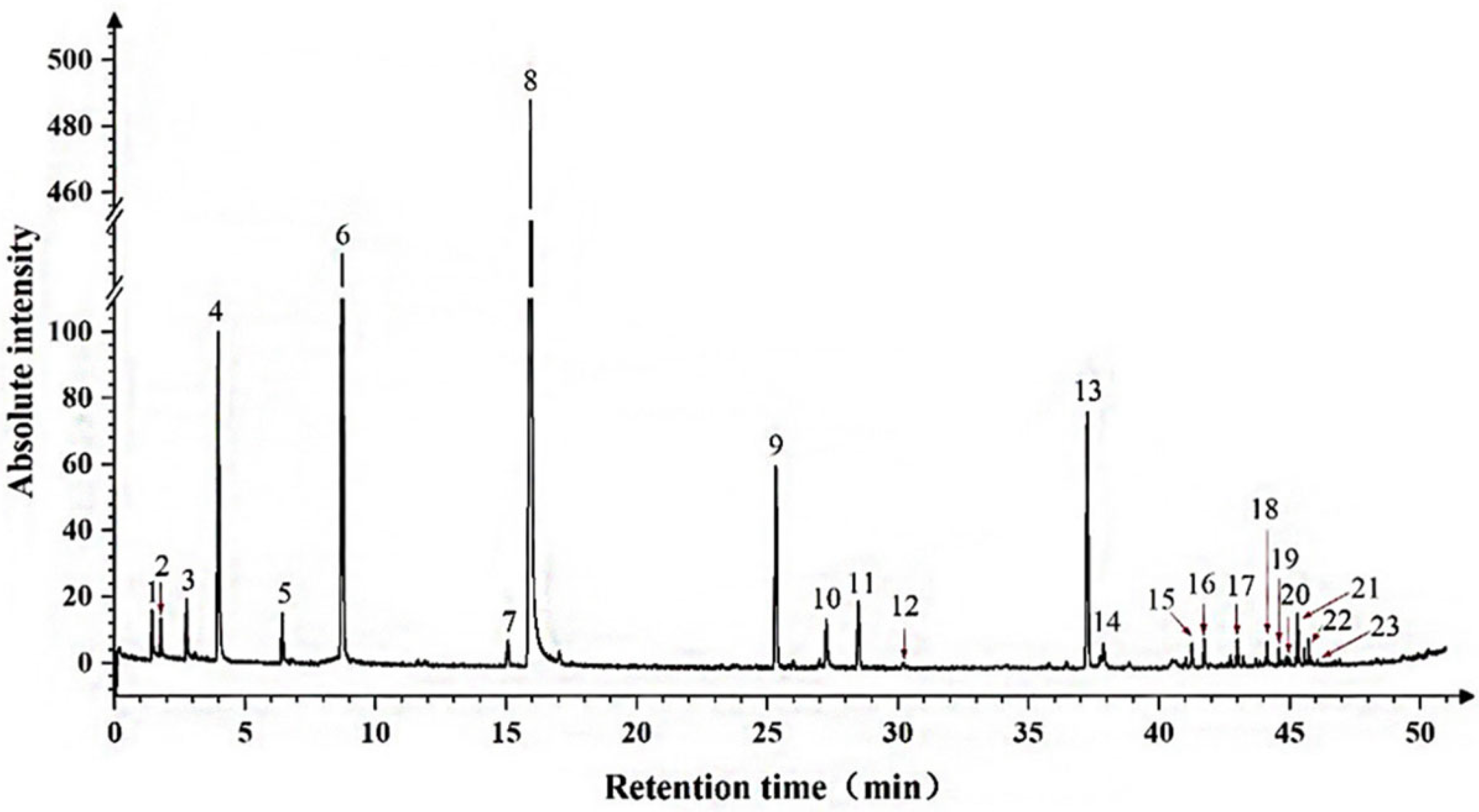
GC-MS Scan analysis of ‘Shine Muscat’ grape samples was performed using an EI ion source. The major volatile compounds were initially identified by searching the NIST 17 standard mass spectrometry library (Figure 2). Further confirmation of the volatile substances in the samples was accomplished by comparing with the retention times and mass spectral information of standard compounds. Based on the reported literature [7,18,30,31], 53 key volatile compounds were selected as target compounds for this study. A mixed standard solution of these 53 volatile compounds was analyzed by GC-MS Scan to determine their retention times. Qualitative and quantitative ions were utilized following the methodology as described by Zhang [32] in our laboratory to perform SIM analysis. The results showed well-resolved peaks for each target compound, with baseline separation and reduced baseline noise interference, making it suitable for subsequent aroma compound detection in samples.

3.3. Standard Curves

Different concentrations of mixed standard working solutions were analyzed by GC-MS to construct standard curves that relate to the peak area of target ions (Y) to the concentration of the substances (X µg/L). The results indicated that, for most of the volatile compounds, the standard curves displayed excellent linearity with R values greater than 0.9950 across the concentration ranges of 4~1600 µg/L, 10~8000 µg/L and 200~80,000 µg/L. Exceptions were noted for methyl tert-butyl ether (R = 0.9949), isopropanol (R = 0.9921), 4-methyl-1-pentanol (R = 0.9805), ethyl lactate (R = 0.9807), and 2,4-di-tert-butylphenol (R = 0.9948). The constructed standard curves demonstrated good linear correlation and are suitable for subsequent quantitative analysis of aroma compounds (Table S4).

3.4. Analysis of Aromatic Compounds During On-Vine Hanging Storage

3.4.1. Changes in Volatile Aromatic Compounds During Delayed Harvest of Berries

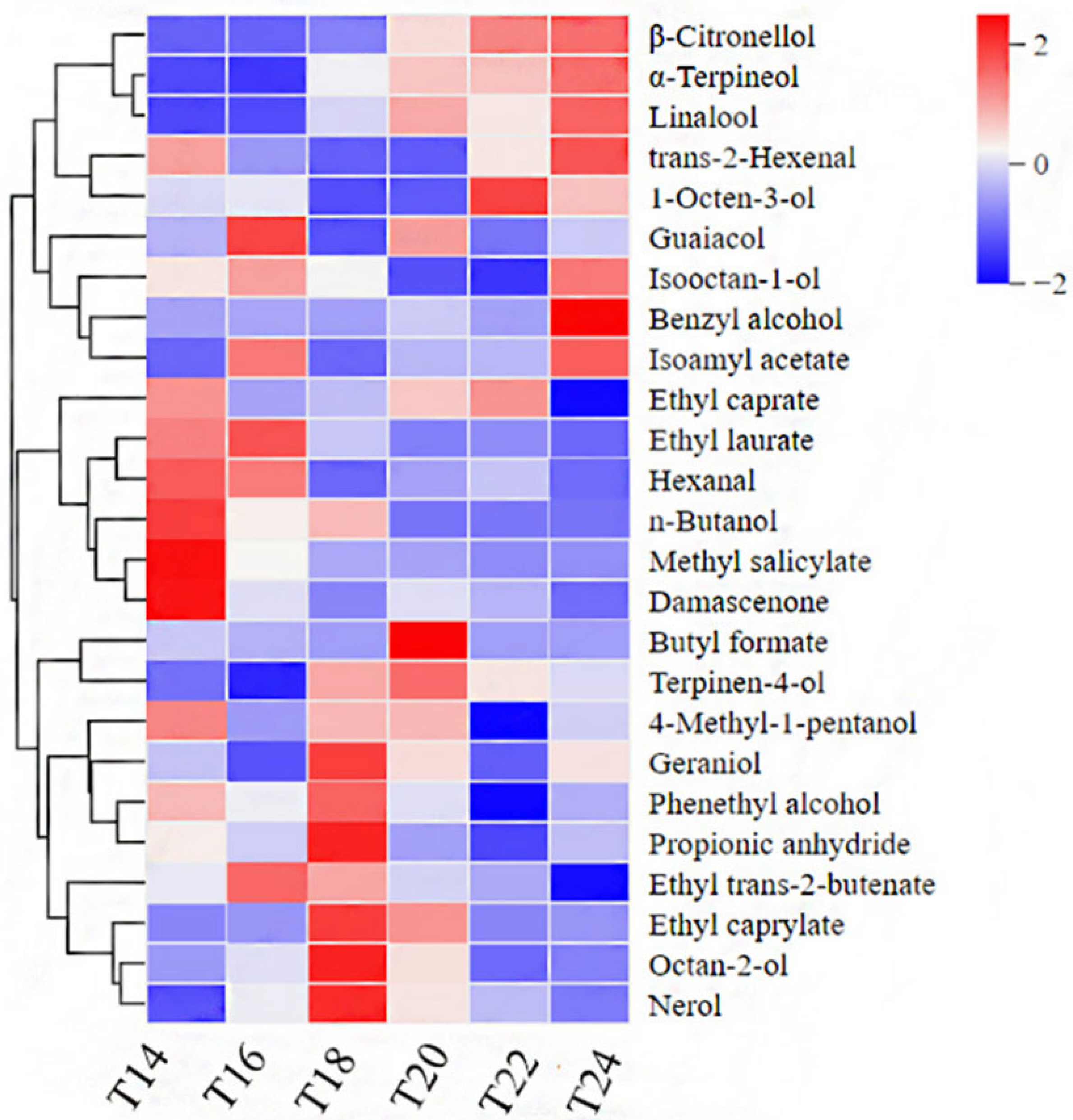
Twenty-five volatile aromatic compounds were identified from the harvested grapes at different sample collection time points throughout the on-vine hanging storage period. As the duration of on-vine hanging storage increased, the concentrations of linalool, β-citronellol, and α-terpineol generally augmented, attaining their peak levels at 24 weeks post-flowering. In contrast, compounds such as damascenone, methyl salicylate, n-butanol, hexanal, and ethyl laurate showed their highest concentrations at the start of berry maturity, with decreased levels during prolonged on-vine storage. The nerol, 2-octanol, ethyl caprylate, and trans-2-butenoic acid ethyl ester exhibited a pattern of initial increase followed by a decline. Notably, trans-2-butenoic acid ethyl ester showed its peak at 16 weeks post-flowering, while the other compounds reached their maximum concentrations at 18 wpf (Figure 3).

3.4.2. Impact of Different Harvest Times on the Volatile Aroma Compounds of Berries

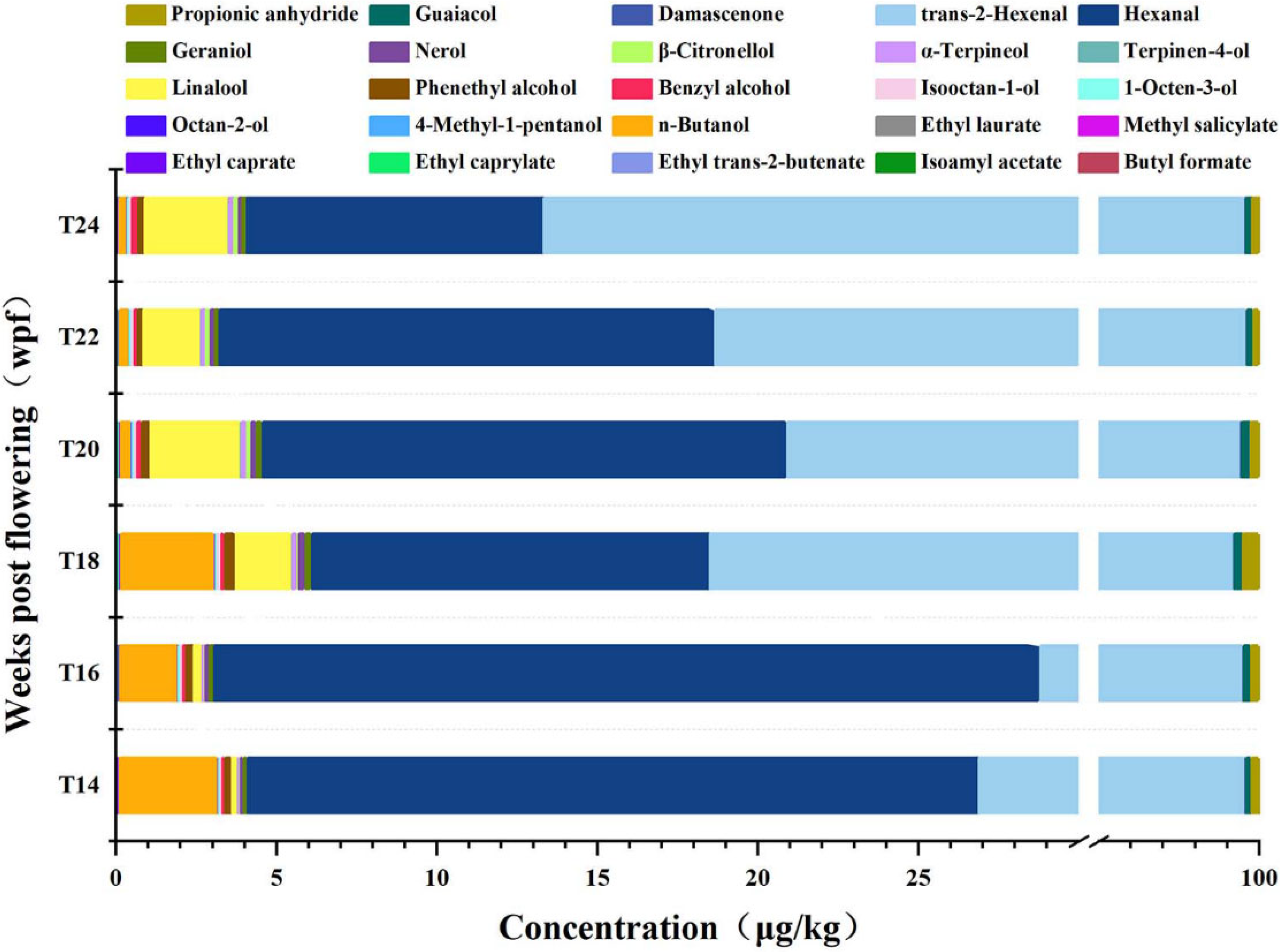
The proportions of the various volatile compounds varied across the samples. Trans-2-hexenal and hexanal were identified as the most abundant compounds in ‘Shine Muscat’ grapes, collectively accounting for over 93% of the total volatile content, establishing them as the dominant volatiles in this variety. The elevated concentration of linalool was record in T14 to T24 samples from 7.75 µg/kg to 96.8 µg/kg, while the concentration of n-butanol decreased from 124.44 µg/kg to 9.17 µg/kg in these samples, respectively. The samples at different stages displayed significant variation in the levels of linalool and n-butanol, and their relative proportions were obviously influenced by the duration of on-vine hanging storage (Figure 4).

3.4.3. Changes in Volatile Aroma During Different Sample Time Delayed Harvest

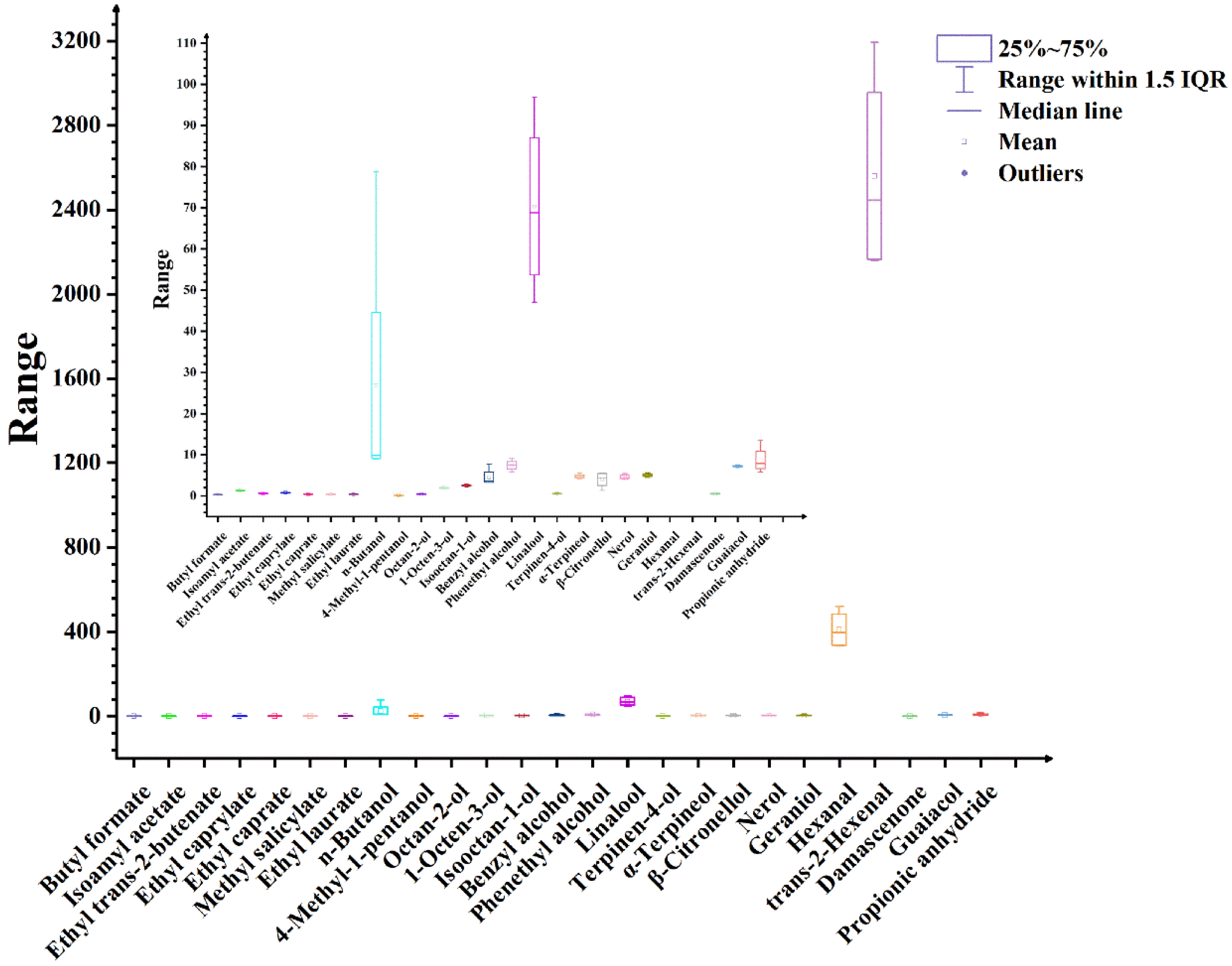
Box plot distribution analysis displayed the significant differences in the levels of 25 detected volatile compounds including hexanal, trans-2-hexenal, linalool, and n-butanol during different on-vine hanging storage time points. A notable increase in ethe linalool content, approximately 14-fold, from T14 to T24 was recorded, while trans-2-hexenal consistently remained around 2000 µg/kg at each delayed harvest period. In contrast, hexanal levels decreased from 923.07 µg/kg to 342.75 µg/kg, and n-butanol content dropped by nearly 14-fold (Figure 5). Based on the analysis above (Section 3.4.2), these four volatile compounds should be the focus as these represent the specific aroma compounds in ‘Shine Muscat’ grapes. A closer analysis revealed that benzyl alcohol, phenylethyl alcohol, β-citronellol, and propionic anhydride also exhibited some exclusive differences in grapes harvested at different on-vine hanging storage times. On the basis these differences, these compounds are also remarked as distinctive aroma compounds in ‘Shine Muscat’ grapes.

3.4.4. Impact of Different Sample Time Harvest on the OAV of Characteristic Volatile Aroma Compounds

The concentration of aroma compounds alone is insufficient for the complete characterization of the aromatic qualities of grapes. It is the combined effect of the concentrations of these aroma compounds and their odor activity values (OAVs) that determine their overall contribution to grape aroma [29]. Generally, a higher OAV indicates a greater influence of the aroma compound on the grape’s fragrance. A previous study demonstrated that the contribution of individual aroma compounds to overall grape aroma by calculating their OAVs, with values > 1 suggesting significant contribution to the aroma [33].
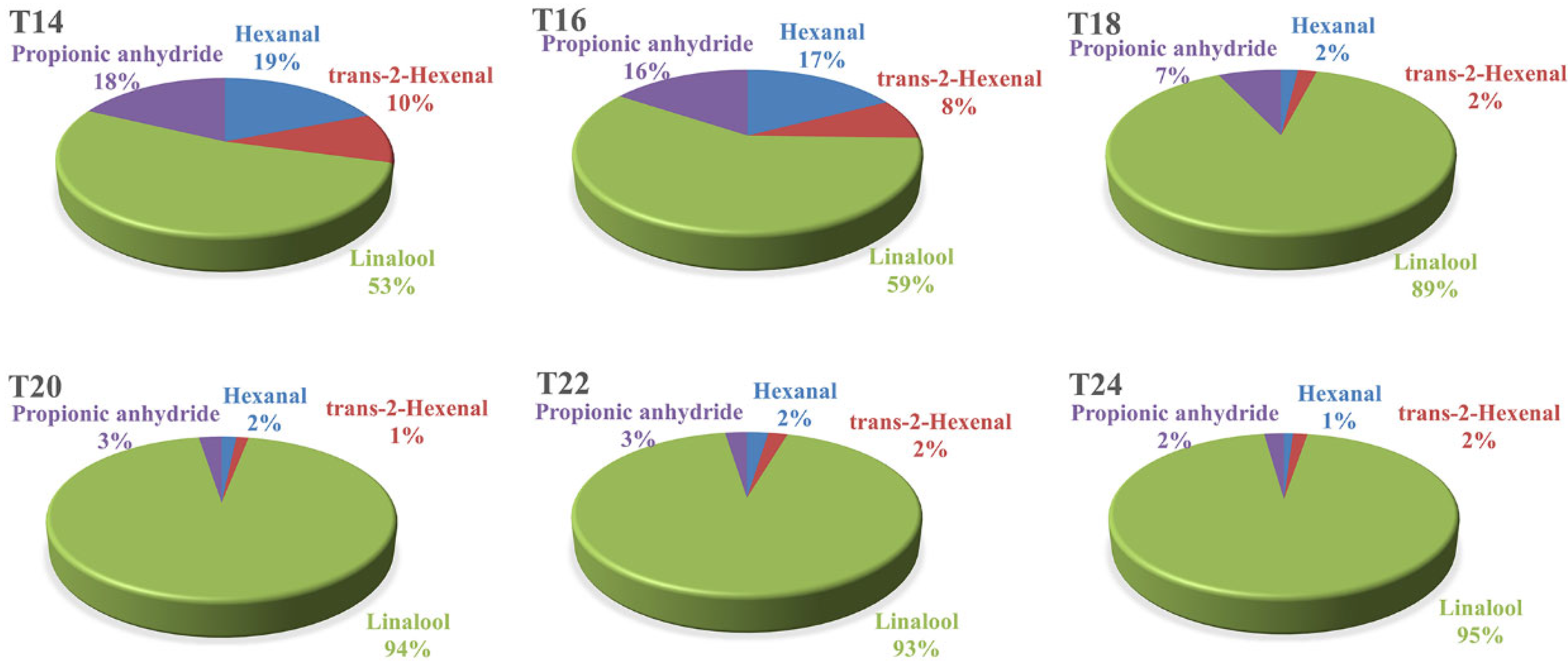
Using published odor thresholds, we calculated the OAVs for four key aroma compounds in ‘Shine Muscat’ grapes harvested at different times. The results revealed that linalool was the predominant contributor to the overall aroma profile of the berries, while its OAV contribution rate improved from 53% to 95% (Figure 6). This finding indicates that extended on-vine hanging storage enhances the richness of the ‘Shine Muscat’ grape aroma.

3.5. RNA-Seq Sequencing Results

3.5.1. Quality Control Data Statistics

After filtering low-quality reads and conducting quality control analysis, the clean reads for each sample ranged from 22,775,664 to 29,937,146. The combined proportion of G and C bases relative to the total bases varied between 45.65% and 46.27%, with the highest proportion of 46.27% observed in T14 samples. The Q30 value for all samples was at least 93.10% (Table 3). These results indicated that the sequencing data are of high quality and suitable for subsequent bioinformatics analysis.

3.5.2. Correlation Analysis Between Each Samples

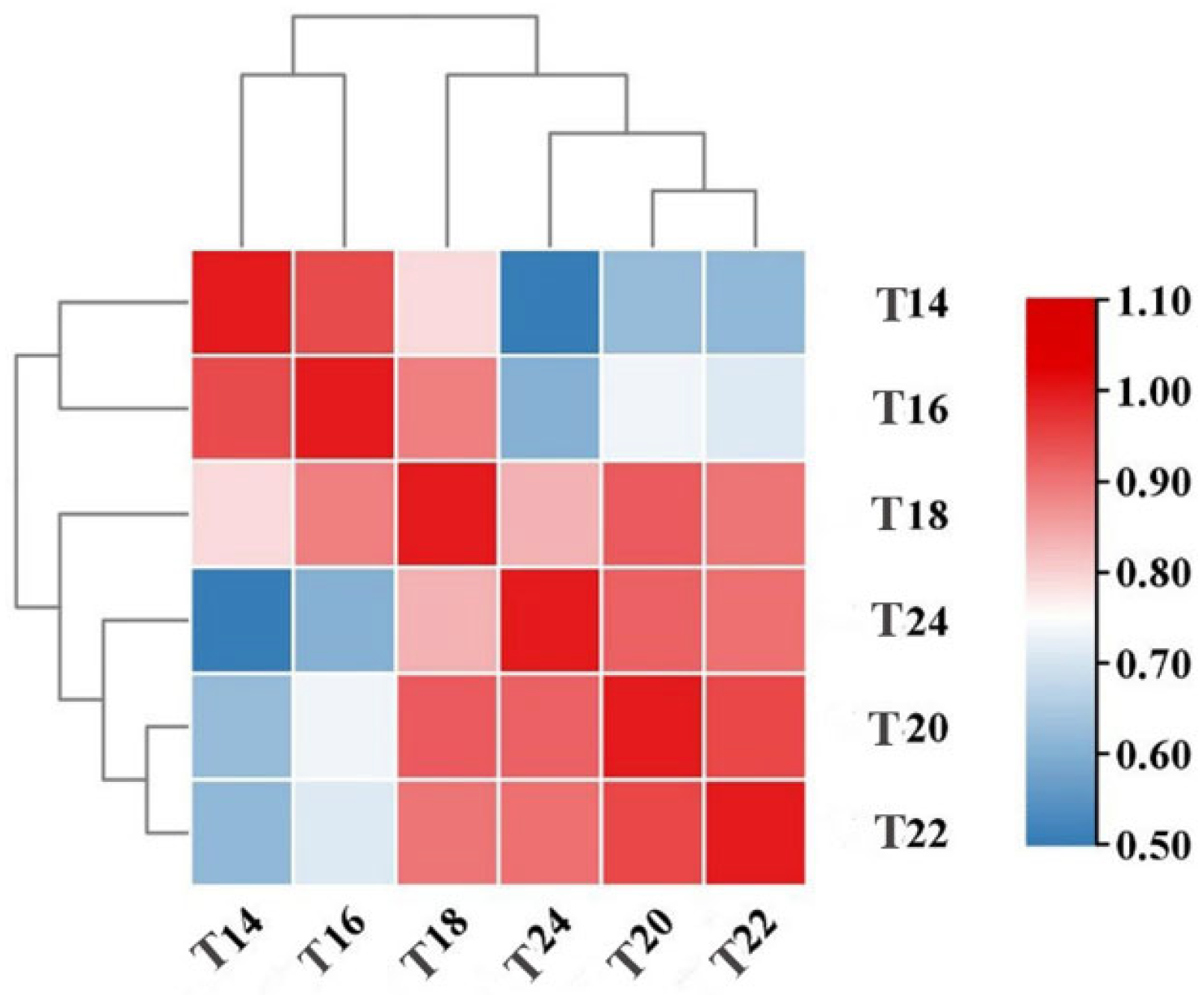
The correlation index among the samples collected at different time points specifically, between T14 and T16, T18 and T20, T18 and T22, T24 and T20, T24 and T22, and T20 and T22 were all greater than 0.9, indicating strong relationships among all the selected stages. In contrast, the correlation between T14 and T24 was only 0.5, suggested a weaker relationship in differential gene expression between the early and late storage periods of berries (Figure 7).

3.5.3. Differential Genes in the MEP Metabolic Pathway Involved in Linalool Synthesis

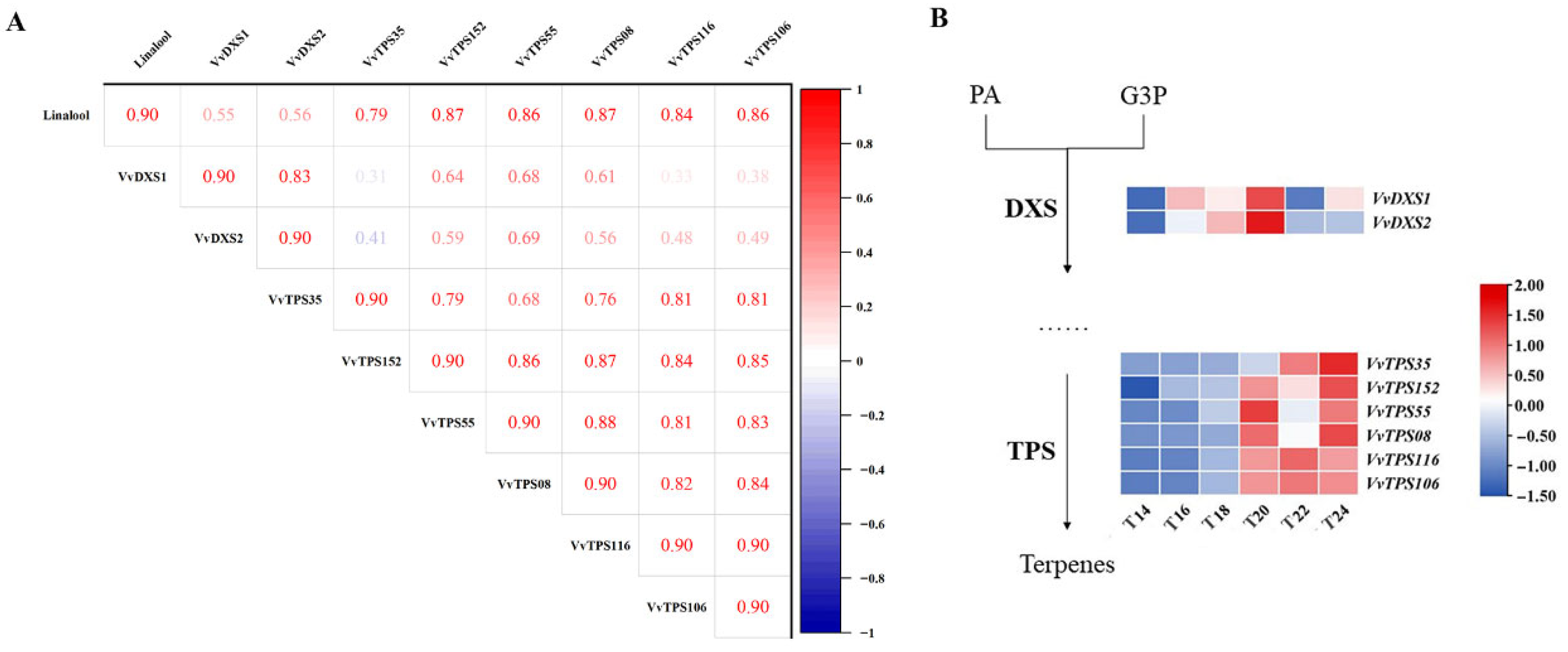
Transcriptome sequencing revealed a total of eight genes associated with the monoterpenoid synthesis pathway (Figure 8A), out of which two genes encoding 1-deoxy-D-xylulose-5-phosphate synthases (VvDXS) and six genes encoding terpene alcohol synthases (VvTPS), and all the genes exhibited varying expression levels during the hanging storage period. Notably, VvDXS1 (VIT_205s0020g02130) and VvDXS2 (VIT_211s0052g01730) exhibited the highest expression levels at 20 weeks post-anthesis. In contrast, the six VvTPS genes: VvTPS35 (VIT_212s0134g00030), VvTPS116 (VIT_213s0067g00090), VvTPS106 (VIT_213s0067g00050), VvTPS152 (VIT_219s0085g00830), VvTPS55 (VIT_200s0271g00010), and VvTPS08 (VIT_218s0001g04510), were highly expressed during the middle and late stages of hanging storage (from T20 to T24). Correlation analysis between linalool content and the expression of these eight genes showed a positive relationship. Specifically, VvTPS116, VvTPS106, VvTPS152, VvTPS55, and VvTPS08, all annotated as terpene alcohol synthases, had correlation coefficients of ≥0.8 with linalool accumulation. This strong correlation suggested that these five genes may play a significant role in the accumulation of linalool (Figure 8B).

3.5.4. qRT-PCR Validation Results

To verify the accuracy and reliability of the transcriptome data, qRT-PCR analysis was conducted using three randomly selected differentially expressed genes (DEGs) associated with linalool synthesis. The validation results showed a consistent correlation between the RNA-seq (FPKM value) and qRT-PCR results of VvTPS55 gene. This analysis also provided insights into the expression patterns of key genes involved in the terpene biosynthesis pathway across six harvesting time points. Additionally, the FPKM and qRT-PCR results for VvTPS106 and VvTPS116 were positively correlated between T14 and T20 (Figure 9).

4. Discussion

‘Shine Muscat’ considered as predominant table grapes variety among the consumers due to thin skin, crisp flesh, and rich aroma. Traditionally, the berry quality and maturity of grapes have been assessed primarily through the soluble solid content and titratable acidity. Later, the Codex Alimentarius Commission established a minimum sweetness requirement, i.e., 16% (FAO, 2022) [34]. In this study, as the on-vine hanging time of the ‘Shine Muscat’ grapes increased, the soluble solid content consistently exceeded the minimum quality requirements for table grapes as specified by Codex Standard [35]. The ratio of soluble solid content to titratable acidity (SSC/TA) value not only acts as a key indicator of berry quality but is also considered an ideal parameter for assessing berry maturity and determining the optimal harvest time [36]. Our results indicate an overall increasing trend in SSC/TA ratios, and this increase may be due to prolonged berry development or delayed harvest. Berry color is one of the key sensory attributes that determine the market value of table grapes [37]. For the color change in berries peel (L*, a*, b* value can similarly represent different colors), with on-vine storage time prolonged, the lightness (L*) and yellow–blue (b*) values of the berry initially increased but later decreased, while the red–green (|a*|) value consistently declined. This trend suggested that delayed harvesting significantly impacts grape skin color. Preserving the specific skin color of grape varieties is a primary objective during the delayed harvest process. Berry hardness is a critical agronomic trait in berry crops, greatly influencing shelf life and transportability, and it is affected by both variety and harvest time [38]. In this study, we observed that the hardness value of berries decreased with sample time delayed harvest. This reduction is likely quantifiable during the changes in cell wall composition and structure development that occur during berry maturation and senescence [39].
The most abundant volatile aromatic compounds in grapes are those that are derived from the lipoxygenase pathway, primarily consisting of C6 and C9 aldehydes, alcohols, and esters that are responsible for “leafy” flavors of the berry [39]. The changes in the concentrations of trans-2-hexenal and hexanal during berry development determine the overall trend of C6/C9 aldehyde levels, making them the two most dominant C6/C9 aldehydes in grapes. Research indicated that trans-2-hexenal and hexanal have the highest concentrations in ‘Shine Muscat’ grapes, and these two compounds were also found to be the most abundant in other table grape varieties [40,41,42]. Therefore, trans-2-hexenal and hexanal may be considered the common dominant volatile compounds across different table grape varieties. Alcohols and terpenes also play a key role in the aroma of rose-scented ‘Shine Muscat’ grapes [7]. In this study, we detected six types of terpenes in ‘Shine Muscat’ grapes harvested at different time points: linalool, β-citronellol, α-terpineol, 4-terpineol, nerol, and geraniol. Among these, linalool had the highest concentration and an OAV greater than one, indicating its significant contribution to the aroma quality of ‘Shine Muscat’ grapes. Additionally, the concentration of linalool increased as the on-vine hanging time extended, reaching at its peak in the later stages of on-vine storage. However, other compounds with OAVs < 1, along with aroma glycosides, also influenced the aroma characteristics. A previous study showed that bound form aroma glycosides are hydrolyzed by β-glucosidase in the mouth, and the hydrolysis increases flavor [43].
‘Shine Muscat’ grapes belong to the rose-type category, with distinctive aroma compounds mainly consisting of terpenes such as linalool, geraniol, and nerolidol, that reveal the rich floral and fruity notes to the grapes [14]. Approximately 40 types of terpenes have been identified in grapes, with the involvement of monoterpenes to grape aroma varying depending on the grape variety. Monoterpenes are the major contributors to the flavor of ‘Shine Muscat’ grapes, and mostly available in the berry in both free and glycosidically bound forms [44,45,46]. Thus, terpenes play a significant role in the defense system, growth and development of grapes.
The terpene synthase (TPS) family in grapes is a large gene family consisting of 152 members, some of which have been functionally characterized. Based on structural functions and sequence similarities, TPS genes are classified into seven subfamilies: TPS-a to TPS-h, with TPS-e and TPS-f grouped together into the TPS-e/f family [47]. In grapes, genes involved in the synthesis of monoterpenes, such as linalool and nerolidol which are responsible for the rose-like aroma are classified within the TPS-g subfamily [48]. In this study, RNA-seq analysis of ‘Shine Muscat’ grapes at six different harvest stages identified eight genes potentially involved in monoterpene biosynthesis. Correlation analysis revealed that several TPS family members, including VvTPS116, VvTPS106, VvTPS152, VvTPS55, and VvTPS08, showed significant positive correlations with linalool synthesis, suggesting that these genes may be involved in the regulation of linalool production. Our study is in agreement with previous studies [48,49]. Research on ‘Shine Muscat’ grapes confirmed that co-expression of TPS56 (another gene encoding linalool synthase) and VvDXS1 significantly increased the levels of several monoterpenes, including linalool and geraniol, in Nicotiana benthamiana leaves [7]. Similarly, previous report demonstrated that co-expression of TPS59 and VvDXS4 promoted monoterpene biosynthesis, with high expression of linalool observed in leaves with transient overexpression of TPS59, indicating its role in linalool biosynthesis, while co-expression with VvDXS4 boosted the production of these compounds [50]. The qRT-PCR results showed that the expression of VvTPS55 is consistent with the RNA-seq data, indicating a strong correlation between transcriptomic changes and qRT-PCR results. Notably, the expression level of the VvTPS55 gene significantly increased at T20 stage, suggesting that this gene may be involved in the accumulation of linalool in grapes. Overall, it is indicated that TPS genes are specifically involved in the synthesis of terpene compounds, significantly improved linalool content and thereby contributing to a rich fruit aroma.
In the early stage of storage after hanging on the tree, the organic matter in the grape fruit is mainly imported from the leaves to the fruit, and then, the soluble solid content tends to increase. In the later stage of hanging on the tree (T24), the soluble solids and total acid content gradually decreases. The color of the fruit becomes darker and darker, indicating that the respiration might degrade the berries’ soluble solids and total acid to increases in the later stages of hanging on the tree for storage. As the delayed harvest time increases, aromatic compounds, particularly linalool, gradually accumulate and reach their peak concentrations. This suggests that in the Hunan Province (even in the middle of China), appropriate hanging until 18~20 wpf is ideal for maturity (mid-September, while the normal maturity time in central China is at the end of August). If managed properly, grapes can be harvested at 22 wpf (early October) in the middle region of China, which enhances the sensory quality of ‘Shine Muscat’ grapes. However, between 22 and 24 wpf, russeting and rotting of berry surface occurs, while the berry gradually softens and hardness decreases. This research indicated that undue delay in harvesting can also negatively affect the berry quality. The duration of hanging time is closely related to the nutritional status of the plants and management practices. In the future, improving soil management (increasing organic matter content and managing water and nutrients), pest and disease control, and other plant management strategies, such as using different concentrations of plant growth regulators like GAs (gibberellic acid), CPPU (forchlorfenuron), and TDZ (thidiazuron), may also help to extend the harvest period of ‘Shine Muscat’ grapes. Currently, in the Chinese market, golden-yellow berries are relatively rare. They are favored by a segment of high-end consumers due to their exceptionally high total soluble solids (TSS) and intense aromatic profile. However, mainstream wholesalers and distributors still prioritize green-skinned fruits for their aesthetic consistency. Given that the ripening period for table grapes in Southern China is highly concentrated (primarily from August to September), leading to a seasonal production surplus, implementing a moderately delayed harvest is a strategic choice. It not only enhances the flavor complexity for niche markets but also helps in regulating the supply chain and extending the market window.

5. Conclusions

After grapes ripen, appropriately delaying harvest not only enhances fruit quality but also alleviates market saturation during peak season, thereby regulating the supply period. In this study, fruit quality analysis was first conducted on ‘Shine Muscat’ grapes harvested at delayed maturity, in the Hunan Province (even in the middle of China), appropriate hanging until 18~20 wpf is ideal for maturity (mid-September, while the normal maturity time in central China is at the end of August). As harvest time is delayed, the skin color of ‘Shine Muscat’ grapes changes from light green to yellow, and the soluble solids content continues to increase. Subsequent testing of aromatic compounds revealed the following results: A total of 25 aroma compounds were detected in delayed-harvest ‘Shine Muscat’ grapes, with trans-2-hexanal and hexanal exhibiting the highest concentrations. These compounds represent the key volatile substances in ‘Shine Muscat’ grapes. Analysis of odor OAV revealed that linalool exhibited the highest OAV, making it the primary contributor to the aroma profile of the ‘Shine Muscat’ grape variety. Transcriptome sequencing based on the results of aroma compound detection revealed that: The VvDXS1, VvDXS2, VvTPS08, VvTPS35, VvTPS55, VvTPS106, VvTPS116, and VvTPS152 genes showed positive correlations with linalool accumulation, making play a potential role in linalool accumulation.

Supplementary Materials

The following supporting information can be downloaded at: https://www.mdpi.com/article/10.3390/horticulturae12010109/s1. Table S1 Materials and Reagents. Table S2 Odor Thresholds and Sources of Key Aroma Compounds. Table S3 Primers Sequence for qRT-PCR. Table S4 Retention Times, Fragment Ions, Linear Correlations, Linear Ranges, and Linear Types of Target Compounds. Figure S1. ‘Shine Muscat’ grapes in Nanjing, Jiangsu Province, can remain on the vine until mid-December (2022). (A) Fruit of delayed-harvest ‘Shine Muscat’ grapes; (B) A vineyard of delayed-harvest ‘Shine Muscat’ grapes.

Author Contributions

Y.X., M.Y. and G.Y. planned and designed the research. R.W., Y.D. and S.L. conducted the experiments. M.K.-U.-R. and X.W. analyzed and visualized the data and wrote original manuscript. J.T. and G.Y. guided the experiments and revised the manuscript. All authors have read and agreed to the published version of the manuscript.

Funding

This work was supported by National Natural Science Foundation of China (General Program, Grant No. 32172519) and National Technology System for Grape Industry (Grant No. CARS-29-zp-9).

Data Availability Statement

The original contributions presented in this study are included in the article/Supplementary Materials. Further inquiries can be directed to the corresponding authors.

Conflicts of Interest

The authors declare that they have no competing interests.

References

  1. Wang, B.; Bai, Y.; Bai, X.; Zhang, Y.; Xie, T.; Liu, J.; Chen, A.; Lou, B.; He, J.; Lin, L.; et al. Introduction performance and double-harvest-a-year cultivation technique of ‘Shine Muscat’ grape in Nanning, Guangxi. J. South. Agric. 2016, 47, 975–979. [Google Scholar]
  2. Ni, P.; Yang, S.; Yuan, Y.; Zhang, C.; Zhu, H.; Ma, J.; Li, S.; Yang, G.; Bai, M. Transcriptome analysis provides new insights into the berry size in ‘Summer Black’ grape under a two-crop-a-year cultivation system. Hortic. Plant J. 2025, 11, 1469–1482. [Google Scholar]
  3. Alem, H.; Rigou, P.; Schneider, R.; Ojeda, H.; Torregrosa, L. Impact of agronomic practices on grape aroma composition: A review. J. Sci. Food Agric. 2019, 99, 975–985. [Google Scholar] [CrossRef]
  4. Ferreira, V.; Lopez, R. The Actual and Potential Aroma of Winemaking Grapes. Biomolecules 2019, 9, 818. [Google Scholar] [CrossRef]
  5. Matsui, K. Green leaf volatiles: Hydroperoxide lyase pathway of oxylipin metabolism. Curr. Opin. Plant Biol. 2006, 9, 274–280. [Google Scholar] [CrossRef] [PubMed]
  6. Yang, C.; Wang, Y.; Liang, Z.; Fan, P.; Wu, B.; Yang, L.; Wang, Y.; Li, S. Volatiles of grape berries evaluated at the germplasm level by headspace-SPME with GC–MS. Food Chem. 2009, 114, 1106–1114. [Google Scholar] [CrossRef]
  7. Wang, W.; Feng, J.; Wei, L.; Khalil-Ur-Rehman, M.; Nieuwenhuizen, N.J.; Yang, L.; Zheng, H.; Tao, J. Transcriptomics Integrated with Free and Bound Terpenoid Aroma Profiling during “Shine Muscat” (Vitis labrusca × V. vinifera) Grape Berry Development Reveals Coordinate Regulation of MEP Pathway and Terpene Synthase Gene Expression. J. Agric. Food Chem. 2021, 69, 1413–1429. [Google Scholar] [CrossRef]
  8. Luo, J.; Brotchie, J.; Pang, M.; Marriott, P.J.; Howell, K.; Zhang, P. Free terpene evolution during the berry maturation of five Vitis vinifera L. cultivars. Food Chem. 2019, 299, 125101. [Google Scholar] [CrossRef]
  9. Zhu, J.C.; Niu, Y.; Xiao, Z.B. Characterization of the key aroma compounds in Laoshan green teas by application of odour activity value (OAV), gas chromatography-mass spectrometry-olfactometry (GC-MS-O) and comprehensive two-dimensional gas chromatography mass spectrometry (GC×GC-qMS). Food Chem. 2020, 339, 128136. [Google Scholar] [CrossRef]
  10. Vilanova, M.; Genisheva, Z.; Bescansa, L.; Masa, A.; Oliveira, J.M. Changes in free and bound fractions of aroma compounds of four Vitis vinifera cultivars at the last ripening stages. Phytochemistry 2012, 74, 196–205. [Google Scholar] [CrossRef]
  11. Mendez-Costabel, M.P.; Wilkinson, K.L.; Bastian, S.E.P.; McCarthy, M.; Ford, C.M.; Dokoozlian, N. Seasonal and regional variation of green aroma compounds in commercial vineyards of Vitis vinifera L. Merlot in California. Am. J. Enol. Vitic. 2013, 64, 430–436. [Google Scholar] [CrossRef]
  12. He, L.; Xu, X.Q.; Wang, Y.; Vanderweide, J.; Sun, R.Z.; Cheng, G.; Chen, W.; Li, S.D.; Li, S.P.; Duan, C.Q.; et al. Differential influence of timing and duration of bunch bagging on volatile organic compounds in Cabernet Sauvignon berries (Vitis vinifera L.). Aust. J. Grape Wine Res. 2022, 28, 75–85. [Google Scholar] [CrossRef]
  13. Mirás-Avalos, J.M.; Bouzas-Cid, Y.; Trigo-Córdoba, E.; Orriols, I.; Falqué, E. Effects of two different irrigation systems on the amino acid concentrations, volatile composition and sensory profiles of Godello musts and wines. Foods 2019, 8, 135. [Google Scholar] [CrossRef] [PubMed]
  14. Matsumoto, H.; Ikoma, Y. Effect of postharvest temperature on the muscat flavor and aroma volatile content in the berries of ‘Shine Muscat’ (Vitis labruscana Baily × V. vinifera L.). Postharvest Biol. Technol. 2016, 112, 256–265. [Google Scholar] [CrossRef]
  15. Xu, T.; Chen, Y.; Kang, H. Melatonin is a potential target for improving post-harvest preservation of fruits and vegetables. Front. Plant Sci. 2019, 10, 1388. [Google Scholar] [CrossRef]
  16. Zhao, R.; Guan, W.; Zhou, X.; Lao, M.; Cai, L. The physiochemical and preservation properties of anthocyanidin/chitosan nanocomposite-based edible films containing cinnamon-perilla essential oil Pickering nanoemulsions. LWT 2022, 153, 112506. [Google Scholar] [CrossRef]
  17. Salto, L.; Maoz, I.; Goldenberg, L.; Carmi, N.; Porat, R. Effects of Rainfall and Harvest Time on Postharvest Storage Performance of ‘Redson’ Fruit: A New Red Pomelo X Grapefruit Hybrid. Agriculture 2024, 14, 1836. [Google Scholar] [CrossRef]
  18. Salifu, R.; Zhang, Z.; Sam, F.E.; Li, J.; Ma, T.Z.; Wang, J.; Han, S.Y.; Jiang, Y.M. Application of different fertilizers to cabernet sauvignon vines: Effects on grape aroma accumulation. J. Berry Res. 2022, 12, 209–225. [Google Scholar] [CrossRef]
  19. El-Otmani, M.; M’Barek, A.; Coggins, C.W., Jr. GA3 and 2,4-D prolong on-tree storage of citrus in Morocco. Sci. Hortic. 1990, 44, 241–249. [Google Scholar] [CrossRef]
  20. Zhao, J.; Miao, A.; He, X.; Li, W.; Deng, L.; Zeng, K.; Ming, J. Changes in phenolic content, composition, and antioxidant activity of blood oranges during cold and on-tree storage. J. Integr. Agric. 2022, 21, 3669–3683. [Google Scholar] [CrossRef]
  21. Kaiser, C.; Wolstenholme, B.N. Aspects of delayed harvest of ‘Hass’ avocado (Persea americana Mill.) fruit in a cool subtropical climate. I. Fruit lipid and fatty acid accumulation. J. Hortic. Sci. 1994, 69, 437–445. [Google Scholar] [CrossRef]
  22. GB 12456-2021; National Food Safety Standard-Determination of Total Acid in Food. National Standard of the People’s Republic of China: Beijing, China, 2021. Available online: https://www.chinesestandard.net/PDF.aspx/GB12456-2021 (accessed on 13 January 2026).
  23. Zhang, L.; Liu, Q.; Li, Y.; Liu, S.; Tu, Q.; Yuan, C. Characterization of wine volatile compounds from different regions and varieties by HS-SPME/GC-MS coupled with chemometrics. Curr. Res. Food Sci. 2023, 6, 100418. [Google Scholar] [CrossRef] [PubMed]
  24. Chen, K.; Wen, J.; Ma, L.; Wen, H.; Li, J. Dynamic changes in norisoprenoids and phenylalanine-derived volatiles in off-vine Vidal blanc grape during late harvest. Food Chem. 2019, 289, 645–656. [Google Scholar] [CrossRef] [PubMed]
  25. Van Gemert, L.J. Odour Thresholds: Compilations of Odour threshold Values in Air, Water and Other Media; Oliemans Punter: Zeist, The Netherlands, 2011. [Google Scholar]
  26. Li, M.; Ji, S.; Ji, R.; Yu, J.; Wei, D. Study on the Dynamic Evolution of Flavor Characteristics during the Fermentation Process of Chinese Northeastern Sauerkraut. Storage Process 2025. (In Chinese) [Google Scholar]
  27. Langen, J.; Wegmann-Herr, P.; Schmarr, H.G. Quantitative determination of α-ionone, β-ionone, and β-damascenone and enantiodifferentiation of α-ionone in wine for authenticity control using multidimensional gas chromatography with tandem mass spectrometric detection. Anal. Bioanal. Chem. 2016, 408, 6483–6496. [Google Scholar] [CrossRef]
  28. Xiong, Y.; Yang, G.; Chen, W.; Xu, Y.; Tan, J. Effects of delayed cultivation on fruit quality and volatile aroma components of ‘Summer Black’ and ‘Jumeigui’ grapes. Sino-Overseas Grapevine Wine 2021, 18–24. (In Chinese) [Google Scholar]
  29. Wu, Y.; Duan, S.; Zhao, L.; Gao, Z.; Luo, M.; Song, S.; Xu, W.; Zhang, C.; Ma, C.; Wang, S. Aroma characterization based on aromatic series analysis in table grapes. Sci. Rep. 2016, 6, 31116. [Google Scholar] [CrossRef]
  30. Rodríguez, M.D.; García-Cordero, J.; Suárez-Coca, D.; Ruiz del Castillo, M.L.; Blanch, G.P.; de Pascual-Teresa, S. Varietal Effect on Composition and Digestibility of Seedless Table Grapes (Vitis vinifera L.) under In Vitro Conditions. Foods 2022, 11, 3984. [Google Scholar] [CrossRef]
  31. Cao, W.; Shu, N.; Wen, J.; Yang, Y.; Jin, Y.; Lu, W. Characterization of the Key Aroma Volatile Compounds in Nine Different Grape Varieties Wine by Headspace Gas Chromatography–Ion Mobility Spectrometry (HS-GC-IMS), Odor Activity Values (OAV) and Sensory Analysis. Foods 2022, 11, 2767. [Google Scholar] [CrossRef]
  32. Zhang, X.; Li, J.; Chen, Y.; He, X.; Chen, W.; Yang, G.; Tan, J. Analysis of 58 volatile compounds in different grape varieties using stable isotope internal standard GC-MS SIM method. Food Sci. 2023, 44, 262–269. (In Chinese) [Google Scholar]
  33. Tan, F.; Wang, P.; Zhan, P.; Tian, H. Characterization of key aroma compounds in flat peach juice based on gas chromatography-mass spectrometry-olfactometry (GC-MS-O), odor activity value (OAV), aroma recombination, and omission experiments. Food Chem. 2022, 366, 130604. [Google Scholar] [CrossRef]
  34. Choi, K.-O.; Hur, Y.Y.; Park, S.J.; Lee, D.H.; Kim, S.J.; Im, D. Relationships between Instrumental and Sensory Quality Indices of Shine Muscat Grapes with Different Harvesting Times. Foods 2022, 11, 2482. [Google Scholar] [CrossRef]
  35. CXS 255-2007; Standard for Table Grapes. Food and Agriculture Organization of the United Nations: Rome, Italy, 2007.
  36. Yu, M.; Li, S.; Zhan, Y.; Huang, Z.; Lv, J.; Liu, Y.; Quan, X.; Xiong, J.; Qin, D.; Zhu, C. Evaluation of the Harvest Dates for Three Major Cultivars of Blue Honeysuckle (Lonicera caerulea L.) in China. Plants 2023, 12, 3758. [Google Scholar] [CrossRef] [PubMed]
  37. Muzolf-Panek, M.; Waśkiewicz, A. Relationship between Phenolic Compounds, Antioxidant Activity and Color Parameters of Red Table Grape Skins Using Linear Ordering Analysis. Appl. Sci. 2022, 12, 6146. [Google Scholar] [CrossRef]
  38. Rivera, S.; Giongo, L.; Cappai, F.; Kerckhoffs, H.; Sofkova-Bobcheva, S.; Hutchins, D.; East, A. Blueberry firmness—A review of the textural and mechanical properties used in quality evaluations. Postharvest Biol. Technol. 2022, 192, 112016. [Google Scholar] [CrossRef]
  39. Moya-León, M.A.; Mattus-Araya, E.; Herrera, R. Molecular Events Occurring During Softening of Strawberry Fruit. Front. Plant Sci. 2019, 10, 615. [Google Scholar] [CrossRef]
  40. Kalua, C.M.; Boss, P.K. Evolution of Volatile Compounds during the Development of Cabernet Sauvignon Grapes (Vitis vinifera L.). J. Agric. Food Chem. 2009, 57, 3818–3830. [Google Scholar] [CrossRef]
  41. Wang, W.N.; Qian, Y.H.; Liu, R.H.; Liang, T.; Ding, Y.T.; Xu, X.L.; Huang, S.; Fang, Y.L.; Ju, Y.L. Effects of Table Grape Cultivars on Fruit Quality and Aroma Components. Foods 2023, 12, 3371. [Google Scholar] [CrossRef]
  42. Yao, H.; Jin, X.Q.; Feng, M.M. Evolution of volatile profile and aroma potential of table grape Hutai-8 during berry ripening. Food Res. Int. 2021, 143, 110330. [Google Scholar] [CrossRef]
  43. Liang, Z.J.; Fang, Z.X.; Ahalya, P.; Luo, J.Q.; Gan, R.Y.; Gao, Y.; Zhang, P.Z. Glycosidically bound aroma precursors in fruits: A comprehensive review. Crit. Rev. Food Sci. Nutr. 2022, 62, 215–243. [Google Scholar] [CrossRef]
  44. González-Barreiro, C.; Rial-Otero, R.; Cancho-Grande, B.; Simal-Gándara, J. Wine Aroma Compounds in Grapes: A Critical Review. Crit. Rev. Food Sci. Nutr. 2014, 55, 202–218. [Google Scholar] [CrossRef]
  45. Belda, I.; Ruiz, J.; Esteban-Fernández, A.; Navascués, E.; Marquina, D.; Santos, A.; Moreno-Arribas, M.V. Microbial Contribution to Wine Aroma and Its Intended Use for Wine Quality Improvement. Molecules 2017, 22, 189. [Google Scholar] [CrossRef]
  46. Bönisch, F.; Frotscher, J.; Stanitzek, S.; Rühl, E.; Wüst, M.; Bitz, O.; Schwab, W. A UDP-glucose: Monoterpenol glucosyltransferase adds to the chemical diversity of the grapevine metabolome. Plant Physiol. 2014, 165, 561–581. [Google Scholar] [CrossRef]
  47. Martin, D.M.; Aubourg, S.; Schouwey, M.B.; Daviet, L.; Schalk, M.; Toub, O.; Lund, S.T.; Bohlmann, J. Functional annotation, genome organization and phylogeny of the grapevine (Vitis vinifera) terpene synthase gene family based on genome assembly, FLcDNA cloning, and enzyme assays. BMC Plant Biol. 2010, 10, 226. [Google Scholar] [CrossRef]
  48. Liu, X.J.; Fan, P.G.; Jiang, J.Z.; Gao, Y.Y.; Liu, C.X.; Li, S.H.; Liang, Z.C. Evolution of volatile compounds composition during grape berry development at the germplasm level. Sci. Hortic. 2022, 293, 110669. [Google Scholar] [CrossRef]
  49. Prusova, B.; Humaj, J.; Sochor, J.; Baron, M. Formation, Losses, Preservation and Recovery of Aroma Compounds in the Winemaking Process. Fermentation 2022, 8, 93. [Google Scholar] [CrossRef]
  50. Liu, S.Y.; Shan, B.Q.; Zhou, X.M.; Gao, W.P.; Liu, Y.R.; Zhu, B.Q.; Sun, L. Transcriptome and metabolomics integrated analysis reveals terpene synthesis genes controlling linalool synthesis in grape berries. J. Agric. Food Chem. 2022, 70, 9084–9094. [Google Scholar] [CrossRef]
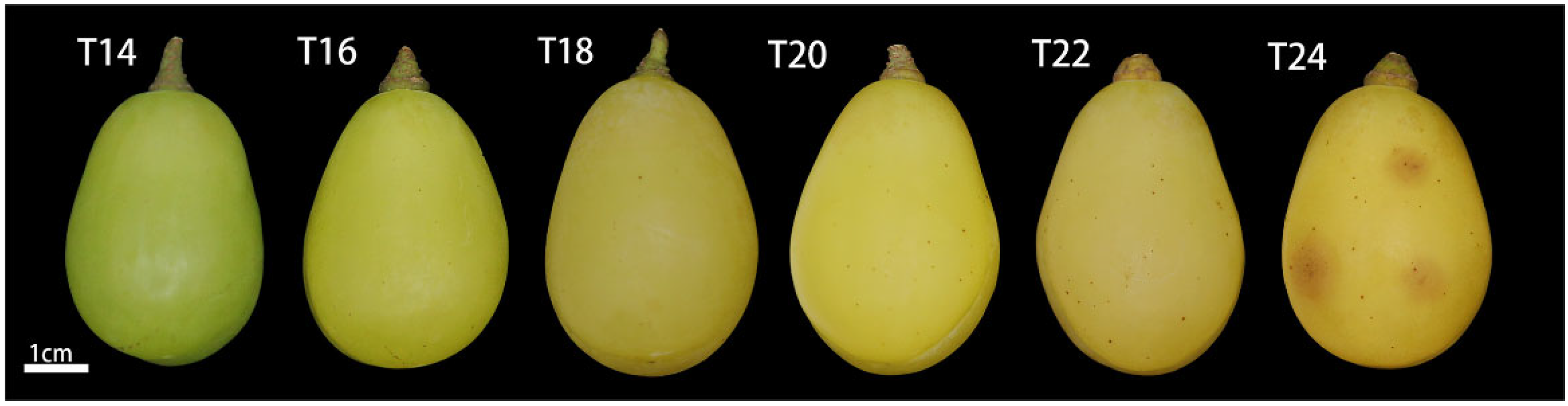
Figure 1. Morphological changes of ‘Shine Muscat’ grapes during on-vine hanging storage.
Horticulturae 12 00109 g001
Figure 2. GC-MS Scan Chromatogram of ‘Shine Muscat’ berries. Note: Peaks numbered 1 to 23 correspond to the following compounds: (1) Column bleed, (2) Acetaldehyde, (3) Column bleed, (4) Ethanol, (5) Butyl formate, (6) Hexanal, (7) Limonene, (8) Trans-2-hexenal, (9) Propionic anhydride, (10) Methyl octanoate, (11) Cis-2-hexen-1-ol, (12) Ethyl octanoate, (13) Linalool, (14) n-Octanol, (15) Ethyl decanoate, (16–18) Column bleed, (19) Nerol, (20) Damascenone, (21) Geraniol, (22) Benzyl alcohol, (23) Phenylethanol.
Horticulturae 12 00109 g002
Figure 3. Changes in volatile compounds in ‘Shine Muscat’ grapes at different on-vine hanging storage periods. Note: The relative concentrations of volatile compounds at different delayed harvest periods are indicated by different colors which the red represents a relatively high concentration of the compound during that period, while blue indicates a relatively low concentration.
Horticulturae 12 00109 g003
Figure 4. Percentage content of volatile compounds in ‘Shine Muscat’ grapes at different on-vine hanging storage times.
Horticulturae 12 00109 g004
Figure 5. Distribution of volatile compounds in ‘Shine Muscat’ grapes during different on-vine hanging storage periods. Note: 25%~75%: This represents the interquartile range (IQR), which encompasses the middle 50% of the data. It includes values between the 25th percentile (Q1) and the 75th percentile (Q3); Range within 1.5 IQR: The range within 1.5 times the interquartile range from the lower quartile (Q1) and upper quartile (Q3). This range is used to identify outliers. Values outside this range are considered potential outliers; Median line: This is the line that represents the median value of the data set in a box plot, showing the middle point of the data; Mean: This is the average value of the data set, calculated by summing all values and dividing by the number of values; Outliers: These are data points that fall significantly outside the normal range of the data, typically identified as values beyond 1.5 times the IQR from Q1 or Q3.
Horticulturae 12 00109 g005
Figure 6. Proportional contribution of OAVs to characteristic aroma compounds. Note: Green represents Linalool; Purple represents Propionic Anhydride; Blue represents Hexanal; Red represents trans-2-Hexenal.
Horticulturae 12 00109 g006
Figure 7. Pearson Correlation Matrix. Note: The Pearson correlation matrix of differential expression genes (DEGs) is calculated for the biological duplicates of each sample (T14, T16, T18, T20, T22, T24) to assess the correlation between samples.
Horticulturae 12 00109 g007
Figure 8. Correlation between linalool and genes, and terpene synthesis pathway. Note: (A) the color represents the correlation between linalool content and the expression levels of the eight genes, with red indicating high correlation and blue indicating low correlation; (B) the color indicates gene upregulation (red) or downregulation (light blue to white). The color scale corresponds to values normalized during the TBtools software (V2.0) visualization.
Horticulturae 12 00109 g008
Figure 9. qRT-PCR validation of DEGs in the terpene biosynthesis pathway. (A) the gene expression level (FPKM value) of VvTPS55 gene; (B) the gene expression level (FPKM value of VvTPS106 gene; (C) the gene expression level (FPKM value) of VvTPS116 gene. Note: The red line represents qRT-PCR results, while the gray bars represent transcriptome sequencing results (FPKM values).
Horticulturae 12 00109 g009
Table 1. Color difference values of ‘Shine Muscat’ grapes during on-vine storage.
wpfL*a*b*
T1436.90 ± 1.80 b−2.47 ± 1.34 a12.46 ± 1.49 b
T1637.17 ± 1.40 ab−1.92 ± 0.57 b12.85 ± 1.30 b
T1837.46 ± 1.96 ab−1.28 ± 0.75 c13.43 ± 1.82 b
T2037.14 ± 1.81 ab−0.64 ± 0.52 d13.45 ± 1.46 b
T2238.24 ± 1.74 a−0.40 ± 0.61 d14.53 ± 1.42 a
T2436.41 ± 1.79 b0.26 ± 0.54 e13.17 ± 1.70 b
Note: different letters represent significant (p < 0.05).
Table 2. Common physic characteristics of ‘Shine Muscat’ grapes during on-vine hanging storage.
wpfSingle Berry Weight/gLongitudinal Diameter/mmHorizontal Diameter/mmFruit Shape IndexStress Tolerance/NSoluble Solids Content (Brix)Total Acidity (g/L)Solid-Acid Ratio
T1410.80 ± 0.50 ab33.30 ± 1.47 a23.73 ± 1.56 a1.41 ± 0.11 a11.67 ± 1.12 c19.87 ± 0.37 c2.56 ± 0.12 a7.80 ± 0.52 c
T1610.62 ± 0.37 ab32.45 ± 2.26 a23.67 ± 1.20 a1.37 ± 0.10 a11.74 ± 1.19 c20.89 ± 0.55 a2.03 ± 0.09 cd10.28 ± 0.30 a
T1811.05 ± 0.07 a33.36 ± 1.68 a24.20 ± 1.06 a1.38 ± 0.08 a9.61 ± 0.73 b20.50 ± 0.44 ab2.20 ± 0.13 b9.36 ± 0.66 b
T2011.13 ± 0.21 a33.28 ± 2.05 a23.80 ± 1.37 a1.40 ± 0.10 a9.45 ± 1.32 b20.60 ± 0.41 ab2.07 ± 0.09 c9.99 ± 0.46 a
T2210.71 ± 0.38 ab32.51 ± 2.11 a23.50 ± 1.13 a1.38 ± 0.09 a9.92 ± 1.25 b20.70 ± 0.39 ab2.09 ± 0.08 c9.96 ± 0.50 a
T2410.17 ± 0.24 b32.84 ± 2.19 a23.52 ± 1.39 a1.40 ± 0.09 a8.46 ± 2.25 a20.36 ± 0.41 b1.96 ± 0.09 d10.43 ± 0.48 a
Note: different letters represent significant (p < 0.05).
Table 3. RNA-sequencing data.
SamplesClean ReadsGC Content (%)≥Q30 (%)
T1429,937,14646.2793.10
T1629,587,31145.9094.49
T1829,687,34645.9994.62
T2022,775,66445.9993.71
T2229,033,16145.6594.77
T2423,043,26046.0094.63
Note: (1) Samples: Grape sample and picking time; (2) Clean Reads: Total number of reads after quality control; (3) GC Content: Percentage of G and C bases in the clean data relative to the total number of bases.
Disclaimer/Publisher’s Note: The statements, opinions and data contained in all publications are solely those of the individual author(s) and contributor(s) and not of MDPI and/or the editor(s). MDPI and/or the editor(s) disclaim responsibility for any injury to people or property resulting from any ideas, methods, instructions or products referred to in the content.