Article

Four Petal-Specific TPS Drive Nocturnal Terpene Scent in Jasminum sambac

College of Horticulture, Fujian Agriculture and Forestry University, Fuzhou 350002, China
*
Author to whom correspondence should be addressed.
Horticulturae 2026, 12(1), 10; https://doi.org/10.3390/horticulturae12010010
Submission received: 21 November 2025 / Revised: 16 December 2025 / Accepted: 19 December 2025 / Published: 23 December 2025
(This article belongs to the Special Issue Molecular Biology for Stress Management in Horticultural Plants)

Abstract

Floral volatile terpenoids are known to play important roles in plant pollination biology by attracting animal pollinators, repelling antagonists, and enhancing resistance to potential microbial pathogens. The terpenoid blend emitted by a flower is usually plant-lineage specific and is primarily determined by a set of versatile terpene synthases (TPSs), which catalyze the final step of diverse terpenoid synthesis. The strongly scented flower of Jasminum sambac (L.) Aiton emits linalool and α-farnesene, which dominate the nocturnal floral VOCs, yet the corresponding TPSs have not been identified. Here, we show that four TPS enzymes are responsible for the synthesis of a mixture of volatile terpenoids in the flower, based on their highly correlated and almost exclusive expression in the petal, as well as their enzymatic characterizations in vitro and in Nicotiana benthamiana Domin. JsTPS01 (TPS-a) acts as a sesquiterpene synthase, producing τ-cadinol in yeast at levels that mirror its rhythmic expression in petals. JsTPS02 (TPS-b) carries a plastid-targeting transit peptide, localizes to chloroplasts/plastids, and converts geranyl diphosphate (GPP) to linalool with high affinity (Km = 28.2 ± 3.4 µM). JsTPS03 is a TPS-b clade member that can convert farnesyl diphosphate (FPP) to farnesol with a Km of 14.4 ± 5.9 μM in an in vitro assay using isolated yeast vehicles. JsTPS04 (TPS-e/f) exhibits dual targeting—cytosolic in protoplasts of Arabidopsis thaliana (L.) Heynh, but plastidic in J. sambac petals—and functions as a bifunctional mono-/sesqui-TPS, forming linalool from GPP (Km = 2.5 ± 0.3 µM) and trans-nerolidol from FPP (Km = 7.6 ± 0.6 µM). Transient expression in N. benthamiana leaves further confirmed its in-planta linalool production. Collectively, we identified four preferentially expressed terpene synthases that contribute to the production of linalool, τ-cadinol, trans-nerolidol, and farnesol in J. sambac.

1. Introduction

Plants utilize diverse “secondary” compounds made from their specialized metabolisms for interactions with the surrounding abiotic or biotic factors [1]. The ecological and/or physiological roles of these specialized metabolites are often lineage-specific or evolutionary convergent, with well-known examples in herbivore defense [2], UV protection [3], and pollinator attraction [4]. An estimate of the number of these specialized compounds across the plant kingdom suggests a range in hundreds of thousands [5], and the enzymes responsible for generating this chemical diversity are known to possess lower catalytic efficiency but remarkable substrate and product promiscuity [6].
Terpenoids, or isoprenoids, are one of the most diverse classes of such compounds [7], the final step in the synthesis of which is mainly catalyzed by two groups of closely related enzymes called prenyl transferases (PTs) and terpene synthases (TPSs) [8]. The precursors in these reactions are the two isomeric 5-carbon (C5) building blocks: isopentenyl diphosphate (IPP) and dimethylallyl diphosphate (DMAPP), as well as their condensed derivatives geranyl diphosphate (GPP, C10), neryl diphosphate (NPP, C10), farnesyl diphosphate (FPP, C15), and geranylgeranyl diphosphate (GGPP, C20) [9]. In plants, IPP and DMAPP are generated via two independent and compartmentalized pathways: the acetyl-CoA-derived cytosolic mevalonate (MVA) pathway and the pyruvate-derived plastidial 2-C-methyl-D-erythritol-4-phosphate (MEP) pathway [10]. While PTs usually work in the condensation of the two C5 blocks [11], or in generation of longer-chain polyisoprenoids via sequential head-to-tail additions of IPP [12], TPSs catalyze the final production of the many structurally distinct isoprenoid molecules, which may be modified simultaneously or subsequently by cytochrome P450 monooxygenase (P450) enzymes, giving rise to the diversity of terpenoid compounds found in nature [13]. Many lower-molecular-weight and high-melting-point acyclic or cyclic terpenoids, primarily C10 monoterpenoids and C15 sesquiterpenoids, are volatile organic compounds (VOCs) that function as attractants for pollinators or seed-dispersers, as well as defense compounds against herbivores [14,15]. Recent studies on the structural and functional divergence of the TPS family, such as in Pinus species [16] and tomato (Solanum lycopersicum L.) [17], highlight the evolutionary importance of terpenoids in mediating plant–plant and plant–microbe interactions that affect plant fitness and adaptation [18,19,20].
Most fragrant flowers typically emit a mixture of 20 to 60 different compounds derived from limited metabolic pathways, including terpenoid, lipoxygenase, and phenylpropanoid/benzenoid pathways [7]. While volatile fatty acid derivatives and phenylpropanoid/benzenoid are commonly found in floral scents, terpenoids constitute the largest class of floral volatiles [21]. It is suggested that floral scent is an important trait of pollination syndromes that may impact plant reproduction strategies and contribute to reproductive isolation as well, and that either “structural” or “regulatory” genes responsible for the production of the fragrant compounds are under evolutionary selection imposed by both mutualists and antagonists [4,22,23,24]. In the model plant Arabidopsis thaliana (L.) Heynh, the genome encodes 32 TPS full-length genes, more than half of which have been functionally investigated. This includes four flower-specific terpene synthases (TPS11, 14, 21, and 24), which, together with the widely expressed TPS03 and TPS10, contribute to a mixture of emitted monoterpenes and sesquiterpenes in the flower, despite the low emission rates [25,26]. Interestingly, the same set of floral terpenoids is similarly produced among 37 Arabidopsis ecotypes, indicating an inherited role in reproductive fitness or pollination strategy for this species [27]. The second most extensively studied plant species concerning TPS functionality is the cultivated tomato (S. lycopersicum), the genome of which contains at least 52 loci with 34 putative functional TPS genes, representing all seven clades of the TPS family [17,28]. However, tomato flowers, as well as Arabidopsis, are typically wind-pollinated, with occasional assistance from insects such as bumble bees [25]. The expression of several non-exclusive floral TPSs corresponds with the mild release of volatile mono- and sesquiterpenes [17,28]. For plant species with strongly scented flowers, such as Clarkia breweri (A. Gray) Greene [29,30,31], Antirrhinum majus L. [32], and several orchids [33,34] and roses [15], knowledge about the composition of specific fragrant bouquets, the genes underpinning the biosynthetic regulation, and the eco-evolutionary significance of floral scent from particular plant lineages is increasingly documented. Despite significant progress, much less investigation has been reported for many other fragrant plants, especially those without a handful of genetic tools [35].
Jasminum sambac (L.) Aiton, a nocturnal anthesis species from the olive family (Oleaceae), is an evergreen shrub or vine native to India and Southeast Asia and cultivated worldwide for its showy and exceptionally fragrant flowers [36]. Most Jasminum species exhibit distylous floral morphology [37], and the cultivated plants are usually clonally propagated, likely due to the lack of natural seed-setting [38]. In Asia, the flowers are used in the essential oil industry and for scent tea production [39]. Closely related species in the genus, including J. grandiflorum (L.) and Jasminum auriculatum (Vahl.), are also used for the same purpose; their floral VOCs constitute a highly characteristic proportion of benzyl acetate, linalool, and α-farnesene, along with quantitative variation of other minor terpenoids and phenylpropanoids/benzenoids among them [40,41,42,43]. In one experiment, enzyme activities of several biosynthesis enzymes, including terpene synthase, were determined using crude petal extract, roughly correlating to the VOC emission rate [41]. However, the corresponding genes encoding such enzymes remain elusive. In recent years, genome data for different jasmine cultivars have provided insights into the biosynthesis of floral scent [36,44], floral trait formation [45], the genetic diversity of different petal morphology and aroma-related genes [46,47], and heat stress tolerance [48]. These reports have also enabled comprehensive functional predictions of the TPSgene family [36,49]. However, only one TPS responsible for synthesizing β-ocimene has been described [36].
To identify TPSs responsible for assembling the nocturnal terpenoid bouquet in J. sambac, we integrated floral transcriptome mining with both in planta and heterologous functional assays. Here, we demonstrate that four highly expressed flower-specific TPSs are responsible for the biosynthesis of the floral monoterpenoids and sesquiterpenoids in J. sambac. Specifically, the most strongly expressing JsTPS04 produces both the monoterpene linalool and the sesquiterpene trans-nerolidol, JsTPS03 converts FPP to farnesol, JsTPS02 is dedicated to linalool formation, and JsTPS01 generates the sesquiterpene τ-cadinol in yeast. It remains to be determined how these genes are regulated and their relevance to pollination syndromes.

2. Materials and Methods

2.1. Nomenclature and Taxonomy

Plant names follow the Plants of the World Online (POWO, Plants of the World Online | Kew Science (https://powo.science.kew.org/)) and the International Plant Names Index (IPNI, International Plant Names Index (https://www.ipni.org/)). Species author citations were verified using IPNI and are given in full upon first mention in the text.

2.2. Plant Materials and Growth Conditions

Three-year-old plants of J. sambac cv. “double petal” were obtained through clonal propagation in a nursery at Fujian Agriculture and Forestry University, Fuzhou, China (26°5′22″ N, 119°13′48″ E) and grown in pots of ∅30 × 40 cm, filled with peat, perlite, and vermiculite in a ratio of 7:0.5:3 (v:v:v). According to local meteorological data, the nursery is in a humid–subtropical regime with a mean annual temperature of ~20.3 °C, a mean relative humidity of ~77%, and a total sunshine duration of ~1850 h·yr−1. In their third year, the plants were moved to a climate room. The climate room has internal dimensions of 4.25 × 2.5 × 2.4 m (L × W × H), with a photoperiod of 16 h/8 h (light/dark), a temperature regime of 26/22 °C (light/dark), a light intensity of ~540 μmol m−2 s−1, and a constant relative humidity of 70%, maintained with regulatory watering.
During the experiments, 20 plants were used in headspace determination, while another 40 plants were used for petal extraction of VOCs, analysis of gene expression, and protoplast isolation. Since J. sambac anthesis (the period from initial bud loosening to full petal expansion) begins at approximately 18:00, all mature flower buds (approximately 1–2 cm in width) were labeled with a plastic tag in the afternoon, and the lifetime of the flowers was followed and sampled accordingly. For repeated experiments, we usually pruned all plants after flowering to maintain uniform growth status and plant height.
Plants of A. thaliana (Columbia-0) and Nicotiana benthamiana Domin were grown in a climate room at 24 °C/20 °C (light/dark) with a photoperiod of 16 h/8 h (light/dark) and a light intensity of ~145 μmol m−2 s−1.

2.3. Headspace and Petal Extract Volatile Compound Collection

Headspace volatile and extract volatile compound collection was inspired by and adapted from the methodology described by Bera et al. [40] and Wang et al. [50], respectively.
A simple headspace measurement was employed to monitor the volatile compounds (VOCs) during the flowering lifetime at 2 h intervals, starting from 17:00 and continuing for the next 48 h. At each sampling time, one removed flower was enclosed in a Perkin Elmer sample vial (20 mL) and kept at 40 °C for 25 min before automatic injection (1 μL of the headspace) into gas chromatography–mass spectrometry (GC-MS). The determination was conducted in triplicate, and the experiment was repeated three times.
For VOC analysis of petal extracts, collected petals were ground into a fine powder in liquid nitrogen, and approximately 0.5 g of the powder was transferred to a 5 mL glass vial. A total of 1.0 mL of n-hexane (cat. nr. 1.04391.4008, Merck KGaA, Darmstadt, Germany) was added to extract organic compounds for 24 h at room temperature. After centrifugation at 2500× g for 10 min at 4 °C, the supernatants were passed through a 0.22 μm membrane filter (Merck KGaA, Darmstadt, Germany), collected, and subjected to GC-MS analysis. The experiments were repeated three times.
For quantification, the peak area was calibrated using a 5 ng·μL−1 internal standard α-Cedrene (cat. nr. 22133, Merck KGaA, Darmstadt, Germany) (Supplementary Data Set S1).

2.4. RNA Extraction and Reverse Transcription

Flowers were collected at continuous timepoints every two hours during flowering, starting from 17:00, similar to the sampling for scent determination. Petals were removed and frozen in liquid nitrogen immediately after collection. Approximately 100 mg of liquid-nitrogen-ground-petal powder was used for RNA extraction with the TransZol Up Plus RNA Kit (TransGen Biotech, Shanghai, China), according to the manufacturer’s standard protocol. The purity and concentration of RNA were assessed using a Nanodrop 1000 spectrophotometer (Thermo Scientific, Waltham, MA, USA). Approximately 1 μg of total RNA was used for cDNA synthesis in a final reaction volume of 20 μL containing Oligo d(T)18 primers and the Transcript® RT/RI Enzyme Transcriptase (TransGen Biotech, Shanghai, China) according to the manufacturer’s specifications.

2.5. Transcriptome Data Mining, Full-Length cDNA Cloning, Plasmid Construction, and Sequence Analysis

Three replicates of flowers at 17:00 (the first day, F1), 01:00 (the following day, F2), 09:00 (the following day, F3), as well as young stems (S) and leaves (L), were used to extract total RNA. A total of 15 libraries (F1, F2, F3, L, S, with three biological duplicates) were constructed and sequenced using the Illumina NovaSeq 6000 sequencer (2 × 150 bp read length). For raw data, FastQC (version 0.11.5) was used for quality control, and Fastp (version 0.20.0) was used for filtering. The filtered clean reads were then independently mapped to the double petal Jasmine genome (accession nr. GWHBFHJ00000000, deposited in the Genome Warehouse of the National Genomics Data Center (NGDC), Beijing Institute of Genomics, Chinese Academy of Sciences, and publicly accessible on 1 January 2022 at https://ngdc.cncb.ac.cn/gwh/Assembly/22881/show) by HISAT2 (v2.1.0) for subsequent analyses [51]. The expression level of each transcript was calculated using Transcripts per Million reads (TPM), and genes were classified as differentially expressed genes (DEGs) if |log2 FC| ≥ 1 and adjusted p-value ≤ 0.05. Kyoto Encyclopedia of Genes and Genomes (KEGG) enrichment analysis of DEGs was performed using clusterProfiler R software (ver. 4.0) [52]. To identify TPS-related sequences in these transcriptomes, a local BLAST search was conducted using TBtools-II (v.2.236) against FaNES1 (P0CV94.1) from Fragaria × ananassa (Weston) Duchesne ex Rozier, PaLIS (AAS47693.1) from Picea abies (L.) H. Karst., and SlNES (NP_001306121.1) from Solanum lycopersicum, resulting in 34 original sequences. These sequences were further refined to a set of 4 genes via petal-dominant expression screening (Table S1). Primers for quantitative RT-PCR were designed accordingly, using Primer3 plus at https://www.primer3plus.com/ with default settings. Primer specificity was evaluated with the Primer Check in TBtools and further verified by melt curve analysis. The primers are listed in Table S2.
For CDS cloning of the four TPS genes, total RNA was isolated using the TransZol Up Plus RNA Kit (TransGen Biotech, Shanghai, China). Synthesis of cDNA was conducted in a 20 µL reaction containing Oligo d(T)18 primers and the Transcript® RT/RI Enzyme Transcriptase (TransGen Biotech, Shanghai, China) using approximately 1 µg of total RNA as templates, following the manufacturer’s instructions. The full-length JsTPS cDNA was PCR amplified using designed primers (Table S2) and then sub-cloned into the pENTR™/D-TOPO® (Thermo Fisher Scientific, Shanghai, China) and subsequently into a binary vector pK7FWG2 [53] using LR reaction (Thermo Fisher Scientific, Shanghai, China), yielding pK7-JsTPS01/02/03/04-GFP, respectively. This Gateway cloning strategy resulted in a 16-amino-acid linker “KGGRA DPAFL YKVVI S” between the JsTPS’s C-terminal and the GFP. A control vector pK7-GFP expressing the GFP alone was described previously [54]. All constructs were verified via Sanger sequencing.
For sequence alignment and phylogenetic tree constructions, the web-based program MUSCLE (https://www.ebi.ac.uk/Tools/msa/muscle/, accessed on 18 December 2025) was used with default parameters. The protein sequences of other TPSs with known functions and/or structures were retrieved from SSWISS-Prot, Protein Data Bank (PDB), and National Center for Biotechnology Information (NCBI). The information on these proteins can be found in Table S3. A Neighbor-Joining tree was constructed using MEGA X ver. 10.1.8 [55] with 1000 bootstraps and visualized via Figtree ver. 1.4.4. (downloaded from http://tree.bio.ed.ac.uk/software/figtree/, accessed on 18 December 2025).

2.6. Quantitative Real-Time PCR Analysis

Quantitative RT-PCR was performed on a Roche LightCycler 96 (Roche Diagnostics GmbH, Mannheim, Germany), using 1 μL of cDNA in a 20 μL reaction mixture containing 10 μL of 2×TransStart® Green qPCR SuperMix (TransGen Biotech, Shanghai, China), with 0.2 μM of each primer pair (Table S1). The relative expression level of target genes was calculated using the 2−ΔC(T) method [56] with JsACTIN2 [50] as the internal reference gene. For measurement on petal samples at various time points during flowering, 3–5 flowers from 3 plants were pooled as a biological sample, which was assessed using at least 3 technical replicates.

2.7. Subcellular Localization of JsTPS Proteins in Protoplasts and N. benthamiana

The binary vectors pK7-JsTPSs, expressing the candidate enzymes in fusion with a C-terminal GFP driven by the cauliflower mosaic virus 35S promoter, were used for PEG-mediated transfection of protoplasts isolated from either 5-week-old Arabidopsis rosette leaves or fully open Jasminum petals. Isolation and transformation of protoplasts from Jasmine petals and Arabidopsis leaves were carried out according to published protocols [57,58]. After incubation at room temperature for 20–22 h in darkness, the protoplasts were examined under a Leica M205 FA confocal microscope (Leica Microsystems GmbH, Wetzlar, Germany) with filter settings for GFP (excitation at 470/40 nm, emission at 525/50 nm) and for chlorophyll autofluorescence (excitation at 545/30 nm, emission at 620/60 nm).
The same set of binary vectors was also used in Agrobacterium infiltration-based transient expression in leaves of 4-week-old N. benthamiana plants. Agrobacterium-mediated gene expression in leaves of N. benthamiana was determined according to the instructions described by Wydro et al. [59]. This was performed by growing Agrobacterium tumefaciens strain GV3101 harboring the respective vectors to an OD600nm of 1, and further incubating without shaking at room temperature for 23 h after washing and resuspending to a final OD600nm of 0.1 in infiltration medium (10 mM MES buffered MS with 3% sucrose and 200 μM acetosyringone, pH 6.1).
The epidermis was removed from the leaves at 2 days post-infiltration for fluorescence observation under the same microscope conditions.

2.8. Transient Expression in N. benthamiana and Collection of Emitted Volatiles

Similar to fluorescence observation in N. benthamiana leaves transiently expressing JsTPS-GFP fusion, the infiltrated tobacco plants were maintained in a climate chamber. The methods used to collect emitted volatiles from N. benthamiana leaves are as described by Jin et al. [60]. Two days after infiltration, infected leaves were harvested, and leaf disks were cut from the infected area and ground into fine powder in liquid nitrogen immediately. Approximately 0.5 g of the powder was extracted with 1.5 mL of ethyl acetate (Merck KGaA, Darmstadt, Germany), and the supernatant obtained after centrifugation at 13,000× g for 10 min at 4 °C was clarified by passing through a 0.22 μm filter before subjecting it to GC-MS analysis [59]. The leaves infiltrated with an Agrobacterium harboring the pK7-GFP vector served as an empty vector (EV) control.

2.9. Heterologous Expression in Yeast

The yeast expression vectors were constructed based on the plasmid pDRTxa [61] by ligating BamH I and Sal I-digested PCR fragments into the same digested plasmid, respectively. The specific primers can be found in Table S2. The yeast strain By4742 was used as the expression host and transformed via the standard PEG protocol [62]. The products of the TPSs expressed in yeast were extracted using solid-phase extraction cartridges (SPE; Waters Corporation, Milford, MA, USA), according to instructions in a previous report by Ginglinger et al. [63]. A single colony of the transformants was grown in 10 mL of selection medium (SD-Ura) at 28 °C overnight with shaking at 200 rpm. This preculture was diluted in a 120 mL SD-Ura to an initial OD600nm of 0.2. When the OD600nm reached 0.8, the excreted products were extracted using solid-phase extraction cartridges (Oasis HLB 3 cc/60 mg, from Waters, Shanghai, China), according to the manufacturer’s guidelines. After washing and drying, the loaded cartridges were eluted with 2.5 mL of ethyl acetate (Merck KGaA) containing 5 ng·μL−1 of α-cedrene (cat. nr. 22133 from Sigma-Aldrich, St. Louis, MO, USA) as an internal standard. The combined organic phase was dehydrated over Na2SO4, concentrated in a stream of nitrogen to dryness, and re-dissolved in 200 μL of ethyl acetate (Merck KGaA) before GC-MS analysis. Empty vector-transformed yeast cells were used as a mock control (EV).

2.10. Recombinant Proteins and In Vitro Enzyme Assay of Four JsTPSs

Recombinant proteins and in vitro enzyme assays refer to methods described previously [60,64]. The cDNA of each JsTPS was amplified with the pK7-JsTPSs plasmid as a template and subcloned into the pET21HA vector using BamH I/Sal I (Thermo Scientific) restriction sites. The resulting plasmids were introduced into E. coli Rosetta (DE3) (WEIDI, Shanghai, China). The transformants were grown to an OD600nm of 0.6 before the induction of protein expression. The recombinant JsTPS was best achieved by adding 1 mM isopropyl β-D-1-thiogalactopyranoside isopropyl β-d-1-thiogalactopyranoside (IPTG) (cat. nr. I6758, Sigma-Aldrich, St. Louis, MO, USA) and incubating for 12 h at 20 °C. Purification of the N-terminal-10×His-tagged recombinants JsTPS02 and JsTPS04 was carried out using a Ni-NTA column kit (Sangon, Shanghai, China), with an elution buffer containing up to 500 mM imidazole.
All constructs were verified by sequencing, and the protein concentration after purification was monitored via the Quick Start Bradford protein assay kits using bovine serum albumin (BSA) as a standard (Bio-Rad Laboratories, Inc., Hercules, CA, USA). The expected size of the recombinant fusion proteins was confirmed by SDS-PAGE.
The in vitro enzymatic assay was performed in a final volume of 250 μL consisting of 30 mM HEPES (pH 7.4), 10 mM MgCl2, 100 mM KCl, 5 mM dithiothreitol, 10% glycerol and 20 μg of the recombinant protein, together with a substrate (either FPP (Sigma-Aldrich, cat. nr. F6892-1VL) or GPP (Sigma-Aldrich, cat. nr. G6772-1VL) or GGPP (Sigma-Aldrich, cat. nr. G6025-1VL)) at a concentration up to 0.2 mM. After mixing gently, the reaction was carefully overlaid with 250 μL of hexane (cat. nr. 1.04391.4008, Merck KGaA, Darmstadt, Germany) to trap volatile products. The tube was then sealed with parafilm and incubated at 30 °C for 1 h. The reaction was terminated by vortexing for 1 min, then immediately centrifuged at 1200× g for 30 min at 4 °C. The hexane upper layer was transferred into a 2 mL glass vial for GC-MS analysis. As a negative control, heat-inactivated recombinant protein was added to the enzyme assay. Reactions were performed over a range of substrate concentrations from 0 to 300 μM to determine the substrate-dependent kinetics. Nonlinear regression fitting of the Michaelis–Menten equation was carried out using the GraphPad Prism ver. 8.3.0.

2.11. Yeast Microsome Isolation and In Vitro Enzyme Assay of JsTPS01 and JsTPS03

Yeast microsomes were isolated following the procedure described by Wu et al. [61], with a brief outline as follows. For yeast microsome isolation, culture cells at log phase with an OD600nm of 0.6–0.8 were collected and chilled on ice. The cell pellet after centrifugation at 3000× g for 5 min at 4 °C was washed once with a half volume of chilled extraction buffer (20 mM Tris-HCl, 10 mM MgCl2, 1 mM EDTA, 5% Glycerol, 1 mM DTT, 1 mM PMSF, pH 8), and resuspended in residue extraction buffer (~100 μL). To this, 1 μL of 0.1M PMSF, 10 μL of freshly prepared protease inhibitors (1 tablet in 1 mL H2O), and an equal volume of acid-washed glass beads (cat. nr. G8772-500G, Sigma-Aldrich Chemie Gmbh, Munich, Germany) were added before performing cell disruption by vortexing for 5–10 min in a cold room. The supernatants obtained after centrifugation at 500× g for 5 min were combined with those from a second extract of the cell debris, which were resuspended in 100 μL of extraction buffer, 1 μL of 0.1 M PMSF, and 10 μL of protease inhibitors, vortexing twice for 30 s and centrifuging again. The microsomal fraction was isolated from the merged supernatants by centrifugation at 100,000× g for 45 min at 4 °C. The microsome pellet was resuspended in 100 μL of storage buffer (20 mM Tris-Cl, 0.1 mM EDTA, 10% glycerol, 100 mM KCl, 1 mM DTT, 1 mM PMSF, pH 7.5) with 20 μL of protease inhibitors. All the purification steps were conducted either in a cool room or on ice. The protein concentration was estimated using the Bradford protein assay (Bio-lab, Shanghai, China, cat. nr. 5000002) with bovine serum albumin as a calibration standard.
The following in vitro enzymatic assay was performed as described above, referring to methods previously described [60,64].

2.12. Gas Chromatography–Mass Spectrometry Analysis

GC-MS analysis was conducted using a Perkin Elmer Clarus 680 GC with SQ 8TGC/MS system (PerkinElmer, Inc., Waltham, MA, USA) coupled to a HP-5 MS capillary column (0.25 mm diameter, 30 m length, and 0.25 μm film thickness).
For headspace volatile compounds, the GC program was isothermal at 40 °C for 4 min, then increased at a rate of 10 °C min−1 to 70 °C for 3 min, followed by further increases at a rate of 1.5 °C min−1 to 100 °C for 2 min, and at 14 °C min−1 to 240 °C for 2 min (a total of 44 min).
For extracted volatiles, the GC program was isothermal at 40 °C for 4 min, then ramped at 10 °C min−1 to 70 °C for 3 min, followed by increases at 3 °C min−1 to 100 °C for 2 min, and at 5 °C min−1 to 280 °C for 2 min (a total of 60 min).
For the analysis of emitted volatiles in N. benthamiana, yeast expression product, and in vitro enzyme assays, the GC program was isothermal at 50 °C for 3 min, then increased at a rate of 6 °C min−1 to 200 °C for 1 min, and further increased at a rate of 20 °C min−1 to 240 °C for 2 min (a total of 33 min).
The detector was activated after a 2.5 min solvent delay. Mass spectra were recorded using the scan mode (total ion count: 45–600 amu). To identify components in the mixture, the mass spectra and linear retention index were searched and compared to the NIST 2020 mass spectra library implemented in the Clarus SQ 8T platform; whenever possible, authentic standards were used for qualitative confirmation. For the internal standard, 5 ng·μL−1 of cedrene was added to the injected samples. Authentic standard compounds linalool (cat. nr. 51782-1 ML) and farnesol (cat. nr. 43348-1 ML) were purchased from Sigma-Aldrich, and nerolidol (cat. nr. B20176-1 mL) was purchased from Orileaf (YuanYe®, Shanghai, China).

2.13. Statistical Data Analysis

When appropriate, one-way ANOVA and pairwise multiple t-tests on the means of the three biological replicates were conducted using the GraphPad Prism software ver. 8.3.0.

3. Results

3.1. Circadian Emission of VOC in Flowers of J. sambac Dominated by Terpenoids

As a typical night-blooming species, the flowers of J. sambac open approximately at dusk and remain open for about 2 days under natural field conditions. Flower senescence normally occurs approximately 24 h post-anthesis (hpa), as indicated by the gradual development of a purple color in petals (Figure 1a). Abscission of the flower occurred at approximately 48 hpa under the controlled climate conditions. It is well known that the floral scent of J. sambac flowers is released mainly during the first 8 hpa at night [43]. To gain more detailed profiles of the floral scents, we analyzed the headspace emission via GC-MS by sampling at 2 h intervals over a 48 h duration (Figure 1b). We found that the most abundant compounds in the emission of J. sambac cv. “double petal” flowers were linalool, α-farnesene, and benzyl acetate (Figure 1b), accounting for 38.1%, 26.7%, and 29.4% of the total VOCs at their maximum, respectively (Supplementary Data Set S1). Total emission reached its maximum at approximately 2–3 hpa, followed by fluctuating reductions before dawn (Figure 1c). Low levels of scent remained during the subsequent daytime, although variation among single flowers existed (Figure 1c). The second dark/light cycle showed a similar emission pattern but with largely reduced volatile emissions (Figure 1c). Our results also showed that the three major headspace constituents, including the overall floral scent, exhibited the same circadian emission pattern (Figure 1c, upper panel). In the petal extracts, 36 compounds were detected (Figure 1d); among the terpenoid volatiles, α-farnesene was the most abundant, followed by τ-cadinol and linalool (Figure 1d, highlighted in red). Additional terpenes—including nerolidol, elemene, β-copaene, caryophyllene, τ-muurolol, and trans-geranylgeraniol—were also present (Figure 1d). α-farnesene, τ-cadinol, and linalool account for 38.6%, 16.2%, and 14.4% of the total extract VOCs at their maximum, respectively (Supplementary Data Set S1). It was also noted that the amount of linalool in the petal extracts was lower than that emitted during the entire flowering time (Supplementary Data Set S1). Nevertheless, the major VOCs in Jasminum flowers are primarily derived from the terpenoid biosynthesis pathway and, to a lesser extent, from the benzenoid pathway. Consistent with findings previously reported by others [40,43], floral scent emission in this species follows a circadian rhythm, but only on the first night is a significant scent release observed (Figure 1c,d).

3.2. Identification and Cloning of Candidate TPS Genes Expressed in Petals
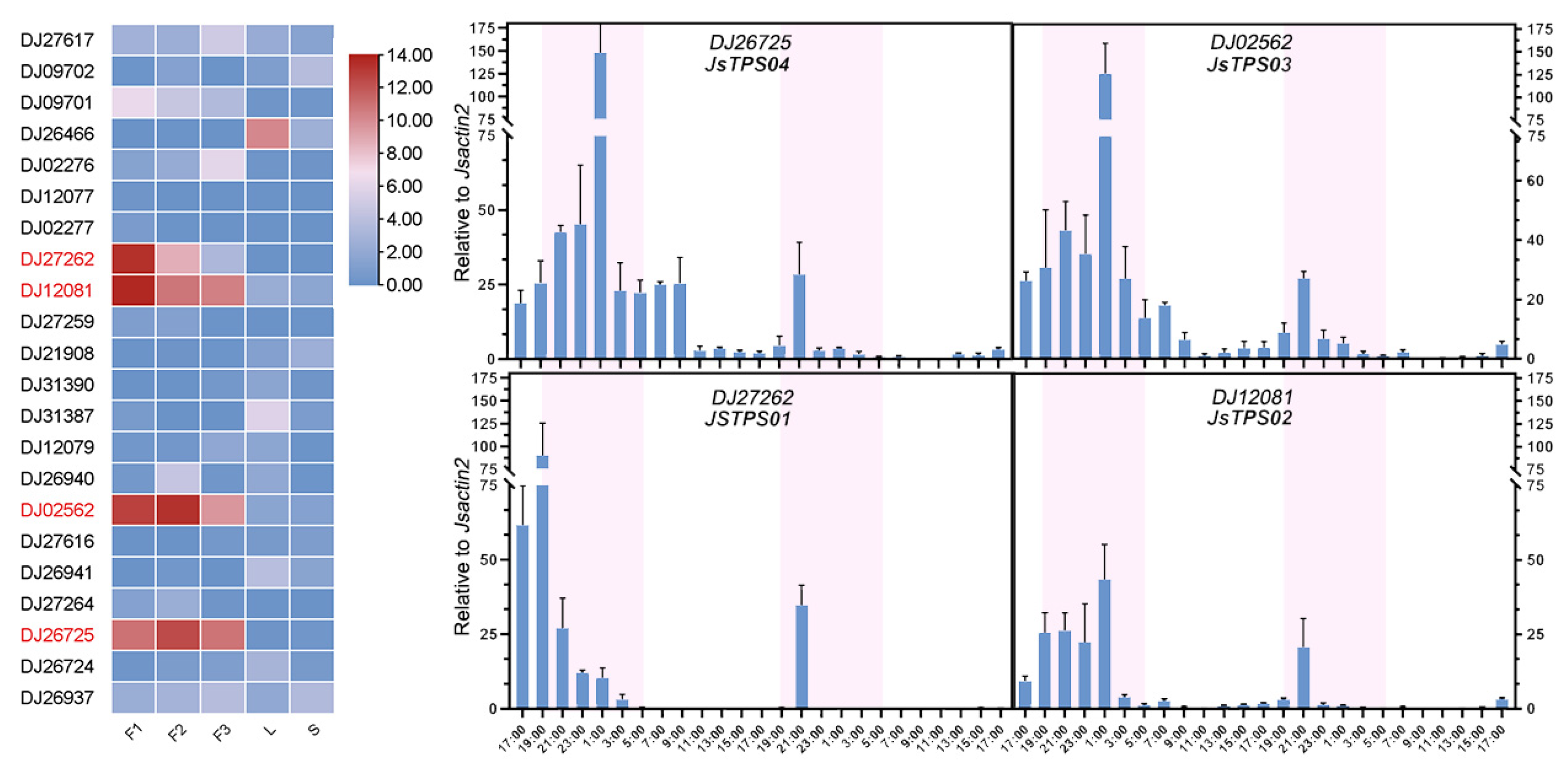
Having characterized the circadian profile of floral VOC emission, we sought to isolate genes corresponding to the biosynthesis of volatile terpenes. We constructed a transcriptome data set from Jasminum flowers, leaves, and stems sampled at different time points of day and night. The raw sequence data were deposited in the Genome Sequence Archive in the National Genomics Data Center, the China National Center for Bioinformation/Beijing Institute of Genomics, the Chinese Academy of Sciences (GSA: CRA031067), which are publicly accessible on 18 December 2025 at https://ngdc.cncb.ac.cn/gsa/browse/CRA031067. Using BLAST searches against a set of homologous sequences in the transcriptomes, followed by manual curation, we identified 34 non-redundant terpene synthase-related genes. Among these genes, four were highly expressed in flowers, having transcript levels 2 to 3 orders of magnitude higher than those in leaves and stems (Figure 2, left panel). Since the transcriptome data represented overall floral tissues rather than merely petals, which are supposed to be the site of VOC synthesis, and were limited in time point sampling, we precisely profiled the expression of these genes in petals, sampled at 2 h intervals throughout the entire floral lifetime (from 17:00 on the first day to 17:00 on the third day). Moreover, the expression patterns of the four putative TPS genes highly correlated with floral terpenoid emission profiles, with maximum mRNA levels observed on the first night (Figure 2, right panel). These four genes, DJ27262, DJ12081, DJ02562, and DJ26725, were assigned as JsTPS01 (NCBI acc.nr. MW057924), JsTPS02 (MW057922), JsTPS03 (MW057923), and JsTPS04 (MW057921), respectively. Subsequently, full-length cDNAs were cloned using specific primers (Table S2), and the deduced amino acid sequences showed that they shared 22.26% to 37.80% identities with each other.
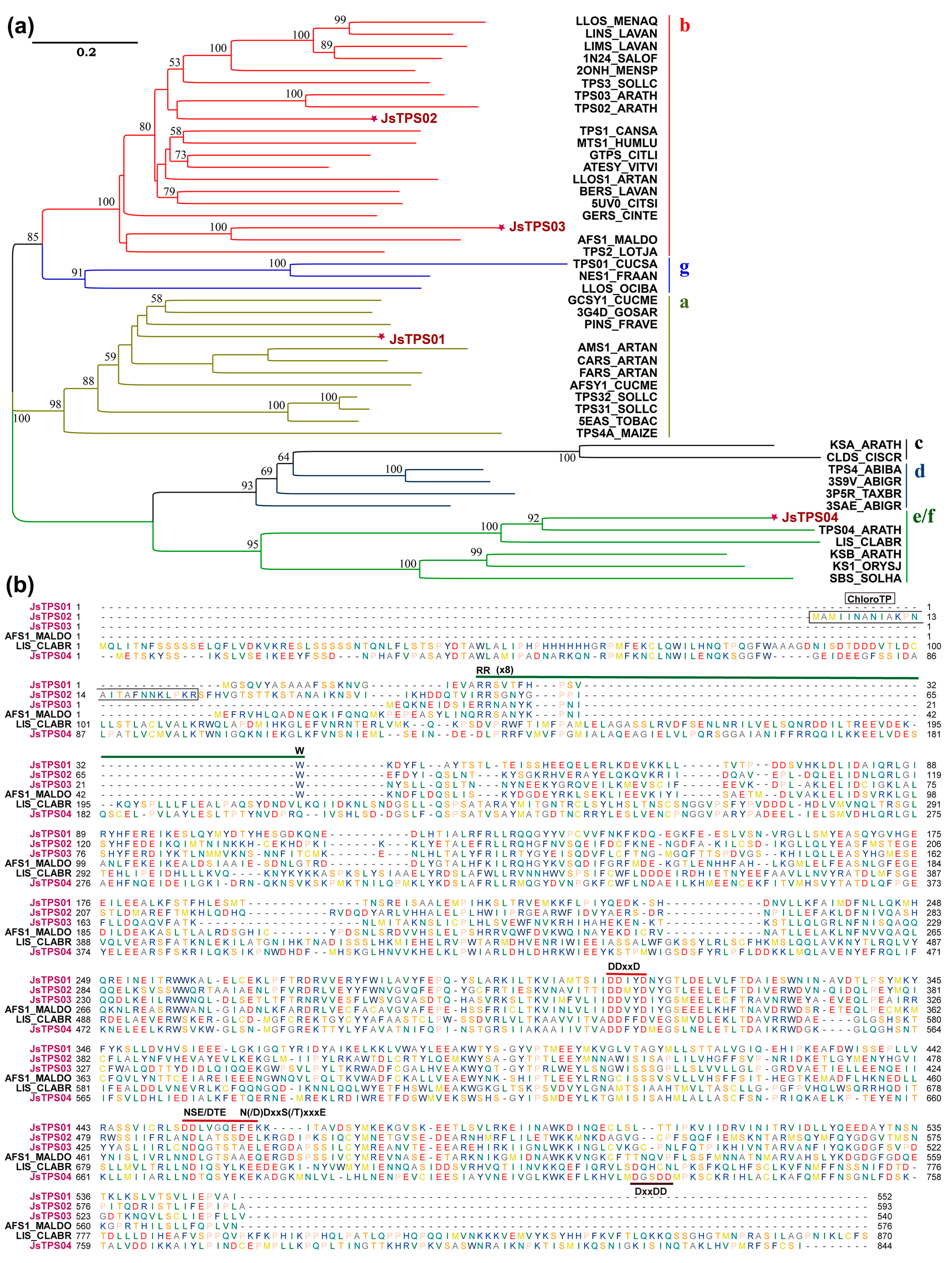
Together with other functionally characterized TPS enzymes (Table S3), a maximum likelihood tree was constructed, which revealed that JsTPS01 belonged to the TPS-a clade, while both JsTPS02 and JsTPS03 were TPS-b type. JsTPS04 was the largest protein among the four, containing 844 amino acid residues with extended N- and C-termini, which fell into the TPS-e/f clade of the terpene synthase family (Figure 3a). According to TargetP predictions, only JsTPS02 contains a plastid-targeting transit peptide, implying plastidial localization.
In terms of sequence similarity, JsTPS04 is more divergent from the other three terpene synthase enzymes, and its amino acid sequence shares 40.6% and 45.3% identity with the Clarkia S-linalool synthase CbLIS (LIS_CLABR) [62] and Arabidopsis geranyllinalool synthase TPS04 [65] (Figure 3b). It lacks the N-terminal tandem arginine/tryptophan motif “RR(x8)W”, thought to be critical for monoterpene cyclization [66] but also found to be present in many sesquiterpene and diterpene synthases [9]. JsTPS04 also contains both the “DDxxD” and “NSE/DTE” motifs, which are important for metal binding and may distinguish isoprenoid diphosphate lyases and terpenoid cyclases from prenyltransferases [9]. Moreover, the C-terminal domain of JsTPS04 contains an additional acid motif, “DxxDD”, which appears to be a variant form mimicking the general acid motif “DxDD” signature in some class II terpenoid synthases [9,16] (Figure 3b). The other three JsTPSs all contain the N-terminal “RRx8W” motif and the typical “DDxxD”, but one of them (JsTPS01) has a modified NSE/DTE motif (Figure 3b). Homologous modeling of the protein structures provides an overview of the domain architecture and the conserved Mg2+-binding “DxxDD” motif configuration in the models (Figure S1).
Figure 3. (a) Phylogenetic relationship of JsTPSs with other terpene synthases of known function from other species, using amino acid sequences (named using SWISS-Prot codes, PDB accession, or NCBI accession; see Table S3). The tree was constructed using MEGA X ver. 10.1.8 and visualized via FigTree ver. 1.4.4. The scale bar represents amino acid residue substitution rate per site. Subgroups are depicted with color lines, and bootstrap values greater than 50 are shown; lowercase letters (a, b, c, d, e/f, g) denote the six TPS subfamilies discussed in the text. (b) amino acid sequence alignment showing the conserved motifs in the JsTPS proteins together with those of the (E,E)-alpha-farnesene synthase 1 from apple (AFS1_MALDO) [67] and the S-linalool synthase from Clarkia breweri (LIS_CLABR) [62]. The predicted chloroplast transit peptide in JsTPS02 is boxed. The known functional motifs RRX8W, DDXXD, NSE/DTE, and DXXD are labeled.
Horticulturae 12 00010 g003

3.3. Subcellular Localization of the Four Terpene Synthase Proteins

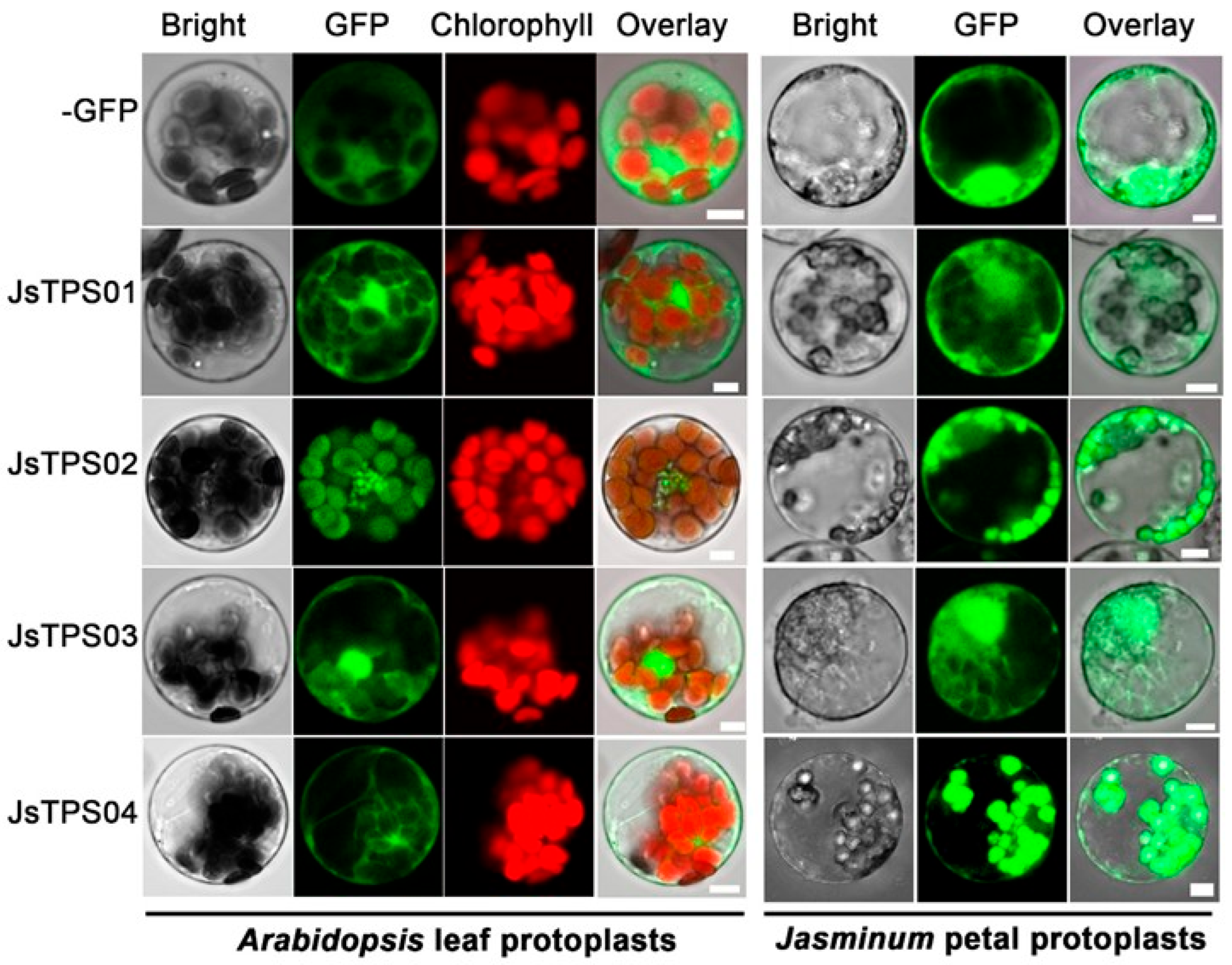
Since the substrates of terpene synthases are primarily derived from the cytosolic MVA and the plastidic MEP pathways, the subcellular localization of a TPS enzyme is a major determinant of its catalytic activity and also provides insights into its functionality. Using C-terminal GFP-tagged JsTPSs for transient expression in protoplasts of Arabidopsis leaves and Jasminum petals, we found that JsTPS02 was clearly distributed in the chloroplasts or plastid-like structures of the petals, consistent with the TargetP predictions, whereas both JsTPS01 and JsTPS03 were mainly localized to the cytosol (Figure 4). Interestingly, the fluorescence signal of the JsTPS04-GFP fusion was differently localized between protoplasts of Arabidopsis leaves and Jasminum petals. It appeared that JsTPS04 localized to the cytosol or endoplasmic reticulum (ER) in leaf protoplasts, while in petal cells, the fluorescence signal was observed in granular-like structures (Figure 4). A further experiment using N. benthamiana leaf infiltration demonstrated that JsTPS04-GFP fusion could be localized to both chloroplasts (or particles around the chloroplasts) and cytoplasm in the leaves, while chloroplast localization of JsTPS02 and cytosolic localization of JsTPS01 and JsTPS03 were confirmed, although chloroplast-associated signals were occasionally found in the latter two (Figure S2).

3.4. Enzyme Activities of the Four Jasminum Terpene Synthase Proteins

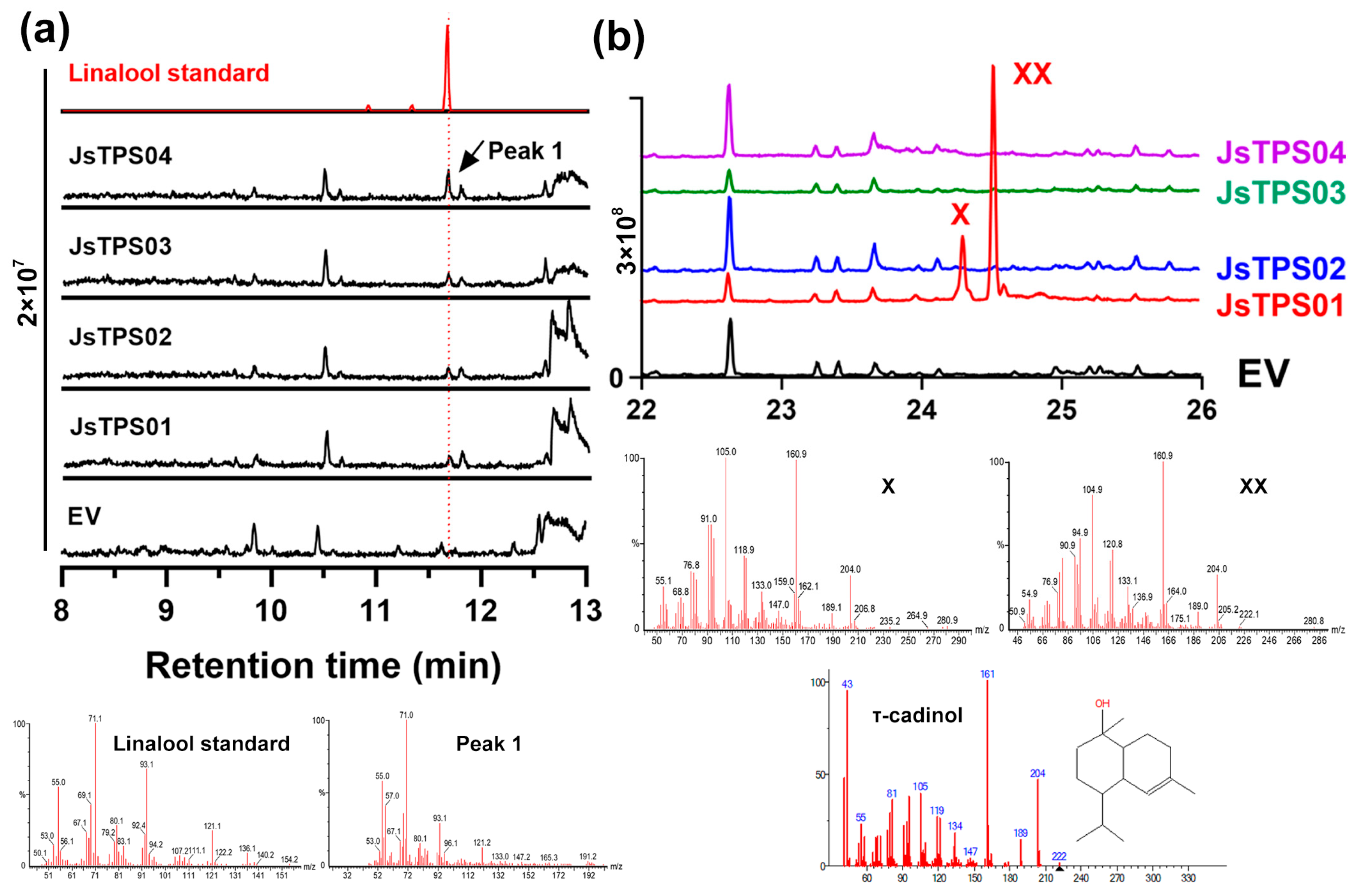
The N. benthamiana leaves transiently expressing the JsTPS-GFP fusions were used to measure enzymatic activity. The assay was conducted using leaf extracts with ethyl acetate (Merck KGaA) in a GC-MS system. A significant peak of linalool with a retention time (RT) of 11.67 min was produced in JsTPS04-expressing leaves, whereas the other three TPS did not yield any different peaks within the retention time range compared to the GFP control vector (EV) (Figure 5a). The linalool peak was identified by comparing the retention time and mass spectra with an authentic standard and the NIST20 library. We also found that in the EV-transfected leaves, phytol, an acyclic diterpene alcohol and a constituent of chlorophyll common to green leaves, was the major compound at the C20 range, while the expression of the JsTPSs induced the accumulation of several aliphatic hydrocarbons and heterocyclic compounds (Figure S3). Some unknown products (RT at ~29.1 min) were also induced in JsTPS01/02/03-transfected leaves but were absent in the GFP control (EV) and JsTPS04-expressing leaves. Thus, only the TPS-e/f member JsTPS04 could catalyze the synthesis of linalool when transiently expressed in the N. benthamiana leaves. However, all JsTPS proteins seemed to interfere with the diterpenoid biosynthesis pathway in leaves.
An in vivo assay for terpenoid accumulation in yeast cells (strain By4742) revealed significant de novo production of a sesquiterpenoid τ-cadinol in JsTPS01-expressing cells, while the other three JsTPSs did not yield different terpenoid profiles compared to the empty vector (Figure 5b). Since yeast cells generally contain less available geranyl diphosphate (GPP) or other prenyl diphosphate but generate a large pool of farnesyl diphosphate (FPP) from the MVA pathway for further synthesis of the sesquiterpene squalene and several essential sterols [68], this endogenous pool of FPP could be used efficiently by JsTPS01 to synthesize τ-cadinol.
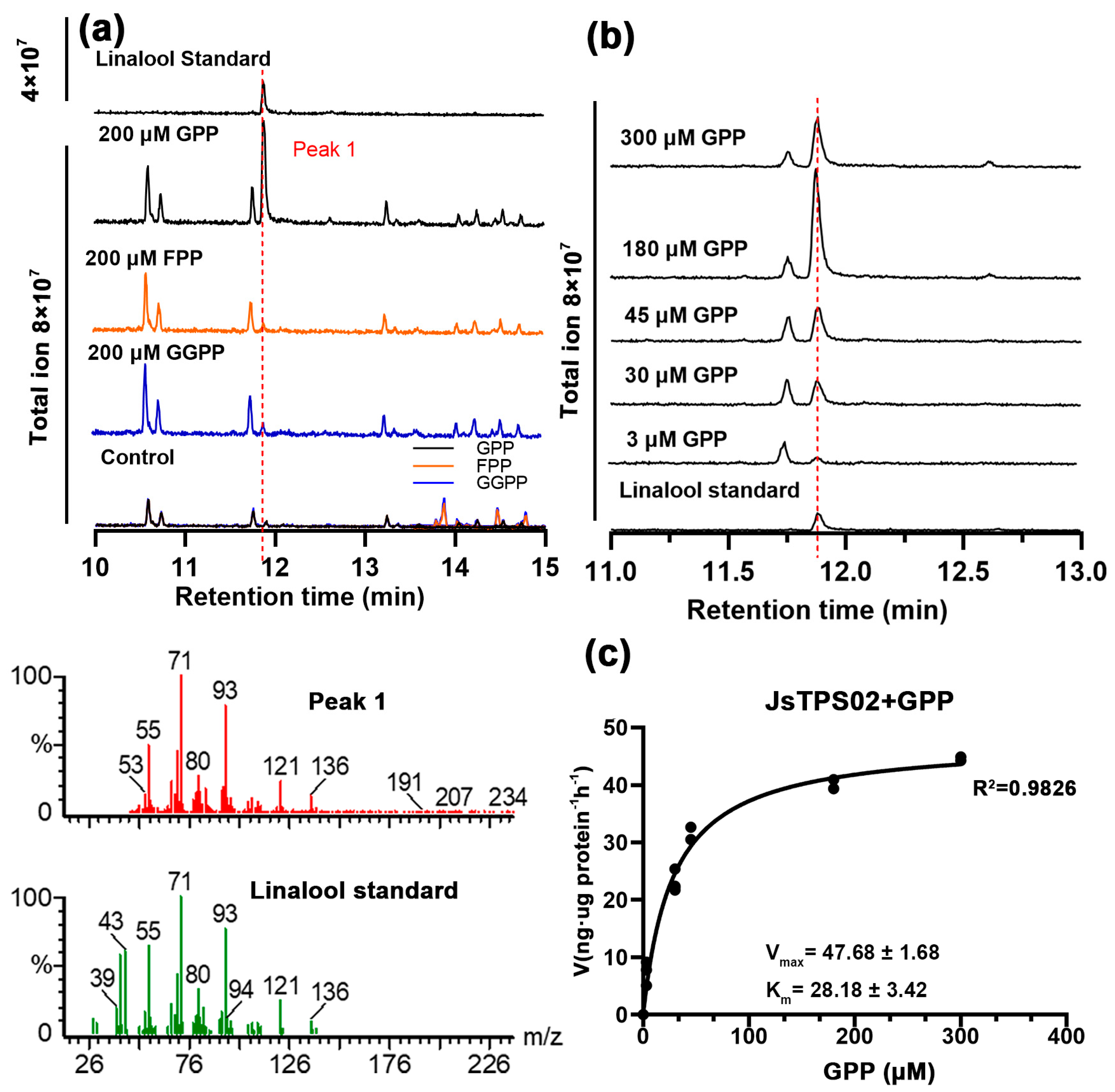
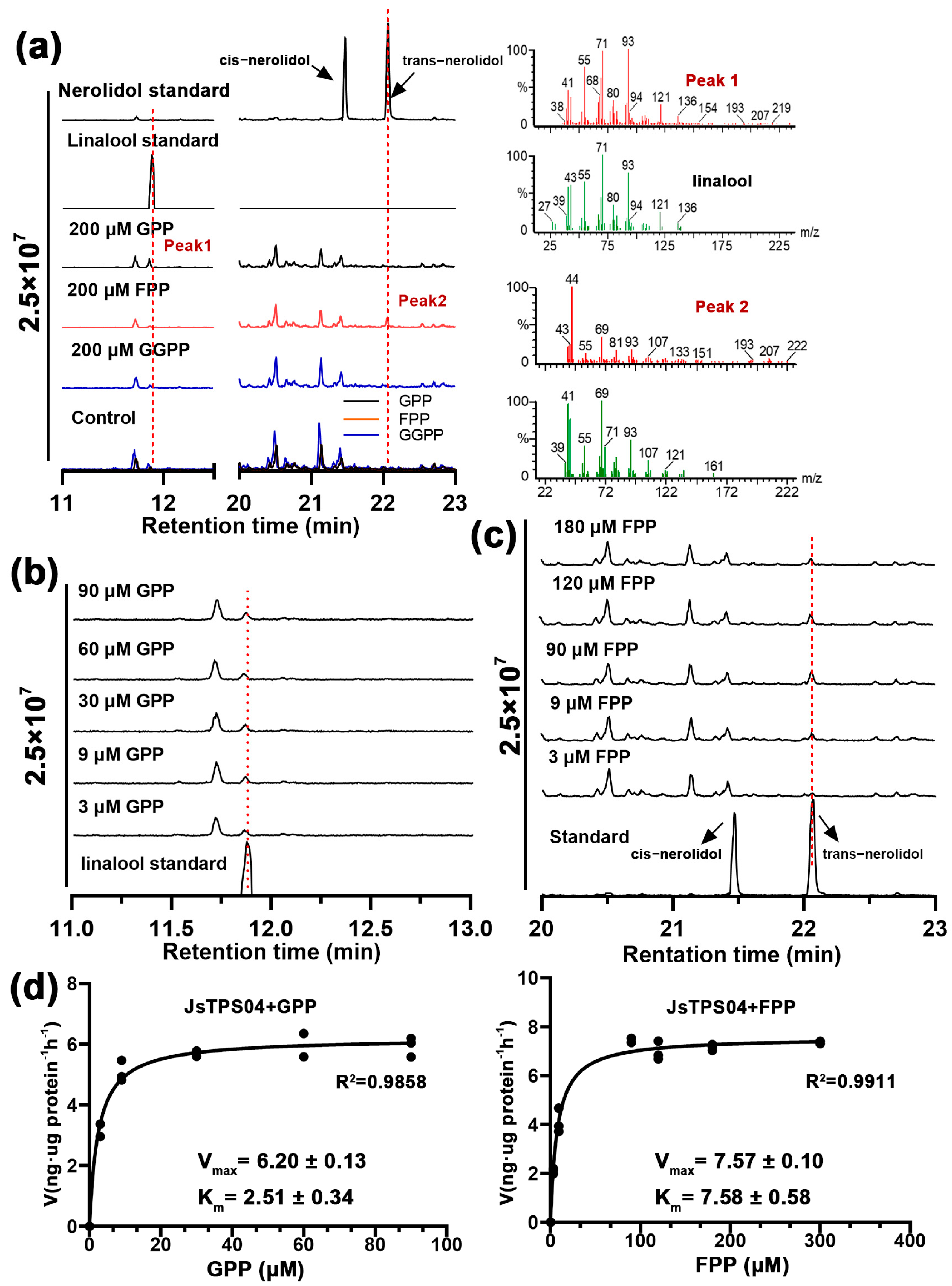
We expressed the full-length cDNAs of JsTPSs in E. coli to obtain purified recombinant proteins using an N-terminal fusion of 10×His-tag. The purified recombinant 10×His JsTPS02 and JsTPS04 were generated successfully (Figure S4). Although the purified recombinant proteins contained a His-tag at the N-terminus, JsTPS02 showed catalytic activity in converting the substrates GPP to linalool (Figure 6a), while JsTPS04 converted GPP to linalool and FPP to trans-nerolidol in a preliminary experiment (Figure 7a). Thus, the recombinant JsTPS02 and JsTPS04 proteins were used in serial reactions with different substrate concentrations to determine their enzymatic property. Using various concentrations of GPP (3 µM, 30 µM, 45 µM, 180 µM, 300 µM) as a substrate, the apparent Vmax and Km of JsTPS02 for GPP were estimated to be 47.68 ± 1.68 ng·ug−1 protein h−1 and 28.18 ± 3.42 µM, respectively (Figure 6b,c). Similarly, with varying concentrations of GPP (3 µM, 9 µM, 30 µM, 60 µM, 90 µM) as a substrate, the apparent Vmax and Km of the JsTPS04 for GPP were estimated to be 6.20 ± 0.13 ng·μg−1 protein h−1 and 2.51 ± 0.34 µM, respectively (Figure 7b,d). Additionally, the apparent Vmax and Km of JsTPS04 for FPP were estimated to be 7.57 ± 0.11 ng·μg−1 protein h−1 and 7.58 ± 0.63 µM, respectively (Figure 7c,d).
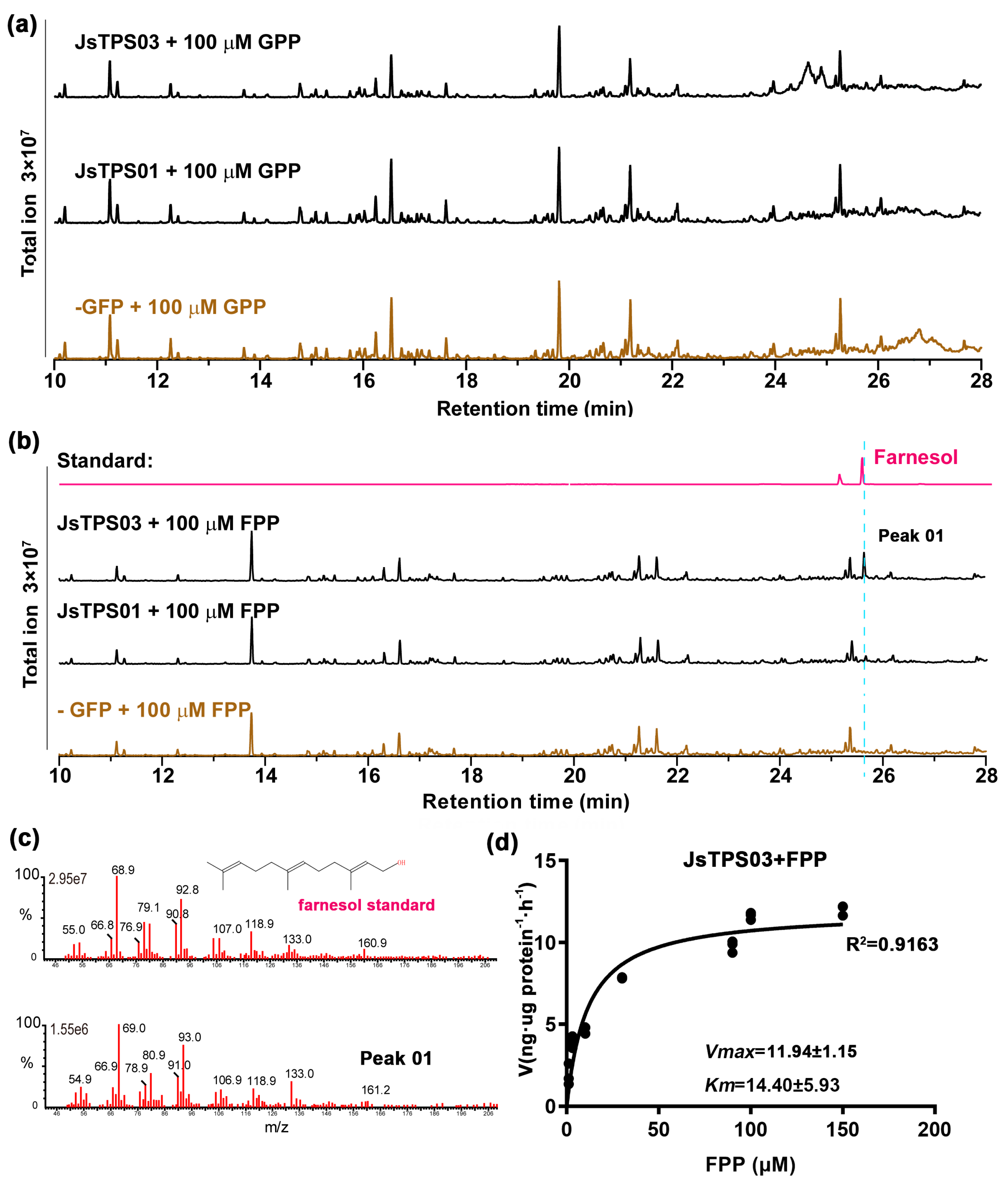
Due to unsuccessful expression and purification in E. coli, JsTPS01 and JsTPS03 with an N-terminal HA-tag were further expressed in yeast cells. The two JsTPS proteins were correctly detected as membrane-bound forms by a Western blot of isolated total and membrane fractions using an anti-HA antibody (Figure S5). We then isolated the recombinant proteins for in vitro assay using the membrane fractions as enzyme sources. The reactions of JsTPS01 and JsTPS03 did not yield any additional products compared to the mock control when using up to 100 µM GPP as a substrate (Figure 8a). However, JsTPS03 was able to generate farnesol from added FPP at concentrations up to 100 µM, which was not observed in JsTPS01 or the mock control (Figure 8b). The product farnesol was identified by comparison with an authentic standard (Figure 8c). To characterize the catalytic activities of JsTPS03, we isolated partially purified proteins and determined enzymatic kinetics using a substrate-dependent assay at varying FPP concentrations, generating their Michaelis–Menten plots (Figure 8d). The apparent Km for JsTPS03 was 15.48 ± 3.43 µM. We were unable to estimate the efficiency parameters of JsTPS03 because the actual concentration of the enzyme molecules was not known in the assay; however, the results indicate that JsTPS03 is likely to function as a farnesol synthase in this in vitro assay.

4. Discussion

J. sambac flowers emitted a variety of volatile compounds after blooming at night; among these, linalool and α-farnesene accounted for more than half of the headspace volatiles and one-third of the volatiles extracted in this study, consistent with previous reports [40,69,70]. The release of linalool, α-farnesene, and τ-cadinol follows a clear rhythm, rising at night and declining during the day, a pattern previously observed in Jasmine and other moth-pollinated species [43,71].
In this study, we identified one monoterpene synthase, two sesquiterpene synthases, and one monoterpene/sesquiterpene synthase that are responsible for the production of linalool, farnesol, τ-cadinol, and trans-nerolidol in J. sambac, based on their abundant and almost exclusive expression in the petal, as well as on the biochemical characterization in N. benthamiana leaves, yeast cells, and E. coli cells.
Yeast cells expressing JsTPS01 accumulated τ-cadinol compared to the empty vector (Figure 5b). Since yeast cells generally contain less available GPP or other prenyl diphosphates, they generate a large pool of FPP through the MVA pathway for further synthesis of the sesquiterpene squalene and several essential sterols [68]. Therefore, this endogenous pool of FPP could be used efficiently by JsTPS01 to make τ-cadinol. τ-cadinol was detected in the extract of Jasminum flowers and was consistently detected throughout the primary scent-emission period (Figure 1). Thus, it is possible that JsTPS01 might catalyze the synthesis of τ-cadinol in the flower petal. Members of the cadinol family of sesquiterpenoids are known for their antimicrobial activity [72]. The contribution of JsTPS01-mediated τ-cadinol to petal defense against pathogens remains to be investigated through loss-of-function or planta assays. A few cadinol synthases from other plants have been functionally and structurally determined. Among them, JsTPS01 has an overall sequence identity of 33.33% and 33.16% and 48.05% at the amino acid level with τ-cadinol synthases LaCADS from Lavandula angustifolia (Mill.) [73] and ZmTPS7 synthase from Zea mays (L.) [74].
JsTPS02 is a member of the TPS-b clade, which may function as a linalool synthase in J. sambac petals. Linalool is the predominant floral volatile monoterpene in most J. spp. fragrance [40] and is a characteristic component of white, night-blooming, moth-pollinated flowers, as well as many diurnal flowers pollinated by bees, beetles, and butterflies [75,76]. JsTPS02 is predicted to contain a signal peptide (Figure 3) and is later correspondingly found in granular structures in both leaf and petal protoplasts (Figure 4). Moreover, in vitro, JsTPS02 could mediate the biosynthesis of linalool using added GPP as a substrate, with an apparent Km of 28.18 ± 3.42 µM (Figure 6). Given its similarity to Clarkia S-linalool synthase [62], JsTPS02 might be a linalool synthase. It has been reported that in J. grandiflorum flower developmental stages from bud to open flower, an enantiomer ratio shift from R- to S-form occurs, with S-(+)-linalool being the most abundant at the opening stage [42]. Further research is needed to determine whether JsTPS02 could produce both or preferentially S-form linalool. Additionally, the free linalool in the petal extract with hexane was rather low compared to the large portion in the headspace (Figure 1d), suggesting that the J. sambac flower may contain similar pools of conjugated non-volatile linalool in the petal subcellular structures before emission, as indicated in a recent study involving four Jasminum species [43].
Farnesol formation in plants has been accomplished through dephosphorylation of FPP by some promiscuous phosphatases and sesquiterpene synthases [77,78]. Several farnesol synthases have been characterized: OsTPS13 from Oryza sativa produces farnesol (84.2% of its products) together with nerolidol [79], ZmTPS1 from Zea mays converts FPP to farnesol (45% of its products) and other sesquiterpenes [80], and MoTPS2 from Phyllostachys edulis J.Houz. is responsible for the production of (E,E)-farnesol [81]. In this study, JsTPS03 belongs to the TPS-b subfamily and could mediate the biosynthesis of farnesol using FPP as a substrate with an apparent Km of 15.48 ± 3.43 µM, while no detectable product was found in the mock control (Figure 8a). Most plant sesquiterpene synthases in purified form have a reported FPP affinity ranging from 0.4 to 142.9 µM, but typically around 10 µM [82], so we speculate that JsTPS03 should function as a farnesol synthase in Jasminum petals.
JsTPS04 belongs to the TPS-e/f clade. Its transient expression in N. benthamiana leaves yielded linalool, and the recombinant protein could convert GPP into linalool in vitro, implying that JsTPS04 possesses linalool-synthase activity. Both JsTPS02 and JsTPS 04 recombinant proteins catalyze the conversion of GPP to linalool, with an apparent Km of 28.18 ± 3.42 µM and 2.51 ± 0.34 µM, respectively (Figure 6c and Figure 7d). This suggests that JsTPS04 has a higher affinity to the substrate than JsTPS02 in vitro. Moreover, JsTPS04 also accepted FPP to produce trans-nerolidol with an apparent Km of 7.58 ± 0.63 µM, which was detected both in petal extracts throughout the floral scent-emission period (Figure 1d). Thus, we speculate that JsTPS04 should also act as a nerolidol synthase in the Jasminum petals, demonstrating that JsTPS04 is a bifunctional terpene synthase capable of generating both monoterpenes and sesquiterpenes. In petal protoplasts, JsTPS04 is found in granular structures; however, it can catalyze the conversion of FPP into sesquiterpenes, a phenomenon that has also been reported previously; e.g., the plastid-located farnesene synthase PvHVS from Prunella vulgaris L. (family Lamiaceae), a member of the TPS-a clade, can use FPP to make bisabolol and farnesene in vitro [83]. JsTPS04 showed dual localization (Figure 5), which has been reported for CsLIS/NES in Camellia sinensis (L.) Kuntze [84], GhTPS6 and GhTPS47 in Gossypium hirsutum L. [85], and VcTPS24 in Vaccinium corymbosum L. [85]. Differential subcellular targeting has been shown to influence terpene product profiles in Arabidopsis (TPS02 and TPS03) [86] and engineered multi-substrate TPS [87]. Thus, the cytosolic/plastidic distribution of JsTPS04 may affect precursor availability (FPP and GPP) and, consequently, terpene diversity. Whether this dual localization is driven by post-translational modification or differential activity of the chloroplast-import machinery between photosynthetic and non-photosynthetic tissues (similar to the RR(x8)W or DxDD motif-dependent targeting reported for TPS-e/f enzymes [88]) requires further investigation.
Linalool is known to attract noctuid and sphingid moths [75] and is involved in the complex interplay between pollinator attraction and plant defense [75]. Nerolidol promotes the accumulation of defense-related compounds with extensive natural anti-herbivore or anti-pathogen effects [89,90], whereas τ-cadinol exhibits night-relevant antimicrobial activity [91]. Farnesol plays a role in quorum sensing and apoptosis induction, and is a natural pesticide to mites [77]. Therefore, these volatile compounds in J. sambac might be able to promote pollinator visitation and help reduce the pathogen load during night blooming; however, further behavioural or infection assays are needed. Notably, these volatile compounds, with their ecological functions in attraction and defense, show potential for agricultural applications as eco-friendly repellents or toxins in “attract-and-kill” formulations, which is consistent with integrated pest management (IPM) strategies [92].
In summary, we identified a linalool synthase (JsTPS02), a τ-cadinol synthase (JsTPS01), a bifunctional mono-/sesquiterpene synthase (JsTPS04) capable of producing linalool/trans-nerolidol, and a farnesol synthase (JsTPS03) in J. sambac petals. These findings elucidate the enzymatic basis for the biosynthesis of key floral scent volatiles in jasmine, providing functional gene candidates for further exploration of terpenoid metabolism and fragrance regulation.

Supplementary Materials

The following supporting information can be downloaded at: https://www.mdpi.com/article/10.3390/horticulturae12010010/s1, Data S1: List of compounds identified in the headspace and ethyl acetate extracts from petals at various timepoints during the flowering lifetime and the quantification; Figure S1: Homologous models of the four JsTPSs showing the conserved Mg2+ binding DDxxD motif in each protein structure. The models were built via the SWISS-MODEL homology-modeling server (https://swissmodel.expasy.org/, accessed on 27 May 2020, last included PDB release: 22 May 2020). Magnesium ion is depicted as a green ball, and the aspartate side chains at the conserved Mg2+ binding motif, as well as at the acid motif, are shown as sticks; Figure S2: Representative images of transient expression of GFP-tagged TPS proteins in leaves of Nicotiana benthamiana; Figure S3: JsTPSs induced the accumulation of several aliphatic hydrocarbon and heterocyclic compounds in N. benthamiana leaves transiently expressing TPS genes; Figure S4: Production of JsTPS02 and JsTPS04 recombinant proteins in E. coli. Proteins were separated on 10% SDS-PAGE, and the gel was stained with 1.25% Coomassie Blue R250. (a): Induction and Western blot detection of the four JsTPS recombinant proteins; (b): purification of the four JsTPS recombinant proteins; Figure S5: JsTPS01 and JsTPS03 expression in yeast were detected with an antibody against the N-terminal HA-tag. EV, empty vector; W, whole cell lysates; M, membrane fraction. A 15 μL sample was loaded in each lane; Table S1: Four JsTPSs from Jasminum flower/leaf/stem transcriptomes and the respective qRT-PCR primers used; Table S2: List of primer sequences used in CDS cloning and vector constructions; Table S3: Information on functionally characterized terpene synthases from other species that are included in sequence alignment and phylogenetic tree constructions.

Author Contributions

Conceptualization, B.W. and Y.Y.; methodology, Y.Y. and B.W.; software, J.L.; validation, Y.Y., B.W., L.H. and X.H.; formal analysis, L.H., X.H., C.W. and Y.Z.; investigation, L.H., C.W. and Y.W.; data curation, J.L., C.W., Y.Z., Y.W. and W.W.; writing—original draft preparation, Y.Y. and B.W.; visualization, Y.Y., B.W., J.L. and W.W.; funding acquisition, Y.Y.; writing—review and editing, Y.Y. All authors have read and agreed to the published version of the manuscript.

Funding

This research was funded by the Natural Science Foundation of Fujian province, grant number nr. 2022J01588; the National Natural Science Foundation of China, grant number nr. 31902050; and the Science and Technology Innovation Special Fund of Fujian Agriculture and Forestry University, grant number nr. KFB23033 from Y.Y.

Data Availability Statement

The original contributions presented in this study are included in the article/Supplementary Materials. Further inquiries can be directed to the corresponding author.

Acknowledgments

We thank Lingjuan Huang for excellent technical assistance.

Conflicts of Interest

The authors state no conflict of interest. The funders had no role in the design of the study; in the collection, analyses, or interpretation of data; in the writing of the manuscript; or in the decision to publish the results.

References

  1. Pichersky, E.; Lewinsohn, E. Convergent Evolution in Plant Specialized Metabolism. Annu. Rev. Plant Biol. 2011, 62, 549–566. [Google Scholar] [CrossRef] [PubMed]
  2. Mithöfer, A.; Boland, W. Plant Defense Against Herbivores: Chemical Aspects. Annu. Rev. Plant Biol. 2012, 63, 431–450. [Google Scholar] [CrossRef]
  3. Booij-James, I.S.; Dube, S.K.; Jansen, M.A.; Edelman, M.; Mattoo, A.K. Ultraviolet-B radiation impacts light-mediated turnover of the photosystem II reaction center heterodimer in Arabidopsis mutants altered in phenolic metabolism. Plant Physiol. 2000, 124, 1275–1284. [Google Scholar] [CrossRef]
  4. Amrad, A.; Moser, M.; Mandel, T.; de Vries, M.; Schuurink, R.C.; Freitas, L.; Kuhlemeier, C. Gain and Loss of Floral Scent Production through Changes in Structural Genes during Pollinator-Mediated Speciation. Curr. Biol. 2016, 26, 3303–3312. [Google Scholar] [CrossRef]
  5. Dixon, R.A.; Strack, D. Phytochemistry meets genome analysis, and beyond. Phytochemistry 2003, 62, 815–816. [Google Scholar] [CrossRef]
  6. Leong, B.J.; Last, R.L. Promiscuity, impersonation and accommodation: Evolution of plant specialized metabolism. Curr. Opin. Struct. Biol. 2017, 47, 105–112. [Google Scholar] [CrossRef] [PubMed]
  7. Bouwmeester, H.; Schuurink, R.C.; Bleeker, P.M.; Schiestl, F. The role of volatiles in plant communication. Plant J. 2019, 100, 892–907. [Google Scholar] [CrossRef]
  8. Gao, Y.; Honzatko, R.B.; Peters, R.J. Terpenoid synthase structures: A so far incomplete view of complex catalysis. Nat. Prod. Rep. 2012, 29, 1153–1175. [Google Scholar] [CrossRef] [PubMed]
  9. Christianson, D.W. Structural and Chemical Biology of Terpenoid Cyclases. Chem. Rev. 2017, 117, 11570–11648. [Google Scholar] [CrossRef]
  10. Hemmerlin, A.; Harwood, J.L.; Bach, T.J. A raison d’être for two distinct pathways in the early steps of plant isoprenoid biosynthesis? Prog. Lipid Res. 2012, 51, 95–148. [Google Scholar] [CrossRef]
  11. Liang, P.; Ko, T.; Wang, A.H.J. Structure, mechanism and function of prenyltransferases. Eur. J. Biochem. 2002, 269, 3339–3354. [Google Scholar] [CrossRef]
  12. Kharel, Y.; Koyama, T. Molecular Analysis of cis-Prenyl Chain Elongating Enzymes. Nat. Prod. Rep. 2003, 34, 111–118. [Google Scholar] [CrossRef]
  13. Banerjee, A.; Hamberger, B. P450s controlling metabolic bifurcations in plant terpene specialized metabolism. Phytochem. Rev. 2018, 17, 81–111. [Google Scholar] [CrossRef]
  14. Pichersky, E.; Gershenzon, J. The formation and function of plant volatiles: Perfumes for pollinator attraction and defense. Curr. Opin. Plant Biol. 2002, 5, 237–243. [Google Scholar] [CrossRef]
  15. Magnard, J.-L.; Roccia, A.; Caissard, J.; Vergne, P.; Sun, P.; Hecquet, R.; Dubois, A.; Hibrand-Saint Oyant, L.; Jullien, F.; Nicolè, F.; et al. Biosynthesis of monoterpene scent compounds in roses. Science 2015, 349, 81–83. [Google Scholar] [CrossRef]
  16. Alicandri, E.; Paolacci, A.R.; Osadolor, S.; Sorgonà, A.; Badiani, M.; Ciaffi, M. On the Evolution and Functional Diversity of Terpene Synthases in the Pinus Species: A Review. J. Mol. Evol. 2020, 88, 253–283. [Google Scholar] [CrossRef]
  17. Zhou, F.; Pichersky, E. The complete functional characterisation of the terpene synthase family in tomato. New Phytol. 2020, 226, 1341–1360. [Google Scholar] [CrossRef] [PubMed]
  18. Boutanaev, A.M.; Moses, T.; Zi, J.; Nelson, D.R.; Mugford, S.T.; Peters, R.J.; Osbourn, A. Investigation of terpene diversification across multiple sequenced plant genomes. Proc. Natl. Acad. Sci. USA 2015, 112, E81–E88. [Google Scholar] [CrossRef] [PubMed]
  19. Beran, F.; Rahfeld, P.; Luck, K.; Nagel, R.; Vogel, H.; Wielsch, N.; Irmisch, S.; Ramasamy, S.; Gershenzon, J.; Heckel, D.G.; et al. Novel family of terpene synthases evolved from trans-isoprenyl diphosphate synthases in a flea beetle. Proc. Natl. Acad. Sci. USA 2016, 113, 2922–2927. [Google Scholar] [CrossRef] [PubMed]
  20. Jia, Q.; Li, G.; Köllner, T.G.; Fu, J.; Chen, X.; Xiong, W.; Crandall-Stotler, B.J.; Bowman, J.L.; Weston, D.J.; Zhang, Y.; et al. Microbial-type terpene synthase genes occur widely in nonseed land plants, but not in seed plants. Proc. Natl. Acad. Sci. USA 2016, 113, 12328–12333. [Google Scholar] [CrossRef]
  21. Dudareva, N.; Pichersky, E. Biology of Floral Scent, 1st ed.; CRC Press: Boca Raton, FL, USA, 2006. [Google Scholar] [CrossRef]
  22. Dudareva, N.; Klempien, A.; Muhlemann, J.K.; Kaplan, I. Biosynthesis, function and metabolic engineering of plant volatile organic compounds. New Phytol. 2013, 198, 16–32. [Google Scholar] [CrossRef]
  23. Schiestl, F.P. Ecology and evolution of floral volatile-mediated information transfer in plants. New Phytol. 2015, 206, 571–577. [Google Scholar] [CrossRef]
  24. Sas, C.; Müller, F.; Kappel, C.; Kent, T.V.; Wright, S.I.; Hilker, M.; Lenhard, M. Repeated Inactivation of the First Committed Enzyme Underlies the Loss of Benzaldehyde Emission after the Selfing Transition in Capsella. Curr. Biol. 2016, 26, 3313–3319. [Google Scholar] [CrossRef]
  25. Chen, F.; Tholl, D.; D’Auria, J.C.; Farooq, A.; Pichersky, E.; Gershenzon, J. Biosynthesis and emission of terpenoid volatiles from Arabidopsis flowers. Plant Cell 2003, 15, 481–494. [Google Scholar] [CrossRef]
  26. Tholl, D.; Lee, S. Terpene Specialized Metabolism in Arabidopsis thaliana. Arab. Book 2011, 9, e0143. [Google Scholar] [CrossRef] [PubMed]
  27. Tholl, D.; Chen, F.; Petri, J.; Gershenzon, J.; Pichersky, E. Two sesquiterpene synthases are responsible for the complex mixture of sesquiterpenes emitted from Arabidopsis flowers. Plant J. 2005, 42, 757–771. [Google Scholar] [CrossRef]
  28. Falara, V.; Akhtar, T.A.; Nguyen, T.T.H.; Spyropoulou, E.A.; Bleeker, P.M.; Schauvinhold, I.; Matsuba, Y.; Bonini, M.E.; Schilmiller, A.L.; Last, R.L.; et al. The Tomato Terpene Synthase Gene Family. Plant Physiol. 2011, 157, 770–789. [Google Scholar] [CrossRef] [PubMed]
  29. Dudareva, N.; Raguso, R.A.; Wang, J.; Ross, J.R.; Pichersky, E. Floral scent production in Clarkia breweri: III. Enzymatic synthesis and emission of benzenoid esters. Plant Physiol. 1998, 116, 599–604. [Google Scholar] [CrossRef]
  30. Lücker, J.; Bouwmeester, H.J.; Schwab, W.; Blaas, J.; Van Der Plas, L.H.W.; Verhoeven, H.A. Expression of Clarkia S-linalool synthase in transgenic petunia plants results in the accumulation of S-linalyl-β-d-glucopyranoside. Plant J. 2001, 27, 315–324. [Google Scholar] [CrossRef] [PubMed]
  31. Tholl, D.; Kish, C.M.; Orlova, I.; Sherman, D.; Gershenzon, J.; Pichersky, E.; Dudareva, N. Formation of Monoterpenes in Antirrhinum majus and Clarkia breweri Flowers Involves Heterodimeric Geranyl Diphosphate Synthases. Plant Cell 2004, 16, 977–992. [Google Scholar] [CrossRef]
  32. Weiss, J.; Mühlemann, J.K.; RuizHernández, V.; Dudareva, N.; Egea-Cortines, M. Phenotypic Space and Variation of Floral Scent Profiles during Late Flower Development in Antirrhinum. Front. Plant Sci. 2016, 7, 1903. [Google Scholar] [CrossRef] [PubMed]
  33. Xu, H.; Bohman, B.; Wong, D.C.J.; RodriguezDelgado, C.; Scaffidi, A.; Flematti, G.R.; Phillips, R.D.; Pichersky, E.; Peakall, R. Complex Sexual Deception in an Orchid Is Achieved by Co-opting Two Independent Biosynthetic Pathways for Pollinator Attraction. Curr. Biol. 2017, 27, 1867–1877.e5. [Google Scholar] [CrossRef]
  34. Ramya, M.; Jang, S.; An, H.; Lee, S.; Park, P.; Park, P.H. Volatile Organic Compounds from Orchids: From Synthesis and Function to Gene Regulation. Int. J. Mol. Sci. 2020, 21, 1160. [Google Scholar] [CrossRef]
  35. Pichersky, E.; Raguso, R.A. Why do plants produce so many terpenoid compounds? New Phytol. 2018, 220, 692–702. [Google Scholar] [CrossRef] [PubMed]
  36. Chen, G.; Mostafa, S.; Lu, Z.; Du, R.; Cui, J.; Wang, Y.; Liao, Q.; Lu, J.; Mao, X.; Chang, B.; et al. The Jasmine (Jasminum sambac) Genome Provides Insight into the Biosynthesis of Flower Fragrances and Jasmonates. Genom. Proteom. Bioinf. 2023, 21, 127–149. [Google Scholar] [CrossRef]
  37. Thompson, J.D.; Dommée, B. Sequential variation in the components of reproductive success in the distylous Jasminum fruticans (Oleaceae). Oecologia 1993, 94, 480–487. [Google Scholar] [CrossRef]
  38. Qi, X.; Li, R.; Chen, S.; Feng, J.; Chen, H.; Liu, X.; Jin, Y.; Deng, Y. Identification of the FLA Gene Family and Functional Analysis of JsFLA2 in Jasminum sambac. Sci. Agric. Sin. 2025, 58, 3516–3530. [Google Scholar] [CrossRef]
  39. Ito, Y.; Sugimoto, A.; Kakuda, T.; Kubota, K. Identification of Potent Odorants in Chinese Jasmine Green Tea Scented with Flowers of Jasminum sambac. J. Agric. Food Chem. 2002, 50, 4878–4884. [Google Scholar] [CrossRef]
  40. Bera, P.; Kotamreddy, J.N.; Samanta, T.; Maiti, S.; Mitra, A. Inter-specific variation in headspace scent volatiles composition of four commercially cultivated jasmine flowers. Nat. Prod. Res. 2015, 29, 1328–1335. [Google Scholar] [CrossRef]
  41. Bera, P.; Mukherjee, C.; Mitra, A. Enzymatic production and emission of floral scent volatiles in Jasminum sambac. Plant Sci. 2017, 256, 25–38. [Google Scholar] [CrossRef] [PubMed]
  42. Pragadheesh, V.S.; Chanotiya, C.S.; Rastogi, S.; Shasany, A.K. Scent from Jasminum grandiflorum flowers: Investigation of the change in linalool enantiomers at various developmental stages using chemical and molecular methods. Phytochemistry 2017, 140, 83–94. [Google Scholar] [CrossRef]
  43. Barman, M.; Mitra, A. Temporal relationship between emitted and endogenous floral scent volatiles in summer- and winter-blooming Jasminum species. Physiol. Plant. 2019, 166, 946–959. [Google Scholar] [CrossRef]
  44. Qi, X.; Wang, H.; Liu, S.; Chen, S.; Feng, J.; Chen, H.; Qin, Z.; Chen, Q.; Blilou, I.; Deng, Y. The chromosome-level genome of double-petal phenotype jasmine provides insights into the biosynthesis of floral scent. Hortic. Plant J. 2024, 10, 259–272. [Google Scholar] [CrossRef]
  45. Xu, S.; Ding, Y.; Sun, J.; Zhang, Z.; Wu, Z.; Yang, T.; Shen, F.; Xue, G. A high-quality genome assembly of Jasminum sambac provides insight into floral trait formation and Oleaceae genome evolution. Mol. Ecol. Resour. 2022, 22, 724–739. [Google Scholar] [CrossRef]
  46. Wang, P.; Fang, J.; Lin, H.; Yang, W.; Yu, J.; Hong, Y.; Jiang, M.; Gu, M.; Chen, Q.; Zheng, Y.; et al. Genomes of single- and double-petal jasmines (Jasminum sambac) provide insights into their divergence time and structural variations. Plant Biotechnol. J. 2022, 20, 1232–1234. [Google Scholar] [CrossRef]
  47. Fan, W.; Liao, Z.; Gu, M.; Zhang, Y.; Lei, W.; Zhang, Y.; Li, H.; Yan, J.; Xiao, Y.; Lin, H.; et al. Pan-Genome of Jasminum sambac Reveals the Genetic Diversity of Different Petal Morphology and Aroma-Related Genes. Mol. Ecol. Resour. 2025, 25, e70013. [Google Scholar] [CrossRef]
  48. Qi, X.; Wang, H.; Chen, S.; Feng, J.; Chen, H.; Qin, Z.; Blilou, I.; Deng, Y. The genome of single-petal jasmine (Jasminum sambac) provides insights into heat stress tolerance and aroma compound biosynthesis. Front. Plant Sci. 2022, 13, 1045194. [Google Scholar] [CrossRef]
  49. Hong, Y.; Chen, X.; Wang, P.; Gu, M.; Gao, T.; Ye, N. Transcriptome Identification of Terpenoid Synthase Genes in Jasminum sambac and Their Expressions Responding to Exogenous Hormones. Biotechnol. Bull. 2022, 38, 41–49. [Google Scholar] [CrossRef]
  50. Wang, Y.; Zhang, H.; Wan, C.; He, X.; Huang, J.; Lyu, M.; Yuan, Y.; Wu, B. Characterization of Two BAHD Acetyltransferases Highly Expressed in the Flowers of Jasminum sambac (L.) Aiton. Plants 2022, 11, 13. [Google Scholar] [CrossRef] [PubMed]
  51. Kim, D.; Langmead, B.; Salzberg, S.L. HISAT: A fast spliced aligner with low memory requirements. Nat. Methods 2015, 12, 357–360. [Google Scholar] [CrossRef] [PubMed]
  52. Wu, T.; Hu, E.; Xu, S.; Chen, M.; Guo, P.; Dai, Z.; Feng, T.; Zhou, L.; Tang, W.; Zhan, L.; et al. clusterProfiler 4.0: A universal enrichment tool for interpreting omics data. Innovation 2021, 2, 100141. [Google Scholar] [CrossRef]
  53. Karimi, M.; Inzé, D.; Depicker, A. GATEWAY™ vectors for Agrobacterium-mediated plant transformation. Trends Plant Sci. 2002, 7, 193–195. [Google Scholar] [CrossRef]
  54. Lu, Y.; Liu, Z.; Lyu, M.; Yuan, Y.; Wu, B. Characterization of JsWOX1 and JsWOX4 during Callus and Root Induction in the Shrub Species Jasminum sambac. Plants 2019, 8, 79. [Google Scholar] [CrossRef] [PubMed]
  55. Kumar, S.; Stecher, G.; Li, M.; Knyaz, C.; Tamura, K. MEGA X: Molecular Evolutionary Genetics Analysis across Computing Platforms. Mol. Biol. Evol. 2018, 35, 1547–1549. [Google Scholar] [CrossRef]
  56. Schmittgen, T.D.; Livak, K.J. Analyzing real-time PCR data by the comparative CT method. Nat. Protoc. 2008, 3, 1101–1108. [Google Scholar] [CrossRef]
  57. Shen, J.; Fu, J.; Ma, J.; Wang, X.; Gao, C.; Zhuang, C.; Wan, J.; Jiang, L. Isolation, culture, and transient transformation of plant protoplasts. Curr. Protoc. Cell Biol. 2014, 63, 2–8. [Google Scholar] [CrossRef] [PubMed]
  58. Yoo, S.; Cho, Y.; Sheen, J. Arabidopsis mesophyll protoplasts: A versatile cell system for transient gene expression analysis. Nat. Protoc. 2007, 2, 1565–1572. [Google Scholar] [CrossRef] [PubMed]
  59. Wydro, M.; Kozubek, E.; Lehmann, P. Optimization of transient Agrobacterium-mediated gene expression system in leaves of Nicotiana benthamiana. Acta Biochim. Pol. 2006, 53, 289–298. [Google Scholar] [CrossRef]
  60. Jin, J.; Kim, M.J.; Dhandapani, S.; Tjhang, J.G.; Yin, J.L.; Wong, L.; Sarojam, R.; Chua, N.H.; Jang, I.C. The floral transcriptome of ylang ylang (Cananga odorata var. fruticosa) uncovers biosynthetic pathways for volatile organic compounds and a multifunctional and novel sesquiterpene synthase. J. Exp. Bot. 2015, 66, 3959–3975. [Google Scholar] [CrossRef]
  61. Wu, B.; Rambow, J.; Bock, S.; HolmBertelsen, J.; Wiechert, M.; Soares, A.B.; Spielmann, T.; Beitz, E. Identity of a Plasmodium lactate/H+ symporter structurally unrelated to human transporters. Nat. Commun. 2015, 6, 6284. [Google Scholar] [CrossRef]
  62. Dudareva, N.; Cseke, L.; Blanc, V.M.; Pichersky, E. Evolution of floral scent in Clarkia: Novel patterns of S-linalool synthase gene expression in the C. breweri flower. Plant Cell 1996, 8, 1137–1148. [Google Scholar] [CrossRef]
  63. Ginglinger, J.F.; Boachon, B.; Höfer, R.; Paetz, C.; Köllner, T.G.; Miesch, L.; Lugan, R.; Baltenweck, R.; Mutterer, J.; Ullmann, P.; et al. Gene coexpression analysis reveals complex metabolism of the monoterpene alcohol linalool in Arabidopsis flowers. Plant Cell 2013, 25, 4640–4657. [Google Scholar] [CrossRef]
  64. Yahyaa, M.; Matsuba, Y.; Brandt, W.; Doron-Faigenboim, A.; Bar, E.; McClain, A.; Davidovich-Rikanati, R.; Lewinsohn, E.; Pichersky, E.; Ibdah, M. Identification, Functional Characterization, and Evolution of Terpene Synthases from a Basal Dicot. Plant Physiol. 2015, 169, 1683–1697. [Google Scholar] [CrossRef]
  65. Herde, M.; Gärtner, K.; Köllner, T.G.; Fode, B.; Boland, W.; Gershenzon, J.; Gatz, C.; Tholl, D. Identification and regulation of TPS04/GES, an Arabidopsis geranyllinalool synthase catalyzing the first step in the formation of the insect-induced volatile C16-homoterpene TMTT. Plant Cell 2008, 20, 1152–1168. [Google Scholar] [CrossRef] [PubMed]
  66. Hyatt, D.C.; Youn, B.; Zhao, Y.; Santhamma, B.; Coates, R.M.; Croteau, R.B.; Kang, C. Structure of limonene synthase, a simple model for terpenoid cyclase catalysis. Proc. Natl. Acad. Sci. USA 2007, 104, 5360–5365. [Google Scholar] [CrossRef] [PubMed]
  67. Pechous, S.W.; Whitaker, B.D. Cloning and functional expression of an (E,E)-alpha-farnesene synthase cDNA from peel tissue of apple fruit. Planta 2004, 219, 84–94. [Google Scholar] [CrossRef]
  68. Fujii, T.; Nagasawa, N.; Iwamatsu, A.; Bogaki, T.; Tamai, Y.; Hamachi, M. Molecular cloning, sequence analysis, and expression of the yeast alcohol acetyltransferase gene. Appl. Environ. Microbiol. 1994, 60, 2786–2792. [Google Scholar] [CrossRef]
  69. Edris, A.E.; Chizzola, R.; Franz, C. Isolation and characterization of the volatile aroma compounds from the concrete headspace and the absolute of Jasminum sambac (L.) Ait. (Oleaceae) flowers grown in Egypt. Eur. Food Res. Technol. 2008, 226, 621–626. [Google Scholar] [CrossRef]
  70. Pragadheesh, V.; Yadav, A.; Chanotiya, C.S.; Rout, P.K.; Uniyal, G.C. Monitoring the emission of volatile organic compounds from flowers of Jasminum sambac using solid-phase micro-extraction fibers and gas chromatography with mass spectrometry detection. Nat. Prod. Commun. 2011, 6, 1333–1338. [Google Scholar] [CrossRef]
  71. Knudsen, J.T.; Tollsten, L.; Bergström, L.G. Floral scents—A checklist of volatile compounds isolated by head-space techniques. Phytochemistry 1993, 33, 253–280. [Google Scholar] [CrossRef]
  72. Cheng, S.S.; Wu, C.L.; Chang, H.T.; Kao, Y.T.; Chang, S.T. Antitermitic and antifungal activities of essential oil of Calocedrus formosana leaf and its composition. J. Chem. Ecol. 2004, 30, 1957–1967. [Google Scholar] [CrossRef]
  73. Jullien, F.; Moja, S.; Bony, A.; Legrand, S.; Petit, C.; Benabdelkader, T.; Poirot, K.; Fiorucci, S.; Guitton, Y.; Nicolè, F.; et al. Isolation and functional characterization of a τ-cadinol synthase, a new sesquiterpene synthase from Lavandula angustifolia. Plant Mol. Biol. 2014, 84, 227–241. [Google Scholar] [CrossRef]
  74. Ren, F.; Mao, H.; Liang, J.; Liu, J.; Shu, K.; Wang, Q. Functional characterization of ZmTPS7 reveals a maize τ-cadinol synthase involved in stress response. Planta 2016, 244, 1065–1074. [Google Scholar] [CrossRef]
  75. Raguso, R.A.; Pichersky, E. New Perspectives in Pollination Biology: Floral Fragrances. A day in the life of a linalool molecule: Chemical communication in a plant-pollinator system. Part 1: Linalool biosynthesis in flowering plants. Plant Species Biol. 1999, 14, 95–120. [Google Scholar] [CrossRef]
  76. FarréArmengol, G.; FernándezMartínez, M.; Filella, I.; Junker, R.R.; Peñuelas, J. Deciphering the Biotic and Climatic Factors That Influence Floral Scents: A Systematic Review of Floral Volatile Emissions. Front. Plant Sci. 2020, 11, 1154. [Google Scholar] [CrossRef] [PubMed]
  77. Wang, C.; Kim, J.; Choi, E.; Kim, S. Microbial production of farnesol (FOH): Current states and beyond. Process Biochem. 2011, 46, 1221–1229. [Google Scholar] [CrossRef]
  78. Degenhardt, J.; Köllner, T.G.; Gershenzon, J. Monoterpene and sesquiterpene synthases and the origin of terpene skeletal diversity in plants. Phytochemistry 2009, 70, 1621–1637. [Google Scholar] [CrossRef]
  79. Cheng, A.; Xiang, C.; Li, J.; Yang, C.; Hu, W.; Wang, L.; Lou, Y.; Chen, X. The rice (E)-β-caryophyllene synthase (OsTPS3) accounts for the major inducible volatile sesquiterpenes. Phytochemistry 2007, 68, 1632–1641. [Google Scholar] [CrossRef] [PubMed]
  80. Schnee, C.; Kollner, T.G.; Gershenzon, J.; Degenhardt, J.R. The Maize Gene terpene synthase 1 Encodes a Sesquiterpene Synthase Catalyzing the Formation of (E)-β-Farnesene, (E)-Nerolidol, and (E,E)-Farnesol after Herbivore Damage. Plant Physiol. 2002, 130, 2049–2060. [Google Scholar] [CrossRef]
  81. Chen, X.; Wang, Y.; Sun, J.; Wang, J.; Xun, H.; Tang, F. Cloning, expression and functional characterization of two sesquiterpene synthase genes from moso bamboo (Phyllostachys edulis). Protein Expr. Purif. 2016, 120, 1–6. [Google Scholar] [CrossRef]
  82. Manczak, T.; Simonsen, H.T. Insight into Biochemical Characterization of Plant Sesquiterpene Synthases. Anal. Chem. Insights 2016, 11, S40292. [Google Scholar] [CrossRef] [PubMed]
  83. Johnson, S.R.; Bhat, W.W.; Sadre, R.; Miller, G.P.; Garcia, A.S.; Hamberger, B. Promiscuous terpene synthases from Prunella vulgaris highlight the importance of substrate and compartment switching in terpene synthase evolution. New Phytol. 2019, 223, 323–335. [Google Scholar] [CrossRef]
  84. Liu, G.; Liu, J.; He, Z.; Wang, F.; Yang, H.; Yan, Y.; Gao, M.; Gruber, M.Y.; Wan, X.; Wei, S. Implementation of CsLIS/NES in linalool biosynthesis involves transcript splicing regulation in Camellia sinensis. Plant Cell Environ. 2018, 41, 176–186. [Google Scholar] [CrossRef]
  85. Liu, W.; Zhang, Z.; Wu, Y.; Zhang, Y.; Li, X.; Li, J.; Zhu, W.; Ma, Z.; Li, W. Terpene synthases GhTPS6 and GhTPS47 participate in resistance to Verticillium dahliae in upland cotton. Plant Physiol. Biochem. 2024, 213, 108798. [Google Scholar] [CrossRef]
  86. Huang, M.; Abel, C.; Sohrabi, R.; Petri, J.; Haupt, I.; Cosimano, J.; Gershenzon, J.; Tholl, D. Variation of herbivore-induced volatile terpenes among Arabidopsis ecotypes depends on allelic differences and subcellular targeting of two terpene synthases, TPS02 and TPS03. Plant Physiol. 2010, 153, 1293–1310. [Google Scholar] [CrossRef] [PubMed]
  87. Dhandapani, S.; Tjhang, J.G.; Jang, I. Production of multiple terpenes of different chain lengths by subcellular targeting of multi-substrate terpene synthase in plants. Metab. Eng. 2020, 61, 397–405. [Google Scholar] [CrossRef]
  88. Pazouki, L.; Niinemets, Ü. Multi-Substrate Terpene Synthases: Their Occurrence and Physiological Significance. Front. Plant Sci. 2016, 7, 1019. [Google Scholar] [CrossRef]
  89. Chen, S.; Zhang, L.; Cai, X.; Li, X.; Bian, L.; Luo, Z.; Li, Z.; Chen, Z.; Xin, Z. (E)-Nerolidol is a volatile signal that induces defenses against insects and pathogens in tea plants. Hortic. Res. 2020, 7, 52. [Google Scholar] [CrossRef]
  90. Cui, W.; Wang, B.; Guo, M.; Liu, Y.; JacquinJoly, E.; Yan, S.; Wang, G. A receptor-neuron correlate for the detection of attractive plant volatiles in Helicoverpa assulta (Lepidoptera: Noctuidae). Insect Biochem. Mol. Biol. 2018, 97, 31–39. [Google Scholar] [CrossRef] [PubMed]
  91. Liu, Y.; Luo, S.; Hua, J.; Li, D.; Ling, Y.; Luo, Q.; Li, S.H. Characterization of defensive cadinenes and a novel sesquiterpene synthase responsible for their biosynthesis from the invasive Eupatorium adenophorum. New Phytol. 2021, 229, 1740–1754. [Google Scholar] [CrossRef]
  92. Hallouti, A.; Ben El Caid, M.; Boubaker, H. Mediterranean fruit fly Ceratitis capitata (Wiedemann) management strategies and recent advances: A review. Int. J. Pest Manag. 2024, 1–13. [Google Scholar] [CrossRef]
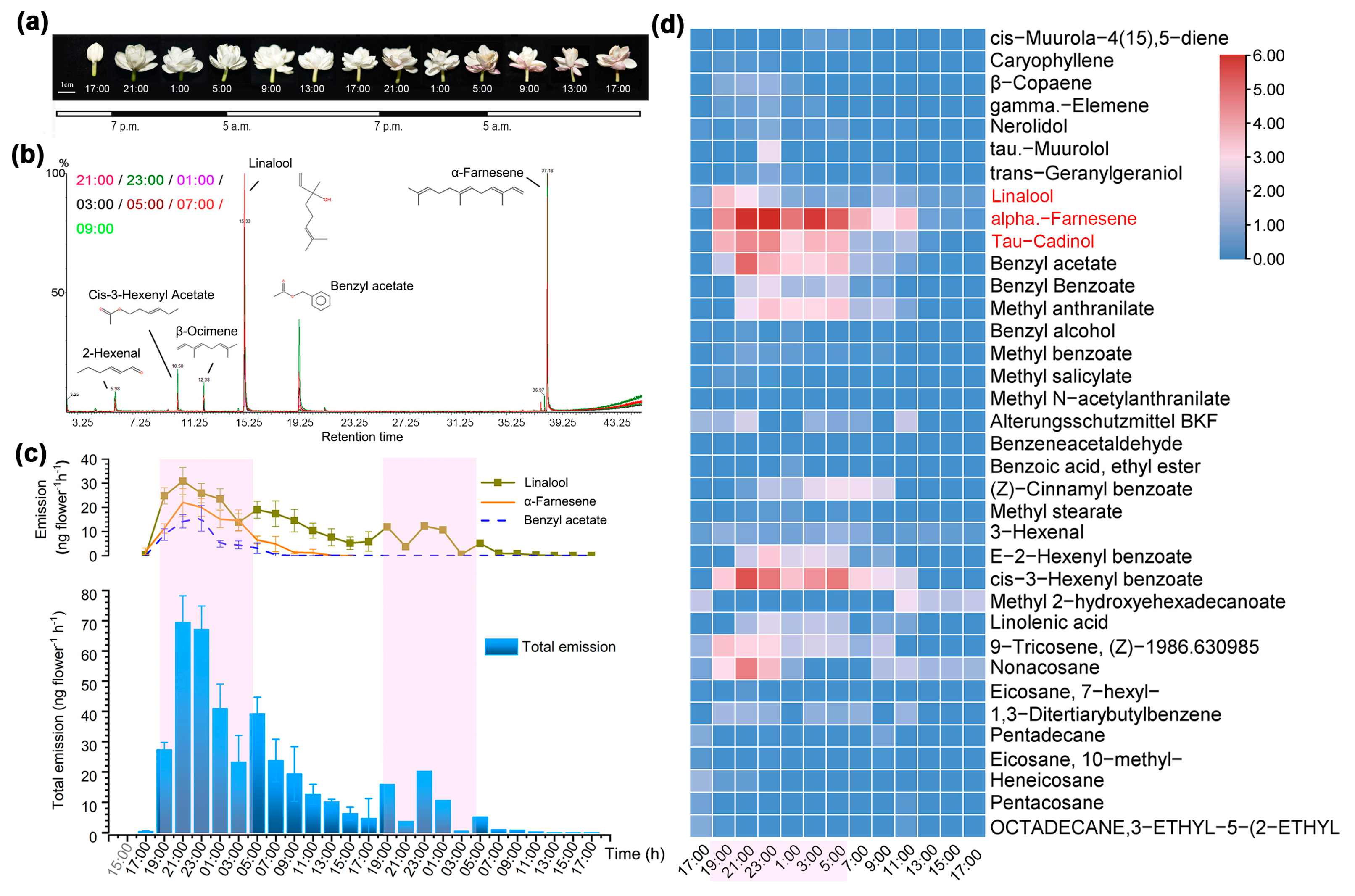
Figure 1. (a) Phenotypic changes in jasmine flowers at 4 h intervals from flower opening to senescence. The light/dark cycle is indicated by white (light) and black (dark) bars below the panel. Scale bar represents1.0 cm; (b) overlay of representative GC-MS spectrum of the headspace VOCs during the first 12 h, when the emission is maximum; (c) headspace emission of floral volatiles during the 48 h lifetime of the flower; pink shaded areas mark night-time intervals; (d) volatile compounds in petal extracts at time points during the 24 h of flower opening, with night-time intervals highlighted as pink blocks; compounds were quantified using an internal standard (Supplementary Data Set S1), and their abundances (μg·g−1 FW) were log2-transformed to generate the heat map.
Horticulturae 12 00010 g001
Figure 2. A heat map depicting the normalized FPKM derived from the transcriptome data and transcript abundance of the most highly expressed TPS genes (highlighted in red in the heat map) in petals during floral lifetime. The relative expression level of target genes was calculated using the 2−ΔC(T) method using JsACTIN2 as the reference gene. Pink shaded areas in the right-hand panel mark night-time intervals.
Horticulturae 12 00010 g002
Figure 4. The four JsTPSs, in fusion with a C-terminal GFP tag, were transiently expressed in protoplasts of Arabidopsis rosette leaves or Jasminum petals. GFP fluorescence was observed at 470 nm excitation and 525 nm emission; chlorophyll fluorescence was detected at 545 nm excitation and 620 nm emission. The scale bar represents 5 µm.
Horticulturae 12 00010 g004
Figure 5. (a) Linalool was produced in JsTPS04-transfected leaves; (b) a sesquiterpenoid product, τ-cadinol, was generated in JsTPS01-expressing yeast cells; the peaks marked “X” and “XX” are newly formed products that both match τ-cadinol in NIST2020.
Horticulturae 12 00010 g005
Figure 6. (a) Incubation with GPP, FPP, and GGPP up to 200 µM resulted in linalool (upper panel); comparison of the mass spectrum of the enzymatic product with that of the authentic compound linalool (lower panel). (b) Representative chromatograms of the reaction products; (c) curve fitting of JsTPS02 against GPP. In panels a and b, the red dashed lines denote the retention-time position of the authentic linalool standard.
Horticulturae 12 00010 g006
Figure 7. (a) Incubation with GPP, FPP, and GGPP up to 200 µM resulted in linalool and trans-nerolidol (left panel); comparison of the mass spectrum of the enzymatic product with that of the authentic compounds, linalool and trans-nerolidol (right panel). (b) Representative chromatograms of the reaction products of JsTPS04 with GPP; (c) representative chromatograms of the reaction products of JsTPS04 with FPP; (d) curve fitting of JsTPS04 against two substrates. In panels a–c, red dashed lines mark the retention-time positions of the authentic standards linalool and trans-nerolidol.
Horticulturae 12 00010 g007
Figure 8. (a) Incubation with GPP up to 100 µM resulted in no significant new product peak; (b) a new product corresponding to farnesol was formed by the activity of JsTPS03 using FPP as substrate; (c) comparison of the mass spectrum of the enzymatic product with that of the authentic compound farnesol; (d) concentration-dependent reaction kinetics of the JsTPS03 against FPP and the apparent Michaelis–Menten parameters. In panel b, the blue dashed line denotes the retention-time position of the authentic farnesol standard.
Horticulturae 12 00010 g008
Disclaimer/Publisher’s Note: The statements, opinions and data contained in all publications are solely those of the individual author(s) and contributor(s) and not of MDPI and/or the editor(s). MDPI and/or the editor(s) disclaim responsibility for any injury to people or property resulting from any ideas, methods, instructions or products referred to in the content.