Article

Strawberry Fruit Softening Driven by Cell Wall Metabolism, Gene Expression, Enzyme Activity, and Phytohormone Dynamics


College of Food Science & Engineering, Wuhan Polytechnic University, Wuhan 430023, China
*
Author to whom correspondence should be addressed.
Horticulturae 2025, 11(12), 1533; https://doi.org/10.3390/horticulturae11121533
Submission received: 19 November 2025 / Revised: 16 December 2025 / Accepted: 16 December 2025 / Published: 18 December 2025

Abstract

Texture is a critical quality attribute of strawberry fruit, and phytohormones play a pivotal role in fruit softening, which mainly results from cell wall metabolism, which is governed by genes and enzymes. To gain further insights into strawberry (Fragaria × ananassa, Duch. cv. Akihime ) softening, our study investigated changes across five stages in fruits in their firmness, soluble solids content (SSC), cell microstructure, cell wall materials, activities of cell wall-modifying enzymes, gene expression, endogenous phytohormone levels, and their correlation. During strawberry ripening, firmness decreased, while SSC, intercellular space, and separation of the cell wall from the plasma membrane increased. Meanwhile, the contents of ionic pectin (ISP) and cellulose (CE), pectin methylesterase (PME) activity, FaPME expression, and the levels of zeatin (Z) and strigolactone (SL) decreased, showing a positive correlation with firmness. In contrast, the activities of pectate lyase (PL) and cellulase (Cx), the expression of FaPL and FaCx, and the contents of gibberellin A4 (GA4), GA9, and abscisic acid (ABA) increased during ripening, and these were negatively correlated with firmness. These results suggest that Z and SL are associated with the maintenance of cell wall integrity and firmness, whereas increases in GA4, GA9, and ABA are linked to enhanced cell wall disassembly and fruit softening.

1. Introduction

Strawberries are soft fruits widely favored by consumers for their appealing sensory characteristics and nutritional value. However, their rapid softening rate accelerates their postharvest deterioration, which complicates transportation and shortens shelf life. Therefore, it is important to study how cell wall metabolism changes in response to physical or chemical treatments. Softening of a strawberry fruit during ripening results from changes in the cell wall structure and its components. The cell wall consists primarily of polysaccharide polymers, including pectin, cellulose (CE), and hemicellulose (HC), which interact to form a load-bearing network [1]. Pectin substances include water-soluble pectin (WSP), ionic-soluble pectin (ISP), and covalent-soluble pectin (CSP) located in the middle lamella. They serve to connect adjacent cells, thereby preserving the shape and structural integrity of the fruit tissue [2]. CE is a linear chain composed of β-1,4-D-glucose chains connected by hydrogen bonds, which assemble into microfibrils serving as the primary load-bearing polymers of the cell wall [3]. HC is a branched heteropolysaccharide that resides mainly within the cell wall matrix, contributing to the structural framework alongside CE [4]. The spaces between CE layers are filled with pectins, forming extensive contacts with the hydrophilic surfaces of CE. During fruit ripening, the levels of pectin, CE, and HC undergo significant changes, including the conversion of protopectin into WSP, the gradual disassembly of CE and HC structures, and an increase in intercellular spaces [5].
Fruit softening results from increased cell wall metabolism and leads to cell wall loosening, pectin solubilization, depolymerization of HC, loss of rhamnogalacturonan I Gal and Ara side chains, dissolution of the middle lamella, reduced cell adhesion, and cell wall swelling [3]. Fruit softening is modulated by a set of cell wall-modifying enzymes, such as polygalacturonase (PG), PL, PME, β-galactosidase (β-GAL), Cx, α-arabinofuranosidase (AFase), endoglucanase (EGase), xyloglucan endotransglycosylase/hydrolase (XTH), and expansins (EXP) [6]. PG cleaves the glycosidic bonds between unesterified galacturonic acid residues in the homogalacturonan backbone, while PL catalyzes the eliminative cleavage of de-esterified pectin, generating oligosaccharides with unsaturated 4-deoxy-α-D-mann-4-enuronosyl groups, both of which contribute to the disassembly of the pectin network and overall cell wall degradation [7]. PME breaks down the constituent methyl esters to generate less methylated homogalacturonan, which can then be decomposed by PL or PG [8]. Cx plays a role in the decomposition of CE and HC [9]. β-GAL and AFase, respectively, decompose the galactosyl and arabinyl residues on the side chains of pectin. EXP is a key protein component that disrupts xyloglucan–cellulose networks and induces cell wall creep. Additionally, EGase and XTH also contribute to cell wall loosening [3].
Phytohormones influence fruit softening and have been extensively investigated. For example, in strawberries, the expression of PG and PL is inhibited when applying abscisic acid (ABA) to the fruit [10]. Auxin (IAA) treatment delayed the cell wall breakdown process and slowed down strawberry softening [11]. Methyl jasmonic acid (MeJA) treatment increased the expression of genes responsible for strawberry softening, resulting in a loss of fruit firmness [12]. It has been demonstrated that salicylic acid (SA) can also delay strawberry softening [13]. Conversely, a pre-harvest treatment with strigolactone (SL) promoted strawberry softening [14]. It was also shown that Z played a crucial role in regulating early cell proliferation and facilitating the ripening process in peach fruit [15]. Finally, the treatment with brassinolide (BR) yielded firmer strawberry fruit [16]. However, most studies have focused on individual hormones, and the integrated relationships between endogenous hormone profiles, cell wall disassembly, and firmness during ripening remain poorly understood.
We hypothesize that the progressive loss of firmness in ripening strawberry fruit is causally linked to a coordinated shift in the endogenous phytohormone profile, which in turn orchestrates the temporal expression and activity of key cell wall-modifying enzymes, leading to the systematic disassembly of pectin, cellulose, and hemicellulose networks. Therefore, in this study, we evaluated the changes in firmness, SSC, cell wall microstructure, and cell wall materials at different ripening stages of the strawberry. Specifically, we aimed to clarify the relationship between the activities of the cell wall-modifying enzymes and the expression of related genes. Phytohormones involved in cell wall metabolism are also investigated. Furthermore, the correlation between firmness, SSC, cell wall materials, cell wall metabolizing enzyme activity, gene expression, and endogenous phytohormone content is analyzed. Overall, this work seeks to provide a comprehensive understanding of cell wall metabolism during strawberry softening by integrating physical, biochemical, molecular, and hormonal data across ripening stages.

2. Materials and Methods

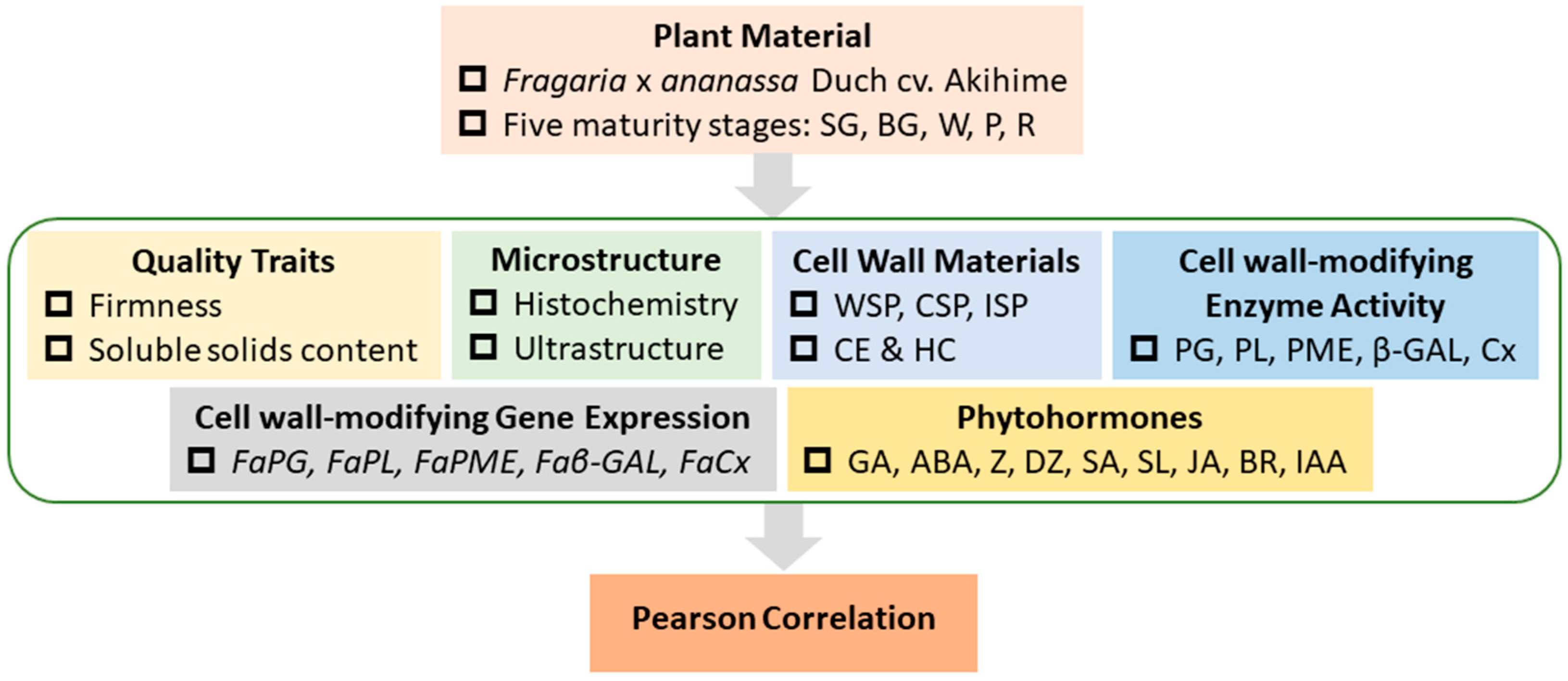
The methodology on which this research was based is shown in Figure 1.

2.1. Plant Materials

Strawberry fruits (Fragaria × ananassa Duch cv. Akihime ) were collected at five maturity stages after the flowering period, namely after 15, 20, 25, 28, and 35 days. Fruits were classified into five ripening stages based on their external sizes and colors: small green (SG), large green (BG), white (W), pink (P), and red (R). The strawberries were obtained from the greenhouse of a commercial orchard in Dongxihu District, Wuhan, China. The harvest occurred from December 2023 to March 2024, and about 50 fruits from each stage were harvested. The fruits were immediately evaluated for firmness, soluble solids content (SSC), and microstructure, and then frozen in liquid nitrogen and kept at −80 °C for storage.

2.2. Firmness and SSC Measurement

The firmness of the fruit was determined using a TA.XT plus texture analyser (Stable Micro Systems Ltd., Surrey, UK) equipped with a P/5S probe. Firmness was measured as the maximum penetration force achieved when the tissue ruptures, expressed in Newtons (N). The settings were as follows: pretest speed of 1.00 mm s−1; test speed of 1.00 mm·s−1, post-test speed of 5.00 mm s−1, and penetration depth of 5.00 mm. Firmness was measured on 10 individual fruits per stage (n = 10), with two measurements taken at opposite points on the equatorial region of each fruit. Results were expressed as the mean ± SD of 10 fruits.
The juice of the whole strawberry fruit was extracted from five fruits per stage using a juicer, poured into a beaker, and stirred well (pooled sample), and the strawberry SSC was determined by dropping the juice into the refractometer measuring position using a rubber-tipped burette. Each stage sample was collected three times, and the average value was expressed as %.

2.3. Histochemical Staining and Electron Microscopy Observation of Cell Wall Ultrastructure

According to the method of Pang et al. [17], safranin O and fast green were used for histochemical staining. The tissue sections were observed under a Motic B5 professional series optical microscope (Bock Optronics Inc., Toronto. ON, Canada) and microphotographed with Motic Images Advanced 3.1 software (Motic China Group Co. Ltd., Xiamen, China).
For transmission electron microscopy, tissues were prepared following the protocol described by Bu et al. [18] with minor adjustments. Briefly, the fruit receptacle tissues were sliced into cubes (1 mm × 1 mm × 1 mm), and fixed in 2.5% glutaraldehyde solution buffered with 0.1 M phosphate-buffered saline (PBS, pH 7.4) at 4 °C for 24 h. Following fixation, the samples were dehydrated using a graded ethanol series (30%, 50%, 70%, 80%, 90%, and finally 100%). After that, they were infiltrated overnight with a 1:1 mixture of acetone and Epon 812 epoxy resin embedding medium. Sections with a thickness of 70 nm were cut with a Leica EM UC7 ultramicrotome. Following double-staining with uranyl acetate and lead citrate, the tissue structure was observed using a FEI Tecnai G2 20 TWIN (Field Electron and Ion Co., Hillsboro, OR, USA) transmission electron microscope operated at a voltage of 80 kV. Three fruits from each stage were used for ultrastructural observations

2.4. Extraction and Measurement of Cell Wall Materials

Alcohol insoluble residue (AIR) was extracted and quantified following a modified protocol based on Zhao et al. [19]. About 20 g of frozen tissue was homogenized in 100 mL of pre-chilled 95% (v/v) ethanol. The homogenate was heated under reflux for 30 min and then centrifuged at 4000× g for 20 min at 4 °C. The resulting pellet was washed three times with 80% (v/v) ethanol. Finally, the sample was incubated in dimethyl sulfoxide overnight at 4 °C. Following overnight soaking, the samples were placed in a chloroform-ethanol mixture (with a volume ratio of 2:1) for 10 min and then washed with acetone repeatedly until the pigments were completely removed. The remaining residue was dried until its weight remained constant. This dried residue was collected as cell wall material.
The extraction of WSP, CSP, and ISP was conducted based on a modified method described by Liu et al. [20]. Briefly, cell wall material was suspended in 8 mL of distilled water and stirred continuously at room temperature for 3 h. After centrifugation, the supernatant was collected and dried to obtain WSP. The resulting pellet was further extracted with 8 mL of 50 mM cyclohexanediaminetetraacetic acid (CDTA) (pH6.5, prepared in a 50 mM sodium acetate buffer) for 6 h. Following centrifugation, the supernatant was dried to yield ISP. Finally, the remaining cell wall material was treated with 8 mL of 50 mM Na2CO3 (containing 2 mM CDTA) and incubated at 4 °C for 12 h. Subsequently, it was centrifuged and dried to obtain CSP. In a test tube, 0.5 mL of pectin extract (WSP, ISP, CSP) was combined with 1 mL of distilled water. Then, 3 mL of concentrated sulfuric acid was slowly added along the tube wall in an ice bath. The mixture was heated in a boiling water bath for 20 min. After being removed and cooled to room temperature, 0.1 mL of a 1.5 g L−1 carbazole–ethanol solution was added. The solution was shaken well and allowed to stand for 30 min. The absorbance of the reaction solution at 530 nm was measured with a microplate spectrophotometer, Multiskan GO 1510 (Thermo Fisher Scientific, Waltham, MA, USA), and a standard curve was plotted using galacturonic acid. Each sample was tested in triplicate, each composed of five fruits, and the results were expressed as mg g−1.
The CE and HC contents were measured according to the instructions of the Cellulose Content Assay Kit and Hemicellulose Content Assay Kit (Solarbio Life Sciences, Beijing, China). Three independent biological samples, each composed of five fruits collected from each stage, were analyzed. Results were expressed in mg g−1.

2.5. Analysis of Cell Wall Metabolizing Enzyme Activity

Enzyme extraction was carried out according to a modified protocol based on Huang et al. [21]. About 5 g of strawberry pulp was homogenized in 18 mL of ice-cold phosphate buffer (0.01 mM, pH7.4) using an ultrasonic homogenizer (UP200St, Hielscher, Coatesville, PA, USA) for 5 min in an ice bath. The homogenate was centrifuged at 6000× g for 20 min at 4 °C, and the resulting supernatant was collected for enzyme activity assays. The activity determinations of PG (EC:3.2.1.15), PME (EC:3.1.1.11), PL (EC:3.2.1.4), β-GAL (EC:3.2.1.23), and Cx (EC:3.2.1.4) were quantified according to the operating instructions of the corresponding test kit (BC2665, BC2700, BC2645, BC2585, BC2545) (Solarbio, Solarbio Technology Co., Ltd., Beijing, China). Each treatment was performed in three biological and technical repetitions. All enzyme activities were measured with a microplate analyzer (MultiskanSkyHigh, Thermo Fisher Scientific, Waltham, MA, USA) and were expressed as U g−1 fresh weight.

2.6. RNA Isolation and Quantitative Real-Time Fluorescence PCR (qRT-PCR)

Based on our previous transcriptome data [22], cell wall metabolizing genes including FaPG (FANhyb_icon00000841_a.1.g00001.1), FaPL (FANhyb_rscf 00001854.1.g00003.1), FaPME (FANhyb_icon00036024_a.1.g00001.1), Faβ-GAL (FANhyb_rscf00000445.1.g00002.1), and FaCx (FANhyb_rscf00000267.1.g00011.1) were selected. Total RNA was extracted from the strawberry using the RN53-EASYspin Plus Kit (Aidalab Biotechnologies, Beijing, China). First-strand cDNA synthesis was performed using the PrimeScript™ RT reagent Kit with gDNA Eraser (Takara Biomedical Technology (Beijing) Co., Ltd., Beijing, China). Quantitative real-time PCR was conducted with three biological replicates on a CFX96 Real-Time PCR Detection System (Bio-Rad Laboratories, Inc., Hercules, CA, USA) using TB Green™ Premix Ex Taq™II (Tli RNaseH Plus) (TaKaRa Biomedical Technology (Beijing) Co., Ltd., Beijing, China). The qRT-PCR program was set as follows: 95 °C for 30 s; then 40 cycles at 95 °C for 5 s; and 60 °C for 30 s; followed by a melt curve stage of 95 °C for 15 s, 60 °C for 1 min, and 95 °C for 15 s. Actin was used as the housekeeping gene, and the primer sequences are listed in Table S1. Gene expression levels were analyzed using the 2−∆∆Ct method.

2.7. Determination of Phytohormones

Phytohormones were extracted and quantified with three biological replicates following a modified protocol based on Manzi et al. [23]. Frozen strawberry fruits were transferred to −20 °C for 30 min and then thawed at 4 °C. Subsequently, 25 mg of each stage sample was weighed into a 2 mL Eppendorf tube. Then, 800 μL of homogenisation solvent (methanol: water = 1:1, v/v) and two steel beads were added. Homogenization was performed using a Tissuelyser II (Qiagen, Hilden, Germany) at 50 Hz for 5 min. Once homogenized, the samples were centrifuged (25,000× g for 10 min at 4 °C) and the supernatant collected. Chromatographic separations were performed using an ultra-performance liquid chromatography (UPLC) system (Waters, Wilmslow, UK) equipped with an ACQUITY UPLC BEH C18 column (100 mm × 2.1 mm, 1.7 μm). The column temperature was maintained at 50 °C. A mobile phase composed of solvent A (water + 0.1% formic acid) and solvent B (acetonitrile + 0.1% formic acid) was delivered at a flow rate of 0.4 mL min−1 under the following gradient program: 0–2 min, 100% A; 2–11 min, 0–100% B; 11–13 min, 100% B; 13–15 min, 0–100% A. The injection volume was 10.00 μL. Metabolites eluted from the column were detected using a SYNAPT G2 XS QTOF high-resolution tandem mass spectrometer (Waters, Wilmslow, UK) in both positive and negative ionization modes. Capillary voltage and sampling cone voltage were set at 2 kV and 40 V for both modes. Data acquisition was performed in Centroid MSE mode across a mass range of 50–1200 Da with a scan time of 0.2 s. For MS/MS analysis, fragmentation of precursors was conducted using 20–40 eV, with a scan time of 0.2 s. Compound areas were normalized against the internal standard for relative quantification.

2.8. Statistical Analysis

Data were presented as mean ± standard deviation (SD) of three independent replicates. The data distribution was assessed for normality using the Shapiro–Wilk test, and the homogeneity of variances was evaluated with Levene’s test. Statistical analysis was performed using one-way analysis of variance (ANOVA) in SPSS software (version 26.0, IBM Corp., Armonk, NY, USA), followed by Tukey’s post hoc test for multiple comparisons. A p-value less than 0.05 was statistically significant. Figures were drawn through Origin 2021 (OriginLab Corp., Northampton, MA, USA) and GraphPad Prism 10 (Graphpad Software, Boston, MA, USA). For correlation analysis, Pearson correlation coefficients were calculated using the combined data from all ripening stages to assess the association between groups of variables. Two-tailed tests and the same significance level (p < 0.05) were used to evaluate the significance of correlations.

3. Results

3.1. Changes in Firmness, SSC, and Cell Microstructure During Strawberry Ripening

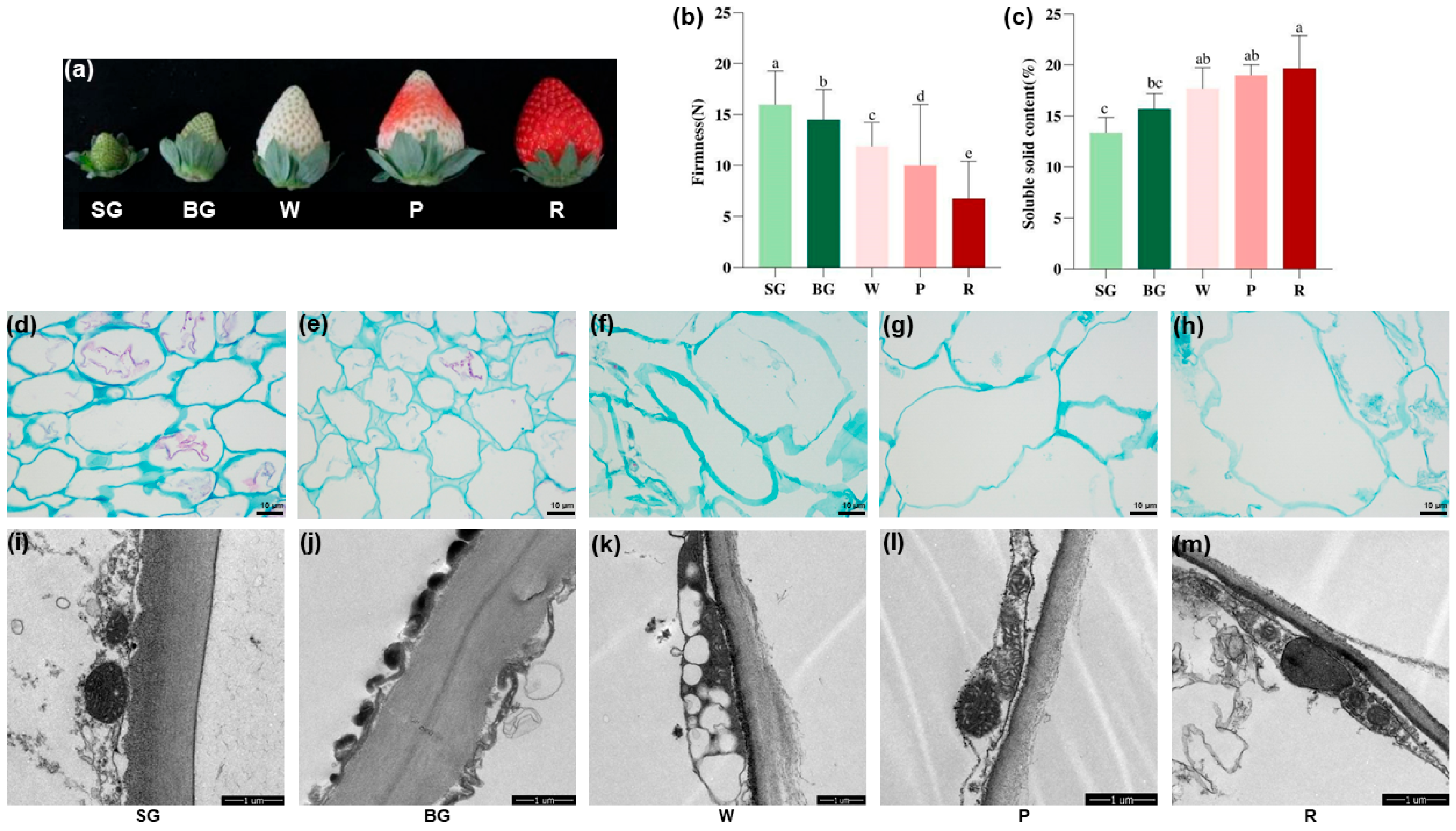
Strawberry fruits at five stages of ripening were collected (Figure 2a). As presented in Figure 2b, fruit firmness declined during ripening, with a total reduction of 57.63%. Strawberries harvested at the SG stage were significantly firmer (16.00 ± 0.65 N) than those harvested at more advanced ripening stages (Figure 2b), while fruit harvested fully red (R) was significantly softer than green immature fruit (SG, BG, and W).
The SSC of the strawberries, on the other hand, increased significantly from stage SG to R, but there was no significant difference between the SSC of fruit harvested at the P and R stages (Figure 2c).
The cell wall microstructure of strawberry fruits during ripening is shown in Figure 2d–m. Along with the decreased firmness of strawberry fruits, significant changes in cell wall microstructure were observed. At the SG stage (Figure 2d,i), the cell wall structure was intact and compacted, the intercellular gap was small, and the adjacent cells were tightly connected by the middle lamella. The cell wall was tightly connected to the plasma membrane (PM). At the BG stage (Figure 2e,j), the cell wall gap was enlarged, the middle lamella was degraded, and the cell wall structure between adjacent cells became loose, and the structure of the PM began to loosen. From the W stage to the P stage (Figure 2f,g,k,l), the gap between cells increased, and the cell wall and PM began to disintegrate. At the R stage (Figure 2h,m), the cell morphology expanded, and the space between the cell wall and the PM increased.

3.2. Changes in Cell Wall Material During Strawberry Ripening

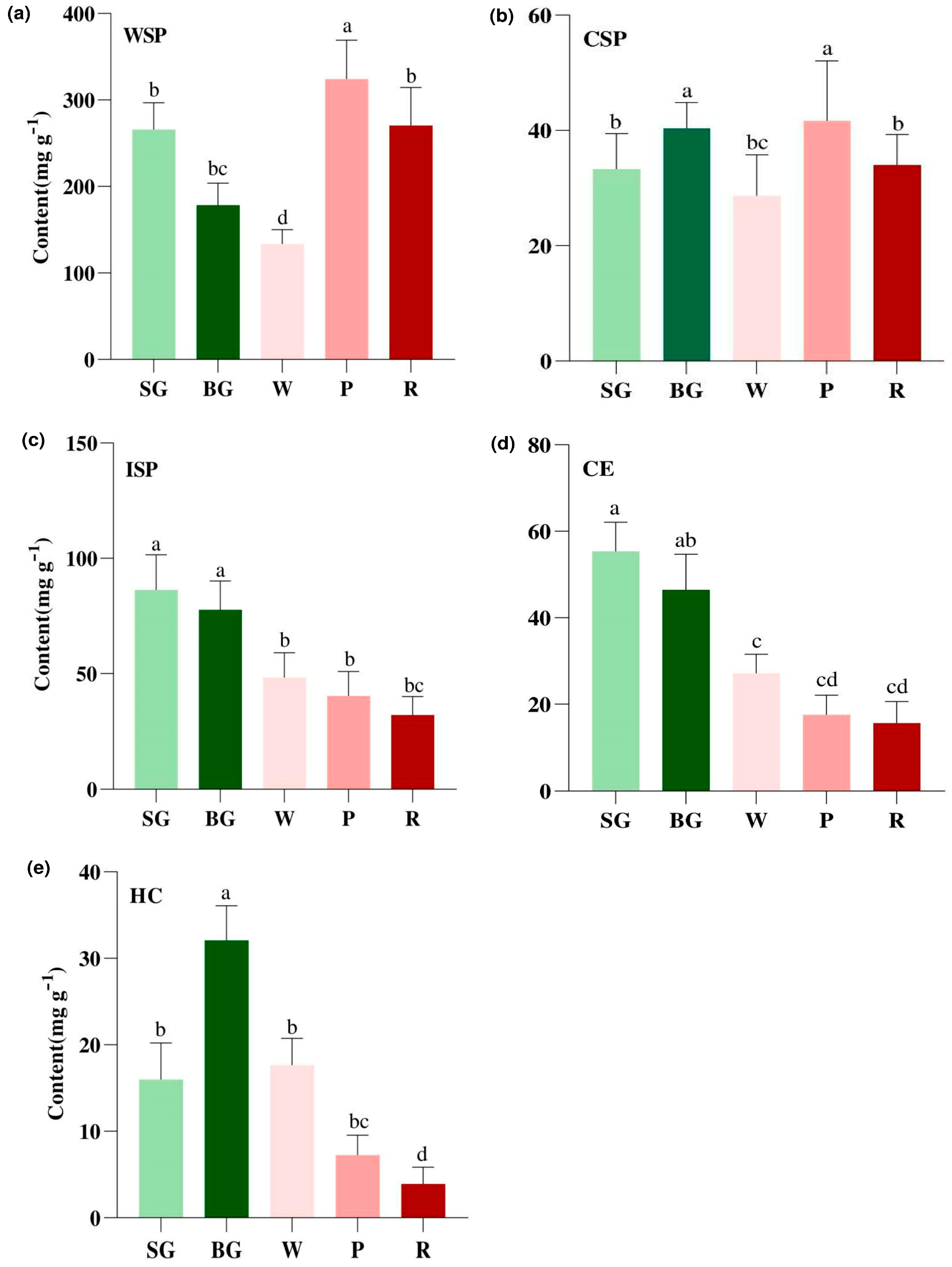
During ripening, WSP content decreased significantly from the SG stage to the W stage, and then increased significantly from the W to P stage (Figure 3a, p < 0.05). CSP content was significantly higher at the BG and P stages compared to other stages (Figure 3b, p < 0.05). Both ISP and CE contents exhibited a declining trend throughout the ripening process (Figure 3c,d). HC content increased significantly from the SG to the BG maturity stage and then decreased from the BG stage to the R stage (Figure 3e, p < 0.05).

3.3. Changes in the Activities of Cell Wall Metabolizing Enzymes During Strawberry Ripening

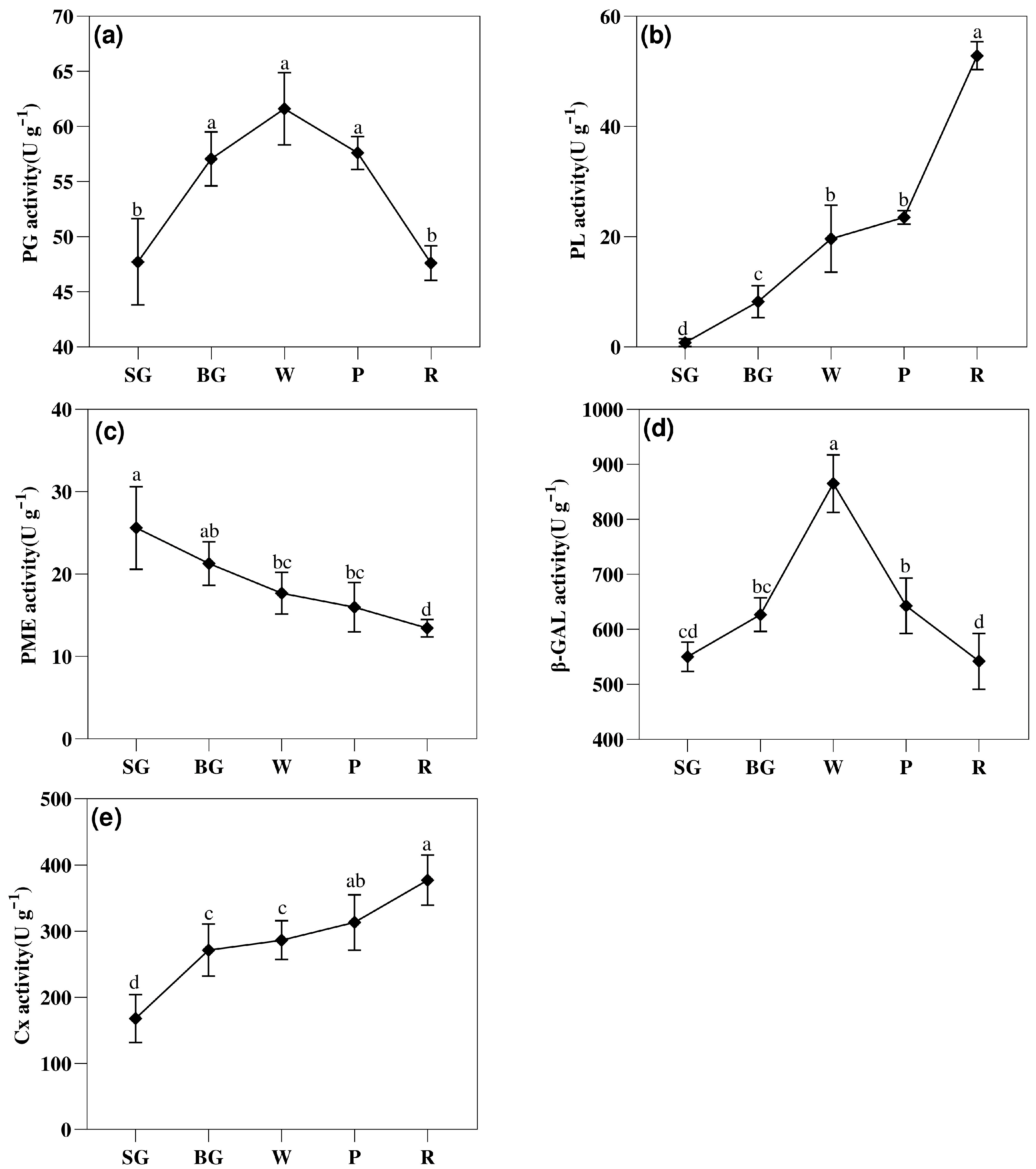
As shown in Figure 4a,d, PG and β-GAL activities increased, and then decreased as the strawberries ripened (p < 0.05). PL and Cx activities significantly increased from stage SG to R (Figure 4b,e, p < 0.05), whereas PME activity decreased significantly as the strawberries ripened (Figure 4c, p < 0.05). These results indicate that PME may play a role in the development stage, PG and β-GAL play roles in the color changing stage, and PL and Cx play roles in the ripening stage of strawberry fruit.

3.4. Changes in the Expression of Cell Wall Metabolism-Related Genes During Strawberry Ripening

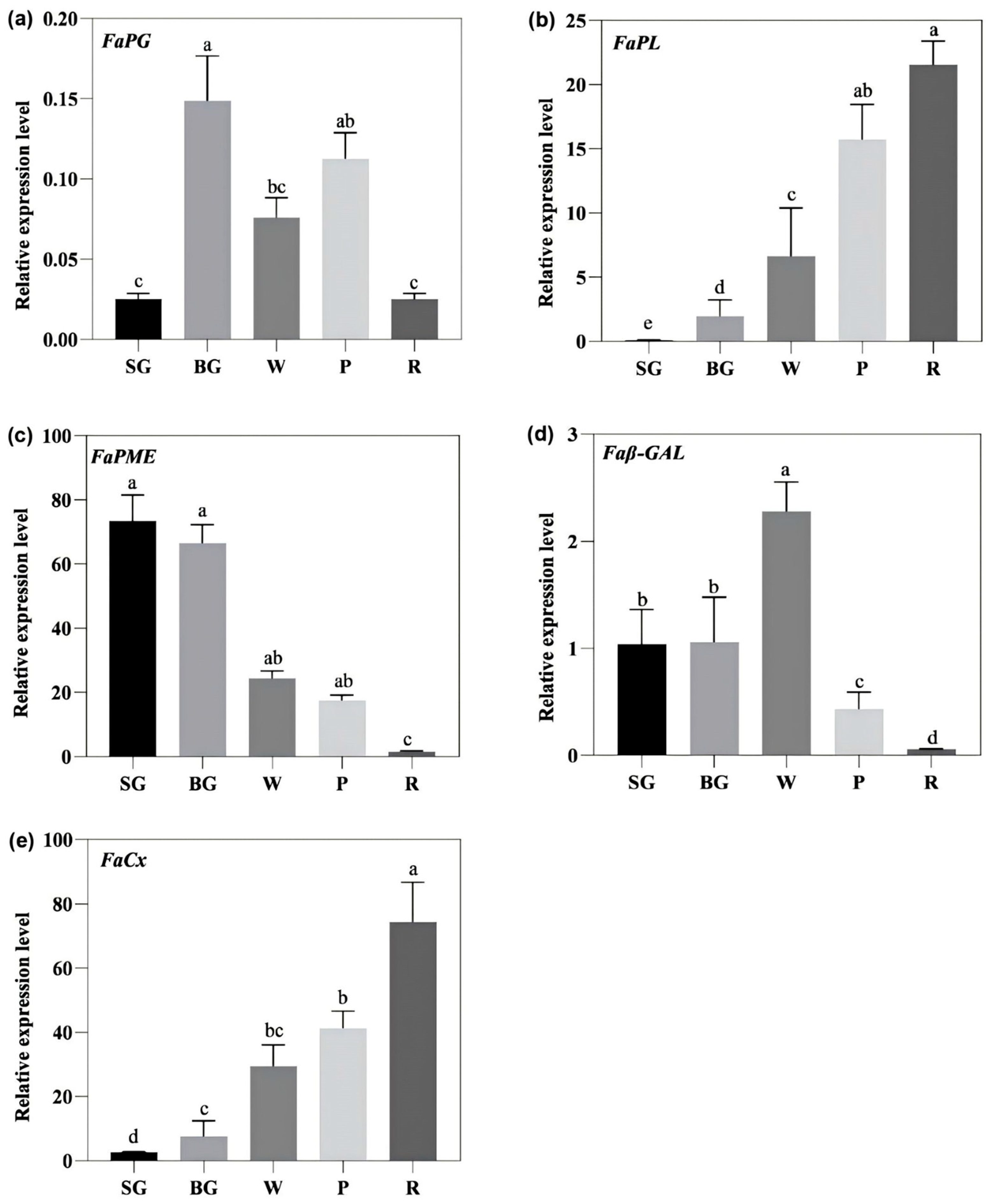
As presented in Figure 5a, the expression of FaPG significantly increased from the SG stage to the BG stage, then declined in the R stage (p < 0.05). The expression levels of FaPL and FaCx increased significantly during ripening, peaking at the R stage (Figure 5b,e, p < 0.05). In contrast, FaPME expression significantly decreased throughout ripening (Figure 5c, p < 0.05). Faβ-GAL expression significantly increased, reaching its highest level at the W stage, and then declined as ripening progressed (Figure 5d, p < 0.05).

3.5. Changes in Endogenous Phytohormones Contents During Strawberry Ripening

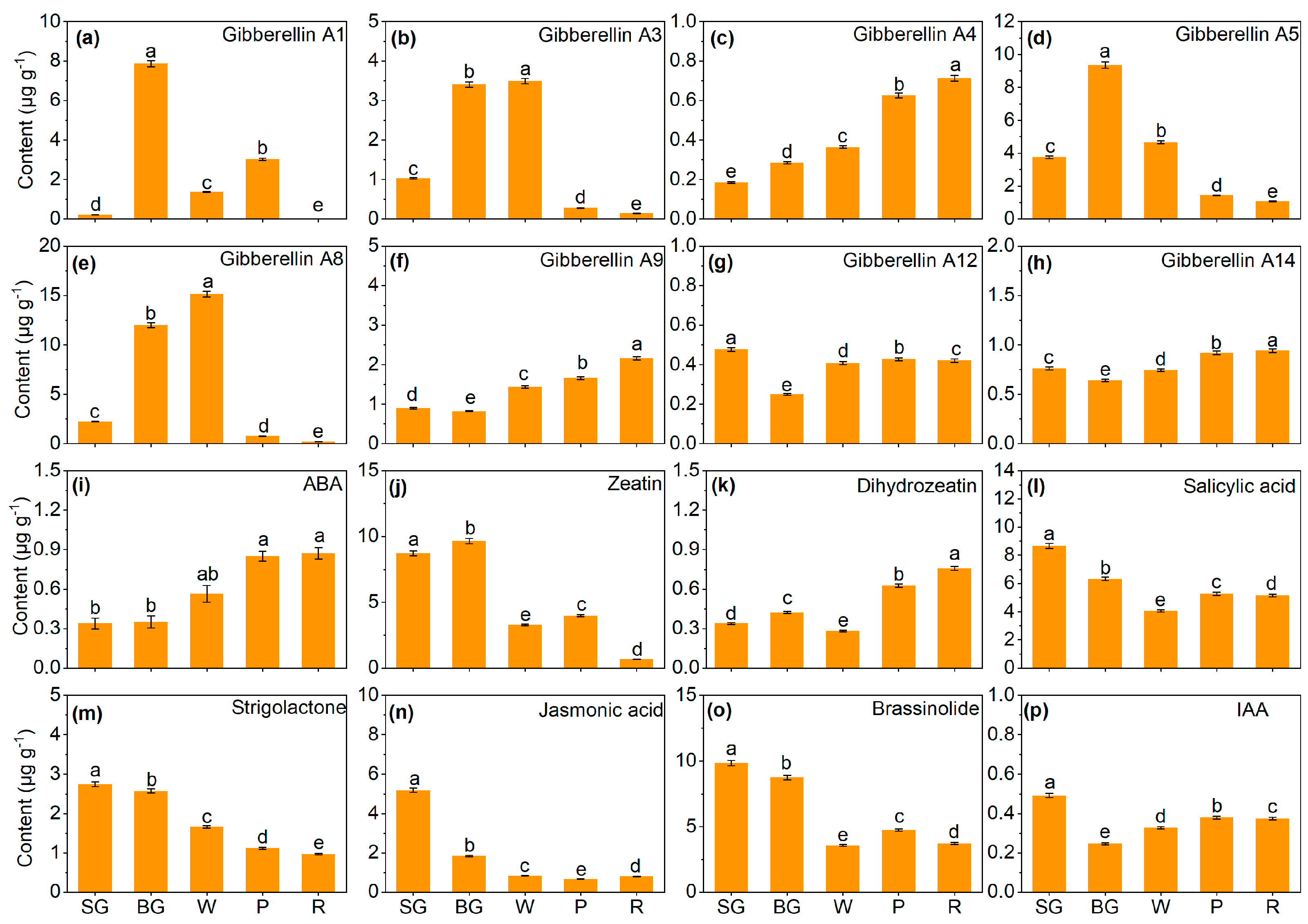
During the ripening process, there were significant differences in most classes of phytohormone. The contents of GA1, GA5, and Z significantly increased, peaking at the BG stage, and then significantly decreased (p < 0.05, Figure 6a,d,j). The contents of GA3 and GA8 reached the highest levels at the W stage and then significantly declined as the strawberries ripened (p < 0.05, Figure 6b,e). The contents of GA4 and ABA exhibited a significant upward trend (p < 0.05, Figure 6c,i) while GA9 and GA14 levels slightly decreased from the SG to BG stage and then significantly increased with fruit ripening (p <0.05, Figure 6f,h). The contents of GA12 and IAA significantly decreased from stages SG to BG, slightly increased from the BG stage to P stage, and declined again slightly from P to R stage (p < 0.05, Figure 6g,p). Dihydrozeatin (DZ) content peaked at the R stage (p < 0.05, Figure 6k). Meanwhile, the SA and BR levels significantly decreased from the SG to W stage, significantly rising to a maximum at the P stage, and subsequently decreasing again at the R stage (p < 0.05, Figure 6l,o). As the strawberries ripened, SL and jasmonic acid (JA) content showed a significantly downward trend (p < 0.05, Figure 6m,n). These results indicated that GA1, GA5, Z, SL, JA, and BR were actively carried out for the development of fruits, GA3 and GA8 functioned during the middle stage of ripening, GA4, ABA, and DZ had an effect during the maturity of fruits, while GA9, GA12, GA14, SA, and IAA were enriched during the whole development and ripening process.

3.6. Correlation Analysis

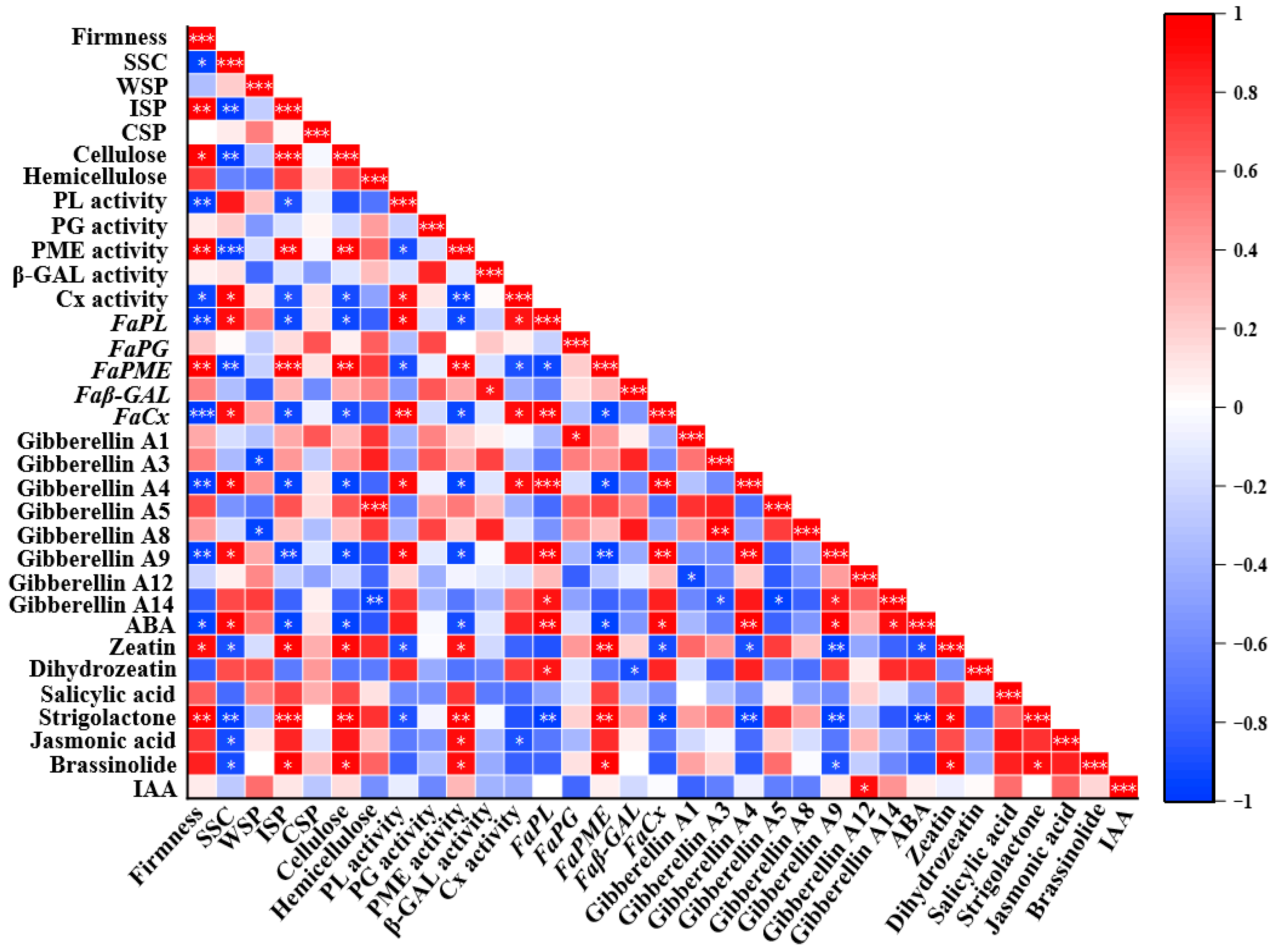
As shown in Figure 7, during ripening, strawberry firmness was negatively correlated with SSC and positively correlated with ISP and CE contents. Regarding cell wall metabolizing enzymes, firmness showed a negative correlation with PL and Cx activities, but a positive correlation with PME activity. At the genetic level, firmness was negatively correlated with the expressions of FaPL and FaCx and positively correlated with FaPME expression. In terms of phytohormones, firmness correlated negatively with GA4, GA9, and ABA concentrations, and positively with Z and SL levels throughout ripening. Hence, the interrelationships among various parameters related to firmness were effectively revealed by the correlation analysis. Our study suggests that the mechanism underlying strawberry fruit softening may involve suppressing PL and Cx activities, FaPL and FaCx expression, and GA4, GA9, and ABA concentrations, while promoting PME activity, FaPME expression, and Z and SL levels related to cell wall modification.
Regarding cell wall materials, WSP contents were negatively correlated with GA3 and GA8 contents. ISP contents were negatively correlated with PL and Cx activities, the expression levels of FaPL and FaCx, and the GA4 and GA9 concentrations, and were positively correlated with the CE concentrations, the PME activities, and the FaPME expression levels, the contents of Z, SL, and BR. CE concentrations were negatively correlated with the Cx activity, FaPL and FaCx expression, as well as the concentrations of GA4, GA9, and ABA, and were positively correlated with the PME activities and FaPME expression levels, and the contents of Z, SL, and BR. HC concentrations were negatively correlated with the GA14 concentrations, and were positively correlated with the GA5 concentrations.
In addition, SSC was negatively correlated with the contents of Z, SL, JA, and BR, but positively correlated with GA4 and GA9 contents. The activities of PL, PME, β-GAL, and Cx were positively correlated with the expression levels of their corresponding genes FaPL, FaPME, Faβ-GAL, and FaCx, respectively. PL activity was negatively correlated with Z and SL contents, and positively with GA4 and GA9. PME activity was negatively correlated with the contents of GA4, GA9, and ABA, and was positively correlated with the contents of Z, SL, JA, and BR. Cx activities were negatively correlated with JA content. At the transcriptional level, FaPL expression was negatively correlated with SL but positively correlated with GA4, GA9, GA14, ABA, and Z. FaPME expression was negatively correlated with GA4, GA9, GA14, and ABA and positively correlated with Z, SL, and BR. Faβ-GAL expression was negatively correlated with DZ. FaCx expression was negatively correlated with Z and SL, and positively with GA4, GA9, and ABA. Additionally, GA4, GA9, and ABA levels were positively correlated with each other and negatively correlated with Z and SL. A positive correlation was also observed between Z and SL contents.

4. Discussion

Fruit firmness is a critical quality attribute and influences consumer acceptability. Fruit softening is a complex physiological and biochemical process, with cell wall metabolism playing a pivotal role in the reduction in firmness. In our study, strawberry firmness decreased significantly as the fruit ripened (Figure 2b). Similar results were reported by Simkova et al. [24], who reported that the strawberry fruit’s firmness decreased with the ripening stages in all cultivars. Furthermore, we found that firmness had a negative correlation with the SSCs (Figure 7), that is, as fruit ripened, firmness decreased, while SSC increased (Figure 2c). This might be due to the degradation of starch and other macromolecular substances and their conversion into soluble sugars. A high concentration of soluble sugars led to water loss and the structural relaxation of the cell wall, thereby aggravating softening and reducing firmness [25].
Fruit softening primarily results from the degradation of cell wall components and the loss of intercellular adhesion, largely due to the dissolution of the middle lamella. Cell wall support plays a crucial role in maintaining the structural integrity and shape of cells, with changes in cell wall composition having a significant impact on fruit firmness [26]. In our study, microscopic observation of the cell wall revealed that cells were tightly packed, and the plasma membrane was closely associated with the cell wall at the SG stage. With ripening, the thickness of the cell wall diminished while gaps between the plasma membrane and cell wall widened (Figure 2d–m). Cell separation is thought to be intricately linked to the metabolic processes of the cell wall and results in an increase in extracellular volume [27]. Therefore, in strawberry fruit cells, separation facilitates cell expansion by compromising cell wall integrity (Figure 2d–m), ultimately leading to reduced firmness (Figure 2b). In the present study, firmness showed a positive correlation with the ISP and CE contents (Figure 7). These findings were consistent with those from previous studies, where blueberry ISP and CE contents were also associated with increased softening [28]. The cell wall is primarily composed of high molecular weight polysaccharides. In the present study, ISP and CE showed declining trends as ripening progressed (Figure 3b,d), which most likely resulted from substantial changes that occur in the composition and structure of pectin, CE, and HC, including the conversion of protopectin to soluble pectin, the disassembly of CE and HC networks, an increase in intercellular spaces, and a decrease in firmness [29].
Fruit softening is closely associated with the degradation of cell wall materials, which largely relies on the activity of specific cell wall metabolic enzymes. In this study, PL and Cx activities increased and were negatively correlated with firmness and ISP content. In contrast, PME activity decreased and demonstrated positive correlations with firmness, ISP and CE (Figure 4 and Figure 7). The softening of strawberry fruits appears to be biphasic: the early phase is primarily driven by PME activity, while the later phase is mediated by the increased actions of PL and Cx. PL catalyzes the eliminative cleavage of de-esterified pectin, generating oligosaccharides with 4-deoxy-α-D-mann-4-enuronosyl termini at their non-reducing ends, thereby contributing to cell wall degradation and softening of the tissues [7]. PME hydrolyzes methyl ester groups in pectin, producing low-methylated homogalacturonan that serves as a substrate for further cleavage by PL or PG [8]. In the current study, a negative correlation was found between PME and PL activities (Figure 7). Additionally, Cx facilitates the degradation of CE and HC [9]. Similarly, Cx activity significantly increased while CE content markedly decreased during lychee maturation [30]. It could be concluded that this early softening was attributed to PME activity, whereas late softening was associated with increased activities of PL and Cx.
In addition to the activity of cell wall metabolism enzymes, the expression of their corresponding genes also plays a crucial role in regulating cell wall structure and composition, ultimately influencing fruit firmness. In the present study, a positive correlation between firmness and FaPME, alongside negative correlations with both FaPL and FaCx, was found (Figure 7). Previous studies have demonstrated that the silencing and overexpression of FaPME38 and FaPME39 significantly influence fruit firmness, pectin content, and cell wall structure [31]. FaPL serves as a crucial cell wall modifier gene, and overexpression of FaPL results in a significant decrease in the firmness of strawberry fruit [32]. In apples, the transcriptional levels of MdPL exhibited a strong correlation with PL activity, promoting a loss of firmness [33]. The FaCx may serve as the principal gene regulating the Cx enzyme, influencing the decomposition of CE and HC in longan fruit [34]. In this study, the expression levels of FaPME, FaPL, and FaCx demonstrated positive correlations with PME, PL, and Cx activities, respectively (Figure 7), indicating that FaPME, FaPL, and FaCx may participate in strawberry softening by regulating enzyme activities. Meanwhile, FaPL was negatively correlated with FaPME and positively correlated with FaCx, while FaPME showed a negative correlation with FaCx (Figure 7), suggesting that FaPME, FaPL, and FaCx interaction promoted strawberry fruit softening throughout ripening.
Phytohormones are key regulators of fruit ripening [35]. In this study, firmness was negatively correlated with the levels of GA4, GA9, and ABA (Figure 7). The contents of GA4, GA9, and ABA increased as the strawberries ripened (Figure 6c,f,i), indicating that GA4 and ABA may act in the middle and late stages of cell expansion during strawberry fruit development. Cell enlargement is a critical factor determining fruit size, and the increase in cell expansion is one of the most important physiological processes regulated by GA [36]. During strawberry ripening, the increasing GA4 and GA9 may promote cell elongation (Figure 2d–h), and thus reduce fruit firmness. Furthermore, the contents of GA4 and GA9 were negatively correlated with ISP content, FaPME expression, and PME activity, all positively correlated with firmness (Figure 7). In addition, GA4 and GA9 showed positive correlations with FaPL expression and PL activity, both negatively correlated with firmness (Figure 7). These results suggest that GA4 and GA9 may contribute to the reduction in firmness by upregulating FaPL expression and PL activity, while inhibiting the expression of FaPME, PME activity, and the formation of ISP during strawberry ripening.
ABA is regarded as one of the key regulators of strawberry ripening [37]. ABA content was negatively correlated with CE content, which was positively correlated with the firmness. Similarly, the treatment of ‘Camarosa’ strawberry with exogenous ABA also led to CE degradation [38]. Meanwhile, ABA content positively correlated with FaCx expression, which was negatively correlated with firmness (Figure 7). These results indicated that ABA may regulate the expression of FaCx, resulting in a decrease in CE content and in strawberry firmness. In blueberries, exogenous ABA treatment also upregulated the expression of Cx and decreased CE levels [39]. In addition, ABA was positively correlated with FaPL expression and negatively correlated with firmness, indicating that ABA may promote softening by up-regulating the expression of FaPL. Chen et al. [40] reported that injection of 1 mM ABA into mature strawberries significantly altered the expression patterns of 132 unigenes and induced fruit softening. The fruit firmness of sweet cherries was decreased by ABA via the regulation of cell wall modification gene expression, specifically PavPL18, PavPME44, and PavXTH26/31 [41].
In the present study, firmness showed a positive correlation with Z and SL (Figure 7). The content of Z showed a decreasing trend (Figure 6j), similar to what was observed in the ‘Seolhyang’ strawberry cultivar [42]. Wu et al. [43] reported that endogenous SL functions in the early stages of diploid strawberry ripening, which was in line with the results from the present study. That is, results suggest that SL and Z may be involved during the early stage of strawberry development, when cell division is active. Similarly, Li et al. [14] reported that exogenous application of SL could promote the softening of strawberry fruits.
It is well known that phytohormones work in synergy. In fact, results from the present study showed that there is a strong correlation between GA4, GA9, ABA, Z, and SL, and that there may be crosstalk between these different compounds (Figure 7). For example, in diploid strawberries, GA promotes the expression of the FveCYP707A4a, which, in turn, can promote ABA catabolism [44]. In addition, GA treatment has been reported to elevate ABA levels in fruits [45]. ABA and SL treatment increases the content of sugar and promotes the ripening of fruits [46]. Carbohydrate substances are the main energy sources for cell wall metabolism and can provide energy for the synthesis or activity maintenance of PME and Cx [47]. Z, GA, and ABA could synergistically regulate the development and ripening of sweet cherries [48]. In apple fruits, the crosstalk between GA and SL can cooperatively regulate the content of apple anthocyanins [49]. In summary, results from our study generated new information suggesting the existence of a synergy between GA, ABA, Z, and SL.
Overall, the evidence presented indicates that as ripening progresses, cell wall integrity and firmness are maintained in association with Z and SL, while increased levels of GA4, GA9, and ABA are associated with enhanced cell wall disassembly and fruit softening. However, further research is required to validate the roles of Z, SL, GA4, GA9, and ABA in fruit firmness, as a key limitation of this study is its correlational design, which relies on combined data across stages.

5. Conclusions

During strawberry ripening, firmness, ISP, and CE contents decreased, and SSCs increased. Cell separation occurred and impaired the structural integrity of the cell wall during ripening. At early stages, Z and SL may reduce strawberry softening by promoting FaPME expression, increasing PME activity, enhancing ISP content, or inhibiting FaCx expression and facilitating CE formation. At the middle and late stages of strawberry ripening, GA4 and GA9 could potentially upregulate FaPL expression and enhance PL activity, whereas they suppress FaPME expression, reduce PME activity, and inhibit the formation of ISP. Meanwhile, ABA may modulate the expression of FaCx and FaPL, along with CE content, thereby contributing to a decrease in strawberry firmness. Our study integrated the correlation between cell wall properties, enzyme activities, gene expression, and an extensive panel of phytohormones across various ripening stages of strawberry fruit. This work establishes a theoretical foundation for elucidating the mechanisms of fruit softening. However, further investigation is necessary to clarify the precise pathways involved.

Supplementary Materials

The following supporting information can be downloaded at: https://www.mdpi.com/article/10.3390/horticulturae11121533/s1, Table S1: Primers used in this study.

Author Contributions

Conceptualization, H.L. and Q.Y.; methodology, H.L. and M.L.; software, Q.Y. and M.L.; validation, Q.Y. and M.L.; formal analysis, Q.Y.; investigation, Q.Y.; resources, H.L.; data curation, Q.Y.; writing—original draft preparation, H.L. and Q.Y.; writing—review and editing, H.L. and Q.Y.; visualization, Q.Y.; supervision, H.L.; project administration, H.L.; funding acquisition, H.L. All authors have read and agreed to the published version of the manuscript.

Funding

This research was funded by the National Natural Science Foundation of China, grant number 32302629, Research Funding of Wuhan Polytechnic University, grant number 2023RZ011, and Research and Innovation Initiatives of WHPU, grant number 2023Y01.

Data Availability Statement

The original contributions presented in this study are included in the article/Supplementary Material. Further inquiries can be directed to the corresponding author.

Conflicts of Interest

The authors declare no conflicts of interest. The funders had no role in the design of the study; in the collection, analyses, or interpretation of data; in the writing of the manuscript; or in the decision to publish the results.

References

  1. Zhang, B.C.; Gao, Y.H.; Zhang, L.J.; Zhou, Y.H. The plant cell wall: Biosynthesis, construction, and functions. J. Integr. Plant Biol. 2020, 63, 251–272. [Google Scholar] [CrossRef]
  2. Husnayain, N.; Adi, P.; Mulyani, R.; Tsai, S.Y.; Chang, C.K.; Punthi, F.; Yudhistira, B.; Cheng, K.C.; Hsieh, C.W. Active packaging of chitosan-casein phosphopeptide modified plasma–treated LDPE for CO2 regulation to delay texture softening and maintain quality of fresh-cut slice persimmon during storage. Food Bioprocess Technol. 2025, 18, 5532–5548. [Google Scholar] [CrossRef]
  3. Shi, Y.N.; Li, B.J.; Grierson, D.; Chen, K.S. Insights into cell wall changes during fruit softening from transgenic and naturally occurring mutants. Plant Physiol. 2023, 192, 1671–1683. [Google Scholar] [CrossRef]
  4. Parra, R.; Gomez-Jimenez, M.C. Spatio–temporal immunolocalization of extensin protein and hemicellulose polysaccharides during olive fruit abscission. Planta 2020, 252, 32. [Google Scholar] [CrossRef]
  5. Li, F.J.; Xia, X.Z.; Li, L.L.; Song, L.L.; Ye, Y.P.; Jiang, Y.M.; Liu, H. Elucidation of pineapple softening based on cell wall polysaccharides degradation during storage. Front. Plant Sci. 2024, 15, 1492575. [Google Scholar] [CrossRef]
  6. Moya León, M.A.; Mattus Araya, E.; Herrera, R. Molecular events occurring during softening of strawberry fruit. Front. Plant Sci. 2019, 10, 615. [Google Scholar] [CrossRef]
  7. Wang, D.D.; Yeats, T.H.; Uluisik, S.; Rose, J.K.C.; Seymour, G.B. Fruit softening: Revisiting the role of pectin. Trends Plant Sci. 2018, 23, 302–310. [Google Scholar] [CrossRef]
  8. Li, Z.X.; Wu, L.M.; Wang, C.; Wang, Y.; He, L.G.; Wang, Z.J.; Ma, X.F.; Bai, F.X.; Feng, G.Z.; Liu, J.H.; et al. Characterization of pectin methylesterase gene family and its possible role in juice sac granulation in navel orange (Citrus sinensis Osbeck). BMC Genom. 2022, 23, 185. [Google Scholar] [CrossRef]
  9. Shi, Z.J.; Yang, H.Y.; Jiao, J.Y.; Wang, F.; Lu, Y.Y.; Deng, J. Effects of graft copolymer of chitosan and salicylic acid on reducing rot of postharvest fruit and retarding cell wall degradation in grapefruit during storage. Food Chem. 2018, 283, 92–100. [Google Scholar] [CrossRef]
  10. Zhao, Y.Y.; Brummell, D.A.; Lin, Q.; Duan, Y.Q. Abscisic acid treatment prolongs the postharvest life of strawberry fruit by regulating sucrose and cell wall metabolism. Food Biosci. 2024, 59, 104054. [Google Scholar] [CrossRef]
  11. Castro, R.I.; González Feliu, A.; Muñoz Vera, M.; Valenzuela Riffo, F.; Parra Palma, C.; Morales Quintana, L. Effect of exogenous auxin treatment on cell wall polymers of strawberry fruit. Int. J. Mol. Sci. 2021, 22, 6294. [Google Scholar] [CrossRef]
  12. Han, Y.L.; Chen, C.; Yan, Z.M.; Li, J.; Wang, Y.H. The methyl jasmonate accelerates the strawberry fruits ripening process. Sci. Hortic. 2019, 249, 250–256. [Google Scholar] [CrossRef]
  13. Gačnik, S.; Veberič, R.; Hudina, M.; Koron, D.; Mikulič Petkovšek, M. Salicylate treatment affects fruit quality and also alters the composition of metabolites in strawberries. Horticulturae 2021, 7, 400. [Google Scholar] [CrossRef]
  14. Li, M.Y.; Yang, M.; Liu, X.Y.; Hou, G.Y.; Jiang, Y.Y.; She, M.S.; He, C.X.; Peng, Y.T.; Lin, Y.X.; Zhang, Y.T.; et al. Pre-harvest application of strigolactone (GR24) accelerates strawberry ripening and improves fruit auality. Agronomy 2023, 13, 2699. [Google Scholar] [CrossRef]
  15. Sutton, M.; Roussel, B.; Chavez, D.J.; Malladi, A. Synthesis of active cytokinins mediated by LONELY GUY is associated with cell production during early fruit growth in peach [Prunus persica (L.) Batsch]. Front. Plant Sci. 2023, 14, 1155755. [Google Scholar] [CrossRef]
  16. Furio, R.N.; Salazar, S.M.; Mariotti Martínez, J.A.; Martínez Zamora, G.M.; Coll, Y.; Díaz Ricci, J.C. Brassinosteroid applications enhance the tolerance to abiotic stresses, production and quality of strawberry fruits. Horticulturae 2022, 8, 572. [Google Scholar] [CrossRef]
  17. Pang, Y.X.; Sharmin, N.; Wu, T.; Pang, C.H. An investigation on plant cell walls during biomass pyrolysis: A histochemical perspective on engineering applications. Appl. Energy 2023, 343, 121055. [Google Scholar] [CrossRef]
  18. Bu, J.; Yu, Y.; Aisikaer, G.; Ying, T. Postharvest UV-C irradiation inhibits the production of ethylene and the activity of cell wall-degrading enzymes during softening of tomato (Lycopersicon esculentum L.) fruit. Postharvest Biol. Technol. 2013, 86, 337–345. [Google Scholar] [CrossRef]
  19. Zhao, Y.T.; Zhu, X.; Hou, Y.Y.; Wang, X.Y.; Li, X.H. Effects of nitric oxide fumigation treatment on retarding cell wall degradation and delaying softening of winter jujube (Ziziphus jujuba Mill. cv. Dongzao) fruit during storage. Postharvest Biol. Technol. 2019, 156, 110954. [Google Scholar] [CrossRef]
  20. Liu, M.P.; Zhang, L.B.; Zhang, L.H.; Ge, Z.Z.; Li, G.; Wang, L.; Zong, W. Combination of intense pulsed light and modified atmosphere packaging delays the texture softening of apricot fruit by inhibiting the degradation of pectin components. Sci. Hortic. 2024, 340, 113918. [Google Scholar] [CrossRef]
  21. Huang, P.; Ding, J.; Liu, C.Y.; Li, H.Y.; Wang, C.L.; Lin, Y.Z.; Sameen, D.E.; Hossen, M.A.; Chen, M.R.; Yan, J.; et al. Konjac glucomannan/low-acyl gellan gum edible coating containing thymol microcapsule regulates cell wall polysaccharides disassembly and delays postharvest softening of blueberries. Postharvest Biol. Technol. 2023, 204, 112449. [Google Scholar] [CrossRef]
  22. Lu, H.Y.; Li, L.; Xu, Y.Q.; Li, D.; Li, G.F.; Yan, Y.Q.; Wu, Q.; Luo, Z.S. FaLEC2 repressing FaLOX2 promoter involved in the metabolism of LOX-derived volatiles during strawberry ripening. Sci. Hortic. 2022, 303, 111188. [Google Scholar] [CrossRef]
  23. Manzi, M.; Gómez-Cadenas, A.; Arbona, V. Rapid and reproducible determination of active gibberellins in citrus tissues by UPLC/ESI-MS/MS. Plant Physiol. Biochem. 2015, 94, 1–9. [Google Scholar] [CrossRef]
  24. Simkova, K.; Veberic, R.; Hudina, M.; Grohar, M.C.; Pelacci, M.; Smrke, T.; Ivancic, T.; Cvelbar Weber, N.; Jakopic, J. Non-destructive and destructive physical measurements as indicators of sugar and organic acid contents in strawberry fruit during ripening. Sci. Hortic. 2024, 327, 112843. [Google Scholar] [CrossRef]
  25. Luo, A.R.; Kang, S.Z.; Chen, J.L. SUGAR model-assisted analysis of carbon allocation and transformation in tomato fruit under different water along with potassium conditions. Front. Plant Sci. 2020, 11, 712. [Google Scholar] [CrossRef]
  26. Han, Y.; Han, S.K.; Ban, Q.Y.; He, Y.H.; Jin, M.J.; Rao, J.P. Overexpression of persimmon DkXTH1 enhanced tolerance to abiotic stress and delayed fruit softening in transgenic plants. Plant Cell Rep. 2017, 36, 583–596. [Google Scholar] [CrossRef]
  27. Zhang, W.W.; Zhao, S.Q.; Zhang, L.C.; Xing, Y.; Jia, W.S. Changes in the cell wall during fruit development and ripening in Fragaria vesca. Plant Physiol. Biochem. 2020, 154, 54–65. [Google Scholar] [CrossRef] [PubMed]
  28. Chen, Y.H.; Hung, Y.C.; Chen, M.Y.; Lin, H.T. Effects of acidic electrolyzed oxidizing water on retarding cell wall degradation and delaying softening of blueberries during postharvest storage. LWT 2017, 84, 650–657. [Google Scholar] [CrossRef]
  29. Li, Y.L.; He, H.; Hou, Y.Y.; Kelimu, A.; Wu, F.; Zhao, Y.T.; Shi, L.; Zhu, X. Salicylic acid treatment delays apricot (Prunus armeniaca L.) fruit softening by inhibiting ethylene biosynthesis and cell wall degradation. Sci. Hortic. 2022, 300, 111061. [Google Scholar] [CrossRef]
  30. Li, C.Q.; Zhao, M.L.; Ma, X.S.; Wen, Z.X.; Ying, P.Y.; Peng, M.J.; Ning, X.P.; Xia, R.; Wu, H.; Li, J.G. The HD-Zip transcription factor LcHB2 regulates litchi fruit abscission through the activation of two cellulase genes. J. Exp. Bot. 2019, 70, 5189–5203. [Google Scholar] [CrossRef] [PubMed]
  31. Xue, C.; Guan, S.C.; Chen, J.Q.; Wen, C.J.; Cai, J.F.; Chen, X. Genome wide identification and functional characterization of strawberry pectin methylesterases related to fruit softening. BMC Plant Biol. 2020, 20, 13. [Google Scholar] [CrossRef]
  32. Lin, Y.X.; He, H.; Wen, Y.L.; Cao, S.P.; Wang, Z.S.; Sun, Z.Q.; Zhang, Y.T.; Wang, Y.; He, W.; Li, M.Y.; et al. Comprehensive analysis of the pectate lyase gene family and the role of FaPL1 in strawberry softening. Int. J. Mol. Sci. 2023, 24, 13217. [Google Scholar] [CrossRef] [PubMed]
  33. Li, X.L.; Fang, S.Q.; Jia, R.J.; Wang, Z.D.; Fu, J.H.; Guo, J.H.; Yang, H.J.; Zhao, Z.Y. Comparison of cell wall changes of two different types of apple cultivars during fruit development and ripening. J. Integr. Agric. 2023, 22, 2705–2718. [Google Scholar] [CrossRef]
  34. Lin, Y.F.; Lin, Y.Z.; Lin, Y.X.; Lin, M.X.; Chen, Y.H.; Wang, H.; Lin, H.T. A novel chitosan alleviates pulp breakdown of harvested longan fruit by suppressing disassembly of cell wall polysaccharides. Carbohydr. Polym. 2019, 217, 126–134. [Google Scholar] [CrossRef] [PubMed]
  35. Xu, Y.Q.; Charles, M.T.; Luo, Z.S.; Mimee, B.; Tong, Z.C.; Véronneau, P.Y.; Roussel, D.; Rolland, D. Ultraviolet-C priming of strawberry leaves against subsequent Mycosphaerella fragariae infection involves the action of reactive oxygen species, plant hormones, and terpenes. Plant Cell Environ. 2019, 42, 815–831. [Google Scholar] [CrossRef] [PubMed]
  36. Csukasi, F.; Osorio, S.; Gutierrez, J.R.; Kitamura, J.; Giavalisco, P.; Nakajima, M.; Fernie, A.R.; Rathjen, J.P.; Botella, M.A.; Valpuesta, V.; et al. Gibberellin biosynthesis and signalling during development of the strawberry receptacle. New Phytol. 2011, 191, 376–390. [Google Scholar] [CrossRef]
  37. Li, D.D.; Mou, W.S.; Xia, R.; Li, L.; Zawora, C.; Ying, T.J.; Mao, L.C.; Liu, Z.C.; Luo, Z.S. Integrated analysis of high-throughput sequencing data shows abscisic acid-responsive genes and miRNAs in strawberry receptacle fruit ripening. Hortic. Res. 2019, 6, 26. [Google Scholar] [CrossRef]
  38. Castro, R.I.; Gonzalez-Feliu, A.; Valenzuela-Riffo, F.; Parra-Palma, C.; Morales-Quintana, L. Changes in the cell wall components produced by exogenous abscisic acid treatment in strawberry fruit. Cellulose 2021, 28, 1555–1570. [Google Scholar] [CrossRef]
  39. Zhou, Q.; Zhang, F.; Ji, S.; Dai, H.; Zhou, X.; Wei, B.; Cheng, S.; Wang, A. Abscisic acid accelerates postharvest blueberry fruit softening by promoting cell wall metabolism. Sci. Hortic. 2021, 288, 110325. [Google Scholar] [CrossRef]
  40. Chen, J.; Mao, L.; Lu, W.; Ying, T.; Luo, Z. Transcriptome profiling of postharvest strawberry fruit in response to exogenous auxin and abscisic acid. Planta 2016, 243, 183–197. [Google Scholar] [CrossRef]
  41. Zhai, Z.; Xiao, Y.; Wang, Y.; Sun, Y.; Peng, X.; Feng, C.; Zhang, X.; Du, B.; Zhou, X.; Wang, C.; et al. Abscisic acid-responsive transcription factors PavDof2/6/15 mediate fruit softening in sweet cherry. Plant Physiol. 2022, 190, 2501–2518. [Google Scholar] [CrossRef]
  42. Lee, G.B.; Lee, J.E.; Lee, J.H.; Lee, Y.J.; Park, Y.H.; Choi, Y.W.; Son, B.G.; Kang, N.J.; Je, B.I.; Kang, J.S. Phytohormone profiles of ‘Seolhyang’ and ‘Maehyang’ strawberry fruits during ripening. Hortic. Environ. Biotechnol. 2020, 61, 229–239. [Google Scholar] [CrossRef]
  43. Wu, H.; Li, H.H.; Chen, H.; Qi, Q.; Ding, Q.Q.; Xue, J.; Ding, J.; Jiang, X.N.; Hou, X.L.; Li, Y. Identification and expression analysis of strigolactone biosynthetic and signaling genes reveal strigolactones are involved in fruit development of the woodland strawberry (Fragaria vesca). BMC Plant Biol. 2019, 19, 73. [Google Scholar] [CrossRef] [PubMed]
  44. Liao, X.; Li, M.S.; Liu, B.; Yan, M.L.; Yu, X.M.; Zi, H.L.; Liu, R.Y.; Yamamuro, C. Interlinked regulatory loops of ABA catabolism and biosynthesis coordinate fruit growth and ripening in woodland strawberry. Proc. Natl. Acad. Sci. USA 2018, 115, 11542–11550. [Google Scholar] [CrossRef] [PubMed]
  45. Chai, L.J.; Chai, P.; Chen, S.W.; Flaishman, M.A.; Ma, H.Q. Transcriptome analysis unravels spatiotemporal modulation of phytohormone-pathway expression underlying gibberellin-induced parthenocarpic fruit set in San Pedro-type fig (Ficus carica L.). BMC Plant Biol. 2018, 18, 100. [Google Scholar] [CrossRef] [PubMed]
  46. Liu, B.C.; Zhang, Y.; Wang, S.; Wang, W.N.; Xu, X.L.; Wu, J.R.; Fang, Y.L.; Ju, Y.L. Effects of strigolactone and abscisic acid on the quality and antioxidant activity of grapes (Vitis vinifera L.) and wines. Food Chem. X 2022, 16, 100496. [Google Scholar] [CrossRef]
  47. Ren, Y.Y.; Sun, P.P.; Wang, X.Z.; Zhu, Z.Y. Degradation of cell wall polysaccharides and change of related enzyme activities with fruit softening in Annona squamosa during storage. Postharvest Biol. Technol. 2020, 166, 111203. [Google Scholar] [CrossRef]
  48. Teribia, N.; Tijero, V.; Munné Bosch, S. Linking hormonal profiles with variations in sugar and anthocyanin contents during the natural development and ripening of sweet cherries. New Biotechnol. 2016, 33, 824–833. [Google Scholar] [CrossRef]
  49. An, J.P.; Zhao, L.; Cao, Y.P.; Ai, D.; Li, M.Y.; You, C.X.; Han, Y.P. The SMXL8-AGL9 module mediates crosstalk between strigolactone and gibberellin to regulate strigolactone-induced anthocyanin biosynthesis in apple. Plant Cell 2024, 36, 4404–4425. [Google Scholar] [CrossRef]
Figure 1. Graphical summary of the methodology. SG, small green fruit; BG, big green fruit; W, white stage; P, pink stage; R, ripe stage; WSP, water-soluble pectin; CSP, covalently bound pectin; ISP, ionic bound pectin; CE, cellulose; HC, hemicellulose; PG, polygalacturonase; PL, pectatelyase; PME, pectin methylesterases; β-GAL, β-galactosidase; Cx, cellulase; GA, gibberellin; ABA, abscisic acid; Z, zeatin; DZ, dihydrozeatin; SA, salicylic acid; SL, strigolactone; JA, jasmonic acid; BR, brassinolide; IAA, auxin.
Horticulturae 11 01533 g001
Figure 2. Strawberry maturity stages (a), firmness (b), soluble solid content (SSC) (c), cells (dh), and cell ultrastructure (im) of a strawberry during ripening. Lowercase letters above the bars denote significant differences at p  < 0.05. SG, small green fruit; BG, big green fruit; W, white stage; P, pink stage; R, ripe stage; CW, cell wall; PM, plasma membrane.
Horticulturae 11 01533 g002
Figure 3. Changes in water-soluble pectin (WSP, (a)), covalently bound pectin (CSP, (b)), ionic-bound pectin (ISP, (c)), cellulose (CE, (d)), and hemicellulose (HC, (e)) during strawberry ripening. Lowercase letters above the bars denote significant differences at p  < 0.05 by Tukey’s test. SG, small green fruit; BG, big green fruit; W, white stage; P, pink stage; R, ripe stage.
Horticulturae 11 01533 g003
Figure 4. Activity changes in polygalacturonase (PG, (a)), pectatelyase (PL, (b)), pectin methylesterases (PME, (c)), β-galactosidase (β-GAL, (d)), and cellulase (Cx, (e)) at different ripening stages of a strawberry. Lowercase letters above the bars denote significant differences at p  < 0.05 by Tukey’s test. SG, small green fruit; BG, big green fruit; W, white stage; P, pink stage; R, ripe stage.
Horticulturae 11 01533 g004
Figure 5. Changes in the expression levels of FaPG (a), FaPL (b), FaPME (c), Faβ-GAL (d), and FaCx (e) during strawberry ripening. Lowercase letters above the bars denote significant differences at p  < 0.05 by Tukey’s test. PG, polygalacturonase; PL, pectatelyase; PME, pectin methylesterases; β-GAL, β-galactosidase; Cx, cellulase; SG, small green fruit; BG, big green fruit; W, white stage; P, pink stage; R, ripe stage.
Horticulturae 11 01533 g005
Figure 6. Changes in the content of phytohormones, including gibberellin (ah), abscisic acid (ABA, (i)), zeatin (j), dihydrozeatin (k), salicylic acid (l), strigolactone (m), jasmonic acid (n), brassinolide (o) and auxin (IAA, (p)) during strawberry ripening. Lowercase letters above the bars denote significant differences at p < 0.05 by Tukey’s test. SG, small green fruit; BG, big green fruit; W, white stage; P, pink stage; R, ripe stage.
Horticulturae 11 01533 g006
Figure 7. Correlations between strawberry firmness and the contents of cell wall materials, activities of cell wall-modifying enzymes, expression levels of related genes, and phytohormone levels during ripening. * p <0.05, ** p <0.01, *** p <0.001.
Horticulturae 11 01533 g007
Disclaimer/Publisher’s Note: The statements, opinions and data contained in all publications are solely those of the individual author(s) and contributor(s) and not of MDPI and/or the editor(s). MDPI and/or the editor(s) disclaim responsibility for any injury to people or property resulting from any ideas, methods, instructions or products referred to in the content.