1. Introduction
Chinese cabbage (
Brassica rapa L. ssp.
pekinensis) is an important vegetable crop in China. As a typical biennial plant, it requires prolonged cold exposure (vernalization) to induce flowering. However, in commercial production, premature bolting significantly reduces market value and causes substantial economic losses for farmers [
1], while accelerated bolting facilitates breeding cycle shortening. Therefore, elucidating the molecular mechanism of vernalization-mediated flowering regulation in Chinese cabbage is of particular importance. Flowering is a complex developmental process regulated by multiple internal and external factors [
2]. In
Arabidopsis, several flowering regulatory pathways have been identified, including the photoperiod, vernalization, autonomous, gibberellin, age, and ambient temperature pathways [
3]. These pathways ultimately converge on floral integrators such as
FT and
SOC1, which activate floral meristem identity genes like
LFY and
AP1 to initiate flowering [
4]. Among these, the vernalization pathway plays a critical role in overwintering crops. In
Arabidopsis, vernalization epigenetically represses the flowering inhibitor
FLC through PRC2-mediated trimethylation of histone H3K27me3 [
5], with participation of auxiliary factors like (VIN3) and (VRN2) [
6].
As a close relative of
Arabidopsis, Chinese cabbage exhibits both conserved and unique flowering regulatory networks [
7]. Due to whole-genome triplication events, the Chinese cabbage genome contains multiple
FLC gene copies (
BrFLC1–
BrFLC5) with divergent expression patterns and functions [
8]. For instance, natural variation in
BrFLC2 and
BrFLC3 is significantly associated with flowering time, and a transposon insertion in its first intron may lead to late-flowering phenotypes [
9]. Beyond
FLC, the
MAF (
MADS AFFECTING FLOWERING) subfamily of MADS-box genes also plays important roles in vernalization responses. In
Arabidopsis,
MAF genes (e.g.,
MAF2–
5) act as paralogs of
FLC, enhancing the robustness of flowering repression through functional redundancy [
10]. Two DEK proteins (DEK3 and DEK4) regulate flowering time by controlling
MAF5 expression [
11], while root-specific activation of novel targets
MAF4 and
MAF5 can delay flowering through
FRI expression [
12]. Epigenetically, the plant-specific
CK1 member
MLK4 accelerates flowering by suppressing
FLC/
MAF transcription via H3T3 phosphorylation, providing a new paradigm for precise developmental regulation through epigenetic modifications [
13]. However, the functions of
MAF genes in Chinese cabbage remain unclear.
The suppression of the expression of the core flowering repressor, the
FLC gene, is a critical step in vernalization-induced flowering [
14]. Long non-coding RNAs (lncRNAs) have emerged as important epigenetic regulators in plant flowering control. In
Arabidopsis, antisense lncRNAs
COOLAIR and
COLDAIR transcribed from the
FLC locus recruit chromatin-modifying complexes to repress
FLC expression [
15,
16]. Three
COOLAIR-like lncRNAs (
lncFLC1,
lncFLC2a, and
lncFLC2b) have been characterized in Chinese cabbage; their overexpression significantly downregulates
FLC while activating flowering promoters
FT and
SOC1 [
17]. Transcriptome sequencing further identified
BrMAF5 and its antisense lncRNA
BrMAF5L [
18]. These findings demonstrate that lncRNAs play crucial roles in flowering regulation. However, the molecular functions of
BrMAF5 and its associated lncRNA
BrMAF5L remain to be experimentally validated.
Based on the established research background of vernalization in Brassicaceae species and our prior RNA-seq analysis of the vernalization pathway in Chinese cabbage, this study proposes the following central hypothesis: the flowering repressor BrMAF5 (BraA02g044940.3C) may function in concert with its genomically adjacent long non-coding RNA BrMAF5L (MSTRG.6639.1), with each regulating the vernalization response and the bolting–flowering process in Chinese cabbage. To test this hypothesis, we systematically characterized the molecular functions of BrMAF5 and BrMAF5L using the bolting-resistant doubled haploid (DH) line B24108C48 as experimental material, and elucidated their regulatory roles in the vernalization-mediated flowering pathway. Our findings provide novel insights into the flowering regulatory network of Chinese cabbage and identify potential molecular targets for the genetic improvement of bolting resistance.
2. Materials and Methods
2.1. Plant Materials and Growth Conditions
The plant material used in this study was the vernalization-requiring Chinese cabbage DH line ‘B24108C48’, maintained by our research group and provided by the Institute of Vegetables and Flowers, Chinese Academy of Agricultural Sciences, Beijing, China. We conducted both germination and ovule vernalization treatments on ‘B24108C48’. Approximately 300 uniformly healthy seeds were carefully selected, washed with sterile water, and placed in Petri dishes lined with two layers of filter paper. The experiment was arranged in six vernalization treatments (0, 5, 10, 15, 20, and 25 days), with three biological replicates per treatment, each comprising an independent lot of approximately 50 seeds. The seeds were placed in a climate chamber at a constant temperature of 25 °C and 16 h light/8 h dark for two days to accelerate germination [
18]. Vernalization was performed at 4 °C (under 2/22-h light/dark cycle and 150 μmol m
−2 s
−1 light intensity for 25 days), while non-vernalized seeds were maintained at 25 °C with the same light/dark cycle and light intensity for 25 days [
19].
Two
Arabidopsis lines were employed in this study: the Columbia wild-type (Col-0) and the
MAF5 loss-of-function mutant
maf5 (SALK_045623C). Both lines were cultivated under controlled conditions at 18–24 °C with a 16/8-h light/dark cycle, a light intensity of 150 µmol/m
2/s, and a growth medium composed of a 1:1:1 (
v/
v/
v) mixture of potting soil, vermiculite, and perlite. A total of 21 plants each of the Columbia wild-type and the
maf5 mutant were grown in 54 × 28 cm trays. For DNA extraction, approximately 200 mg of young leaves were collected at the rosette stage, all plants were uniformly processed for genomic DNA extraction using the CTAB method [
20]. For floral-dip transformation, the bacterial suspension was adjusted to an OD600 of 0.8–1.0 for infection. The
maf5 mutants were screened using the triple-primer PCR method (protocol available at:
http://signal.salk.edu/tdnaprimers.2.html, accessed on 17 March 2025).
2.2. RNA Isolation
Total RNA was extracted from materials subjected to different vernalization durations and samples collected from various plant tissues using the RNA extraction kit (TransGen Biotech, Beijing, China). The integrity of extracted RNA was verified by electrophoresis on 1.0% agarose gels, while RNA concentration and purity were determined using a micro-nucleic acid detection instrument. Qualified RNA samples were subsequently reverse transcribed into cDNA using the TransGen reverse transcription kit (TransGen Biotech, Beijing, China), with all procedures performed on ice. The extracted RNA was stored at −80 °C, and the resulting cDNA solutions were preserved at −20 °C for subsequent cloning of gene CDS regions and RT-qPCR (Real-Time Quantitative Polymerase Chain Reaction) analysis.
2.3. Cloning of BrMAF5 and Its Antisense lncRNA in Chinese Cabbage
The reference sequences of the
BrMAF5 gene and its lncRNA were obtained from the Chinese cabbage database BRAD (
http://brassicadb.cn/, accessed on 25 May 2024) and transcriptome data, and specific primers for DNA and CDS amplification were designed using Primer Premier 6 software. All designed primers were subsequently subjected to BLAST analysis in BRAD (
http://www.brassicadb.cn, accessed on 17 June 2024) to verify their specificity. The amplification template consisted of cDNA samples from the vernalization-requiring Chinese cabbage cultivar B24108C48. Restriction enzyme digestion was performed according to the requirements of different vector constructions and specific restriction sites. The digested products and PCR-amplified fragments (using homologous arm primers) were gel-purified. Using the homologous recombination kit (TransGen Biotech, Beijing, China), the recombination products were transformed into DH5α competent E. coli cells. Positive clones were selected and verified by PCR amplification with universal vector primers, followed by sequencing confirmation. The successfully ligated constructs were identified, and all primer sequences used are listed in
Supplementary Table S1.
2.4. Temporal and Spatial Expression Analysis of BrMAF5 and Its Antisense lncRNA
To validate the reliability of RNA-seq data, selected genes were verified by RT-qPCR analysis. First-strand cDNA was synthesized from total RNA using the TransGen Reverse Transcription Kit (TransGen Biotech, Beijing, China). Primer amplification efficiency was evaluated by constructing a standard curve via a five-fold serial dilution of pooled cDNA templates. Based on the analysis of amplification curves, primers meeting the criteria of 90–110% amplification efficiency and a linear correlation coefficient (R
2) greater than 0.990 were selected for subsequent experiments. The expression stability of candidate reference genes (
AtActin for
Arabidopsis and
BrActin for Chinese cabbage) under all experimental conditions was assessed using the geNorm algorithm, and the most stably expressed gene was used for normalization. Each sample was analyzed with three biological replicates and three technical replicates. Amplification was then carried out on a BIORAD CFX96 real-time PCR system. Relative gene expression levels were calculated using the 2
−ΔCT method [
21], normalized against the reference genes. The corresponding primer sequences are listed in
Supplementary Table S1.
2.5. Subcellular Localization Analysis
The coding sequences of
BrMAF5 (lacking stop codons) were cloned into the pCAMBIA2300-eGFP vector and fused in-frame with the green fluorescent protein (GFP), successfully generating plasmids, including BrMAF5-eGFP. Using specifically designed homologous arm primers (sequences listed in
Supplementary Table S1), the target fragments were amplified by PCR, gel-purified, and subsequently subjected to homologous recombination with the double-digested BrMAF5-eGFP vector. To validate subcellular localization, essential controls were implemented, including the 35S::eGFP empty vector. The recombinant BrMAF5-eGFP plasmid and the eGFP empty vector were transformed into
Agrobacterium tumefaciens GV3101 competent cells. The resulting bacterial suspensions were infiltrated into the abaxial side of Nicotiana benthamiana leaves for transient expression assays. After 48 h of dark incubation, the samples were observed and imaged using a confocal laser scanning microscope (Zeiss LSM780, Oberkochen, Germany).
2.6. Fluorescence In Situ Hybridization (FISH) Analysis
Collected shoot apex and leaf tissues were fixed immediately with RNase-free formaldehyde fixative following paraffin sectioning. The fixed samples were then subjected to graded dehydration using a JJ-12J dehydration system (WHJJ, Wuhan, China), followed by paraffin embedding with a JB-P5 embedding system (WHJJ, Wuhan, China). Using a Leica RM2016 rotary microtome (Leica, Shanghai, China), the embedded blocks were serially sectioned at a thickness of 5 μm, and the resulting sections were transferred onto glass slides. The sections were thoroughly dewaxed with xylene, rehydrated through a graded ethanol series, and subsequently permeabilized with PBS containing 0.5% TritonX-100. The permeabilized sections were hybridized with specific probes, and non-specific binding was removed by stringent washes. Probe signals were detected using a confocal microscope (FV100, Olympus, Tokyo, Japan) for subcellular localization, while overall tissue expression profiles were captured via whole-slide scanning with a microscope (Leica DM2000 LED, Shanghai, China). Furthermore, fluorescence labeling was verified using a Nikon TS2 inverted fluorescence microscope, and entire slides were digitally archived using a fully automated slide scanner (3DHISTECH, Jinan, China).
2.7. Construction of Overexpression Vector and Arabidopsis Transformation
The overexpression vectors for
BrMAF5 and
BrMAF5L were constructed using the pCAMBIA1305 vector, with
BamHI and
HindIII serving as restriction sites for generating pCAMBIA1305-
BrMAF5 and pCAMBIA1305-
BrMAF5L constructs. The recombinant plasmids were subsequently transformed into
Agrobacterium tumefaciens GV3101 competent cells. For
Arabidopsis transformation,
Agrobacterium infection solution was prepared following standard protocols [
22]. One day prior to infection,
Arabidopsis plants were watered thoroughly, with siliques and fully opened flowers removed. Floral dip transformation was performed by immersing inflorescences in the infection solution for 2 min with gentle agitation. Post-infection, plants were laid horizontally in trays and covered with plastic film to maintain humidity. After 24 h of dark treatment, plants were returned to normal growth conditions. Apex meristems were removed 10 days later, and the resulting seeds were collected as T
1 generation. After each generation of seeds was harvested and air-dried, positive lines were screened on 1/2 MS medium supplemented with hygromycin and timentin antibiotics. After 14 days of cultivation,
Arabidopsis plants capable of rooting and growing on the antibiotic-containing medium were transplanted into soil and continued to be cultured under suitable temperature and humidity conditions to ensure healthy growth. When
Arabidopsis developed five to six rosette leaves, DNA from transgenic
Arabidopsis and control groups was extracted using the CTAB method [
20] and subjected to PCR detection.
Commercially obtained mutants were screened and identified using the three-primer method. DNA was extracted from mutant plants, and homozygous mutants were identified by PCR in preparation for subsequent infection experiments.
Phenotypic observation included recording bolting time (defined as when the bolting stem reached 2 cm in height), flowering time (when the first flower was fully open), and the number of rosette leaves across different Arabidopsis lines. For molecular analysis, RNA was extracted from T3 generation plants and reverse-transcribed into cDNA for quantitative real-time PCR (qRT-PCR) analysis.
2.8. Yeast Two-Hybrid Assay
The homologous arm primers pBT3-N-
BrMAF5-F/R were designed using Primer Premier 6 software (
Supplementary Table S1) to clone the
BrMAF5 coding sequence into pBT3-N without altering its reading frame. Subsequently, the Coolaber NMY51 Yeast Two-Hybrid Interaction Verification Kit was employed to co-transform the following plasmid combinations into NMY51 yeast competent cells: pBT3-N-
BrMAF5 with pPR3-N, pTSU2-APP with pNubG-Fe65 (positive control), and pTSU2-APP with pPR3-N (negative control). Autoactivation verification was performed on three types of media: SD/-Leu/-Trp, SD/-Leu/-Trp/-His, and SD/-Leu/-Trp/-His/X-α-gal. Colonies that grew normally on SD/-Leu/-Trp/-His/-Ade/X-α-gal medium were selected for PCR amplification, and the PCR products were sent for sequencing. Comparative analysis was conducted based on the Chinese cabbage reference genome sequence information to screen candidate interacting genes for subsequent one-to-one verification. The PCR amplification results and functional annotation information of the screened interacting protein genes are presented in
Supplementary Table S2.
For one-to-one validation,
BrACP4 (BraA01g015780.3C) and
BrRAB1A (BraA06g041250.3C) were amplified using homologous-arm primers (pPR3-N-BrACP4-F/R and pPR3-N-BrRAB1A-F/R;
Supplementary Table S1) and cloned into pPR3-N. The full-length BrMAF5 coding sequence was cloned into pBT3-N. Accordingly, pBT3-N-BrMAF5 was co-transformed with pPR3-N-BrACP4, pPR3-N-BrRAB1A, or empty pPR3-N (negative control) into NMY51 yeast cells. The known interacting pair pTSU2-APP + pNubG-Fe65 served as a positive control, whereas pTSU2-APP + pPR3-N served as a negative control. Transformants were selected on SD/−Leu/−Trp plates and incubated at 30 °C until colonies appeared. PCR-positive single colonies, together with positive and negative controls, were resuspended in 0.9% (w/v) NaCl, adjusted to OD600 = 0.2, and serially diluted (10
0, 10
−1, 10
−2, and 10
−3). Aliquots (4 μL) of each dilution were spotted onto SD/−Leu/−Trp/−His and SD/−Leu/−Trp/−His/−Ade plates. Plates were incubated inverted at 30 °C for 60 h to assess protein–protein interactions.
2.9. Statistical Analysis
Data are presented as the mean ± standard deviation (SD) of at least three biological replicates. All statistical analyses were performed using GraphPad Prism 9.0 software. The normality of the data distribution was verified by the Shapiro–Wilk test, and the homogeneity of variances was confirmed by Levene’s test. For comparisons among multiple groups (e.g., different vernalization durations), one-way analysis of variance (ANOVA) was applied, followed by Tukey’s post hoc test for pairwise comparisons. A p-value of less than 0.05 was considered statistically significant.
4. Discussion
Chinese cabbage, a cruciferous crop belonging to the Brassica genus, is one of China’s most important vegetable crops, with abundant genetic resources and numerous varieties. Bolting and flowering are critical agronomic traits in agricultural production. Premature bolting significantly reduces the commercial value of Chinese cabbage, causing substantial economic losses for farmers; however, for breeders, rapid bolting can shorten the breeding cycle and accelerate the breeding process. Therefore, investigating the flowering regulation mechanisms in Chinese cabbage not only provides theoretical foundations for addressing practical production issues like premature bolting but also offers support for accelerating vegetable breeding.
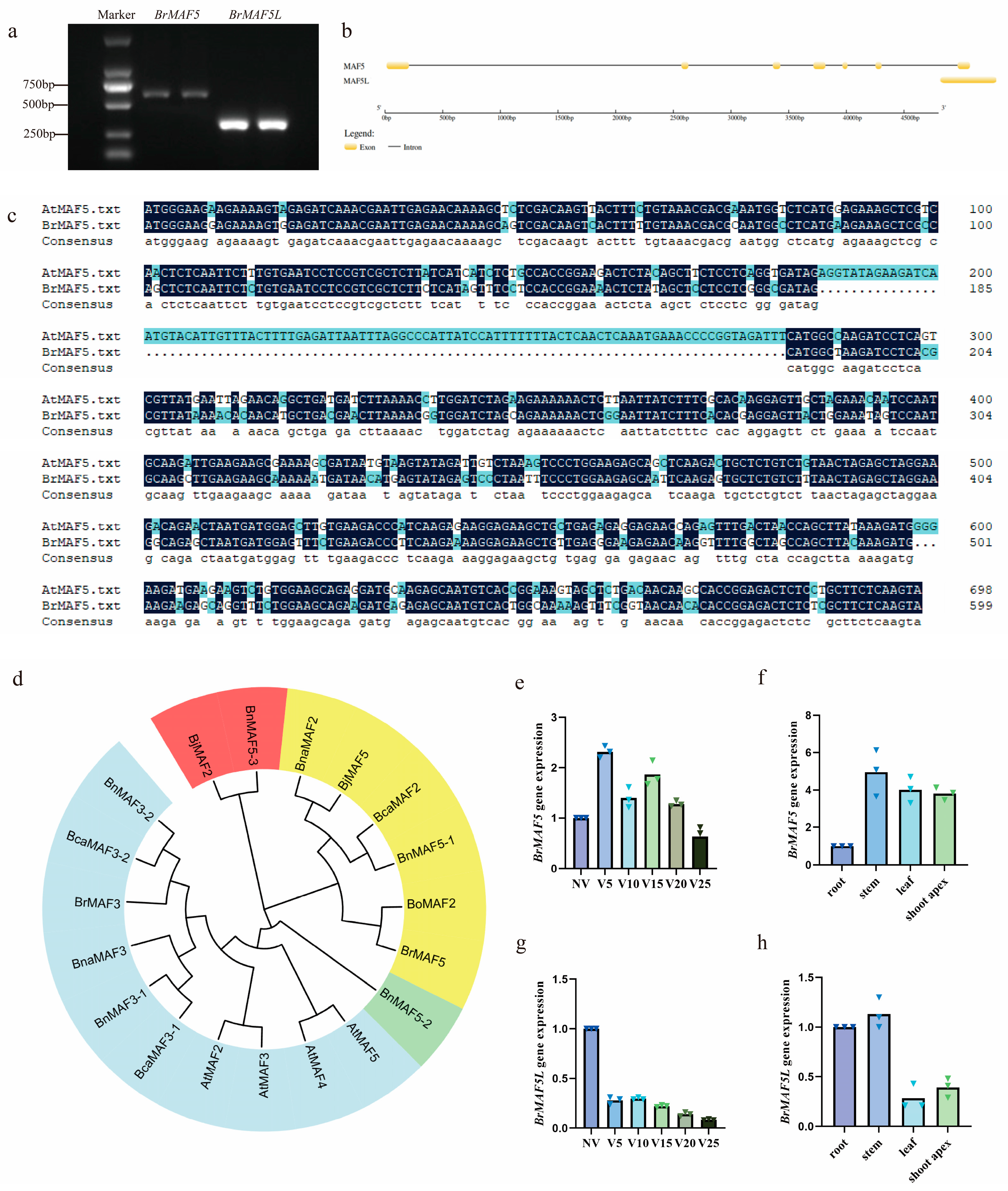
This study elucidates the expression patterns of
BrMAF5 and
BrMAF5L, finding that their expression levels decreased significantly with prolonged vernalization, a trend similar to the vernalization response pattern of the
Arabidopsis FLC gene [
12].
AtMAF5 has been functionally verified to be a flowering repressor [
23], Meanwhile, we also noted the opposite spatial expression patterns of
BrMAF5 and
BrMAF5L in roots, leaves, and shoots. This phenomenon could be attributed to the fact that Chinese cabbage is a vegetable that has undergone whole-genome triplication [
24,
25]. This event has led to structural and expressional changes in numerous genes during evolution. Our experimental validation confirmed that the expression levels of both
BrMAF5 and
BrMAF5L have indeed been altered.
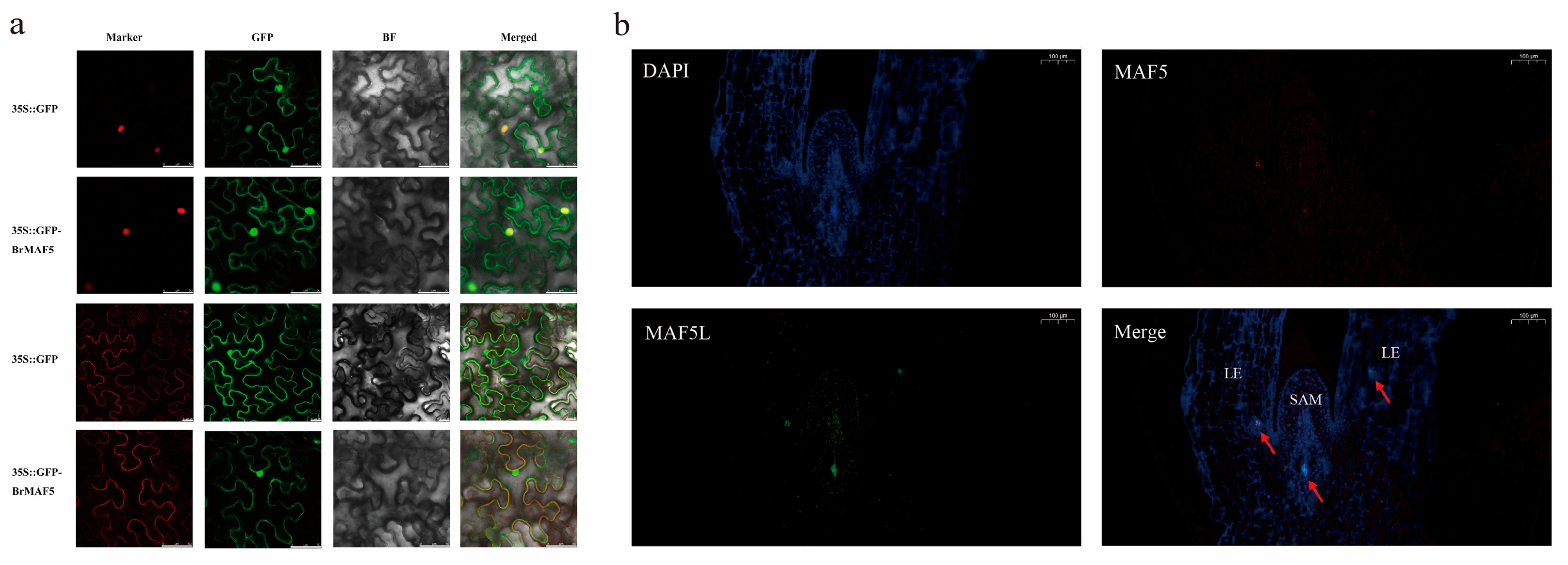
FISH analysis revealed that
BrMAF5L is adjacent to
BrMAF5 in shoot apex tissues, implying potential spatial regulatory relationships between them. Subcellular localization showed that BrMAF5 protein localizes to both the nucleus and cell membrane, consistent with the typical nuclear function of MADS-box transcription factors in regulating target gene expression [
26]. Fluorescence in situ hybridization further confirmed that
BrMAF5L might regulate
BrMAF5 expression through a cis-acting mechanism, analogous to the COOLAIR-mediated repression of
FLC in
Arabidopsis [
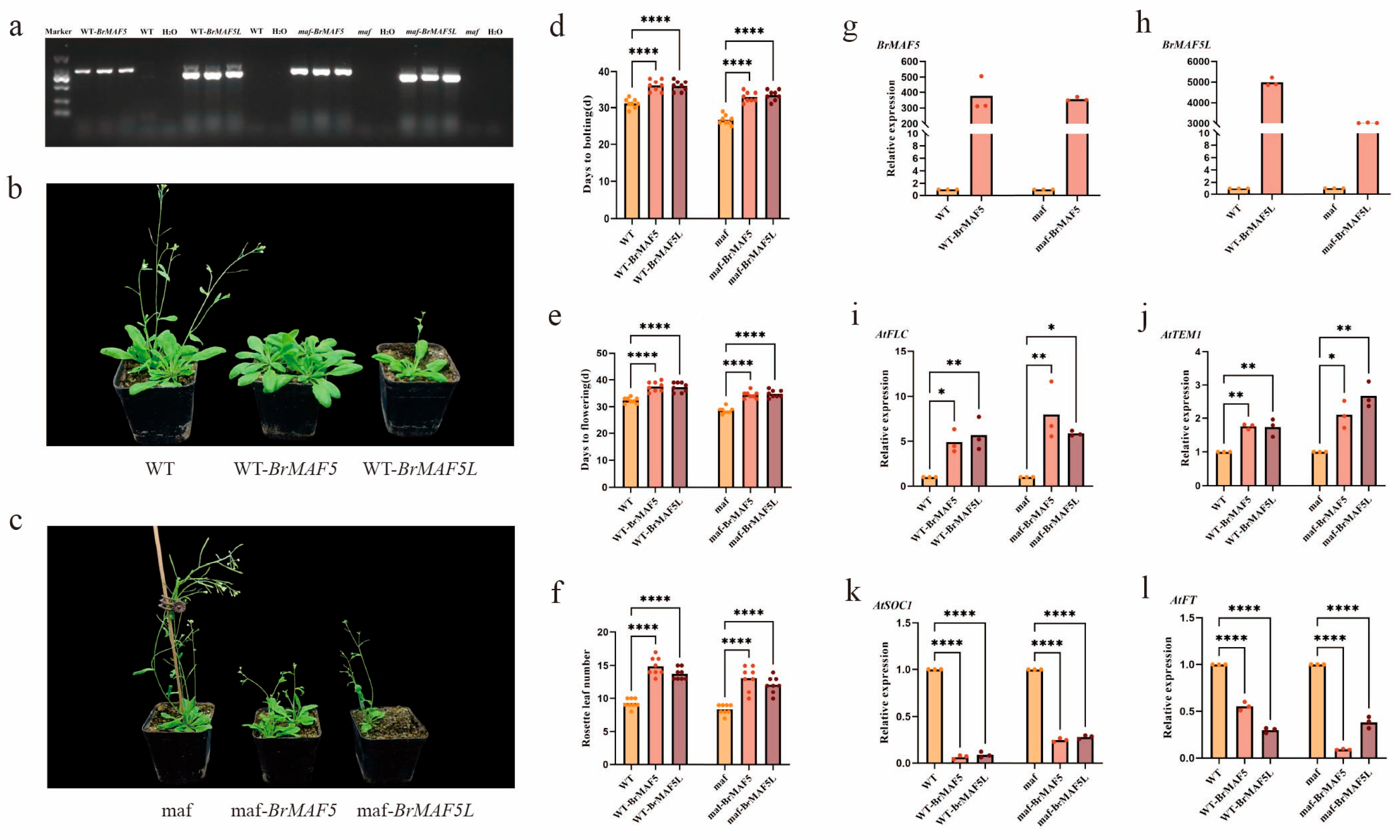
6]. Heterologous overexpression of both
BrMAF5 and
BrMAF5L in
Arabidopsis delayed flowering and increased rosette leaf number, supporting the hypothesis that
BrMAF5 acts as a flowering repressor. Further analysis revealed significant upregulation of flowering repressor genes (
AtFLC and
AtTEM1) and downregulation of flowering promoters (
AtFT and
AtSOC1) in overexpression lines. Notably,
AtTEM1 is a transcriptional repressor that negatively regulates the juvenile-to-adult transition and flowering transition by participating in multiple flowering pathways [
27];
SOC1 encodes a MADS-box transcription factor that integrates diverse flowering signals from photoperiod, temperature, hormone, and age-related pathways [
28]. These findings suggest that
BrMAF5 likely delays flowering by suppressing key flowering integrators such as
FT and
SOC1. This aligns with reports that
FRI expression in roots delays flowering by activating other MADS-box targets including
MAF4 and
MAF5 [
29]. Additionally,
BrMAF5L overexpression produced phenotypes similar to
BrMAF5, indicating it may regulate
BrMAF5 stability or transcriptional activity.
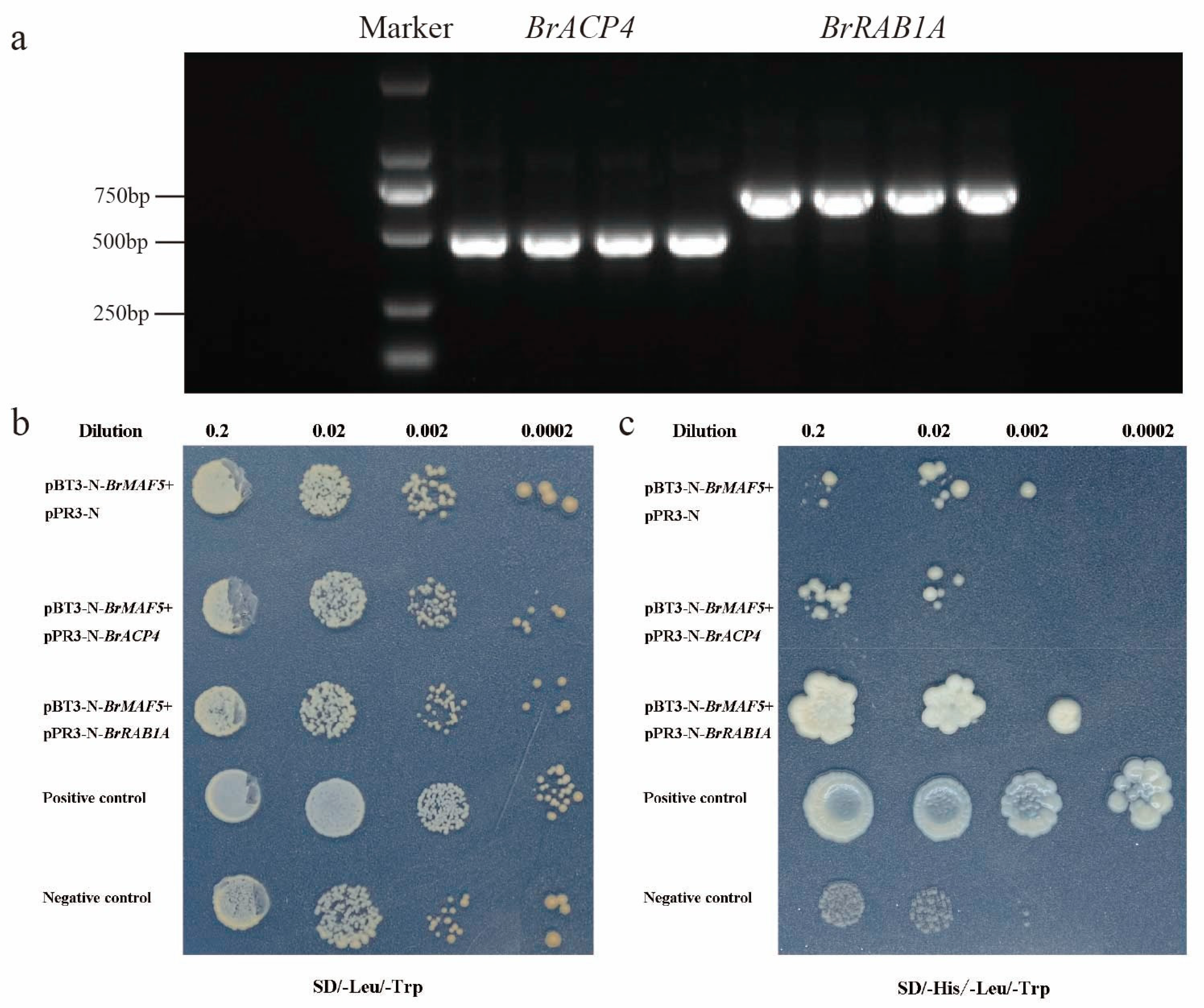
We verified the interactions between BrMAF5 and BrACP4 as well as BrRAB1A using yeast two-hybrid assays. Notably, the
Arabidopsis homolog ACP4 is involved in chloroplast lipid synthesis and responds to photoperiod regulation [
23,
30], while RAB1A plays a central role in vesicle trafficking and pollen development [
31]. Therefore, BrMAF5 may connect photoperiod and metabolic pathways through BrACP4, and influence membrane trafficking and reproductive development through BrRAB1A, thereby jointly regulating flowering time. Future research should focus on the dynamic changes in these interactions under different photoperiods and reproductive stages to reveal how
BrMAF5 integrates environmental and intracellular signals for precise flowering regulation.
In
Arabidopsis, studies have revealed that the flowering repressor
MAF5 is precisely regulated through multiple pathways: the deubiquitinase OTU5 activates the expression of
FLC,
MAF4, and
MAF5 through histone modifications to delay flowering [
32]; simultaneously, the T-hook/PPC domain protein TEK has been shown to directly negatively regulate flowering-related genes, including
MAF4 and
MAF5 [
33]. These findings provide critical clues for deciphering the regulatory mechanisms of
BrMAF5 in Chinese cabbage, particularly its potential integration of epigenetic and transcriptional inputs. The dosage accumulation of
FLC,
FLM, and
MAF genes (including
MAF5) determines whether plants exhibit annual or perennial habits [
34], suggesting that introducing
MAF5 may convert annual plants into perennial ones. This can be considered an extension of
MAF5’
s flowering regulatory function in
Arabidopsis and other plants. Thus, studying the
BrMAF5 gene holds significant importance for Chinese cabbage and other
Brassica crops.




 ,
,