1. Introduction
Double microencapsulation offers an innovative strategy for delivering probiotics in poultry nutrition, providing superior protection and functional performance compared with conventional single-layer systems. Given the challenges associated with probiotic stability and efficacy, encapsulation technologies have emerged as promising solutions [
1]. These positive attributes are especially noteworthy because single-layer encapsulation fails to protect probiotics from thermal stress, storage degradation, and bile salts, thus reducing viability. In fact, insufficient protection under these conditions frequently results in considerable loss of viable probiotic cells, diminished metabolic activity, and reduced colonization capacity within the gut. Thus, the synergistic design of the double-layer coating not only improves probiotic viability, but enables targeted gut release, and supports antibiotic-free production [
2]. By removing water under low-temperature and vacuum conditions, lyophilization is an effective encapsulation technique that preserves the structural integrity and bioactivity of probiotics and thermolabile phytogenic compounds, thereby minimizing oxidative degradation and cellular damage [
3]. Encapsulation within polymeric matrices further enhances compound stability, protects against environmental stress, and allows for targeted delivery [
4]. Clearly, double microencapsulation can enhance probiotic stability, targeted gut release, and antibiotic-free poultry production, outperforming single-layer encapsulation. Consequently, adoption can improve flock health, performance, and overall sustainability.
With the increasing demand for sustainable poultry feed, cereal by-products such as rice and wheat bran have emerged as novel encapsulation materials. These by-products are abundant in fermentable carbohydrates, fibers, and phenolic compounds, which act as prebiotics to promote gut health and fermentation. For instance, rice bran contains dietary fiber, protein, antioxidants, and γ-oryzanol, which exert antioxidant, anti-inflammatory, and immunomodulatory effects [
5]. Wheat bran is rich in insoluble fiber, especially arabinoxylans, which support microbial fermentation and metabolic health but can be further enhanced by processing techniques that improve digestibility [
6,
7]. The ability of bran fiber to act as a protective carrier during drying processes, such as freeze-drying and spray-drying, further strengthens its role as a sustainable prebiotic feed component [
8]. Thus, cereal by-products can simultaneously valorize agricultural waste streams and support the development of next-generation feed formulations. To overcome the challenges for sustainable poultry feed production, use of biopolymer-based microencapsulation can help protect probiotics against adverse conditions and ensure targeted gastrointestinal delivery [
9,
10].
In recent years, there has been a growing interest in synbiotics as functional feed additives for broiler diets [
11,
12]. Synbiotics, which are combinations of probiotics and prebiotics, create multifunctional products with synergistic benefits [
13]. These formulations improve gut health, modulate intestinal microbiota, enhance immune competence, and increase nutrient utilization, making them highly relevant for antibiotic-free broiler production systems [
14]. Prebiotics, mainly derived from polysaccharides and other plant-based substrates, act as selective energy sources for beneficial microorganisms, contributing to the improvement of the intestinal microflora. In parallel, probiotics, particularly lactic acid bacteria (LAB), such as
Lactobacillus,
Pediococcus, and
Staphylococcus, play crucial roles in maintaining microbial homeostasis, supporting digestion, enhancing immunity, and improving growth performance in poultry [
15,
16]. They contribute to pathogen exclusion and produce short-chain fatty acids (SCFA) that support intestinal health [
17]. Despite these benefits, the efficacy of probiotics in practical applications is often constrained by their sensitivity to temperature, acidity, exposure to bile salts, and storage conditions, factors that reduce their viability and functional stability [
18].
Phytobiotics or phytogenic feed additives are among the most promising innovations and are derived from herbs, plant extracts, and bioactive phytochemicals such as polyphenols, flavonoids, and polysaccharides [
19]. These compounds exhibit antioxidant, antimicrobial, and anti-inflammatory properties, and their supplementation in poultry diets improves nutrient utilization, microbial balance, and immunity [
20]. Among phytogenic ingredients,
Tiliacora triandra (Yanang in Thai) is a Southeast Asian medicinal plant rich in polyphenols, vitamins, dietary fiber, and prebiotic oligosaccharides with strong antioxidant and anti-inflammatory properties [
21]. This species also contains substantial levels of phytochemicals such as alkaloids, flavonoids, chlorophyll, and notably high levels of mucilaginous polysaccharides [
22,
23]. Furthermore, the xylose-rich polysaccharides in the leaves confer antioxidant and immunomodulatory functions, alongside structural properties that enable their use as natural encapsulating matrices for bioactive delivery in feed formulations [
24]. Although Yanang exhibits promising pharmacological potential, its incorporation into poultry nutrition remains underexplored and merits a systematic investigation.
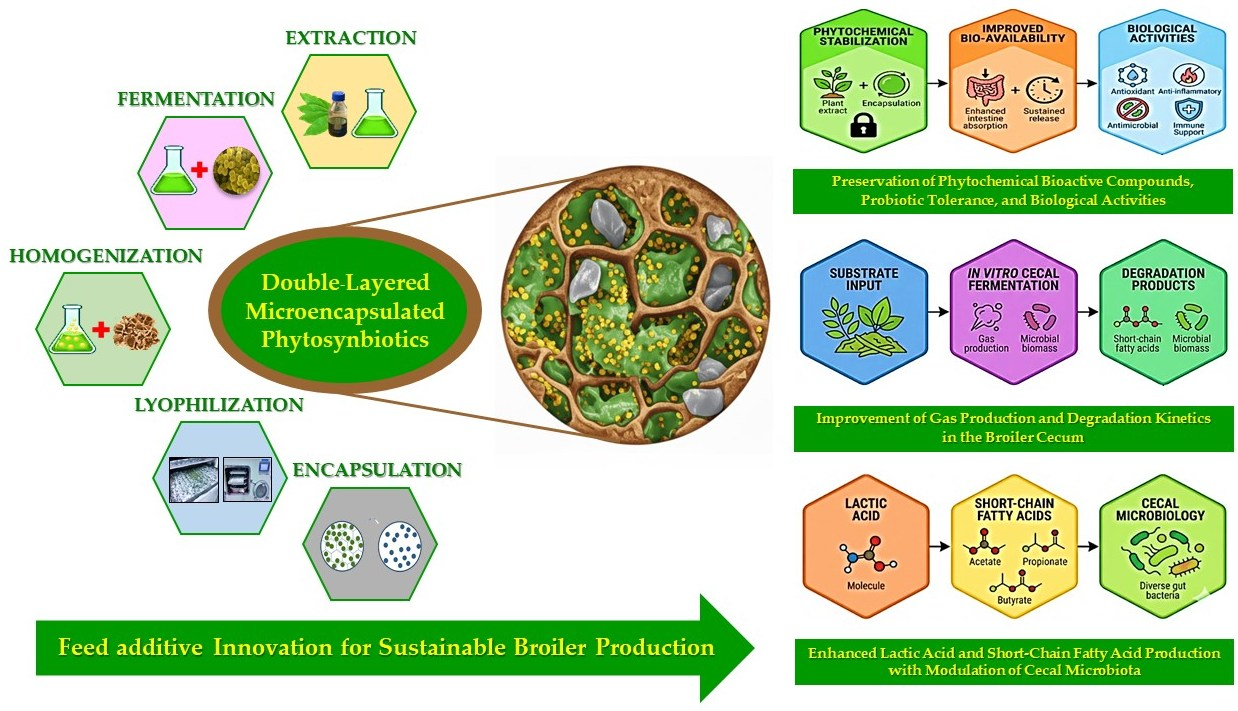
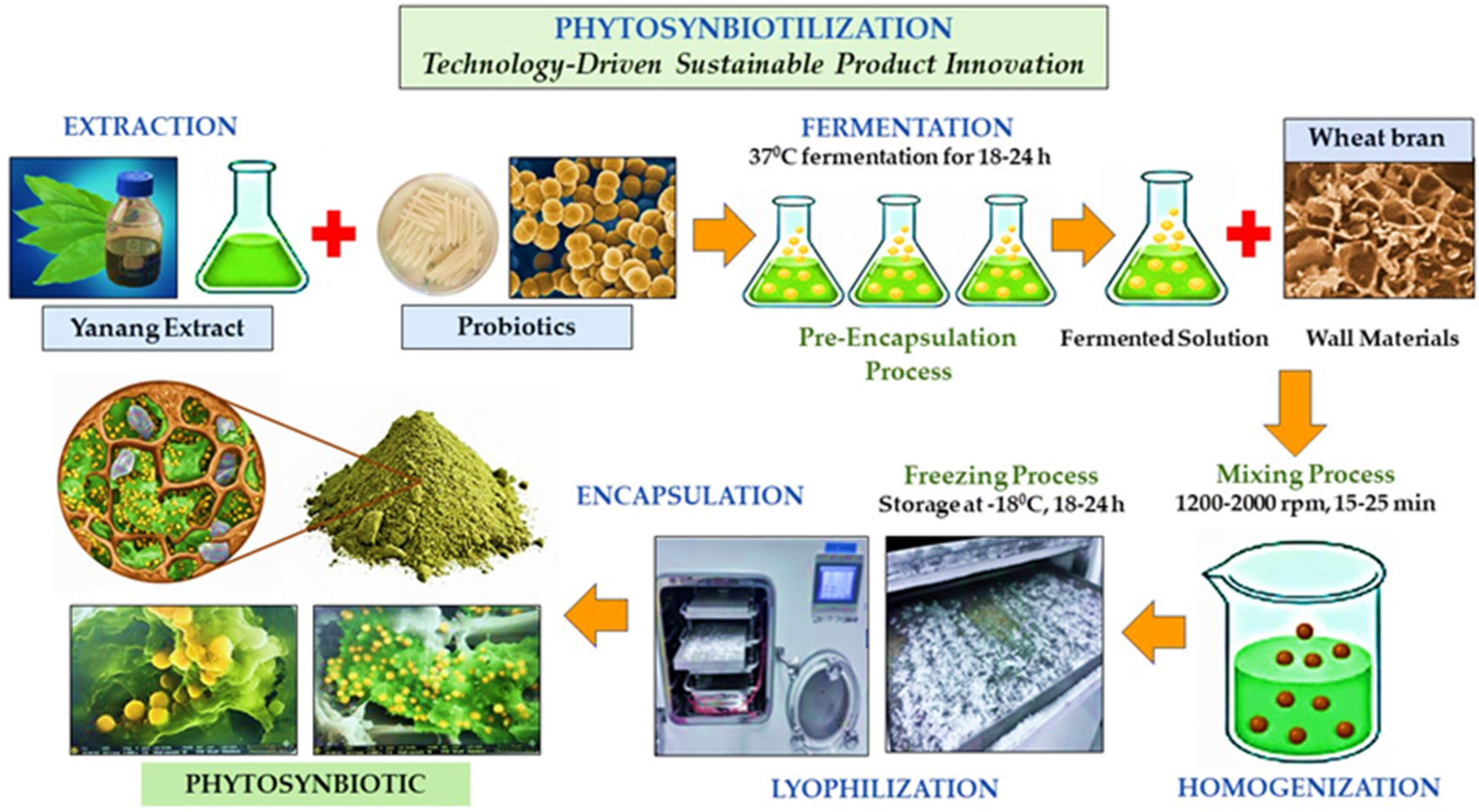
Building on these foundations, we introduce phytosynbiotics as a novel category of next-generation feed additives that strategically integrate phytobiotics with synbiotics into a unified multifunctional formulation. Phytosynbiotics combine plant-derived bioactive compounds from Yanang leaf with probiotics and cereal bran-derived prebiotics. In contrast to conventional synbiotics, which combine probiotics and prebiotics primarily for microbial modulation, phytosynbiotics achieve physical co-encapsulation and functional synergy through a proprietary double-layer microencapsulation system utilizing lyophilization. The primary layer comprises fermented Yanang mucilage, which functions as a natural hydrogel matrix to protect probiotics during processing and gastrointestinal transit. The secondary layer incorporates porous cereal bran, serving a dual role as a prebiotic carrier and structural reinforcement to enable targeted release in the distal sections of the gut. This approach represents a novel strategy for stabilizing probiotics and phytochemicals in a double-layered, lyophilized delivery system [
19]. Thus, by offering safe and eco-friendly alternatives that connect animal nutrition, environmental stewardship, and human health outcomes, phytosynbiotics align closely with the One Health concept and are within the framework of sustainable livestock production and consumer concerns regarding antibiotic resistance [
25].
This study aimed to develop and evaluate a double-layered microencapsulated phytosynbiotic (DMP) formulation containing Yanang leaf extract (YLE), probiotics, and cereal by-products via lyophilization. To address these aims, using an in vitro three-step digestibility model, we investigated the encapsulation efficiency, nutrient composition, bioactive retention, particle size, and effects of encapsulation on gastrointestinal tolerance, fermentative activity, and microbial viability. Ultimately, this study sought to transform local botanical and agricultural resources into globally applicable functional feed solutions to improve broiler production efficiency, support antibiotic-free production systems, and advance sustainable poultry farming.
4. Discussion
The present study demonstrated that both wall material and particle size significantly influenced the encapsulation efficiency, stability, physical characteristics, and nutritional composition of DMP formulations composed of
P. acidilactici V202 and YLE. Wheat bran emerged as the most effective wall material, yielding the highest probiotic viability (97.40%) and superior tolerance to gastrointestinal and thermal stress compared with defatted rice bran and corn. The enhanced performance of wheat bran can be attributed to its highly porous, fibrous structure, high β-glucan content, and abundant dietary fiber [
55], which collectively provide a protective matrix for probiotic cells during lyophilization and subsequent storage [
10]. A smaller particle size (0.6 mm) further improved encapsulation efficiency, probiotic viability, and stress tolerance by increasing the surface area and reducing interparticle voids, thereby promoting more uniform coverage and immobilization of probiotics within the wall matrix [
56]. The observed interaction between wall material and particle size for acid tolerance underscores the importance of optimizing both factors to maximize probiotic survival under harsh conditions.
The DMP formulation, composed of
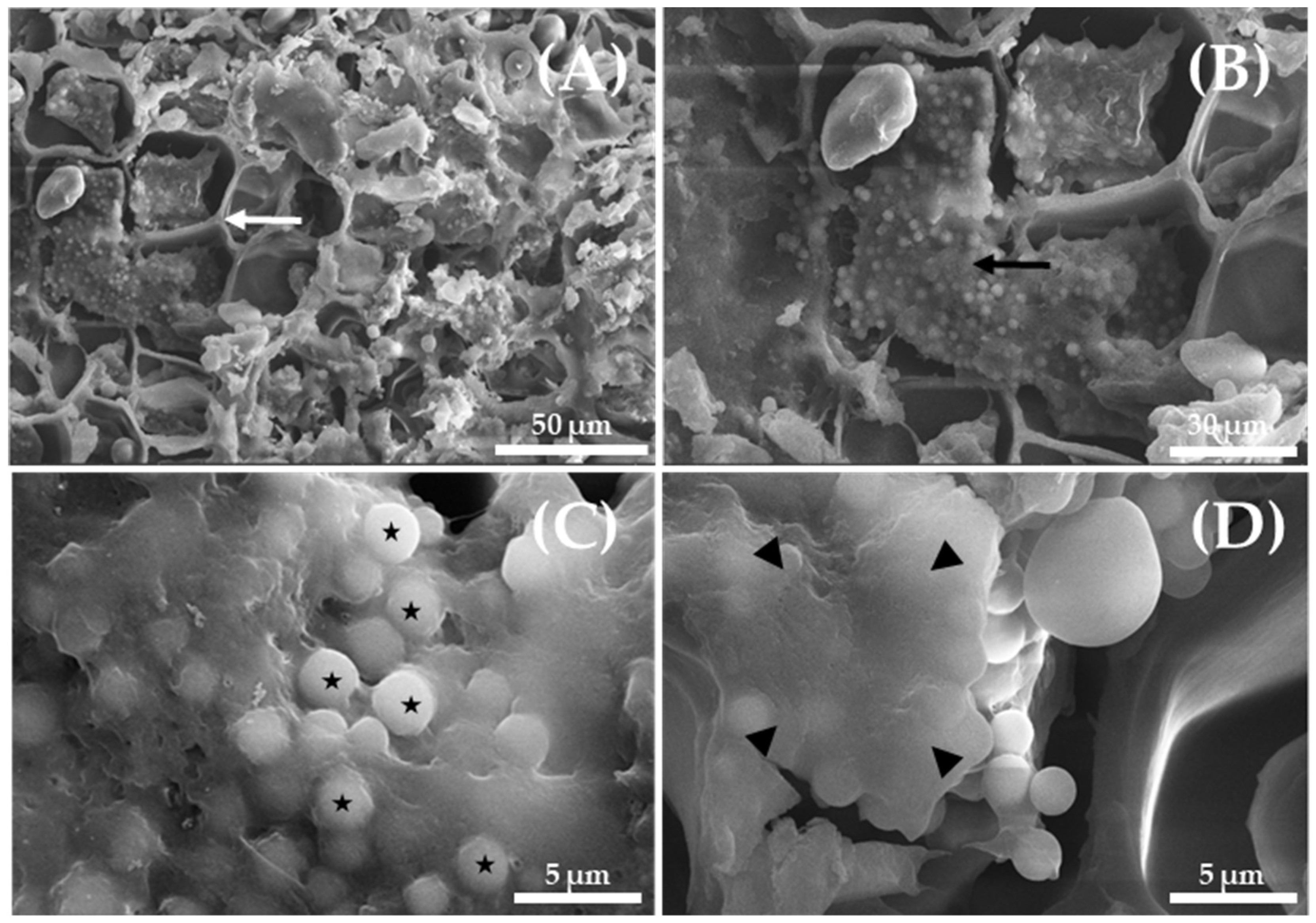
P. acidilactici V202 combined with YLE and double-layer microencapsulation within wheat bran, exhibited a well-defined morphology, as confirmed by scanning electron microscopy (
Figure 2), demonstrating the successful incorporation of both probiotics and YLE within the porous wheat bran matrix. The lyophilization process produced a stable, double-layered structure capable of protecting bioactive components from gastrointestinal enzymes and thermal stress while maintaining the structural integrity of encapsulated probiotics. During fermentation, the viscous YLE likely formed a protective hydrogel-like coating, enhancing bacterial stability and tolerance to environmental stressors, particularly at low temperatures [
57]. This observation aligns with previous studies [
58], which reported that biopolymer-based coatings in probiotic microencapsulation improved cell viability by providing physical protection and mitigating stress during processing and storage. This protective effect is likely due to the high polysaccharide content and unique rheological properties of YLE. Additionally, extracellular polysaccharides produced by lactic acid bacteria during fermentation [
59] contribute to both physical and biochemical barriers, creating a microenvironment with antioxidant activity that mitigates oxidative stress and preserves bacterial viability during fermentation and storage [
60].
The superior performance of wheat bran at 0.6 mm particle size can be mechanistically attributed to its unique physicochemical properties. Wheat bran’s high arabinoxylan content (approximately 70% of the total dietary fiber) [
6], characterized by feruloylated arabinoxylan side chains, endows it with an exceptional water-holding capacity, which is instrumental in maintaining microcapsule hydration during lyophilization, thereby preventing desiccation of probiotic cells. In addition, the water-holding and gel-forming properties of the extract maintain cellular hydration and reduce osmotic and freeze–thaw stress, further supporting the viability of probiotics [
61]. Our data suggest that the 0.6 mm particle size optimizes the surface area-to-volume ratio (increased by 45% vs. 1.0 mm), thus enhancing adsorption of Yanang mucilage into the bran pores. The porous structure and internal matrix of wheat bran serve as an effective physical carrier, providing an extensive surface area and a network of insoluble and fermentable dietary fibers, including arabinoxylans and cellulose [
10,
62], which facilitate microbial attachment and protection against environmental stressors, such as acidity, heat, and oxygen exposure.
The diffusion of viscous, polysaccharide-rich YLE into wheat bran pores enables deeper immobilization of probiotics [
63], forming a double-layer encapsulation system that enhances shielding from gastric acid and bile while supporting gradual release in the intestine [
64]. This composite strategy not only improves encapsulation efficiency and storage stability under varying conditions but also enables the controlled release of both probiotics and Yanang-derived bioactive compounds, maximizing their bioavailability and functional effects. Furthermore, the small particle size, high porosity, and β-glucan content of wheat bran contributed to superior probiotic viability (97.40%), outperforming that of defatted rice bran (96.24%) and corn (95.72%). Its porous matrix provides physical protection, retains bioactive compounds, and combined with its inherent prebiotic properties, supports microbial colonization and gut health. The polysaccharides and dietary fibers in wheat bran synergistically reinforce the encapsulation matrix, further promoting survival during storage and gastrointestinal transit [
65]. Collectively, these findings demonstrate that the combination of YLE and wheat bran constitutes a robust and efficient strategy for protection during processing, storage, and delivery, highlighting its potential application in functional feed and food systems, where stability, bioactivity, and controlled release of probiotics are critical for efficacy.
The physical and nutritional characteristics of DMP are largely determined by the type of wall material and particle size, which collectively influence the density, flowability, water activity, color, and macronutrient composition, ultimately affecting the stability and functionality of the encapsulated probiotics. Corn-based powders exhibit the highest bulk and tapped densities [
66] owing to their dense and starch-rich structure, which facilitates tighter particle packing. Wheat bran powders have the lowest densities, reflecting their highly porous and fibrous architecture [
67]. Smaller particle sizes (0.6 mm) increased packing efficiency and reduced interparticle voids [
68], particularly in corn powders, demonstrating a significant wall material × particle size interaction in powder handling and flowability. Flowability, evaluated via the compressibility index, was lowest in corn powders, while wheat bran and defatted rice bran powders exhibited higher flowability due to their fibrous and porous matrices that reduce interparticle cohesion [
69]. The higher water activity observed in wheat bran and defatted rice bran powders was attributed to the hygroscopic nature of dietary fibers, which provide water-binding sites that can influence probiotic survival and shelf life [
70]. Color attributes are also dependent on wall material and particle size [
71]. Defatted rice bran powders were lighter (higher L*), wheat bran powders exhibited higher redness (a*), and corn powders displayed greater yellowness (b*). Smaller particles generally enhance lightness and uniformity by promoting an even microcapsule distribution. From a nutritional perspective, wheat bran powders exhibit the highest levels of CP, CF, and GE [
72], providing a supportive matrix for both probiotic proliferation and prebiotic activity. In contrast, corn powder is richer in EE [
73] but contains lower protein and fiber levels, whereas defatted rice bran has intermediate nutritional values. These differences in macronutrient composition, together with the structural characteristics of the cell wall materials, play a key role in influencing the probiotic encapsulation efficiency and stability [
74]. Overall, the nutrient content was predominantly determined by the type of wall material, with particle size exerting only a minor effect, highlighting that the intrinsic properties of the carrier largely dictate the nutritional profile of the DMP.
The current findings demonstrate that DMP, prepared using YLE and wheat bran for double microencapsulation of probiotics, successfully preserves its phytochemical profile and bioactive functions, regardless of the probiotic strains involved. Tannins, total phenolics, flavonoids, carotenoids, and chlorophyll contents were comparable among
P. acidilactici,
L. plantarum, and
S. thermophilus, demonstrating that the microencapsulation process preserves the integrity of Yanang-derived bioactive compounds from degradation caused by oxygen, moisture, and adverse conditions [
75]. Antioxidant capacity, as evaluated by DPPH, ABTS, and FRAP assays, remained consistent across probiotic strains, indicating that the choice of probiotic does not compromise the free radical scavenging potential or reducing power of the powders [
76]. These results align with previous reports showing that polysaccharide-rich plant extracts and hydrogel-forming carriers [
77], such as wheat bran, provide a protective environment that stabilizes phytochemicals during processing and storage, preventing degradation under thermal or oxidative stress. In addition, the antibacterial activity of DMP was moderate and primarily bacteriostatic [
78], with greater efficacy against Gram-positive (
B. cereus and
S. aureus) than Gram-negative bacteria (
E. coli). The observed differential inhibition likely reflects the structural differences in the bacterial cell wall. Gram-positive bacteria possess a thick peptidoglycan layer that is more susceptible to tannins and polyphenols [
79], which can bind to cell wall proteins, disrupt membrane integrity, and interfere with enzymatic activities [
80]. In contrast, the outer membrane of Gram-negative bacteria confers partial resistance, limiting the penetration of phytochemicals. Among the probiotic strains,
P. acidilactici supernatant exhibited significant inhibitory activity against
S. aureus, with a minimum inhibitory concentration of approximately 10–20%
v/
v, primarily exerting a bacteriostatic effect by delaying bacterial growth rather than directly killing the cells [
81]. This inhibition is likely driven by the synergistic action of organic acids, such as lactic acid, and bacteriocin-like compounds, including pediocin, which are known to target Gram-positive pathogens [
82,
83]. The susceptibility of
S. aureus can be attributed to its thick peptidoglycan cell wall [
84], which is more vulnerable to tannins and polyphenols [
85]. These plant-derived bioactives can bind to cell wall proteins, compromise membrane integrity [
86], and interfere with enzymatic functions, thereby enhancing bacteriostatic effects [
87]. Although bactericidal activity was not observed, the combined action of
P. acidilactici metabolites and YLE bioactives effectively limited pathogen proliferation while maintaining the overall microbial balance. This suggests that
P. acidilactici inhibits the growth of
S. aureus primarily via bacteriostatic mechanisms, with its activity enhanced by tannins and polyphenols, offering an effective approach for pathogen control in the developed DMP formulations.
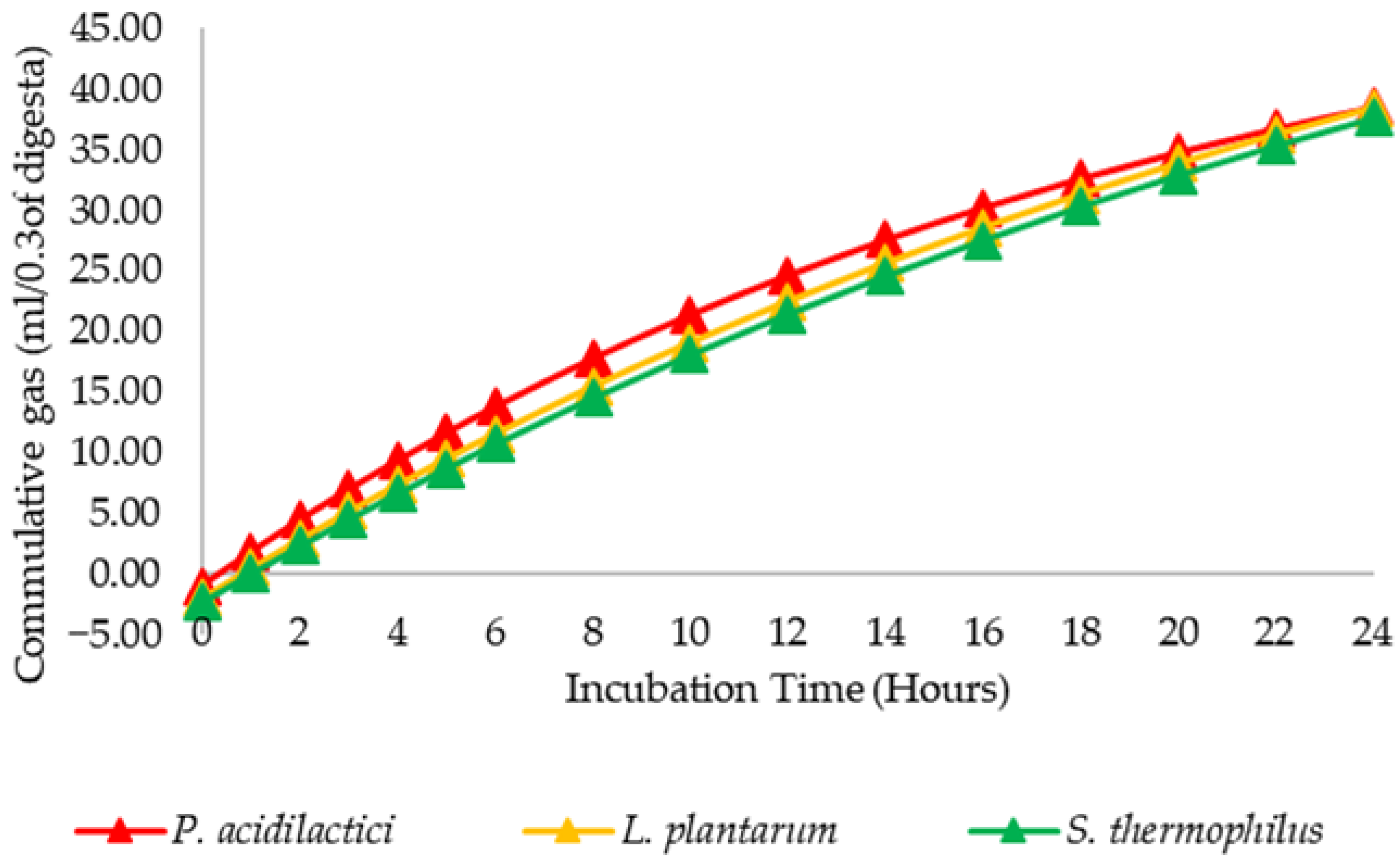
In the present study, phytosynbiotic formulations derived from YLE and containing double-microencapsulated probiotics exhibited distinct strain-dependent influences on in vitro cecal fermentation dynamics. The DMP formulation with
P. acidilactici resulted in higher gas production during the early incubation period (4–16 h) and had the greatest rapidly fermentable fraction and fermentation rate, whereas
L. plantarum and
S. thermophilus exhibited slower and more prolonged fermentation.
P. acidilactici also enhanced lactic acid and total SCFA production, particularly acetic and butyric acids, which are critical for maintaining gut barrier integrity [
62], supporting energy metabolism, and facilitating microbial cross-feeding. However, the enhanced production of SCFA by
P. acidilactici occurs through its heterofermentative phosphoketolase pathway rather than the homofermentative metabolism route used by
S. Thermophilus [
88]. These effects occurred without altering the total cecal microbial populations, indicating that the observed changes were primarily driven by the metabolic activity of the encapsulated probiotics [
89]. Combined with the high survival rate during simulated ileal digestion (97.88–98.20%) and stable retention of phytochemicals, these results confirm the functional efficacy of the formulations.
The superior nutrient utilization and early fermentation of
P. acidilactici can be attributed to its strong fermentative capacity, including rapid acid production and efficient exopolysaccharide (EPS) synthesis [
90]. EPS contributes to substrate degradation, feed digestibility, and antioxidant protection against reactive oxygen species and lipid peroxidation, thereby supporting gut health [
90]. The associated increase in SCFA production, particularly acetic and butyric acids, reinforces intestinal barrier function, supplies energy to colonocytes, modulates immune responses, and preserves microbial homeostasis [
91]. Butyric acid, in particular, serves as a key energy source for colonocytes and promotes anti-inflammatory processes [
92]. Enhanced SCFA production by
P. acidilactici supports microbial cross-feeding in the gut, amplifying its beneficial effects on gut health. Specifically,
P. acidilactici mainly produces acetic acid, which serves as a substrate for other gut microbes to convert into butyric acid, a critical SCFA for colonocyte energy and intestinal health [
62]. This cross-feeding between microbes boosts butyrate levels, helping to maintain intestinal barrier integrity, modulate immune responses, reduce oxidative stress, and promote anti-inflammatory processes [
93].
Increased SCFA production also correlates with a higher abundance of beneficial bacteria, such as Actinobacteria, Faecalibacterium, Lachnospiraceae, and Ruminococcaceae [
94,
95], which further contribute to gut homeostasis by continuously fermenting dietary fibers and supporting gut barrier function [
96]. Thus, the interaction between
P. acidilactici and other commensal microbes via SCFA cross-feeding enhances the overall gut microbial ecosystem and its health benefits. Furthermore, supplementation with
P. acidilactici has been linked to increased antioxidant enzyme activity, reduced oxidative stress, and a higher abundance of beneficial gut bacteria, contributing to a balanced intestinal microbiome. Collectively, these attributes highlight
P. acidilactici as a promising functional feed additive for improving gut fermentation efficiency, SCFA production, microbial balance, and overall gastrointestinal health in chickens.
While this study has demonstrated excellent in vitro performance of the DMP formulations, the findings constitute preliminary evidence that necessitates validation through in vivo trials with broilers. Assertions regarding the promotion of gut health, enhancement of productivity, optimal inclusion rates, cost-effectiveness, carcass quality, and improvements in immune parameters remain to be substantiated in practical settings. As such, future research should aim to establish practical dosage levels, assess long-term efficacy under commercial production conditions, evaluate economic viability in comparison to antibiotic alternatives, and investigate the impacts on broiler performance metrics and immune biomarkers. These critical next steps will determine the commercial applicability of DMP in antibiotic-free poultry systems.



 ,
,