Article

Adsorbed Carrier Solid-State Fermentation of Beauveria bassiana: Process Optimization and Growth Dynamics Modelization Based on an Improved Biomass Determination Method


1
College of Chemistry and Chemical Engineering, Yan’an University, Yan’an 716000, China
2
Shaanxi Key Laboratory of Chemical Reaction Engineering, Yan’an University, Yan’an 716000, China
*
Author to whom correspondence should be addressed.
Fermentation 2026, 12(1), 15; https://doi.org/10.3390/fermentation12010015 (registering DOI)
Submission received: 1 December 2025 / Revised: 23 December 2025 / Accepted: 25 December 2025 / Published: 27 December 2025
(This article belongs to the Section Fermentation Process Design)

Abstract

To optimize and model the fermentation process of Beauveria bassiana, adsorbed carrier solid-state fermentation (ACSSF) was used with rice husk as the inert support. The sample pretreating method was improved by combining homogenization and ultrasonic treatment after dry crushing; the large particles (100–1000 μm in size) were broken and the content of small particles (2–100 μm in size) increased, and the relative standard deviation of the biomass detection method was as low as 3.32% (intra-day) and 3.75% (inter-day). The most suitable carbon source—cassava starch—and the most suitable nitrogen source—corn steep liquor powder (CSLP)—were screened from multiple carbon and nitrogen sources. Through single-factor optimization and an artificial neural network combining genetic algorithm optimization, the optimal recipe including cassava starch 0.0314 g·cm−3, CSLP 0.004885 g·cm−3 and water 0.2630 g·cm−3 was obtained, and the highest biomass yield was verified as 0.1379 g·cm−3, which was 45.0% higher than the original recipe before the optimization (0.0951 g·cm−3). The modeling of microbial growth was based on the Logistic model and executed by nonlinear regression with the R2 value as high as 0.9525 and absolute value of the residues completely under 0.003 g·cm−3, which validated not only the feasibility of modeling the growth kinetics of B. bassiana using total biomass content, but also the reliability of the improved biomass pretreating and determination method.

1. Introduction

As a well-known and widely used microbial insecticide, Beauveria bassiana has received significant attention from the fields of biomanufacturing and plant protection. Meanwhile, the dry powder and the suspension of its conidia are the most common forms [1,2,3]. The insecticidal mechanism of B. bassiana is to degrade the insect cuticle by extracellular enzymes such as chitinases, lipases and proteases, and then invade the insect body to release toxins, without releasing toxic compounds to humans and animals into the environment during the insecticidal process [1,4,5,6]. Although the time the mycoinsecticides need to control insects is generally longer than that for chemical insecticides, they are encouraged to be used because of the advantages in environmental protection and food safety [7,8,9]. Conidia in solid-state fermentation (SSF) and blastospores in submerged fermentation (SmF) are two important forms of the entomopathogenic fungi B. bassiana, and the insecticidal activity of conidia from SSF is higher than that of the blastospores from SmF [10,11,12]. Therefore, although some valuable by-products other than blastospores, such as oosporein and R-2-(4-hydroxyphenoxy) propionic acid, can also be produced in SmF, most of the microbial insecticides derived from B. bassiana in the market are still conidia products such as dry powder and suspension in oil, and it is of obvious economic value to promote the biomass yield of SSF processes in the production of B. bassiana conidia [13,14].
SSF is an important type of industrial fermentation which has been widely used in the production of traditional foods, feeds, biofuels and microbial insecticides [12,15,16,17]. This type of fermentation is a mode using SSF substrates or supports without free water or only containing a very small amount of free water [18,19]. In the industrial SSF feedstocks, microorganisms grow in the inter-particle spaces, the particle surfaces and even in the pores or cracks inside the particles [18]. Since it is difficult to separate the microorganisms with the feedstock particles in SSF, it is infeasible to use conventional biomass detection methods such as optical density (O.D.) and dry cell weight (D.C.W.). Otherwise, the plate-counting method (determining the parameter Colony-Forming Unit, CFU) and cell counting method (usually using a hemocytometer) are both fit for single-cell organisms such as yeasts, fungal spores and bacteria, but they cannot be used in the determination of hyphae content [18,20]. At present, indirect methods by detecting the content of a special component are the mainstream methods for hyphae content determination in SSF fermentation feedstocks, including ergosterol, glucosamine, nucleic acid, etc. [20]. As a unique component of microbial organisms, glucosamine is widely used for biomass determination in SSF with 3-methyl-2-benzothiazolone hydrazone hydrochloride (MBTH) as the chromogenic agent [21,22,23,24]. To fit the appropriate concentration range for this chemical detection method, the sample size is usually as small as several hundreds or even several tens of milligrams. However, the particle size of the crushed SSF feed stock is usually uneven and the particles are commonly heterogeneous between each other, easily bringing large errors into the detection. Thus, it is important to improve the crushing process and evaluate the quality of crushing results by detecting the particle size, so as to elevate the uniformity of the SSF samples for the detection of the unique components. As a commonly used instrument, a laser particle size analyzer can determine the particle size not only in a dry powder state but also in a suspension state, so it has the potential to be used in the evaluation of crushed SSF samples, which could be beneficial for improving the uniformity of these samples [25,26].
In the industrial SSF production of conidial insecticides, the homogeneity of temperature and moisture distribution inside a fermentation bed is a bottleneck for the scaling up of solid-state bioreactors, and redesigning the reactor structure is an important way to mitigate this problem which has received much attention [17,19,27,28]. On the other hand, increasing the porosity of the fermentation bed is also an effective way which includes the use of adsorbed carrier solid-state fermentation (ACSSF) and the addition of rigid particles into the nutritional media [29]. In some reported ACSSF fermentation beds, high voidage (inter-particle) and porosity (intra-particle) were obtained by using polyurethane foam as a carrier, which benefited the production of xanthan, rhamnolipid and polyunsaturated fatty acids [30,31,32]. In addition, some rigid particles obtained from agro-industrial wastes such as sugar cane bagasse, rice husk and pistachio shell can also make the SSF bed more porous and intensify the heat and water transfer [33,34,35]. Thus, it is feasible to use these agro-industrial waste particles as the inert carrier in an ACSSF process. As a widely used rigid particle, rice husk possesses uniform particle size and consistent particle morphology, which is superior to crushed particles such as corn cob [36] and bagasse [33], and it thus becomes an ideal carrier for ACSSFs [35,37]. However, in the previous reports, rice husk was used as the sole medium without supplementing other nutrition [35,38]. Thus, in the present research, carbon sources and nitrogen sources were added into the rice husk to further promote the biomass yield.
According to an SSF process producing B. bassiana conidial insecticides, as common sense, the cost of media is also a key factor affecting its economic feasibility, and it is necessary to develop cheap media, especially nitrogen sources [39,40]. Plenty of feedstocks from agricultural by-products have been used in B. bassiana conidial or blastospore production, such as wheat, wheat bran, potato, quinoa wheat germ, oat bran, flax, beer draff, potato peel and cottonseed flour [2,38,41,42]. Nevertheless, as a waste of the starch industry which contains abundant proteins, vitamins and organic acids, corn steep liquor (CSL) has not been widely used in the SSFs producing B. bassiana conidia. Since CSL has precedents for being used in other fermentation products, it has the potential to act as a cheap nitrogen source in the SSF of B. bassiana conidial [43,44].
As a widely recognized artificial intelligence technology in recent years, artificial neural networks (ANNs) have been widely used in the optimization of fermentation processes [45,46]. However, they have not been used in the optimization of SSF processes with B. bassiana. Thus, in the present research, the ANN model was employed to obtain optimal SSF conditions for the biomass production. On the other hand, as an important foundation of process controlling, the microbial growth kinetic model has received widespread attention [47]. However, most of the reported studies on the microbial growth process of B. bassiana were based on the conidia yield [2,12], and since conidium is not the only form of the filamentous fungus B. bassiana during the whole SSF process, it is difficult to construct a microbial growth kinetic model solely based on the conidia yield. Therefore, to develop a microbial growth kinetic model, it is necessary to detect the total biomass yield during the whole SSF process using MBTH method, and this is also one of the targets of the present research.
In the present research, to develop an ACSSF media suitable for B. bassiana conidia production, single-factor experiments, central composite designed experiments and an artificial neural network (ANN) model have been carried out, with rice husk used as the ACSSF carrier. However, since the mycelium of the strain B. bassiana ACCC 30736 is dense and easily agglomerates, which could interfere the detection of conidia amount by the cell counting method and then reduce the accuracy of biomass detection, the MBTH method was used to evaluate the total biomass yield as the evaluation metric for the ACSSF process. Since the rice husk is rigid and it is difficult to completely crush into small particles, a laboratory homogenizer was used to further break the rice husk particles in the state of suspension, and a laser particle size analyzer was used to evaluate the result of the sample pretreating method. These studies revealed that combined homogenization and ultrasonic treatment was effective to increase the detection accuracy of biomass in ACSSF by the MBTH detection method, and it is feasible to produce B. bassiana biomass by the ACSSF technique using rice husk as the carrier with the carbon source and nitrogen source supplemented, and the results also validated the feasibility to model the microbial growth process of B. bassiana with the biomass data obtained by the MBTH detection method.

2. Materials and Methods

2.1. Microbial Strain and Inoculum Preparation

The microbial strain B. bassiana ACCC30736 was purchased from the Agricultural Culture Collection of China (ACCC). The original strain grown on a PDA slant was preserved in liquid paraffin at 4 °C, and it was inoculated on a newly prepared PDA slant and cultivated at 28 °C for 4 days before each use. The inoculum used for ACSSF was inoculated by a piece of lawn measuring 1 cm × 1 cm (approximately) and cultivated in a liquid medium containing soy protein isolate 10 g·L−1 and glucose monohydrate 20 g·L−1 in a 250-mL Erlenmeyer flask with 4 baffles and cultivated at 28 °C and 140 rpm for 48 h in an shaker incubator (OLB-2102C, Shandong OLABO Instrument Co., Ltd., Ji’nan, China).

2.2. ACSSF Experiments for Single-Factor Optimizations and ANN Optimization

All the optimizations were carried out in 250 mL Erlenmeyer flasks as the ACSSF reactor. Each flask contained 6.5 g dry rice husk as the carrier (with the packing volume at 80 cm3 after water absorption and autoclaving), and the fermentations were all carried out in a thermostatic and humid static incubator (XT5107-IH250, XUTEMP THERMOTECH Co., Ltd., Hangzhou, China) with the temperature kept at 28 °C and the humidity kept at 70% (R.H.) for 6.5 days. The dosage of carbon source, nitrogen source and water were designed according to the different demand of each experiment. In the single-factor experiment for carbon source screening, pea starch (net content 95%), corn starch (net content 95%), sweet potato starch (net content 80%), cassava starch (net content 90%) and potato starch (net content 95%) were used separately with the same dosage of 0.025 g·cm−3 (weight/bed volume); the common nitrogen source was corn steep liquor powder (CSLP) with a dosage of 0.0060 g·cm−3, and the water dosage was 0.160 g·cm−3. In the single-factor experiment for nitrogen source screening, since the different nitrogen sources possessed different protein contents, the dosage of each nitrogen source was calculated based on its protein content to keep the protein contents used in all the tests the same: CSLP 0.0060 g·cm−3 (protein content 42%), soy peptone 0.0050 g·cm−3 (protein content 50%), soy protein isolate 0.0028 g·cm−3 (protein content 89%), soybean meal powder 0.0056 g·cm−3 (protein content 45%) and corn protein powder 0.0042 g·cm−3 (protein content 60%) were used separately; the common carbon source was cassava starch with a dosage of 0.025 g·cm−3, and the water dosage was 0.160 g·cm−3. In the single-factor experiment optimizing the dosage of carbon source, the dosage of cassava starch (the optimal carbon source obtained from the above screening) ranged from 0.005 g·cm−3 to 0.045 g·cm−3, and in the optimization of nitrogen source, the dosage of CSLP (the optimal carbon source obtained from the above screening) ranged from 0.002 g·cm−3 to 0.010 g·cm−3. In the optimization of moisture content, the water dosage ranged from 0.16 g·cm−3 to 0.28 g·cm−3, with 0.025 g·cm−3 of cassava starch and 0.006 g·cm−3 of CSLP used. In the central composite designed (CCD) experiment, the dosages of cassava starch, CSLP and water were arranged as shown in Table 1. The experiments for kinetic growth model construction and the detection of growth curves were carried out under the optimized ACSSF conditions.

2.3. ANN-GA Optimization

An ANN model consisting of three layers, including an input layer, hidden layer and output layer was constructed and trained to predict the optimal biomass yield and the corresponding dosage of cassava starch, CSLP and water [45,46]. The results of CCD experiments were used for the training of the model, and the input and output data were scaled using the “mapminmax” function. The data points were randomly divided into three subsets: the training set (70%), the validation set (15%) and the testing set (15%). The training set was used for model training and parameter adjustment, the validation set was used to evaluate and optimize model hyperparameters during the training process to prevent overfitting, and the test set was used to ultimately evaluate the model’s generalization ability and actual performance on unseen data. The hyperbolic tangent transfer function “tansig” was chosen as the mapping from the input layer to the hidden layer, while the linear transfer function “purelin” was chosen as the mapping from the hidden layer to the output layer. In the training process of the model, a Levenberg–Marquardt backpropagation (LMBP) algorithm was used, with the maximum number of epochs set at 50, the learning rate at 0.01, and the target error at 0.001. To minimize the mean square error (MSE) between predicted and experimental values, the deviation and weight of the ANN was adjusted. The MSE value was calculated as the following Equation (1):
M S E = 1 z i = 1 z ( x x ) 2
In the equation, z is the number of samples, x is the experimental value, and x′ is the predicted value. In the extremal optimization, the Genetic Algorithm (GA) was applied using the formal ANN as the fitness function. In the GA process, the individual group was randomly generated, and the fitness function was used to estimate the individual performance. The principle was followed that the individuals with higher fitness values were more likely to produce offspring. The operations of selection, crossover and mutation were repeated, until the performance of the optimal individual tended to stabilize, and then the maximum value of the objective function and the optimal composition of the ACSSF media were obtained. The settings of the GA method were as follows: the population size was 10, the number of iterations was 100, the crossover probability was 0.4, and the mutation probability was 0.1. The software MATLABTM 2019a, including the Neural Network Toolbox and the Global Optimization Toolbox, was used in the ANN-GA optimization.

2.4. Kinetic Model of Microbial Growth

In the kinetic model construction, the reported Logistic model was applied [47]. The nonlinear regression was carried out based on the biomass data in the ACSSF samples using the optimized media in 250 mL Erlenmeyer flasks. The differential form of the model was as follows:
dX dt = μ X 1 X X m
The integral form of the model was as follows:
X = X m 1 + X m X 0 1 e μ t
In the above Equations (2) and (3), X is the biomass content of the SSF media (g·cm−3), t is the fermentation time (h), μ is the specific growth rate (h−1), X0 is the initial biomass content (g·cm−3) and Xm is the maximum biomass content (g·cm−3). The software MATLABTM including the Curve Fitting Toolbox was used for the nonlinear regression.

2.5. Pretreatment of ACSSF Samples and Granularity Analysis

The biomass determination method was improved based on the original reports [21,22]. At the end of the ACSSF process, the feedstock in each fermentation flask was dried at 80 °C until constant weight, and then transferred into a crusher (AQ-180E 50 mL, NAIOU Electric Appliance Co., Ltd., Cixi, China) and crushed for 5 min. In the experiments on improving the pretreatment method, different ways and their combinations were tried (details introduced in the “Results” section). When the homogenization method was used to further process the crushed sample, the sample powder was transferred into pure water and homogenized by a rotor–stator homogenizer (HR-10B, Huxi Industry Co., Ltd., Shanghai, China) at its highest turning speed. When the agitation method was used in the further processing step, an overhead stirrer equipped with a Φ50 mm disc mixer (RWD-50, Huxi Industry Co., Ltd., Shanghai, China) was used. When the ultrasonic treatment was conducted on the sample suspensions, an ultrasonic cleaning machine (SN-QX-32, Shangyi Instrument Equipment Co., Ltd., Shanghai, China) was used, with the suspensions filled in 100 mL volumetric flasks. The flasks were settled into the sink of the ultrasonic cleaning machine, and the sink was loaded with tap water, with the water level in the sink 1–2 cm higher than the water level inside the volumetric flasks. The ultrasonic cleaning machine was then turned on, and it worked at its highest power (120 w) for 30 min. To evaluate the effectiveness of the pretreatment methods, a laser particle size analyzer (Mastersizer3000 + Ultra, Malvern Instruments Limited, Malven, UK) was applied to detect the particle size in the suspension.

2.6. Biomass Determination (MBTH Method)

After the pretreatment, 200 μL of the suspension was added into a 25 mL pressure-resistant hydrolysis tube and mixed with 1 mL of 60% (w/v) H2SO4 solution in water, then kept at 25 °C for 24 h in a constant-temperature water bath (HH-2, LICHEN BANGXI Instrument Technology Co., Ltd., Shanghai, China). After the above room-temperature hydrolyzing, the H2SO4 concentration was diluted into 1 mol·L−1 by supplementing pure water, and a high-temperature hydrolyzation was executed in an autoclave (BKQ-Z751, Shandong Boke Sterilizing Equipment Co., Ltd., Jinan, China) at 121 °C for 60 min. The hydrolytic solution was neutralized to pH 7.0, and diluted to 100 mL. After filtration by a filter paper, I mL of the filtrate was added to a test tube with a sealed threaded cap, and then 1 mL of 50 g·L−1 NaNO2 (MACKLIN, Shanghai, China) and 1 mL of 50 g·L−1 KHSO4 (MACKLIN, China) solution were added to the test tube in sequence, and the test tube was sealed and intermittently shaken for 15 min. Next, 2.4 mL of the test solution in this test tube was taken out and mixed with 0.8 mL of 125 g·L−1 NH4SO3NH2 (MACKLIN, China) in another test tube. After shaking for 3 min, the new test solution was mixed with 0.8 mL of 5 g·L−1 3-methyl-2-benzothiazolone hydrazone hydrochloride (MBTH, MACKLIN, China), and the test tube was sealed and heated in a boiling water bath for 3 min. This test solution was immediately cooled to 25 °C and mixed with 0.8 mL of 5 g·L−1 FeCl3. The terminal test solution was kept at a 25 °C water bath for 30 min, and then immediately cooled to 4 °C by a water bath, and its absorbance was detected immediately within 10 min by a spectrophotometer (UV-1800PC, MAPADA Instrument Co., Ltd., Shanghai, China) at a wavelength of 650 nm. A standard curve made by standard glucosamine (MACKLIN, China) solutions in different concentrations was used to calculate the glucosamine content in each sample, and the equation was as follows, in which X is the glucosamine content (mg) and Y is the absorbance of the test solution at the wave length of 650 nm:
Y = 15.075 X + 0.0011 , R 2 = 0.9983

2.7. Moisture Content Determination

The ACSSF samples were taken and put into an oven (DHG-9240A, Shanghai Yiheng Scientific Instrument Co., Ltd., Shanghai, China) and heated at 103 °C until the weight remains unchanged. An analytical balance (JT3003D, Lichen Bangxi Instrument Technology Co., Ltd., Shanghai, China) was used to weigh the samples. Moisture content of an ACSSF sample was calculated as follows:
M o i s t u r e   c o n t e n t = W e t   w e i g h t ( g ) D r y   w e i g h t ( g ) W e t   w e i g h t ( g ) × 100 %

3. Results

3.1. The Improvement of the Pretreating Method for ACSSF Samples and the Methodological Evaluation of the Improved MBTH Method

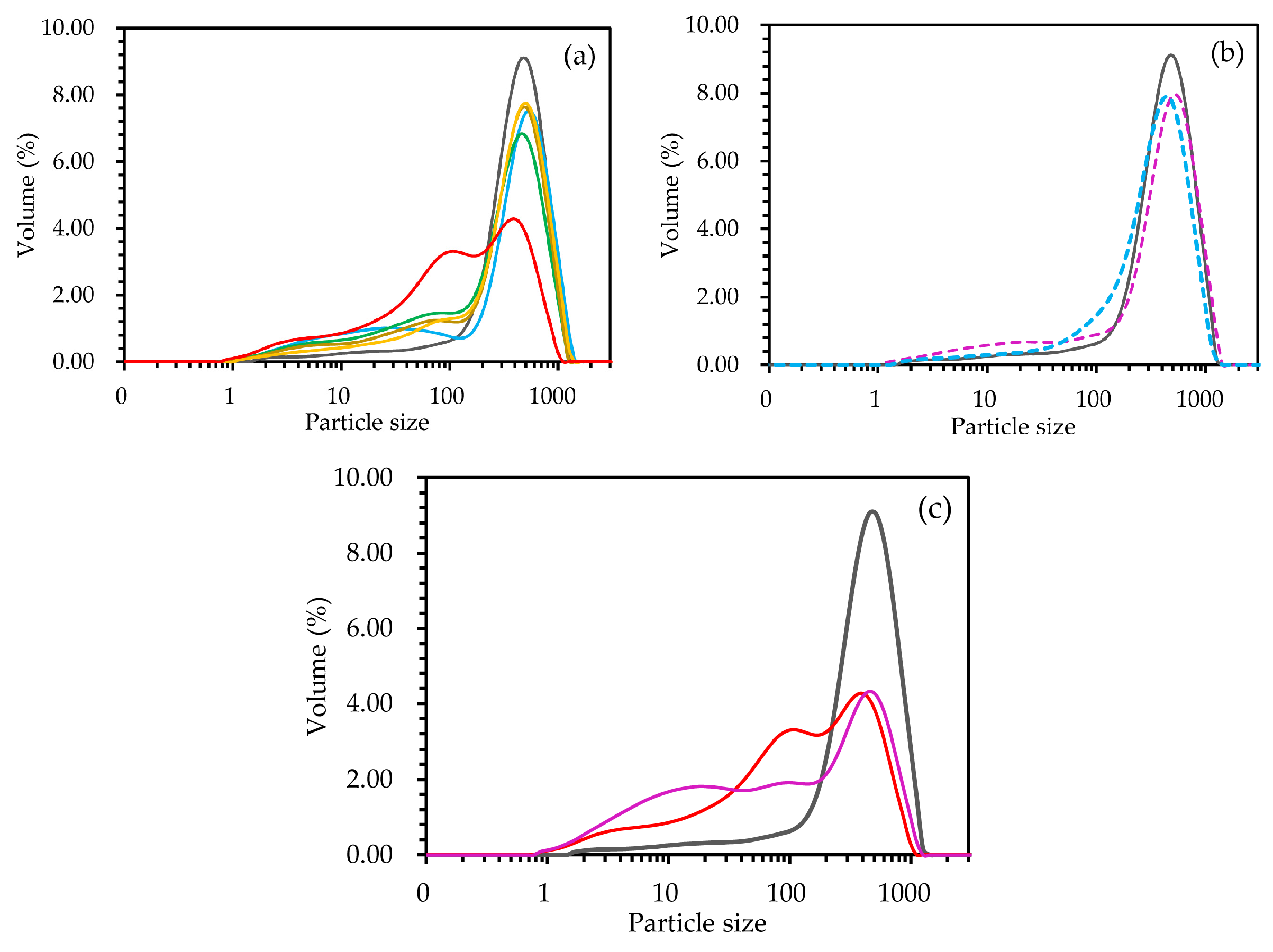
Considering that the sample size of the MBTH method was small, but that the uniformity of the dry crushed sample of ACSSF containing rise husk was relatively low, pretreatment methods combining dry and wet methods were developed in the present research. Since the rotor–stator homogenizer had the potential to break the rigid particles in suspension, it was used to pretreat the suspension of the crushed dry samples for different lengths of time from 2 min to 10 min. When the homogenizing time increased from 2 min to 8 min, the content of large particles (100–1000 μm in size) did not change obviously, but when the time was extended to 10 min, the content of large particles significantly decreased (Figure 1a). Furthermore, to enhance the effect of homogenizing, combined pretreating methods are helpful; thus, other methods, including ultrasonic treating and disc mixer agitating, were tried, and ultrasonic treating displayed a better effect in generating small particles (2–20 μm), so it was chosen to be the second step after homogenizing (Figure 1b). In Figure 1c, the effect of this combined method showed the best effect among all the tested wet crushing methods in this section, which generated the highest content of small particles ranging from 2 μm to 20 μm, and it would benefit the accuracy of the latter biomass determination using the MBTH method.
Based on the formal optimized pretreatment method combining homogenization and ultrasonic treatment, the linear test and precision test of the MBTH method was carried out. Above all, the glucosamine content of the pure B. bassiana biomass was detected as 6.97% (w/w). Intra-day and inter-day precisions were detected using the ACSSF samples (Table 1), with the relative standard deviation (RSD) detected as low as 3.32% and 3.75% in sequence, which validated the feasibility of the improved method.

3.2. Single-Factor Optimization

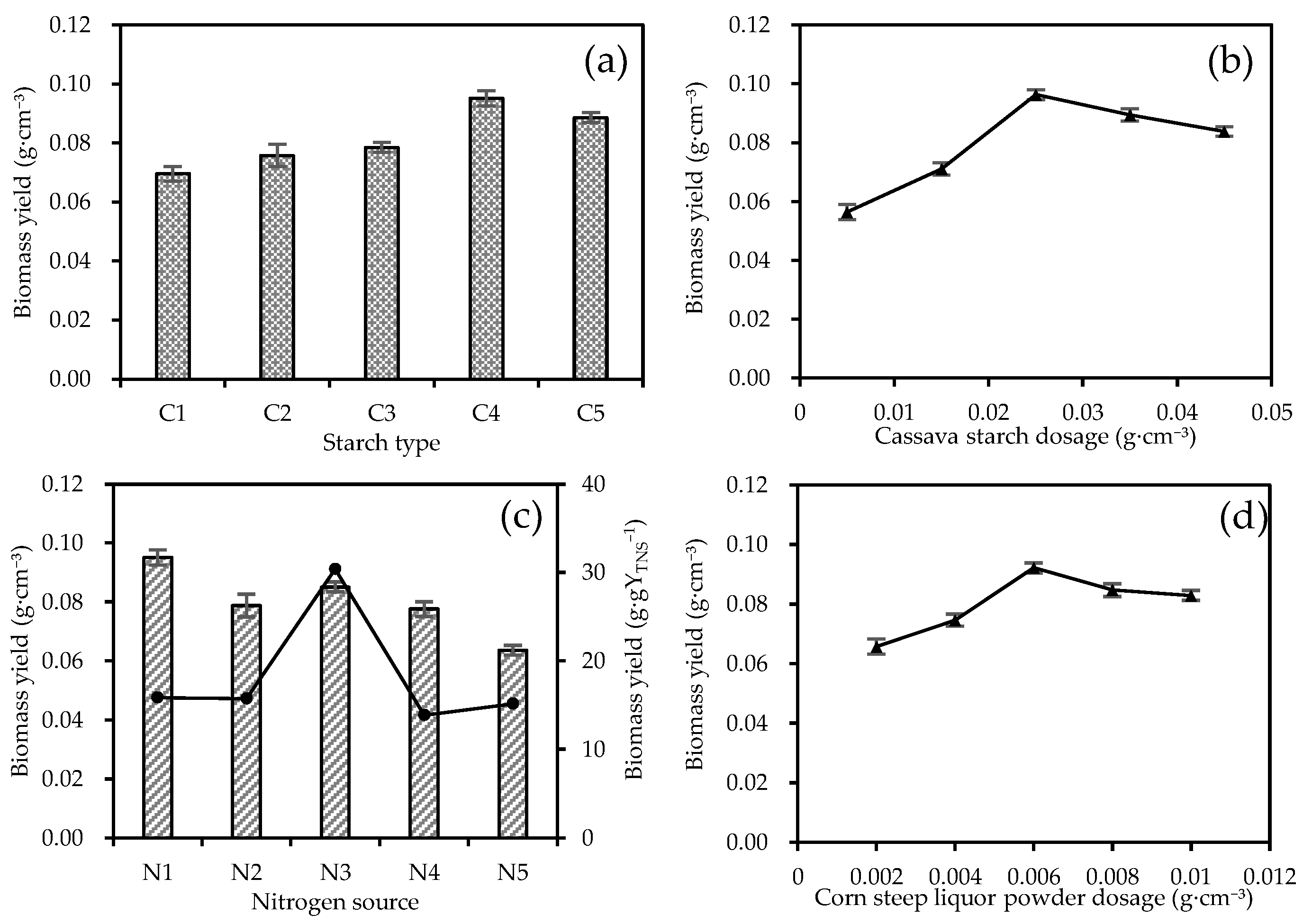
To fit the fermentation bed structure of ACSSF, the candidate carbon sources were focused on five kinds of starches, which can provide not only nutrition but also adhesion, so as to help the attachment of all the media components to the rice husk surface. In the carbon source screening, the cassava starch provided the highest biomass yield of 0.0951 g·cm−3, which was 1.37fold that of the lowest one, provided by pea starch (Figure 2a). Since cassava starch is a typical high-adhesion starch, this result revealed that the adhesive ability was most possibly the key factor affecting the contribution of a starch to the biomass yield. In the single-factor optimization of cassava starch dosage, within the range of 0.005 g·cm−3 to 0.045 g·cm−3, the dosage of 0.025 g·cm−3 displayed the highest biomass yield. This result not only further confirmed the importance of the adhesive ability to the biomass yield, but also revealed that too much cassava starch over 0.025 g·cm−3 would decrease the biomass yield, which was because of the low moisture content (Figure 2b).
Since the selected nitrogen sources were natural raw materials, considering their different protein contents, the dosage of each nitrogen source was calculated based on its protein content, and the absolute amount of protein in each test was the same. The CSLP (group N1) possessed the lowest protein content among the five nitrogen sources, but its biomass yield was the highest (Figure 2c). On the other hand, when the biomass yield was calculated based on the total nitrogen source dosage, CSLP also displayed the second-highest biomass yield after soy protein isolate. Considering that CSLP is the least expensive among these candidate nitrogen sources, but that soy protein isolate is the most expensive one among the tested five nitrogen sources, CSLP was chosen as the nitrogen source for the biomass production of B. bassiana. However, the single-factor optimization of CSLP dosage showed that CSLP dosages over 0.006 g·cm−3 decreased the biomass yield (Figure 2d).
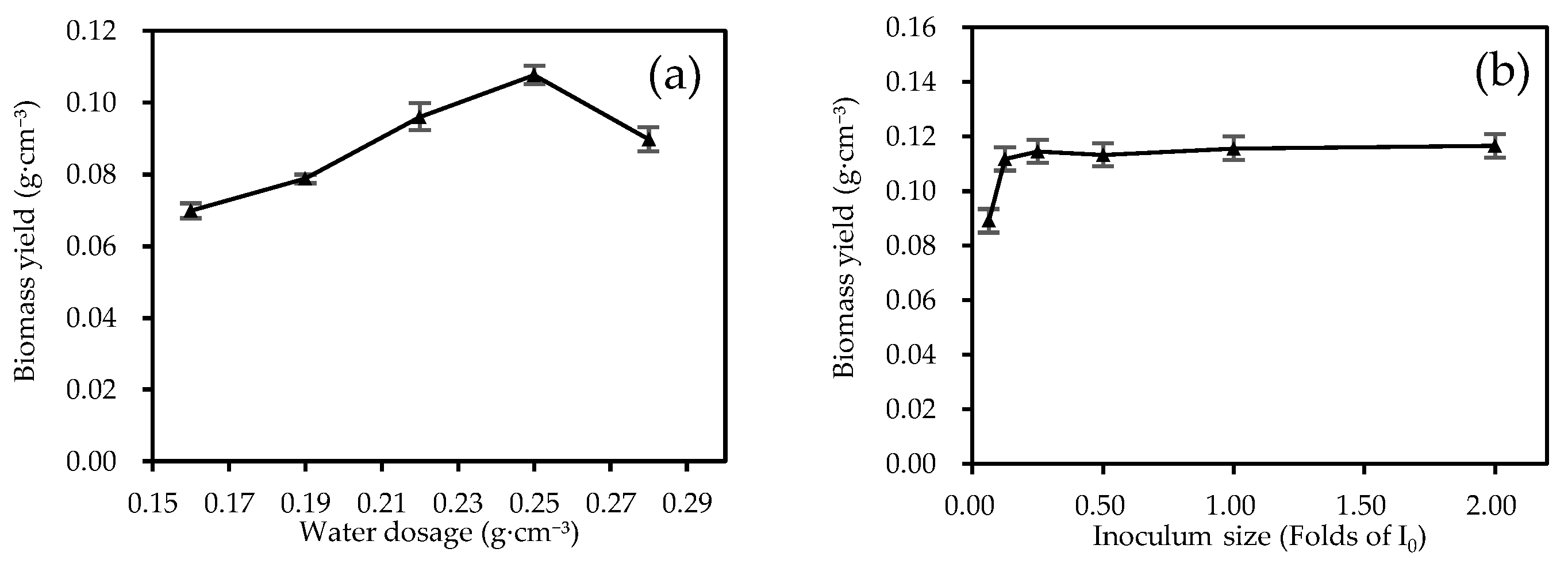
Water content is a key factor affecting ACSSF processes. In the single-factor optimization, a water content of 0.25 g·cm−3 proved to be the most suitable level within the tested range from 0.16 g·cm−3 to 0.28 g·cm−3 (Figure 3a). Otherwise, the effect of inoculum size on the biomass yield was also observed, and an inoculum size larger than I0/8 did not obviously affect the terminal biomass yield of the ACSSF process (Figure 3b).

3.3. Optimization of ACSSF Media by the ANN-GA Method

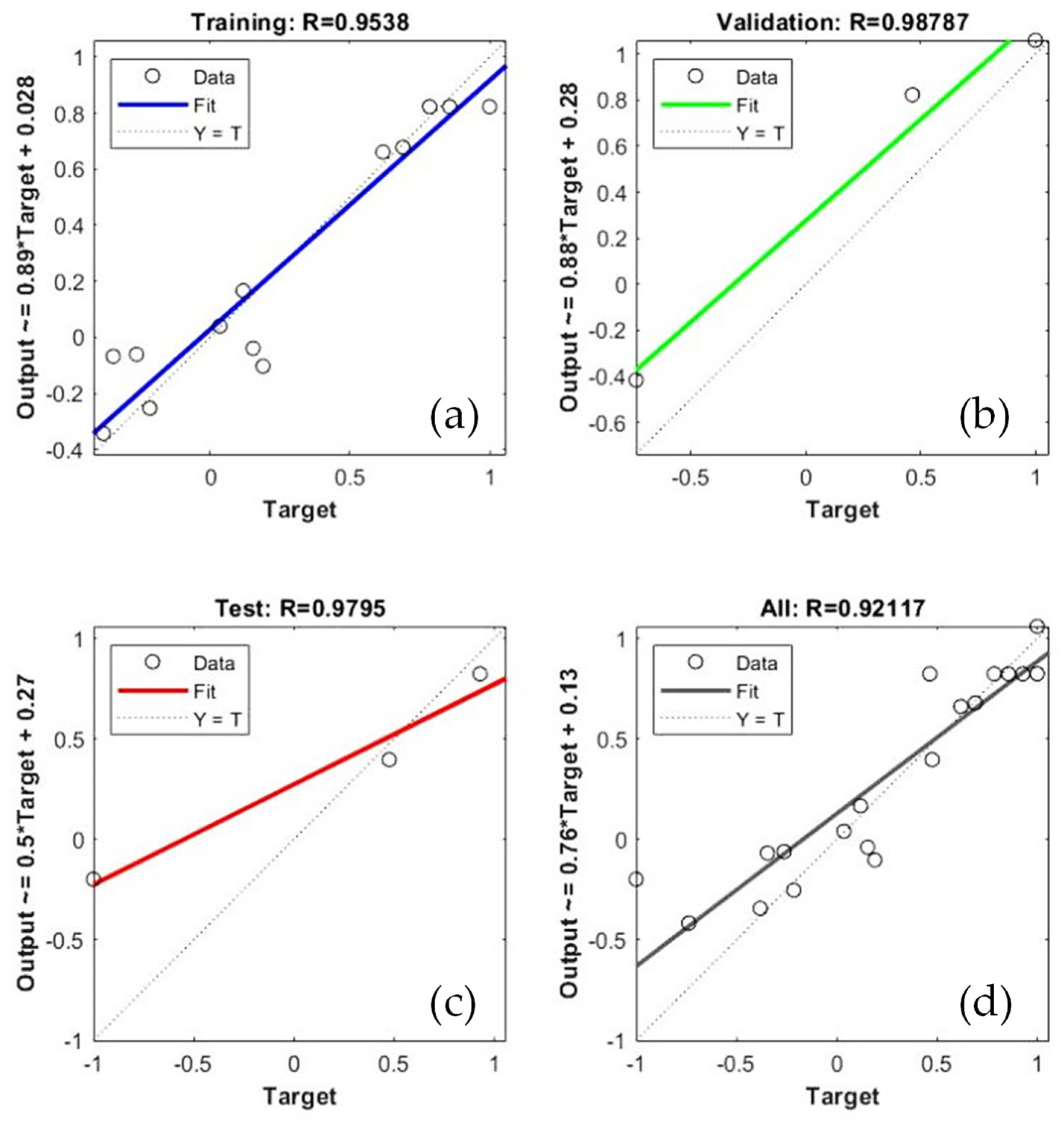
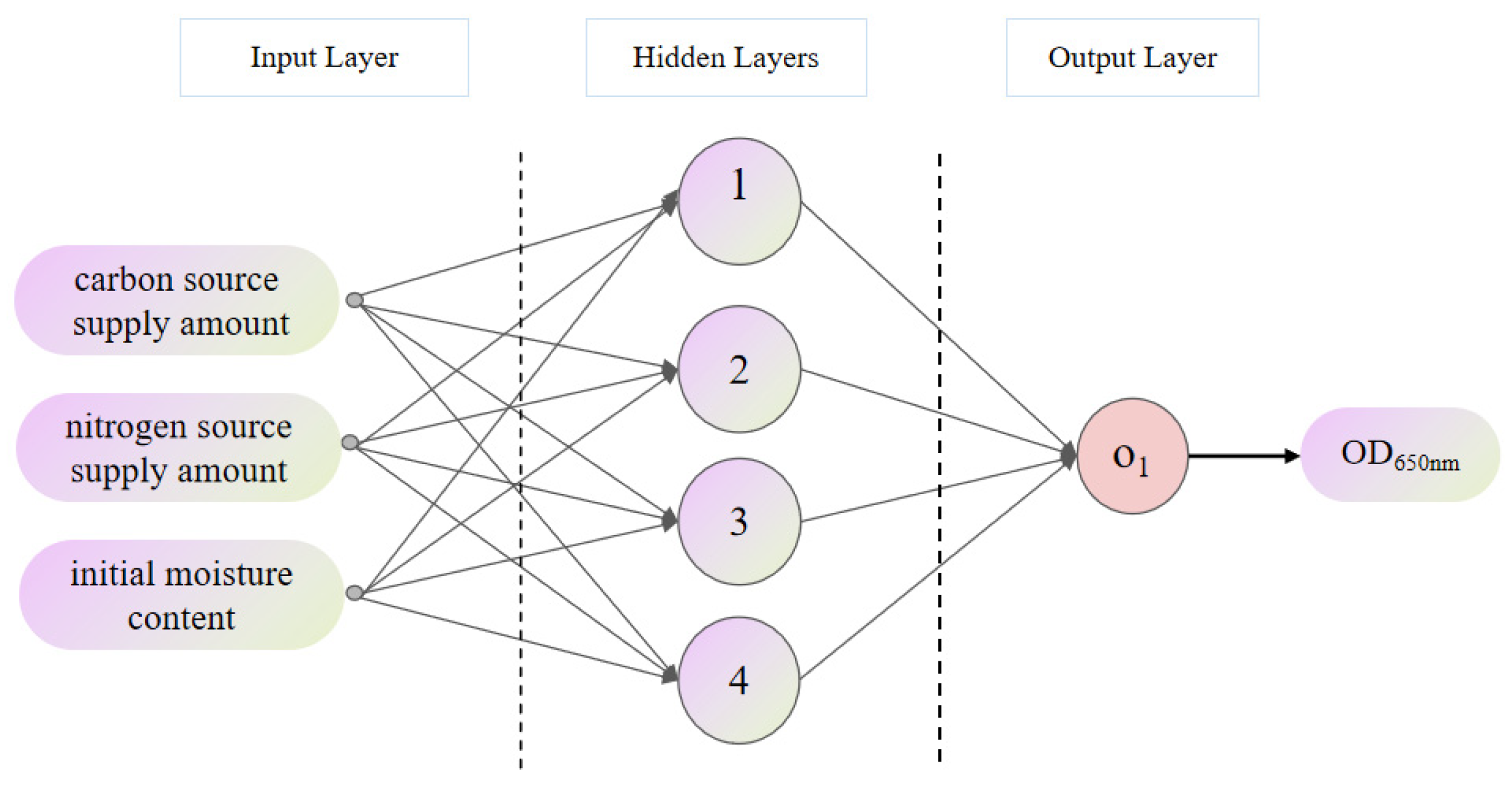
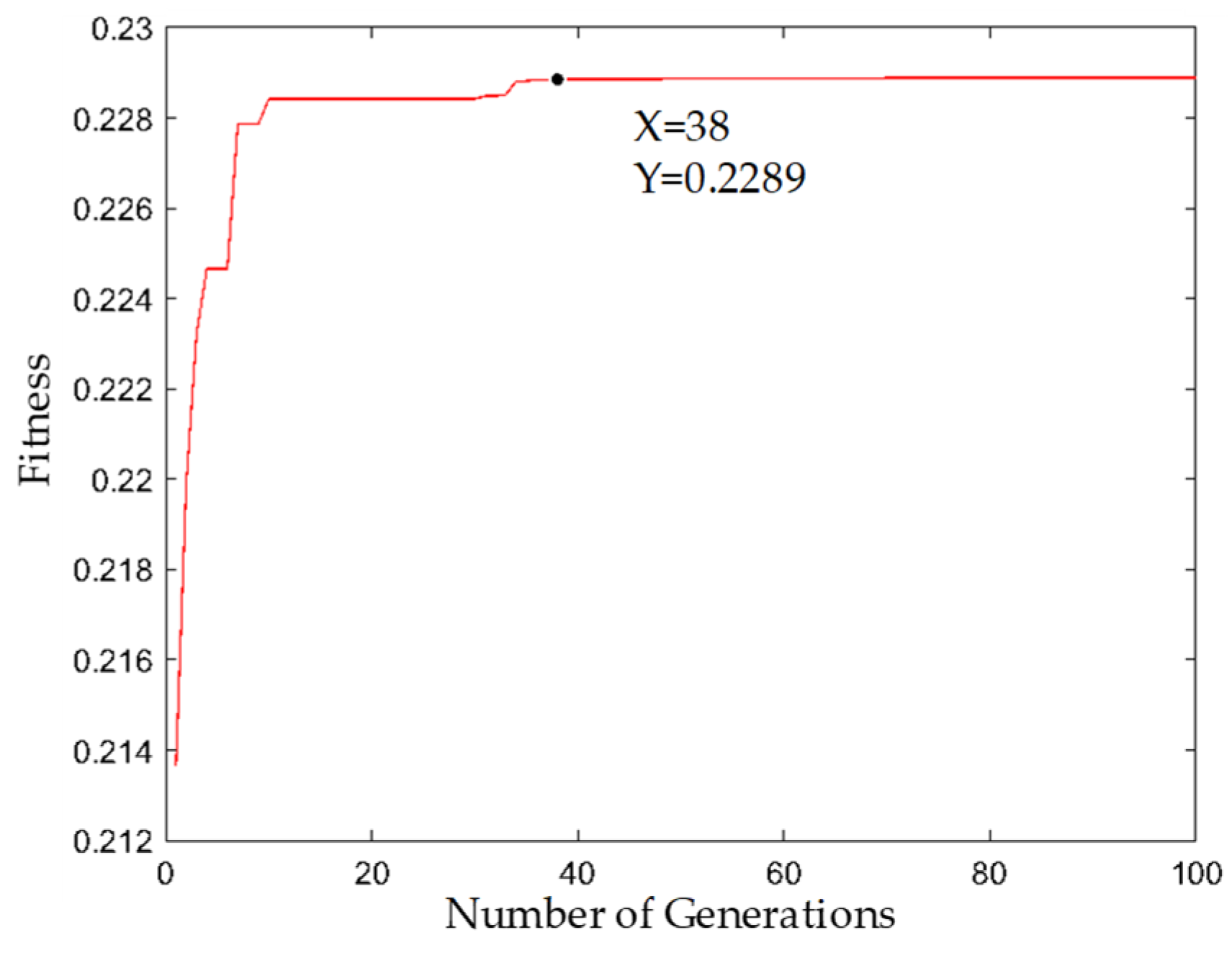
As the foundation of ANN optimization, a group of CCD experiments were carried out following Table 2, and the ANN-GA optimization was carried out based on the results of the CCD experiments (Table 3). The training of the ANN was executed using the three variables Carbon source dosage (B), Nitrogen source dosage (C) and Water dosage (D) making up the input layer, and the original detection results of samples from the CCD experiments (OD650nm) were used as the output layer, with the detections of all the samples executed under the same pretreating method, the same sampling size, the same dilution ratio and the same chromogenic reacting procedure. The number of neurons in the hidden layer was within the range from (2(n + m)1/2) to (2n + 1), in which n is the number of neurons in input layer, and m is the number of neurons in output layer [48]. After training, the mean squared error (MSE) tended to the lowest with the number of neurons in the hidden layer being 4. Thus, the numbers of neurons in the input layer, hidden layer and output layer were determined to be 3, 4 and 1, respectively (Figure 4). Under this overall framework, a feasible artificial neural network model was established through sufficient training, with the correlation coefficients (R values) of the training set, validation set, test set and overall dataset all over 0.92 (Figure 5), and this result indicated that the accuracy of this model was high enough to be used in the ACSSF media optimization. To obtain an optimal recipe of the ACSSF media on the basis of the above ANN model, GA optimization was executed with the following settings: the population size was 10, the number of iterations was 100, the crossover probability was 0.4 and the mutation probability was 0.1. With the increase in the generation number, the fitness increased simultaneously, and when the generation number increased up to 38, the fitness increased to 0.2289, but its rate of increase decreased to a very low level close to 0 (Figure 6). After the ANN-GA process, the final predicted optimal recipe was carbon source (cassava starch) 0.0314 g·cm−3, nitrogen source (CSLP) 0.004885 g·cm−3 and water 0.2630 g·cm−3, and the highest biomass yield was predicted as 0.1355 g·cm−3. In the verification experiment, the biomass detected was 0.1379 g·cm−3, which was 20.5% higher than the highest biomass yield in the single-factor optimizations (0.1144 g·cm−3) and 45.0% higher than the original recipe before the optimization (0.0951 g·cm−3).

3.4. The Process Dynamics of ACSSF

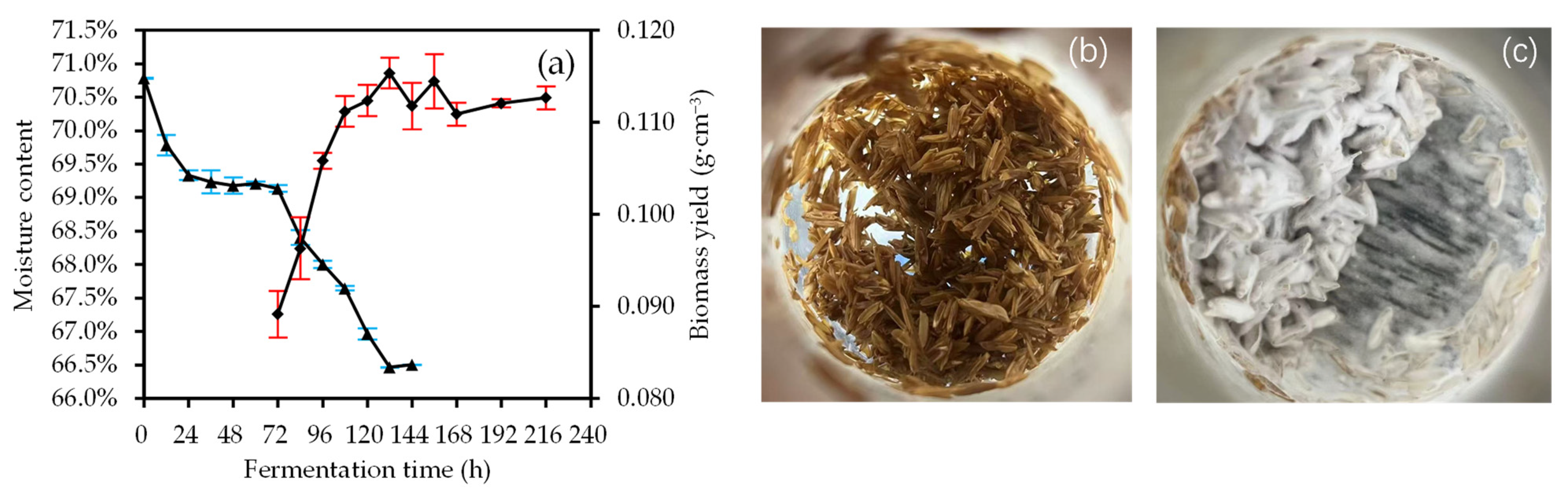
The trend of moisture content and biomass yield over time in the ACSSF process is evaluated in Figure 7a. During 0–24 h, the moisture content of the media decreased rapidly (1.44% per day), which revealed that the media particles possessed a water film on the surface, and that this part of free water was easily evaporated in 250 mL Erlenmeyer flasks under the fermentation condition of 28 °C and 70% (R.H.). During 24–72 h, the moisture content decreased at an extremely low rate (0.10% per day), which revealed that the free water film on the particle surface had been exhausted before 24 h, and that it was difficult to evaporate the water adsorbed in the rice husk and the nutritional media, including starch and SCLP, during this period. During the whole initial period (0–72 h), no growth was observed in the fermentation flasks, indicating that high moisture content was not conducive to the growth of this B. Bassiana strain. Thus, the detection of biomass yield had begun from 72 h. During 72–132 h, the biomass yield increased at a high rate (0.0104 g·cm−3 per day); simultaneously, the moisture content also decreased at a high rate (1.07% per day), which indicated that the microbial growth was in the logarithmic growth phase. After 132 h, the moisture content and the biomass yield did not change obviously, indicating that the microbial growth was in the stationary phase and decline phase. Based on the above results, the optimal fermentation time was 5.5 days. The morphology of the ACSSF media at the beginning (Figure 7b) and the end (Figure 7c) of the process had a very obvious difference, and the mycelia layer densely covered the particle surface at the end of the process.
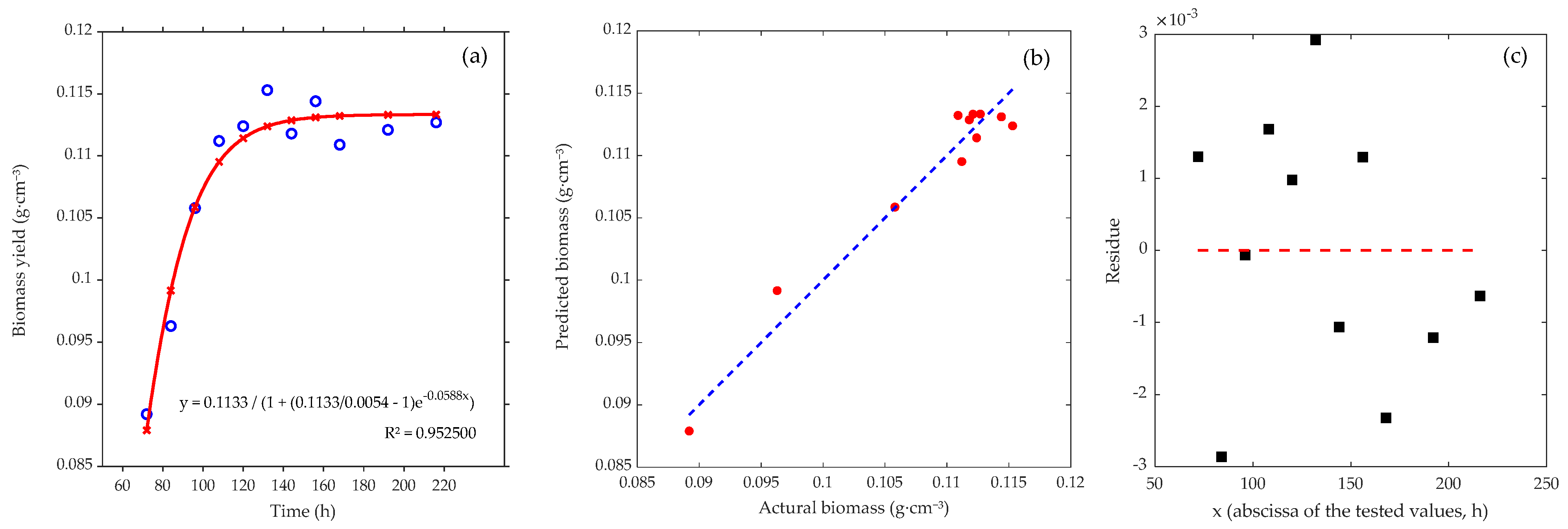
The data of the growth curve (Figure 7a) was also used in the regression of the Microbial growth kinetic model. The Logistic model was applied for the data fitting, with the result shown in the following equation, in which X0 = 0.0054 g·cm−3, Xm = 0.1133 g·cm−3 and μ = 0.0588 h−1.
X = 0.1133 1 + 0.1133 0.0054 1 e 0.0588 t = 0.1133 1 + 19.98 e 0.0588 t
The R2 of the regression was 0.9525, the fitting curve displayed the ideal fitting effect (Figure 8a), and the scattered dots distributed on both sides of the diagonal (Figure 8b), which indicated that the regression was reliable. The absolute values of the residues were completely under 0.003 g·cm−3 (Figure 8c).

4. Discussion

In Section 3.1, The homogenization treatment time of 2 to 8 min has no significant effect on the crushing of large particles, but extending the homogenization treatment time to 10 min has a significant effect on the crushing of large particles and the generation of small particles. Considering that the working principle of a rotor–stator homogenizer is to grind the particles in the gap between the rotor and the stator, and since the remaining large particles after dry crushing are mainly rigid particles such as rice husk, which are difficult to soften by simply soaking in water at room temperature, it was difficult for these large particles to enter the annular gap (0.25 mm in width) in the early period of the homogenizing process (0–8 min), and small particles under 100 μm increased in this period (compared with the untreated group) and were mainly attachments on the large particle surfaces, such as the mixture of media and microbe, which were separated from the large particles due to the impact of the rotor. When the homogenizing time reached 10 min, the content of small particles under 100 μm increased significantly, which indicated that a portion of the large particles were broken by the homogenizer after 8 min. The most possible reason is that after 8 min of homogenizing, the attachments on the large particles were separated, and these rigid particles were also softened, benefiting from the hitting of the rotor, which decreased the size of the large particles and made them enter the gap between the rotor and the stator more easily, and they were then broken by the homogenizer.
As an important foundation for the accurate analysis and mathematical model construction of SSF processes, the detection of biomass is a typical technical challenge. However, the previous reports have focused on the detection process itself, and the pretreatment of the SSF sample, usually in the form of large and heterogeneous particles, is rarely addressed [20,21,22]. Although the large-scale dry crushing technique of crops and agro-industrial wastes is very mature, the conventional laboratory crusher still has the chance to fail in uniformly crushing the rigid particles such as rice husks. In Section 3.1, the technical route of wet crushing after dry crushing, which combined homogenizing and ultrasonic treatment, proved to be effective in improving the uniformity of the ACSSF samples (Figure 1c) and consequently ensured the high precision of the MBTH method in biomass determination experiments (Table 1). Otherwise, although the conidia counting method using a hemocytometer has been widely used in determination of the concentration of fungal spores, it is also unfit for the present strain B. bassiana ACCC30736. The reason is that the hyphae of this strain are prolific, and the hyphae are easily agglomerate and form a dense coating on the surface of the medium particles (Figure 7c), which would accommodate part of the conidia and interfere the detection with a hemocytometer. In a previous report, the RSV values of biomass yield varied between 2.7% and 8.3% [21], and the RSV values in the present research were 3.32% (intra-day) and 3.75 (inter-day), which were more stable than the reported data, and this result indicated the positive role played by the improved pretreating method in enhancing the accuracy of the MBTH method. Furthermore, the accuracy of the detection method is also the foundation of all the fermentation experiments, especially the ANN-GA optimization and the regression of the microbial growth kinetic model, so the improvement in the detection method was executed before other experiments.
As important by-products of the corn starch industry, CSL and CSLP possess high yield, high protein content of over 40% (gProtein/gDry matter) and competitive prices [49,50], which can be used not only in the SmF of B. bassiana producing blastospores [51], but also in plenty of fermentative productions [52,53]. Therefore, in Section 3.2, it did provide the highest B. bassiana conidia yield compared with the soy derived nitrogen sources and corn protein (Figure 2c). However, since the CSLP contained organic acids and sulfite [49,50], growth inhibition was observed when the CSLP dosage was higher than 0.006 g·cm−3 (Figure 2d). Since the sulfite content in CSL was reported to be 0.01%, but the organic acid content was as high as 9.75% [50], this result revealed that organic acids might be the main reason for the inhibition to the growth of B. bassiana. In the previous reports, the feedstocks for the production of B. bassiana conidia are mainly rice, rice bran, wheat bran, beer draff and corn cobs, but neither CSL nor CSLP has been reported to be used [2,12,37]. However, in the Chinese market, the prices of rice, rice bran and wheat bran are all higher than that of CSL. Wet beer draff is cheap but difficult to transport and store. Since CSL is cheap and does not deteriorate easily, it would be an outstanding nitrogen source for the production of B. bassiana biomass or conidia.
As a common support of SSFs, rice husk possesses high hardness, which helps it maintain the porosity of the fermentation bed, but in a such rigid particle, the content of internal pores is generally low, which can limit its water-holding capacity. Thus, the excessively added water would form a water film on the surface of the rice husk particles, which have a chance to weaken the oxygen transfer from the air to the hyphae which were coated by the water film on the particle surface. The trend of the biomass yield with the increase in the water dosage supports this supposition (Figure 3a). In addition, the surface of the rice husk particle is smoother than that of some other particles containing plenty of internal pores, such as corn cob particles, and this character makes it relatively difficult to load the rice husk with the nutritional media, unless the media was sticky enough and easy to form into hydrogel (Figure 7b). The result of carbon source screening (Figure 2a) supports this supposition, in which the cassava starch with high adhesion and gelation capacity displayed higher biomass yield than other carbon sources. In the previous reports, rice husk was used as the sole medium without supplementing other nutrients [35,38]. In the present research, carbon sources and nitrogen sources were supplemented, and these nutrients were not only absorbed inside the rice husks but also adhered on their surface, which further unleashed the potential of rice husks in conidia production.
The ANN-GA method is a typical Artificial Intelligence (AI) tool useful in many fields [45]. In Section 3.3, an ANN model was constructed and trained, with the GA method used for the optimization based on the ANN model. The optimized medium recipe was verified by actual fermentation runs, which displayed an obvious increase in biomass yield (Figure 5 and Figure 6). In the previously reported SSFs, the product yield was mainly detected by conidia counting, which can directly display the yield of the main component of the bioinsecticide, but cannot display the overall biomass production capacity of the SSF system [2,7,12].
Although the original reason for choosing the MBTH method was only to avoid the interference of the easily adhesive mycelium on the detection of conidia concentration, nevertheless, the total biomass content data obtained by the improved sample pretreating method and the MBTH method unexpectedly provided a different perspective to evaluate and understand this kind of ACSSF process, and this perspective based on total biomass content was more suitable for the modeling of the growth kinetics than the previously reported results based on the conidia yield [2,12]. The premise of this superiority is that conidium is not the only form of the filamentous fungus B. bassiana during the whole ACSSF process. Therefore, the microbial growth kinetic model displayed good fitting effect to the Logistic model (Figure 8), and this result not only validated the feasibility of modeling the growth kinetics of B. bassiana using total biomass content data, but also validated the reliability of the improved sample pretreating method and the MBTH method. Furthermore, the result of this work also laid the foundation for the construction of more complex models considering the heat and moisture transfer, which could help to gain a deeper understanding of the mechanism behind the ACSSF process.
Otherwise, the optimized ACSSF media using CSLP as the nitrogen source also laid a foundation for the scaling up of this technique in industrial production, and in large-scale production, the cheaper CSL can be used instead of CSLP, which could further decrease the feedstock cost. Furthermore, the high porosity an ACSSF bed composed of rice husks also possesses the potential to provide higher uniformity of inner-bed temperature and moisture distribution in the large-scale production. Considering the high porosity of the fermentation bed composed of rice husk, although the main limitation of the ACSSF technique in further promoting the biomass productivity is the load capacity of the rice husk carrier, it is still promising to promote the biomass productivity by using more sticky carbon sources and nitrogen sources in the future.

5. Conclusions

The improved pretreating method combining homogenization and ultrasonic treatment after dry crushing was effective for the ACSSF samples containing rigid rice husk particles, by which a considerable portion of the large particles (100–1000 μm in size) were broken and the content of small particles (2–100 μm in size) increased, and the effect of this improved pretreating method was validated by the RSD of the MBTH method, which was as low as 3–4%. The ANN-GA optimization based on single-factor optimizations provided an optimal recipe including the best dosages of cassava starch, CSLP and water, which was validated by actual experiments, and the inhibition of excessive CSLP, cassava starch and water to the biomass yield was also observed, which was caused by organic acids (CSLP) and the too-thick water film on the particle surface (cassava starch and water). The Logistic kinetic model was observed by nonlinear regression (Figure 8a); its R2 value as high as 0.9525 and its residue values (Figure 8c) also validated the high accuracy of the improved pretreating method and the MBTH method for the biomass determination in ACSSFs.

Author Contributions

X.Z. provided the original ideas, conducted some of the experiments and calculations and wrote the manuscript; Y.L. conducted some of the experiments and calculations; M.Z. attended to some of the biomass detection experiments, data calculation and manuscript writing; L.C. and Y.Q. attended to some of the biomass detection experiments; Y.Z. attended to some of the pretreating experiments of ACSSF samples. All authors have read and agreed to the published version of the manuscript.

Funding

The present study was funded by a project of the National Natural Science Foundation of China (Regional fund project, NSFC 22168039) and a start-up fund of Yan’an University for new teachers with doctorates (YDBK 2018-58).

Institutional Review Board Statement

Not applicable.

Informed Consent Statement

Not applicable.

Data Availability Statement

The original contributions presented in this study are included in the article. Further inquiries can be directed to the corresponding author.

Acknowledgments

We acknowledge the technical support provided by Science Guide Compass in the laser particle size analysis.

Conflicts of Interest

The authors declare no conflict of interest.

References

  1. Lopez-Perez, M.; Rodriguez-Gomez, D.; Loera, O. Production of conidia of Beauveria bassiana in solid-state culture: Current status and future perspectives. Crit. Rev. Biotechnol. 2015, 35, 334–341. [Google Scholar] [CrossRef]
  2. Lou, H.X.; Luo, Q.Z.; Guo, Q.Q.; Su, R.S.; Liu, J.F.; He, H.L.; Cheng, Y.Q. Optimization of the Culture Medium of Beauveria bassiana and Spore Yield Using Response Surface Methodology. Fermentation 2024, 10, 587. [Google Scholar] [CrossRef]
  3. Verma, M.L.; Kumar, A.; Chintagunta, A.D.; Samudrala, P.J.K.; Bardin, M.; Lichtfouse, E. Microbial Production of Biopesticides for Sustainable Agriculture. Sustainability 2024, 16, 28. [Google Scholar] [CrossRef]
  4. Zhang, S.Z.; Xia, Y.X.; Kim, B.; Keyhani, N.O. Two hydrophobins are involved in fungal spore coat rodlet layer assembly and each play distinct roles in surface interactions, development and pathogenesis in the entomopathogenic fungus, Beauveria bassiana. Mol. Microbiol. 2011, 80, 811–826. [Google Scholar] [CrossRef]
  5. Fang, W.G.; Feng, J.; Fan, Y.H.; Zhang, Y.J.; Bidochka, M.J.; Leger, R.J.S.; Pei, Y. Expressing a fusion protein with protease and chitinase activities increases the virulence of the insect pathogen Beauveria bassiana. J. Invertebr. Pathol. 2009, 102, 155–159. [Google Scholar] [CrossRef]
  6. Fang, W.G.; Leng, B.; Xiao, Y.H.; Jin, K.; Ma, J.C.; Fan, Y.H.; Feng, J.; Yang, X.Y.; Zhang, Y.J.; Pei, Y. Cloning of Beauveria bassiana chitinase gene Bbchit1 and its application to improve fungal strain virulence. Appl. Environ. Microbiol. 2005, 71, 363–370. [Google Scholar] [CrossRef]
  7. Mascarin, G.M.; Jaronski, S.T. The production and uses of Beauveria bassiana as a microbial insecticide. World J. Microbiol. Biotechnol. 2016, 32, 177. [Google Scholar] [CrossRef] [PubMed]
  8. Wu, T.; Zhan, F.F.; Zeng, L.Q.; Sun, Y.L.; Fu, S.H.; Fang, Y.; Lin, X.C.; Lin, H.Y.; Su, J.; Cai, S.P. Arginine accumulation suppresses heat production during fermentation of the biocontrol fungus Beauveria bassiana. Appl. Environ. Microbiol. 2025, 91, e02134-24. [Google Scholar] [CrossRef] [PubMed]
  9. Gao, Y.P.; Shi, D.X.; Li, Y.H.; He, X.Z.; Wang, X.Y.; Lin, K.; Zheng, X.L. Development of Biphasic Culture System for an Entomopathogenic Fungus Beauveria bassiana PfBb Strain and Its Virulence on a Defoliating Moth Phauda flammans (Walker). J. Fungi 2025, 11, 202. [Google Scholar] [CrossRef] [PubMed]
  10. Mascarin, G.M.; Kobori, N.N.; Coleman, J.J.; Jackson, M.A. Impact of osmotic stress on production, morphology, and fitness of Beauveria bassiana blastospores. Appl. Microbiol. Biotechnol. 2023, 107, 4815–4831. [Google Scholar] [CrossRef]
  11. Iwanicki, N.S.; Lopes, E.C.M.; de Lira, A.C.; Poletto, T.B.; Fonceca, L.Z.; Delalibera, I.D. Comparative analysis of Beauveria bassiana submerged conidia with blastospores: Yield, growth kinetics, and virulence. Biol. Control 2023, 185, 105314. [Google Scholar] [CrossRef]
  12. Sala, A.; Artola, A.; Barrena, R.; Sánchez, A. Harnessing Packed-Bed Bioreactors’ Potential in Solid-State Fermentation: The Case of Beauveria bassiana Conidia Production. Fermentation 2024, 10, 481. [Google Scholar] [CrossRef]
  13. Zou, S.P.; Ma, Y.Z.; Ding, W.; Jiang, Y.K.; Chen, X.M.; Chen, J.; Gao, H.L.; Xue, Y.P.; Zheng, Y.G. Efficient production of R-2-(4-hydroxyphenoxy) propionic acid by Beauveria bassiana using biofilm-based two-stage fermentation. Bioresour. Technol. 2024, 399, 130588. [Google Scholar] [CrossRef] [PubMed]
  14. Lara-Juache, H.R.; Avila-Hernández, J.G.; Rodríguez-Durán, L.V.; Michel, M.R.; Wong-Paz, J.E.; Muñiz-Márquez, D.B.; Veana, F.; Aguilar-Zárate, M.; Ascacio-Valdés, J.A.; Aguilar-Zárate, P. Characterization of a Biofilm Bioreactor Designed for the Single-Step Production of Aerial Conidia and Oosporein by Beauveria bassiana PQ2. J. Fungi 2021, 7, 582. [Google Scholar] [CrossRef]
  15. Ren, Z.Q.; Chen, Q.X.; Tang, T.X.; Huang, Z.G. Unraveling the water source and formation process of Huangshui in solid-state fermentation. Food Sci. Biotechnol. 2025, 34, 665–675. [Google Scholar] [CrossRef]
  16. Jin, G.; Uhl, P.; Zhu, Y.; Wijffels, R.H.; Xu, Y.; Rinzema, A. Modeling of industrial-scale anaerobic solid-state fermentation for Chinese liquor production. Chem. Eng. J. 2020, 394, 124942. [Google Scholar] [CrossRef]
  17. da Cunha, L.P.; Casciatori, F.P.; De, C.L.I.; Thoméo, J.C. Production of conidia of the entomopathogenic fungus Metarhizium anisopliae ICB 425 in a tray bioreactor. Bioprocess. Biosyst. Eng. 2019, 42, 1757–1768. [Google Scholar] [CrossRef]
  18. Garro, M.S.; Rivas, F.P.; Garro, O.A. Solid State Fermentation in Food Processing: Advances in Reactor Design and Novel Applications. In Innovative Food Processing Technologies; Kai Knoerzer, K.M., Ed.; Elsevier: Amsterdam, The Netherlands, 2021; pp. 165–182. [Google Scholar]
  19. Vandenberghe, L.; Pandey, A.; Carvalho, J.; Letti, L.; Soccol, C.R. Solid-state fermentation technology and innovation for the production of agricultural and animal feed bioproducts. Syst. Microbiol. Biomanuf. 2020, 1, 142–165. [Google Scholar] [CrossRef]
  20. Steudler, S.; Bley, T. Better One-Eyed than Blind-Challenges and Opportunities of Biomass Measurement During Solid-State Fermentation of Basidiomycetes. In Filaments in Bioprocesses; Krull, R., Bley, T., Eds.; Advances in Biochemical Engineering-Biotechnology; Springer: Berlin, Germany, 2015; Volume 149, pp. 223–252. [Google Scholar]
  21. Papadaki, A.; Diamantopoulou, P.; Papanikolaou, S.; Philippoussis, A. Evaluation of Biomass and Chitin Production of Morchella Mushrooms Grown on Starch-Based Substrates. Foods 2019, 8, 16. [Google Scholar] [CrossRef]
  22. Van Wychen, S.; Long, W.; Black, S.K.; Laurens, L.M.L. MBTH: A novel approach to rapid, spectrophotometric quantitation of total algal carbohydrates. Anal. Biochem. 2017, 518, 90–93. [Google Scholar] [CrossRef]
  23. Steudler, S.; Bley, T. Biomass estimation during macro-scale solid-state fermentation of basidiomycetes using established and novel approaches. Bioprocess Biosyst. Eng. 2015, 38, 1313–1323. [Google Scholar] [CrossRef] [PubMed]
  24. Scotti, C.T.; Vergoignan, C.; Feron, G.; Durand, A. Glucosamine measurement as indirect method for biomass estimation of Cunninghamella elegans grown in solid state cultivation conditions. Biochem. Eng. J. 2001, 7, 1–5. [Google Scholar] [CrossRef]
  25. Li, M.; Zhu, W.; Gao, L. Analysis of Cell Concentration, Volume Concentration, and Colony Size of Microcystis via Laser Particle Analyzer. Environ. Manag. 2014, 53, 947–958. [Google Scholar] [CrossRef] [PubMed]
  26. Xie, Q.; Zhang, F.G.; Lü, Q.N. Ideal Laser Particle Size Analyzer and Its Lower Limit of Measurement and Resolving Power. Laser Optoelectron. Prog. 2022, 59, 1329001. [Google Scholar] [CrossRef]
  27. Casciatori, F.P.; Bück, A.; Thoméo, J.C.; Tsotsas, E. Two-phase and two-dimensional model describing heat and water transfer during solid-state fermentation within a packed-bed bioreactor. Chem. Eng. J. 2016, 287, 103–116. [Google Scholar] [CrossRef]
  28. Zhang, Y.; Liu, J.; Zhou, Y.; Ge, Y. Spore Production of Clonostachys rosea in a New Solid-state Fermentation Reactor. Appl. Biochem. Biotechnol. 2014, 174, 2951–2959. [Google Scholar] [CrossRef]
  29. Chen, H. Modern Solid State Fermentation; Springer: London, UK, 2013. [Google Scholar]
  30. Zhang, Z.G.; Chen, H.Z. Xanthan Production on Polyurethane Foam and Its Enhancement by Air Pressure Pulsation. Appl. Biochem. Biotechnol. 2010, 162, 2244–2258. [Google Scholar] [CrossRef]
  31. Gong, Z.; He, Q.; Che, C.; Liu, J.; Yang, G. Optimization and scale-up of the production of rhamnolipid by Pseudomonas aeruginosa in solid-state fermentation using high-density polyurethane foam as an inert support. Bioprocess. Biosyst. Eng. 2020, 43, 385–392. [Google Scholar] [CrossRef]
  32. Ferreira, M.; Fernandes, H.; Peres, H.; OliveTeles, A.; Salgado, J.M. Polyunsaturated fatty acids production by solid-state fermentation on polyurethane foam by Mortierella alpina. Biotechnol. Prog. 2020, 37, e3133. [Google Scholar] [CrossRef] [PubMed]
  33. Pitol, L.O.; Biz, A.; Mallmann, E.; Krieger, N.; Mitchell, D.A. Production of pectinases by solid-state fermentation in a pilot-scale packed-bed bioreactor. Chem. Eng. J. 2016, 283, 1009–1018. [Google Scholar] [CrossRef]
  34. Orzua, M.C.; Mussatto, S.I.; Contreras-Esquivel, J.C.; Rodriguez, R.; de la Garza, H.; Teixeira, J.A.; Aguilar, C.N. Exploitation of agro industrial wastes as immobilization carrier for solid-state fermentation. Ind. Crop. Prod. 2009, 30, 24–27. [Google Scholar] [CrossRef]
  35. Sala, A.; Artola, A.; Sánchez, A.; Barrena, R. Rice husk as a source for fungal biopesticide production by solid-state fermentation using B. bassiana and T. harzianum. Bioresour. Technol. 2020, 296, 122322. [Google Scholar] [CrossRef]
  36. Narwade, J.D.; Odaneth, A.A.; Lele, S.S. Solid-state fermentation in an earthen vessel: Trichoderma viride spore-based biopesticide production using corn cobs. Fungal Biol. 2023, 127, 1146–1156. [Google Scholar] [CrossRef]
  37. Sala, A.; Barrena, R.; Meyling, N.V.; Artola, A. Conidia production of the entomopathogenic fungus Beauveria bassiana using packed-bed bioreactor: Effect of substrate biodegradability on conidia virulence. J. Environ. Manag. 2023, 341, 118059. [Google Scholar] [CrossRef] [PubMed]
  38. Sala, A.; Vittone, S.; Barrena, R.; Sánchez, A.; Artola, A. Scanning agro-industrial wastes as substrates for fungal biopesticide production: Use of Beauveria bassiana and Trichoderma harzianum in solid-state fermentation. J. Environ. Manag. 2021, 295, 113113. [Google Scholar] [CrossRef] [PubMed]
  39. Lpdc, A.; Fpc, B.; Ivv, A.; Rlg, A.; Jct, A. Metarhizium anisopliae conidia production in packed-bed bioreactor using rice as substrate in successive cultivations. Process Biochem. 2020, 97, 104–111. [Google Scholar] [CrossRef]
  40. Viccini, G.; Mannich, M.; Capalbo, D.M.F.; Valdebenito-Sanhueza, R.; Mitchell, D.A. Spore production in solid-state fermentation of rice by Clonostachys rosea, a biopesticide for gray mold of strawberries. Process Biochem. 2007, 42, 275–278. [Google Scholar] [CrossRef]
  41. Toledo, A.V.; Brentassi, M.E. Effectiveness of several nutritional sources on the virulence of Beauveria bassiana s.l. CEP147 against the planthopper Delphacodes kuscheli. Entomol. Exp. Appl. 2022, 170, 134–144. [Google Scholar] [CrossRef]
  42. Lohse, R.; Jakobs-Schönwandt, D.; Patel, A.V. Screening of liquid media and fermentation of an endophytic Beauveria bassiana strain in a bioreactor. AMB Express 2014, 4, 47. [Google Scholar] [CrossRef]
  43. Suresh, G.; Ragunathan, R.; Johney, J. Assessing the impact of corn steep liquor as an inducer on enhancing laccase production and laccase gene (Lac1) transcription in Pleurotus pulmonarius during solid-state fermentation. Bioresour. Technol. Rep. 2024, 27, 7. [Google Scholar] [CrossRef]
  44. Amini, A.B.; Koucheh, M.F.; Babakhani, S.; Kafil, H.S.; Fahmi, A. Improvement of Mortar Samples Using the Bacterial Suspension Cultured in the Industrial Corn Steep Liquor Media. Ind. Biotechnol. 2022, 18, 162–167. [Google Scholar] [CrossRef]
  45. Vidra, A.; Németh, A. Applicability of Neural Networks for the Fermentation of Propionic Acid by Propionibacterium acidipropionici. Period. Polytech.-Chem. Eng. 2022, 66, 10–19. [Google Scholar] [CrossRef]
  46. Hu, K.Q.; Ding, C.; Zhou, M.Z.; Wang, C.; Hu, B.; Chen, Y.Y.; Wu, Q.; Feng, N.J. Artificial Neural Network Genetic Algorithm to Optimize Yin Rice Inoculation Fermentation Conditions for Improving Physico-chemical Characteristics. Food Sci. Technol. Res. 2018, 24, 729–737. [Google Scholar] [CrossRef]
  47. Mitchell, D.A.; Krieger, N.; Berovič, M. Solid-State Fermentation Bioreactors; Springer: Berlin/Heidelberg, Germany, 2006; pp. 203–220. [Google Scholar]
  48. Aklilu, E.G.; Adem, A.; Kasirajan, R.; Ahmed, Y. Artificial neural network and response surface methodology for modeling and optimization of activation of lactoperoxidase system. S. Afr. J. Chem. Eng. 2021, 37, 12–22. [Google Scholar] [CrossRef]
  49. Chang, Y.; Zhao, X.Q.; Zhang, X.; Jiao, Y. Corn Steep Liquor as an Efficient Bioresource for Functional Components Production by Biotransformation Technology. Foods 2025, 14, 18. [Google Scholar] [CrossRef]
  50. Xiao, X.; Hou, Y.Y.; Du, J.; Liu, Y.; Liu, Y.J.; Dong, L.Y.; Liang, Q.L.; Wang, Y.M.; Bai, G.; Luo, G.A. Determination of Main Categories of Components in Corn Steep Liquor by Near-Infrared Spectroscopy and Partial Least-Squares Regression. J. Agric. Food Chem. 2012, 60, 7830–7835. [Google Scholar] [CrossRef]
  51. Chong-Rodríguez, M.J.; Maldonado-Blanco, M.G.; Hernández-Escareno, J.J.; Galán-Wong, L.J.; Sandoval-Coronado, C.F. Study of Beauveria bassiana growth, blastospore yield, desiccation-tolerance, viability and toxic activity using different liquid media. Afr. J. Biotechnol. 2011, 10, 5736–5742. [Google Scholar] [CrossRef]
  52. Wu, W.Q.; Pang, B.; Yang, R.R.; Liu, G.W.; Ai, C.Y.; Jiang, C.M.; Shi, J.L. Improvement of the probiotic potential and yield of Lactobacillus rhamnosus cells using corn steep liquor. LWT-Food Sci. Technol. 2020, 131, 9. [Google Scholar] [CrossRef]
  53. Asun, A.C.; Lin, S.T.; Ng, H.S.; Lan, J.C.W. Production of gamma-aminobutyric acid (GABA) by Bacillus subtilis BBEL02 fermentation using nitrogen-rich industrial wastes as crude feedstocks. Biochem. Eng. J. 2022, 187, 5. [Google Scholar] [CrossRef]
Figure 1. The effect of different pretreating methods on the particle size distribution of the crushed ACSSF samples. (a) Comparison of homogenizations in different time length; (b) Comparison of disc mixing and ultrasonic treating; (c) Comparison of the best homogenization time (10 min) and the combined method (homogenized for 10 min and then ultrasonically treated for 30 min). The meanings of the colors and types of the curves are as follows: black solid curves (ac), the unpretreated sample; blue solid curve (a), the sample homogenized for 2 min; green solid curve (a), the sample homogenized for 4 min; brown solid curve (a), the sample homogenized for 6 min; orange solid curve (a), the sample homogenized for 8 min; red solid curve (a,c), the sample homogenized for 10 min; violet dashed curve (b), the sample stirred by a Φ50 mm disc mixer for 10 min; blue dashed curve (b), the sample ultrasonically treated for 30 min; violet solid curve (c), the sample homogenized for 10 min and then ultrasonically treated for 30 min.
Fermentation 12 00015 g001
Figure 2. Single-factor optimization of carbon sources and nitrogen sources. (a) Carbon source screening experiment with pea starch (C1), corn starch (C2), sweet potato starch (C3), cassava starch (C4) and potato starch (C5) used as the candidates; (b) The single-factor optimization of the cassava starch dosage; (c) Nitrogen source screening experiment with CSLP (N1, 0.0060 g·cm−3, protein content 42%), soy peptone (N2, 0.0050 g·cm−3, protein content 50%), soy protein isolate (N3, 0.0028 g·cm−3, protein content 89%), soybean meal powder (N4, 0.0056 g·cm−3, protein content 45%) and corn protein powder (N5, 0.0042 g·cm−3, protein content 60%); the columns are the biomass yields based on the bed volume, and the line chart is the biomass yield based on the total nitrogen source dosage (TNS); (d) The single-factor optimization of the CSLP.
Fermentation 12 00015 g002
Figure 3. Single-factor optimization of water content and inoculum size. (a) Single-factor optimization of water content; (b) Optimization of inoculum size. I0 is the initial inoculum size (1 mL liquid seed culture per 250 mL ACSSF flask), and the horizontal ordinate is the inoculum size used in the tests which was measured by the folds of I0.
Fermentation 12 00015 g003
Figure 4. The topological structure of the artificial neural network.
Fermentation 12 00015 g004
Figure 5. The simulation effect of the artificial neural network. (a) The Predicted vs. Actual Plot for the training set with the correlation coefficient R = 0.9538; (b) The Predicted vs. Actual Plot for the validation set with the correlation coefficient R = 0.98787; (c) The Predicted vs. Actual Plot for the test set with the correlation coefficient R = 0.9795; (d) The Predicted vs. Actual Plot for the overall dataset with the correlation coefficient R = 0.92117. In each plot, the colored solid line is the fitted model, and the scatter plot of empty circles is the corresponding data.
Fermentation 12 00015 g005
Figure 6. The population fitness value in the GA process. The fitness converged to 0.2289 when the number of generations reached 38.
Fermentation 12 00015 g006
Figure 7. The process dynamics of ACSSF and the morphology of the media. (a) The trend of moisture content (triangle) and the biomass yield (diamond) during the ACSSF process; (b,c) The photos of the ACSSF media at 0 h (b) and 144 h (c), taken from the bottle mouth to the inside of the bottle.
Fermentation 12 00015 g007
Figure 8. The effect of nonlinear regression on microbial growth dynamics. (a) Fitting curve of nonlinear regression. Scattered dots in blue: original detection data; red solid curve: the fitting curve; (b) Predicted value vs. actual value; (c) Residual values of the regression.
Fermentation 12 00015 g008
Table 1. Intra-day and inter-day precisions of the biomass content results detected by the improved MBTH method 1.
Type of the PrecisionNumber of
Repetitions
Average 2
g·cm−3
Standard
Deviation (SD)
g·cm−3
Relative Standard
Deviation (RSD)
%
Intra-day60.08600.00293.32
Inter-day180.08570.00323.75
1 The intra-day precision was obtained in 1 batch of experiments on one date, including 6 parallel ACSSF samples; the inter-day precision was obtained in 3 batches of experiments executed on three separate dates, with each batch containing 6 parallel ACSSF samples. 2 The data was the biomass weight (g) contained in a dry ACSSF sample with a unit bulk volume (cm−3).
Table 2. Factors and levels in the CCD experiment design.
FactorLevel 1
−α−101α
Carbon source dosage (B)
g·cm−3
0.00820.01500.02500.03500.0418
Nitrogen source dosage (C)
g·cm−3
0.00400.00480.00600.00720.0080
Water dosage (D)
g·cm−3
0.21630.23000.25000.27000.2836
1 α = 2n/4|n=3 = 1.682.
Table 3. Experimental design matrix and results.
Run No.Carbon Source Dosage (B)
g·cm−3
Nitrogen Source Dosage (C)
g·cm−3
Water
Dosage (D)
g·cm−3
Biomass Yield
g·cm−3
1−1−1−10.1055
21−1−10.1189
3−11−10.0951
411−10.1171
5−1−110.0930
61−110.1266
7−1110.1064
81110.1136
90000.1213
100000.1133
110000.1231
12−1.682000.0767
131.682000.0963
140−1.68200.0921
1501.68200.0832
1600−1.6820.1025
17001.6820.1046
180000.1266
190000.1210
200000.1249
Disclaimer/Publisher’s Note: The statements, opinions and data contained in all publications are solely those of the individual author(s) and contributor(s) and not of MDPI and/or the editor(s). MDPI and/or the editor(s) disclaim responsibility for any injury to people or property resulting from any ideas, methods, instructions or products referred to in the content.