Article

Colletotrichum fructicola CfGti1 Transcriptionally Regulates Penetration, Colonization, and Pathogenicity on Apple


1
Shanxi Center for Testing of Functional Agro-Products, Shanxi Agricultural University, Taiyuan 030031, China
2
State Key Laboratory of Crop Stress Biology in Arid Areas, Northwest A&F University, Yangling, Xianyang 712100, China
3
College of Plant Protection, Northwest A&F University, Yangling, Xianyang 712100, China
4
Department of Plant Pathology and Microbiology, Iowa State University, Ames, IA 50011, USA
*
Authors to whom correspondence should be addressed.
J. Fungi 2026, 12(1), 36; https://doi.org/10.3390/jof12010036
Submission received: 8 December 2025 / Revised: 20 December 2025 / Accepted: 22 December 2025 / Published: 2 January 2026

Abstract

Glomerella leaf spot (GLS), mainly caused by Colletotrichum fructicola, is a destructive disease of apple. However, the underlying pathogenesis mechanisms of GLS are still largely obscure. Previous infection transcriptome analysis showed that transcription factor CfGti1 was induced during leaf infection. The present study confirms that the CfGti1 gene is strongly expressed in conidia and early infection. To identify functions performed, we generated gene deletion mutant ΔCfGti1 by homologous recombination. Phenotypic analysis revealed that ΔCfGti1 lost pathogenicity to apple leaves by blocking appressorium-mediated host penetration, although penetration pegs still developed on cellophane. In addition, ΔCfGti1 colonization and hyphal extension in wounded apple fruit were dramatically decreased. The ΔCfGti1 mutant exhibited defects in growth and development of hyphae, which may be partly responsible for its inability to colonize apple. Comparative transcriptome and qRT-PCR analyses suggested that CfGti1 regulated appressorium-mediated host penetration by modulating genes related to metabolism of appressorial lipid droplets. Interestingly, CfGti1 also regulated the expression of ybtS and AKT1 or AFT1-1 related to biosynthesis of AK and AF host-specific toxins. This study demonstrated that CfGti1 is a pivotal regulator for apple GLS pathogenesis in C. fructicola.

1. Introduction

Glomerella leaf spot (GLS) is a severe foliar and fruit disease harming apple production. In periods of high temperature and humidity, GLS leads to severe leaf and fruit spots, defoliation, and weakening of the trees [1,2]. In the past 30 years, GLS has spread rapidly to Brazil, America, China, Japan, and Uruguay [1,3,4,5]. In China, GLS was first found in 2011 in Feng County, Jiangsu, and caused severe defoliation in 90% of Gala and Golden Delicious cultivars [5]. GLS has spread to most apple-producing areas and has become an epidemic fungal disease in China due to its rapid development and difficult control [2].
Multiple species of Colletotrichum have been reported as causal agents of glomerella leaf spot (GLS). These include species from the Gloeosporioides section, such as C. gloeosporioides, C. aenigma, C. fructicola, C. asianum, and C. chrysophilum, as well as C. karstii from the Boninense section [4,6,7,8,9,10,11,12,13]. Of these, Colletotrichum fructicola is one of the predominant pathogens worldwide.
C. fructicola is a widely distributed fungus causing leaf black spot or fruit rot disease on a broad range of host flora (>90) including cherry, apple, pear, kiwifruit, strawberry, and tea oil [14,15,16,17,18]. As a hemibiotrophic fungus, the C. fructicola differentiates into specialized infection structures—appressoria to penetrate host epidermal cell, then bulbous biotrophic hyphae developed inside living epidermal cells, followed by thin, highly destructive necrotrophic hyphae formed to kill and degrade host tissues [19]. Infection-related structure and morphological changes are essential for infection and indicate the changes during the infection stage [19,20,21].
Identification and functional studies of pathogenic factors in GLS pathogens, mostly in C. fructicola, have gradually attracted researchers’ attention in recent years. In C. fructicola, a histone deacetylase Cfhos2 and a mitogen-activated protein kinase (MAPK) CfPMK1 are required for appressorium formation and pathogenicity [22,23]. MAPK downstream transcription factor CfSte12 facilitates GLS pathogenicity by impacting conidial germination, appressorium formation, and penetration [24]. A recent study found that the MADS-box protein CfMcm1 of the GLS pathogen C. fructicola is an indispensable transcription factor for appressorium development during infection [25]. In C. gloeosporioides, the ATP-binding cassette protein CgABCF2 and a carbamoyl phosphate synthase subunit CgCPS1 were both involved in appressorial formation, growth, and pathogenicity [26,27]. In addition, an effector Sntf2 of GLS pathogen C. gloeosporioides was found to promote invasion by suppressing plant defense responses including callose deposition and H2O2 accumulation [28]. In C. fructicola causing tea-oil anthracnose, several pathogenic factors were identified. Two retromer complex proteins, CfVps35 and CfVps29, of C. fructicola participated in functional appressorium formation and pathogenicity [29,30]. A histone acetyltransferase CfGcn5 is essential for appressorium formation and pathogenicity by negatively regulating autophagy [31,32]. Furthermore, three endoplasmic reticulum stress-response-related proteins were identified, which are a SANT-domain-containing protein CfSnt2 that regulates pathogenicity, autophagy, and responses to oxidative stress, and a bZIP transcription factor CfHac1 and a SNARE protein CfVam7 that are both important in growth, appressorium formation, and pathogenicity, respectively [33,34,35].
Our previous comparative transcriptome analysis of leaf infection revealed that the CfGti1 gene of C. fructicola was strongly induced during C. fructicola infection [14]. Based on hypothesized GLS pathogenesis mechanisms, CfGti1 was characterized in C. fructicola in the present study. The results showed that CfGti1 transcriptionally regulates pathogenicity and colonization by influencing development of penetration pegs and hyphae.

2. Materials and Methods

2.1. Bioinformatic Analysis

The protein sequences of Gti1 orthologs were downloaded from the NCBI database (https://www.ncbi.nlm.nih.gov/, accessed on 8 May 2022) (Figure 1). The BlastP tool (https://blast.ncbi.nlm.nih.gov/Blast.cgi, accessed on 13 May 2022) was used for prediction of the Gti1/Pac2 domain. All Gti1 orthologs were subjected to multiple sequence alignment by MEGA6 with default parameters. Phylogenetic analysis was conducted with MEGA version 6.06 software using the neighbor-joining method, and the statistical reliability of the tree was tested using bootstrap with 1000 replications.
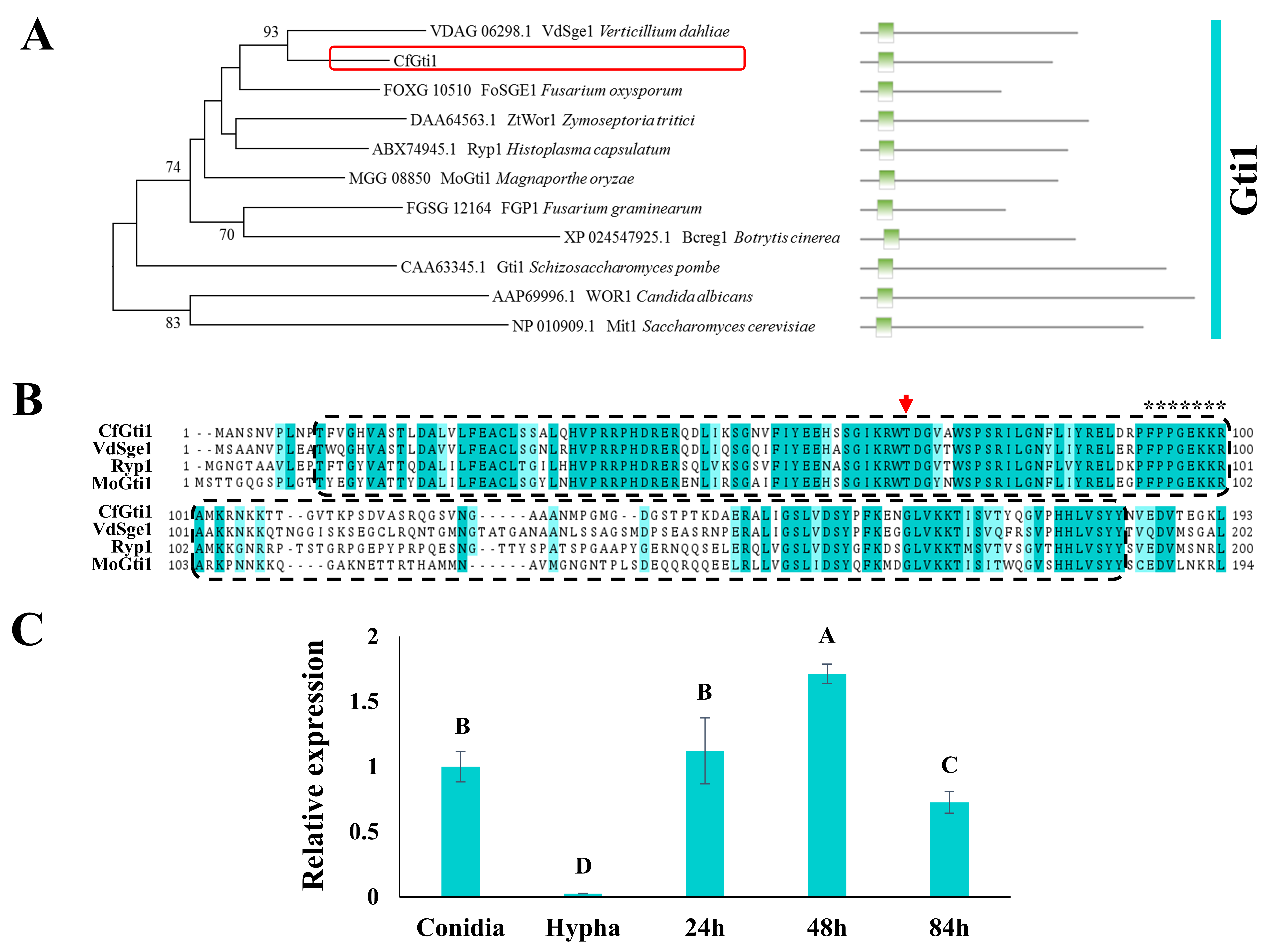
Figure 1. Phylogenetic and structural domain analysis and gene expression pattern analysis. (A): Phylogenetic analysis of CfGti1 and Gti1 orthologs in selected fungi. The corresponding sequence length and domain location are shown on the right. Gti1/Pac2 domains are indicated as green rectangles. The phylogenetic tree was constructed using 1000 non-parametric bootstrap runs with the neighbor-joining method; bootstrap percentages over 50% are indicated at the nodes. (B): Multiple amino acid sequence alignments of the N-terminal region of CfGti1 and its orthologs from Verticillium dahliae VdSge1 (XP_009656971.1), Histoplasma capsulatum Ryp1 (ABX74945.1), and Magnaporthe oryzae MoGti1 (XP_003713871.1). The red arrow indicates the conserved threonine residue within the potential protein kinase A phosphorylation site, and the putative nuclear localization signal is marked by asterisks. The box with the dashed line indicates the Gti1/Pac2 domains. Conserved residues are shaded in aquamarine. (C): Relative transcript level of CfGti1 gene at five developmental stages including conidia, hyphae, 24 h post-inoculation (hpi), 48 hpi, and 84 hpi on apple leaves. Error bars represent the standard deviation from three technical repetitions. The data were analyzed using Tukey’s HSD test. Means associated with the same capital letter do not differ significantly (p > 0.05).
Jof 12 00036 g001

2.2. Fungal Isolates and Culture Conditions

Colletotrichum fructicola wild-type strain (WT) 1104-6 was isolated from apple leaves displaying GLS symptoms in Hebei Province, China, and was stored in the laboratory of the Fungal Research Laboratory of NWAFU, Yangling, China. The isolation and pathogenicity test of 1104-6 were carried out through the following steps: Surface-sterilized pieces (5 × 5 mm) from the lesion margin of tissue were placed onto potato dextrose agar (PDA) plates. The plates were incubated at 25 °C in the dark for 5 days. Emerging fungal hyphae from the pieces were transferred to fresh PDA plates using a sterile needle to obtain pure cultures. Conidial suspensions (1 × 10⁶ conidia/mL) harvested from the pure culture were sprayed onto intact apple leaves. Inoculated leaves were placed in a humid chamber for 3–5 days. The wild-type strain and transformants generated in this study were stored as conidial suspensions at −80 °C with 30% glycerol and propagated on potato dextrose agar (PDA) plates at 25 °C.

2.3. Growth, Stress Tests, and Conidiation

Mycelial growth was induced on PDA at 25 °C by placing one 5 mm-diameter mycelial agar block in the center of each 90 mm Petri dish. Cell-wall stress sensitivity assays were conducted on PDA plates supplemented with either 200 μg/mL Congo red (CR) or 0.02% (w/v) sodium dodecylsulfate (SDS). The PDA plates were inoculated with mycelial plugs derived from the margin of 3-day-old colonies of WT and mutant strains. To test the impact of the pH environment on mycelial growth, the PDA plates were constructed by mixing 100 mL of 2 × PDA medium with an equal volume of adjustment buffer to achieve pH levels of 3 (0.2 M Na2HPO4 20.4 mL plus citric acid 79.6 mL), 5 (0.2 M Na2HPO4 51.4 mL plus citric acid 48.6 mL), or 7 (0.2 M Na2HPO4 87 mL plus citric acid 13 mL). The diameter of mycelial colonies was recorded, and the colonies were photographed at 6 days post-inoculation (dpi). The growth inhibition ratio of mutants was calculated using the following equation.
Growth   inhibition   ratio % = WT   colony   diameter Mutant   colony   diameter WT   colony   diameter × 100 %
All assays were performed with four replicates for each strain. Conidia used for penetration and pathogenicity assays were collected as described in the literature [25].

2.4. Deletion of the CfGti1 Gene and Complementation Constructs

The CfGti1 gene was deleted using the split-marker method for targeted gene replacement [36]. The upstream and downstream flanking sequences of CfGti1 were amplified with primers LFup/LR and RF/RRdown, respectively. The hygromycin B resistance cassettes HP and PT were amplified with primers NHYGHSF/HyRNest and NygF/NHYGHSR, respectively. The HP and PT were linked with upstream and downstream sequences by overlap PCR with primers LF/XuHyR and XuYgF/RR, respectively. PEG-mediated protoplast transformation was used to introduce two resulting overlapping fragments into the WT strain 1104-6 [22]. PDA plates supplemented with 100 µg/mL hygromycin B were used to select the transformants. CfGti1 gene deletion mutants were selected using three sets of PCR primer pairs: LF/855R, 866F/RR, and DF/DR. To analyze the homologous recombination events in the mutants, Southern blotting was conducted with the DIG-High Prime DNA Labeling and Detection Starter Kit II, Roche, catalog number 11585614910, following the manufacturer’s protocol. The probe was amplified by primers Gti1-pbF/Gti1-pbR.
For generating the CfGti1 gene complementation construct and analyzing the cellular location of CfGti1, the open reading frame and native promoter sequence (~2 kb) of the CfGti1 gene without a stop codon was cloned using the primers Gti1-gfpF/Gti1-gfpR. The required PCR product was linked to the vector PHZ100-GFP. The fusion expression vector PHZ100-GFP-CfGti1 was transformed into the ΔCfGti1-15 strain. The transformants were selected on PDA medium supplemented with 300 µg/mL of geneticin. Successful complementation was confirmed by PCR with the primer pairs: LF/855R, 866F/RR, and DF/DR. Transformants were observed with a fluorescence microscope at different stages. Primers used for gene deletion, identification, and complementation are displayed in Table S1.

2.5. Pathogenicity Assays

Detached fully expanded leaves (cv. Gala) were drop-inoculated with 20 μL of conidial suspension (5 × 10⁶ conidia/mL) or spray-inoculated with the same concentration of conidial suspension [25]. The pathogenicity test was conducted on non-wounded apple fruit using the following method: Each apple was sprayed with a conidial suspension containing 0.1% Tween 20 (4 × 10⁶ conidia/mL). Then, all inoculated apples were incubated in a sealed plastic storage box with moist gauze on the bottom at 25 °C for 9 days. Sterile water was sprayed on the surface of the fruit every 24 h [24]. The pathogenicity test was conducted on wounded apple fruit using the following method: Each apple was wounded by a 6 mm-diameter cork borer at three sites symmetrically. Then, 20 μL conidial suspensions (5 × 10⁶ conidia/mL) of WT, deletion mutant, and revertant were inoculated at three wounded sites on one apple, respectively [25]. Inoculations were performed on three repeats (three apples) independently. To determine penetration ability, conidial suspensions were inoculated on aseptic cellophane [25].

2.6. RNA-Seq and qRT-PCR Validation

For RNA-seq analysis, mycelia were harvested by filtration from PDB mixed cultures as described in reference [25]. Three biological replicates were analyzed for each strain under test. To explore gene expression during leaf infection, fully expanded leaves with uniform size were sprayed until runoff with a conidial suspension (5 × 10⁶ conidia/mL). Each strain was used to inoculate four leaves, which were then incubated in moist chambers at 25 °C. Sterile water was sprayed on leaves every 24 h after inoculation in order to maintain a wet environment. At 72 h post-inoculation (hpi), when appressoria had formed, four leaves inoculated with the same strain were mixed as one sample, quick-frozen in liquid nitrogen, then sent with freezer packs to Biomarker Technologies Corporation, Beijing, China, where RNA-seq was performed using an Illumina Hi-seq X10 sequencer (Illumina, San Diego, CA, USA). The sequencing protocol was 150 bp paired-end.
The resulting clean reads were mapped to the reference genome of C. fructicola strain 1104-6 using TopHat (v2.1.1) software [37]. The TopHat mapping parameters were set as described in reference [25]. Transcript quantitation of each gene and identification of differentially expressed genes were calculated via the Cuffdiff 2 pipeline using default parameters. Genes with a fold change in expression > 2 and false discovery rate (FDR)-corrected p < 0.05 were set as down- or up-regulated. Kyoto Encyclopedia of Genes and Genomes (KEGG) and Gene Ontology (GO) analyses were performed by using the OmicShare tools (http://www.omicshare.com/tools, accessed on 25 May 2022).
Genes of interest or differentially expressed in RNA-Seq data were validated by qRT-PCR using the original samples. To monitor the expression of the CfGti1 gene in different developmental stages, five samples (including conidia, vegetative hyphae on PDA, and apple leaves inoculated with conidia for 24 h, 48 h, and 84 h) were harvested for RNA isolation. Total RNAs were extracted using a RN53-EASYspin Plus Kit (Aidlab, Beijing, China). The resulting RNAs were used to synthesize cDNAs with a TransScript® II One-Step gDNA Removal and cDNA Synthesis SuperMix (TransGen Biotech, Beijing, China, catalog number: AH311-02). qRT-PCR amplifications and relative transcript quantity were performed as described in reference [25]. Primers used for qRT-PCR assays are provided in Table S2.

3. Results

3.1. Identification and Expression of CfGti1

Two transcription factors, CfGti1 (XP_031877756.1) and CfPac2 (XP_031879723.1), that contain the Gti1/Pac2 domain were identified in C. fructicola (GenBank accession number MVNS00000000) by a local BlastP search using MoGti1 and MoPac2 in Magnaporthe oryzae as a query [38]. The CfGti1 gene contains a 1359 bp open reading frame with no introns. It encoded a 452-amino-acid protein with a presumed weight of 49.5 kDa and an isoelectric point of 6.86 using the ExPASy online tool. Phylogenetic analysis revealed that CfGti1 was clustered in the same clade with other Gti1 orthologs (Figure 1A).
Sequence alignment indicated that Gti1 orthologs varied in length, and all these proteins contain a typical gluconate transport-inducing protein domain, called Gti1/Pac2 domain (Pfam09729), which is present at the N-terminus with relatively high conservation across these fungal lineages (Figure 1A). However, the C-terminus of Gti1 orthologs had relatively lower conservation. Additionally, a potential protein kinase A phosphorylation site and a putative nuclear localization signal (NLS) motif (PPGEKKR) were found in the Gti1/Pac2 domains of CfGti1 (Figure 1B).
Before testing the functions of CfGti1, we measured its transcript level. Reverse transcription–quantitative PCR (qRT-PCR) revealed that the expression of CfGti1 was apparently higher in conidia and infection stages than that in vegetative hyphae cultivated on PDA. The transcript level of CfGti1 in early stages of infection (24 and 48 h post-inoculation, hpi) was higher than that in the late stage of infection (84 hpi) (Figure 1C). These results suggest that CfGti1 may play an important role during pathogenesis.

3.2. CfGti1 Is Required for Vegetative Growth, Cell Wall Integrity, and Abiotic Tolerance

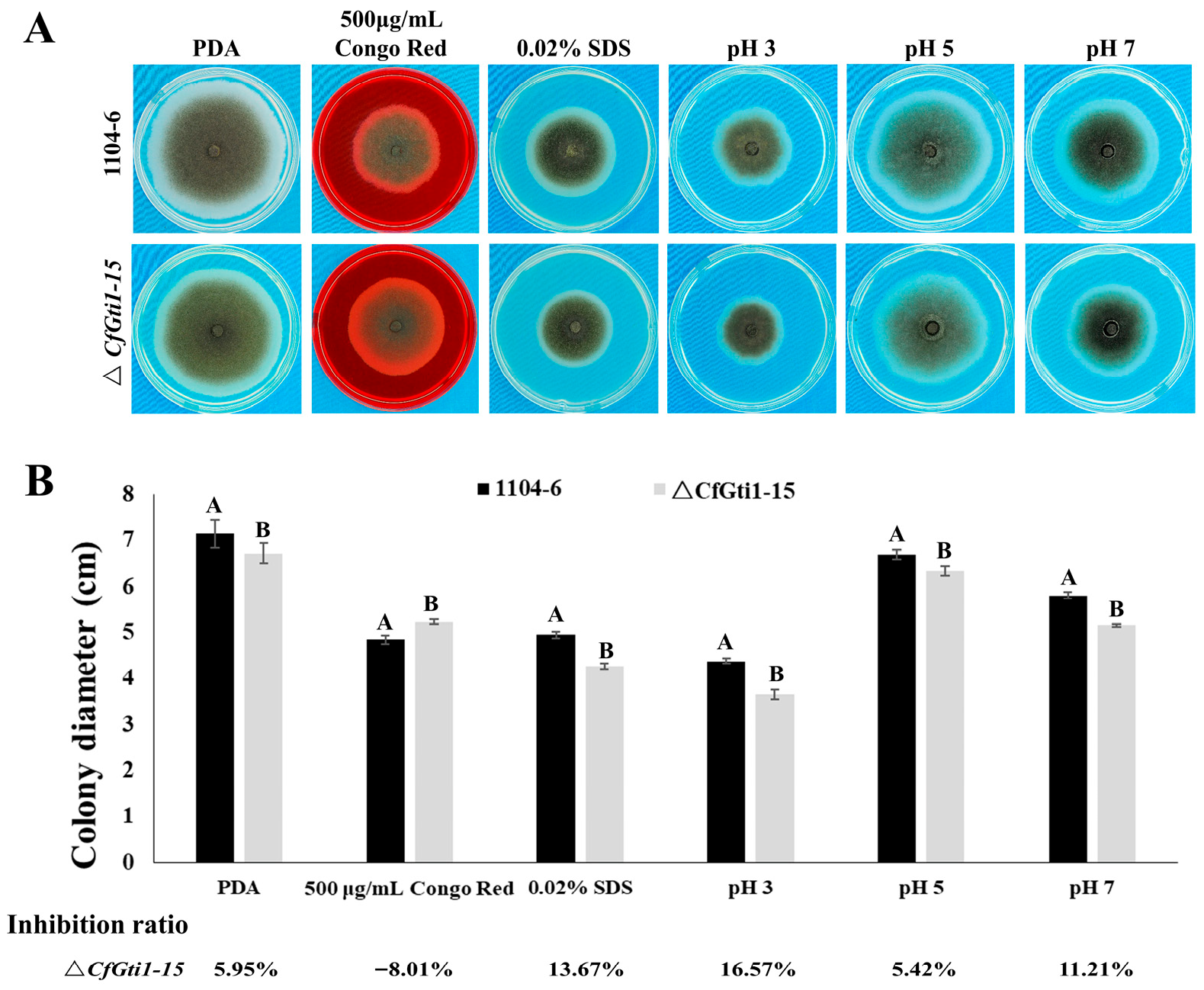
To assess the role of CfGti1 in C. fructicola, the CfGti1 gene knock-out mutant strain ΔCfGti1-15 was generated using a split-marker approach (Figure S1A). A deletion mutant was identified by three PCR reactions and confirmed by Southern blot analysis (Figure S1B,C). For complementation of ΔCfGti1-15, the CfGti1 gene with its native promoter region (~2 kb) was transformed into ΔCfGti1-15. The complementary strain CfGti1-15C10 was confirmed by three PCR reactions (Figure S1B). The colony of both wild type (WT) and ΔCfGti1-15 displayed black in an inner ring and white in an outer ring (Figure 2A). For the vegetative growth test, the colony diameter of ΔCfGti1-15 showed a 6% reduction compared to WT 1104-6 on PDA plates after 6 days of incubation.
To evaluate sensitivity to cell wall antagonists (SDS and Congo red), the WT and ΔCfGti1-15 were cultivated on PDA supplemented with 0.02% SDS or 500 μg/mL Congo red, respectively. The ΔCfGti1-15 showed a 13.7% reduction in colony diameter on PDA with 0.02% SDS and an 8% increase on PDA supplemented with Congo red. On PDA of pH 5, ΔCfGti1-15 showed growth reduction just like the vegetative growth test, compared to 16.6% and 11.2% reduction at pH 3 and 7, respectively (Figure 2A,B). These results indicate that CfGti1 plays a role in maintaining cell wall integrity and pH tolerance.

3.3. CfGti1 Is Indispensable for Pathogenicity and Colonization of C. fructicola

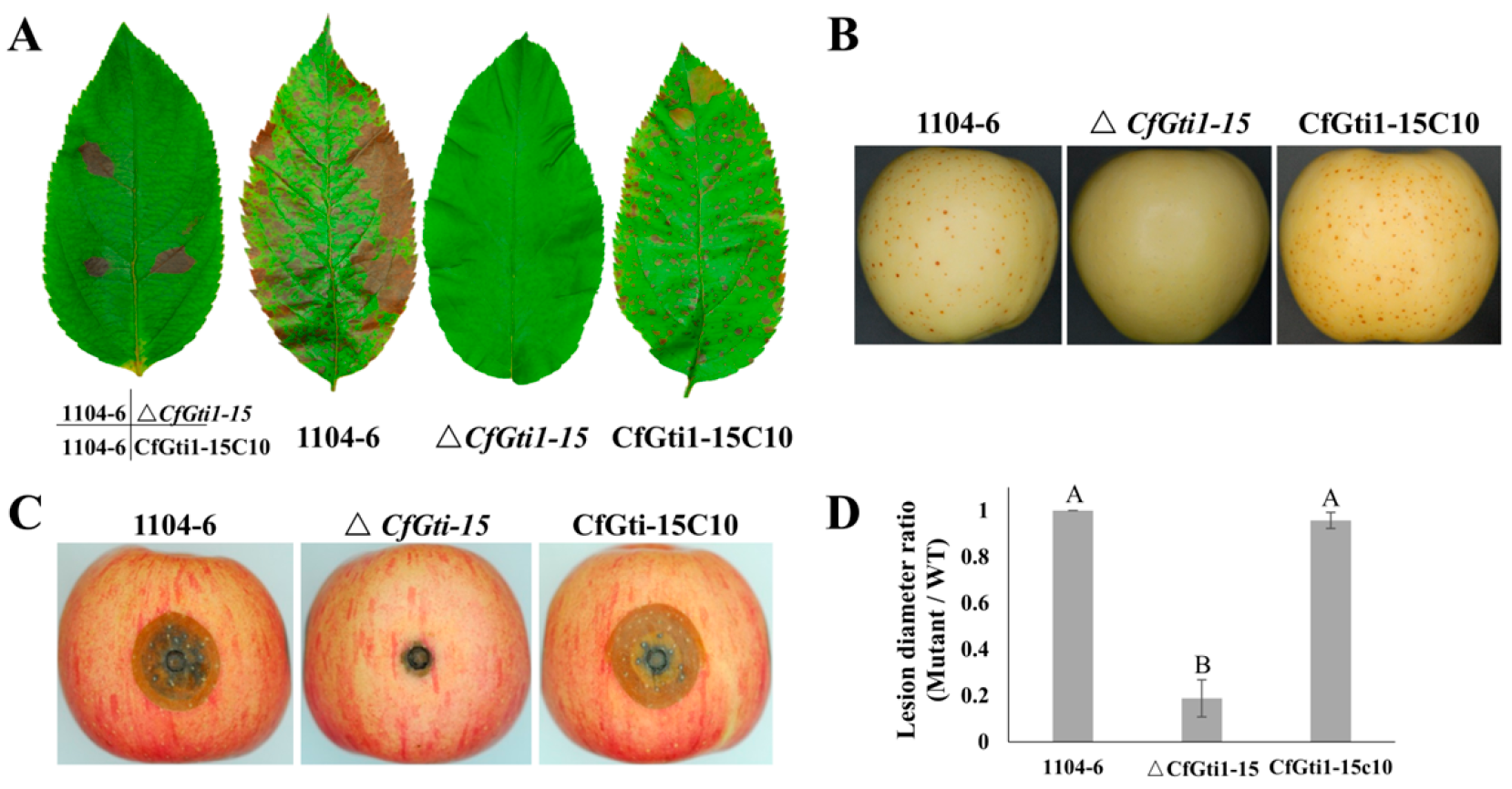
To determine if CfGti1 is involved in pathogenicity, we performed pathogenicity tests on detached apple leaves and fruit (cv. Gala). By drop inoculation of conidial suspensions side by side on leaves, the WT 1104-6 and the complementary strain CfGti1-15C10 caused conspicuous black necrotic spots at 5 days post-inoculation (dpi). Under the same conditions, however, the ΔCfGti1-15 mutant did not induce any lesions (Figure 3A). Spray-inoculation of the WT and CfGti1-15C10 conidial suspensions on leaves caused massive lesions on leaves, compared to no lesions for spray-inoculation with ΔCfGti1-15 (Figure 3A). Spraying apple fruit with a conidial suspension of ΔCfGti1-15 caused no necrotic spots, whereas spraying WT and CfGti1-15C10 inoculum caused numerous lesions of about 1–2 mm in diameter (Figure 3B). These results indicate that CfGti1 is indispensable for pathogenicity of C. fructicola.
To investigate the function of CfGti1 in colonization and hyphal extension, appressorium-mediated penetration was bypassed by wound inoculation. A 20 μL conidial suspension of each strain was inoculated into wounded apple fruit. At 7 dpi, lesion diameter caused by ΔCfGti1-15 on wounded fruit averaged 92 ± 2% smaller than for inoculation with the WT. At the same time, lesion diameter caused by CfGti1-15C10 was 96 ± 14% of that caused by the WT (Figure 3C,D). This result indicates that ΔCfGti1 was almost entirely deficient in colonization of wounded apple fruit tissue.

3.4. CfGti1 Is Involved in Penetration and Hyphal Development After Penetration

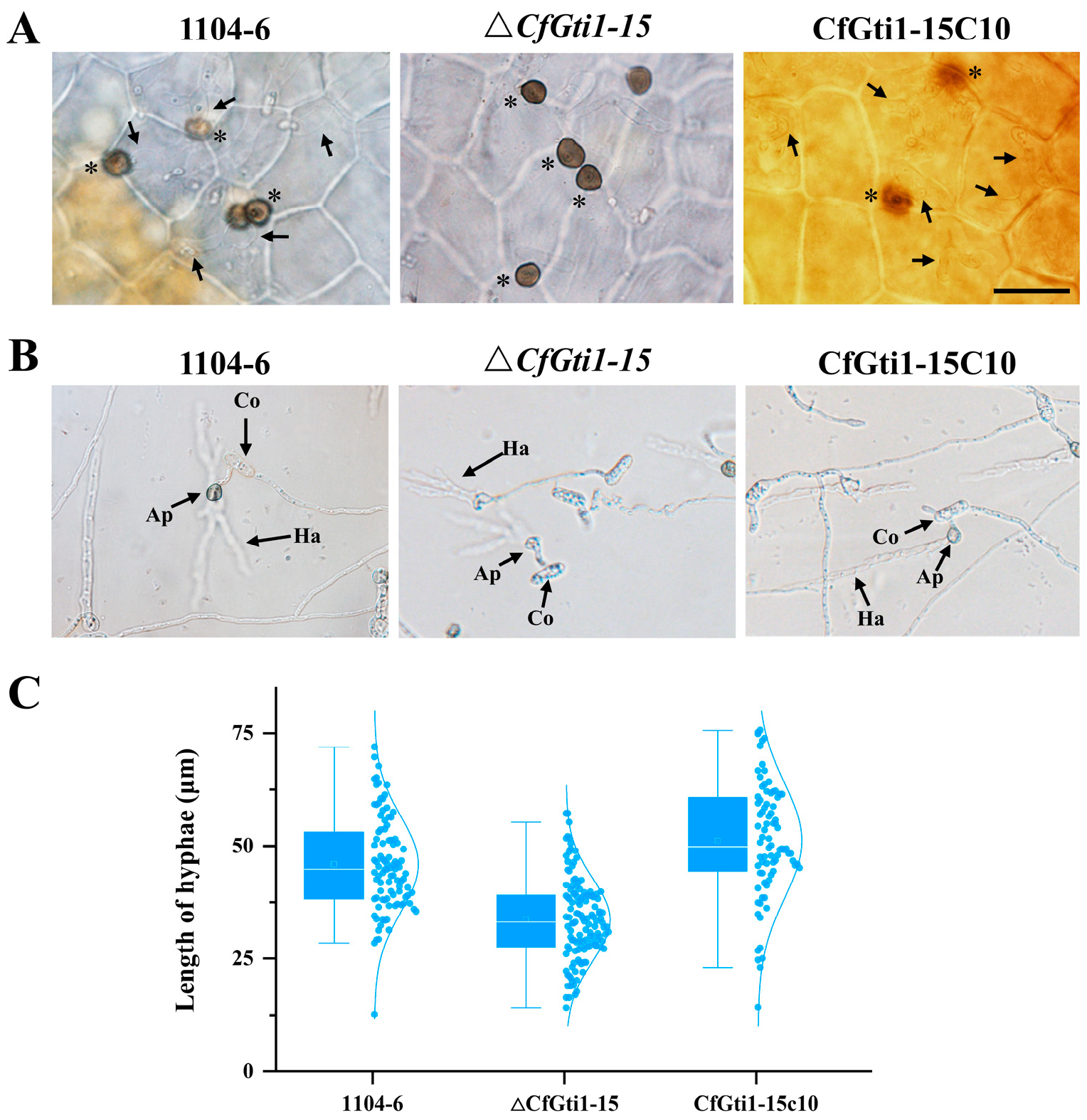
To determine the stage at which the CfGti1 gene deletion mutant was halted during leaf infection, inoculated leaves were examined microscopically. At 4 dpi, all tested strains including ΔCfGti1-15 formed massive numbers of appressoria on the leaf surface. Although the WT and complementary strains developed hyphae in leaf cells, ΔCfGti1-15 failed to penetrate leaf epidermal cells (Figure 4A). However, ΔCfGti1-15 readily penetrated cellophane, although developing abnormally shortened hyphae after penetration. The complemented strain CfGti1-15C10 penetrated leaf tissue in the same manner as the WT (Figure 4B,C).

3.5. Comparative Transcriptome Analysis Revealed Genes Modulated by CfGti1

To uncover the underlying mechanisms of the phenotype and pathogenicity defection in the ΔCfGti1 mutant, we performed transcriptome sequencing (RNA-seq) analysis. Compared to the WT, 1248 genes showed differential expression (fold change ≥ 2, Q-value < 0.05) in mycelia of the ΔCfGti1-15 mutant. Among those genes, 570 and 678 genes were up- and down-regulated, respectively. Results of reverse transcription–quantitative PCR (qRT-PCR) of six down-regulated genes were consistent with RNA-seq data (Figure 5C). During leaf infection, 2008 and 1937 genes were up- and down-regulated (fold change ≥ 4), respectively, in the ΔCfGti1-15 mutant compared to the WT.
Gene Ontology (GO) enrichment analysis showed that most affected genes associated with mycelial growth were related to metabolism, catalytic activity, and single-organism processes (Figure S2A). Down-regulated genes were enriched in the membrane, the intrinsic component of the membrane, and the integral component of the membrane (Figure S2B). A KEGG pathway enrichment analysis revealed that down-regulated genes were enriched in ether lipid metabolism, nicotinate and nicotinamide metabolism, or butanoate metabolism pathways (Figure S2C).
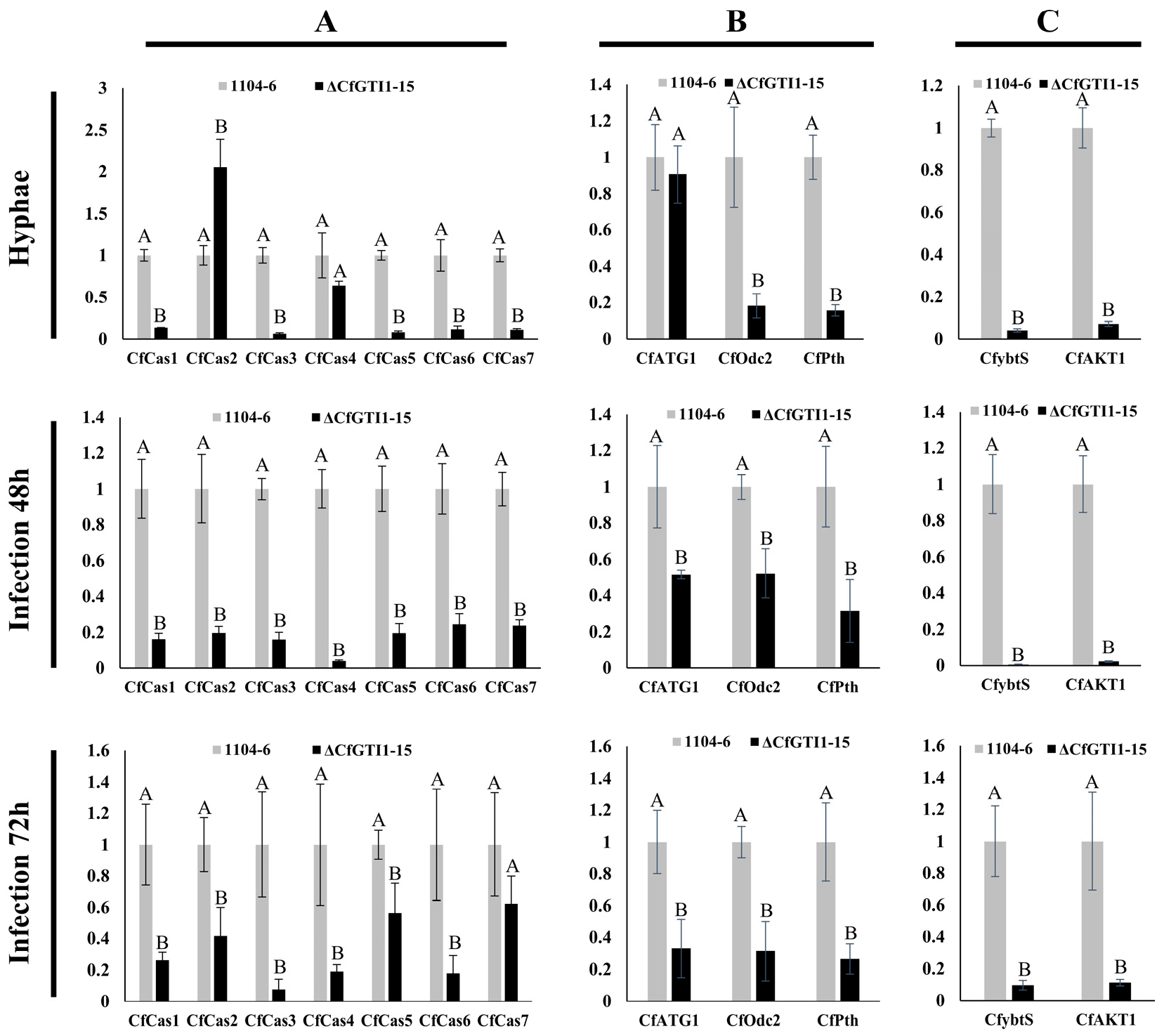
As mentioned above, deletion of the CfGti1 gene led to defect of appressorium-mediated penetration on leaves. Consistent with this defect, many genes involved in appressorium-mediated penetration were strongly down-regulated in ΔCfGti1-15 during leaf infection, including the serine/threonine kinase gene CfATG1 (MgATG1 ortholog) [39], peroxisomal carnitine acetyl transferase gene CfPTH2 (PTH2) [40], oxalate decarboxylase gene CfOdc2 (Ss-odc2) [41], and four of seven Gas1-like DUF3129 family genes, CfCas3, CfCas4, CfCas5, and CfCas6 [42] (Table 1). The relative expression of Gas1-like DUF3129 family genes (CfCas1CfCas7), CfATG1, CfPTH2, and CfOdc2 genes was verified by qRT-PCR in three phases. All genes mentioned above were down-regulated in ΔCfGti1-15 during production of hyphae, leaf infection (48 h), and leaf infection (72 h) except CfCas2, CfCas4, and CfATG1 in hyphae, and CfCas7 in infection (72 h) (Figure 6A,B).
Expression of multiple pathogenesis-related genes was affected by the deletion. Among them, a multidrug resistance transporter Cf07568 (CgTpo1_2) [43], a major facilitator superfamily transporter Cf08985 (CaNAG4) [44], a tensin-like phosphatase Cf15556 (FgTep1) [45], and eisosome Cf09682 (PilB) [46] were down-regulated during both leaf infection and vegetative hyphae in ΔCfGti1-15 (Table 1). In addition, kinase Cf00781 (FgCtk1) [47], pyruvate dehydrogenase kinase Cf16115 (FgPDK1) [48], bZIP transcription factor Cf07907 (GzbZIP007) [49], ferric reductase Cf10343 (FreB) [50], secreted LysM Protein 1 Cf05289 (Slp1) [51], effector candidates Cf02031 (ChEC91) [52], retromer component Cf07959 (FgVps29) [53], pectate lyase Cf16857 (pelB) [54], methylenetetrahydrofolate reductase Cf16072 (MET13) [55], α-1,2-mannosyltransferase Cf00854 (Ktr4) [56], ubiquitin-conjugating enzyme Cf09590 (FgPEX4) [57], exosome component Cf00756 (GzOB047) [49], ROGDI domain contain gene Cf11008 (FgRav2) [58], and Ca2+-ATPases Cf00193 (MGG_05078.5) [59] were down-regulated during leaf infection in ΔCfGti1-15 (Table 1).
Table 1. Expression of differentially expressed genes in comparative transcriptome analysis.
Gene ID Gene NameAccession NumberDescriptionLeaf InfectionHyphaeReferences
FPKM (1104-6)FPKM (ΔCfGti1-15)Log2
(FC)
FPKM (1104-6)FPKM (ΔCfGti1-15)Log2
(FC)
Cf15211CfCas1XP_031876572.1DUF3129 domain protein565.9389.8−0.53.78.51.2[42,60]
Cf17702CfCas2XP_031887373.169.0247.91.84.55.80.4
Cf02102CfCas3XP_031881140.11186.6634.8−0.90.00.20.0
Cf08259CfCas4XP_031885643.1174.121.8−3.038.638.50.0
Cf04403CfCas5XP_031892225.1378.80.02.74.20.6
Cf09988CfCas6XP_031882861.144.00.03.14.90.6
Cf16160CfCas7XP_031893297.1116.3206.80.853.118.1−1.6
Cf02383CfAtg1XP_031886481.1Serine/Threonine protein kinase43.07.4−2.577.9118.00.6[39]
Cf07707CfPth2XP_031885495.1Peroxisomal carnitine acetyl transferase86.20.036.733.3−0.1[40]
Cf05405CfOdc2XP_031881493.1Oxalate decarboxylase151.40.027.81.2−4.6[41]
Cf07568CfTpo1XP_031879473.1Major facilitator superfamily transporter64.628.5−1.2142.77.0−4.3[43]
Cf08985CfNag4XP_031877042.1Major facilitator superfamily transporter217.987.4−1.3187.612.7−3.9[44]
Cf15556CfTep1XP_031877149.1Tensin-like phosphatase565.2268.7−1.1224.228.7−3.0[45]
Cf09682CfPilBXP_031882758.1Sphingolipid long chain base-responsive712.1494.9−0.5212.947.6−2.2[46]
Cf00781CfCtk1XP_031880716.1Ctd kinase115.410.3−3.532.445.90.5[47]
Cf16115CfPDK1XP_031876717.1Pyruvate dehydrogenase kinase294.00.089.676.1−0.2[48]
Cf07907CfZip007XP_031882559.1bZIP transcription factor215.70.0140.3164.70.2[49]
Cf10343CfFreBXP_031884339.1Ferric reductase133.414.7−3.255.553.5−0.1[50]
Cf02031CfEC91XP_031881071.1Hypersensitive response-inducing protein341.20.015.93.5−2.2[52]
Cf07959CfVps29XP_031883282.1Vacuolar protein sorting-associated protein212.10.044.053.40.3[53]
Cf16857CfPelBXP_031889329.1Pectate lyase148.70.067.3268.62.0[54]
Cf16072 CfMet13XP_031885300.1Methylenetetrahydrofolate reductase117.10.052.171.40.5[55]
Cf00854CfKtr4XP_031887124.1α-1,2-mannosyltransferase116.90.084.086.00.0[56]
Cf09590CfPEX4XP_031888472.1Ubiquitin-conjugating enzyme106.70.076.098.40.4[57]
Cf00756CfGzOB047XP_031891276.1Exosome component exosc1 csl494.40.018.515.8−0.2[49]
Cf11008CfRav2XP_031881664.1ROGDI domain contain protein90.40.019.418.7−0.1[58]
Cf00193CfATPase3XP_031888621.1Calcium-transporting ATPase 3121.019.4−2.628.222.8−0.3[59]

3.6. CfGti1 Modulates the Gene Expression Residing on Accessory Chromosomes of C. fructicola

In contrast to the core chromosomes, accessory chromosomes (generally less than 2.0 MB) which integrate numerous transposable elements and pathogenicity genes are dispensable for normal growth but essential for determining host-specific virulence [61,62].
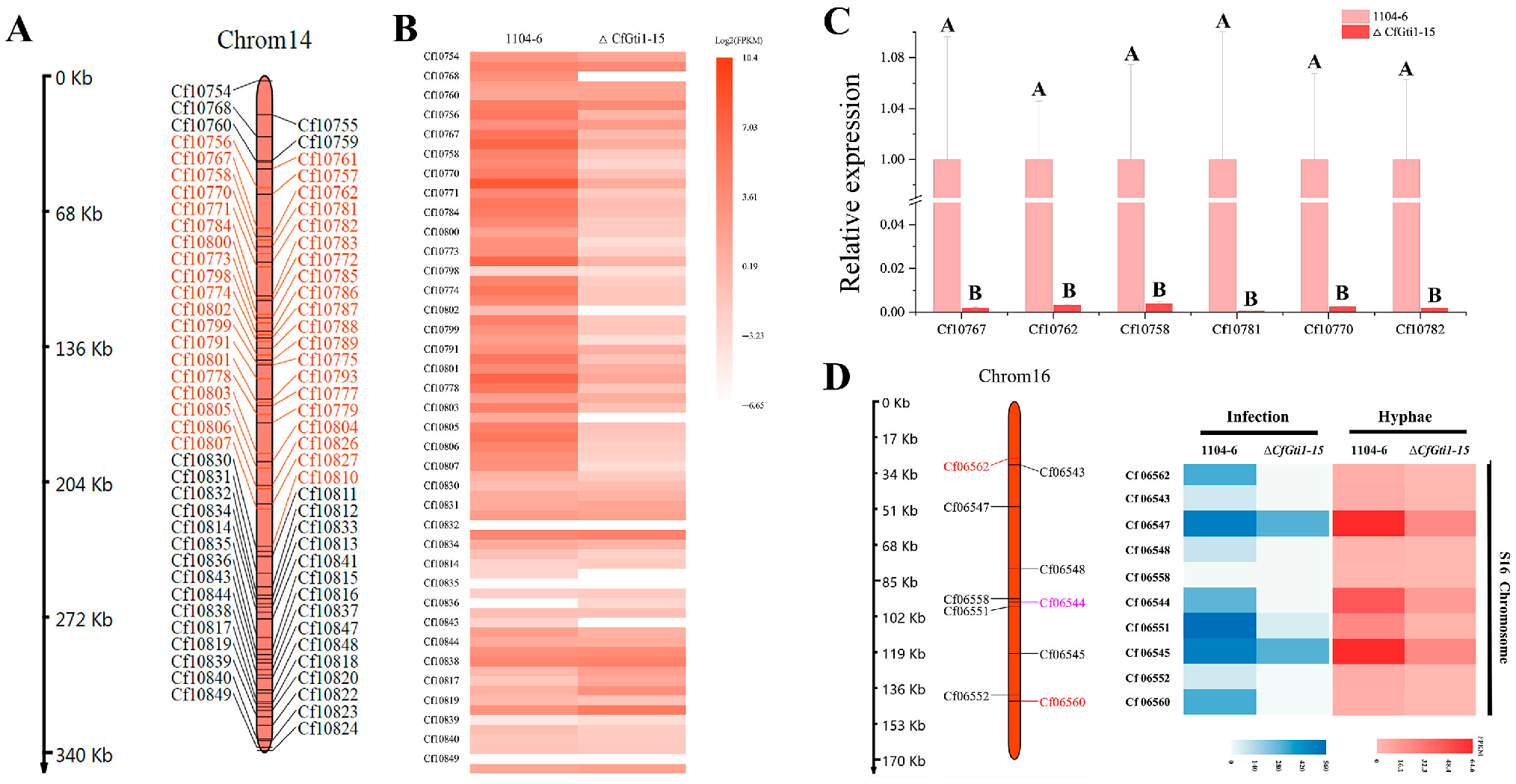
After acquisition of a high-quality genome by long-read sequencing and Hi-C map data, we found that there are five putative accessory chromosomes (0.17 MB to 0.92 MB) in C. fructicola [63]. In the 14th putative accessory chromosome (0.35 MB), a predicted 82 genes resided there (Figure 5A). Based on transcriptome data of vegetative hyphae, 45 adjacent genes were drastically down-regulated because of deletion of CfGti1 (Figure 5A,B). Among them, six genes were selected to verify the transcript levels by qRT-PCR; this result was consistent with transcriptome data (Figure 5C). In addition, 10 predicted genes residing on the 16th putative accessory chromosome (0.17 MB) were also all down-regulated, not only in vegetative hyphae growth but also in leaf infection in ΔCfGti1-15 (Figure 5D). Nine of these genes were induced during leaf infection. Of them, two presumed virulence-related genes were identified: a salicylate synthetase gene CfytbS (Cf06562, Cf06560) and an acyl-CoA ligase gene CfAKT1 (Cf06544). The CfytbS was a ybtS and MaSalS ortholog, which were required for virulence in Klebsiella pneumonia and Metarhizium acridum, respectively [64,65]. The CfAKT1 was an AKT1 and AFT1-1 ortholog, which were required for biosynthesis of AK and AF host-specific toxin, respectively, in Alternaria alternata [66,67]. The relative expression of CfytbS and CfAKT1 was verified by qRT-PCR and dramatically down-regulated for vegetative hyphae growth, leaf infection at 48 h, and leaf infection at 72 h (Figure 6C).

3.7. CfGti1-GFP Localizes to the Nucleus

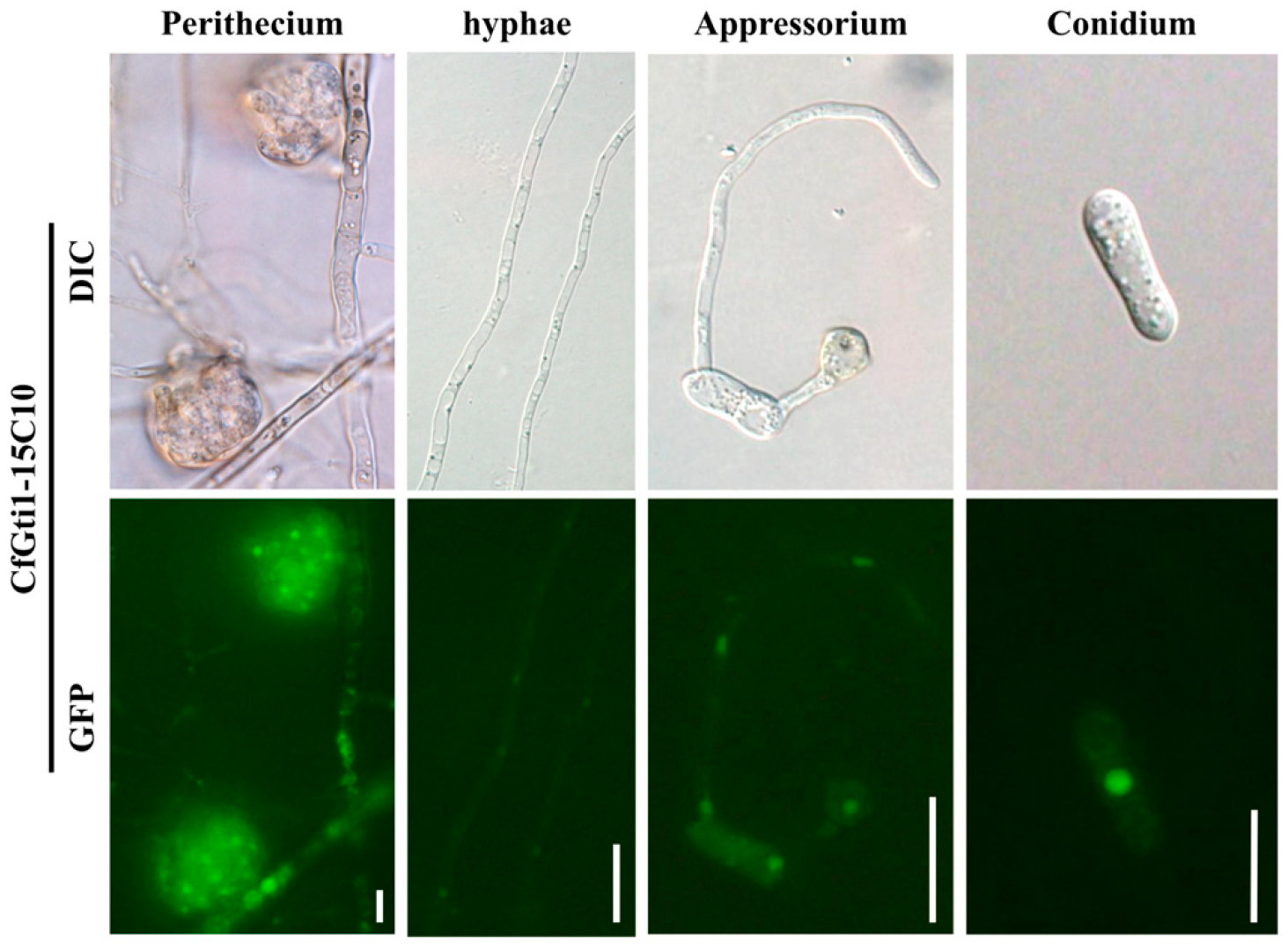
To analyze the cellular location of CfGti1, a CfGti1-GFP construct was generated and transformed into the mutant ΔCfGti1-15. The resulting transformant CfGti1-15C10 was screened by geneticin, PCR reactions, and GFP fluorescence. Under examination by fluorescence microscopy, weak GFP fluorescence signals were detected exclusively in the nuclei of conidia, appressoria, hyphae, and perithecia. In hyphae, the GFP fluorescence signal intensity seemed weaker than for other cell types (Figure 7). This result was consistent with gene expression analysis of CfGti1. These data indicate that CfGti1-GFP possessed characteristics of a transcription factor and was localized to the nucleus in C. fructicola.

4. Discussion

In the present study, we characterized a key pathogenicity-related transcription factor in C. fructicola, CfGti1, which possesses pleiotropic functions in pathogenicity and colonization by regulating infection-related morphogenesis, including host penetration and hyphae development. These results provide important new insight into the genetic regulation of GLS pathogenesis.
Gti1 and its ortholog’s transcription factor were vital for morphological switching and pathogenesis in the human fungal pathogen Candida albicans and Histoplasma capsulatum. Specifically, it was required for switching two different cell types when encountering specific environmental transformation [68,69,70]. In many plant-pathogenic fungi, Gti1-like proteins are also involved in virulence. In Fusarium verticillioides, F. graminearum, Zymoseptoria tritici, and Cladosporium fulvum, Gti1-like gene deletion mutants induced disease symptoms with reduced virulence [71,72,73,74]. In F. oxysporum, Botrytis cinerea, and M. oryzae, Gti1-like gene deletion affected host penetration either weakly or not at all [75,76,77]. In contrast, CfGti1 gene deletion in C. fructicola resulted in total loss of GLS symptoms due to its shutdown of host penetration. These observations showed that CfGti1 performs essential roles in pathogenicity of C. fructicola.
The deletion mutant ΔCfGti1 resulted in loss of C. fructicola’s ability to penetrate a plant host, but it was still able to penetrate cellophane. These results suggest that ΔCfGti1 retained the ability, at least in part, to develop a penetration peg. Two completely different penetration phenotypes on two different surfaces may reflect the defects of ΔCfGti1 in host plant signal recognition or mechanical penetration pressure. Consistent with this phenotype of host penetration defect, we identified several appressorium-mediated, penetration-related genes that were putatively regulated by CfGti1, including a serine/threonine kinase MgATG1 orthologous gene [39], a peroxisomal carnitine acetyl transferase PTH2 orthologous gene [40], an oxalate decarboxylase Ss-odc2 orthologous gene [41], and a Gas1-like DUF3129 family of genes [42]. Of these genes, MgATG1 is indispensable for initiating autophagy and lipid turnover in conidia and appressoria, which is essential for appressorium-mediated host penetration [39], and Gas1-like DUF3129 proteins are enriched in appressoria and promote appressorial penetration by promoting lipid droplet degradation [42]. The impairment of appressorium-mediated penetration of the PTH2 gene deletion mutant was due to delayed mobilization of lipid droplets in infection structures [40]. Future research should aim to determine whether CfGti1 regulates appressorium-mediated host penetration by targeting various penetration-related genes, especially those related to lipid droplet metabolism.
When the penetration process was bypassed by wound inoculation of apple fruit, the ΔCfGti1 mutant was almost unable to colonize fruit tissues. Similar colonization loss was also observed in the deletion mutant of VdSge1 (Gti1 ortholog) in V. dahliae [78]. In Cladosporium fulvum, deletion of a Gti1-like gene affected only part of the colonization process [74]. In contrast, the Gti1-like protein is not required for host colonization in F. verticillioides and F. oxysporum [71,75]. Overall, the functions that Gti1-like proteins perform in colonization vary among plant pathogenic fungi. Our results suggest that CfGti1 is indispensable for colonization by C. fructicola. A hypothesized explanation for loss of colonization ability by ΔCfGti1 is deficient development of hyphal growth and development. At the level of gene regulation, we identified numerous virulence-related genes that were deactivated during vegetative hyphae growth and infection in ΔCfGti1. These results suggest that CfGti1 performs functions in colonization and virulence by modulating virulence-related genes.
Among pathogenic fungal species, accessory chromosomes that are generally small and harbor pathogenicity-related genes exist separately from the core chromosomes and play a prominent role in pathogenicity in some cases [79,80]. Accessory chromosomes are notable in their ability to transform a non-pathogenic strain into a pathogenic strain by means of horizontal transfer of these chromosomes between strains [81,82]. In the present study, CfGti1 acted as a regulator for genes residing on accessory chromosomes of C. fructicola. Interestingly, two putative pathogenicity-related genes, a salicylate synthetase gene (ybtS orthologue) and an acyl-CoA ligase gene (AKT1 and AFT1-1 orthologue), residing on an accessory chromosome of C. fructicola, are also modulated by CfGti1. AKT1 and AFT1-1 are responsible for biosynthesis of host-specific toxins AK and AF, which share many aspects of their molecular structure [66,67]. The ybtS gene encodes salicylate synthetase, which is required for the early steps of the biosynthesis of yersiniabactin, which is involved in iron uptake and pathogenesis of pneumonic plague and bubonic plague [83]. Studies about the pathogenicity-related accessory chromosomes were relatively indistinct in Colletotrichum species. In the future, it is worth exploring whether there is linkage between virulence-related genes residing on accessory chromosomes, toxin synthesis, and pathogenesis of GLS.

5. Conclusions

Taken together, our results demonstrate that CfGti1, a key pathogenic-related transcription factor, is essential for regulating appressorium-mediated host penetration, colonization, hyphal extension, and pathogenesis in C. fructicola.
Methodological Limitation: These transcriptomic analyses were performed using the then-standard TopHat/Cuffdiff pipeline. We note that the rapid evolution of RNA-seq analysis means newer tools (e.g., HISAT2/StringTie for alignment/assembly or Salmon/DESeq2 for quantification) now offer improvements in accuracy and computational efficiency.

Supplementary Materials

The following supporting information can be downloaded at: https://www.mdpi.com/article/10.3390/jof12010036/s1, Figure S1: Targeted gene replacement and CfGti1 gene deletion mutant identification; Figure S2: Function categorization of the differentially expressed genes in the ΔCfGti1 mutant. Table S1: Primers used for gene knockout, mutant identification and complementation. Table S2: qRT-PCR primers used in this study.

Author Contributions

W.L. and B.H. designed and managed the whole project; W.Z., W.S., Y.P., P.D., C.Y. and Y.W. assisted in data collection; G.S., R.Z. and M.L.G. revised the manuscript; W.L. performed the experiments, analyzed data, and wrote the initial manuscript. All authors have read and agreed to the published version of the manuscript.

Funding

This research was funded by the Fundamental Research Program of Shanxi Province (202303021222056), the Scientific and Technological Innovation Programs of Higher Education Institutions in Shanxi (2023L053), the Talent Introduction and Research Initiation Project of Shanxi Agricultural University (2023BQ77), the Excellent Doctoral Award of Shanxi Province for Scientific Research Project (SXBYKY2023040), Key Research and Development Project of Shanxi Province (2022ZDYF122), and National Natural Science Foundation of China (32070144).

Institutional Review Board Statement

Not applicable.

Informed Consent Statement

Not applicable.

Data Availability Statement

The original contributions presented in this study are included in the article. Further inquiries can be directed to the corresponding authors.

Conflicts of Interest

The authors declare no conflicts of interest. The funders had no role in the design of the study; in the collection, analyses, or interpretation of data; in the writing of the manuscript; or in the decision to publish the results.

References

  1. Wang, B.; Li, B.H.; Dong, X.L.; Wang, C.X.; Zhang, Z.F. Effects of temperature, wetness duration, and moisture on the conidial germination, infection, and disease incubation period of Glomerella cingulata. Plant Dis. 2015, 99, 249–256. [Google Scholar] [CrossRef]
  2. Shang, S.P.; Liang, X.F.; Liu, G.L.; Zhang, S.; Lu, Z.X.; Zhang, R.; Gleason, M.L.; Sun, G.Y. Histological and ultrastructural characterization of the leaf infection events of Colletotrichum fructicola on Malus domestica ‘Gala’. Plant Pathol. 2020, 69, 538–548. [Google Scholar] [CrossRef]
  3. Yokosawa, S.; Eguchi, N.; Kondo, K.; Sato, T. Phylogenetic relationship and fungicide sensitivity of members of the Colletotrichum gloeosporioides species complex from apple. J. Gen. Plant Pathol. 2017, 83, 291–298. [Google Scholar] [CrossRef]
  4. Casanova, L.; Hernandez, L.; Martinez, E.; Velho, A.C.; Rockenbach, M.F.; Stadnik, M.J.; Alaniz, S.; Mondino, P. First report of Glomerella leaf spot of apple caused by Colletotrichum fructicola in Uruguay. Plant Dis. 2017, 101, 834. [Google Scholar] [CrossRef]
  5. Wang, C.X.; Zhang, Z.F.; Li, B.H.; Wang, H.Y.; Dong, X.L. First report of Glomerella leaf spot of apple caused by Glomerella cingulata in China. Plant Dis. 2012, 96, 912–913. [Google Scholar] [CrossRef]
  6. Wang, N.; Xu, J.; Zhao, X.; Wang, M.; Zhuang, J. First report of Glomerella leaf spot of apple caused by Colletotrichum asianum. Plant Dis. 2020, 104, 2734. [Google Scholar] [CrossRef]
  7. Velho, A.C.; Stadnik, M.J.; Wallhead, M. Unraveling Colletotrichum species associated with Glomerella leaf spot of apple. Trop. Plant Pathol. 2019, 44, 197–204. [Google Scholar] [CrossRef]
  8. Velho, A.C.; Alaniz, S.; Casanova, L.; Mondino, P.; Stadnik, M.J. New insights into the characterization of Colletotrichum species associated with apple diseases in southern Brazil and Uruguay. Fungal Biol. 2015, 119, 229–244. [Google Scholar] [CrossRef]
  9. Wang, W.; Fu, D.D.; Zhang, R.; Sun, G.Y. Etiology of apple leaf spot caused by Colletotrichum spp. Mycosystema 2015, 34, 13–25. [Google Scholar] [CrossRef]
  10. Gonzalez, E.; Sutton, T.B.; Correll, J.C. Clarification of the etiology of Glomerella leaf spot and bitter rot of apple caused by Colletotrichum spp. based on morphology and genetic, molecular, and pathogenicity tests. Phytopathology 2006, 96, 982–992. [Google Scholar] [CrossRef]
  11. Du, X.L.; Hu, T.L.; Liu, Y.J.; Wang, Y.N.; Wang, S.T.; Cao, K.Q. First report of Glomerella cingulata causing Glomerella leaf spot on pear in Hebei, China. Plant Dis. 2015, 99, 553–554. [Google Scholar] [CrossRef]
  12. Velho, A.C.; Stadnik, M.J.; Casanova, L.; Mondino, P.; Alaniz, S. First report of Colletotrichum karstii causing Glomerella leaf spot on apple in Santa Catarina state, Brazil. Plant Dis. 2014, 98, 157–158. [Google Scholar] [CrossRef]
  13. Zhang, Z.; Yan, M.; Li, W.; Guo, Y.; Liang, X. First report of Colletotrichum aenigma causing apple Glomerella leaf spot on the Granny Smith cultivar in China. Plant Dis. 2021, 105, 1563. [Google Scholar] [CrossRef]
  14. Liang, X.F.; Shang, S.P.; Dong, Q.Y.; Wang, B.; Zhang, R.; Gleason, M.L.; Sun, G.Y. Transcriptomic analysis reveals candidate genes regulating development and host interactions of Colletotrichum fructicola. BMC Genom. 2018, 19, 557. [Google Scholar] [CrossRef] [PubMed]
  15. Guo, J.; Zhou, X.; Xie, F.; Cao, J.; Liu, S.; Zhong, J.; Zhu, H. Hypovirulence caused by mycovirus in Colletotrichum fructicola. Front. Plant Sci. 2022, 13, 1038781. [Google Scholar] [CrossRef]
  16. Huang, L.; Sheng, J.; Song, W.; Zheng, D.; Song, S.; Xu, X.; Yu, J.; Liu, Q.; Liu, Y.; Tang, W. First report of leaf spot caused by Colletotrichum fructicola on Kiwifruit in China. Plant Dis. 2022, 106, 2760. [Google Scholar] [CrossRef]
  17. Tang, Z.; Lou, J.; He, L.; Wang, Q.; Chen, L.; Zhong, X.; Wu, C.; Zhang, L.; Wang, Z.Q. First report of Colletotrichum fructicola causing anthracnose on cherry (Prunus avium) in China. Plant Dis. 2022, 106, 317. [Google Scholar] [CrossRef]
  18. Health, E.P.o.P.; Bragard, C.; Dehnen-Schmutz, K.; Di Serio, F.; Gonthier, P.; Jacques, M.A.; Jaques Miret, J.A.; Justesen, A.F.; MacLeod, A.; Magnusson, C.S.; et al. Pest categorisation of Colletotrichum fructicola. EFSA J. 2021, 19, e06803. [Google Scholar] [CrossRef] [PubMed]
  19. O’Connell, R.J.; Thon, M.R.; Hacquard, S.; Amyotte, S.G.; Kleemann, J.; Torres, M.F.; Damm, U.; Buiate, E.A.; Epstein, L.; Alkan, N.; et al. Lifestyle transitions in plant pathogenic Colletotrichum fungi deciphered by genome and transcriptome analyses. Nat. Genet. 2012, 44, 1060–1065. [Google Scholar] [CrossRef]
  20. Gan, P.; Ikeda, K.; Irieda, H.; Narusaka, M.; O’Connell, R.J.; Narusaka, Y.; Takano, Y.; Kubo, Y.; Shirasu, K. Comparative genomic and transcriptomic analyses reveal the hemibiotrophic stage shift of Colletotrichum fungi. New Phytol. 2013, 197, 1236–1249. [Google Scholar] [CrossRef]
  21. Giraldo, M.C.; Dagdas, Y.F.; Gupta, Y.K.; Mentlak, T.A.; Yi, M.; Martinez-Rocha, A.L.; Saitoh, H.; Terauchi, R.; Talbot, N.J.; Valent, B. Two distinct secretion systems facilitate tissue invasion by the rice blast fungus Magnaporthe oryzae. Nat. Commun. 2013, 4, 1996. [Google Scholar] [CrossRef]
  22. Liang, X.; Wei, T.; Cao, M.; Zhang, X.; Liu, W.; Kong, Y.; Zhang, R.; Sun, G. The MAP kinase CfPMK1 is a key regulator of pathogenesis, development, and stress tolerance of Colletotrichum fructicola. Front. Microbiol. 2019, 10, 1070. [Google Scholar] [CrossRef]
  23. Cao, M.; Zhang, Z.; Tian, H.; Yu, W.; Zhao, X.; Yang, W.; Zhang, R.; Sun, G.; Liang, X. The histone deacetylase Cfhos2 is a key epigenetic factor regulating appressorium development and pathogenesis in apple Glomerella leaf spot fungus Colletotrichum fructicola. Phytopathol. Res. 2022, 4, 39. [Google Scholar] [CrossRef]
  24. Liu, W.K.; Liang, X.F.; Gleason, M.L.; Cao, M.Y.; Zhang, R.; Sun, G.Y. Transcription factor CfSte12 of Colletotrichum fructicola is a key regulator of early apple Glomerella leaf spot pathogenesis. Appl. Environ. Microb. 2021, 87, e02212-20. [Google Scholar] [CrossRef] [PubMed]
  25. Liu, W.K.; Han, L.; Chen, J.Z.; Liang, X.F.; Wang, B.; Gleason, M.L.; Zhang, R.; Sun, G.Y. The CfMcm1 regulates pathogenicity, conidium germination, and sexual development in Colletotrichum fructicola. Phytopathology 2022, 112, 2159–2173. [Google Scholar] [CrossRef]
  26. Zhou, Z.S.; Wu, J.Y.; Wang, M.Y.; Zhang, J.X. ABC protein CgABCF2 is required for asexual and sexual development, appressorial formation and plant infection in Colletotrichum gloeosporioides. Microb. Pathog. 2017, 110, 85–92. [Google Scholar] [CrossRef]
  27. Mushtaq, A.; Tariq, M.; Ahmed, M.; Zhou, Z.; Ali, I.; Mahmood, R.T. Carbamoyl phosphate synthase subunit CgCPS1 is necessary for virulence and to regulate stress tolerance in Colletotrichum gloeosporioides. Plant Pathol. J. 2021, 37, 414. [Google Scholar] [CrossRef] [PubMed]
  28. Wang, M.; Ji, Z.; Yan, H.; Xu, J.; Zhao, X.; Zhou, Z. Effector Sntf2 interacted with chloroplast-related protein Mdycf39 promoting the colonization of Colletotrichum gloeosporioides in apple leaf. Int. J. Mol. Sci. 2022, 23, 6379. [Google Scholar] [CrossRef] [PubMed]
  29. Li, X.Y.; Zhang, S.P.; He, L. Retromer subunit, CfVps35 is required for growth development and pathogenicity of Colletotrichum fructicola. BMC Genom. Data 2022, 23, 68. [Google Scholar] [CrossRef]
  30. Li, S.; Li, X.; Li, H. The Retromer subunit CfVps29 is involved in the growth, development, and pathogenicity of Colletotrichum fructicola. J. Fungi 2022, 8, 835. [Google Scholar] [CrossRef]
  31. Zhang, S.; Guo, Y.; Li, S.; Li, H. Histone acetyltransferase CfGcn5-mediated autophagy governs the pathogenicity of Colletotrichum fructicola. mBio 2022, 13, e0195622. [Google Scholar] [CrossRef] [PubMed]
  32. Zhang, S.; Guo, Y.; Chen, S.; Li, H. The histone acetyltransferase CfGcn5 regulates growth, development, and pathogenicity in the anthracnose fungus Colletotrichum fructicola on the Tea-Oil Tree. Front. Microbiol. 2021, 12, 680415. [Google Scholar] [CrossRef]
  33. Guo, Y.; Chen, Z.; Li, H.; Zhang, S. The CfSnt2-dependent deacetylation of histone H3 mediates autophagy and pathogenicity of Colletotrichum fructicola. J. Fungi 2022, 8, 974. [Google Scholar] [CrossRef]
  34. Li, S.; Zhang, S.; Li, B.; Li, H. The SNARE protein CfVam7 is required for growth, endoplasmic reticulum stress response, and pathogenicity of Colletotrichum fructicola. Front. Microbiol. 2021, 12, 736066. [Google Scholar] [CrossRef]
  35. Yao, Q.; Guo, Y.; Wei, F.Y.; Li, S.Z.; Zhang, S.P.; Li, H. The bZIP transcription factor CfHac1 is involved in regulating the growth, development and pathogenicity of Colletotrichum fructicola. Mycosystema 2019, 38, 1643–1652. [Google Scholar] [CrossRef]
  36. Goswami, R.S. Targeted gene replacement in fungi using a split-marker approach. Methods Mol. Biol. 2012, 835, 255–269. [Google Scholar] [CrossRef]
  37. Kim, D.; Pertea, G.; Trapnell, C.; Pimentel, H.; Kelley, R.; Salzberg, S.L. TopHat2: Accurate alignment of transcriptomes in the presence of insertions, deletions and gene fusions. Genome Biol. 2013, 14, R36. [Google Scholar] [CrossRef]
  38. Chen, Y.; Zhai, S.; Zhang, H.F.; Zuo, R.F.; Wang, J.M.; Guo, M.; Zheng, X.B.; Wang, P.; Zhang, Z.G. Shared and distinct functions of two Gti1/Pac2 family proteins in growth, morphogenesis and pathogenicity of Magnaporthe oryzae. Environ. Microbiol. 2014, 16, 788–801. [Google Scholar] [CrossRef]
  39. Liu, X.H.; Lu, J.P.; Zhang, L.; Dong, B.; Min, H.; Lin, F.C. Involvement of a Magnaporthe grisea serine/threonine kinase gene, MgATG1, in appressorium turgor and pathogenesis. Eukaryot. Cell 2007, 6, 997–1005. [Google Scholar] [CrossRef] [PubMed]
  40. Bhambra, G.K.; Wang, Z.Y.; Soanes, D.M.; Wakley, G.E.; Talbot, N.J. Peroxisomal carnitine acetyl transferase is required for elaboration of penetration hyphae during plant infection by Magnaporthe grisea. Mol. Microbiol. 2006, 61, 46–60. [Google Scholar] [CrossRef] [PubMed]
  41. Liang, X.; Moomaw, E.W.; Rollins, J.A. Fungal oxalate decarboxylase activity contributes to Sclerotinia sclerotiorum early infection by affecting both compound appressoria development and function. Mol. Plant Pathol. 2015, 16, 825–836. [Google Scholar] [CrossRef]
  42. Huang, W.; Hong, S.; Tang, G.; Lu, Y.; Wang, C. Unveiling the function and regulation control of the DUF3129 family proteins in fungal infection of hosts. Philos. Trans. R. Soc. Lond. Ser. B Biol. Sci. 2019, 374, 20180321. [Google Scholar] [CrossRef] [PubMed]
  43. Santos, R.; Costa, C.; Mil-Homens, D.; Romao, D.; de Carvalho, C.C.; Pais, P.; Mira, N.P.; Fialho, A.M.; Teixeira, M.C. The multidrug resistance transporters CgTpo1_1 and CgTpo1_2 play a role in virulence and biofilm formation in the human pathogen Candida glabrata. Cell. Microbiol. 2017, 19, e12686. [Google Scholar] [CrossRef] [PubMed]
  44. Yamada-Okabe, T.; Yamada-Okabe, H. Characterization of the CaNAG3, CaNAG4, and CaNAG6 genes of the pathogenic fungus Candida albicans: Possible involvement of these genes in the susceptibilities of cytotoxic agents. FEMS Microbiol. Lett. 2002, 212, 15–21. [Google Scholar] [CrossRef] [PubMed]
  45. Zhang, D.J.; Fan, F.Y.; Yang, J.R.; Wang, X.L.; Qiu, D.W.; Jiang, L.H. FgTep1p is linked to the phosphatidylinositol-3 kinase signalling pathway and plays a role in the virulence of Fusarium graminearum on wheat. Mol. Plant Pathol. 2010, 11, 495–502. [Google Scholar] [CrossRef]
  46. Zhang, L.B.; Tang, L.; Ying, S.H.; Feng, M.G. Two eisosome proteins play opposite roles in autophagic control and sustain cell integrity, function and pathogenicity in Beauveria bassiana. Environ. Microbiol. 2017, 19, 2037–2052. [Google Scholar] [CrossRef]
  47. Wang, C.; Zhang, S.; Hou, R.; Zhao, Z.; Zheng, Q.; Xu, Q.; Zheng, D.; Wang, G.; Liu, H.; Gao, X.; et al. Functional analysis of the kinome of the wheat scab fungus Fusarium graminearum. PLoS Pathog. 2011, 7, e1002460. [Google Scholar] [CrossRef]
  48. Gao, T.; Chen, J.; Shi, Z. Fusarium graminearum pyruvate dehydrogenase kinase 1 (FgPDK1) is critical for conidiation, mycelium growth, and pathogenicity. PLoS ONE 2016, 11, e0158077. [Google Scholar] [CrossRef]
  49. Son, H.; Seo, Y.S.; Min, K.; Park, A.R.; Lee, J.; Jin, J.M.; Lin, Y.; Cao, P.; Hong, S.Y.; Kim, E.K.; et al. A phenome-based functional analysis of transcription factors in the cereal head blight fungus, Fusarium graminearum. PLoS Pathog. 2011, 7, e1002310. [Google Scholar] [CrossRef]
  50. Rehman, L.; Su, X.; Li, X.; Qi, X.; Guo, H.; Cheng, H. FreB is involved in the ferric metabolism and multiple pathogenicity-related traits of Verticillium dahliae. Curr. Genet. 2018, 64, 645–659. [Google Scholar] [CrossRef]
  51. Mentlak, T.A.; Kombrink, A.; Shinya, T.; Ryder, L.S.; Otomo, I.; Saitoh, H.; Terauchi, R.; Nishizawa, Y.; Shibuya, N.; Thomma, B.P.; et al. Effector-mediated suppression of chitin-triggered immunity by Magnaporthe oryzae is necessary for rice blast disease. Plant Cell 2012, 24, 322–335. [Google Scholar] [CrossRef] [PubMed]
  52. Kleemann, J.; Rincon-Rivera, L.J.; Takahara, H.; Neumann, U.; Ver Loren van Themaat, E.; van der Does, H.C.; Hacquard, S.; Stuber, K.; Will, I.; Schmalenbach, W.; et al. Sequential delivery of host-induced virulence effectors by appressoria and intracellular hyphae of the phytopathogen Colletotrichum higginsianum. PLoS Pathog. 2012, 8, e1002643. [Google Scholar] [CrossRef]
  53. Zheng, W.; Zheng, H.; Zhao, X.; Zhang, Y.; Xie, Q.; Lin, X.; Chen, A.; Yu, W.; Lu, G.; Shim, W.B.; et al. Retrograde trafficking from the endosome to the trans-Golgi network mediated by the retromer is required for fungal development and pathogenicity in Fusarium graminearum. New Phytol. 2016, 210, 1327–1343. [Google Scholar] [CrossRef]
  54. Yakoby, N.; Beno-Moualem, D.; Keen, N.T.; Dinoor, A.; Pines, O.; Prusky, D. Colletotrichum gloeosporioides pelB is an important virulence factor in avocado fruit-fungus interaction. Mol. Plant-Microbe Interact. 2001, 14, 988–995. [Google Scholar] [CrossRef]
  55. Yan, X.; Que, Y.; Wang, H.; Wang, C.; Li, Y.; Yue, X.; Ma, Z.; Talbot, N.J.; Wang, Z. The MET13 methylenetetrahydrofolate reductase gene is essential for infection-related morphogenesis in the rice blast fungus Magnaporthe oryzae. PLoS ONE 2013, 8, e76914. [Google Scholar] [CrossRef]
  56. Wang, J.J.; Qiu, L.; Cai, Q.; Ying, S.H.; Feng, M.G. Three alpha-1,2-mannosyltransferases contribute differentially to conidiation, cell wall integrity, multistress tolerance and virulence of Beauveria bassiana. Fungal Genet. Biol. 2014, 70, 1–10. [Google Scholar] [CrossRef]
  57. Zhang, L.; Wang, L.; Liang, Y.; Yu, J. FgPEX4 is involved in development, pathogenicity, and cell wall integrity in Fusarium graminearum. Curr. Genet. 2019, 65, 747–758. [Google Scholar] [CrossRef]
  58. Spanu, F.; Scherm, B.; Camboni, I.; Balmas, V.; Pani, G.; Oufensou, S.; Macciotta, N.; Pasquali, M.; Migheli, Q. FcRav2, a gene with a ROGDI domain involved in Fusarium head blight and crown rot on durum wheat caused by Fusarium culmorum. Mol. Plant Pathol. 2018, 19, 677–688. [Google Scholar] [CrossRef]
  59. Nguyen, Q.B.; Kadotani, N.; Kasahara, S.; Tosa, Y.; Mayama, S.; Nakayashiki, H. Systematic functional analysis of calcium-signalling proteins in the genome of the rice-blast fungus, Magnaporthe oryzae, using a high-throughput RNA-silencing system. Mol. Microbiol. 2008, 68, 1348–1365. [Google Scholar] [CrossRef] [PubMed]
  60. Xue, C.; Park, G.; Choi, W.; Zheng, L.; Dean, R.A.; Xu, J.R. Two novel fungal virulence genes specifically expressed in appressoria of the rice blast fungus. Plant Cell 2002, 14, 2107–2119. [Google Scholar] [CrossRef] [PubMed]
  61. Zhang, Y.; Ma, L.J. Deciphering pathogenicity of Fusarium oxysporum from a phylogenomics perspective. Adv. Genet. 2017, 100, 179–209. [Google Scholar] [CrossRef]
  62. Hu, J.; Chen, C.; Peever, T.; Dang, H.; Lawrence, C.; Mitchell, T. Genomic characterization of the conditionally dispensable chromosome in Alternaria arborescens provides evidence for horizontal gene transfer. BMC Genom. 2012, 13, 171. [Google Scholar] [CrossRef]
  63. Liang, X.; Cao, M.; Li, S.; Kong, Y.; Rollins, J.A.; Zhang, R.; Sun, G. Highly contiguous genome resource of Colletotrichum fructicola generated using long-read sequencing. Mol. Plant-Microbe Interact. 2020, 33, 790–793. [Google Scholar] [CrossRef]
  64. Lawlor, M.S.; O’Connor, C.; Miller, V.L. Yersiniabactin is a virulence factor for Klebsiella pneumoniae during pulmonary infection. Infect. Immun. 2007, 75, 1463–1472. [Google Scholar] [CrossRef]
  65. Lu, X. The Roles of Salicylic Acid Metabolism of Metarhizium acridum in Plant Disease Resistance. Master’s Thesis, Chongqing University, Chongqing, China, 2020. [Google Scholar]
  66. Hatta, R.; Ito, K.; Hosaki, Y.; Tanaka, T.; Tanaka, A.; Yamamoto, M.; Akimitsu, K.; Tsuge, T. A conditionally dispensable chromosome controls host-specific pathogenicity in the fungal plant pathogen Alternaria alternata. Genetics 2002, 161, 59–70. [Google Scholar] [CrossRef] [PubMed]
  67. Tanaka, A.; Shiotani, H.; Yamamoto, M.; Tsuge, T. Insertional mutagenesis and cloning of the genes required for biosynthesis of the host-specific AK-toxin in the Japanese pear pathotype of Alternaria alternata. Mol. Plant-Microbe Interact. 1999, 12, 691–702. [Google Scholar] [CrossRef]
  68. Lachke, S.A.; Lockhart, S.R.; Daniels, K.J.; Soll, D.R. Skin facilitates Candida albicans mating. Infect. Immun. 2003, 71, 4970–4976. [Google Scholar] [CrossRef]
  69. Nguyen, V.Q.; Sil, A. Temperature-induced switch to the pathogenic yeast form of Histoplasma capsulatum requires Ryp1, a conserved transcriptional regulator. Proc. Natl. Acad. Sci. USA 2008, 105, 4880–4885. [Google Scholar] [CrossRef]
  70. Huang, G.; Wang, H.; Chou, S.; Nie, X.; Chen, J.; Liu, H. Bistable expression of WOR1, a master regulator of white-opaque switching in Candida albicans. Proc. Natl. Acad. Sci. USA 2006, 103, 12813–12818. [Google Scholar] [CrossRef] [PubMed]
  71. Brown, D.W.; Busman, M.; Proctor, R.H. Fusarium verticillioides SGE1 is required for full virulence and regulates expression of protein effector and secondary metabolite biosynthetic genes. Mol. Plant-Microbe Interact. 2014, 27, 809–823. [Google Scholar] [CrossRef] [PubMed]
  72. Jonkers, W.; Dong, Y.; Broz, K.; Kistler, H.C. The Wor1-like protein Fgp1 regulates pathogenicity, toxin synthesis and reproduction in the phytopathogenic fungus Fusarium graminearum. PLoS Pathog. 2012, 8, e1002724. [Google Scholar] [CrossRef]
  73. Mirzadi Gohari, A.; Mehrabi, R.; Robert, O.; Ince, I.A.; Boeren, S.; Schuster, M.; Steinberg, G.; de Wit, P.J.; Kema, G.H. Molecular characterization and functional analyses of ZtWor1, a transcriptional regulator of the fungal wheat pathogen Zymoseptoria tritici. Mol. Plant Pathol. 2014, 15, 394–405. [Google Scholar] [CrossRef] [PubMed]
  74. Okmen, B.; Collemare, J.; Griffiths, S.; van der Burgt, A.; Cox, R.; de Wit, P.J. Functional analysis of the conserved transcriptional regulator CfWor1 in Cladosporium fulvum reveals diverse roles in the virulence of plant pathogenic fungi. Mol. Microbiol. 2014, 92, 10–27. [Google Scholar] [CrossRef]
  75. Michielse, C.B.; van Wijk, R.; Reijnen, L.; Manders, E.M.; Boas, S.; Olivain, C.; Alabouvette, C.; Rep, M. The nuclear protein Sge1 of Fusarium oxysporum is required for parasitic growth. PLoS Pathog. 2009, 5, e1000637. [Google Scholar] [CrossRef] [PubMed]
  76. Michielse, C.B.; Becker, M.; Heller, J.; Moraga, J.; Collado, I.G.; Tudzynski, P. The Botrytis cinerea Reg1 protein, a putative transcriptional regulator, is required for pathogenicity, conidiogenesis, and the production of secondary metabolites. Mol. Plant-Microbe Interact. 2011, 24, 1074–1085. [Google Scholar] [CrossRef]
  77. Li, Y.; Wang, G.; Xu, J.R.; Jiang, C. Penetration peg formation and invasive hyphae development require stage-specific activation of MoGTI1 in Magnaporthe oryzae. Mol. Plant-Microbe Interact. 2016, 29, 36–45. [Google Scholar] [CrossRef]
  78. Santhanam, P.; Thomma, B.P. Verticillium dahliae Sge1 differentially regulates expression of candidate effector genes. Mol. Plant-Microbe Interact. 2013, 26, 249–256. [Google Scholar] [CrossRef]
  79. Witte, T.E.; Villeneuve, N.; Boddy, C.N.; Overy, D.P. Accessory chromosome-acquired secondary metabolism in plant pathogenic fungi: The evolution of biotrophs into host-specific pathogens. Front. Microbiol. 2021, 12, 664276. [Google Scholar] [CrossRef] [PubMed]
  80. Croll, D.; McDonald, B.A. The accessory genome as a cradle for adaptive evolution in pathogens. PLoS Pathog. 2012, 8, e1002608. [Google Scholar] [CrossRef]
  81. Ma, L.J.; van der Does, H.C.; Borkovich, K.A.; Coleman, J.J.; Daboussi, M.J.; Di Pietro, A.; Dufresne, M.; Freitag, M.; Grabherr, M.; Henrissat, B.; et al. Comparative genomics reveals mobile pathogenicity chromosomes in Fusarium. Nature 2010, 464, 367–373. [Google Scholar] [CrossRef] [PubMed]
  82. Li, J.M.; Fokkens, L.; Conneely, L.J.; Rep, M. Partial pathogenicity chromosomes in Fusarium oxysporum are sufficient to cause disease and can be horizontally transferred. Environ. Microbiol. 2020, 22, 4985–5004. [Google Scholar] [CrossRef] [PubMed]
  83. Fetherston, J.D.; Kirillina, O.; Bobrov, A.G.; Paulley, J.T.; Perry, R.D. The yersiniabactin transport system is critical for the pathogenesis of bubonic and pneumonic plague. Infect. Immun. 2010, 78, 2045–2052. [Google Scholar] [CrossRef] [PubMed]
Figure 2. Colony morphology and stress tolerance of the ΔCfGti1 mutant. (A): Colony morphology and mycelial growth on PDA medium and when supplemented with cell wall antagonists (Congo red and SDS) and different pH at 25 °C for 6 dpi. (B): The colony diameter indicates strains under various stresses from the colony displayed in (A). The inhibition ratio represents inhibition of hyphal growth compared to WT under equivalent stress conditions. Error bars represent the standard deviation from four independent repetitions; clustered means associated with the different capital letters are significantly different (p ≤ 0.05) using Tukey’s HSD test. PDA, potato dextrose agar; SDS, sodium dodecylsulfate.
Jof 12 00036 g002
Figure 3. Pathogenicity defects of ΔCfGti1 mutant on apple leaves and fruit (cv. Gala). (A): Pathogenicity defects of ΔCfGti1 mutant on apple leaves at 25 °C for 5 d. (B): Pathogenicity test of WT and mutant strains on non-wounded apple fruit at 25 °C for 9 dpi. (C): Pathogenicity test of WT and mutant strains on wounded apple fruit at 25 °C for 7 dpi. (D): Lesion diameter ratio of ΔCfGti1 mutant compared to WT on wounded fruit at 7 dpi. Error bars represent the standard deviation from three independent repetitions. Means associated with the same capital letters to not differ significantly (p > 0.05) using the LSD test.
Jof 12 00036 g003
Figure 4. Penetration and hyphal development defects of the ΔCfGti1 mutant. (A): Penetration defect of the ΔCfGti1 mutant on apple leaves at 4 dpi; leaves have been decolorized to aid in viewing the pathogen. Asterisks indicate appressoria formed by strains on the leaf surface. Black arrows indicate invasive hyphae under appressoria in leaf cells. Bar = 20 μm. (B): Hyphal development defects of the ΔCfGti1 mutant after penetrating cellophane at 25 °C for 18 h after conidia inoculation. Co: conidium; Ap: appressorium; Ha: hyphae after penetration. Bar = 20 μm. (C): Box chart shows the length of hyphae under cellophane after penetration at 25 °C for 18 hpi displayed in (B).
Jof 12 00036 g004
Figure 5. The expression pattern of genes on accessory chromosomes was affected after deletion of CfGti1. (A): Gene distribution map of the 14th accessory chromosome according to third-generation genome sequencing and assembly. Genes shown in red were sharply down-regulated in ΔCfGti1-15 compared to WT in vegetative hyphae. (B): The heat map indicates the gene transcript levels of the 14th accessory chromosome based on the FPKM value of vegetative hyphae from three technical repetitions. (C): Fluorescence qPCR of six selected genes was used to verify the transcriptome data of the 14th accessory chromosome. Error bars represent the standard deviation from three technical repetitions. Clustered means associated with different capital letters differ significantly (p ≤ 0.05). (D): Gene distribution of the 16th accessory chromosome and gene transcript levels of infection (72 hpi on apple leaves) and vegetative hyphae. Two genes with red color are salicylate synthetase ybtS and MaSalS ortholog; the gene with purple color is acyl-CoA ligase AKT1 and AFT1-1 ortholog. The transcriptome data of infection were derived from a pooled sample of four independent samples, while the transcriptome data of vegetative hyphae were obtained from three independent biological replicates.
Jof 12 00036 g005
Figure 6. Fluorescence qPCR of orthologues of pathogenicity-related genes during vegetative hyphae, leaf infection at 48 h, and leaf infection at 72 h in C. fructicola. (A): Relative expression of seven Gas1-like DUF3129 family genes that are required for appressorium-mediated penetration in three phases. (B): Relative expression of three penetration-related genes in three phases. (C): Relative expression of two putative virulence-related genes that reside in 16th accessory chromosomes in three phases. Error bars represent the standard deviation from three technical repetitions. Clustered means associated with the same capital letters do not differ significantly (p > 0.05).
Jof 12 00036 g006
Figure 7. Subcellular localization of CfGti1-GFP. Fluorescence microscopy of CfGti1-GFP in conidia, appressoria, hyphae, and perithecia. Conidia and hyphae were harvested from 4-day-old PDB cultures. Bar = 20 μm. Appressoria were observed on cellophane 18 h after inoculation with a conidial suspension. Bar = 20 μm. Perithecia were obtained from 7-day-old oatmeal agar cultures. Bar = 20 μm. The fluorescence of protein was localized mainly in the nucleus.
Jof 12 00036 g007
Disclaimer/Publisher’s Note: The statements, opinions and data contained in all publications are solely those of the individual author(s) and contributor(s) and not of MDPI and/or the editor(s). MDPI and/or the editor(s) disclaim responsibility for any injury to people or property resulting from any ideas, methods, instructions or products referred to in the content.