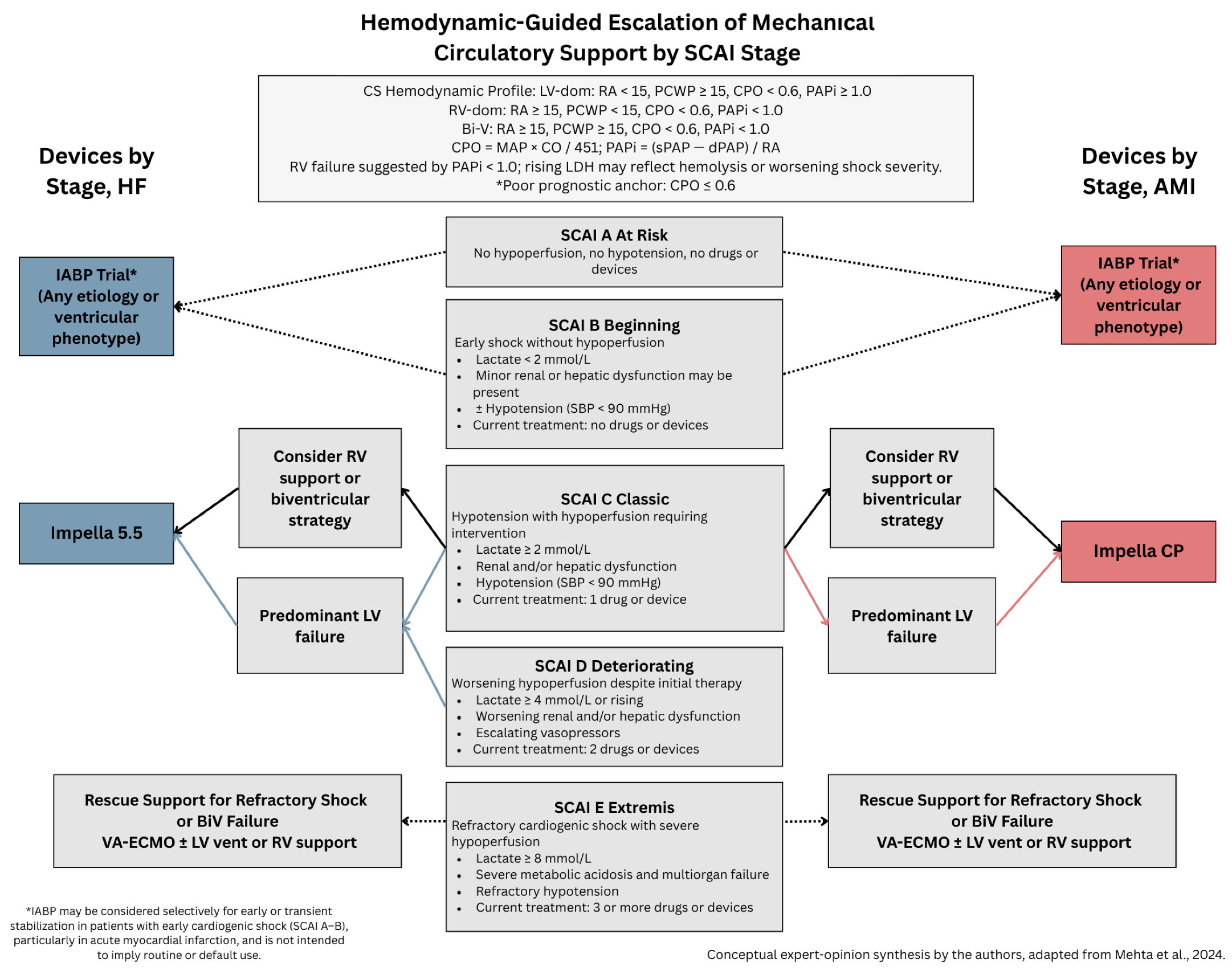

Cardiogenic Shock Management in the Modern Era: A Narrative Review of Percutaneous Mechanical Circulatory Support Devices

 , , , ,
Abstract
1. Introduction
2. Cardiogenic Shock: Definitions and Phenotypes
2.1. Overview of Classic Definitions
2.2. Society for Cardiovascular Angiography and Interventions (SCAI) Consensus Classification
2.3. Clinical Utility and Prognostic Implications of SCAI Classification
2.4. Risk Prediction Tools in CS

| Risk Scores | Inputs | Predictive Use | Limitations |
|---|---|---|---|
| CLIP | Pro-inflammatory markers such as Cystatin C, Interleukin-6, and B-type Natriuretic Peptide (BNP) [5]. | 30-day mortality in AMI-CS [5]. | Generalizability to non-AMI-CS is limited. Pro-inflammatory markers are not routinely measured in clinical practice [23]. |
| IABP-SHOCK II | Age > 73 years, prior stroke, admission glucose >191 mg/dL, admission creatinine > 1.5 mg/dL, post-PCI TIMI flow < 3, and arterial lactate > 5 mmol/L [25]. | 30-day mortality in AMI-CS [25]. | Generalizability to non-AMI-CS is limited [23]. |
| J-PVAD | Age, sex, body mass index (BMI), fulminant myocarditis etiology, in-hospital cardiac arrest, VA-ECMO use, mean arterial pressure, creatinine, total bilirubin, lactate, LDH, and albumin [18,24]. | In-hospital mortality regardless of etiology of CS. Specified in LV Impella support (2.5, 5.0, or CP) only [18,24]. | Not generalizable to CS requiring non-LV Impella MCS devices [18,24]. |
| CSS | Age, sex, systolic blood pressure, heart rate, pH, lactate, glucose, and duration of CPR or cardiac arrest [23]. | 30-day in-hospital mortality in CS regardless of etiology [23]. | Generalizability and predictive accuracy may be limited [23]. |
| AGEF | Age, estimated glomerular filtration rate (eGFR), and LVEF% [18,26]. | 90-day mortality in CS regardless of etiology [18,26]. | Limited generalizability to short-term mortality (30-day mortality) [18,26]. |
| CardShock | Age > 75 years, altered mental status, previous MI or coronary artery bypass graft (CABG), active ACS, and LVEF < 40% [18,27]. | 30-day inpatient mortality regardless of etiology [18,27]. | Limited generalizability to long-term mortality in CS. Additionally, given the limited number of non-AMI-CS patients studied, may have less predictive value [18,27]. |
| ECLS-SHOCK | Age ≥ 69, female gender, ≥3 cardiovascular risk factors, baseline arterial lactate ≥ 7.1 mmol/L, and resuscitation efforts [18,28]. | 30-day inpatient mortality in AMI-CS [18,28]. | Not generalizable to non-AMI-CS. Cannot be utilized to accurately predict long-term mortality [18,28]. |
3. Percutaneous Mechanical Circulatory Support Devices: Technical Overview, Clinical Data, and Efficacy
| Device Name | Indications | Flow Rates | Absolute Contraindications | Relative Contraindications | Device Complications |
|---|---|---|---|---|---|
| Intra-Aortic Balloon Pump (IABP) | HRPCI and Stage A-B AMI-CS and HF-CS [29]. Stage C LV AMI-CS and HF-CS [20,30]. | 0.5 L/min [29] | Aortic regurgitation, severe sepsis, aortic dissection, and aortic aneurysm [31]. | Bleeding disorders, severe aortic calcifications, PAD, obstruction of left ventricular outflow tract (i.e., aortic stenosis), or arrhythmias including atrial fibrillation and, premature ventricular complexes (PVCs) [31]. | Limb ischemia, vascular laceration, major hemorrhage, and iatrogenic aortic dissection [31]. Hemolysis, thrombocytopenia, cholesterol embolization, and, rarely, sepsis if the device remains in place for greater than 7 days [32,33,34]. |
| Left Ventricular Impella Devices (CP, ECP, 2.5, 5.0, and 5.5) | HRPCI (CP, ECP, and 2.5) and Stage C-D LV AMI-CS and HF-CS (5.0, 5.5, and LD) [35,36,37]. | 2.5–6 L/min [35,36,37] | LV thrombus, mechanical aortic valve, severe aortic stenosis, LV outflow tract obstruction, severe aortic regurgitation, severe PAD, severe RV failure, atrial septal defects, ventral septal defects, LV rupture, and cardiac tamponade [37]. | Access vessel diameter less than 6 mm, severe aortic calcification, and active insertion site infection [37]. | Hemolysis, AKI, limb ischemia, and stroke [37,38,39,40]. |
| Right Ventricular Impella Devices (RP and RP Flex) | Stage C-D RV CS (both AMI-CS and HF-CS) [20,29,30]. | 2–4 L/min [20,29,30] | Mechanical tricuspid valve or pulmonary valve prosthesis, severe tricuspid regurgitation, severe pulmonary regurgitation, and right heart thrombus or mass [37]. | Active insertion site infection, severe PAD, pre-existing right-to-left shunt, and severe coagulopathy [41]. | Hemolysis, AKI, limb ischemia, and stroke [37,38,39,40]. |
| TandemHeart | HRPCI, Stage C-D LV AMI-CS, and HF-CS [42]. Can be utilized in the setting of severe mitral stenosis and possibly in the setting of aortic stenosis or LV thrombus as well [43,44,45]. | 3.5 to 5.0 L/min [42] | Right or left atrial thrombus, severe coagulopathies, severe aortic regurgitation, and severe ventral septal defect (VSD) [41]. | Pre-existing renal impairment and active insertion site infection [46]. | Bleeding, hemolysis, thrombosis, stroke, limb ischemia, access site infection, sepsis, device migration, atrial perforation, cardiac tamponade, air embolism during insertion, and iatrogenic residual ASD, resulting in right- to- left shunt [47]. |
| VA-ECMO | Stage D-E refractory AMI-CS and HF-CS [19,30]. | 4–7 L/min [48,49,50,51] | Pre-existing terminal illness, aortic dissection or insufficiency, severe irreversible non-cardiopulmonary organ failure, or severe coagulopathy [52]. | Advanced age (≥70 years), class III obesity, and active infection or sepsis [53]. | Bleeding, limb ischemia, compartment syndrome, stroke, AKI, infection, and lung dysfunction [54,55]. |
| Protek-Duo | Stage C-D RV-predominant CS (both AMI-CS and HF-CS) [56]. | 4–5 L/min [56] | Mechanical tricuspid valve or pulmonary valve prosthesis, severe tricuspid regurgitation, severe pulmonary regurgitation, and right heart thrombus or mass [57,58]. | Severe coagulopathy and small body habitus [46,58]. | Vascular injury, hemolysis, iatrogenic tricuspid regurgitation, pulmonary valve dysfunction, superior vena cava syndrome, cardiac wall perforation, pericardial effusion with tamponade, infection, embolism, thrombosis, and cannula migration [59]. |
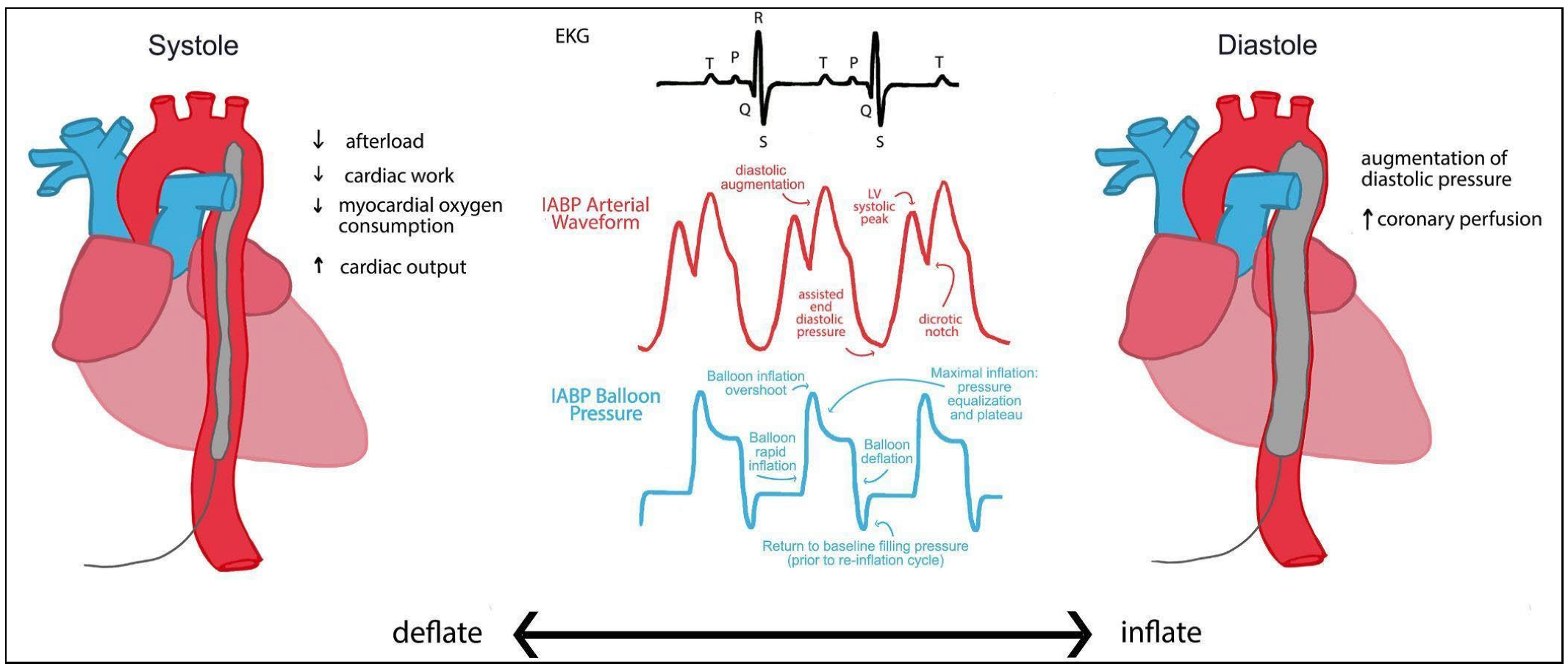
3.1. Intra-Aortic Balloon Pump
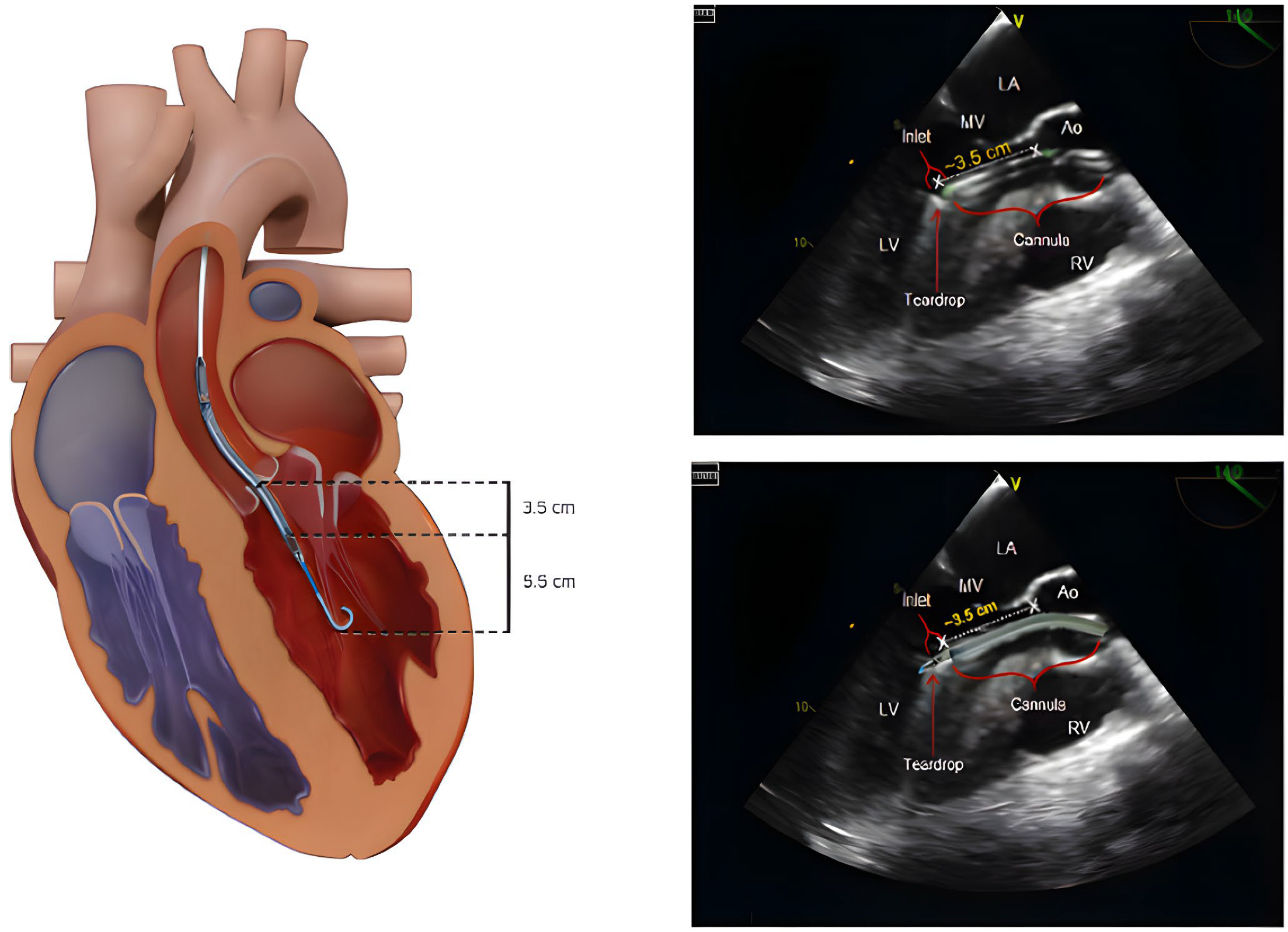
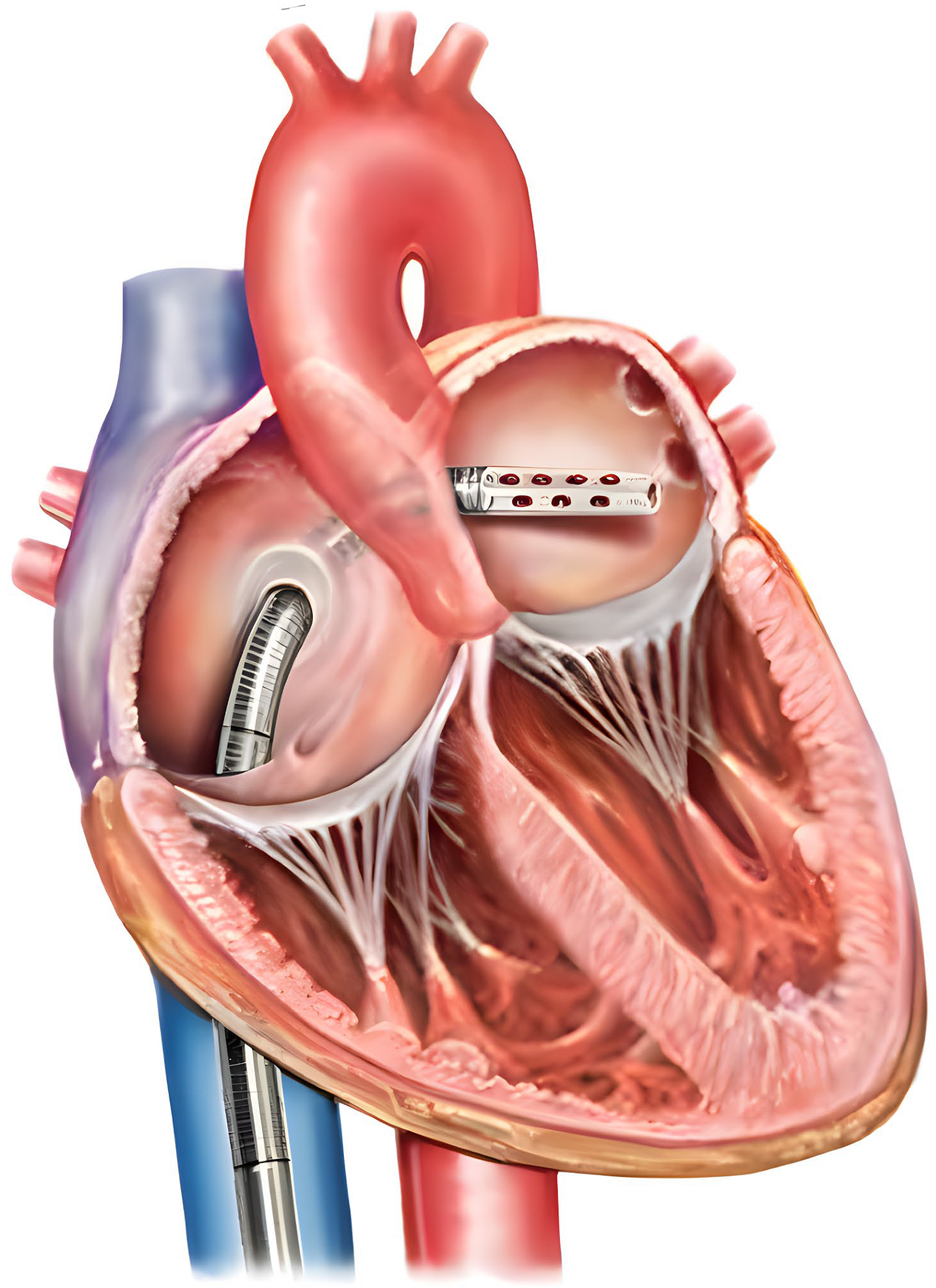
3.2. Impella Devices (CP, 2.5, 5.0, 5.5, RP, and ECP)

3.3. TandemHeart

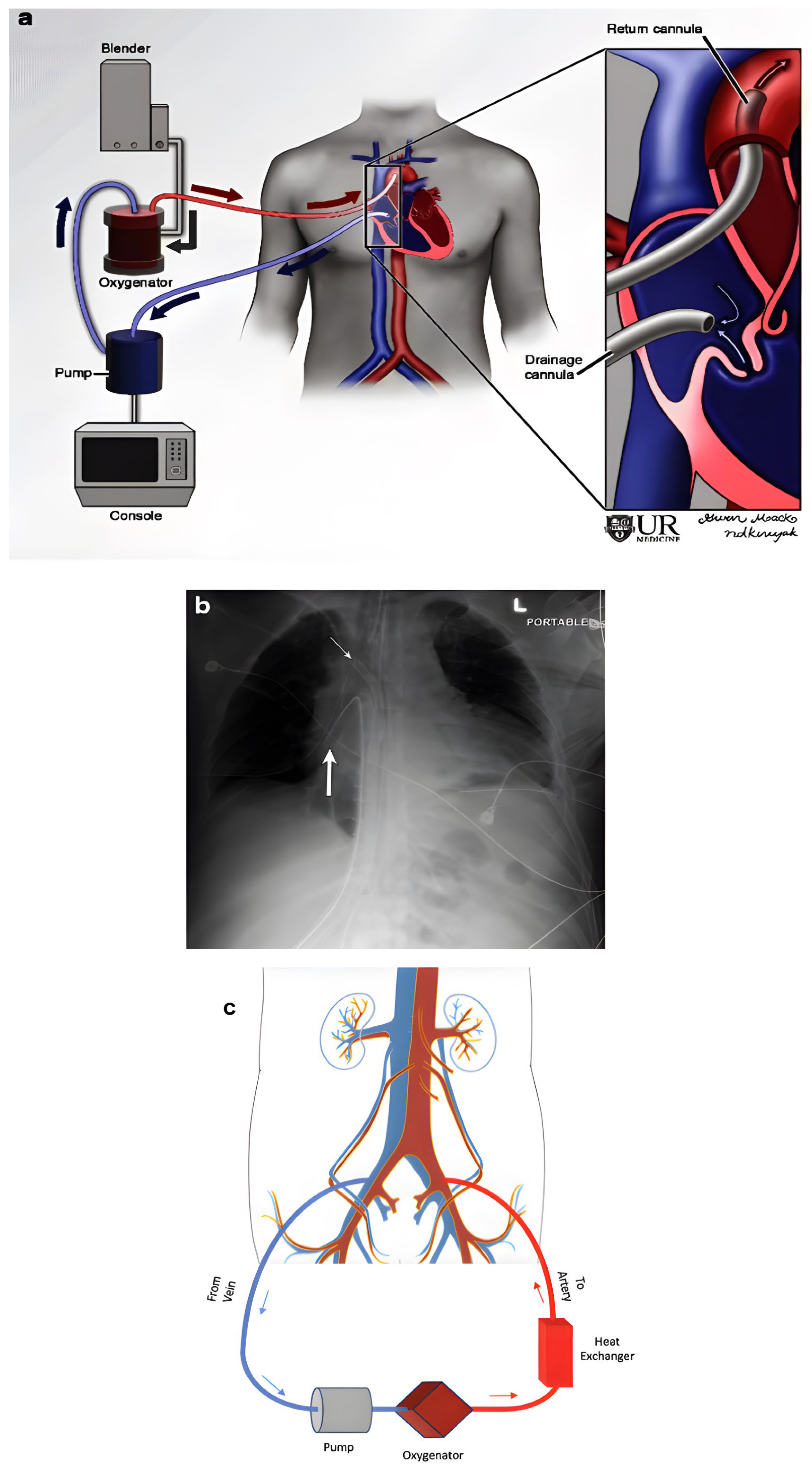
3.4. Veno-Arterial Extracorporeal Membrane Oxygenation (VA-ECMO)

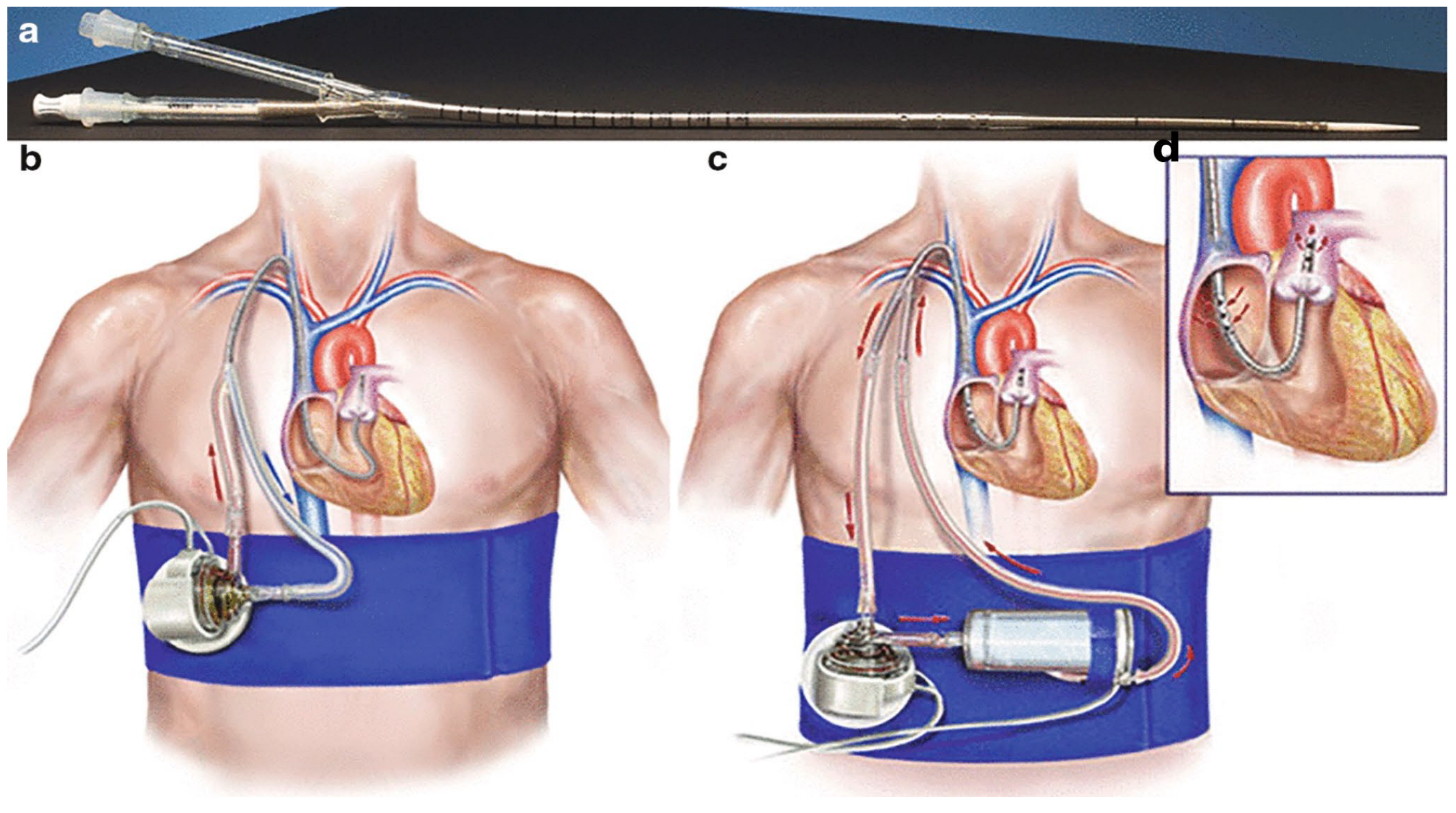
3.5. Protek-Duo

3.6. Overview of Promising Technologies in Development or Early Clinical Use (e.g., PulseCath iVAC2L, NuPulse, and Others)
4. Patient and Device Selection
4.1. Etiology of Shock
4.2. Development of Combination Therapies
4.3. Anatomical Considerations and Patient Comorbidities
4.4. Institutional Resources and Interdisciplinary Shock Team
4.5. Decision-Making Algorithms for Optimal Device Choice
4.6. Weaning Strategies for MCS Devices
- IABP: transition from 1:1 to 1:2, then 1:3 support prior to decannulation.
- Impella: reduce P-levels by 1–2 every 2–4 h (max P9), with decannulation at P2.
- TandemHeart, Protek-Duo, VA-ECMO: decrease flow by 0.5 L/min every 2–4 h until ~2 L/min, then decannulate [138].
5. Ongoing Research and Future Directions
5.1. Overview of Ongoing Trials and Registries
5.2. Prospective and Ongoing Trials
5.3. Innovations in Patient Monitoring and Predictive Analytics (e.g., Artificial Intelligence (AI)-Based Decision Support)
6. Interpretation of Evidence, Bias, and Resource Utilization in Mechanical Circulatory Support
6.1. Comparative Synthesis of MCS Devices
6.2. Key Methodological Challenges in MCS Research
6.3. Economic Burden
6.4. Strategies to Optimize Resource Utilization
7. Conclusions
Author Contributions
Funding
Institutional Review Board Statement
Informed Consent Statement
Data Availability Statement
Conflicts of Interest
Appendix A
| Parameter | Definition/Formula | Normal Range | Clinical Relevance in CS |
|---|---|---|---|
| Mean Arterial Pressure (MAP) | (SBP + 2 × DBP)/3 | 70–100 mmHg | MAP < 60 mmHg indicates inadequate perfusion. |
| Cardiac Output (CO) | Heart Rate × Stroke Volume | 4.0–8.0 L/min | Typically reduced in CS due to impaired ventricular function. |
| Cardiac Power Output (CPO) | (MAP × CO)/451 | >0.8 watts | CPO < 0.6 watts suggests severe LV dysfunction. |
| Pulmonary Artery Pulsatility Index (PAPi) | (PA Systolic—PA Diastolic)/Mean RA Pressure | >1.5 | PAPi < 1.0 suggests RV failure. |
| Pulmonary Capillary Wedge Pressure (PCWP) | Direct catheter measurement via PA catheter | 6–12 mmHg | Elevated in LV failure; often >15 mmHg in CS. |
| Right Atrial Pressure (RAP) | Direct measurement via central venous or PA catheter | 2–8 mmHg | Elevated in RV or BiV failure. |
| Cardiac Index (CI) | CO/Body Surface Area (BSA) | 2.5–4.0 L/min/m2 | CI < 2.2 L/min/m2 indicates shock state. |
References
- Van Diepen, S.; Katz, J.N.; Albert, N.M.; Henry, T.D.; Jacobs, A.K.; Kapur, N.K.; Kilic, A.; Menon, V.; Ohman, E.M.; Sweitzer, N.K.; et al. Contemporary Management of Cardiogenic Shock: A Scientific Statement From the American Heart Association. Circulation 2017, 136, e232–e268. [Google Scholar] [CrossRef] [PubMed]
- Sinha, S.S.; Morrow, D.A.; Kapur, N.K.; Kataria, R.; Roswell, R.O. 2025 Concise Clinical Guidance: An ACC Expert Consensus Statement on the Evaluation and Management of Cardiogenic Shock. J. Am. Coll. Cardiol. 2025, 85, 1618–1641. [Google Scholar] [CrossRef] [PubMed]
- Borovac, J.A.; D’Amario, D.; Bozic, J.; Glavas, D. Sympathetic Nervous System Activation and Heart Failure: Current State of Evidence and the Pathophysiology in the Light of Novel Biomarkers. World J. Cardiol. 2020, 12, 373–408. [Google Scholar] [CrossRef] [PubMed]
- Fukuta, H.; Little, W.C. The Cardiac Cycle and the Physiologic Basis of Left Ventricular Contraction, Ejection, Relaxation, and Filling. Heart Fail. Clin. 2008, 4, 1–11. [Google Scholar] [CrossRef]
- Samsky, M.D.; Morrow, D.A.; Proudfoot, A.G.; Hochman, J.S.; Thiele, H.; Rao, S.V. Cardiogenic Shock After Acute Myocardial Infarction: A Review. JAMA 2021, 326, 1840. [Google Scholar] [CrossRef]
- Heidenreich, P.A.; Bozkurt, B.; Aguilar, D.; Allen, L.A.; Byun, J.J.; Colvin, M.M.; Deswal, A.; Drazner, M.H.; Dunlay, S.M.; Evers, L.R.; et al. 2022 AHA/ACC/HFSA Guideline for the Management of Heart Failure. J. Am. Coll. Cardiol. 2022, 79, e263–e421. [Google Scholar] [CrossRef]
- Osman, M.; Syed, M.; Patibandla, S.; Sulaiman, S.; Kheiri, B.; Shah, M.K.; Bianco, C.; Balla, S.; Patel, B. Fifteen-Year Trends in Incidence of Cardiogenic Shock Hospitalization and In-Hospital Mortality in the United States. J. Am. Heart Assoc. 2021, 10, e021061. [Google Scholar] [CrossRef]
- Buda, K.G.; Hryniewicz, K.; Eckman, P.M.; Basir, M.B.; Cowger, J.A.; Alaswad, K.; Mukundan, S.; Sandoval, Y.; Elliott, A.; Brilakis, E.S.; et al. Early vs. Delayed Mechanical Circulatory Support in Patients with Acute Myocardial Infarction and Cardiogenic Shock. Eur. Heart J. Acute Cardiovasc. Care 2024, 13, 390–397. [Google Scholar] [CrossRef]
- Møller, J.E.; Engstrøm, T.; Jensen, L.O.; Eiskjær, H.; Mangner, N.; Polzin, A.; Schulze, P.C.; Skurk, C.; Nordbeck, P.; Clemmensen, P.; et al. Microaxial Flow Pump or Standard Care in Infarct-Related Cardiogenic Shock. N. Engl. J. Med. 2024, 390, 1382–1393. [Google Scholar] [CrossRef]
- Kang, G.; Ha, R.; Banerjee, D. Pulmonary Artery Pulsatility Index Predicts Right Ventricular Failure after Left Ventricular Assist Device Implantation. J. Heart Lung Transplant. 2016, 35, 67–73. [Google Scholar] [CrossRef]
- Sinha, S.S.; Rosner, C.M.; Tehrani, B.N.; Maini, A.; Truesdell, A.G.; Lee, S.B.; Bagchi, P.; Cameron, J.; Damluji, A.A.; Desai, M.; et al. Cardiogenic Shock From Heart Failure Versus Acute Myocardial Infarction: Clinical Characteristics, Hospital Course, and 1-Year Outcomes. Circ. Heart Fail. 2022, 15, e009279. [Google Scholar] [CrossRef]
- Thiele, H.; Akin, I.; Sandri, M.; Fuernau, G.; De Waha, S.; Meyer-Saraei, R.; Nordbeck, P.; Geisler, T.; Landmesser, U.; Skurk, C.; et al. PCI Strategies in Patients with Acute Myocardial Infarction and Cardiogenic Shock. N. Engl. J. Med. 2017, 377, 2419–2432. [Google Scholar] [CrossRef]
- Williams, S.; Kalakoutas, A.; Olusanya, S.; Schrage, B.; Tavazzi, G.; Carnicelli, A.P.; Montero, S.; Vandenbriele, C.; Luk, A.; Lim, H.S.; et al. The Management of Heart Failure Cardiogenic Shock: An International RAND Appropriateness Panel. Crit. Care 2024, 28, 105. [Google Scholar] [CrossRef]
- Waksman, R.; Pahuja, M.; Van Diepen, S.; Proudfoot, A.G.; Morrow, D.; Spitzer, E.; Nichol, G.; Weisfeldt, M.L.; Moscucci, M.; Lawler, P.R.; et al. Standardized Definitions for Cardiogenic Shock Research and Mechanical Circulatory Support Devices: Scientific Expert Panel From the Shock Academic Research Consortium (SHARC). Circulation 2023, 148, 1113–1126. [Google Scholar] [CrossRef] [PubMed]
- Kanwar, M.K.; Billia, F.; Randhawa, V.; Cowger, J.A.; Barnett, C.M.; Chih, S.; Ensminger, S.; Hernandez-Montfort, J.; Sinha, S.S.; Vorovich, E.; et al. Heart Failure Related Cardiogenic Shock: An ISHLT Consensus Conference Content Summary. J. Heart Lung Transplant. 2024, 43, 189–203. [Google Scholar] [CrossRef]
- Burkhoff, D.; Mirsky, I.; Suga, H. Assessment of Systolic and Diastolic Ventricular Properties via Pressure-Volume Analysis: A Guide for Clinical, Translational, and Basic Researchers. Am. J. Physiol.-Heart Circ. Physiol. 2005, 289, H501–H512. [Google Scholar] [CrossRef] [PubMed]
- Sagawa, K. The End-Systolic Pressure-Volume Relation of the Ventricle: Definition, Modifications and Clinical Use. Circulation 1981, 63, 1223–1227. [Google Scholar] [CrossRef] [PubMed]
- Castiello, D.S.; Polimeni, A.; Curcio, A. Predictive Value of Scores for All-Cause Mortality in Patients with Cardiogenic Shock. J. Cardiovasc. Med. 2025, 26, 280–283. [Google Scholar] [CrossRef]
- Naidu, S.S.; Baran, D.A.; Jentzer, J.C.; Hollenberg, S.M.; Van Diepen, S.; Basir, M.B.; Grines, C.L.; Diercks, D.B.; Hall, S.; Kapur, N.K.; et al. SCAI SHOCK Stage Classification Expert Consensus Update: A Review and Incorporation of Validation Studies. J. Soc. Cardiovasc. Angiogr. Interv. 2022, 1, 100008. [Google Scholar] [CrossRef]
- Mehta, A.; Vavilin, I.; Nguyen, A.H.; Batchelor, W.B.; Blumer, V.; Cilia, L.; Dewanjee, A.; Desai, M.; Desai, S.S.; Flanagan, M.C.; et al. Contemporary Approach to Cardiogenic Shock Care: A State-of-the-Art Review. Front. Cardiovasc. Med. 2024, 11, 1354158. [Google Scholar] [CrossRef]
- Fuernau, G.; Desch, S.; De Waha-Thiele, S.; Eitel, I.; Neumann, F.-J.; Hennersdorf, M.; Felix, S.B.; Fach, A.; Böhm, M.; Pöss, J.; et al. Arterial Lactate in Cardiogenic Shock. JACC Cardiovasc. Interv. 2020, 13, 2208–2216. [Google Scholar] [CrossRef] [PubMed]
- Jones, T.L.; Nakamura, K.; McCabe, J.M. Cardiogenic Shock: Evolving Definitions and Future Directions in Management. Open Heart 2019, 6, e000960. [Google Scholar] [CrossRef] [PubMed]
- Beer, B.N.; Jentzer, J.C.; Weimann, J.; Dabboura, S.; Yan, I.; Sundermeyer, J.; Kirchhof, P.; Blankenberg, S.; Schrage, B.; Westermann, D. Early Risk Stratification in Patients with Cardiogenic Shock Irrespective of the Underlying Cause—The Cardiogenic Shock Score. Eur. J. Heart Fail. 2022, 24, 657–667. [Google Scholar] [CrossRef] [PubMed]
- Kondo, T.; Yoshizumi, T.; Morimoto, R.; Imaizumi, T.; Kazama, S.; Hiraiwa, H.; Okumura, T.; Murohara, T.; Mutsuga, M. Predicting Survival after Impella Implantation in Patients with Cardiogenic Shock: The J- PVAD Risk Score. Eur. J. Heart Fail. 2025, 27, 51–59. [Google Scholar] [CrossRef]
- Pöss, J.; Köster, J.; Fuernau, G.; Eitel, I.; De Waha, S.; Ouarrak, T.; Lassus, J.; Harjola, V.-P.; Zeymer, U.; Thiele, H.; et al. Risk Stratification for Patients in Cardiogenic Shock After Acute Myocardial Infarction. J. Am. Coll. Cardiol. 2017, 69, 1913–1920. [Google Scholar] [CrossRef]
- Liao, Y.; Luo, D.; Zhang, X.; Liu, T.; Zhang, C. Predictive Value of Age, Estimated Glomerular Filtration Rate and Ejection Fraction (AGEF) Score for All-Cause 90-Day Mortality in Patients with Cardiogenic Shock. J. Cardiovasc. Med. 2025, 26, 269–279. [Google Scholar] [CrossRef]
- Harjola, V.; Lassus, J.; Sionis, A.; Køber, L.; Tarvasmäki, T.; Spinar, J.; Parissis, J.; Banaszewski, M.; Silva-Cardoso, J.; Carubelli, V.; et al. Clinical Picture and Risk Prediction of Short-term Mortality in Cardiogenic Shock. Eur. J. Heart Fail. 2015, 17, 501–509. [Google Scholar] [CrossRef]
- Thevathasan, T.; Freund, A.; Kresoja, K.P.; Akin, I.; Fichtlscherer, S.; Zeymer, U.; Feistritzer, H.J.; Poess, J.; Jobs, A.; Jung, C.; et al. Early Risk Stratification of Patients with Acute Myocardial Infarction Complicated by Severe Cardiogenic Shock—The ECLS-SHOCK Risk Score. Eur. Heart J. 2024, 45, ehae666.1703. [Google Scholar] [CrossRef]
- Wong, A.S.K.; Sin, S.W.C. Short-Term Mechanical Circulatory Support (Intra-Aortic Balloon Pump, Impella, Extracorporeal Membrane Oxygenation, TandemHeart): A Review. Ann. Transl. Med. 2020, 8, 829. [Google Scholar] [CrossRef]
- Baran, D.A.; Grines, C.L.; Bailey, S.; Burkhoff, D.; Hall, S.A.; Henry, T.D.; Hollenberg, S.M.; Kapur, N.K.; O’Neill, W.; Ornato, J.P.; et al. SCAI Clinical Expert Consensus Statement on the Classification of Cardiogenic Shock: This Document Was Endorsed by the American College of Cardiology (ACC), the American Heart Association (AHA), the Society of Critical Care Medicine (SCCM), and the Society of Thoracic Surgeons (STS) in April 2019. Catheter. Cardiovasc. Interv. 2019, 94, 29–37. [Google Scholar] [CrossRef]
- Thiele, H.; Zeymer, U.; Neumann, F.-J.; Ferenc, M.; Olbrich, H.-G.; Hausleiter, J.; Richardt, G.; Hennersdorf, M.; Empen, K.; Fuernau, G.; et al. Intraaortic Balloon Support for Myocardial Infarction with Cardiogenic Shock. N. Engl. J. Med. 2012, 367, 1287–1296. [Google Scholar] [CrossRef] [PubMed]
- Kapur, N.K.; Whitehead, E.H.; Thayer, K.L.; Pahuja, M. The Science of Safety: Complications Associated with the Use of Mechanical Circulatory Support in Cardiogenic Shock and Best Practices to Maximize Safety. F1000Research 2020, 9, 794. [Google Scholar] [CrossRef] [PubMed]
- Alderman, J.D.; Gabliani, G.I.; McCabe, C.H.; Brewer, C.C.; Lorell, B.H.; Pasternak, R.C.; Skillman, J.J.; Steer, M.L.; Baim, D.S. Incidence and Management of Limb Ischemia with Percutaneous Wire-Guided Intraaortic Balloon Catheters. J. Am. Coll. Cardiol. 1987, 9, 524–530. [Google Scholar] [CrossRef] [PubMed]
- Aksnes, J.; Abdelnoor, M.; Berge, V.; Fjeld, N. Risk Factors of Septicemia and Perioperative Myocardial Infarction in a Cohort of Patients Supported with Intra-Aortic Balloon Pump (IABP) in the Course of Open Heart Surgery. Eur. J. Cardiothorac. Surg. 1993, 7, 153–157. [Google Scholar] [CrossRef]
- Burzotta, F.; Russo, G.; Previ, L.; Bruno, P.; Aurigemma, C.; Trani, C. Impella: Pumps Overview and Access Site Management. Minerva Cardioangiol. 2018, 66, 606–611. [Google Scholar] [CrossRef]
- Zein, R.; Patel, C.; Mercado-Alamo, A.; Schreiber, T.; Kaki, A. A Review of the Impella Devices. Interv. Cardiol. Rev. Res. Resour. 2022, 17, e05. [Google Scholar] [CrossRef]
- Bernhardt, A.M.; Copeland, H.; Deswal, A.; Gluck, J.; Givertz, M.M.; Bernhardt, A.M.; Gluck, J.; Garan, A.R.; Hall, S.; Hayanga, A.; et al. The International Society for Heart and Lung Transplantation/Heart Failure Society of America Guideline on Acute Mechanical Circulatory Support. J. Heart Lung Transplant. 2023, 42, e1–e64. [Google Scholar] [CrossRef]
- Lüsebrink, E.; Kellnar, A.; Krieg, K.; Binzenhöfer, L.; Scherer, C.; Zimmer, S.; Schrage, B.; Fichtner, S.; Petzold, T.; Braun, D.; et al. Percutaneous Transvalvular Microaxial Flow Pump Support in Cardiology. Circulation 2022, 145, 1254–1284. [Google Scholar] [CrossRef]
- Roberts, N.; Chandrasekaran, U.; Das, S.; Qi, Z.; Corbett, S. Hemolysis Associated with Impella Heart Pump Positioning: In Vitro Hemolysis Testing and Computational Fluid Dynamics Modeling. Int. J. Artif. Organs 2020, 43, 710–718. [Google Scholar] [CrossRef]
- Zaiser, A.S.; Fahrni, G.; Hollinger, A.; Knobel, D.T.; Bovey, Y.; Zellweger, N.M.; Buser, A.; Santer, D.; Pargger, H.; Gebhard, C.E.; et al. Adverse Events of Percutaneous Microaxial Left Ventricular Assist Devices—A Retrospective, Single-Centre Cohort Study. J. Clin. Med. 2021, 10, 3710. [Google Scholar] [CrossRef]
- Rihal, C.S.; Naidu, S.S.; Givertz, M.M.; Szeto, W.Y.; Burke, J.A.; Kapur, N.K.; Kern, M.; Garratt, K.N.; Goldstein, J.A.; Dimas, V.; et al. 2015 SCAI/ACC/HFSA/STS Clinical Expert Consensus Statement on the Use of Percutaneous Mechanical Circulatory Support Devices in Cardiovascular Care: Endorsed by the American Heart Assocation, the Cardiological Society of India, and Sociedad Latino Americana de Cardiologia Intervencion; Affirmation of Value by the Canadian Association of Interventional Cardiology-Association Canadienne de Cardiologie d’intervention. J. Am. Coll. Cardiol. 2015, 65, e7–e26. [Google Scholar] [CrossRef] [PubMed]
- Kar, B.; Adkins, L.E.; Civitello, A.B.; Loyalka, P.; Palanichamy, N.; Gemmato, C.J.; Myers, T.J.; Gregoric, I.D.; Delgado, R.M. Clinical Experience with the TandemHeart Percutaneous Ventricular Assist Device. Tex. Heart Inst. J. 2006, 33, 111–115. [Google Scholar] [PubMed]
- Kapur, N.K.; Pan, C.; Krishnamurthy, B. High-Risk Coronary Intervention with a Percutaneous Ventricular Assist Device in the Presence of an Unstable Left Ventricular Thrombus. J. Invasive Cardiol. 2010, 22, E138–E140. [Google Scholar] [PubMed]
- Alkhouli, M.; Al Mustafa, A.; Chaker, Z.; Alqahtani, F.; Aljohani, S.; Holmes, D.R. Mechanical Circulatory Support in Patients with Severe Aortic Stenosis and Left Ventricular Dysfunction Undergoing Percutaneous Coronary Intervention. J. Card. Surg. 2017, 32, 245–249. [Google Scholar] [CrossRef]
- Hegde, S.; Noory, A.J.; Ranganathan, K. Tandem Heart for Left Atrial Uloading in Severe Bioprosthetic Mitral Stenosis with Pulmonary Hypertension and Cardiogenic Shock. J. Am. Coll. Cardiol. 2024, 83, 4278. [Google Scholar] [CrossRef]
- Miller, P.E.; Solomon, M.A.; McAreavey, D. Advanced Percutaneous Mechanical Circulatory Support Devices for Cardiogenic Shock. Crit. Care Med. 2017, 45, 1922–1929. [Google Scholar] [CrossRef]
- Gilotra, N.A.; Stevens, G.R. Temporary Mechanical Circulatory Support: A Review of the Options, Indications, and Outcomes. Clin. Med. Insights Cardiol. 2014, 8s1, CMC.S15718. [Google Scholar] [CrossRef]
- Ostadal, P.; Rokyta, R.; Karasek, J.; Kruger, A.; Vondrakova, D.; Janotka, M.; Naar, J.; Smalcova, J.; Hubatova, M.; Hromadka, M.; et al. Extracorporeal Membrane Oxygenation in the Therapy of Cardiogenic Shock: Results of the ECMO-CS Randomized Clinical Trial. Circulation 2023, 147, 454–464. [Google Scholar] [CrossRef]
- Zeymer, U.; Freund, A.; Hochadel, M.; Ostadal, P.; Belohlavek, J.; Rokyta, R.; Massberg, S.; Brunner, S.; Lüsebrink, E.; Flather, M.; et al. Venoarterial Extracorporeal Membrane Oxygenation in Patients with Infarct-Related Cardiogenic Shock: An Individual Patient Data Meta-Analysis of Randomised Trials. The Lancet 2023, 402, 1338–1346. [Google Scholar] [CrossRef]
- Thiele, H.; Zeymer, U.; Akin, I.; Behnes, M.; Rassaf, T.; Mahabadi, A.A.; Lehmann, R.; Eitel, I.; Graf, T.; Seidler, T.; et al. Extracorporeal Life Support in Infarct-Related Cardiogenic Shock. N. Engl. J. Med. 2023, 389, 1286–1297. [Google Scholar] [CrossRef]
- Banning, A.S.; Sabaté, M.; Orban, M.; Gracey, J.; López-Sobrino, T.; Massberg, S.; Kastrati, A.; Bogaerts, K.; Adriaenssens, T.; Berry, C.; et al. Venoarterial Extracorporeal Membrane Oxygenation or Standard Care in Patients with Cardiogenic Shock Complicating Acute Myocardial Infarction: The Multicentre, Randomised EURO SHOCK Trial. EuroIntervention 2023, 19, 482–492. [Google Scholar] [CrossRef] [PubMed]
- Guglin, M.; Zucker, M.J.; Bazan, V.M.; Bozkurt, B.; El Banayosy, A.; Estep, J.D.; Gurley, J.; Nelson, K.; Malyala, R.; Panjrath, G.S.; et al. Venoarterial ECMO for Adults. J. Am. Coll. Cardiol. 2019, 73, 698–716. [Google Scholar] [CrossRef] [PubMed]
- Moyon, Q.; Triboulet, F.; Reuter, J.; Lebreton, G.; Dorget, A.; Para, M.; Chommeloux, J.; Stern, J.; Pineton De Chambrun, M.; Hékimian, G.; et al. Venoarterial Extracorporeal Membrane Oxygenation in Immunocompromised Patients with Cardiogenic Shock: A Cohort Study and Propensity-Weighted Analysis. Intensive Care Med. 2024, 50, 406–417. [Google Scholar] [CrossRef] [PubMed]
- Cheng, R.; Hachamovitch, R.; Kittleson, M.; Patel, J.; Arabia, F.; Moriguchi, J.; Esmailian, F.; Azarbal, B. Complications of Extracorporeal Membrane Oxygenation for Treatment of Cardiogenic Shock and Cardiac Arrest: A Meta-Analysis of 1866 Adult Patients. Ann. Thorac. Surg. 2014, 97, 610–616. [Google Scholar] [CrossRef]
- Roumy, A.; Liaudet, L.; Rusca, M.; Marcucci, C.; Kirsch, M. Pulmonary Complications Associated with Veno-Arterial Extra-Corporeal Membrane Oxygenation: A Comprehensive Review. Crit. Care 2020, 24, 212. [Google Scholar] [CrossRef]
- John, K.J.; Nabzdyk, C.G.S.; Chweich, H.; Mishra, A.K.; Lal, A. ProtekDuo Percutaneous Ventricular Support System—Physiology and Clinical Applications. Ann. Transl. Med. 2024, 12, 14. [Google Scholar] [CrossRef]
- Ravichandran, A.K.; Baran, D.A.; Stelling, K.; Cowger, J.A.; Salerno, C.T. Outcomes with the Tandem Protek Duo Dual-Lumen Percutaneous Right Ventricular Assist Device. ASAIO J. 2018, 64, 570–572. [Google Scholar] [CrossRef]
- Alam, A.; Baran, D.A.; Doshi, H.; Van Zyl, J.; Patlolla, S.; Salem, M.; Afzal, A.; Al-Saffar, F.; Hall, S.A. Safety and Efficacy of ProtekDuo Right Ventricular Assist Device: A Systemic Review. Artif. Organs 2023, 47, 1094–1103. [Google Scholar] [CrossRef]
- Salna, M.; Garan, A.R.; Kirtane, A.J.; Karmpaliotis, D.; Green, P.; Takayama, H.; Sanchez, J.; Kurlansky, P.; Yuzefpolskaya, M.; Colombo, P.C.; et al. Novel Percutaneous Dual-Lumen Cannula-Based Right Ventricular Assist Device Provides Effective Support for Refractory Right Ventricular Failure after Left Ventricular Assist Device Implantation. Interact. Cardiovasc. Thorac. Surg. 2020, 30, 499–506. [Google Scholar] [CrossRef]
- Jiritano, F.; Lo Coco, V.; Matteucci, M.; Fina, D.; Willers, A.; Lorusso, R. Temporary Mechanical Circulatory Support in Acute Heart Failure. Card. Fail. Rev. 2020, 6, e01. [Google Scholar] [CrossRef]
- Parissis, H.; Soo, A.; Al-Alao, B. Intra Aortic Balloon Pump: Literature Review of Risk Factors Related to Complications of the Intraaortic Balloon Pump. J. Cardiothorac. Surg. 2011, 6, 147. [Google Scholar] [CrossRef] [PubMed]
- Khan, T.; Siddiqui, A. Intra-Aortic Balloon Pump. In StatPearls [Internet]; StatPearls Publishing: Treasure Island, FL, USA, 2025. [Google Scholar]
- Luo, D.; Huang, R.; Wang, X.; Zhang, J.; Cai, X.; Liu, F.; Lei, Y.; Li, D.; Zhou, W.; Xu, C.; et al. Intra-Aortic Balloon Pump Reduces 30-Day Mortality in Early-Stage Cardiogenic Shock Complicating Acute Myocardial Infarction According to SCAI Classification. Shock 2023, 60, 385–391. [Google Scholar] [CrossRef] [PubMed]
- Barnett, M.G.; Swartz, M.T.; Peterson, G.J.; Naunheim, K.S.; Pennington, D.G.; Vaca, K.J.; Fiore, A.C.; McBride, L.R.; Peigh, P.; Willman, V.L.; et al. Vascular Complications from Intraaortic Balloons: Risk Analysis. J. Vasc. Surg. 1994, 19, 81–89. [Google Scholar] [CrossRef] [PubMed]
- Gillespie, L.E.; Lane, B.H.; Shaw, C.R.; Gorder, K.; Grisoli, A.; Lavallee, M.; Gobble, O.; Vidosh, J.; Deimling, D.; Ahmad, S.; et al. The Intra-Aortic Balloon Pump: A Focused Review of Physiology, Transport Logistics, Mechanics, and Complications. J. Soc. Cardiovasc. Angiogr. Interv. 2024, 3, 101337. [Google Scholar] [CrossRef]
- Atti, V.; Narayanan, M.A.; Patel, B.; Balla, S.; Siddique, A.; Lundgren, S.; Velagapudi, P. A Comprehensive Review of Mechanical Circulatory Support Devices. Heart Int. 2022, 16, 37. [Google Scholar] [CrossRef]
- Basile, E.; Russo, G.; Leone, A.M. Principles of Hemodynamics for Mechanical Circulatory Support: Patho-Physiological Key Aspects of Assisted PCI. Minerva Cardioangiol. 2018, 66, 600–605. [Google Scholar] [CrossRef]
- Kuchibhotla, S.; Esposito, M.L.; Breton, C.; Pedicini, R.; Mullin, A.; O’Kelly, R.; Anderson, M.; Morris, D.L.; Batsides, G.; Ramzy, D.; et al. Acute Biventricular Mechanical Circulatory Support for Cardiogenic Shock. J. Am. Heart Assoc. 2017, 6, e006670. [Google Scholar] [CrossRef]
- Kapur, N.K.; Breton, C.; O’Kelly, R.; Esposito, M.L.; Kuchibhotla, S.; Pedicini, R.; Mullin, A.; Annamalai, S.; Grise, M.; Kiernan, M.; et al. Abstract 19972: Simultaneous, Not Staged, Deployment of Biventricular Micro-Axial Flow Impella Catheters (BiPella) Is Associated with Improved Survival for Cardiogenic Shock Involving Biventricular Failure. Circulation 2016, 134, A19972. [Google Scholar] [CrossRef]
- Pappalardo, F.; Schulte, C.; Pieri, M.; Schrage, B.; Contri, R.; Soeffker, G.; Greco, T.; Lembo, R.; Müllerleile, K.; Colombo, A.; et al. Concomitant Implantation of Impella® on Top of Veno-arterial Extracorporeal Membrane Oxygenation May Improve Survival of Patients with Cardiogenic Shock. Eur. J. Heart Fail. 2017, 19, 404–412. [Google Scholar] [CrossRef]
- Meani, P.; Lorusso, R.; Pappalardo, F. ECPella: Concept, Physiology and Clinical Applications. J. Cardiothorac. Vasc. Anesth. 2022, 36, 557–566. [Google Scholar] [CrossRef]
- Kapur, N.K.; Kim, R.J.; Moses, J.W.; Stone, G.W.; Udelson, J.E.; Ben-Yehuda, O.; Redfors, B.; Issever, M.O.; Josephy, N.; Polak, S.J.; et al. Primary Left Ventricular Unloading with Delayed Reperfusion in Patients with Anterior ST-Elevation Myocardial Infarction: Rationale and Design of the STEMI-DTU Randomized Pivotal Trial. Am. Heart J. 2022, 254, 122–132. [Google Scholar] [CrossRef] [PubMed]
- Anderson, M.B.; Goldstein, J.; Milano, C.; Morris, L.D.; Kormos, R.L.; Bhama, J.; Kapur, N.K.; Bansal, A.; Garcia, J.; Baker, J.N.; et al. Benefits of a Novel Percutaneous Ventricular Assist Device for Right Heart Failure: The Prospective RECOVER RIGHT Study of the Impella RP Device. J. Heart Lung Transplant. 2015, 34, 1549–1560. [Google Scholar] [CrossRef] [PubMed]
- Dhruva, S.S.; Ross, J.S.; Mortazavi, B.J.; Hurley, N.C.; Krumholz, H.M.; Curtis, J.P.; Berkowitz, A.; Masoudi, F.A.; Messenger, J.C.; Parzynski, C.S.; et al. Association of Use of an Intravascular Microaxial Left Ventricular Assist Device vs Intra-Aortic Balloon Pump with In-Hospital Mortality and Major Bleeding Among Patients with Acute Myocardial Infarction Complicated by Cardiogenic Shock. JAMA 2020, 323, 734. [Google Scholar] [CrossRef] [PubMed]
- Fried, J.; Farr, M.; Kanwar, M.; Uriel, N.; Hernandez-Montfort, J.; Blumer, V.; Li, S.; Sinha, S.S.; Garan, A.R.; Li, B.; et al. Clinical Outcomes among Cardiogenic Shock Patients Supported with High-Capacity Impella Axial Flow Pumps: A Report from the Cardiogenic Shock Working Group. J. Heart Lung Transplant. 2024, 43, 1478–1488. [Google Scholar] [CrossRef]
- O’Neill, W.W.; Schreiber, T.; Wohns, D.H.W.; Rihal, C.; Naidu, S.S.; Civitello, A.B.; Dixon, S.R.; Massaro, J.M.; Maini, B.; Ohman, E.M. The Current Use of Impella 2.5 in Acute Myocardial Infarction Complicated by Cardiogenic Shock: Results from the USpella Registry. J. Intervent. Cardiol. 2014, 27, 1–11. [Google Scholar] [CrossRef]
- Nicoara, A.; Skubas, N.; Ad, N.; Finley, A.; Hahn, R.T.; Mahmood, F.; Mankad, S.; Nyman, C.B.; Pagani, F.; Porter, T.R.; et al. Guidelines for the Use of Transesophageal Echocardiography to Assist with Surgical Decision-Making in the Operating Room: A Surgery-Based Approach. J. Am. Soc. Echocardiogr. 2020, 33, 692–734. [Google Scholar] [CrossRef]
- Garg, P.; Hussain, M.W.A.; Sareyyupoglu, B. Role of Acute Mechanical Circulatory Support Devices in Cardiogenic Shock. Indian J. Thorac. Cardiovasc. Surg. 2023, 39, 25–46. [Google Scholar] [CrossRef]
- Burkhoff, D.; Cohen, H.; Brunckhorst, C.; O’Neill, W.W. A Randomized Multicenter Clinical Study to Evaluate the Safety and Efficacy of the TandemHeart Percutaneous Ventricular Assist Device versus Conventional Therapy with Intraaortic Balloon Pumping for Treatment of Cardiogenic Shock. Am. Heart J. 2006, 152, e1-e469–469.e8. [Google Scholar] [CrossRef]
- Weil, B.R.; Konecny, F.; Suzuki, G.; Iyer, V.; Canty, J.M. Comparative Hemodynamic Effects of Contemporary Percutaneous Mechanical Circulatory Support Devices in a Porcine Model of Acute Myocardial Infarction. JACC Cardiovasc. Interv. 2016, 9, 2292–2303. [Google Scholar] [CrossRef]
- Kaki, A.; Alraies, M.C. Large-Bore Access Site Management. Card. Interv. Today 2019, 13, 59–66. [Google Scholar]
- Thiele, H.; Sick, P.; Boudriot, E.; Diederich, K.-W.; Hambrecht, R.; Niebauer, J.; Schuler, G. Randomized Comparison of Intra-Aortic Balloon Support with a Percutaneous Left Ventricular Assist Device in Patients with Revascularized Acute Myocardial Infarction Complicated by Cardiogenic Shock. Eur. Heart J. 2005, 26, 1276–1283. [Google Scholar] [CrossRef]
- Kar, B.; Gregoric, I.D.; Basra, S.S.; Idelchik, G.M.; Loyalka, P. The Percutaneous Ventricular Assist Device in Severe Refractory Cardiogenic Shock. J. Am. Coll. Cardiol. 2011, 57, 688–696. [Google Scholar] [CrossRef] [PubMed]
- Megaly, M.; Gandolfo, C.; Zakhour, S.; Jiang, M.; Burgess, K.; Chetcuti, S.; Ragosta, M.; Adler, E.; Coletti, A.; O’Neill, B.; et al. Utilization of TandemHeart in Cardiogenic Shock: Insights from the THEME Registry. Catheter. Cardiovasc. Interv. 2023, 101, 756–763. [Google Scholar] [CrossRef] [PubMed]
- Vranckx, P.; Meliga, E.; De Jaegere, P.P.T.; Van den Ent, M.; Regar, E.S.; Serruys, P.W. The TandemHeart, Percutaneous Transseptal Left Ventricular Assist Device: A Safeguard in High-Risk Percutaneous Coronary Interventions. The Six-Year Rotterdam Experience. Euro Interv. J. Eur. Collab. Work. Group Interv. Cardiol. Eur. Soc. Cardiol. 2008, 4, 331–337. [Google Scholar] [CrossRef]
- Rao, P.; Khalpey, Z.; Smith, R.; Burkhoff, D.; Kociol, R.D. Venoarterial Extracorporeal Membrane Oxygenation for Cardiogenic Shock and Cardiac Arrest: Cardinal Considerations for Initiation and Management. Circ. Heart Fail. 2018, 11, e004905. [Google Scholar] [CrossRef] [PubMed]
- Tsangaris, A.; Alexy, T.; Kalra, R.; Kosmopoulos, M.; Elliott, A.; Bartos, J.A.; Yannopoulos, D. Overview of Veno-Arterial Extracorporeal Membrane Oxygenation (VA-ECMO) Support for the Management of Cardiogenic Shock. Front. Cardiovasc. Med. 2021, 8, 686558. [Google Scholar] [CrossRef]
- Wrisinger, W.C.; Thompson, S.L. Basics of Extracorporeal Membrane Oxygenation. Surg. Clin. North Am. 2022, 102, 23–35. [Google Scholar] [CrossRef]
- Donker, D.W.; Brodie, D.; Henriques, J.P.S.; Broomé, M. Left Ventricular Unloading during Veno-Arterial ECMO: A Review of Percutaneous and Surgical Unloading Interventions. Perfusion 2019, 34, 98–105. [Google Scholar] [CrossRef]
- Weber, C.; Deppe, A.-C.; Sabashnikov, A.; Slottosch, I.; Kuhn, E.; Eghbalzadeh, K.; Scherner, M.; Choi, Y.-H.; Madershahian, N.; Wahlers, T. Left Ventricular Thrombus Formation in Patients Undergoing Femoral Veno-Arterial Extracorporeal Membrane Oxygenation. Perfusion 2018, 33, 283–288. [Google Scholar] [CrossRef]
- Russo, J.J.; Aleksova, N.; Pitcher, I.; Couture, E.; Parlow, S.; Faraz, M.; Visintini, S.; Simard, T.; Di Santo, P.; Mathew, R.; et al. Left Ventricular Unloading During Extracorporeal Membrane Oxygenation in Patients with Cardiogenic Shock. J. Am. Coll. Cardiol. 2019, 73, 654–662. [Google Scholar] [CrossRef]
- Krasivskyi, I.; Großmann, C.; Dechow, M.; Djordjevic, I.; Ivanov, B.; Gerfer, S.; Bennour, W.; Kuhn, E.; Sabashnikov, A.; Rahmanian, P.B.; et al. Acute Limb Ischaemia during ECMO Support: A 6-Year Experience. Life 2023, 13, 485. [Google Scholar] [CrossRef] [PubMed]
- Cakici, M.; Gumus, F.; Ozcinar, E.; Baran, C.; Bermede, O.; Inan, M.B.; Durdu, M.S.; Sirlak, M.; Akar, A.R. Controlled Flow Diversion in Hybrid Venoarterial–Venous Extracorporeal Membrane Oxygenation. Interact. Cardiovasc. Thorac. Surg. 2018, 26, 112–118. [Google Scholar] [CrossRef] [PubMed]
- Ezad, S.M.; Ryan, M.; Donker, D.W.; Pappalardo, F.; Barrett, N.; Camporota, L.; Price, S.; Kapur, N.K.; Perera, D. Unloading the Left Ventricle in Venoarterial ECMO: In Whom, When, and How? Circulation 2023, 147, 1237–1250. [Google Scholar] [CrossRef] [PubMed]
- Lavonas, E.J.; Akpunonu, P.D.; Arens, A.M.; Babu, K.M.; Cao, D.; Hoffman, R.S.; Hoyte, C.O.; Mazer-Amirshahi, M.E.; Stolbach, A.; St-Onge, M.; et al. 2023 American Heart Association Focused Update on the Management of Patients with Cardiac Arrest or Life-Threatening Toxicity Due to Poisoning: An Update to the American Heart Association Guidelines for Cardiopulmonary Resuscitation and Emergency Cardiovascular Care. Circulation 2023, 148, e149–e184. [Google Scholar] [CrossRef]
- Tamis-Holland, J.E.; Menon, V.; Johnson, N.J.; Kern, K.B.; Lemor, A.; Mason, P.J.; Rodgers, M.; Serrao, G.W.; Yannopoulos, D.; on behalf of the Interventional Cardiovascular Care Committee and the Acute Cardiac Care and General Cardiology Committee of the Council on Clinical Cardiology; Council on Arteriosclerosis, Thrombosis and Vascular Biology; and Council on Cardiovascular and Stroke Nursing. Cardiac Catheterization Laboratory Management of the Comatose Adult Patient with an Out-of-Hospital Cardiac Arrest: A Scientific Statement From the American Heart Association. Circulation 2024, 149, e274–e295. [Google Scholar] [CrossRef]
- Lee, S.; Chaturvedi, A. Imaging Adults on Extracorporeal Membrane Oxygenation (ECMO). Insights Imaging 2014, 5, 731–742. [Google Scholar] [CrossRef]
- Koziol, K.J.; Isath, A.; Rao, S.; Gregory, V.; Ohira, S.; Van Diepen, S.; Lorusso, R.; Krittanawong, C. Extracorporeal Membrane Oxygenation (VA-ECMO) in Management of Cardiogenic Shock. J. Clin. Med. 2023, 12, 5576. [Google Scholar] [CrossRef]
- Kremer, J.; Farag, M.; Brcic, A.; Zubarevich, A.; Schamroth, J.; Kreusser, M.M.; Karck, M.; Ruhparwar, A.; Schmack, B. Temporary Right Ventricular Circulatory Support Following Right Ventricular Infarction: Results of a Groin-free Approach. ESC Heart Fail. 2020, 7, 2853–2861. [Google Scholar] [CrossRef]
- Cain, M.T.; Smith, N.J.; Barash, M.; Simpson, P.; Durham, L.A.; Makker, H.; Roberts, C.; Falcucci, O.; Wang, D.; Walker, R.; et al. Extracorporeal Membrane Oxygenation with Right Ventricular Assist Device for COVID-19 ARDS. J. Surg. Res. 2021, 264, 81–89. [Google Scholar] [CrossRef]
- Condello, I. Percutaneous Right Ventricular Assist Device, Rapid Employment in Right Ventricular Failure during Septic Shock. Crit. Care 2020, 24, 674. [Google Scholar] [CrossRef]
- Van Mieghem, N.M.; Daemen, J.; Lenzen, M.J.; Zandstra, R.; Malkin, O.; Van Geuns, R.-J.M. The PulseCath iVAC 2L Left Ventricular Assist Device: Conversion to a Percutaneous Transfemoral Approach. EuroIntervention 2015, 11, 835–839. [Google Scholar] [CrossRef] [PubMed]
- Bulum, J.; Bastos, M.B.; Hlinomaz, O.; Malkin, O.; Pawlowski, T.; Dragula, M.; Gil, R. Pulsatile Left Ventricular Assistance in High-Risk Percutaneous Coronary Interventions: Short-Term Outcomes. J. Clin. Med. 2024, 13, 5357. [Google Scholar] [CrossRef] [PubMed]
- Peura, J.L.; Colvin-Adams, M.; Francis, G.S.; Grady, K.L.; Hoffman, T.M.; Jessup, M.; John, R.; Kiernan, M.S.; Mitchell, J.E.; O’Connell, J.B.; et al. Recommendations for the Use of Mechanical Circulatory Support: Device Strategies and Patient Selection: A Scientific Statement From the American Heart Association. Circulation 2012, 126, 2648–2667. [Google Scholar] [CrossRef] [PubMed]
- Jeevanandam, V.; Song, T.; Onsager, D.; Ota, T.; LaBuhn, C.J.; Lammy, T.; Sayer, G.; Kim, G.; Patel-Raman, S.; Uriel, N. The First-in-Human Experience with a Minimally Invasive, Ambulatory, Counterpulsation Heart Assist System for Advanced Congestive Heart Failure. J. Heart Lung Transplant. 2018, 37, 1–6. [Google Scholar] [CrossRef]
- D’Andria Ursoleo, J.; Shah, A.M. Magenta Elevate: The Beginning of a New Era in Protected PCI? Artif. Organs 2025, 49, 727–728. [Google Scholar] [CrossRef]
- Novel Percutaneous Ventricular Assist Device Feasible in Patients Undergoing High-Risk Percutaneous Coronary Interventions (HRPCI). SCAI 2023. Available online: https://www.scai.org/media-center/news-and-articles/novel-percutaneous-ventricular-assist-device-feasible-patients (accessed on 16 June 2025).
- Taleb, I.; Koliopoulou, A.G.; Tandar, A.; McKellar, S.H.; Tonna, J.E.; Nativi-Nicolau, J.; Alvarez Villela, M.; Welt, F.; Stehlik, J.; Gilbert, E.M.; et al. Shock Team Approach in Refractory Cardiogenic Shock Requiring Short-Term Mechanical Circulatory Support: A Proof of Concept. Circulation 2019, 140, 98–100. [Google Scholar] [CrossRef]
- O’Neill, W.W.; Grines, C.; Schreiber, T.; Moses, J.; Maini, B.; Dixon, S.R.; Ohman, E.M. Analysis of Outcomes for 15,259 US Patients with Acute Myocardial Infarction Cardiogenic Shock (AMICS) Supported with the Impella Device. Am. Heart J. 2018, 202, 33–38. [Google Scholar] [CrossRef]
- Bhatt, A.S.; Berg, D.D.; Bohula, E.A.; Alviar, C.L.; Baird-Zars, V.M.; Barnett, C.F.; Burke, J.A.; Carnicelli, A.P.; Chaudhry, S.-P.; Daniels, L.B.; et al. De Novo vs Acute-on-Chronic Presentations of Heart Failure-Related Cardiogenic Shock: Insights from the Critical Care Cardiology Trials Network Registry. J. Card. Fail. 2021, 27, 1073–1081. [Google Scholar] [CrossRef]
- Abraham, J.; Blumer, V.; Burkhoff, D.; Pahuja, M.; Sinha, S.S.; Rosner, C.; Vorovich, E.; Grafton, G.; Bagnola, A.; Hernandez-Montfort, J.A.; et al. Heart Failure-Related Cardiogenic Shock: Pathophysiology, Evaluation and Management Considerations. J. Card. Fail. 2021, 27, 1126–1140. [Google Scholar] [CrossRef]
- Brucato, A.; Colombo, T.; Bonacina, E.; Orcese, C.; Vago, L.; Oliva, F.; Distefano, G.; Frigerio, M.; Paino, R.; Violin, M.; et al. Fulminant Myocarditis during HIV Seroconversion: Recovery with Temporary Left Ventricular Mechanical Assistance. Ital. Heart J. Off. J. Ital. Fed. Cardiol. 2004, 5, 228–231. [Google Scholar]
- Maisch, B.; Alter, P. Treatment Options in Myocarditis and Inflammatory Cardiomyopathy: Focus on i. v. Immunoglobulins. Herz 2018, 43, 423–430. [Google Scholar] [CrossRef] [PubMed]
- Hage-Sleiman, M.; Derre, N.; Verdet, C.; Pialoux, G.; Gaudin, O.; Senet, P.; Fartoukh, M.; Boissan, M.; Garnier, M. Meningococcal Purpura Fulminans and Severe Myocarditis with Clinical Meningitis but No Meningeal Inflammation: A Case Report. BMC Infect. Dis. 2019, 19, 252. [Google Scholar] [CrossRef] [PubMed]
- Dinser, R.; Frerix, M.; Meier, F.M.P.; Klingel, K.; Rolf, A. Endocardial and Myocardial Involvement in Systemic Sclerosis—Is There a Relevant Inflammatory Component? Joint Bone Spine 2013, 80, 320–323. [Google Scholar] [CrossRef] [PubMed]
- Leung, M.C.H.; Harper, R.W.; Boxall, J. Extracorporeal Membrane Oxygenation in Fulminant Myocarditis Complicating Systemic Lupus Erythematosus. Med. J. Aust. 2002, 176, 374–375. [Google Scholar] [CrossRef]
- Lin, C.Y.; Hsu, C.Y.; Huang, P.H. Rapid Resolution of Severe Myocardial Dysfunction in a Patient with Rheumatoid Arthritis by Intravenous Immunoglobulin and Steroid Treatment. Acta Cardiol. Sin. 2014, 30, 570–573. [Google Scholar] [CrossRef]
- Zhang, L.; Jones-O’Connor, M.; Awadalla, M.; Zlotoff, D.A.; Thavendiranathan, P.; Groarke, J.D.; Villani, A.-C.; Lyon, A.R.; Neilan, T.G. Cardiotoxicity of Immune Checkpoint Inhibitors. Curr. Treat. Options Cardiovasc. Med. 2019, 21, 32. [Google Scholar] [CrossRef]
- Hang, W.; Chen, C.; Seubert, J.M.; Wang, D.W. Fulminant Myocarditis: A Comprehensive Review from Etiology to Treatments and Outcomes. Signal Transduct. Target. Ther. 2020, 5, 287. [Google Scholar] [CrossRef]
- Mody, K.P.; Takayama, H.; Landes, E.; Yuzefpolskaya, M.; Colombo, P.C.; Naka, Y.; Jorde, U.P.; Uriel, N. Acute Mechanical Circulatory Support for Fulminant Myocarditis Complicated by Cardiogenic Shock. J Cardiovasc. Transl. Res. 2014, 7, 156–164. [Google Scholar] [CrossRef]
- Basso, C. Myocarditis. N. Engl. J. Med. 2022, 387, 1488–1500. [Google Scholar] [CrossRef]
- Hasegawa-Tamba, S.; Sugi, K.; Gatate, Y.; Sugiyama, K.; Muramatsu, T.; Nishimura, S.; Yasuda, M.; Fukushima, K.; Nakano, S. Successful Bridge-to-Recovery Treatment in a Young Patient with Fulminant Eosinophilic Myocarditis: Roles of a Percutaneous Ventricular Assist Device and Endomyocardial Biopsy. Case Rep. Emerg. Med. 2019, 2019, 1–8. [Google Scholar] [CrossRef]
- Kondo, T.; Okumura, T.; Shibata, N.; Imaizumi, T.; Dohi, K.; Izawa, H.; Ohte, N.; Amano, T.; Murohara, T. Differences in Prognosis and Cardiac Function According to Required Percutaneous Mechanical Circulatory Support and Histological Findings in Patients with Fulminant Myocarditis: Insights From the CHANGE PUMP 2 Study. J. Am. Heart Assoc. 2022, 11, e023719. [Google Scholar] [CrossRef] [PubMed]
- Wang, K.; Wang, L.; Ma, J.; Xie, H.; Li, C.; Hao, X.; Du, Z.; Wang, H.; Hou, X. Intra-Aortic Balloon Pump after VA-ECMO Reduces Mortality in Patients with Cardiogenic Shock: An Analysis of the Chinese Extracorporeal Life Support Registry. Crit. Care 2024, 28, 394. [Google Scholar] [CrossRef] [PubMed]
- Nishi, T.; Ishii, M.; Tsujita, K.; Okamoto, H.; Koto, S.; Nakai, M.; Sumita, Y.; Iwanaga, Y.; Matoba, S.; Kobayashi, Y.; et al. Outcomes of Venoarterial Extracorporeal Membrane Oxygenation Plus Intra-Aortic Balloon Pumping for Treatment of Acute Myocardial Infarction Complicated by Cardiogenic Shock. J. Am. Heart Assoc. 2022, 11, e023713. [Google Scholar] [CrossRef] [PubMed]
- Gandhi, K.D.; Moras, E.C.; Niroula, S.; Lopez, P.D.; Aggarwal, D.; Bhatia, K.; Balboul, Y.; Daibes, J.; Correa, A.; Dominguez, A.C.; et al. Left Ventricular Unloading with Impella Versus IABP in Patients with VA-ECMO: A Systematic Review and Meta-Analysis. Am. J. Cardiol. 2023, 208, 53–59. [Google Scholar] [CrossRef]
- Estep, J.D.; Cordero-Reyes, A.M.; Bhimaraj, A.; Trachtenberg, B.; Khalil, N.; Loebe, M.; Bruckner, B.; Orrego, C.M.; Bismuth, J.; Kleiman, N.S.; et al. Percutaneous Placement of an Intra-Aortic Balloon Pump in the Left Axillary/Subclavian Position Provides Safe, Ambulatory Long-Term Support as Bridge to Heart Transplantation. JACC Heart Fail. 2013, 1, 382–388. [Google Scholar] [CrossRef]
- Moussa Pacha, H.; Al-Khadra, Y.; Alraies, M.C. Transaxillary Intra-Aortic Balloon Pump Placement: A New Approach with Great Potential. Mayo Clin. Proc. 2018, 93, 539–540. [Google Scholar] [CrossRef]
- Uriel, N.; Jeevanandam, V.; Imamura, T.; Onsager, D.; Song, T.; Ota, T.; Juricek, C.; Combs, P.; Lammy, T.; Patel-Raman, S.; et al. Clinical Outcomes and Quality of Life with an Ambulatory Counterpulsation Pump in Advanced Heart Failure Patients: Results of the Multicenter Feasibility Trial. Circ. Heart Fail. 2020, 13, e006666. [Google Scholar] [CrossRef]
- Cook, J.L.; Colvin, M.; Francis, G.S.; Grady, K.L.; Hoffman, T.M.; Jessup, M.; John, R.; Kiernan, M.S.; Mitchell, J.E.; Pagani, F.D.; et al. Recommendations for the Use of Mechanical Circulatory Support: Ambulatory and Community Patient Care: A Scientific Statement From the American Heart Association. Circulation 2017, 135, e1145–e1158. [Google Scholar] [CrossRef]
- Lederman, R.J.; Greenbaum, A.B.; Khan, J.M.; Bruce, C.G.; Babaliaros, V.C.; Rogers, T. Transcaval Access and Closure Best Practices. JACC Cardiovasc. Interv. 2023, 16, 371–395. [Google Scholar] [CrossRef]
- Afana, M.; Altawil, M.; Basir, M.; Alqarqaz, M.; Alaswad, K.; Eng, M.; O’Neill, W.W.; Lederman, R.J.; Greenbaum, A.B. Transcaval Access for the Emergency Delivery of 5.0 Liters per Minute Mechanical Circulatory Support in Cardiogenic Shock. Catheter. Cardiovasc. Interv. 2021, 97, 555–564. [Google Scholar] [CrossRef]
- Mehra, M.R.; Goldstein, D.J.; Cleveland, J.C.; Cowger, J.A.; Hall, S.; Salerno, C.T.; Naka, Y.; Horstmanshof, D.; Chuang, J.; Wang, A.; et al. Five-Year Outcomes in Patients with Fully Magnetically Levitated vs Axial-Flow Left Ventricular Assist Devices in the MOMENTUM 3 Randomized Trial. JAMA 2022, 328, 1233. [Google Scholar] [CrossRef] [PubMed]
- Rab, T.; Ratanapo, S.; Kern, K.B.; Basir, M.B.; McDaniel, M.; Meraj, P.; King, S.B.; O’Neill, W. Cardiac Shock Care Centers. J. Am. Coll. Cardiol. 2018, 72, 1972–1980. [Google Scholar] [CrossRef] [PubMed]
- Tchantchaleishvili, V.; Hallinan, W.; Massey, H.T. Call for Organized Statewide Networks for Management of Acute Myocardial Infarction–Related Cardiogenic Shock. JAMA Surg. 2015, 150, 1025. [Google Scholar] [CrossRef] [PubMed]
- Wang, J.I.; Lu, D.Y.; Feldman, D.N.; McCullough, S.A.; Goyal, P.; Karas, M.G.; Sobol, I.; Horn, E.M.; Kim, L.K.; Krishnan, U. Outcomes of Hospitalizations for Cardiogenic Shock at Left Ventricular Assist Device Versus Non–Left Ventricular Assist Device Centers. J. Am. Heart Assoc. 2020, 9, e017326. [Google Scholar] [CrossRef]
- Shaefi, S.; O’Gara, B.; Kociol, R.D.; Joynt, K.; Mueller, A.; Nizamuddin, J.; Mahmood, E.; Talmor, D.; Shahul, S. Effect of Cardiogenic Shock Hospital Volume on Mortality in Patients with Cardiogenic Shock. J. Am. Heart Assoc. 2015, 4, e001462. [Google Scholar] [CrossRef]
- Geller, B.J.; Sinha, S.S.; Kapur, N.K.; Bakitas, M.; Balsam, L.B.; Chikwe, J.; Klein, D.G.; Kochar, A.; Masri, S.C.; Sims, D.B.; et al. Escalating and De-Escalating Temporary Mechanical Circulatory Support in Cardiogenic Shock: A Scientific Statement From the American Heart Association. Circulation 2022, 146, e50–e68. [Google Scholar] [CrossRef]
- Varma, B.; Katz, J.N.; Alviar, C.L. Building a Cardiogenic Shock Response Team: Key Considerations Necessary to Improve Outcomes. Curr. Opin. Crit. Care 2024, 30, 354–361. [Google Scholar] [CrossRef]
- Papolos, A.I.; Kenigsberg, B.B.; Berg, D.D.; Alviar, C.L.; Bohula, E.; Burke, J.A.; Carnicelli, A.P.; Chaudhry, S.-P.; Drakos, S.; Gerber, D.A.; et al. Management and Outcomes of Cardiogenic Shock in Cardiac ICUs with Versus Without Shock Teams. J. Am. Coll. Cardiol. 2021, 78, 1309–1317. [Google Scholar] [CrossRef]
- Abiomed Inc. Impella®-Supported PCI in High-Risk Patients with Complex Coronary Artery Disease and Reduced Left Ven-tricular Function: The PROTECT IV Trial. 2025. Available online: https://clinicaltrials.gov/study/NCT04763200 (accessed on 16 June 2025).
- Assistance Publique—Hôpitaux de Paris. Assessment of ECMO in Acute Myocardial Infarction with Non-Reversible Cardi-ogenic Shock to Halt Organ Failure and Reduce Mortality (ANCHOR). 2025. Available online: https://clinicaltrials.gov/study/NCT04184635 (accessed on 16 June 2025).
- Insel Gruppe AG; University Hospital Bern. Clinical Outcomes in Patients in Need of a Non-Permanent Extracorporeal Car-diocirculatory Support System (Peripheral Extracorporeal Membrane Oxygenation (ECMO) or Axial Flow Pump IMPELLA). 2024. Available online: https://clinicaltrials.gov/study/NCT04117230 (accessed on 16 June 2025).
- Huerta, N.; Rao, S.J.; Isath, A.; Wang, Z.; Glicksberg, B.S.; Krittanawong, C. The Premise, Promise, and Perils of Artificial Intelligence in Critical Care Cardiology. Prog. Cardiovasc. Dis. 2024, 86, 2–12. [Google Scholar] [CrossRef]
- Aleman, R.; Patel, S.; Sleiman, J.; Navia, J.; Sheffield, C.; Brozzi, N.A. Cardiogenic Shock and Machine Learning: A Systematic Review on Prediction through Clinical Decision Support Softwares. J. Card. Surg. 2021, 36, 4153–4159. [Google Scholar] [CrossRef]
- Obmann, D.; Münch, P.; Graf, B.; Von Jouanne-Diedrich, H.; Zausig, Y.A. Comparison of Different AI Systems for Diagnosing Sepsis, Septic Shock, and Cardiogenic Shock: A Retrospective Study. Sci. Rep. 2025, 15, 15850. [Google Scholar] [CrossRef] [PubMed]
- Zymliński, R.; Tokarczyk, W.; Urban, S. AI Driven Mechanical Circulatory Support: Can AI and Impella Team up to Beat Cardiogenic Shock. ESC Heart Fail. 2024, 11, 2487–2489. [Google Scholar] [CrossRef] [PubMed]
- Estep, J.D.; Nicoara, A.; Cavalcante, J.; Chang, S.M.; Cole, S.P.; Cowger, J.; Daneshmand, M.A.; Hoit, B.D.; Kapur, N.K.; Kruse, E.; et al. Recommendations for Multimodality Imaging of Patients with Left Ventricular Assist Devices and Temporary Mechanical Support: Updated Recommendations from the American Society of Echocardiography. J. Am. Soc. Echocardiogr. 2024, 37, 820–871. [Google Scholar] [CrossRef] [PubMed]
- Villablanca, P.A.; Fadel, R.A.; Giustino, G.; Jabri, A.; Basir, M.B.; Cowger, J.; Alaswad, K.; O’Neill, B.; Gonzalez, P.E.; Gyzm, G.G.; et al. Hemodynamic Effects and Clinical Outcomes of Left Atrial Veno-Arterial Extracorporeal Membrane Oxygenation (LAVA-ECMO) in Cardiogenic Shock. Am. J. Cardiol. 2025, 236, 79–85. [Google Scholar] [CrossRef]
- John, K.J.; Hernandez-Montfort, J.; Kanwar, M.K.; Li, S.; Garan, A.R.; Sinha, S.S.; Abraham, J.; Vallabhajosyula, S.; Li, B.; Kong, Q.; et al. Utilization and Outcomes of Temporary Percutaneous Right Ventricular Assist Devices in Cardiogenic Shock. ASAIO J. 2025, 71, 379–386. [Google Scholar] [CrossRef]
- Choi, K.H.; Yang, J.H.; Hong, D.; Park, T.K.; Lee, J.M.; Song, Y.B.; Hahn, J.-Y.; Choi, S.-H.; Choi, J.-H.; Chung, S.R.; et al. Optimal Timing of Venoarterial-Extracorporeal Membrane Oxygenation in Acute Myocardial Infarction Patients Suffering From Refractory Cardiogenic Shock. Circ. J. Off. J. Jpn. Circ. Soc. 2020, 84, 1502–1510. [Google Scholar] [CrossRef]
- Delmas, C.; Pernot, M.; Le Guyader, A.; Joret, R.; Roze, S.; Lebreton, G. Budget Impact Analysis of Impella CP® Utilization in the Management of Cardiogenic Shock in France: A Health Economic Analysis. Adv. Ther. 2022, 39, 1293–1309. [Google Scholar] [CrossRef]
- Vetrovec, G.W.; Lim, M.J.; Needham, K.A. Cost Savings for pVAD Compared to ECMO in the Management of Acute Myocardial Infarction Complicated by Cardiogenic Shock: An episode-of-care analysis. Catheter. Cardiovasc. Interv. 2021, 98, 703–710. [Google Scholar] [CrossRef]
- Parlow, S.; Fernando, S.M.; Pugliese, M.; Qureshi, D.; Talarico, R.; Sterling, L.H.; Van Diepen, S.; Herridge, M.S.; Price, S.; Brodie, D.; et al. Resource Utilization and Costs Associated with Cardiogenic Shock Complicating Myocardial Infarction. JACC Adv. 2024, 3, 101047. [Google Scholar] [CrossRef]

Disclaimer/Publisher’s Note: The statements, opinions and data contained in all publications are solely those of the individual author(s) and contributor(s) and not of MDPI and/or the editor(s). MDPI and/or the editor(s) disclaim responsibility for any injury to people or property resulting from any ideas, methods, instructions or products referred to in the content. |
© 2025 by the authors. Licensee MDPI, Basel, Switzerland. This article is an open access article distributed under the terms and conditions of the Creative Commons Attribution (CC BY) license.
Share and Cite
Jana, S.; Wijesinghe, M.; DiCaro, M.V.; Lei, K.; Houshmand, N.; Ahsan, C. Cardiogenic Shock Management in the Modern Era: A Narrative Review of Percutaneous Mechanical Circulatory Support Devices. J. Cardiovasc. Dev. Dis. 2026, 13, 9. https://doi.org/10.3390/jcdd13010009
Jana S, Wijesinghe M, DiCaro MV, Lei K, Houshmand N, Ahsan C. Cardiogenic Shock Management in the Modern Era: A Narrative Review of Percutaneous Mechanical Circulatory Support Devices. Journal of Cardiovascular Development and Disease. 2026; 13(1):9. https://doi.org/10.3390/jcdd13010009
Chicago/Turabian StyleJana, Srijit, Makayla Wijesinghe, Michael V. DiCaro, KaChon Lei, Nazanin Houshmand, and Chowdhury Ahsan. 2026. "Cardiogenic Shock Management in the Modern Era: A Narrative Review of Percutaneous Mechanical Circulatory Support Devices" Journal of Cardiovascular Development and Disease 13, no. 1: 9. https://doi.org/10.3390/jcdd13010009
APA StyleJana, S., Wijesinghe, M., DiCaro, M. V., Lei, K., Houshmand, N., & Ahsan, C. (2026). Cardiogenic Shock Management in the Modern Era: A Narrative Review of Percutaneous Mechanical Circulatory Support Devices. Journal of Cardiovascular Development and Disease, 13(1), 9. https://doi.org/10.3390/jcdd13010009