

Intra-Patient Heterogeneity of Mechanical and Anatomical Properties in Thoracic Aortic Wall: An Ex Vivo Study Comparing Patients with Bicuspid and Tricuspid Aortic Valve Aortopathy

 ,
,  , ,
, ,
Abstract
1. Introduction
2. Materials and Methods
2.1. Mechanical Properties Analysis
2.2. Statistical Analysis
3. Results
3.1. Patients’ Characteristics
3.2. Primary Endpoint: Analysis of Overall Intra-Patient Heterogeneity
3.3. Secondary Endpoints: Comparison Between BAV and TAV Intra-Patient Heterogeneity
4. Discussion
5. Conclusions
6. Limitations
Author Contributions
Funding
Institutional Review Board Statement
Informed Consent Statement
Data Availability Statement
Acknowledgments
Conflicts of Interest
Abbreviations
| BAV | Bicuspid Aortic Valve |
| TAV | Tricuspid Aortic Valve |
| cV | Coefficient of Variation |
| Pstr | Peak Strain |
| PS | Peak Stress |
| EM | Maximum Elastic Modulus |
| Dmax | Maximum Aortic Dilation |
| ID | Indexed Dilation = Dmax/BSA (Body Surface Area) |
| A/Hr | Dilation Area/Height Ratio |
| AAP | Ascending Aorta Phenotype |
| RP | Root Phenotype |
Appendix A

| Anatomical Parameter | Overall n = 56 | BAV n = 37 | TAV n = 19 | p |
| Aortic Wall Thickness (mm) | ||||
| range | 0.7–3.9 | 0.7–2.8 | 0.9–3.9 | |
| mean ± sd | 1.8 ± 0.4 | 1.6 ± 0.3 | 1.8 ± 0.4 | |
| median | 1.7 | 1.6 | 1.7 | 0.0008 |
| 95% CI | 1.7 to 1.8 | 1.6 to 1.7 | 1.7 to 1.8 | |
| Mechanical Parameters | Overall n = 35 | BAV n = 13 | TAV n = 22 | p |
| Peak Strain (mm/mm) | ||||
| range | 0.01–0.79 | 0.07–0.67 | 0.01–0.79 | |
| mean ± sd | 0.31 ± 0.28 | 0.33 ± 0.34 | 0.30 ± 0.13 | |
| median | 0.28 | 0.34 | 0.27 | 0.0012 |
| 95% CI | 0.27 to 0.30 | 0.28 to 0.37 | 0.25 to 0.29 | |
| Peak Stress (MPa) | ||||
| range | 0.11–6.54 | 0.22–3.78 | 0.11–6.54 | |
| mean ± sd | 1.47 ± 0.98 | 1.53 ± 0.87 | 1.45 ± 1.02 | |
| median | 1.26 | 1.37 | 1.23 | 0.1765 |
| 95% CI | 1.17 to 1.36 | 1.16 to 1.54 | 1.13 to 1.34 | |
| Elastic Modulus (MPa/mm) | ||||
| range | 1.0–57.6 | 2.3–51.7 | 1.0–57.6 | |
| mean ± sd | 13.9 ± 9.4 | 16.1 ± 11.4 | 13.0 ± 8.3 | |
| median | 12.2 | 13.2 | 11.9 | 0.0566 |
| 95% CI | 11.2 to 12.9 | 10.2 to 17.0 | 10.6 to 12.7 |
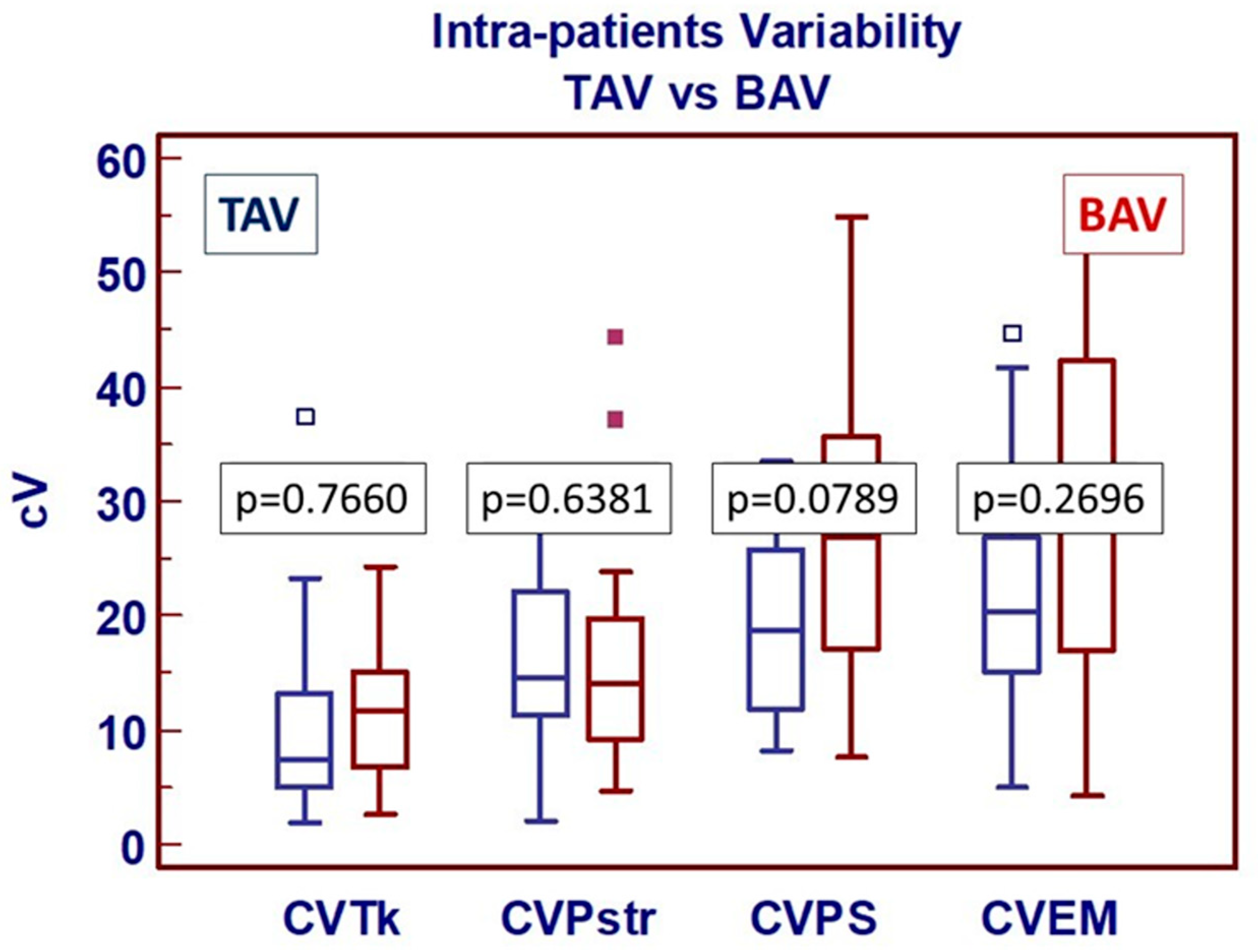
| Coefficient of Variation | Overall n = 56 | BAV n = 37 | TAV n = 19 | p |
| Aortic Wall Thickness § | ||||
| range | 2–37 | 3–24 | 2–37 | |
| mean ± sd | 10.6 ± 7.2 | 11 ± 6 | 10 ± 8 | |
| median | 9.08 | 11.6 | 7.45 | 0.7664 |
| 95% CI | 7 to 11.9 | 6.6 to 15.3 | 5.5 to 11.2 | |
| Coefficient of Variation | Overall n = 35 | BAV n = 13 | TAV n = 22 | p |
| Peak Strain § | ||||
| range | 2–44 | 5–44 | 2–28 | |
| mean ± sd | 16.2 ± 8.8 | 17.1 ± 11.6 | 15.6 ± 6.8 | |
| median | 14.09 | 14.09 | 14.5 | 0.6820 |
| 95% CI | 11.8 to 18.0 | 8.3 to 25.3 | 11.4 to 21.8 | |
| Peak Stress § | ||||
| range | 8–54 | 15–54 | 8–33 | |
| mean ± sd | 22.4 ± 11.4 | 27.4 ± 13.6 | 19.5 ± 8.9 | |
| median | 21.02 | 26.9 | 18.7 | 0.0798 |
| 95% CI | 14.6 to 27.9 | 15.5 to 40.5 | 11.9 to 25.6 | |
| Maximum Elastic Modulus § | ||||
| range | 4–54 | 4–54 | 5–45 | |
| mean ± sd | 24.5 ± 12.9 | 28.0 ± 15.4 | 23 ± 11 | |
| median | 21.07 | 29.4 | 20.3 | 0.2696 |
| 95% CI | 18.1 to 29.8 | 13.7 to 44.8 | 15.3 to 26.3 |
| Variable | Coefficient of Variability (cV) | |||
|---|---|---|---|---|
| Wall Thickness | Peak Strain | Peak Stress | Elastic Modulus | |
| Age | r = 0.0424, p = 0.7664 | r = 0.1136, p = 0.5289 | r = 0.2882, p = 0.1038 | r = −0.5522, p = 0.0005 |
| Aortic Dilation | r = 0.0944, p = 0.5100 | r = 0.0000, p = 0.9999 | r = 0.1821, p = 0.3103 | r = 0.1755, p = 0.3286 |
| Indexed Aortic Dilation | r = 0.2597, p = 0.0657 | r = 0.0957, p = 0.5962 | r = 0.2337, p = 0.1906 | r = 0.0607, p = 0.7373 |
| Area/Height ratio | r = 0.2240, p = 0.1140 | r = 0.0746, p = 0.6801 | r = 0.2505, p = 0.1596 | r = 0.1639, p = 0.3622 |
| BSA | r = 0.1664, p = 0.2433 | r = 0.0470, p = 0.7949 | r = 0.0256, p = 0.8875 | r = 0.1122, p = 0.5342 |
| BMI | r = 0.0854, p = 0.5514 | r = 0.1607, p = 0.3716 | r = 0.0039, p = 0.9829 | r = 0.0370, p = 0.8379 |
Appendix B
| Male (Female) gender |
| Patients’ Age > 66 |
| AAP (RP) phenotype of aortic dilatation |
| BAV (TAV) type of native aortic valve |
| BMI > 28.6 (<23.6) kg/m2 |
| BSA > 2.0 (<1.7) m2 |
| Weight > 85 (<66) kg |
| Height > 1.76 (<1.65) m |
| Maximum aortic diameter > 52mm |
| Maximum indexed dilatation > 27.5mm/m2 |
| Area/height ratio > 11 |
References
- Avanzini, A.; Battini, D.; Bagozzi, L.; Bisleri, G. Biomechanical evaluation of ascending aortic aneurysm. Biomed. Res. Int. 2014, 2014, 820385. [Google Scholar] [CrossRef] [Scilit]
- Martufi, G.; Forneris, A.; Appoo, J.; Di Martino, E.S. Is there a role for biomechanics engineering in helping to elucidate the risk profile of the thoracic aorta ? Ann. Thorac. Surg 2016, 101, 390–398. [Google Scholar] [CrossRef] [Scilit]
- Emmott, A.; Garcia, J.; Chung, J.; Lachapelle, K.; El-Hamamsy, I.; Mongrain, R.; Cartier, R.; Leask, R.L. Biomechanics of the Ascending Thoracic Aorta: A Clinical Perspective on Engineering Data. Can. J. Cardiol. 2016, 32, 35–47. [Google Scholar] [CrossRef] [Scilit]
- Pichamuthu, J.E.; Phillippi, J.A.; Cleary, D.A.; Chew, D.W.; Hempel, J.; Vorp, D.A.; Gleason, T.G. Differential tensile strength and collagen composition in ascending aortic aneurysms by aortic valve phenotype. Ann. Thorac. Surg. 2013, 96, 2147–2154. [Google Scholar] [CrossRef] [Scilit] [PubMed]
- Ferrara, A.; Morganti, S.; Totaro, P.; Mazzola, A.; Auricchio, F. Human dilated ascending aorta: Mechanical characterization via uniaxial tensile tests. J. Mech. Behav. Biomed. Mater. 2016, 53, 257–271. [Google Scholar] [CrossRef] [Scilit]
- Cebull, H.L.; Rayz, V.L.; Goergen, C.J. Recent Advances in Biomechanical Characterization of Thoracic Aortic Aneurysms. Front. Cardiovasc. Med. 2020, 7, 75. [Google Scholar] [CrossRef] [Scilit]
- Takada, J.; Hamada, K.; Zhu, X.; Tsuboko, Y.; Iwasaki, K. Biaxial tensile testing system for measuring mechanical properties of both sides of biological tissues. J. Mech. Behav. Biomed. Mater. 2023, 146, 106028. [Google Scholar] [CrossRef] [Scilit] [PubMed]
- Davis, F.M.; Luo, Y.; Avril, S.; Duprey, A.; Lu, J. Local mechanical properties of human ascending thoracic aneurysms. J. Mech. Behav. Biomed. Mater. 2016, 61, 235–249. [Google Scholar] [CrossRef] [Scilit] [PubMed]
- Martufi, G.; Forneris, A.; Nobakht, S.; Rinker, K.D.; Moore, R.D.; Di Martino, E. Case Study: Intra-Patient Heterogeneity of Aneurysmal Tissue Properties. Front. Cardiovasc. Med. 2018, 5, 82. [Google Scholar] [CrossRef] [Scilit] [PubMed]
- Czerny, M.; Grabenwöger, M.; Berger, T.; Aboyans, V.; Della Corte, A.; Chen, E.P.; Desai, N.D.; Dumfarth, J.; Elefteriades, J.A.; Etz, C.; et al. EACTS/STS Guidelines for diagnosing and treating acute and chronic syndromes of the aortic organ. Eur. J. Cardiothorac. Surg. 2024, 65, ezad426. [Google Scholar] [CrossRef] [Scilit] [PubMed]
- Forsell, C.; Björck, H.M.; Eriksson, P.; Franco-Cereceda, A.; Gasser, T.C. Biomechanical properties of the thoracic aneurysmal wall: Differences between bicuspid aortic valve and tricuspid aortic valve patients. Ann. Thorac. Surg. 2014, 98, 65–71. [Google Scholar] [CrossRef] [Scilit] [PubMed]
- Chung, J.C.; Wong, E.; Tang, M.; Eliathamby, D.; Forbes, T.L.; Butany, J.; Simmons, C.A.; Ouzounian, M. Biomechanics of Aortic Dissection: A Comparison of Aortas Associated with Bicuspid and Tricuspid Aortic Valves. J. Am. Heart Assoc. 2020, 9, e016715. [Google Scholar] [CrossRef] [Scilit]
- Pisano, C.; D’Amico, F.; Balistreri, C.R.; Vacirca, S.R.; Nardi, P.; Altieri, C.; Scioli, M.G.; Bertoldo, F.; Santo, L.; Bellisario, D.; et al. Biomechanical properties and histomorphometric features of aortic tissue in patients with or without bicuspid aortic valve. J. Thorac. Dis. 2020, 12, 2304–2316. [Google Scholar] [CrossRef] [Scilit] [PubMed]
- Xu, X.; Zhang, Z.; Abudupataer, M.; Yang, F.; Wang, C.; Zhu, K.; Tong, J. Mechanical characterization and material modeling of ascending aortic aneurysm with different bicuspid aortic cusp fusion morphologies. J. Mech. Behav. Biomed. Mater. 2022, 132, 105295. [Google Scholar] [CrossRef] [Scilit] [PubMed]
- Pham, T.; Martin, C.; Elefteriades, J.; Sun, W. Biomechanical characterization of ascending aortic aneurysm with concomitant bicuspid aortic valve and bovine aortic arch. Acta Biomater. 2013, 9, 7927–7936. [Google Scholar] [CrossRef] [Scilit]
- Auricchio, F.; Ferrara, A.; Lanzarone, E.; Morganti, S.; Totaro, P. A Regression Method Based on Noninvasive Clinical Data to Predict the Mechanical Behavior of Ascending Aorta Aneurysmal Tissue. IEEE Trans. Biomed. Eng. 2017, 64, 2607–2617. [Google Scholar] [CrossRef] [Scilit]
- Ferrara, A.; Totaro, P.; Morganti, S.; Auricchio, F. Effects of clinico-pathological risk factors on in-vitro mechanical properties of human dilated ascending aorta. J. Mech. Behav. Biomed. Mater. 2018, 77, 1–11. [Google Scholar] [CrossRef] [Scilit]
- Totaro, P.; Morganti, S.; Auricchio, F.; Pelenghi, S. Aortic wall thickness in dilated ascending aorta: Comparison between tricuspid and bicuspid aortic valve. Arch. Cardiovasc. Dis. 2023, 116, 498–505. [Google Scholar] [CrossRef] [Scilit]
- Sigaeva, T.; Sattari, S.; Polzer, S.; Appoo, J.J.; Di Martino, E.S. Biomechanical properties of ascending aortic aneurysms: Quantification of inter- and intra-patient variability. J. Biomech. 2021, 125, 110542. [Google Scholar] [CrossRef] [Scilit]
- Salmasi, M.Y.; Sasidharan, S.; Frattolin, J.; Edgar, L.; Stock, U.; Athanasiou, T.; Moore, J. Regional variation in biomechanical properties of ascending thoracic aortic aneurysms. Eur. J. Cardiothorac. Surg. 2022, 62, ezac392. [Google Scholar] [CrossRef] [Scilit]
- Lin, S.; Morgan, M.C.; Lalande, A.; Cochet, A.; Bouchot, O. Local ex-vivo evaluation of the biomechanical properties of the ascending aortic aneurysms. Comput. Methods Biomech. Biomed. Eng. 2019, 22, S413–S414. [Google Scholar] [CrossRef] [Scilit]
- Schena, S. Ascending aortic aneurysms: Is it time for a radical change in the current surveillance and treatment guidelines? Eur. J. Cardiothorac. Surg. 2022, 62, ezac406. [Google Scholar] [CrossRef] [Scilit] [PubMed]
- Totaro, P.; Caimi, A.; Formenton, G.; Musto, M.; Schembri, M.; Morganti, S.; Pelenghi, S.; Auricchio, F. Bicuspid Valve Aortopathy: Is It Reasonable to Define a Different Surgical Cutoff Based on Different Aortic Wall Mechanical Properties Compared to Those of the Tricuspid Valve? J. Cardiovasc. Dev. Dis. 2024, 11, 312. [Google Scholar] [CrossRef] [Scilit] [PubMed]
- Zschäpitz, D.; Bohmann, B.; Lutz, B.; Eckstein, H.H.; Reeps, C.; Maegdefessel, L.; Gasser, C.T.; Busch, A. Rupture risk parameters upon biomechanical analysis independently change from vessel geometry during abdominal aortic aneurysm growth. JVS Vasc. Sci. 2022, 4, 100093. [Google Scholar] [CrossRef] [Scilit]
- Kazim, M.; Razian, S.A.; Zamani, E.; Varandani, D.; Shahbad, R.; Desyatova, A.; Jadidi, M. Variability in structure, morphology, and mechanical properties of the descending thoracic and infrarenal aorta around their circumference. J. Mech. Behav. Biomed. Mater. 2024, 150, 106332. [Google Scholar] [CrossRef] [Scilit]
- Perez-Casares, A.; Dionne, A.; Gauvreau, K.; Prakash, A. Rapid ascending aorta stiffening in bicuspid aortic valve on serial cardiovascular magnetic resonance evaluation: Comparison with connective tissue disorders. J. Cardiovasc. Magn. Reson. 2021, 23, 11. [Google Scholar] [CrossRef] [Scilit]
- Emmott, A.; Alzahrani, H.; Alreshidan, M.; Therrien, J.; Leask, R.L.; Lachapelle, K. Transesophageal echocardiographic strain imaging predicts aortic biomechanics: Beyond diameter. J. Thorac. Cardiovasc. Surg. 2018, 156, 503–512.E1. [Google Scholar] [CrossRef] [Scilit]
- Markodimitrakis, E.; Lin, S.; Koutoulakis, E.; Marín-Castrillón, D.M.; Tovar Sáez, F.A.; Leclerc, S.; Bernard, C.; Boucher, A.; Presles, B.; Bouchotet, O.; et al. Comparison of In-Vivo and Ex-Vivo Ascending Aorta Elastic Properties through Automatic Deep Learning Segmentation of Cine-MRI and Biomechanical Testing. J. Clin. Med. 2023, 12, 402. [Google Scholar] [CrossRef] [Scilit]
- Duprey, A.; Trabelsi, O.; Vola, M.; Favre, J.P.; Avril, S. Biaxial rupture properties of ascending thoracic aortic aneurysms. Acta Biomater. 2016, 42, 273–285. [Google Scholar] [CrossRef] [Scilit]
- Wang, R.; Mattson, J.M.; Zhang, Y. Effect of aging on the biaxial mechanical behavior of human descending thoracic aorta: Experiments and constitutive modeling considering collagen crosslinking. J. Mech. Behav. Biomed. Mater. 2023, 140, 105705. [Google Scholar] [CrossRef] [Scilit]
- Della Corte, A.; Lo Presti, F. Aortic diameter: Really ‘the hallmark of aortic health’? Eur. J. Cardiothorac. Surg. 2024, 65, ezae202. [Google Scholar] [CrossRef] [Scilit] [PubMed]
- Breslavsky, I.D.; Amabili, M. Fitting mechanical properties of the aortic wall and individual layers to experimental tensile tests including residual stresses. J. Mech. Behav. Biomed. Mater. 2023, 138, 105647. [Google Scholar] [CrossRef] [Scilit] [PubMed]




| Overall n = 56 | BAV n = 19 | TAV n = 37 | p | |
|---|---|---|---|---|
| Gender | ||||
| Male | 34 (61) | 13 (68) | 21 (57) | 0.5643 |
| Female | 22 (39) | 6 (32) | 16 (43) | |
| Age (years) § | ||||
| range | 28–85 | 28–79 | 32–85 | |
| mean ± sd | 64 ± 14 | 58 ± 16 | 68 ± 11 | 0.0120 |
| >66 | 29 (52) | 6 (31) | 23 (62) | 0.0476 |
| Weight (kg) § | 75 ± 15 | 73 ± 12 | 77 ± 15 | 0.4723 |
| Height (m) § | 1.69 ± 0.09 | 1.69 ± 0.09 | 1.70 ± 0.09 | 0.8827 |
| BSA (m2) § | 1.88 ± 0.21 | 1.87 ± 0.23 | 1.878 ± 0.20 | 0.5736 |
| BMI (kg/m2) § | 26 ± 4 | 25 ± 3 | 27 ± 4 | 0.2127 |
| Aortic Dilation (mm) § | ||||
| range | 41–66 | 45–60 | 41–66 | |
| mean ± sd | 52 ± 5 | 52 ± 4 | 52 ± 6 | 0.7412 |
| ≥52 | 22 (39) | 7 (37) | 14 (38) | 0.8065 |
| Indexed Aortic Dilation (mm/m2) § | ||||
| range | 22–38 | 23–37 | 22–38 | |
| mean ± sd | 27 ± 9 | 28 ± 4 | 27 ± 6 | 0.7228 |
| ≥27 | 32 (57) | 10 (53) | 22 (59) | 0.7736 |
| Area/height ratio (mm2/m) § | ||||
| range | 7–19 | 8–17 | 7–19 | |
| mean ± sd | 12.6 ± 2.4 | 12.6 ± 1.9 | 12.6 ± 2.6 | 0.8588 |
| ≥11 | 43 (77) | 15 (79) | 28 (75) | 0.8915 |
| Phenotype of Aortic Dilatation | ||||
| AAP | 41 (73) | 16 (84) | 25 (68) | 0.3377 |
| RP | 15 (37) | 3 (16) | 12 (32) |
Disclaimer/Publisher’s Note: The statements, opinions and data contained in all publications are solely those of the individual author(s) and contributor(s) and not of MDPI and/or the editor(s). MDPI and/or the editor(s) disclaim responsibility for any injury to people or property resulting from any ideas, methods, instructions or products referred to in the content. |
© 2025 by the authors. Licensee MDPI, Basel, Switzerland. This article is an open access article distributed under the terms and conditions of the Creative Commons Attribution (CC BY) license.
Share and Cite
Totaro, P.; Formenton, G.; Musto, M.; Sciacca, C.; Caimi, A.; Schembri, M.; Pelenghi, S.; Auricchio, F. Intra-Patient Heterogeneity of Mechanical and Anatomical Properties in Thoracic Aortic Wall: An Ex Vivo Study Comparing Patients with Bicuspid and Tricuspid Aortic Valve Aortopathy. J. Cardiovasc. Dev. Dis. 2026, 13, 15. https://doi.org/10.3390/jcdd13010015
Totaro P, Formenton G, Musto M, Sciacca C, Caimi A, Schembri M, Pelenghi S, Auricchio F. Intra-Patient Heterogeneity of Mechanical and Anatomical Properties in Thoracic Aortic Wall: An Ex Vivo Study Comparing Patients with Bicuspid and Tricuspid Aortic Valve Aortopathy. Journal of Cardiovascular Development and Disease. 2026; 13(1):15. https://doi.org/10.3390/jcdd13010015
Chicago/Turabian StyleTotaro, Pasquale, Giulia Formenton, Martina Musto, Chiara Sciacca, Alessandro Caimi, Martina Schembri, Stefano Pelenghi, and Ferdinando Auricchio. 2026. "Intra-Patient Heterogeneity of Mechanical and Anatomical Properties in Thoracic Aortic Wall: An Ex Vivo Study Comparing Patients with Bicuspid and Tricuspid Aortic Valve Aortopathy" Journal of Cardiovascular Development and Disease 13, no. 1: 15. https://doi.org/10.3390/jcdd13010015
APA StyleTotaro, P., Formenton, G., Musto, M., Sciacca, C., Caimi, A., Schembri, M., Pelenghi, S., & Auricchio, F. (2026). Intra-Patient Heterogeneity of Mechanical and Anatomical Properties in Thoracic Aortic Wall: An Ex Vivo Study Comparing Patients with Bicuspid and Tricuspid Aortic Valve Aortopathy. Journal of Cardiovascular Development and Disease, 13(1), 15. https://doi.org/10.3390/jcdd13010015