


The Clock Drawing Test: A Valid Screening Instrument for Dementia Detection in Low-Educated Patients?
 ,
,
Abstract
1. Background
2. Materials and Methods
2.1. Data Source and Setting
2.2. Cohorts
2.3. Instruments
2.4. Data Analysis
3. Results
3.1. Baseline Characteristics

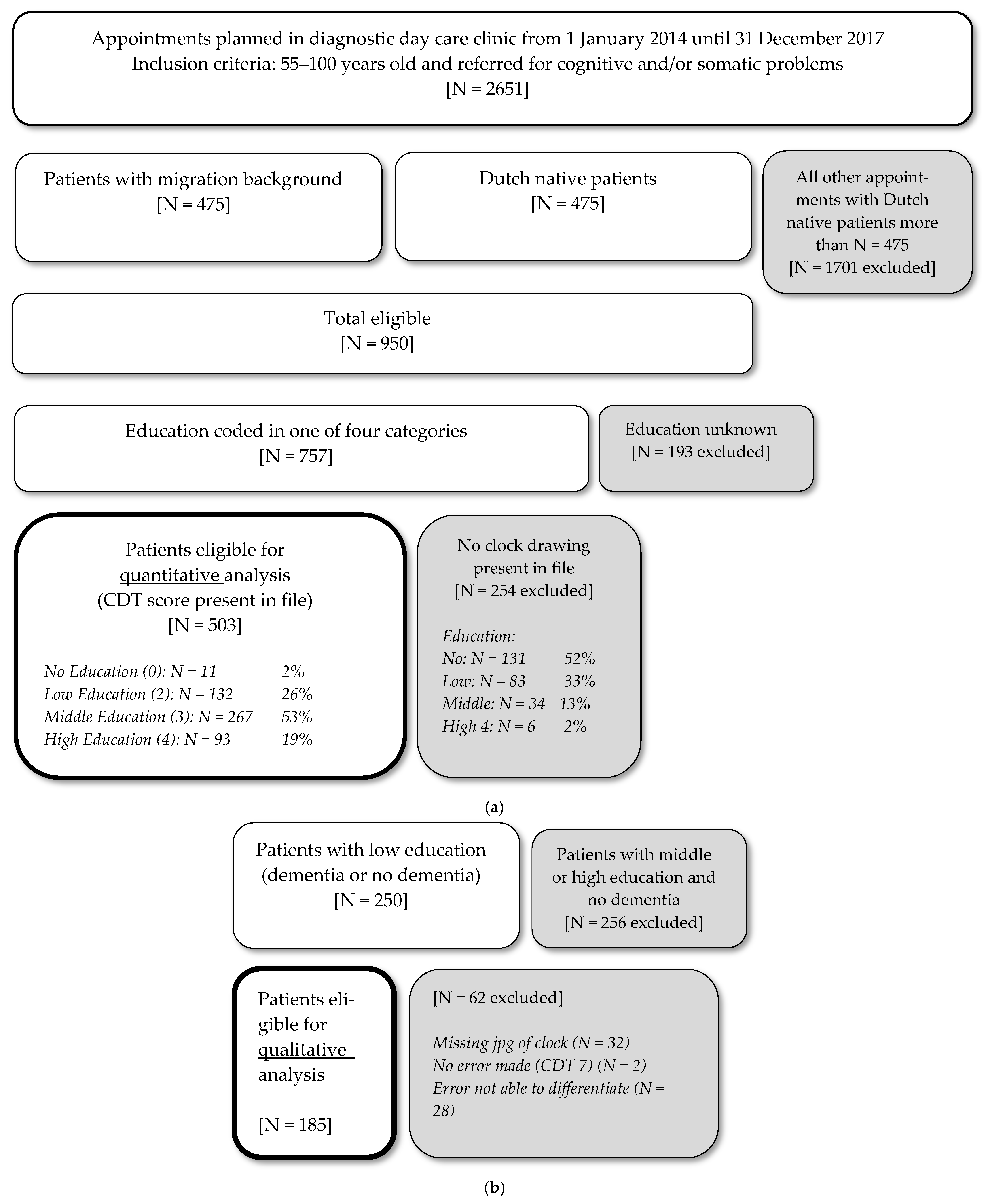
| Quantitative Analyses | |||||
|---|---|---|---|---|---|
| Clinical Diagnosis | |||||
| No Cognitive Impairment | MCI 1 | Dementia | Other Diagnosis 2 | Total | |
| Table 2 | N = 130 | N = 171 | N = 180 | N = 22 | 503 |
| Figure 2 Boxplot CDT score per education group | N = 301 | N = 180 | N = 22 not included | 481 | |
| Table 3 Sensitivity specificity | N = 301 | N = 180 | N = 22 not included | 481 | |
| Table 4 Logistic regression | N = 481 | N = 22 not included | 481 | ||
| Qualitative Analyses | |||||
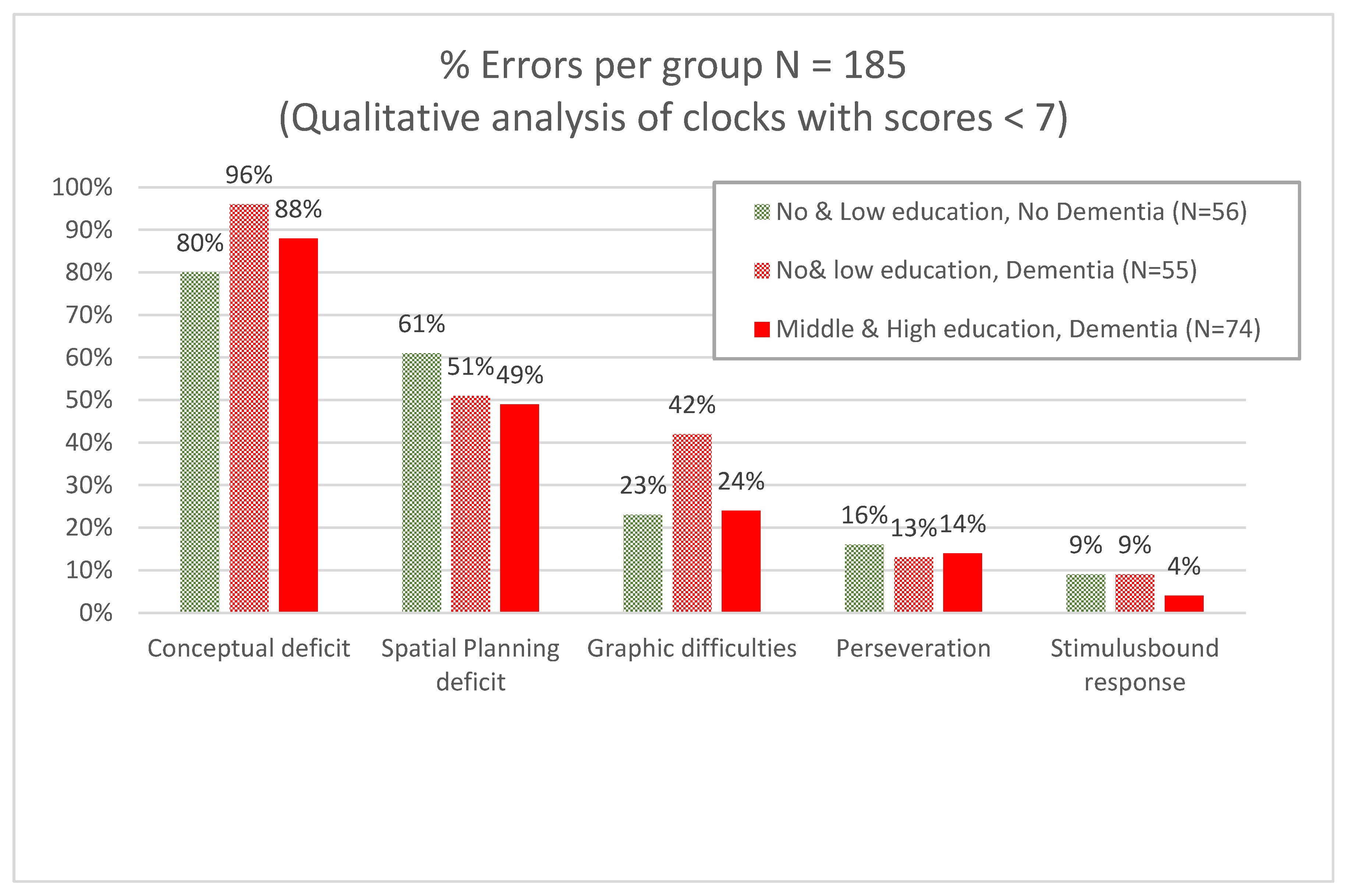
| No and low education | 56 | 55 | N = 22 not included | 185 | |
| Middle or High education | N = 256 not included | 74 | N = 22 not included | ||
| Clinical Diagnosis | ||||||
|---|---|---|---|---|---|---|
| No Cognitive Impairment | MCI 5 | Dementia | Other Diagnosis | Total | p | |
| N | 130 | 171 | 180 | 22 | 503 | |
| Gender, male (N, %) | 53 (41%) | 64 (37%) | 79 (44%) | 9 (41%) | 205 (41%) | X2 (3) = 1.51; p = 0.68 |
| Age (M, SD) | 77 (8.3) | 80 (8.0) | 82 (7.3) | 78 (9.0) | 80 (8.1) | K-W 6 (3) = 26.3; p ≤ 0.001 |
| Education | ||||||
| No education (N, %) | 5 (4%) | 2 (1%) | 4 (2%) | 0 (0%) | 11 (2%) | X2 (9) = 28.0; p ≤ 0.001 |
| Low education 1 (N, %) | 29 (22%) | 31 (38%) | 69 (14%) | 3 (14%) | 132 (26%) | |
| Middle education 2 (N, %) | 69 (53%) | 103 (60%) | 83 (46%) | 12 (55%) | 267 (53%) | |
| High education 3 (N, %) | 27 (21%) | 35 (20%) | 24 (13%) | 7 (32%) | 93 (18%) | |
| Ethnicity | ||||||
| Dutch (N, %) | 85 (66%) | 129 (75%) | 128 (72%) | 16 (76%) | 358 (72%) | X2 (12) = 9.9; p = 0.62 |
| Turkish (N, %) | 8 (6%) | 3 (2%) | 8 (4%) | 0 (0%) | 19 (4%) | |
| Moroccan (N, %) | 5 (4%) | 5 (3%) | 5 (3%) | 0 (0%) | 15 (3%) | |
| Surinamese/Hindustani (N, %) | 2 (%) | 0 (0%) | 2 (1%) | 0 (0%) | 4 (1%) | |
| Other (N, %) | 29 (22%) | 34 (20%) | 35 (20%) | 5 (24%) | 103 (21%) | |
| MMSE 4 (M, SD) | 26 (3.8) | 24 (3.5) | 19 (5.6) | 23 (5.8) | 23 (5.3) | K-W 6 (3) = 128; p ≤ 0.001 |
| CDT score 7 (M, SD) | 5.1 (1.41) | 4.3 (1.71) | 3.2 (1.94) | 3.7 (1.88) | 4.1 (1.88) | |
| Cut-off < 3 (N; %) 8 | 9 (7%) | 26 (15%) | 69 (38%) | 7 (32%) | 111 (22%) | X2 (3) = 51.0; p ≤ 0.001 |
| Cut-off < 4 (N; %) 9 | 22 (17%) | 56 (33%) | 105 (58%) | 11 (50%) | 194 (39%) | X2 (3) = 59.0; p ≤ 0.001 |
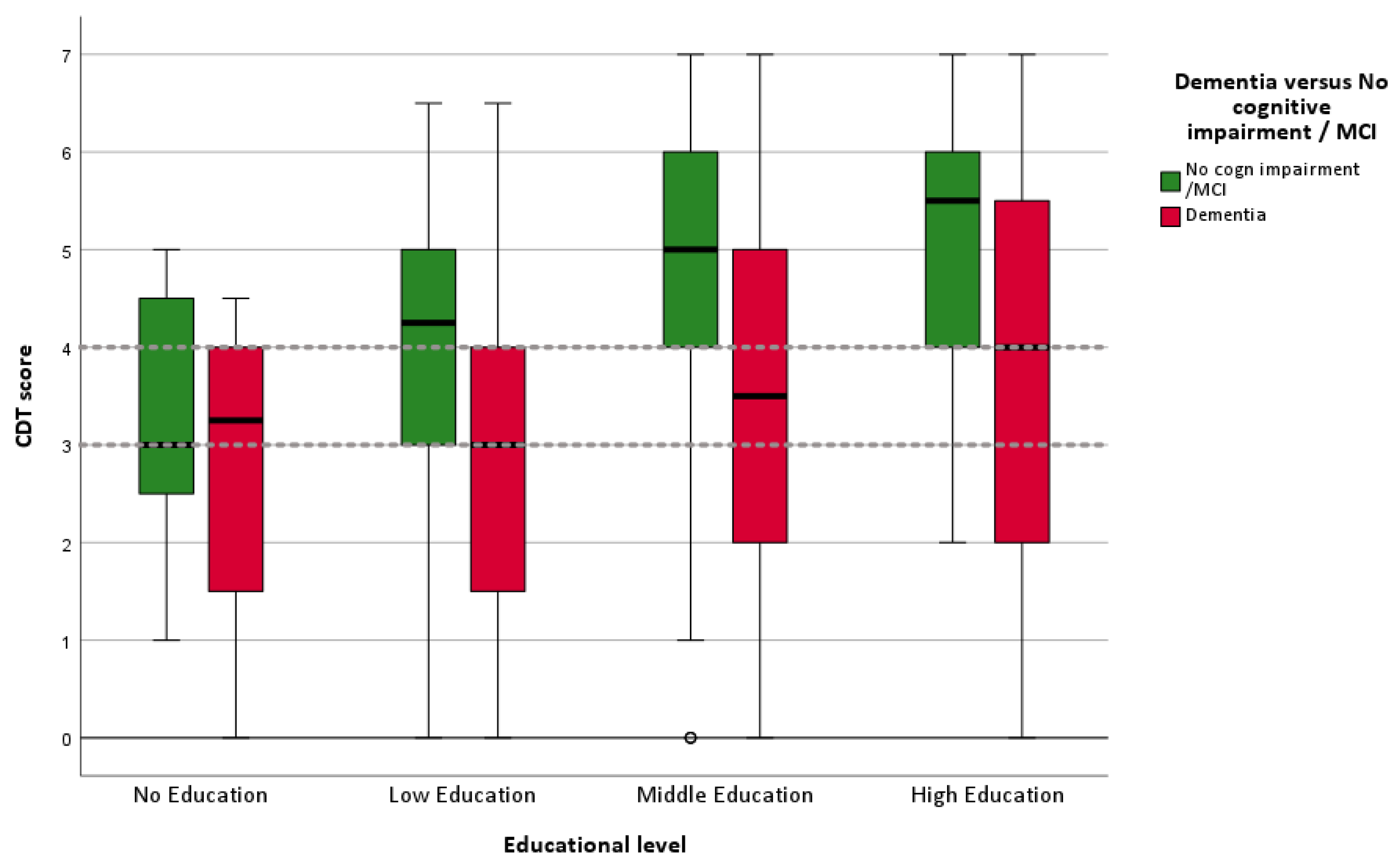
| N | Sensitivity% (95% CI 1) | Specificity% (95% CI) | Youden Index 2 | PPV 3 (95% CI) | NPV 4 (95% CI) | LR+ 5 (95% CI) | LR− 6 (95% CI) | |
|---|---|---|---|---|---|---|---|---|
| Cutoff < 3 | ||||||||
| Total | 481 | 38% (31–46%) | 88% (84–92%) | 0.26 | 66% (58–74%) | 71% (68–73%) | 3.30 (2.29–4.74) | 0.70 (0.62–0.79) |
| No education | 11 | 25% (0.63–81%) | 71% (29–96%) | −0.04 | 33% (6–80%) | 63% (44–78%) | 0.88 (0.11–6.88) | 1.05 (0.50–2.19) |
| Low education | 129 | 46% (34–59%) | 87% (75–94%) | 0.33 | 80% (67–89%) | 58% (52–64%) | 3.48 (1.74–6.96) | 0.62 (0.49–0.79) |
| Middle education | 255 | 34% (24–45%) | 88% (82–92%) | 0.22 | 57% (45–69%) | 73% (70–76%) | 2.76 (1.67–4.56) | 0.75 (0.64–0.89) |
| High education | 86 | 33% (16–55%) | 94% (84–98%) | 0.27 | 67% (40–86%) | 78% (73–83%) | 5.17 (1.71–15.58) | 0.71 (0.53–0.95) |
| Cutoff < 4 | ||||||||
| Total | 481 | 58% (51–66%) | 74% (69–79%) | 0.32 | 57% (52–63%) | 75% (71–78%) | 2.25 (1.79–2.83) | 0.56 (0.47–0.68) |
| No education | 11 | 75% (19–99%) | 43% (10–82%) | 0.18 | 43% (24–64%) | 75% (31–95%) | 1.31 (0.56–3.09) | 0.58 (0.09–3.90) |
| Low education | 129 | 74% (62–84%) | 62% (48–74%) | 0.36 | 69% (61–76%) | 67% (57–76%) | 1.93 (1.36–2.74) | 0.42 (0.27–0.66) |
| Middle education | 255 | 51% (39–62%) | 77% (70–83%) | 0.28 | 52% (43–60%) | 76% (72–80%) | 2.23 (1.58–3.16) | 0.64 (0.51–0.81) |
| High education | 86 | 38% (19–59%) | 81% (69–90%) | 0.19 | 42% (27–61%) | 77% (71–82%) | 1.94 (0.94–4.00) | 0.78 (0.56–1.08) |
| Variable | B 1 | SE B 2 | Wald Test | p | OR 3 (95% CI 4) |
|---|---|---|---|---|---|
| CDT score (the dependent variable) < 3 | |||||
| Age | 0.050 | 0.015 | 10.649 | 0.001 | 1.051 (1.020–1.083) |
| Gender | 0.083 | 0.234 | 0.127 | 0.722 | 1.087 (0.687–1.721) |
| Ethnicity | 0.065 | 0.057 | 1.309 | 0.252 | 1.067 (0.955–1.192) |
| Educational level | −0.493 | 0.162 | 9.288 | 0.002 | 0.611 (0.445–0.839) |
| Constant | −4.602 | 1.298 | 12.570 | <0.001 | 0.010 |
| CDT score (the dependent variable) < 4 | |||||
| Age | 0.041 | 0.013 | 9.821 | 0.002 | 1.041 (1.015–1.068) |
| Gender | −0.168 | 0.205 | 0.670 | 0.413 | 0.846 (0.566–1.263) |
| Ethnicity | 0.112 | 0.050 | 5.069 | 0.024 | 1.119 (1.015–1.234) |
| Educational level | −0.752 | 0.144 | 27.194 | <0.001 | 0.472 (0.356–0.626) |
| Constant | −2.559 | 1.090 | 5.507 | 0.019 | |
3.2. Clock Drawing Test Performance for Patients with and Without Dementia per Educational Level
3.3. Error Analysis
4. Discussion
4.1. Summary of Findings and Comparison to Literature
4.2. Strengths and Limitations
4.3. Implications for Research and Practice
5. Conclusions
Supplementary Materials
Author Contributions
Funding
Data Availability Statement
Acknowledgments
Conflicts of Interest
References
- Prince, M.J.; Wimo, A.; Guerchet, M.; Ali, G.; Wu, Y.; Prina, M.A. World Alzheimer Report 2015. The Global Impact of Dementia: An Analysis of Prevalence, Incidence, Cost and Trends. 2015. Available online: https://hal.science/hal-03495438/ (accessed on 1 July 2025).
- Nielsen, T.R.; Vogel, A.; Riepe, M.W.; de Mendonça, A.; Rodriguez, G.; Nobili, F.; Gade, A.; Waldemar, G. Assessment of dementia in ethnic minority patients in Europe: A European Alzheimer’s Disease Consortium survey. Int. Psychogeriatr. 2011, 23, 86–95. [Google Scholar] [CrossRef]
- Cooper, C.; Tandy, A.R.; Balamurali, T.B.; Livingston, G. A systematic review and meta-analysis of ethnic differences in use of dementia treatment, care, and research. Am. J. Geriatr. Psychiatry 2010, 18, 193–203. [Google Scholar] [CrossRef]
- Manly, J.J.; Espino, D.V. Cultural influences on dementia recognition and management. Clin. Geriatr. Med. 2004, 20, 93–119. [Google Scholar] [CrossRef]
- Ardila, A.; Bertolucci, P.H.; Braga, L.W.; Castro-Caldas, A.; Judd, T.; Kosmidis, M.H.; Matute, E.; Nitrini, R.; Ostrosky-Solis, F.; Rosselli, M. Illiteracy: The neuropsychology of cognition without reading. Arch. Clin. Neuropsychol. 2010, 25, 689–712. [Google Scholar] [CrossRef]
- Pedraza, O.; Clark, J.H.; O’BRyant, S.E.; Smith, G.E.; Ivnik, R.J.; Graff-Radford, N.R.; Willis, F.B.; Petersen, R.C.; Lucas, J.A. Diagnostic validity of age and education corrections for the mini-mental state examination in older African Americans. J. Am. Geriatr. Soc. 2012, 60, 328–331. [Google Scholar] [CrossRef] [PubMed]
- Shulman, K.I. Clock-drawing: Is it the ideal cognitive screening test? Int. J. Geriatr. Psychiatry 2000, 15, 548–561. [Google Scholar] [CrossRef] [PubMed]
- Park, J.K.; Jeong, E.H.; Seomun, G.A. The clock drawing test: A systematic review and meta-analysis of diagnostic accuracy. J. Adv. Nurs. 2018, 74, 2742–2754. [Google Scholar] [CrossRef] [PubMed]
- Agrell, B.; Dehlin, O. The clock-drawing test. 1998. Age Ageing 2012, 41, iii41–iii45. [Google Scholar] [CrossRef]
- Maestri, G.; Nicotra, A.; Pomati, S.; Canevelli, M.; Pantoni, L.; Cova, I. Cultural influence on clock drawing test: A systematic review. J. Int. Neuropsychol. Soc. 2023, 29, 704–714. [Google Scholar] [CrossRef]
- Mazancova, A.F.; Nikolai, T.; Stepankova, H.; Kopecek, M.; Bezdicek, O. The Reliability of Clock Drawing Test Scoring Systems Modeled on the Normative Data in Healthy Aging and Nonamnestic Mild Cognitive Impairment. Assessment 2017, 24, 945–957. [Google Scholar] [CrossRef] [PubMed]
- Nielsen, T.R.; Jørgensen, K. Visuoconstructional abilities in cognitively healthy illiterate turkish immigrants: A quantitative and qualitative investigation. Clin. Neuropsychol. 2013, 27, 681–692. [Google Scholar] [CrossRef]
- Fabricio, A.T.; Aprahamian, I.; Yassuda, M.S. Qualitative analysis of the clock drawing test by educational level and cognitive profile. Arq. Neuropsiquiatr. 2014, 72, 289–295. [Google Scholar] [CrossRef] [PubMed]
- Santana, I.; Duro, D.; Freitas, S.; Alves, L.; SimõEs, M.R. The Clock Drawing Test: Portuguese norms, by age and education, for three different scoring systems. Arch. Clin. Neuropsychol. 2013, 28, 375–387. [Google Scholar] [CrossRef]
- Xu, S.; Chen, L.; Jin, X.; Yan, J.; Xu, S.; Xu, Y.; Liu, C.; Jin, Y. Effects of age and education on clock-drawing performance by elderly adults in China. Clin. Neuropsychol. 2019, 33, 96–105. [Google Scholar] [CrossRef] [PubMed]
- Bozikas, V.P.; Giazkoulidou, A.; Hatzigeorgiadou, M.; Karavatos, A.; Kosmidis, M.H. Do age and education contribute to performance on the clock drawing test? Normative data for the Greek population. J. Clin. Exp. Neuropsychol. 2008, 30, 199–203. [Google Scholar] [CrossRef]
- Kim, H.; Chey, J. Effects of education, literacy, and dementia on the clock drawing test performance. J. Int. Neuropsychol. Soc. 2010, 16, 1138–1146. [Google Scholar] [CrossRef]
- McKhann, G.M.; Knopman, D.S.; Chertkow, H.; Hyman, B.T.; Jack, C.R., Jr.; Kawas, C.H.; Klunk, W.E.; Koroshetz, W.J.; Manly, J.J.; Mayeux, R.; et al. The diagnosis of dementia due to Alzheimer’s disease: Recommendations from the National Institute on Aging-Alzheimer’s Association workgroups on diagnostic guidelines for Alzheimer’s disease. Alzheimer’s Dement. 2011, 7, 263–269. [Google Scholar] [CrossRef] [PubMed]
- Albert, M.S.; DeKosky, S.T.; Dickson, D.; Dubois, B.; Feldman, H.H.; Fox, N.C.; Gamst, A.; Holtzman, D.M.; Jagust, W.J.; Petersen, R.C.; et al. The diagnosis of mild cognitive impairment due to Alzheimer’s disease: Recommendations from the National Institute on Aging-Alzheimer’s Association workgroups on diagnostic guidelines for Alzheimer’s disease. Alzheimer’s Dement. 2011, 7, 270–279. [Google Scholar] [CrossRef]
- Verhage, F. Intelligence and Age: Research Study in Dutch Individuals Aged Twelve to Seventy-Seven. 1964. Available online: https://research.rug.nl/nl/publications/intelligentie-en-leeftijd-bij-volwassenen-en-bejaarden (accessed on 1 November 2024).
- Folstein, M.F.; Folstein, S.E.; McHugh, P.R. “Mini-mental state”. A practical method for grading the cognitive state of patients for the clinician. J. Psychiatr. Res. 1975, 12, 189–198. [Google Scholar] [CrossRef]
- Jorm, A.F.; Jacomb, P.A. The Informant Questionnaire on Cognitive Decline in the Elderly (IQCODE): Socio-demographic correlates, reliability, validity and some norms. Psychol. Med. 1989, 19, 1015–1022. [Google Scholar] [CrossRef]
- Solomon, P.R.; Hirschoff, A.; Kelly, B.; Relin, M.; Brush, M.; DeVeaux, R.D.; Pendlebury, W.W. A 7 minute neurocognitive screening battery highly sensitive to Alzheimer’s disease. Arch. Neurol. 1998, 55, 349–355. [Google Scholar] [CrossRef]
- Zwart, L.A.R.; Goudsmit, M.; van Campen, J.P.C.M.; Rijkers, C.J.M.; Wind, A.W. The MMSE as a cognitive screener among Turkish and Moroccan migrants. Tijdschr. Gerontol. Geriatr. 2015, 46, 28–36. [Google Scholar] [CrossRef]
- Freedman, M. Clock Drawing: A Neuropsychological Analysis; Oxford University Press: Oxford, UK, 1994. [Google Scholar]
- Rouleau, I.; Salmon, D.P.; Butters, N.; Kennedy, C.; McGuire, K. Quantitative and qualitative analyses of clock drawings in Alzheimer’s and Huntington’s disease. Brain Cogn. 1992, 18, 70–87. [Google Scholar] [CrossRef]
- Kehl-Floberg, K.E.; Marks, T.S.; Edwards, D.F.; Giles, G.M. Conventional clock drawing tests have low to moderate reliability and validity for detecting subtle cognitive impairments in community-dwelling older adults. Front. Aging Neurosci. 2023, 15, 1210585. [Google Scholar] [CrossRef]
- de Noronha, Í.F.C.; Barreto, S.D.S.; Ortiz, K.Z. The influence of education on performance of adults on the Clock Drawing Test. Dement. Neuropsychol. 2018, 12, 61–67. [Google Scholar] [CrossRef]
- Leung, J.; Lui, V.; Lam, L. Screening for Early Alzheimer’s Disease in Elderly Chinese Patients Using the Chinese Clock Drawing Test. Hong Kong J. Psychiatry 2005, 15, 14–17. [Google Scholar]
- Ainslie, N.K.; Murden, R.A. Effect of Education on the Clock-Drawing Dementia Screen in Non-Demented Elderly Persons. J. Am. Geriatr. Soc. 1993, 41, 249–252. [Google Scholar] [CrossRef]
- Storey, J.E.; Rowland, J.T.J.; Conforti, D.A.; Dickson, H.G. The Rowland Universal Dementia Assessment Scale (RUDAS): A multicultural cognitive assessment scale. Int. Psychogeriatr. 2004, 16, 13–31. [Google Scholar] [CrossRef] [PubMed]
- Goudsmit, M.; van Campen, J.; Schilt, T.; Hinnen, C.; Franzen, S.; Schmand, B. One Size Does Not Fit All: Comparative Diagnostic Accuracy of the Rowland Universal Dementia Assessment Scale and the Mini Mental State Examination in a Memory Clinic Population with Very Low Education. Dement. Geriatr. Cogn. Dis. Extra 2018, 8, 290–305. [Google Scholar] [CrossRef] [PubMed]
- Goudsmit, M.; van Campen, J.; Franzen, S.; Berg, E.v.D.; Schilt, T.; Schmand, B. Dementia detection with a combination of informant-based and performance-based measures in low-educated and illiterate elderly migrants. Clin. Neuropsychol. 2021, 35, 660–678. [Google Scholar] [CrossRef] [PubMed]
- Staios, M.; Nielsen, T.R.; Kosmidis, M.H.; Papadopoulos, A.; Kokkinias, A.; Velakoulis, D.; Tsiaras, Y.; March, E.; Stolwyk, R.J. Validity of Visuoconstructional Assessment Methods within Healthy Elderly Greek Australians: Quantitative and Error Analysis. Arch. Clin. Neuropsychol. 2023, 38, 598–607. [Google Scholar] [CrossRef] [PubMed]
- Crombie, M.; Dutt, A.; Dey, P.; Nandi, R.; Evans, J. Examination of the validity of the ‘Papadum test’: An alternative to the clock drawing test for people with low levels of education. Clin. Neuropsychol. 2023, 37, 1025–1042. [Google Scholar] [CrossRef] [PubMed]
Disclaimer/Publisher’s Note: The statements, opinions and data contained in all publications are solely those of the individual author(s) and contributor(s) and not of MDPI and/or the editor(s). MDPI and/or the editor(s) disclaim responsibility for any injury to people or property resulting from any ideas, methods, instructions or products referred to in the content. |
© 2025 by the authors. Licensee MDPI, Basel, Switzerland. This article is an open access article distributed under the terms and conditions of the Creative Commons Attribution (CC BY) license (https://creativecommons.org/licenses/by/4.0/).
Share and Cite
Boots-van der Heiden, J.; van Campen, J.; Kooistra, T.; van de Vorst, I.; Goudsmit, M. The Clock Drawing Test: A Valid Screening Instrument for Dementia Detection in Low-Educated Patients? Geriatrics 2025, 10, 164. https://doi.org/10.3390/geriatrics10060164
Boots-van der Heiden J, van Campen J, Kooistra T, van de Vorst I, Goudsmit M. The Clock Drawing Test: A Valid Screening Instrument for Dementia Detection in Low-Educated Patients? Geriatrics. 2025; 10(6):164. https://doi.org/10.3390/geriatrics10060164
Chicago/Turabian StyleBoots-van der Heiden, Janique, Jos van Campen, Tessa Kooistra, Irene van de Vorst, and Miriam Goudsmit. 2025. "The Clock Drawing Test: A Valid Screening Instrument for Dementia Detection in Low-Educated Patients?" Geriatrics 10, no. 6: 164. https://doi.org/10.3390/geriatrics10060164
APA StyleBoots-van der Heiden, J., van Campen, J., Kooistra, T., van de Vorst, I., & Goudsmit, M. (2025). The Clock Drawing Test: A Valid Screening Instrument for Dementia Detection in Low-Educated Patients? Geriatrics, 10(6), 164. https://doi.org/10.3390/geriatrics10060164

