


Predicting Conversion from Mild Cognitive Impairment to Alzheimer’s Disease Using a Vision Transformer and Hippocampal MRI Slices

 and
and
Abstract
1. Introduction
2. Materials and Methods
2.1. Magnetic Resonance Imaging Data
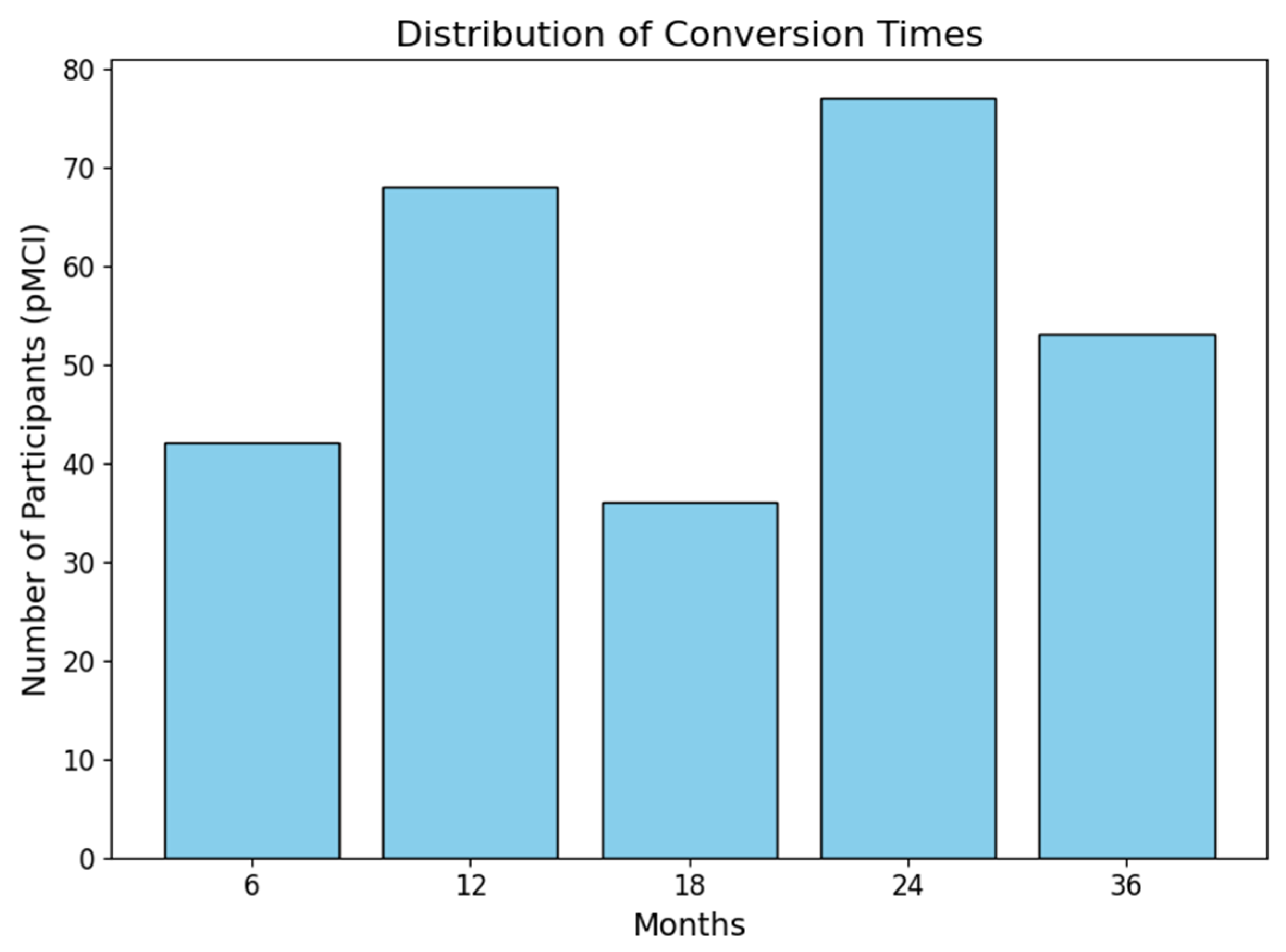
2.2. Demographics and MCI Status
2.3. MRI Data Preprocessing and Preparation
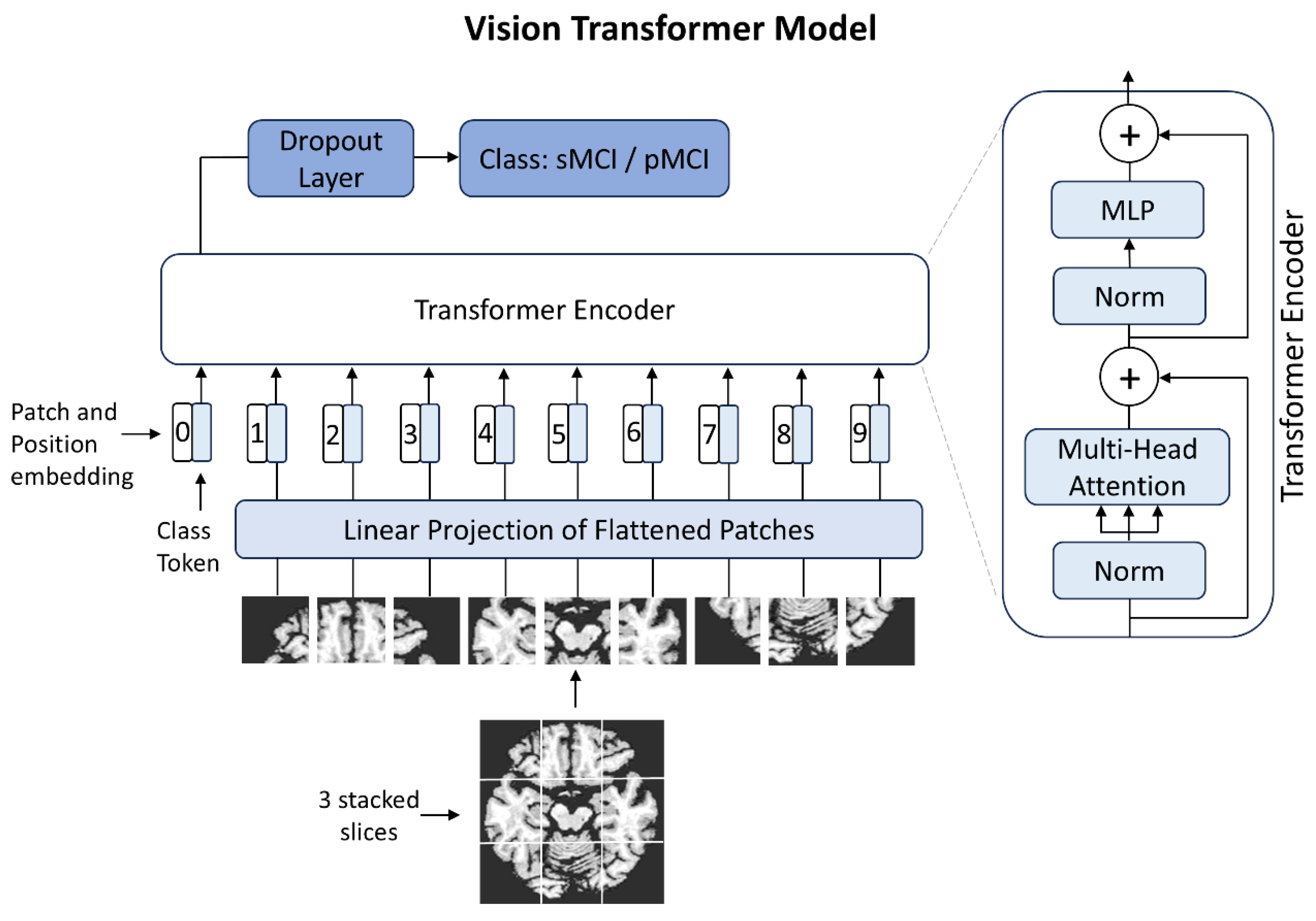
2.4. Model Architecture—Vision Transformer (ViT)
2.5. Model Training and Fine-Tuning
2.6. 3D-ResNet Model for Comparison
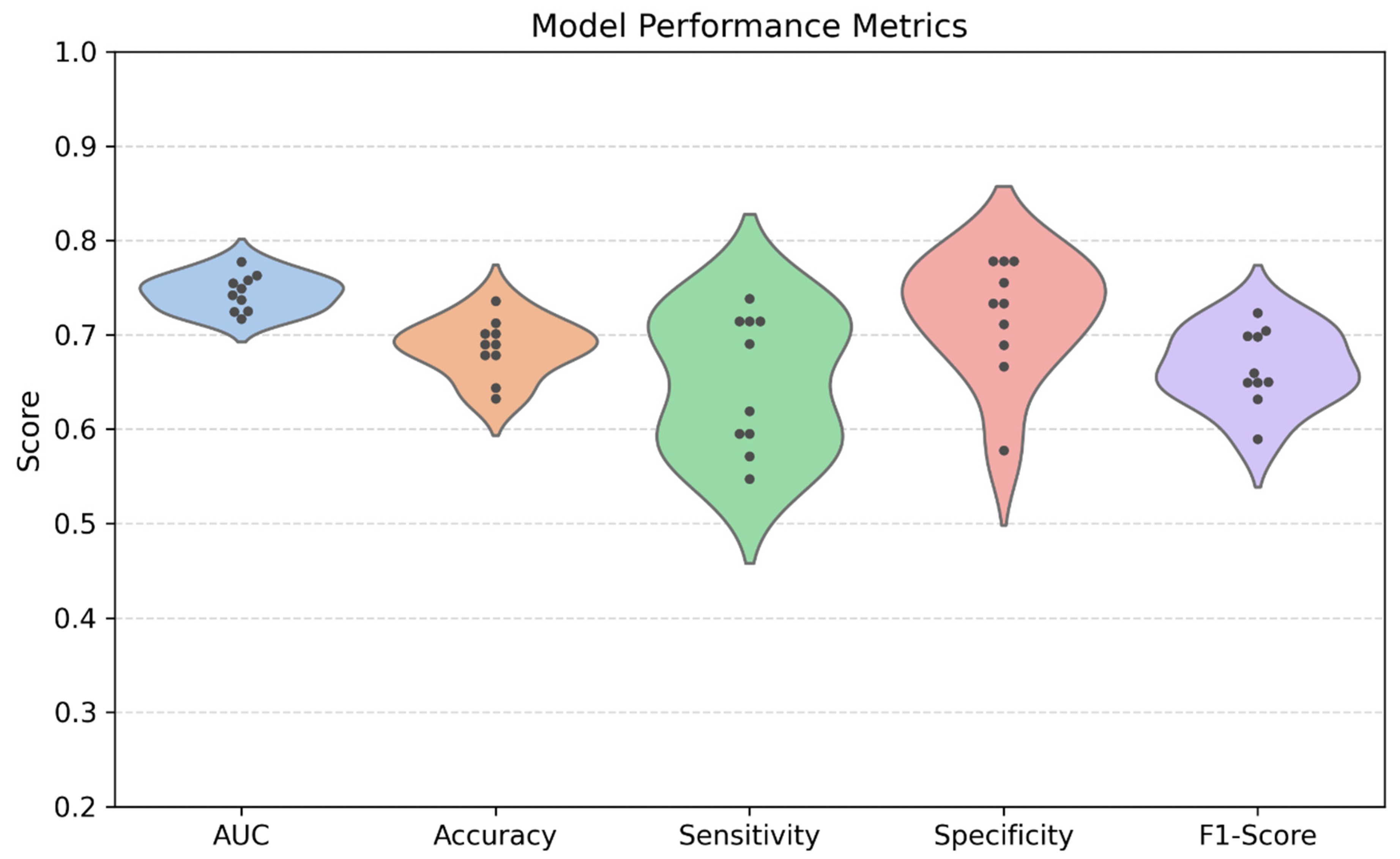
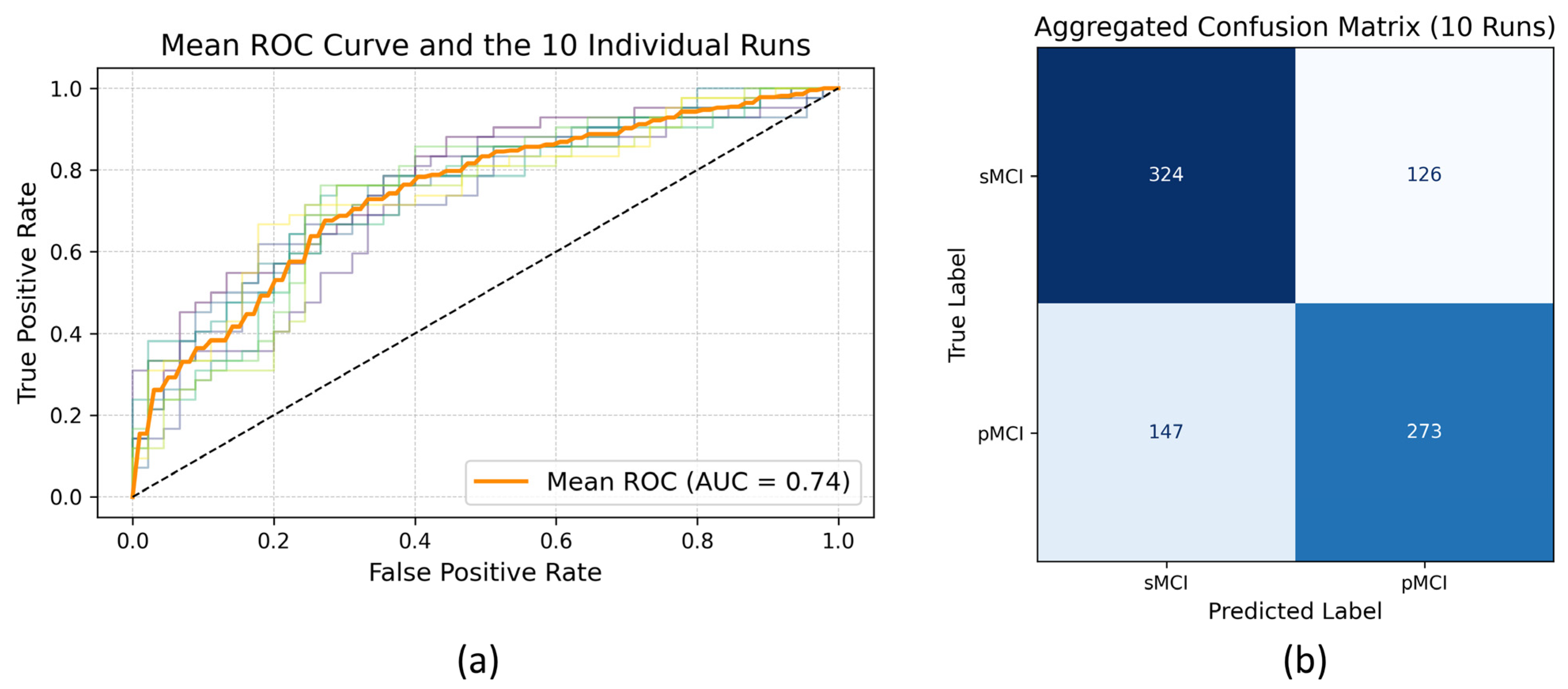
3. Results
4. Discussion
5. Conclusions
Supplementary Materials
Author Contributions
Funding
Institutional Review Board Statement
Informed Consent Statement
Data Availability Statement
Acknowledgments
Conflicts of Interest
Abbreviations
| AD | Alzheimer’s Disease |
| AUC-ROC | Area Under the Receiver Operating Characteristic Curve |
| CDR-SOB | Clinical Dementia Rating—Sum of Boxes |
| CN | Cognitively Normal |
| CNN | Convolutional Neural Network |
| DICOM | Digital Imaging and Communications in Medicine |
| MCI | Mild Cognitive Impairment |
| MLP | Multilayer Perceptron |
| MMSE | Mini-Mental State Examination |
| MNI | Montreal Neurological Institute |
| MRI | Magnetic Resonance Imaging |
| NIfTI | Neuroimaging Informatics Technology Initiative |
| PET | Positron Emission Tomography |
| pMCI | Progressive Mild Cognitive Impairment |
| sMCI | Stable Mild Cognitive Impairment |
| SPM | Statistical Parametric Mapping |
| TIMM | PyTorch Image Models |
| ViT | Vision Transformer |
References
- Fukushima, K. Neocognitron: A Self-Organizing Neural Network Model for a Mechanism of Pattern Recognition Unaffected by Shift in Position. Biol. Cybern. 1980, 36, 193–202. [Google Scholar] [CrossRef]
- LeCun, Y.; Bottou, L.; Bengio, Y.; Haffner, P. Gradient-Based Learning Applied to Document Recognition. Proc. IEEE 1998, 86, 2278–2324. [Google Scholar] [CrossRef]
- Vaswani, A.; Shazeer, N.; Parmar, N.; Uszkoreit, J.; Jones, L.; Gomez, A.N.; Kaiser, L.; Polosukhin, I. Attention Is All You Need. In Proceedings of the Advances in Neural Information Processing Systems 30, Long Beach, CA, USA, 4–9 December 2017. [Google Scholar]
- Bahdanau, D.; Cho, K.; Bengio, Y. Neural Machine Translation by Jointly Learning to Align and Translate. In Proceedings of the International Conference on Learning Representations, Banff, AB, Canada, 14–16 April 2014. [Google Scholar]
- Dosovitskiy, A.; Beyer, L.; Kolesnikov, A.; Weissenborn, D.; Zhai, X.; Unterthiner, T.; Dehghani, M.; Minderer, M.; Heigold, G.; Gelly, S.; et al. An Image Is Worth 16 × 16 Words: Transformers for Image Recognition at Scale. In Proceedings of the International Conference on Learning Representations, Addis Ababa, Ethiopia, 26–30 April 2020. [Google Scholar]
- Maurício, J.; Domingues, I.; Bernardino, J. Comparing Vision Transformers and Convolutional Neural Networks for Image Classification: A Literature Review. Appl. Sci. 2023, 13, 5521. [Google Scholar] [CrossRef]
- Gustavsson, A.; Norton, N.; Fast, T.; Frölich, L.; Georges, J.; Holzapfel, D.; Kirabali, T.; Krolak-Salmon, P.; Rossini, P.M.; Ferretti, M.T.; et al. Global Estimates on the Number of Persons across the Alzheimer’s Disease Continuum. Alzheimer’s Dement. 2023, 19, 658–670. [Google Scholar] [CrossRef]
- Bloom, G.S. Amyloid-β and Tau: The Trigger and Bullet in Alzheimer Disease Pathogenesis. JAMA Neurol. 2014, 71, 505–508. [Google Scholar] [CrossRef]
- Gauthier, S.; Reisberg, B.; Zaudig, M.; Petersen, R.C.; Ritchie, K.; Broich, K.; Belleville, S.; Brodaty, H.; Bennett, D.; Chertkow, H.; et al. Mild Cognitive Impairment. Lancet 2006, 367, 1262–1270. [Google Scholar] [CrossRef]
- Alzheimer’s Association. 2024 Alzheimer’s Disease Facts and Figures; Alzheimer’s Association: Chicago, IL, USA, 2024; pp. 3708–3821. [Google Scholar]
- Gordon, B.A.; Blazey, T.M.; Su, Y.; Hari-Raj, A.; Dincer, A.; Flores, S.; Christensen, J.; McDade, E.; Wang, G.; Xiong, C.; et al. Spatial Patterns of Neuroimaging Biomarker Change in Individuals from Families with Autosomal Dominant Alzheimer’s Disease: A Longitudinal Study. Lancet Neurol. 2018, 17, 241–250. [Google Scholar] [CrossRef] [PubMed]
- Bravo-Ortiz, M.A.; Holguin-Garcia, S.A.; Quiñones-Arredondo, S.; Mora-Rubio, A.; Guevara-Navarro, E.; Arteaga-Arteaga, H.B.; Ruz, G.A.; Tabares-Soto, R. A Systematic Review of Vision Transformers and Convolutional Neural Networks for Alzheimer’s Disease Classification Using 3D MRI Images. Neural Comput. Appl. 2024, 36, 21985–22012. [Google Scholar] [CrossRef]
- Mubonanyikuzo, V.; Yan, H.; Komolafe, T.E.; Zhou, L.; Wu, T.; Wang, N. Detection of Alzheimer Disease in Neuroimages Using Vision Transformers: Systematic Review and Meta-Analysis. J. Med. Internet Res. 2025, 27, e62647. [Google Scholar] [CrossRef] [PubMed]
- Hoang, G.M.; Kim, U.-H.; Kim, J.G. Vision Transformers for the Prediction of Mild Cognitive Impairment to Alzheimer’s Disease Progression Using Mid-Sagittal sMRI. Front. Aging Neurosci. 2023, 15, 1102869. [Google Scholar] [CrossRef] [PubMed]
- Valizadeh, G.; Elahi, R.; Hasankhani, Z.; Rad, H.S.; Shalbaf, A. Deep Learning Approaches for Early Prediction of Conversion from MCI to AD Using MRI and Clinical Data: A Systematic Review. Arch. Comput. Methods Eng. 2025, 32, 1229–1298. [Google Scholar] [CrossRef]
- Braak, H.; Braak, E. Neuropathological Stageing of Alzheimer-Related Changes. Acta Neuropathol. 1991, 82, 239–259. [Google Scholar] [CrossRef]
- Scoville, W.B.; Milner, B. Loss of Recent Memory After Bilateral Hippocampal Lesions. J. Neurol. Neurosurg. Psychiatry 1957, 20, 11–21. [Google Scholar] [CrossRef]
- Wen, J.; Thibeau-Sutre, E.; Diaz-Melo, M.; Samper-González, J.; Routier, A.; Bottani, S.; Dormont, D.; Durrleman, S.; Burgos, N.; Colliot, O. Convolutional Neural Networks for Classification of Alzheimer’s Disease: Overview and Reproducible Evaluation. Med. Image Anal. 2020, 63, 101694. [Google Scholar] [CrossRef]
- He, K.; Zhang, X.; Ren, S.; Sun, J. Deep Residual Learning for Image Recognition. In Proceedings of the IEEE Conference on Computer Vision and Pattern Recognition, Boston, MA, USA, 7–12 June 2015. [Google Scholar]
- Hara, K.; Kataoka, H.; Satoh, Y. Can Spatiotemporal 3D CNNs Retrace the History of 2D CNNs and ImageNet? In Proceedings of the Conference on Computer Vision and Pattern Recognition, Salt Lake City, UT, USA, 18–22 June 2018. [Google Scholar]
- Kay, W.; Carreira, J.; Simonyan, K.; Zhang, B.; Hillier, C.; Vijayanarasimhan, S.; Viola, F.; Green, T.; Back, T.; Natsev, P.; et al. The Kinetics Human Action Video Dataset. In Proceedings of the IEEE Conference on Computer Vision and Pattern Recognition, Honolulu, HI, USA, 21–26 July 2017. [Google Scholar]
- Cardoso, M.J.; Li, W.; Brown, R.; Ma, N.; Kerfoot, E.; Wang, Y.; Murrey, B.; Myronenko, A.; Zhao, C.; Yang, D.; et al. MONAI: An Open-Source Framework for Deep Learning in Healthcare. arXiv 2022, arXiv:2211.02701. [Google Scholar] [CrossRef]
- De Flores, R.; La Joie, R.; Chételat, G. Structural Imaging of Hippocampal Subfields in Healthy Aging and Alzheimer’s Disease. Neuroscience 2015, 309, 29–50. [Google Scholar] [CrossRef] [PubMed]
- Deininger, L.; Stimpel, B.; Yuce, A.; Abbasi-Sureshjani, S.; Schönenberger, S.; Ocampo, P.; Korski, K.; Gaire, F. A Comparative Study between Vision Transformers and CNNs in Digital Pathology. arXiv 2022, arXiv:2206.00389. [Google Scholar] [CrossRef]
- Bae, J.; Stocks, J.; Heywood, A.; Jung, Y.; Jenkins, L.; Hill, V.; Katsaggelos, A.; Popuri, K.; Rosen, H.; Beg, M.F.; et al. Transfer Learning for Predicting Conversion from Mild Cognitive Impairment to Dementia of Alzheimer’s Type Based on a Three-Dimensional Convolutional Neural Network. Neurobiol. Aging 2021, 99, 53–64. [Google Scholar] [CrossRef] [PubMed]
- Oh, K.; Chung, Y.-C.; Kim, K.W.; Kim, W.-S.; Oh, I.-S. Classification and Visualization of Alzheimer’s Disease Using Volumetric Convolutional Neural Network and Transfer Learning. Sci. Rep. 2019, 9, 18150. [Google Scholar] [CrossRef]
- Lu, P.; Hu, L.; Zhang, N.; Liang, H.; Tian, T.; Lu, L. A Two-Stage Model for Predicting Mild Cognitive Impairment to Alzheimer’s Disease Conversion. Front. Aging Neurosci. 2022, 14, 826622. [Google Scholar] [CrossRef]
- Ashtari-Majlan, M.; Seifi, A.; Dehshibi, M.M. A Multi-Stream Convolutional Neural Network for Classification of Progressive MCI in Alzheimer’s Disease Using Structural MRI Images. IEEE J. Biomed. Health Inform. 2022, 26, 3918–3926. [Google Scholar] [CrossRef]
- Bron, E.E.; Klein, S.; Papma, J.M.; Jiskoot, L.C.; Venkatraghavan, V.; Linders, J.; Aalten, P.; De Deyn, P.P.; Biessels, G.J.; Claassen, J.A.H.R.; et al. Cross-Cohort Generalizability of Deep and Conventional Machine Learning for MRI-Based Diagnosis and Prediction of Alzheimer’s Disease. NeuroImage Clin. 2021, 31, 102712. [Google Scholar] [CrossRef]
- Basaia, S.; Agosta, F.; Wagner, L.; Canu, E.; Magnani, G.; Santangelo, R.; Filippi, M. Automated Classification of Alzheimer’s Disease and Mild Cognitive Impairment Using a Single MRI and Deep Neural Networks. NeuroImage Clin. 2019, 21, 101645. [Google Scholar] [CrossRef]
- Abrol, A.; Bhattarai, M.; Fedorov, A.; Du, Y.; Plis, S.; Calhoun, V. Deep Residual Learning for Neuroimaging: An Application to Predict Progression to Alzheimer’s Disease. J. Neurosci. Methods 2020, 339, 108701. [Google Scholar] [CrossRef] [PubMed]
- Zheng, B.; Gao, A.; Huang, X.; Li, Y.; Liang, D.; Long, X. A Modified 3D EfficientNet for the Classification of Alzheimer’s Disease Using Structural Magnetic Resonance Images. IET Image Process. 2023, 17, 77–87. [Google Scholar] [CrossRef]
- Ren, F.; Yang, C.; Nanehkaran, Y.A. MRI-Based Model for MCI Conversion Using Deep Zero-Shot Transfer Learning. J. Supercomput. 2023, 79, 1182–1200. [Google Scholar] [CrossRef]
- Zhang, J.; Zheng, B.; Gao, A.; Feng, X.; Liang, D.; Long, X. A 3D Densely Connected Convolution Neural Network with Connection-Wise Attention Mechanism for Alzheimer’s Disease Classification. Magn. Reson. Imaging 2021, 78, 119–126. [Google Scholar] [CrossRef] [PubMed]
- Zhu, W.; Sun, L.; Huang, J.; Han, L.; Zhang, D. Dual Attention Multi-Instance Deep Learning for Alzheimer’s Disease Diagnosis with Structural MRI. IEEE Trans. Med. Imaging 2021, 40, 2354–2366. [Google Scholar] [CrossRef]
- Hu, Z.; Wang, Z.; Jin, Y.; Hou, W. VGG-TSwinformer: Transformer-Based Deep Learning Model for Early Alzheimer’s Disease Prediction. Comput. Methods Programs Biomed. 2023, 229, 107291. [Google Scholar] [CrossRef]
- Cao, G.; Zhang, M.; Wang, Y.; Zhang, J.; Han, Y.; Xu, X.; Huang, J.; Kang, G. End-to-End Automatic Pathology Localization for Alzheimer’s Disease Diagnosis Using Structural MRI. Comput. Biol. Med. 2023, 163, 107110. [Google Scholar] [CrossRef]
- Khatri, U.; Shin, S.; Kwon, G.-R. Convolution Driven Vision Transformer for the Prediction of Mild Cognitive Impairment to Alzheimer’s Disease Progression. In Proceedings of the 2024 IEEE International Conference on Consumer Electronics (ICCE), Las Vegas, NV, USA, 6–8 January 2024; IEEE: Piscataway, NJ, USA, 2024; pp. 1–7. [Google Scholar]
- Jack, C.R.; Bennett, D.A.; Blennow, K.; Carrillo, M.C.; Dunn, B.; Haeberlein, S.B.; Holtzman, D.M.; Jagust, W.; Jessen, F.; Karlawish, J.; et al. NIA-AA Research Framework: Toward a Biological Definition of Alzheimer’s Disease. Alzheimer’s Dement. 2018, 14, 535–562. [Google Scholar] [CrossRef] [PubMed]
- Gu, A.; Dao, T. Mamba: Linear-Time Sequence Modeling with Selective State Spaces. In Proceedings of the First Conference on Language Modeling, Philadelphia, PA, USA, 7–9 October 2024. [Google Scholar]
- Zhu, L.; Liao, B.; Zhang, Q.; Wang, X.; Liu, W.; Wang, X. Vision Mamba: Efficient Visual Representation Learning with Bidirectional State Space Model. arXiv 2024, arXiv:2401.09417. [Google Scholar] [CrossRef]
- Spasov, S.; Passamonti, L.; Duggento, A.; Liò, P.; Toschi, N. A Parameter-Efficient Deep Learning Approach to Predict Conversion from Mild Cognitive Impairment to Alzheimer’s Disease. NeuroImage 2019, 189, 276–287. [Google Scholar] [CrossRef] [PubMed]



| Characteristic | Stable MCI | Progressive MCI | p-Value |
|---|---|---|---|
| n | 299 | 276 | |
| Female (n, %) | 120 (40.1%) | 118 (42.8%) | 0.5806 |
| Male (n, %) | 179 (59.9%) | 158 (57.2%) | |
| Age (Mean ± SD) | 72.59 ± 7.48 | 74.09 ± 7.05 | 0.0132 |
| MMSE (Mean ± SD) | 27.99 ± 1.69 | 26.75 ± 1.80 | <0.001 |
| CDR-SOB (Mean ± SD, Range) | 1.20 ± 0.66 (0.5–3.5) | 1.99 ± 0.96 (0.5–5.0) | <0.001 |
Disclaimer/Publisher’s Note: The statements, opinions and data contained in all publications are solely those of the individual author(s) and contributor(s) and not of MDPI and/or the editor(s). MDPI and/or the editor(s) disclaim responsibility for any injury to people or property resulting from any ideas, methods, instructions or products referred to in the content. |
© 2026 by the authors. Licensee MDPI, Basel, Switzerland. This article is an open access article distributed under the terms and conditions of the Creative Commons Attribution (CC BY) license.
Share and Cite
Seiger, R.; Fierlinger, P., on behalf of the Alzheimer’s Disease Neuroimaging Initiative. Predicting Conversion from Mild Cognitive Impairment to Alzheimer’s Disease Using a Vision Transformer and Hippocampal MRI Slices. Bioengineering 2026, 13, 163. https://doi.org/10.3390/bioengineering13020163
Seiger R, Fierlinger P on behalf of the Alzheimer’s Disease Neuroimaging Initiative. Predicting Conversion from Mild Cognitive Impairment to Alzheimer’s Disease Using a Vision Transformer and Hippocampal MRI Slices. Bioengineering. 2026; 13(2):163. https://doi.org/10.3390/bioengineering13020163
Chicago/Turabian StyleSeiger, René, and Peter Fierlinger on behalf of the Alzheimer’s Disease Neuroimaging Initiative. 2026. "Predicting Conversion from Mild Cognitive Impairment to Alzheimer’s Disease Using a Vision Transformer and Hippocampal MRI Slices" Bioengineering 13, no. 2: 163. https://doi.org/10.3390/bioengineering13020163
APA StyleSeiger, R., & Fierlinger, P., on behalf of the Alzheimer’s Disease Neuroimaging Initiative. (2026). Predicting Conversion from Mild Cognitive Impairment to Alzheimer’s Disease Using a Vision Transformer and Hippocampal MRI Slices. Bioengineering, 13(2), 163. https://doi.org/10.3390/bioengineering13020163