Article

Modelling Attitude as a Delighter in Supply Chains: A Kano-Based Perspective

Department of Logistics, Széchenyi István University, Egyetem Tér 1., 9026 Gyor, Hungary
*
Author to whom correspondence should be addressed.
Logistics 2026, 10(4), 74; https://doi.org/10.3390/logistics10040074

Submission received: 24 February 2026 / Revised: 16 March 2026 / Accepted: 26 March 2026 / Published: 1 April 2026
(This article belongs to the Section Sustainable Supply Chains and Logistics)

Abstract

Background: Global supply chains operate in increasingly volatile and technology-intensive environments shaped by digital transformation and artificial intelligence integration. While prior research has emphasized structural and technological enablers of flexibility, the behavioral foundations of supply chain adaptability remain insufficiently explored. Methods: This study develops a conceptual integration of the Kano model and the Cobb–Douglas production function to position managerial attitude as a strategic “delighter” within supply chain systems. The proposed framework models supply chain flexibility as a function of capital, labor, artificial intelligence integration, and managerial attitude within an extended economic representation. Results: The model suggests that managerial attitude acts as a behavioral amplifier that strengthens the performance effects of technological and economic inputs, potentially generating nonlinear gains in responsiveness and adaptive capacity. By distinguishing human-driven, algorithmic, and hybrid attitudinal configurations, the framework clarifies how behavioral orientations influence artificial intelligence adoption and supply chain flexibility, particularly in small and medium-sized enterprise contexts. Conclusions: Although conceptual in nature, the framework provides a formal analytical foundation for future empirical testing and elasticity-based sensitivity analysis in supply chain research.

1. Introduction

Global supply chains are operating in an increasingly complex and volatile environment shaped by technological advances, market disruptions, and shifting customer expectations [1]. Speed, flexibility, and the seamless flow of information have become critical determinants of competitiveness [2]. These pressures demand not only operational efficiency but also adaptive capabilities that allow organizations to respond effectively to unexpected challenges, ranging from geopolitical tensions and natural disasters [3] to capacity constraints and technological disruptions [4].
In the pursuit of resilient and agile supply chains, research and practice have traditionally focused on structural and technological enablers such as advanced analytics, automation, and artificial intelligence [5,6].
Recent research on digital supply chains further emphasizes the role of artificial intelligence, advanced analytics, and algorithmic decision-support systems [7,8] in improving supply chain visibility, coordination, and resilience in increasingly complex global networks. While these tools significantly enhance visibility and decision-making, they cannot fully deliver their potential without the behavioral and attitudinal readiness of decision-makers [9]. Managerial attitudes influence how organizations perceive risks, engage with stakeholders, and adopt innovative practices [10,11]. As such, they act as hidden but powerful drivers of performance, often shaping long-term strategic outcomes more profoundly than technological capabilities alone.
From a social–psychological perspective, attitude represents a relatively stable evaluative orientation that shapes cognitive processing, behavioral intentions, and decision patterns [12,13]. Despite its well-established theoretical grounding in psychology, the construct remains only partially integrated into formal supply chain models, where economic and technological variables typically dominate analytical frameworks.
This paper introduces a conceptual model that applies the Kano framework [14] to classify and position managerial attitude as a delighter in supply chains. In Kano’s original formulation, delighters are attributes that exceed basic requirements and deliver exceptional satisfaction. Translated into the supply chain context, positive managerial attitudes—especially those fostering trust, collaboration, and proactive problem-solving—can serve as high-impact levers that amplify the benefits of digital transformation and artificial intelligence integration [3].
Although behavioral dimensions of supply chains have been examined in areas such as the bullwhip effect, relational competencies, and organizational culture [15,16,17], these studies predominantly analyze behavioral drivers separately from economic production structures. Consequently, existing research rarely provides a unified analytical model that formally connects capital allocation, technological integration, and managerial attitude within a single economic representation of supply chain flexibility. This separation constitutes a theoretical gap in contemporary supply chain modeling.
The aim of this study is to contribute to the behavioral perspective of supply chain research by offering a theoretical foundation for understanding and leveraging attitudes as a strategic resource. In doing so, it responds to a critical research gap: the need to systematically examine how leadership mindset and organizational culture interact with technological innovations to build adaptive, customer-centric, and competitive supply networks.
Furthermore, research published in the Journal of Small Business Strategy highlights that technology adoption and digital transformation in small and medium-sized enterprises are strongly shaped by managerial orientation and organizational capabilities [18,19]. These studies emphasize that behavioral and cognitive factors play a decisive role in determining whether small and medium-sized enterprises successfully integrate new technologies—an insight that directly supports the relevance of examining managerial attitudes within supply chain contexts.
Building on this foundation, the present study argues that managerial attitude functions as a strategic delighter, particularly in environments where human and artificial intelligence interact to shape decision-making. This perspective is especially important for small and medium-sized enterprises, where limited resources often magnify the impact of leadership behavior on supply chain responsiveness and technological adoption.
To provide analytical rigor to this argument, the study integrates the Kano model with the Cobb–Douglas production function, a widely applied economic framework for modeling input–output relationships [20]. By embedding managerial attitude as an economically interpretable variable within a modified production structure, the paper moves beyond descriptive analogies and formalizes attitude as a multiplicative factor influencing supply chain flexibility. This integration bridges behavioral theory and economic modeling, enabling future empirical estimation and elasticity-based sensitivity analysis [20].
Accordingly, this study develops a conceptual analytical framework integrating the Kano model and the Cobb–Douglas production function in order to formalize the behavioral role of managerial attitude in supply chain flexibility and to provide a theoretical foundation for future empirical research.

2. Analytical Framework: Integrating Kano and Cobb–Douglas

2.1. Research Gap

Recent research on supply chain management has increasingly focused on the role of digital technologies and artificial intelligence in improving operational performance, resilience, and responsiveness. Studies on digital supply chains and Industry 4.0 emphasize the importance of data-driven decision-making, advanced analytics, and algorithmic optimization in managing complex global supply networks.
However, the existing literature predominantly examines technological and structural determinants of supply chain performance, while the behavioral foundations of managerial decision-making remain less systematically integrated into analytical supply chain models. Although behavioral operations management acknowledges the importance of managerial cognition, leadership orientation, and organizational culture, these constructs are rarely incorporated into formal economic or production–function-based representations of supply chain systems [21,22].
Consequently, an important gap exists between technological perspectives on supply chain digitalization and behavioral perspectives on managerial decision processes [6]. Current models typically treat technology adoption as an exogenous driver of performance, without explicitly considering how managerial attitudes influence the utilization and effectiveness of AI-supported decision systems [23].
The present study addresses this gap by developing a conceptual framework that integrates the Kano model with an extended Cobb–Douglas formulation. By introducing managerial attitude as a behavioral amplifier within the economic representation of supply chain flexibility, the proposed model provides a bridge between technological and behavioral approaches to supply chain analysis.

2.2. Analytical Foundation: Cobb–Douglas and Kano Integration

The aim of this section is to formally conceptualize supply chain flexibility as a function of economic, technological, and attitudinal inputs. The study follows a conceptual and analytical research approach based on theoretical synthesis and model development rather than empirical experimentation.
Rather than proposing an immediately estimable econometric specification, the model establishes an analytical structure that embeds behavioral constructs within a production–theoretical framework. It therefore serves as a structural representation of how managerial attitudes and artificial intelligence integration jointly influence adaptive supply chain performance.
A suitable analytical foundation for this integration is the Cobb–Douglas production function, a widely applied functional form in economic modelling [20,24]. In its classical representation, output is expressed as a multiplicative function of capital and labor inputs, where elasticity parameters measure the percentage change in output resulting from a one percent change in the respective input.
Q = A · Kα · Lβ
where Q denotes output, A represents technological efficiency, K and L denote capital and labor inputs, and α and β are elasticity parameters reflecting the responsiveness of output to proportional changes in the respective inputs.
This elasticity-based structure makes the function particularly appropriate for examining relative contribution and interaction effects within complex organizational systems, including supply chain environments characterized by interacting economic and technological inputs. However, while the Cobb–Douglas specification captures economic and technological inputs, it does not explicitly account for behavioral or attitudinal factors [25]. To address this limitation, the present study draws on the Kano model, originally developed to distinguish differentiated impacts of product attributes on customer satisfaction [26]. The analytical relevance of the Kano framework lies in its asymmetric logic: basic attributes prevent dissatisfaction, performance attributes generate proportional gains, and attractive attributes—referred to as delighters—produce nonlinear improvements without being required for baseline functionality. Although the Kano model originates in customer satisfaction research, its asymmetric contribution logic has increasingly been applied beyond product design to explain nonlinear performance effects in organizational and innovation contexts [27]. In this study, the framework is therefore used as an analytical logic for asymmetric performance contributions rather than as a literal customer perception model.
This asymmetric contribution logic provides the conceptual bridge for integrating managerial attitude into a production-based modelling structure. When transposed into a supply chain context, the asymmetry becomes analytically meaningful: certain managerial characteristics may not be required for operational continuity, yet their presence can generate disproportionate improvements in adaptive capacity. In other words, behavioral orientation may not determine whether a supply chain functions at a basic level, but it can critically influence how effectively it adapts under conditions of uncertainty.
Rather than repeating the full categorical structure of the Kano model, its relevance here lies in the differentiation between necessary inputs and value-amplifying attributes. While basic and performance-related elements correspond to operational and technological requirements, delighters introduce nonlinear gains that exceed proportional expectations. This distinction allows managerial attitude to be interpreted not merely as a supportive organizational factor, but as a strategic amplifier within a production structure.
In the context of supply chains characterized by increasing artificial intelligence integration, this interpretation becomes particularly relevant. Technological systems alone do not ensure adaptive performance; their effectiveness depends on managerial openness, trust, and strategic orientation [28]. Consequently, the Cobb–Douglas specification captures classical economic inputs, whereas the Kano logic introduces an asymmetrical behavioral dimension that can modify the overall responsiveness of the system.
Within the integrated framework, managerial attitude is therefore conceptualized as a contextual behavioral resource that amplifies the effectiveness of economic and technological inputs in shaping supply chain flexibility. This interpretation is summarized in Table 1, which aligns the Kano categories with their supply chain equivalents and corresponding model representation.
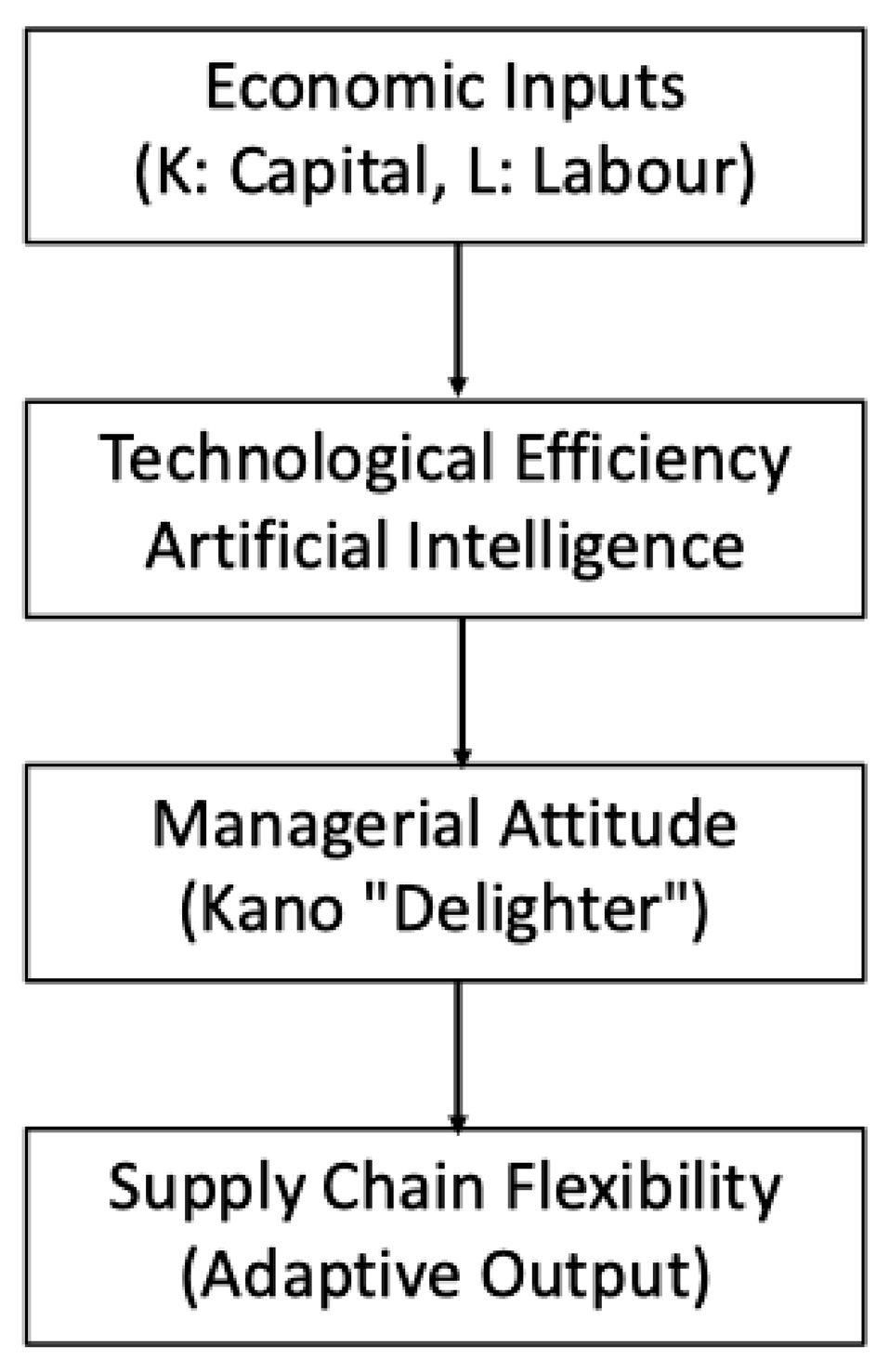
Based on this conceptual mapping, the interaction between economic inputs, technological integration, and managerial attitude can be summarized through a simplified conceptual flow illustrated in Figure 1. In the present formulation, artificial intelligence integration is conceptually captured within the technological efficiency parameter A, rather than introduced as a separate input variable. This allows the model to focus analytically on the behavioral amplification effect of managerial attitude.
The figure illustrates how economic inputs (capital and labour), technological efficiency, and managerial attitude interact to shape supply chain flexibility within the proposed analytical structure.

2.3. Extended Model and Theoretical Interpretation

Building on the analytical foundation outlined above, the Cobb–Douglas specification can be extended to incorporate behavioral dynamics relevant to supply chain adaptability. In this framework, managerial attitude is introduced as a multiplicative elasticity parameter that amplifies the effectiveness of economic and technological inputs. With this interpretation, the Cobb–Douglas model is explicitly integrated with the Kano model, resulting in the following extended form:
SCF = A · KαLβ · Attγ
where supply chain flexibility represents the adaptive output of the system; technological efficiency (A) captures the technological dimension of the system, including the effects of artificial intelligence integration; capital and labour represent traditional economic inputs; and managerial attitude is conceptualized as a strategic behavioral resource [8,29]. The parameters α, β, and γ are elasticity coefficients subject to empirical estimation. The specification is intended as a simplified analytical representation that enables elasticity-based interpretation rather than a strict econometric production model. In this formulation, managerial attitude should not be interpreted as a conventional production input comparable to capital or labor. Instead, it functions as a behavioral scaling factor that conditions how effectively technological and economic resources are mobilized within the supply chain. In this sense, the attitudinal elasticity parameter captures the behavioral efficiency with which organizations translate investments in infrastructure, workforce capability, and technological systems into adaptive operational outcomes.
The introduction of the attitudinal elasticity parameter fundamentally modifies the interpretative structure of the production model. While capital and labour constitute necessary economic conditions for operational performance, the attitudinal parameter governs the efficiency with which technological and economic resources are transformed into adaptive capacity. A positive attitudinal elasticity implies that managerial orientation exerts a multiplicative effect on flexibility. If the magnitude of this elasticity exceeds that of traditional inputs, behavioral orientation becomes the dominant determinant of adaptive performance. Conversely, if the attitudinal parameter approaches zero, technological investment alone may generate only limited improvements in supply chain responsiveness.
From an analytical standpoint, the elasticity parameters allow differentiation between structural and behavioral constraints within supply chains. If the combined elasticities remain relatively low, the system exhibits limited scalability in flexibility. However, when the attitudinal elasticity increases, the model suggests that behavioral alignment enhances the overall adaptive capacity of the system. In this interpretation, managerial attitude functions not merely as a supportive factor but as a structural amplifier of technological and economic inputs.
The multiplicative specification further implies complementarity between artificial intelligence integration and managerial orientation [30,31]. Technological intensity cannot fully compensate for weak attitudinal support. Instead, adaptive performance emerges from the alignment of economic resources, technological capability, and behavioral readiness. This complementarity represents the core theoretical contribution of the integrated framework.
Beyond its static interpretation, the model also permits a dynamic reading consistent with behavioral evolution in supply chains. Managerial attitude is not a fixed parameter but may change over time through learning processes, organizational experience, and technological exposure. As artificial intelligence systems become embedded in operational routines, repeated interaction between human decision-makers and predictive technologies can gradually reshape attitudinal orientation.
In this sense, the attitudinal elasticity parameter may be interpreted as partially endogenous to organizational development. Initial resistance to artificial intelligence integration may suppress adaptive returns, while progressive cognitive alignment and trust formation may increase the effective elasticity of attitude. Over time, such feedback effects can shift the relative contribution of behavioral and technological inputs, reinforcing the adaptive capacity of the system.
This dynamic interpretation aligns with the broader perspective of supply chains as evolving systems in which technological and behavioral dimensions co-develop [31,32].
This extended formulation therefore shifts the analytical focus from purely technological determinism toward an integrated economic–behavioral interpretation of supply chain flexibility. By enabling elasticity-based interpretation and outlining pathways for empirical testing, the model provides a formal foundation for quantitative sensitivity analysis across organizational contexts.
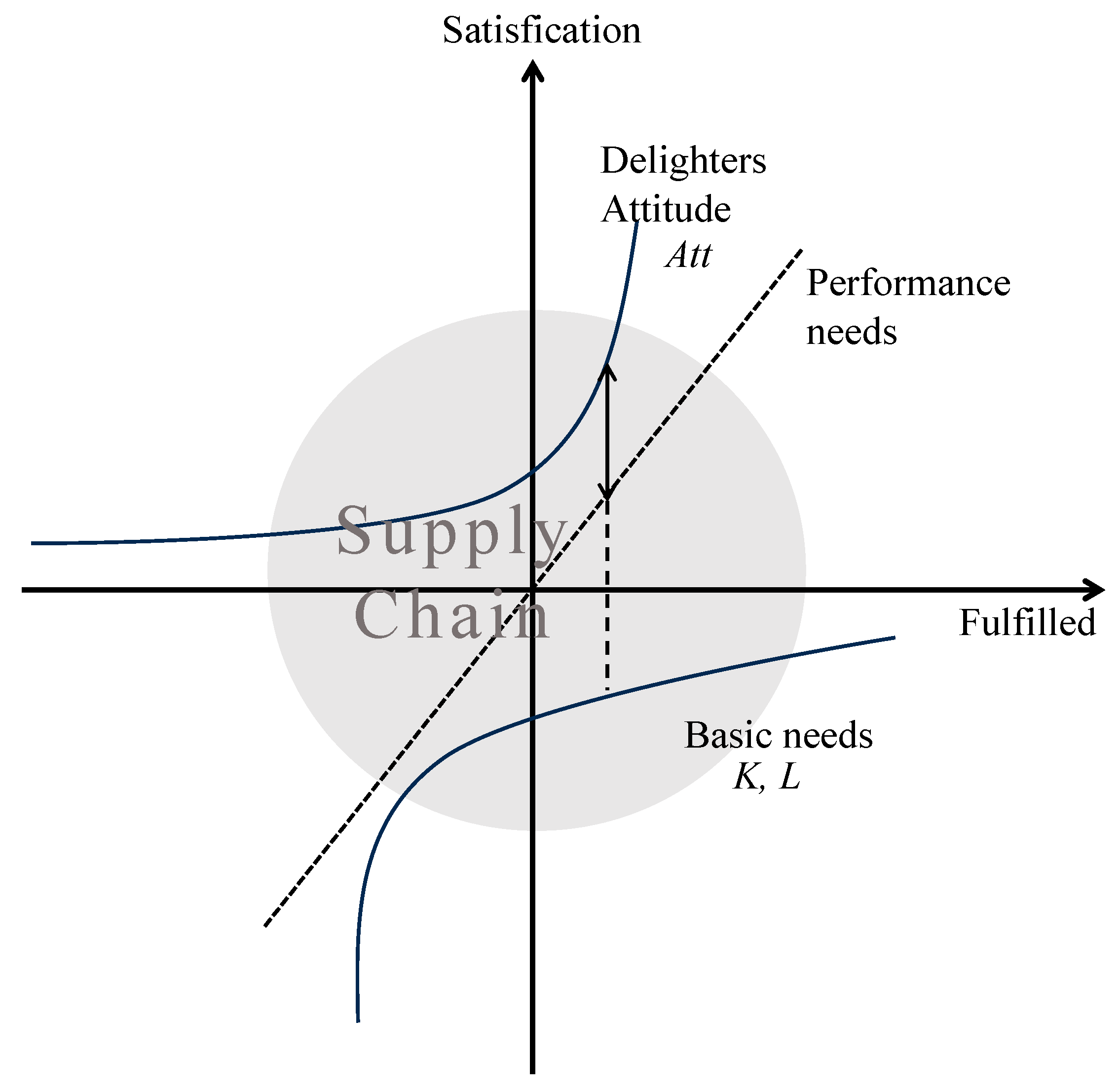
Figure 2 illustrates how economic inputs (K: capital and L: labour), technological efficiency, and managerial attitude interact to shape supply chain flexibility within the proposed analytical framework. Solid arrows denote direct causal relationships, whereas dotted lines capture non-linear transitions and threshold effects, reflecting the transformation of managerial attitude into a “delighter” within the Kano-based conceptualization.
Importantly, the model can be interpreted not only at the firm level but also at the inter-organizational supply chain level. In networked production environments, attitudinal alignment across partners may influence the collective elasticity of flexibility. If upstream and downstream actors exhibit heterogeneous orientations toward digital integration, the effective adaptive capacity of the chain may be constrained by the least aligned participant [33,34].
Conversely, coordinated behavioral orientation toward innovation and collaboration may amplify system-wide responsiveness. In this broader interpretation, managerial attitude becomes a network-level behavioral parameter that conditions the scalability and resilience of the entire supply chain structure. This perspective is consistent with the understanding of supply chains as relational systems rather than isolated production units.
The framework is particularly relevant in small and medium-sized enterprises, where managerial decisions exert disproportionate influence due to limited resource slack. Prior research indicates that digital transformation outcomes in such contexts are strongly mediated by managerial orientation and behavioral capabilities [18,19], supporting the plausibility of an attitudinal elasticity parameter.

2.4. Empirical Operationalization and Research Implications

Despite its analytical contribution, the model entails limitations. Measurement of attitudinal constructs requires rigorous operationalization, and elasticity estimation may be sensitive to structural correlations between technological and behavioral variables. Moreover, cross-industry generalizability depends on similarity in production environments and governance structures. These limitations suggest directions for empirical refinement rather than diminishing the conceptual validity of the framework.
Although the model is presented in conceptual form, its empirical operationalization is feasible through multi-dimensional measurement of attitudinal constructs. Managerial attitude may be captured using validated psychometric scales assessing openness to innovation, risk perception, trust in digital systems, and collaborative orientation [12,35]. These dimensions can be aggregated into a composite attitudinal index, allowing estimation of the elasticity parameter through regression-based approaches.
In operational terms, capital input may be proxied by logistics infrastructure investment, labor input by workforce capability indicators, and artificial intelligence integration by digital maturity indices or the extent of predictive analytics implementation. Supply chain flexibility may be measured using responsiveness indicators such as lead-time variability, recovery speed after disruption, or adaptability to demand fluctuations.
Importantly, the multiplicative structure implies that empirical testing should examine interaction effects rather than isolated linear relationships. Structural equation mod-elling or panel-data regression techniques may allow estimation of how attitudinal readiness moderates the relationship between technological investment and flexibility outcomes [36]. Such an approach would enable validation of the complementarity assumption embedded in the extended production framework.
Cross-industry comparison represents another promising empirical pathway. In highly standardized production environments, attitudinal elasticity may be lower due to process rigidity, whereas in innovation-driven sectors behavioral orientation may exert stronger influence. Similarly, small and medium-sized enterprises may exhibit higher variability in attitudinal parameters due to leadership centralization.
To deepen empirical specification of the attitudinal parameter, the construct may be decomposed into observable dimensions that align with the Kano-inspired “delighter” logic. In this framework, attitude is not treated as a generic cultural attribute, but as a behavioral configuration that becomes strategically valuable when it generates disproportionate adaptive gains beyond baseline operational requirements. Accordingly, attitudinal measurement should focus on dimensions that plausibly operate as amplifiers of flexibility rather than as mere hygiene factors.
The first dimension concerns innovation openness, capturing managerial willingness to experiment, tolerate uncertainty, and reconfigure routines when facing volatility. The second dimension relates to trust in data-driven systems, reflecting the extent to which managers accept algorithmic recommendations and integrate predictive insights into decision routines. The third dimension is collaborative orientation, capturing relational readiness to share information, engage in joint problem-solving, and sustain coordination under stress. The fourth dimension addresses risk perception and resilience mindset, representing how managers interpret disruption signals and whether they adopt proactive versus reactive coping strategies. Together, these dimensions can be aggregated into a composite attitudinal index that reflects the organization’s behavioral readiness to translate technological potential into adaptive output.
Within the Kano logic, these dimensions may be empirically examined for asymmetric performance effects. Some attitudinal components may function as prerequisites for successful technology-enabled coordination (analogous to basic needs), while others may generate proportional improvements (performance needs). Crucially, a subset may operate as true delighters by producing nonlinear gains in flexibility when present, while their absence does not immediately collapse operations but limits adaptive surplus. This offers a testable pathway for distinguishing which behavioral orientations represent strategic leverage points.
From a research design perspective, empirical validation could proceed through cross-sectional comparisons of firms with different digital maturity levels, or through longitudinal analysis capturing changes in attitude during artificial intelligence implementation phases. In such designs, the key expectation is not that attitude independently explains flexibility, but that it conditions the effectiveness of technological integration. In other words, the performance contribution of artificial intelligence adoption is expected to be stronger when the composite attitudinal index indicates high openness, trust, and collaborative readiness. This perspective is consistent with the model’s complementarity assumption and provides an empirical rationale for why similar technology investments can yield divergent flexibility outcomes across organizations.
In addition to refining attitudinal measurement, conceptual clarity requires clear separation between technological integration and behavioral readiness. A complementary empirical refinement concerns the separation of the technological integration component from the behavioral construct. In practice, artificial intelligence integration should be operationalized as a distinct technological maturity domain rather than being implicitly captured by attitudinal measures. This distinction is important to avoid construct overlap and to ensure that the attitudinal parameter reflects behavioral readiness rather than technological availability.
Artificial intelligence integration may be proxied through observable indicators such as the scope of predictive analytics deployment, the degree of automation in planning and replenishment, the use of machine learning-based forecasting, or the integration level of real-time sensor data and decision-support dashboards. In operational supply chain environments, such integration may involve machine-learning-based demand forecasting models, predictive maintenance algorithms, reinforcement-learning inventory optimization, or automated planning systems supporting real-time logistics coordination. Organizational digital maturity frameworks may also serve as structured proxies, provided that they explicitly capture artificial intelligence-enabled capabilities rather than general information technology adoption. Importantly, the measurement focus should remain on integration in decision routines (e.g., whether algorithmic recommendations are systematically used in planning meetings or replenishment decisions) rather than on the mere presence of digital tools.
Separating technology and attitude also enables clearer theoretical interpretation of the complementarity mechanism. If artificial intelligence integration is high but attitudinal readiness remains low, the model implies that adaptive returns will be constrained by limited trust, weak interpretative capability, or reluctance to redesign processes. Conversely, strong attitudinal readiness in contexts of low artificial intelligence integration may indicate behavioral potential that has not yet been structurally enabled by technological investment. This separation supports comparative evaluation of “technology-rich but behavior-poor” versus “behavior-ready but technology-poor” configurations, offering a more nuanced empirical logic than treating digital transformation as a single bundled construct.
Methodologically, this distinction may be strengthened through measurement design. For example, survey instruments capturing managerial attitude should focus on cognitive and relational orientations (e.g., openness, trust, collaboration, risk interpretation), while technological measures should rely on more objective indicators (e.g., system capabilities, deployment scope, process coverage). Where possible, triangulation may be achieved through mixed data sources, combining survey measures for attitude with archival or operational indicators for technology adoption and flexibility outcomes. This approach increases measurement validity and reduces common-method bias in empirical testing.
By clarifying the measurement boundary between artificial intelligence integration and managerial attitude, the framework becomes more robust for future quantitative validation and better aligned with the model’s conceptual intent: explaining not only whether technology matters, but under what behavioral conditions its contribution becomes multiplicative.
Finally, supply chain-level operationalization can capture whether attitudinal alignment extends beyond the focal firm. Survey-based measures can be complemented with relational indicators such as information-sharing intensity, partner responsiveness, and coordination quality. This enables the attitudinal construct to be interpreted both as an intra-organizational behavioral input and as an inter-organizational alignment mechanism, thereby reflecting the networked nature of modern supply chains.
Together, these operationalization pathways demonstrate that the proposed framework is empirically testable and provides a structured foundation for future quantitative validation across different supply chain contexts.
Consequently, the framework not only contributes conceptually but also establishes a feasible pathway for empirical investigation through survey-based measurement of managerial attitudes, operational performance indicators, and regression-based estimation of elasticity parameters within supply chain systems.

3. Emerging Types of Attitudes in Supply Chain Management

Technological transformation—particularly the integration of artificial intelligence and machine learning—redefines the behavioral foundations of supply chains. As routine operational tasks become increasingly automated, the human role shifts from execution toward supervision, interpretation, and strategic coordination. This transition does not diminish the relevance of managerial attitude; rather, it reshapes its expression within increasingly digital socio-technical systems.
In data-driven environments characterized by real-time analytics, predictive modelling, and machine-to-machine communication [37], managerial orientation increasingly reflects interactions with algorithmic decision-support systems. In such contexts, attitudes are partially shaped through repeated exposure to structured data, automated forecasts, and probabilistic reasoning. Managers may develop stronger reliance on artificial intelligence-generated insights, altering how uncertainty is interpreted and how flexibility is pursued. However, behavioral research also highlights potential challenges in human–algorithm interaction, including phenomena such as algorithmic aversion, cognitive overload, and reduced trust in automated decision-support systems [38]. These factors may influence the extent to which managers accept, question, or override algorithmically generated recommendations in operational decision-making processes. This algorithmically influenced orientation can strengthen technological alignment; however, if uncritically adopted, it may reduce sensitivity to contextual nuances and relational dynamics.
At the same time, supply chains remain embedded in human judgment, ethical considerations, and relational coordination. Strategic decision-making, long-term partnerships, and innovation processes continue to rely on trust, cultural awareness, and cross-disciplinary communication [39]. Artificial intelligence can optimize established routines, but breakthrough adaptation and resilience during disruption frequently emerge from human interpretation and creative recombination of organizational knowledge [40]. Consequently, managerial attitudes increasingly reflect a hybrid configuration in which analytical precision and human intuition interact rather than substitute for one another.
Within the integrated Kano–Cobb–Douglas framework, this evolution has direct implications for the attitudinal elasticity parameter. As artificial intelligence becomes more deeply embedded in operational processes, the effectiveness of technological investment depends on managerial openness, cognitive flexibility, and trust formation. In this sense, attitude does not merely accompany digital transformation but conditions its impact on supply chain flexibility. The balance between algorithmic precision and relational sensitivity influences how strongly technological inputs translate into adaptive output.
These developments are particularly salient in small and medium-sized enterprises, where managerial cognition and behavioral capability exert disproportionate influence due to limited structural slack and less formalized governance mechanisms. Prior research demonstrates that digital transformation outcomes in such contexts are strongly mediated by managerial orientation [18,19]. As a result, emerging attitudinal patterns do not evolve uniformly across firms; instead, they are shaped by organizational size, leadership behavior, and the maturity of technological integration.
In this broader interpretation, managerial attitude remains a strategic delighter within the extended production framework. However, its manifestation is increasingly co-determined by interaction between human decision-makers and algorithmic systems. As supply chains evolve toward digitally intensive coordination structures, the attitudinal parameter captures not only leadership disposition but also the organization’s capacity to align technological capability with behavioral readiness. This alignment ultimately determines whether artificial intelligence functions as a mere efficiency tool or as a multiplier of adaptive flexibility.
In this perspective, managerial attitude evolves into a socio-technical construct shaped jointly by human cognition and algorithmic interaction, reinforcing its role as a critical behavioral determinant of supply chain adaptability.
As a result, the effectiveness of AI-enabled supply chains increasingly depends on the alignment between algorithmic capabilities and human interpretative capacity, reinforcing the socio-technical nature of digitally transformed supply chain systems.

4. Discussion

This study has proposed a conceptual integration of the Cobb–Douglas production function and the Kano model in order to capture the strategic role of managerial attitude in supply chain flexibility. By embedding a behavioral construct within a production-function-based analytical framework, the study contributes to the growing stream of behavioral supply chain research that seeks to integrate economic modeling with managerial cognition and organizational behavior. By extending the traditional production framework with an attitudinal elasticity parameter, the model moves beyond purely economic and technological determinism and introduces a structurally embedded behavioral dimension into the analysis of adaptive performance.
The primary theoretical contribution lies in reframing managerial attitude from a leadership-dependent or culturally descriptive construct into an economically interpretable production factor, thereby enabling its formal representation within a production-function-based framework. Within the extended formulation, attitude is not treated as an external contextual variable but as a multiplicative elasticity parameter that conditions how effectively capital and artificial intelligence integration are transformed into adaptive output. This repositioning shifts the analytical focus from individual managerial influence toward structurally embedded behavioral configurations within supply chain systems.
Importantly, the model advances supply chain theory by formalizing complementarity between technological and behavioral resources. Rather than assuming that artificial intelligence integration automatically leads to greater flexibility, the framework suggests that its marginal contribution depends on attitudinal readiness. When attitudinal elasticity is high, technological investments yield amplified adaptive returns; when it is weak, similar levels of technological integration may produce limited performance gains. This complementarity perspective offers a theoretical explanation for heterogeneous digital transformation outcomes across organizations operating under comparable technological conditions [41].
At the same time, the classification of managerial attitude as a “delighter” should be interpreted as context-dependent rather than universal. In highly standardized or process-rigid environments, certain behavioral orientations may function as performance factors rather than true delighters. Conversely, in volatile or innovation-intensive contexts, attitudinal openness, trust, and collaborative readiness may generate disproportionate improvements in responsiveness. Recognizing these boundary conditions strengthens the theoretical robustness of the integrated framework and prevents overgeneralization of the delighter classification.
The framework has particular relevance for small and medium-sized enterprises, where managerial cognition and leadership orientation exert disproportionate influence due to centralized decision-making and limited structural slack. In such settings, variations in attitudinal elasticity may substantially alter the effectiveness of artificial intelligence integration. However, the model is not confined to SMEs. At the inter-organizational level, attitudinal alignment across supply chain partners may influence collective adaptive capacity, suggesting that elasticity parameters may operate not only within firms but also across network structures.
Beyond its firm-level implications, the model contributes to a broader reconceptualization of supply chains as evolving systems in which technological and behavioral dimensions co-develop over time. Managerial attitudes are not static attributes; they co-evolve with technological exposure, organizational learning, and relational dynamics [20]. As artificial intelligence becomes increasingly embedded in planning and coordination routines, repeated interaction between human decision-makers and algorithmic systems may reshape attitudinal elasticity over time. This dynamic reading extends the framework from a static production analogy toward a co-development perspective of technology and behavior.
From a practical standpoint, the integrated Kano–Cobb–Douglas model encourages decision-makers to treat attitudinal alignment as a strategic lever rather than a soft cultural variable. Investments in artificial intelligence infrastructure may fail to generate expected returns if behavioral readiness remains underdeveloped. Conversely, cultivating openness, trust, and collaborative orientation may increase the marginal productivity of technological resources. This insight supports a more balanced digital transformation strategy that integrates infrastructural and behavioral development.
Nevertheless, the framework remains conceptual and requires empirical validation. Future research should estimate attitudinal elasticity across industries, examine interaction effects between technological integration and behavioral readiness, and explore how network-level alignment influences collective flexibility. Comparative analyses between process-intensive and innovation-driven sectors may further clarify the boundary conditions of the delighter classification.
Overall, this study advances a behavioral production perspective in supply chain management. By embedding managerial attitude within a formal production structure, the model provides a theoretically grounded explanation of how flexibility and competitiveness emerge from the joint interaction of economic, technological, and behavioral resources in digitally transformed supply chains. This study contributes to the literature by integrating behavioral and economic perspectives within a unified analytical framework, demonstrating how managerial attitude can function as a behavioral elasticity parameter influencing supply chain flexibility. In doing so, the research addresses the gap between technological perspectives on digital supply chains and behavioral approaches to managerial decision-making.

5. Conclusions

This study has introduced a behavioral extension of the Cobb–Douglas production framework by integrating the Kano model to conceptualize managerial attitude as a strategic delighter in supply chain management. By formalizing attitude as a multiplicative factor influencing supply chain flexibility, the model demonstrates that adaptive performance emerges not solely from capital investment or technological capability, but from the alignment between economic resources, artificial intelligence systems, and managerial orientation.
The findings underscore that digital transformation is fundamentally a socio-technical process. Artificial intelligence enhances analytical capacity, but its strategic impact depends on behavioral readiness and cognitive openness at the managerial level. In this sense, supply chain flexibility is not merely an operational outcome, but a structurally conditioned capability shaped by both technological and attitudinal elasticity.
The proposed framework contributes to the literature by bridging production theory and behavioral supply chain research, offering a structured lens through which to explain variation in digital transformation outcomes across firms. Its relevance is particularly pronounced in small and medium-sized enterprises, where leadership orientation significantly influences the effectiveness of technological adoption.
By positioning managerial attitude as a measurable and strategically relevant input, this study advances a more integrated understanding of adaptive supply chain systems. Future empirical research can build on this conceptual framework to estimate attitudinal elasticity across industries and organizational contexts, thereby empirically validating the behavioral production perspective introduced in this study. In doing so, the study highlights the importance of integrating technological capabilities with behavioral readiness in order to fully realize the adaptive potential of digitally transformed supply chains.
From a managerial perspective, the framework suggests that investments in artificial intelligence and digital infrastructure should be accompanied by the development of managerial capabilities and attitudinal readiness, as behavioral alignment may significantly amplify the adaptive benefits of technological resources.

Author Contributions

Conceptualization, A.R. and P.N.; validation, P.N.; writing—original draft preparation, A.R.; writing—review and editing, A.R.; visualization, A.R.; supervision, P.N. All authors have read and agreed to the published version of the manuscript.

Funding

The research was funded by Széchenyi István University.

Institutional Review Board Statement

Not applicable.

Informed Consent Statement

Not applicable.

Data Availability Statement

No new data were created or analyzed in this study. Data sharing is not applicable to this article.

Conflicts of Interest

The authors declare no conflicts of interest.

References

  1. Christopher, M. Logistics & Supply Chain Management, 5th ed.; FT Publishing: Harlow, UK, 2016; ISBN 9781292083797. [Google Scholar]
  2. Sirisomboonsuk, P.; Burns, J. Sustainability in supply chains through rapid capacity increases and minimized disruptions. Sustainability 2023, 15, 5629. [Google Scholar] [CrossRef]
  3. Linardos, V.; Drakaki, M.; Tzionas, P.; Karnavas, Y.L. Machine learning in disaster management: Recent developments in methods and applications. Mach. Learn. Knowl. Extr. 2022, 4, 446–473. [Google Scholar] [CrossRef]
  4. Tabansi, O. Capacity Constraints in Supply Chain: How to Manage It. Supply Chain Nuggets. 2023. Available online: https://supplychainnuggets.com/capacity-constraints-in-supply-chain/ (accessed on 22 August 2025).
  5. Dwivedi, Y.K.; Hughes, D.L.; Coombs, C.; Constantiou, I.; Duan, Y.; Edwards, J.S.; Gupta, B.; Lal, B.; Misra, S.; Prashant, P.; et al. Artificial intelligence (AI): Multidisciplinary perspectives on emerging challenges, opportunities, and agenda for research, practice and policy. Int. J. Inf. Manag. 2021, 57, 101994. [Google Scholar] [CrossRef]
  6. Naz, F.; Agrawal, R.; Kumar, A.; Gunasekaran, A.; Majumdar, A.; Luthra, S. Reviewing the applications of artificial intelligence in sustainable supply chains: Exploring research propositions for future directions. Bus. Strategy Environ. 2022, 31, 2400–2423. [Google Scholar] [CrossRef]
  7. Sodhi, M.S.; Choi, T.Y. Don’t Abandon Your Just-in-Time Supply Chain, Revamp It. Harvard Business Review. 2022. Available online: https://hbr.org/2022/10/dont-abandon-your-just-in-time-supply-chain-revamp-it (accessed on 22 August 2025).
  8. Riahi, Y.; Saikouk, T.; Gunasekaran, A.; Badraoui, I. Artificial intelligence applications in supply chain: A descriptive bibliometric analysis and future research directions. Expert Syst. Appl. 2021, 173, 114702. [Google Scholar] [CrossRef]
  9. Krzywdzinski, M.; Butollo, F.; Flemming, J.; Gerber, C.; Wandjo, D.; Delicat, N.; Nerger, M. The growing gap between pioneers and laggards. Weizenbaum Ser. 2022, 25, 1–18. [Google Scholar] [CrossRef]
  10. Ahmad, I.; Gupta, S. Digital Transformation: Key Technology, Cybersecurity and Privacy Risks. Norton Rose Fulbright. 2021. Available online: https://www.nortonrosefulbright.com/en/knowledge/publications/4318add0/digital-transformation-key-technology-cybersecurity-and-privacy-risks (accessed on 12 May 2025).
  11. Mahesh Prabhu, A.K. Leadership and supply chain management: A systematic literature review. J. Model. Manag. 2022, 17, 1221–1244. [Google Scholar] [CrossRef]
  12. Altmann, T. Attitude: A concept analysis. Nurs. Forum 2008, 43, 144–150. [Google Scholar] [CrossRef]
  13. Vargas-Sánchez, A.; Plaza-Mejía, M.Á.; Porras-Bueno, N. Attitude. In Encyclopedia of Tourism; Jafari, J., Xiao, H., Eds.; Springer: Cham, Switzerland, 2016; pp. 58–62. [Google Scholar] [CrossRef]
  14. Kano, N.; Seraku, N.; Takahashi, F.; Tsuji, S. Attractive quality and must-be quality. J. Jpn. Soc. Qual. Control 1984, 14, 39–48. [Google Scholar]
  15. Yang, Y.; Lin, J.; Liu, G.; Zhou, L. The behavioural causes of bullwhip effect in supply chains: A systematic literature review. Int. J. Prod. Econ. 2021, 240, 108120. [Google Scholar] [CrossRef]
  16. Croom, S.; Fritzon, K.; Brooks, N. Personality differences and buyer–supplier relationships: Psychopathy in executives, gender differences and implications for future research. J. Purch. Supply Manag. 2021, 27, 100721. [Google Scholar] [CrossRef]
  17. Zanon, L.G.; Marcelloni, F.; Gerolamo, M.C. Exploring the relations between supply chain performance and organizational culture: A fuzzy grey group decision model. Int. J. Prod. Econ. 2021, 233, 108023. [Google Scholar] [CrossRef]
  18. Levenburg, N.M.; Schwarz, T.V.; Motwani, J. Understanding adoption of internet technologies among SMEs. J. Small Bus. Strateg. 2005, 16, 51–70. [Google Scholar]
  19. Dörr, L.; Fliege, K.; Lehmann, C.; Kanbach, D.K.; Kraus, S. A taxonomy on influencing factors towards digital transformation in SMEs. J. Small Bus. Strateg. 2023, 33, 1–17. [Google Scholar] [CrossRef]
  20. Zellner, A.; Kmenta, J.; Drèze, J. Specification and estimation of Cobb-Douglas production function models. Econometrica 1966, 34, 784–795. [Google Scholar] [CrossRef]
  21. Taylor, A.; Santiago, F.; Hynes, R. Relationships among Leadership, Organizational Culture, and Support for Innovation. In Effective and Creative Leadership in Diverse Workforces; Springer: Cham, Switzerland, 2019; pp. 11–42. [Google Scholar] [CrossRef]
  22. Singh, P.; Jain, R.K.; Sharma, R. Application of social psychology in supply chain. Int. J. Manag. Econ. Soc. Sci. 2021, 10, 110–127. [Google Scholar] [CrossRef]
  23. Russo, M. Digital Transformation in the Automotive Supply Chain: China, Germany, Italy and Japan in a Comparative Perspective. University of Modena and Reggio Emilia Repository 2019. Available online: https://iris.unimore.it/handle/11380/1184316 (accessed on 15 September 2025).
  24. Heizer, J.; Render, B.; Munson, C. Operations Management, 13th ed.; Pearson: Boston, MA, USA, 2020. [Google Scholar]
  25. Croson, R.; Donohue, K.; Katok, E.; Sterman, J. Behavioral operations: The state of the field. J. Oper. Manag. 2013, 31, 1–5. [Google Scholar] [CrossRef]
  26. Földesi, P.; Kóczy, L.T.; Botzheim, J. Fuzzy Solution for Non-Linear Quality Models. In Proceedings of the IEEE International Conference on Intelligent Engineering Systems (INES), Miami, FL, USA, 25–29 February 2008; IEEE: New York, NY, USA, 2008. [Google Scholar] [CrossRef]
  27. Matzler, K.; Hinterhuber, H.H. How to make product development projects more successful by integrating Kano’s model of customer satisfaction into quality function deployment. Technovation 1998, 18, 25–38. [Google Scholar] [CrossRef]
  28. Tagscherer, F.; Carbon, C.-C. Leadership for successful digitalization: A literature review on companies’ internal and external aspects of digitalization. Sustain. Technol. Entrep. 2023, 2, 100039. [Google Scholar] [CrossRef]
  29. Ganesh, A.D.; Kalpana, P. Future of artificial intelligence and its influence on supply chain risk management—A systematic review. Comput. Ind. Eng. 2022, 166, 108206. [Google Scholar] [CrossRef]
  30. Kane, G.C.; Phillips, A.N.; Copulsky, J.R.; Andrus, G.R. The Technology Fallacy: How People Are the Real Key to Digital Transformation; MIT Press: Cambridge, MA, USA, 2019. [Google Scholar] [CrossRef]
  31. Hofmann, E.; Sternberg, H.; Chen, H.; Pflaum, A.; Prockl, G. Supply chain management and Industry 4.0: Conducting research in the digital age. Int. J. Phys. Distrib. Logist. Manag. 2019, 49, 945–955. [Google Scholar] [CrossRef]
  32. Ivanov, D. Lean resilience: AURA (Active Usage of Resilience Assets) framework for post-COVID-19 supply chain management. Int. J. Logist. Manag. 2022, 33, 1196–1217. [Google Scholar] [CrossRef]
  33. Wieland, A.; Wallenburg, C.M. The influence of relational competencies on supply chain resilience: A relational view. Int. J. Phys. Distrib. Logist. Manag. 2013, 43, 300–320. [Google Scholar] [CrossRef]
  34. Baah, C.; Agyeman, D.O.; Acquah, I.S.K.; Afum, E.; Issau, K.; Ofori, D.; Faibil, D. Effect of information sharing in supply chains: Understanding the roles of supply chain visibility, agility, collaboration on supply chain performance. Benchmarking 2021, 28, 434–455. [Google Scholar] [CrossRef]
  35. McGuire, W.J.; Katz, D. Attitudes. In Issues in the Psychological Research of Attitudes; Halász, L., Ed.; Akadémiai Kiadó: Budapest, Hungary, 1979; pp. 41–57. (In Hungarian) [Google Scholar]
  36. Huo, B. The impact of supply chain integration on company performance: An organizational capability perspective. Supply Chain. Manag. 2012, 17, 596–610. [Google Scholar] [CrossRef]
  37. Agrawal, N.; Cohen, M.A.; Deshpande, R.; Deshpande, V. How machine learning will transform supply chain management. Harv. Bus. Rev. 2024, 103, 128–137. [Google Scholar]
  38. Dietvorst, B.J.; Simmons, J.P.; Massey, C. Algorithm aversion: People erroneously avoid algorithms after seeing them err. J. Exp. Psychol. Gen. 2015, 144, 114–126. [Google Scholar] [CrossRef]
  39. Eapen, T.T.; Finkenstadt, D.J.; Folk, J.; Venkataswamy, L. How generative AI can augment human creativity. Harv. Bus. Rev. 2023, 101, 56–64. [Google Scholar] [CrossRef]
  40. Raisch, S.; Krakowski, S. Artificial intelligence and management: The automation–augmentation paradox. Acad. Manag. Rev. 2021, 46, 192–210. [Google Scholar] [CrossRef]
  41. Verhoef, P.C.; Broekhuizen, T.; Bart, Y.; Bhattacharya, A.; Dong, J.Q.; Fabian, N.; Haenlein, M. Digital transformation: A multidisciplinary reflection and research agenda. J. Bus. Res. 2021, 122, 889–901. [Google Scholar] [CrossRef]
Figure 1. Conceptual flow of the integrated Kano–Cobb–Douglas framework.
Logistics 10 00074 g001
Figure 2. Visual representation of the integrated Kano-Cobb–Douglas model.
Logistics 10 00074 g002
Table 1. Mapping Kano categories to supply chain system components (own compilation based on Kano, 1984 [14]).
Kano-ModelSupply Chain EquivalentModel Representation
Basic needsBasic logistics requirementsK, L: capital and labour as classic inputs
Performance needsPerformance-sensitive expectationsA: efficiency level
DelightersPositive managerial attitudeAtt: Attitude as a strategic
resource
Disclaimer/Publisher’s Note: The statements, opinions and data contained in all publications are solely those of the individual author(s) and contributor(s) and not of MDPI and/or the editor(s). MDPI and/or the editor(s) disclaim responsibility for any injury to people or property resulting from any ideas, methods, instructions or products referred to in the content.