1. Introduction
In today’s fast-moving and highly competitive retail sector, supply chain transparency and responsiveness have become essential prerequisites for operational success [
1]. Many organizations increasingly rely on real-time data and cloud-based logistics platforms to coordinate and optimize the different stages of their supply chains, from order placement to the final point of sale [
2]. The growing adoption of Artificial Intelligence (AI), Machine Learning (ML), Internet of Things (IoT), and cloud computing technologies enables organizations not only to collect large volumes of operational data but also to process, share, and interpret these data almost immediately, thereby supporting faster and more informed decision-making [
3,
4,
5,
6]. These technological capabilities are gradually transforming traditional supply chain models that often struggled with mismatches between supply and demand, excessive inventory accumulation, and inefficient replenishment cycles. Such inefficiencies frequently resulted in increased operational costs and lower levels of customer satisfaction [
5].
The Supply Chain Wave Report introduced in this study arose from the need to analyze supply chain operations as an integrated process rather than as isolated operational stages. Instead of examining each step independently, the proposed framework structures the supply chain into several interconnected phases—Booked Orders, Main Transit, On-Carriage, Warehouse Operations, Store Delivery, Stores, and Sales. When analyzed collectively, these stages form a continuous analytical structure referred to as a “Supply Chain Wave.”
In this study, the term Supply Chain Wave refers to the continuous analytical representation of goods flow across multiple logistics stages derived from operational event data. This concept should not be confusing with wave picking in warehouse operations, which refers to batching strategies used for organizing order-picking tasks. The framework relies on cloud-based data integration, allowing operational data from different systems and locations to be consolidated into a unified analytical environment.
Each stage within the wave provides real-time key performance indicators (KPIs) and operational status signals, enabling managers to monitor supply chain activities as goods move through the system. This continuous monitoring approach makes it possible to detect irregularities earlier, often before they develop into larger operational disruptions. Through centralized cloud-based processing and integrated data flows, the wave structure supports operational monitoring, risk awareness, and faster decision-making. Over time, such analytical visibility may contribute to improved coordination and operational efficiency across supply chain stages. From a broader perspective, research on big data analytics and cloud-enabled supply chain systems has shown that data-driven technologies significantly influence operational performance, sustainability, and predictive capabilities within supply chain networks [
7]. These approaches are increasingly applied across strategic, tactical, and operational decision levels. Their effectiveness lies in combining real-time information infrastructures with predictive and adaptive analytical models, thereby enabling organizations to respond more dynamically to changing operational conditions [
8].
Demand uncertainty remains a fundamental challenge in supply chain management. However, the analytical framework proposed in this study focuses primarily on the operational execution stage of the supply chain, where booked orders represent confirmed demand entering the logistics system. Even within this stage, disruptions in transportation, warehousing, or distribution processes may propagate across the network and amplify variability across supply chain stages. This phenomenon is commonly referred to as the bullwhip effect, where small fluctuations at one stage may result in amplified variations upstream in the supply chain [
9].
The wave-based analytical approach aims to increase visibility across the entire operational flow by representing supply chain processes as a continuous time-dependent structure. Rather than eliminating variability entirely, the framework enables earlier detection of deviations and supports more coordinated responses through improved information transparency and dynamic monitoring [
10].
Wave analysis provides an additional analytical perspective for understanding the interactions between supply chain stages. By representing the movement of goods as a continuous operational flow, the approach allows organizations to observe how delays emerge, how bottlenecks accumulate over time, and how disruptions propagate across multiple logistics stages. When supported by cloud-based data infrastructures, such monitoring capabilities can reveal operational risks that may remain hidden in conventional reporting systems. This type of analysis supports not only inventory management and logistics planning but also scenario-based evaluation of potential disruptions. By providing earlier signals of operational deviations, the framework strengthens the ability of organizations to respond proactively before localized disruptions escalate into broader supply chain disturbances.
This study therefore investigates the design and application of the Supply Chain Wave Report as a cloud-enabled analytical framework for integrating real-time operational data across multiple supply chain stages in a retail environment. The research aims to contribute to the field of data-driven supply chain management by introducing a unified monitoring structure that combines operational event data, KPI-based performance analysis, and wave-based flow modeling. Through this approach, the study seeks to enhance supply chain transparency, support risk-aware decision-making, and provide practical insights for the development of more adaptive and resilient retail supply networks.
2. Related Work: Supply Chain Integration and Performance Implications
Supply chain integration (SCI) is widely recognized as a critical enabler of operational efficiency and firm performance in complex supply networks. SCI refers to the coordinated alignment of processes, information flows, and decision-making activities within and across organizational boundaries in order to ensure efficient material, information, and financial flows along the supply chain [
11,
12]. Prior studies consistently indicate that higher levels of integration enhance transparency, responsiveness, and coordination among supply chain partners, thereby improving overall organizational performance [
13,
14].
The literature generally differentiates between internal and external integration within supply chain management. Internal integration emphasizes coordination and information exchange among functional units inside the organization, whereas external integration is concerned with the development of collaborative relationships with key suppliers and customers [
15,
16]. Empirical research shows that organizations with higher levels of both internal and external integration tend to achieve superior operational performance, including enhanced process capabilities, reduced lead-time variability, and more stable inventory flows [
11,
17]. Internal integration primarily supports the alignment of planning and execution activities across logistics, procurement, warehousing, and sales functions, while supplier and customer integration contributes to improved coordination along upstream and downstream supply chain processes [
18].
Recent research increasingly highlights the role of digital technologies and cloud-enabled information infrastructures in strengthening supply chain integration. These technologies support real-time information exchange across organizational boundaries and improve transparency across supply chain processes [
19,
20]. Such capabilities are particularly relevant in retail supply chains, where demand patterns change rapidly and product life cycles are relatively short. In this environment, several studies emphasize that digital adaptability—rather than the mere adoption of new technologies—plays a central role in improving supply chain resilience and responsiveness when disruptions occur [
21,
22].
The performance implications of SCI have been widely examined in the literature. In general, higher levels of integration are associated with improvements in operational performance, including more reliable deliveries, improved inventory utilization, and shorter cycle times. These operational improvements are often linked to positive financial outcomes such as cost reductions and improved profitability [
13,
14,
23]. Many researchers argue that operational performance represents the primary mechanism through which SCI affects financial results, as improved coordination and reduced inefficiencies support more effective resource utilization and stable service levels [
11,
24]. In this context, KPI-based performance measurement has been widely adopted as a practical approach for evaluating operational outcomes in supply chain systems [
25].
Despite the extensive discussion of SCI, many existing studies still evaluate integration outcomes using static indicators or questionnaire-based assessments. While such approaches have provided valuable insights into supply chain collaboration, they offer limited visibility into how disruptions and operational performance changes evolve over time and interact across multiple supply chain stages. Studies that explicitly analyze supply chain dynamics using real-time operational data remain comparatively limited [
26,
27]. Relatively few contributions address the simultaneous development of lead-time variability, inventory accumulation, and material flow synchronization within a unified analytical and visualization framework.
To address this limitation, the present study adopts a different analytical perspective. Rather than examining integration as a static organizational condition, the proposed approach operationalizes integration through a real-time, wave-based analytical representation of supply chain processes. The Supply Chain Wave Report combines continuous KPI monitoring, mathematical representations of material flows, and end-to-end visualization across logistics stages. By linking operational event data with dynamic flow modeling, the framework allows integration effects to be observed directly in operational process behavior as it evolves over time. In this way, the study extends existing SCI research by introducing a practical analytical framework for real-time monitoring and risk-aware decision support in retail supply chain environments.
3. System Description and Process Structure
The Supply Chain Wave Report is used in this study as an operational framework to improve transparency across the retail supply chain. Rather than analyzing each operational stage independently, the framework integrates real-time data from ordering, transportation, warehousing, distribution, and sales into a unified analytical structure. This integrated perspective allows the movement of goods and information to be observed as a continuous operational flow.
Each stage of the wave represents a specific segment of the physical product flow and its corresponding information processes. These stages are connected through key performance indicators (KPIs) that support performance monitoring, trend identification, and predictive analysis. When these indicators are evaluated collectively, the supply chain can be interpreted as a dynamic system rather than a set of isolated operational activities. This perspective improves the ability of managers to detect potential disruptions earlier and to respond more effectively to operational risks.
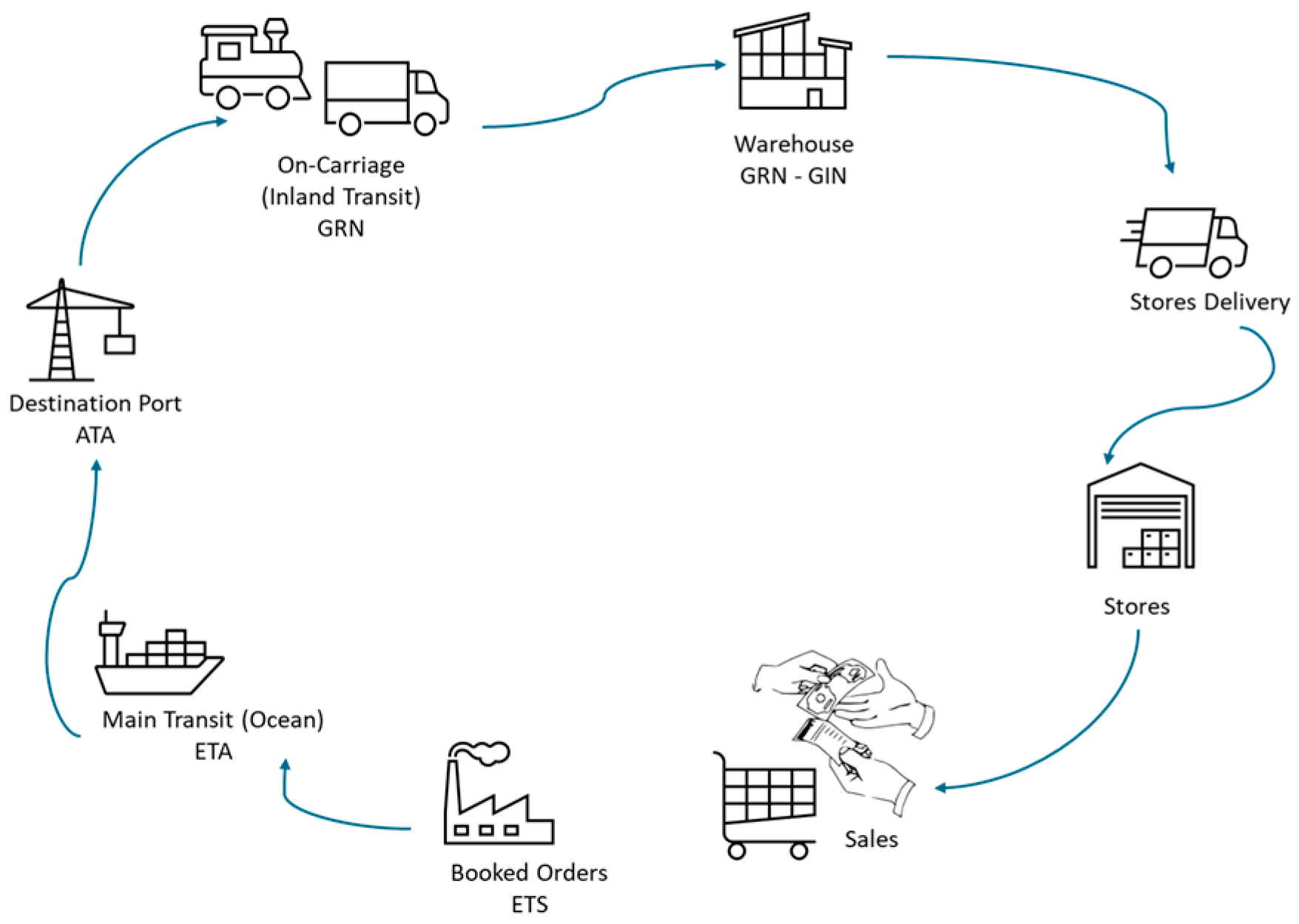
Figure 1 illustrates the overall structure of the supply chain analyzed in this study. The diagram depicts the sequential flow of goods from the booking stage at the supplier to the final sales in retail stores. The operational stages include booked orders, main transit, port arrival, on-carriage transportation, warehouse processing, store delivery, store inventory, and sales. In addition, the figure highlights the key performance indicators (KPIs) used to monitor each stage of the process, such as Estimated Time of Shipment (ETS), Estimated Time of Arrival (ETA), Actual Time of Arrival (ATA), Goods Receipt Notification (GRN), and Goods Issue Notification (GIN). Together, these stages form the analytical structure referred to in this study as the Supply Chain Wave. It should be noted that the term “wave” in this context refers to the continuous flow of goods and information across the entire supply chain and should not be confused with the concept of wave picking used in warehouse order-picking operations.
Before introducing the mathematical modeling framework used to represent this wave, the operational definition of each stage of the supply chain is described in the following subsections.
3.1. Booked Orders
The Booked Orders phase represents the initial stage of the supply chain process. At this point, goods are formally booked with a freight forwarder and prepared for shipment from the port of origin (POL). The primary KPI used in this stage is the Estimated Time of Shipment (ETS), which represents the planned departure time of goods from POL.
ETS is determined based on supplier production completion, inventory availability, and carrier scheduling information. As an early planning indicator, this KPI enables downstream functions such as warehouse planning and transportation scheduling to anticipate incoming volumes and allocate resources accordingly.
Differences between planned and actual shipment initiation can provide insights into supplier reliability and logistics readiness. Once the shipment process begins, the goods move from the booking stage into the main international transportation phase.
3.2. Main Transit
The Main Transit phase represents the international transportation of goods from POL to the port of destination (POD). Two time-based KPIs are particularly relevant in this stage:
While ETS reflects the planned shipment initiation, ETA represents the expected arrival time calculated based on route distance, vessel speed, and environmental conditions.
To evaluate transportation reliability, ETA is typically compared with the Actual Time of Arrival (ATA) recorded when the shipment reaches at POD. Differences between ETA and ATA provide a measurable indicator of transport performance and allow early identification of potential delays that may affect downstream operations.
Continuous monitoring of these temporal indicators helps logistics managers anticipate disruptions and coordinate subsequent supply chain stages more effectively.
3.3. On-Carriage
The On-Carriage phase refers to the inland transportation of goods from POD to the warehouse. This stage represents the transition between international transportation and internal distribution.
Two primary KPIs are monitored in this phase:
Actual Time of Arrival (ATA)—the recorded arrival time of goods at POD.
Goods Receipt Notification (GRN)—the timestamp confirming that the goods have been received and registered in the warehouse management system (WMS).
The time difference between ATA and GRN reflects the efficiency of port-to-warehouse transportation and customs processing activities. Continuous monitoring of this interval allows the Wave Report to estimate inbound warehouse flows and anticipate potential capacity constraints.
Unusual delays in this stage may indicate congestion at the port, customs clearance issues, or transportation capacity limitations.
3.4. Warehouse
The Warehouse phase represents the operational core of the supply chain, where goods are received, stored, processed, and prepared for distribution to retail stores.
Two key performance indicators are used to monitor warehouse operations:
Goods Issue Notification (GIN)—the timestamp indicating that goods are released from the warehouse system for outbound shipment.
Picking Rate (Pr)—the number of items or units picked and prepared for shipment during a given operational period.
The time interval between the Goods Receipt Notification (GRN) and the Goods Issue Notification (GIN) reflects the throughput performance of the warehouse. Meanwhile, the picking rate provides a detailed indicator of operational productivity within the order-picking process.
Monitoring these indicators allows warehouse managers to detect inefficiencies such as resource shortages, workflow bottlenecks, or order consolidation issues. By continuously observing these KPIs, the Wave Report supports adaptive planning and helps maintain synchronization between inbound and outbound logistics activities.
3.5. Store Delivery
The Store Delivery phase represents the distribution of goods from the warehouse to individual retail stores. This stage directly affects product availability at the point of sale and therefore has a significant impact on customer service levels.
The primary KPI in this phase is Delivery Performance, typically evaluated by comparing planned delivery times with actual arrival times at the stores.
Additional indicators include the following
These metrics collectively evaluate the efficiency of last-mile logistics operations. Even minor disruptions in this phase can affect store inventory availability and sales performance.
3.6. Stores
In the Stores phase, goods enter the retail inventory and become available for sale. The most relevant KPI in this stage is the Inventory Turnover Ratio (ITR), which measures how efficiently inventory is sold and replenished within a given period.
Additional store-level indicators include Stock Availability Rate and Days of Supply, which provide insights into inventory sufficiency and replenishment efficiency.
Data generated at the store level serves as an important feedback mechanism for upstream supply chain stages. Sales and inventory information helps improve forecasting accuracy, replenishment planning, and procurement decisions. Effective monitoring of store-level KPIs enables retailers to balance product availability with efficient inventory utilization.
3.7. Sales
The Sales phase represents the final stage of the supply chain wave, where inventory is converted into revenue through customer purchases. The primary KPI in this stage is the Sales Rate, which measures the number of units sold during a specific time interval. This metric reflects market demand and provides a direct indicator of supply chain responsiveness.
Comparing actual sales with forecasted demand allows organizations to evaluate forecasting accuracy and adjust replenishment strategies. Sales data also contributes to product life-cycle analysis and supports continuous improvement of demand planning processes.
3.8. Interconnectivity and Dynamic Behavior
A key characteristic of the Supply Chain Wave framework is the interconnectivity between all operational stages. Each KPI not only reflects the performance of its respective stage but also influences downstream processes. This interconnected structure allows the supply chain to behave as a dynamic system that continuously adapts to changes in demand, lead times, and operational capacity. Real-time monitoring of KPIs such as ETS, ETA, ATA, GRN, GIN, and picking rate enables the detection of early disruption signals across the Supply Chain Wave.
By aligning information flows and decision timing across operational stages, the framework also contributes to mitigating the bullwhip effect, where demand variability amplifies upstream in the supply chain. When these indicators are integrated within the wave-based analytical structure, the Supply Chain Wave Report functions as both a monitoring and decision support system. It enables predictive visualization of operational fluctuations across the supply chain and supports proactive risk management, performance optimization, and continuous operational improvement.
An overview of the supply chain phases, associated with KPIs, and their operational roles is provided in
Table 1.
4. Mathematical Modeling and Process Throughput Analysis
To represent the operational flow of the Supply Chain Wave Report within a quantitative analytical framework, each stage of the supply chain is modeled as a time-dependent process characterized by its throughput rate and corresponding lead time. Let denote the instantaneous supply (or flow) rate associated with stage i, where represents the seven sequential phases of the supply chain. The lead time defines the time required for goods to pass through stage i. By integrating the flow rate over the respective lead-time interval, the amount of inventory currently present in that stage can be estimated.
Formally, the instantaneous inventory level within stage
i at time
t is defined as follows:
where
—instantaneous inventory level in stage at time ;
—inflow rate into stage at time ;
—effective lead time of stage , estimated from empirical operational data;
—continuous time variable representing past inflow events.
This formulation implies that the area under the flow curve within the time interval [t − Li, t] corresponds to the amount of material currently present in that stage.
Aggregating the inventory across all stages yields the total amount of goods present within the entire supply chain:
This total inventory function represents the mathematical foundation of the Supply Chain Wave Report and allows a dynamic estimation of material distribution across the supply chain.
4.1. Mathematical Model of Booked Orders
The Booked Orders phase represents the initiation of the logistics process. The key temporal KPI for this stage is the Estimated Time of Shipment (ETS), which defines the expected departure time of goods from POL.
Let
denote the rate of shipment bookings. The amount of inventory currently assigned to this stage is given by
where
(lead time for booked orders) represents the average duration between booking confirmation and actual shipment departure. This formulation captures the volume of orders that have been booked but have not yet entered the physical transportation stage.
4.2. Mathematical Model of Main Transit
The Main Transit stage corresponds to international transportation between origin and destination ports. Two time-related KPIs are relevant in this phase:
Estimated Time of Shipment (ETS);
Estimated Time of Arrival (ETA).
The lead time for this stage L
2 can be approximated by the expected difference between ETA and ETS:
The quantity of goods currently in international transit is therefore
This value represents the amount of material moving between POL and POD at time t.
4.3. Mathematical Model of On-Carriage
The On-Carriage phase represents inland transportation from POD to the warehouse.
Two operational KPIs characterize this stage:
The empirical lead time is defined as the average time difference between these events:
where
is the total number of inbound transportations from different ports to warehouse in observed period (Day).
The inventory in this stage is therefore
which corresponds to goods currently transported from port to warehouse but not yet registered in the warehouse system.
4.4. Mathematical Model of Warehouse
In the Warehouse phase, goods are received, processed, and prepared for store distribution.
The main KPIs include
The warehouse lead time is defined as the time difference between GRN and GIN events.
Following the previously validated formulation, the warehouse inventory can be represented as follows:
where,
denotes the inbound warehouse flow.
The picking rate is defined as
where
is the cumulative number picked items in the time
. This indicator reflects the operational throughput capacity of warehouse order-picking activities.
The integral under this curve shows the total number of items prepared for dispatch within a given period.
4.5. Mathematical Model of Store Delivery
The Store Delivery phase measures the time between departure from warehouse and arrival at retail stores. As the transportation is primarily controlled by temporal distance, the average duration between dispatch
and receipt
defines its lead time:
The quantity of goods currently in store delivery is therefore
This expression captures all current goods in outbound’s transit from warehouses to stores. Variations in provide early warning signals for last-mile delays.
4.6. Mathematical Model of Stores
At the store level, the principal KPI is the Inventory Turnover Ratio (ITR) is defined as
where
represents the cost of sold goods within a period and
shows the average inventory level. The instantaneous stock in stores is calculated by using the general integral:
where
provides the average staying time of the good on shelves at store. A decreasing
or an increasing
indicates faster turnover and efficient replenishment cycles.
4.7. Mathematical Model of Sales
The Sales phase converts inventory into revenue. The Sales Rate shows the instantaneous number of sold goods per unit time.
The cumulative sales volume
over a given interval is the integral of the sales rate:
The Sales Performance KPI compares realized sales with forecasted demand
:
This metric links the terminal stage of the supply chain back to demand forecasting accuracy and completes the analytical feedback loop.
4.8. Total Wave Integral
Finally, the total integral under the supply chain wave represents the overall stock level across all interconnected stages.
If the entire chain is modeled as a continuous process wave
, then
and the total cumulative material volume within the supply chain is given by
where
provides the maximum effective lead time among all stages.
Mathematically, this formula defines the area under the supply chain’s wave, which is equal to the instantaneous total stock distributed across the chain.
4.9. Interpretation
From a systems perspective, these integrals provide a continuous time representation of inventory dynamics across the supply chain.
The area under each stage-specific flow curve represents the amount of material present within that stage, while the total integral corresponds to the overall system inventory at time t.
This mathematical representation enables predictive monitoring of supply chain dynamics, supports the detection of cumulative delays, and provides an analytical basis for identifying propagation effects such as the bullwhip phenomenon.
The proposed integral formulation is conceptually related to classical stock–flow balance models widely used in operations research and system dynamics. In such models, inventory levels are determined by the accumulation of inflows over time, which is mathematically represented through integration of the flow rate. The approach adopted in this study follows the same fundamental principle but applies it to a multi-stage retail supply chain structure in which each operational phase is represented as a time-dependent flow segment within a unified analytical wave. By linking stage-specific lead times with real-time KPI observations, the model extends traditional stock–flow formulations toward a data-driven representation of supply chain dynamics suitable for operational monitoring and decision support.
5. Methodology
This study adopts a quantitative and data-driven research design to develop and evaluate the Supply Chain Wave Report within a real retail supply chain environment. The analysis is based on operational data obtained from a large non-food discount retailer operating an extensive multi-stage supply network in Germany. The methodological approach integrates data engineering, mathematical modeling, and analytical visualization by combining structured database extraction with dynamic supply chain monitoring.
5.1. Data Collection and Extraction
Operational and historical supply chain data were extracted from the retailer’s enterprise systems using Structured Query Language (SQL). The dataset covered multiple operational systems across the supply chain, including the following:
Booking and freight-forwarding systems;
International transportation and vessel-tracking systems;
Port arrival and customs clearance records;
Warehouse management system (WMS) logs;
Distribution and store delivery documentation;
Retail inventory records;
Point-of-sale (POS) transaction data.
The dataset includes operational observations across multiple supply chain stages over a multi-month observation period and covers several thousand product SKUs distributed across a large network of retail stores.
To ensure consistency between different IT systems, all datasets were standardized and synchronized. Timestamp information from different sources was aligned to a common time format, and missing or inconsistent records were filtered through validation checks to ensure data quality.
An overview of the data sources, corresponding systems, and their analytical purposes is provided in
Table 2.
5.2. Data Processing and KPI Computation
After data extraction, key performance indicators used in the Supply Chain Wave Report—including ETS, ETA, ATA, GRN, GIN, picking rate, inventory turnover, and sales velocity—were computed using SQL-based transformations.
In
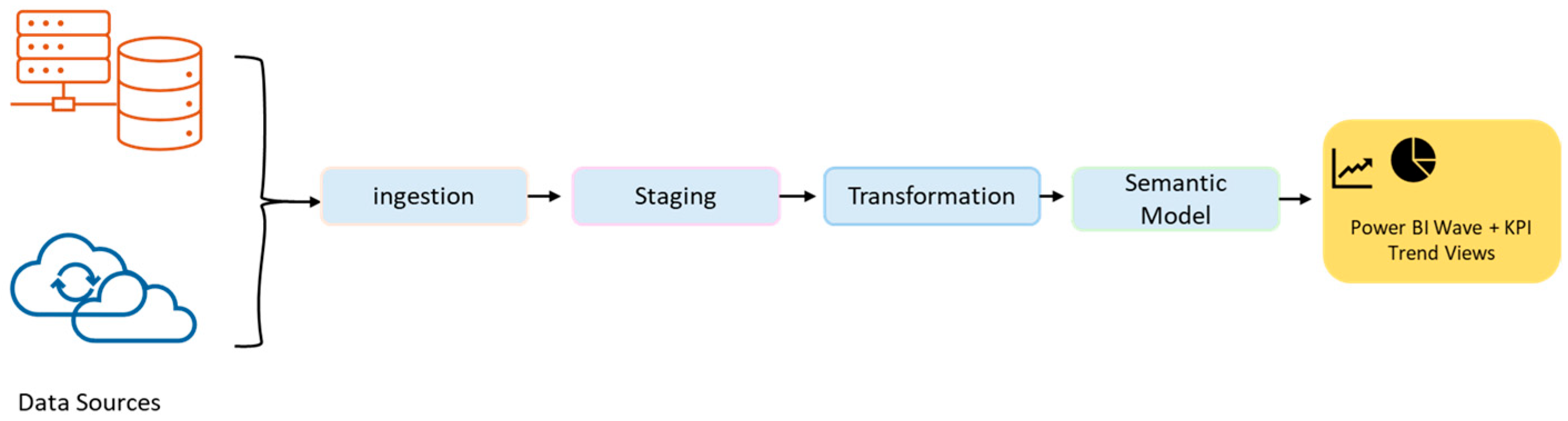
Figure 2, data processing pipelines are used to construct the Supply Chain Wave Report. Raw operational events from enterprise systems are cleaned, reconciled, and validated before lead-time estimation and stock calculations are performed. The processed data are then transformed into Wave KPIs and visualized through real-time analytical dashboards.
Lead times for the seven supply chain stages were calculated from timestamp differences between relevant operational events. Aggregate SQL functions were used to compute average stage durations and time distributions.
The processed data was then imported into Power BI for further analytical processing and visualization. This workflow ensured a reproducible transformation pipeline capable of handling large operational datasets.
5.3. Modeling and Analytical Framework
The wave-based analytical framework was implemented based on the integral formulation described in
Section 3.
For each supply chain stage, three primary analytical variables were derived:
The flow rate ;
The stage-specific inventory level ;
The total system inventory ;
Since the operational data is recorded in discrete time intervals, the continuous integrals described in the mathematical model were approximated using discrete daily aggregation of supply chain flows.
Analytical implementation combined several tools:
SQL for data preparation and KPI pre-calculation;
Power BI and DAX (Data Analysis Expressions) for numerical approximation of the integral functions;
Automated daily data refresh cycles for near real-time reporting.
5.4. Visualization and System Integration
To support real-time monitoring and analytical transparency, the Supply Chain Wave framework is implemented through a cloud-based data architecture that integrates operational data sources with visualization and reporting tools.
Figure 3 illustrates the cloud-based system architecture used to implement the Supply Chain Wave Report. Operational data are ingested from multiple enterprise systems and processed through several analytical layers before being visualized in Power BI dashboards.
The dashboard integrates KPI monitoring with visual flow representation and provides analytical capabilities, including the following:
Real-time monitoring of supply chain performance;
Detection of operational bottlenecks;
Scenario exploration and sensitivity analysis;
Early identification of potential disruptions.
The interactive interface allows operational users from procurement, logistics, warehouse operations, and sales departments to explore supply chain dynamics and identify deviations from expected performance patterns.
5.5. Validation Approach
The analytical model was validated by comparing predicted inventory levels derived from the integral formulation with actual observed inventory levels in warehouses and retail stores. Validation procedures included the following:
Historical back-testing of lead time estimates;
Cross-validation of KPI calculations across multiple datasets;
Expert evaluation through structured discussions with supply chain managers.
The validation results confirmed that the Supply Chain Wave framework provides a reliable representation of operational supply chain dynamics and supports practical decision-making in retail logistics environments.
6. Results
The implementation of the Supply Chain Wave Report provides a dynamic view of how the non-food retail supply chain evolves over time. Instead of analyzing operational stages separately, the system visualizes the entire chain as a continuous flow of goods across seven interconnected phases. The primary output of the framework is the Wave Diagram, which aggregates data from ordering, transportation, warehouse operations, store replenishment, and sales into a single analytical representation.
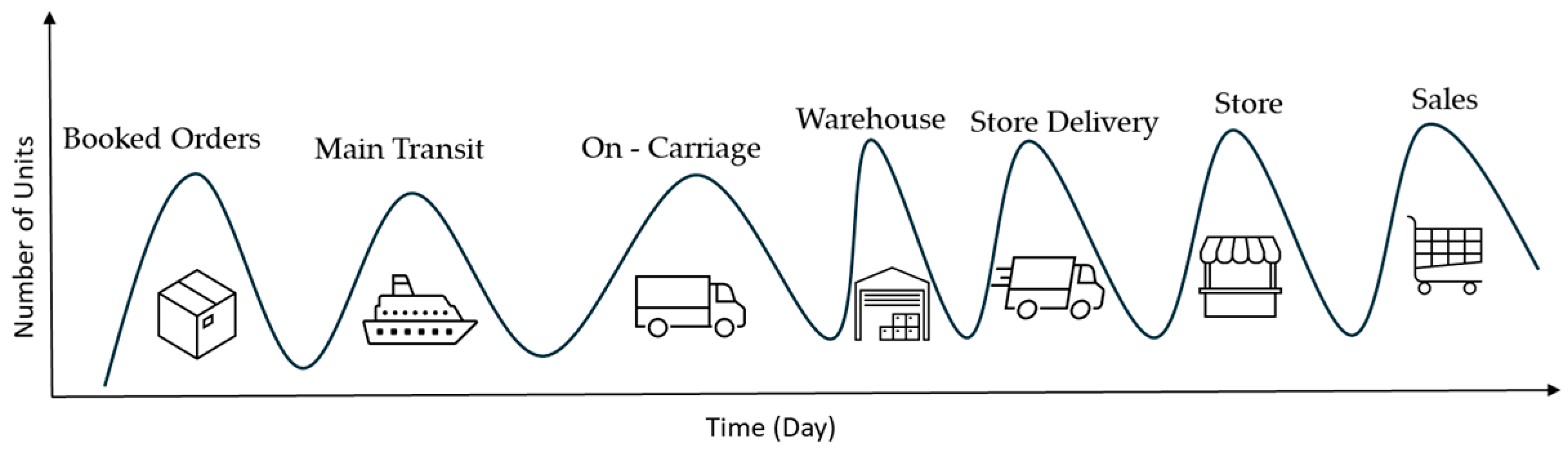
Figure 4 illustrates the conceptual idea behind the Supply Chain Wave visualization. The figure presents the theoretical structure in which supply chain stages are arranged sequentially and represented as a continuous wave. The purpose of this conceptual model is to illustrate how operational events occurring in earlier stages propagate through later stages of the supply chain over time.
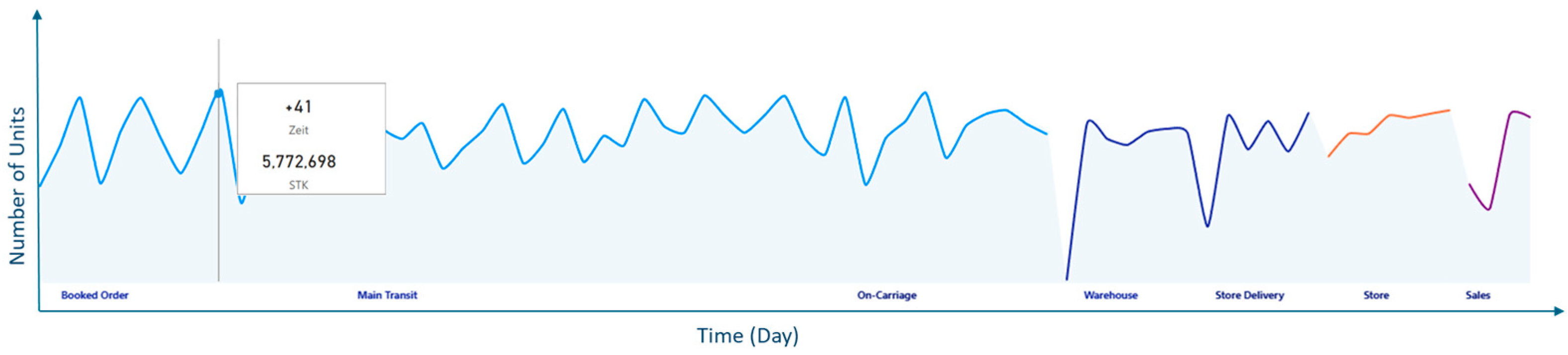
Figure 5 shows the real-world implementation of the Wave dashboard based on operational data from the case company. The horizontal axis represents time in days, while the vertical axis indicates the number of units moving through the supply chain. Each segment of the curve corresponds to one operational stage: booked orders, main transit, on-carriage transportation, warehouse processing, store delivery, store inventory, and final sales.
By aggregating all operational flows into a single dynamic curve, the Wave Diagram provides a continuous visualization of how inventory and product movements propagate across the supply chain. Peaks in the curve generally correspond to procurement cycles and shipment arrivals, while downward movements may reflect slower logistics processes or inventory depletion at later stages.
An important feature of the dashboard is its interactive analytical capability. By selecting a specific day within the Wave Diagram, users can trace how shipments propagate across subsequent supply chain stages. For example, selecting a point in the Booked Orders phase reveals how many units are expected to appear in later stages such as warehouse processing or store delivery after the corresponding lead time. In the illustrated example, a selected booking event results in approximately 5.7 million units moving through subsequent stages over the following 41 days. This functionality allows managers to analyze the temporal distribution of goods flows and supports proactive planning across operational departments.
6.1. Overall Wave Behavior
The observed Wave Diagram reveals several recurring patterns that align with the operational cycles of the retailer. Increases in the booked orders and main transit sections correspond closely with procurement planning cycles and international shipment schedules. Subsequent stages react to these upstream changes with predictable delays that reflect the natural lead-time structure of the supply chain.
For instance, increases in booked order volumes are followed by rising curves in the main transit phase and later appear as inbound peaks in the warehouse stage. This sequential propagation illustrates the temporal dependencies between supply chain stages and validates the conceptual wave structure proposed in the analytical model.
Visualization also makes operational disruptions easier to detect. Sudden deviations in the On-Carriage phase, for example, often correspond to transport delays or port congestion. Similarly, extended accumulation patterns in the warehouse section can signal reduced picking capacity or temporary imbalances between inbound and outbound flows.
6.2. Section-Specific KPI Dashboards
In addition to the integrated Wave Diagram, the dashboard provides dedicated KPI trend charts for each supply chain stage. These charts track the development of operational indicators over the previous three months and complement the wave visualization with more detailed performance analysis. The monitored indicators include the following:
ETS deviation trends for the Booked Orders stage;
ETS–ETA variance trends for the Main Transit phase;
ATA–GRN lead-time development for the On-Carriage stage;
GIN processing time and picking-rate trends in the warehouse;
Delivery accuracy trends for Store Delivery operations;
Inventory turnover development at the store level;
Sales velocity trends for the Sales stage.
These time-series views allow users to observe gradual changes in operational performance that may not be immediately visible in the aggregated Wave Diagram. By combining stage-specific KPIs with the integrated wave visualization, the dashboard provides both macro-level and micro-level insights into supply chain behaviors.
6.3. Impact on Operational Insights
The combined analysis of the Wave Diagram and KPI trends enabled several operational insights.
First, the propagation of disturbances across stages became clearly observable. Delays in the main transit phase were followed by increased warehouse accumulation approximately 20–30 days later, reflecting the typical transport and processing lead times within the supply chain. This time lag illustrates the temporal wave effect described in the analytical framework.
Second, correlations between micro-level operational indicators and macro-level inventory behaviors became visible. For example, temporary decreases in picking rates were directly associated with increased warehouse inventory levels, demonstrating the sensitivity of the system to throughput variations.
Third, the KPI trend charts provided early warning signals for potential operational risks. Gradual declines in delivery reliability and increasing lead-time variability were detectable before stock shortages occurred at the warehouse or store level.
Finally, the integrated visualization significantly improved decision support. Managers were able to link short-term operational fluctuations with downstream supply chain effects and therefore adjust procurement, transportation, and warehouse planning earlier than with previous static reporting tools.
6.4. Qualitative Feedback
Qualitative feedback from supply chain managers confirmed the practical usefulness of the Wave Report. According to operational users, the combination of a single integrated Wave Diagram and complementary KPI trend charts provided a level of transparency that had not previously been achievable with traditional reporting approaches.
The system improved cross-functional communication between procurement, logistics, warehouse operations, and store management teams. In particular, the ability to trace how operational events propagate through the supply chain helped decision-makers understand the broader consequences of local disruptions.