1. Introduction
Artificial Intelligence (AI) is changing how supply chains operate by improving how companies respond to uncertainty. AI helps organizations predict demand, manage inventory, and make faster decisions by using real-time data [
1]. These technologies strengthen two important capabilities in supply chain management, which are adaptability and agility [
2]. Adaptability is the organizational responsiveness to long-term changes, such as new technologies or market shifts. Meanwhile, supply chain agility is defined as the organization’s capabilities to respond quickly to unpredictable disruptions, such as sudden changes in demand or supplier problems [
3]. Together, these capabilities help companies stay competitive and stable during uncertain conditions [
4].
As companies face more global competition, they are adopting new technologies, such as automation and robotics, to improve efficiency and reduce reliance on manual processes [
5]. Digital tools help companies collect and use data in real time, which improves coordination across the supply chain [
6]. Cutting-edge technologies such as blockchain, digital twins, big data analytics, and AI play important roles in helping companies deal with supply chain risks and improve long-term performance [
7]. However, some companies face challenges when adopting these technologies. These include the cost of implementation, lack of expertise, and uncertainty in the external environment [
8].
Robotics is becoming more common in many industries, such as manufacturing, logistics, e-commerce, and education [
9]. These tools improve safety and efficiency. Future robotic systems are expected to be more flexible and easier to use in different types of supply chains [
10]. Several studies have examined what influences the adoption of automation and robotics in supply chain operations. They have identified benefits such as faster operations and reduced labor costs, as well as barriers such as investment risks and lack of skilled staff [
11,
12].
Supply chain agility and adaptability are two internal capabilities that are important for adopting these advanced technologies. Agility helps companies respond to fast-changing markets, while adaptability helps companies plan for long-term changes [
13,
14]. As technologies become more complex and difficult to manage, companies also face problems related to data quality and system integration [
15]. Some researchers suggest that tools like blockchain can help solve these problems by making supply chain data more accurate and transparent [
16]. However, previous studies often investigate adaptability and agility independently, while their concurrent role in transforming digital technology implementation into supply chain domains remains underexplored [
5].
Robotic process automation (RPA) is one of the technologies that companies are using to improve supply chain operations. It allows companies to automate repetitive tasks, reduce errors, and respond faster to changes in customer demand [
11]. RPA can also support delivery and logistics operations, such as drone-based last-mile delivery, which helps companies meet customer expectations [
10].
Moreover, external market conditions have roles in how companies adopt these technologies. The market turbulence term indicates the intensity of change and unpredictability in customer preferences, competitor actions, and regulations [
17]. In high-turbulence environments, companies need to act quickly to stay competitive. Research shows that companies in uncertain markets are more likely to use technologies that help them respond faster and reduce risk [
12]. However, the influence of market turbulence on the relationship between supply chain capabilities and technology adoption has not been fully explored.
The gaps in the literature show that existing research has examined AI, agility, adaptability, and robotics adoption separately [
18,
19]. Also, there is limited evidence on how these elements are connected in one framework, especially under market uncertainty [
12,
13]. In response to these gaps, this study makes three contributions. First, it analyzes the cutting-edge literature and establishes a moderation–mediation model that encompasses the interdependencies between AI-driven supply chain adaptability and agility and the adoption of automation and robotics [
9,
10]. Second, this study also examines how market turbulence affects the relationships among adaptability, agility, and the adoption of automation and robotics [
17]. Third, the current study is based on two theories (i.e., dynamic capabilities theory and institutional theory). The dynamic capabilities theory explains how firms build and adjust their process competences to respond to external changes [
20]. This theory helps explain how AI can improve supply chain capabilities that support innovation. Meanwhile, institutional theory explains organizational responsiveness to exogenous forces and pressures from regulations, industry standards, and competition [
21,
22]. This theory helps explain how market turbulence may affect firms’ decisions to adopt automation and robotics. Therefore, this study answers the following research questions:
RQ1: How do AI-driven supply chains influence supply chain adaptability and agility?
RQ2: How do supply chain adaptability and agility influence the adoption of automation and robotics?
RQ3: How does market turbulence affect the connection between supply chain capabilities and adopting automation and robotics?
The next sections present a literature review of related studies, describe the research model and method, and report the research work results. The final sections provide practical implications for decision-makers, as well as directions for future research.
2. Literature Review
Robotics, as a core application of Artificial Intelligence (AI), has taken on an increasingly important role in manufacturing and supply chain processes [
23]. Recent technological improvements, such as object detection and semantic segmentation, have allowed robots to better perceive and interact with their environments [
24]. Robots equipped with AI and advanced imaging systems are now used for tasks like shelf scanning and object selection, offering improvements over traditional manual systems [
25]. Although robots are primarily used in industrial settings, they are becoming more common in areas such as defense and hazardous environments [
26,
27].
A growing number of studies are exploring how emerging digital technologies support supply chain innovation and operational performance. For example, Wei et al. [
28] demonstrated how IT exploration and exploitation can improve supply chain performance through innovation, using data from Chinese firms. Similarly, Wang et al. [
29] used information processing theory to show that ambidexterity balancing exploration and exploitation can improve supply chain resilience through enhanced agility, flexibility, and redundancy. These studies highlight how internal capabilities like information processing and ambidexterity contribute to dynamic supply chain performance.
Other research examines how cutting-edge technologies like big data and AI impact supply chain management [
30], business intelligence [
31], and market learning [
19]. These findings show that advanced technologies, when combined with organizational knowledge development and ambidextrousness, contribute to better supply chain outcomes and sustainability practices in developing markets.
Industry 4.0 technologies like blockchain, automation, and robotics are transforming traditional supply chains [
32]. These tools have been shown to improve supply chain visibility, traceability, and coordination across partners [
13,
33]. Several studies have examined how blockchain supports agility and transparency in supply chains and how market volatility moderates this adoption [
12,
16].
Other scholars emphasize the strategic role of technological integration. For instance, Chatterjee et al. [
18] identified how technological turbulence affects the relationship between technology adoption and production system sustainability. Saengchai and Jermsittiparsert [
34] and Trainor et al. [
17] demonstrated how market volatility and external pressures shape the success of supply chain strategies. Similarly, Aslam et al. [
35] found that supply chain ambidexterity improves resilience, with agility acting as a mediator.
Several studies have also examined supply chain digitalization [
7], blockchain’s role in improving competitiveness and alignment [
13,
36], and how companies manage technological complexity and organizational readiness [
11,
37]. Others explored the effect of AI and automation on manufacturing system durability [
18], or how supply chain agility and adaptability affect firm performance [
38,
39].
Across these studies, several common themes emerge: First, robotics, automation, AI, and blockchain are transforming supply chain processes, improving performance, transparency, and adaptability [
10,
23]. Second, organizational capabilities such as ambidexterity, agility, and adaptability are critical for effective technology adoption and performance [
28,
40]. Third, market turbulence, technological uncertainty, and environmental dynamism shape the effectiveness of digital transformation strategies [
18,
39].
Despite these contributions, an important gap remains. Most of the existing studies focus on individual technologies or organizational capabilities in isolation. For example, studies on robotics and AI have explored their role in automation and supply chain tasks [
25,
30], while research on blockchain has mainly addressed transparency and performance outcomes [
32,
36]. Similarly, ambidexterity, agility, and adaptability have been studied in relation to resilience or performance without directly linking them to robotics adoption [
19,
35]. Few studies have developed a unified framework that links AI-driven supply chain capabilities (adaptability and agility) with the adoption of automation and robotics, while also considering the moderating role of market turbulence [
17,
34]. Additionally, the connection between these constructs has not been fully explored in a way that combines internal dynamic capabilities with external institutional or market pressures [
13,
28].
The current research work aims to fill this gap by integrating insights from prior research into a single model. It investigates how AI-driven supply chains enhance adaptability and agility [
20], how these capabilities influence the adoption of automation and robotics [
13,
14], and how market turbulence moderates these relationships [
20,
22]. By doing so, the study builds on both dynamic capabilities theory [
24] and institutional theory [
25] to explain how firms can respond effectively to technological change and environmental uncertainty.
Table 1 shows the most recent studies involving the different variables in this study.
2.1. Underpinning Theories of the Study
This research work is theoretically framed through dynamic capabilities theory and institutional theory, which together provide a robust and complementary foundation for explaining how AI-driven supply chains influence adaptability, agility, and the adoption of automation and robotics under conditions of market turbulence. The integration of these theories enables the study to capture both internal capability development and external environmental pressures, addressing a key limitation identified by the reviewer regarding the depth of the theoretical background.
Dynamic capabilities theory explains how firms sense environmental changes, seize opportunities, and reconfigure resources to sustain competitive advantage in volatile environments [
20]. In supply chain contexts, dynamic capabilities are increasingly enabled by disruptive digital technologies such as automation [
2,
5]. AI-driven supply chains enhance firms’ sensing capabilities by improving visibility, predictive analytics, and real-time information processing, allowing organizations to detect disruptions and market shifts earlier and more accurately [
1,
7]. These sensing mechanisms are critical in turbulent environments, where uncertainty and complexity are high.
Through this theoretical lens, supply chain adaptability and agility are conceptualized as distinct but complementary manifestations of dynamic capabilities. Adaptability reflects a firm’s ability to make long-term structural adjustments to its supply chain configuration, such as redesigning networks, altering sourcing strategies, or modifying production systems in response to persistent environmental changes [
14,
15]. Agility, by contrast, represents a short-term, execution-oriented capability that enables rapid responses to sudden demand fluctuations, supply disruptions, and operational disturbances [
3,
12]. Prior studies emphasize that treating adaptability and agility as separate capabilities is essential, as they operate over different time horizons and rely on different managerial and technological mechanisms [
14,
35].
AI-driven supply chains play a central role in strengthening both capabilities. AI enhances adaptability by supporting scenario planning, predictive risk assessment, and strategic reconfiguration of supply chain resources [
2,
30]. Simultaneously, AI improves agility by enabling real-time decision-making, faster coordination among supply chain partners, and rapid operational adjustments [
5,
17]. By framing AI-driven supply chains as a higher-order dynamic capability, this study aligns with the latest research highlighting the role of digital technologies in enabling continuous capability renewal and operational resilience [
7,
28].
From a dynamic capabilities perspective, the adoption of automation and robotics represents an outcome of effective capability deployment rather than a purely technological decision. Organizations with robust agile competences are better positioned to integrate automation and robotics because agility facilitates rapid process reconfiguration, experimentation, and alignment between digital systems and physical operations [
10,
11]. This explains why agility has been shown to be a more immediate driver of automation adoption than adaptability, which is primarily oriented toward long-term structural change [
12,
18]. Thus, this study extends DCT by empirically distinguishing between the differential roles of adaptability and agility in translating AI-enabled capabilities into concrete technology adoption outcomes.
While dynamic capabilities theory explains internal capability development, institutional theory provides insight into how external environmental pressures shape organizational decisions [
21]. Institutional theory argues that firms’ strategic actions are influenced by coercive, normative, and mimetic pressures arising from regulations, market competition, and industry norms [
21,
22]. In this study, market turbulence captures these external pressures by reflecting instability in customer preferences, competitive intensity, and market conditions [
17,
34]. Such turbulence increases uncertainty and risk, influencing managerial willingness to commit to large-scale investments such as automation and robotics.
By incorporating market turbulence as a moderating variable, this study extends institutional theory by demonstrating that environmental uncertainty conditions the effectiveness of internal dynamic capabilities. Under high turbulence, firms may delay or constrain automation investments despite being adaptable, due to financial risk, demand unpredictability, or strategic caution [
18,
34]. This explains the negative moderating effect of market turbulence on the adaptability–adoption relationship. Conversely, the non-significant moderating effect on the agility–adoption relationship suggests that agility functions as a buffering capability, allowing firms to cope with environmental uncertainty without altering their technology adoption behavior [
12,
35].
Thus, the combination of institutional theory and dynamic capabilities theory provides a multi-level theoretical explanation for AI-enabled supply chain transformation. Dynamic capabilities explain how AI-driven supply chains build adaptability and agility internally, while institutional theory clarifies when and why these capabilities translate into automation and robotics adoption under external market pressures.
2.2. Influence of AI-Driven Supply Chain (SC) on SC Adaptability and Agility
The embedding of AI-driven systems into supply chain functions has led to significant advancements, particularly in developing supply chain adaptability. Adaptability refers to a supply chain’s ability to modify its structure, processes, and operations in response to external changes such as market volatility, supply disruptions, or sudden shifts in customer demand [
10,
11]. AI-driven systems contribute to this adaptability by leveraging advanced data analytics, machine learning, and predictive modeling to forecast potential disruptions and recommend timely responses [
30]. For example, AI-enabled platforms can assess global events, evaluate supplier performance risks, and recommend alternative sourcing strategies before a disruption affects supply continuity [
23,
25].
These proactive capabilities reduce downtime, improve risk management, and support business continuity [
13,
24]. Moreover, adaptive AI tools are designed to learn from historical data and previous disruptions, enabling organizations to improve their response strategies over time [
29]. This continual learning process strengthens resilience and helps organizations align with dynamic market requirements [
19,
35].
Companies with AI-enhanced supply chains are better equipped to adapt to evolving client expectations and external pressures, thus achieving higher levels of operational responsiveness and flexibility [
28,
31]. In addition to adaptability, AI technologies significantly enhance supply chain agility through improving organizational responsiveness to short-term fluctuations in demand or supply and recovering from unexpected disruptions [
3]. AI improves agility through up-to-date data processing and operational process visibility, which enable faster and more accurate decision-making [
7].
Tools such as AI-based demand forecasting, dynamic pricing algorithms, and intelligent inventory management allow firms to respond promptly to fluctuations, prevent stock imbalances, and shorten lead times [
18,
30]. AI also supports logistics optimization, including smart routing and delivery rescheduling, which helps reduce transportation delays and improve customer satisfaction [
32,
38].
Given the increasing demand for rapid, flexible, and customer-centric operations, supply chains must be agile to remain competitive [
34,
38]. AI-enabled systems contribute to this goal by ensuring that decisions are data-driven, timely, and aligned with customer needs [
17,
18].
Overall, AI serves as a foundational technology that enhances both the adaptability and agility of supply chains, enabling firms to remain responsive and resilient in volatile environments [
12,
36]. Based on this discussion and supported by prior studies, we propose the following hypotheses:
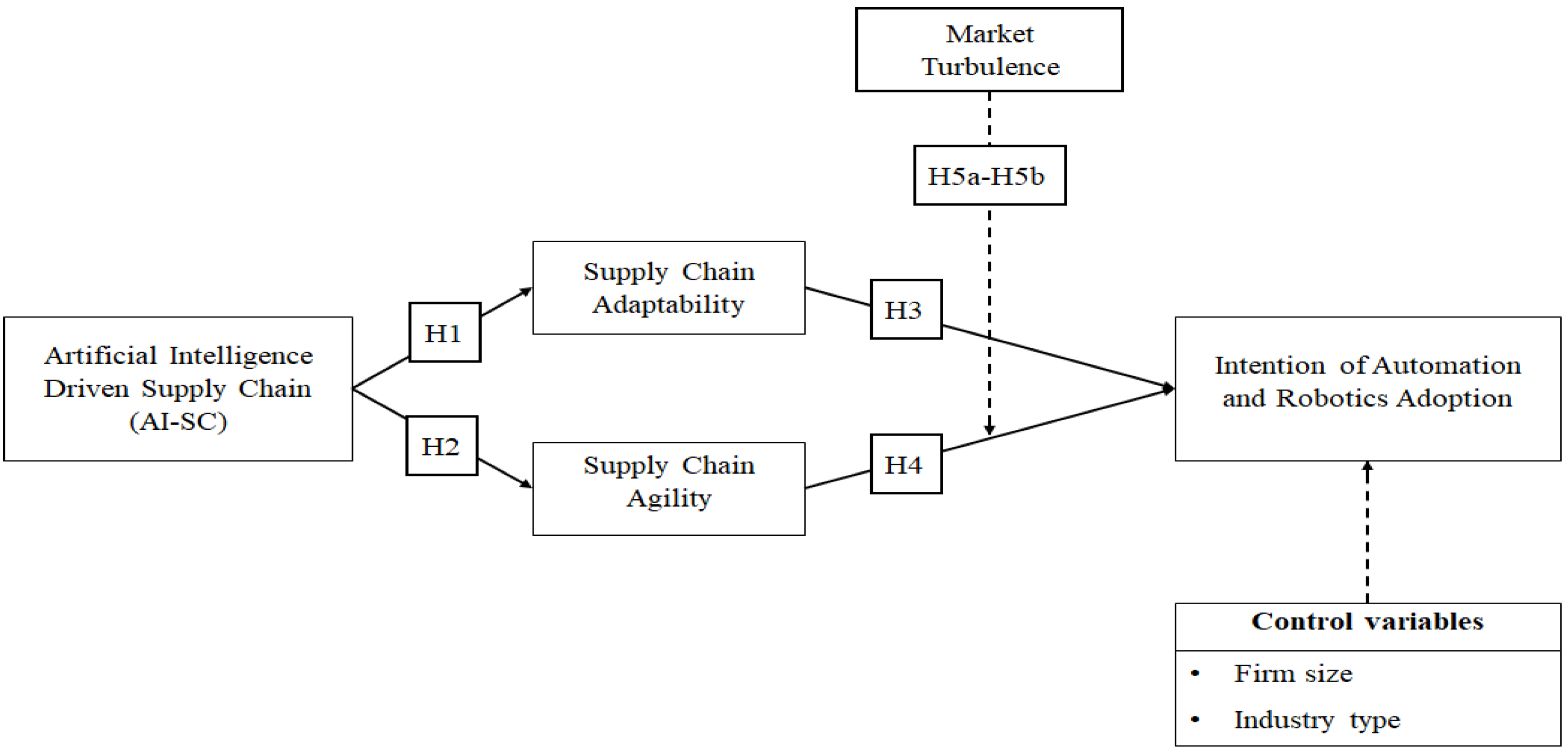
Hypothesis H1. An Artificial Intelligence-driven supply chain positively influences supply chain adaptability.
Hypothesis H2. An Artificial Intelligence-driven supply chain positively influences supply chain agility.
2.3. Influence of Supply Chain Adaptability
Supply chain adaptability relates to a firm’s ability to restructure its supply chain procedures and relationships in response to long-term, fundamental transformations in the operating market [
14,
35]. These changes may include economic development, political shifts, demographic trends, or rapid technological advancements [
14,
18]. Adaptability involves actions like building new supplier networks, reconfiguring production capacities and outsourcing operations to effectively adjust to these changes [
10,
14].
As supply chains evolve, businesses across multiple sectors, including manufacturing, transportation, e-commerce, and education, are increasingly adopting robotics technologies to improve flexibility and responsiveness [
26]. Modern robots can now operate collaboratively with humans, communicate with each other, and safely support production tasks [
24]. Future developments are expected to make these robots even more versatile and useful across various supply chain functions [
10,
25].
Adaptability allows firms to predict and remain responsive to market fluctuations more effectively [
29,
34]. It supports strategic decision-making in dynamic conditions and promotes rapid adjustment to new challenges or opportunities [
28,
35]. For instance, companies can adopt flexible production strategies such as micro-segmentation, mass customization, and advanced scheduling techniques to meet specific customer requirements [
31].
These capabilities also help solve last-mile delivery issues through digital tools like drone-based logistics, resulting in faster and more efficient service [
30]. Adaptable supply chains also encourage the implementation of emerging technologies (i.e., automation and robotics) [
13]. E-Fatima et al. [
11] demonstrated that robotic process automation has been successfully implemented in beef supply chains to perform operational tasks such as unloading, deboning, packing, and product handling. These applications enhance efficiency and accuracy while reducing reliance on manual labor, making RPA a desirable solution in adaptable supply networks [
12]. Vendor alignment and collaboration further promote adaptability by improving data accuracy, process transparency, and shared knowledge across the supply chain [
7,
11].
This alignment allows companies to make quicker, better-informed decisions and adjust their operations proactively [
16,
33]. Iranmanesh et al. [
12] emphasized that adaptability and agility are interrelated, and both rely on predictive capabilities and readiness to adjust to change. The ability to modify the supply chain’s structure enables firms to rapidly manage uncertainty and improve performance [
17,
38].
As companies face more complex supply chain dynamics, adaptability becomes a key driver of automation and robotics adoption [
18,
19]. The flexibility to redesign operations, align with technological advances, and optimize performance positions adaptable firms to integrate automation tools more effectively [
37,
39]. These tools, in turn, support resilience, responsiveness, and competitiveness in rapidly evolving markets [
13,
36]. Based on previous discussions, the following hypotheses are presented:
Hypothesis H3. Supply chain adaptability positively influences the adoption of automation and robotics.
2.4. Influence of Supply Chain Agility
Supply chain agility denotes an organizational capability to detect short-term, temporary instabilities in its supply chain and market environments (i.e., demand variability, supply disruptions, and vendor delays) and to respond rapidly and effectively using its existing operational resources [
14]. This includes adjusting production speeds, changing shipping schedules, or substituting materials to minimize disruption and maintain customer satisfaction [
5,
10].
Supply chain agility enables companies to reconfigure operational strategies and processes to deal with unexpected or time-sensitive changes [
18,
40]. The agile supply chain helps organizations improve demand–supply alignment, reduce inventory and transportation overhead, and respond to market volatility with minimal operational delays [
5,
36]. Agility also allows businesses to reduce material and product substitution cycles, shorten setup times, and implement flexible manufacturing techniques, thereby maintaining cost-effectiveness and avoiding stockouts or excess inventory [
5,
12].
Hsu et al. [
41] emphasized that several Industry 4.0 drivers are essential to increasing supply chain agility, such as investment in digital transformation, data privacy and security measures and systems for managing large-scale data. These technological investments improve agility by enhancing visibility, enabling quicker decision-making, and fostering long-term collaboration with supply chain partners [
42]. Features such as transparent data sharing and digital supply chain mapping can help organizations respond faster to changing customer needs and improve overall service performance [
17,
42].
Furthermore, firms are increasingly investing in information technology and data-driven tools to strengthen both intra- and inter-organizational supply chain processes [
5,
42]. The adoption of big data analytics (BDA), particularly in large global corporations such as Amazon, Uber, and Walmart, has significantly improved responsiveness and operational efficiency [
5,
33]. These firms use real-time data to predict customer behavior, manage inventories dynamically, and adjust delivery schedules—all of which contribute to greater agility in the supply chain [
5,
37].
Wong et al. [
42] highlighted that in highly competitive environments, supply chains have become a crucial aspect for strategic advantage, placing pressure on managers to develop agile systems. Agility is viewed as an externally oriented capability, reflecting how quickly a company can adapt to market shifts [
14,
42]. One of the key technological enablers in this context is AI-driven risk management (AIRM), which supports real-time visibility and strengthens operational agility, ultimately enhancing firm performance [
18,
41]. Iranmanesh et al. [
12] found that supply chain agility enables firms to respond quickly to market developments, which is especially important in today’s complex and dynamic supply networks.
Challenges such as lack of transparency, weak data integration, and mistrust among partners can reduce efficiency and effectiveness [
12,
16]. However, the adoption of technologies like blockchain can improve supply chain end-to-end transparency and trust, which in turn enhances agility and competitiveness, specifically for small and medium-sized firms [
12,
36]. In agile supply chains, the ability to quickly detect, process, and act on market signals plays a significant role in firms’ ability to efficiently adopt automation and robotics [
11]. Agility enables rapid process reconfiguration and technology alignment, making it easier to integrate robotic systems in areas such as logistics, inventory handling, and production [
10,
33]. These technologies enhance operational speed, consistency, and responsiveness [
24,
25]. Hence, the following hypotheses are presented:
Hypothesis H4. Supply chain agility positively influences the adoption of automation and robotics.
2.5. Moderating Effect of Market Turbulence
In the context of this study, market turbulence serves as a potential moderator, influencing the strength of the correlations between supply chain capabilities and the adoption of automation and robotics [
18]. Market turbulence denotes the pace of change in customer preferences and market conditions that creates uncertainty for firms seeking to maintain a competitive advantage [
12].
Irregular shifts in demand and changes in the external environment contribute to market instability, complicating forecasting and decision-making for businesses [
12]. This unpredictability is also described as environmental turbulence and represents a critical factor companies must manage to remain competitive [
18,
34]. Managers’ strategic decisions are shaped by their perceptions of uncertainty and how they interpret environmental signals [
34,
42].
In highly turbulent market environments, firms often place greater emphasis on developing agile and adaptable supply chains to respond to rapid changes in demand and supply conditions [
16]. According to Iranmanesh et al. [
12], supply chain agility becomes significantly more important in turbulent markets than in stable ones for firms aiming to sustain a competitive edge. In such contexts, the strategic benefit of agility-enhancing technologies such as blockchain and automation is more pronounced, especially for SMEs operating under constant market fluctuations [
12,
36].
As a result, market turbulence positively moderates the association between supply chain responsiveness and technology implementation, strengthening the influence of agile capabilities on firms’ willingness to adopt innovations such as automation and robotics [
12]. Chatterjee et al. [
18] argued that environmental conditions, especially technological advances and external industry dynamics, can either amplify or reduce the impact of AI-based technologies on long-term manufacturing performance. Similarly, Saengchai and Jermsittiparsert [
34] found that market turbulence moderates the association between logistics strategy and organizational outcome by complicating efforts to analyze market trends and accurately forecast demand.
In highly volatile environments, firms face challenges related to unpredictable pricing, consumer behavior, and demand shifts, which hinder accurate planning and forecasting [
34]. Additionally, uncertainty in the market often leads to reduced collaboration and trust within the supply chain, as firms become less willing to share information and knowledge [
16]. This breakdown in cooperation can impact the adoption and implementation of advanced technologies, particularly those requiring high levels of supply chain integration and coordination [
12,
33]. Hence, the resulting hypotheses are presented:
Hypothesis H5a. Market turbulence moderates the relationship between supply chain adaptability and the adoption of automation and robotics.
Hypothesis H5b. Market turbulence moderates the connection between supply chain agility and the adoption of automation and robotics.
Based on the previous discussions,
Figure 1 is developed as the conceptual framework of the current study.
5. Discussion
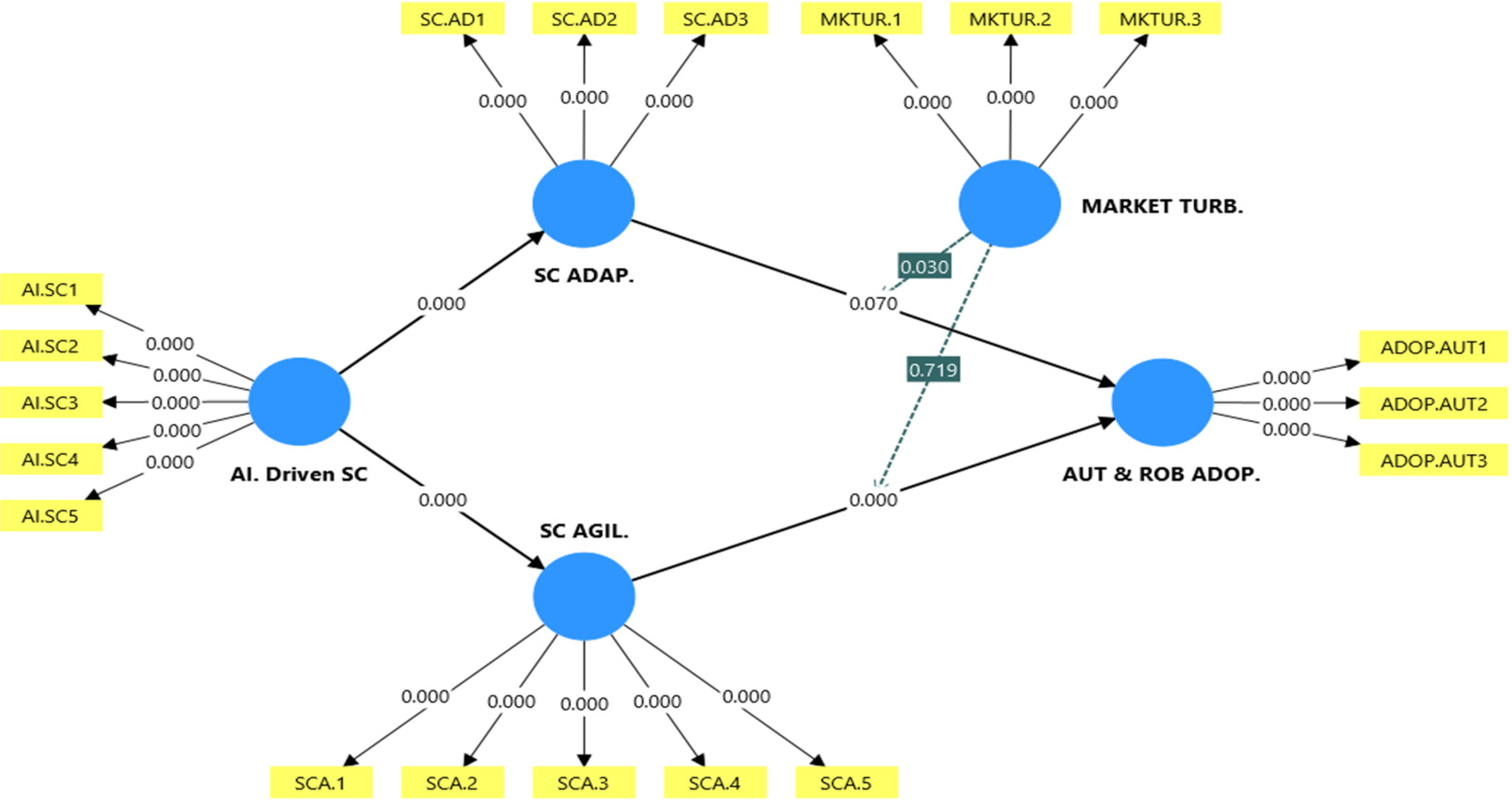
The statistical analysis confirms that H1 is supported, which proposed that an AI-driven supply chain positively influences supply chain adaptability. The results suggest that firms implementing AI technologies are adequately armed to adjust their structures and operations in their supply chains in response to long-term market or marketplace transformations. This is consistent with previous research, which highlights the role of AI in enhancing real-time decision-making, predictive analytics, and the ability to manage supply chain risks effectively [
2]. AI systems enable firms to anticipate disruptions and reconfigure supply networks, thus fostering adaptive capabilities [
5,
52].
Hypothesis H2, which posited that AI-driven supply chains positively influence supply chain agility, was also strongly supported. This aligns with studies by Choi et al. [
3] and Eslami et al. [
47], who found that AI enhances supply chain responsiveness by improving real-time visibility, demand forecasting, and operational flexibility. The results reinforce the view that AI plays a central role in enabling firms to respond swiftly to supply and demand fluctuations [
5,
30].
Hypothesis H3, which proposed a positive relationship between supply chain adaptability and the adoption of automation and robotics, was not supported. From a dynamic capabilities theory perspective, the repeated reconfigurations without strategic alignment can weaken the firm’s long-term viability [
53]. In addition, firms may possess the capacity to adapt but still face barriers such as cost, lack of technical expertise, or organizational resistance that hinder automation uptake [
35,
54]. It is also possible that adaptability affects adoption indirectly through other capabilities not tested in this model.
In contrast, Hypothesis H4 was supported, confirming that supply chain agility positively influences the adoption of automation and robotics. This finding is in line with the literature suggesting that agile supply chains capable of responding quickly and flexibly are more likely to embrace advanced technologies to maintain competitiveness [
10,
42]. Agility supports rapid process reconfiguration and makes it easier for firms to integrate automation and robotics into supply chain operations [
12].
Hypothesis H5a, which posited the moderating effect of market turbulence on the relationship between adaptability and the adoption of automation and robotics, was supported. Interestingly, the interaction effect was negative, suggesting that high levels of market turbulence may weaken the influence of adaptability on adoption. In uncertain environments, firms may be hesitant to invest in automation due to risk aversion or budget constraints, even if they are otherwise adaptable [
18,
34]. As such, turbulent conditions can dampen the positive effects of internal capabilities.
Finally, Hypothesis H5b, which examined whether market turbulence moderates the relationship between supply chain agility and the adoption of automation and robotics, was not supported. A possible explanation is that agile firms are already equipped to manage uncertainty effectively, making the additional moderating influence of market turbulence negligible. In such cases, agility functions as a dynamic capability that buffers external shocks and allows firms to continue adopting technologies without significant disruption [
20,
55]. Additionally, the dynamic capabilities theory posits that agility, as an essential dimension of dynamic capabilities, enhances long-term resilience by enabling faster responses and adjustments to external environmental changes [
35,
56]. Furthermore, agility represents a vital organizational capability that allows firms to operate continuously during disruptions, thereby minimizing vulnerability and sustaining resilience [
57,
58].
5.1. Managerial Implications
The results emphasize the strategic importance of integrating AI technologies into the supply chains of manufacturing firms in Jordan. Managers should consider implementing AI-powered demand forecasting tools and real-time inventory tracking systems to improve adaptability and agility. For example, a packaging manufacturer in Jordan could use machine learning algorithms to analyze order patterns and anticipate raw material shortages, allowing timely supplier adjustments. Similarly, real-time production monitoring systems can help detect equipment faults early, reducing downtime and ensuring smoother operations.
Given the strong effect of supply chain agility on the adoption of automation and robotics, firms should first build agile internal systems before making large investments in automation. This includes adopting lean manufacturing techniques, flexible staffing models, and decentralized decision-making. For instance, a food processing company in Jordan can benefit from agile production lines that allow rapid switching between product types in response to fluctuating demand, making it easier to later integrate automated packing or quality control systems without disrupting existing workflows.
The non-significant impact of adaptability on automation and robotics adoption suggests that having long-term flexibility does not automatically translate into readiness for technological change. Firms may be strategically adaptive but still face operational or financial constraints. A textiles firm that adjusts sourcing strategies to manage global cotton price fluctuations may still lack the technical infrastructure or skilled workforce needed to implement robotics in fabric cutting. Managers should therefore invest in workforce training programs and upgrade digital systems to bridge the gap between strategic adaptability and practical implementation, particularly in a developing country like Jordan, where such investments are often limited.
Market turbulence’s moderating effect on adaptability highlights the challenges of adopting automation in unstable environments. In volatile market conditions, such as fluctuating export regulations or raw material prices, firms may hesitate to make large capital investments. For example, a manufacturer producing electrical components for regional markets may delay automation due to unpredictable demand or currency shifts. In such cases, managers can adopt a phased approach, starting with small-scale automation pilots (e.g., robotic arms for packaging) and expanding gradually based on performance and market feedback.
Next, the policymakers and governments in Jordan must facilitate manufacturing firms’ adoption of digital technologies, including the adoption of automation and robotics, in addition to formulating awareness programs for managers of manufacturing firms to overcome long-standing size-related limitations in accessing finance and reaching new markets, hence improving productivity and competitiveness in global markets.
Finally, the finding that agile firms are less affected by market turbulence when adopting technology shows that agility acts as a buffer against environmental uncertainty. Managers in Jordan should institutionalize agility across supply chain operations. For example, a plastics manufacturer in Jordan can enhance agility by using shared digital platforms with suppliers and logistics providers to enable real-time coordination and faster response to delays or demand shifts. These practices not only support smoother integration of robotics and automation but also strengthen competitive positioning in both domestic and export markets.
5.2. Theoretical Implications
This study contributes to the theoretical understanding of supply chain innovation by integrating dynamic capabilities theory and institutional theory to explain how internal capabilities and external environmental factors jointly influence technology adoption in manufacturing firms. The findings confirm that AI-driven supply chains enhance both adaptability and agility, supporting the view that digital capabilities are essential components of dynamic capabilities in volatile markets. The significant role of agility in facilitating the adoption of automation and robotics reinforces its position as an essential dynamic capability that allows firms to adapt and respond rapidly to change. Additionally, the moderating effect of market turbulence on the adaptability–adoption link extends institutional theory by demonstrating how environmental uncertainty can either constrain or reshape internal strategic responses. The non-significant moderating effect of market turbulence on agility suggests that agility may function as a self-sufficient capability that offsets external pressures, offering new insights into how firms in developing economies like Jordan manage uncertainty.
Overall, this research contributes to theory in different ways. Firstly, this study integrates dynamic capabilities theory and institutional theory to establish a clearer theoretical logic jointly connecting internal capabilities (i.e., AI-driven supply chains) and external environmental factors (i.e., supply chain agility adaptability) and their influence on technology adoption in manufacturing firms in developing countries (i.e., Jordan). Secondly, this study identifies agility and adaptability conceptualized as separate mediating capabilities, each operating across different temporal horizons. Thirdly, this study reveals that market turbulence positively moderates the relationships between supply chain adaptability and automation and robotics adoption. This means that when manufacturing firms operate in a competitive and unpredictable market like Jordan, the strategic importance of adaptability forces the manufacturing firms to have higher intentions to adopt cutting-edge technology.
6. Conclusions
The current research work aimed to investigate how AI-driven supply chains influence supply chain adaptability and agility, and how these capabilities, in turn, affect the adoption of automation and robotics. It also investigated whether market turbulence moderates these relationships. The study was grounded in dynamic capabilities theory and institutional theory to capture both internal and external drivers of technology adoption. The results showed that AI-driven supply chains significantly enhance both adaptability and agility. However, only agility had a significant direct influence on the adoption of automation and robotics, while the effect of adaptability was not significant. Also, statistical results showed that market turbulence strengthens the connection between adaptability and adoption, but not between agility and adoption. These findings offer new insights into how digital capabilities and environmental uncertainty interact in shaping innovation adoption.
Managerially, the study highlights the importance of manufacturing organizations in Jordan deploying intelligent technologies and developing agile supply chain systems to enable smooth integration of automation. Managers should also recognize that while adaptability is valuable, it may require additional operational support to lead to effective technology adoption, particularly in volatile environments. From a theoretical standpoint, the study contributes to the literature by linking AI capabilities to dynamic supply chain capabilities and showing how market turbulence alters the strength of these relationships. It extends existing frameworks by demonstrating that agility may serve as a buffer against environmental uncertainty, while adaptability may be more vulnerable to external disruptions.
Despite its contributions, the study has some limitations. First, the use of judgmental sampling may limit the generalizability of the findings. Second, the study sought to examine manufacturing firms in Jordan, which could impede its applicability to other industries or regions. Third, the model did not account for possible mediators or other contextual factors, such as organizational readiness or digital infrastructure. Future research should address these limitations by using probability sampling methods, expanding the study to include other sectors or countries, and exploring mediating variables such as digital readiness, training, or supply chain integration. Longitudinal studies could also provide deeper insights into how these relationships evolve over time.