
Systematic Review

Blockchain Technology and Maritime Logistics: A Systematic Literature Review
by
Christian Muñoz-Sánchez
1,
Jesica Menéndez-García
1,
Jorge Alejandro Silva
1,
Jose Arturo Garza-Reyes
2,3,*,
Dulce María Monroy-Becerril
1 and
Eugene Hakizimana
1
1
Escuela Superior de Comercio y Administración Unidad Santo Tomás, Instituto Politécnico Nacional, Mexico City 11350, Mexico
2
Centre for Supply Chain Improvement, University of Derby, Derby DE22 1GB, UK
3
Department of Management Studies, Graphic Era Deemed to be University, Dehradun 248002, India
*
Author to whom correspondence should be addressed.
Logistics 2026, 10(1), 12; https://doi.org/10.3390/logistics10010012
Submission received: 23 November 2025 / Revised: 25 December 2025 / Accepted: 30 December 2025 / Published: 31 December 2025

Abstract

Background: Blockchain has been extensively discussed for enhancing transparency, traceability, and trust in general; however, there is fragmented empirical evidence available with respect to this issue within maritime logistics. The objective is to integrate and categorize peer-reviewed publications concerning applications of blockchain in maritime logistics and related supply chain domains. Methods: A systematic literature review with PRISMA 2020 was performed in Scopus database, and after a process of screening and eligibility, a total of 78 journal articles published mainly from September 2024 were incorporated. Descriptive and bibliometric analyses were conducted, and VOS viewer-based bibliographic coupling were employed to visualize thematic structure. Results: The review identifies seven research priorities for blockchain in maritime logistics: Technological Interoperability, Economic and Operational Impact, Cybersecurity and Privacy, Adoption and Scalability, Decision-Making and Trust, Environmental Sustainability, and Standardization and Regulatory Frameworks. Blockchain’s primary advantages are enhanced data integrity and visibility, whereas key challenges include interoperability, legal/regulatory uncertainty (e.g., e-doc recognition), high costs, scalability ceilings, integration with legacy systems, and data governance fears. Conclusions: The application of blockchain in maritime logistics depends on combined technical and institutional enabling conditions; an Integrated Blockchain Adoption Framework (IBAF) is suggested, and providing practical guides based on standardization, legal convergence, and hybrid governance modes.

1. Introduction

Water maritime logistics is a fundamental component of global trade, responsible for the transportation of approximately 80% of the world’s goods by volume [1]. However, this sector faces persistent challenges such as lack of visibility, complex regulatory frameworks, bureaucratic inefficiencies, port congestion, and contract disputes [2]. These issues underscore the importance of creative solutions to improve efficiency, accountability, and security throughout maritime supply chains.
Blockchain technology, a decentralized and immutable digital ledger, has been identified as a potential tool to address these inefficiencies [3]. It offers secure, real-time data sharing, reduces reliance on paper-based documentation, enhances trust among stakeholders, and improves traceability and security in logistics operations [3]. Various studies suggest that blockchain could revolutionize maritime logistics by optimizing supply chain processes, automating transactions through smart contracts, and facilitating compliance with regulatory requirements [4].
A handful of systematic reviews between 2020 and 2024 aggregate the blockchain uses in supply chains and logistics in general. Nevertheless, the domain of maritime logistics is characterized by specific institutional and legal constraints (for example, cross-border enforceability of smart contracts and uneven recognition of electronic Bills of Lading) [5,6], multi-actor governance (ports–carriers–customs) as well as interoperability requirements [7] that are not systematically confronted with these presenting hierarchical dimensions [8]. On this basis, the contribution of the study centers on a maritime-focused SLR that (i) maps the thematic structure of literature via bibliographic coupling, (ii) consolidates adoption drivers and barriers with explicit focus on maritime legal–regulatory impediments, as well as (iii) critically appraises methodological maturity of knowledge base by distinguishing conceptual from empirical contributions.
This study aims to address this gap by conducting a systematic literature review (SLR) to evaluate how blockchain research in maritime logistics has evolved and to identify the primary challenges and opportunities associated with its adoption [9].
The primary research question guiding this study is as follows:
How has blockchain research in maritime logistics evolved, and what are the primary challenges and opportunities for its adoption?
Additionally, the study explores three specific research questions:
  • Q1. What are the main areas of research on blockchain relating to logistics in the supply chain?
  • Q2. What are the primary challenges and barriers to the adoption of blockchain technology in maritime logistics?
  • Q3. What key factors drive blockchain adoption in maritime logistics?
Using the extant literature, it is anticipated that blockchain will provide greater transparency, efficiency, and tractability for maritime logistics, with key impediments comprising interoperability difficulties, regulatory ambiguity, and investment expenses. These are the expectations by which they were considered review questions and draw evidence together, but the study is not framed to test causal hypotheses.
In the context of the major problem of this research, it is expressed that although there is a growing academic and industrial focus on the implementation of blockchain technology in maritime logistics, there is a seeming shortage of empirical research confirming the actual implementation effect in practice and the influence of the same to efficiency cost and the operational feasibility. Interoperability, regulatory ambiguity, and implementation costs are also impediments to its adoption.
This paper is structured as follows: the introduction establishes the theoretical foundation of the topic in Section 1, Section 2 provides a background on maritime logistics and blockchain technology, Section 3 outlines the methods used for the systematic literature review, Section 4 presents the results, Section 5 provides the discussion and key findings, and Section 6 concludes with insights and recommendations.

2. Research Context and Literature Review

2.1. Logistics in Supply Chain

Logistics within the supply chain context highlights its critical role in the efficient movement and management of goods, information, and resources [10]. Logistics has evolved as an essential component of supply chain management, focusing on the planning, implementation, and coordination of the transportation and storage of products [11]. Its primary objective is to ensure that goods move smoothly from suppliers to manufacturers, then to distributors, retailers, and finally to the end customers.
There is a clear distinction between supply chain and logistics. The supply chain involves the complete process of transforming raw materials into finished products and delivering them to customers [12], while logistics specifically focus on the movement of raw materials, services, funds, and information within the supply chain [13].
Logistics also covers the internal flow within an organization, including monitoring the entry and exit of goods and managing the flow of related information [14]. It encompasses various activities such as transportation, inventory management, goods handling, packaging, and, in some cases, security measures [14]. Logistics is a component of the supply chain that enhances time and place value. According to the World Trade Organization, logistics is a segment of supply chain management that involves planning, efficient use, and control of the flow and storage of goods, services, and related information during production, distribution, and delivery from primary suppliers to end customers [14]. The logistics system integrates processes to manage and optimize the transport of goods from the point of origin to the final consumer, aiming to meet customer needs effectively [14]. A well-functioning logistics system can reduce overall logistics costs, thereby giving companies in the industry a competitive edge [14].
Effective logistics management involves integrating various activities, including inventory control, transportation, warehousing, packaging, and information flow, which collectively contribute to optimizing operations and reducing costs [15].
In supply chain, the value added by logistics is a function of the timing and predictability of delivery, and customer satisfaction is paramount [16]. It also has a crucial role in the flow of products keeping track, inventory control, and coordination through various intermediaries to continue product quality across the supply chain [16].
Over the years, logistics has responded to new challenges and developments by adopting automation, real-time tracking systems and data analytics to enhance efficiency and react rapidly to market demand [17]. There are varied sectors in logistics, but one important sub-sector of logistics is the maritime sector, which is the long-distance sea carriage of goods. As it holds that about 90% of world trade takes place through sea trade, this sector is crucial for global supply chains [17].

2.2. Maritime Logistics

Maritime logistics plays an important role in the global supply chain, as well as in international trade, since it enhances the exchange of trade over the seas [18]. It covers, among other activities, port operations, shipping, cargo handling, warehousing, and custom clearance and freight forwarders [18]. The roots of maritime logistics history go back to ancient times and since its inception thousands of years ago, seaborne trade remains the most significant mode of transferring goods across countries [18]. However, it has changed substantially over the years, with technological advances, larger ships, and more efficient ports making it one of the most cost-effective and efficient ways to move large amounts of goods around the world [19].
Given the size and carrying capacity of the maritime logistics, the efficiency is of great significance [20]. The industry is deeply coordinated with heterogeneous players such as shippers, port authorities, freight forwarders, and the customs community who jointly ensure that goods flow smoothly [20]. Digitalization in maritime logistics: digital tools, including real-time tracking, blockchain applications, and automated port systems, have increasingly been used within modern maritime logistics to overcome the issues of visibility, delays, and reduce efficiency in the system [20].
Efficient maritime logistics can help to reduce the cost of transportation and time of transit, and make the supply chains more secure in the international market. This has turned maritime logistics into a pillar of world trade, favoring economic development and linking producers and consumers across the globe.

2.3. Blockchain Technology

UV-based blockchain technology was introduced with Bitcoin in 2008 [4], with the release of a white paper by the pseudonymous Satoshi Nakamoto, introducing it as the foundational framework for Bitcoin [21]. It was designed to enable a decentralized digital currency system, eliminating the need for traditional financial intermediaries [22]. The concept revolves around a distributed ledger where transactions are recorded transparently in blocks, which are then linked chronologically to form an immutable chain [22]. This structure ensures data integrity and security, facilitating peer-to-peer transactions and paving the way for blockchain’s applications beyond cryptocurrencies [23].
This technology has now matured to a level where it is applicable for different purposes [24]. In recent studies, blockchain is often depicted as a disruptive technology that has the potential to revolutionize businesses, challenging modes of corporate development, slowing down corporate decision processes and revolutionizing business models [24].
Blockchain technology consists of data blocks that are stored by computer (servers) of all users in the network [25]. This grouping of data into blocks forms a chain that contains history of transactions. Future manipulation is prevented for every data block due to cryptographic approaches, which ensures a continued and uninterrupted serial chain of encrypted data blocks [25]. Writing and the consensus mechanism: usually, writing to the blockchain involves the same consensus mechanisms that bind all actors of the network together [25]. This mechanism will reach agreement and consensus amongst all participants to the correct status of the data on the blockchain [26], thereby ensuring the data is consistent across all nodes [27].
Blockchain technology for supply chains has attracted much attention due to its potential to improve transparency, trust, and efficiency in complicated logistics networks [22]. The decentralized nature of blockchain enables companies to store a tamper-resistant ledger of transactions, stressing counterparty trust while decreasing the role of intermediaries [22]. For example, from real-time monitoring goods and verifying their condition, it supports supply chain members to maintain accurate data, as well as optimizes the process [28]. Adoption has increased as other industries realize these benefits, particularly in sectors where traceability and fraud prevention are important [29]. The application of blockchain provides substantial enhancements by way of supply chain transparency and operational dependability, rendering it an increasing level for supply chain management [30].

2.4. Prior Reviews and What They Miss (Maritime-Specific Gap)

Several systematic and bibliometric reviews during the period of 2020–2024 distilled research on blockchain in supply chains and logistics by plotting application area, barriers, and future exploration agendas [31,32,33,34]. These reviews offer cross-industry insights of value (e.g., traceability, transparency, auditability, and coordination gains), yet they tend to consider maritime logistics along with other sectors rather as standing aside as a manifest governance-heavy object-multi-jurisdictional trade going through ports and territorial waters. And, in the specific context of maritime environments, the viability of adoption is further conditioned by (i) document-of-title barriers and legal recognition of transferable records (like electronic Bills of Lading), (ii) port–customs–carrier interdependence and gatekeeper positions, as well as (iii) interoperability demands vis-a-vis heterogeneous legacy systems/standards [35,36,37,38,39].
There are already recent reviews of the maritime out there that you will have to compare. Shin et al. [40] present the systematic literature review and propose a conceptual TOE-based blockchain in maritime supply chain’s framework based on a wider corpus and focusing on application domains and adoption factors. The present review is distinctive in that (i) it complements PRISMA screening with bibliographic coupling (VOSviewer), along with robustness checks, for the structuring of this thematic landscape, (ii) provides an evidence map of study-type, unit-of-analysis, coded barriers and quality tiering for enhanced transparency and comparability across studies; (iii) incorporates maritime legal–regulatory constraints more overtly within the environmental/institutional context (e.g., eBL recognition and cross-border enforceability), and (iv) develops and appraises IBAF as a synthesis framework having stated boundary conditions and testability pathways.
In addition, Liu et al. [41] converge applications, architecture, and challenges for blockchain in maritime supply chains and are often referred to as a key reference synthesis; we adopt this work to frame our discussion on technical architecture with the focus of this review aimed at adoption, governance, and institutional feasibility in maritime logistics.
Table 1 compares this review with previous review-type publications centered around blockchain in maritime applications. Previous reviews have focused more on (i) the maritime supply chain application domains and adoption factors (e.g., TOE-framed syntheses), (ii) technology architectures and design considerations, or (iii) more fragmented sub-domains like port or MSW/PCS. The current work extends that homage by contextualizing such evidence through a maritime logistics lens (ports–carriers–customs–trade documentation), marrying PRISMA screening with bibliographic coupling to surface the thematic structure, and appending an evidence map with study-type/unit-of-analysis/barrier coding and quality tiering. More importantly, the legal–regulatory aspects of the marine environment (having regard particularly for eBL recognition and cross-border enforceability) have been specifically subsumed in the IBAT institutional/environmental context to present a unified and critically appraised view by way of IBAF.
Further, few applied technology studies (e.g., performance measurement) specific to maritime management/adoption topics (e.g., berth-allocation decision support) and readiness/maturity models were found. Since adoption, governance, and institutional feasibility are the focus of the review, these are mentioned in context but not integrated into the systematic evidence map [41,45,46].
Accordingly, it is not claimed novelty by disavowing other SLRs; the contribution is to re-frame the evidence with a maritime logistics lens, and provide a theory-driven synthesis of adoption facilitators and barriers. In particular, (i) map the structure of knowledge through bibliographic coupling and cluster analysis [47], and (ii) interpret adoption factors with an explicit analytical scaffold Section 2.5 so cross-study comparison is grounded in theory rather than just description. This theoretical infrastructure also grounds the Integrated Blockchain Adoption Framework (IBAF) in specific mechanisms (technological, organizational, and institutional) rather than generic stories.

2.5. Theoretical Lenses Used in This Review (TOE, Institutional Theory, RBV) and How They Are Operationalized

This review is grounded in three complimentary theoretical viewpoints that guide synthesis beyond descriptive levels and toward comparative mechanism-based analysis: Technology–Organization–Environment (TOE) framework, institutional theory, and the resource-based view (RBV). First, TOE offers a simple frame on which to organize the determinants of adoption by technological context (e.g., interoperability, data standards, cybersecurity, smart-contract reliability), organizational context (e.g., managerial commitment governance change readiness investment/ROI logic), and environmental context (e.g., regulatory acceptance port/customs requirements partner ecosystem standards). TOE is not applied here as a hypothesis-testing model but rather as a coding scheme to ensure that the factors of adoption are being identified and compared in similar ways across studies, including TOE-specific empirical works within logistics settings [48,49].
Second, institutional theory is employed to clarify why environmental factors are particularly influential in maritime logistics: the adoption of those is based on formal rules (regulatory compliance and legal acknowledgment of trade documents), normative expectations (industry standards and professional “best practice”), as well as mimetic pressures (copying successful consortia/platforms in conditions of uncertainty). In the maritime industry, additional institutional forces that are enforced with cross-border transactions and gatekeepers (ports, customs, carriers, and regulators) are also introduced: technical feasibility does not directly result in implement ability [35,36,38]. To be more specific, we take the legal recognition of transferable records (e.g., eBL) as an institutional precondition that shapes value capture from blockchain-enabled documentation and thus readings working on documentation, governance, or regulation are viewed in terms of existing institutional conditions rather than being absorbed into generic “barriers” lists [35,37].
Third, RBV is applied to rationalize heterogeneity in organizational adoption and outcomes: despite experiencing similar exogenous pressures, those firms have quite contrasting levels of capacities to mobilize the blockchain since they possess different bundles of IT assets, laborious data sources, governance agreements, or relational capabilities. Thus, RBV informs interpretation of organizational readiness as capabilities (as opposed to attitudes); such capabilities include the ability to integrate blockchain with existing systems, mitigate cyber-security risks, and facilitate inter-organizational data sharing. This is in line with empirical studies that identify relationships between information systems and performance/adoption/level dynamics at the firm level, from logistics to shipping [49], to resource/capability requirements.
In practice, the review uses these lenses in three stages. (1) In the process of extracting data, reported primary study drivers/barriers are coded to TOE categories, whilst maritime governance/regulatory items also are thematically categorized through institutional mechanisms. (2) RBV is applied for reading organization context items as a (capability) constraint/enabler and for distinguishing “readiness” from “strategic advantage potential.” (3) The Discussion integrates these coded factors into a mapping table by means of subheadings (TOE—Technological; TOE/RBV—Organizational; TOE/Institutional—Environmental), to be followed through such that cluster narratives can be linked to theory-driven adoption mechanisms and not just summarized anecdotally.

2.6. Maritime Legal–Regulatory Constraints and Trade Documents (eBL, Smart Contracts)

Maritime logistics is unique among other supply chain settings in that title passing, possession-type control, and enforcement are facilitated by trade documents (Bills of Lading), which qualify as transferable/negotiable instruments and can be enforced across several jurisdictions. Therefore, digitalization is indeed a technical issue of data consistency, but also a legal matter of functional equivalence and cross-border enforceability. Blockchain technologies may be able to facilitate eBill of Lading (eBL) process flows, as they offer immutability, traceability, and shared access; however, legal recognition of electronic transferable records represents a key barrier to practical implementation.
A key facilitating reference point here is the UNCITRAL Model Law on Electronic Transferable Records (MLETR), which forms a legal framework for giving legal validity to an electronic transferable record if certain conditions of functional equivalence are met [5]. On the national level, the UK Electronic Trade Documents Act 2023 is a well-known example of legislative acknowledgment which permits certain electronic trade documents to enjoy equal legal status as paper counterparts depending on reliability and control criteria [6]. Nevertheless, in cases where legitimacy has been attained at the legal level, the implementation by maritime transport still encounters cross-border enforceability frictions (i.e., jurisdictional conflicts and issues of private international law), compliance and auditability norms (e.g., customs and port authority regimes) as well as data jurisdiction and governance questions with regard to storage/processing of data, as well as question on who controls access such documents.
Another element is legal recognition, which is necessary but not sufficient: mass adoption also needs interoperable standards for the exchange of data and documents among carriers, ports, freight forwarders, and customs. Industry-lead projects such as the Digital Container Shipping Association (DCSA) Booking and Bill of Lading standards is an example of how standardization efforts are focused on the interoperability level, which blockchain platforms by themselves do not natively address [7]. This paper thus considers regulation (including eBL acceptance) and standardization as two central components of the institutional/environmental context that determines adoptability in maritime logistics.

2.7. Research Gaps and Contributions of This Review

Based on this review, five recurring gaps were identified: (i) lack of adequate legal–regulatory operable design for electronic trade documents (in particular eBLs) and cross-border enforceability; (ii) continuing challenges in interoperability and standards fragmentation across ports–carriers–customs–forwarders; (iii) absence of robust empirical evidence from multi-stakeholder deployments longitudinally across operational scale context; (iv) inadequate broad-based economic impact assessment, especially also the system-level and distributional implications among stakeholders; and (v) poorly stipulated governance arrangements as well as data-jurisdictional considerations for multi-actor roll-out implementations. As an answer, the review provides an evidence map with quality tiering, a theory-driven synthesis from TOE/institutional/RBV lenses and critically appraised IBAF to guide further empirical testing.

3. Methods

This paper provides a systematic literature review of research papers in the field of blockchain in the logistics dimension of the supply chain using the Scopus database, whose reputation as a sound bibliographic resource [9] and as one of the largest curated databases with much more content being added ensures particularly strong coverage in the social sciences compared to other databases [50]. Scopus was chosen due to it including a comprehensive multidisciplinary range and its good indexing of the logistics, management, and social science journals pertinent to maritime supply chains. Comparative studies indicate that Scopus and Web of Science demonstrate a different journal coverage, where Scopus generally has better coverage in several fields related to applied logistics and management research [50]. Web of Science and IEEE Xplore were not included in the primary database sources because this is a literature review that focuses mainly on peer-reviewed journal research from managerial, institutional, and operational points of view, and it is still considered that IEEE Xplore has more engineering as well as being conference-focused.
As a result, included content has been chosen to meet the demand for material that is both authoritative and comprehensive, offering readers high-quality reliable analyses, accompanied by robust representation in the relevant discipline.
Ref. [51] conceptualizes the systematic review process as an approach aimed at identifying, evaluating, and synthesizing all relevant studies on a specific topic, proposing a twelve-step structured review. Ref. [52] outlines two key processes: the first defines the review protocol and the relevance of the research studies within the specific field, while the second identifies the main findings to highlight gaps in the current knowledge.

3.1. Search Stage

The articles were selected mainly from Scopus between 2017 and September 2024, although papers from other dates were included due to their relevance to this review, to track the evolution and development of the research area [53]; the keywords set to perform the search were “blockchain” AND “supply chain” AND “logistics”, aiming to explore these under-researched topics. The Scopus search was conducted through an advanced query of the TITLE-ABS-KEY fields to retrieve studies in which blockchain is explicitly mentioned regarding logistics/supply chain. Filters for source type were applied (journals), document type (articles and reviews), language (English), and the stated time. To make the synthesis focused on adoption, governance, and institution-related maritime logistics, the search scope was confined into relevant subject-area scopes (e.g., Social Sciences/Business/Management). The first number after Scopus retrieval (944) refers to the wide logistics/supply chain query under these database filters, while maritime specificity was obtained after additional search with the “Focus of the papers” filter, which led to the final corpus. Since Scopus is a dynamic database, the exact number will be slightly different if the search criteria are repeatedly run. The initial retrieval is made widely to focus on logistics/supply chain blockchain research (the search topic) prior to vessel-specific relevance screening, and this accounts for a relatively high starting count.
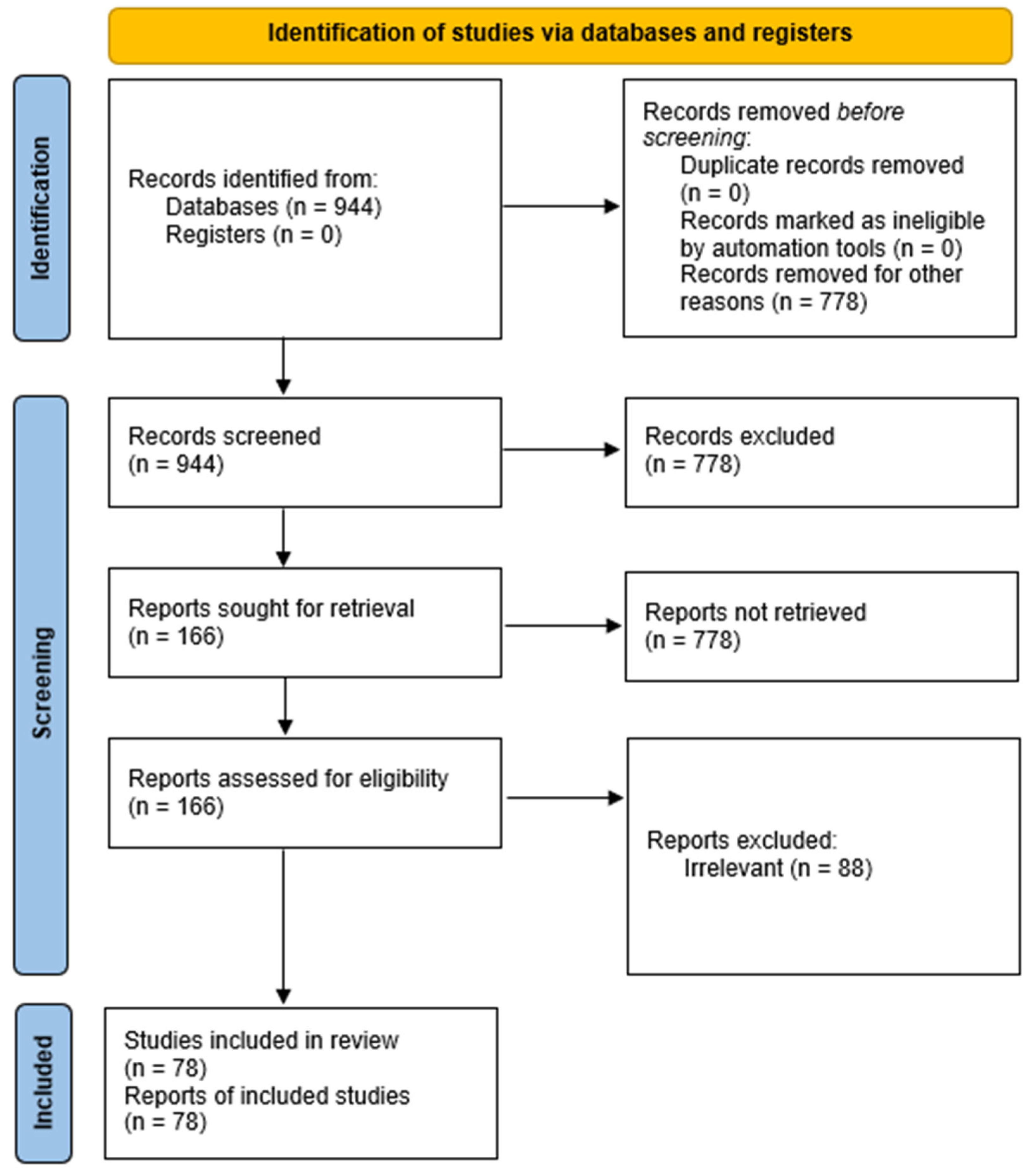
After, 166 papers related to social science were selected to focus on research articles that align with the specific academic framework relevant to this study [54]. In the second step, books, book chapters, and conference papers were excluded, leaving 99 academic articles, which typically present validated research aimed at expanding knowledge [55]. In the third step, 20 documents were manually excluded due to subject matter not relevant to items of interest, which were excluded because they focus on technical engineering areas and not practical administrative areas, like creation of smart cities, data science, etc., and as a result, 78 documents were obtained to be studied. After completing this process using the PRISMA model (Figure 1), the final selection included 78 documents (Table 2).
To reduce selection bias during manual curation, an explicit inclusion/exclusion codebook was developed based on criteria and employed a two-step process for selection (title/abstract then full text). A calibration exercise was conducted on a sample of records to tighten up the codebook and enhance consistency. A second reviewer screened a sample of the records independently, and discrepancies were discussed and the codebook was amended. The remaining records were re-assessed applying the final criteria, and reasons for exclusion were recorded to ensure traceability [56].

3.2. Selection Stage

Two selection criteria were established to identify the articles, enabling a focused and clear approach to the subject under investigation. These criteria are presented in Table 3.
To minimize subjective bias in applying the ‘Focus of the paper’ criterion, a screening codebook was used that operationalized ‘central focus’ vs. ‘peripheral mention’, recorded exclusion reasons, and conducted a second-reviewer verification on a random subsample to check consistency and resolve ambiguities.

3.3. Data Analysis

To add coherence, besides these methods, the PRISMA diagram of Systematic Reviews and Meta-Analyses was employed for inclusion and exclusion of articles [57] (the PRISMA checklist document is provided in the Supplementary Materials, see Table S1). Identifying and selecting high-quality, relevant papers is facilitated by the PRISMA method, which involves four stages: identification, screening, eligibility, and inclusion [58].
Following previous studies such as [59,60], the literature analysis was divided into two phases. This process has two stages; in the first stage, a flow chart developed by PRISMA was used to select the articles to be analyzed. In the second phase, the included papers were read and analyzed at a full-text level.
The screening of documents was carried out to result according to the PRISMA model (Preferred Reporting Items for Systematic Reviews and Meta-Analyses) [56] to allow systematic reporting.

3.4. Inclusion and Exclusion Criteria

The authors included peer-reviewed journal articles that were indexed in the Scopus database, and articles from 2017 to 2024 were prioritized. Scopus selection was safeguarded by the coverage of high-quality scientific publications (especially in the field of social science), and the increasing breadth of coverage of multidisciplinary areas, blockchain and logistics included. Only papers focusing on blockchain for supply chains and logistics, in particular, maritime logistics, are included. It was further narrowed down by filtering only papers with title and abstract that mentioned the main study’s keywords: “blockchain”, “supply chain”, and “logistics”. This helped to promote thematic consistency and to retain an adherence to the research questions. Full-text publication was also a condition which allowed us to perform an exhaustive analysis of each of the selected manuscripts.
On the other hand, several exclusion criteria were used to further narrow the dataset. Books, book chapters, and conference papers were excluded as these are not always subjected to the same peer review process as journal articles or may not hold the methodological detail necessary for a systematic literature review. These large-scale or highly specialized (smart cities) or engineering-centered (data science) studies on a particular area were not included in the review, due to focusing mainly on administrative, managerial, and policy aspects insights of blockchain technology applications in maritime logistics rather than technical development. Finally, papers prior to 2017 were not prioritized but some relevant papers were included to target the latest developments and the research direction of this quickly progressing topic.
The review gives priority to managerial/operational, governance, and institutional angles of blockchain adoption in maritime logistics (e.g., interoperability, regulatory enablement for eBLs, multi-actor governance, ROI readiness). Highly technical engineering studies are thus likely to have been under-represented in the systematic corpus of included literature; these are recognized as supplementary and cited strategically for framing purposes on the issue of technical feasibility.

3.5. Study Quality Appraisal

Due to the multidisciplinary nature of literature that will be included (conceptual, case-based, and empirical research designs), a single tool for risk of bias in biomedical studies cannot be directly utilized. Therefore, it was used a lightweight, non-design-specific quality appraisal rubric to label each included study as being of High/Medium/Low methodological rigor. The rubric considered six dimensions: (i) clarity of aims and context, (ii) transparency of study design and procedures, (iii) adequacy of data/evidence or argumentation in conceptual work, (iv) appropriateness of method to the stated aims, (v) treatment of validity/limitations or boundary conditions), and (vi) reproducibility/traceability (e.g., amount detail sufficient to replicate or verify). Each criterion was rated 0 (not addressed), 1 (partially), or 2 (completely satisfied), resulting in a score of 0–12. To this end, we coded studies that scored 9–12 High, 5–8 Medium, and 0–4 Low. Quality tiers were applied to judiciously attenuate the strength of conclusions and describe areas where evidence is more exploratory rather than implementation-proven nature [56].

3.6. Bibliometric Mapping Configuration and Robustness Checks

VOSviewer software (version 1.6.20) was employed to visualize the thematic structure of literature through bibliographic coupling and cluster analysis [47]. It is reporting the following set-up to be transparent and reproducible:
Counting technique: Full counting (every co-citation link counts as one).
Normalization approach: Association strength (proximity index).
Thresholds: A minimum threshold of 5 citations per document was used, thus rendering a network of 64 out of the 78 documents that passed this cut-off for analysis.
Clustering algorithm: We applied the smart local moving algorithm with its default resolution value (which corresponds to 1.0 in VOSviewer).
To evaluate the stability of the obtained cluster solution, we carried out sensitivity analyses by running the analysis for different parameterizations:
Different levels of thresholds: We set the minimum number of citations per document as 3 and 7. In the lower threshold (3), more documents (72) penetrated in the network while the constituents of seven main thematic clusters were still maintained at core, by only adding peripheral documents. At the upper cutoff of 7, as many as 58 documents were retained in network and the cluster structure was very stable, with no significant topics shifted.
Changing clustering resolution: The resolution varied from value 1.5 to 0.5. At the higher resolution (1.5), the main cluster (Red: “Technology Adoption”) was resolved into two finer clusters. At the lower level of resolution (0.5), “Stakeholders/Industry 4.0” (Purple) and “Sustainability” (Blue) clusters collapsed into a broader theme.
Despite these variations, the underlying theme identities of the clusters (for example, maritime-focused applications, technological innovation, and sustainability) did not change meaningfully. This stability provides confidence in the reported cluster solution.

3.7. Thematic Coding and Derivation of the Seven Research Fields

Themes were identified and developed by a triangulated synthesis of the findings. The identification of a persistent cluster structure was in the first place approached through bibliometric coupling, as implemented by VOSviewer. Second, it was conducted a structured evidence-map extraction to capture study metadata (e.g., study type, unit of analysis, theory use, and data type) and coded the recurring barriers/drivers’ issues (e.g., interoperability/standards, regulation–eBL recognition, cost/ROI). Third, the labels, or “research fields,” for clusters were confirmed by examining cluster contents in relation to coded patterns and structuring using TOE/institutional/RBV as analytical frames. Screening and coding process and rules of resolving disagreements are presented to reduce reviewer bias, as well as maintaining consistency when applying “Focus of the papers” criterion.

4. Results

The primary purpose of the descriptive stage was to present a description of the papers analyzed that address blockchain in the supply chain context specifically in the logistics sector. Table 4 presents the abridged evidence map and the complete evidence map (of 78 studies). A lightweight critical appraisal for each included study was performed to facilitate methodological transparency and comparative synthesis across heterogeneous study designs, e.g., by classifying methodological rigor as High/Medium/Low (as reported in Table 4). The assessment was based on (i) clarity of aims and scope, (ii) transparency of methods/procedure (or argument build-up for conceptual/legal work), (iii) sufficiency of data/evidence, and (iv) discussion about limitations/validity threats were gauged, along with the characteristics/traceability/reproducibility. Quality levels were not applied as exclusion criteria, but with the purpose of qualifying how strongly inferences could be made in the synthesis (e.g., placing more interpretive weight on more rigorous empirical evidence vs. purely conceptual claims).

4.1. Articles by Time

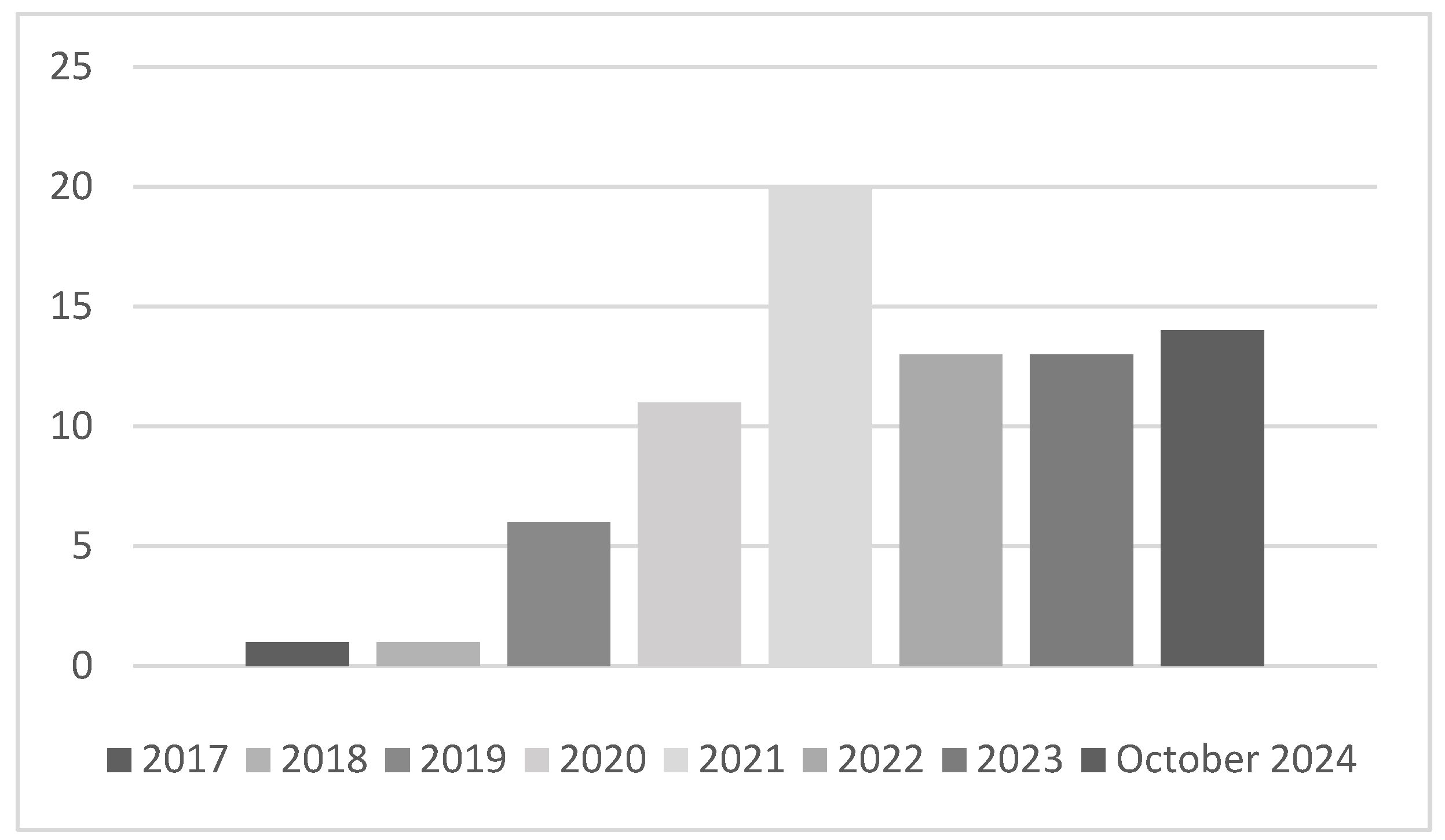
Figure 2 illustrates the trend in publications focused on Blockchain and logistics in supply chain studies from 2017 to September 2024. Between 2017 and 2020, the annual number of publications remained quite low, fluctuating between 0 and 6. However, a noticeable rise in the number of studies began in 2020. Notably, about 75% of the total articles on this subject were published in the last four years, indicating a growing interest and relevance in these topics in recent years.

4.2. Articles by Journal

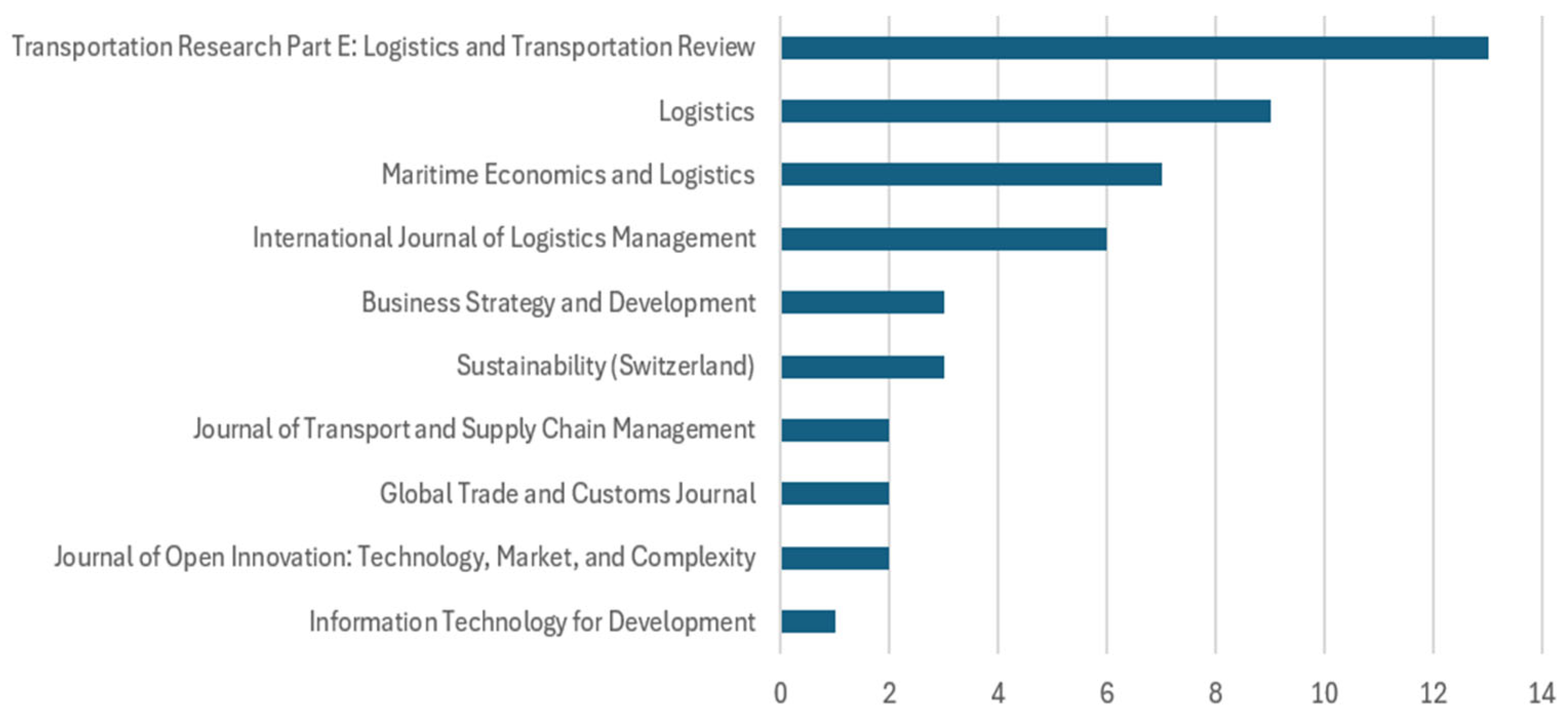
The selected papers were distributed across 38 different journals. However, nearly 43% of these articles appeared in just four specific journals (Figure 3). Transportation Research Part E: Logistics and Transportation Review (13), Logistics (9), Maritime Economics and Logistics (7), and International Journal of Logistics Management (6).

4.3. Articles by Region

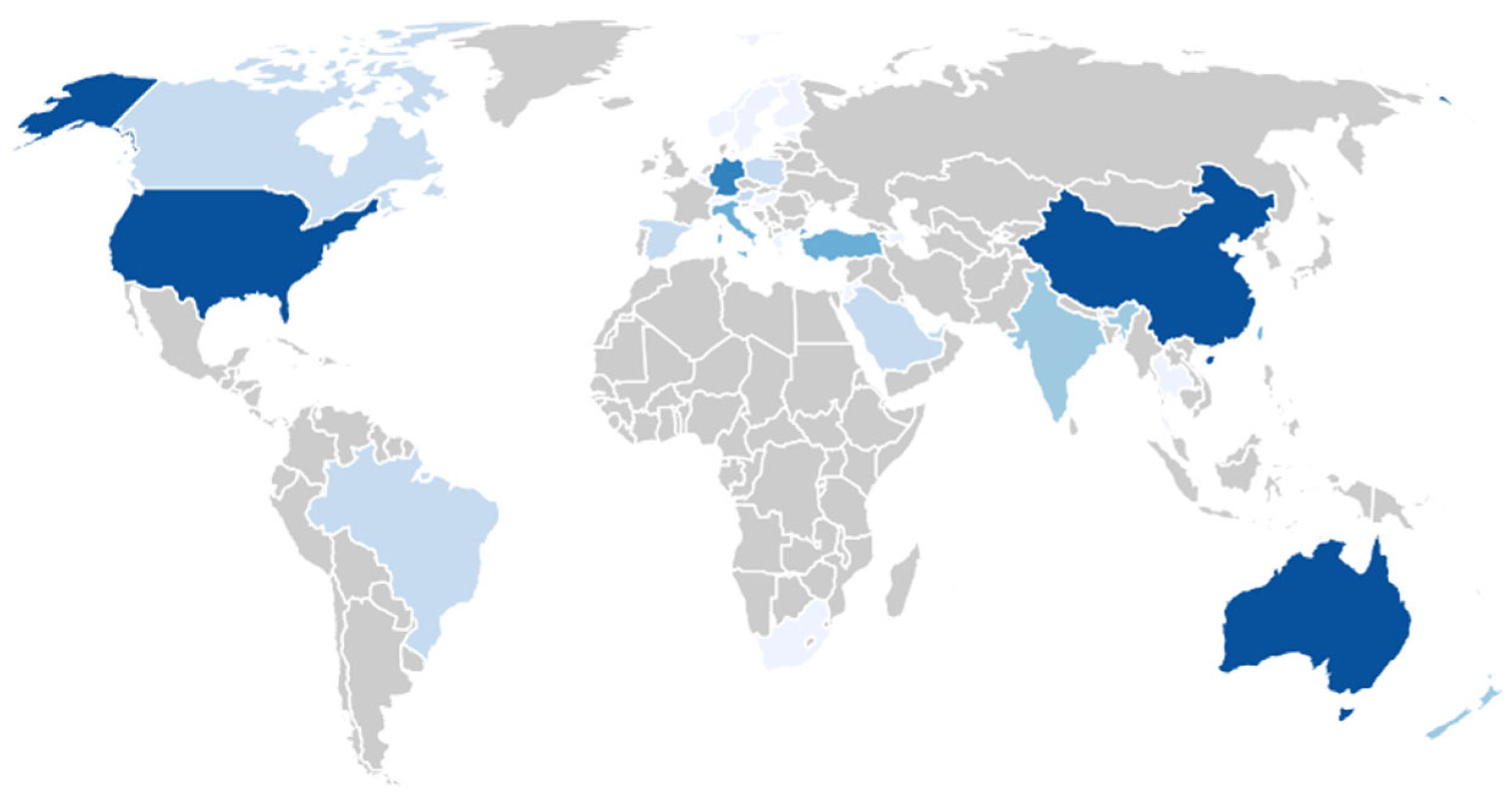
Despite the extensive range of journals globally addressing this topic, it was observed that majority of the publications originated from China (12), the US (10), and Australia (8). When analyzing the data presented in the documents by country (Figure 4), China and the US remained the most studied nations, followed by Germany, Italy, Hong Kong, and Turkey.

4.4. Articles by Methodology

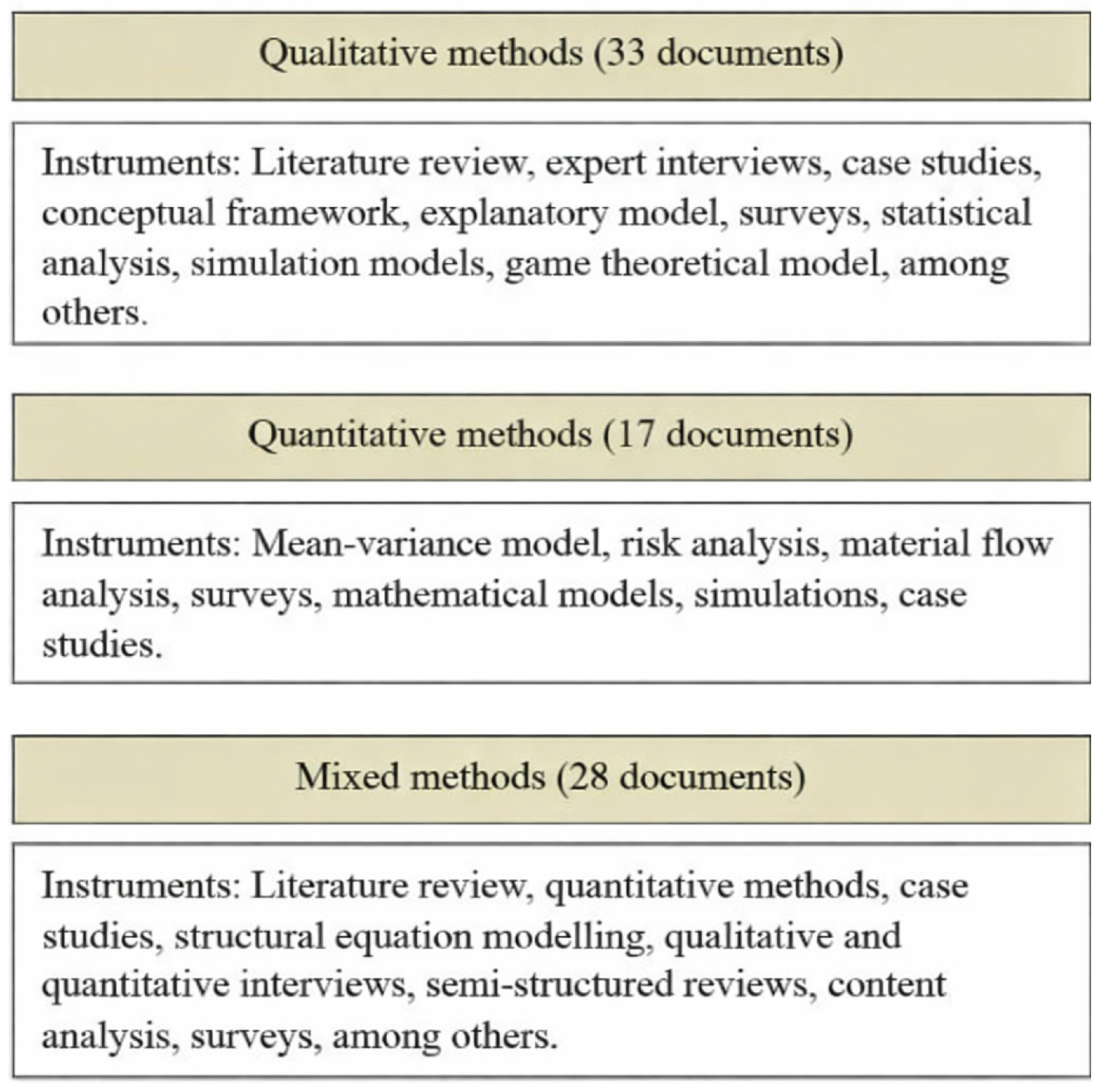
The purpose of analyzing the methods applied is to clarify how the reviewed studies were conducted. A total of 78 articles (Figure 5) were categorized into qualitative (33), quantitative (17), and mixed (28) methodologies.
In this review, the qualitative consists of both conceptual/theoretical papers and empirical research, which are essentially based on non-quantitative or with at most very little quantitative evidence (e.g., interview, content analysis). Quantitative consists of numerical data and modeling in terms of statistical, econometric, or optimization. Mixed methods are defined as papers that (i) couple a qualitative and a quantitative empirical part, or (ii) combine conceptual/theoretical development with an empirical validation part (e.g., case study/survey/simulation) in the same article.

5. Discussion

This literature review revealed a growing interest in the relationship between the blockchain and supply chain, specifically, in the segment of logistics over the past three years. This highlights that the topic is still emerging, with significant potential for development and relevance not only in countries like China or the US but also globally. The review provided a comprehensive overview and emphasized the depth of existing research on blockchain and logistics, particularly regarding the maritime sector.
  • RQ1. What are the main areas of research on blockchain relating to logistics in the supply chain?
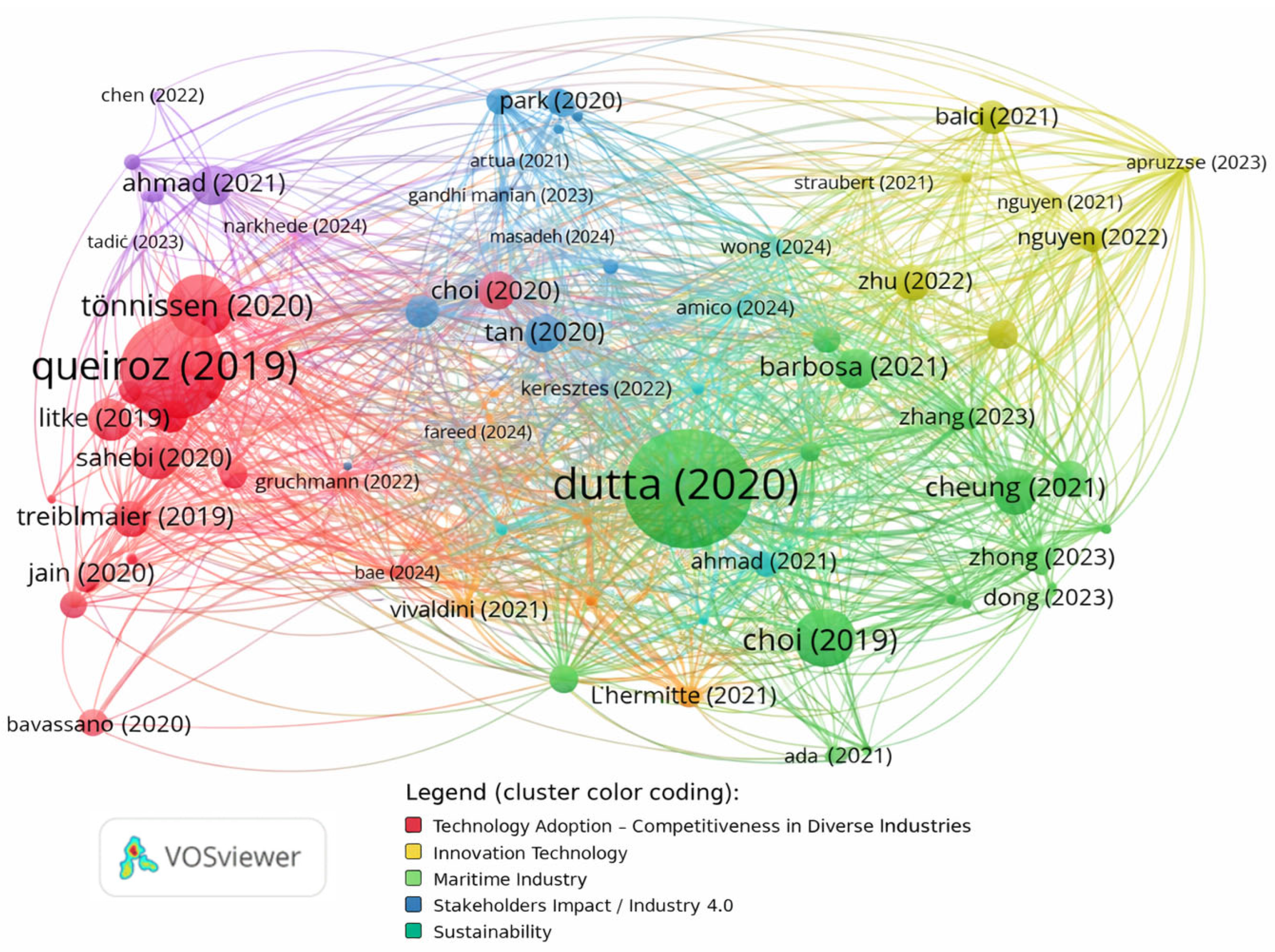
Blockchain technology has been examined from various perspectives and has been applied to specific domains focused on the logistics segment of the supply chain. The goal of this segment of the analysis was to conduct a comprehensive investigation using visualization software to identify the emerging research clusters that exist between the two variables (Figure 6). The tool utilized for this purpose was VOS viewer, an open-access software. It enables the construction and visualization of networks based on significant items derived from the scientific literature and is commonly employed for bibliometric reviews across different fields, including business [9,125]. Visualizing data through networks aids in clarifying and comprehending various fields and subfields while illustrating the relationships between mapping similarities and patterns [126]. Numerous bibliometric techniques exist, and in this instance, we employed bibliographic coupling [127]. The bibliographic coupling within VOSviewer serves as a method for analyzing and visualizing the interconnections between different couplings in academic texts, assisting in identifying usage patterns and relationships among diverse topics within a particular research domain [47].
The method can group very recent papers [128], which is particularly beneficial in this case due to the recent publication of most of the articles analyzed. Figure 6 illustrates the bibliographic coupling map generated using the chosen data, where seven distinct clusters can be observed [9].
The literature surrounding the relationship between blockchain and logistics in supply chain has seen substantial growth; this analysis highlights key areas of focus, emerging trends, and the evolution of blockchain applications in this field. The clusters reveal a diverse range of research topics, from blockchain technology integration to its impact on supply chain efficiency, offering a comprehensive view of how this technology is being explored and developed within logistics.

5.1. Red Cluster: Technology Adoption-Competitiveness in Diverse Industries (20 Documents)

The adoption of blockchain technology varies across industries, influenced by sector-specific needs, regulatory environments, and technological readiness [10]. While some industries are leading in blockchain integration due to high regulatory compliance requirements or the need for enhanced security and efficiency, others face greater challenges related to costs, interoperability, and resistance to change. Below is a detailed examination of how blockchain adoption differs across key industries:
  • Maritime Logistics and Global Trade—Supply chain visibility, regulatory compliance, fraud prevention.
  • Retail and Consumer Goods—Product authentication, consumer trust, ethical sourcing.
  • Pharmaceuticals and Healthcare—Drug traceability, regulatory compliance, data security.
  • Financial Services and Banking—Fraud prevention, smart contracts, cross-border transactions.
  • Sustainability and Circular Economy—Carbon footprint tracking, sustainable sourcing, green logistics.
  • Automotive and Manufacturing Supply Chains—Real-time component tracking, quality assurance, smart-contract automation.
Blockchain adoption varies widely across industries, depending on sector-specific challenges, regulatory demands, and digital readiness. To unlock blockchain’s full potential, industries must address key challenges such as interoperability, regulatory alignment, and technological scalability.

5.2. Green Cluster: Innovation Technology (16 Documents)

Blockchain technology is a key innovation in supply chains, addressing traditional challenges such as lack of transparency and data tampering [8]. It offers a decentralized, secure ledger that enhances traceability and allows real-time tracking of goods, reducing fraud and delays [8]. Blockchain also enables smart contracts to automate processes, streamline transactions, and improve efficiency. While blockchain has great potential to transform logistics operations, challenges such as high costs, system integration complexity, and standardization issues need to be addressed for successful implementation [12].

5.3. Yellow Cluster: Maritime Industry (12 Documents)

Using blockchain for the maritime logistics industry provides solutions to historical inefficiencies such as poor documentation, fraudulent activity, and lack of transparency [38]. Blockchain enhances the velocity and accuracy of the ship movement process through digitizing the papers and applying a distributed ledger [3]. Smart contracts can automate duties like payment and shipping notification, thus reducing the error and improving the efficiency of operations [3]. Despite this, blockchain uptake in maritime logistics experiences many difficulties such as lack of interoperability, high cost, and the required industry-level cooperation [3]. Nevertheless, blockchain offers great prospects for enhancing the efficiency and transparency of global trade [129,130,131].

5.4. Purple Cluster: Stakeholders Impact Industry 4.0 (10 Documents)

In the 4.0 industry, blockchain creates more collaboration and transparency between the supply chain stakeholders, such as manufacturers, suppliers, and consumers [132]. Blockchain’s real-time and immutable data-mechanism improves trust and mitigates conflicts due to misinformation [132]. Such intermediaries’ processes can be automated using smart contracts, which will reduce human error and ensure efficiency in processes such as shipment verification and inventory tracking [132]. Furthermore, the traceability and real-time data provided by blockchain also allow stakeholders to track and adapt to disruptions, thus leading to more resilient and responsive supply chain [117].

5.5. Blue Cluster: Sustainability Blue Cluster: Sustainability

Blockchain in sustainability is devoted to enhancing the traceability and transparency of environmental and social practices in supply chains [65,70]. It allows for the validation of sustainability claims through immutable records of product journeys from origin to customer receipt [65,70]. Furthermore, blockchain—when embedded with IoT devices—can also enhance such logistical processes, which may translate to less wastage and lower carbon footprints [98,133,134], such as fuel consumption monitoring and suggesting efficient routes. Through smart contracts, blockchain further streamline processes and minimize human error, aligning logistics operations with sustainability goals and fostering more responsible supply chain management [48]. Below the key benefits of blockchain technology for supply chain operations are shown (Table 5).
Blockchain application in maritime logistics is rooted in its capability to offer decentralized, transparent, and immutable record-keeping, to alter inefficiencies of the sector, including paper-based documentation, cargo frauds, and no real-time visibility [30,150]. Blockchain technology enables stakeholders to securely share data, thus improving trust, compliance with the regulations, and supply chain performance [151].
Smart contracts automate the transactions and minimize the delay in customs clearance, freight payments, and cargo handover, but the enforceability of smart contracts in cross-border legal systems is still a problem [152]. In addition, blockchain-integrated electronic Bills of Lading (eBLs) help smooth operations but are inhibited by true and false acceptance differences among legal systems [56]. Security research has proved blockchain’s tamper resistance and can solve the problem of suppressing cyber risk, but privacy in permissionless systems and security flaws in smart contracts remain a concern [11].
However, the high deployment cost, compatibility problem, and standard protocols are the main barriers for deploying it on a large-scale [153]. Future research should focus on scalability, hybrid blockchain models, and empirical case studies to validate blockchain’s long-term viability in maritime logistics.
  • RQ2. What are the primary challenges and barriers to the adoption of blockchain technology in maritime logistics?
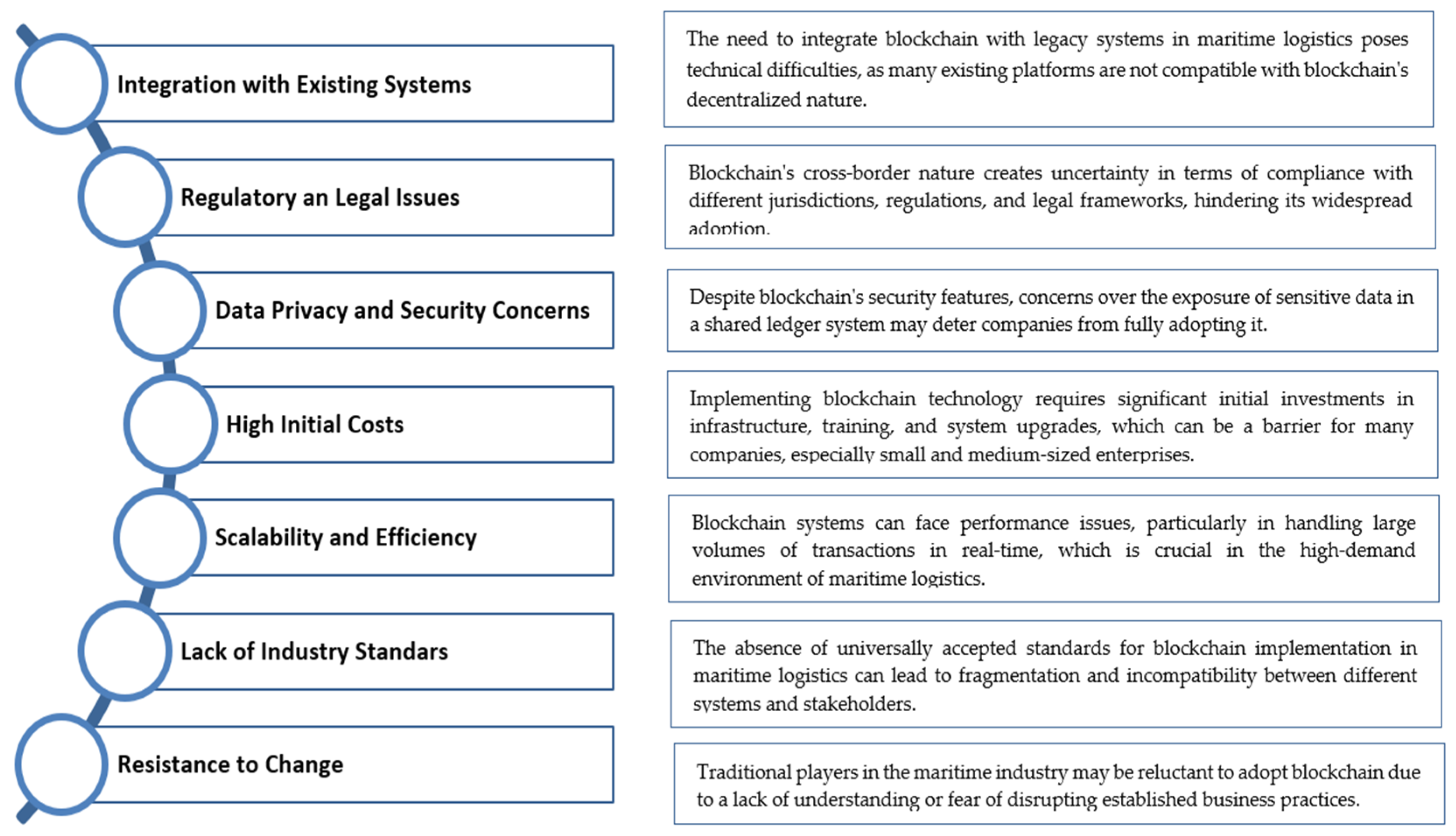
Implementing blockchain technology in maritime logistics faces significant obstacles (Figure 7). One major challenge is integrating it with existing legacy systems, as these were not built for decentralized frameworks [8]. Additionally, regulatory uncertainty complicates adoption due to varying international legal standards [10]. Issues related to data privacy are also prevalent, since access to sensitive information on an open ledger adds up to high risk for many businesses [142].
High initial costs for infrastructure, along with the requirement of staff training, again add up to another obstacle, least of all for SMEs [144]. The scalability issue occurs since it is not efficient for blockchain networks to process with many transactions operated in global logistics, in which the amount of transaction is huge [144]. The lack of universal standards resulted in the fragmentation and intricate implementation [144]. Finally, there is a high degree of resistance to change, since many well-established maritime players are unwilling to replace their existing systems with newer technologies with which they are less familiar [144].
Solving these issues will require regulators, industry players, and tech providers to work together to scale this up.
Table 6 consolidates these adoption factors based on the TOE as the main framework supported by institutional theory and RBV to explain mechanisms and capability demands.

5.6. TOE—Technological Context: Interoperability, Standards, Cybersecurity, Smart Contracts

The common technical bottleneck in the literature on maritime, is unadulterated—unquestionably—it is not merely ‘difficulty of integration’, but a structural barrier to system convergence between heterogeneous port/carrier/customs/forwarder systems around common data models and means of exchanging. This is consistent with the TOE “technology context” as an enabler: while blockchain’s ledger immutability is appreciated, adoption lags where legacy architectures, unclean master data, and discordant platform choices inhibit end-to-end process completion [35,37,38,39].
A second persistent technological tension is the one around security and privacy. While maritime stakeholders can require transparency to ensure traceability, they also control data exposure to protect commercial sensitivity and comply with regulations. This mitigates designs towards permissioned/consortium and selective disclosure but also drives smart-contract assurance demands and cyber-risk implications [154,155]. What the literature, therefore, implies is that blockchain security should not be portrayed as a given; rather, it depends on threat modeling activities, smart contract auditing approach, and audit firms’ credentials for being efficient in governance of access rights or tuning cybersecurity routines [38,154].
Finally, scaling up and performance are still limiting adoption factors in that maritime logistics involves a very large number of transactions, and time-critical coordination is required. Scalability is repeatedly discussed not only in terms of throughput, but also as operational robustness under peak loads, and multi-party synchronization [35,37]. This adds fuel to a cautious stance: the technical case is strongest where workflows can be modularized, digitalized, and governed with clearly defined interfaces, not ‘plug-and-play’ across the entire maritime ecosystem [155,156].

5.7. TOE/RBV—Organizational Context: Capabilities, Readiness, Resistance, ROI Governance

In TOE parlance, the organizational context (resources, structure, and readiness) directly interacts with RBV: many maritime actors do not use blockchain as it is missing the complementarity dynamic of capabilities that transform a ledger to functional improvements. The literature cited for review considers adoption feasibility often in terms of IT competence, process governance maturity, and change-management capability that is disproportionately distributed between carriers, ports, customs brokers and, particularly, SMEs [38,48,150]. This means that the “business case” is not abstract but will vary depending on whether the firm (or port ecosystem) has what it takes to re-engineer workflows, train personnel, and institutionalize new control routines.
Cost and return-on-investment (ROI) discussions should be positioned as investment governance under uncertainty, rather than a binary “high cost” obstacle. Upfront infrastructure, integration, and training expenses are indicated in the literature with benefits that occur only after the involvement of multiple parties surpasses a certain threshold [38,150]. This backs up a more poignant point in the discussion, that ROI is endogenous to the adoption of such systems—meaning single-firm pilots may underestimate or mis-measure value, while large consortia reconfigure these benefits and incentives [48].
Resistance to change should also realistically be thought of as an organizational capability issue: path dependence on existing routines (handling documentation, port community traditions and bias, compliance processes) means adoption depends far more on leadership and governance than it does on demand. As evidenced in empirical studies of adoption barriers, human skills and organizational readiness have been identified as constraining factors rather than second-order challenges [37,48]. This helps with RBV-based explanation: capability development and change governance are strategic resources which determine whether blockchain can be a source of sustained advantage.

5.8. TOE/Institutional—Environmental Context: Regulation, eBL Recognition, Customs/Ports Gatekeeping, Consortia Diffusion

The capture of blockchain value in shipping and trade comes down to whether electronic trade documents can reach legal parity regardless of jurisdiction. Thus, legal acceptance of transferable electronic records (including eBL) is not incidental but a formal condition for scaling documentary workflows and achieving purported efficiencies [5,6,79]. This “environment” in TOE is the institution: adoption depends on regulatory enforceability, cross-border recognition, and legitimacy of digital documentation.
Furthermore, ports, customs, and lead carriers act as intermediaries (or mediators), which may facilitate or hinder diffusion through their procedural demands and choices of platforms. As the literature highlights, multi-stakeholder-mode governance and coordination are central to the uptake of maritime that is in line with the institutional theory levers (coercive, normative, and mimetic pressures), as well as with ecosystem participative thresholds [35,36]. Thus, adoption drivers such as “collaboration” and “network effects,” are an example of institutional coordination work, rather than simply a technical collaboration preference [36,157].
Lastly, standards and consortia also matter because they operationalize the institutional diffusion mechanism: once shared data models and interoperable workflows become standardized, uncertainty decreases while mimetic adoption becomes more likely. The evidence collected reveals that industry frameworks or interoperability initiatives (e.g., [7]) are not merely “details of implementation,” but they really are relevant evidence for the environmental/institutional dimension of adoption.

5.9. Implications for IBAF: What It Explains Well vs. What It Omits

There is a solid foundation to assess the four pillars of IBAF. First, technological readiness is thoroughly encouraged: interoperability, standards alignment, cybersecurity, and smart-contract soundness are seen rising repeatedly among the most enduring blockers (and design requirements) when we explore maritime logistical studies [35,37], such as [154,155]. Second, economic viability is also endorsed; however, the literature implies that viability is contingent on ecosystem; costs and ROI are moderated by organizational capability and network participation rather than uniform across adopters [38,48,150]. Third, an underpinning regulatory foundation emerges as maritime-specific because the legal consideration of eBLs as transferable electronic records will determine whether such BL and documentary processes are scalable and remain legally effective [5,6,79]. Fourth, operational integration is further substantiated as the source-receiver spectrum and governance structure have been repeatedly confirmed to induce diffusion and impacts [35,36].
Meanwhile what IBAF currently under-specifies and should acknowledge more openly—value distribution and power asymmetries (who ‘captures’ gains in consortia), data-ownership/commercial-confidentiality tensions that limit claims to transparency, and the likelihood that adoption will proceed via hybrid forms of governance whereby institutional legitimacy/standards maturity typically precede full integration on the ground [36,48]. Nuancing in this way will also help prevent the overstatement of “practical readiness”: review evidence to date indicates “conditional potential” (that is, it is ready but only under contingent circumstances brought about by coordinated enabling conditions—e.g., legal, organizational, and standards) rather than pure technical feasibility [5,6,38].

5.10. Theory-Guided Synthesis of Barriers, Drivers, and Adoption Mechanisms for Blockchain in Maritime Logistics and Linkage to the IBAF

Several barriers to the adoption of blockchain in maritime logistics exist, such as high costs of adoption, regulatory and standardization landscape uncertainties, complex interoperability problems, resistance to change, and questions about scalability [30,150]. Economic constraints are the result of considerable investment in infrastructure, integration of systems, and in training the staff of the enterprise, thereby presenting challenges to small- and medium-sized enterprises (SMEs) to adopt [153]. Regulatory digital technologies continue developing due to the absence of a standardized legal framework for blockchain-based documentation, for example, Bills of Lading (eBLs) that are not yet accepted in all jurisdictions [56]. Interoperability problems stem from the existence of several blockchain platforms without end-to-end communication protocols, which hinders efficient joint working of shipping lines, ports, and customs [151].
Moreover, resistance to change exists among various interested parties who are reluctant to move from centralized to decentralized as the interest groups are concerned with privacy, controlling, and even the job lost with the change [84]. Scalability challenges persist, particularly in public blockchain networks, where transaction processing speed and energy consumption remain major obstacles [11].
While recent studies propose hybrid blockchain models combining public and private ledgers to address privacy and efficiency concerns, their widespread adoption remains limited [158]. Future research should focus on developing cost-effective solutions, regulatory harmonization, and cross-platform interoperability to ensure the large-scale deployment of blockchain in maritime logistics.
  • RQ3. What key factors drive blockchain adoption in maritime logistics?
As has been analyzed, blockchain adoption in maritime logistics is driven by its potential to enhance transparency, security, and efficiency in global supply chains [150]. Amidst continued deadlock between the players of the shipping industry (due to habitual fraud, manual documentation, cargo tracking complexity, and cybersecurity concerns), the blockchain provides decentralized, immutable, and trust-enhancing repositories for all stakeholders [30]. Crucial adoption drivers are to decrease costs by automation, compliance with regulations, business sector cooperation, and increased necessity for secure digital transactions [151]. But, broad adoption is being stymied by impediments such as the high cost of entry, compatibilities, and regulatory uncertainty [152].
An interesting aspect concerning blockchain in maritime logistics is its potential to improve the interoperability in global supply chains. When different stakeholders use several systems and standards, sharing information preempting into involved parties may become challenging, and there would be a likelihood of error [157]. Blockchain’s dispersed ledger makes it possible that all parties irrespective of their location or system have real-time access to the same trusted information [159]. This common view can remove data silos, facilitate communications and decrease paperwork time and other bureaucratic burdens, which should allow for greater ease of collaboration over distances [160]. Blockchain is expected to substantially mitigate inefficiencies and enhance collaboration across the global maritime supply chain by establishing a standardized, secure platform of information exchange [161].
Reviewing the available research, what makes the adoption of blockchain technology successful and what are the limitations and gaps in the area can be discovered.
(1) Transparency and Integrity of Data.
One of the major reasons for adopting blockchain technology in maritime logistics is its capability to improve transparency and maintain the integrity of data. The industry is also plagued with fraud, tampering of documents, and poor management of data, all of which blockchain can address by offering an immutable and verifiable ledger [30,150].
Research Contributions:
  • Some articles emphasize that blockchain can improve data integrity and traceability, which reduces disputes and increases the efficiency of operations [30,150].
  • Cases such as TradeLens, which have been built by Maersk and IBM, show how blockchain enables real-time visibility across the global shipping ecosystem.
Limitations:
  • The issue of data privacy is one of the challenges of utilizing blockchain technology as companies are not willing to share sensitive information on a decentralized ledger [13].
  • Adoption is hindered by lack of standardized data sharing protocols among various supply chain stakeholders [151].
(2) Economy and Efficiency.
There are also opportunities blockchain technology offer: reducing the operational inefficiencies caused by intermediation alongside the automated automation of tracking via smart contracts and reduction in paperwork [155,156]. This is especially true in the context of maritime logistics, where manual paperwork, port congestion, and customs checks drive up expenses.
Research Contributions:
  • It has been identified from studies that blockchain smart contracts reduce the transaction costs by removing the middlemen and making document verification more automatic [156].
  • IoT and blockchain integration for real-time cargo tracking enhance port operations efficiency by minimizing avoidable demurrage payment [155].
Limitations:
  • High start-up costs are involved involving infrastructure, technology, and manpower training [140].
  • Hundreds of small- and medium-sized enterprises in the maritime sector do not dispose of the necessary financial and technical requirements to effectively implement blockchain [153].
(3) Compliance with Regulations and Laws.
Regulation also plays a part in blockchain implementation, as shipping regulations are universal. Institutions and the government are among the huge number of entities who are increasingly taking union between blockchain and security (International Maritime Organization [IMO]), as well as standardization of digital documentation, seriously [158,162].
Research Contributions:
  • The International Chamber of Commerce (ICC) has advocated blockchain-based digitalized documentation, such as eBL, to ease the compliance and mitigate fraud [162].
  • Regulatory checks can also be automated with smart contracts to ensure compliance with environmental and customs norms [158].
Limitations:
  • Lack of regulatory clarity in many jurisdictions hinders blockchain implementation [56].
  • The maritime industry is highly fragmented, making global regulatory harmonization difficult.
(4) Industry Collaboration and Network Effects.
The effectiveness of blockchain in maritime logistics depends on widespread industry collaboration [150,163]. Since maritime supply chains involve multiple stakeholders (shipping companies, ports, customs authorities, freight forwarders), successful implementation requires coordinated efforts [150,163].
Research Contributions:
  • Studies indicate that collaborative blockchain platforms create network effects, where benefits increase as more participants join [150].
  • Blockchain enhances trust among stakeholders, reducing dependency on intermediaries and promoting direct transactions [163].
Limitations:
  • Resistance to change remains a significant barrier, as many firms are reluctant to adopt blockchain due to perceived risks and the complexity of integration [164].
  • Interoperability issues between different blockchain systems limit seamless data exchange [165].
(5) Cybersecurity and Risk Management.
Cybersecurity threats, including data breaches and hacking, pose significant risks to maritime logistics [154]. Blockchain offers a decentralized and encrypted solution that enhances data security and fraud prevention [154].
Research Contributions:
  • Blockchain’s distributed ledger system reduces the risk of single-point failures, making it harder for cybercriminals to manipulate data [154].
  • The use of private and consortium blockchains ensures controlled access, balancing transparency with security [166].
Limitations:
  • Quantum computing advancements may pose a future threat to blockchain encryption [167].
  • Security vulnerabilities in smart contracts can still be exploited if not properly audited [11].
While blockchain enhances transparency, efficiency, regulatory compliance, and cybersecurity, adoption remains hindered by high implementation costs, regulatory uncertainty, and resistance to change [168]. Overcoming these barriers through targeted research and innovation will enable blockchain to transform global maritime supply chains, making them more secure, transparent, and efficient [161].
To bridge this gap, the Integrated Blockchain Adoption Framework (IBAF) is introduced as a comprehensive theoretical model that synthesizes technological readiness, economic feasibility, regulatory support, and operational integration as the four core pillars influencing blockchain adoption in maritime logistics [169]. Unlike previous models, IBAF specifically considers maritime-specific factors, including legal recognition of electronic Bills of Lading (eBLs), supply chain interoperability, and cybersecurity risks [169].

5.11. Future Research

This section outlines the proposed future research directions, derived from the comprehensive analysis conducted at the intersection of the two concepts through the literature review (Table 7).
Note that the research questions in this table are re-formulated by the authors as directions for future research based on repeated limitations and gaps evident in synthesis; they are not exact quotations taken from reports.
This table presents seven key research areas that address critical aspects of blockchain adoption in maritime logistics, outlining their descriptions, potential research questions, and suggested methodologies for further investigation.
Each research area highlights critical knowledge gaps, providing a roadmap for future studies to enhance blockchain’s adoption and effectiveness in global maritime logistics.
Blockchain can revolutionize supply chain transparency in several sectors including pharmaceutical and meat production industry [37]. In these industries, in which product authenticity, traceability, and safety are paramount, as is the case with food and healthcare, blockchain presents an opportunity to securely record every step a product has taken from production to distribution. This inviolable ledger guarantees that the consumer, regulators, and businesses authenticate in real time the integrity and history of the goods [147]. In pharmaceuticals, this would prevent counterfeit drugs from being circulated since the blockchain would be able to monitor every transaction and movement of the drug in question [61]. In the same vein, in the food sector, it may ensure quality and safety and establish consumer confidence for good tracking of farm-to-fork via specific products [138]. This broad utility in different fields illustrates the adaptability of blockchain and its potential to improve transparency, reliability, and safety.

6. Conclusions

This literature review suggests that blockchain-based solutions have the potential to overcome many harbored inefficiencies in maritime logistics and that, specifically, transparency, traceability, and trust in supply chains are key to potential applications. Nevertheless, the evidence base described in our review is still characterized by conceptual, exploratory work and proportionally few longitudinal multi-stakeholder full-scale deployments. Practical implementation is thus better described as promising but haphazard, assuming (i) legal recognition of electronic trade documents (notably eBLs), (ii) diverse codes enabling interoperability among actors, and (iii) governance structures that set out responsibilities and liabilities in a transparent manner.
This IBAF developed in this study integrates the overarching factors identified as connected into an integrated framework, which reflects a more comprehensive perspective than disparate factor inventories. What it does so particularly well is to combine the institutional difficulties deriving from maritime with existing technological and organizational aspects, creating adoption as a multidimensional problem. Yet, as a theoretical model constructed from synthesis, the IBAF has not yet been tested empirically. Its present description may also downplay other explanatory factors, such as market power imbalances between consortia, data sovereignty disputes, and the drag of legacy business models. However, this is a theory in need of operationalization and testing—whether through comparative cases, hypothesis-based surveys, or event-studies around regulatory changes—to assess its explanatory power and its limits.
The maritime logistics sector has great potential for the transformative leanings of blockchain applications as there are enduring challenges surrounding inefficiencies, transparency, as well as trust [3]. Through this systematic literature review, it was found that the key characteristics of blockchain—decentralization, immutability, and increased data security—can revolutionize present maritime operations, creating a more collaborative and accountable supply chain. Nevertheless, although the potential benefits are clear in theory, implementation on the ground continues to be stymied by issues of scalability, interoperability, regulatory confluence, and the high financial costs of adoption [8].
The study also identifies several major knowledge gaps, for example, the complete economics impact of blockchain, its interface with emerging technologies like AI and IoT, and the potential of the technology to generate sustainability of the maritime industry [147]. While economic and operational effects are widely debated, there is a paucity of evidence regarding the full range of economic impacts—especially system-wide and distributional impacts (e.g., how costs/benefits shift across carriers, ports, forwarders, shippers, insurers, regulators), or how micro-level ROI aggregates up to shape macro/sector-wide efficiency and resilience outcomes. These shortages are calling for more empirical research, industry-wide cooperation, and the creation of standardized institutional mechanisms to accelerate the diffusion of blockchain on a worldwide basis.
With an eye to the future, now is the time for cooperation between academia, industry, and policy makers to break down these barriers and ensure that blockchain technology can truly succeed. Through targeted investigation and pilot effort, stakeholders can examine new applications, share best practices, and create solutions that reflect the changing requirements in maritime [38]. It would allow blockchain technology to not only improve efficiency and transparency but to make maritime logistics a forerunner of digital transformation and sustainable growth within the global logistics supply chain [112].
This paper has examined the development of blockchain research in maritime logistics, delineating research areas, adoption drivers, and challenges that are perceived as critical to the successful adoption and implementation. Consistent with the aim of the research, it is proved that the blockchain can increase transparency, efficiency, and security in maritime supply chains by providing more traceability, automation, and fraud prevention. Nevertheless, as promising as it sounds, barriers like interoperability of systems, regulatory ambiguity, cost of implementation, and resistance from the organizations are some of the challenges faced by blockchain implementation.
Solving these challenges, this paper recommends three strategies as follows: (1) designing uniformed blockchain standards to improve interoperability and further integration of maritime players; (2) forming a set of global legislations to synchronize blockchain-based trade documentations and compliance; (3) building hybrid blockchain such that it mixes the advantages of both public and private ledgers to achieve the security and scalability for the seaward logistic operations. Research on empirical cases, cross-industry synergies, and the economic consequences of blockchain implementation is needed to help further the adoption of digital technology and better prepare the maritime logistics system for future shocks. These three approaches are synthesis recommendations arrived at by the authors by collating common barriers and solution patterns from across all 78 reviewed papers, rather than concepts recorded word-for-word as a uniform ‘result’ from any one paper.
In summary, while blockchain technology in maritime logistics remains a field in its early stages of development, its promise to drive operational, economic, and environmental benefits presents a compelling case for continued investment in research and implementation efforts. This study serves as a foundational step in shaping future discussions and strategies, paving the way for a more efficient and resilient maritime logistics ecosystem.

Supplementary Materials

The following supporting information can be downloaded at: https://www.mdpi.com/article/10.3390/logistics10010012/s1, Table S1: PRISMA 2020 checklist [56].

Author Contributions

Conceptualization, C.M.-S., J.M.-G., J.A.S. and J.A.G.-R.; methodology, C.M.-S., J.M.-G., D.M.M.-B. and J.A.S.; validation, C.M.-S., J.M.-G., J.A.S. and J.A.G.-R.; formal analysis, C.M.-S., J.M.-G. and J.A.G.-R.; investigation, C.M.-S., J.A.S., D.M.M.-B. and E.H.; data curation, J.M.-G., J.A.S., J.A.G.-R. and E.H.; writing—original draft preparation, C.M.-S., J.M.-G., J.A.S. and J.A.G.-R.; writing—review and editing, C.M.-S., J.M.-G., J.A.S., D.M.M.-B., E.H. and J.A.G.-R.; visualization, C.M.-S., J.M.-G., J.A.S. and D.M.M.-B.; supervision, C.M.-S., J.A.S. and J.A.G.-R.; project administration, C.M.-S., J.A.S., D.M.M.-B. and E.H. All authors have read and agreed to the published version of the manuscript.

Funding

This research received no external funding.

Institutional Review Board Statement

Not applicable.

Informed Consent Statement

Not applicable.

Data Availability Statement

The original contributions presented in this study are included in the article/Supplementary Materials. Further inquiries can be directed to the corresponding author.

Conflicts of Interest

The authors declare no conflicts of interest.

References

  1. International Maritime Organization (IMO). IMO. 2023. Available online: https://www.imo.org/en/about/pages/default.aspx (accessed on 24 December 2025).
  2. Cheung, K.-F.; Bell, M.G.H.; Bhattacharjya, J. Cybersecurity in logistics and supply chain management: An overview and future research directions. Transp. Res. Part E Logist. Transp. Rev. 2021, 146, 102217. [Google Scholar] [CrossRef]
  3. Peronja, I.; Lenac, K.; Glavinović, R. Blockchain technology in maritime industry. Pomorstvo 2020, 34, 178–184. [Google Scholar] [CrossRef]
  4. Tönnissen, S.; Teuteberg, F. Analysing the impact of blockchain-technology for operations and supply chain management: An explanatory model drawn from multiple case studies. Int. J. Inf. Manag. 2020, 52, 101953. [Google Scholar] [CrossRef]
  5. United Nations Commission on International Trade Law (UNCITRAL). Model Law on Electronic Transferable Records (MLETR). 2017. Available online: https://uncitral.un.org/en/texts/ecommerce/modellaw/electronic_transferable_records?utm_source= (accessed on 12 December 2017).
  6. UK Parliament. Electronic Trade Documents Act 2023. 2023. Available online: https://www.legislation.gov.uk/ukpga/2023/38/contents?utm_source= (accessed on 12 December 2025).
  7. Digital Container Shipping Association (DCSA). Booking and Bill of Lading Standards—Adoption Guide. 2025. Available online: https://dcsa.org/standards/booking/adoption-guide-booking-and-bill-of-lading?utm_source= (accessed on 12 December 2025).
  8. Dutta, P.; Choi, T.-M.; Somani, S.; Butala, R. Blockchain technology in supply chain operations: Applications, challenges and research opportunities. Transp. Res. Part E Logist. Transp. Rev. 2020, 142, 102067. [Google Scholar] [CrossRef]
  9. Paul, J.; Criado, A.R. The art of writing literature review: What do we know and what do we need to know? Int. Bus. Rev. 2020, 29, 101717. [Google Scholar] [CrossRef]
  10. Litke, A.; Anagnostopoulos, D.; Varvarigou, T. Blockchains for Supply Chain Management: Architectural Elements and Challenges towards a Global Scale Deployment. Logistics 2019, 3, 5. [Google Scholar] [CrossRef]
  11. Zhu, Q.; Bai, C.; Sarkis, J. Blockchain Technology and Supply Chains: The Paradox of the Atheoretical Research Discourse. Transp. Res. Part E Logist. Transp. Rev. 2022, 164, 102824. [Google Scholar] [CrossRef]
  12. Teodorescu, M.; Korchagina, E. Applying Blockchain in the Modern Supply Chain Management: Its Implication on Open Innovation. J. Open Innov. Technol. Mark. Complex. 2021, 7, 80. [Google Scholar] [CrossRef]
  13. Sun, X.; Kuo, Y.-H.; Xue, W.; Li, Y. Technology-Driven Logistics and Supply Chain Management for Societal Impacts. Transp. Res. Part E Logist. Transp. Rev. 2024, 185, 103523. [Google Scholar] [CrossRef]
  14. Tseng, Y.-Y.; Yue, W.L.; Taylor, M.A.P. The Role of Transportation in Logistics Chain. Proc. East. Asia Soc. Transp. Stud. 2005, 5, 1657–1672. [Google Scholar]
  15. Mentzer, J.T.; DeWitt, W.; Keebler, J.S.; Min, S.; Nix, N.W.; Smith, C.D.; Zacharia, Z.G. Defining Supply Chain Management. J. Bus. Logist. 2001, 22, 1–25. [Google Scholar] [CrossRef]
  16. Rushton, A.; Croucher, P.; Baker, P. The Handbook of Logistics and Distribution Management: Understanding the Supply Chain, 5th ed.; Kogan Page: London, UK, 2014. [Google Scholar]
  17. UNCTAD. Trade and Development Report 2020: From Global Pandemics to Prosperity for All: Avoiding Another Lost Decade; United Nations Conference on Trade and Development: Geneva, Switzerland, 2020; Available online: https://unctad.org/publication/trade-and-development-report-2020 (accessed on 24 December 2025).
  18. Alnipak, S.; Toraman, Y. Analysing the Intention to Use Blockchain Technology in Payment Transactions of Turkish Maritime Industry. Qual. Quant. 2024, 58, 2103–2123. [Google Scholar] [CrossRef]
  19. Stopford, M. Maritime Economics, 3rd ed.; Routledge: London, UK, 2009. [Google Scholar]
  20. Marenković, S.; Tijan, E.; Aksentijević, S. Blockchain Technology Perspectives in Maritime Industry. In Proceedings of the MIPRO 2021, Opatija, Croatia, 27 September–1 October 2021; pp. 1414–1419. [Google Scholar] [CrossRef]
  21. Nakamoto, S. Bitcoin: A Peer-to-Peer Electronic Cash System. 2008. Available online: https://bitcoin.org/bitcoin.pdf (accessed on 24 December 2025).
  22. Yli-Huumo, J.; Ko, D.; Choi, S.; Park, S.; Smolander, K. Where Is Current Research on Blockchain Technology?—A Systematic Review. PLoS ONE 2016, 11, e0163477. [Google Scholar] [CrossRef]
  23. Zheng, Z.; Xie, S.; Dai, H.-N.; Chen, X.; Wang, H. Blockchain Challenges and Opportunities: A Survey. Int. J. Web Grid Serv. 2018, 14, 352–375. [Google Scholar] [CrossRef]
  24. Holotiuk, F.; Moormann, J. The Impact of Blockchain Technology on Business Models in the Payments Industry. In Proceedings of the 13th International Conference on Wirtschaftsinformatik (WI 2017), St. Gallen, Switzerland, 12–15 February 2017; Available online: https://aisel.aisnet.org/wi2017/track09/paper/6/ (accessed on 24 December 2025).
  25. Risius, M.; Spohrer, K. A Blockchain Research Framework: What We (Don’t) Know, Where We Go from Here, and How We Will Get There. Bus. Inf. Syst. Eng. 2017, 59, 385–409. [Google Scholar] [CrossRef]
  26. Beck, R.; Avital, M.; Rossi, M.; Thatcher, J.B. Blockchain Technology in Business and Information Systems Research. Bus. Inf. Syst. Eng. 2017, 59, 381–384. [Google Scholar] [CrossRef]
  27. Swan, M. Blockchain: Blueprint for a New Economy; O’Reilly Media: Sebastopol, CA, USA, 2015; Available online: https://books.google.com.mx/books?hl=en&lr=&id=4vFiBgAAQBAJ&oi=fnd&pg=PT11&dq=wan,+M.+Blockchain:+Blueprint+for+a+New+Economy%3B+&ots=Qhn9fDFKMI&sig=_Vh06cGZ3Qb_6Xh_bgCtRpZbhUY&redir_esc=y#v=onepage&q&f=false (accessed on 24 December 2025).
  28. Francisco, K.; Swanson, D. The Supply Chain Has No Clothes: Technology Adoption of Blockchain for Supply Chain Transparency. Logistics 2018, 2, 2. [Google Scholar] [CrossRef]
  29. Wang, X.; Lin, X.; Spencer, M.K. Exploring the Effects of Extrinsic Motivation on Consumer Behaviors in Social Commerce: Revealing Consumers’ Perceptions of Social Commerce Benefits. Int. J. Inf. Manag. 2019, 45, 163–175. [Google Scholar] [CrossRef]
  30. Saberi, S.; Kouhizadeh, M.; Sarkis, J.; Lejia, S. Blockchain Technology and Its Relationships to Sustainable Supply Chain Management. Int. J. Prod. Res. 2019, 57, 2117–2135. [Google Scholar] [CrossRef]
  31. Rejeb, A.; Rejeb, K.; Simske, S.; Treiblmaier, H. Blockchain Technologies in Logistics and Supply Chain Management: A Bibliometric Review. Logistics 2021, 5, 72. [Google Scholar] [CrossRef]
  32. Moritz, B.; Bartsch, D.; Herwig, W. Application of Blockchain Technology in Logistics and Supply Chain Management—Insights from a Systematic Literature Review. Logistics 2021, 5, 43. [Google Scholar] [CrossRef]
  33. Berneis, M.; Winkler, H. Value Proposition Assessment of Blockchain Technology for Luxury, Food, and Healthcare Supply Chains. Logistics 2021, 5, 85. [Google Scholar] [CrossRef]
  34. Argumedo-García, M.; Salas-Navarro, K.; Acevedo-Chedid, J.; Ospina-Mateus, H. Bibliometric Analysis of the Potential of Technologies in the Humanitarian Supply Chain. J. Open Innov. Technol. Mark. Complex. 2021, 7, 232. [Google Scholar] [CrossRef]
  35. Zhou, Y.; Soh, Y.S.; Loh, H.S.; Yuen, K.F. The Key Challenges and Critical Success Factors of Blockchain Implementation: Policy Implications for Singapore’s Maritime Industry. Mar. Policy 2020, 122, 104265. [Google Scholar] [CrossRef] [PubMed]
  36. Pu, S.; Lam, J.S.L. Blockchain Adoptions in the Maritime Industry: A Conceptual Framework. Marit. Policy Manag. 2021, 48, 777–794. [Google Scholar] [CrossRef]
  37. Irannezhad, E. The Architectural Design Requirements of a Blockchain-Based Port Community System. Logistics 2020, 4, 30. [Google Scholar] [CrossRef]
  38. Balci, G.; Surucu-Balci, E. Blockchain Adoption in the Maritime Supply Chain: Examining Barriers and Salient Stakeholders in Containerized International Trade. Transp. Res. Part E Logist. Transp. Rev. 2021, 156, 102539. [Google Scholar] [CrossRef]
  39. Jović, M.; Tijan, E.; Žgaljić, D.; Aksentijević, S. Improving Maritime Transport Sustainability Using Blockchain-Based Information Exchange. Sustainability 2020, 12, 8866. [Google Scholar] [CrossRef]
  40. Shin, S.; Wang, Y.; Pettit, S.; Abouarghoub, W. Blockchain Application in Maritime Supply Chain: A Systematic Literature Review and Conceptual Framework. Marit. Policy Manag. 2024, 51, 1062–1095. [Google Scholar] [CrossRef]
  41. Liu, J.; Zhang, H.; Zhen, L. Blockchain Technology in Maritime Supply Chains: Applications, Architecture and Challenges. Int. J. Prod. Res. 2023, 61, 3547–3563. [Google Scholar] [CrossRef]
  42. Guan, P.; Wood, L.; Wang, J.; Duong, L. Blockchain Adoption in the Port Industry: A Systematic Literature Review. Cogent Bus. Manag. 2024, 11, 2431650. [Google Scholar] [CrossRef]
  43. Nasser, A.; Ouzayd, F.; Ech-cheikh, H. Blockchain Technology in Maritime Single Window and Port Community Systems: A Bibliometric Analysis and Systematic Literature Review. Telemat. Inform. Rep. 2025, 18, 100206. [Google Scholar] [CrossRef]
  44. Tsiulin, S.; Reinau, K.H.; Hilmola, O.-P.; Goryaev, N.; Mostafa, A. Blockchain-Based Applications in Shipping and Port Management: A Literature Review towards Defining Key Conceptual Frameworks. Rev. Int. Bus. Strategy 2020, 30, 201–224. [Google Scholar] [CrossRef]
  45. Ni, L.; Irannezhad, E. Performance Analysis of LogisticChain: A Blockchain Platform for Maritime Logistics. Comput. Ind. 2024, 154, 104038. [Google Scholar] [CrossRef]
  46. Hamidi, S.M.M.; Hoseini, S.F.; Gholami, H.; Kananizadeh-Bahmani, M. A Three-Stage Digital Maturity Model to Assess Readiness for Blockchain Implementation in the Maritime Logistics Industry. J. Ind. Inf. Integr. 2024, 41, 100643. [Google Scholar] [CrossRef]
  47. van Eck, N.J.; Waltman, L. Software Survey: VOSviewer, a Computer Program for Bibliometric Mapping. Scientometrics 2010, 84, 523–538. [Google Scholar] [CrossRef] [PubMed]
  48. Park, K.O. A Study on Sustainable Usage Intention of Blockchain in the Big Data Era: Logistics and Supply Chain Management Companies. Sustainability 2020, 12, 10670. [Google Scholar] [CrossRef]
  49. Bae, H.-S. The Interaction Effect of Information Systems of Shipping and Logistics Firms and Managers’ Support for Blockchain Technology on Cooperation with Shippers for Sustainable Value Creation. Sustainability 2021, 13, 4493. [Google Scholar] [CrossRef]
  50. Mongeon, P.; Paul-Hus, A. The Journal Coverage of Web of Science and Scopus: A Comparative Analysis. Scientometrics 2016, 106, 213–228. [Google Scholar] [CrossRef]
  51. Petticrew, M.; Roberts, H. Systematic Reviews in the Social Sciences: A Practical Guide; Blackwell Publishing: Hoboken, NJ, USA, 2006; Available online: https://fcsalud.ua.es/en/portal-de-investigacion/documentos/tools-for-the-bibliographic-research/guide-of-systematic-reviews-in-social-sciences.pdf (accessed on 24 December 2025).
  52. Easterby-Smith, M.; Thorpe, R.; Jackson, P.R. Management Research. 2012. Available online: https://books.google.es/books?hl=es&lr=&id=3VJdBAAAQBAJ (accessed on 24 December 2025).
  53. Geissdoerfer, M.; Savaget, P.; Bocken, N.M.P.; Hultink, E.J. The Circular Economy—A New Sustainability Paradigm? J. Clean. Prod. 2017, 143, 757–768. [Google Scholar] [CrossRef]
  54. Schotten, M.; Meester, W.J.; Steiginga, S.; Ross, C.A. A Brief History of Scopus: The World’s Largest Abstract and Citation Database of Scientific Literature. In Research Analytics: Boosting University Productivity and Competitiveness Through Scientometrics; CRC Press: Boca Raton, FL, USA, 2017; pp. 31–58. [Google Scholar] [CrossRef]
  55. Murray, R. Writing for Academic Journals, 3rd ed.; Open University Press: Maidenhead, UK, 2013; Available online: https://books.google.com.mx/books?hl=en&lr=&id=pfPfAAAAQBAJ&oi=fnd&pg=PP1&dq=Murray,+R.+Writing+for+Academic+Journals,+3rd+ed.%3B+Open+University+Press:+Maidenhead,+UK,+2013.&ots=8Gy-qITHaI&sig=16MwKbtH3PV3y-IUHrRrNdz0REs&redir_esc=y#v=onepage&q=Murray%2C%20R.%20Writing%20for%20Academic%20Journals%2C%203rd%20ed.%3B%20Open%20University%20Press%3A%20Maidenhead%2C%20UK%2C%202013.&f=false (accessed on 24 December 2025).
  56. Page, M.J.; McKenzie, J.E.; Bossuyt, P.M.; Boutron, I.; Hoffmann, T.C.; Mulrow, C.D.; Shamseer, L.; Tetzlaff, J.M.; Akl, E.A.; Brennan, S.E.; et al. The PRISMA 2020 Statement: An Updated Guideline for Reporting Systematic Reviews. BMJ 2021, 372, n71. [Google Scholar] [CrossRef]
  57. Pickering, C.; Grignon, J.; Steven, R.; Guitart, D.A.; Byrne, J.A. Publishing Not Perishing: How Research Students Transition from Novice to Knowledgeable Using Systematic Quantitative Literature Reviews. Stud. High. Educ. 2015, 40, 1756–1769. [Google Scholar] [CrossRef]
  58. Moher, D.; Liberati, A.; Tetzlaff, J.; Altman, D.G. Preferred Reporting Items for Systematic Reviews and Meta-Analyses: The PRISMA Statement. PLoS Med. 2009, 6, e1000097. [Google Scholar] [CrossRef]
  59. Centobelli, P.; Cerchione, R.; Esposito, E. Knowledge Management in Startups: Systematic Literature Review and Future Research Agenda. Sustainability 2017, 9, 361. [Google Scholar] [CrossRef]
  60. Cerchione, R.; Esposito, E. A systematic review of supply chain knowledge management research: State of the art and research opportunities. Int. J. Prod. Econ. 2016, 182, 276–292. [Google Scholar] [CrossRef]
  61. Gromovs, G.; Lammi, M. Blockchain and internet of thing require innovative approach to logistics education. Transp. Probl. 2017, 12, 23–34. [Google Scholar] [CrossRef]
  62. Gausdal, A.H.; Czachorowski, K.V.; Solesvik, M.Z. Applying blockchain technology: Evidence from Norwegian companies. Sustainability 2018, 10, 1985. [Google Scholar] [CrossRef]
  63. Liao, D.-Y.; Wang, X. Applications of blockchain technology to logistics management in integrated casinos and entertainment. Informatics 2018, 5, 44. [Google Scholar] [CrossRef]
  64. Tijan, E.; Aksentijević, S.; Ivanić, K.; Jardas, M. Blockchain technology implementation in logistics. Sustainability 2019, 11, 1185. [Google Scholar] [CrossRef]
  65. Choi, D.; Chung, C.Y.; Seyha, T.; Young, J. Factors affecting organizations resistance to the adoption of blockchain technology in supply networks. Sustainability 2020, 12, 8882. [Google Scholar] [CrossRef]
  66. Hribernik, M.; Zero, K.; Kummer, S.; Herold, D.M. City logistics: Towards a blockchain decision framework for collaborative parcel deliveries in micro-hubs. Transp. Res. Interdiscip. Perspect. 2020, 8, 100274. [Google Scholar] [CrossRef]
  67. Lähdeaho, O.; Hilmola, O.-P. Business models amid changes in regulation and environment: The case of Finland–Russia. Sustainability 2020, 12, 3393. [Google Scholar] [CrossRef]
  68. Orji, I.J.; Kusi-Sarpong, S.; Huang, S.; Vazquez-Brust, D. Evaluating the factors that influence blockchain adoption in the freight logistics industry. Transp. Res. Part E Logist. Transp. Rev. 2020, 141, 102025. [Google Scholar] [CrossRef]
  69. Bullón Pérez, J.J.; Queiruga-Dios, A.; Gayoso Martínez, V.; Del Rey, Á.M. Traceability of ready to wear clothing through blockchain technology. Sustainability 2020, 12, 7491. [Google Scholar] [CrossRef]
  70. Tan, B.Q.; Wang, F.; Liu, J.; Kang, K.; Costa, F. A blockchain-based framework for green logistics in supply chains. Sustainability 2020, 12, 4656. [Google Scholar] [CrossRef]
  71. Tozanli, Ö.; Kongar, E.; Gupta, S.M. Evaluation of waste electronic product trade-in strategies in predictive twin disassembly systems in the era of blockchain. Sustainability 2020, 12, 5416. [Google Scholar] [CrossRef]
  72. Ada, N.; Ethirajan, M.; Kumar, A.; Vimal, K.; Nadeem, S.P.; Kazancoglu, Y.; Jayakrishna, K. Blockchain technology for enhancing traceability and efficiency in automobile supply chain: A case study. Sustainability 2021, 13, 13667. [Google Scholar] [CrossRef]
  73. Aritua, B.; Wagener, C.; Wagener, N.; Adamczak, M. Blockchain solutions for international logistics networks along the new silk road between Europe and Asia. Logistics 2021, 5, 55. [Google Scholar] [CrossRef]
  74. Batarlienė, N.; Meleniakas, M. Claims solutions using a blockchain system in international logistics. Sustainability 2021, 13, 3710. [Google Scholar] [CrossRef]
  75. Bekrar, A.; Ait El Cadi, A.; Raca, T.; Joseph, S. Digitalizing the closing-of-the-loop for supply chains: A transportation and blockchain perspective. Sustainability 2021, 13, 2895. [Google Scholar] [CrossRef]
  76. Černý, M.; Gogola, M.; Kubaľák, S.; Ondruš, J. Blockchain technology as a new driver in supply chain. Transp. Res. Procedia 2021, 55, 299–306. [Google Scholar] [CrossRef]
  77. Jagtap, S.; Bader, F.; Garcia-Garcia, G.; Trollman, H.; Fadiji, T.; Salonitis, K. Food logistics 4.0: Opportunities and challenges. Logistics 2021, 5, 2. [Google Scholar] [CrossRef]
  78. Ali, Z.; Ghani, R.F. A proposed hash algorithm to use for blockchain base transaction flow system. Period. Eng. Nat. Sci. 2021, 9, 657–673. [Google Scholar] [CrossRef]
  79. Lee, C.; Kim, Y.; Shin, Y. Data usage and the legal stability of transactions for the commercial operation of autonomous vessels based on digital ownership in Korean civil law. Sustainability 2021, 13, 8134. [Google Scholar] [CrossRef]
  80. Novinkina, J.; Davydovitch, A.; Vasiljeva, T.; Haidabrus, B. Industries pioneering blockchain technology for electronic data interchange. Acta Logist. 2021, 8, 319–327. [Google Scholar] [CrossRef]
  81. Stanislawski, R.; Szymonik, A. Impact of Selected Intelligent Systems in Logistics on the Creation of a Sustainable Market Position of Manufacturing Companies in Poland in the Context of Industry 4.0. Sustainability 2021, 13, 3996. [Google Scholar] [CrossRef]
  82. Straubert, C.; Sucky, E. How Useful is a Distributed Ledger for Tracking and Tracing in Supply Chains? A Systems Thinking Approach. Logistics 2021, 5, 75. [Google Scholar] [CrossRef]
  83. Su, Z.; Zhang, M.; Wu, W. Visualizing Sustainable Supply Chain Management: A Systematic Scientometric Review. Sustainability 2021, 13, 4409. [Google Scholar] [CrossRef]
  84. Wong, S.; Yeung, J.-K.-W.; Lau, Y.-Y.; So, J. Technical Sustainability of Cloud-Based Blockchain Integrated with Machine Learning for Supply Chain Management. Sustainability 2021, 13, 8270. [Google Scholar] [CrossRef]
  85. Arunmozhi, M.; Venkatesh, V.; Arisian, S.; Shi, Y.; Sreedharan, V.R. Application of Blockchain and Smart Contracts in Autonomous Vehicle Supply Chains: An Experimental Design. Transp. Res. Part E Logist. Transp. Rev. 2022, 165, 102864. [Google Scholar] [CrossRef]
  86. Ayan, B.; Güner, E.; Son-Turan, S. Blockchain Technology and Sustainability in Supply Chains and a Closer Look at Different Industries: A Mixed Method Approach. Logistics 2022, 6, 85. [Google Scholar] [CrossRef]
  87. Baena-Luna, P.; García-Río, E. Tecnología Blockchain: Desafíos Presentes y Futuros en su Aplicación. Rev. Conhecimiento Online 2022, 2, 258–273. [Google Scholar] [CrossRef]
  88. Carlan, V.; Sys, C.; Vanelslander, T. Cost-Effectiveness and Gain-Sharing Scenarios for Purchasing a Blockchain-Based Application in the Maritime Supply Chain. Eur. Transp. Res. Rev. 2022, 14, 21. [Google Scholar] [CrossRef]
  89. Chen, C.-L.; Guo, L.-H.; Zhou, M.; Tsaur, W.-J.; Sun, H.; Zhan, W.; Deng, Y.-Y.; Li, C.-T. Blockchain-Based Anti-Counterfeiting Management System for Traceable Luxury Products. Sustainability 2022, 14, 12814. [Google Scholar] [CrossRef]
  90. Chukleang, T.; Jandaeng, C. Security Enhancement in Smart Logistics with Blockchain Technology: A Home Delivery Use Case. Informatics 2022, 9, 70. [Google Scholar] [CrossRef]
  91. Hunt, K.; Narayanan, A.; Zhuang, J. Blockchain in Humanitarian Operations Management: A Review of Research and Practice. Socio-Econ. Plan. Sci. 2022, 80, 101175. [Google Scholar] [CrossRef]
  92. Jung, D.H. Enhancing Competitive Capabilities of Healthcare SCM through the Blockchain: Big Data Business Model’s Viewpoint. Sustainability 2022, 14, 4815. [Google Scholar] [CrossRef]
  93. Keresztes, É.R.; Kovács, I.; Horváth, A.; Zimányi, K. Exploratory Analysis of Blockchain Platforms in Supply Chain Management. Economies 2022, 10, 206. [Google Scholar] [CrossRef]
  94. Khan, M.; Parvaiz, G.S.; Ali, A.; Jehangir, M.; Hassan, N.; Bae, J. A Model for Understanding the Mediating Association of Transparency between Emerging Technologies and Humanitarian Logistics Sustainability. Sustainability 2022, 14, 6917. [Google Scholar] [CrossRef]
  95. Mthimkhulu, A.; Jokonya, O. Exploring the Factors Affecting the Adoption of Blockchain Technology in the Supply Chain and Logistic Industry. J. Transp. Supply Chain Manag. 2022, 16, a750. [Google Scholar] [CrossRef]
  96. Noor, A. Adoption of Blockchain Technology Facilitates a Competitive Edge for Logistic Service Providers. Sustainability 2022, 14, 15543. [Google Scholar] [CrossRef]
  97. Santhi, A.R.; Muthuswamy, P. Influence of Blockchain Technology in Manufacturing Supply Chain and Logistics. Logistics 2022, 6, 15. [Google Scholar] [CrossRef]
  98. Remondino, M.; Zanin, A. Logistics and Agri-Food: Digitization to Increase Competitive Advantage and Sustainability. Literature Review and the Case of Italy. Sustainability 2022, 14, 787. [Google Scholar] [CrossRef]
  99. Zhou, F.; Liu, Y. Blockchain-Enabled Cross-Border E-Commerce Supply Chain Management: A Bibliometric Systematic Review. Sustainability 2022, 14, 15918. [Google Scholar] [CrossRef]
  100. Aljabhan, B.; Obaidat, M.A. Privacy-Preserving Blockchain Framework for Supply Chain Management: Perceptive Craving Game Search Optimization. Sustainability 2023, 15, 6905. [Google Scholar] [CrossRef]
  101. Balfaqih, M.; Balfagih, Z.; Lytras, M.D.; Alfawaz, K.M.; Alshdadi, A.A.; Eesa, A. A blockchain-enabled IoT logistics system for efficient tracking and management of high-price shipments: A resilient, scalable and sustainable approach to smart cities. Sustainability 2023, 15, 13971. [Google Scholar] [CrossRef]
  102. Bastiuchenko, V.; Krajčovič, M.; Biňasová, V.; Papánek, L. Prospects for using blockchain technology in transportation and supply chain management. Transp. Res. Procedia 2023, 74, 472–479. [Google Scholar] [CrossRef]
  103. Gandhi Maniam, P.S.; Prentice, C.; Sassenberg, A.-M.; Soar, J. Identifying an optimal model for blockchain technology adoption in the agricultural sector. Logistics 2023, 7, 59. [Google Scholar] [CrossRef]
  104. George, W.; Al-Ansari, T. GM-Ledger: Blockchain-based certificate authentication for international food trade. Foods 2023, 12, 3914. [Google Scholar] [CrossRef]
  105. Hauschild, C.; Coll, A. The influence of technologies in increasing transparency in textile supply chains. Logistics 2023, 7, 55. [Google Scholar] [CrossRef]
  106. Li, H.; Zhu, S.; Tolba, A.; Liu, Z.; Wen, W. A reliable delivery logistics system based on the collaboration of UAVs and vehicles. Sustainability 2023, 15, 12720. [Google Scholar] [CrossRef]
  107. Lubag, M.; Bonifacio, J.; Tan, J.M.; Concepcion, R., II; Mababangloob, G.R.; Galang, J.G.; Maniquiz-Redillas, M. Diversified impacts of enabling a technology-intensified agricultural supply chain on the quality of life in hinterland communities. Sustainability 2023, 15, 12809. [Google Scholar] [CrossRef]
  108. Niavis, H.; Zafeiropoulou, A.M. A blockchain-based architecture and smart contracts for an interoperable physical internet. Transp. Res. Procedia 2023, 72, 2022–2029. [Google Scholar] [CrossRef]
  109. Razmjooei, D.; Alimohammadlou, M.; Askarifar, K. Industry 4.0 research in the maritime industry: A bibliometric analysis. WMU J. Marit. Aff. 2023, 22, 385–416. [Google Scholar] [CrossRef]
  110. Spitalleri, A.; Kavasidis, I.; Cartelli, V.; Mineo, R.; Rundo, F.; Palazzo, S.; Spampinato, C.; Giordano, D. BioTrak: A blockchain-based platform for food chain logistics traceability. arXiv 2023, arXiv:2304.09601. [Google Scholar] [CrossRef]
  111. Tardivo, A.; Sánchez Martín, C.C. A study of blockchain adoption in the rail sector. Transp. Res. Procedia 2023, 72, 1396–1403. [Google Scholar] [CrossRef]
  112. Tiwari, S.; Sharma, P.; Choi, T.-M.; Lim, A. Blockchain and third-party logistics for global supply chain operations: Stakeholders’ perspectives and decision roadmap. Transp. Res. Part E Logist. Transp. Rev. 2023, 170, 103012. [Google Scholar] [CrossRef]
  113. Uddin, M.; Selvarajan, S.; Obaidat, M.; Arfeen, S.U.; Khadidos, A.O.; Khadidos, A.O.; Maha, A. From hype to reality: Unveiling the promises, challenges and opportunities of blockchain in supply chain systems. Sustainability 2023, 15, 12193. [Google Scholar] [CrossRef]
  114. Wang, Y.; Yang, Y.; Qin, Z.; Yang, Y.; Li, J. A literature review on the application of digital technology in achieving green supply chain management. Sustainability 2023, 15, 8564. [Google Scholar] [CrossRef]
  115. Fareed, A.G.; De Felice, F.; Forcina, A.; Petrillo, A. Role and application of advanced digital technologies in achieving sustainability in multimodal logistics operation: A systematic literature review. Sustain. Futures 2024, 8, 100278. [Google Scholar] [CrossRef]
  116. Kaštelan, N.; Vidan, P.; Assani, N.; Miličević, M. Digital Horizon: Assessing current status of digitalization in maritime industry. Trans. Marit. Sci. 2024, 13. [Google Scholar] [CrossRef]
  117. Masa’deh, R.; Jaber, M.; Sharabati, A.-A.A.; Nasereddin, A.Y.; Marei, A. The blockchain effect on courier supply chains digitalization and its contribution to Industry 4.0 within the circular economy. Sustainability 2024, 16, 7218. [Google Scholar] [CrossRef]
  118. Mvubu, M.; Naude, M.J. Blockchain in the logistics sector: A systematic literature review of benefits and constraints. J. Transp. Supply Chain Manag. 2024, 18, a1068. [Google Scholar] [CrossRef]
  119. Nazir, H.; Fan, J. Revolutionizing retail: Examining the influence of blockchain-enabled IoT capabilities on sustainable firm performance. Sustainability 2024, 16, 3534. [Google Scholar] [CrossRef]
  120. Osuna-Velarde, D.V.; Salazar-Echeagaray, J.E.; Aya, F.A.; Cano-Vargas, Á.A. Logistics 4.0: Transformative potential and challenges in agribusiness. J. Logist. Supply Chain Manag. 2024, 12, 45–58. Available online: https://systems.enpress-publisher.com/index.php/jipd/article/view/2871/2143 (accessed on 24 December 2025).
  121. Peng, H.; Sun, Y.; Hao, J.; An, C.; Lyu, L. Carbon emissions trading in ground transportation: Status quo, policy analysis, and outlook. Transp. Res. Part D Transp. Environ. 2024, 131, 104225. [Google Scholar] [CrossRef]
  122. Quliyev, V.M.; Abbasova, S.A.; Aliyeva, M.S.; Samedova, E.R.; Mammadova, M.A. Analysis of corporate management risks in the work of logistic enterprises. Acta Logist. 2024, 11, 66–77. [Google Scholar] [CrossRef]
  123. Theotokas, I.N.; Lagoudis, I.N.; Raftopoulou, K. Challenges of maritime human resource management for the transition to shipping digitalization. J. Shipp. Trade 2024, 9, 6. [Google Scholar] [CrossRef]
  124. Ülkü, M.A.; Bookbinder, J.H.; Yun, N.Y. Leveraging Industry 4.0 technologies for sustainable humanitarian supply chains: Evidence from the extant literature. Sustainability 2024, 16, 1321. [Google Scholar] [CrossRef]
  125. Rialp, A.; Merigó, J.M.; Cancino, C.A.; Urbano, D. Twenty-five years (1992–2016) of the International Business Review: A bibliometric overview. Int. Bus. Rev. 2019, 28, 101587. [Google Scholar] [CrossRef]
  126. McCain, K.W. The author cocitation structure of macroeconomics. Scientometrics 1983, 5, 277–289. [Google Scholar] [CrossRef]
  127. Kessler, M. Bibliographic coupling between scientific papers. Am. Doc. 1963, 14, 10–25. [Google Scholar] [CrossRef]
  128. Boyack, K.W.; Klavans, R. Co-citation analysis, bibliographic coupling, and direct citation: Which citation approach represents the research front most accurately? J. Am. Soc. Inf. Sci. Technol. 2010, 61, 2389–2404. [Google Scholar] [CrossRef]
  129. Li, K.; Lee, J.-Y.; Gharehgozli, A. Blockchain implementation in the maritime industry: A literature review and synthesis analysis of benefits and challenges. Marit. Econ. Logist. 2024, 26, 630–657. [Google Scholar] [CrossRef]
  130. Nguyen, S.; Chen, P.S.-L.; Du, Y. Risk assessment of maritime container shipping blockchain-integrated systems: An analysis of multi-event scenarios. Transp. Res. Part E Logist. Transp. Rev. 2022, 163, 102764. [Google Scholar] [CrossRef]
  131. Yang, C.-S. Maritime shipping digitalization: Blockchain-based technology applications, future improvements and intention to use. Transp. Res. Part E Logist. Transp. Rev. 2019, 131, 108–117. [Google Scholar] [CrossRef]
  132. Ahmad, R.W.; Salah, K.; Jayaraman, R.; Yaqoob, I.; Omar, M. Blockchain in oil and gas industry: Applications, challenges, and future trends. Technol. Soc. 2022, 68, 101941. [Google Scholar] [CrossRef]
  133. Barretti, J.W.; Mergulhão, R.C.; Mendes, J.V. Evolution of blockchain technology in sustainable supply chain management: A theoretical perspective. World Rev. Intermodal Transp. Res. 2023, 11, 396–414. [Google Scholar] [CrossRef]
  134. Punathumkandi, S.; Sundaram, V.M.; Paneer, P. Interoperable permissioned-blockchain with sustainable performance. Sustainability 2021, 13, 11132. [Google Scholar] [CrossRef]
  135. Grzelakowski, A.S. Global container shipping market development and its impact on mega logistics system. Int. J. Mar. Navig. Saf. Sea Transp. 2019, 13, 529–535. [Google Scholar] [CrossRef]
  136. Lambourdiere, E.; Corbin, E. Blockchain and maritime supply-chain performance: Dynamic capabilities perspective. Worldw. Hosp. Tour. Themes 2020, 12, 24–34. [Google Scholar] [CrossRef]
  137. Asante Boakye, E.; Zhao, H.; Ahia, B.N.K. Blockchain technology prospects in transforming Ghana’s economy: A phenomenon-based approach. Inf. Technol. Dev. 2023, 29, 348–377. [Google Scholar] [CrossRef]
  138. Epps, T.; Carey, B.; Upperton, T. Revolutionizing global supply chains one block at a time: Growing international trade with blockchain: Are international rules up to the task? Glob. Trade Cust. J. 2019, 14, 136–145. [Google Scholar] [CrossRef]
  139. Jugović, A.; Bukša, H.J.; Dragoslavić, A.; Sopta, D. The possibilities of applying blockchain technology in shipping. Pomorstvo 2019, 33, 274–279. [Google Scholar] [CrossRef]
  140. Wang, Y.; Men, S.; Guo, T. Application of blockchain technology in value chain of procurement in manufacturing enterprises. Wirel. Commun. Mob. Comput. 2021, 2021, 1674412. [Google Scholar] [CrossRef]
  141. Jain, G.; Singh, H.; Chaturvedi, K.R.; Rakesh, S. Blockchain in logistics industry: In fizz customer trust or not. J. Enterp. Inf. Manag. 2020, 33, 541–558. [Google Scholar] [CrossRef]
  142. Nguyen, S.; Chen, P.S.-L.; Du, Y. Blockchain adoption in container shipping: An empirical study on barriers, approaches, and recommendations. Mar. Policy 2023, 155, 105724. [Google Scholar] [CrossRef]
  143. Lee, P.T.-W.; Song, Z.-Y.; Lin, C.-W.; Lam, J.S.L.; Chen, J. New framework of port logistics in the post-COVID-19 period with 6th-generation ports (6GP) model. Transp. Rev. 2024, 45, 77–93. [Google Scholar] [CrossRef]
  144. Tangsakul, M.; Sureeyatanapas, P. Understanding critical barriers to the adoption of blockchain technology in the logistics context: An interpretive structural modelling approach. J. Open Innov. Technol. Mark. Complex. 2024, 10, 100355. [Google Scholar] [CrossRef]
  145. Amico, C.; Cigolini, R. Improving port supply chain through blockchain-based bills of lading: A quantitative approach and a case study. Marit. Econ. Logist. 2024, 26, 74–104. [Google Scholar] [CrossRef]
  146. Lu, B.; Lu, H.; Wang, H. Design and value analysis of the blockchain-based port logistics financial platform. Marit. Policy Manag. 2024, 51, 1037–1061. [Google Scholar] [CrossRef]
  147. Bavassano, G.; Ferrari, C.; Tei, A. Blockchain: How shipping industry is dealing with the ultimate technological leap. Res. Transp. Bus. Manag. 2020, 34, 100428. [Google Scholar] [CrossRef]
  148. Li, X.; Lai, P.-L.; Yang, C.-C. Determinants of blockchain adoption in the aviation industry: Empirical evidence from Korea. J. Air Transp. Manag. 2021, 97, 102139. [Google Scholar] [CrossRef]
  149. Meyer, C.; Gerlitz, L.; Henesey, L. Cross-border capacity-building for port ecosystems in small and medium-sized baltic ports. TalTech J. Eur. Stud. 2021, 11, 113–132. [Google Scholar] [CrossRef]
  150. Queiroz, M.M.; Wamba, S.F. Blockchain adoption challenges in supply chain: An empirical investigation of the main drivers in India and the USA. Int. J. Inf. Manag. 2019, 46, 70–82. [Google Scholar] [CrossRef]
  151. Mezquita, Y.; Podgorelec, B.; Gil-González, A.B.; Corchado, J.M. Blockchain-Based Supply Chain Systems, Interoperability Model in a Pharmaceutical Case Study. Sensors 2023, 23, 1962. [Google Scholar] [CrossRef] [PubMed]
  152. Wang, J.; Liu, J.; Wang, F.; Yue, X. Blockchain technology for port logistics capability: Exclusive or sharing. Transp. Res. Part B Methodol. 2021, 149, 347–392. [Google Scholar] [CrossRef]
  153. García-Cabrera, A.M.; García-Soto, M.G. Subnational institutional configurations and international expansion of SMEs in emerging economies. J. Int. Entrep. 2023, 21, 31–59. [Google Scholar] [CrossRef]
  154. Tusher, A.; Dethlefsen, K.; Ledwoch, F.; Berretta, E. Cyber Security Risk Assessment in Autonomous Shipping. Marit. Econ. Logist. 2022, 24, 208–227. [Google Scholar] [CrossRef]
  155. Wang, S.; Ouyang, L.; Yuan, Y.; Ni, X.; Han, X.; Wang, F.-Y. Blockchain-Enabled Smart Contracts: Architecture, Applications, and Future Trends. IEEE Trans. Syst. Man Cybern. Syst. 2019, 49, 2266–2277. [Google Scholar] [CrossRef]
  156. Chang, S.E.; Chen, Y.-C.; Lu, M.-F. Supply chain re-engineering using blockchain technology: A case of smart contract based tracking process. Technol. Forecast. Soc. Change 2019, 144, 1–11. [Google Scholar] [CrossRef]
  157. Chakkol, M.; Selviaridis, K.; Finne, M. The governance of collaboration in complex projects. Int. J. Oper. Prod. Manag. 2018, 38, 997–1019. [Google Scholar] [CrossRef]
  158. Kim, J.; Cartagena, M.; Kim, S. Secure and Transparent Space Exploration Data Management Using a Hybrid Blockchain Model. Appl. Sci. 2025, 15, 6060. [Google Scholar] [CrossRef]
  159. Ayoade, G.; Karande, V.; Khan, L.; Hamlen, K. Decentralized IoT data management using blockchain and trusted execution environment. In Proceedings of the IEEE International Conference on Information Reuse and Integration (IRI), Salt Lake City, UT, USA, 6–9 July 2018. [Google Scholar] [CrossRef]
  160. Abu Bakar, Z.; Mathews, M. A proposal to harmonize BIM and IoT data silos using blockchain application. In Proceedings of the CITa BIM Gathering 2021, Virtual, 21–23 September 2021. [Google Scholar] [CrossRef]
  161. Ben Farah, M.; Ahmed, Y.; Mahmoud, H.; Shah, S.A.; Al-Kadri, M.O.; Taramonli, S.; Bellekens, X.; Abozariba, R.; Idrissi, M.; Aneiba, A. A Survey on Blockchain Technology in the Maritime Industry: Challenges and Future Perspectives. Future Gener. Comput. Syst. 2024, 157, 618–637. [Google Scholar] [CrossRef]
  162. Heutger, M.; Kückelhaus, M. Blockchain in Logistics: Perspectives on the Upcoming Impact of Blockchain Technology and Use Cases for the Logistics Industry; DHL Customer Solutions & Innovation: Troisdorf, Germany, 2018; Available online: https://www.dhl.com/content/dam/dhl/global/core/documents/pdf/glo-core-blockchain-trend-report.pdf (accessed on 24 December 2025).
  163. Li, Z.; Sun, Y. Blockchain in Maritime: Applications, Effects and Challenges. Front. Mar. Sci. 2025, 12, 1627544. [Google Scholar] [CrossRef]
  164. Büyüközkan, G.; Göçer, F. Digital supply chain: Literature review and a proposed framework for future research. Comput. Ind. 2018, 97, 157–177. [Google Scholar] [CrossRef]
  165. Kim, H.M.; Laskowski, M. Toward an ontology-driven blockchain design for supply-chain provenance. Intell. Syst. Account. Financ. Manag. 2018, 25, 18–27. [Google Scholar] [CrossRef]
  166. Khan, N.; Islam, M.A.; Hassan, R.; Kumar, A. Emerging Blockchain Adoption in Supply Chain Management: A Systematic Review of Reviews. Glob. Knowl. Mem. Commun. 2023, 72, 1191–1208. [Google Scholar] [CrossRef]
  167. Ellul, J.; Pace, G.J. Towards External Calls for Blockchain and Distributed Ledger Technology. arXiv 2021, arXiv:2105.10399. [Google Scholar] [CrossRef]
  168. Evans, M.I.; Britt, D.W. Resistance to Change. Reprod. Sci. 2022, 30, 835–853. [Google Scholar] [CrossRef]
  169. Masip-Bruin, X.; Marín-Tordera, E.; Ruíz, J.; Jukan, A.; Trakadas, P.; Cernivec, A.; Lioy, A.; López, D.; Santos, H.; Gonos, A.; et al. Cybersecurity in ICT supply chains: Key challenges and a relevant architecture. Sensors 2021, 21, 6057. [Google Scholar] [CrossRef] [PubMed]
Figure 1. PRISMA flow chart diagram.
Logistics 10 00012 g001
Figure 2. Papers’ distribution over time.
Logistics 10 00012 g002
Figure 3. Papers by journal (top 10 journals with the highest number of published documents).
Logistics 10 00012 g003
Figure 4. Regions reviewed in the documents, citation frequency.
Logistics 10 00012 g004
Figure 5. Main methods and instruments for collecting data from literature review.
Logistics 10 00012 g005
Figure 6. Results of cluster mapping analyzed using bibliographic coupling.
Logistics 10 00012 g006
Figure 7. Challenges and obstacles for the implementation of blockchain technology in maritime logistics.
Logistics 10 00012 g007
Table 1. Comparison of maritime-focused review papers and the present SLR.
StudyMaritime ScopeEvidence BaseCorpus (Reported)Method TypePrimary OutputWhat This SLR Adds
Shin et al. [40] Maritime supply chainAcademic and practical evidence73 academic and 75 practicalSLR and conceptual framework (TOE)Application domains and adoption factors; TOE framingIncorporates VOSviewer bibliographic coupling and robustness checks; evidence map with quality tiering; stronger legal/regulatory (eBL/enforceability) operationalization; IBAF critical appraisal.
Liu et al. [41]Maritime supply chainsLiterature synthesisReview/synthesis (architecture-oriented)Applications, architecture, challenges; proposed system architectureRefocuses the focus on adoption/governance/institutional feasibility between maritime logistics actors; theory-coded synthesis (TOE/Institutional/RBV).
Guan and Shibasaki [42]Port industryScopus and Web of Science (reported)316 articlesSLRPort-focused adoption and sustainability insightsExpands from port-only to a maritime logistics ecosystem (ports–carriers–customs–docs); introduces evidence map and cluster structure and adoption framework (IBAF).
Nasser et al. [43]MSW/PCSBibliometric and SLRBibliometric analysis and SLRTrend mapping and agenda for MSW/PCSExtends from MSW/PCS fragmentation to broader maritime logistics issues of adoption barriers (interoperability, eBL legality, and governance) and maps the field through bibliographic coupling.
Tsiulin et al. [44]Shipping and port managementLiterature reviewNarrative reviewConceptual framing of blockchain in shipping/portsAdded with PRISMA-based SLR and explicit inclusion/exclusion; added bibliometric coupling for evidence/quality and map and theory-driven synthesis.
This studyMaritime logistics (ports–carriers–customs–trade docs)Scopus; 2017–Sep 202478 journal articlesPRISMA 2020 SLR and descriptive and bibliographic coupling7 research priorities/clusters and IBAF
Table 2. Search.
Table 2. Search.
Keywords Used
Date rangePublished from 2017 to present
Scopus database944
Social science area166
Articles document type99
Papers based on items of interest78
Table 3. Selection criteria.
CriterionDefinition
First criterion: Title and AbstractIncluded those that were explicitly stated in the title/abstract to be (i) a primary theme of blockchain and, likewise, (ii) applicable to logistics/supply chain as well as maritime/shipping domains. Studies where the blockchain was secondary such as an Industry 4.0 generic or without logistics/maritime fit did not meet our criteria and were removed from the records.
Second criterion: Focus of the papers“Utilized during full-text reading with a screening codebook. A paper was included when blockchain featured as an analytical object (explicitly mentioned in aim or research question) and was investigated considering logistics/maritime processes (e.g., ports, carriers, customs, documentation/eBL). Papers that mentioned blockchain on the perimeter (briefly noted as peripheral without analysis) “would be eliminated”.
Table 4. Evidence map of 78 included studies (coding used for comparative synthesis and quality appraisal).
StudyMaritime-Specific (Y/N)Study TypeUnit of AnalysisTheory UsedData TypeKey Barrier(s) CodedQuality Tier
Gromovs (2017) [61]NConceptualEducation/TrainingNone statedNone/ConceptualLow
Gausdal (2018) [62]YConceptualGeneral/ConceptualNone statedNone/ConceptualCOST; REG; RESLow
Liao and Wang (2018) [63]NConceptualSupply chain (general)None statedNone/ConceptualINT; PRIVLow
Litke (2019) [10]NConceptualSupply chain (general)None statedNone/ConceptualLow
Tijan et al. (2019) [64]NConceptualSupply chain (general)None statedNone/ConceptualLow
Choi et al. (2020) [65]NConceptualSupply chain (general)None statedNone/ConceptualRESLow
Dutta et al. (2020) [8]NConceptualSupply chain (general)None statedNone/ConceptualPRIVLow
Hribernik et al. (2020) [66]NModel/FrameworkSupply chain (general)None statedNone/ConceptualGOVLow
Irannezhad (2020) [37]YDesign/ArchitecturePort/PCSTransaction costNone/ConceptualCOST; SCALLow
Jović et al. (2020) [39]YConceptualGeneral/ConceptualNone statedNone/ConceptualCOSTLow
Lähdeaho and Hilmola (2020) [67]NModel/FrameworkSupply chain (general)None statedNone/ConceptualREGLow
Orji et al. (2020) [68]NConceptualSupply chain (general)None statedNone/ConceptualLow
Park (2020) [48]NModel/FrameworkSupply chain (general)TOE; UTAUTNone/ConceptualLow
Bullón Pérez et al. (2020) [69]NConceptualSupply chain (general)None statedNone/ConceptualLow
Tan et al. (2020) [70]NModel/FrameworkSupply chain (general)None statedNone/ConceptualINTLow
Tozanli et al. (2020) [71]NConceptualSupply chain (general)None statedNone/ConceptualLow
Zhou et al. (2020) [35]YConceptualGeneral/ConceptualCSFNone/ConceptualRESMedium
Ada et al. (2021) [72]NCase studySupply chain (general)None statedPrimaryLow
Argumedo-García et al. (2021) [34]NBibliometricSupply chain (general)None statedSecondaryLow
Aritua et al. (2021) [73]NModel/FrameworkCustoms/TradeNone statedNone/ConceptualREGMedium
Bae (2021) [49]YConceptualMaritime SC (multi-actor)RBVNone/ConceptualLow
Balci and Surucu-Balci (2021) [38]YConceptualCustoms/TradeNone statedNone/ConceptualGOV; REGLow
Batarlienė and Meleniakas (2021) [74]NConceptualSupply chain (general)Game theoryNone/ConceptualCOST; PRIVMedium
Bekrar et al. (2021) [75]NConceptualSupply chain (general)None statedNone/ConceptualLow
Moritz et al. (2021) [32]NSLR/ReviewSupply chain (general)None statedSecondaryLow
Berneis and Winkler (2021) [33]NConceptualSupply chain (general)None statedNone/ConceptualLow
Černý et al. (2021) [76]NConceptualSupply chain (general)None statedNone/ConceptualINT; PRIVLow
Jagtap et al. (2021) [77]NConceptualSupply chain (general)None statedNone/ConceptualCOSTLow
Ali and Ghani (2021) [78]NConceptualGeneral/ConceptualNone statedNone/ConceptualPRIVLow
Lee et al. (2021) [79]YConceptualGeneral/ConceptualNone statedNone/ConceptualREGLow
Novinkina et al. (2021) [80]NConceptualGeneral/ConceptualNone statedNone/ConceptualLow
Pu and Lam (2021) [36]YModel/FrameworkGeneral/ConceptualNone statedNone/ConceptualGOV; PRIVLow
Rejeb et al. (2021) [31]NBibliometricSupply chain (general)None statedSecondaryRESLow
Stanislawski and Szymonik (2021) [81]NConceptualSupply chain (general)None statedNone/ConceptualLow
Straubert and Sucky (2021) [82]NConceptualSupply chain (general)None statedNone/ConceptualLow
Su et al. (2021) [83] NSLR/ReviewSupply chain (general)None statedSecondaryLow
Teodorescu and Korchagina (2021) [12]NConceptualSupply chain (general)None statedNone/ConceptualLow
Wong et al. (2021) [84]YDesign/ArchitectureMaritime SC (multi-actor)None statedNone/ConceptualPRIVLow
Arunmozhi et al. (2022) [85]NDesign/ArchitectureSupply chain (general)None statedNone/ConceptualCOSTLow
Ayan et al. (2022) [86]NConceptualSupply chain (general)None statedNone/ConceptualLow
Baena-Luna and García-Río (2022) [87]NConceptualSupply chain (general)None statedNone/ConceptualLow
Carlan et al. (2022) [88]YConceptualMaritime SC (multi-actor)None statedNone/ConceptualCOSTLow
Chen et al. (2022) [89]NConceptualGeneral/ConceptualNone statedNone/ConceptualLow
Chukleang and Jandaeng (2022) [90]NDesign/ArchitectureSupply chain (general)None statedNone/ConceptualPRIV; SCALMedium
Hunt et al. (2022) [91]NConceptualGeneral/ConceptualNone statedNone/ConceptualGOVLow
Jung (2022) [92]NModel/FrameworkSupply chain (general)None statedNone/ConceptualINT; SCALLow
Keresztes et al. (2022) [93]NConceptualSupply chain (general)None statedNone/ConceptualCOST; INTLow
Khan et al. (2022) [94]NModel/FrameworkSupply chain (general)None statedNone/ConceptualLow
Mthimkhulu and Jokonya (2022) [95]NModel/FrameworkSupply chain (general)TOENone/ConceptualCOST; PRIV; REGLow
Noor (2022) [96]NConceptualSupply chain (general)None statedNone/ConceptualPRIV; SCALLow
Santhi and Muthuswamy (2022) [97]NConceptualSupply chain (general)None statedNone/ConceptualINTLow
Remondino and Zanin (2022) [98]NReviewSupply chain (general)None statedSecondaryLow
Zhou and Liu (2022) [99]NSLR/ReviewCustoms/TradeNone statedSecondaryLow
Aljabhan and Obaidat (2023) [100]NModel/FrameworkSupply chain (general)None statedNone/ConceptualPRIVLow
Balfaqih et al. (2023) [101]NConceptualSupply chain (general)None statedNone/ConceptualLow
Bastiuchenko et al. (2023) [102]NConceptualSupply chain (general)None statedNone/ConceptualINTLow
Gandhi Maniam et al. (2023) [103]NModel/FrameworkGeneral/ConceptualNone statedNone/ConceptualPRIVLow
George and Al-Ansari (2023) [104]YConceptualMaritime SC (multi-actor)None statedNone/ConceptualGOV; PRIVLow
Hauschild and Coll (2023) [105]NConceptualSupply chain (general)None statedNone/ConceptualINTLow
Li et al. (2023) [106]NConceptualSupply chain (general)None statedNone/ConceptualCOST; GOV; PRIVLow
Lubag et al. (2023) [107]NModel/FrameworkSupply chain (general)None statedNone/ConceptualGOV; PRIVLow
Niavis and Zafeiropoulou (2023) [108]NDesign/ArchitectureSupply chain (general)None statedNone/ConceptualCOST; GOV; INTLow
Razmjooei et al. (2023) [109]YBibliometricGeneral/ConceptualNone statedSecondaryLow
Spitalleri et al. (2023) [110]NModel/FrameworkSupply chain (general)None statedNone/ConceptualINTLow
Tardivo and Sánchez Martín (2023) [111]NConceptualCustoms/TradeNone statedNone/ConceptualINTLow
Tiwari et al. (2023) [112]NConceptual3PL/ForwarderNone statedNone/ConceptualGOV; PRIVLow
Uddin et al. (2023) [113]NConceptualSupply chain (general)None statedNone/ConceptualPRIVLow
Wang et al. (2023) [114]NReviewSupply chain (general)None statedSecondaryLow
Fareed et al. (2024) [115]NSLR/ReviewSupply chain (general)None statedSecondaryLow
Kaštelan et al. (2024) [116]YConceptualGeneral/ConceptualNone statedNone/ConceptualGOVLow
Masa’deh et al. (2024) [117] NConceptualSupply chain (general)None statedNone/ConceptualPRIVLow
Mvubu and Naude (2024) [118]NSLR/ReviewSupply chain (general)None statedSecondaryGOVLow
Nazir and Fan (2024) [119]NConceptualSupply chain (general)None statedNone/ConceptualINT; SCALLow
Osuna-Velarde et al. (2024) [120]NSLR/ReviewSupply chain (general)None statedSecondaryLow
Peng et al. (2024) [121]NConceptualGeneral/ConceptualNone statedNone/ConceptualLow
Quliyev et al. (2024) [122]NConceptualSupply chain (general)None statedNone/ConceptualPRIVLow
Theotokas et al. (2024) [123]YConceptualGeneral/ConceptualNone statedNone/ConceptualRESLow
Ülkü et al. (2024) [124]NConceptualSupply chain (general)None statedNone/ConceptualGOVLow
Note: Barrier codes—INT: interoperability/standards/integration; REG: legal/regulatory/eBL; COST: cost/ROI; PRIV: privacy/cybersecurity; GOV: multi-stakeholder governance/consortia; SCAL: scalability/performance; RES: resistance/skills/readiness. Quality tier reflects the manuscript’s appraisal rubric based on information available in the extracted study summaries.
Table 5. Advantages of using blockchain technology in supply chains.
AuthorsTopicsKey Insights Findings
Balci and Surucu-Balci (2021); Grzelakowski (2019); Tiwari et al. (2023) [38,112,135]Increased VisibilityBlockchain provides an open distributed ledger that offers end-to-end transparency of shipment and can prevent fraudulent activities while enhancing responsibility within the supply chain.
George and Al-Ansari (2023); Irannezhad (2020); Lambourdiere and Corbin (2020) [37,104,136]Simplified DocumentationBlockchain technology digitizes critical documents, such as Bills of Lading, helping to minimize delays, errors, and fraudulent activities associated with traditional paper-based systems.
Asante Boakye et al. (2022); Epps et al. (2019); George and Al-Ansari (2023); Lambourdiere and Corbin (2020) [104,136,137,138]Automated Smart ContractsSmart contracts in blockchain automatically execute predefined actions such as processing payments and updating shipment statuses, which eliminates intermediaries and accelerates operations.
Ada et al. (2021); Jugović et al. (2019); Wang et al. (2021); Yang (2019) [72,131,139,140]Operational EfficiencyBy automating manual tasks and reducing human involvement, blockchain enhances workflow efficiency, reducing errors, and speeding up processes across the supply chain.
Jain et al. (2020); Nguyen et al. (2023); Teodorescu and Korchagina (2021) [12,141,142]Continuous Shipment MonitoringBlockchain and IoT real-time tracking of goods helps companies to provide their stakeholders with information regarding the location, condition, and situation of the shipment.
Lee et al. (2024); Tangsakul and Sureeyatanapas (2024) [143,144]Cost SavingsThe application of blockchain substantially reduces transaction costs by eliminating intermediaries and interferences, souping-up processes, and reducing mistakes, all of which lead to an increase in cost.
Ayan et al. (2022); Cheung et al. (2021); Dutta et al. (2020); Yang (2019) [2,8,86,131]Enhanced Data SecurityBlockchain’s decentralized structure strengthens the security of sensitive logistics and financial data, reducing vulnerabilities to cyberattacks and unauthorized data alterations.
Amico and Cigolini (2024); Lu et al. (2024); Tönnissen and Teuteberg (2020) [4,145,146]Fraud PreventionThe immutability character of blockchain would help to minimize the likelihood of fraudulent activities in the maritime supply chain by not allowing others to change the shipment information.
Bavassano et al. (2020); Li et al. (2021); Meyer et al. (2021) [147,148,149]Support for StandardizationBlockchain enables secure sharing of data and makes it easier for everyone to sing from the same hymn sheet across the global supply chain, while all agree to play it one way and collaborate.
Table 6. Adoption factors in maritime blockchain research mapped to TOE, institutional theory, and RBV.
Adoption FactorTOE BucketInstitutional InterpretationRBV InterpretationRepresentative Evidence in the Reviewed Literature
Compatibility with old systems; data standardsTechnologicalNormative pressure for standard and common; consortia coordinationIntegration capability; IT architecture competenceIrannezhad (2020); Zhou et al. (2020); Balci and Surucu-Balci (2021); Jović et al. (2020); Digital Container Shipping Association (2025) [7,35,37,38,39]
Cybersecurity risk; privacy; smart-contract vulnerabilitiesTechnologicalCompliance demand; uncertainty in liability riskSecurity capability; risk-management routinesTusher et al. (2022); Balci and Surucu-Balci (2021) [38,154]
Scalability/performance and implementation complexityTechnologicalMimetic reluctance if there are few demonstrable large-scale deploymentsExecution capability; vendor/partner managementIrannezhad (2020); Zhou et al. (2020) [35,37]
High implementation cost; unclear ROIOrganizationalUncertain market; not enough clarity of institutionsFinancial slack; investment governance capabilityBalci and Surucu-Balci (2021); Park (2020) [38,48]
Resistance to change; limited skillsOrganizationalProfessional norms; path dependence in port–carrier routinesHuman capital; change-management capabilityPark (2020); Irannezhad (2020) [37,48]
Multi-stakeholder governance (ports–carriers–customs); network effectsEnvironmentalGatekeeping, coercive isomorphism; coordination as institutional workRelational capability; ecosystem orchestrationPu and Lam (2021); Zhou et al. (2020); Balci and Surucu-Balci (2021) [35,36,38]
Legal recognition of eBL/transferable recordsEnvironmentalFormal institutional isomorphic demands for capture of documentation valueCapability to redesign documentation processesUNCITRAL (2017); UK Parliament (2023) [5,6]
Partner pressure and ecosystem standards (ports, customs, shipping alliances)EnvironmentalCoercive and normative isomorphism; mimetic adoption in the face of uncertaintySocial inputs; reputation and trust capitalZhou et al. (2020); Pu and Lam (2021) [35,36]
Table 7. Key benefits of blockchain technology for supply chain operations.
No.Research
Area
DescriptionPotential Research QuestionsSuggested Methodologies
1Technological InteroperabilityAssess the integration of blockchain with other technologies (IoT, AI, big data) to optimize maritime logistics processes.How can interoperability between blockchain and other technologies enhance efficiency in maritime port logistics?
- What are the main technical barriers to integrating blockchain into existing systems?
Case studies, computational simulations, expert interviews in logistics technology.
2Economic and Operational ImpactAnalyze the benefits and costs of implementing blockchain in maritime logistics operations.- What are the tangible and intangible economic benefits of adopting blockchain in maritime logistics?
- How does blockchain impact transaction costs in maritime supply chains?
Econometric modeling, ROI (Return on Investment) analysis, longitudinal studies.
3Cybersecurity and PrivacyExplore how blockchain can address challenges related to data security and privacy in maritime operations.- What specific vulnerabilities can blockchain mitigate in maritime logistics?
- How can blockchain ensure data privacy among multiple stakeholders in maritime supply chains?
Vulnerability analysis, regulatory review, threat modeling.
4Adoption and ScalabilityStudying the organizational, cultural, and regulatory barriers to the widespread adoption of blockchain in the maritime industry.- What are the key factors influencing blockchain adoption by global maritime stakeholders?
- What business models can facilitate faster blockchain adoption?
Surveys of logistics actors, qualitative analysis, interviews with executives.
5Environmental SustainabilityExamine the potential of blockchain to promote eco-friendly practices in maritime logistics, such as reducing emissions and waste.- How can blockchain optimize maritime routes to minimize environmental impact?
- What role does blockchain play in real-time emissions monitoring?
Geospatial analysis, simulation studies, review of global best practices.
6Standardization of ProtocolsInvestigate how to develop global standards for blockchain use in the maritime industry.- What frameworks can facilitate blockchain standardization in global maritime trade?
- How can international organizations collaborate to establish global standards?
Regulatory analysis, comparison of global case studies, development of theoretical frameworks.
7Impact on Decision-MakingAnalyze how blockchain affects transparency and trust among stakeholders in the maritime supply chain.- How does blockchain influence collaborative decision-making in maritime trade?
- What benefits does blockchain-driven transparency bring to small-scale actors in the sector?
Case studies, stakeholder surveys, data network analysis.
Disclaimer/Publisher’s Note: The statements, opinions and data contained in all publications are solely those of the individual author(s) and contributor(s) and not of MDPI and/or the editor(s). MDPI and/or the editor(s) disclaim responsibility for any injury to people or property resulting from any ideas, methods, instructions or products referred to in the content.