Multi-Analysis Characterization of Makgeolli Made from the Novel Glutinous Rice Cultivar ‘Gureumchal’: Free Amino Acids, GC–MS Volatiles, and Electronic Tongue-Derived Flavor Profile

Abstract
1. Introduction
2. Materials and Methods
2.1. Materials, Samples, and Strains
2.2. Makgeolli Fermentation
2.3. Analysis of Quality Characteristics
2.4. Amino Acid Characterization
2.5. Volatile Aromatic Compound Analysis
2.6. E-Tongue
2.7. Statistical Analysis
3. Results and Discussion
3.1. Physicochemical Characteristics of Makgeolli Made Using Different Rice Cultivars and Cultivar Blending Ratios
3.2. Free Amino Acids of Makgeolli Made Using Different Rice Cultivars and Cultivar Blending Ratios
3.3. Volatile Aromatic Compounds in the Tested Makgeolli

| Compound | Odor Description | RI | Threshold (mg/L) | OAV (min) | OAV (max) | C100 | B100 | G100 | C80G20 | C60G40 | Identification (MS/RI) |
|---|---|---|---|---|---|---|---|---|---|---|---|
| Esters | |||||||||||
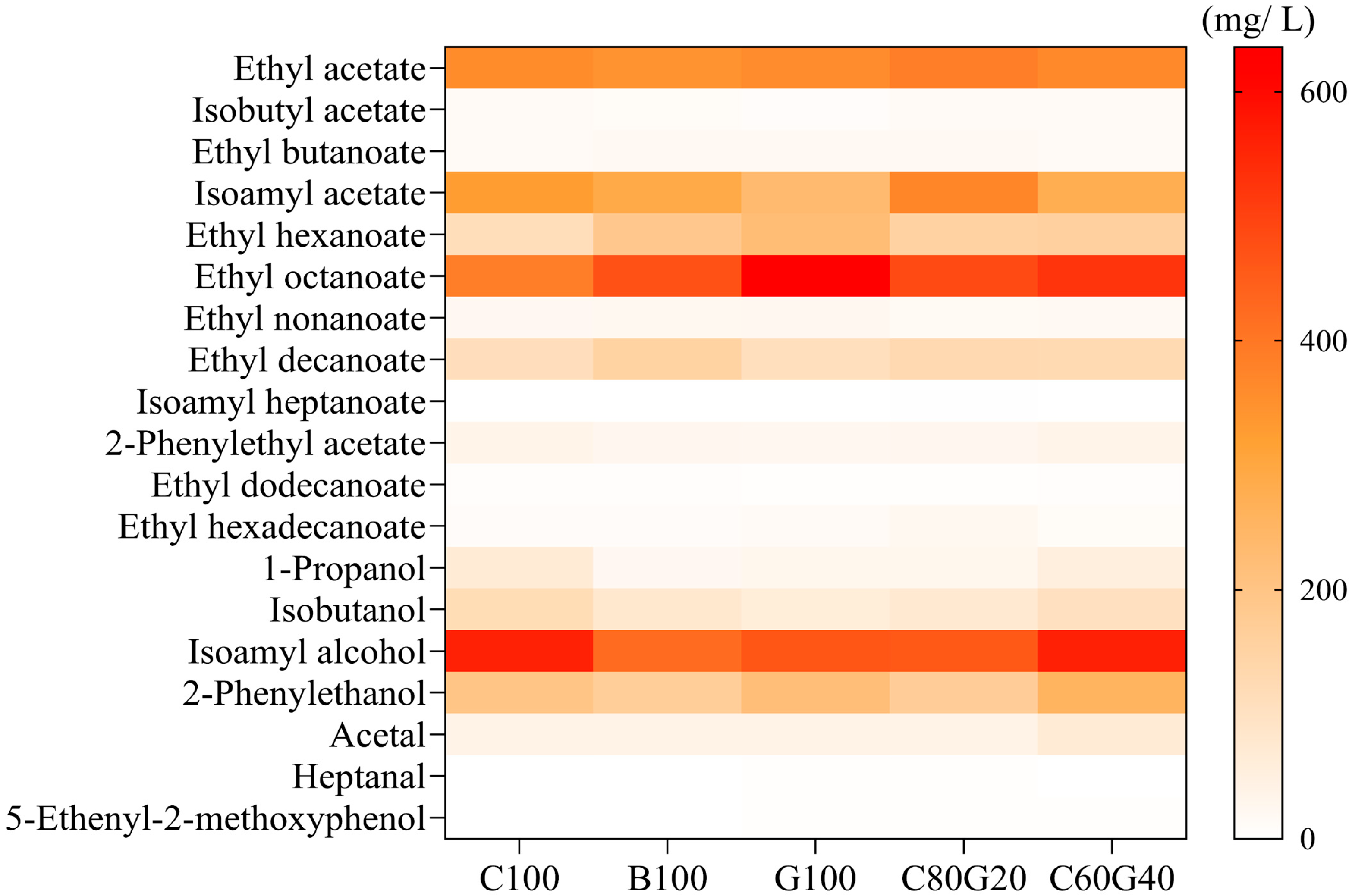
| Ethyl acetate | Fruity, solvent-like | 820 | 7.50 [47] | 45.88 | 51.52 | 359.1 ± 12.9 a | 344.1 ± 8.0 a | 359.8 ± 28.1 a | 386.4 ± 30.8 a | 364.0 ± 18.1 a | MS/RI |
| Isobutyl acetate | 1037 | 0.066 [48] | 127.25 | 213.82 | 13.61 ± 0.97 a | 12.69 ± 0.65 a | 8.40 ± 0.37 b | 14.11 ± 0.58 a | 14.10 ± 1.23 a | MS/RI | |
| Ethyl butanoate | Fruity, sweet strawberry | 1060 | 0.02 [47] | 752.37 | 991.92 | 15.05 ± 0.89 c | 17.40 ± 0.75 abc | 19.84 ± 0.77 a | 18.70 ± 1.69 ab | 16.21 ± 0.63 bc | MS/RI |
| Isoamyl acetate | Banana | 1145 | 0.003 [48] | 77966.93 | 124472.45 | 323.9 ± 10.4 b | 290.7 ± 7.4 c | 233.9 ± 13.7 d | 373.4 ± 15.3 a | 274.8 ± 12.1 c | MS/RI |
| Ethyl hexanoate | Apple, peach | 1259 | 0.014 [47,48] | 8079.00 | 15948.63 | 113.1 ± 4.4 d | 185.2 ± 3.2 b | 223.3 ± 9.5 a | 152.3 ± 6.1 c | 157.62 ± 11.56 c | MS/RI |
| Ethyl octanoate | Pineapple, pear, floral, banana | 1464 | 0.005 [47,48] | 77414.54 | 127158.01 | 387.0 ± 20.4 c | 471.3 ± 22.4 b | 635.8 ± 32.1 a | 486.1 ± 28.1 b | 526.4 ± 19.0 b | MS/RI |
| Ethyl nonanoate | Fruity, coconut | 1567 | 0.20 [47] | 83.56 | 119.51 | 21.57 ± 0.08 a | 22.14 ± 1.18 c | 23.90 ± 2.25 a | 16.71 ± 0.93 b | 16.9 ± 1.3 b | MS |
| Ethyl decanoate | Fruity, fatty | 1671 | 0.20 [47,48] | 546.08 | 750.43 | 111.4 ± 5.0 c | 150.1 ± 6.8 a | 109.2 ± 6.3 c | 129.5 ± 7.3 b | 126.9 ± 7.4 bc | MS/RI |
| Isoamyl heptanoate | 1691 | 0.00 | 0.00 | ND | ND | ND | 1.43 ± 0.06 | ND | MS | ||
| 2-Phenylethyl acetate | Floral | 1847 | 0.25 [47,48] | 98.12 | 142.09 | 35.52 ± 1.50 a | 25.60 ± 1.30 b | 24.53 ± 0.79 b | 25.60 ± 1.29 b | 33.97 ± 1.02 a | MS/RI |
| Ethyl dodecanoate | Rose, honey | 1879 | 1.50 [47] | 2.01 | 3.86 | 3.44 ± 0.09 bc | 5.79 ± 0.18 a | 3.28 ± 0.17 cd | 3.02 ± 0.15 d | 3.76 ± 0.11 b | MS/RI |
| Ethyl hexadecanoate | Wax | 2296 | 1.50 [47] | 7.52 | 15.40 | 11.27 ± 0.56 c | 11.37 ± 0.79 c | 15.69 ± 0.59 b | 23.10 ± 1.42 a | 13.05 ± 0.60 c | MS/RI |
| Subtotal | 1395 ± 10 c | 1536 ± 35 b | 1658 ± 30 a | 1630 ± 23 a | 1547 ± 28 b | ||||||
| Alcohols | |||||||||||
| 1-Propanol | 1065 | 66.93 ± 2.45 a | 21.15 ± 0.88 d | 26.86 ± 1.56 c | 27.27 ± 0.92 c | 54.69 ± 0.26 b | MS/RI | ||||
| Isobutanol | Fusel, alcohol | 1118 | 40 [47,48] | 1.57 | 3.00 | 120.1 ± 3.8 a | 78.43 ± 3.87 c | 62.89 ± 1.63 d | 75.94 ± 3.18 c | 105.4 ± 4.9 b | MS/RI |
| Isoamyl alcohol | Whiskey, malt | 1235 | 30 [47,48] | 14.09 | 18.71 | 560.0 ± 23.2 a | 422.6 ± 16.4 b | 464.9 ± 18.4 b | 457.3 ± 9.3 b | 561.3 ± 40.4 a | MS/RI |
| 2-Phenylethanol | Flowery, Rose, honey pollen | 1946 | 14 [47,48] | 11.94 | 18.39 | 197.1 ± 6.2 c | 167.2 ± 5.1 d | 219.7 ± 1.4 b | 169.1 ± 5.8 d | 257.5 ± 13.2 a | MS/RI |
| Subtotal | 979.0 ± 16.0 a | 714.8 ± 11.9 c | 798.7 ± 16.7 b | 756.1 ± 16.4 bc | 1013 ± 37 a | ||||||
| Aldehydes | |||||||||||
| Acetal | Pungent, green, woody solvent | 825 | 41.49 ± 1.14 b | 38.87 ± 1.80 b | 40.81 ± 0.88 b | 39.82 ± 1.28 b | 69.65 ± 5.02 a | MS/RI | |||
| Heptanal | 1134 | 0.003 [49] | 0 | 1090 | ND | ND | 3.27 ± 0.17 a | 2.11 ± 0.10 b | ND | MS | |
| Subtotal | 41.49 ± 1.14 b | 38.87 ± 1.80 b | 44.08 ± 0.81 b | 41.93 ± 1.19 b | 69.65 ± 5.02 a | ||||||
| Other | |||||||||||
| 5-Ethenyl-2- methoxyphenol | 2230 | ND | ND | 2.16 ± 0.12 b | 2.04 ± 0.00 b | 2.38 ± 0.08 a | MS | ||||
| Total | 2503 ± 16 b | 2290 ± 42 c | 2416 ± 27 b | 2430 ± 9 b | 2633 ± 61 a | ||||||
3.4. E-Tongue-Derived Flavor Profiles of the Tested Makgeolli
4. Conclusions
Author Contributions
Funding
Institutional Review Board Statement
Informed Consent Statement
Data Availability Statement
Conflicts of Interest
References
- Noh, D.H.; Jeong, S.T.; Park, B.; Kim, Y.S.; Lim, B. Changes in isomaltooligosaccharides during fermentation of makgeolli. Korean J. Food Sci. Technol. 2022, 54, 351–361. [Google Scholar]
- Jung, W.H.; Kim, G.W.; Kang, K.O.; Shim, J.Y.; Son, J.Y. Effect of lactic acid bacteria inoculation on functional component and antioxidant activity of makgeolli. Foodserv. Ind. J. 2021, 17, 129–141. [Google Scholar]
- Kim, J.Y.; Choi, J.H.; Kim, C.W.; Lim, B. Quality characteristics of makgeolli under nutrient deficiency and high-temperature fermentation. Food Sci. Preserv. 2025, 32, 289–300. [Google Scholar] [CrossRef]
- Jung, J.; Kwak, H.S.; Kim, S.; Park, S.J.; Lee, D.; Saleh, M.I.; Lee, Y. Comparison of methods for evaluating drivers of liking for yakju: Ideal napping versus the check-all-that-apply method. Prev. Nutr. Food Sci. 2025, 30, 409–418. [Google Scholar] [CrossRef]
- Choi, J.H.; Lim, B.R.; Kang, J.E.; Kim, C.W.; Kim, Y.S.; Jeong, S.T. Changes in microbial community and physicochemical characterization of makgeolli during fermentation by yeast as a fermentation starter. Korean J. Food Sci. Technol. 2020, 52, 529–537. [Google Scholar]
- Lee, H.S.; Park, Y.S.; Bai, D.H. Quality characteristics of makgeolli (rice wine) fermented with koji by starch types. Food Eng. Prog. 2014, 18, 215–221. [Google Scholar] [CrossRef]
- Mao, X.; Yue, S.J.; Xu, D.Q.; Fu, R.J.; Han, J.Z.; Zhou, H.M.; Tang, Y.P. Research progress on flavor and quality of Chinese rice wine in the brewing process. ACS Omega 2023, 8, 32311–32330. [Google Scholar] [CrossRef]
- Kang, S.M.; Kim, S.J.; Ko, K.H.; Nam, S. Formation of biogenic amines and bioactivities of makgeolli under different fermentation conditions. Food Sci. Preserv. 2016, 23, 402–412. [Google Scholar]
- Lee, S.J.; Kim, J.H.; Jung, Y.W.; Park, S.Y.; Shin, W.C.; Park, C.S.; Hong, S.Y.; Kim, G.W. Composition of organic acids and physiological functionality of commercial makgeolli. Korean J. Food Sci. Technol. 2011, 43, 206–212. [Google Scholar] [CrossRef]
- Park, H.J.; Lee, S.M.; Song, S.H.; Kim, Y.S. Characterization of volatile components in makgeolli, a traditional Korean rice wine, with or without pasteurization, during storage. Molecules 2013, 18, 5317–5325. [Google Scholar] [CrossRef]
- Kim, J.H.; Son, E.S.; Cheong, C. Quality characteristics of makgeolli according to fermentation agent and rice milling degree. J. Korea Acad. Ind. Coop. Soc. 2021, 22, 281–289. [Google Scholar]
- He, Z.; Jiang, L.; Wang, K.; Chen, S.; Mei, M.; Sun, C.; Hu, Y.; Li, A.; Du, X. Multi-scale structural heterogeneity of glutinous rice starch in different varieties: A determinant of physicochemical properties and digestibility. Int. J. Biol. Macromol. 2025, 311, 143946. [Google Scholar] [CrossRef] [PubMed]
- Tian, Y.; Li, J.; Nie, M.; Wang, L.; Liu, L.; Wang, F.; Tong, L.T. The impact of gelatinization property differences based on amylopectin structure variations on the glutinous rice flour properties and quality of Daifuku. Food Chem. X 2025, 27, 102423. [Google Scholar] [CrossRef]
- Gong, M.; Zhou, Z.; Jin, J.; Yu, Y.; Liu, S.; Han, X.; Fang, Z.; Mao, J. Effects of soaking on physicochemical properties of four kinds of rice used in Huangjiu brewing. J. Cereal Sci. 2020, 91, 102855. [Google Scholar] [CrossRef]
- Kee, Y.S.; Kim, H.N.; Eom, T.K.; Kim, S.H.; Choi, G.P.; Kim, M.S.; Yu, S.R.; Jeong, Y.H. Quality characteristics of Korean traditional rice wine with glutinous rice. J. Korean Soc. Food Sci. Nutr. 2013, 42, 1829–1836. [Google Scholar] [CrossRef]
- Wang, C.; Yuan, G.; He, Y.; Tang, J.; Zhou, H.; Qiu, S. The formation of higher alcohols in rice wine fermentation using different rice cultivars. Front. Microbiol. 2022, 13, 978323. [Google Scholar] [CrossRef]
- Chen, S.; Wang, C.; Qian, M.; Li, Z.; Xu, Y. Characterization of the key aroma compounds in aged Chinese rice wine by comparative aroma extract dilution analysis, quantitative measurements, aroma recombination, and omission studies. J. Agric. Food Chem. 2019, 67, 4876–4884. [Google Scholar] [CrossRef]
- Chen, L.; Liu, B.; Li, D.; Wang, S.; Ma, X.; Zhang, Y. Effects of fermentation on flavor and antioxidant activity in ginkgo rice wine. Food Biosci. 2023, 53, 102652. [Google Scholar] [CrossRef]
- Kawai, M.; Okiyama, A.; Ueda, Y. Taste enhancements between various amino acids and IMP. Chem. Senses 2022, 27, 739–745. [Google Scholar] [CrossRef]
- Bang, C.M.; Moon, J.K.; Kong, H.S. Characteristics of organic acid of makgeolli by yeast strains type. Korean J. Food Cook. Sci. 2016, 32, 44–49. [Google Scholar] [CrossRef]
- Shin, D.S.; Jeong, S.T.; Sim, E.Y.; Lee, S.K.; Kim, H.J.; Woo, K.S.; Oh, S.K.; Kim, S.J.; Park, H.Y. Quality characteristics of mixed makgeolli with barley and wheat by fermentation temperature. Korean J. Food Nutr. 2017, 30, 305–311. [Google Scholar] [CrossRef][Green Version]
- Kim, H.S.; Choi, J.S.; Yu, S.H.; Kim, M.K.; Lim, B.; Jeong, S.T. Changes in quality characteristics of ‘Makgeolli’ prepared by independent two-step fermentation during storage. Food Sci. Preserv. 2020, 27, 685–693. [Google Scholar]
- Park, H.Y.; Choi, I.; Oh, S.K.; Woo, K.S.; Yoon, S.D.; Kim, H.J.; Sim, E.Y.; Jeong, S.T. Effects of different cultivars and milling degrees on quality characteristics of barley makgeolli. J. Korean Soc. Food Sci. Nutr. 2015, 44, 1839–1846. [Google Scholar] [CrossRef]
- Cha, J.; Cho, K.M.; Kwon, S.J.; Park, S.E.; Kim, E.J.; Seo, S.H.; Son, H.S. Investigation of lactic acid bacterial profiles in commercial rice wine and their effect on metabolites during low-temperature storage. Food Chem. X 2023, 17, 100552. [Google Scholar] [CrossRef] [PubMed]
- Chen, L.; Wang, S.X.; Ren, L.; Li, D.; Ma, X.; Rong, Y. Flavour characteristics of rice wine fermented with mixed starter by moulds and yeast strains. Int. J. Food Sci. Technol. 2021, 56, 5791–5798. [Google Scholar] [CrossRef]
- Tang, A.; Peng, B. Uncovering the flavor differences between black rice wine and glutinous rice wine by GC-MS, GC-IMS, HPLC, and electronic sensory analysis. Food Biosci. 2024, 60, 104235. [Google Scholar] [CrossRef]
- Lim, B.; Kim, D.; Shin, Y.; Hwang, I.S.; Choi, J.Y.; Kim, C.W.; Choi, J.H. Prediction of compounds affecting makgeolli aroma through multivariate analysis. Food Sci. Preserv. 2025, 32, 301–312. [Google Scholar] [CrossRef]
- Piergiovanni, M.; Giliberti, C.; Maffezzoni, C.; Errico, D.; Blandino, M.; Dall’Asta, C.; Mattarozzi, M.; Bianchi, F.; Giannetto, M.; Careri, M. Electronic nose technology for the detection of ergot alkaloid in soft wheat and identification of the relevant volatile compounds by solid phase microextraction/gas chromatography-high resolution Orbitrap-mass spectrometry coupled to chemometrics. Food Chem. 2025, 484, 144455. [Google Scholar] [CrossRef]
- Won, S.H.; Kim, Y.J.; Choi, K.T.; Choi, J.S.; Park, H.D.; Lee, S.B. Fermentation characteristics of unripe Citrus unshiu vinegar production using acetic acid bacteria isolated from traditional fermented vinegars. Prev. Nutr. Food Sci. 2024, 29, 220–227. [Google Scholar] [CrossRef] [PubMed]
- Kim, D.H.; Lee, S.B.; Park, H.D. Fermentation characteristics of Campbell Early grape wine inoculated with indigenous Korean wine yeasts encapsulated in Ca-alginate beads after air-blast drying. Ital. J. Food Sci. 2018, 30, 535–552. [Google Scholar]
- Hong, Y.A.; Park, H.D. Role of non-Saccharomyces yeasts in Korean wines produced from Campbell Early grapes: Potential use of Hanseniaspora uvarum as a starter culture. Food Microbiol. 2013, 34, 207–214. [Google Scholar] [CrossRef] [PubMed]
- Lee, S.B.; Choi, W.S.; Jo, H.J.; Yeo, S.H.; Park, H.D. Optimization of air-blast drying process for manufacturing Saccharomyces cerevisiae and non-Saccharomyces yeast as industrial wine starters. AMB Express 2016, 6, 105. [Google Scholar] [CrossRef] [PubMed]
- Peng, B.; Huang, H.; Xu, J.; Xin, Y.; Hu, L.; Wen, L.; Li, C. Rice wine fermentation: Unveiling key factors shaping quality, flavor, and technological evolution. Foods 2025, 14, 2544. [Google Scholar] [CrossRef]
- Wang, Q.J.; Sun, D.W.; Jeong, S.T.; Yeo, S.H.; Choi, J.H.; Choi, H.S. Screening of rice cultivars for brewing high quality turbid rice wine. LWT 2014, 56, 145–152. [Google Scholar] [CrossRef]
- Chun, A.; Kim, D.J.; Yoon, M.R.; Oh, S.K.; Choi, I.S. Quality characteristics of makgeolli of rice cultivars with different starch compositions. Korean J. Food Nutr. 2014, 27, 50–58. [Google Scholar] [CrossRef]
- Chen, Q.; Zhu, Y.; Liu, Y.; Liu, Y.; Dong, C.; Lin, Z.; Teng, J. Black tea aroma formation during the fermentation period. Food Chem. 2022, 374, 131640. [Google Scholar] [CrossRef]
- Hazelwood, L.A.; Daran, J.M.; Van Maris, A.J.; Pronk, J.T.; Dickinson, J.R. The ehrlich pathway for fusel alcohol production: A century of research on Saccharomyces cerevisiae metabolism. Appl. Environ. Microbiol. 2008, 74, 2259–2266. [Google Scholar] [CrossRef]
- Zhao, C.J.; Schieber, A.; Gänzle, M.G. Formation of taste-active amino acids, amino acid derivatives and peptides in food fermentations—A review. Food Res. Int. 2016, 89, 39–47. [Google Scholar] [CrossRef]
- Zhao, W.; Ruan, F.; Qian, M.; Huang, X.; Li, X.; Li, Y.; Dong, H. Comparing the differences of physicochemical properties and volatiles in semi-dry hakka rice wine and traditional sweet rice wine via HPLC, GC–MS and E-tongue analysis. Food Chem. X 2023, 20, 100898. [Google Scholar] [CrossRef]
- Li, B.; Mu, Q.; Guo, H.; Jia, W.; Zhang, M.; Liu, Y.; Jin, X. Effects of different roasting temperatures on the flavor characteristics of jujube wine: Analysis based on HPLC, HS-GC-IMS, and HS-SPME-GC–MS. Food Chem. X 2025, 30, 102891. [Google Scholar] [CrossRef]
- Xi, B.; Zhang, J.; Xu, X.; Li, C.; Shu, Y.; Zhang, Y.; Shen, Y. Characterization and metabolism pathway of volatile compounds in walnut oil obtained from various ripening stages via HS-GC-IMS and HS-SPME-GC–MS. Food Chem. 2024, 435, 137547. [Google Scholar] [CrossRef]
- Chang, L.; Liu, Z.; Ying, X.; Kalandarov, B.; Ergashev, M.; Tong, X.; Zhang, J.; Jin, J.; Ying, J. Molecular Basis of Lipid Metabolism in Oryza sativa L. Plants 2024, 13, 3263. [Google Scholar] [CrossRef]
- Hu, S.; Ren, H.; Song, Y.; Liu, F.; Qian, L.; Zuo, F.; Meng, L. Analysis of volatile compounds by GCMS reveals their rice cultivars. Sci. Rep. 2023, 13, 7973. [Google Scholar] [CrossRef]
- Shen, C.; Yu, Y.; Zhang, X.; Zhang, H.; Chu, M.; Yuan, B.; Guo, Y.; Li, Y.; Zhou, J.; Mao, J.; et al. The dynamic of physicochemical properties, volatile compounds and microbial community during the fermentation of Chinese rice wine with diverse cereals. Food Res. Int. 2024, 198, 115319. [Google Scholar] [CrossRef] [PubMed]
- Yang, Y.; Guo, M.; Sun, S.; Zou, Y.; Yin, S.; Liu, Y.; Tang, S.; Gu, M.; Yang, Z.; Yan, C. Natural variation of OsGluA2 is involved in grain protein content regulation in rice. Nat. Commun. 2019, 10, 1949. [Google Scholar] [CrossRef] [PubMed]
- Wisetkomolmat, J.; Arjin, C.; Satsook, A.; Seel-Audom, M.; Ruksiriwanich, W.; Prom-u-Thai, C.; Sringarm, K. Comparative analysis of nutritional components and phytochemical attributes of selected Thai rice bran. Front. Nutr. 2022, 9, 833730. [Google Scholar] [CrossRef]
- Yang, Y.; Ai, L.; Mu, Z.; Liu, H.; Yan, X.; Ni, L.; Xia, Y. Flavor compounds with high odor activity values (OAV > 1) dominate the aroma of aged Chinese rice wine (Huangjiu) by molecular association. Food Chem. 2022, 383, 132370. [Google Scholar] [CrossRef] [PubMed]
- Rahayu, Y.Y.S.; Yoshizaki, Y.; Yamaguchi, K.; Okutsu, K.; Futagami, T.; Tamaki, H.; Takamine, K. Key volatile compounds in red koji-shochu, a Monascus-fermented product, and their formation steps during fermentation. Food Chem. 2017, 224, 398–406. [Google Scholar] [CrossRef]
- Piergiovanni, M.; Carlin, S.; Lotti, C.; Vrhovsek, U.; Mattivi, F. Development of a fully automated method HS-SPME-GC-MS/MS for the determination of odor-active carbonyls in wines: A “green” approach to improve robustness and productivity in the oenological analytical chemistry. J. Agric. Food Chem. 2023, 72, 1995–2007. [Google Scholar] [CrossRef]
- Yang, Y.; Zhong, H.; Yang, T.; Lan, C.; Zhu, H. Characterization of the key aroma compounds of a sweet rice alcoholic beverage fermented with Saccharomycopsis fibuligera. J. Food Sci. Technol. 2021, 58, 3752–3764. [Google Scholar] [CrossRef]
- Chen, S.; Wang, D.; Xu, Y. Characterization of odor-active compounds in sweet-type Chinese rice wine by aroma extract dilution analysis with special emphasis on sotolon. J. Agric. Food Chem. 2013, 61, 9712–9718. [Google Scholar] [CrossRef] [PubMed]
- Choi, K.T.; Lee, S.H.; Kim, Y.J.; Choi, J.S.; Lee, S.B. Improvement of volatile aromatic compound levels and sensory quality of distilled soju derived from Saccharomyces cerevisiae and Wickerhamomyces anomalus co-fermentation. Food Chem. X 2024, 22, 101368. [Google Scholar] [CrossRef] [PubMed]
- Yu, H.; Li, Q.; Guo, W.; Ai, L.; Chen, C.; Tian, H. Unraveling the difference in flavor characteristics of Huangjiu fermented with different rice varieties using dynamic sensory evaluation and comprehensive two-dimensional gas chromatography–quadrupole mass spectrometry. Front. Nutr. 2023, 10, 1160954. [Google Scholar] [CrossRef] [PubMed]


| Property | Rice Formulations | ||||
|---|---|---|---|---|---|
| C100 | B100 | G100 | C80G20 | C60G40 | |
| Soluble solid (°Brix) | 7.20 ± 0.01 a | 7.20 ± 0.01 a | 6.95 ± 0.01 c | 7.00 ± 0.01 b | 6.37 ± 0.01 d |
| Reducing sugar (%) | 0.29 ± 0.01 c | 0.32 ± 0.01 a | 0.22 ± 0.01 e | 0.30 ± 0.01 b | 0.27 ± 0.01 d |
| Alcohol content (%) | 8.60 ± 0.01 b | 8.80 ± 0.01 a | 8.40 ± 0.01 c | 8.80 ± 0.01 a | 8.60 ± 0.01 b |
| pH | 3.23 ± 0.10 cd | 3.28 ± 0.01 d | 3.33 ± 0.01 c | 3.44 ± 0.01 b | 3.52 ± 0.01 a |
| Total acidity (%, w/v) | 0.61 ± 0.01 a | 0.59 ± 0.01 b | 0.49 ± 0.01 d | 0.62 ± 0.01 a | 0.56 ± 0.01 c |
| Organic acid (mg/mL) | |||||
| Citric acid | 1.33 ± 0.15 a | 1.47 ± 0.22 a | 1.42 ± 0.15 a | 1.30 ± 0.23 a | 1.48 ± 0.27 a |
| Lactic acid | 1.96 ± 0.07 a | 2.17 ± 0.16 a | 2.09 ± 0.13 a | 2.10 ± 0.18 a | 1.93 ± 0.19 a |
| Free sugar (mg/L) | |||||
| Glucose | 116.06 ± 2.18 a | 109.21 ± 6.60 a | 40.44 ± 2.11 c | 77.07 ± 4.20 b | 81.10 ± 4.86 b |
| Fructose | 350.65 ± 7.98 b | 425.30 ± 18.61 a | 247.50 ± 9.24 c | 210.48 ± 9.09 d | 353.52 ± 15.50 b |
| Taste | Amino Acid | Free Amino Acid Content (mg/L) | ||||
|---|---|---|---|---|---|---|
| C100 | B100 | G100 | C80G20 | C60G40 | ||
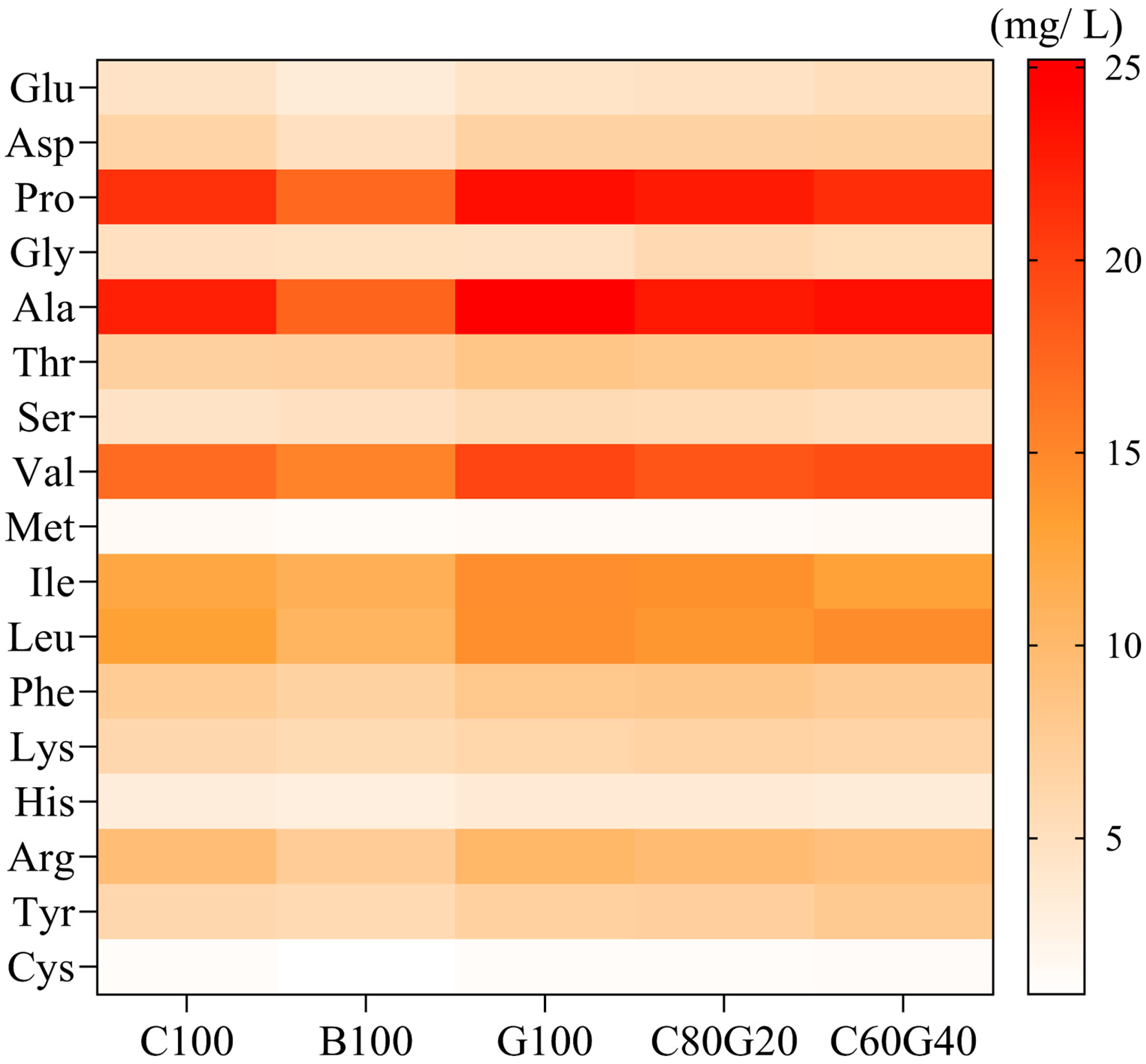
| Umami | Glu | 4.56 ± 0.24 ab | 3.41 ± 0.19 c | 4.44 ± 0.26 b | 4.71 ± 0.27 ab | 5.17 ± 0.22 a |
| Asp | 6.42 ± 0.19 a | 4.88 ± 0.37 b | 6.73 ± 0.16 a | 6.70 ± 0.02 a | 6.78 ± 0.24 a | |
| Subtotal | 10.98 ± 0.15 b | 8.29 ± 0.19 c | 11.17 ± 0.31 ab | 11.40 ± 0.26 ab | 11.95 ± 0.46 a | |
| Sweet | Pro | 21.18 ± 0.64 a | 17.23 ± 0.86 b | 23.57 ± 1.48 a | 22.67 ± 0.29 a | 21.33 ± 1.03 a |
| Gly | 4.84 ± 0.10 c | 4.77 ± 0.12 c | 4.75 ± 0.29 c | 5.90 ± 0.15 a | 5.29 ± 0.06 b | |
| Ala | 22.41 ± 1.23 a | 17.56 ± 0.56 b | 25.19 ± 1.08 a | 22.81 ± 0.96 a | 23.47 ± 1.80 a | |
| Thr | 6.96 ± 0.30 b | 7.08 ± 0.30 b | 8.32 ± 0.27 a | 7.94 ± 0.44 a | 7.79 ± 0.23 ab | |
| Ser | 4.55 ± 0.31 b | 4.82 ± 0.33 ab | 5.60 ± 0.32 a | 5.57 ± 0.51 a | 5.22 ± 0.22 ab | |
| Subtotal | 59.95 ± 1.70 b | 51.47 ± 0.62 c | 67.43 ± 2.07 a | 64.89 ± 0.52 ab | 63.11 ± 3.05 ab | |
| Bitter | Val | 17.05 ± 1.52 bc | 15.30 ± 0.43 c | 19.81 ± 0.45 a | 18.67 ± 0.84 ab | 19.16 ± 0.85 ab |
| Met | 1.56 ± 0.05 a | 1.25 ± 0.10 c | 1.36 ± 0.07 bc | 1.40 ± 0.06 abc | 1.52 ± 0.01 ab | |
| Ile | 12.35 ± 0.13 b | 11.25 ± 0.66 b | 14.39 ± 0.95 a | 14.26 ± 0.60 a | 12.78 ± 0.66 ab | |
| Leu | 12.97 ± 0.80 ab | 10.72 ± 0.49 b | 14.46 ± 0.48 a | 13.82 ± 0.60 a | 14.62 ± 0.70 a | |
| Phe | 7.53 ± 0.21 ab | 6.78 ± 0.20 ab | 8.07 ± 0.32 a | 8.24 ± 0.34 a | 7.65 ± 0.41 a | |
| Lys | 6.16 ± 0.44 ab | 5.60 ± 0.32 b | 6.19 ± 0.08 ab | 6.62 ± 0.34 a | 6.46 ± 0.07 a | |
| His | 3.30 ± 0.10 ab | 3.07 ± 0.07 b | 3.59 ± 0.21 a | 3.55 ± 0.09 a | 3.48 ± 0.27 ab | |
| Arg | 9.49 ± 0.55 ab | 7.38 ± 0.35 c | 10.28 ± 0.43 a | 9.65 ± 0.62 ab | 9.01 ± 0.27 b | |
| Subtotal | 70.4 ± 2.5 bc | 61.4 ± 1.5 d | 78.2 ± 0.6 a | 76.2 ± 1.6 ab | 74.7 ± 0.7 b | |
| Neutral | Tyr | 6.09 ± 0.31 cd | 5.80 ± 0.41 d | 6.81 ± 0.18 bc | 7.11 ± 0.09 bc | 7.79 ± 0.25 a |
| Unflavored | Cys | 1.34 ± 0.06 a | 0.96 ± 0.08 b | 1.31 ± 0.01 a | 1.34 ± 0.05 a | 1.36 ± 0.06 a |
| Total | 148.7 ± 0.8 c | 127.9 ± 1.0 d | 164.9 ± 2.2 a | 161.0 ± 2.1 ab | 158.9 ± 2.7 b | |
Disclaimer/Publisher’s Note: The statements, opinions and data contained in all publications are solely those of the individual author(s) and contributor(s) and not of MDPI and/or the editor(s). MDPI and/or the editor(s) disclaim responsibility for any injury to people or property resulting from any ideas, methods, instructions or products referred to in the content. |
© 2026 by the authors. Licensee MDPI, Basel, Switzerland. This article is an open access article distributed under the terms and conditions of the Creative Commons Attribution (CC BY) license.
Share and Cite
Heo, S.-H.; Lee, S.-H.; Lee, J.-H.; Kang, J.; Kim, Y.; Jung, H.M.; Lee, M.H.; Cho, J.-S.; Lee, S.-B. Multi-Analysis Characterization of Makgeolli Made from the Novel Glutinous Rice Cultivar ‘Gureumchal’: Free Amino Acids, GC–MS Volatiles, and Electronic Tongue-Derived Flavor Profile. Foods 2026, 15, 586. https://doi.org/10.3390/foods15030586
Heo S-H, Lee S-H, Lee J-H, Kang J, Kim Y, Jung HM, Lee MH, Cho J-S, Lee S-B. Multi-Analysis Characterization of Makgeolli Made from the Novel Glutinous Rice Cultivar ‘Gureumchal’: Free Amino Acids, GC–MS Volatiles, and Electronic Tongue-Derived Flavor Profile. Foods. 2026; 15(3):586. https://doi.org/10.3390/foods15030586
Chicago/Turabian StyleHeo, Su-Hyeon, Su-Hyun Lee, Jong-Hyeon Lee, Jungmin Kang, Yeonghun Kim, Hyun Mo Jung, Myung Hee Lee, Jeong-Seok Cho, and Sae-Byuk Lee. 2026. "Multi-Analysis Characterization of Makgeolli Made from the Novel Glutinous Rice Cultivar ‘Gureumchal’: Free Amino Acids, GC–MS Volatiles, and Electronic Tongue-Derived Flavor Profile" Foods 15, no. 3: 586. https://doi.org/10.3390/foods15030586
APA StyleHeo, S.-H., Lee, S.-H., Lee, J.-H., Kang, J., Kim, Y., Jung, H. M., Lee, M. H., Cho, J.-S., & Lee, S.-B. (2026). Multi-Analysis Characterization of Makgeolli Made from the Novel Glutinous Rice Cultivar ‘Gureumchal’: Free Amino Acids, GC–MS Volatiles, and Electronic Tongue-Derived Flavor Profile. Foods, 15(3), 586. https://doi.org/10.3390/foods15030586