


Fermentation Technologies to Produce and Improve Alternative Protein Sources
 , , , , and
Abstract
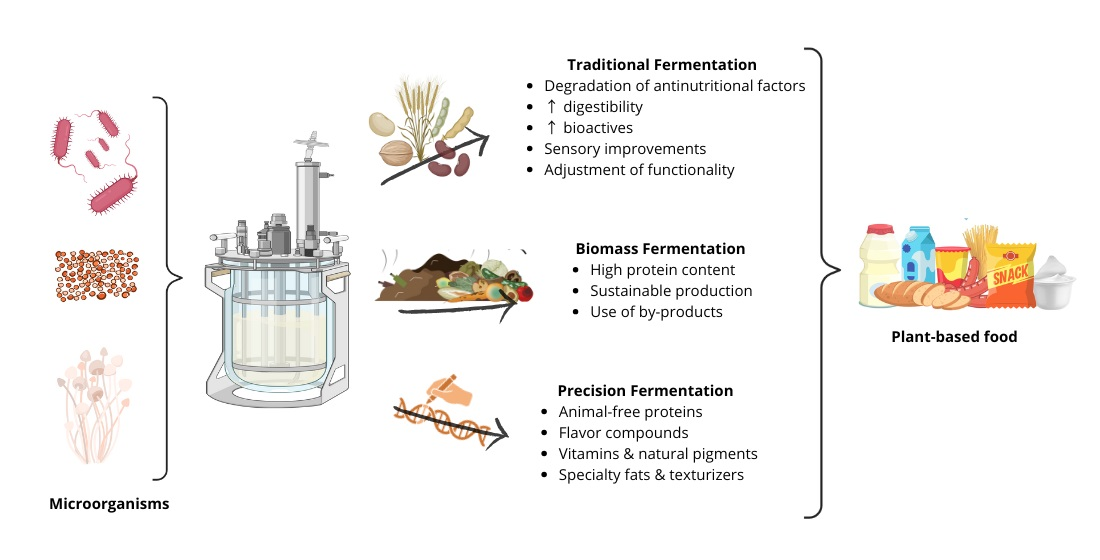
1. Introduction
2. Plant-Based Proteins: Importance, Advantages, and Limitations
Plant-Based Techno-Functional Ingredients
3. Microbial Strategies for Innovative Ingredient Production in Novel Food Alternatives
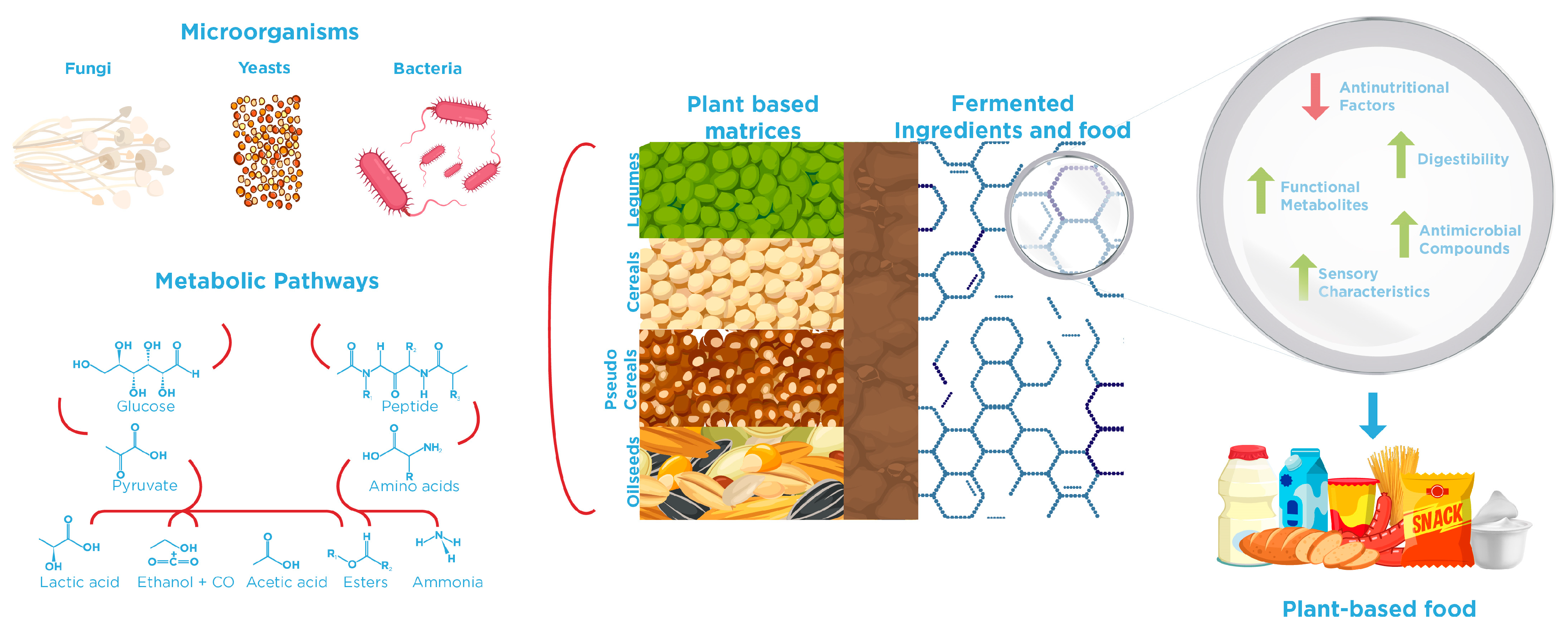
3.1. Traditional Fermentation to Improve the Nutritional Quality of Plant-Based Derivatives
3.1.1. Antinutritional Factors
3.1.2. Digestibility
3.1.3. Functional Metabolites

| Microorganisms | Plant-Based Ingredients | Fermentation Conditions | Effect | References |
|---|---|---|---|---|
| Lacticaseibacillus casei LBC491, Lactiplantibacillus plantarum 299V, Leuconostoc mesenteroides OM94, L. plantarum E75 | Chickpea flour | SmF, 24 h, 30–37 °C | Reduce phytic acid | [60] |
| L. plantarum CRL 2211, Weissella paramesenteroides CRL 2182 | Bean flour | SmF, 24 h, 37 °C | Decrease tannin content | [61] |
| L. plantarum MRS1, Levilactobacillus brevis MRS4 | Legume flours | SmF, 24 h, 30 °C | Reduce phytic acid, condensed tannins, raffinose, trypsin inhibitors, and starch hydrolysis index | [62] |
| Aspergillus oryzae Rhizopus oligosporus | Faba bean flour | SSF, 24–72 h, 28–30 °C | Decrease phytic acid, tannins, chymotrypsin inhibitors, saponins (A. oryzae eliminated completely) | [64] |
| Aspergillus oryzae, Aspergillus sojae | Marama bean flour | SSF, 8 days, 30 °C | Reduce phytic acid, trypsin inhibitors | [65] |
| Pleurotus ostreatus | Lentils and Quinoa flours | SSF, 14 days, 25 °C | Increased protein and reduced phytate content. | [66] |
| Bacillus subtilis + A. oryzae (sequential inoculation) | Soybean meals | two-step SSF, 96 h 25 °C, | Reductions in phytic acid, tannin, and saponins | [67] |
| L. plantarum NRRLB-4496 | Pea protein concentrate | SmF, 32 °C, 11 h | Protein digestibility increased to 87.4% | [68] |
| A. oryzae, R. oligosporus | Rice | SSF; A. oryzae 32 °C, 68 h, R. oligosporus 28 °C, 44 h | No significant change In Vitro Protein Digestibility (IVPD) | [71] |
| A. oryzae, A. niger, L. plantarum | Chickpea, Lentil, Faba bean | SSF, 30–37 °C, 48 h | Reduction IVPD (from 87% to 74–82%) | [72] |
| Bacillus subtilis | Kidney beans extracts | SSF, 48 h | Higher contents of soluble phenolic compounds and antioxidant activity | [77] |
| L. plantarum | Kidney beans extracts | SmF, 96 h | Antihypertensive peptides | [77] |
| Rhizopus spp. | Soybean meals | SSF, 24–72 h, 25–37 °C, | Increase digestibility, release of bioactive compounds | [78] |
| L. reuteri, L. plantarum | Quinoa, Lupin, Wheat flours | SSF, 72 h | Antihypertensive activity, the higher ACE-inhibitory effects of lupin and quinoa | [79] |
3.1.4. Antimicrobial Compounds
3.1.5. Sensory Characteristics
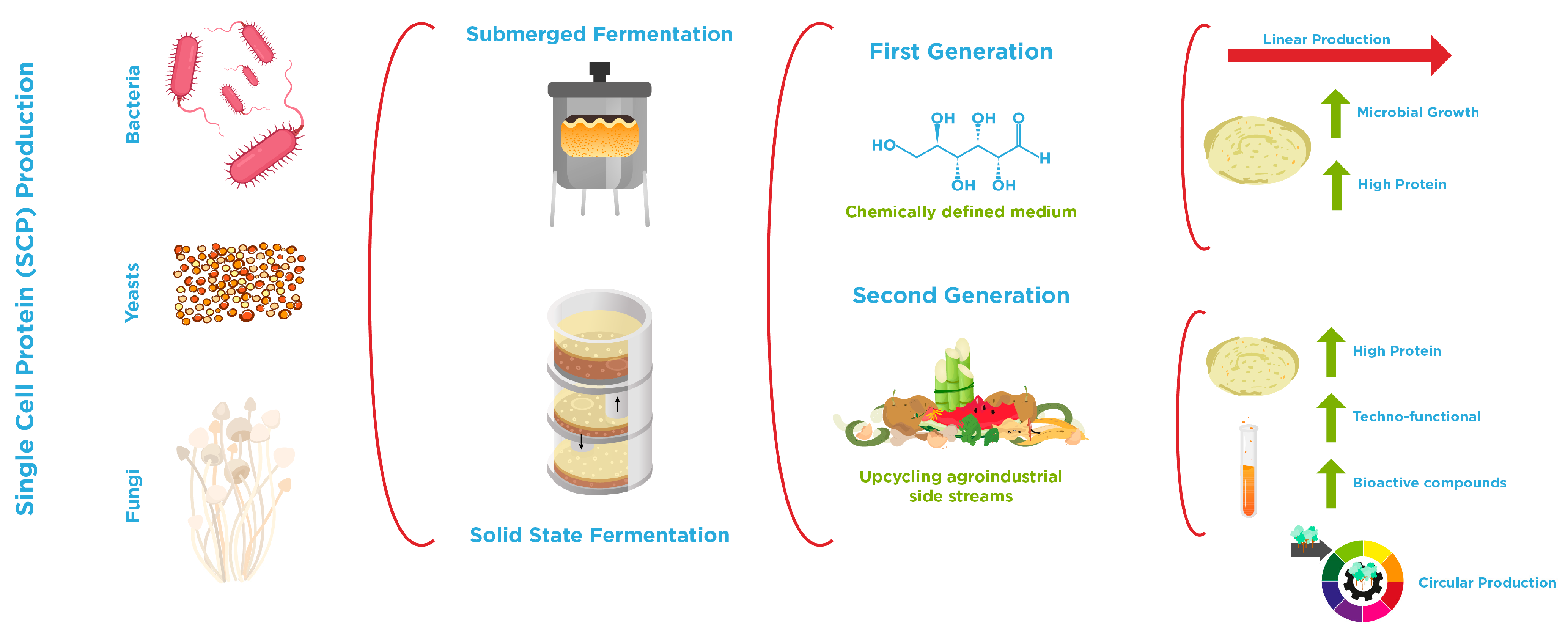
3.2. Biomass Fermentation: Microorganisms as a Source of Alternative Proteins
3.2.1. Fermentation Methods: Submerged and Solid State
3.2.2. Substrates and Microorganisms
3.2.3. Applications and Sustainability
3.2.4. Consumer Perception and Acceptance
3.2.5. Opportunities and Challenges
3.3. Precision Fermentation
4. Conclusions and Perspectives
Supplementary Materials
Author Contributions
Funding
Institutional Review Board Statement
Informed Consent Statement
Data Availability Statement
Conflicts of Interest
References
- Kurek, M.A.; Onopiuk, A.; Pogorzelska-Nowicka, E.; Szpicer, A.; Zalewska, M.; Półtorak, A. Novel Protein Sources for Applications in Meat-Alternative Products—Insight and Challenges. Foods 2022, 11, 957. [Google Scholar] [CrossRef]
- Food Security Information Network; Global Network Against Food Crises. Global Report on Food Crises; Food Security Information Network: Rome, Italy, 2025. [Google Scholar] [CrossRef]
- Corredig, M.; Young, N.; Dalsgaard, T.K. Food Proteins: Processing Solutions and Challenges. Curr. Opin. Food Sci. 2020, 35, 49–53. [Google Scholar] [CrossRef]
- Calvez, J.; Azzout-Marniche, D.; Tomé, D. Protein Quality, Nutrition and Health. Front. Nutr. 2024, 11, 1406618. [Google Scholar] [CrossRef] [PubMed]
- Marinangeli, C.P.F.; Fabek, H.; Ahmed, M.; Sanchez-Hernandez, D.; Foisy, S.; House, J.D. The Effect of Increasing Intakes of Plant Protein on the Protein Quality of Canadian Diets. Appl. Physiol. Nutr. Metab. 2021, 46, 771–780. [Google Scholar] [CrossRef]
- Daas, M.C.; van ‘t Veer, P.; Temme, E.H.M.; Kuijsten, A.; Gurinović, M.; Biesbroek, S. Diversity of Dietary Protein Patterns across Europe—Impact on Nutritional Quality and Environmental Sustainability. Curr. Res. Food Sci. 2025, 10, 101019. [Google Scholar] [CrossRef]
- Salter, A.M.; Lopez-Viso, C. Role of Novel Protein Sources in Sustainably Meeting Future Global Requirements. Proc. Nutr. Soc. 2021, 80, 186–194. [Google Scholar] [CrossRef]
- Aschemann-Witzel, J.; Gantriis, R.F.; Fraga, P.; Perez-Cueto, F.J.A. Plant-Based Food and Protein Trend from a Business Perspective: Markets, Consumers, and the Challenges and Opportunities in the Future. Crit. Rev. Food Sci. Nutr. 2021, 61, 3119–3128. [Google Scholar] [CrossRef]
- Millward, D.J. Identifying Recommended Dietary Allowances for Protein and Amino Acids: A Critique of the 2007 WHO/FAO/UNU Report. Br. J. Nutr. 2012, 108, S3–S21. [Google Scholar] [CrossRef]
- Food and Agriculture Organization of the United Nations. Dietary Protein Quality Evaluation in Human Nutrition Report of an FAO Expert Consultation; Food and Agriculture Organization of the United Nations: Rome, Italy, 2013. [Google Scholar]
- Duluins, O.; Baret, P.V. A Systematic Review of the Definitions, Narratives and Paths Forwards for a Protein Transition in High-Income Countries. Nat. Food 2024, 5, 28–36. [Google Scholar] [CrossRef] [PubMed]
- Sha, L.; Xiong, Y.L. Plant Protein-Based Alternatives of Reconstructed Meat: Science, Technology, and Challenges. Trends Food Sci. Technol. 2020, 102, 51–61. [Google Scholar] [CrossRef]
- Giezenaar, C.; Orr, R.E.; Godfrey, A.J.R.; Maggs, R.; Foster, M.; Hort, J. Profiling the Novel Plant-Based Meat Alternative Category: Consumer Affective and Sensory Response in the Context of Perceived Similarity to Meat. Food Res. Int. 2024, 188, 114465. [Google Scholar] [CrossRef] [PubMed]
- Motoki, K.; Bunya, A.; Park, J.; Velasco, C. Decoding the Meaning of Alternative Proteins: Connotations and Music-Matching. Food Qual. Prefer. 2024, 115, 105117. [Google Scholar] [CrossRef]
- Smith, E.; Etienne, J.; Montanari, F. Alternative Protein Sources for Food and Feed; European Parliament: Luxembourg, 2024. [Google Scholar]
- Directorate-General for Research and Innovation (European Commission). Food 2030 Pathways for Action—Alternative Proteins and Dietary Shift; Publications Office of the European Union: Luxembourg, 2020. [Google Scholar]
- Witte, B.; Obloj, P.; Koktenturk, S.; Morach, B.; Brigl, M.; Rogg, J.; Schulze, U.; Walker, D.; Koeller, V.; Dehnert, N.; et al. Food for Thought the Protein Transformation; Boston Consulting Group: Boston, MA, USA, 2021. [Google Scholar]
- Wood, P.; Tavan, M. A Review of the Alternative Protein Industry. Curr. Opin. Food Sci. 2022, 47, 100869. [Google Scholar] [CrossRef]
- Zeng, Y.; Chen, E.; Zhang, X.; Li, D.; Wang, Q.; Sun, Y. Nutritional Value and Physicochemical Characteristics of Alternative Protein for Meat and Dairy—A Review. Foods 2022, 11, 3326. [Google Scholar] [CrossRef]
- Hefferon, K.L.; De Steur, H.; Perez-Cueto, F.J.A.; Herring, R. Alternative Protein Innovations and Challenges for Industry and Consumer: An Initial Overview. Front. Sustain. Food Syst. 2023, 7, 1038286. [Google Scholar] [CrossRef]
- Zhang, C.; Guan, X.; Yu, S.; Zhou, J.; Chen, J. Production of Meat Alternatives Using Live Cells, Cultures and Plant Proteins. Curr. Opin. Food Sci. 2022, 43, 43–52. [Google Scholar] [CrossRef]
- Grossmann, L.; Weiss, J. Alternative Protein Sources as Technofunctional Food Ingredients. Annu. Rev. Food Sci. Technol. 2021, 12, 93–117. [Google Scholar] [CrossRef] [PubMed]
- Garrido-Galand, S.; Asensio-Grau, A.; Calvo-Lerma, J.; Heredia, A.; Andrés, A. The Potential of Fermentation on Nutritional and Technological Improvement of Cereal and Legume Flours: A Review. Food Res. Int. 2021, 145, 110398. [Google Scholar] [CrossRef] [PubMed]
- Ayllón-Parra, N.; Castellari, M.; Gou, P.; Ribas-Agustí, A. Effects of Solid-State Fermentation with Pleurotus ostreatus on the Nutritional and Techno-Functional Properties of Alternative Protein Ingredients. Food Chem. 2025, 490, 145090. [Google Scholar] [CrossRef]
- Chai, K.F.; Ng, K.R.; Samarasiri, M.; Chen, W.N. Precision Fermentation to Advance Fungal Food Fermentations. Curr. Opin. Food Sci. 2022, 47, 100881. [Google Scholar] [CrossRef]
- Good Food Institute, T. State of the Industry-Fermentation; Good Food Institute: Arlington, VA, USA, 2024. [Google Scholar]
- Augustin, M.A.; Hartley, C.J.; Maloney, G.; Tyndall, S. Innovation in Precision Fermentation for Food Ingredients. Crit. Rev. Food Sci. Nutr. 2024, 64, 6218–6238. [Google Scholar] [CrossRef] [PubMed]
- Tropea, A.; Ferracane, A.; Albergamo, A.; Potortì, A.G.; Lo Turco, V.; Di Bella, G. Single Cell Protein Production through Multi Food-Waste Substrate Fermentation. Fermentation 2022, 8, 91. [Google Scholar] [CrossRef]
- Nandini Roy Choudhury. Plant-Based Ingredients Market; Future Market Insights: Newark, DE, USA, 2025. [Google Scholar]
- Petersen, T.; Hirsch, S. Comparing Meat and Meat Alternatives: An Analysis of Nutrient Quality in Five European Countries. Public Health Nutr. 2023, 26, 3349–3358. [Google Scholar] [CrossRef] [PubMed]
- Ali, A.; Devarajan, S.; Manickavasagan, A.; Ata, A. Antinutritional Factors and Biological Constraints in the Utilization of Plant Protein Foods. In Plant Protein Foods; Springer International Publishing: Cham, Switzerland, 2022; pp. 407–438. [Google Scholar]
- Salim, R.; Nehvi, I.B.; Mir, R.A.; Tyagi, A.; Ali, S.; Bhat, O.M. A Review on Anti-Nutritional Factors: Unraveling the Natural Gateways to Human Health. Front. Nutr. 2023, 10, 1215873. [Google Scholar] [CrossRef]
- Arsov, A.; Tsigoriyna, L.; Batovska, D.; Armenova, N.; Mu, W.; Zhang, W.; Petrov, K.; Petrova, P. Bacterial Degradation of Antinutrients in Foods: The Genomic Insight. Foods 2024, 13, 2408. [Google Scholar] [CrossRef]
- Samtiya, M.; Aluko, R.E.; Dhewa, T. Plant Food Anti-Nutritional Factors and Their Reduction Strategies: An Overview. Food Prod. Process. Nutr. 2020, 2, 6. [Google Scholar] [CrossRef]
- Rutherfurd, S.M.; Fanning, A.C.; Miller, B.J.; Moughan, P.J. Protein Digestibility-Corrected Amino Acid Scores and Digestible Indispensable Amino Acid Scores Differentially Describe Protein Quality in Growing Male Rats. J. Nutr. 2015, 145, 372–379. [Google Scholar] [CrossRef]
- Kaur, L.; Mao, B.; Beniwal, A.S.; Abhilasha; Kaur, R.; Chian, F.M.; Singh, J. Alternative Proteins vs Animal Proteins: The Influence of Structure and Processing on Their Gastro-Small Intestinal Digestion. Trends Food Sci. Technol. 2022, 122, 275–286. [Google Scholar] [CrossRef]
- Tyndall, S.M.; Maloney, G.R.; Cole, M.B.; Hazell, N.G.; Augustin, M.A. Critical Food and Nutrition Science Challenges for Plant-Based Meat Alternative Products. Crit. Rev. Food Sci. Nutr. 2024, 64, 638–653. [Google Scholar] [CrossRef]
- Wang, Y.; Tuccillo, F.; Lampi, A.; Knaapila, A.; Pulkkinen, M.; Kariluoto, S.; Coda, R.; Edelmann, M.; Jouppila, K.; Sandell, M.; et al. Flavor Challenges in Extruded Plant-based Meat Alternatives: A Review. Compr. Rev. Food Sci. Food Saf. 2022, 21, 2898–2929. [Google Scholar] [CrossRef]
- Appiani, M.; Cattaneo, C.; Laureati, M. Sensory Properties and Consumer Acceptance of Plant-Based Meat, Dairy, Fish and Eggs Analogs: A Systematic Review. Front. Sustain. Food Syst. 2023, 7, 1268068. [Google Scholar] [CrossRef]
- McClements, D.J.; Grossmann, L. A Brief Review of the Science behind the Design of Healthy and Sustainable Plant-Based Foods. NPJ Sci. Food 2021, 5, 17. [Google Scholar] [CrossRef]
- Yu, J.; Wang, L.; Zhang, Z. Plant-Based Meat Proteins: Processing, Nutrition Composition, and Future Prospects. Foods 2023, 12, 4180. [Google Scholar] [CrossRef] [PubMed]
- Wang, Y.; Cai, W.; Li, L.; Gao, Y.; Lai, K. Recent Advances in the Processing and Manufacturing of Plant-Based Meat. J. Agric. Food Chem. 2023, 71, 1276–1290. [Google Scholar] [CrossRef]
- Jeon, Y.H.; Gu, B.J.; Ryu, G.H. Investigating the Potential of Full-Fat Soy as an Alternative Ingredient in the Manufacture of Low- and High-Moisture Meat Analogs. Foods 2023, 12, 1011. [Google Scholar] [CrossRef]
- Qin, P.; Wang, T.; Luo, Y. A Review on Plant-Based Proteins from Soybean: Health Benefits and Soy Product Development. J. Agric. Food Res. 2022, 7, 100265. [Google Scholar] [CrossRef]
- Arshad, P.M.; Sharma, N.; Sharma, M. Extraction and Characterization of Chickpea Protein Isolate and Its Application in the Development of a Plant-Based Frozen Dessert. Sustain. Food Technol. 2025, 3, 2192–2203. [Google Scholar] [CrossRef]
- Caldeira, R.F.; de Paiva Gouvêa, L.; Azevedo de Lima, T.; Wilhelm, A.E.; de Grandi Castro Freitas de Sá, D.; Galdeano, M.C.; Felberg, I.; Antoniassi, R.; Mellinger, C.G.; Lima, J.R. Chickpea Processing to Obtain a Protein Ingredient for the Plant-Based Market. Front. Food Sci. Technol. 2025, 5, 1547684. [Google Scholar] [CrossRef]
- Roman, L.; Tsochatzis, E.; Jiménez-Munoz, L.; Ottosen, C.-O.; Corredig, M. Evaluation of Protein Composition and Functionality of Lupin Protein Isolates Extracted from Different Blue Lupin (Lupinus angustifolius) Cultivars. Curr. Res. Food Sci. 2025, 11, 101242. [Google Scholar] [CrossRef]
- Sajib, M.; Forghani, B.; Kumar Vate, N.; Abdollahi, M. Combined Effects of Isolation Temperature and PH on Functionality and Beany Flavor of Pea Protein Isolates for Meat Analogue Applications. Food Chem. 2023, 412, 135585. [Google Scholar] [CrossRef]
- Brishti, F.H.; Chay, S.Y.; Muhammad, K.; Ismail-Fitry, M.R.; Zarei, M.; Saari, N. Texturized Mung Bean Protein as a Sustainable Food Source: Effects of Extrusion on Its Physical, Textural and Protein Quality. Innov. Food Sci. Emerg. Technol. 2021, 67, 102591. [Google Scholar] [CrossRef]
- Du, M.; Xie, J.; Gong, B.; Xu, X.; Tang, W.; Li, X.; Li, C.; Xie, M. Extraction, Physicochemical Characteristics and Functional Properties of Mung Bean Protein. Food Hydrocoll. 2018, 76, 131–140. [Google Scholar] [CrossRef]
- López, D.N.; Galante, M.; Raimundo, G.; Spelzini, D.; Boeris, V. Functional Properties of Amaranth, Quinoa and Chia Proteins and the Biological Activities of Their Hydrolyzates. Food Res. Int. 2019, 116, 419–429. [Google Scholar] [CrossRef] [PubMed]
- Anyiam, P.N.; Phongthai, S.; Grossmann, L.; Jung, Y.H.; Sai-Ut, S.; Onsaard, E.; Rawdkuen, S. Potential Plant Proteins for Functional Food Ingredients: Composition, Utilization and Its Challenges. NFS J. 2025, 38, 100216. [Google Scholar] [CrossRef]
- Taylor, S.L.; Marsh, J.T.; Koppelman, S.J.; Kabourek, J.L.; Johnson, P.E.; Baumert, J.L. A Perspective on Pea Allergy and Pea Allergens. Trends Food Sci. Technol. 2021, 116, 186–198. [Google Scholar] [CrossRef]
- Sim, S.Y.J.; Srv, A.; Chiang, J.H.; Henry, C.J. Plant Proteins for Future Foods: A Roadmap. Foods 2021, 10, 1967. [Google Scholar] [CrossRef] [PubMed]
- Graham, A.E.; Ledesma-Amaro, R. The Microbial Food Revolution. Nat. Commun. 2023, 14, 2231. [Google Scholar] [CrossRef]
- Vinicius De Melo Pereira, G.; De Carvalho Neto, D.P.; Junqueira, A.C.D.O.; Karp, S.G.; Letti, L.A.J.; Magalhães Júnior, A.I.; Soccol, C.R. A Review of Selection Criteria for Starter Culture Development in the Food Fermentation Industry. Food Rev. Int. 2020, 36, 135–167. [Google Scholar] [CrossRef]
- Molina, G.E.S.; Ras, G.; da Silva, D.F.; Duedahl-Olesen, L.; Hansen, E.B.; Bang-Berthelsen, C.H. Metabolic Insights of Lactic Acid Bacteria in Reducing Off-Flavors and Antinutrients in Plant-Based Fermented Dairy Alternatives. Compr. Rev. Food Sci. Food Saf. 2025, 24, e70134. [Google Scholar] [CrossRef]
- Amritha, G.K.; Venkateswaran, G. Use of Lactobacilli in Cereal-Legume Fermentation and as Potential Probiotics towards Phytate Hydrolysis. Probiotics Antimicrob. Proteins 2018, 10, 647–653. [Google Scholar] [CrossRef]
- Byanju, B.; Hojilla-Evangelista, M.P.; Lamsal, B.P. Fermentation Performance and Nutritional Assessment of Physically Processed Lentil and Green Pea Flour. J. Sci. Food Agric. 2021, 101, 5792–5806. [Google Scholar] [CrossRef]
- Chiacchio, M.F.; Tagliamonte, S.; Pazzanese, A.; Vitaglione, P.; Blaiotta, G. Lactic Acid Fermentation Improves Nutritional and Functional Properties of Chickpea Flours. Food Res. Int. 2025, 203, 115899. [Google Scholar] [CrossRef]
- Sabater, C.; Sáez, G.D.; Suárez, N.; Garro, M.S.; Margolles, A.; Zárate, G. Fermentation with Lactic Acid Bacteria for Bean Flour Improvement: Experimental Study and Molecular Modeling as Complementary Tools. Foods 2024, 13, 2105. [Google Scholar] [CrossRef] [PubMed]
- De Pasquale, I.; Pontonio, E.; Gobbetti, M.; Rizzello, C.G. Nutritional and Functional Effects of the Lactic Acid Bacteria Fermentation on Gelatinized Legume Flours. Int. J. Food Microbiol. 2020, 316, 108426. [Google Scholar] [CrossRef]
- Joudaki, H.; Aria, N.; Moravej, R.; Rezaei Yazdi, M.; Emami-Karvani, Z.; Hamblin, M.R. Microbial Phytases: Properties and Applications in the Food Industry. Curr. Microbiol. 2023, 80, 374. [Google Scholar] [CrossRef]
- Gautheron, O.; Nyhan, L.; Torreiro, M.G.; Tlais, A.Z.A.; Cappello, C.; Gobbetti, M.; Hammer, A.K.; Zannini, E.; Arendt, E.K.; Sahin, A.W. Exploring the Impact of Solid-State Fermentation on Fava Bean Flour: A Comparative Study of Aspergillus oryzae and Rhizopus oligosporus. Foods 2024, 13, 2922. [Google Scholar] [CrossRef]
- Gbenle, J.; Mert, M.; Phasha, N.N.; Madibana, M.J.; Manyeula, F.; Bamidele, O.P.; Toefy, R.; Dibakoane, S.R.; Mlambo, V. Fungal-Mediated Solid-State Fermentation Ameliorates Antinutritional Factors but Does Not Improve In Vitro Digestibility of Marama (Tylosema esculentum) Beans. Future Foods 2025, 11, 100664. [Google Scholar] [CrossRef]
- Sánchez-García, J.; Asensio-Grau, A.; García-Hernández, J.; Heredia, A.; Andrés, A. Nutritional and Antioxidant Changes in Lentils and Quinoa through Fungal Solid-State Fermentation with Pleurotus ostreatus. Bioresour. Bioprocess. 2022, 9, 51. [Google Scholar] [CrossRef]
- Suprayogi, W.P.S.; Ratriyanto, A.; Akhirini, N.; Hadi, R.F.; Setyono, W.; Irawan, A. Changes in Nutritional and Antinutritional Aspects of Soybean Meals by Mechanical and Solid-State Fermentation Treatments with Bacillus subtilis and Aspergillus oryzae. Bioresour. Technol. Rep. 2022, 17, 100925. [Google Scholar] [CrossRef]
- Çabuk, B.; Nosworthy, M.G.; Stone, A.K.; Korber, D.R.; Tanaka, T.; House, J.D.; Nickerson, M.T. Effect of Fermentation on the Protein Digestibility and Levels of Non-Nutritive Compounds of Pea Protein Concentrate. Food Technol. Biotechnol. 2018, 56, 257–264. [Google Scholar] [CrossRef]
- Anyiam, P.N.; Nwuke, C.P.; Uhuo, E.N.; Ije, U.E.; Salvador, E.M.; Mahumbi, B.M.; Boyiako, B.H. Effect of Fermentation Time on Nutritional, Antinutritional Factors and in-Vitro Protein Digestibility of Macrotermes nigeriensis-Cassava Mahewu. Meas. Food 2023, 11, 100096. [Google Scholar] [CrossRef]
- Yakubu, C.M.; Sharma, R.; Sharma, S.; Singh, B. Influence of Alkaline Fermentation Time on in Vitro Nutrient Digestibility, Bio- & Techno-Functionality, Secondary Protein Structure and Macromolecular Morphology of Locust Bean (Parkia biglobosa) Flour. LWT 2022, 161, 113295. [Google Scholar] [CrossRef]
- Zwinkels, J.; Wolkers-Rooijackers, J.; Smid, E.J. Solid-State Fungal Fermentation Transforms Low-Quality Plant-Based Foods into Products with Improved Protein Quality. LWT 2023, 184, 114979. [Google Scholar] [CrossRef]
- Stone, A.K.; Shi, D.; Liu, E.; Jafarian, Z.; Xu, C.; Bhagwat, A.; Lu, Y.; Akhov, L.; Gerein, J.; Han, X.; et al. Effect of Solid-State Fermentation on the Functionality, Digestibility, and Volatile Profiles of Pulse Protein Isolates. Food Biosci. 2024, 61, 104580. [Google Scholar] [CrossRef]
- Cirkovic Velickovic, T.D.; Stanic-Vucinic, D.J. The Role of Dietary Phenolic Compounds in Protein Digestion and Processing Technologies to Improve Their Antinutritive Properties. Compr. Rev. Food Sci. Food Saf. 2018, 17, 82–103. [Google Scholar] [CrossRef]
- Rezvani, F.; Ardestani, F.; Najafpour, G. Growth Kinetic Models of Five Species of Lactobacilli and Lactose Consumption in Batch Submerged Culture. Braz. J. Microbiol. 2017, 48, 251–258. [Google Scholar] [CrossRef]
- Cruz-Casas, D.E.; Aguilar, C.N.; Ascacio-Valdés, J.A.; Rodríguez-Herrera, R.; Chávez-González, M.L.; Flores-Gallegos, A.C. Enzymatic Hydrolysis and Microbial Fermentation: The Most Favorable Biotechnological Methods for the Release of Bioactive Peptides. Food Chem. Mol. Sci. 2021, 3, 100047. [Google Scholar] [CrossRef] [PubMed]
- Nasri, R.; Abdelhedi, O.; Nasri, M.; Jridi, M. Fermented Protein Hydrolysates: Biological Activities and Applications. Curr. Opin. Food Sci. 2022, 43, 120–127. [Google Scholar] [CrossRef]
- Limón, R.I.; Peñas, E.; Torino, M.I.; Martínez-Villaluenga, C.; Dueñas, M.; Frias, J. Fermentation Enhances the Content of Bioactive Compounds in Kidney Bean Extracts. Food Chem. 2015, 172, 343–352. [Google Scholar] [CrossRef]
- Harahap, I.A.; Suliburska, J.; Karaca, A.C.; Capanoglu, E.; Esatbeyoglu, T. Fermented Soy Products: A Review of Bioactives for Health from Fermentation to Functionality. Compr. Rev. Food Sci. Food Saf. 2025, 24, e70080. [Google Scholar] [CrossRef]
- Ayyash, M.; Johnson, S.K.; Liu, S.Q.; Mesmari, N.; Dahmani, S.; Al Dhaheri, A.S.; Kizhakkayil, J. In Vitro Investigation of Bioactivities of Solid-State Fermented Lupin, Quinoa and Wheat Using Lactobacillus spp. Food Chem. 2019, 275, 50–58. [Google Scholar] [CrossRef]
- Leonard, W.; Zhang, P.; Ying, D.; Adhikari, B.; Fang, Z. Fermentation Transforms the Phenolic Profiles and Bioactivities of Plant-Based Foods. Biotechnol. Adv. 2021, 49, 107763. [Google Scholar] [CrossRef]
- Gustaw, K.; Niedźwiedź, I.; Rachwał, K.; Polak-Berecka, M. New Insight into Bacterial Interaction with the Matrix of Plant-Based Fermented Foods. Foods 2021, 10, 1603. [Google Scholar] [CrossRef]
- Melini, F.; Melini, V. Impact of Fermentation on Phenolic Compounds and Antioxidant Capacity of Quinoa. Fermentation 2021, 7, 20. [Google Scholar] [CrossRef]
- Klongklaew, A.; Banwo, K.; Soodsawaeng, P.; Christopher, A.; Khanongnuch, C.; Sarkar, D.; Shetty, K. Lactic Acid Bacteria Based Fermentation Strategy to Improve Phenolic Bioactive-Linked Functional Qualities of Select Chickpea (Cicer arietinum L.) Varieties. NFS J. 2022, 27, 36–46. [Google Scholar] [CrossRef]
- Hur, J.; Nguyen, T.T.H.; Park, N.; Kim, J.; Kim, D. Characterization of Quinoa (Chenopodium quinoa) Fermented by Rhizopus oligosporus and Its Bioactive Properties. AMB Express 2018, 8, 143. [Google Scholar] [CrossRef] [PubMed]
- Starzyńska-Janiszewska, A.; Stodolak, B.; Gómez- Caravaca, A.M.; Mickowska, B.; Martin-Garcia, B.; Byczyński, Ł. Mould Starter Selection for Extended Solid-State Fermentation of Quinoa. LWT 2019, 99, 231–237. [Google Scholar] [CrossRef]
- Lorusso, A.; Verni, M.; Montemurro, M.; Coda, R.; Gobbetti, M.; Rizzello, C.G. Use of Fermented Quinoa Flour for Pasta Making and Evaluation of the Technological and Nutritional Features. LWT 2017, 78, 215–221. [Google Scholar] [CrossRef]
- Ibrahim, S.A.; Ayivi, R.D.; Zimmerman, T.; Siddiqui, S.A.; Altemimi, A.B.; Fidan, H.; Esatbeyoglu, T.; Bakhshayesh, R.V. Lactic Acid Bacteria as Antimicrobial Agents: Food Safety and Microbial Food Spoilage Prevention. Foods 2021, 10, 3131. [Google Scholar] [CrossRef]
- Cocolin, L. Microbial Bioprotection: An Opportunity to Improve Safety and Quality of Meat Products in a Sustainable Way. Meat Sci. 2025, 219, 109576. [Google Scholar] [CrossRef]
- Ma, H.; Wang, L.; Yu, H.; Wang, W.; Wu, G.; Qin, G.; Tan, Z.; Wang, Y.; Pang, H. Protease-Producing Lactic Acid Bacteria with Antibacterial Properties and Their Potential Use in Soybean Meal Fermentation. Chem. Biol. Technol. Agric. 2022, 9, 40. [Google Scholar] [CrossRef]
- Pang, H.; Zhang, X.; Chen, C.; Ma, H.; Tan, Z.; Zhang, M.; Duan, Y.; Qin, G.; Wang, Y.; Jiao, Z.; et al. Combined Effects of Lactic Acid Bacteria and Protease on the Fermentation Quality and Microbial Community during 50 Kg Soybean Meal Fermentation Simulating Actual Production Scale. Microorganisms 2024, 12, 1339. [Google Scholar] [CrossRef]
- Verni, M.; Wang, Y.; Clement, H.; Koirala, P.; Rizzello, C.G.; Coda, R. Antifungal Peptides from Faba Bean Flour Fermented by Levilactobacillus Brevis AM7 Improve the Shelf-Life of Composite Faba-Wheat Bread. Int. J. Food Microbiol. 2023, 407, 110403. [Google Scholar] [CrossRef]
- Lee, M.-H.; Lee, J.; Nam, Y.-D.; Lee, J.S.; Seo, M.-J.; Yi, S.-H. Characterization of Antimicrobial Lipopeptides Produced by Bacillus sp. LM7 Isolated from Chungkookjang, a Korean Traditional Fermented Soybean Food. Int. J. Food Microbiol. 2016, 221, 12–18. [Google Scholar] [CrossRef]
- Kitagawa, M.; Shiraishi, T.; Yamamoto, S.; Kutomi, R.; Ohkoshi, Y.; Sato, T.; Wakui, H.; Itoh, H.; Miyamoto, A.; Yokota, S. Novel Antimicrobial Activities of a Peptide Derived from a Japanese Soybean Fermented Food, Natto, against Streptococcus pneumoniae and Bacillus subtilis Group Strains. AMB Express 2017, 7, 127. [Google Scholar] [CrossRef] [PubMed]
- Ricci, A.; Cirlini, M.; Calani, L.; Bernini, V.; Neviani, E.; Del Rio, D.; Galaverna, G.; Lazzi, C. In Vitro Metabolism of Elderberry Juice Polyphenols by Lactic Acid Bacteria. Food Chem. 2019, 276, 692–699. [Google Scholar] [CrossRef] [PubMed]
- Ricci, A.; Bertani, G.; Maoloni, A.; Bernini, V.; Levante, A.; Neviani, E.; Lazzi, C. Antimicrobial Activity of Fermented Vegetable Byproduct Extracts for Food Applications. Foods 2021, 10, 1092. [Google Scholar] [CrossRef] [PubMed]
- Shi, Y.; Singh, A.; Kitts, D.D.; Pratap-Singh, A. Lactic Acid Fermentation: A Novel Approach to Eliminate Unpleasant Aroma in Pea Protein Isolates. LWT 2021, 150, 111927. [Google Scholar] [CrossRef]
- Tao, A.; Zhang, H.; Duan, J.; Xiao, Y.; Liu, Y.; Li, J.; Huang, J.; Zhong, T.; Yu, X. Mechanism and Application of Fermentation to Remove Beany Flavor from Plant-Based Meat Analogs: A Mini Review. Front. Microbiol. 2022, 13, 1070773. [Google Scholar] [CrossRef]
- Pei, M.; Zhao, Z.; Chen, S.; Reshetnik, E.I.; Gribanova, S.L.; Li, C.; Zhang, G.; Liu, L.; Zhao, L. Physicochemical Properties and Volatile Components of Pea Flour Fermented by Lactobacillus rhamnosus L08. Food Biosci. 2022, 46, 101590. [Google Scholar] [CrossRef]
- Schlegel, K.; Leidigkeit, A.; Eisner, P.; Schweiggert-Weisz, U. Technofunctional and Sensory Properties of Fermented Lupin Protein Isolates. Foods 2019, 8, 678. [Google Scholar] [CrossRef]
- Vong, W.C.; Liu, S. Changes in Volatile Profile of Soybean Residue (Okara) upon Solid-state Fermentation by Yeasts. J. Sci. Food Agric. 2017, 97, 135–143. [Google Scholar] [CrossRef]
- El Youssef, C.; Bonnarme, P.; Fraud, S.; Péron, A.-C.; Helinck, S.; Landaud, S. Sensory Improvement of a Pea Protein-Based Product Using Microbial Co-Cultures of Lactic Acid Bacteria and Yeasts. Foods 2020, 9, 349. [Google Scholar] [CrossRef]
- Tan, Q.; Wu, Y.; Li, C.; Jin, J.; Zhang, L.; Tong, S.; Chen, Z.; Ran, L.; Huang, L.; Zuo, Z. Characterization of Key Aroma Compounds of Soy Sauce-like Aroma Produced in Ferment of Soybeans by Bacillus subtilis BJ3-2. Foods 2024, 13, 2731. [Google Scholar] [CrossRef] [PubMed]
- Tian, H.; Huang, N.; Chen, C.; Yu, H.; Ge, C. Flavor Profiles and Genetic Basis Differences of Lacticaseibacillus paracasei Isolates from Different Isolations in Fermented Milk. Int. J. Food Microbiol. 2025, 440, 111274. [Google Scholar] [CrossRef] [PubMed]
- Astuti, R.D.; Fibri, D.L.N.; Handoko, D.D.; David, W.; Budijanto, S.; Shirakawa, H.; Ardiansyah, A. The Volatile Compounds and Aroma Description in Various Rhizopus oligosporus Solid-State Fermented and Nonfermented Rice Bran. Fermentation 2022, 8, 120. [Google Scholar] [CrossRef]
- Peng, B.; Fei, L.; Lu, Z.; Mao, Y.; Zhang, Q.; Zhao, X.; Tang, F.; Shan, C.; Zhang, D.; Cai, W. Effects of Different Yeasts on the Physicochemical Properties and Aroma Compounds of Fermented Sea Buckthorn Juice. Fermentation 2025, 11, 195. [Google Scholar] [CrossRef]
- Huang, Y.; Peng, X.; Chen, Y.; Wang, Y.; Ma, J.; Zhu, M.; Liu, Z.; Xiao, Y. Decoding the Dynamic Evolution of Volatile Organic Compounds of Dark Tea during Solid-State Fermentation with Debaryomyces hansenii Using HS-SPME-GC/MS, E-Nose and Transcriptomic Analysis. LWT 2025, 223, 117765. [Google Scholar] [CrossRef]
- Han, X.; Qing, X.; Yang, S.; Li, R.; Zhan, J.; You, Y.; Huang, W. Study on the Diversity of Non-Saccharomyces Yeasts in Chinese Wine Regions and Their Potential in Improving Wine Aroma by β-Glucosidase Activity Analyses. Food Chem. 2021, 360, 129886. [Google Scholar] [CrossRef] [PubMed]
- Zhang, J.; He, Y.; Yin, L.; Hu, R.; Yang, J.; Zhou, J.; Cheng, T.; Liu, H.; Zhao, X. Isolation of Aroma-Producing Wickerhamomyces anomalus Yeast and Analysis of Its Typical Flavoring Metabolites. Foods 2023, 12, 2934. [Google Scholar] [CrossRef]
- Gautheron, O.; Nyhan, L.; Ressa, A.; Torreiro, M.G.; Tlais, A.Z.A.; Cappello, C.; Gobbetti, M.; Hammer, A.K.; Zannini, E.; Arendt, E.K.; et al. Solid-State Fermentation of Quinoa Flour: An In-Depth Analysis of Ingredient Characteristics. Fermentation 2024, 10, 360. [Google Scholar] [CrossRef]
- Olukomaiya, O.O.; Adiamo, O.Q.; Fernando, W.C.; Mereddy, R.; Li, X.; Sultanbawa, Y. Effect of Solid-State Fermentation on Proximate Composition, Anti-Nutritional Factor, Microbiological and Functional Properties of Lupin Flour. Food Chem. 2020, 315, 126238. [Google Scholar] [CrossRef] [PubMed]
- Nikinmaa, M.; Renzetti, S.; Juvonen, R.; Rosa-Sibakov, N.; Noort, M.; Nordlund, E. Effect of Bioprocessing on Techno-Functional Properties of Climate-Resilient African Crops, Sorghum and Cowpea. Foods 2022, 11, 3049. [Google Scholar] [CrossRef] [PubMed]
- Valtonen, A.; Aisala, H.; Nisov, A.; Nikinmaa, M.; Honkapää, K.; Sozer, N. Synergistic Use of Fermentation and Extrusion Processing to Design Plant Protein-Based Sausages. LWT 2023, 184, 115067. [Google Scholar] [CrossRef]
- Boukid, F.; Hassoun, A.; Zouari, A.; Tülbek, M.; Mefleh, M.; Aït-Kaddour, A.; Castellari, M. Fermentation for Designing Innovative Plant-Based Meat and Dairy Alternatives. Foods 2023, 12, 1005. [Google Scholar] [CrossRef]
- Onyeaka, H.; Anumudu, C.K.; Okpe, C.; Okafor, A.; Ihenetu, F.; Miri, T.; Odeyemi, O.A.; Anyogu, A. Single Cell Protein for Foods and Feeds: A Review of Trends. Open Microbiol. J. 2022, 16, e187428582206160. [Google Scholar] [CrossRef]
- Li, Y.P.; Ahmadi, F.; Kariman, K.; Lackner, M. Recent Advances and Challenges in Single Cell Protein (SCP) Technologies for Food and Feed Production. NPJ Sci. Food 2024, 8, 66. [Google Scholar] [CrossRef]
- Khoshnevisan, B.; Tabatabaei, M.; Tsapekos, P.; Rafiee, S.; Aghbashlo, M.; Lindeneg, S.; Angelidaki, I. Environmental Life Cycle Assessment of Different Biorefinery Platforms Valorizing Municipal Solid Waste to Bioenergy, Microbial Protein, Lactic and Succinic Acid. Renew. Sustain. Energy Rev. 2020, 117, 109493. [Google Scholar] [CrossRef]
- Sharif, M.; Zafar, M.H.; Aqib, A.I.; Saeed, M.; Farag, M.R.; Alagawany, M. Single Cell Protein: Sources, Mechanism of Production, Nutritional Value and Its Uses in Aquaculture Nutrition. Aquaculture 2021, 531, 735885. [Google Scholar] [CrossRef]
- Bratosin, B.C.; Darjan, S.; Vodnar, D.C. Single Cell Protein: A Potential Substitute in Human and Animal Nutrition. Sustainability 2021, 13, 9284. [Google Scholar] [CrossRef]
- Karabulut, G.; Purkiewicz, A.; Goksen, G. Recent Developments and Challenges in Algal Protein and Peptide Extraction Strategies, Functional and Technological Properties, Bioaccessibility, and Commercial Applications. Compr. Rev. Food Sci. Food Saf. 2024, 23, e13372. [Google Scholar] [CrossRef]
- Li, K.; Qiao, K.; Xiong, J.; Guo, H.; Zhang, Y. Nutritional Values and Bio-Functional Properties of Fungal Proteins: Applications in Foods as a Sustainable Source. Foods 2023, 12, 4388. [Google Scholar] [CrossRef]
- Cardoso Alves, S.; Díaz-Ruiz, E.; Lisboa, B.; Sharma, M.; Mussatto, S.I.; Thakur, V.K.; Kalaskar, D.M.; Gupta, V.K.; Chandel, A.K. Microbial Meat: A Sustainable Vegan Protein Source Produced from Agri-Waste to Feed the World. Food Res. Int. 2023, 166, 112596. [Google Scholar] [CrossRef]
- Whittaker, J.A.; Johnson, R.I.; Finnigan, T.J.A.; Avery, S.V.; Dyer, P.S. The Biotechnology of Quorn Mycoprotein: Past, Present and Future Challenges. In Grand Challenges in Fungal Biotechnology; Nevalainen, H., Ed.; Springer International Publishing: Cham, Switzerland, 2020; pp. 59–79. ISBN 978-3-030-29541-7. [Google Scholar]
- Rousta, N.; Hellwig, C.; Wainaina, S.; Lukitawesa, L.; Agnihotri, S.; Rousta, K.; Taherzadeh, M.J. Filamentous Fungus Aspergillus oryzae for Food: From Submerged Cultivation to Fungal Burgers and Their Sensory Evaluation—A Pilot Study. Foods 2021, 10, 2774. [Google Scholar] [CrossRef] [PubMed]
- Zhou, Y.-M.; Chen, Y.-P.; Guo, J.-S.; Shen, Y.; Yan, P.; Yang, J.-X. Recycling of Orange Waste for Single Cell Protein Production and the Synergistic and Antagonistic Effects on Production Quality. J. Clean. Prod. 2019, 213, 384–392. [Google Scholar] [CrossRef]
- Ye, L.; Bogicevic, B.; Bolten, C.J.; Wittmann, C. Single-Cell Protein: Overcoming Technological and Biological Challenges towards Improved Industrialization. Curr. Opin. Biotechnol. 2024, 88, 103171. [Google Scholar] [CrossRef] [PubMed]
- Fernández-López, L.; González-García, P.; Fernández-Ríos, A.; Aldaco, R.; Laso, J.; Martínez-Ibáñez, E.; Gutiérrez-Fernández, D.; Pérez-Martínez, M.M.; Marchisio, V.; Figueroa, M.; et al. Life Cycle Assessment of Single Cell Protein Production—A Review of Current Technologies and Emerging Challenges. Clean. Circ. Bioecon. 2024, 8, 100079. [Google Scholar] [CrossRef]
- Reihani, S.F.S.; Khosravi-Darani, K. Influencing Factors on Single-Cell Protein Production by Submerged Fermentation: A Review. Electron. J. Biotechnol. 2019, 37, 34–40. [Google Scholar] [CrossRef]
- Simões, A.C.P.; Fernandes, R.P.; Barreto, M.S.; da Costa, G.B.M.; de Godoy, M.G.; Freire, D.M.G.; Pereira, N. Growth of Methylobacterium organophilum in Methanol for the Simultaneous Production of Single-Cell Protein and Metabolites of Interest. Food Technol. Biotechnol. 2022, 60, 338–349. [Google Scholar] [CrossRef]
- Yang, R.; Chen, Z.; Hu, P.; Zhang, S.; Luo, G. Two-Stage Fermentation Enhanced Single-Cell Protein Production by Yarrowia lipolytica from Food Waste. Bioresour. Technol. 2022, 361, 127677. [Google Scholar] [CrossRef]
- Kobayashi, Y.; EL-Wali, M.; Guðmundsson, H.; Guðmundsdóttir, E.E.; Friðjónsson, Ó.H.; Karlsson, E.N.; Roitto, M.; Tuomisto, H.L. Life-Cycle Assessment of Yeast-Based Single-Cell Protein Production with Oat Processing Side-Stream. Sci. Total Environ. 2023, 873, 162318. [Google Scholar] [CrossRef] [PubMed]
- Aidoo, R.; Kwofie, E.M.; Adewale, P.; Lam, E.; Ngadi, M. Overview of Single Cell Protein: Production Pathway, Sustainability Outlook, and Digital Twin Potentials. Trends Food Sci. Technol. 2023, 138, 577–598. [Google Scholar] [CrossRef]
- Sillman, J.; Uusitalo, V.; Ruuskanen, V.; Ojala, L.; Kahiluoto, H.; Soukka, R.; Ahola, J. A Life Cycle Environmental Sustainability Analysis of Microbial Protein Production via Power-to-Food Approaches. Int. J. Life Cycle Assess. 2020, 25, 2190–2203. [Google Scholar] [CrossRef]
- Owsianiak, M.; Pusateri, V.; Zamalloa, C.; de Gussem, E.; Verstraete, W.; Ryberg, M.; Valverde-Pérez, B. Performance of Second-Generation Microbial Protein Used as Aquaculture Feed in Relation to Planetary Boundaries. Resour. Conserv. Recycl. 2022, 180, 106158. [Google Scholar] [CrossRef]
- Linder, T. What next for Mycoprotein? Curr. Opin. Food Sci. 2024, 58, 101199. [Google Scholar] [CrossRef]
- Cheriaparambil, R.; Grossmann, L. Properties and Cultivation of Fusarium spp. to Produce Mycoprotein as an Alternative Protein Source. Sustain. Food Proteins 2025, 3, e70002. [Google Scholar] [CrossRef]
- Godley, A. Green Entrepreneurship in UK Foods and the Emergence of the Alternative Meat Sector: Quorn 1965–2006. Bus Hist 2024, 67, 1877–1903. [Google Scholar] [CrossRef]
- Available online: https://www.quorn.co.uk (accessed on 25 September 2025).
- U.S. Food & Drug Administration. Mycoprotein Generally Recognized as Safe (Gras) Notice for Mycoprotein as a Food Ingredient 3f Bio Limited; GRAS Notice (GRN) No. 945; U.S. Food & Drug Administration: College Park, MD, USA, 2020. Available online: https://www.Fda.Gov/Food/Generally-Recognized-Safe-Gras/Gras-Notice-Inventory (accessed on 1 September 2025).
- Available online: https://www.enough-food.com (accessed on 1 September 2025).
- Available online: https://www.naturesfynd.com/ (accessed on 25 September 2025).
- Furey, B.; Slingerland, K.; Bauter, M.R.; Dunn, C.; Goodman, R.E.; Koo, S. Safety Evaluation of Fy Protein™ (Nutritional Fungi Protein), a Macroingredient for Human Consumption. Food Chem. Toxicol. 2022, 166, 113005. [Google Scholar] [CrossRef]
- Sylvain Baughan, J. Administration Center for Food Safety & Applied Nutrition. Available online: https://fda.report/media/147828/GRAS-Notice-904-Agency-Response-Letter.pdf (accessed on 1 September 2025).
- Gadd, G.; Lundell, R.; Forss, K.; Williamson, H. Process for the Manufacture of Protein-Containing Substances for Fodder, Foodstuffs and Technical Applications. U.S. Patent 3809614A, 15 May 1974. [Google Scholar]
- Naylor, T.W.; Williamson, T.; Trinci, A.P.J.; Robson, G.D.; Wiebe, M.G. Fungal Food. U.S. Patent 5980958A, 9 November 1999. [Google Scholar]
- Fazenda, M.; Johnston, C.; McNeil, B. Bioprocess for Coproduction of Ethanol and Mycoproteins. U.S. Patent 11293044B2, 4 April 2022. [Google Scholar]
- Szczepanski, L.; Sass, S.; Olding, C.; Dupont, J.; Fiebelkorn, F. Germans’ Attitudes toward the Microbial Protein Solein® and Willingness to Consume It—The Effect of Information-Based Framing. Food Qual. Prefer. 2024, 117, 105132. [Google Scholar] [CrossRef]
- Dyson, L.; Rao, K.; Reed, J. High Protein Food Compositions. U.S. Patent 12408684B2, 9 September 2025. [Google Scholar]
- Scaife, K.; Vo, T.D.; Dommels, Y.; Leune, E.; Albermann, K.; Pařenicová, L. In Silico and in Vitro Safety Assessment of a Fungal Biomass from Rhizomucor pusillus for Use as a Novel Food Ingredient. Food Chem. Toxicol. 2023, 179, 113972. [Google Scholar] [CrossRef] [PubMed]
- SONI, B.K.; Kelly, B.J.; Langan, J.P.; DAVIS, H.; Hahn, A.D. Methods for the Production and Use of Myceliated High Protein Food Compositions. U.S. Patent 10806101B2, 25 October 2020. [Google Scholar]
- Clark, A.J.; Soni, B.K.; Sharkey, B.; Acree, T.; Lavin, E.; Bailey, H.M.; Stein, H.H.; Han, A.; Elie, M.; Nadal, M. Shiitake Mycelium Fermentation Improves Digestibility, Nutritional Value, Flavor and Functionality of Plant Proteins. LWT 2022, 156, 113065. [Google Scholar] [CrossRef]
- Karkos, P.D.; Leong, S.C.; Karkos, C.D.; Sivaji, N.; Assimakopoulos, D.A. Spirulina in Clinical Practice: Evidence-Based Human Applications. Evid. Based Complement. Altern. Med. 2011, 2011, 531053. [Google Scholar] [CrossRef] [PubMed]
- Barre, P.; Traore, C. Substitut D’ œuf à Base de Microalgues; Algama Foods: Malakoff, France, 2024. [Google Scholar]
- Wang, Y.-H. Methods of Producing Plant Protein from Food Waste Using Microalgae. U.S. Patent 20210352932A1, 12 May 2021. [Google Scholar]
- Peterson, B.C.; Ekmay, R.; Sealey, W.; Burr, G.S. Growth Performance of Atlantic Salmon Smolts Fed Diets Containing Three Levels of a Single Cell Protein, Torula Yeast. Aquac. Fish Fish. 2025, 5, e70088. [Google Scholar] [CrossRef]
- Tracy, B.P.; Eyal, A.M.; Somekh, S.; Jones, S.; Mitchell, D.K.; Karpol, A.; Ankella-Anderson, K. Food Components Having High Protein Content. U.S. Patent 11918019B2, 12 October 2024. [Google Scholar]
- Sharma, R.; Garg, P.; Kumar, P.; Bhatia, S.K.; Kulshrestha, S. Microbial Fermentation and Its Role in Quality Improvement of Fermented Foods. Fermentation 2020, 6, 106. [Google Scholar] [CrossRef]
- Bohrer, B.M. An Investigation of the Formulation and Nutritional Composition of Modern Meat Analogue Products. Food Sci. Hum. Wellness 2019, 8, 320–329. [Google Scholar] [CrossRef]
- Chezan, D.; Flannery, O.; Patel, A. Factors Affecting Consumer Attitudes to Fungi-Based Protein: A Pilot Study. Appetite 2022, 175, 106043. [Google Scholar] [CrossRef]
- Dean, D.; Rombach, M.; de Koning, W.; Vriesekoop, F.; Satyajaya, W.; Yuliandari, P.; Anderson, M.; Mongondry, P.; Urbano, B.; Luciano, C.A.G.; et al. Understanding Key Factors Influencing Consumers’ Willingness to Try, Buy, and Pay a Price Premium for Mycoproteins. Nutrients 2022, 14, 3292. [Google Scholar] [CrossRef]
- Mellor, C.; Embling, R.; Neilson, L.; Randall, T.; Wakeham, C.; Lee, M.D.; Wilkinson, L.L. Consumer Knowledge and Acceptance of “Algae” as a Protein Alternative: A UK-Based Qualitative Study. Foods 2022, 11, 1703. [Google Scholar] [CrossRef] [PubMed]
- Benmeridja, N.; Deltomme, B.; Sakarika, M.; Rini, L.; De Steur, H.; Gellynck, X. Feeding the Future: Consumer Willingness to Try Bacterial Protein, a Comparative Study with Fungi, Algae and Cultured Meat. Br. Food J. 2025, ahead of print. [Google Scholar] [CrossRef]
- Sturne, M.; van de Berg, J.P.; Kleter, G. Precision Fermentation—With a Focus on Food Safety; Food Security Information Network: Rome, Italy, 2025; ISBN 978-92-5-139643-8. [Google Scholar]
- Resha, K.R..; Gopi, S.; Balakrishnan, P. Introduction to Flavor and Fragrance in Food Processing; ACS Publishing: Washington, DC, USA, 2022; pp. 1–19. [Google Scholar]
- Rice, D.; Singh, R.; Priya, H.; Valerozo, J.; Anal, A.K. Transforming Plant-based Alternatives by Harnessing Precision Fermentation for Next-generation Ingredients. J. Sci. Food Agric. 2025, 105, 6296–6305. [Google Scholar] [CrossRef]
- Liu, J.-M.; Chen, L.; Jensen, P.R.; Solem, C. Food Grade Microbial Synthesis of the Butter Aroma Compound Butanedione Using Engineered and Non-Engineered Lactococcus lactis. Metab. Eng. 2021, 67, 443–452. [Google Scholar] [CrossRef]
- Ahmad, M.I.; Farooq, S.; Alhamoud, Y.; Li, C.; Zhang, H. Soy Leghemoglobin: A Review of Its Structure, Production, Safety Aspects, and Food Applications. Trends Food Sci. Technol. 2023, 141, 104199. [Google Scholar] [CrossRef]
- Hilgendorf, K.; Wang, Y.; Miller, M.J.; Jin, Y.S. Precision Fermentation for Improving the Quality, Flavor, Safety, and Sustainability of Foods. Curr. Opin. Biotechnol. 2024, 86, 103084. [Google Scholar] [CrossRef] [PubMed]
- Eastham, J.L.; Leman, A.R. Precision Fermentation for Food Proteins: Ingredient Innovations, Bioprocess Considerations, and Outlook—A Mini-Review. Curr. Opin. Food Sci. 2024, 58, 101194. [Google Scholar] [CrossRef]
- Tazon, A.W.; Awwad, F.; Meddeb-Mouelhi, F.; Desgagné-Penix, I. Biotechnological Advances in Vanillin Production: From Natural Vanilla to Metabolic Engineering Platforms. BioChem 2024, 4, 323–349. [Google Scholar] [CrossRef]
- Li, D.; Li, Y.; Amin, F.R.; Duan, Y. Schizochytrium limacinum Strain for Efficiently Converting Kitchen Waste to Produce Single-Cell Protein and Application of Schizochytrium limacinum Strain. 2025. Available online: https://patents.google.com/patent/CN120230649A/en?oq=CN120230649A (accessed on 1 September 2025).
- Liu, Z.; Fang, L.; Yan, K.; Kang, X.; Zheng, Y.; Liu, R.; Lin, J.; Xiao, W.; Li, J.; Gong, Y. Genetically Recombinant Saccharomyces cerevisiae for Degrading Kitchen Waste. U.S. Patent 10584359B2, 10 March 2020. Available online: https://patents.google.com/patent/US10584359B2/en?oq=US10584359B2 (accessed on 1 September 2025).
- Wang, B.; Ma, G.; Pan, Z.; Zhang, Y.; Ma, L.; Zhang, Y. Method for Producing Single-Cell Protein by Means of High-Density Fermentation. WO2025065137A1, 3 April 2025. Available online: https://patents.google.com/patent/WO2025065137A1/en?oq=WO2025065137A1 (accessed on 1 September 2025).
- Jeroen, H.; Maria, T.; Rudolf, M.V.; Kirsten, C.A.D. Providing an Oil Composition through Fermentation of Biomass with a Yeast. WO2024054110A1/NL2032949B1, 29 August 2024. Available online: https://patents.google.com/patent/NL2032949B1/en?oq=NL2032949B1 (accessed on 1 September 2025).
- Muheim, A.; Mueller, B.; Muench, T.; Wetli, M. Process for the Production of Vanillin. EP0885968A1, 22 February 2006. Available online: https://patents.google.com/patent/EP0885968B1/de?oq=EP0885968B1 (accessed on 1 September 2025).
- Zhou, R.; Yu, X. Methods of Making Vanillin via the Microbial Fermentation of Ferulic Acid from Eugenol Using a Plant Dehydrogenase. US10428356B2, 12 July 2018. Available online: https://patents.google.com/patent/US10428356B2/en?oq=US10428356B2 (accessed on 1 September 2025).
- Raetz, L.; Hansen, C. Modified Host Cells for High Efficiency Production of Vanillin. WO2021022216A1, 4 February 2021. [Google Scholar]
- Frost, J.W. Synthesis of Vanillin from a Carbon Source. U.S. Patent 6372461B1, 16 April 2002. Available online: https://patents.google.com/patent/WO2021022216A1/en?oq=WO2021022216A1 (accessed on 1 September 2025).
- Koehler, K. Coloring Composition Comprising Monascus Red Pigment and a Hydrocolloid. WO2016008779A1, 21 January 2016. Available online: https://patents.google.com/patent/WO2016008779A1/en?oq=WO2016008779A1 (accessed on 1 September 2025).
- Graham, S.E.; Aghighi, R.; Pokhrel, S. Process for Production of Biological Colorants. WO2024092372A1, 10 May 2024. Available online: https://patents.google.com/patent/WO2024092372A1/en?oq=WO2024092372A1 (accessed on 1 September 2025).
- Sharpe, P.L.; Ye, R.W.; Zhu, Q.Q. Carotenoid Production in a Recombinant Oleaginous Yeast. U.S. Patent 8846374B2, 7 June 2014. Available online: https://patents.google.com/patent/US8846374B2/en?oq=US8846374B2 (accessed on 1 September 2025).
- Carberry, J.; Carberry, M.J.; Tagrin, D.S. Method and Apparatus for Producing Astaxanthin. U.S. Patent 10227557B2, 17 March 2019. Available online: https://patents.google.com/patent/US10227557B2/en?oq=US10227557B2+ (accessed on 1 September 2025).
- Boussiba, S.; Vonshak, A.; Cohen, Z.; Richmond, A. Procedure for Large-Scale Production of Astaxanthin from Haematococcus. U.S. Patent 6022701A, 8 February 2000. Available online: https://patents.google.com/patent/US6022701A/en?oq=US6022701A+ (accessed on 1 September 2025).
- Bailey, R.B.; Madden, K.T.; Trueheart, J. Production of Carotenoids in Oleaginous Yeast and Fungi. WO2008042338A2, 10 April 2012. Available online: https://patents.google.com/patent/WO2008042338A2/en?oq=WO2008042338A2 (accessed on 1 September 2025).
- Yu, B.J.; Jang, I.S.; Jang, J.Y. Microorganism for Producing Bioretinol and Method of Producing Bioretinol Using the Same. U.S. Patent 20220017878A1, 19 October 2022. Available online: https://patents.google.com/patent/US20220017878A1/en?oq=US20220017878A1+ (accessed on 1 September 2025).
- Huang, S.; Li, Q.; Zhi, L.; Ling, W.; Wu, S.; Jiang, H. Yarrowia lipolytica Genetically Engineered Bacterium with High Yield of Retinol and Application Thereof. 2024. Available online: https://patents.google.com/patent/CN119120239A/en?oq=CN119120239A (accessed on 1 September 2025).
- Pasamontes, L.; Tsygankov, Y. Forbedret Carotenoidproduktion ved Fermentering. 2003. Available online: https://patents.google.com/patent/DK0872554T3/da?oq=DK0872554T3+ (accessed on 1 September 2025).
- Hirano, S.; Nakamura, J.; Ito, H. L-Glutamic Acid-Producing Bacterium and Method for Production of L-Glutamic Acid. US20050196846A1, 8 September 2012. Available online: https://patents.google.com/patent/US20050196846A1/en?oq=US20050196846A1 (accessed on 1 September 2025).
- Feng, L.; Xiaodong, M.; Yanmin, L. Lactobacillus Delbrueckii Suitable for Fermentation Production of High-Purity L-Lactic Acid by Molasses as Well as Fermenting Method and Application of Lactobacillus Delbrueckii. CN104178438A, 3 December 2016. Available online: https://patents.google.com/patent/CN104178438A/en?oq=CN104178438A (accessed on 1 September 2025).
- Troostembergh, J.-C.M.; Oudenne, F.C.M.; Obyn, W.R. Process for the Manufacture of Citric Acid. EP1096020A1, 1 June 2005. Available online: https://patents.google.com/patent/EP1096020A1/de?oq=EP1096020A1 (accessed on 1 September 2025).
- Morrison, N.A.; Talashek, T.A.; Yu, H.; Raczkowski, R. Gellan Gum Products and Methods of Preparation Thereof. EP3282867B1, 21 February 2021. Available online: https://patents.google.com/patent/EP3282867B1/de?oq=EP3282867B1 (accessed on 1 September 2025).
- Patel, Y.; Schneider, J.C.; Ielpi, L.; Ielmini, M.V. High Viscosity Xanthan Polymer Preparations. U.S. Patent 7868168B2, 11 January 2009. Available online: https://patents.google.com/patent/US20090093626A1/en?oq=US20090093626A1 (accessed on 1 September 2025).
- Boeck, A.; Lechner, K.; Huber, O. Aureobasidium Pullulans Strain, Process for Its Preparation, and Use Thereof. U.S. Patent 5019514A, 28 May 1991. Available online: https://patents.google.com/patent/US5019514A/en?oq=US5019514A (accessed on 1 September 2025).
- Breit, J.F.; Downey, B.J.; Beller, J. Process for Making Pullulan. BR112019021396A2, 28 April 2019. Available online: https://patents.google.com/patent/AU2018253392A1/en?oq=AU2018253392A1 (accessed on 1 September 2025).
- Mironov, A.S.; Errais, L.L.; Korolkova, N.V.; Bayeva, O.V.; Battalova, I.Y.; Brovkin, A.N.; Cmirnov, P.V.; Rykov, S.V.; Urchenko, U.V.; Kalujskiy, V.E. Bacteria of the Genus Bacillus Producing Hyaluronic Acid. WO2021020995A1, 26 June 2021. Available online: https://patents.google.com/patent/WO2021020995A1/en?oq=WO2021020995A1%2c (accessed on 1 September 2025).
- Clark, R.; Hayden, H. Xanthan Gum with Fast Hydration and High Viscosity. WO2012030651A1, 26 August 2012. Available online: https://patents.google.com/patent/WO2012030651A1/en?oq=WO2012030651A1 (accessed on 1 September 2025).
- Rise Processum AB. Production of Superior Meat Analogues by Bridging the Benefits of Plant Proteins and Mycelium Protein Biomass Produced from Circular Substrates. 2025. Available online: https://cordis.europa.eu/project/id/101181982 (accessed on 1 September 2025).
- Centrale Supelec Impact of Alternative Protein Sources to Improve Nutrition. 2025. Available online: https://cordis.europa.eu/project/id/101182324 (accessed on 20 September 2025).
- Technical Research Centre of Finland VTT. Propelling Health and Sustainability Through Innovative Food Products and Processes. 2024. Available online: https://cordis.europa.eu/project/id/101180399 (accessed on 25 September 2025).
- University of Southern Denmark. Unleashing the Flavour Potential of Plant-Based Foods via Fermentation. 2024. Available online: https://cordis.europa.eu/project/id/101181661 (accessed on 5 October 2025).
- Idener Research and Development Green. VALORisation Cascade Approach of FISH Waste and By-Products Through Fermentation towards a Zero-Waste Future. 2024. Available online: https://cordis.europa.eu/project/id/101135078 (accessed on 5 October 2025).
- Rise Processum AB. Flavour, Odour and Texture Improvements of Plant-Based Dairy Products Using Microbial Fermentation Products. 2024. Available online: https://cordis.europa.eu/project/id/101181822 (accessed on 5 October 2025).
- Arbiom. Alternative Sources for High Added Value Food and/or Feed Ingredients. 2023. Available online: https://cordis.europa.eu/project/id/101112555/reporting (accessed on 10 October 2025).
- Fundacion Tecnalia. New Sustainable Proteins for Food, Feed and Non-Food Bio-Based Applications. 2023. Available online: https://cordis.europa.eu/project/id/101112072/reporting (accessed on 10 October 2025).
- Universite de Mons. Innovative Sustainable and Circular Production of Purple Phototrophic Bacteria as Health Promoting Ingredeint for Food and Feed Applications. 2025. Available online: https://cordis.europa.eu/project/id/101212806 (accessed on 25 September 2025).
- Universidad de Vigo. Alternative PROteins from MIcrobial Fermentation of Non-Conventional SEA Sources for Next-Generation Food, Feed and Non-Food Bio-Based Applications. 2023. Available online: https://cordis.europa.eu/project/id/101112378/de (accessed on 25 September 2025).
- Danish Technological Institute. Valorization of Agro-Industrial Waste through Fungi Fermentation Supported by Digital Modeling. 2024. Available online: https://www.developmentaid.org/organizations/awards/view/525720/valorization-of-agro-industrial-waste-through-fungi-fermentation-supported-by-digital-modeling-zest (accessed on 10 October 2025).
- KU Leuven. Innovative Pulse and Cereal-Based Food Fermentations for Human Health and Sustainable Diets. 2022. Available online: https://cordis.europa.eu/project/id/101060247 (accessed on 20 October 2025).
- MOA Biotech SL. Transforming Agri-Food By-Products into High-Nutritional Value, Sustainable Proteins and Ingredients. 2025. Available online: https://cordis.europa.eu/project/id/101217636 (accessed on 20 October 2025).
- Esencia Foods Spain, S.L. Pioneering Vegan Whole Cuts Through Mycelium Solid State Fermentation. 2025. Available online: https://cordis.europa.eu/project/id/101217726 (accessed on 10 October 2025).
- Solmegia Monoprosopi I.K.E. Inspiring CO2 Circularity by Introducing Carbon Transformation to Our Plates. 2024. Available online: https://cordis.europa.eu/project/id/101188544 (accessed on 20 October 2025).
- Onego Bio LTD. Novel Precision Fermentation Process to Produce Animal-Free Bioidentical Ovalbumin. 2025. Available online: https://cordis.europa.eu/project/id/101188965 (accessed on 20 October 2025).
- Melt and Marble. Harnessing the Immense Potential of Precision Fermentation to Produce Animal Fats for the Next Generation of Meat and Dairy Alternatives. 2025. Available online: https://cordis.europa.eu/project/id/101188773 (accessed on 15 October 2025).
- Draghi, M.; Letta, E.; Heitor, M. Scaling Deep Tech in Europe-European Innovation Council-Impact Report 2025; The European Innovation Council and SMEs Executive Agency (EISMEA): Brussels, Belgium, 2025. [Google Scholar]


| Microorganisms | Fermentation System | Metabolic Origin | Chemical Class | Odor Descriptor | References |
|---|---|---|---|---|---|
| Bacillus subtilis BJ3-2 | SSF | Amino acid catabolism and Maillard-type reactions | Pyrazines and other volatile compounds | Roasted, nutty, soy-sauce-like | [102] |
| Lacticaseibacillus paracasei | SmF | Glycolysis and citrate metabolism | Diketones; ketones; lactones | Buttery, creamy, fruity, floral | [103] |
| Rhizopus oligosporus 6010 | SSF | Glycolysis, lipid oxidation, amino acid catabolism, esterase activity, and Maillard-like heterocycle formation | Alcohols, aldehydes, phenols, acids, ketones, esters, furans | Citrus/Lemon; Creamy; Fatty; Grass | [104] |
| Saccharomyces cerevisiae RW | SSF | Ester synthesis via acetyl-CoA, higher alcohol formation via Ehrlich pathway, fatty-acid metabolism | Esters; higher alcohols | Fruity, floral, sweet | [105] |
| Debaryomyces hansenii (CGMCC5770) | SSF | Enzymatic release of terpenes and esters; carotenoid degradation; and amino-acid-derived aroma formation | Ester | Minty, wintergreen | [106] |
| Candida glabrata D18 | SmF | Release of terpenes via β-glucosidase activity and enhanced ester formation during fermentation | Terpenes, esters, higher alcohols | Floral, fruity (lychee, rose), tropical fruit, sweet | [107] |
| Wickerhamomyces anomalus Y3 | SmF or mixed fermentation | Ester biosynthesis, higher alcohol production, alkenes and sulfur compounds via amino acid catabolism | Esters, alcohols, alkenes, disulfides, isothiocyanates | Fruity, floral–honey, wine-like, green, sulfurous | [108] |
| Commercial Brand | Microorganisms | Substrates | Fermentation System | Product | Started at | Reference |
|---|---|---|---|---|---|---|
| Quorn | Fusarium venenatum | Glucose, NH4H2PO4, Micronutrients | SmF | Mycoprotein-based meat analogs | 1985 | [143,144] |
| ENOUGH/Abunda | Fusarium venenatum | Glucose, Na3C6H5O7, KH2PO4, NH4NO3, Micronutrients | SmF | Mycoprotein ingredient | 2015 | [145] |
| Nature’s Fynd | Fusarium flavolapis | Glucose, NH4NO3, KH2PO4, Urea, Micronutrients | SmF | Mycoprotein ingredient | 2020 | [141] |
| Solein (Solar Foods) | No published | CO2, H2, O2, Ammonia, minerals (sulfur, phosphorus, calcium, and magnesium) | SmF | Protein-rich powder | 2017 | [146] |
| Air Protein | Xanthobacter autotrophicus, Cupriavidus necator | CO2 + H2 + Minerals + Air | SmF in gas-fed bioreactor | Protein flour | 2019 | [147] |
| The Protein Brewery/Fermotein | Rhizomucor pusillus | Glucose syrup (maize), dextrose (wheat), Ammonium salts, Minerals | SmF | Protein ingredient | 2020 | [148] |
| MycoTechnology/FermentIQ | Mushroom mycelia | Pea, rice protein blends | SSF | Protein powder, functional ingredients | 2013 | [149,150] |
| Spirulina (We Are the New Farmers) | Arthrospira platensis (Spirulina) | CO2, light, mineral medium | Photoautotrophic cultivation | Fresh spirulina paste | 2018 | [151] |
| Algama/The Good Spoon | Chlorella vulgaris | Sugars, minerals | Heterotrophic fermentation | Eggs substitute | 2013 | [152] |
| Sophie’s Bionutrients | Chlorella vulgaris | Food waste, spent grains, sugars (molasses), okara | Heterotrophic fermentation | Microalgae protein flour | 2019 | [153] |
| Sylpro | Cyberlindnera jadinii (Torula yeast) | Agricultural feedstocks | SmF | Single-cell protein (animal feed) | 2016 | [154] |
| Yusto | Single-cell protein (food industry) | |||||
| Superbrewed Protein | Clostridium tyrobutyricum | Agricultural feedstocks | SmF (anaerobic) | Protein-rich ingredient (85%) | 2019 | [155] |
Disclaimer/Publisher’s Note: The statements, opinions and data contained in all publications are solely those of the individual author(s) and contributor(s) and not of MDPI and/or the editor(s). MDPI and/or the editor(s) disclaim responsibility for any injury to people or property resulting from any ideas, methods, instructions or products referred to in the content. |
© 2025 by the authors. Licensee MDPI, Basel, Switzerland. This article is an open access article distributed under the terms and conditions of the Creative Commons Attribution (CC BY) license.
Share and Cite
Coronel-León, J.; Maza, D.; García-Álvarez de Toledo, I.; Jofré, A.; Martín, B.; Serra, X.; Bover-Cid, S. Fermentation Technologies to Produce and Improve Alternative Protein Sources. Foods 2026, 15, 117. https://doi.org/10.3390/foods15010117
Coronel-León J, Maza D, García-Álvarez de Toledo I, Jofré A, Martín B, Serra X, Bover-Cid S. Fermentation Technologies to Produce and Improve Alternative Protein Sources. Foods. 2026; 15(1):117. https://doi.org/10.3390/foods15010117
Chicago/Turabian StyleCoronel-León, Jonathan, Daniela Maza, Ignacio García-Álvarez de Toledo, Anna Jofré, Belén Martín, Xavier Serra, and Sara Bover-Cid. 2026. "Fermentation Technologies to Produce and Improve Alternative Protein Sources" Foods 15, no. 1: 117. https://doi.org/10.3390/foods15010117
APA StyleCoronel-León, J., Maza, D., García-Álvarez de Toledo, I., Jofré, A., Martín, B., Serra, X., & Bover-Cid, S. (2026). Fermentation Technologies to Produce and Improve Alternative Protein Sources. Foods, 15(1), 117. https://doi.org/10.3390/foods15010117