3.5.1. Volatile Compounds and Odor Activity Value Analysis
Flavor is also an essential factor influencing consumer acceptance of meat products. To understand the flavor attributes of frankfurters, the composition and relative content of volatile compounds were investigated by GC-MS. The types and relative contents of the volatile compounds in frankfurters with different substitution ratios of PGL are shown in
Table 6, with a total of 50 volatile compounds classified into seven categories, including 7 aldehydes, 5 alcohols, 15 terpenes, 14 aromatic hydrocarbons, 3 acids, 2 esters, and 4 others. The composition and relative content of volatile compounds in the frankfurters were affected by PGL substitution. A total of 32, 45, 44, and 41 volatile compounds were detected in the 100% Lard, 25% PGL, 50% PGL, and 100% PGL groups, respectively. Moreover, the replacement of lard with DG increased the content of most volatile compounds, with the 100% PGL group showing the greatest abundance. These results indicated that replacing pork fat with DG oils was conducive to the generation of volatile compounds in frankfurters, which can be explained by the lipid oxidation. Lipid and/or fat influenced flavor development due to lipid oxidation, which led to the formation of flavor compounds such as aldehydes, alcohols, and esters, resulting in the unique aroma of meat products [
33]. Li et al. [
21] reported that thiobarbituric acid-reactive substance (TBARS) levels in 100% PGL-based frankfurters were higher than those in 100% lard-based frankfurters. Lipid and/or fat not only influenced flavor retention behaviors because of the solubilization of liposoluble volatile compounds in it, but also affected flavor release by reducing the vapor pressure of lipophilic compounds [
20].
Aldehydes predominantly originate from lipid oxidation (especially the degradation of unsaturated FAs) and obviously influence the animal species-specific meat flavor due to their high relative contents and low odor threshold [
24]. Hexanal was the most abundant aldehyde compound found in frankfurters, and its content was found to be linked with lipid oxidation [
34]. Meanwhile, the relative content of aldehydes in frankfurters containing PGL exceeded that in frankfurters containing 100% lard (
p < 0.05), and increased with increasing PGL content (
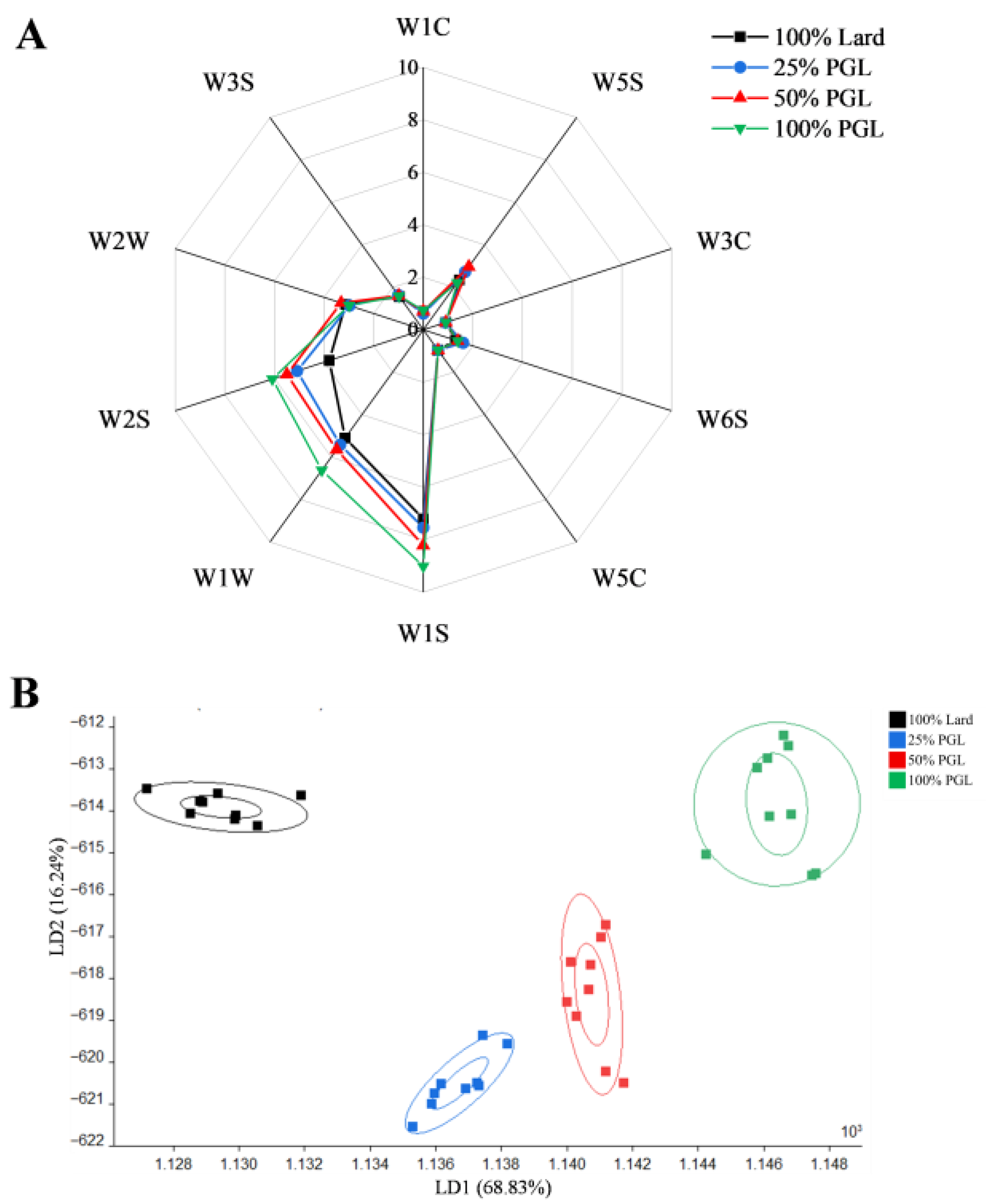
p < 0.05), which was in line with the results in the electronic nose. Flavor perception is not only related to the content of flavor compounds, but also depends on the threshold values of these flavor compounds [
26]. Odor activity value (OAV) reflects the contribution of flavor compounds to aroma and is calculated by the ratio of the content to the odor threshold of the flavor compounds [
35,
36]. Generally, flavor compounds with OAV > 1 are regarded as key aroma-active compounds that contribute to the flavor characteristics. The approximate OAV of three aldehydes (hexanal, octanal, and nonanal) was greater than 1 (
Table 7). This phenomenon is due to the high relative content and low odor threshold of these aldehydes, which play an important role in the overall odor of frankfurters. Chevance et al. [
31] reported that aldehydes were derived from the meat fraction in frankfurters, with hexanal contributing to the green odor. This may be because the 100% Lard group showed the highest cooking loss and the lowest emulsion stability [
16], thereby resulting in the highest total released liquid and released fat, which increases the loss of volatile compounds via the juice. Similarly, Yuan et al. [
24] reported that frankfurters with the highest cooking yield had significantly higher content of aldehydes. High temperature also promotes the lipid oxidation to produce aldehydes, especially in frankfurters containing PGL that have undergone purification at high temperature. Meanwhile, the viscosity of DG (84.8 mPa·s) is higher than that of TGs (74.5 mPa·s) [
37]. The higher the viscosity of the food matrix, the stronger the adsorption effect on volatile compounds [
38], which is another possible reason for the higher content of aldehydes of frankfurters containing PGL.
Alcohols primarily originate from lipid oxidation and spices [
39], with 5 alcohols being detected in all treatments. The 100% Lard group had the lowest relative content of alcohols (
p < 0.05), particularly 1-hexanol, 1-octen-3-ol, linalool, and (−)-terpinen-4-ol, which were significantly lower than in frankfurters with PGL (
p < 0.05), implying that the addition of DG increased the relative content of alcohols. Based on OAV, the main contributors of alcohols to frankfurters were 1-hexanol, 1-octen-3-ol, and linalool. As reported by Wang et al. [
40], alcohols were likely to bind to muscle proteins owing to the number of hydrogen bonds present in alcohols. Meanwhile, the presence of a hydrogen bond in DG, and thus the addition of PGL, resulted in an increase in hydrogen bonds. Alcohols interact with muscle proteins through hydrogen bonds, which reduces the volatilization of volatile flavor compounds during the heating [
24]. Additionally, some volatile compounds, such as linalool and α-terpineol, may originate from the spice (coriander seed) used in formulation [
41].
Terpenes possess a spicy aroma and are mainly produced by the addition of spices (such as white pepper powder, ground ginger powder, ground nutmeg powder, bell pepper powder, and ground coriander seed powder) to frankfurters. For instance, γ-terpinene and 3-carene mainly originate from coriander seed and white pepper, respectively [
25,
41,
42]. β-Pinene has been confirmed in nutmeg and coriander seed [
31,
41]. In this study, terpenes were the most diverse class of volatile compounds in sausages, with a total of 15 terpenes being identified. In particular, γ-terpinene was the most abundant terpene in frankfurters. The relative content of terpenes in the 100% lard group was significantly lower than in the 25% PGL, 50% PGL, and 100% PGL groups (
p < 0.05), indicating that adding a higher DG content has a positive impact on the production and release of terpenes. Meanwhile, the main contributor to the frankfurters odor from terpenes was (+)-dipentene based on its higher approximate OAV. It has been speculated that the greater juice loss in the 100% Lard group caused the terpenes to escape via the juice. Zhao et al. [
16] reported that the juiciness score of frankfurters increased as the PGL content increased, with frankfurters containing 100% lard achieving the lowest score. Another possible reason is that emulsions prepared with DG have smaller droplets than those prepared with TG. Charles et al. [
43] reported that reducing the size of the droplets in emulsions increased the release of volatile compounds in salad dressings.
Aromatic hydrocarbons were the most abundant in frankfurters with PGL (few types of aromatic hydrocarbons were detected in the control group) and possibly originate from the thermal oxidation of lipids [
25,
44]. This is possibly because the PGL preparation undergoes a two-step molecular distillation purification process at high temperatures (205 and 280 °C). Diao et al. [
45] also reported that the heating process involved in DG synthesis. Long-chain fatty acids present in fats undergo auto- and thermal oxidation (via peroxide-initiated free radical decomposition) to form long-chain unsaturated hydrocarbons, which then form aromatic hydrocarbons (such as alkylbenzenes). Watanabe et al. [
46] reported that benzene, xylenes, isopropylbenzene, and several uncharacterized C
4–C
6 alkylbenzenes were detected in fried beef fat at high temperature (cooking temperature of 145 °C). However, aromatic hydrocarbons have high odor thresholds in water. For instance, the odor thresholds of m-cymene, 1,3,5-triethylbenzene, and 2-pentylfuran are 800, 170, and 14.5 μg/kg, respectively [
47,
48,
49]. Furthermore, the majority of volatile compounds are hydrophobic and have a stronger affinity for oils, as well as a higher odor threshold in oil than in water [
50]. Therefore, aromatic hydrocarbons contribute very little to the flavor characteristics of frankfurters. Similarly, Chevance et al. [
31] reported that the contribution of the aromatic hydrocarbons to frankfurters was smaller than that of the aldehydes and alcohols.
Additionally, safrole and myristicin are generated from spice (nutmeg), and their relative content increased with increasing PGL addition levels. This result indicated that adding DG may promote the release of safrole and myristicin due to their greater solubility and lipophilicity in lipids than in water. Meanwhile, DG is less hydrophobic than TG due to the presence of a hydrophilic hydroxyl group in DG that replaces a hydrophobic fatty acid chain. Therefore, in foods containing lipids, more volatile compounds are released from the lipid phase into the aqueous phase, where they mainly interact with proteins through hydrophobic interactions [
51,
52].
3.5.2. Principal Component Analysis and Clustering Visualization
Principal component analysis (PCA) is a non-supervised chemometric method and an exploratory tool based on dimensionality reduction [
53]. The PCA plot enables an overall analysis of the variability within and between the groups of samples. Higher similarity between samples corresponds to a higher degree of clustering, while higher differences between the samples correspond to greater distances [
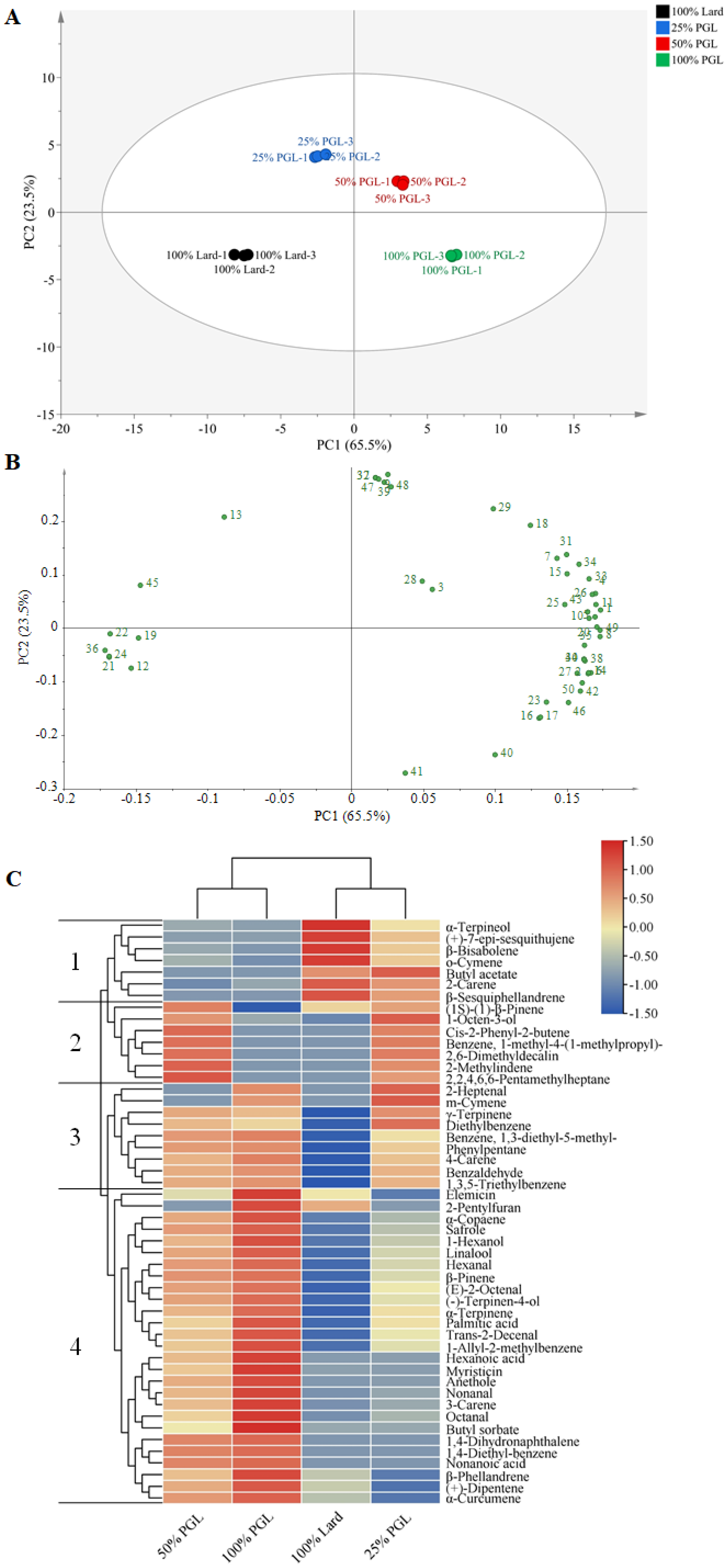
54]. In order to investigate the differences in the flavor profiles of frankfurters containing 100% lard or lard replaced with 25%, 50% or 100% PGL, a PCA was carried out to describe the distribution of the four treatments. As shown in
Figure 2A, a total of 89% of the variance was explained by the first two principal components, which was greater than 80%. This indicated that the first two principal components explained the majority of the flavor characteristics of frankfurters [
55]. The four treatments were clearly separated with no overlap, indicating that the flavor profile of frankfurters with different levels of PGL was distinctly different. Notably, the 100% Lard group was the furthest from the 100% PGL group on the PC1 axis, demonstrating the most obvious difference in flavor characteristics between the two groups. As shown in
Figure 2B, the 50% PGL and 100% PGL groups were found on the positive axis of the PC1, and they were positively correlated with hexanal (No. 1), octanal (No. 2), nonanal (No. 6), 1-hexanol (No. 8), linalool (No. 10), (+)-dipentene (No. 16), 1-allyl-2-methylbenzene (No. 35), hexanoic acid (No. 42), and safrole (No. 49), etc. The 100% Lard and 25% PGL groups were found on the negative axis of the PC1, and they were positively correlated with β-sesquiphellandrene (No. 22), β-bisabolene (No. 24), and o-cymene (No. 36), etc. This indicated that the volatile profiles of the 50% PGL and 100% PGL groups were obviously different from those of the 100% Lard and 25% PGL groups. In other words, the flavor characteristics of frankfurters with a high PGL replacement level were clearly different from those of the 100% Lard and low PGL replacement groups, which coincides with the LDA result of the electronic nose.
Hierarchical cluster analysis (HCA) was employed to identify differences in volatile compounds that play a key role in frankfurters with different levels of PGL. As shown in
Figure 2C, in the vertical pattern, the 50% PGL and 100% PGL groups were clustered into one category, and the 100% Lard and 25% PGL groups were clustered into another category. Meanwhile, all volatile compounds were distinguished into four clusters. In zone 1, (+)-7-epi-sesquithujene, β-bisabolene, o-cymene, butyl acetate, 2-carene, and β-sesquiphellandrene increased in the 100% Lard and 25% PGL groups. In zone 2, 1-octen-3-ol, cis-2-phenyl-2-butene, benzene, 1-methyl-4-(1-methylpropyl)-, 2,6-dimethyldecalin, 2-methylindene, and 2,2,4,6,6-pentamethylheptane increased in the 25% PGL and 50% PGL groups. In zone 3, γ-terpinene, 4-carene, benzaldehyde, and 1,3,5-triethylbenzene increased in the 25% PGL, 50% PGL, and 100% PGL groups. In zone 4, 1,4-dihydronaphthalene, 1,4-diethyl-benzene, nonanoic acid, α-copaene, safrole, 1-hexanol, linalool, β-pinene, (E)-2-octenal, (−)-terpinen-4-ol, α-terpinene, anethole, nonanal, 3-carene, (+)-dipentene, β-phellandrene, and α-copaene increased in the 50% PGL and 100% PGL groups. These results showed that the addition of PGL could markedly influence the flavor profile of frankfurters, which was in line with the results of GC-MS and PCA. Our previous studies also showed that the addition of DG (the main component of PGL) increased the flavor intensity score of frankfurters [
15].
3.5.3. Partial Least Squares Discriminant Analysis
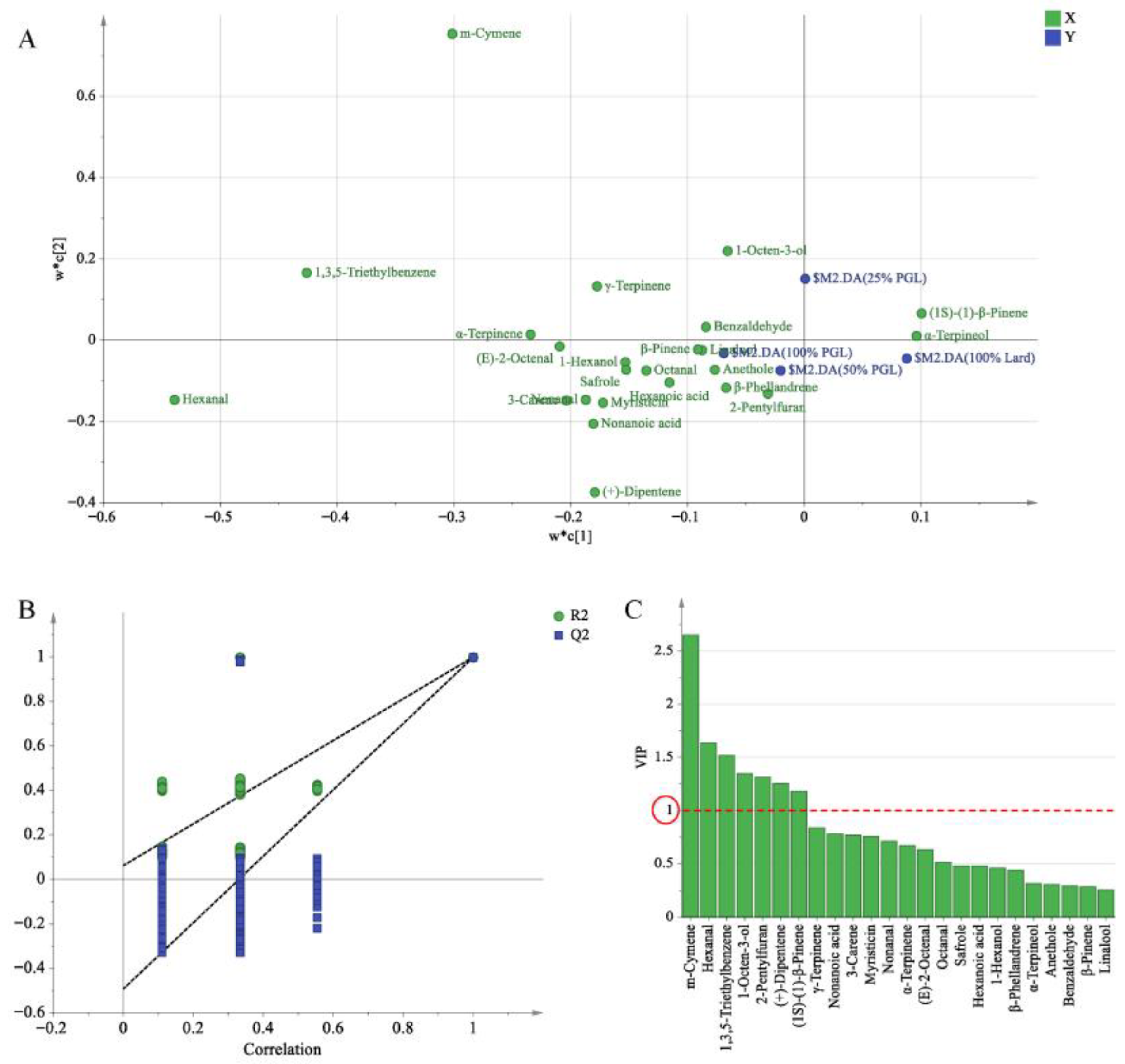
Partial least squares discriminant analysis (PLS-DA) was used to identify the volatile compounds based on OAV data responsible for the differences in frankfurters containing different levels of PGL. As shown in
Figure 3A, R
2X, R
2Y, and the prediction ability parameter Q
2 were 0.969, 0.998, and 0.995, respectively, all of which were close to 1. This showed that the model possessed good interpretation and classification predictive ability. Meanwhile, the model was not overfitting because the intercept of the Q
2 regression line on the Y-axis was less than zero (
Figure 3B). To confirm the main variables causing the PLS-DA model classification, the contribution of volatile compounds was analyzed using variable importance in projection (VIP) based on PLS-DA. In general, VIP > 1 indicates that the variables significantly affect the sample classification [
56]. As shown in
Figure 3C, 7 volatile compounds with VIP > 1 were detected, including m-cymene (No. 28), hexanal (No. 1), 1,3,5-triethylbenzene (No. 31), 1-octen-3-ol (No. 9), 2-pentylfuran (No. 41), (+)-dipentene (No. 16), and (1S)-(1)-β-pinene (No. 13).
According to the OAV > 1 and VIP > 1, 3 volatile compounds (including 1 aldehyde, 1 alcohol, and 1 terpene) played a vital role in the flavor profile of frankfurters with varying levels of PGL. The above volatile compounds [hexanal, 1-octen-3-ol, and (+)-dipentene] could be used as key volatile compounds and markers to differentiate between the frankfurters with different levels of PGL.




 ,
,