1. Introduction
Open access (OA) has reshaped scholarly communication by expanding readership, accelerating reuse, and diversifying business models. However, this transformation has also intensified scrutiny of editorial quality, transparency, and long-term sustainability in indexed venues (
Tennant et al., 2016). Research on “vanished” OA journals shows that long-term accessibility is not guaranteed: a non-trivial number of OA titles have disappeared from the web due to gaps in preservation and governance arrangements, raising concerns about the integrity of the scholarly record (
Laakso et al., 2021). Scopus, one of the world’s largest bibliographic databases, addresses these challenges by conducting periodic reassessments through its Content Selection and Advisory Board (CSAB) and the Scopus Title Evaluation Platform (STEP) (
Kähler, 2010). These evaluations, which examine both publication performance and ethical standards, can lead to journal discontinuation—that is, the formal removal of a journal from Scopus coverage following a negative reassessment, typically due to persistent quality or ethical concerns such as inadequate peer review or data/results manipulation—directly affecting visibility, credibility, and evaluation systems that rely heavily on index status (
Cortegiani et al., 2020;
Krauskopf, 2018).
As of June 2025 (latest available update at the time of data extraction), Scopus listed 44,415 journals, including both active and inactive titles, while the Directory of Open Access Journals (DOAJ) contained 21,751 journals. After merging both databases, 8672 journals were identified as currently indexed in Scopus, 314 were inactive but not discontinued for quality reasons, and 58 had been explicitly discontinued by Scopus following negative reassessment. This subset confirms that even journals adhering to open access and transparency principles remain vulnerable to discontinuation, underscoring that openness alone is insufficient to guarantee long-term inclusion in selective indexes. This is consistent with evidence that sustaining OA journals depends on robust funding and preservation infrastructures; when these are fragile, titles are more exposed to disappearance or loss of coverage (
Laakso et al., 2021). The trajectory is also concerning: while from 2013 to 2020 the average number of discontinued DOAJ-registered titles was 3.5 per year, between 2021 and 2023 the average rose to seven, peaking at eight in 2023.
The literature reveals multiple causes behind discontinuation.
Cortegiani et al. (
2020) showed that 93% of discontinued Scopus journals were OA, with Medicine, Agriculture and Biological Sciences, and Pharmacology most affected, and 22% classified as predatory. In Australia, analysis of 140 discontinued journals found that funding shortages, lack of quality submissions, and weak institutional support were central drivers, compounded by pressure to comply with international ranking systems (
Jamali et al., 2022). Similar dynamics have been reported elsewhere, where changes in evaluation frameworks, financial constraints, and publishers’ unwillingness to support less profitable journals contribute to instability (
Naxera, 2024). The effects of discontinuation, however, do not end with that;
Nazarovets (
2022) documented that Ukrainian institutions continued to publish in discontinued journals, even attracting higher citation rates than indexed (active) ones. Regional disparities also play a role; African publishers, for example, often face discontinuation from Scopus and struggle to gain legitimacy in alternative platforms such as DOAJ (
Mills et al., 2021). These findings demonstrate that discontinuation reflects a complex interplay of financial, institutional, and reputational pressures rather than a single cause.
Among the observable editorial characteristics that may help explain these patterns, economic and governance structures occupy a central place. Article processing charges (APCs) have become one of the main mechanisms for sustaining OA publishing, yet their relationship with journal stability remains diverse. Practices differ significantly across disciplines and publishers: architecture journals indexed in Scopus, for instance, range from no charges to conditional waivers, illustrating heterogeneous approaches to financing editorial operations (
Perdomo et al., 2023). Broader patterns confirm disciplinary variation, with medical and science journals charging higher APCs than those in other fields, influenced by impact factor, publisher, and language (
Siler & Frenken, 2020). Global analyses indicate that large publishers increasingly depend on APC revenues, while diamond OA models remain crucial for equitable access yet are chronically underfunded (
Borrego, 2023;
Pilatti et al., 2025). Cost trends reinforce this imbalance:
Morrison et al. (
2022) reported that average APCs increased from USD 906 to 958 per journal between 2011 and 2021, with per-article costs rising more sharply, while
Asai (
2023) found that hybrid journals charged approximately USD 1620 more than gold OA titles after accounting for other variables. Beyond APCs, the presence of other editorial fees—such as submission or publication charges not disclosed through standard APC models—has also been discussed as a potential signal of operational opacity or financial fragility, which may undermine the long-term sustainability of journals.
Another factor of particular interest in the literature is the historical trajectory of discontinuation. Once a journal has been discontinued, its probability of subsequent discontinuation tends to rise, suggesting it follows a cumulative, path-dependent process rather than isolated incidents. Approximately 10% of Scopus-indexed journals have faced discontinuation or coverage gaps, reflecting ongoing efforts to regulate content quality (
E. Kim, 2024). Regional evidence illustrates the consequences: in Africa, discontinuation undermines not only access but also perceptions of legitimacy and circulation of local knowledge (
Mills et al., 2021). Although reinclusion in Scopus is possible, it requires journals to meet strict standards related to peer review, editorial composition, and metadata accuracy, making recovery a demanding process (
Andriansyah, 2023). These dynamics confirm that discontinuation history functions both as a practical indicator of editorial instability and as a structural constraint on sustainability.
Other editorial attributes, including research integrity safeguards and workflow efficiency, also contribute to the broader picture of journal governance. Journals that adopt plagiarism-detection policies and enforce routine similarity checks signal accountability and credibility, thereby strengthening their editorial reputation (
Milovanovic et al., 2025;
Perdomo & Morales, 2022;
Tennant et al., 2016). The introduction of systematic tools such as CrossCheck by iThenticate
1 has moved plagiarism detection from chance discovery to standardized practice, enhancing editorial reliability (
Baždarić, 2012;
S. Y. Kim, 2017). High-impact biomedical journals, which often endorse international editorial policies, are more likely to define misconduct explicitly and to implement structured procedures for handling allegations, fostering greater public trust (
Bosch et al., 2012). By contrast, journals in low- and middle-income countries frequently lack such policies or tools, which contributes to higher rates of undetected misconduct (
Rohwer et al., 2018).
Similarly, submission-to-publication intervals reflect workflow efficiency and the capacity to balance speed and rigor. Moderate times may indicate structured editorial processes, whereas excessively short or inconsistent times can suggest superficial peer review or bottlenecks. In Latin America, OA journals indexed in DOAJ report average response times of about four months, but persistent gaps in metadata quality and interoperability still erode discoverability and trust (
González-Sanabria et al., 2020). Comparative evidence confirms both extremes as problematic: excessive delays weaken knowledge diffusion and citation potential (
Chen et al., 2024;
Ding & Du, 2023), while unusually fast processing raises concerns about review rigor.
Finger et al. (
2022) found that longer handling times were associated with higher impact factor journals in agricultural economics, whereas in high-profile outlets such as Nature, Science, and PNAS, faster handling correlated with greater scholarly and societal impact (
Gul et al., 2023;
Xie et al., 2024). Since Scopus re-assessments evaluate publication performance and process quality together, editorial timeliness and metadata consistency are directly linked to index retention.
This study is therefore motivated by the practical and scholarly need to anticipate editorial risks among OA journals that are simultaneously indexed in Scopus and registered in DOAJ. While prior work has addressed OA economics, transparency, and interoperability, few studies have modeled discontinuation as a function of observable editorial variables (
Borrego, 2023). By examining financial structure (APCs and other fees), discontinuation history, editorial turnaround time, and integrity safeguards, this research aims to identify early-warning signals of instability and provide empirical evidence to guide sustainable editorial practices and evaluation mechanisms. The evidence seeks to inform editorial policies, support fairer evaluation frameworks, and contribute to the sustainable inclusion of OA journals in selective indexes by aligning openness with integrity and efficiency.
2. Material and Methods
This study adopted a quantitative approach, as it analyzes and models objective numerical data in order to establish statistical relationships between observable editorial variables and the discontinuation of open access journals indexed in Scopus and registered in the Directory of Open Access Journals (DOAJ). The research is applied in nature, given its focus on addressing a practical issue in the field of scientific evaluation, namely the identification of potential indicators associated with the discontinuation of journals from selective indexing databases. The design is non-experimental, correlational, and predictive, since no variables were manipulated; instead, existing data were retrospectively analyzed to estimate the probability of journal discontinuation.
The study population included all journals registered in the Directory of Open Access Journals (DOAJ) that were active or discontinued by Scopus for quality-related reasons. According to Elsevier’s official Scopus Source List (June 2025, latest available update at the time of extraction), a total of 44,415 journals were identified, including both active and inactive titles. The DOAJ database contained 21,751 journals at that same time.
Table 1 summarizes the distribution of Scopus-listed journals according to their indexing status and registration in DOAJ. Among the 21,751 journals registered in DOAJ, a total of 8730 were included in the analytical sample—comprising 8672 active titles and 58 discontinued by Scopus for quality-related reasons. An additional 314 journals were inactive for other, non-quality-related causes.
Data collection was conducted by merging two authoritative and up-to-date sources: the Scopus Source List and the complete metadata set of journals registered in DOAJ, both extracted on the same date (6 June 2025). The matching between both registries was performed hierarchically using three identifiers—ISSN, e-ISSN, and journal title—as primary keys. This process ensured that the same journal could be traced across both datasets despite minor discrepancies in metadata.
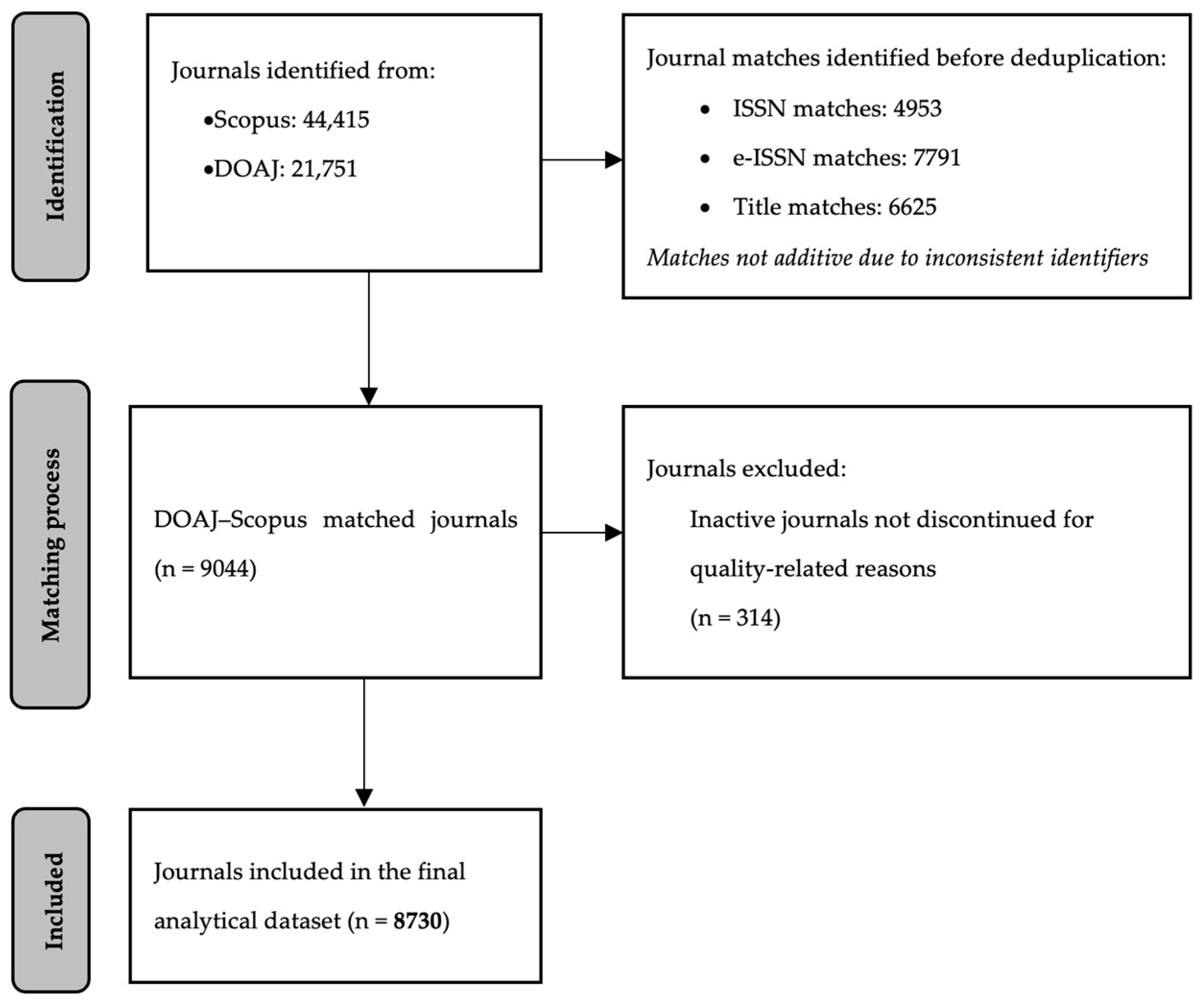
From the Scopus database (44,415 journals) and the DOAJ registry (21,751 journals), a hierarchical matching process using ISSN, e-ISSN, and title produced a consolidated set of 9044 journals indexed in both databases. As shown in
Figure 1, a subsequent eligibility step excluded 314 inactive journals whose removal from Scopus did not result from quality-related discontinuation, for example, journals that were merged or absorbed into another title, underwent publisher or platform migration, changed their identifiers (ISSN/e-ISSN), or were restructured administratively without undergoing a formal quality reassessment by Scopus. After applying this criterion, the final analytical dataset comprised 8730 DOAJ–Scopus journals.
Two dependent variables were defined to capture different dimensions of discontinuation: (i) the discontinuation status in Scopus, coded as a binary outcome (1 = discontinued, 0 = active), and (ii) the total number of discontinuations per journal, treated as a discrete count variable. Independent variables included the presence of a plagiarism-detection policy, existence of article processing charges (APCs), presence of other editorial fees beyond APCs, author copyright ownership, existence of a waiver policy, average turnaround time from submission to publication (measured in weeks), and journal age in Open Access (measured in years since establishment). Prior discontinuation history was also included as a discrete predictor to capture the accumulated effect of previous discontinuations on current status.
Statistical analyses were carried out using Stata version 16. The bivariate analysis examined the association between each editorial predictor and discontinuation status through chi-square tests for categorical variables and Student’s
t-tests for continuous variables. These analyses provided the initial diagnostic view of which characteristics differentiated discontinued from active journals. Subsequently, a binary logistic regression model estimated the probability of discontinuation as a function of the editorial variables, reporting coefficients, z-values, p-values, and odds ratios (OR) with 95% confidence intervals. To examine discontinuation as a recurrent process, an initial Poisson regression model was fitted using the number of discontinuations as the dependent variable. The results of this model are reported in
Appendix A (
Table A1) for methodological transparency and comparison purposes. However, the dispersion test indicated significant overdispersion in the count data (LR test of α = 247.15,
p < 0.001); therefore, Negative Binomial Regression (NBR) model was subsequently estimated, providing variance-adjusted coefficients and more reliable incidence rate ratios (IRR).
This sequential modeling strategy allowed the Poisson specification to serve as a preliminary baseline, while the Negative Binomial Regression (NBR) was adopted as the main model due to its superior fit under overdispersion. Accordingly, only the NBR results are presented and discussed in the main text, whereas the Poisson estimates are retained in
Appendix A (
Table A1) for methodological transparency. The combined use of logistic, Poisson, and NBR models provided complementary perspectives on the phenomenon of discontinuation: the logistic regression captured the overall probability of discontinuation, whereas the count models quantified its recurrence over time. Together, these specifications enabled the identification of the most consistent and statistically robust predictors, integrating both the likelihood and the intensity of the process. Rigorous data matching, systematic variable coding, and the application of multiple model specifications ensured analytical reproducibility and enhanced the validity of the findings presented in the following section.
3. Results
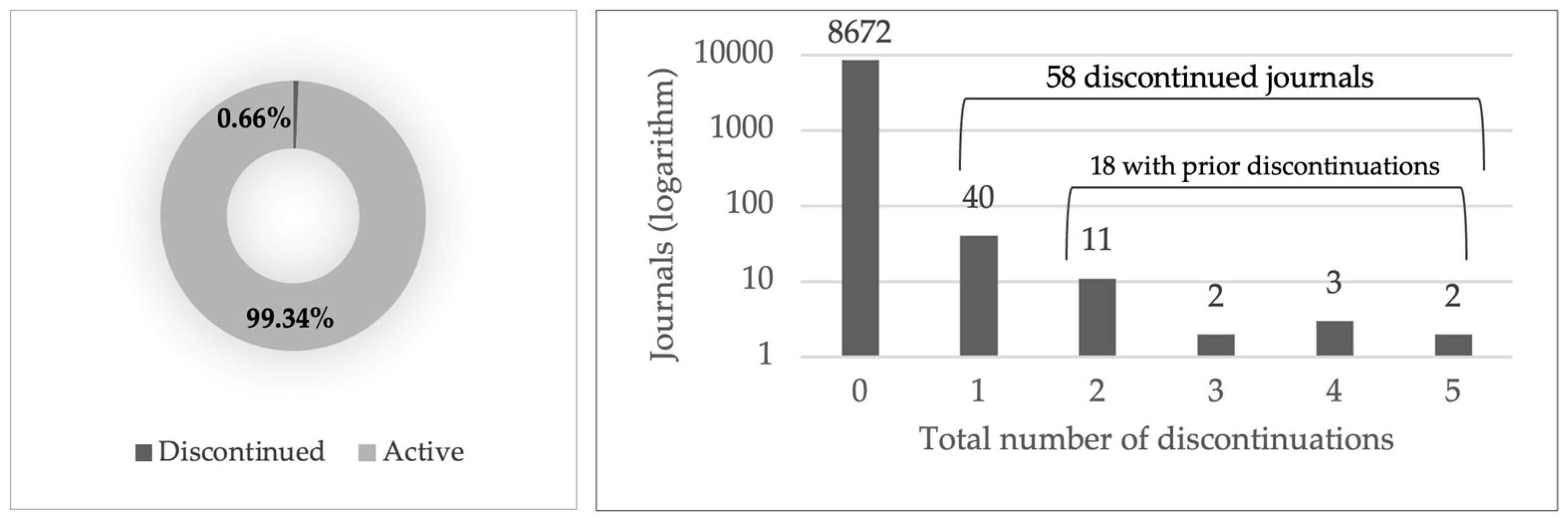
The overall distribution of discontinuation within the dataset is presented in
Figure 2. Out of the 8730 journals included in the census, only 58 were identified as discontinued in Scopus, representing 0.66% of the total sample, while 99.34% remained active. Although the proportion of discontinued journals appears relatively small, the frequency distribution of discontinuation events per journal reveals important nuances. Most journals (
n = 8672) had never been discontinued, whereas a minimal subset experienced one or more discontinuations, with the counts rapidly decreasing as the number of events increased. This logarithmic decay pattern indicates that discontinuation is a rare but non-trivial occurrence in the open-access ecosystem, concentrated in a small group of titles that display recurrent indexing instability.
Bivariate analyses were conducted to identify the editorial characteristics most closely associated with discontinuation in Scopus. As shown in
Table 2, most editorial and procedural variables did not exhibit statistically significant associations with discontinuation status, suggesting that discontinuation is not systematically explained by standard editorial practices. The presence of plagiarism detection policies was nearly identical among discontinued (0.7%) and active journals (99.3%) (χ
2 = 0.00,
p = 0.978), confirming that this practice has become a widespread baseline across the open-access landscape. Likewise, the presence of APCs (χ
2 = 0.84,
p = 0.359), copyright ownership policies (χ
2 = 1.40,
p = 0.237), and waiver programs (χ
2 = 0.01,
p = 0.915) showed no significant differences between discontinued and active journals. Neither turnaround time (
p = 0.264) nor journal age (
p = 0.510) exhibited notable contrasts, indicating that editorial maturity or workflow duration alone do not determine discontinuation outcomes.
In contrast, two variables displayed strong and statistically significant relationships. Prior discontinuation history emerged as the most decisive factor (χ2 = 2548.15, p < 0.001): all journals with a prior discontinuation record were again found among the discontinued group. This perfect overlap reflects a structural path dependence, where prior discontinuation strongly predicts future exclusion. The second significant variable was the presence of other editorial fees (χ2 = 4.878, p = 0.027), where journals applying additional charges beyond APCs exhibited a discontinuation rate of 1.6%, more than twice that of journals without such fees (0.6%). This pattern suggests that complex or opaque financial structures may be associated with greater operational fragility and higher discontinuation risk.
Building upon the bivariate results, a multivariate logistic regression was estimated to evaluate the combined influence of editorial characteristics on the likelihood of discontinuation. As shown in
Table 3, most variables lost statistical significance once modeled jointly, indicating that their individual effects were not robust when controlling for intercorrelations among predictors. Plagiarism detection policies (OR = 1.052,
p = 0.871), copyright ownership (OR = 1.320,
p = 0.311), waiver policies (OR = 1.841,
p = 0.185), turnaround time (OR = 0.983,
p = 0.198), and journal age (OR = 1.001,
p = 0.520) showed no significant influence.
Although the presence of APCs approached the significance threshold (p = 0.073), its effect was inverse (OR = 0.442), indicating that journals charging APCs were less likely to be discontinued—a trend consistent with financial and operational stability but statistically inconclusive. In contrast, the presence of other editorial fees retained a robust positive effect (p = 0.006, OR = 3.365, 95% CI [1.406, 8.055]), meaning that journals reporting additional or unspecified fees were over three times more likely to be discontinued than those without such charges. This finding reinforces the hypothesis that non-standard fee structures are associated with higher discontinuation risk, even when other factors are controlled.
To further explore the recurrence dimension of discontinuation, a Poisson regression model was initially estimated using the number of discontinuations as the dependent variable. Its results are reported in
Appendix A (
Table A1) for methodological transparency, as this preliminary model served only as a baseline prior to overdispersion correction. Most editorial variables were not significantly associated with the frequency of discontinuation events. Plagiarism detection policies (IRR = 0.946,
p = 0.816), copyright ownership (IRR = 1.083,
p = 0.710), waiver policies (IRR = 1.690,
p = 0.166), turnaround time (IRR = 0.998,
p = 0.806), and journal age (IRR = 1.001,
p = 0.202) all exhibited non-significant effects. Only two variables reached significance: the presence of APCs (IRR = 0.360,
p = 0.006) and other editorial fees (IRR = 3.202,
p = 0.001), showing opposite financial effects that would later be re-evaluated with the Negative Binomial Regression model.
After detecting overdispersion in the Poisson specification (LR test of α = 247.15,
p < 0.001), the final analysis relied on the Negative Binomial Regression (NBR) model, whose results are presented in
Table 4. This model captures the same set of editorial predictors but provides a better fit for the count data distribution, as indicated by the significant dispersion parameter (α = 102.91). Interpretation in the main text is therefore based on the NBR coefficients, whereas the Poisson output remains in
Appendix A solely for comparison.
As shown in
Table 4, most variables remained statistically non-significant after correcting for overdispersion, confirming the robustness of previous findings. The presence of plagiarism detection policies (IRR = 0.848,
p = 0.653), copyright ownership (IRR = 1.227,
p = 0.534), waiver policies (IRR = 1.733,
p = 0.344), turnaround time (IRR = 0.993,
p = 0.636), and APCs (IRR = 0.378,
p = 0.084) did not exert statistically significant effects. This indicates that routine editorial safeguards—while essential—are not decisive once historical and financial structures are considered.
In contrast, two variables reached statistical significance and displayed meaningful positive effects. The first was the presence of other editorial fees (p = 0.048, IRR = 3.877; 95% CI [1.011, 14.861]), which implies that journals applying additional or non-standard fees have nearly four times the expected number of discontinuations compared to those without such charges. This result underscores financial opacity and administrative complexity as central predictors of instability.
The second was journal age (p = 0.031, IRR = 1.032; 95% CI [1.003, 1.061]), suggesting that older journals tend to experience slightly higher discontinuation counts over time, potentially reflecting the cumulative exposure of long-standing titles to changes in indexing criteria or editorial restructuring.
Across all models, the results consistently indicate that discontinuation among Scopus-indexed OA journals is not statistically associated with standard editorial practices but rather by structural, historical, and financial dimensions. The recurrent significance of other editorial fees and the persistence of discontinuation history highlight the influence of financial governance and institutional resilience in sustaining indexing stability. Conversely, the negative association of APCs with discontinuation counts suggests that transparent, standardized fee structures may foster editorial continuity. Finally, the modest yet significant role of journal age indicates that temporal accumulation may compound exposure to discontinuation events. Collectively, these findings reveal that financial transparency, adaptive governance, and editorial continuity are the key empirical correlates of sustained indexing stability, providing a robust foundation for the interpretive discussion that follows.
4. Discussion
The findings of this study provide clear empirical evidence that discontinuation among Scopus-indexed, DOAJ-registered journals, although numerically infrequent (0.66%), follows a highly concentrated and recurrent pattern. The data show that a very small subset of journals accounts for nearly all discontinuation events, and that once a title experiences a first discontinuation, its likelihood of subsequent events increases sharply. This behavior is consistent with the cumulative and path-dependent trajectories reported in previous studies (
Cortegiani et al., 2020;
Moussa, 2023), reinforcing the idea that discontinuation is not a random or isolated outcome but an indicator of deeper structural vulnerabilities within the editorial system.
In this context, the recurrence observed in the dataset may reflect difficulties in meeting evolving standards in governance, transparency, or operational continuity. While these factors cannot be claimed as causal with the available data, their alignment with the patterns observed suggests that discontinuation tends to accumulate in journals where institutional resilience, financial clarity, or adaptive capacity may be limited. This interpretation positions discontinuation not as a single event but as part of a broader editorial trajectory shaped by historical, managerial, and organizational conditions.
This cumulative dynamic may also be compounded by the persistence of discontinued journals within scholarly communication networks. Even after formal discontinuation, many of these journals continue to circulate in citation ecosystems, maintaining visibility despite compromised credibility (
Lancho Barrantes et al., 2023;
Nazarovets, 2022). Previous studies have reported that this persistence can distort scholarly metrics by allowing discontinued journals to continue influencing citation counts, h-indices, and impact analyses (
Abalkina, 2024;
Somoza-Fernández et al., 2016). Similarly, the recurrence of suppressions in Clarivate’s Journal Citation Reports (
Moussa, 2023) and the continued engagement of authors with outlets of dubious reputation (
Frandsen, 2022) reinforce the notion that discontinuation does not mark a definitive end but a cyclical process of instability. This observation is consistent with the present findings, where journals with a prior discontinuation history consistently reappeared in the discontinued group, underscoring that editorial instability may be self-reinforcing over time. This cumulative loop suggests that discontinuation functions less as an isolated sanction and more as an evolving state of fragility that demands sustained institutional reform and transparent governance responses.
The models also reveal important insights regarding the role of editorial integrity safeguards. The presence of plagiarism-detection policies, copyright ownership statements, and waiver programs did not show statistically significant effects in predicting discontinuation or its recurrence. These elements, while essential to good editorial practice, have become standard across the OA landscape and therefore lack discriminant power. Their implementation represents baseline governance rather than a determinant of discontinuation risk. However, their near-universal adoption reflects progress in baseline editorial governance. Prior studies have shown that the mere presence of integrity mechanisms does not guarantee effective implementation; rather, their consistent enforcement and transparency determine their true preventive capacity (
Krokoscz, 2021;
Perdomo & Morales, 2022). These results confirm that technical compliance alone is insufficient to prevent discontinuation once systemic weaknesses are established.
The findings regarding financial structures appear to reveal the strongest and most consistent relationships across all models. Among the examined variables, other editorial fees—defined as charges beyond standard article processing charges (APCs)—emerged as the only factor with a stable, statistically significant association with discontinuation in both logistic and count-based regressions. Journals imposing additional or unspecified fees were over three times more likely to be discontinued (OR = 3.365, p = 0.006), and they exhibited more than three times the expected number of discontinuations (IRR = 3.202, p = 0.001; IRR = 3.877, p = 0.048 in the negative binomial model). Substantively, this pattern may point to to fee opacity and administrative complexity as credible signals of governance weakness: fragmented charging schemes, ad hoc surcharges or poorly disclosed costs may reflect limited financial controls and unstable operational routines—the very conditions that indexers detect during reassessment. Indexing systems such as Scopus evaluate not only editorial quality but also transparency and governance; hence, journals with nonstandard or ambiguous fee structures may trigger greater scrutiny during re-evaluation. In this sense, “other fees” function less as a causal mechanism and more as a proxy for fragile managerial capacity and non-transparent decision-making, which aligns with the observed increases in both the odds and recurrence of discontinuation.
Conversely, APCs displayed a consistently inverse relationship with discontinuation. Although their protective effect did not reach significance in the logistic model (OR = 0.442,
p = 0.073), it was significant in the Poisson regression (IRR = 0.360,
p = 0.006) and remained negative in the negative binomial model (IRR = 0.378,
p = 0.084). This pattern suggests that transparent and standardized APC schemes can function as stabilizing mechanisms rather than threats to quality. Structured and predictable APC frameworks reflect a higher level of institutionalization, which supports sustainability. These results align with findings by (
Nejadghanbar & Hu, 2022), who note that the legitimacy of OA business models depends less on the presence of fees and more on their clarity, consistency, and ethical management. Thus, while other editorial fees indicate opacity and administrative disorganization, APCs—when clearly defined—can represent operational maturity and good governance. The differentiation observed here between APCs and other editorial fees reinforces the value of financial transparency as a key dimension of responsible publishing.
Regarding timeliness, turnaround time from submission to publication did not exhibit significant effects on either the probability or recurrence of discontinuation. This finding suggests that moderate variations in editorial speed do not directly influence index retention. However, the literature indicates that both extremes—excessive delay and overly rapid acceptance—can raise concerns. Prolonged processing times have been linked to lower citation accrual and reduced author satisfaction (
Manjunath et al., 2020;
Xie et al., 2024) while unusually short timelines may signal insufficient peer review and questionable editorial rigor (
Gallent Torres, 2022). Therefore, timeliness functions less as a direct predictor and more as a contextual indicator whose interpretation depends on transparency and field norms. Our results suggest that while editorial speed alone does not predict discontinuation, its intersection with governance quality and reviewer management could contribute to long-term vulnerability (
Horbach, 2020).
The effect of journal age introduces another temporal dimension to discontinuation. Although age was not significant in the binary logistic model, it reached significance in the negative binomial specification (IRR = 1.032,
p = 0.031). This means that older journals tend to experience a gradual accumulation of discontinuation events over time. Far from indicating maturity, this may reflect structural inertia, legacy workflows, or resource constraints that hinder adaptation to evolving quality criteria. Similar findings have been reported by
Jamali et al. (
2022) and
Rezazade Mehrizi et al. (
2022), who argue that organizational aging can erode flexibility and innovation, particularly in journals reliant on volunteer editors or without stable institutional support. As
Naxera (
2024) observes, the sustainability of editorial practices depends on continuous modernization, not longevity per se. Age thus emerges as a double-edged factor: it brings experience but also accumulated exposure to regulatory and technological shifts that may heighten discontinuation risk.
The persistence of discontinued journals in scholarly networks raises additional implications for recovery and reintegration. Restoration after discontinuation is possible but typically requires comprehensive reforms in editorial governance, peer review, and international visibility. As documented by
Gasparyan and Kitas (
2021) and
S. Kim (
2021), journals that successfully regained Scopus coverage did so by demonstrating measurable improvements in quality control and transparency. Scopus’s Content Selection and Advisory Board (CSAB) enforces these standards rigorously, ensuring that reindexing is conditional upon sustained compliance (
Baas et al., 2020;
Jang, 2020). However, as prior studies indicate, discontinued content often continues to circulate and be cited long after discontinuation (
Cortegiani et al., 2020), producing a temporal lag between corrective actions and their effect on research evaluation. It is important to note, however, that discontinuation does not automatically imply that previously published articles are of poor quality or fraudulent. Many discontinued journals contain valid and methodologically sound research, but their editorial or governance practices no longer meet the current indexing criteria. This situation challenges the consistency of bibliometric databases, as citations to such content remain part of scholarly metrics even though the journals themselves are no longer indexed (
Hatherill, 2020).
Finally, the discussion of discontinuation cannot overlook the equity dimension of openness. Although open access promotes visibility and inclusivity (
Huang et al., 2024;
Kudlow et al., 2020;
Saravudecha et al., 2023), the capacity to maintain compliance with ethical, technical, and editorial standards is unevenly distributed across regions and journal types. Diamond OA initiatives, which operate without APCs, often face chronic underfunding and administrative limitations, making them especially vulnerable to discontinuation. Deficiencies in metadata quality, interoperability, and archiving exacerbate these disparities (
González-Sanabria et al., 2020;
Perdomo & Morales, 2022). The consistent association of other editorial fees with discontinuation observed in this study may therefore reflect broader systemic inequalities: journals with fewer institutional resources may rely on supplementary charges to sustain operations, inadvertently exposing themselves to greater scrutiny or reputational risk. Although variables such as field, publisher, and region may influence discontinuation patterns, their inclusion was not statistically meaningful in this study due to the very small number of discontinued journals and their uneven distribution across categories. Future large-scale analyses encompassing both OA and non-OA journals could more effectively assess these contextual effects. It is also important to acknowledge that both Scopus and DOAJ, while authoritative and widely used, present inherent limitations related to data completeness and update frequency. Minor inconsistencies in metadata or coverage may introduce bias in cross-database matching, although their combined use remains the most reliable approach currently available for assessing journal continuity.
Taken together, these findings reinforce that discontinuation in Scopus is not statistically associated with isolated editorial deficiencies but by an interplay of historical, financial, and structural forces. The predictive role of prior discontinuation underscores the weight of historical trajectories; the strong and consistent effect of other editorial fees highlights the central role of financial transparency and governance in sustaining indexation; and the modest yet significant influence of journal age reveals that long-term continuity depends on adaptive capacity rather than permanence. Traditional integrity measures remain important but have reached a threshold of standardization that limits their explanatory power. Discontinuation, therefore, can be interpreted not solely as a technical consequence of evaluation but as an embedded process within the evolving political economy of scholarly publishing, shaped by disparities in resources, governance, and adaptation capacity.
5. Conclusions
The analysis of discontinuation patterns among open access journals indexed in Scopus and registered in DOAJ reveals a striking reality: the strongest and most consistent predictor of instability is a journal’s own history of prior discontinuation.
Every journal that had been discontinued previously was found again among the discontinued group, confirming a perfect recurrence pattern (χ2 = 2548.15, p < 0.001). This result demonstrates that discontinuation functions as a path-dependent process, in which once a journal is discontinued, its probability of subsequent discontinuation approaches certainty within the observed data.
Beyond this historical effect, financial structure emerged as the most powerful explanatory dimension. Journals charging other editorial fees beyond standard article processing charges (APCs) were 3.36 times more likely to be discontinued (OR = 3.365, p = 0.006) and exhibited up to 3.88 times higher expected counts of discontinuations in the negative binomial model (IRR = 3.877, p = 0.048). In contrast, journals applying standard APC models showed markedly lower recurrence rates—64% fewer expected discontinuations (IRR = 0.360, p = 0.006)—highlighting the stabilizing role of transparent and regulated business models. These results suggest that discontinuation is not determined by the existence of publication fees, but by the degree of financial transparency and governance integrity supporting them.
Other editorial indicators—such as plagiarism detection, waiver policies, or turnaround time—did not show significant independent effects when adjusted for other variables, reflecting their status as baseline practices in open-access publishing. However, journal age proved to be a modest but significant factor: each additional year of operation increased the expected number of discontinuations by 3.2% (IRR = 1.032, p = 0.031), suggesting that legacy workflows and cumulative exposure to evolving evaluation criteria may gradually heighten vulnerability.
By focusing on DOAJ-listed journals, this study demonstrates that even within a transparent and regulated ecosystem, discontinuation risk is primarily shaped by historical continuity, financial design, and editorial governance. For editors, the findings stress the need to institutionalize integrity safeguards and maintain clear, sustainable financial structures. For indexers, prior discontinuation history stands as a reliable early-warning indicator for targeted monitoring. For institutions and policymakers, Scopus inclusion should be viewed not as a permanent certification of quality, but as a dynamic indicator reflecting continuous compliance and adaptability.
Although discontinuation remains rare among DOAJ-registered journals, these findings offer a solid empirical basis for improving sustainability and accountability in scholarly publishing. Future research should employ longitudinal designs to examine reindexing trajectories and to assess how governance reforms and resource models affect long-term continuity. Ultimately, the durability of journals in selective databases depends less on openness or fee presence than on the resilience, transparency, and adaptability of their editorial systems—core conditions to preserve credibility and trust in global research evaluation frameworks.




 ,
,