

Evaluating Undergraduate Dental Curricula on Oral Health Care for Autistic Persons in Australia and New Zealand—A Cross-Sectional Study


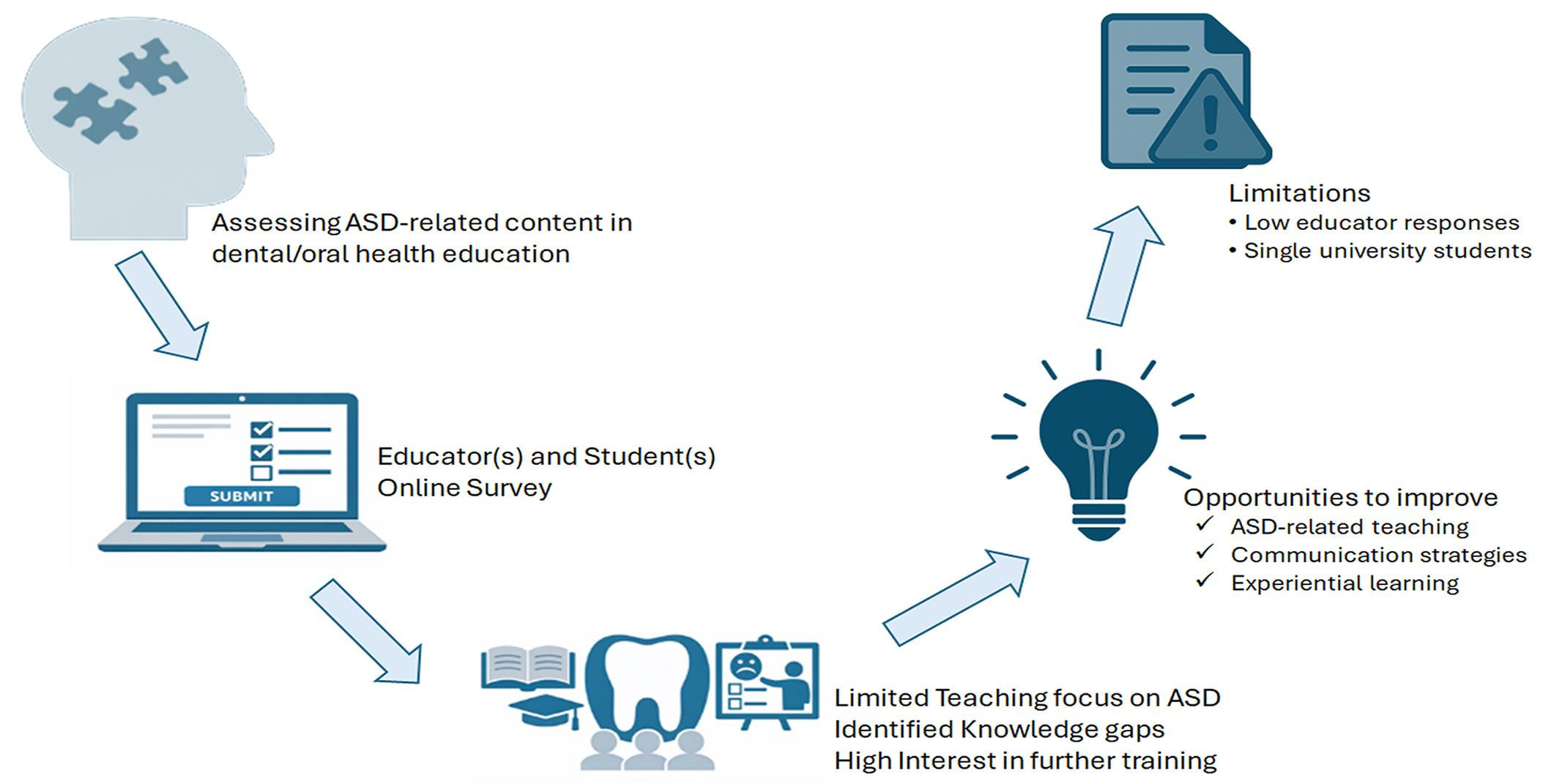
Abstract
1. Introduction
2. Methods
- Educators recruited through the College of Oral Health Academics (COHA) and Australasian Council of Dental School (ACODS)
- Bachelor of Oral Health Therapy (BOHT) students from University of Newcastle (UON).
2.1. Educator Surveys
2.2. Student Surveys
3. Results
3.1. Educator Surveys
3.2. Student Surveys
3.3. Responses to Polar and Open-Ended Questions
4. Discussion
5. Conclusions
Supplementary Materials
Author Contributions
Funding
Institutional Review Board Statement
Informed Consent Statement
Data Availability Statement
Conflicts of Interest
References
- Alshatrat, S.M.; Al-Bakri, I.A.; Al-Omari, W.M. Dental Service Utilization and Barriers to Dental Care for Individuals with Autism Spectrum Disorder in Jordan: A Case-Control Study. Int. J. Dent. 2020, 2020, 3035463. [Google Scholar] [CrossRef]
- American Psychiatric Association. DSM-5 Diagnostic Classification. In Diagnostic and Statistical Manual of Mental Disorders, 5th ed.; American Psychiatric Association: Washington, DC, USA, 2013; pp. 31–40. [Google Scholar] [CrossRef]
- Asiri, F.Y.I.; Tennant, M.; Kruger, E. Bridging the Gap: Dental Students’ Attitudes toward Persons with Disabilities (PWDs). Healthcare 2024, 12, 1386. [Google Scholar] [CrossRef] [PubMed]
- Atchison, C.J.; Gilby, N.; Pantelidou, G.; Clemens, S.; Pickering, K.; Chadeau-Hyam, M.; Ashby, D.; Barclay, W.S.; Cooke, G.S.; Darzi, A.; et al. Strategies to Increase Response Rate and Reduce Nonresponse Bias in Population Health Research: Analysis of a Series of Randomized Controlled Experiments during a Large COVID-19 Study. JMIR Public Health Surveill. 2025, 11, e60022. [Google Scholar] [CrossRef] [PubMed]
- Australian Bureau of Statistics. Autism in Australia. 2022. Available online: https://www.abs.gov.au/articles/autism-australia-2022 (accessed on 25 September 2025).
- Australian Dental Council. Professional Competencies of the Newly Qualified Dental Practitioner; Australian Dental Council: Melbourne, Australia, 2022; Available online: https://www.adc.org.au/accreditation/accredited-programs/professional-competencies/ (accessed on 31 October 2023).
- Blomqvist, M.; Bejerot, S.; Dahllöf, G. A cross-sectional study on oral health and dental care in intellectually able adults with autism spectrum disorder. BMC Oral Health 2015, 15, 81. [Google Scholar] [CrossRef] [PubMed]
- Braun, V.; Clarke, V. Using thematic analysis in psychology. Qual. Res. Psychol. 2006, 3, 77–101. [Google Scholar] [CrossRef]
- Braun, V.; Clarke, V. Reflecting on reflexive thematic analysis. Qual. Res. Sport Exerc. Health 2019, 11, 589–597. [Google Scholar] [CrossRef]
- Braun, V.; Clarke, V. One size fits all? What counts as quality practice in (reflexive) thematic analysis? Qual. Res. Psychol. 2021, 18, 328–352. [Google Scholar] [CrossRef]
- Brown, W.J.; Tortorella, R.A.W. Hybrid medical simulation—A systematic literature review. Smart Learn. Environ. 2020, 7, 16. [Google Scholar] [CrossRef]
- Byrne, D. A worked example of Braun and Clarke’s approach to reflexive thematic analysis. Qual. Quant. 2022, 56, 1391–1412. [Google Scholar] [CrossRef]
- Eades, D.; Leung, P.; Cronin, A.; Monteiro, J.; Johnson, A.; Remington, A. Treating dental patients on the autism spectrum. BDJ Team 2019, 6, 19–25. [Google Scholar] [CrossRef]
- Erwin, J.; Paisi, M.; Neill, S.; Burns, L.; Vassallo, I.; Nelder, A.; Facenfield, J.; Devalia, U.; Vassallo, T.; Witton, R. Factors influencing oral health behaviours, access and delivery of dental care for autistic children and adolescents: A mixed-methods systematic review. Health Expect. 2022, 25, 1269–1318. [Google Scholar] [CrossRef]
- Green, D.; Flanagan, D. Understanding the autistic dental patient. Gen. Dent. 2008, 56, 167–171. [Google Scholar]
- Harris, P.A.; Taylor, R.; Minor, B.L.; Elliott, V.; Fernandez, M.; O’Neal, L.; McLeod, L.; Delacqua, G.; Delacqua, F.; Kirby, J.; et al. The REDCap consortium: Building an international community of software platform partners. J. Biomed. Inf. 2019, 95, 103208. [Google Scholar] [CrossRef]
- Harris, P.A.; Taylor, R.; Thielke, R.; Payne, J.; Gonzalez, N.; Conde, J.G. Research electronic data capture (REDCap)—A metadata-driven methodology and workflow process for providing translational research informatics support. J. Biomed. Inf. 2009, 42, 377–381. [Google Scholar] [CrossRef]
- Higgins, D.; Hayes, M.; Taylor, J.; Wallace, J. How do we teach simulation-based dental education? Time for an evidence-based, best-practice framework. Eur. J. Dent. Educ. 2020, 24. [Google Scholar] [CrossRef]
- Hsu, C. A call for an attitude adjustment. RDH 2016, 36, 12–66. Available online: https://digital.rdhmag.com/rdhmag/201612?article_id=1249286&pg=NaN#pgNaN (accessed on 6 April 2026).
- Jones, J.; Roberts, E.; Cockrell, D.; Higgins, D.; Sharma, D. Barriers to Oral Health Care for Autistic Individuals-A Scoping Review. Healthcare 2024, 12, 103. [Google Scholar] [CrossRef]
- Koh, D.K.L.; Pradhan, A.; Aley, M.J.; Sohn, W.; Leadbeatter, D.M. Oral Health Care for People with Disability: Curriculum Content in Oral Health Programs. J. Dent. Educ. 2025, 89, e13894. [Google Scholar] [CrossRef]
- Nelson, T.M.; Sheller, B.; Friedman, C.S.; Bernier, R. Educational and therapeutic behavioral approaches to providing dental care for patients with Autism Spectrum Disorder. Spec. Care Dent. 2015, 35, 105–113. [Google Scholar] [CrossRef]
- Parry, J.; Shepherd, J. Understanding oral health challenges for children and young people with autistic spectrum conditions: Views of families and the dental team. J. Disabil. Oral Health 2018, 19, 170–174. [Google Scholar]
- Rosales García, P.; Medina Morales, G.C.; Martínez Zumarán, A.; Torre Delgadillo, A.; Bermúdez Jiménez, C.; Hernández Benavidez, J.; Casillas Santana, M.A.; Lozano González, O.; Patiño-Marín, N.; Salas Orozco, M.F. Preparedness, Satisfaction, and Intentions Among Dental Students Treating Patients with Disabilities: Evidence from Two Mexican Dental Schools. Cureus 2025, 17, e86737. [Google Scholar] [CrossRef]
- Rosen, K.R. The history of medical simulation. J. Crit. Care 2008, 23, 157–166. [Google Scholar] [CrossRef]
- Stein Duker, L.I.; Florindez, L.I.; Como, D.H.; Tran, C.F.; Henwood, B.F.; Polido, J.C.; Cermak, S.A. Strategies for Success: A Qualitative Study of Caregiver and Dentist Approaches to Improving Oral Care for Children with Autism. Pediatr. Dent. 2019, 41, 4E–12E. Available online: http://ovidsp.ovid.com/ovidweb.cgi?T=JS&PAGE=reference&D=emexa&NEWS=N&AN=626552000 (accessed on 6 April 2026).
- Udhya, J.; Varadharaja, M.M.; Parthiban, J.; Srinivasan, I.L.A. Autism Disorder (AD): An Updated Review for Paediatric Dentists. J. Clin. Diagn. Res. 2014, 8, 275–279. [Google Scholar] [CrossRef]
- Uliana, J.C.; Del’ Agnese, C.C.; Antoniazzi, R.P.; Kantorski, K.Z. Autistic individuals have worse oral status than neurotypical controls: A systematic review and meta-analysis of observational studies. Clin. Oral Investig. 2024, 28, 137. [Google Scholar] [CrossRef]
- von Elm, E.; Altman, D.G.; Egger, M.; Pocock, S.J.; Gøtzsche, P.C.; Vandenbroucke, J.P. The Strengthening the Reporting of Observational Studies in Epidemiology (STROBE) statement: Guidelines for reporting observational studies. J. Clin. Epidemiol. 2008, 61, 344–349. [Google Scholar] [CrossRef]
- Whitehouse, A.J.O.; Evans, K.; Eapen, V.; Wray, J. A National Guideline for the Assessment and Diagnosis of Autism Spectrum Disorders in Australia; Autism CRC: Indooroopilly, Australia, 2018. [Google Scholar]
- World Health Organisation. Autism; WHO: Geneva, Switzerland, 2025; Available online: https://www.who.int/news-room/fact-sheets/detail/autism-spectrum-disorders (accessed on 25 September 2025).



| Question | Yes (%) | No (%) | No Reply/ Don’t Know (%) | Total (%) |
|---|---|---|---|---|
| Does your Dentistry or Oral Health curriculum include education for students in the treatment and management of persons with Autism? | 7 (46.7%) | 5 (33.3%) | 3 (20.0%) | 15 (100%) |
| Are you be interested in using an educational module to teach dental practitioners about Autism in the dental setting? | 5 (33.3%) | 0 (0.0%) | 10 (66.7%) | 15 (100%) |
| How many hours (approx.) during their studies would this include? Responses: 2 h, 2.5 h | 2 (13.3%) | 0 (0.0%) | 13 (86.7%) | 15 (100%) |
| Face to Face Delivery of Education Responses: 1 h lecture in BOH2 paediatrics, 1.5 h tutorial on the neurodivergent patient in BOH3 integrated theory | 5 (33.3%) | 0 (0.0%) | 10 (66.7%) | 15 (100%) |
| Online Synchronous (Live) Delivery of Education | 2 (13.3%) | 3 (20.0%) | 10 (66.7%) | 15 (100%) |
| Asynchronous (Recorded) Delivery of Education | 2 (13.3%) | 3 (20.0%) | 10 (66.7%) | 15 (100%) |
| Other Delivery of Education Responses: Role play | 1 (6.7%) | 0 (0.0%) | 14 (93.3%) | 15 (100%) |
| Are you familiar with a Sensory Adapted Dental Environment (SADE)? | 3 (20.0%) | 2 (13.3%) | 10 (66.7%) | 15 (100%) |
| Do you teach the topics listed below? | ||||
| SADE for persons with Autism | 2 (13.3%) | 1 (6.7%) | 12 (80.0%) | 15 (100%) |
| Communication for persons with Autism | 4 (26.7%) | 0 (0.0%) | 11 (73.3%) | 15 (100%) |
| Oral hygiene instruction for persons with Autism | 2 (13.3%) | 1 (6.7%) | 12 (80.0%) | 15 (100%) |
| Pretreatment questionnaires for persons with Autism | 2 (13.3%) | 1 (6.7%) | 12 (80.0%) | 15 (100%) |
| Developing social stories for persons with Autism | 1 (6.7%) | 2 (13.3%) | 12 (80.0%) | 15 (100%) |
| Role Play for persons with Autism | 2 (13.3%) | 1 (6.7%) | 12 (80.0%) | 15 (100%) |
| Other activity for persons with Autism Responses: Tutorial discussions, sharing personal experiences, visuals | 2 (13.3%) | 0 (0.0%) | 13 (86.7%) | 15 (100%) |
| Does your department deliver Oral Health Simulation Education in the treatment and management of Autistic Individuals? | 1 (6.%) | 4 (26.%) | 10 (66.%) | 15 (100%) |
| Would you consider Oral Health Simulation Education in the treatment and management of Autistic Individuals beneficial? | 2 (13.3%) | 2 (13.3%) | 11 (73.3%) | 15 (100%) |
| Question | Details | Responses (Percentage) |
|---|---|---|
| Student cohort | First-year BOHT | 22 (57.9%) |
| Third-year BOHT | 16 (42.1%) | |
| Demographics | Female | 32 (84.2%) |
| Male | 2 (5.3%) | |
| Did not answer | 4 (10.5%) | |
| Country of origin | Australian | 17 (44.7%) |
| Asian | 6 (15.8%) | |
| Europeans | 3 (7.9%) | |
| Middle East | 3 (7.9%) | |
| Unknown/Not stated | 9 (23.7%) | |
| How many patients with Autism have you treated? | ≥10 persons | 3 (7.9%) |
| 5–9 persons | 4 (10.5%) | |
| 1–4 persons | 6 (15.8%) | |
| Did not answer | 25 (65.8%) | |
| Personal experience with Autism | Yes | 10 (26.3%) |
| No | 19 (50.0%) | |
| Did not answer | 9 (23.7%) |
| True/False Questions | True (%) | False (%) | No Reply (%) | Total (%) |
|---|---|---|---|---|
| People with Autism can be interested in social interaction | 25 * (65.8%) | 4 (10.5%) | 9 (23.7%) | 38 (100%) |
| Independent living is not possible for Autistic people | 1 (2.6%) | 28 * (73.7%) | 9 (23.7%) | 38 (100%) |
| People with Autism feel no empathy or affection | 1 (2.6%) | 28 * (73.7%) | 9 (23.7%) | 38 (100%) |
| A lack of eye contact is necessary for a person to be considered Autistic | 2 (5.3%) | 27 * (71.0%) | 9 (23.7%) | 38 (100%) |
| Autism cannot be diagnosed in adulthood | 1 (2.6%) | 28 * (73.7%) | 9 (23.7%) | 38 (100%) |
| Most people with Autism also have intellectual disabilities | 8 (21.0%) | 21 * (55.3%) | 9 (23.7%) | 38 (100%) |
| Females are more difficult to diagnose with Autism than males | 19 * (50.0%) | 10 (26.3%) | 9 (23.7%) | 38 (100%) |
| People with Autism always display challenging behaviours | 8 (21.0%) | 21 * (55.3%) | 9 (23.7%) | 38 (100%) |
| Autistic people have difficulty with non-literal language and non-verbal communication (e.g., body language and gesturing) | 24 * (63.2%) | 4 (10.5%) | 10 (26.3%) | 38 (100%) |
| Additional mental health conditions (e.g., anxiety, depression) are more prevalent in individuals diagnosed with Autism than in the general population | 24 * (63.2%) | 4 (10.5%) | 10 (26.3%) | 38 (100%) |
| People with Autism can show unusual reactions to sensory experiences (e.g., lights, touch, sounds, etc.) | 27 * (71.1%) | 1 (2.6%) | 10 (26.3%) | 38 (100%) |
| Autism is a very rare condition, affecting only 0.05% of the Australian population | 1 (2.6%) | 27 * (71.0%) | 10 (26.3%) | 38 (100%) |
| Autistic people are more prone to interpersonal violence than non-Autistic people | 15 (39.5%) | 13 * (34.2%) | 10 (26.3%) | 38 (100%) |
| Change in routine and uncertainty are often upsetting for Autistic people | 27 * (71.1%) | 1 (2.6%) | 10 (26.3%) | 38 (100%) |
| More than half of people diagnosed with Autism do not talk | 7 (18.4%) | 21 * (55.3%) | 10 (26.3%) | 38 (100%) |
| Likert Scale | 1–3 (Low) | 4–6 (Moderate) | 7 (High) | Total Responded |
|---|---|---|---|---|
| Recognising the signs and symptoms of Autism in children | 6 (25.0%) | 17 (70.8%) | 1 (4.2%) | 24 |
| Recognising the signs and symptoms of Autism in adults | 10 (38.5%) | 15 (57.7%) | 1 (3.8%) | 26 |
| Treating Autistic children | 9 (37.5%) | 15 (62.5%) | 0 (0%) | 24 |
| Treating Autistic adults | 6 (25.0%) | 18 (75.0%) | 0 (0%) | 24 |
| Knowing where to find further information and guidance for treating Autistic people | 14 (53.8%) | 12 (46.2%) | 0 (0%) | 26 |
| Knowing what adjustments could be made to facilitate treatment for Autistic people | 7 (28.0%) | 18 (72.0%) | 0 (0%) | 25 |
| Making adjustments in practice to facilitate treatment for Autistic people | 8 (32.0%) | 17 (68.0%) | 0 (0%) | 25 |
| Knowing the relevant local care pathways/services for Autistic people | 15 (57.7%) | 11 (42.3%) | 0 (0%) | 26 |
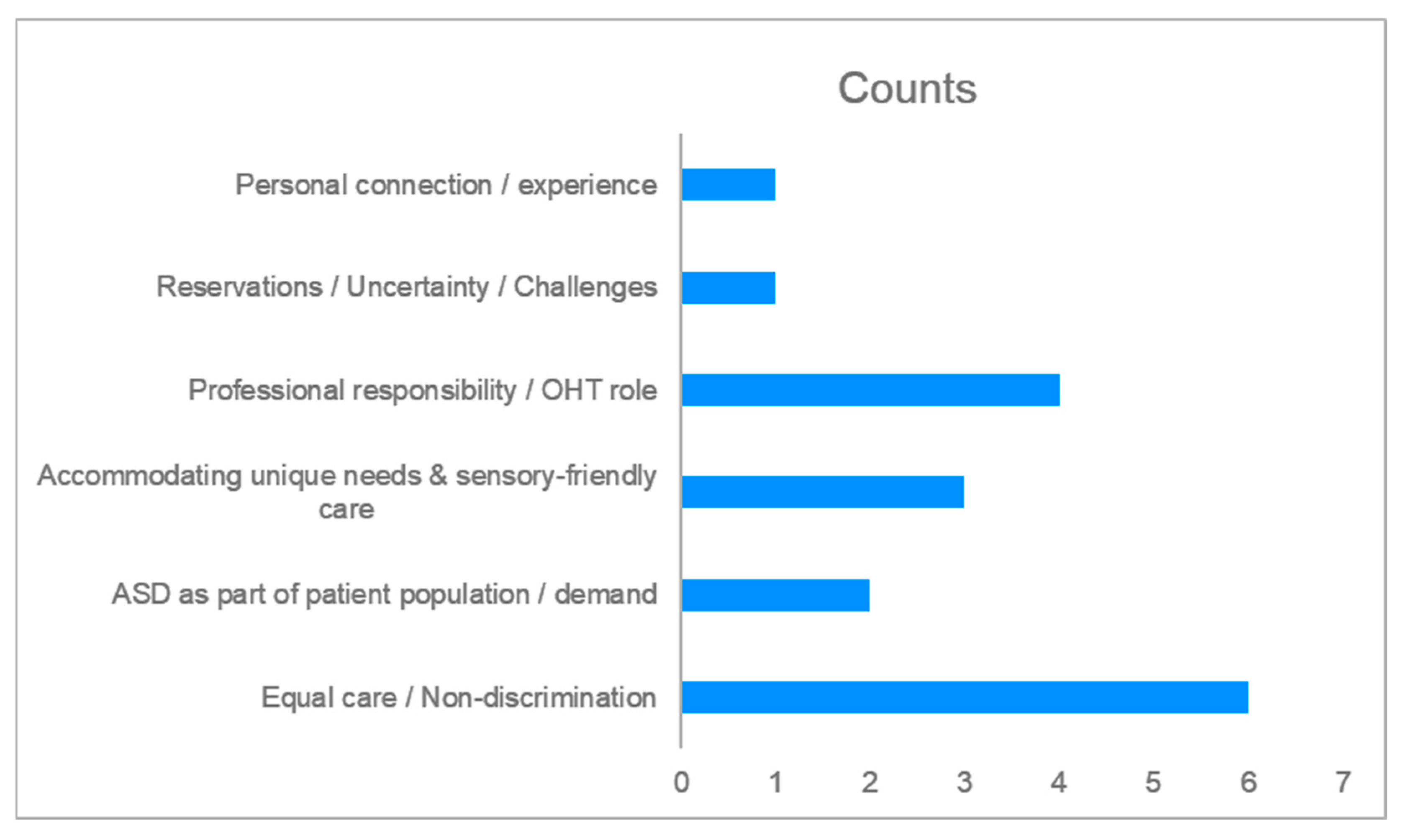
| Response | Quotes/Subthemes (As Superscript) |
|---|---|
| Yes | I plan to treat persons with ASD as an Oral Health Therapy graduate. I genuinely believe in creating a warm and supportive atmosphere that acknowledges their unique needs. By using gentle communication and personalized approaches, I hope to build trust and make them feel at ease during their visits. My goal is to provide compassionate care that not only addresses their oral health but also makes them feel understood and valued. (3) |
| Yes | Definitely it would involve understanding and accommodating the unique needs of individuals with ASD. (3) This includes creating a sensory-friendly environment, communicating clearly, and being patient and flexible during appointments. My role would also involve educating patients and caregivers about oral hygiene practices and making necessary adjustments to ensure comfort and successful treatment outcomes. |
| Yes | I think it’s important. A person with ASD needs dental care just as someone that does not have ASD. (1) |
| Yes | They represent a portion of the public so I will undoubtedly treat them. (2) |
| Yes | There is a large demand for dentistry with special needs. OHT as a preventive provider will play a significant role in treating people with ASD. (2) |
| Yes | Not as in I plan to, but not opposed. (5) |
| Yes | It is extremely important for persons with ASD to maintain adequate oral hygiene and receive the treatment that they need. (4) |
| Yes | If I have chance, I will try my best to helps them. (4) |
| Yes | I want to provide the care I am able to for all patients equally. (1) |
| Yes | I know someone with autism, and they are not that different than a regular person, he sometimes doesn’t pick up on social cues or prefers to be by himself but other than that no difference. (6) |
| Yes | I am interested in working with children from different diversities. (1) |
| Yes | Discriminatory not to. If they need help, I’ll do it no matter who it is. (1) |
| Unstated | Because individuals with autism deserve to be treated equally. (1) |
| Yes | As a health care professional, I am open to treating any patient who needs care, including patients with ASD. (1,4) |
| No | Too difficult to engage them if they’re unwilling to cooperate. (5) |
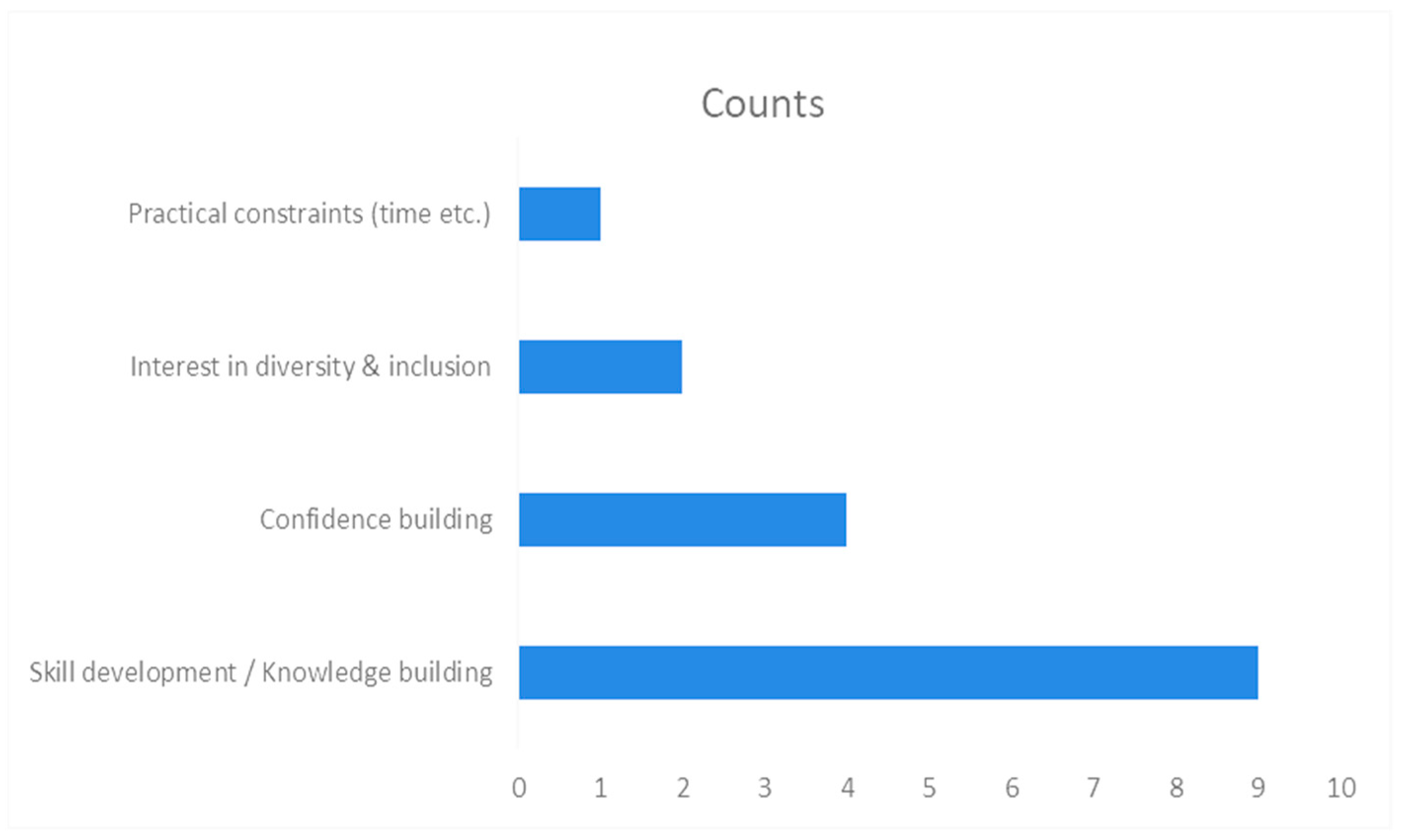
| Response | Quotes/Subthemes (As Superscript) |
|---|---|
| Yes | I’m always eager to increase my knowledge and understanding. Attending CPD courses is a great opportunity to further develop my confidence and competence in treating persons with ASD, and I look forward to learning more about how to provide the best care for them. (1) |
| No | No comment |
| Yes | I would like to feel more confident in treating people with ASD. (1,2) |
| Yes | No comment |
| Yes | It’s critical to empower myself with theoretical knowledge in full scope of treating different types of people. (1) |
| Yes | I think that learning about different disabilities is a necessity for people finishing a degree to ensure all people can be treated effectively and appropriately. (1,2) |
| Yes | To develop confidence and know how and when to treat them |
| Yes | Treat different patients is also helpful for us to develop our communication skills and can help them get better treatment. (1) |
| Yes | To develop my knowledge and clinical skills further which enables a more comfortable environment. (1) |
| Yes | To develop my knowledge and clinical skills further which enables a more comfortable environment. (1) |
| Yes | I have a strong interest in working with children/adult from all different background and diversity. (1,3) |
| Yes | I’d like to but struggle with finding time for things. (4) |
| Yes | As an OHT, I would like to be able to treat individuals with autism and be confident in making them feel comfortable in the practice. (3) |
| Yes | To improve my understanding and become a better healthcare professional. (1) |
| Yes | Will be good to know how to treat them if there’s patients with ASD. At least I have an idea how to treat them and try my best to do it if they come to the clinic. (1) |
Disclaimer/Publisher’s Note: The statements, opinions and data contained in all publications are solely those of the individual author(s) and contributor(s) and not of MDPI and/or the editor(s). MDPI and/or the editor(s) disclaim responsibility for any injury to people or property resulting from any ideas, methods, instructions or products referred to in the content. |
© 2026 by the authors. Licensee MDPI, Basel, Switzerland. This article is an open access article distributed under the terms and conditions of the Creative Commons Attribution (CC BY) license.
Share and Cite
Jones, J.; Sharma, D.; Chu, K.-Y.; Roberts, E.; Cockrell, D. Evaluating Undergraduate Dental Curricula on Oral Health Care for Autistic Persons in Australia and New Zealand—A Cross-Sectional Study. Dent. J. 2026, 14, 238. https://doi.org/10.3390/dj14040238
Jones J, Sharma D, Chu K-Y, Roberts E, Cockrell D. Evaluating Undergraduate Dental Curricula on Oral Health Care for Autistic Persons in Australia and New Zealand—A Cross-Sectional Study. Dentistry Journal. 2026; 14(4):238. https://doi.org/10.3390/dj14040238
Chicago/Turabian StyleJones, Jayne, Dileep Sharma, Kuang-Yin Chu, Elysa Roberts, and Deborah Cockrell. 2026. "Evaluating Undergraduate Dental Curricula on Oral Health Care for Autistic Persons in Australia and New Zealand—A Cross-Sectional Study" Dentistry Journal 14, no. 4: 238. https://doi.org/10.3390/dj14040238
APA StyleJones, J., Sharma, D., Chu, K.-Y., Roberts, E., & Cockrell, D. (2026). Evaluating Undergraduate Dental Curricula on Oral Health Care for Autistic Persons in Australia and New Zealand—A Cross-Sectional Study. Dentistry Journal, 14(4), 238. https://doi.org/10.3390/dj14040238