Communication

Minimal Perturbation Engineering for Programmable Optical Skyrmions on Metasurfaces

1
School of Optical-Electrical and Computer Engineering, University of Shanghai for Science and Technology, Shanghai 200093, China
2
Engineering Research Center of Optical Instrument and System, Ministry of Education, Shanghai 200093, China
*
Author to whom correspondence should be addressed.
Photonics 2025, 12(12), 1170; https://doi.org/10.3390/photonics12121170
Submission received: 21 October 2025 / Revised: 23 November 2025 / Accepted: 26 November 2025 / Published: 28 November 2025

Abstract

Optical skyrmions, as topologically protected quasiparticles, hold great promise for on-chip photonic technologies. However, achieving programmable control over their properties through subtle structural changes remains challenging. This study introduces a minimal perturbation engineering strategy on a plasmonic metasurface. By applying controlled geometric perturbations (either continuous shortening or discrete segmentation) to a single edge of a hexagonal groove structure, combined with incident phase perturbations, we systematically manipulate the evolution of the skyrmion texture. These minimal perturbations induce reproducible shifts in the skyrmions’ center intensity and peak position, yielding up to ~32% center suppression, while the global topological charge remains conserved. This “geometry × phase” dual-perturbation approach provides a straightforward and efficient approach for engineering programmable topological light fields on a chip, with promising applications in integrated photonic devices.

1. Introduction

Skyrmions were originally proposed as stable topological solitons in the nonlinear σ-model and have garnered extensive attention in magnetic thin film systems due to their nontrivial topological properties [1,2,3,4]. First predicted by Tony Skyrme in 1962, Skyrmions have since been experimentally realized in quantum Hall ferromagnets, monolayer ferromagnets, and Bose–Einstein condensates [5,6,7]. Physically, a Skyrmion can be regarded as a quasiparticle carrying a nonzero topological charge, offering a promising platform for the next generation of optoelectronic devices [8,9], as well as magnetic information storage and communication technologies [10,11,12,13]. Beyond magnetic systems, Skyrmions can also be excited by acoustic or optical fields [14], owing to their vector topological characteristics. In optics, optical Skyrmions are typically generated through the coherent interference of Surface Plasmon Polaritons (SPPs) [15,16,17,18]. In such structures, the electric field vector undergoes a continuous rotation from the center to the boundary, forming a vector texture that is topologically analogous to magnetic Skyrmions and exhibiting smooth transitions among different core states on the surface [19,20].
Current strategies for controlling optical Skyrmions can generally be categorized into two approaches. The first leverages the coupling between orbital angular momentum (OAM) and spin angular momentum (SAM), often using spiral structures or vortex beams, enabling direct imaging via techniques such as time-resolved photoemission electron microscopy (TR-PEEM) [21,22,23,24]. The second approach focuses on dynamically programming the excitation by adjusting the structural and illumination parameters to reconfigure the resulting optical Skyrmion lattices, such as varying phase, polarization, amplitude, symmetry, or chirality [25,26]. However, these approaches often rely on highly symmetric structures such as sixfold symmetric coupling units, which inherently limit the dimension and tunability of the state control.
To overcome these limitations, researchers have explored symmetry-breaking designs, including segmented Archimedean spirals, metasurface–Archimedean composite structures, and hexagonal nano-grooves on noble metal films to achieve greater degrees of freedom in manipulating near-field distributions and topological charge of plasmonic vortices. However, when SPPs propagate through additional optical paths, the inevitable accumulation of dynamic phase introduces significant wavelength dependence, restricting many plasmonic vortex field generators to operate effectively only at nearly a single wavelength. Additionally, switching between distinct topological configurations within the same device remains challenging, limiting their potential applications in areas such as quantum cryptography and macromolecule selective separation. Therefore, constructing broadband, reconfigurable composite plasmonic vortex lattices is essential for expanding their versatility and scope of application.
Pancharatnam–Berry (PB) geometric phase provides an effective approach to addressing these issues [27,28,29]. For plasmonic metasurfaces composed of nano-slits or anisotropic nano-antennas, the radiated SPP phase can be directly imparted by the structural orientation, which is a geometric phase independent of propagation, naturally exhibiting broadband characteristics and enabling efficient SPP excitation across a wide frequency range [30,31]. Integrating PB phase metasurfaces with polygonal vortex lattice generators thus facilitates broadband generation and programmable control of plasmonic Skyrmion lattices.
In this study, to overcome the limitations in bandwidth and reconfigurability of Archimedean spirals, we propose a minimal perturbation engineering strategy to achieve programmable optical Skyrminons on symmetry-breaking metasurfaces [32,33]. Keeping the device layer constant and operating wavelength unchanged while maintaining conventional hexagonal/multi-sided coupling units, we apply extremely weak localized perturbations, either in the geometry of a single edge (amplitude perturbation) or in the excitation phase of a specific SPP channel (phase perturbation). By synergistically combining these “geometry × phase” dual-perturbations, we project a controlled asymmetry that selectively biases the properties of Skyrmions—such as their intensity distribution and local chirality—without altering the global topological charge. The primary measurable indicator is the intensity difference of the generated Skyrmions at the center, which follows a nearly regular pattern. Compared to phase-dependent propagation schemes, this approach avoids strong wavelength dependence induced by additional optical paths, thereby facilitating broadband implementation and device integration, offering a practical and efficient method for on-chip topological light field engineering.

2. Theoretical Analysis

The topological properties of Skyrmions with topological textures can be characterized by the Skyrmion number N s k :
N s k = 1 4 π σ s · s x × s y d x d y
Here, s = [ s 1 , s 2 , s 3 ] T is the normalized Stokes vector distribution, and σ represents the region confining the Skyrmion lattice (with an infinite region representing a single Skyrmion lattice). The Skyrmion number serves as a topological invariant quantifying the degree of vector rotation from the center to the boundary of the Skyrmion lattice. The unit vector s is expressed as follows:
s = cos α θ sin β r , sin α θ sin β r , cos β r
Here, α is the azimuthal angle of the vector, depending on the polar angle θ on the surface, representing the deflection angle from the x-axis to the vector projection. β is the latitude angle of the vector, which is a function of the radial distance r, representing the deflection angle from the z-axis to the vector. Substituting Equation (2) into Equation (1), we obtain:
S = 1 4 π 0 r d r 0 2 π d β r d r d α θ d θ sin β ( r ) d θ = 1 4 π cos β r r = r r = 0 α θ θ = 2 π θ = 0
The s-values for several typical Skyrmion configurations are fixed. For example, the Skyrmion numbers for the Néel and Bloch types are both ± 1, while the Skyrmion number for a meron (half-Skyrmion) is ± 1/2. In our simulations, the initial phase of all light sources is set to 0, and the coupling slots of the excitation structure are identical to ensure that the performance of the vector texture is solely determined by the propagation of the interfering SPPs. A Gaussian laser is incident vertically onto the center of each coupling slot, with polarization perpendicular to the main axis of the slot.
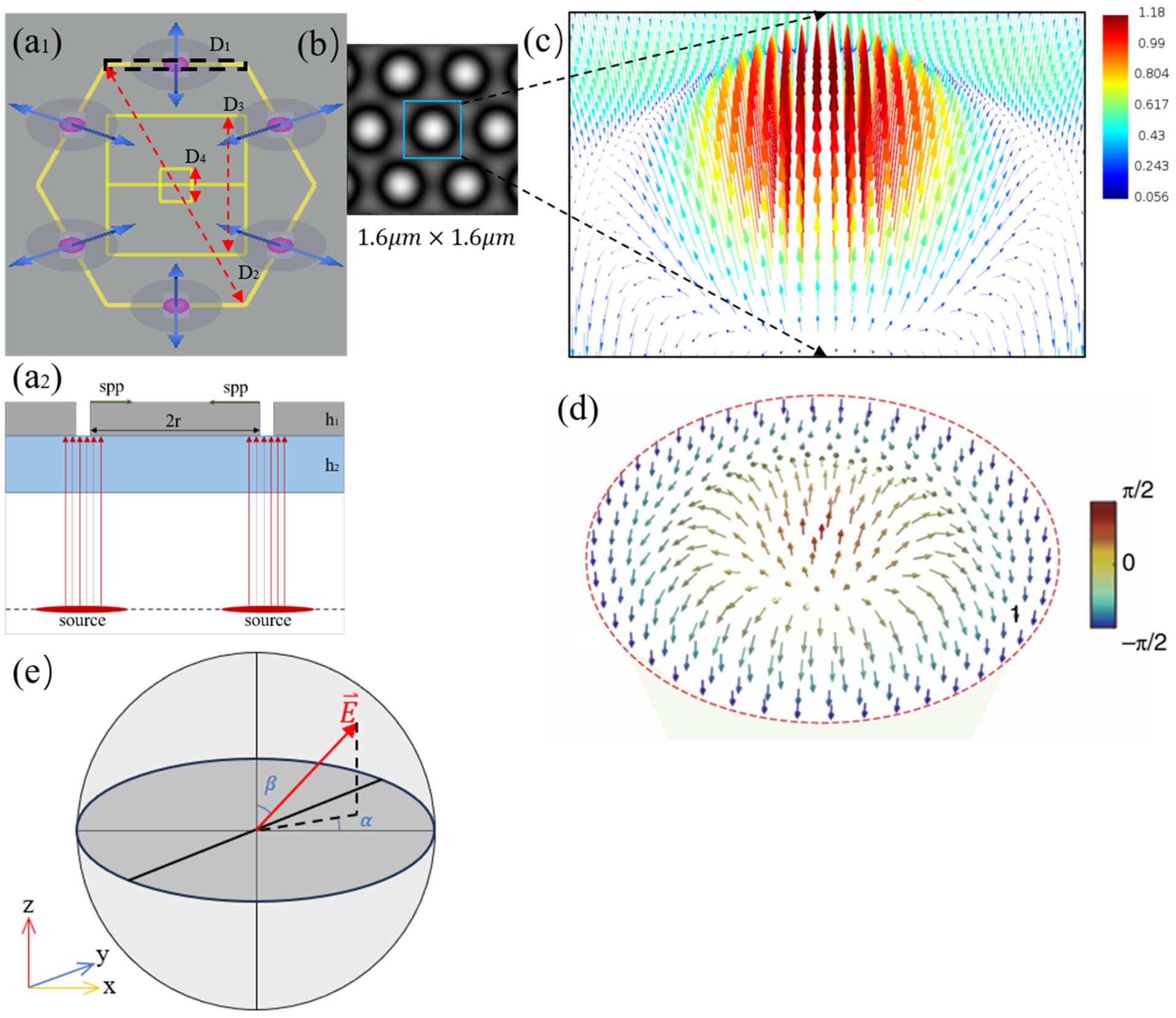
Figure 1 illustrates a schematic of the plasmonic vortex lattice induced on a metal surface. To achieve programmable control, we employ a sixfold rotationally symmetric hexagonal plasmonic metasurface. This structure is illuminated vertically by six independent Gaussian beams, each normally incident onto one edge of the hexagon. This configuration ensures the efficient excitation of surface plasmon polaritons from six symmetrical directions, whose coherent interference forms the basis for generating the central Skyrmion lattice. This multi-beam normal incidence approach based on a symmetric structure provides a clear and programmable initial condition for the subsequent introduction of controlled minimal perturbations. Panel 1a illustrates the model, including the hexagonal groove metasurface, the Gaussian excitation light source, and the monitor. Panel 1b shows the electric field distribution in the central region of the hexagonal structure. Panel 1c presents the corresponding simulation result in the central region, where the electric field orientation flips from the center to the boundary of the optical Skyrmion lattice, with a phase difference of π. Panel 1d displays the vector distribution of the Néel-type Skyrmions, and Panel 1e depicts the relevant orientation of the electric field vector in spherical coordinates. The results indicate that a well-ordered electric field is generated within the Skyrmion lattice, with a smooth transition from the center to the edge. Compared with Panel d, it is evident that the Skyrmions exhibit a clear Néel-type topological distribution. Previous studies have also noted that the direction of the vector rotation is determined by the initial phase of the SPPs, leading to both outward and inward orientations. However, this does not affect the formation of the Skyrmions [34].
The optical properties of surface plasmons can be derived from the continuity equations for the electromagnetic fields at the metal–dielectric interface. For simplicity, the transverse component of the surface plasmon wavevector k z is approximated as imaginary, while its perpendicular component is approximated as real. This results in the electromagnetic field being localized at the metal–dielectric interface. The electric field components generated by the interference of the SPPs can be expressed as:
E x = j = 1 n i exp k z , j z E r , j cos θ j exp i ω t i k x , j x + k y , j y
E y = j = 1 n iexp k z , j z E r , j sin θ j exp i ω t i k x , j x + k y , j y
E z = j = 1 n exp k z , j z E r , j exp i ω t i k x , j x + k y , j y
where n  3 represents the number of interfering SPPs excited by the polygonal structure. E x and E y represent the in-plane components of the total electric field, tangential to the metasurface (metal–dielectric interface), while E z   is the component normal to the surface. E r , j and E z , j represent the amplitude of the transverse and vertical components of the electric field, respectively. θ j is the polar angle of the propagation vector, defined as θ j = 2 π j / n , and ω is the angular frequency of the incident light. Combining the above expression with the Helmholtz equation yields the distribution of n evanescent waves at the interface:
E x = j = 1 n 1 k r 2 d 2 E z d x d z = j = 1 n i k z , j k r 2 k x , j E 0 exp k z , j z 0 exp i ω t i k x , j x + k y , j y
By extracting the electric field spatial mode of a single SPP, we obtain:
E x , j = E 0 cos θ j exp k z , j z 0 k z k x k r 2 sin k x , j x + k y , j y
E y , j = E 0 sin θ j exp k z , j z 0 k z k x k r 2 sin k x , j x + k y , j y
E z , j = E 0 exp k z , j z 0 cos k x , j x + k y , j y
The electric field of the SPPs is a bivariate function of the spatial variables x and y, i.e., E j ( x , y ) . At the center of a single standard optical Skyrmion lattice, the transverse components cancel out, leaving only the normal component E z . Additionally, there are no further constraints imposed on the number of surface waves.
To introduce the perturbation model, we first apply a variation to a single propagation direction (denoted as the “±x” channel). This is equivalent to slightly splitting a pair of SPP channels in opposite propagation directions from a degenerate state into strongly/weakly coupled branches, representing the perturbation coupling of near-degenerate channels. This can be described using Time-Coupled Mode Theory (TCMT): small amplitude or phase mismatches will introduce asymmetric terms in the output power, which can be expressed as the inner or cross products of the coupling constant and the incident phase.
Assuming that only amplitude or phase perturbations are applied to the grooves in the j = 0th direction (along + x), the total field is as follows:
E t o t a l = j = 1 n A j e i φ j e i k s p p r c o s + x
In the ideal hexagonal structure, the amplitudes are equal in all six directions and the phases are symmetric. Here, we introduce a perturbation to only one pair of phase directions. The first perturbation is the geometric amplitude perturbation:
A t ± x = A t 1 ± ε , A z ± x = A z 1 ± ε   0 < ε 1
The second perturbation is the incident phase perturbation (deviation from ideal circular polarization), where represents the relative phase:
+ x = 0 + 2 ,   x = 0 2   1
At the center, r = 0, and all propagation phases are 0; therefore:
E x ( 0 ) = j A j e i φ j c o s j
E y ( 0 ) = j A j e i φ j c o s j
E z 0 = C
where C is constant, and under ideal conditions, E x 0 = E y 0 = 0 , Any amplitude or phase disturbance in a single direction will introduce nonzero E x ( 0 ) or E y ( 0 ) , resulting in a transverse vector at the center and a decrease in the total field at the center, that is, the phenomenon of center intensity suppression.
All simulations were performed using finite-difference time-domain (FDTD); detailed settings can be found in the Supplementary Materials.

3. Results and Discussion

3.1. Intensity of Periodic Optical Lattice with Slit Perturbation Structure

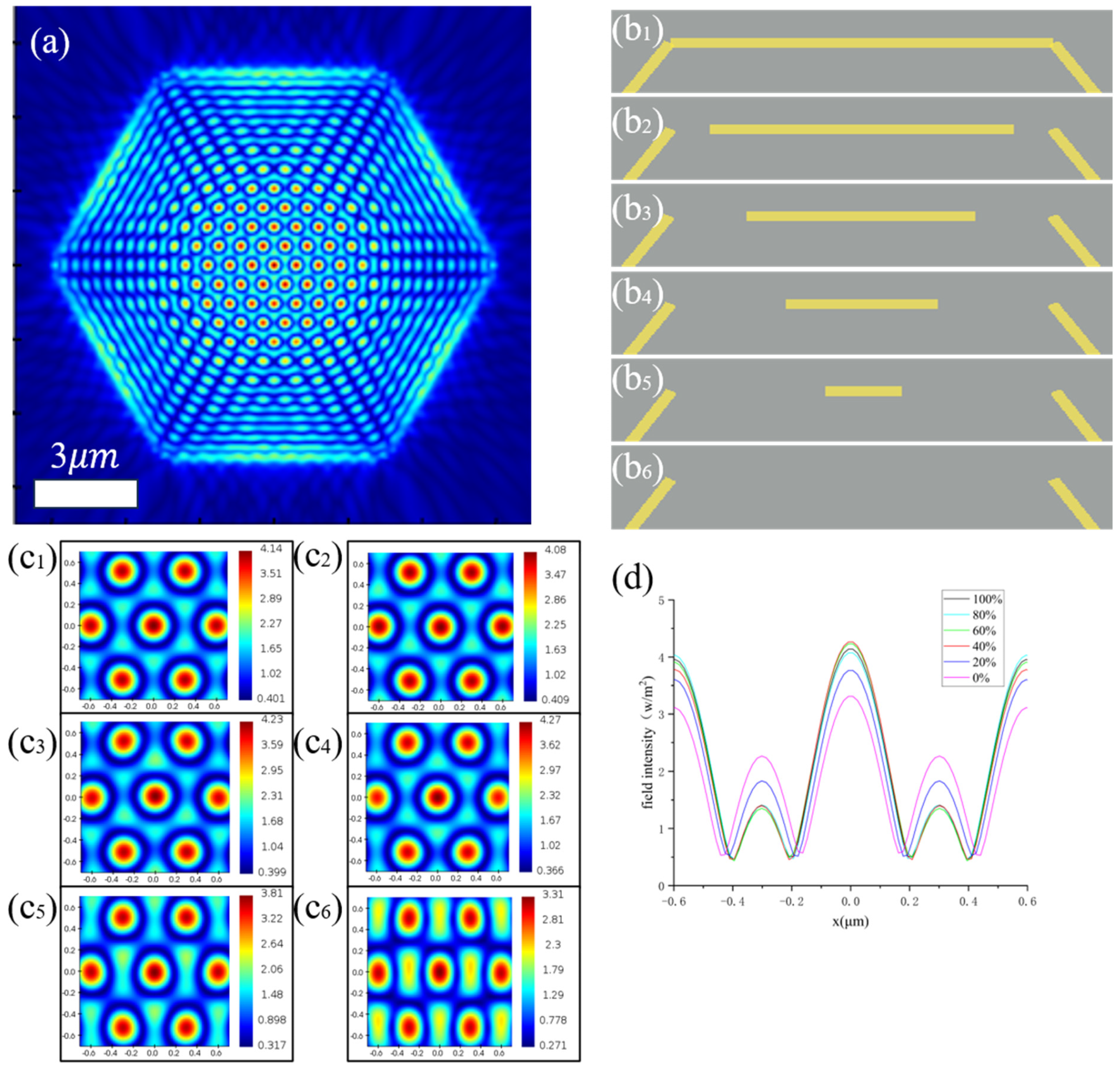
To simplify the geometric structure for generating the Skyrmion lattice and facilitate locating the geometric center of the structure, the coupling grooves are arranged in a hexagonal pattern on the metal film to form a lattice, as shown in Figure 2a. Simulation results confirm that this structure generates an optical lattice. Based on Equation (3), the Skyrmion number is calculated as S6 = 1, corresponding to the standard Néel-type optical Skyrmions, with the Skyrmion lattice exhibiting a circular distribution in the central excitation region. Figure 2c also reveals that the number and distribution of the excited structures have a certain impact on the spatial layout of the unit cell.
Here, the overall structure is closed, while the impact of semi-open excitation structures on optical Skyrmions remains underexplored. To investigate this, we maintained identical illumination conditions while gradually shortening both sides of one slit by a certain proportion, keeping the central point of one slit fixed, as shown in Figure 2(b1–b6). This aligns with the small perturbation model, where two opposing SPP channels split slightly from complete degeneracy into strong and weak branches. Overall, this model still follows the hexagonal excitation pattern. Due to the symmetry of the hexagonal structure, similar electric field distributions are generated at the center of these structures. However, spatial asymmetry leads to distinct intensity distributions at the center, as shown in Figure 2c.
As illustrated in Figure 2d, when the incident conditions remain unchanged and only one edge of the hexagonal coupling structure is geometrically shortened ( L / L 0 = 1 → 0.8 → 0.6 → 0.4 → 0.2 → 0), the electric field intensity E 2 at x = 0 on the y = 0 cross-section exhibits a unimodal response characterized by a slight initial decrease, followed by a small mid-range increase, and eventually a pronounced decrease. Compared to the baseline value at L / L 0 , the center intensity decreases by approximately 1.6% at L / L 0 = 0.8, increases by about 2.2% and 3.0% at L / L 0 = 0.6 and 0.4, respectively, and decreases by 9.0% and 20.0% at L / L 0 = 0.2 and 0, respectively. The corresponding intensities and variation percentages are summarized in Table 1. This trend is well explained by the minimal perturbation model. In the small change range from 1 to 0.8, the central intensity is formed by the superposition of the electric field, where a slight reduction in amplitude causes a minor decrease in intensity. As the length continues to shorten, the local resonance of the slit enhances the amplitude at that point, accompanied by a phase transition, resulting in stronger constructive interference, which accounts for the 2.2% and 3% increases at L / L 0 = 0.6 and 0.4, respectively. This is the result of the amplitude-phase synergy. However, when the edge is shortened to a certain extent, the non-closed nature of the structure is further enhanced, and the hexagonal symmetry further degrades. The absence of the coupling groove strongly disrupts the formation of the Skyrmion lattice. The distribution of the E-component deviates noticeably from the closed structure, and the intensity decreases significantly. When the groove of this side is completely removed, the center coherence condition is significantly weakened, and the intensity further decreases (see Figure 2d).
Finally, at 0% proportion, the structure can be regarded as an open pentagon with no edges. The E-component shows a noticeable difference from the hexagonal case, yet its topological vector still exhibits a clear transition from outward-pointing at the center to inward-pointing toward the surrounding edges, which corresponds to the optical Skyrmion texture.
These results reveal that modifying the coupling elements to tune the SPPs in specific directions enables the design of optical Skyrmions with customized forms, opening new pathways for generating optical Skyrmions with complex structures or unique shapes. Furthermore, the limitations of non-closed structures in generating Skyrmions are influenced by various factors such as misaligned central lines hindering energy focusing, oversized structures causing rapid energy attenuation, and small edge lengths leading to SPP diffraction—these issues all affect the generation of Skyrmions.
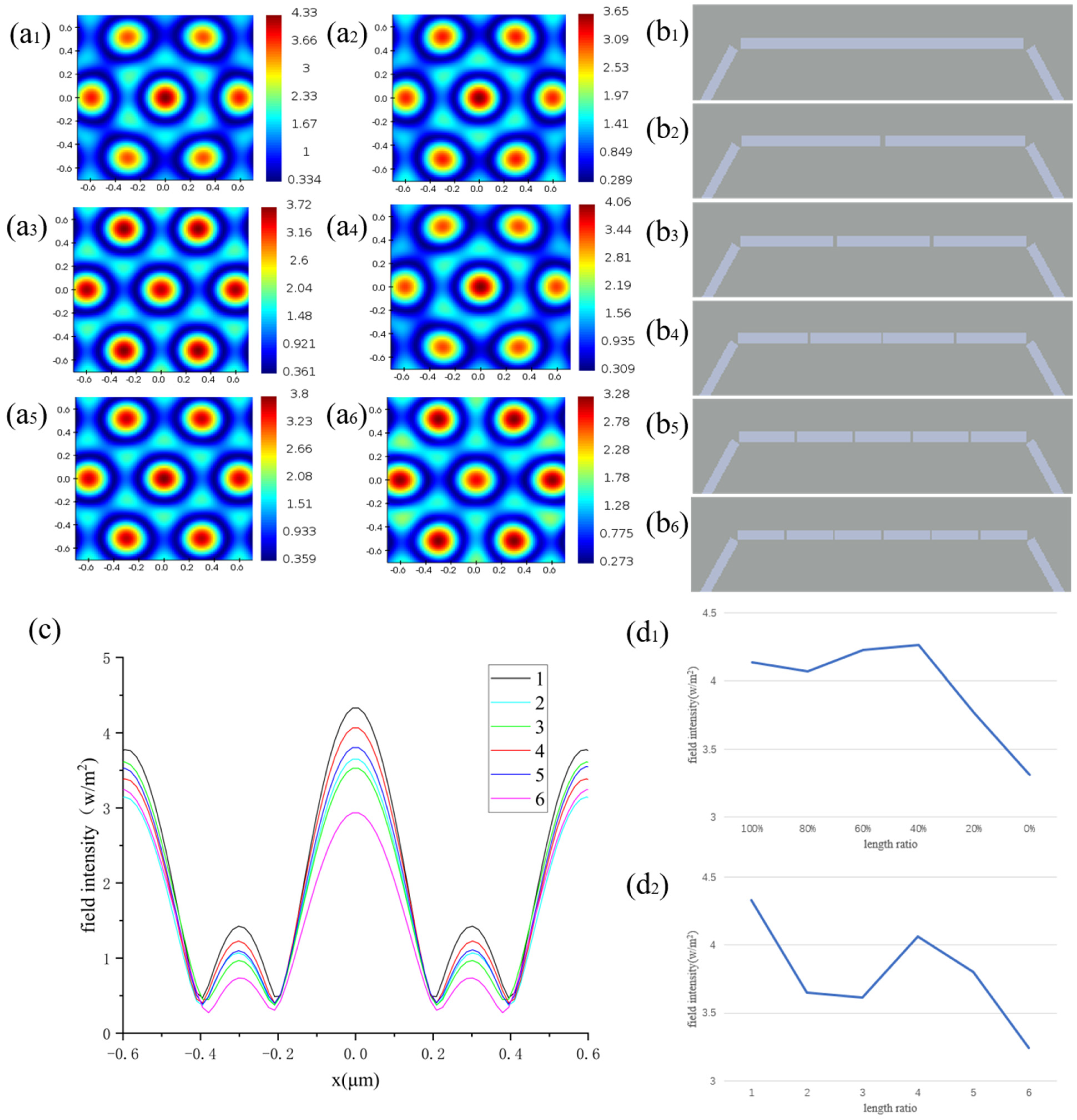
To investigate the performance of optical Skyrmions in non-closed structures, the initially constructed regular hexagon was divided into equal periods, with each period keeping an equal proportion of slit length. The electric field vector profile in the central region was monitored, as shown in Figure 3a,b. The non-closed structure is formed by the migration and evolution of vertical grooves. The electric field distribution and the E-component at the excitation structure’s center are shown in Figure 3a. In all cases, a Skyrmion lattice forms in the central region, but the E-component deviates from that of the closed structure. It is evident that the intensity distribution in the central region is significantly related to the number of segments. Observation of the central electric field distribution and E-component reveals that the maximum electric field at the y = 0 cross-section follows a clear outward migration from the center pattern: for N = 1, 2, 3, 4, the maximum value of E 2 falls at the sampling points closest to x = 0 on the grid. at N = 5, the peak shifts to the neighboring sampling point of the center. For N = 6, the peak is significantly offset from the center, appearing at x ≈ −0.596, as shown in the six-segment curve in Figure 3c. This trend is consistently explained within a perturbation framework. Discretizing a continuous edge into N equal-length sub-slits equates the corresponding SPP beam to the coherent superposition of multiple radiating elements. For small N, the main lobe of the array factor still points toward the center, retaining the peak at the center. As N increases, path differences between sub-slits and the local phase φ ( L ) weakens the coherence condition in the central direction (the main lobe deflects slightly and redistributes energy with the side lobes), leading to mild eccentricity at N = 5. When N = 6, the main lobe of the array factor significantly deviates from the central direction in the angular domain, coupling more energy to the lateral wave vector, causing a large centrifugal shift in the intensity peak in real-space cross-section. This result indicates that the center intensity alone is insufficient to fully characterize the impact of segmentation on near-field coupling, and both the peak position and the angular distribution in k-space must be considered simultaneously.
The initial continuous edge is divided into N equal segments while keeping the total duty cycle unchanged. As shown in Figure 3a–c, the centers of all N still form a skyrmion sublattice, but the intensity distribution and the position of the maximum value undergo systematic evolution. For N = 1–4, the peak value of the e component at y = 0 is still close to the geometric center (x ≈ 0), indicating that the main lobe of the equivalent SPP beam is still toward the center. When N increases to 5, the maximum value slightly moves to the adjacent sampling points. For N = 6, the peak is obviously off-center (x ≈ −0.596), showing the obvious eccentricity of the optical skyrmion lattice. This is because when N is small, the lattice in the middle can still maintain a symmetrical structure, but when N continues to increase, the phase delay between multiple slits will cause the main field distribution to deviate from the center, and the field on the side will be strengthened, which explains the outward migration of the maximum intensity and the asymmetric deformation of the skyrmion sublattice in space.
In the first perturbation scheme, the overall central intensity is reduced by 20% while the radiation center remains fixed. In contrast, the second, segmented scheme achieves a larger reduction of about 32%, but the radiation center is perturbed, and the central energy is redistributed to off-axis positions. Both approaches effectively modulate the skyrmion’s structure intensity. By exploiting these methods, one can deliberately control the vector texture of optical skyrmions during the design of the structure, enabling the engineering of complex vector fields and their application to data processing and encryption.
Through the above continuous conversion from six-beam configuration to five-beam configuration or the change in the skyrmion sub-texture in different segmentation states, it can be directly mapped to a group of discrete skyrmion sub-states for information coding, providing a group of natural addressable states in a single device. For example, the undisturbed wavefront state can represent logic ‘0’, the disturbed state can be set as logic ‘1’, and other hierarchical states can be defined in the middle. These states are achieved by changing the minimum disturbance of the structure. If the specific impact of each disturbance can be further defined, it will become feasible to realize the method of a multi-level storage unit based on skyrmions on a single hypersurface platform.

3.2. Polarization Perturbation Structure Period Optical Lattice Intensity

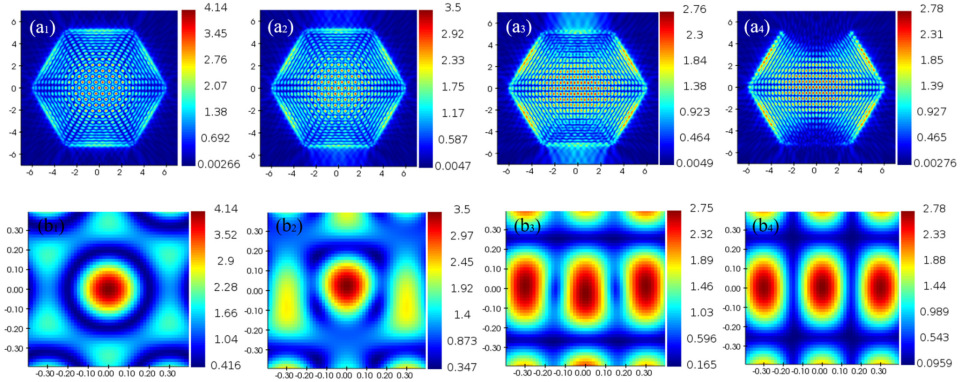
In the previous sections, structural defects were gradually introduced under fixed illumination to observe changes in the electric field intensity, which corresponds to geometric perturbations. Here, the structure is kept unchanged, and an asymmetry is applied to a pair of incident phases, which represents a coupling asymmetry model. As shown in Figure 4, we choose a defect-free hexagonal model and vary the phase difference between a pair of excitation light sources from 0 to π .
In the previous discussions, the non-closed structures were realized by changing the groove length and period. Here, by simply altering the phase difference of a pair of beams, topological domain wall fracture occurs at the center of the structure, leading to increasing deformation and a continuous reduction in the Skyrmion number. Compared to the symmetric case in Figure 4(a1), the vector fields in Figure 4(a2–a4) no longer exhibit clear flipping at the edges. This breaking of topology can also be viewed as a form of structural defect, and as it intensifies, the unit cell structure degrades into a meron (half-Skyrmion) configuration. Comparing with Figure 4(b3,b4), it can be observed that the electric field component profile in the y-direction for the non-closed quadrilateral is similar, yet its topological vector still shows a clear transition from outward-pointing at the center to inward-pointing at the edges, corresponding to the optical Skyrmion texture. This implies that tuning the photonic crystal in specific directions by modifying the coupling elements or light sources allows designing optical Skyrmions with special shapes, opening new avenues for forming optical Skyrmions with complex structures or unique shapes. Moreover, limitations of non-closed structures in generating Skyrmions must be considered, as they are influenced by various factors such as misaligned central lines preventing energy focusing, oversized structures causing rapid energy decay, and insufficiently small edge lengths leading to SPP diffraction. These issues all potentially affect the formation of Skyrmion structures.

4. Conclusions

In summary, we have demonstrated a highly effective minimal perturbation engineering strategy for the programmable control of Skyrmions on a plasmonic metasurface. By applying extremely weak and localized perturbations either by continuously shortening or discretely segmenting a single edge, we can precisely bias the near-field intensity distribution, shift the intensity peak position, and control the local chirality. When the edge is continuously shortened, the central intensity decreases overall, with a slight recovery in the moderate shortening range due to local resonance and temporary phase alignment, ultimately approaching a 20% low plateau near the six-beam to five-beam limit (decrease of about). In contrast, discretizing a single edge into multiple segments introduces the synergistic effect of the mode factor and array factor under the same duty cycle, significantly degrading the coherence condition in the central direction and causing main lobe deflection. This results in a non-monotonic intensity evolution, with the peak shifting outward from the center. At six segments, the central intensity drops by about 32%, which is closer to the ideal modulation limit. These results demonstrate that subtle geometric perturbations can stably control both the central intensity and peak position through coherent weight redistribution and angular energy rearrangement, while preserving the overall topological charge unchanged, provided singularities and boundary conditions are not crossed. Only measurable biases are introduced in the local chiral density and domain wall curvature. Combined with the broadband advantages of the PB system, this approach requires no change in the device layer stack or illumination configuration, enabling low-power, predictable selection of Skyrmion states and intensity shaping, providing a simple and universal engineering method for the design and application of on-chip programmable topological light fields.

Supplementary Materials

The following supporting information can be downloaded at: https://www.mdpi.com/article/10.3390/photonics12121170/s1, References [35,36,37,38] are cited in the Supplementary Materials. Figure S1. Schematic of excitation structures with varying side counts. (a) Schematic diagram of the regular polygon structure with different sides, the lengths for the trenches consisting of triangle, pentagon and hexagon are 18.66, 7.83 and 6.0 µm, respectively. (b) Profiles of the electric field of the generated skyrmions with different excitation structures. The three figures are taken with the geometrical center of the excitation structures with the side length of 2 µm. (c) Single skyrmions lattice generated with different excitation structures. The arrow represents the electric field polarization. Schematic diagrams of the coherent superposition of SPP equiphase planes excited by the triangular (d) and hexagon (e). (f) The relationship between the electric field strength on the center of the optical skyrmions and the number of sides (excitation source). The red line is the fitted linear line.

Author Contributions

Conceptualization, Z.Z.; methodology, Q.W.; software, validation, data curation, analysis, and writing—original draft preparation, Z.Z.; writing—review and editing, Q.W.; supervision, D.Z. All authors have read and agreed to the published version of the manuscript.

Funding

This project was supported by the National Natural Science Foundation of China, No. 62275160 and No. 62305113.

Institutional Review Board Statement

Not applicable.

Informed Consent Statement

Not applicable.

Data Availability Statement

Data are contained within the article.

Acknowledgments

The authors would like to thank the University of Shanghai for Science and Technology for helping to identify collaborators for this work. All individuals included in this section have consented to the acknowledgments.

Conflicts of Interest

The authors declare no conflicts of interest.

References

  1. Skyrme, T.H.R. A unified field theory of mesons and baryons. Nucl. Phys. 1962, 31, 556–569. [Google Scholar] [CrossRef]
  2. Rössler, U.K.; Bogdanov, A.N.; Pfleiderer, C. Spontaneous skyrmion ground states in magnetic metals. Nature 2006, 442, 797–801. [Google Scholar] [CrossRef]
  3. Nayak, A.K.; Kumar, V.; Ma, T.P. Magnetic antiskyrmions above room temperature in tetragonal Heusler materials. Nature 2017, 548, 561–566. [Google Scholar] [CrossRef]
  4. Moore, J.E. The birth of topological insulators. Nature 2010, 464, 194–198. [Google Scholar] [CrossRef]
  5. Mühlbauer, S. Skyrmion lattice in a chiral magnet (February, pg 915, 2009). Science 2011, 333, 1381. [Google Scholar]
  6. Al Khawaja, U.; Stoof, H.T.C. Skyrmion physics in Bose-Einstein ferromagnets—Art. no. 043612. Phys. Rev. A 2001, 64, 043612. [Google Scholar] [CrossRef]
  7. Fukuda, J.; Zumer, S. Quasi-two-dimensional Skyrmion lattices in a chiral nematic liquid crystal. Nat. Commun. 2011, 2, 246. [Google Scholar] [CrossRef]
  8. Nicolas, A.; Veissier, L.; Giner, L. A quantum memory for orbital angular momentum photonic qubits. Nat. Photonics 2014, 8, 234–238. [Google Scholar] [CrossRef]
  9. Zhou, L.; Xu, B.W.; Zhong, W. Device-Independent Quantum Secure Direct Communication with Single-Photon. Phys. Rev. Appl. 2023, 19, 014036. [Google Scholar] [CrossRef]
  10. Romming, N.; Hanneken, C.; Menzel, M. Writing and Deleting Single Magnetic Skyrmions. Science 2013, 341, 636–639. [Google Scholar] [CrossRef] [PubMed]
  11. Maccariello, D.; Legrand, W.; Reyren, N. Electrical detection of single magnetic skyrmions in metallic multilayers at room temperature. Nat. Nanotechnol. 2018, 13, 233–237. [Google Scholar] [CrossRef]
  12. Fert, A.; Cros, V.; Sampaio, J. Skyrmions on the track. Nat. Nanotechnol. 2013, 8, 152–156. [Google Scholar] [CrossRef]
  13. Nagaosa, N.; Tokura, Y. Topological properties and dynamics of magnetic skyrmions. Nat. Nanotechnol. 2013, 8, 899–911. [Google Scholar] [CrossRef] [PubMed]
  14. Kedia, H.; Foster, D.; Dennis, M.R. Weaving Knotted Vector Fields with Tunable Helicity. Phys. Rev. Lett. 2016, 117, 274501. [Google Scholar] [CrossRef] [PubMed]
  15. Lei, X.R.; Yang, A.P.; Shi, P. Photonic Spin Lattices: Symmetry Constraints for Skyrmion and Meron Topologies. Phys. Rev. Lett. 2021, 127, 237403. [Google Scholar] [CrossRef] [PubMed]
  16. Du, L.P.; Yang, A.P.; Zayats, A.V. Deep-subwavelength features of photonic skyrmions in a confined electromagnetic field with orbital angular momentum. Nat. Phys. 2019, 15, 650–654. [Google Scholar] [CrossRef]
  17. Sun, L.; Cao, R.X.; Miao, B.F. Creating an Artificial Two-Dimensional Skyrmion Crystal by Nanopatterning. Phys. Rev. Lett. 2013, 110, 167201. [Google Scholar] [CrossRef]
  18. Gilbert, D.A.; Maranville, B.B.; Balk, A.L. Realization of ground-state artificial skyrmion lattices at room temperature. Nat. Commun. 2015, 6, 8462. [Google Scholar] [CrossRef]
  19. Hafezi, M.; Mittal, S.; Fan, J. Imaging topological edge states in silicon photonics. Nat. Photonics 2013, 7, 1001–1005. [Google Scholar] [CrossRef]
  20. Zhen, W.M.; Ren, Z.C.; Wang, X.L. Polarization structure transition of C-point singularities upon reflection. Sci. China-Phys. Mech. Astron. 2025, 68, 244211. [Google Scholar] [CrossRef]
  21. Yang, W.R.; Yang, H.H.; Cao, Y.S. Photonic orbital angular momentum transfer and magnetic skyrmion rotation. Opt. Express 2018, 26, 8778–8790. [Google Scholar] [CrossRef] [PubMed]
  22. Wang, W.W.; Beg, M.; Zhang, B. Driving magnetic skyrmions with microwave fields. Phys. Rev. B 2015, 92, 020403. [Google Scholar] [CrossRef]
  23. Spektor, G.; Prinz, E.; Hartelt, M. Orbital angular momentum multiplication in plasmonic vortex cavities. Sci. Adv. 2021, 7, eabg5571. [Google Scholar] [CrossRef] [PubMed]
  24. Spektor, G.; Kilbane, D.; Mahro, K. Revealing the subfemtosecond dynamics of orbital angular momentum in nanoplasmonic vortices. Science 2017, 355, 1187–1191. [Google Scholar] [CrossRef]
  25. Fang, K.J.; Yu, Z.F.; Fan, S.H. Realizing effective magnetic field for photons by controlling the phase of dynamic modulation. Nat. Photonics 2012, 6, 782–787. [Google Scholar] [CrossRef]
  26. Yin, X.B.; Hesselink, L.; Liu, Z.W. Large positive and negative lateral optical beam displacements due to surface plasmon resonance. Appl. Phys. Lett. 2004, 85, 372–374. [Google Scholar] [CrossRef]
  27. Yang, J.; Xiao, X.; Hu, C. Broadband Surface Plasmon Polariton Directional Coupling via Asymmetric Optical Slot Nanoantenna Pair. Nano Lett. 2014, 14, 704–709. [Google Scholar] [CrossRef]
  28. Qin, Y.L.; Song, X.W.; Ji, B.Y. Demonstrating a two-dimensional-tunable surface plasmon polariton dispersion element using photoemission electron microscopy. Opt. Lett. 2019, 44, 2935–2938. [Google Scholar] [CrossRef]
  29. Hu, H.M.; Qin, Y.L.; Lang, P. Investigation of a dual-hole structure-based broadband femtosecond nondiffracting SPP beam emitter by photoemission electron microscopy. Opt. Laser Technol. 2022, 146, 107538. [Google Scholar] [CrossRef]
  30. Van Mechelen, T.; Jacob, Z. Universal spin-momentum locking of evanescent waves. Optica 2016, 3, 118–126. [Google Scholar] [CrossRef]
  31. Bliokh, K.Y.; Nori, F. Transverse and longitudinal angular momenta of light. Phys. Rep.-Rev. Sec. Phys. Lett. 2015, 592, 1–38. [Google Scholar] [CrossRef]
  32. Fan, S.H.; Suh, W.; Joannopoulos, J.D. Temporal coupled-mode theory for the Fano resonance in optical resonators. J. Opt. Soc. Am. A-Opt. Image Sci. Vis. 2003, 20, 569–572. [Google Scholar] [CrossRef]
  33. Bliokh, K.Y.; Nori, F. Characterizing optical chirality. Phys. Rev. A 2011, 83, 021803. [Google Scholar] [CrossRef]
  34. Meiler, T.; Frank, B.; Giessen, H. Dynamic tailoring of an optical skyrmion lattice in surface plasmon polaritons: Comment. Opt. Express 2020, 28, 33614–33615. [Google Scholar] [CrossRef] [PubMed]
  35. Chen, J.Y.; Ji, B.Y.; Lang, P. Impact of the geometry of the excitation structure on optical skyrmion. Opt. Express 2023, 31, 37929–37942. [Google Scholar] [CrossRef] [PubMed]
  36. Johnson, P.B.; Christy, R.W. Optical Constants of the Noble Metals. Phys. Rev. B 1972, 6, 4370–4379. [Google Scholar] [CrossRef]
  37. Davis, T.J.; Janoschka, D.; Dreher, P. Ultrafast vector imaging of plasmonic skyrmion dynamics with deep subwavelength resolution. Science 2020, 368, eaba6415. [Google Scholar] [CrossRef]
  38. Lin, M.; Liu, Q.; Duan, H.G. Wavelength-tuned transformation between photonic skyrmion and meron spin textures. Appl. Phys. Rev. 2024, 11, 6. [Google Scholar] [CrossRef]
Figure 1. (a1,a2) Schematic of the metasurface structure. The external hexagonal structure represents the grooves etched on a silver film on an SiO2 substrate, and the internal quadrilateral represents the placement of the monitor. From top to bottom are silver film, silica substrate and silicon wafer, respectively. Gaussian light is vertically irradiated from bottom to excite SPPs. D 1 = 6   μ m , D 2 = 12   μ m , D 3 = 6   μ m , D 4 = 1.6   μ m , h 1 = 120   n m , h 2 = 200   n m , r = 6   μ m . (b) Grayscale image of the Skyrmions at the center of the structure. The image size is 1.6   μ m × 1.6   μ m . (c) Schematic of the electric field vector of a single Skyrmion lattice, corresponding to one period of the structure shown in (b). The arrow represents the electric field polarization. (d) Schematic of the electric field flipping in a Néel-type Skyrmions, corresponding to the red-to-blue flipping process in (c). (e) Schematic of the electric field vector in spherical coordinates.
Photonics 12 01170 g001
Figure 2. (a) Electric field profile of the hexagonal structure excitation. The side length is 6 μm, with the Gaussian light source wavelength of 532 nm placed at the center of each edge. (b1b6) Schematic of the perturbed structure. The central position remains fixed while both sides are uniformly shortened, each by 20%, until the grooves disappear. (c1c6) Skyrmions’ electric field distribution and intensity color map for different groove lengths. All six images are centered at the geometric center of the excitation structure with a side length of 1.4 μm. (d) Intensity curve of the optical Skyrmion light field at y = 0 as a function of the x-axis position.
Photonics 12 01170 g002
Figure 3. (a1a6) Skyrmions’ electric field distribution and intensity color map for segmentation values of 1, 2, 3, 4, 5 and 6. All six images are centered at the geometric center of the excitation structure with a side length of 1.4 μm. (b1b6) Schematic of the model. (c) Intensity curve of the optical Skyrmion light field at y = 0 as a function of the x-axis position. (d1,d2) Line chart showing the variation in central light field intensity due to length and segmentation perturbations.
Photonics 12 01170 g003
Figure 4. (a1a4) Skyrmions’ electric field distribution for phase differences of 0°, 90°, and 180°, and bilateral structure defects. (b1b4) Central electric field profile of the corresponding structure.
Photonics 12 01170 g004
Table 1. Optical field intensity and variation ratio for non-closed perturbation structures.
proportion of full length100%80%60%40%20%0%
E 2 4.1374.0714.2294.2623.7643.309
variation/−1.6%+2.2%+3.0%−9.0%−20.0%
Disclaimer/Publisher’s Note: The statements, opinions and data contained in all publications are solely those of the individual author(s) and contributor(s) and not of MDPI and/or the editor(s). MDPI and/or the editor(s) disclaim responsibility for any injury to people or property resulting from any ideas, methods, instructions or products referred to in the content.