1. Introduction
During the past few centuries, the world has witnessed a dramatic increase in the human population, mainly driven by advances in agricultural practices that aim to enhance primary productivity through the enrichment of food resources [
1]. Enrichment techniques, including the utilization of highly enriched grains and genetically modified organisms, have become integral to our daily lives [
2]. However, the sustainability of such practices raises significant concerns about the long-term viability of the human population [
3]. In classical predator–prey dynamics, one would typically expect that increasing the availability of limiting nutrients or energy would benefit both predator and prey populations [
4]. However, Rosenzweig challenged this conventional wisdom by proposing a paradox: enrichment schemes can disrupt the characteristic steady state of the system and potentially lead to the extinction of one or both species [
5]. This counterintuitive proposition, known as the paradox of enrichment, has captivated the attention of empiricists and theoreticians over the past five decades, prompting numerous theoretical and experimental studies.
Rosenzweig’s paradox has gained renewed significance in the context of modern conservation biology and ecosystem management. Recent empirical studies in both terrestrial and aquatic ecosystems have validated this counterintuitive phenomenon. For example, Verschoor et al. [
6] demonstrated destabilization in plankton communities after nutrient enrichment, while Meyer et al. [
3] documented similar patterns in agroecosystems subjected to fertilization. The paradox has proven particularly relevant for understanding harmful algal blooms in coastal environments [
7], where anthropogenic nutrient inputs can trigger population explosions followed by crashes that destroy entire food webs. These findings highlight the critical importance of understanding the mathematical foundations underlying the paradox of enrichment.
Despite the considerable time that has elapsed since Rosenzweig first proposed this paradox, studies addressing it continue to be conducted recently across a wide variety of theoretical and empirical frameworks [
8,
9,
10]. Beyond its ecological implications, the paradox of enrichment has significant economic consequences for resource management in multiple sectors, such as fisheries management, agricultural pest control, and wildlife conservation. Modern conservation strategies now increasingly incorporate these dynamic instabilities when planning interventions. For example, Takashina et al. [
11] used mathematical models to explore the unintended consequences of establishing marine protected areas (MPAs) and demonstrated that, under certain conditions, the creation of these areas can lead to a decline or even extinction of prey species. Similarly, modern agroecological approaches now often employ diversification strategies rather than simple resource enrichment to avoid pest outbreaks [
12].
Even after years of studies involving the paradox, a comprehensive theoretical framework unifying the various mathematical models of this phenomenon has remained elusive. Rosenzweig originally proposed six analytical models of trophic exploitation, each capturing different aspects of predator–prey dynamics. These models, while mathematically distinct, share fundamental principles regarding how enrichment affects system stability, yet their underlying mathematical connections have not been fully explored. The models focus on the unique behavior of predators, which is described by a differential equation characterizing population growth in relation to prey availability and carrying capacity.
In this study, we present a unified mathematical framework that connects Rosenzweig’s six models through the Richards growth model [
13], which can be interpreted as a Box–Cox transformation of one species’ abundance relative to carrying capacity [
14,
15,
16]. It is a statistical technique used to stabilize the variance of a dataset and is named after the statisticians George Box and David Cox, who introduced it in 1964 [
14]. This transformation is commonly applied when the assumption of constant variance (homoscedasticity) is violated in a regression or other statistical analysis. The optimal value of the transformation parameter
can be determined using statistical techniques, such as using maximum likelihood estimation (MLE) to find the value of
that maximizes the log-likelihood function. The Box–Cox transformation is often used in cases where the data exhibit skewness or heteroscedasticity. By transforming the data, it aims to achieve normality and stabilize the variance. This can improve the validity of statistical analyses that assume normally distributed errors or constant variance.
Our proposal provides a fresh perspective on the Rosenzweig’s six original models, allowing us to retrieve each of them by appropriately choosing the parameter values. We base our approach on the framework of generalized logarithm and exponential functions derived from nonextensive statistical mechanics [
17,
18,
19,
20] and growth models [
13,
17,
21,
22,
23,
24]. This mathematical synthesis offers several advantages over previous approaches. First, it demonstrates how Rosenzweig’s seemingly disparate models emerge as special cases within our generalized framework. Second, it provides analytical conditions for predicting when enrichment will destabilize ecological systems. Third, it establishes a theoretical foundation for understanding the mechanistic processes that drive population fluctuations after environmental enrichment. Together, these advances create new opportunities for predicting ecosystem responses to anthropogenic influences.
Our results can be positioned within recent eco-evolutionary approaches that examine enrichment, stability, phase transitions, and scaling properties in predator–prey systems. Recent studies have shown that trophic interactions produce scale-invariant patterns and power-law relationships, linking enrichment dynamics to greater statistical regularities in ecological communities [
25,
26]. These approaches emphasize how functional responses, adaptive behavior, and life-history trade-offs shape stability and phase transitions in ecological systems. In parallel, several theoretical studies have revisited the paradox of enrichment and proposed mechanisms that resolve or reinterpret its instability conditions, including changes in functional responses and interaction structures [
27,
28]. Classical formulations of trophic interactions, such as prey-dependent and ratio-dependent functional responses, have also played a central role in understanding how enrichment affects system stability [
29,
30]. In this context, the unified framework that we propose complements these lines of research by providing a continuous mathematical structure that connects multiple classical exploitation models, allowing intermediate scenarios between distinct functional responses and stability regimes to be explored within a single formalism.
We organize our presentation as follows. In
Section 2, we provide a comprehensive review of Rosenzweig’s original models. In
Section 3, we introduce the generalized logarithm and exponential functions derived from nonextensive statistical mechanics, which form the mathematical foundations of our generalized framework. We outline the step-by-step process of unification and present numerical simulations demonstrating how our generalized framework reproduces the classic paradox of enrichment patterns. In
Section 4, we discuss our results and the limitations of the generalization process. Finally, in
Section 5, we summarize our contribution and its implications for contemporary ecological theory and conservation practice. Through this mathematical synthesis, we aim to contribute both to theoretical ecology and to practical conservation efforts by enhancing our ability to predict when enrichment strategies might backfire, potentially informing more nuanced approaches to ecosystem management in an era of unprecedented anthropogenic influence on global ecosystems.
2. Materials and Methods
To investigate ecological systems in which increased resource availability can paradoxically lead to a decline in fitness and abundance, M. Rosenzweig proposed some mathematical models [
5]. These models focus on the unique behavior of predators, which can be described by the following differential equation:
with
P representing the predator population (number or density),
V the victims (prey),
J is a constant reference density of victims, and where
A,
k, and
c are the predator-victim conversion efficiency, the predation rate, and a constant accounting for density-dependent predation effects, respectively. Here,
J represents the density of prey at which the predator population exhibits zero net growth, acting as a fixed threshold that defines the predator isocline (
) in the phase plane. This parameter plays a central role in the steady-state analysis, as it determines the equilibrium prey density independently of predator abundance. Rather than being derived from first principles, Equation (
1) generalizes the conversion of prey biomass into predator biomass while incorporating saturation effects through the exponential terms. The steady states (
) for this equation are
, representing a trivial state, and
, which holds for any value of
P.
For victims in the context of trophic exploitation, six analytical models were proposed, each describing the discrepancy between the inherent rate of increase in victims (V) and the number of victims who die or are not born due to predator activity (P). These models are based on different assumptions. In the first assumption, the inherent rate of increase in victims is . Here, R represents the rate at which nutrients flow to an individual victim V, Q is the rate at which each V must receive a quota of nutrients to maintain replacement levels and denotes the constant of victim competition. The parameter corresponds to the standing crop of victims when predator abundance vanishes. In this way, we have the relationship between and K, and between and R, and the enrichment implies K increases, considering intraspecific competition between victims where the effective “feedingrate” decreases as increases. Furthermore, alternative expressions for the inherent rate of increase in victims include the traditional Pearl-Verhulst logistic model and the Gompertz model . To account for the number of victims that die or are not born, two representations were introduced. The first is a model of the kill rate expressed as , with , which assumes that each predator kills victims at a rate of k times V increased to the power of g. The second representation is , which assumes that each predator attacks victims in a fixed amount of time. These different models provide insight into the dynamics of trophic exploitation, capturing the intricate interplay between predators and victims while considering various assumptions about their interactions and responses to enrichment.
The interaction terms adopted in this study are consistent with generalized forms of the Law of Mass Action (Gause) [
31]. In particular, the term
represents a nonlinear encounter rate, which may arise from heterogeneous mixing, spatial constraints, or predator interference, while the alternative formulation
accounts for saturation in predation at high prey densities.
Combining the previously described models for the inherent rate of increase of victims and the number of victims that die, the six models are:
Each of these models reflects different assumptions about the nature of predator–prey interactions and the response of the prey population to changes in the predator population. The rich variety of models has sparked extensive theoretical and empirical investigations. These studies have aimed to unravel the intricate dynamics of predator–prey interactions and comprehend the implications of the paradox of enrichment.
Theoretical analyses of these models have provided information on the complex interplay between predator and prey populations and the consequences of resource enrichment. The conditions under which population fluctuations occur have been explored, as well as the existence of stable equilibria and the potential for population extinction. Understanding the dynamics of predator–prey interactions is crucial for managing and conserving ecosystems, as well as predicting the outcomes of environmental changes and human interventions. The extensive investigation of these models has contributed to our understanding of trophic dynamics and the delicate balance between predator and prey populations. It has also emphasized the need for caution when implementing enrichment schemes, highlighting the potential risks associated with disrupting the equilibrium of ecological systems.
The nontrivial equilibrium of a system described by one of the six equations above is stable for values of
K, or
R, below certain thresholds [
5]. For example, in the case of Equations (
1) and (2d), the nontrivial equilibrium is:
and it exists when
. To analyze the stability of this system, one constructs the Jacobian matrix
of partial derivatives and evaluates it in the steady-state [
32]:
The system is stable when the determinant of the Jacobin matrix
is positive and its trace is negative. The determinant of
is always positive when the equilibrium exists. Denoting
and
, the trace of
is negative when the following condition is satisfied:
Calling
, the nontrivial equilibria of the systems given by each of the Equation (2a–f) are stable for values of
K, or
R, below the following thresholds, respectively [
32]:
Enriching the environment can increase the values of
K, or
R, above these thresholds, leading the nontrivial equilibria to become unstable, destabilizing the systems, and resulting in the extinction of both predators and victims.
3. Results
These six models of the previous section [
5] (Equation (2a–f)) were elaborated based on plausible ecological assumptions and share some characteristics. To explore their intrinsic connections, we rewrite them in a single unified model. Equations (2b) and (2e), and Equations (2a) and (2f), can be unified by the Richards model [
13,
33], respectively:
with
being the generalized logarithmic function (
-logarithm), initially proposed by Tsallis in the context of nonextensive statistical mechanics [
18,
19,
20,
23,
24]. Focusing on interaction term
of Equations (2d) and (6b), we see that if
,
. Thus, we can unify Equations (2d) and (6b), and Equations (2c) and (
6a), by writing the interaction term as
. In this way, one has only two equations:
When
, Equation (
8a) retrieves Equation (2a,d,f). When
, so that
, Equation (8b) retrieves Equation (2b,c,e).
We have written the first addend of the sum in Equation (
8a) in terms of the generalized logarithmic function and obtained:
, where
is a constant and
. This means that this addend corresponds to the Richards model [
13], with
. From this generalization, we have finally unified Equations (8a) and (8b):
which retrieves Equation (2a–f), depending on the values of
,
g, and
c, according to
Table 1.
This structure reveals that the different dynamics proposed by Rosenzweig can be seen as continuous variations controlled by these key parameters (, g, and c), suggesting a deeper common basis for the response of ecosystems to environmental enrichment. This unification simplifies analyses, potentially revealing common patterns previously hidden among different models.
The critical values below which the nontrivial equilibria of the systems described by Equation (2a–f) are stable can also be rewritten to unify some of their expressions. In this way, Equations (5a,c) and (5b,d,e), are unified and we obtain:
with
being the
Tsallis’ generalized exponential function (
-exponential) [
18,
19,
20,
23,
24], inverse of the generalized logarithm function,
the step (Heavyside) function,
, and
.
We can go further, initially rewriting Equation (
9) and dividing by
K:
where
. In this way, we propose a more general model by introducing a second logarithm function in the second addend of the sum in Equation (
12). Combining this result with Equation (
1), one has:
with
,
,
,
, and
.
To obtain a steady-state regime, one calculates the fixed points. From
, the trivial solution is
, for any value of
, and the nontrivial one is
, for any
. Considering
, one has:
Using the above model, we retrieve the results of Ref. [
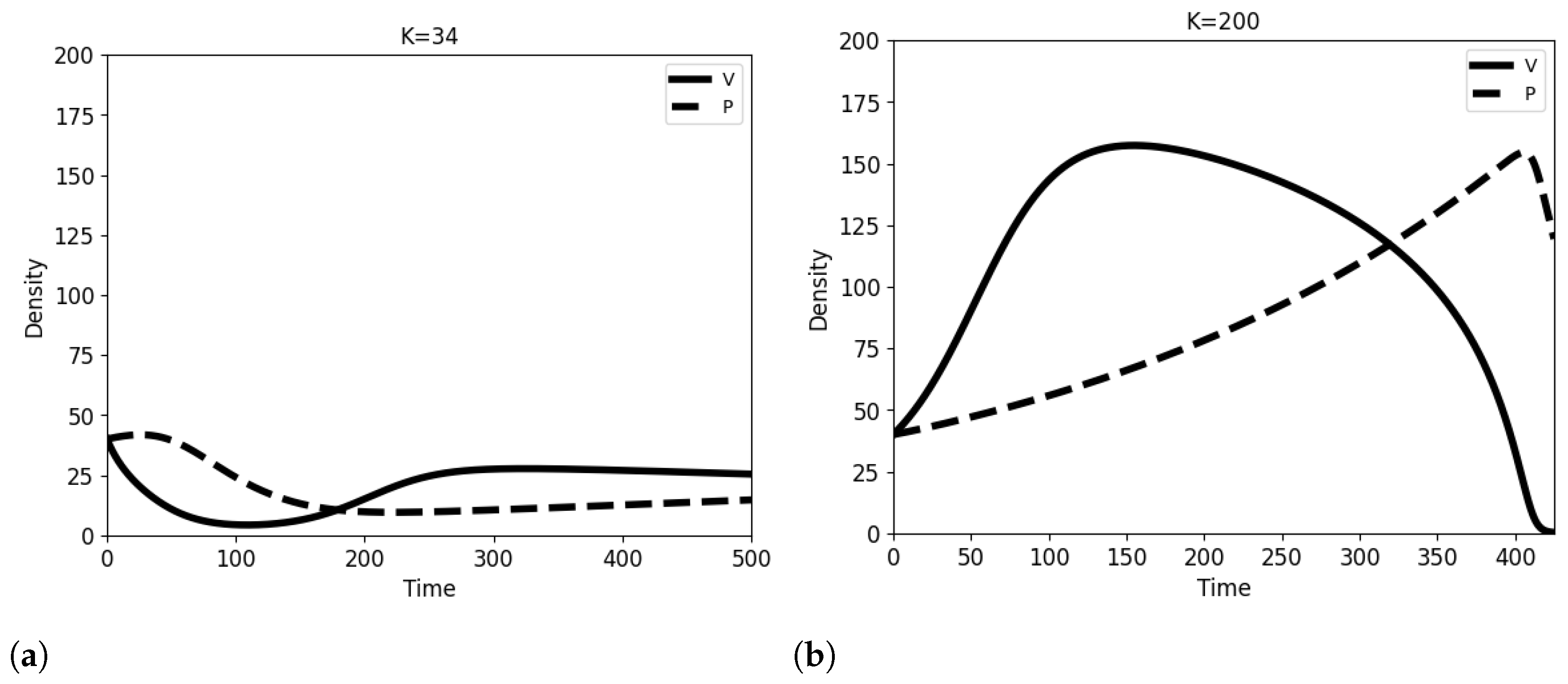
5]. We have constructed two graphs of density × time for two substantially different values of
K (34 and 200), simulating the simultaneous temporal evolution of predator and victim populations, where this second occurs according to the model (2d). Rosenzweig showed that, according to his prediction, nutritional enrichment (an increase in
K) in the interaction of two species can lead to instability that eventually causes the extinction of one or both species, as in this case. In deterministic predator–prey models, extinction is typically associated with large-amplitude limit cycles in which population densities approach arbitrarily small values. In highly enriched systems, these oscillations bring both predator and prey densities close to zero, such that even small perturbations in real ecological systems would result in extinction. From our generalized model (
13), for
and
(which makes it retrieve the model (2d)), we have simulated in Python the temporal evolution of predator and victim populations (see
Figure 1). We have chosen parameter values to obtain results similar to those of Rosenzweig [
5] and, in this way, validate our model.
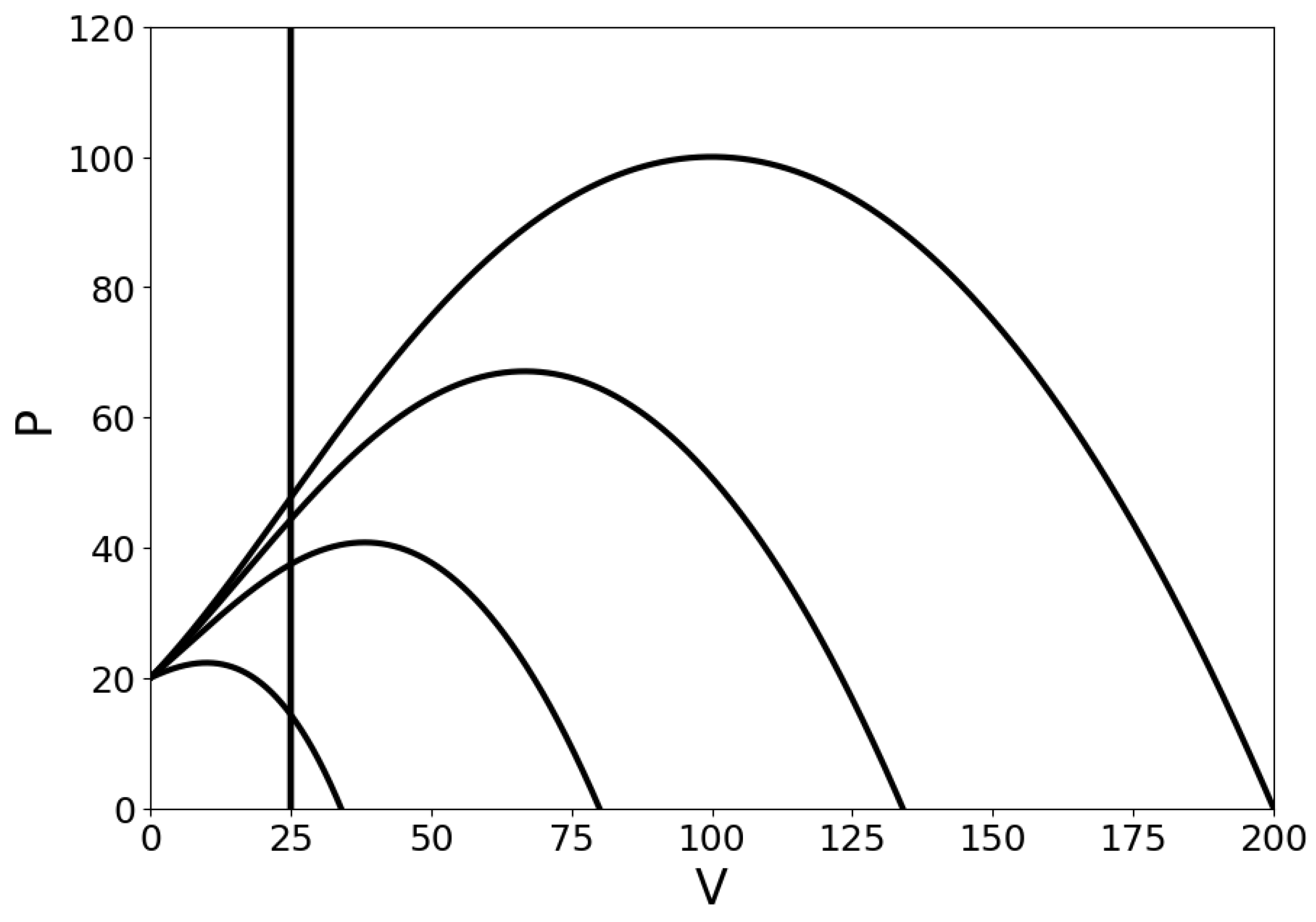
To clearly state the conditions that define persistent, or explosive, system, Rosenzweig et al. [
5,
34] used what they called a general graph of exploitation (see
Figure 2), characterized by a victims (prey) density,
V, plotted against an exploiter (predator) density,
P. The set of graph points at which
has a hump shape and is called the victim isocline. The set of graph points at which
forms a line parallel to the
P axis (
), since exploiters do not actually interfere with each other directly, and is called exploiter isocline. The ecosystem equilibria that result, or not, in steady states are represented by the intersection point of these two isoclines. If the equilibrium point is on the left side of the maximum point of the victim isocline (where
), the predator is too proficient and the system will ordinarily not persist (
). If the equilibrium point is on the right side of the maximum point of the victim isocline, the system will persist (
). That is,
is a critical value and, if the equilibrium value of
V is greater than
, the system is safe. If the equilibrium value of
V is smaller than
, the system is in danger of extinction.
Since is a critical value that determines whether the system persists or is at risk of extinction, and Rosenzweig’s goal is to relate these possibilities to the enrichment process, one needs to find how changes as enrichment proceeds. For this, it is necessary to find an algebraic equation for the V isocline and calculate . Since K represents the standing crop of V where , K must be directly proportional to the flow rates of limiting nutrients. Thus, enrichment implies increases in K. The final step is to calculate , which, if always positive, shows that enrichment leads to system instability.
Following these procedures to evaluate the effect of enriching a system, it is necessary to study how
varies as enrichment occurs, that is, how
varies as
K increases. If enrichment increases
, that means that the system is at risk, since eventually
will become greater than
J. Initially, to obtain the algebraic equation for the
V isocline, we set
and solve for
P:
In fact, the
V isoclines from
Figure 2 have been obtained in Python from Equation (
15) for
and
(which makes it retrieve the expression derived from model (2d)) and using for its parameters a numerical values set that allows reproducing the curves of Ref. [
5] study:
,
, and
.
Continuing the method, we have obtained an expression for
and determined the value of
V that satisfies
, that is,
. Taking
:
we have worked the partial derivative in the second addend of the Equation (
16):
and replaced this result in Equation (
16) to obtain a definitive expression:
Making
, with
:
The structure of the generalized equations imposes some limitations on the full implementation of this method. A final analytical step would require calculating
(or
), which remains a promising challenge for future investigation.
Although the mathematical tools employed in this study, such as the Richards growth model and Box–Cox transformations, are well established, their combined use enables a continuous unification of six historically distinct trophic exploitation models. This formulation allows the Paradox of Enrichment to be explored over a continuous parameter space defined by , g, and c, rather than as isolated cases.
4. Discussion
By identifying the underlying connections between seemingly disparate formulations of trophic exploitation, our framework reveals how these models emerge as special cases of a more general mathematical structure, offering new insights into the mechanisms driving the paradox of enrichment.
Within this generalized formulation, the generalized parameters
,
g, and
c can be associated with meaningful processes. The parameter
controls the density dependence simmetry in the growth of the prey, modulating the relative strength of intraspecific competition at low versus high densities. It also has a microscopic interpretation in the context of the Richards’ model. The underlying microscopic model can be thought of as interacting cells with repulsion as
, with
r being the distance between two cells and
the range of a potential. These cells grow on a fractal substrate with dimension
. This model has been proposed in Ref. [
35], where the authors demonstrate that the mean population grows as the Richards’ model. In Ref. [
13], the authors show that
is one of the few examples in which the deformation parameter has a clear interpretation. The parameter
g reflects deviations from homogeneous mixing, often associated with spatial constraints or predator interference. Finally, the parameter
c governs the saturation rate of predation, capturing limitations in predator handling or consumption capacity.
The key innovation of our approach lies in the parameter , which allows seamless transitions between the original models while preserving their ecological implications. Through this parameterization, our generalized model retrieves the six original expressions used to demonstrate how predator and/or prey populations can be driven to extinction due to the enrichment of the environment, that is, due to the increase in the food available to the prey, which can cause instability and destroy the characteristic steady state of the system. As a final expression, we have proposed a more general model that incorporates the g-logarithm function from nonextensive statistical mechanics, which extends the framework’s applicability, providing mathematical tools to analyze systems that deviate from classical assumptions. Although a complete parametric sweep of the generalized model is beyond the scope of this study, the unified conditions derived here allow numerical stability testing for arbitrary combinations of , g, and c, providing a flexible platform for future theoretical and computational investigations.
We also have derived a generalized function for . However, the mathematical structure of generalized equations imposes some limitations on the generalization process, which prevents the full implementation of an analogous Rosenzweig method in our study, such as the calculation of and . These limitations represent fertile ground for future mathematical exploration.
Regarding the analytical determination of the critical point , the generalized structure of the logarithmic and exponential functions leads to expressions that are algebraically intractable in closed form. Nevertheless, the unified formulation derived here provides explicit functional conditions that can be evaluated numerically, allowing the stability boundaries of the system to be systematically explored through isocline analysis.
Furthermore, the theoretical implications of the paradox of enrichment have been subject to significant scrutiny since their original formulation. In particular, May [
36] challenged the ubiquity of this paradox by demonstrating that it often arises as an artifact of simplified predator–prey models. Using limit cycle analysis, May [
36,
37] argued that natural ecosystems possess stabilizing mechanisms—such as spatial heterogeneity, prey refuges, or more complex functional responses—that are frequently omitted in basic deterministic frameworks. Crucially, our unified mathematical structure enables a systematic evaluation of whether May’s criticisms hold as the generalization parameters
,
g, and
c are varied, providing a continuous framework to test stability across a broad spectrum of ecological scenarios.