1. Introduction
The niche, as a core concept in ecology, provides crucial guidance for ecological management and conservation. Within ecosystems, the survival and development of biological organisms are intimately tied to their niche status. This status not only intuitively reflects the adaptive advantages or disadvantages of individuals in their environment but also serves as a key indicator for assessing the overall health and dynamics of the ecosystem [
1]. With the continuous process of biological evolution, higher-order niche systems have increasingly demonstrated complex nonlinear characteristics and significant uncertainties. This dual complexity renders conventional linear or simple nonlinear modeling methods inadequate to accurately describe and effectively control such systems. While Type-1 fuzzy control can handle certain types of imprecise information, its reliance on fixed and precise membership functions limits its ability to capture the inherent fuzziness and uncertainty in niche perception and environmental disturbances. As a result, it falls short of meeting the precision required for dynamic ecosystem regulation.
Li et al. pioneered a fuzzy control method based on niche modeling [
2,
3]. By integrating the “state” and “potential” theory of niches into the T-S fuzzy framework, they replaced the traditional linear or constant consequent parts in fuzzy rules with niche-based variables. This innovation allowed the fuzzy rules to directly embody the adaptive principle that “biological organisms always develop in a self-beneficial direction” [
4]. However, as this method was built on Type-1 fuzzy sets, its predetermined membership functions could not fully represent the dual complex characteristics of niche systems.
In contrast, Type-2 fuzzy sets extend the capabilities of Type-1 fuzzy sets by handling uncertainties in membership degrees themselves, which significantly broadens their application range and enhances robustness against disturbances and uncertainties. The use of interval Type-2 fuzzy sets for fuzzifying inputs or outputs can also reduce computational complexity, improving practicality for real-time control [
5,
6]. The experimental results in [
7] demonstrated that interval Type-2 T-S fuzzy models achieve an accuracy improvement of over 30% compared to Type-1 models when fitting uncertain parameters. Studies [
8,
9] further confirmed the superior performance of interval Type-2 fuzzy models in managing complex systems and uncertainties. Additionally, the study in [
10] combined evolutionary and adaptive biological characteristics with direct Type-2 T-S fuzzy control to develop a bio-inspired control strategy. Comparative simulations revealed that Type-2 controllers outperform Type-1 in stability and convergence. Nevertheless, existing Type-2 fuzzy methods predominantly address “single uncertainty” and remain insufficiently optimized for the “high-order nonlinearity” of niche systems. As system order increases beyond two, control errors accumulate and convergence time lengthens [
5,
6,
7].
The backstepping control method, proposed by Krstic [
11] in 1995, is a nonlinear control approach that eliminates the traditional requirement for nonlinear functions to satisfy “matching conditions”. When systems exhibit complexities such as parametric uncertainties, unknown nonlinearities, and structural uncertainties, the adaptive fuzzy backstepping control method effectively addresses these challenges: fuzzy systems approximate unknown nonlinear functions, ensuring the system output asymptotically and stably tracks the desired reference signal while maintaining uniform boundedness of all closed-loop signals, thereby significantly enhancing robustness and stability [
12,
13]. In addition to handling general nonlinearities, the backstepping control method has also been successfully applied in other fields requiring high-precision control; for example, reference [
14] applied this method to high-order trajectory tracking in quadrotor unmanned aerial vehicles (UAVs), reducing convergence time by 40%; the authors of [
15] developed a nonlinear strategy for pneumatic manipulators by integrating an adaptive extended state observer (AESO) with a backstepping integral sliding mode controller (BISMC), validating its effectiveness and superiority through comparative experiments. The authors of [
16] designed a novel fast fixed-time backstepping method that further improves convergence speed and system stability. However, these methods have not been integrated with the “state-potential” characteristics of ecological niches and thus fail to reflect the biological principle of “development toward beneficial conditions”.
In recent years, many scholars have integrated the backstepping control into Type-2 fuzzy systems for research. In [
17], the authors incorporated backstepping into a Type-2 T-S fuzzy control framework. They employed an exponential symmetric function composed of ecological factors as the consequent part of the backstepping controller. This integration of “ecological factor + control method” provides a design reference for using niche state-potential functions as consequents in fuzzy rules. For uncertain discrete nonlinear systems, Boukhalfa and Khettab [
18] proposed a hybrid backstepping Type-2 fuzzy adaptive control (HBT2AC) scheme, and they designed an adaptive Type-2 fuzzy controller that uses a derived weighted simplified least squares (WSLS) estimator to approximate unmeasurable states and adjustable parameters. The study in [
19] combined backstepping with artificial intelligence (Type-1 and Type-2 fuzzy logic) in wind energy conversion systems, achieving high-precision power control and demonstrating the complementary advantages of “Type-2 handling uncertainty + backstepping handling nonlinearity”. For SISO nonlinear systems with unmeasurable states, Chouelkn and Kermani [
20] proposed fuzzy adaptive backstepping control (FABC) and fuzzy adaptive backstepping sliding mode control (FABSMC), with comparative analysis of these adaptive schemes providing valuable insights for optimizing Type-2 fuzzy and backstepping control.
To further reduce system errors and enhance stability and anti-interference capabilities, researchers have in recent years explored the integration of intelligent optimization algorithms with fuzzy control. The study in [
21] proposed an improved variable-step MPPT method based on the grey wolf optimizer (GWO) and whale optimization algorithm (WOA), which was combined with a PID controller in photovoltaic systems, effectively optimizing output power. The study in [
22] introduced the grey wolf optimizer (GWO) into the direct torque control of double-star induction motors, improving control accuracy and dynamic response speed. The study in [
23] confirmed through comparative validation that the variable-step MPPT algorithm optimized by GWO and WOA significantly enhances the power tracking efficiency and stability of photovoltaic systems. These research results on intelligent optimization algorithms not only provide novel tools for improving the control performance of complex nonlinear systems but also offer new insights for algorithm optimization and performance improvement, supporting subsequent studies—including the integration of Type-2 T-S backstepping fuzzy control with niche state-potential properties as proposed in this paper.
Therefore, building on Type-2 T–S fuzzy control, this paper introduces the backstepping control method, adopts the niche state-potential function as the consequent of the backstepping fuzzy controller, derives adaptive laws for the ecological factors within the function, and performs stability analysis using Lyapunov theory.
The main innovations of this paper are as follows: (1) To address the high-order complex nonlinearity and parametric uncertainties exhibited by evolved high-order niche systems, this study overcomes the limitations of Type-1 T–S fuzzy control and proposes a composite control method that integrates Type-2 T–S fuzzy control with backstepping control. This approach leverages both the ability of Type-2 fuzzy systems to handle membership function uncertainties and the layered design advantages of backstepping control for nonlinear systems, enabling effective regulation of high-order complex nonlinear systems. (2) The niche state-potential function is adopted as the consequent part of the T–S backstepping fuzzy controller, replacing traditional linear or constant output forms. This establishes a direct relationship between the control rules and the “state-potential” characteristics of the ecosystem. Meanwhile, the stability of the system is analyzed via the construction of a Lyapunov function, and adaptive laws for the parameters of the niche state-potential function are derived, ensuring asymptotic stability of the system. (3) The derived adaptive laws for the niche state-potential function parameters embody the ecological principle of “self-beneficial development”, highlighting the bio-inspired intelligent nature of the proposed method. (4) Multi-dimensional comparative verification is conducted through case simulations to confirm the effectiveness of the proposed composite control method: On one hand, by comparing the Type-2 and Type-1 backstepping control methods, it is quantitatively concluded that the Type-2 control shortens the convergence time by approximately 13.3% and reduces the dynamic error by about 40%, which verifies the advantages of the composite method in stability and convergence. On the other hand, through the comparison of reference signal tracking and the verification of anti-interference performance between the Type-2 backstepping control (the proposed method) and the Type-2 T-S adaptive fuzzy control, the comprehensive performance advantages of the proposed method in complex scenarios are further highlighted. At the same time, combined with all simulation results, the adaptive and self-development capabilities of biological individuals as well as their efficiency in environmental utilization are verified, endowing this control method with a more solid practical physical background.
The paper is organized as follows:
Section 2 introduces the theory and inference mechanism of Type-2 bio-inspired fuzzy systems and presents the structure and design algorithm of Type-2 backstepping T–S control.
Section 3 describes the design of the Type-2 backstepping T-S fuzzy controller for niche state-potential and the corresponding adaptive laws.
Section 4 validates the effectiveness of the method through numerical simulations.
Section 5 summarizes the research conclusions.
3. Design Type-2 Controller with Backstepping
The following is the specific design process and proof:
Step 1: Define the system tracking error:
where
.
With the derivation of Equation (9) with respect to time, we obtain .
Substitute (from Equation (1) when ) into the above formula .
To facilitate the design of the virtual controller, rearrange the terms by factoring out
(using
>
from Assumption 1, the sign of
remains unchanged during rearrangement):
To stabilize the error
, we treat
as a virtual controller and define its ideal form as:
where
is a normal number.
Substitute into Equation (10), and Equation (10) becomes since > (Assumption 1) and > , the error derivative satisfies the convergence trend: when > , < ; when < , > .
Because
is an unknown function, the
function, although bounded, is also an unknown and imprecise function, making it difficult to obtain an ideal controller. To solve this problem, Type-2 T-S fuzzy logic systems
and
can be used to approximate the unknown function
, obtaining
Let
, then we have
Let
(where
denotes the error between the actual
and the approximate virtual controller
) and define as follows:
Then Equation (10) is updated to the complete error dynamic equation considering approximation errors and parameter uncertainties:
where
Consider the following Lyapunov function:
Then the derivative of
is
The adaptive laws are designed as follows:
where
,
are given positive real numbers.
Substituting the adaptive law of Equation (17) into the derivative of the Lyapunov function yields the simplified result:
The adaptive law of ecological factor parameters in the niche situation function is derived using the gradient descent method. These parameters are specifically updated for the niche situation function (serving as the consequent part of fuzzy rules) to reflect the bionic characteristic of biological individuals “developing in directions beneficial to themselves”. The specific forms include the following:
A similar expression can be obtained for the function.
Using the methodology of the literature of [
25], it is proved out:
where
and
are positive real numbers.
The parameters of the niche equality index function are derived, and the adaptive law of the parameters is obtained using the gradient descent method. Equations (9)–(21) utilize the adaptive law to adjust the parameters by defining the error, the virtual controller, and introducing the Lyapunov function to ensure the stability and tracking performance of the system; these are the key steps of the backstepping control method.
Step : As with the method in the first step, define
By differentiating
, we obtain
Consider
as a virtual controller and define
where
is a normal number.
Using Type-2 T-S fuzzy logic systems
and
to approximate the unknown function
, we obtain
Considering
as
, then Equation (23) reads as follows:
where
,
,
.
Consider the following Lyapunov function:
Adopt a method completely similar to the first step, take the derivative of
with respect to time, and we have
Select the following adaptive rate:
where
,
are given positive real numbers.
,
,
, and others can be similarly expressed.
According to the adaptive law obtained from (30), there are
Adopt a method similar to the first step, take the derivative of the parameters of the niche situation function and use the gradient descent method to obtain the parameter adaptive law of the niche situation function:
Bringing Equation (30) to Equation (29) gives
Similarly, the parameters of the niche equality index function are derived, and the adaptive law of the parameters is obtained using the gradient descent method. The subsequent steps are similar to the first step, which is gradually derived, and the parameter adaptive law is adjusted by continuously defining new errors, virtual controllers, and introducing Lyapunov functions, so as to gradually construct the complete controller to achieve the effective control of the system. Every step is taken on the premise of guaranteeing the stability of the system to advance towards the final controller design.
Step n: This is the last step and will derive the actual controller for this method.
Define
, and take the derivative:
According to Assumption 1, the control gain function
> 0 and has a lower bound
> 0; so the actual controller is defined as follows:
where
,
,
.
Choose the final Lyapunov function as:
where
,
,
, and
similar expressions.
Deriving the above Equation (37), we have
Select the adaptive rate as follows:
where
,
are given positive real numbers.
,
,
. Other parameters such as
can be expressed similarly.
According to the adaptive law obtained from (39), there are
Then the parameters of the niche situation function are derived, and the gradient descent method is used to obtain the parameter adaptive rate of the niche situation function:
Substituting (39) into (38) yields
Choose an appropriate
such that
, then
where
is a positive constant, and
Then it can be deduced from (44) that
According to (45), we can obtain
It can be seen that the signals , , , , , , , , , and are all globally uniformly ultimately bounded, and . To make the tracking error converge to a small neighborhood around zero, the parameters ρ and δ must take appropriate values such that is sufficiently small. Let . Since , , there exists T, when t ≥ T, , and thus .
4. Example Simulation
Equation for cerebral aneurysms with damping terms:
In the equation, denotes the blood flow velocity within the cerebral aneurysm, denotes the rate of change of blood flow, denote the resistance to blood flow, denotes the amplitude of the blood flow impulse, and represents heartbeat frequency.
Let
, then the driving system is
Let
, the response system is
When the parameters
and the initial values are taken as
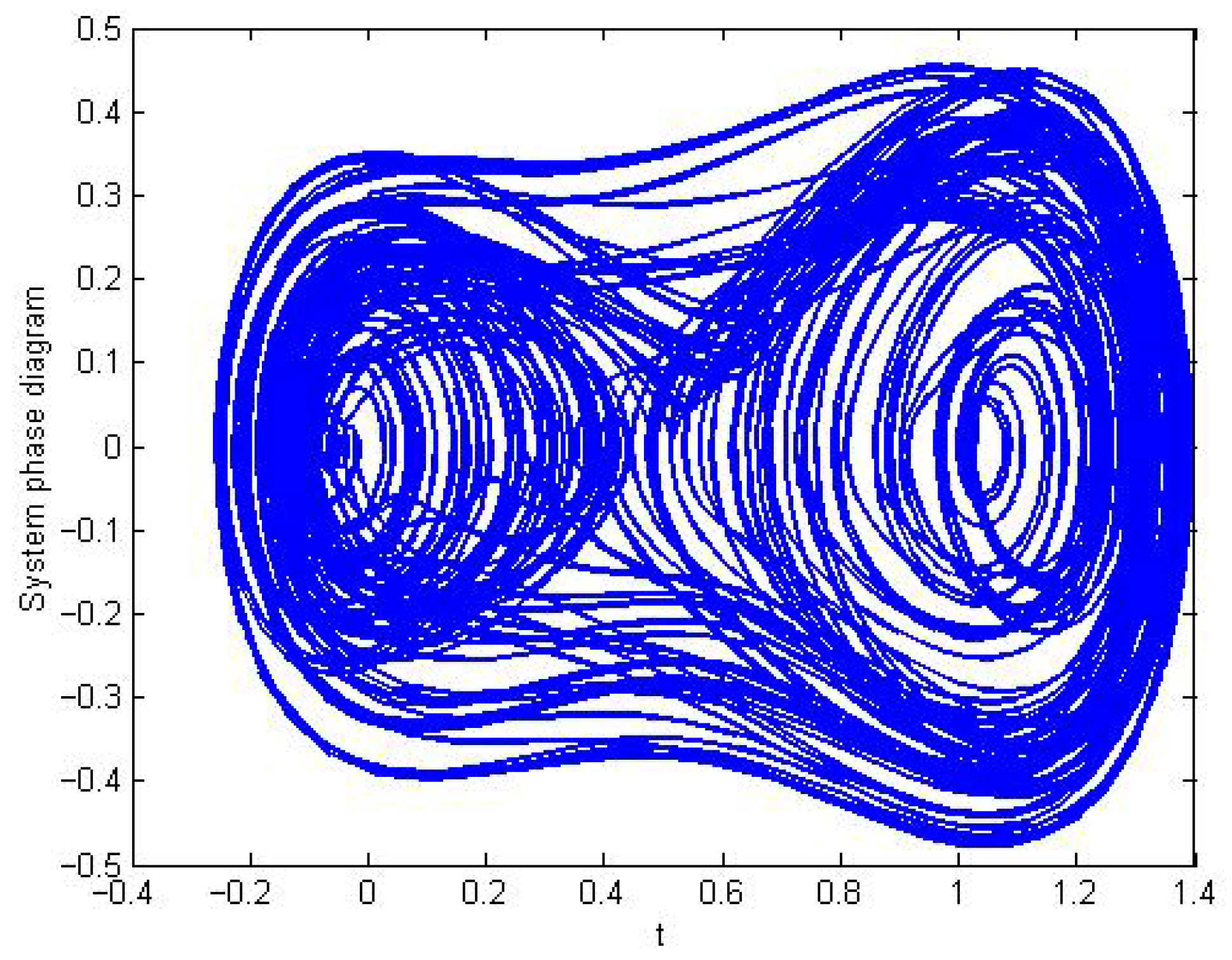
, the system exhibits a chaotic state, as shown in
Figure 1, and the two-variable operating curves are shown in
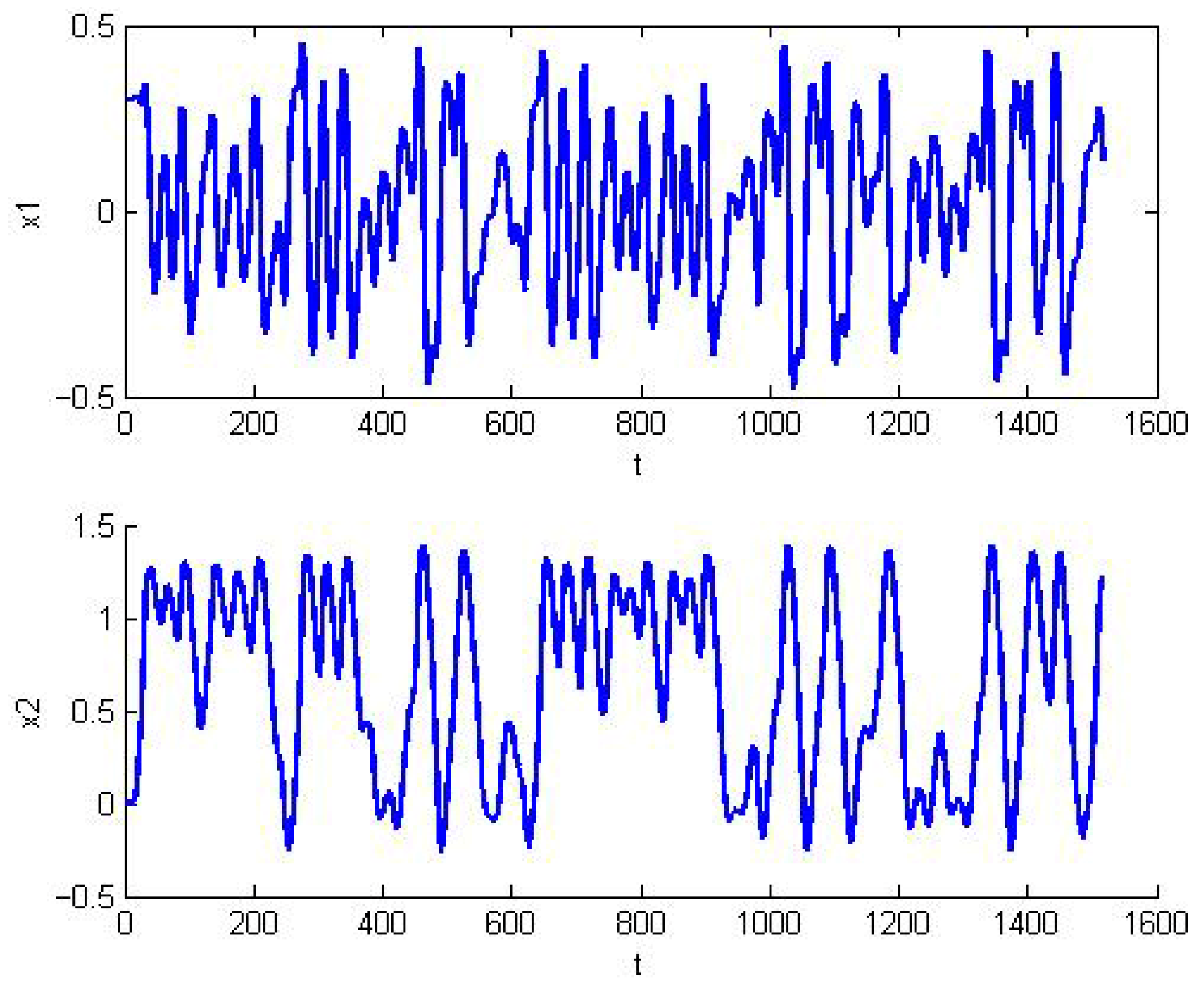
Figure 2.
Figure 1 indicates that the system exhibits chaotic behavior in the absence of control.
Figure 2 shows large fluctuations in the two variables, with significant oscillations present in the uncontrolled system. The system fails to maintain stability, possibly due to external disturbances. Throughout the observed duration, the state variables do not converge and continue to fluctuate. The Type-2 adaptive backstepping fuzzy control design process is specified as follows:
Step 1: Define the Type-2 affiliation function:
The fuzzy basis function is
Step 2: We assume that the following language rules exist for the unknown functions 1, 2, respectively:
The fuzzy rule for the unknown function 1 is as follows:
The fuzzy rule for the unknown function 2 is as follows:
Step 3: Design parameters are specified as follows:
The first intermediate controller is designed as follows:
The first intermediate adaptive law is designed as follows:
The second intermediate controller is designed as follows:
The second intermediate adaptive law is designed as follows:
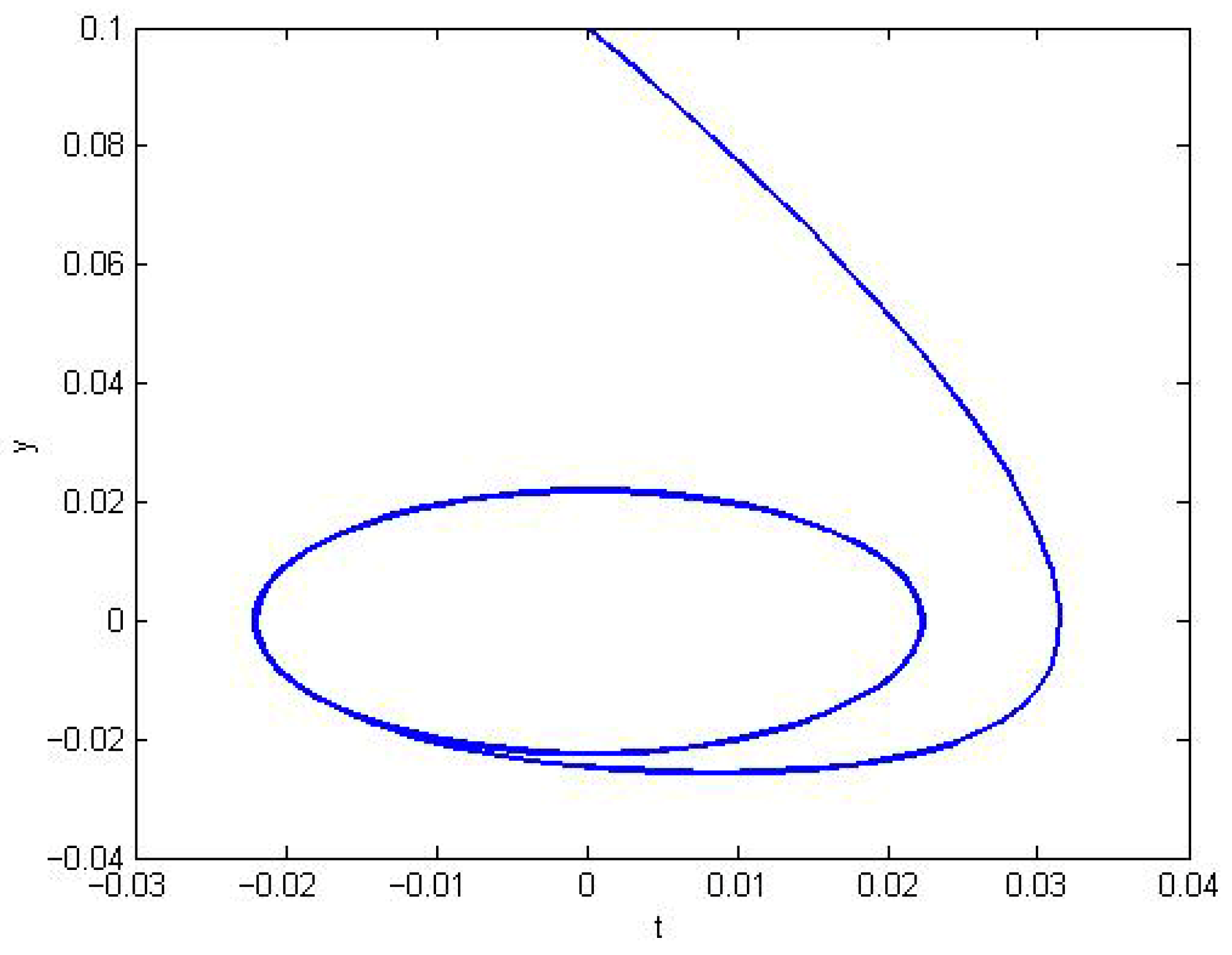
It can be seen from
Figure 3 that after the system incorporates the Type-2 adaptive backstepping fuzzy controller, it undergoes a fundamental transformation, rapidly changing from a chaotic state to a stable and convergent state. The control method effectively suppresses chaotic oscillations.
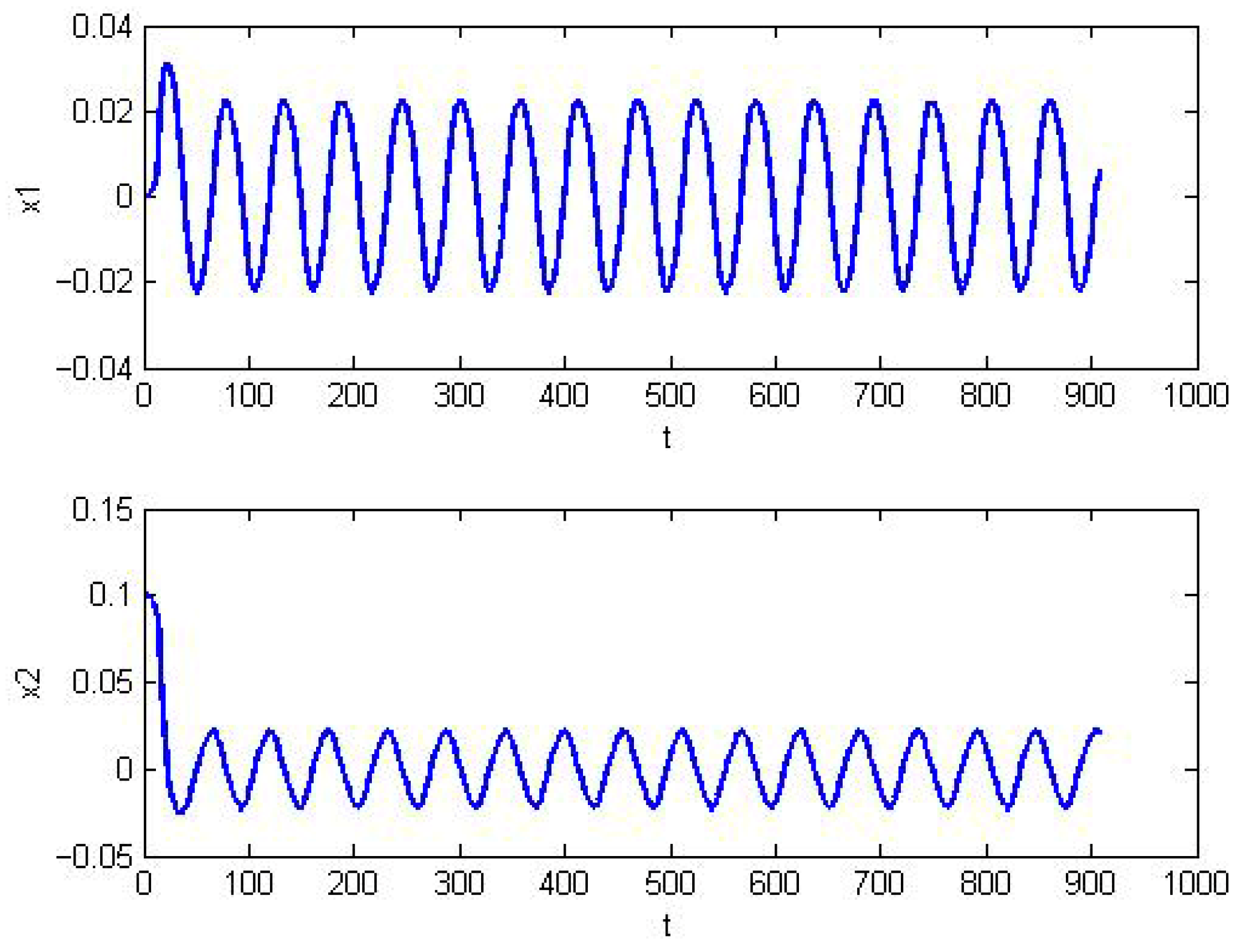
Figure 4 shows that the state variables quickly converge to near zero, which proves the excellent convergence and robustness of the controller.
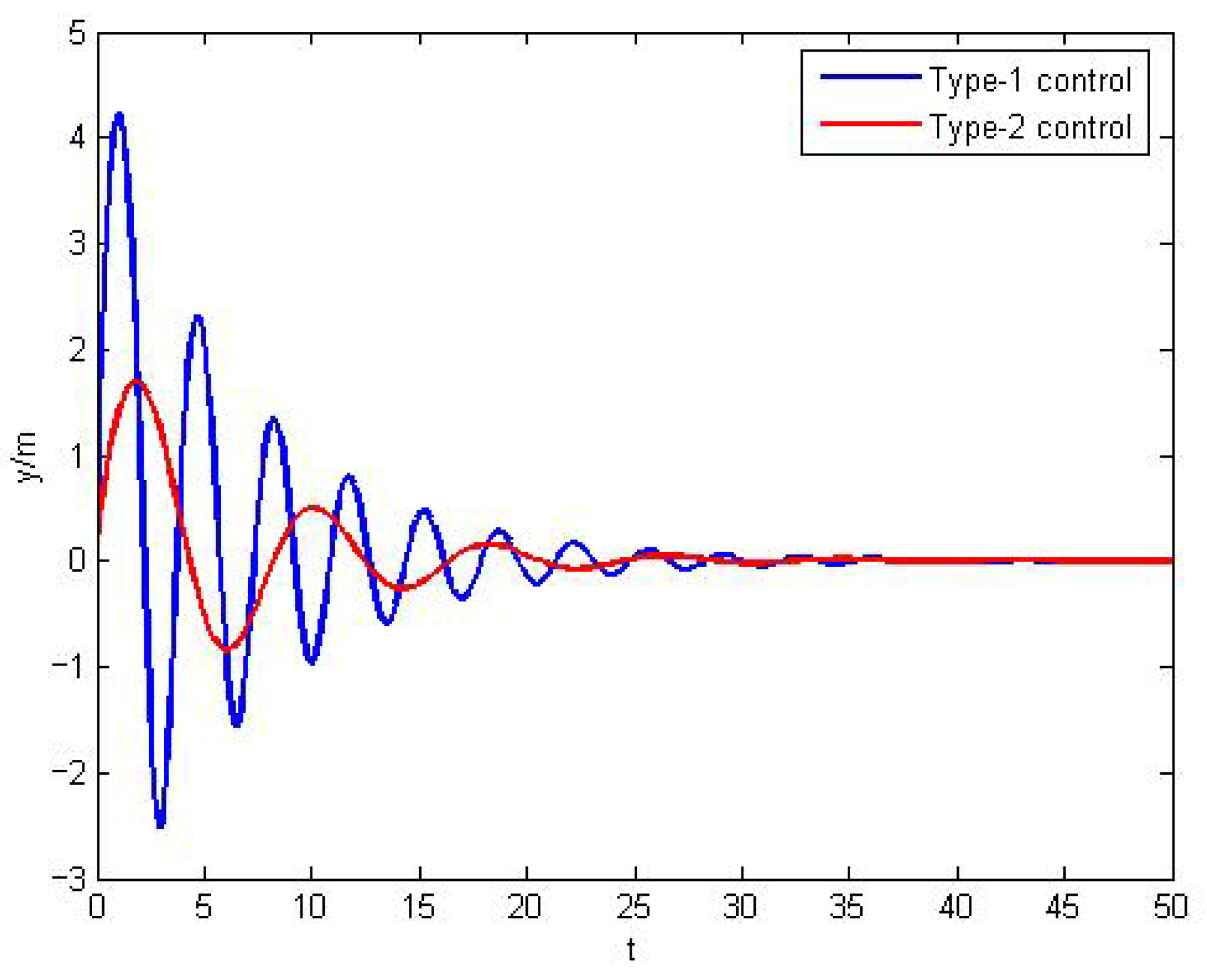
Figure 5 presents a comparative analysis of the control performance between the Type-2 and Type-1 adaptive backstepping controllers. The analysis shows the following: 1. Compared with the Type-1 controller, the Type-2 controller exhibits superior convergence performance. Its response curve can approach and stabilize near the target value more quickly. Quantitative analysis indicates that its convergence time is approximately 13.3% shorter than that of the Type-1 controller, demonstrating better convergence speed. 2. In terms of oscillation suppression and steady-state maintenance, the Type-2 controller performs significantly better, with a smaller fluctuation amplitude and smoother control effect. The dynamic error (peak–valley deviation) is reduced by about 40% compared with the Type-1 controller. Overall, the Type-2 adaptive backstepping control strategy demonstrates stronger robustness and a better control effect than the Type-1 strategy in handling system uncertainties. The quantitative data of the above qualitative analysis have been organized in
Table A1.
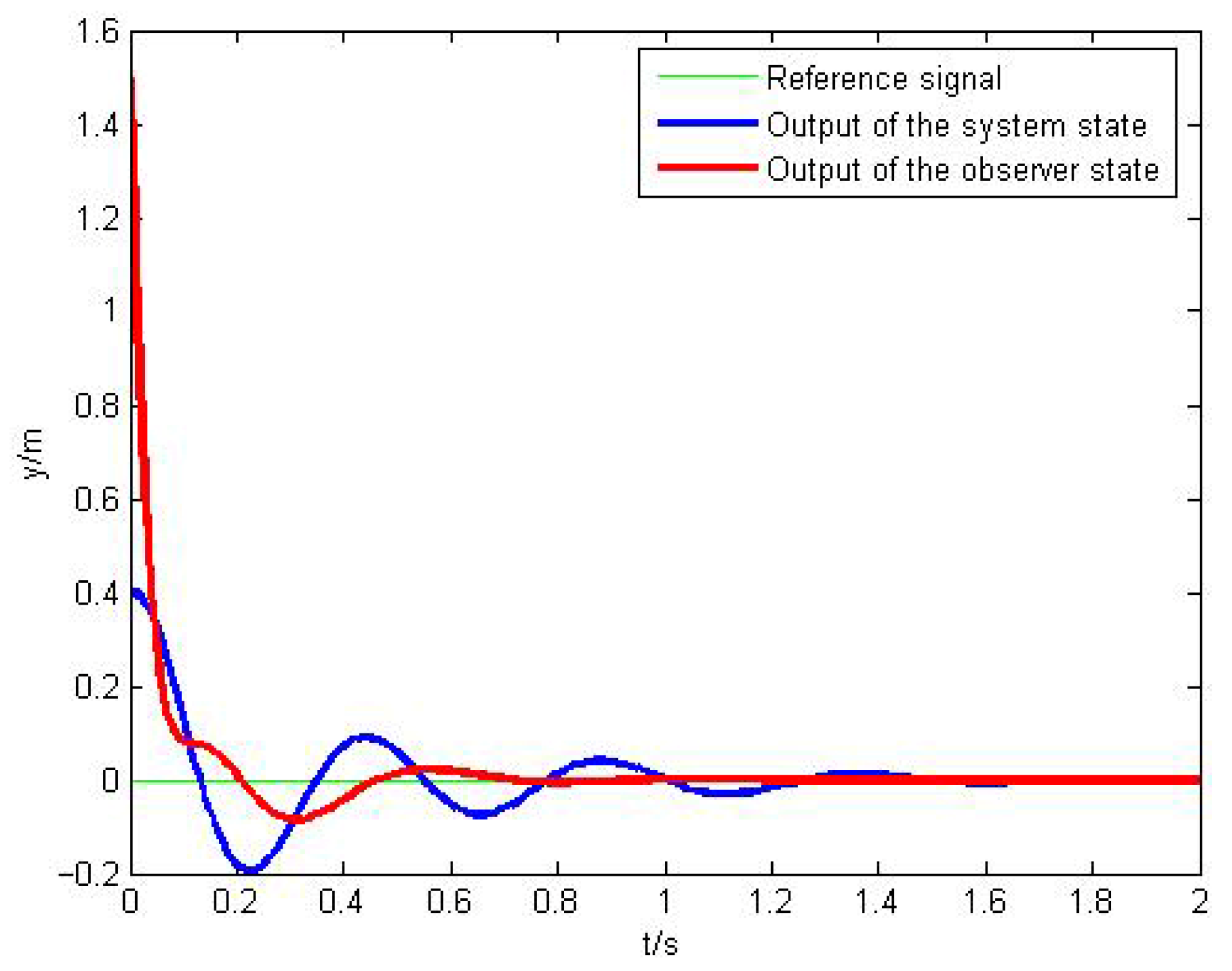
Figure 6 shows that the controller and adaptive law designed based on Lyapunov stability theory can indeed ensure the global stability of the entire closed-loop system, and all signals are uniformly ultimately bounded.
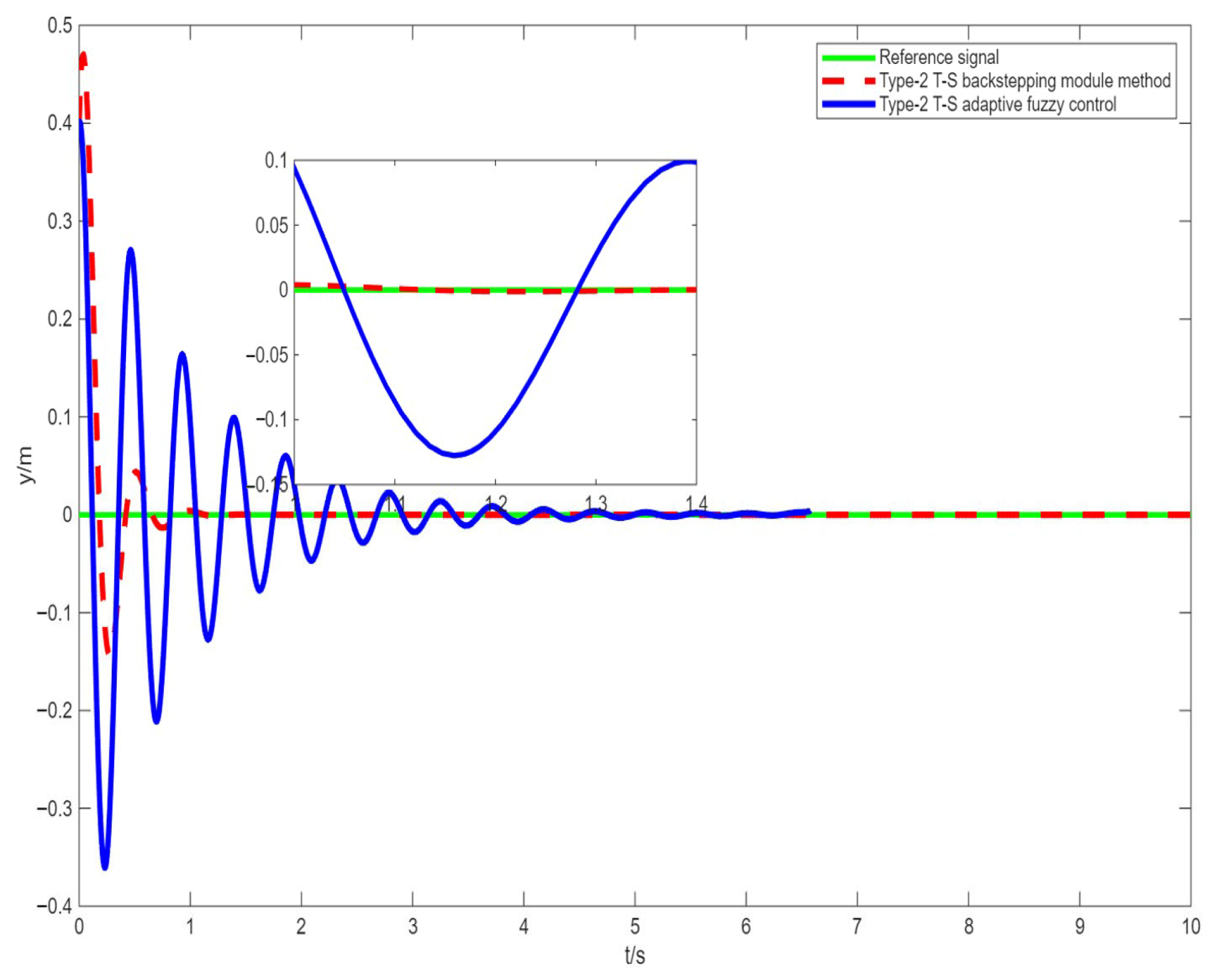
To further verify the effectiveness of the Type-2 T-S backstepping control method, an analytical comparison was conducted between the Type-2 T-S backstepping control and the Type-2 T-S adaptive fuzzy control, as shown in
Figure 7. Among them, the green solid line represents the reference signal, the red dashed line represents the Type-2 T-S backstepping control, and the blue solid line represents the Type-2 T-S adaptive fuzzy control. It can be seen from
Figure 7 that the Type-2 T-S backstepping control method can track the reference signal quickly and stably, approaching the reference signal and maintaining stability within a short period of time. In contrast, the Type-2 T-S adaptive fuzzy control exhibits large fluctuations in the initial stage, and it takes a long time to adjust before gradually stabilizing, with a large fluctuation range during the adjustment process.
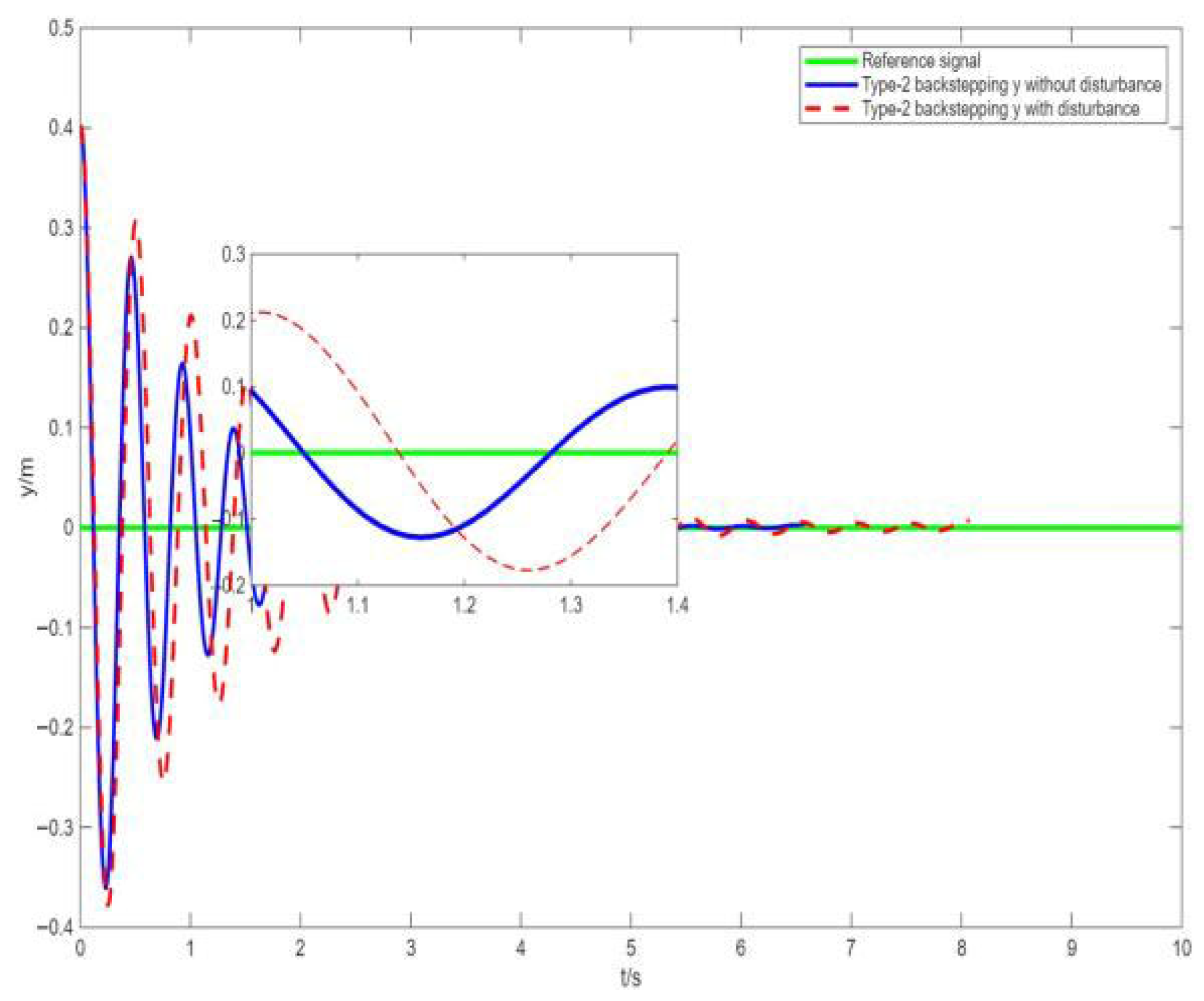
Figure 8 shows the variation in the system output over time under Type-2 backstepping control with and without interference. The blue line represents the system output based on Type-2 backstepping control in the absence of interference: there is oscillation in the initial stage, but the oscillation amplitude is relatively small, and the system output can quickly approach the reference signal. The red dashed line represents the system output under Type-2 backstepping control in the presence of interference; although the oscillation amplitude increases in the initial stage, it gradually approaches the reference signal afterward, indicating that this control method can still function effectively even when interference exists.
5. Conclusions
This study has addressed the challenge of controlling higher-order niche systems, which are characterized by complex nonlinearities and significant parametric uncertainties. To this end, a novel bio-inspired intelligent control strategy was developed by synergistically integrating interval Type-2 T-S fuzzy logic with the backstepping control framework. The key innovation lies in adopting the niche state-potential function as the consequent of the fuzzy rules, thereby directly embedding the ecological principle of “self-beneficial development” into the controller’s core. The global stability of the closed-loop system was rigorously guaranteed via Lyapunov theory, with corresponding adaptive laws derived for the controller parameters.
Comprehensive simulation results on a chaotic system model convincingly demonstrate the superiority of the proposed method. (1) In a comparative analysis, the Type-2 backstepping controller achieved a 13.3% reduction in convergence time and a 40% decrease in dynamic error compared to its Type-1 counterpart, confirming its enhanced performance in convergence speed and steady-state maintenance. (2) Furthermore, when compared to a standard Type-2 T-S adaptive fuzzy controller, the proposed method exhibited significantly better reference signal tracking accuracy and robustness against disturbances. These performance metrics not only validate the control efficacy but also reflect the adaptive and self-optimizing capabilities of biological systems that the method aims to emulate.
While the proposed method entails higher computational complexity than conventional approaches, its significant performance gains in precision and stability make it highly suitable for applications where these factors are critical, such as in ecological system management and other complex nonlinear systems.
In summary, this research contributes both a theoretically sound and practically effective solution for complex system control and provides valuable insights into bio-inspired intelligent design. Future work will focus on streamlining the computational algorithms for real-time implementation and exploring its potential in burgeoning fields like medical robotics and smart energy microgrids.