Article

A Novel Framework for Mental Illness Detection Leveraging TOPSIS-ModCHI-Based Feature-Driven Randomized Neural Networks


by
Santosh Kumar Behera
and
Rajashree Dash
*
Department of Computer Science and Engineering, Siksha O Anusandhan University, Bhubaneswar 751030, Odisha, India
*
Author to whom correspondence should be addressed.
Math. Comput. Appl. 2025, 30(4), 67; https://doi.org/10.3390/mca30040067
Submission received: 10 May 2025 / Revised: 28 June 2025 / Accepted: 28 June 2025 / Published: 30 June 2025

Abstract

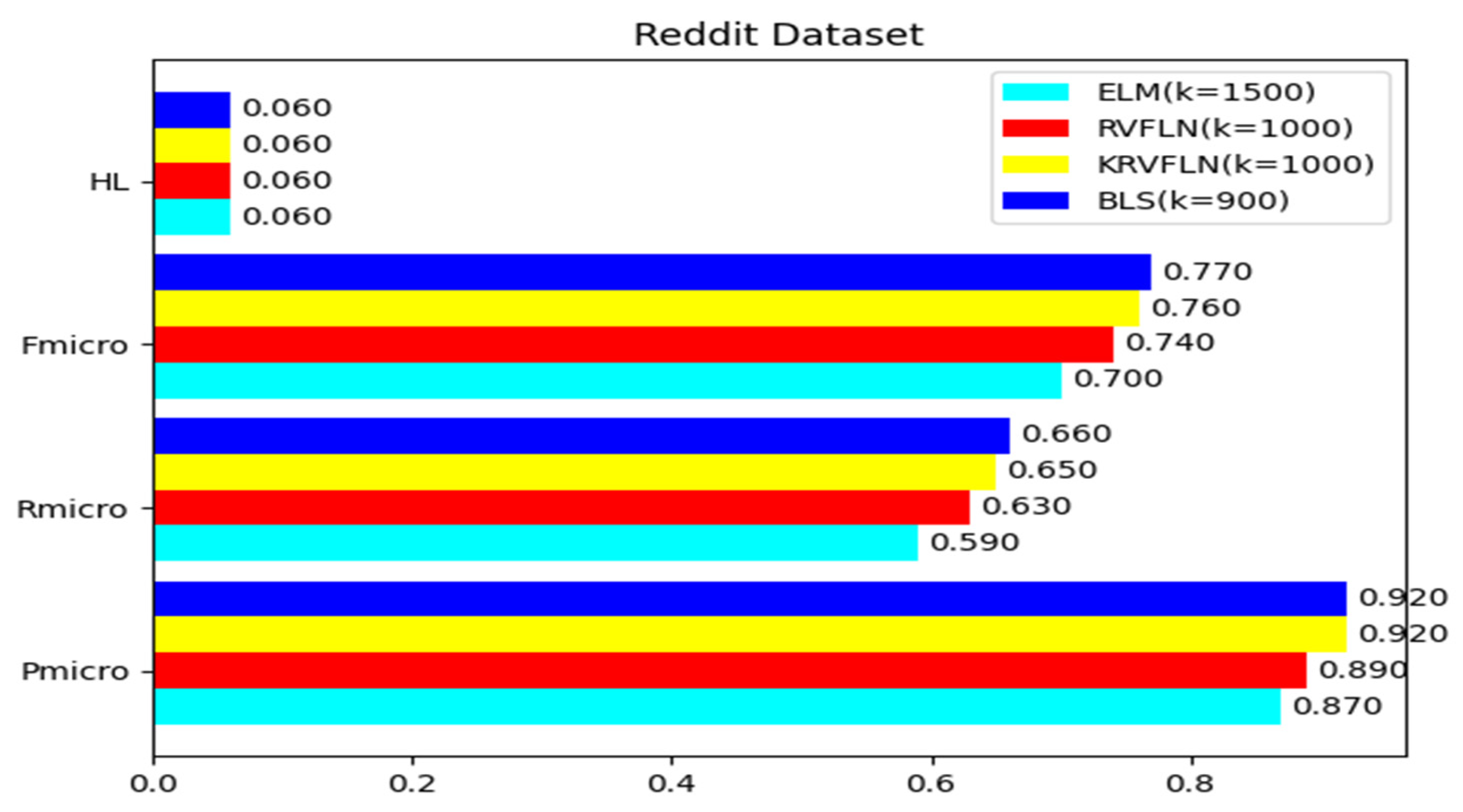
Mental illness has emerged as a significant global health crisis, inflicting immense suffering and causing a notable decrease in productivity. Identifying mental health disorders at an early stage allows healthcare professionals to implement more targeted and impactful interventions, leading to a significant improvement in the overall well-being of the patient. Recent advances in Artificial Intelligence (AI) have opened new avenues for analyzing medical records and behavioral data of patients to assist mental health professionals in their decision-making processes. In this study performance of four Randomized Neural Networks (RandNNs) such as Board Learning System (BLS), Random Vector Functional Link Network (RVFLN), Kernelized RVFLN (KRVFLN), and Extreme Learning Machine (ELM) are explored for detecting the type of mental illness a user may have by analyzing the random text of the user posted on social media. To improve the performance of the RandNNs during handling the text documents with unbalanced class distributions, a hybrid feature selection (FS) technique named as TOPSIS-ModCHI is suggested in the preprocessing stage of the classification framework. The effectiveness of the suggested FS with all the four randomized networks is assessed over the publicly available Reddit Mental Health Dataset after experimenting on two benchmark multiclass unbalanced datasets. From the experimental results, it is inferred that detecting the mental illness using BLS with TOPSIS-ModCHI produces the highest precision value of 0.92, recall value of 0.66, f-measure value of 0.77, and Hamming loss value of 0.06 as compared to ELM, RVFLN, and KRVFLN with a minimum feature size of 900. Overall, utilizing BLS for mental health analysis can offer a promising avenue toward improved interventions and a better understanding of mental health issues, aiding in decision-making processes.
Keywords: mental illness; text classification; randomized neural network; feature selection mental illness; text classification; randomized neural network; feature selection