


Abstract
The main intention of this article is to examine the heat transmission of the flow of Eyring–Powell fluid over an unstable oscillatory porous stretching surface. The effect of thermal radiation on the fluid flow is investigated, where the flow is actuated by the unbounded flexible surface which is extended occasionally to and fro on its plane. The rudimentary leading equations are changed to differential equations through the use of applicable similarity variables. An optimal and numerical approach was used to find the solution to the modeled problems. The convergence of the homotopy analysis method (HAM) is shown numerically. The homotopy analysis method predictions of the structures formed are in close agreement with the obtained results from the numerical method. Comparisons between HAM and numerical methods are shown graphically as well as numerically. The convergence of this method is shown numerically. The impacts of the skin friction and heat flux are shown through a table. The influence of the porosity, oscillation, thermal radiation, and heat absorption/generation are the main focus of this work. The consequences of emerging parameters are demonstrated through graphs.
1. Introduction
Boundary layer fluid flow problems in different dimensions through a stretching sheet with heat transfer and magnetohydrodynamic effects have plentiful and inclusive applications in several engineering and industrial sectors. They include glass blowing melt spinning, heat exchanger design, fiber and wire coating, production of glass fibers, industrialization of rubber and plastic sheets, etc. In addition, the action of thermal radiation is vital to calculating heat transmission in the polymer treating industry. In investigations of all these applications, many investigators deliberate the flow of different fluid models over a stretching sheet. Sakiadis [1] studied boundary layer flow over a flat surface. Crane [2] obtained the closed-form solution for the flow instigated by the stretching of a flexible parallel sheet moving periodically. Gupta and Gupta [3] extended this work by considering suction/blowing at the surface of the sheet. The dissemination of chemically reactive species over a moving continuous sheet was studied by Anderson et al. [4]. Pop [5] studied time-dependent flow over a stretched surface. The impact of heat transmission on second-grade fluid over a stretching sheet was explored by Cortell et al. [6]. Areal [7] studied an asymmetric viscoelastic fluid flow past a stretching sheet for different purposes in the fluid field. Rashdi et al. [8,9] studied entropy generation in magneto hydrodynamic Eyring–Powell field and Carreau nanofluid through a permeable stretching surface. Hayat et al. [10,11,12,13] studied boundary layer flow using different phenomena.
There are no solitary constitutive equations for non-Newtonian fluid that clarify all the distinctive aspects of compound rheological fluids. The Eyring–Powell model [14], an important subclass of these, models from the kinetic theory of liquids instead of experimental relations. Recently, Prasad [15] studied heat transfer and momentum in Eyring–Powell fluid over a nonisothermal stretching sheet. Noreen et al. [16] examined the peristaltic flow of magnetohydrodynamic Eyring–Powell fluid in a channel. Ellahi [17] recently completed a numerical study of the magnetohydrodynamic generalized Couette flow of Eyring–Powell fluid with heat transfer and the slip condition. Ellahi et al. [18] examined the shape effects of spherical and nonspherical nanoparticles in mixed convection flow over a vertical stretching permeable sheet. Other related studies concerning Eyring–Powell fluid can be seen in [19,20,21,22,23,24,25].
Thermal radiation is the procedure in which energy is released in the form of electromagnetic radiation by a surface in all directions. Thermal radiation has numerous uses in the areas of engineering and heat transfer analysis. In the case of conduction and convection, energy transmission amongst objects depends almost entirely on the temperature. For natural free convection, or when variable property effects are included, the power of the temperature difference may be slightly larger than one, and can reach two. Tawade et al. [26] investigated a thin liquid flow through a stretching surface with the influence of thermal radiation and a magnetic field. A brief discussion was given on physical parameters in his work. Ellahi et al. [27] examined the boundary layer magnetic flow of nano-ferroliquid under the influence of low oscillation over a stretchable rotating disk. Zeeshan et al. [28] studied the effect of a magnetic dipole on viscous ferrofluid past a stretching surface with thermal radiation. The Hall effect on Falkner–Skan boundary layer fluid flow over a stretching sheet was examined by Maqbool et al. [29]. The enhancement of heat transfer and heat exchange effectiveness in a double-pipe heat exchanger filled with porous media was examined by Shirvan et al. [30]. Ramesh et al. [31] studied the Casson fluid flow near the stagnation point over a stretching sheet with variable thickness and radiation. Other related studies concerning stretching sheets can be seen in [32,33,34]. Bakier and Moradi et al. [35,36] studied the influence of thermal radiation on assorted convective flow on an upright surface in a permeable medium. Chaudhary et al. [37] investigated the thermal radiation effects of fluid on an exponentially extending surface.
The aim of the current research is to investigate the heat transmission of Eyring–Powell fluid over an unsteady oscillatory porous stretching surface. The homotopy analysis method (HAM) was used in the present work for the solution of modelled equations that are nonlinear and coupled. The homotopy analysis method is a substitute method and its main advantage is in its application to nonlinear differential equations without discretization and linearization. In 1992, Liao [38,39,40] was the first to investigate this technique for the solution of this type of problem and generally proved that this method is rapidly convergent to the approximated solutions. Solutions using this technique are significant because they involve all the physical parameters of the problem and we can easily discuss their behavior. Due to its fast convergence, many researchers [41,42,43,44] have used this procedure to solve highly nonlinear combined equations. The effects of all the embedding parameters have been studied graphically. Khan et al. [45] studied the flow and heat transfer of Eyring–Powell fluid over an oscillatory stretching sheet with thermal radiation. Shah et al. [46,47] studied the effects of a Hall current on three-dimensional non-Newtonian nanofluids and micropolar nanofluids in a rotating frame. Hameed et al. [48] investigated the combined magnetohydrodynamic and electric field effect on an unsteady Maxwell nanofluid flow over a stretching surface under the influence of variable heat and thermal radiation. Recently Muhammad et al. [49] studied the rotating flow of magneto hydrodynamic carbon nanotubes over a stretching sheet with the impact of non-linear thermal radiation and heat generation/absorption.
2. Formulation of the Problem
Consider a two-dimensional incompressible boundary layer flow of Eyring–Powell fluid over an oscillating stretched sheet concurring with plane (Figure 1). In the Cartesian coordinate system, is beside the sheet and is vertical to the sheet. The fluid flow is assumed to be in an unsteady state and the stretching sheet is kept porous. Let denote the surface temperature and denote the temperature of the fluid as the distance from the surface tends to infinity. It is assumed that . The Cauchy stress tensor for Eyring–Powel fluid [15,16,17,18,19,20,21,22,23,24,25] is
where for the Eyring–Powel fluid is
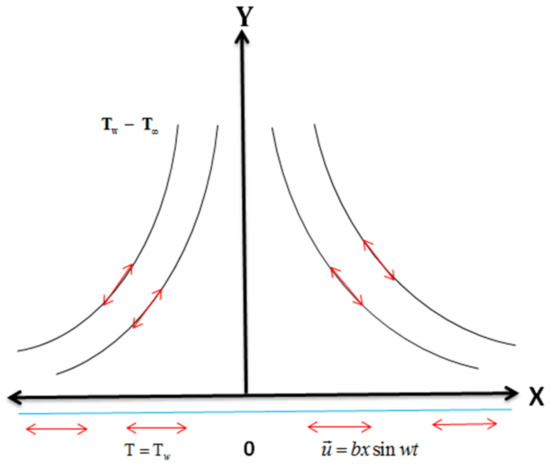
Figure 1.
Geometrical figure of the problem.
Here, and c denote the Eyring–Powel fluid constants. We expand the term as below:
Using the boundary layer approximations, the continuity, energy equations and momentum are as:
The terms and represent the velocity component in the directions of and , respectively; indicates the kinematic viscosity; the symbol denotes the density; and are the fluid materials; indicates the specific heat; is the heat source/sink; signifies thermal conductivity; and is the radiative heat flux is defined as
where denotes the Stefan–Boltzmann constant and is the absorption coefficient.
Expanding Equation (7) by Taylor series, we obtain
By neglecting the higher terms from Equation (8), we get
In observation of Equations (7) and (8), Equation (6) becomes
The subjected boundary condition for the flow phenomena [45] is
where the dimensionless variables are given as
In observation of the dimensionless variables defined above, Equations (5) and (10) reduce to
with the boundary conditions
In the above equations, and are dimensionless material fluid parameters, indicates the porosity, represents the ratio of the oscillation frequency, represents the heat source/sink, denotes the Prandtl number, and is the radiation parameter. According to Javed et al. [27], Equation (15) is subject to the constraint .
Physical Quantities of Interest
The physical quantities for interest to engineers, such as skin friction and the local Nusselt number , are defined as
In observation of Equation (12), Equation (16) takes the following forms:
3. Solution by HAM
Liao was the first person who used the basic idea of a topology called homotopy and derived a new method known as the homotopy analysis method. He used two homotopic functions to derive this technique. Two functions are called homotopic functions when one of them can be continuously distorted into the other. Let be two functions that are continuous and be two topological spaces where and map from to ; then is said to be homotopic to if there is a continuous function ,
such that, ,
This mapping is then called homotopic.
In order to solve Equations (13) and (14) with the boundary Condition (15), we use the HAM according to the following process. The preliminary guesses are
The linear operators are taken as
These operators have the following properties:
where are constants.
The nonlinear operators and are specified as
The zero-order problems from Equations (13) and (14) are
The equivalent boundary conditions are
where is the embedding parameter. When and we have
Expanding and by Taylor series,
where
Setting in (29), we obtain
The th-order problem satisfies the following:
with the conditions
Here,
where
4. HAM Solution Convergence
When we compute the series solutions of the velocity and temperature functions in order to use HAM, the assisting parameters appear. These assisting parameters are responsible for adjusting the convergence of these solutions. The -curves of and , at 12th-order approximations are plotted in Figure 2 and Figure 3 for dissimilar values of the embedding parameter. The -curves consecutively display the valid region.
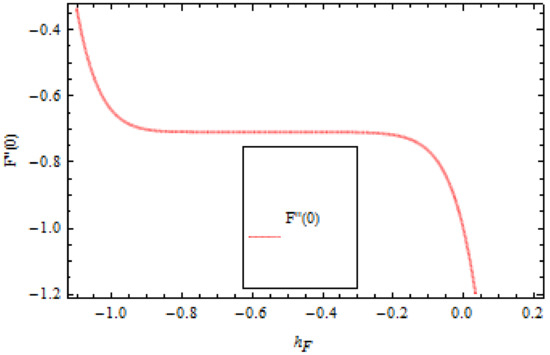
Figure 2.
The -curve graph of velocity profile, when .
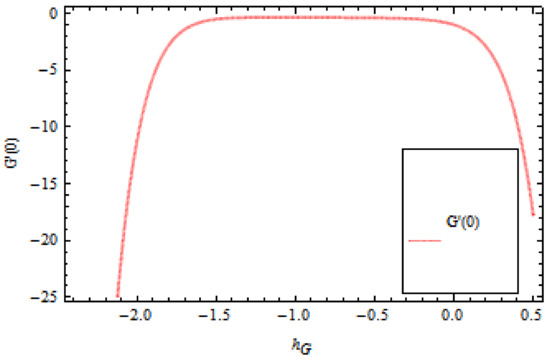
Figure 3.
The -curve graph of temperature profile, when .
5. Results and Discussion
In this section, we present the special effects of the concerned parameters graphically. In all the graphs, the values of and are chosen such that the product should be much smaller than one. Figure 4 shows the effect of the rate of the relative amplitude of frequency and the stretching rate on the time series of the velocity distribution. It is observed that the amplitude of the flow motion falls with large values of Figure 5 demonstrates the effect of on the temperature profile. It is observed that the temperature profile decreases as increases. Actually, the amplitude of oscillation rises for large values of which, in turn, decreases the temperature. The influence of the Prandtl number () on the temperature distribution is shown in Figure 6. The temperature distribution varies inversely with It is clear that the temperature distribution decreases for a large and increases for small values of . Physically, the fluids with a small have larger thermal diffusivity, and this effect is opposite for a higher Prandtl number. Due to this fact, a large causes the thermal boundary layer to decrease. The effect is even more distinct for a small , since the thermal boundary layer thickness is relatively large. The impact of the thermal radiation parameter is presented in Figure 7. Thermal radiation has a dominating role in the comprehensive surface heat transmission, when the coefficient of convection heat transmission is small. When we increase the thermal radiation parameter we see that it augments the temperature in the boundary layer area in the fluid layer. Figure 8 represents the influence of on the velocity profile. It is noted that the increasing value of increases the velocity of the fluid during oscillation. The features of the porosity parameter on the velocity field are shown in Figure 9, and have an imperative character in terms of the flow motion. The higher values of increase the porous space; this produces resistance in the flow path and reduces the flow motion. In fact, growing values of show a large number of porous spaces, which create resistance in the flow path and reduce overall fluid motion. Figure 10 shows the influence of the dimensionless fluid parameter on the velocity profile. Large values of speed up the flow motion and increase its oscillation. Figure 11 presents the influence of the heat source/sink on the temperature profile. It is obvious from the figure that increases in the value enhance the temperature profile of the flow. This occurs due to the fact that the different values of perform like a heat generator, releasing heat energy to the flow. This helps to develop the thermal boundary layer thickness. Figure 12 and Figure 13 show the effect of different values of on the velocity and temperature profiles. Greater values of increase the temperature and velocity profiles.
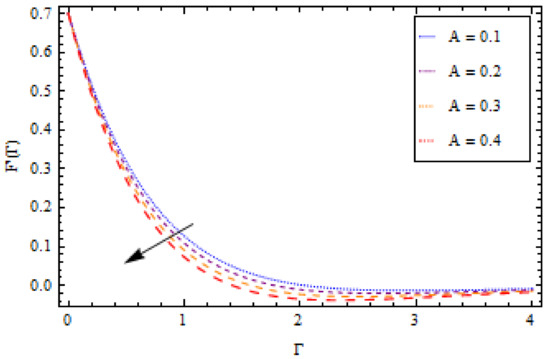
Figure 4.
Impact of on velocity profile when .
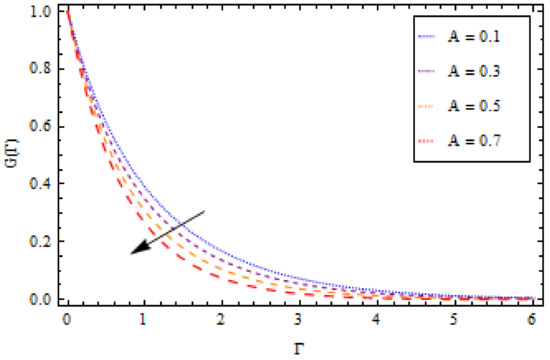
Figure 5.
Impact of on temperature profile , when .
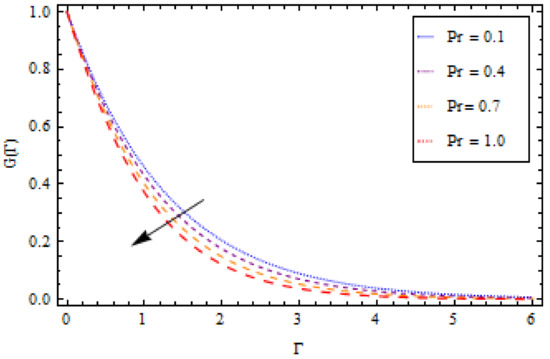
Figure 6.
Impact of on temperature profile , when .
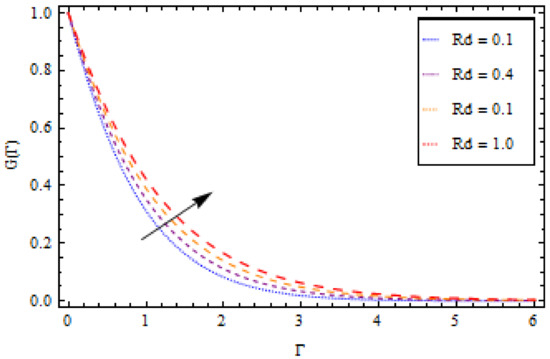
Figure 7.
Impact of on temperature profile , when .
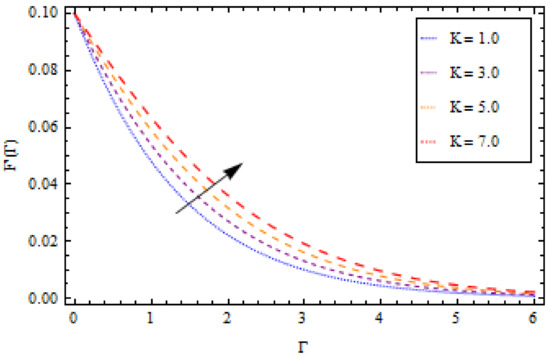
Figure 8.
Impact of on velocity profile , when .
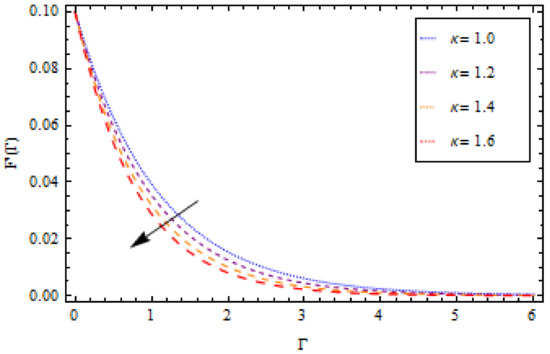
Figure 9.
Impact of on velocity profile , when .
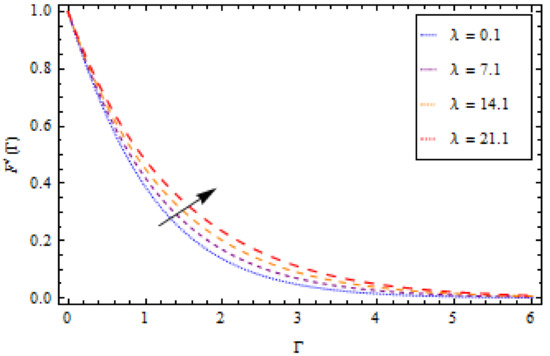
Figure 10.
Impact of on velocity profile when .
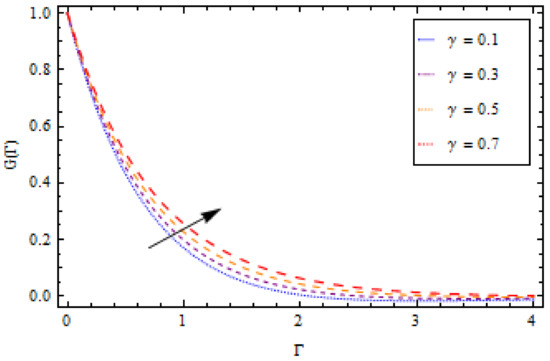
Figure 11.
Impact of on temperature profile , when .
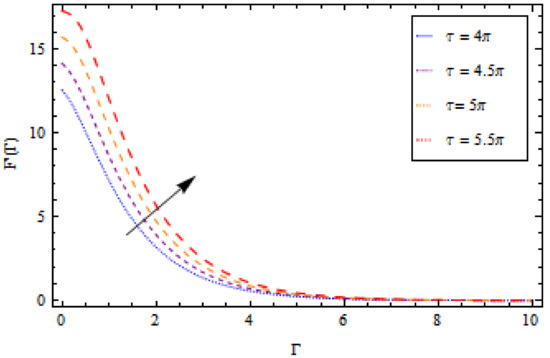
Figure 12.
Impact of on velocity profile , when .
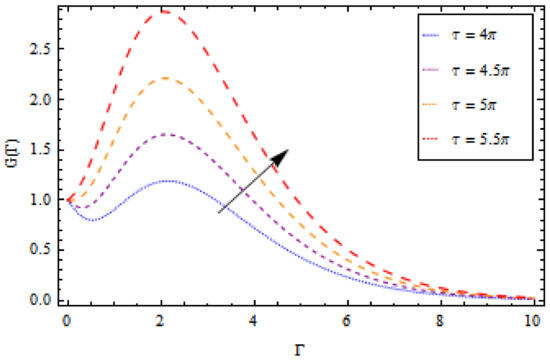
Figure 13.
Impact of on temperature profile , when .
Figure 14 and Figure 15 show the comparison between HAM and numerical solutions using the ND-solve technique on velocity and temperature profiles, respectively. An excellent agreement was found between the homotopy analysis method and the ND-solve technique.
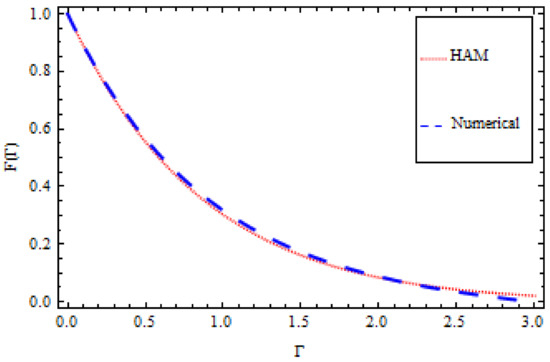
Figure 14.
HAM and numerical comparison for velocity profile .
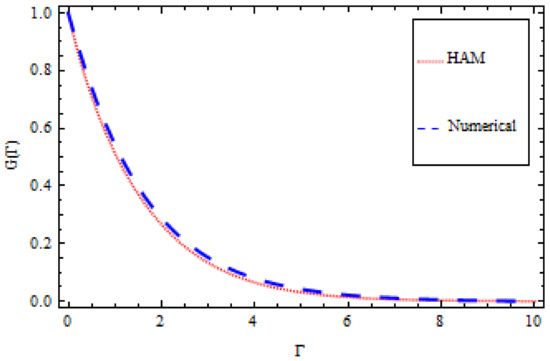
Figure 15.
HAM and numerical comparison for temperature profile .
Table Discussion
The physical quantities such as the skin friction coefficient and heat flux , which are of engineering interest, are calculated through Table 1 and Table 2. The impact of on the skin friction coefficient is shown in Table 1. It is observed that higher values of and reduce the coefficient. The impact of on heat flux is shown in Table 2. It is observed that higher values of decrease the heat flux, while higher values of increase the heat flux. The comparison of HAM and the numerical solution and the absolute error are provided in Table 3 and Table 4. Table 3 shows the comparison of HAM and the numerical solution for the velocity profile, while Table 4 shows the comparison of HAM and the numerical solution for the temperature profile.

Table 1.
The numerical values of skin fraction when at time instant .
Table 2.
The numerical values of heat flux when at time instant .
Table 3.
The association between HAM and numerical solution for when .
Table 4.
The association between HAM and numerical solution for , when .
6. Conclusions
In this article, we analyzed an Eyring–Powell fluid over an oscillatory thermally conductive stretching sheet in the presence of thermal radiation and a heat source/sink. A coordinate transformation was used to transform the semi-infinite flow domain to a finite computational domain. The homotopy analysis method was used to solve the modeled problem. The main remarks from this study are as follows:
- The amplitude of the velocity decreased with an increase in and porosity , while it increased with an increase in the dimensionless fluid parameters and
- The temperature increased with an increase in , the radiation parameter , and the heat source/sink , while it decreased with an increase in the Prandtl number and the ratio of the oscillation frequency of the sheet to its stretching rate .
- The local Nusselt number increased with an increase in the Prandtl number , the heat source/sink , the dimensionless fluid parameter and radiation parameter , while it decreased with an increase in the porosity and the dimensionless fluid parameter .
Author Contributions
Abdullah and Zahir Shah modelled the problem. Waris Khan solved the problem. Abdullah and Muhammad Idrees wrote the manuscript. Zahir Shah and Saeed Islam thoroughly checked the mathematical modeling and English language corrections. Saeed Islam and Taza Gul contributed in the results and discussions. All the corresponding authors finalized the manuscript after its internal evaluation.
Conflicts of Interest
The authors declare no conflict of interest.
Nomenclature
| pressure (Pa) | |
| c | constant |
| X,Y | topological space |
| x,y | coordinates |
| , | velocity components |
| specific heat | |
| , | fluid materials |
| heat source/sink | |
| thermal conductivity () | |
| radiative heat flux | |
| absorption coefficient | |
| fluid parameter | |
| ratio of the oscillation frequency | |
| radiation parameter | |
| Prandtl number | |
| skin fraction coefficient | |
| local Nusselt number | |
| Greek Letters | |
| dynamic viscosity | |
| constant | |
| kinematic viscosity (m2/s) | |
| density (kg/m3) | |
| Stefan–Boltzmann constant | |
| porosity term | |
| heat source/sink | |
References
- Sakiadis, B.C. Boundary Layer Behavior on Continuous Solid Surfaces: II Boundary Layer on a Continuous Flat Surface. AIChE J. 1961, 7, 221–225. [Google Scholar] [CrossRef]
- Crane, L.J. Flow past a stretching plate. Z. Angew. Math. Phys. 1970, 21, 645–647. [Google Scholar] [CrossRef]
- Gupta, P.S.; Gupta, A.S. Heat and mass transfer on stretching sheet with suction or blowing. Can. J. Chem. Eng. 1977, 55, 744–746. [Google Scholar] [CrossRef]
- Anderson, H.I.; Hansen, O.R.; Olmedal, B. Diffusion of chemically reactive species from a stretching sheet. Int. J. Heat Mass Transf. 1994, 37, 659–664. [Google Scholar] [CrossRef]
- Pop, I.; Na, T.Y. Unsteady flow past a stretching sheet. Mech. Res. Commun. 1996, 23, 413–422. [Google Scholar] [CrossRef]
- Cortell, R. A note on flow and heat transfer of viscoelastic fluid over a stretching sheet. Int. J. Non-Lin. Mech. 2006, 41, 78–85. [Google Scholar] [CrossRef]
- Ariel, P.D. Axismmetric flow of a second grade fluid past a stretching sheet. Int. J. Eng. Sci. 2001, 39, 529–553. [Google Scholar] [CrossRef]
- Rashdi, M.M.; Ali, M.E.S.; Yang, Z. Entropy generation on MHD Eyring–Powell nanofluid through a permeable stretching surface. Entropy 2016, 18, 224. [Google Scholar] [CrossRef]
- Rashdi, S.; Esfahani, A.J.; Ellahi, R. Convective heat transfer and particle motion in an obstructed duct with two side-by-side obstacles by means of DPM model. Appl. Sci. 2017, 7, 431. [Google Scholar] [CrossRef]
- Hayat, T.; Abbas, Z.; Sajid, M. Heat and mass transfer analysis on the flow of second grade fluid in the presence of chemical reaction. Phys. Lett. A 2008, 372, 2400–2408. [Google Scholar] [CrossRef]
- Hayat, T.; Sajid, M. Analytic solution for axisymmetric flow and heat transfer flow of a second grade fluid past a stretching sheet. Int. J. Heat Mass Transf. 2007, 50, 75–84. [Google Scholar] [CrossRef]
- Hayat, T.; Asad, S.; Mustafa, M.; Alsaedi, A. Radiation effects on the flow of Powell–Eyring fluid past an unsteady inclined stretching sheet with Non-uniform heat source/sink. PLoS ONE 2014, 9, e103214. [Google Scholar] [CrossRef] [PubMed]
- Hayat, T.; Awais, M.; Asghar, S. Radiative effects in a three-dimensional flow of MHD Eyring–Powell fluid. J. Egypt. Math. Soc. 2013, 21, 379–384. [Google Scholar] [CrossRef]
- Powell, R.E.; Eyring, H. Mechanism for the Relaxation Theory of Viscosity. Nature 1944, 154, 427–428. [Google Scholar] [CrossRef]
- Prasad, K.V.; Datti, P.S.; Raju, B.T. Momentum and Heat Transfer of a Non-Newtonian Eyring–Powell Fluid over a Non-Isothermal Stretching Sheet. Int. J. Math. Arch. 2013, 4, 230–241. [Google Scholar]
- Noreen, S.; Qasim, M. Peristaltic Flow of MHD Eyring–Powell Fluid in a Channel. Eur. Phys. J. Plus 2013, 128, 91–103. [Google Scholar] [CrossRef]
- Ellahi, R. Numerical study of magnetohydrodynamics generalized Couette flow of Eyring–Powell fluid with heat transfer and slip condition. Int. J. Numer. Methods Heat Fluid Flow 2016, 26, 1433–1445. [Google Scholar] [CrossRef]
- Ellahi, R.; Hassan, M.; Zeeshan, A. Shape effects of spherical and nonspherical nanoparticles in mixed convection flow over a vertical stretching permeable sheet. J. Mech. Adv. Mater. Struct. 2017, 24, 1231–1238. [Google Scholar] [CrossRef]
- Mahmoudi, M.A.A.; Ahmad, M.; Megahed, M. Slip flow of Powell–Eyring liquid film due to an unsteady stretching sheet with heat. Braz. J. Phys. 2016, 3, 299–307. [Google Scholar] [CrossRef]
- Zaman, H.; Shah, M.A.; Ibrahim, M. Unsteady incompressible coquette flow problem for the Eyring–Powell Model with porous walls. Am. J. Comput. Math. 2013, 3, 313–325. [Google Scholar] [CrossRef]
- Hayat, T.; Tanveer, A.; Yasmin, H.; Alsaedi, A. Effects of convective conditions and chemical reaction on peristaltic flow of Erying–Powell fluid. Appl. Bionics Biomech. 2014, 11, 221–233. [Google Scholar] [CrossRef]
- Javed, T.; Ali, N.; Abbas, Z.; Sajid, M. Flow of an Eyring–Powell non-Newtonian over a stretching sheet. Chem. Eng. Commun. 2012, 200, 327–336. [Google Scholar] [CrossRef]
- Hayat, T.; Imtiaz, M.; Alsaedi, A. Effects of homogeneous-heterogeneous reactions in flow of Powell–Eyring fluid. J. Cent. South. Univ. Technol. 2015, 22, 3211–3216. [Google Scholar] [CrossRef]
- Khan, N.A.; Sultan, F. On the double diffusive convection flow of Eyring–Powell fluid due to cone through a porous medium with Soret and Dufour effects. AIP ADVANCES 2015, 5, 057140. [Google Scholar] [CrossRef]
- Panigrahi, S.; Reza, M.; Mishra, A.K. Mixed convective flow of a Powell–Eyring fluid over non-linear stretching surface with thermal diffusion and diffusion thermo. Procedia Eng. 2015, 127, 645–651. [Google Scholar] [CrossRef]
- Tawadem, L.M.; Gmetri, P.; Koti, A. Thin film flow and heat transfer over an unsteady stretching sheet with thermal radiation, internal heating in presence of external magnetic field. Int. J. Adv. Appl. Math. Mech. 2016, 3, 29–40. [Google Scholar]
- Ellahi, R.; Tariq, M.H.; Hassan, M.; Vafai, K. On boundary layer magnetic flow of nano-Ferroliquid under the influence of low oscillating over stretchable rotating disk. J. Mol. Liq. 2017, 229, 339–345. [Google Scholar] [CrossRef]
- Zeeshan, A.; Majeed, A.; Ellahi, R. Effect of magnetic dipole on viscous ferro-fluid past a stretching surface with thermal radiation. J. Mol. Liq. 2016, 215, 549–554. [Google Scholar] [CrossRef]
- Maqbool, M.; Sohail, A.; Naeema, M.; Ellahi, R. Hall effect on Falkner-Skan boundary layer flow of FENE-P fluid over a stretching sheet. Commun. Theor. Phys. 2016, 66, 547–554. [Google Scholar] [CrossRef]
- Shirvan, M.K.; Ellahi, R.; Mirzakhanlar, S.; Mamourian, M. Enhancement of Heat Transfer and Heat Exchanger Effectiveness in a Double Pipe Heat Exchanger Filled with Porous Media: Numerical Simulation and Sensitivity Analysis of Turbulent Fluid Flow. Appl. Therm. Eng. 2016, 109, 761–774. [Google Scholar] [CrossRef]
- Ramesh, G.K.; Prasannakumara, B.C.; Gireesha, B.J.; Rashidi, M.M. Casson Fluid Flow near the Stagnation Point over a Stretching Sheet with Variable Thickness and Radiation. J. Appl. Fluid Mech. 2016, 9, 1115–1122. [Google Scholar] [CrossRef]
- Krishnamurthy, M.R.; Gireesha, B.J.; Prasannakumara, B.C.; Gorla, R.S.R. Thermal radiation and chemical reaction effects on boundary layer slip flow and melting heat transfer of nanofluid induced by a nonlinear stretching sheet. Nonlinear Eng. 2016, 5, 147–159. [Google Scholar] [CrossRef]
- Prasannakumara, B.C.; Gireesha, B.J.; Gorla, R.S.R.; Krishnamurthy, M.R. Effect of multiple slips and thermal radiation on MHD flow of Jeffery nanofluid with heat transfer. J. Nanofluids 2016, 5, 82–93. [Google Scholar] [CrossRef]
- Prasannakumara, B.C.; Gireesha, B.J.; Gorla, R.S.R.; Krishnamurthy, M.R. Non-Linear Thermal Radiation and Slip Effect on Boundary Layer Flow and Heat Transfer of Suspended Nanoparticles over a Stretching Sheet Embedded in Porous Medium with Convective Boundary Conditions. J. Nanofluids 2016, 5, 522–530. [Google Scholar]
- Bakier, A.Y. Thermal radiation effect on mixed convection from vertical surface in saturated porous media. Int. Commun. Heat Mass Transf. 2001, 28, 119–126. [Google Scholar] [CrossRef]
- Moradi, A.; Ahmadikia, H.; Hayat, T.; Alsaedi, A. On mixed convection-radiation interaction about an inclined plate through a porous medium. Int. J. Therm. Sci. 2013, 64, 129–136. [Google Scholar] [CrossRef]
- Chaudhary, S.; Singh, S.; Chaudhary, S. Thermal radiation effects on MHD Boundary layer flow over an exponentially stretching surface. Sci. Res. Publ. Appl. Math. 2015, 6, 295–303. [Google Scholar] [CrossRef]
- Liao, S.J. The Proposed Homotopy Analysis Method for the Solution of Nonlinear Problems. Ph.D. Thesis, Shanghai Jiao Tong University, Shanghai, China, 1992. [Google Scholar]
- Liao, S.J. An Explicit, Totally Analytic Approximate Solution for Blasius Viscous Flow Problems. Int. J. Non-Linear Mech. 1999, 34, 759–778. [Google Scholar] [CrossRef]
- Liao, S.J. Beyond Perturbation: Introduction to the Homotopy Analysis Method; Chapman and Hall, CRC: Boca Raton, FL, USA, 2003. [Google Scholar]
- Rashidi, M.M.; Siddiqui, A.M.; Asadi, M. Application of homotopy analysis method to the unsteady squeezing flow of a second grade fluid between circular plates. Math. Probl. Eng. Art. 2010. [Google Scholar] [CrossRef]
- Rashidi, M.M.; Pour, S.A.M. Analytic approximate solutions for unsteady boundary-layer flow and heat transfer due to a stretching sheet by homotopy analysis method. Nonlinear Anal. Model. Control 2010, 15, 83–95. [Google Scholar]
- Abbasbandy, S. Homotopy analysis method for heat radiation, equations. Int. Commun. Heat Mass Transf. 2007, 34, 380–388. [Google Scholar] [CrossRef]
- Nadeem, S.; Awais, M. Thin film flow of an unsteady shrinking sheet through porous medium with variable viscosity. Phys. Lett. A 2008, 372, 4965–4972. [Google Scholar] [CrossRef]
- Khan, S.U.; Ali, N.; Abas, Z. Hydromagnetic Flow and Heat Transfer of Eyring–Powell Fluid over an Oscillatory Stretching Sheet with Thermal Radiation. Appl. Appl. Math. 2015, 10, 893–908. [Google Scholar]
- Shah, Z.; Gul, T.; Khan, A.M.; Ali, I.; Islam, S. Effects of hall current on steady three dimensional non-newtonian nanofluid in a rotating frame with brownian motion and thermophoresis effects. J. Eng. Technol. 2017, 6, 280–296. [Google Scholar]
- Shah, Z.; Islam, S.; Gul, T.; Bonyah, E.; Khan, M.A. The electrical MHD and hall current impact on micropolar nanofluid flow between rotating parallel plates. Results Phys. 2018. [Google Scholar] [CrossRef]
- Hammed, H.; Haneef, M.; Shah, Z.; Islam, S.; Khan, W.; Muhammad, S. The Combined Magneto hydrodynamic and electric field effect on an unsteady Maxwell nanofluid Flow over a Stretching Surface under the Influence of Variable Heat and Thermal Radiation. Appl. Sci. 2018, 8, 160. [Google Scholar] [CrossRef]
- Muhammad, S.; Ali, G.; Shah, Z.; Islam, S.; Hussain, A. The Rotating Flow of Magneto Hydrodynamic Carbon Nanotubes over a Stretching Sheet with the Impact of Non-Linear Thermal Radiation and Heat Generation/Absorption. Appl. Sci. 2018, 8, 482. [Google Scholar] [CrossRef]
© 2018 by the authors. Licensee MDPI, Basel, Switzerland. This article is an open access article distributed under the terms and conditions of the Creative Commons Attribution (CC BY) license (http://creativecommons.org/licenses/by/4.0/).