Clinical aspects of bacterial meningitis
The spectrum of meningeal microorganisms causing bacterial meningitis is mainly dependent on the age of the patient, predisposing factors and underlying diseases. The most common aetiological agents of bacterial meningitis in adults and children are Neisseria meningitidis and Streptococcus pneumoniae. Listeria monocytogenes is seen especially in neonates, the elderly and immunocompromised patients with bacterial meningitis. Gram-negative Enterobacteriaceae cause 10% of the overall cases of bacterial meningitis; however, they are the aetiologic agents in 60 to 70% of all cases of meningitis following a neurosurgical procedure and are a common cause of meningitis in the elderly and adults debilitated by chronic illness. The most common agents causing bacterial meningitis in newborns are group B streptococci (Streptococcus agalactiae).
Bacterial meningitis is clinically characterised by stiff neck, headache, fever, photophobia, malaise, vomiting, alteration of consciousness, seizures, confusion, irritability and, rarely, acute psychosis. Focal neurologic signs (e.g., hemi- or tetraparesis, ataxia, aphasia, visual field defects) are found in approximately 10–15% of the patients. Cranial nerve palsies, usually of the 3rd, 6th, 7th or 8th cranial nerve, are detectable in approximately 10% of the patients. Hearing impairment, most often due to purulent labyrinthitis, is a well-known sequela of acute bacterial meningitis.
Diagnosis of acute bacterial meningitis is based on (a) identification of the bacterial pathogen in the cerebrospinal fluid (CSF), microscopy of a Gram’s stained smear or antigen detection using latex particle agglutination test, and/or (b) elevated CSF cell count of more than 1000 white blood cells/µl and CSF consisting of more than 60% polymorphonuclear leukocytes, an elevated total protein content (>120 mg/dl) and a low CSF glucose concentration (usually a ratio of CSF: blood glucose of less than 0.3).
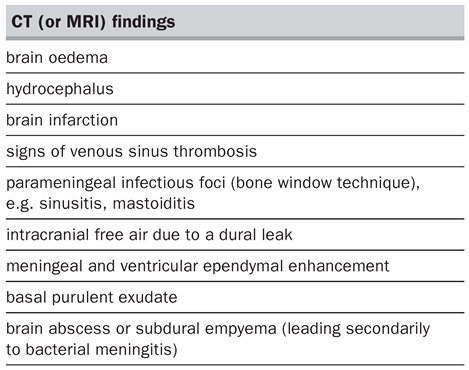
Cranial CT (or MRI) may identify several abnormalities in patients with bacterial meningitis (
Table 1). Cerebrovascular involvement may be detected by MRI (diffusion imaging), MR angiography and transcranial Doppler sonography (TCD). TCD may be useful in diagnosing and monitoring the involvement of great arteries at the base of the brain [
1]. In addition, MRI may reveal septic sinus thrombosis.
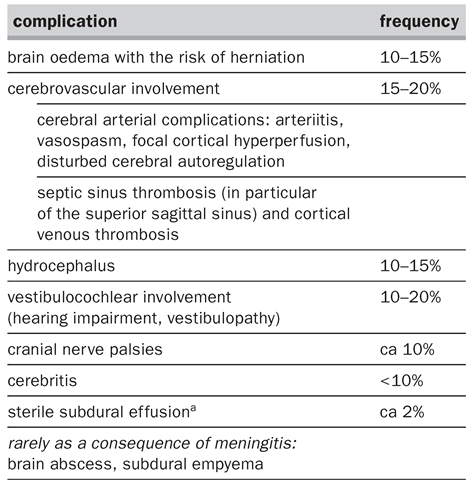
Cerebral and systemic complications arising during the acute phase of the disease are responsible both for the mortality and the long-term sequelae caused by bacterial meningitis (
Table 2) [
2].
Cerebrovascular involvement, both of arteries (arteriitis, vasospasm) and veins (septic sinus venous thrombosis) may lead to infarction with severe irreversible cerebral damage and an increase in intracranial pressure due to cytotoxic oedema [
3]. In addition to oedema, increased intracranial blood volume due to disturbed cerebrovascular autoregulation or septic venous sinus thrombosis may lead to life-threatening elevation of intracranial pressure with the risk of herniation. There is a risk of cortical necrosis when cerebral perfusion pressure (defined as the difference between systemic mean arterial blood pressure and intracranial pressure) decreases as a result of increased intracranial pressure and systemic hypotension. Interstitial oedema may occur due to transependymal movement of CSF from the ventricular system into the surrounding brain parenchyma as a consequence of obstructive hydrocephalus.
Management of an adult patient with bacterial meningitis
In patients with clinical signs and symptoms suggesting acute bacterial meningitis, a lumbar puncture should be performed immediately after the initial clinical examination. After drawing a single blood culture, antibiotic therapy is immediately started (dexamethasone treatment see below). In patients who are unconscious and have focal neurologic deficits (e.g. hemiparesis), a CT scan should be performed prior to lumbar puncture. These patients receive an initial antibiotic dose immediately after drawing a single blood culture, prior to any other diagnostic procedure. Afterwards CT scanning and CSF examination should be performed as soon as possible. Contraindications to lumbar puncture are clinical signs of cerebral herniation (e.g. unconsciousness, a unilaterally dilated and unreactive pupil, decerebrate movements) or a focal mass lesion (e.g. large, spaceoccupying brain abscess) on CT. The presence of a parameningeal infectious focus such as sinusitis or mastoiditis should also be investigated by CT, including the bone window technique (see table 1). In addition, clinical examination by an otolaryngologist should be performed. If a parameningeal focus (e.g. otitis, mastoiditis, sinusitis) is identified as a possible origin of bacterial meningitis, drainage is required as soon as possible. If antibiotic therapy has to be started without microbiologic confirmation, empiric therapy is initiated under consideration of the patient’s age, predisposing factors, underlying diseases and the most probable meningeal pathogens (
Table 3). Importantly, the sensitivity of the causative pathogen against the antibiotic regimen administered must be confirmed by in vitro testing and antibiotic coverage must be adjusted to the sensitivity results.
Patients with clinically suspected meningococcal meningitis (e.g. petechial rash, gram-negative diplococci on Gram’s stained smear of the CSF) have to be isolated for the first 24 hours after initiation of antibiotic therapy.
Treatment of bacterial meningitis due to Streptococcus pneumoniae, H. influenzae, and group B streptococci usually consists of intravenous administration of antibiotics for 10 to 14 days. Some clinical observations have suggested that shorter courses of 7 days may be adequate for uncomplicated meningococcal meningitis. For antibiotic treatment of meningitis due to L. monocytogenes and gram-negative Enterobacteriaceae, a treatment duration of 3 to 4 weeks may be required.
Adjunctive therapy
Recently, a meta-analysis of 11 randomised clinical trials since 1988 using
dexamethasone as adjunctive therapy in bacterial meningitis was performed [
4]. In
Haemophilus influenzae meningitis in children, dexamethasone reduced severe hearing loss overall. In pneumococcal meningitis, only studies in which dexamethasone was given early suggested protection, which was significant for severe hearing loss and approached significance for any neurological or hearing deficit. Outcomes were similar in studies that used 2 days versus 3 or 4 days of dexamethasone therapy. In contrast, a prospective, randomised, double-blind study in 598
children with bacterial meningitis (study centre: Malawi) did not show superiority of dexamethasone compared with placebo [
5]. Recently, a prospective, randomised, multicentre, double-blind trial of adjuvant therapy with dexamethasone, as compared with placebo, in 301 adults with acute bacterial meningitis was performed [
6]. Dexamethasone (10 mg) or placebo was administered 15 to 20 minutes before or with the first dose of antibiotic and was given every 6 hours for 4 days. The primary outcome measure was the score on the Glasgow Outcome Scale at 8 weeks (a score of 5, indicating a favourable outcome, a score of 1 to 4, indicating an unfavourable outcome).Treatment with dexamethasone was associated with a significant reduction in the risk of an unfavourable outcome and also a significant reduction in mortality. Among the patients with pneumococcal meningitis, there were unfavourable outcomes in 26% of the dexamethasone group, as compared with 52% of the placebo group. Gastrointestinal bleeding occurred in 2 patients of the dexamethasone group and in 5 patients of the placebo group. Based on these data the use of dexamethasone is recommended in adult patients with suspected bacterial meningitis (e.g. clinical suspicion plus cloudy cerebrospinal fluid, detection of bacteria in the cerebrospinal fluid by microscopy of a Gram’s stained smear or a CSF cell count of more than 1000 cells/μl). The subgroup analyses revealed that dexamethasone was protective only for patients with pneumococcal meningitis but not for others, e.g. with meningococcal disease [
6]. The patient’s level of consciousness might be an important guide to a decision to administer corticosteroids, since the beneficial effect of dexamethasone was limited to the group of the more severely ill patients (Glasgow Coma Score <12). The questions of whether to administer adjunctive dexamethasone to less severely ill patients or patients who are strongly suspected to suffer from meningococcal meningitis are important, because animal studies of experimental meningitis have shown that adjuvant dexamethasone causes aggravation of hippocampal neuronal apoptosis and learning deficits [
7,
8]. This concern should therefore be addressed by neuropsychological testing of survivors of meningitis.
We do not currently know whether early dexamethasone will be able to prevent cerebrovascular arterial complications.
Corticosteroids are not recommended for the therapy of meningitis following infective endocarditis or in newborns with bacterial meningitis.
Increased intracranial pressure may be managed by
elevation of the head of the bed to 30°,
hyperventilation to maintain a pCO2 concentration between 32 and 35 torr and the intravenous
administration of hyperosmolar agents (e.g. 20% mannitol). Stuporous or comatose patients may benefit from intracranial pressure monitoring to control this therapy [
9]. If meningitis-associated hydrocephalus is diagnosed, CT scan follow-up investigations or ventricular drainage should be performed, depending on the patient’s level of consciousness and the degree of ventricular dilatation on CT.
Anticoagulation of septic venous sinus thrombosis in bacterial meningitis is controversial. There are no prospective controlled clinical studies, but anticoagulation with dose-adjusted intravenous heparin should be considered in patients with meningitis-associated septic venous sinus thrombosis proven by MRI or cerebral angiography.
Anticonvulsants are given to treat seizures, e.g. rapid intravenous phenytoin administration.
MR angiographic studies and transcranial Doppler sonography recordings in patients with bacterial meningitis and focal neurologic deficits may reveal vasospasm of the large arteries at the base of the brain resembling vasospasm following subarachnoid haemorrhage. In these patients, hypervolaemic therapy or nimodipine therapy should be considered; however, these therapeutic approaches have not been scientifically proven.
Several therapeutic agents, which may limit meningeal inflammation, have shown beneficial effects in animal models of bacterial meningitis (in particular of the rat, rabbit and mouse). These
anti-inflammatory agents include antioxidants, inhibitors of matrix metalloproteinases and caspases [
10]. These agents have not yet been investigated in humans with bacterial meningitis, but some show promising beneficial effects in experimental models.
Chemoprophylaxis of meningococcal meningitis
Eradication of bacterial pathogens from the nasopharynx by chemoprophylaxis may prevent secondary cases of meningococcal meningitis. Prophylaxis for meningococcal meningitis is recommended for all people sleeping in the same household and engaging in saliva-exchanging contacts and all persons who probably had contact with oropharyngeal secretions of the index patient. Rifampin is the drug most often recommended for chemoprophylaxis of meningococcal meningitis; alternative drugs are ceftriaxone and ciprofloxacin (
Table 4).