The schizophrenias: historical roots of the nosological construct
The era before the turn of the 19th to the 20th century is called the era of nosography, i. e. the various attempts to collect stabile types of mental disorders. Examples of them are constructions of primary delusional disorder (Griesinger 1845, Snell 1865), catatonia (Kahlbaum 1863, 1874), hebephrenia (Kahlbaum 1863, Hecker 1871), dementia simplex (Pick 1891, Diem 1903). The other large group were melancholia with a tradition as long as the times of Hippocrates in ancient Greece, whereas the term mania at that time was mainly used for agitation, exaltation, irritability. The French psychiatrist Falret (1851) connected symptomatology and course in his “folie circulaire”, nowadays called manic-depressive disorder. Concerning the mostly unknown causes of mental disorders, it was again a French psychiatrist, Bayle (1822), who firstly related chronic arachnitis with psychopathology and course (progressive paralysis).
The alienists of that time either discribed a multitude of mental disorders or followed the idea of one idiopathic psychosis (Zeller 1837, Griesinger 1845) which in a progressive metamorphosis manifested itself in various clinical pictures, leading finally in a global mental deterioration. It was this state of psychiatry which Kraepelin in progressive steps tried to put in a rigorous order. From 1896 on until 1909–1915, Kraepelin collected under the term dementing processes: hebephrenia, dementia simplex, catatonia, dementia paranoides. In Kraepelin’s view, the common characteristics of his dementia praecox (a name he borrowed from Morel 1852, 1860) were (1) early beginning, (2) deteriorating course with bad outcome, (3) a predominantly non-affective (in the sense of depression and mania) symptomatology.
It was a twofold nosopoietic construction which led Kraepelin to his famous dichotomy of the so-called “endogenous” psychoses. The mental disorders which were characterized by alternate swings of mood and activity he collected together as mood disorders (Gemütskrankheiten). The other act of unification was the collection of the non-mood, non-affective disorders as dementia praecox. This two unification acts allowed the split of mood disorders and dementia praecox, the dichotomy which is continued in the Euro- American psychiatry, even in DSM and ICD now nearly a century [
14].
The concept of dissociation and the name schizophrenia
Kraepelin was aware of his somewhat rigorous nosopoietic construction and looked for a common characteristic of his polymorphous group. He conceived it in the following feature: “a pe-culiar destruction of the inner coherence of the psychic personality” ([
8], p. 668).
Eugen Bleuler, who already 1902 had followed the definition of Kraepelin’s dementia praecox (with the exception of the prognosis), proposed the term schizophrenias [
1]. He created this term because he thought that “the disruption and splitting of the psychic functions” was the prominent symptom of the whole group ([
1], p. 436).This name was handy and suggestive, easy to use as a noun as well as an adjective.
The concept of dissociation which led E. Bleuler to the name was widespread at that time. Hysteria, hypnotic phenomena and multiple personalities were the main sources for the interpretation by the concept of dissociation. This ment the separation of conscious from unconscious events, but also of certain mental functions from its normally interrelated and connected context.
Thus, it was suggestive to apply this model of dissociation (which was rather loosely defined at that time as it is nowadays) also to the psychoses which seemed to be characterized mainly by a disorganization, dissolution, split, fragmentation of the most central instance of the conscious person, his ego, self. Consequently, many psychiatrists conceived a certain group of mental disorders as manifestations of a dissociated ego. And they proposed names which should express this central feature: sejunction psychosis (Wernicke 1894), dementia sejunctiva (Gross 1904), dysphrenia (Wolff 1908), dementia dissecans (Zweig 1908), psychosis of mental destruction (Jahrmärker 1908) [
11].
Schizophrenia brings together nosography and dissociation
In the concept of schizophrenia, two historical roots came together: the nosographical leading to Kraepelin’s construction of dementia praecox and the theoretical interpretative model of dissociation. Dissociation was seen as resulting from a weakness of the synthetic (synthesizing) capacity of the psyche (Janet 1886). Therefore, individuals prone to dissociate under the pressure of their traumatic life experiences where called psychasthenics. This idea of predisposed individuals with a certain weakness fitted to the much older ideas of hereditary or acquired disposition, proneness to psychosis. As early as 1841 Canstatt described such personalities under the heading: psychic vulnerability [
15].
The fate of the nosopoietic construct schizophrenia
To many psychiatrists of the 20th century the Kraepelin-Bleuler disease schizophrenia appeared very suggestive and led to the illusion of a valid nosological entity. That happened in spite of the polymorphous and unspecific psychopathology, the variable course and outcome, the inhomogeneous results of genetic and neurobiological research, the by far not uniform response to psychopharmaco-logical treatment. Lumpers which represent the concept of one schizophrenia and splitters which change with the tide of time [
5].
In this process of establishing schizophrenia as a valid nosological category and entity, the concept of dissociation was almost but not fully lost. Manfred Bleuler conceived autism and splitting as the central psychic manifestations of his father’s schizophrenia [
3]. Meehl [
10] conceived schizotaxia as the model for personalities prone to dissociation.
In the last three decennia of the 20th century there is a new wave of conceptualization of dissociative phenomena together with dissociated identity disorder, trauma etiology (especially incest), posttraumatic disorders. But the spectrum of phenomena interpreted by the model of dissociation is broadly extended from cultural and health phenomena to the multiplication of subpersonalities.
But schizophrenias are kept separate in spite of the fact that schizophrenias were named by authors who followed the concept of dissociation. There are valid arguments for reintroducing schizophrenias as the most severe manifestation of dissociative disorders, namely a fragmentation, even destruction of the ego/self.
Schizophrenias are the most severe ego disorders
Long before the nosopoietic construction and naming of schizophrenias, psychiatrists had observed patients with a “destruction of their I-ness” (Heinroth), with a loss of their certainty of being an egoized unity (Esquirol), a coherent being, even of being alive (Kahlbaum), of maintaining the former identity.
This observations which can be seen as the early forerunners of ego psychopathology of the schizophrenic syndrome have been confirmed again and again by later authors in the field. And the most corroborative arguments are the personal accounts of our present patients:
“I feel myself dead ... I feel directed by alien forces ... I am split apart, my body dissolved ... I am no longer aware of any boundary of myself ... The shape of my face has changed ... I am someone else than I appeared to be before ...”
Put into a system, this statements can be presented in five basic ego dimensions:
The empirical studies of the self-experience of schizophrenics, which are not presented here,could proof the concept as reliable and valid for evaluation of the central disorder of the person, his/her ego [
17].
The concept of the autotherapeutic effort
It was Karl Wilhelm Ideler (1795–1860) who in the line of his teacher Langerman observed the dynamics of the patient’s struggle to overcome his threat and danger [
6]. This idea of the attempts to self-rescue was applied for psychopathology for the first time: “We see in the psychosis the strenuous effort of the consciousness to its reorganization ([
7], p. 11).
A young man in a catatonic stupor, opening and closing his fingers for hours, could utter: “I have to do this to reassure myself that I can move on my own intention.” Another patient, hyperventilating in his catatonic state, explained: “I have to breath forcedly to know that I am still alive.” Another schizophrenic bound his fingers together with a string and applied glue and wooden sticks to act against his bodily dissolution. A schizophrenic inflicted herself pains and wounds; she had to do this to reassure herself: As long as I feel pain and see my blood I am aware of myself of being alive.
The systematic evaluation of bodily ego disorders
The empirical studies of the ego disorders in schizophrenics (n = 552) revealed that about 25% of the patients reported bodily symptoms, as an expression of their disordered body ego (
Table 1).
Table 1.
Reported symptoms in 552 schizophrenics.
Table 1.
Reported symptoms in 552 schizophrenics.
From the three ego pathology syndromes resulting from the study one is called the dismembered and mortified body ego:
Psychopathological symptoms as hints for treatment
Psychopathological symptoms are much more than only pathognostic signs for attributing a patient to a given diagnostic category.
Psychopathological symptoms indicate:
- 1
what functions the patient has lost;
- 2
what should be reconstructed;
- 3
what self-help strategies are to be found in a patient and with what effect;
- 4
what kind of treatment a patient is accessible for.
The treatment plan for an individual patient should be established after seriously considering the symptomatology, the degree of dysfunctionality as well as judging the patient’s remaining capacities (resources).
The therapeutic offer includes pharmacological, psychologic as well as psychosocial elements tailored to the patient’s needs and accessibility. Body-including treatment may be one important additional help and has to fit into the whole spectrum of treatment strategies.
The body-including therapy
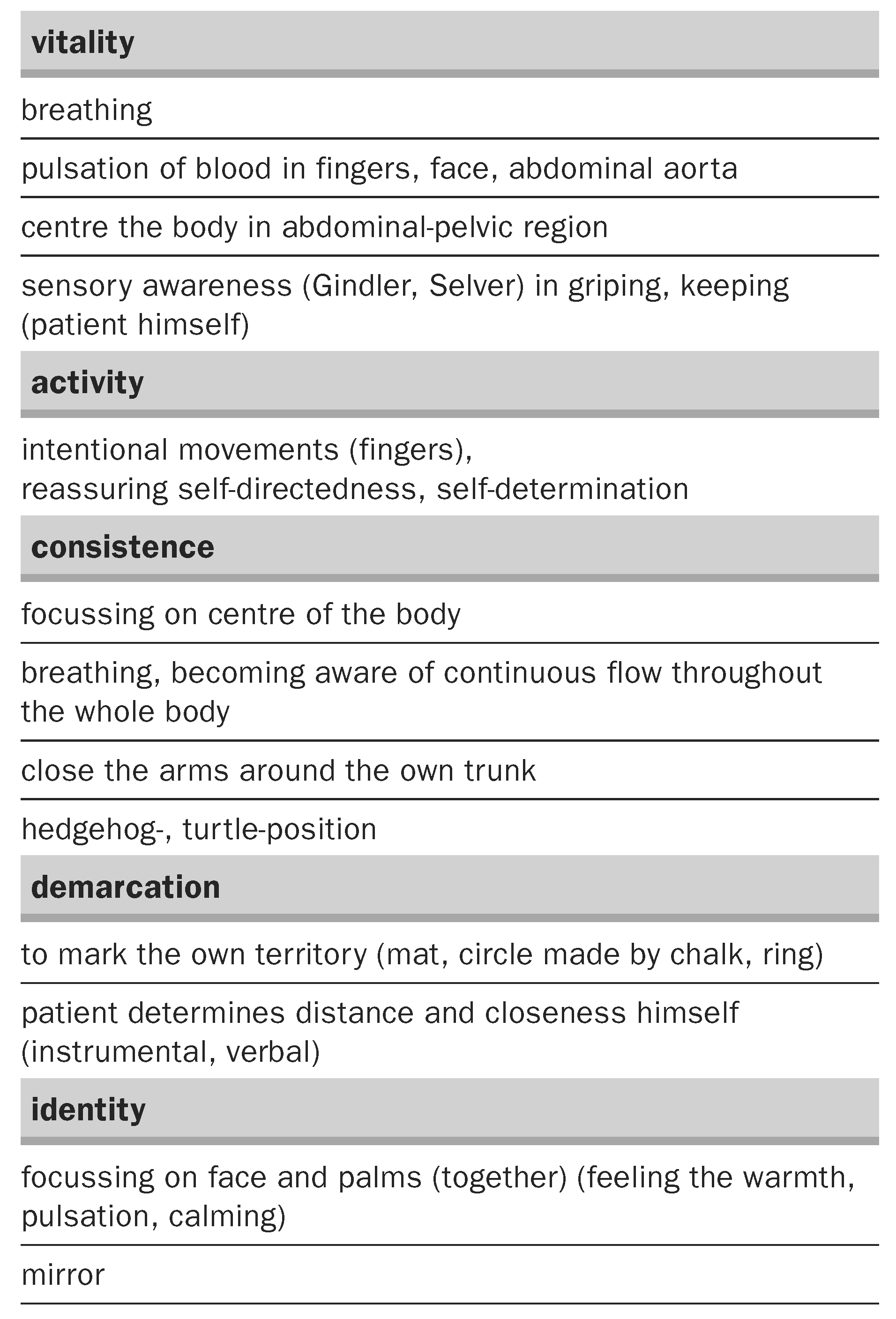
In all the patients who manifest bodily symptoms of their ego pathology, the treatment plan should consider to include the patient’s body in the resynthetic work. The details have to be adapted to the individuals’ needs and accessibility. Some elements we often use are listed in
Table 2.
Table 2.
Body-including treatment as suggested by ego psychopathology.
Table 2.
Body-including treatment as suggested by ego psychopathology.
Body-including treatment can contribute to at least three functional realms of the patient:
- -
It helps to reconstruct the disordered body ego as an important fundament of the patient’s self-experience.
- -
It establishes the interpersonal relation between patient and therapist as an important step in the disordered intersubjectivity of the schizophrenic.
- -
It guides the patient back to the commonly shared reality. It reestablishes the disordered or lost sense of reality and corroborates it.