Next Article in Journal
Entecavir as Specific Antiviral Therapy in Selected Cases of Severe Acute Hepatitis B
Previous Article in Journal
The Use of Computational Models to Predict Response to HIV Therapy for Clinical Cases in Romania
 
 
Germs is published by MDPI from Volume 15 Issue 4 (2025). Previous articles were published by another publisher in Open Access under a CC-BY (or CC-BY-NC-ND) licence, and they are hosted by MDPI on mdpi.com as a courtesy and upon agreement with the former publisher Infection Science Forum.
Article

Serum Adipokines and HIV Viral Replication in Patients Undergoing Antiretroviral Therapy

by
Victoria Aramă
1,2,
Cătălin Tilişcan
2,3,*,
Daniela Adriana Ion
4,
Raluca Mihăilescu
2,
Daniela Munteanu
2,
Anca Streinu-Cercel
1,2,
Ana Maria Tudor
1,2,
Adriana Hristea
1,2,
Viorica Leoveanu
2,
Ioana Olaru
2 and
Ştefan Sorin Aramă
3
1
Department of Infectious Diseases, Carol Davila University of Medicine and Pharmacy, Bucharest, Romania
2
National Institute for Infectious Diseases ‘Prof. Dr. Matei Balş’, 1 Dr. Calistrat Grozovici Street, Bucharest, Romania
3
Department of Physiopathology and Immunology, Carol Davila University of Medicine and Pharmacy, 37 Dionisie Lupu Street, 020022 Bucharest, Romania
4
Department of Physiopathology II, Carol Davila University of Medicine and Pharmacy, Bucharest, Romania
*
Author to whom correspondence should be addressed.
Germs 2012, 2(1), 12-17; https://doi.org/10.11599/germs.2012.1008
Submission received: 28 December 2011 / Revised: 13 February 2012 / Accepted: 27 February 2012 / Published: 1 March 2012

Abstract

Introduction: Several studies have reported that cytokines secreted by adipose tissue (adipokines) may be linked to HIV replication. The aim of the study was to evaluate the relationship between HIV replication and serum levels of adipokines, in a Caucasian HIV-infected population of men and women undergoing complex antiretroviral therapy. Methods: A cross-sectional study was conducted in an unselected sample of 77 HIV-1-positive patients. Serum adipokines levels were measured including circulating adiponectin, leptin, resistin, tumor necrosis factor alpha (TNF-alpha) and interleukin-6 (IL-6). Patients were divided into two groups: Group 1—with undetectable viral load and Group 2—with persistent HIV viral replication. Differences between groups were tested using independent-sample t-test for Gaussian variables and Mann–Whitney–Wilcoxon test for non-parametric variables. Pearson’s chi-squared test was used for correlation analysis. Results: A total of 77 patients (age range: 17–65, mean: 32.5 years) including 44 men (57.1% men, age range: 17–63 years, mean: 34.1 years) and 33 women (42.9% women age range: 19–65 years, mean: 30.3 years) were included in the study. TNF-alpha had significantly higher serum levels in patients with detectable viral load (16.89 vs. 9.35 pg/mL), (p = 0.043), but correlation analysis lacked statistical significance. Adiponectin had median serum levels of 9.22 μg/mL in Group 1 vs. 16.50 μg/mL in Group 2 but the results lacked statistical significance (p = 0.059). Higher leptin, IL-6 and resistin serum levels were noted in patients with undetectable HIV viral load, without statistical significance. Conclusions: The present study reported higher TNF-alpha serum levels in patients with persistent HIV viral load. We found no statistically significant correlations between adiponectin, leptin, resistin and IL-6 and HIV viral load in our Caucasian HIV-positive study population, undergoing antiretroviral therapy.

Introduction

Adipokines are adipocyte-synthesized cytokines that have various immunomodulatingroles. Adipocytes release adiponectin, leptin, resistin, tumor necrosis factor-alpha(TNF-alpha) and various interleukins (IL) [1].
The introduction of complex combined antiretroviral therapy (cART) has determined a significant increase in the life expectancy of HIV-positive patients but has also led to fat redistribution (lipodystrophy) and complex metabolic changes [2,3,4]. Lipodystrophy associates subcutaneous lipid wasting with central adiposity [3,5]. Lipodystrophy may be associated with chronic inflammation and high levels of TNF-alpha [6]. TNF-alpha may promote HIV replication via activation of nuclear factor kappa-light-chain-enhancer of activated B cells (NFκB) [7]. Leptin regulates caloric intake via hypothalamic feedback and contributes to energy homeostasis and neuroendocrine function. Leptin also exerts immunomodulatory activity and may be associated with HIV viral replication [8].
The aim of the study was to evaluate the relationship betweenHIV replication and serum levels ofadipokines, in a Caucasian HIV-infected non-diabetic population of men and women, undergoing cART.

Methods

A cross-sectional study was performed in a Caucasian cohort ofHIV-1-positive patients attending the National Institute of Infectious Diseases ‘Prof.Dr. Matei Balş’ in Bucharest, Romania, between June 2009 and June 2010. The study was part of a prospective Romanian research grant (SLD-ART no. 62077/2008) on HIV infected patients. The research was approved by the local research ethics committee (protocol no. 190/15.01.2009).
The study enrolled 77 consecutive patients who gave their written informed consent to participate in the study. All enrolled patients had undergonecART for at least 6 months at the timethe blood samples were collected.A standard questionnaire was filled out by the patients for demographic parameters and for personal and family medical histories.
We calculated the body mass index (BMI), defined according to WHO criteria [9]. Patients were classified as being overweight and obese with BMI of 25–29.9 kg/m2 and ≥30kg/m2, respectively.
Blood samples were collected and tested for:HIV viral load (Roche LightCycler® 480 Real-Time PCR System); CD4 T cell count (BD FACSCanto IIflow cytometer); leptin (BioSource EASIA (Enzyme Amplified Sensitivity Immunoassay), KAP2281, Belgium); adiponectin (BioSource ELISA, KAPME09, Belgium); resistin (BioSource ELISA, KAPME 50, Belgium); TNF-alpha (BioSource EASIA (Enzyme Amplified Sensitivity Immunoassay), KAP 1751, Belgium); interleukin-6 (IL-6) (BioSource EASIA (Enzyme Amplified Sensitivity Immunoassay), KAP 1261, Belgium); fastinginsulin (ELx50 Bioelisa Washer BioTek, Spain) and fastingplasmaglucose, fasting triglycerides, total cholesterol, low-density lipoprotein (LDL) cholesterol and high-density lipoprotein (HDL) cholesterol (dry slide technology, Vitros 950, Johnson & Johnson, USA).
Insulin resistance was measured using the Homeostatic Model Assessment of Insulin Resistance, known as the HOMA-IR, described by Matthews et al. [10]. Using the fasting insulin and fasting glucose levels, HOMA-IR was calculated in the following formula:
[Fasting insulin (μU/mL) × Fasting plasma glucose (mmol/L)]/22.5.
Values >3 were considered to indicate insulin resistance.

Statistical analysis

The Shapiro–Wilk test was used to determine whether the samples came from normally distributed populations. Gaussian distribution variables were expressed as means (± standard deviation [SD]). For non-normally distributed variables we used medians.
Differences between groupswere tested using independent-sample t-test for normally distributed variables and Mann–Whitney–Wilcoxontest for non-parametric variables. Pearson’s chi-squared test was used for correlation analysis. The level of statistical significance was set at 5%. SPSS® Statistics software v.17.0, IBM®, New York, USA was used to perform all analyses.

Results

A total of 77 patients (mean age 32.5 years, range: 17–65) were enrolled, including 44 men (57.1%, mean age 34.1 years, range: 17–63), and 33 women (42.9%, mean age 30.3 years, range: 19-65).
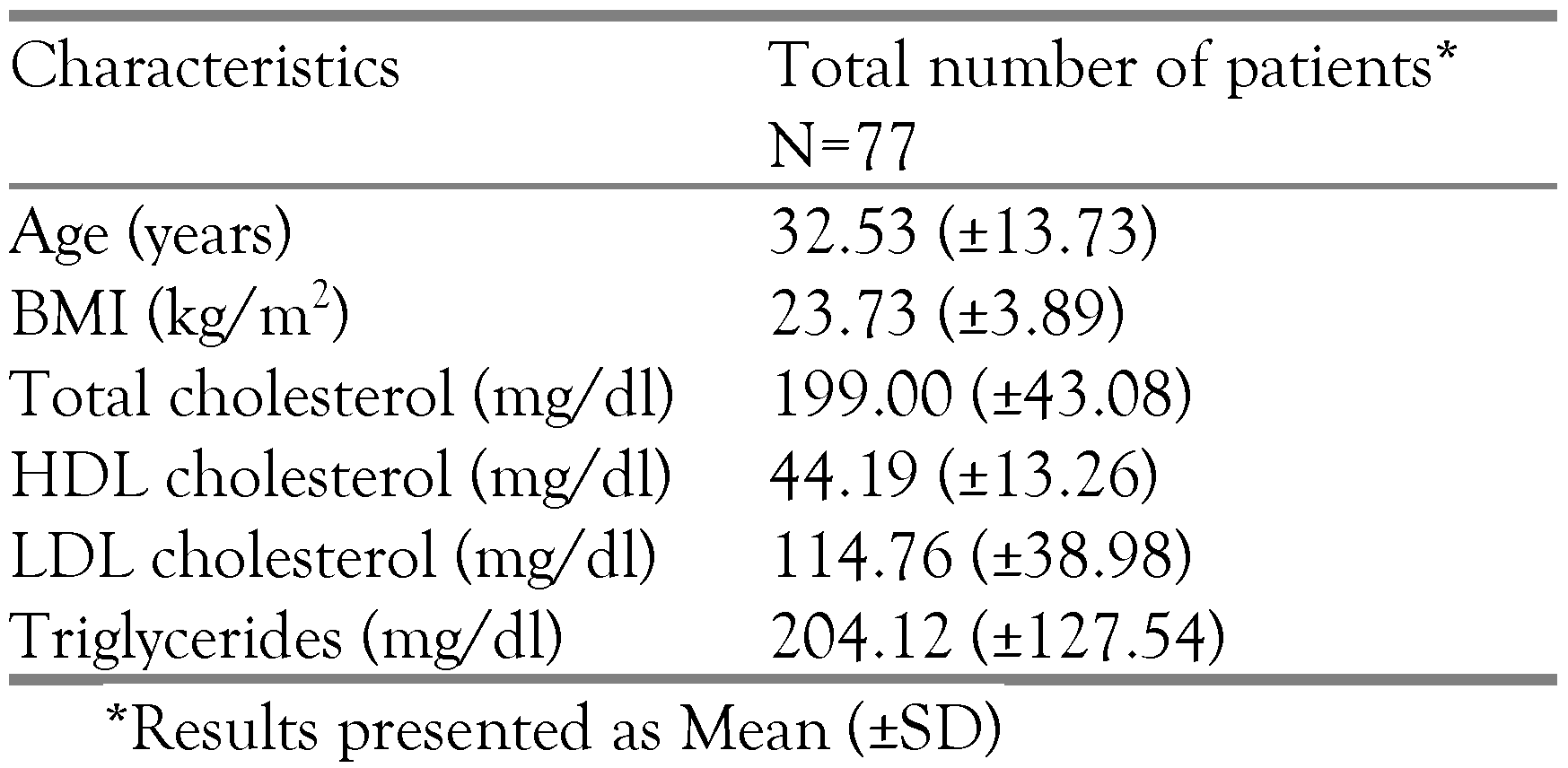
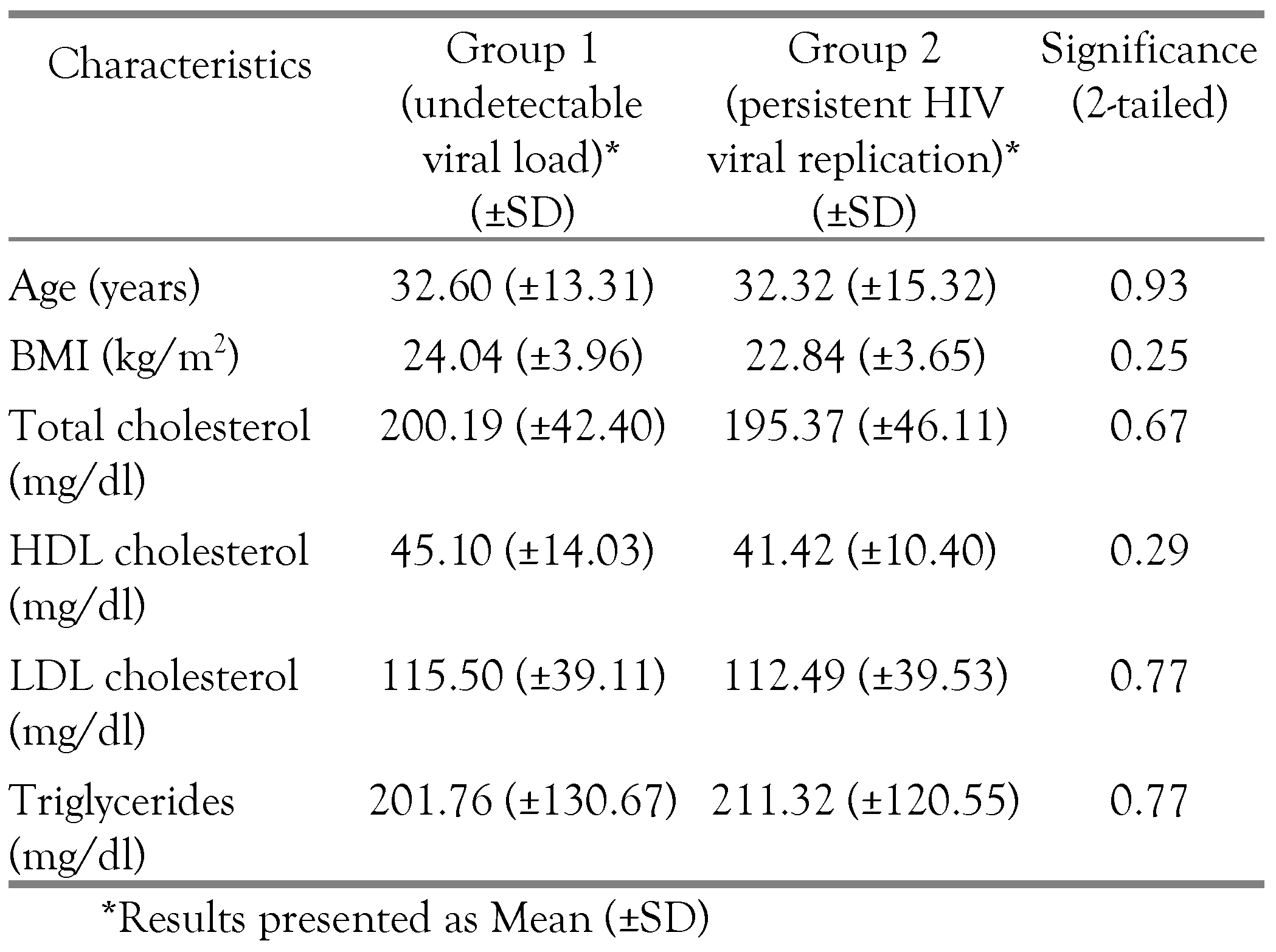
More than half (57.9%) of the patients had at least 2 antiretroviral combinations in the past. 76.84% of the patients had at least one PI in their current cART regimen. The mean BMI of study patients was 23.7 kg/m2. Overall, 23.4% of the patients were overweight and 6.5% were obese. The median overall CD4 T cell count of enrolled patients was 515.00 cells/cmm. Clinical and biological characteristics of study patients are presented in table I and table II and compared in table III.
Out of the enrolled patients, 75.32% hadserum undetectable HIV viral load at the time of blood sampling and 24.68% had HIV viral loads ranging from 344 to 364 000 copies/ml. Study subjects were divided into two groups: Group 1 (with undetectable viral load): 58 subjects; and Group 2 (with persistent HIV viral replication): 19 subjects.
Patients with undetectable HIV viral load had lower median concentrations of adiponectin (9.22 vs. 16.50 μg/mL) than Group 2 but the results lacked statistical significance (p=0.059).The significance level of Pearson’s chi-squared test was 0.058.
Higher levels of median CD4 T cell count (549.50 vs. 334.00 cells/cmm) were observed in Group 1 compared to Group 2 (p=0.02). Higher leptin, IL-6 and resistin serum levels were noted in patients with undetectable HIV viral load, however this was not statistically significant. TNF-alpha had significantly higher serum levels in patients with detectable viral load (16.89 vs. 9.35), (p=0.043), however Pearson’s chi-squared test had a significance level of 0.14 (table IV).

Discussion

Adiponectin is exclusively and significantly expressed in human adipose cells. Studies have reported that adiponectin may act as an endogenous insulinsensitizer [11]. In non-HIV patients, lower levels of adiponectin were associated with the development of components of the metabolic syndrome such as obesity, insulin resistance and type II diabetes [12,13,14].
Li L. et al. have compared the levels of adiponectin in patients with untreated HIV infection vs. healthy subjects. The HIV-positive naive patients had lower serum concentrations of adiponectin compared to the included healthy subjects [15].
In treated HIV-positive patients, the levels of adiponectin may be lower than in naive HIV-patients. Lagathu C. et al. have reported in 2007 that both protease inhibitors (PIs) and nucleoside reverse transcriptase inhibitors (NRTIs) altered adipokine secretion from human subcutaneous adipocytes [16].
Sankale et al. reported that human subcutaneous adipocytes exposed to HIV-1 dramatically increased the secretion of adiponectin [17]. Our study has found no significant statistical evidence to confirm that adiponectin levels are associated with persistent viral replication, although the patients in Group 2 had higher median concentrations of adiponectin than those in Group 1.
Matarese et al. showed that serumleptinconcentration positively correlated with CD4+ lymphocyte number in a cohort of naive HIV-positive patients [18]. Azzoni et al. reported in 2010 that leptin levels are inversely associated with HIV replication, independent of disease progression, in a cohort composed only of ART-naïve women with a narrow CD4 range. The authors hypothesized that the inverse relationship between leptin levels and viral replication may be independent of the amount of adipose tissue. Chronic inflammation in HIV-patients with viral replication may affect adipocytes and may cause lipoatrophy and lower leptin levels [19].
Contrary tothe above, other studies prior to Azzoni et al. report that testing whether viral replication was associated with serum adipokines did not evidence a significant association between HIV viral load and leptin levels [20]. Our study similarly found no statistical evidence regarding the association between leptin and HIV viral load, in our cohort of cART multiexperienced patients.
In humans, prior work has demonstrated that patients with chronic HIV infection typically show elevations in serum or plasma TNF-alpha levels [21,22,23]. In a study published in 2011, Keating et al. compared cytokines profiles in three women clinical groups, including cART responders, untreatedHIV patients andHIV-uninfected subjects. Untreated, progressive HIV infectionwas associated with increased levels of inflammatory mediators such as TNF-alpha. cART responders had cytokine profiles that more closely resembled those of HIV-uninfected women [24]. TNF-alpha is involved in a paracrine loop in which HIV-1 binding to CD4 induces TNF-alpha production, and TNF-alpha stimulates HIV-1 gene expression by a nuclear factor kappa-light-chain-enhancer of activated B cells (NFκB) [6]. Roberts et al. have reported that during primary HIV infection TNF-alpha levels correlated positively with quantitative viral load [25]. In our study, serum TNF-alpha levels were significantly higher in patients with persistent HIV replications – a finding that concurs with the previously mentioned studies – but the correlation analysis lacked statistical significance.
The most important limitation of this study was that the number of patientswith persistent HIV viral replication (Group 2) was too small and as a result the statistical power was low. Also, the results should be interpreted in light of the cross-sectional design of our study, which does not permit cause-effect relationships interpretations in the studied variables.
The present study reported higher TNF-alpha serum levels in patients with persistent HIV viral load undergoing antiretroviral therapy. We found no statistically significant correlations between adiponectin, leptin, resistin and IL-6 and HIV viral load in our study population. Further studies with larger number of patients and prospective designs may be required to draw statistically significant and relevant conclusions regarding the association between adipokines and HIV replication.

Author Contributions

All authors had equal contributions.

Funding

The study was funded by the National Authority for Scientific Research (Grant No. 62077/2008, 2008-2011). Coordinating center: National Institute of Infectious Diseases ‘Prof.Dr. Matei Balş’, Bucharest, Romania. Project Manager: Professor Adrian Streinu-Cercel, MD, PhD.

Acknowledgments

The authors thank all study participants for their contribution to the research, as well as all medical staff involved in this study, especially Cristina Loredana Benea for the involvement in recruiting and in the follow-up of the patients.

Conflicts of Interest

All authors—none to declare.

References

  1. Rabe, K.; Lehrke, M.; Parhofer, K.G.; Broedl, U.C. Adipokines and insulin resistance. Mol Med. 2008, 14, 741–751. [Google Scholar] [CrossRef] [PubMed]
  2. Guaraldi, G. Evolving approaches and resources for clinical practice in the management of HIV infection in the HAART era. GERMS 2011, 1, 6–8. [Google Scholar] [CrossRef] [PubMed][Green Version]
  3. Falutz, J. Management of fat accumulation in patients with HIV infection. Curr HIV/AIDS Rep. 2011, 8, 200–208. [Google Scholar] [CrossRef]
  4. Giralt, M.; Domingo, P.; Villarroya, F. Adipose tissue biology and HIV-infection. Best Pract Res Clin Endocrinol Metab. 2011, 25, 487–499. [Google Scholar] [CrossRef]
  5. Tilişcan, C.; Aramă, V.; Mihăilescu, R.; Streinu-Cercel, A.; Ion, D.; Aramă, Ş.S. Methods for monitoring mitochondrial toxicity of nucleoside-analogue reverse-transcriptase inhibitors in HIVpatients during antiretroviral therapy. Ther. Pharmacol. Clin. Toxicol. 2011, XV, 289–292. [Google Scholar]
  6. Bulló, M.; García-Lorda, P.; Peinado-Onsurbe, J.; et al. TNFalpha expression of subcutaneous adipose tissue in obese and morbid obese females: Relationship to adipocyte LPL activity and leptin synthesis. Int J Obes Relat Metab Disord. 2002, 26, 652–658. [Google Scholar] [CrossRef] [PubMed]
  7. Herbein, G.; Varin, A.; Larbi, A.; et al. Nef and TNFalpha are coplayers that favor HIV-1 replication in monocytic cells and primary macrophages. Curr HIV Res. 2008, 6, 117–129. [Google Scholar] [CrossRef]
  8. Mantzoros, C.S. The role of leptin in human obesity and disease: A review of current evidence. Ann Intern Med. 1999, 130, 671–680. [Google Scholar] [CrossRef]
  9. World Health Organization. Obesity: Preventing and Managing the Global Epidemic; Technical Report Series No. 894; WHO: Geneva, Switzerland, 2000. [Google Scholar]
  10. Matthews, D.R.; Hosker, J.P.; Rudenski, A.S.; Naylor, B.A.; Treacher, D.F.; Turner, R.C. Homeostasis model assessment: Insulin resistance and beta-cell function from fasting plasma glucose and insulin concentrations in man. Diabetologia. 1985, 28, 412–419. [Google Scholar] [CrossRef]
  11. Ziemke, F.; Mantzoros, C.S. Adiponectin in insulin resistance: Lessons from translational research. Am J Clin Nutr. 2010, 91, 258S–261S. [Google Scholar] [CrossRef]
  12. Kubota, N.; Terauchi, Y.; Yamauchi, T.; et al. Disruption of adiponectin causes insulin resistance and neointimal formation. J Biol Chem. 2002, 277, 25863–25866. [Google Scholar] [CrossRef]
  13. Weyer, C.; Funahashi, T.; Tanaka, S.; et al. Hypoadiponectinemia in obesity and type 2 diabetes: Close association with insulin resistance and hyperinsulinemia. J Clin Endocrinol Metab. 2001, 86, 1930–1935. [Google Scholar] [CrossRef]
  14. Yamamoto, Y.; Hirose, H.; Saito, I.; et al. Correlation of the adipocyte-derived protein adiponectin with insulin resistance index and serum high-density lipoprotein-cholesterol, independent of body mass index, in the Japanese population. Clin Sci 2002, 103, 137–142. [Google Scholar] [CrossRef]
  15. Li, L.; Chen, J.; Sun, F.Y.; et al. Markers of endothelial injury and plasma adipocytokine in antiretroviral-naive HIV patients. Zhonghua Nei Ke Za Zhi. 2011, 50, 136–139. [Google Scholar] [PubMed]
  16. Lagathu, C.; Eustace, B.; Prot, M.; et al. Some HIV antiretrovirals increase oxidative stress and alter chemokine, cytokine or adiponectin production in human adipocytes and macrophages. Antivir Ther. 2007, 12, 489–500. [Google Scholar] [CrossRef]
  17. Sankalé, J.L.; Tong, Q.; Hadigan, C.M.; Tan, G.; Grinspoon, S.K.; Kanki, P.J.; Hotamisligil, G.S. Regulation of adiponectin in adipocytes upon exposure to HIV-1. HIV Med. 2006, 7, 268–274. [Google Scholar] [CrossRef]
  18. Matarese, G.; Castelli-Gattinara, G.; Cancrini, C.; et al. Serum leptin and CD4+ T lymphocytes in HIV+ children during highly active antiretroviral therapy. Clin Endocrinol 2002, 57, 643–646. [Google Scholar] [CrossRef] [PubMed]
  19. Azzoni, L.; Crowther, N.J.; Firnhaber, C.; et al. Association between HIV replication and serum leptin levels: An observational study of a cohort of HIV-1-infected South African women. J Int AIDS Soc. 2010, 13, 33. [Google Scholar] [CrossRef] [PubMed]
  20. Scherzer, R.; Shen, W.; Bacchetti, P.; et al. Simple anthropometric measures correlate with metabolic risk indicators as strongly as magnetic resonance imaging-measured adipose tissue depots in both HIV-infected and control subjects. Am J Clin Nutr. 2008, 87, 1809–1817. [Google Scholar] [CrossRef][Green Version]
  21. Lähdevirta, J.; Maury, C.P.; Teppo, A.M.; Repo, H. Elevated levels of circulating cachectin/tumor necrosis factor in patients with acquired immunodeficiency syndrome. Am J Med 1988, 85, 289–291. [Google Scholar] [CrossRef]
  22. von Sydow, M.; Sonnerborg, A.; Gaines, H.; Strannegård, O. Interferon-alpha and tumor necrosis factor-alpha in serum of patients in various stages of HIV-1 infection. AIDS Res Hum Retroviruses 1991, 7, 375–380. [Google Scholar] [CrossRef] [PubMed]
  23. Zangerle, R.; Gallati, H.; Sarcletti, M.; Wachter, H.; Fuchs, D. Tumor necrosis factor alpha and soluble tumor necrosis factor receptors in individuals with human immunodeficiency virus infection. Immunol Lett 1994, 41, 229–234. [Google Scholar] [CrossRef] [PubMed]
  24. Keating, S.M.; Golub, E.T.; Nowicki, M.; et al. Women’s Interagency HIV Study. The effect of HIV infection and HAART on inflammatory biomarkers in a population-based cohort of women. AIDS 2011, 25, 1823–1832. [Google Scholar] [CrossRef] [PubMed]
  25. Roberts, L.; Passmore, J.A.; Williamson, C.; et al. Plasma cytokine levels during acute HIV-1 infection predict HIV disease progression. AIDS 2010, 24, 819–831. [Google Scholar] [CrossRef]

Table I. Clinical and biological characteristics of study patients (parametric variables).
Germs 02 00012 i001
Table II. Clinical and biological characteristics of study patients (non-parametric variables).
Germs 02 00012 i002
Table III. Differences in means between Group 1 and Group 2.
Germs 02 00012 i003
Table IV. Differences in medians between Group 1 and Group 2.
Germs 02 00012 i004