Article

Parameter Optimization and Modeling for Improving Gear Grinding Surface Quality Within the Scope of Dual Carbon Goals and Institution Promotion

1
School of Public Administration, Xiangtan University, Xiangtan 411105, China
2
School of Mechanical Engineering and Mechanics, Xiangtan University, Xiangtan 411105, China
*
Author to whom correspondence should be addressed.
Processes 2026, 14(7), 1171; https://doi.org/10.3390/pr14071171
Submission received: 9 March 2026 / Revised: 28 March 2026 / Accepted: 2 April 2026 / Published: 5 April 2026

Abstract

The surface quality of machined gears is closely related to operational energy efficiency and service durability, which affect the achievement of dual carbon goals in sustainable manufacturing. This study proposes a radial pre-stressed grinding method for gear manufacturing. Firstly, an analytical model for the radial pre-stress exerted on the gear inner hole was established by virtue of thick-walled cylinder theory. Secondly, a simulation and experiment were conducted under the same pre-stress conditions to obtain the radial stress. The theoretical, simulated, and experimental results were compared and discussed. Then, gear grinding simulations were performed at different pre-stress levels, grinding depths and grinding speeds. Finally, the grinding parameters were optimized by means of response surface methodology (RSM). This study recommends incorporating gears manufactured with radial pre-stressing into relevant industrial standards for green and low-carbon development. The results indicate that applying radial pre-stress to the gear inner hole significantly influences surface roughness and residual compressive stress after grinding, whereas it exhibits a minimal effect on grinding force. After optimization, compared with the initial simulation results, surface roughness is reduced by 12.5%, the absolute value of residual compressive stress is increased by 52.6%, and grinding force is decreased by 2.1%. The implementation of radial pre-stressed grinding in gear manufacturing requires institutional support, including its integration into green standard institutions, the development of technical specifications, and the establishment of promotion mechanisms. Such integration can be facilitated through national ‘Green Factory’ initiatives, comprehensive intellectual property protection, and targeted personnel training.

1. Introduction

In response to global climate change, China’s commitment to achieving carbon peaking and carbon neutrality reflects its dedication to addressing the critical resource and environmental constraints and building a shared future for humanity. The machinery industry, with its vast array of products, broad sphere of influence, and strong driving force, is pivotal and foundational for China’s achievement of these dual carbon goals. This investigation is closely related to the broader research on mechanical transmission devices [1,2,3,4,5]. As the most widely used mechanical components in power transmission, gears play a crucial role in numerous fields [6,7,8]. Gear quality is critical to reducing carbon emissions in the machinery sector. In particular, surface quality directly determines energy efficiency: gears with high surface roughness and poor precision generate excessive friction due to uneven meshing clearance, which impairs transmission efficiency, leads to power loss, and increases energy demand. Conversely, superior surface quality reduces failure rates, extends service life, and reduces the carbon emissions associated with gear repair, replacement, and manufacturing. This is particularly critical under harsh industrial and mining operating conditions, where the geometric precision and surface quality of gears directly determine their service life and load-bearing capacity and thus directly affect the overall energy efficiency. Consequently, enhancing gear surface quality serves as an effective strategy for advancing carbon reduction objectives.
Grinding is a critical process for manufacturing gears with high precision and excellent surface finish [9,10,11]. In the field of machining, the evaluation of workpiece surface quality is generally categorized into two aspects: surface topography and surface integrity. Surface topography directly influences the appearance and functional performance of the workpiece, while surface integrity reflects the effects of various stresses and deformations introduced during machining, including residual stress, microhardness, phase transformation, and micro- or macro-cracks. These characteristics are closely related to the in-service performance and service life of the workpiece, making their comprehensive evaluation and control highly significant. Extensive research has been conducted to optimize gear surface quality through grinding. For instance, Zhou et al. [12] proposed a grinding method based on multi-axis CNC machining that uses a single path to dress the worm surface—improving efficiency—and incorporates a closed-loop manufacturing process to ensure accuracy. The effectiveness of this method was validated through simulation and experiment. Similarly, You et al. [13] developed a tooth surface roughness model based on the kinematics of continuous generation grinding. Experimental verification showed that this model can optimize process parameters to achieve higher tooth surface quality. Gülzow et al. [14] suggested that contoured grinding tools can be employed to enhance the surface quality of individual tooth flanks. Their results demonstrate that surface roughness can be reliably reduced by approximately ΔRa ≈ 0.2 μm when a single grinding brush is used to process the entire gear, without altering its geometry.
Residual stress is a critical indicator of surface integrity [15,16]. Numerous studies have investigated surface residual stress in grinding processes. For instance, Hong et al. [17] introduced a micro-carburizing technique and quantitatively analyzed the influence of thermo-metallurgical phase transformation on residual stress at the microstructural level. Their results indicate that micro-carburizing increases the carbon content of the ground surface from 0.2% to 0.5%, raises the martensite phase by 15%, and leads to more pronounced residual compressive stress (approximately 120 MPa). da Silva et al. [18] examined the ground surface of hardened AISI 4340 steel, finding that compressive residual stress was generated under all tested grinding conditions. In a study on cylindrical grinding of 42CrMo4 (AISI 4140) steel, Borchers et al. [19] compared different grinding stages and reported consistent material deformation (residual stress) outcomes between continuous and interrupted grinding processes.
Grinding force is a critical factor influencing surface quality in grinding operations. Various prediction models for grinding forces have been proposed in the literature [20,21,22,23,24]. For example, Kar et al. [23] investigated the grinding force generated during the grinding of ceramic coatings and compared experimental results with an analytical model based on the critical load and critical depth of brittle fracture. The model demonstrated good agreement with experimental force values. In another study, Kadivar et al. [24] developed a micro-grinding cutting force prediction model based on the probability distribution of undeformed chip thickness. The model achieved average prediction accuracies of 10% for tangential grinding force and 30% for normal grinding force. Research on grinding under pre-stressed conditions remains relatively limited. Among existing studies, Hou et al. [25] established a predictive model for surface morphology in pre-stressed grinding, incorporating the deformation characteristics and material removal mechanisms of difficult-to-machine materials. Their experimental and simulation results indicate that applying appropriate pre-stress can improve ground surface morphology. With increasing pre-stress, surface defects such as stained areas, indentations, and deep grooves are reduced, resulting in a smoother surface. In a related approach, Xu et al. [26] proposed a pre-stressed dry grinding and strengthening technique to improve surface roughness by controlling pre-stress levels. Metallographic analysis revealed that the workpiece subsurface layer consists of martensite and ferrite, with the high-density martensite identified as a hardened layer. As pre-stress increases, the microstructure of this hardened layer becomes more refined and grain density increases.
Pre-stressed machining is a significant factor influencing surface quality. Several studies have investigated the effect of pre-stress on surface integrity. Xiao et al. [27] employed a coupled discrete element–finite element (DEM-FEM) model to simulate and experimentally analyze crack wear in ceramic tools under varying pre-stress conditions. Their results indicate that applying pre-stress significantly reduces both cutting force and tool wear. Similarly, Chao et al. [28] developed a pre-stressed dry grinding technology and simulated the surface trajectory of 40Cr steel using a temperature field and non-Gaussian random function model. They found that increasing pre-stress gradually reduces surface defects such as cracks and burn marks, thereby improving surface quality. Furthermore, Xu [26] proposed a pre-stressed machining method incorporating a thermo-mechanical coupling effect, validating its feasibility through experiments and modeling. This study demonstrated that the method can produce a strengthened surface layer, with surface quality improving as pre-stress increases. In a related study, Hou et al. [29] established a computational model for surface residual stress that accounts for martensitic transformation, verifying its accuracy through experiments and simulations. Their results show that appropriate pre-stress grinding can alter stress corrosion cracking (SCC) morphology and reduce martensite content, while higher pre-stress levels can inhibit the initiation and propagation of SCC.
In summary, while extensive research has been conducted on surface quality parameters such as surface roughness, residual stress, and grinding force in grinding processes, the application of radial pre-stress specifically to gear inner holes during gear grinding remains scarcely explored. To address this gap, this study establishes an equivalent model for radial loading on gears and a simulation model for single-abrasive-grain grinding under radial pre-stress. Using ABAQUS2021 simulations and experimental tests, the influence of grinding speed and depth on ground surface quality is investigated under varying levels of gear inner hole pre-stress. Furthermore, the parameters for radial pre-stress-assisted single-abrasive-grain gear grinding are optimized.

2. Stress Analysis for Gear Radial Loading

2.1. Theoretical Analysis for Gear Radial Loading

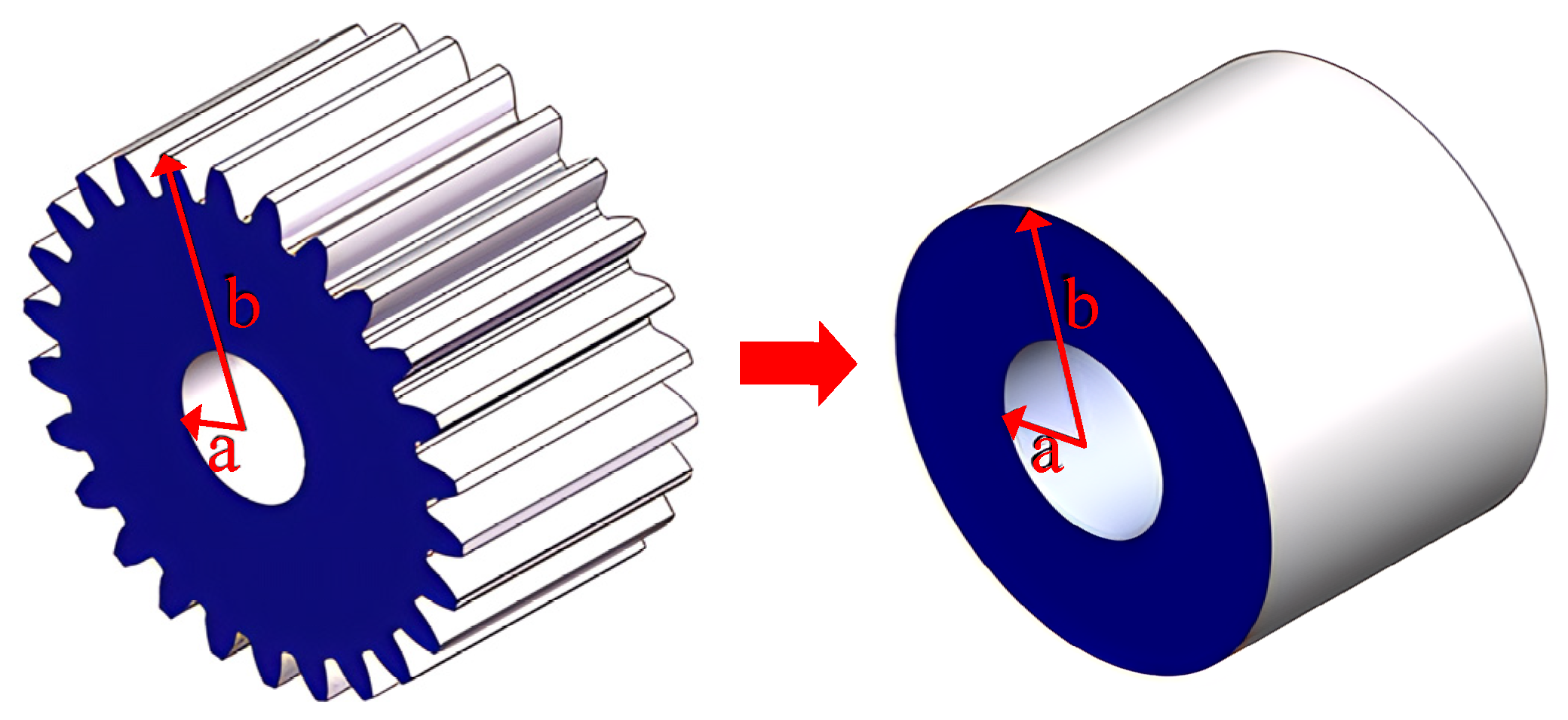
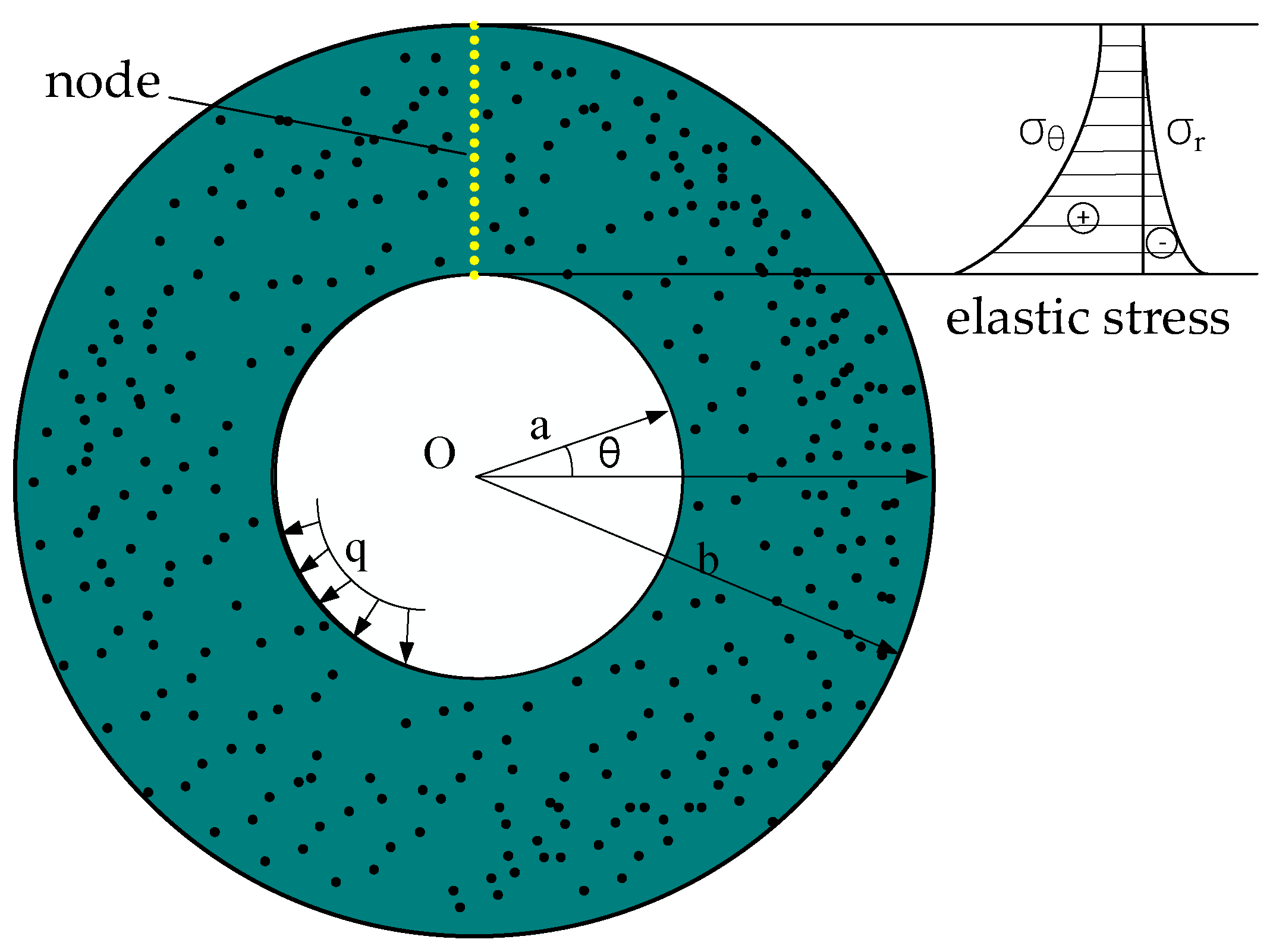
Due to its central symmetry, the gear can be treated as a thick-walled cylinder for pre-stress calculation. As illustrated in Figure 1, the inner radius a is taken as the radius of the gear’s center hole, and the outer radius b as the radius of its tip circle. The pre-stress is applied by subjecting the inner wall to a uniform internal pressure q. Figure 2 illustrates the distributions of radial stress (σr) and circumferential stress (σθ) along the diameter of the cylinder.
According to elastoplastic theory, the thick-walled cylinder remains entirely elastic when the internal pressure q is sufficiently small. Under the assumption of material incompressibility, Poisson’s ratio is taken as ν = 1/2. The governing equations are as follows:
The equilibrium equation:
d σ r d r + σ r σ θ r = 0
The strain components in the cylinder are given by the following:
ε r = d u d r , ε θ = u r
By applying the stress solution method, Equation (2) can be rewritten as follows:
σ θ = σ r + r d σ r d r
The generalized Hooke’s law is expressed by Equation (4).
ε r = 1 E σ r ν σ θ ε θ = 1 E σ θ ν σ r ε z = 1 E σ z ν σ r + σ θ
Substituting Equation (3) into Equation (4) yields the following:
ε r = 1 E 1 ν σ r ν r d σ r d r ε θ = 1 E 1 ν σ r + r d σ r d r
The boundary conditions are given by the following:
σ r | r = a = q σ r | r = b = 0
Furthermore, the geometric equation gives the following:
ε r = d r ε θ d r
Combining Equations (3), (5) and (7) yields the following expression:
d 2 σ r d r 2 + 3 r d σ r d r = 0
This expression can be written in general form as follows:
σ r = A + B r 2
where A and B are coefficients to be determined by applying the boundary conditions:
σ r = q b 2 a 2 1 b 2 r 2 1 σ θ = q b 2 a 2 1 b 2 r 2 + 1
Furthermore, for this plane strain problem, σz = 0. This follows directly from the third equation of the generalized Hooke’s law (3) with ν = 1/2:
σ z = 1 2 σ r + σ z = q b 2 a 2 1
Due to the axisymmetric nature of the thick-walled cylinder model, all shear stress components are zero. Consequently, the normal stresses σr, σθ, and σz are the principal stresses. Following the convention σ1σ2σ3, they are assigned as σ1 = σθ, σ2 = σz, and σ3 = σr.
The equivalent stress in the elastic regime is calculated as follows:
σ i = 3 b 2 b 2 a 2 1 q r 2
The maximum equivalent stress occurs at the inner wall of the cylinder, i.e.,
σ i m a x = σ i r = a = 3 b 2 b 2 a 2 1 q a 2
According to the von Mises yield criterion, yielding begins at the inner wall when the equivalent stress reaches the yield strength σs. The corresponding internal pressure is calculated as follows:
q e = 1 b 2 a 2 σ s 3
This pressure defines the elastic limit pressure qe, as the cylinder remains entirely elastic only for qqe.
The gear material considered in this study is 20CrMnTi, with its key geometrical and mechanical parameters provided in Table 1. Based on the gear’s number of teeth and module, the tip circle radius was accurately calculated to be 32 mm. Consequently, for the equivalent thick-walled cylinder model, the inner radius was set to a = 15 mm and the outer radius to b = 32 mm. Upon substituting the values of a, b and the yield stress into Equation (14), the ultimate pressure for the inner hole under fully elastic conditions was determined to be 376.16 MPa.
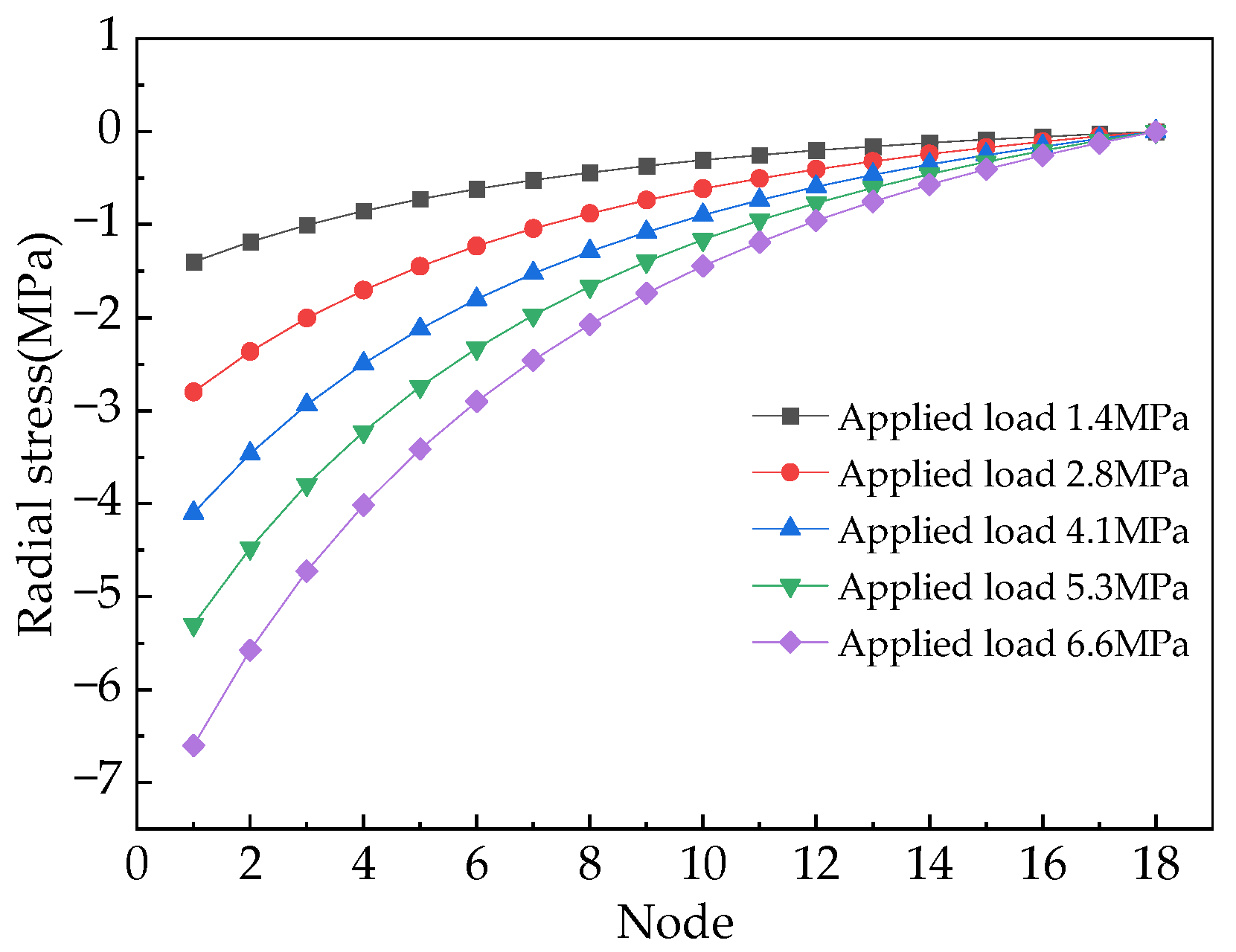
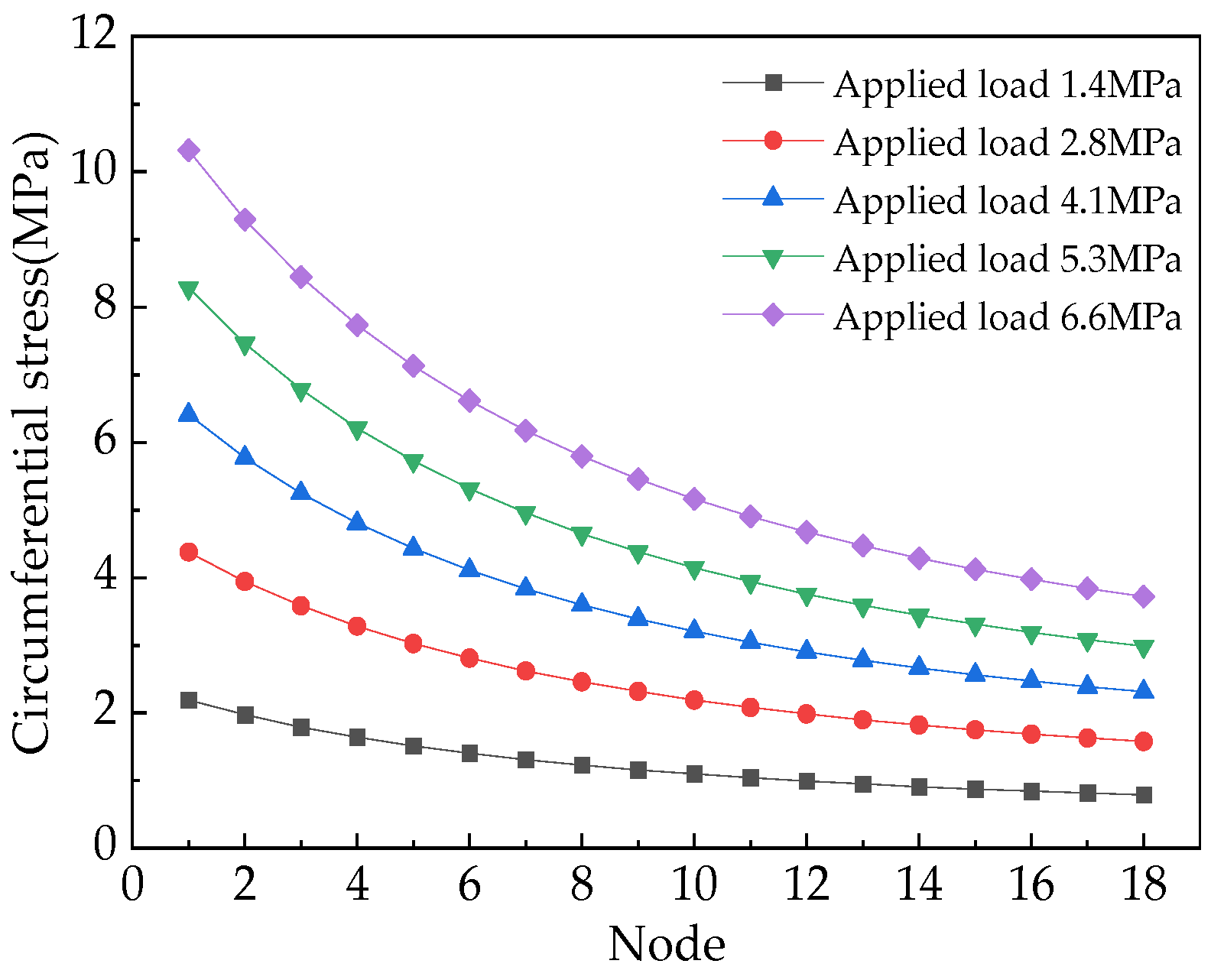
Nodes were uniformly distributed along the diameter of the thick-walled cylinder for stress evaluation. For each applied load, the radial and circumferential stresses at these node positions were computed based on the aforementioned formulation. The resulting radial stress distributions across the nodes are plotted in Figure 3 for different loads, and the circumferential stress distributions are presented in Figure 4.

2.2. Finite Element Analysis of Gear Loading

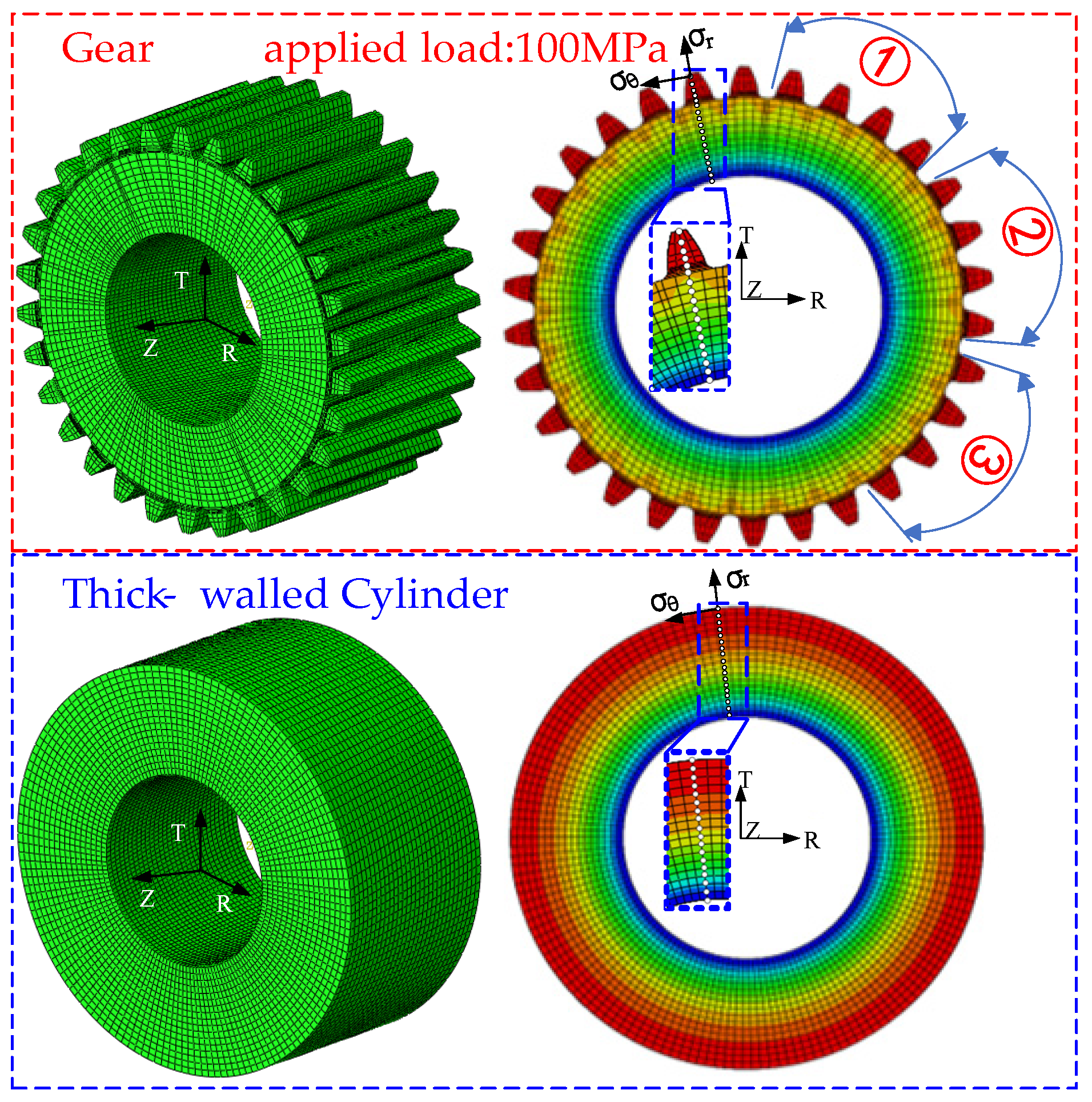
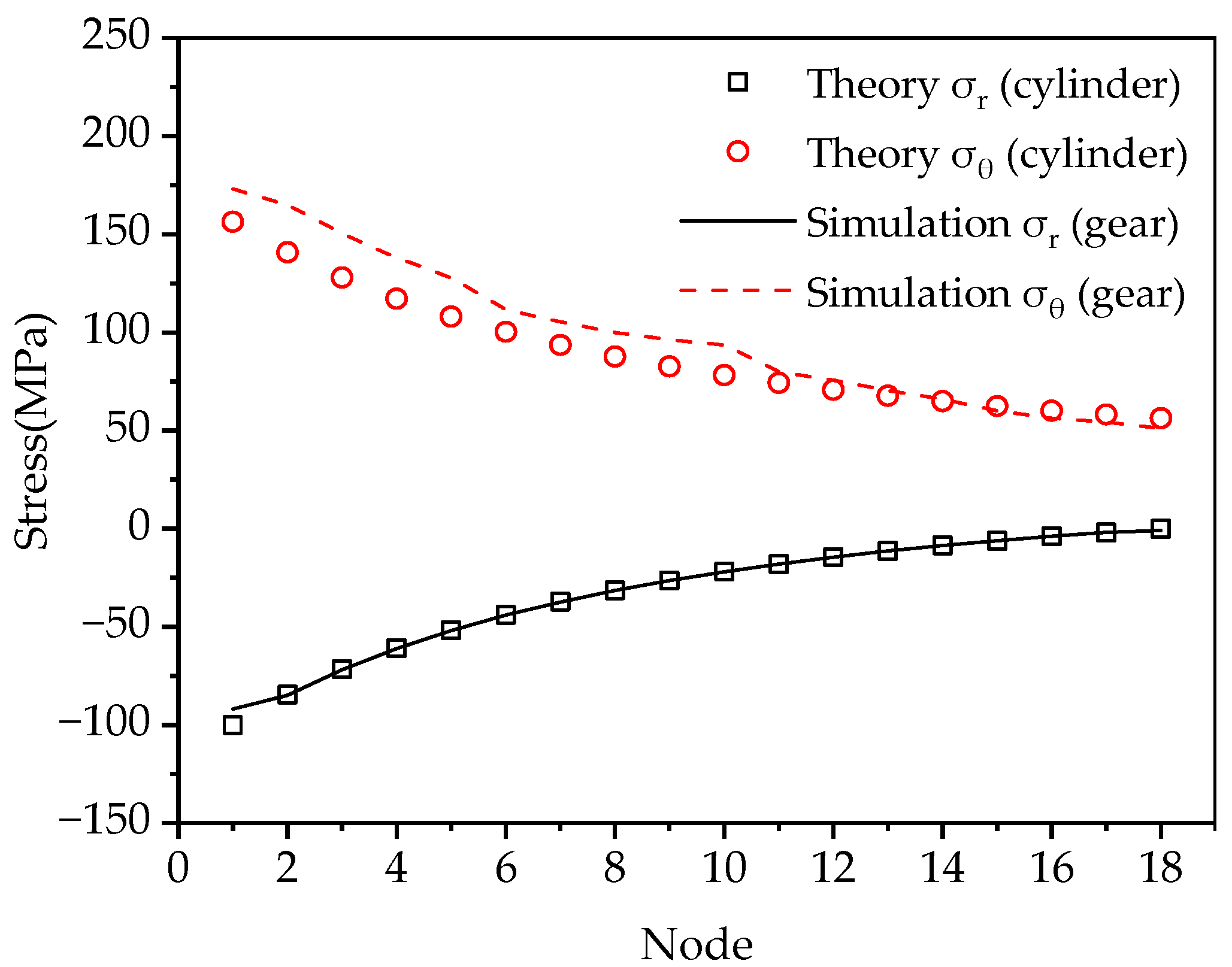
A three-dimensional model of the gear and thick-walled cylinder was established and is then simulated in Figure 5. As shown in Figure 5, the color distribution corresponds to the simulation cloud map.The dashed border distinguishes the gear from the thick-walled cylinder model, while the inner dashed line marks the region shown in the partial enlarged view. The arrows and numbers 1–3 indicate typical measurement positions for the gear common normal length. The inner and outer radii of the thick-walled cylinder correspond to the gear’s addendum circle radius and inner hole radius, respectively. The computational domain was discretized into 88,800 linear hexahedral reduced integration elements (C3D8R), with a uniform mesh size of 1 mm. The simulation results also include verification of the gear’s common normal length. In the cylindrical coordinate system, stress from equivalent nodes on both the detailed gear model and the simplified cylinder model were extracted. Subsequently, the radial and circumferential stress distributions at the corresponding nodes were compared for the detailed gear model and its simplified cylindrical counterpart. The comparison results are presented in Figure 6. The trend of the curves demonstrates that the stress distribution obtained from the simplified thick-walled cylinder model is in good agreement with that of the detailed gear model. The proposed equivalent model is suitable for gears featuring a large tooth width and rim thickness.

2.3. Experiment for Pre-Loading Gear

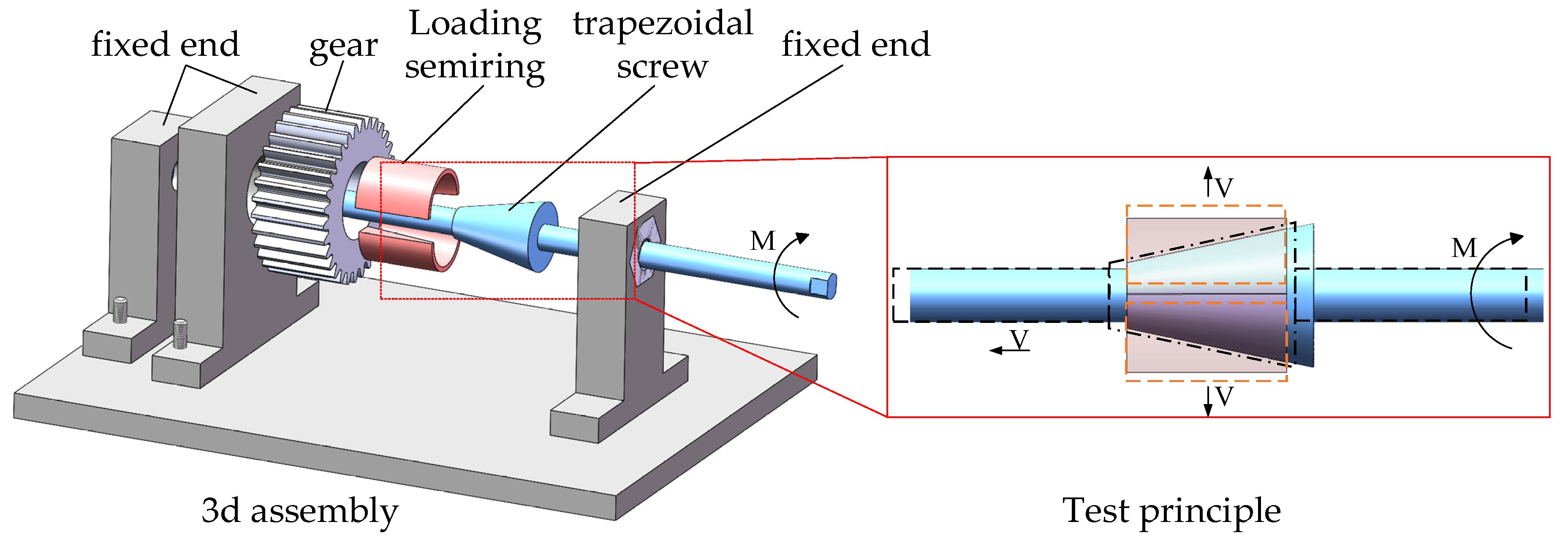
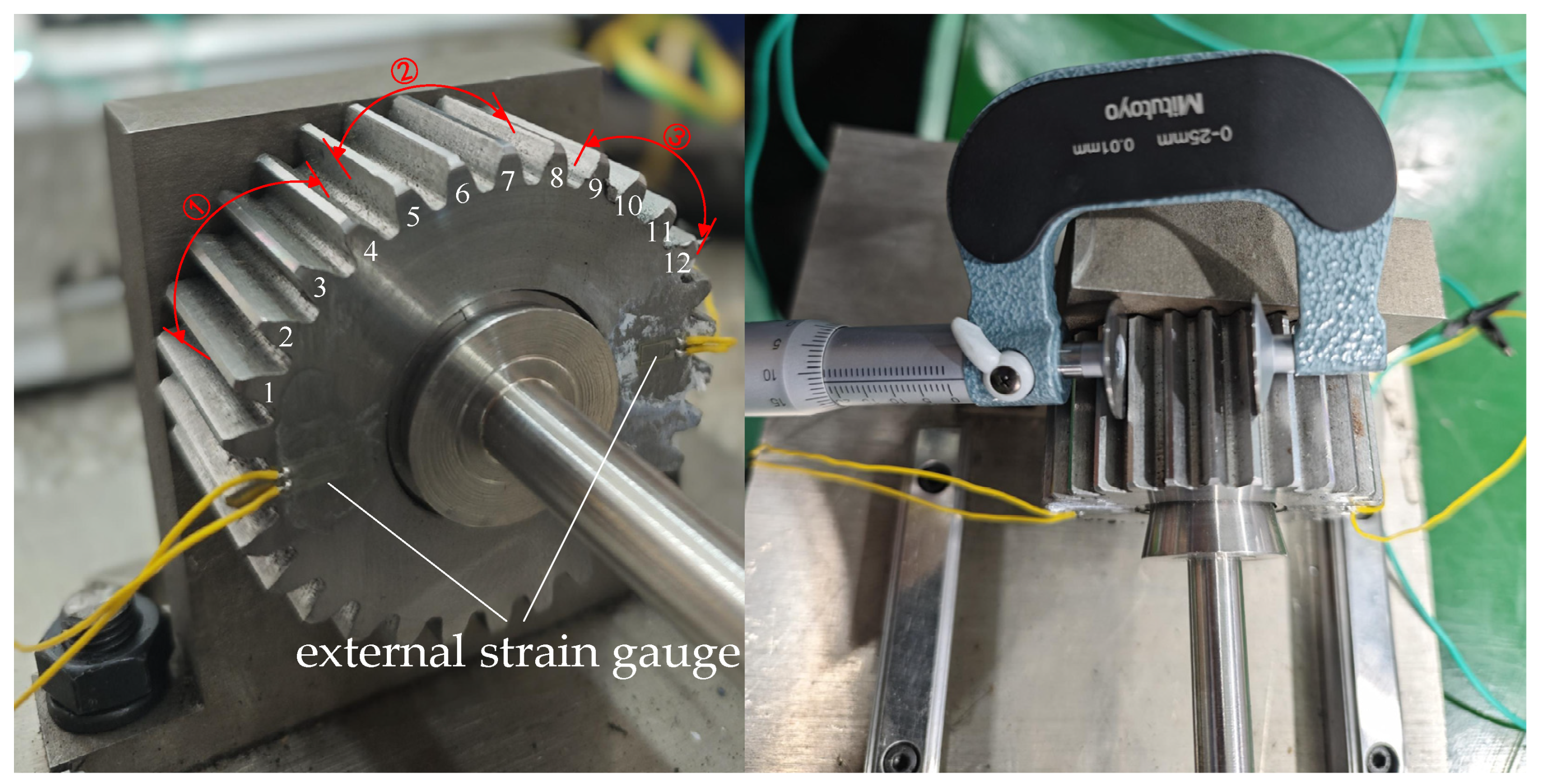
A radial loading test was designed based on the thick-walled cylinder analogy for gears. Figure 7 illustrates the 3D assembly and schematic diagram of the pre-stress loading device. The device primarily comprises a fixed end on either side, a loading semi-ring, and a trapezoidal screw, with the gear mounted at the center of the device. By applying torque to one end of the trapezoidal screw, the screw drives the loading semi-ring via a conical interface. This converts the axial motion into radial displacement acting against the gear’s inner hole, thereby applying the required radial pre-stress. The key geometric parameters of the trapezoidal screw are as follows: a major diameter of 9.97 mm, pitch of 1.51 mm, and length of 63.54 mm.
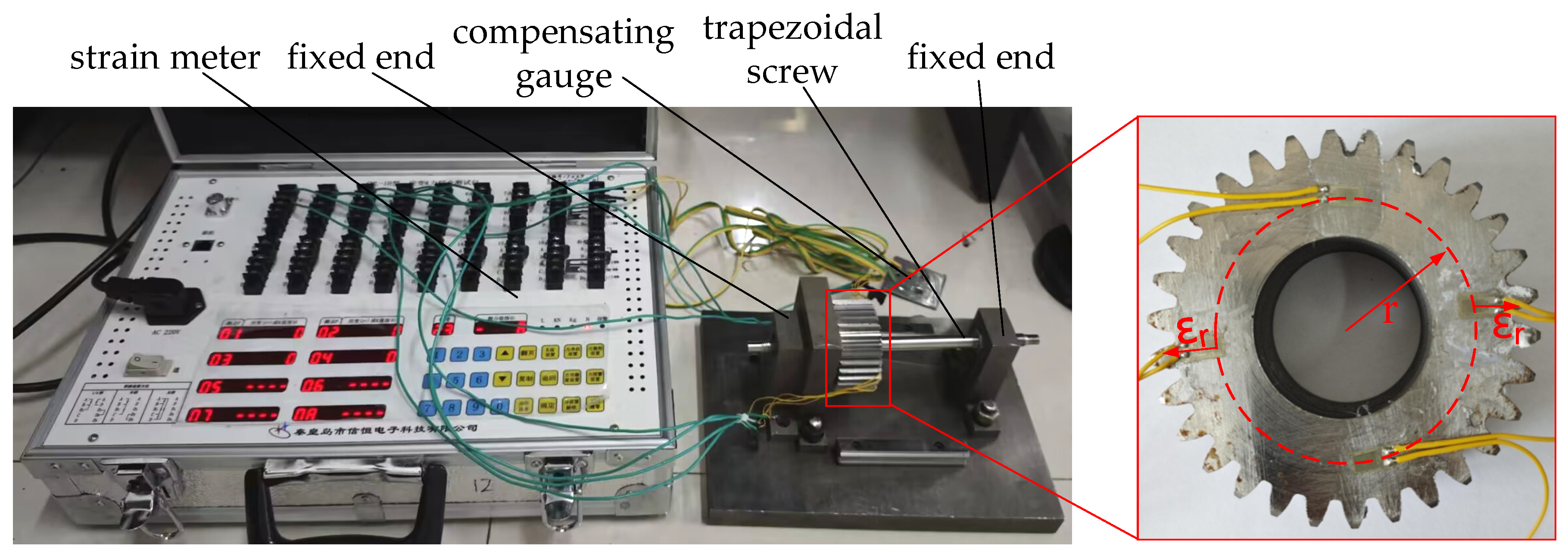
Figure 8 shows the physical test setup. To measure the induced strain, a strain gauge was attached to a circular path of radius r on the gear, and the change in strain after pre-stress loading was subsequently recorded. The strain gauge used was a foil-type model BMB120-3AA(11)-P150-W (AVIC Electrical Measuring Instruments Co., Ltd., Xi’an, China). Its key electrical parameters include a nominal resistance of 120.0 ± 0.3 Ω and a sensitivity coefficient of 2.11 ± 1%. The associated signal conditioner/measuring instrument featured a measurement range of ±25,000 με, an accuracy of 0.2% ± 2 με of the reading, a sensitivity adjustment range of 0.001–9.999, a rated test resistance for the experiment in the range of 60 Ω to 1 kΩ, and an operating voltage of 220 V ± 10% at 50 Hz.
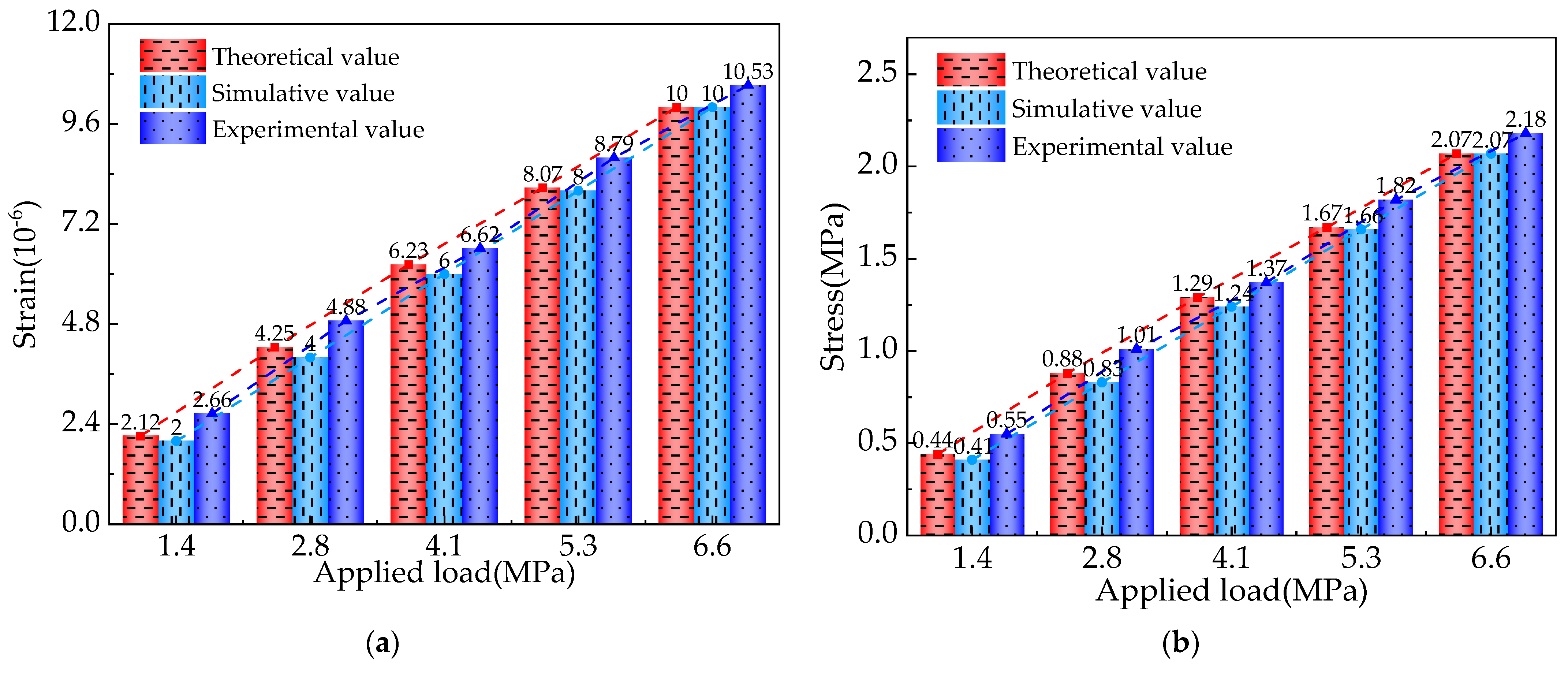
The experimentally measured strain was substituted into Equation (15) to calculate the radial stress σr at r = 22 mm. The calculated σr was then used as input for Equation (10) to determine the corresponding applied load q. A comparative summary of the experimental, theoretical, and simulation results is illustrated in Figure 9. The results indicate that with the same inner hole load, the experimental and theoretical strain values at the same location are in good agreement. The simulated stresses were underestimated because the mesh density was inadequate to accurately capture the radial and circumferential stress components at the corresponding points. Nevertheless, these discrepancies remain within an acceptable range.
σ r = E · ε r
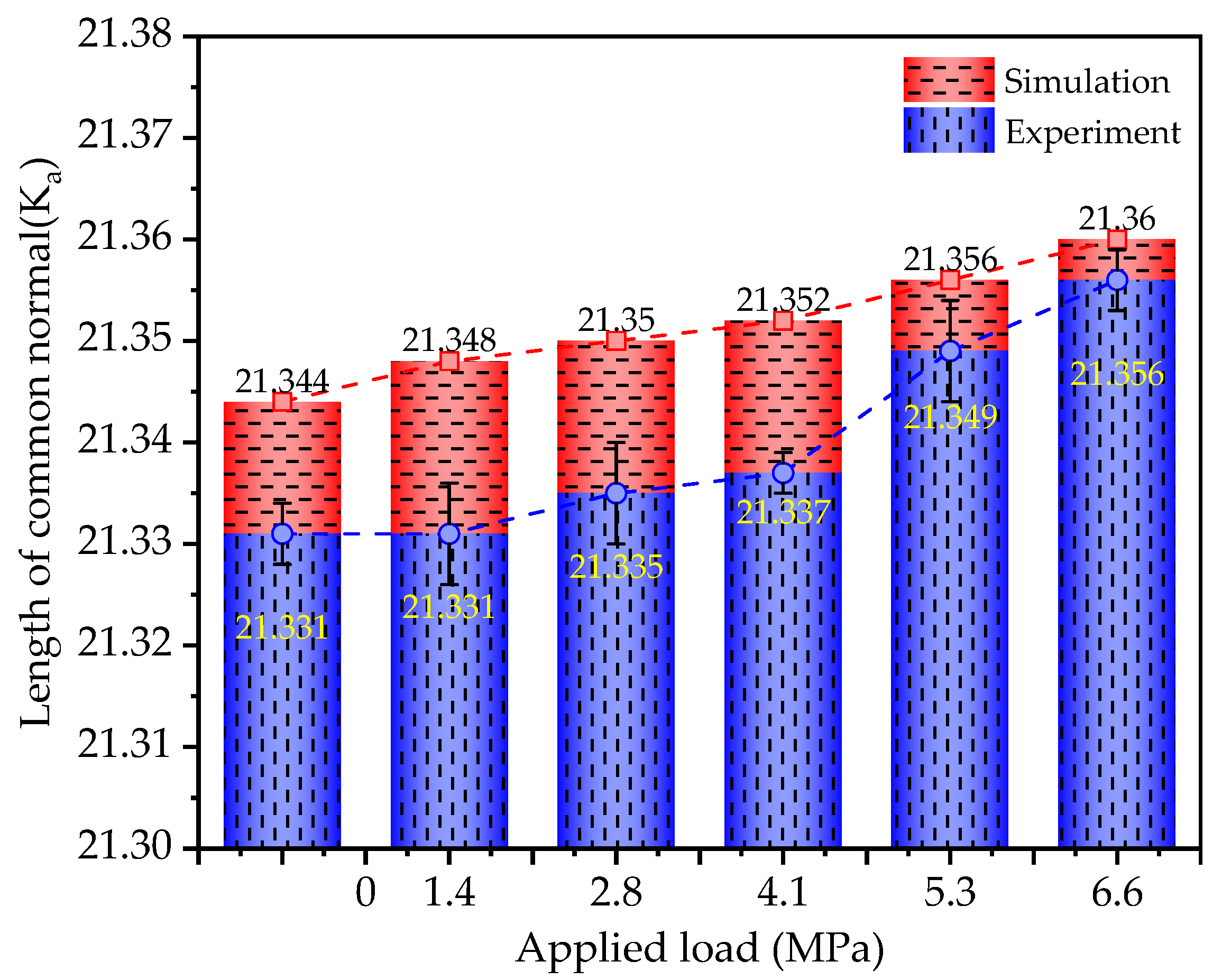
The common normal length of the test gear was measured over a span of four teeth. The procedure, illustrated in Figure 10, involved selecting 12 teeth on either side of the strain gauge location. Using a micrometer (Guangdong Seal Hardware Tools Co., Ltd., Dongguan, China), the common normal length was measured across every four teeth. This measurement was repeated three times, and the average was calculated to eliminate system error. The test and simulation results are presented in Figure 11. In Figure 11, the red and blue dashed lines represent the trends of the simulated and experimental values of the common normal length, respectively. The data show that after applying a load to the gear’s inner hole, the strain at a given point increases with the load, and the common normal length of the gear increases correspondingly. This trend is consistent with the findings in Figure 9, The red, light blue, and blue dashed lines represent the trends of the theoretical, simulated, and experimental values, respectively.

3. Grinding Simulation of a Radially Pre-Stressed Gear

3.1. Grinding Simulation Model

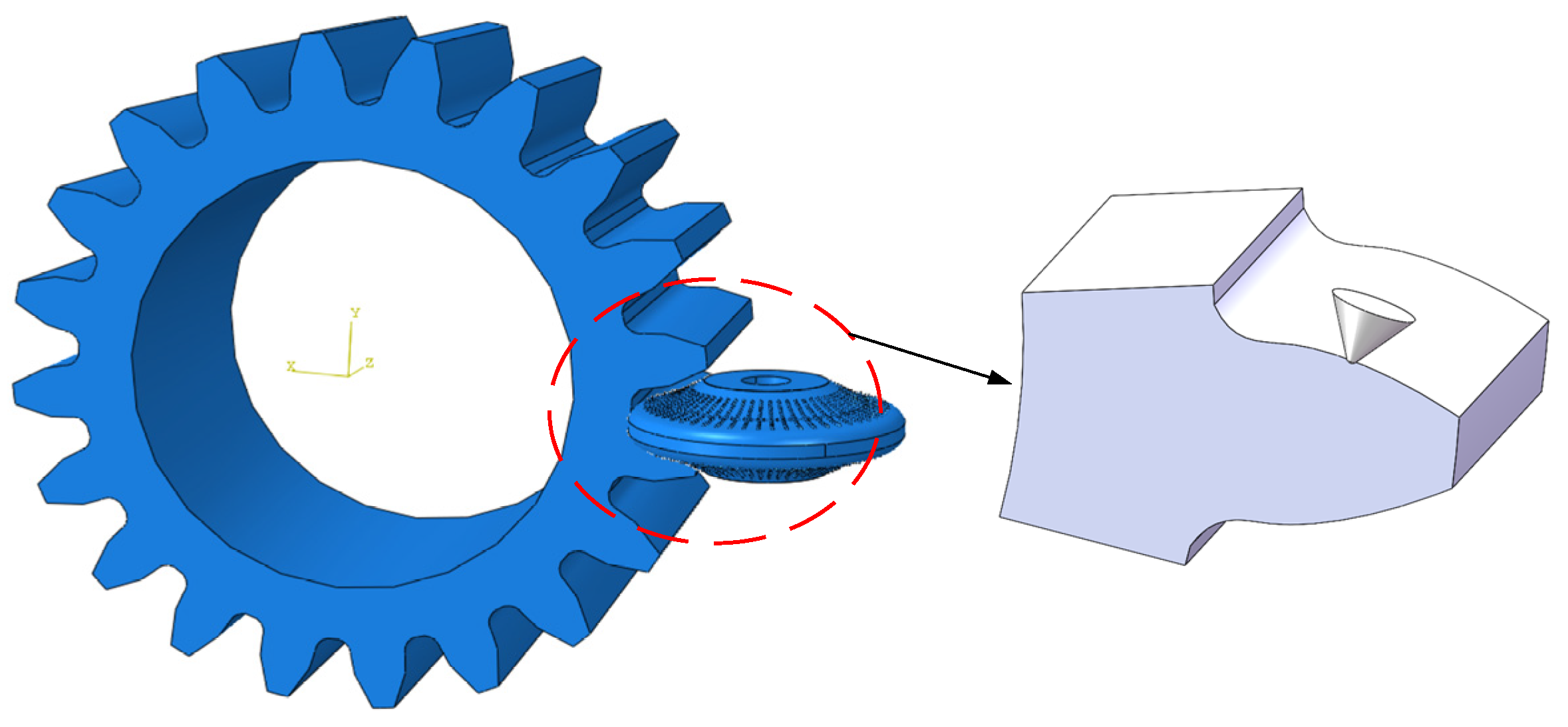
Based on the above parameters, the gear model was created in SOLIDWORKS2022. A grinding wheel was then assembled onto the gear with precise alignment. As shown in Figure 12, the red dashed circle indicates the region of local enlargement, due to the complexity of the full assembly, and considering the periodic nature and central symmetry of the gear, the simulation employs a simplified hypothesis: the working conditions are consistent for each tooth during grinding. Consequently, the simulation can be effectively performed by analyzing a single, representative gear tooth. Although numerous abrasive grains exist on the grinding wheel surface, only a subset actively participate in material removal during high-speed grinding. To significantly improve computational efficiency while maintaining accuracy, this study focuses on simulations using a single, representative abrasive grain. Research on gear grinding under multi-abrasive pre-stressed loading remains limited in the existing literature. This work proposes a pre-stressed machining method for single-abrasive gear grinding. Although single- and multi-abrasive grinding differ obviously in surface roughness, residual compressive stress and grinding force, their variation trends with influencing factors are consistent.
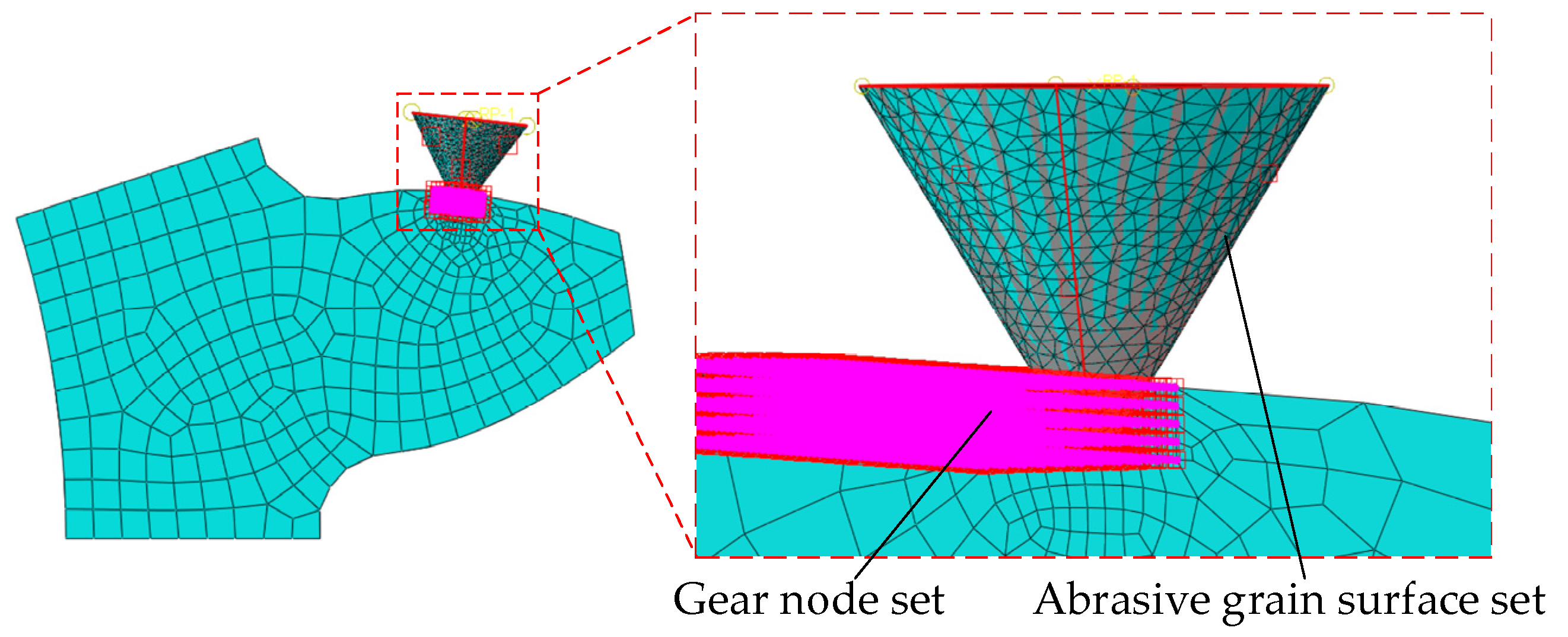
Once the metal damage constitutive model is defined, the material properties required for the static analysis are reduced to basic parameters: the density, Young’s modulus, and Poisson’s ratio of both the gear and the abrasive particle. These specific material properties are listed in Table 2. To guarantee contact simulation accuracy, the gear meshing zone is discretized into 22,260 eight-node linear hexahedral elements (C3D8RT) with a uniform size of 0.16 mm × 0.16 mm × 0.5 mm. Meanwhile, the microcrystalline corundum abrasive cutter is meshed with 12,096 ten-node quadratic tetrahedral elements (C3D10MT) at a uniform element size of 0.22 mm for the finite element grinding model. The mesh in the grinding contact zone is locally refined, and a node set is created within this region to facilitate the definition of contact interactions with the surface set of the abrasive particle. The defined node set and surface set are illustrated in Figure 13.
The finite element simulation for the grinding process comprises two key components: the constitutive model and the damage model of the workpiece material. The Johnson–Cook (J-C) constitutive model is employed, which accounts for the material’s strain hardening, strain rate strengthening, and thermal softening effects. This model is widely used to describe the mechanical behavior of metals under conditions of large deformation, high strain rates, and elevated temperatures. The J-C constitutive equation is given by the following:
σ = A + B ε 1 + C ln ε ˙ ε ˙ 0 1 T T r T m T r m
where:
A—yield strength under quasi-static conditions;
B—strain hardening coefficient;
n—strain hardening index;
C—strain rate sensitivity coefficient;
m—temperature sensitivity coefficient;
Tr—reference temperature;
Tm—melting point temperature;
ε ˙ —reference strain rate.
Metal grinding is a complex process involving significant elastoplastic deformation. The workpiece surface undergoes shear and extrusion by abrasive grains. When the fracture criterion is met, material separates from the surface, forming chips. The shear fracture criterion is based on a cumulative damage parameter; material elements are deleted once this parameter reaches unity. The critical damage for element deletion is given by the following:
D = ε ¯ P ε ¯ f p
The failure strain is given by the following:
ε ¯ f p = D 1 + D 2 e x p ( D 3 σ ) 1 + D 4 ln ε P ε 0 1 D 5 T T r T m T r m
In the above expression, ε ¯ f p is a function of the stress triaxiality σ, temperature T, and strain rate ε 0 . Here, σ is defined as σm/ ε ¯ , where σm is the mean stress and ε ¯ is the equivalent von Mises stress. The specific parameter values for the Johnson–Cook model employed in this study are listed in Table 3.
Pre-stress was introduced via a predefined field in the load module, with the static results from the initial analysis assigned as the gear’s initial state. Boundary conditions included a fixed constraint on one of the end face gear and a reference point (RP) on the abrasive particle surface for applying motion. The abrasive particle’s rotational velocity was defined for the grinding simulation. The grinding wheel linear speed is given by the following:
v   =   π d 0 n 0 1000
In the formula, v denotes the grinding wheel linear speed, m/s; d 0 is the grinding wheel diameter, mm; and n0 represents the machine tool rotational speed, r/min;
In the simulation, a grinding wheel diameter of 200 mm was used. The rotation speed was 1000, 1500, 3000, 3500, and 5000 r/min, yielding a corresponding range of linear speeds. All parameters for pre-stressed grinding simulations are summarized in Table 4.

3.2. Analysis of Surface Roughness

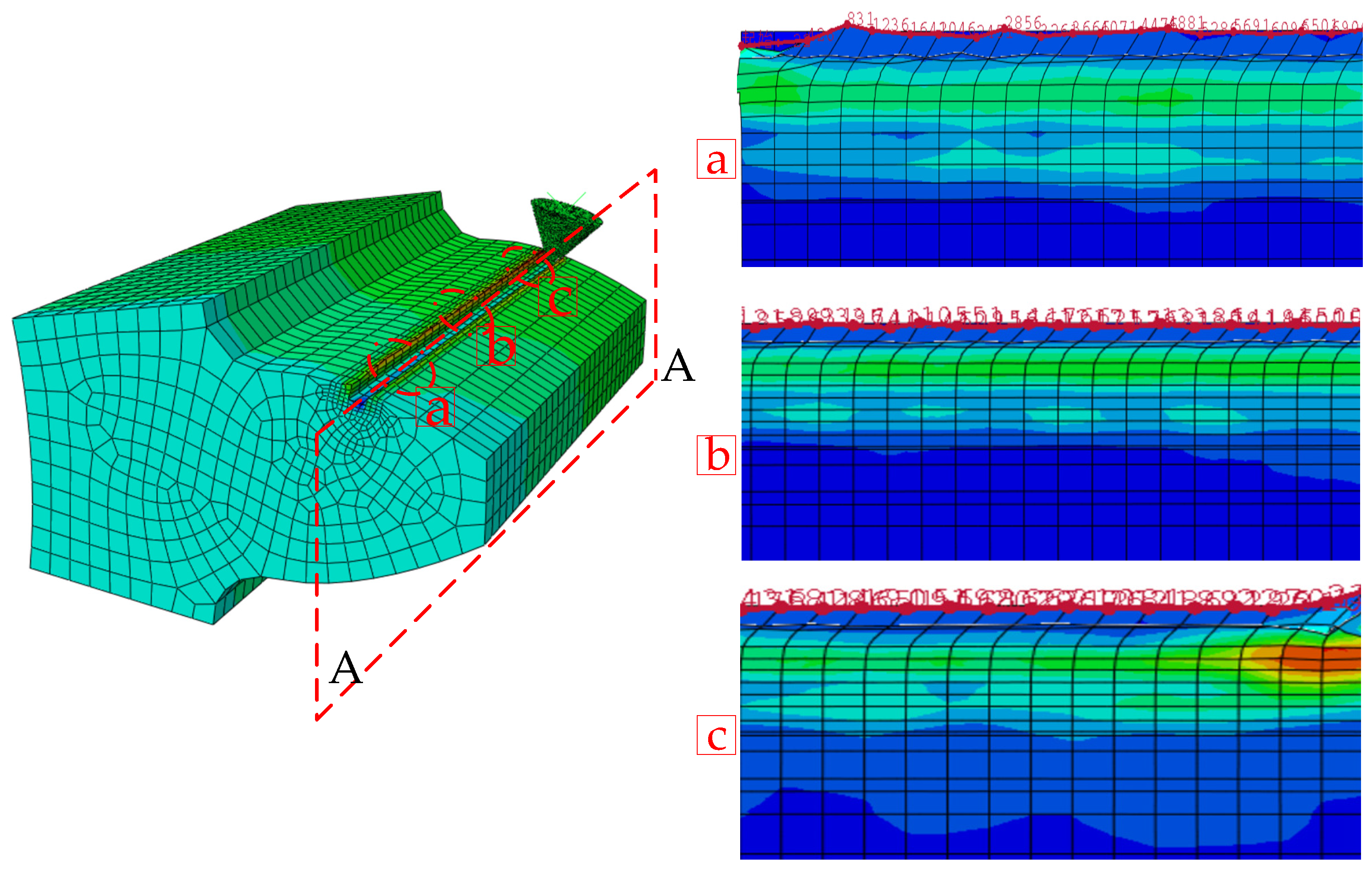
The method for calculating surface roughness is illustrated in Figure 14. In Figure 14, A denotes the dashed-line profile, whereas a, b, and c represent the initial, stable, and exit grinding zones, respectively. The different colors correspond to the simulation cloud map. Following the established analysis, cross-section A-A in the grinding zone is selected for evaluation. Along this section, key regions—the grinding entry, stable grinding, and grinding exit zones—are defined sequentially. The nodal displacements within these zones (a, b, and c) are extracted and used to compute the surface roughness. The calculation formula is as follows:
R a = 1 n Z i
The arithmetic mean of Ra obtained from the three sections is adopted as the resultant surface roughness for the simulation, utilizing Equation (19).
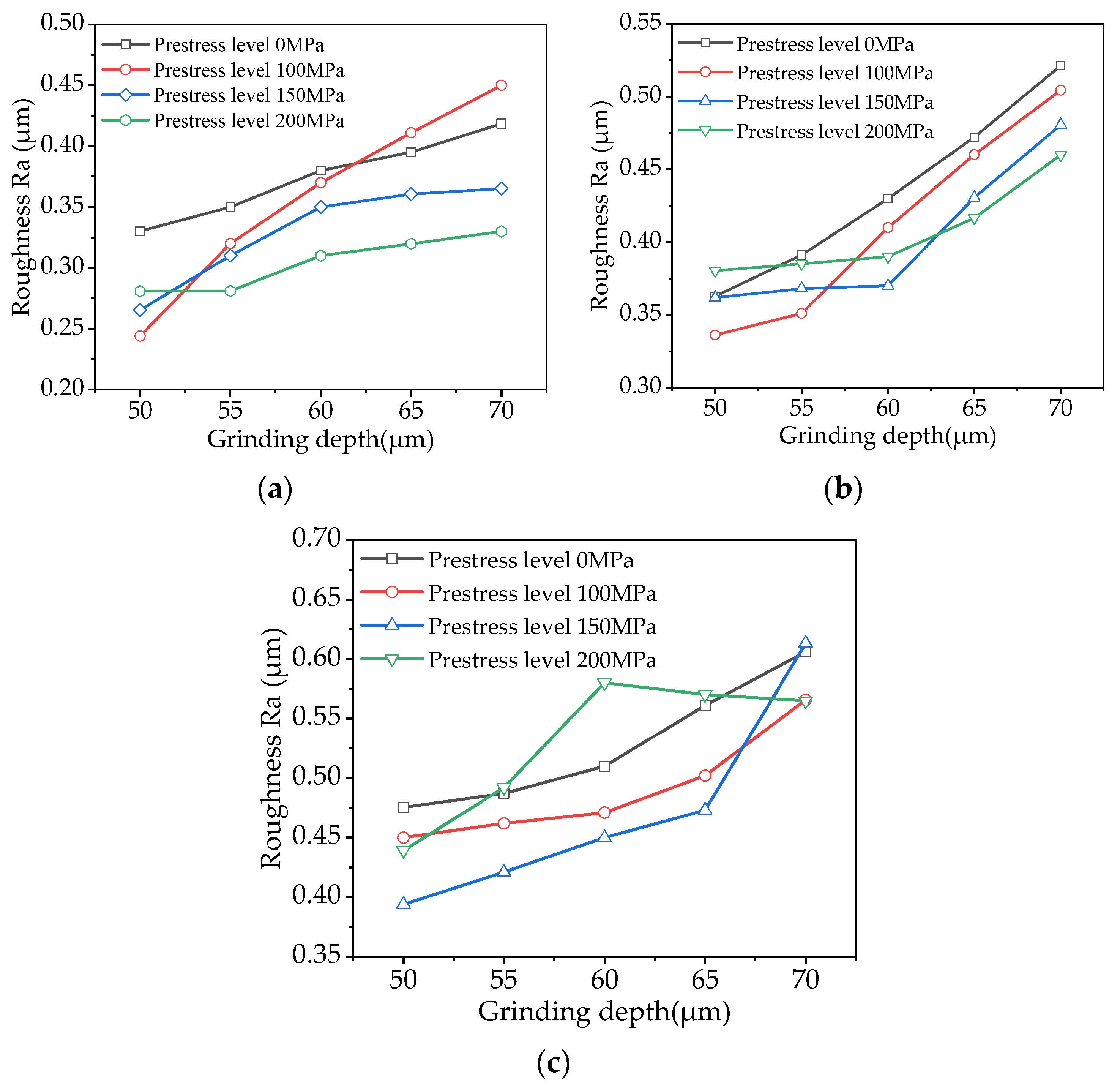
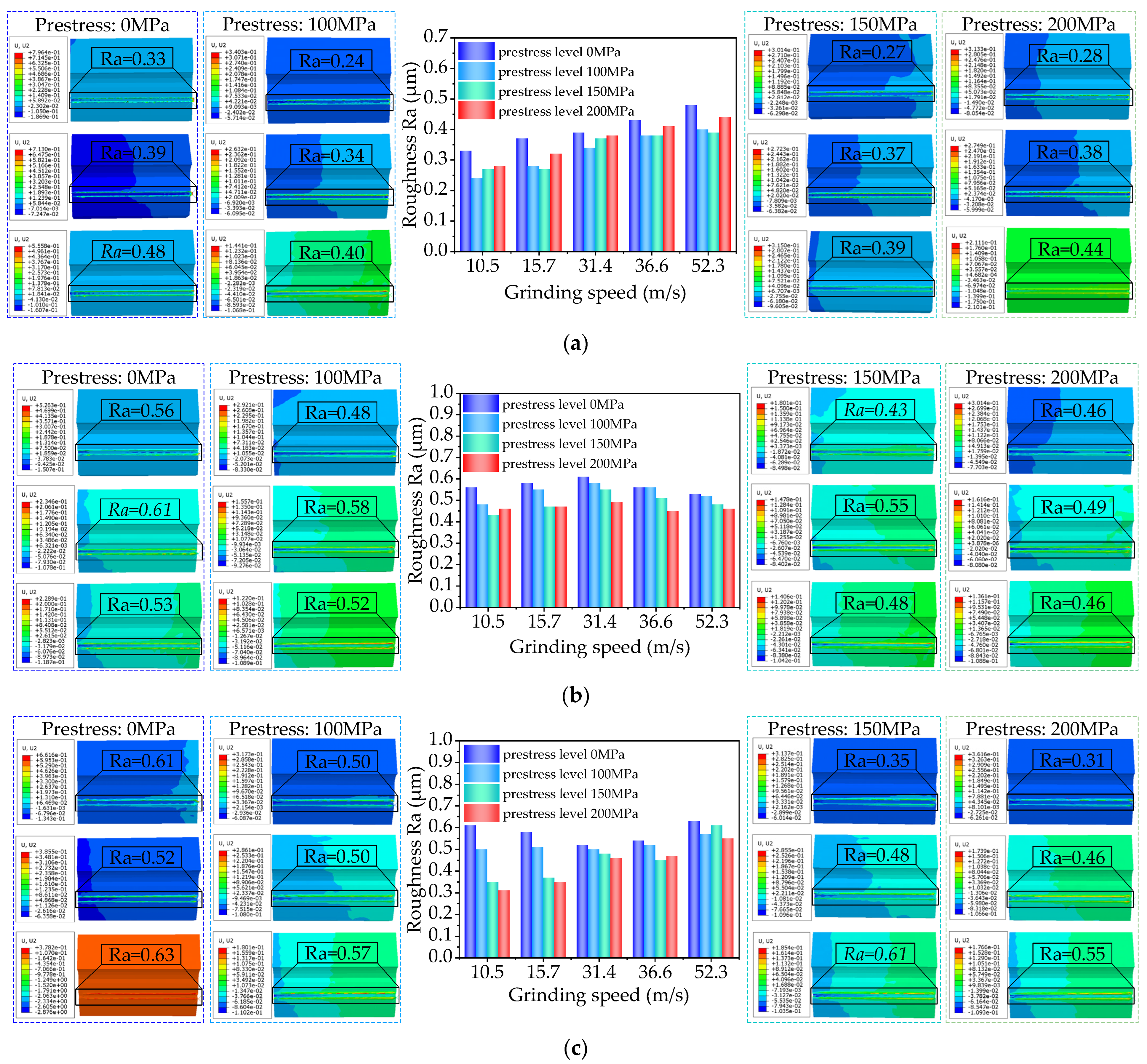
According to the influencing factors identified in previous studies [32,33], residual compressive stress is correlated with grinding speed and grinding depth. Figure 15a–c present the relationship between surface roughness and grinding speed at fixed depths of 50 μm, 60 μm, and 70 μm, respectively. The results show that surface roughness increases with grinding speed at a constant depth. This trend can be attributed to the reduced interaction time between individual abrasive grains and the workpiece at higher speeds, which decreases the effective grinding length per grain. Concurrently, the number of active abrasive grains changes. These factors promote the rapid generation and accumulation of abrasive debris on the machined surface. Macroscopically, this manifests as increased roughness and degraded surface quality. Furthermore, as evidenced in Figure 15a–c, surface roughness increases with grinding depth. However, the application of a pre-stress load during grinding was found to significantly reduce surface roughness, thereby markedly improving final surface quality.
Figure 16 illustrates the relationship between surface roughness and grinding depth at different grinding speeds. As shown in Figure 16a–c, surface roughness increases monotonically with grinding depth when the speed is held constant. Conversely, the application of graded pre-stress loading consistently reduces surface roughness. These results confirm that applying pre-stress within an appropriate range can effectively improve ground surface quality, which is expected to enhance both the operational accuracy and service life of the component.

3.3. Analysis of Residual Compressive Stress

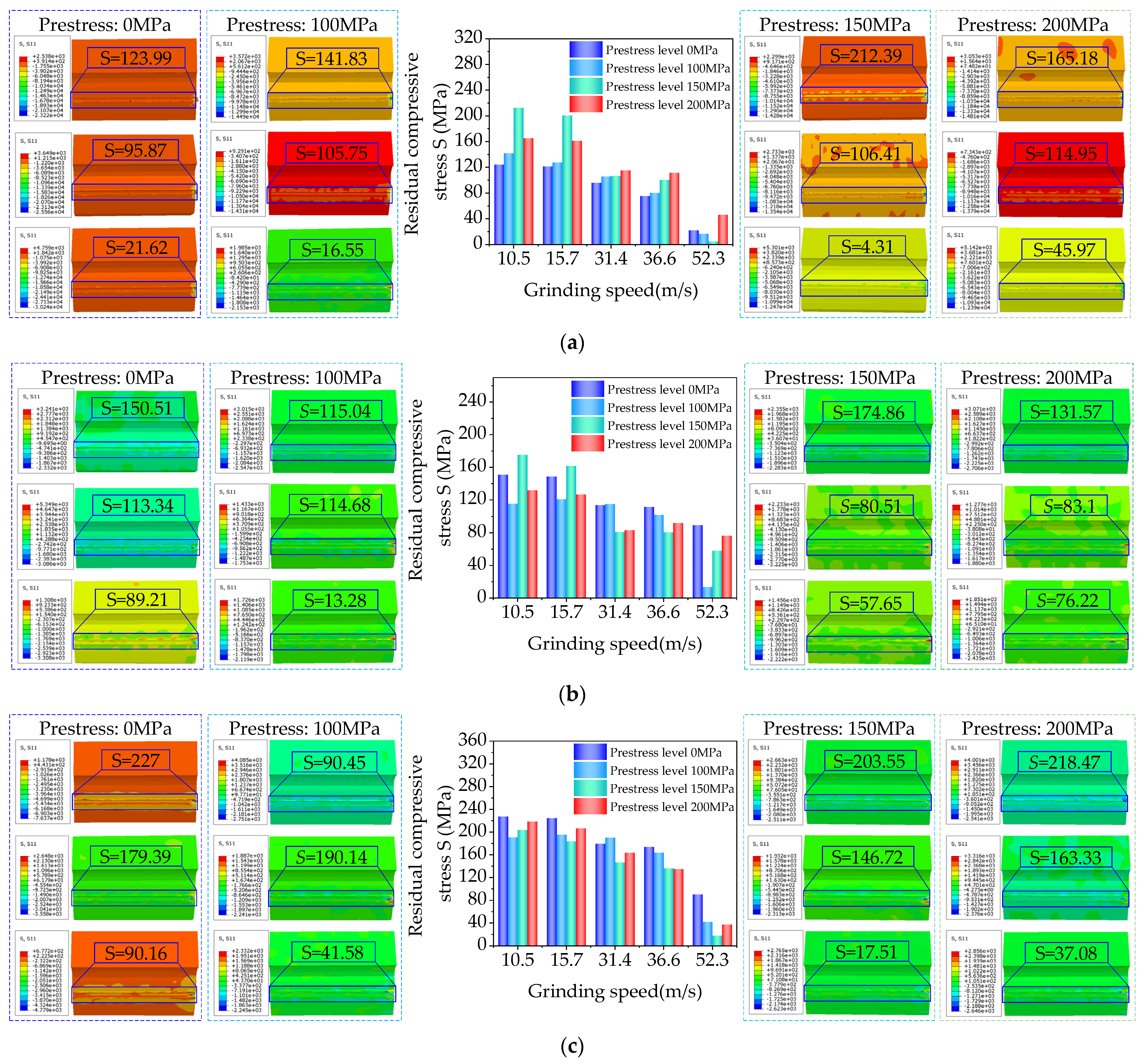
Residual compressive stress is closely correlated with grinding speed and depth, as reported in previous studies [34]. Figure 17a–c show the trend of how residual compressive stress changes with grinding speed under different grinding depths. When the grinding depth is determined, the trend in the absolute value of the residual compressive stress will change in contrary to the increase in grinding speed, thereby reducing residual compressive stress to a rather low level. However, in the case of ap = 60 μm in Figure 17b, continuing the pre-stress while confirming a steady speed can greatly boost residual compressive stress. As the pre-stress keeps rising, some fluctuations are expected in the trend, advocating further optimization. Actually, the optimal pre-stress is essential for the optimal residual compressive stress.
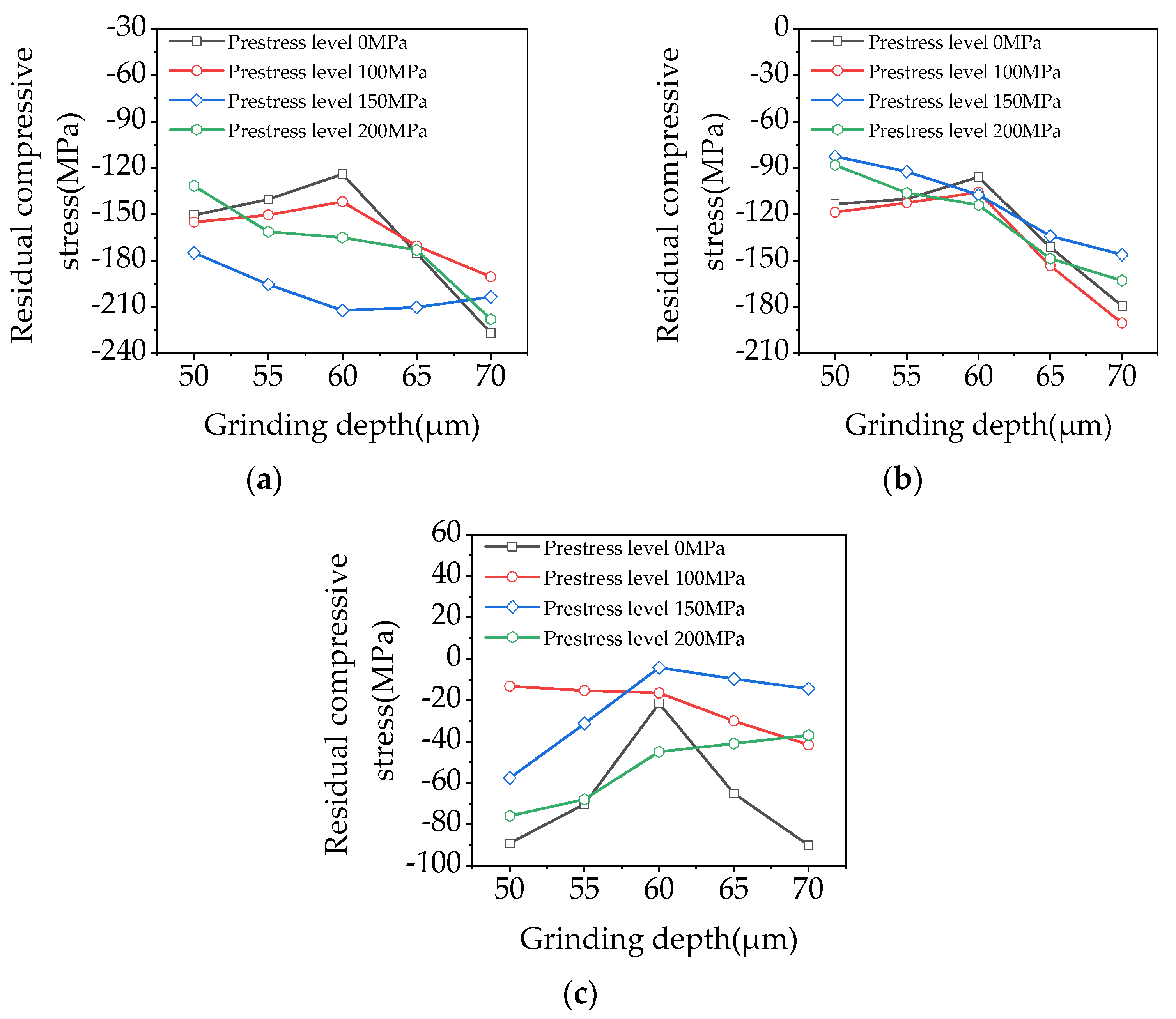
Figure 18 presents the correlation between residual compressive stress and grinding depth at varied grinding speeds. As the grinding depth increases, the magnitude of residual compressive stress exhibits a consistent upward trend across all speed conditions. Comparing Figure 18a–c, it can be observed that at excessively high grinding speeds, the residual compressive stress profile demonstrates notable fluctuation, initially decreasing before ultimately rising again. Moreover, under shallow grinding depths, the application of pre-stress loading results in a marked improvement in residual compressive stress opposed to conventional grinding without any pre-stress.

3.4. Analysis of Simulated Grinding Forces

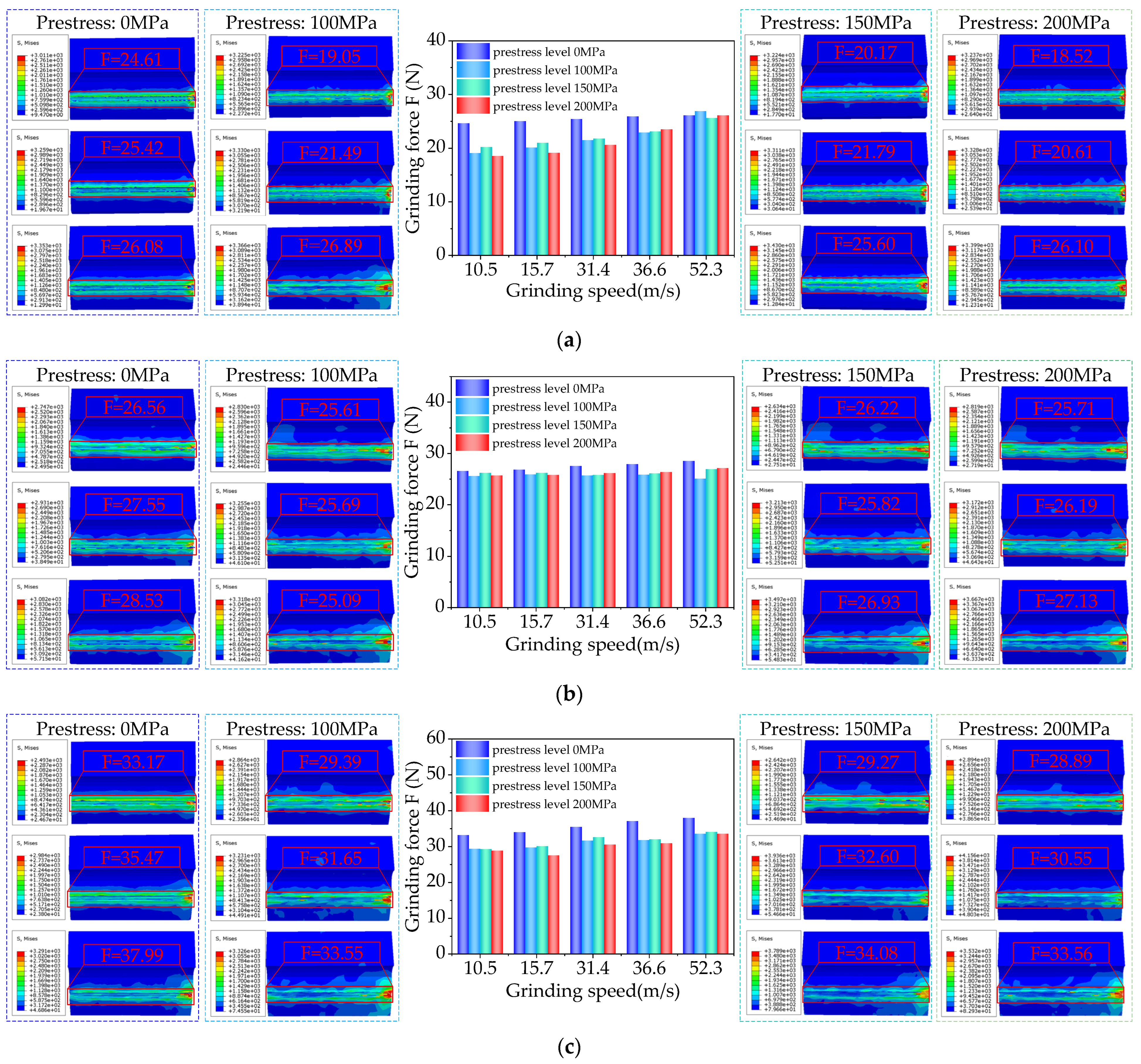
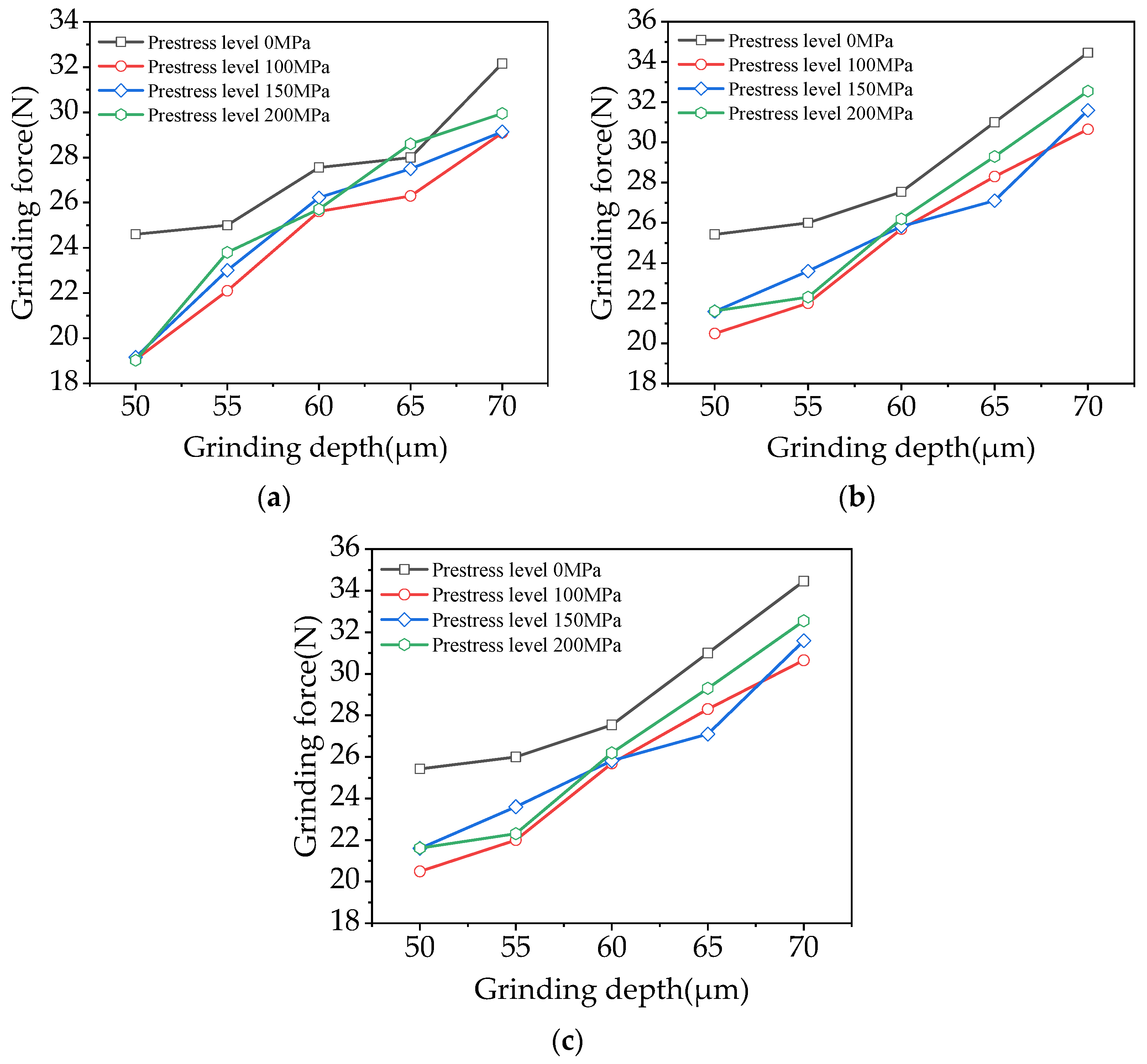
Grinding force is closely dependent on grinding speed and depth, which is consistent with the findings of previous studies [35]. Figure 19 illustrates the variation in grinding force with grinding speed at different grinding depths, while Figure 20 shows the variation in grinding force with grinding depth at different grinding speeds. Overall, the grinding force increases with higher grinding speeds or greater grinding depths, though the rate of increase is relatively moderate. Furthermore, under the application of pre-stress, the grinding force is consistently reduced within a certain range. This reduction contributes significantly to the improvement in grinding efficiency.

4. Optimization of Grinding Parameters for Radially Pre-Stressed Gears

Response surface methodology (RSM) is an experimental design technique used to optimize predefined objectives. This method primarily includes the Central Composite Design and the Box–Behnken Design. In this study, the grinding process involves three factors at multiple levels, pre-stress magnitude, grinding depth, and grinding speed, making it well-suited for the Box–Behnken Design. Simulation analysis indicates that applying an appropriate level of pre-stress can improve post-grinding surface roughness and residual compressive stress while reducing the grinding force. However, the interaction and connection among these parameters have not been fully understood, and excessive pre-stress may adversely affect the grinding outcomes. Based on the aforementioned analysis, the design variables and their levels for the pre-stressed grinding process are defined in Table 5. To minimize the number of design points while ensuring the accuracy of the response surface model, this study employed data analysis software to generate sampling points. An experimental design based on a three-level Box–Behnken structure was established, comprising a total of 17 sampling points. The design matrix for the response surface test is presented in Table 6.
Surface roughness (R1), residual compressive stress (R2), and grinding force (R3) are critical indicators for evaluating post-grinding surface integrity and process efficiency. To ensure superior gear performance and reliable service life, it is desirable to minimize surface roughness after grinding. Residual compressive stress influences the fatigue strength of the ground surface; meanwhile, variations in grain size can also indirectly affect surface roughness. Accordingly, the optimization objective for residual compressive stress is to maximize its absolute value. Grinding force, which reflects the kinematic trajectory and engagement of abrasive grains during material removal, should be minimized to enhance process stability and efficiency. Therefore, the overall optimization aims to achieve lower surface roughness, higher compressive residual stress, and reduced grinding force.

4.1. Response Surface Analysis

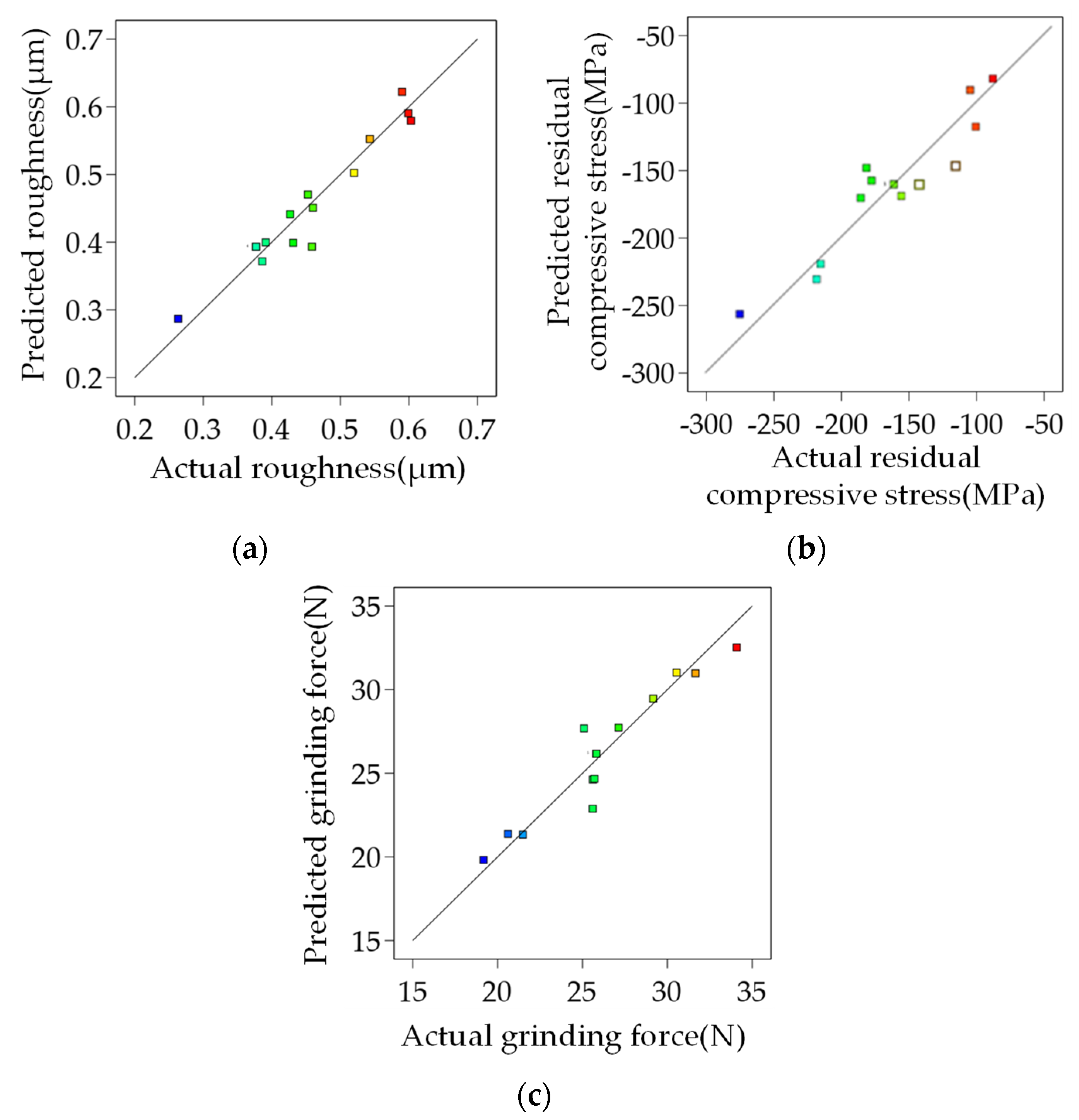
The Analysis of Variance (ANOVA) module built in the data analysis software was employed to assess the goodness-of-fit between the response surface models and the experimental sampling points. Key statistical indicators intended for evaluation include the p-value, R2 (coefficient of determination), adjusted R2, predicted R2, and the signal-to-noise ratio. A well-fitted model is generally expected to satisfy the following five criteria: (1) a p-value of less than 0.05, indicating the statistical significance of the model; (2) an R2 value greater than 0.9, demonstrating a good fit; (3) a difference of less than 0.2 between the predicted R2 and adjusted R2, which verifies the model’s accuracy and predictive capability; (4) a signal-to-noise ratio greater than 4, confirming adequate model discrimination; and (5) actual response values versus predicted ones that align closely along a 45° reference line in a scatter plot. The ANOVA results for the three response surface models—surface roughness, residual compressive stress, and grinding force—are summarized in Table 7. In Figure 21, the differently colored squares represent the different response variables. Figure 21 illustrates the correlation between the actual and predicted values for these models, where the data points are distributed closely around the 45° line within the coordinate system, confirming strong predictive performance.
The quadratic regression models for the three response surfaces are presented in Table 8. The equations for surface roughness, residual compressive stress, and grinding force each incorporate linear terms (A, B, C), interaction terms (AB, AC, BC), and quadratic terms (A2, B2, C2).

4.2. Interaction Effects of Key Grinding Parameters on Post-Grinding Quality

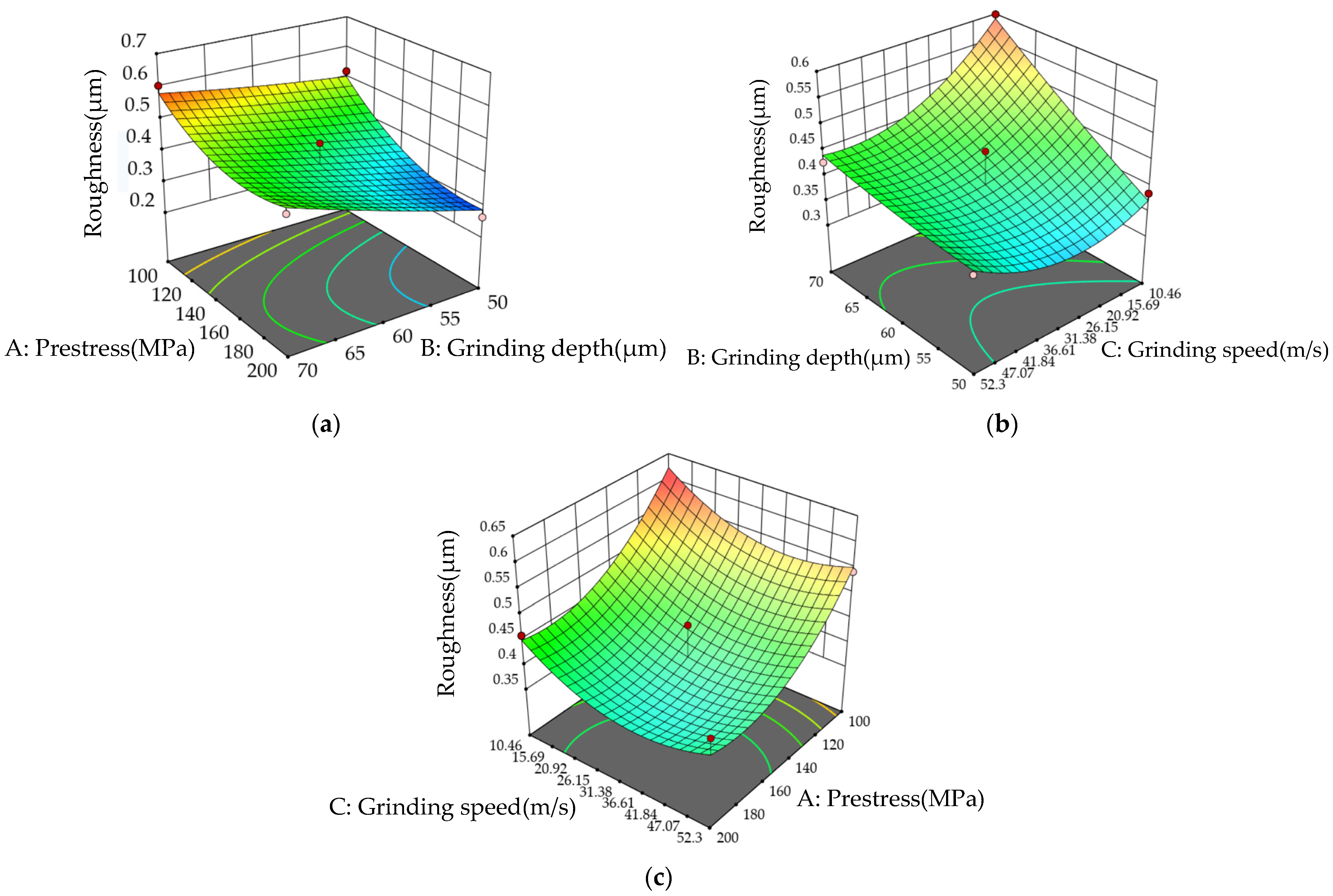
In Figure 22, the color changes from blue to red with a continuous increase in the corresponding response value. Points on the same contour line have the same predicted response value, and the circles represent the experimental data points. Figure 22 presents the interactive effects of various grinding parameters on surface roughness. In Figure 22a, with the grinding speed held constant at 31.4 m/s, surface roughness is observed to decrease as grinding depth and applied pre-stress increase. Conversely, Figure 22b shows that under a constant pre-stress of 150 MPa, surface roughness follows the increasing trajectory with both grinding depth and grinding speed. Finally, the interaction between grinding speed and pre-stress is illustrated in Figure 22c, where surface roughness decreases as the pre-stress surges.
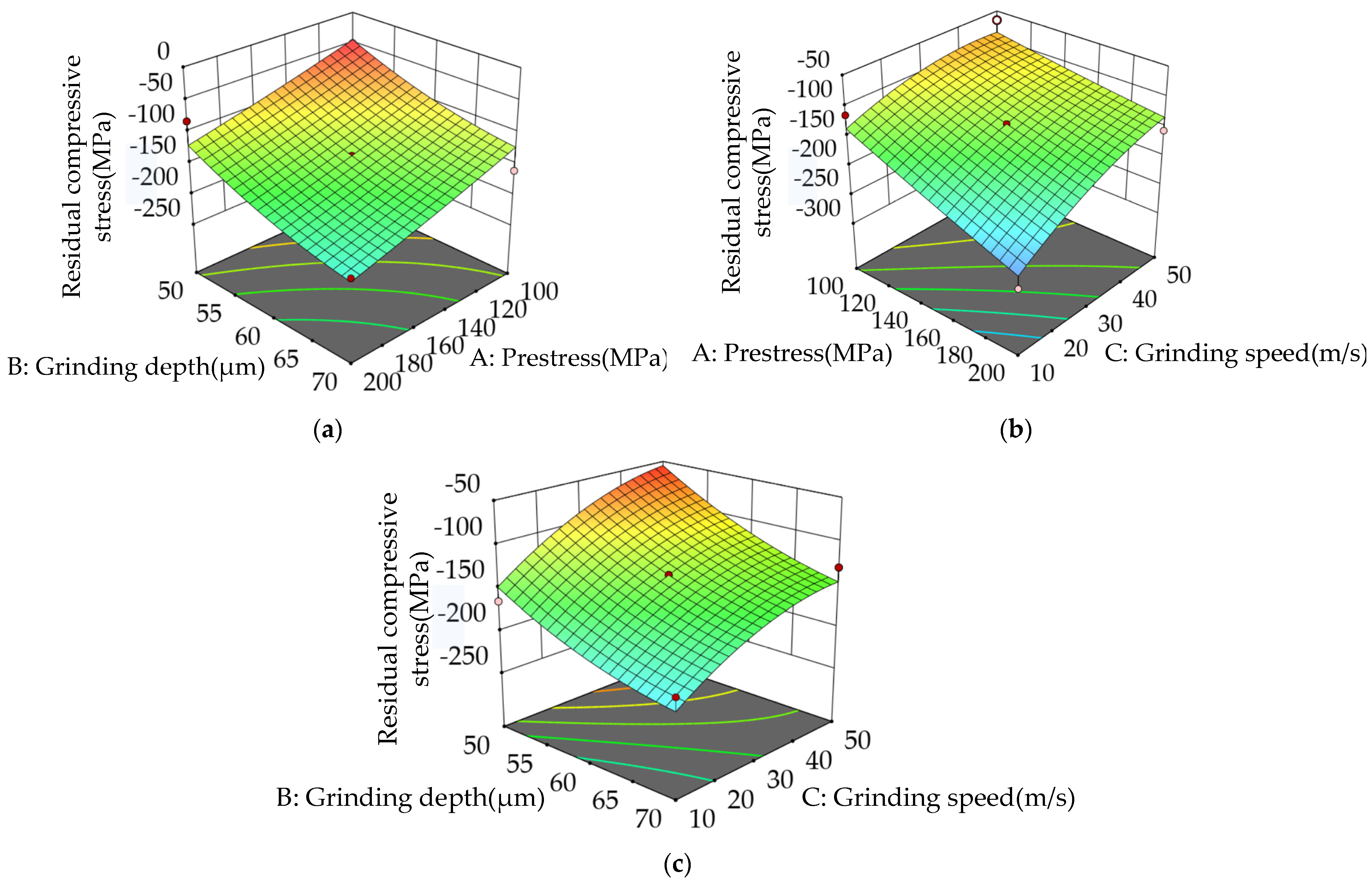
In Figure 23, the color changes from blue to red with a continuous increase in the corresponding response value. Points on the same contour line have the same predicted response value, and the circles represent the experimental data points. Figure 23 illustrates the interactive effects of parameter pairs on the magnitude of residual compressive stress. In Figure 23a, with the grinding speed held steady, the magnitude increases with both applied pre-stress and grinding depth. Figure 23b shows that at a fixed grinding depth, the magnitude decreases with grinding speed but increases with pre-stress. Finally, Figure 23c indicates that under constant pre-stress, the magnitude decreases with grinding speed yet increases with grinding depth.
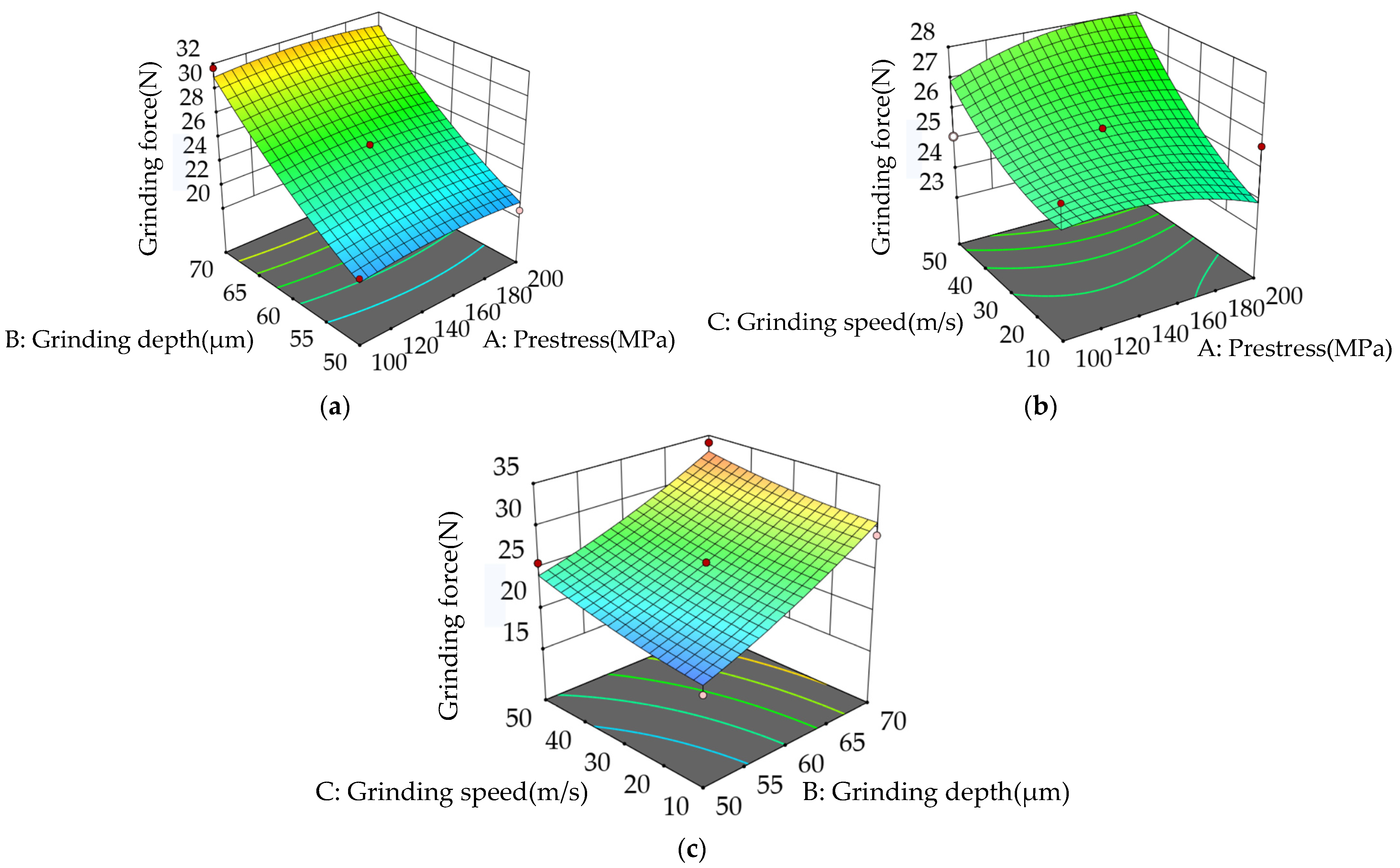
In Figure 24, the color changes from blue to red with a continuous increase in the corresponding response value. Points on the same contour line have the same predicted response value, and the circles represent the experimental data points. Figure 24 illustrates the interaction effects of parameter pairs on grinding force via response surface analysis. In Figure 24a, with the grinding speed held constant, grinding force shows a minor variation with pre-stress but a clear increase with grinding depth. Figure 24b indicates that the interaction between pre-stress and grinding speed results in only a gradual, non-dramatic increase in grinding force. Figure 24c demonstrates that under constant pre-stress, the force increases with both grinding depth and speed, with grinding depth exhibiting a more pronounced influence.

4.3. Grinding Parameter Optimization

The optimization module integrated in the data analysis software was employed to define the objectives and constraints based on the three established response surface functions. Subsequently, the three response objectives were normalized to the same order of magnitude to conduct comprehensive optimization of the processing parameters for single-abrasive-grain gear grinding under radial pre-stress loading.
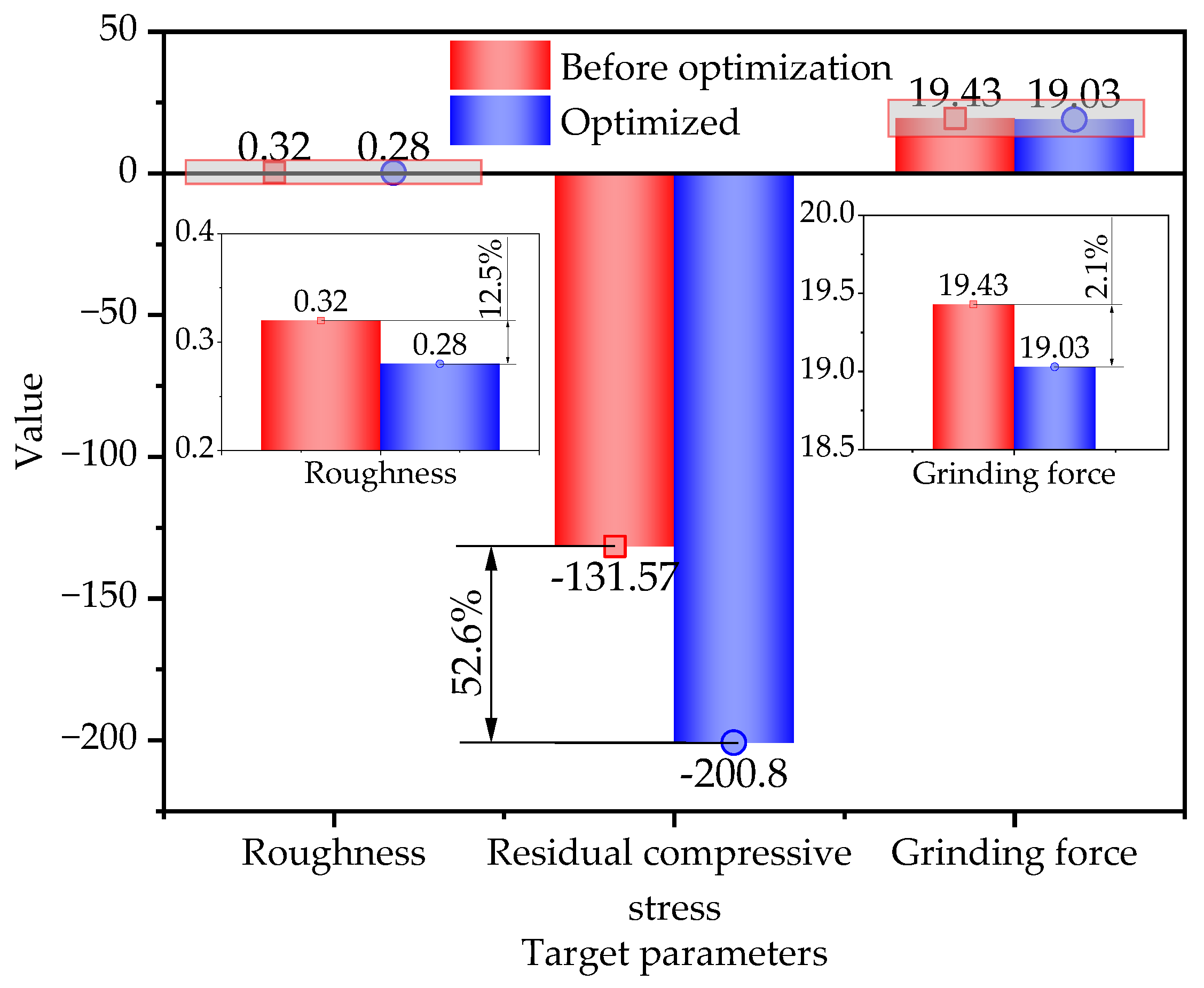
The optimal parameter set and corresponding outcomes are presented in Figure 25. In Figure 25, the red squares and blue circles represent the pre-optimization and optimized values of surface roughness, residual compressive stress, and grinding force, respectively. Specifically, an applied pre-stress of 172.55 MPa, a grinding depth of 50 μm, and a grinding speed of 32.63 m/s yielded an optimized surface roughness of 0.28 μm, a residual compressive stress of 200.80 MPa, and a grinding force of 19.03 N. The relative errors between the initial simulation values and optimized values for surface roughness, residual compressive stress, and grinding force were 12.5%, 52.6%, and 2.1%, respectively. The magnitude of the error correlates with the effectiveness of optimization, with a larger error indicating a more significant improvement potential. All three response metrics met the optimization targets, acknowledging residual compressive stress as the foremost incentive for the pronounced enhancement.

5. Radial Pre-Stress Loading in Gear Manufacturing: Standards and Implementation Mechanisms

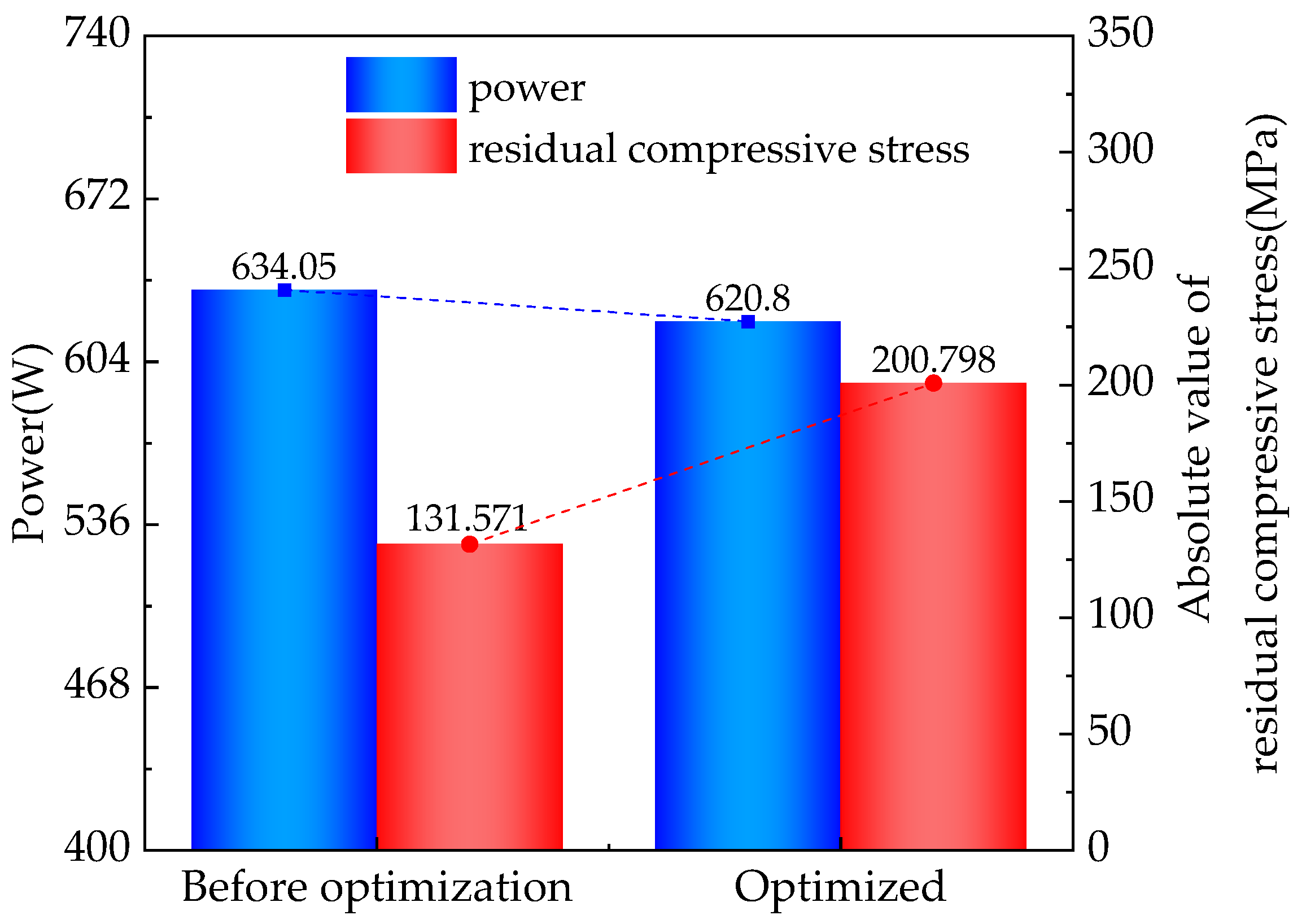
Improving gear surface quality contributes directly to the achievement of the dual carbon goals in the machinery industry. Adopting radial pre-stress during gear manufacturing effectively reduces surface roughness, thereby enhancing surface quality. This improvement promotes better meshing between gears during operation, helps prevent fractures and other damage caused by surface imperfections, reduces energy consumption, extends service life, and ultimately facilitates energy conservation and efficiency improvement. Enhancing the residual compressive stress and reducing the grinding force of gears is critical to achieving the dual carbon goals in the machinery industry [36,37]. To this end, applying radial pre-stress during gear manufacturing proves effective, as it simultaneously improves residual compressive stress and reduces grinding force. These improvements not only optimize gear meshing performance during operation but also mitigate the risk of gear fracture and other surface-defect-induced failures by virtue of elevated residual compressive stress. According to the formula P = Fv, a reduction in grinding force under a constant rotational speed decreases power demand, thereby lowering energy consumption and extending component service life. Figure 26 compares the power and absolute value of residual compressive stress before and after optimization. In Figure 26, the blue and red dashed lines indicate the trends of power consumption and the absolute value of residual compressive stress, respectively. As gears are key components widely used in mechanical transmission institutions, the broader adoption of radial pre-stress technology in gear manufacturing—and the resulting enhancement in surface quality—requires targeted institutional support to facilitate its technological transformation and industry-wide implementation.

5.1. Institutional Measures to Enhance Gear Surface Quality to Support Dual Carbon Goals

Firstly, provisions related to the application of radial pre-stress in gear manufacturing should be integrated into the national green and low-carbon development standard institution. In March 2026, the Ecological Environment Code promulgated by the People’s Republic of China stipulates that the state shall promote the establishment of a standard institution in the ecological and environmental field, strengthen inter-departmental coordination among standards, and reinforce their supporting role in environmental protection. As a technological innovation that contributes to ecological protection, energy saving, and low-carbon development, radial pre-stressed gear manufacturing should be incorporated into this environmental standard framework—a fundamental prerequisite for its widespread technological transformation. Currently, China has established numerous national and industrial standards for gears, covering fields including high-speed gear transmissions, industrial enclosed gear drives, and rotary planetary gear institutions. To advance the sector’s decarbonization, the application of radial pre-stress should be included in machinery industrial standards related to emission reduction. Furthermore, clear guidelines on carbon emission accounting, reporting, and verification (CARV) and product carbon footprints of gear products should be established for enterprises adopting this technology.
Secondly, technical specifications for the adoption of radial pre-stress in gear manufacturing should be established. These specifications should cover the entire process of radial pre-stress application—from gear design and manufacturing to final inspection—and specify clear operational procedures and requirements. Key elements to be standardized include professional terminology, equipment structure and models, environmental conditions, testing procedures, and other relevant criteria. By offering clear technical guidelines to practitioners, such specifications will help ensure that the implementation of this technology is consistent with the requirements of the dual carbon goals.
Thirdly, within the relevant institutional framework related to carbon peaking and emission reduction in the machinery industry, radial pre-stress-based gear surface quality enhancement technology should be explicitly identified as a key carbon reduction technology for key industrial equipment. Furthermore, it is recommended that the “15th Five-Year Plan” for the machinery industry improve and refine institutional arrangements for the promotion, application, and sustained innovation of this technology.

5.2. Promotion Mechanism for Radial Pre-Stress-Based Gear Surface Quality Enhancement Technology to Support Dual Carbon Goals

Firstly, enterprises that adopt radial pre-stressed gear manufacturing technology should be cultivated and accredited as national “Green Factories.” In 2024, the Ministry of Industry and Information Technology issued the Interim Measures for the Gradient Cultivation and Management of Green Factories, which aim to guide and support enterprises in achieving intensive land use, cleaner raw materials, clean production, waste recycling, and low-carbon energy use. The adoption of radial pre-stressed gear manufacturing directly contributes to enterprises’ clean production and low-carbon energy consumption. By leveraging this policy framework, industries or enterprises adopting this technology should be incorporated into the “Green Factory” cultivation program, thereby guiding the targeted adoption of this technology in relevant sectors.
Secondly, the entire intellectual property (IP) [38] chain for radial pre-stressed gear manufacturing technology must be strengthened. According to institutional economics theory, a market economy is predicated on a legal institution that safeguards property rights. Therefore, the market-oriented transformation of this technology is heavily reliant on robust IP protection and support. It is essential to enhance IP safeguards for the entire lifecycle of radial pre-stressed gear manufacturing technology—encompassing validation, management, maintenance, application, and enforcement. This involves raising IP awareness among R&D personnel and end-users, as well as facilitating financing support through mechanisms such as the pledging of technological achievements. Such measures will offer sustained momentum for the continuous advancement and innovation of the technology.
Thirdly, talent development for the application of radial pre-stress loading in gear manufacturing must be strengthened. As a novel and technically complex technology, radial pre-stressed gear manufacturing (involving radial pre-stress loading) requires effective training to ensure that both manufacturers and end-users can master the relevant processes. A multi-faceted training approach is recommended. On one hand, specialized vocational colleges can be tapped into, as they boast professional instructors and comprehensive teaching facilities, enabling the delivery of systematic theoretical knowledge and practical skills. On the other hand, government-led vocational training programs can also play a pivotal role, capitalizing on the government’s unique capacity to integrate and coordinate training resources to provide a broader learning platform and more authoritative guidance. Furthermore, engaging professional designers to train enterprise technical personnel is advisable. Leveraging their specialized design expertise, designers can offer in-depth explanations from a professional design perspective, helping technical staff better understand and master the key application points and operational techniques of this technology. Through the integrated implementation of these diverse approaches, the professional competence and skill proficiency of both manufacturing personnel and end-users can be comprehensively enhanced.


6. Conclusions

This article mainly studies the surface quality of gears made of 20CrMnTi material after grinding with pre-stressed load applied to the inner hole. This lays a foundation for subsequent research on multi-abrasive grinding. The conclusions of this article are summarized as follows:
(1)
Determination of Pre-Stress Load: The gear is simplified as a thick-walled cylindrical structure for mechanical analysis. According to the key geometric parameters, including tooth number, module, and pressure angle, the outer radius and inner hole radius of the thick-walled cylinder are calculated to be 32 mm and 10 mm, respectively. Further calculations adopting the obtained inner and outer radii together with the yield stress yield a limit pressure of 376.16 MPa for the inner hole under a fully elastic state.
(2)
Simulation of Grinding Process: This paper analyzes the surface roughness, residual compressive stress, and grinding force from gear abrasive grinding simulations. The findings indicate that under the same grinding depth and speed conditions, applying a certain level of pre-stress can exert a significant influence on surface roughness, residual compressive stress, and grinding force. Specifically, as pre-stress increases, surface roughness decreases, signifying an improvement in surface quality, the absolute value of residual compressive stress increases, and grinding force fluctuates within a narrow range. Furthermore, at a fixed pre-stress level, surface roughness increases with increasing grinding depth and speed. The absolute value of residual compressive stress decreases as grinding speed increases; however, when the grinding depth exceeds 60 μm, residual compressive stress increases with increasing grinding depth. Grinding force also increases with increasing grinding depth and speed, though the magnitude of the increase remains relatively small.
(3)
The simulation data were processed and analyzed via professional optimization software. Regression prediction models were established to characterize the relationships between three independent variables (pre-stress level, grinding depth, grinding speed) and three responses: surface roughness, residual compressive stress, and grinding force. Three-dimensional response surface plots were further generated to visualize the interactive effects of factor combinations on each response. Based on the optimization results, the optimal pre-stress level, grinding depth, and grinding speed were identified. Under these optimized conditions, compared with the initial simulation results, the response targets were improved by 12.5%, 52.6%, and 2.1%, respectively.
(4)
Experimental Validation and Model Verification: A radial pre-stress loading test platform for gears was established. The strain values under pre-stress loading were measured and compared with the theoretical predictions and simulation results. The comparison revealed good consistency between the experimental and theoretical values, whereas the simulation results were slightly higher. Since the common normal length of the gear increases with applied load, static simulations were carried out for the pre-stress applied to the gear inner hole. The simulated circumferential and radial stresses agree well with the theoretical values calculated by using the thick-walled cylinder model, verifying the reliability of the proposed equivalent gear model.
(5)
Corresponding institutional safeguards should be established to support the technological transformation of gear manufacturing via radial pre-stress loading. This includes integrating radial pre-stress loading into the green manufacturing standard institution and formulating dedicated technical specifications. A promotion mechanism for the application of this technology should also be established. Furthermore, enterprises adopting radial pre-stress loading should be cultivated and accredited as national “Green Factories,” whole-chain intellectual property (IP) protection should be strengthened, and targeted personnel training should be enhanced.

Author Contributions

Conceptualization, T.F. and X.X. (Xiao Xiao); methodology, T.F.; software, X.X. (Xiao Xiao); validation, C.H., X.X. (Xiangwu Xiao) and R.C.; formal analysis, T.F.; investigation, X.X. (Xiao Xiao); resources, X.X. (Xiangwu Xiao); data curation, C.H.; writing—original draft preparation, T.F.; writing—review and editing, X.X. (Xiao Xiao); visualization, X.X. (Xiangwu Xiao); supervision, R.C.; project administration, C.H.; funding acquisition, C.H. All authors have read and agreed to the published version of the manuscript.

Funding

This study was co-supported by the Excellent Youth Project of Education Department of Hunan Province (Nos. 25B0162 and 24B0148), the National Science and Technology Major Project of the Ministry of Science and Technology of China (No. 2025ZD1605700), the Xiangtan University doctoral research start-up project ‘Research on ecological environment damage compensation litigation under administrative and judicial interaction’ (No. 2021BSQDF41), and the undergraduate innovation and entrepreneurship training program (No. S202410530243).

Data Availability Statement

The dataset is available on request from the authors.

Acknowledgments

The authors gratefully acknowledge the editors and reviewers for their constructive feedback and insightful comments on this manuscript.

Conflicts of Interest

The authors declare no conflicts of interest.

References

  1. Ren, Y.; Sun, X.; Luo, Y.; Lu, W.; Wang, H. Layering vibration transfer path analysis of a flexible supported gear system based on the vibration power flow theory. Processes 2023, 11, 1233. [Google Scholar] [CrossRef]
  2. Hu, C.; Liu, Z.; Xiao, X.; Jin, Y.; Wang, T.; Zhou, L.; Su, L. A degradation evaluation method with the convolutional neural network for the cyclic symmetry rolling bearing. Meas. Sci. Technol. 2024, 36, 016188. [Google Scholar] [CrossRef]
  3. Fu, B.; Zhu, T.; Liu, J.; Zhao, Y.; Chen, J. Influencing factors of electric vehicle economy based on continuously variable transmission. Int. J. Automot. Technol. 2022, 23, 717–728. [Google Scholar] [CrossRef]
  4. Hu, C.; Yi, W.; Chen, S.; Chen, R.; Liang, X. Dynamics Analysis of High-speed Encased Differential Planetary Gear Trains with Different Load-Sharing. J. Sound Vib. 2025, 619, 119385. [Google Scholar] [CrossRef]
  5. Hu, C.; Geng, G.; Spanos, P.D. Stochastic dynamic load-sharing analysis of the closed differential planetary transmission gear system by the Monte Carlo method. Mech. Mach. Theory 2021, 165, 104420. [Google Scholar] [CrossRef]
  6. Zhang, J.; Wang, H.; Liu, Y.; Hou, S.; Liu, Z.; Wang, H. Research on the strength calculation method and effects of gear parameters for high-coincidence high-tooth gears. Processes 2023, 11, 1807. [Google Scholar] [CrossRef]
  7. Shi, C.; Song, X.; Xu, W.; Tian, Y.; Yang, L.; Dong, X.; Zhang, Q. SPH Simulation of Gear Meshing with Lubricating Fluid–Solid Coupling and Heat-Transfer Process. Processes 2025, 13, 730. [Google Scholar] [CrossRef]
  8. Pinheiro, P.M.; Junio, J.U.; Gonçalves, L.A.P.; da Costa, J.Â.P.; Ochoa, A.A.V.; Alves, K.G.B.; de Novaes Pires Leite, G.; Michima, P.S.A. Modeling and simulation of the induction hardening process: Evaluation of gear deformations and parameter optimization. Processes 2024, 12, 1428. [Google Scholar] [CrossRef]
  9. Kim, G.; Park, S.; Choi, J.G.; Yang, S.M.; Park, H.W.; Lim, S. Developing a data-driven system for grinding process parameter optimization using machine learning and metaheuristic algorithms. CIRP J. Manuf. Sci. Technol. 2024, 51, 20–35. [Google Scholar] [CrossRef]
  10. Zhou, W.; Tang, J.; He, H.; Li, Z.; Shao, W.; Wen, J.; Huang, W. Position-dependent rough surface formation in face gear worm grinding. Int. J. Mech. Sci. 2024, 270, 109076. [Google Scholar] [CrossRef]
  11. Li, X.; Shao, W.; Tang, J.; Zhang, D.; Chen, J.; Zhao, J.; Wen, Y. Multi-physics field coupling interface lubrication contact analysis for gear transmission under various finishing processes. Eng. Fail. Anal. 2024, 165, 108742. [Google Scholar] [CrossRef]
  12. Zhou, Y.; Tang, Z.; Shi, X.; Tang, J.; Li, Z. Efficient and accurate worm grinding of spur face gears according to an advanced geometrical analysis and a closed-loop manufacturing process. J. Cent. South Univ. 2022, 29, 1–13. [Google Scholar] [CrossRef]
  13. You, T.; Han, J.; Tian, X.; Tang, J.; Li, G.; Xia, L. Tooth surface roughness model based on kinematics of continuous generating grinding. J. Manuf. Process. 2024, 131, 1857–1868. [Google Scholar] [CrossRef]
  14. Gülzow, B.; Uhlmann, E. Gear wheel finishing with abrasive brushing tools to improve the surface quality of tooth flanks for the industrial application. Machines 2022, 10, 1220. [Google Scholar] [CrossRef]
  15. Gong, P.; Zhang, Y.; Wang, C.; Cui, X.; Li, R.; Sharma, S.; Liu, M.; Gao, T.; Zhou, Z.; Wang, X.; et al. Residual stress generation in grinding: Mechanism and modeling. J. Mater. Process. Technol. 2024, 324, 118262. [Google Scholar] [CrossRef]
  16. Ma, X.; Cai, Z.; Li, J.; Li, Z.; Li, Z.; Gao, S. Prediction method for residual stress in face gear generating grinding based on a unified thermo-mechanical computational unit with discrete grains. J. Manuf. Process. 2025, 141, 865–884. [Google Scholar] [CrossRef]
  17. Hong, Y.; Sun, C.; Xiu, S.; Xu, C.; Liang, D.; Deng, Y. Grinding residual stress optimization under the micro-carburizing effect. Tribol. Int. 2023, 188, 108807. [Google Scholar] [CrossRef]
  18. da Silva, L.R.; Couto, D.A.; Santo, F.V.D.; Duarte, F.J.; Mazzaro, R.S.; Veloso, G.V. Evaluation of machined surface of the hardened AISI 4340 steel through roughness and residual stress parameters in turning and grinding. Int. J. Adv. Manuf. Technol. 2020, 107, 791–803. [Google Scholar] [CrossRef]
  19. Borchers, F.; Meyer, H.; Heinzel, C.; Meyer, D.; Epp, J. Development of surface residual stress and surface state of 42CrMo4 in multistage grinding. Procedia CIRP 2020, 87, 198–203. [Google Scholar] [CrossRef]
  20. Singh, A.K.; Sharma, V.; Pandey, P.M. Predictive model for cutting forces and specific cutting energy in ultrasonic-assisted grinding process: A mechanistic approach. Int. J. Adv. Manuf. Technol. 2022, 122, 2953–2969. [Google Scholar] [CrossRef]
  21. Maeng, S.; Lee, P.A.; Kim, B.H.; Min, S. An analytical model for grinding force prediction in ultra-precision machining of WC with PCD micro grinding tool. Int. J. Precis. Eng. Manuf.-Green Technol. 2020, 7, 1031–1045. [Google Scholar] [CrossRef]
  22. Pratap, A.; Patra, K. Analytical Cutting Force Modeling of Micro-Slot Grinding Considering Tool–Workpiece Interactions on Both Primary and Secondary Tool Surfaces. J. Manuf. Sci. Eng. 2022, 144, 021001. [Google Scholar] [CrossRef]
  23. Kar, S.; Kumar, S.; Bandyopadhyay, P.P.; Paul, S. Grinding of hard and brittle ceramic coatings: Force analysis. J. Eur. Ceram. Soc. 2020, 40, 1453–1461. [Google Scholar] [CrossRef]
  24. Kadivar, M.; Azarhoushang, B.; Krajnik, P. Modeling of micro-grinding forces considering dressing parameters and tool deflection. Precis. Eng. 2021, 67, 269–281. [Google Scholar] [CrossRef]
  25. Hou, Z.; Xiu, S.; Yao, Y.; Li, Q.; Wang, Y.; Zou, X. The study of the improvement and mechanisms on ASS surface topography in pre-stress grinding considering SCC. Int. J. Adv. Manuf. Technol. 2022, 121, 7733–7748. [Google Scholar] [CrossRef]
  26. Xu, C.; Zhang, H.; Xiu, S.; Hong, Y.; Sun, C. Analysis of microcosmic geometric property in pre-stressed dry grinding process. Int. J. Adv. Manuf. Technol. 2024, 131, 2509–2523. [Google Scholar] [CrossRef]
  27. Xiao, X.; Geng, M.; Peng, R.; Gao, J.; Zhao, L. Mitigating ceramic tool wear in GH4169 machining through pre-stressed cutting: Insights from DEM-FEM coupling. Eng. Fail. Anal. 2025, 182, 110166. [Google Scholar] [CrossRef]
  28. Chao, C.; Zhang, H.; Sun, C.; Lin, K.; Wang, X.; Wang, G. The 40Cr surface hardening mechanism by pre-stressed dry grinding. Int. J. Adv. Manuf. Technol. 2025, 137, 1281–1292. [Google Scholar] [CrossRef]
  29. Hou, Z.; Xiu, S.; Yao, Y.; Sun, C. The residual stress and martensitic transformation of 304 stainless steel in pre-stress grinding: Influence and control on chloride induced SCC. J. Mater. Res. Technol. 2023, 24, 4601–4617. [Google Scholar] [CrossRef]
  30. Kong, W.; Zhang, D.; Tao, Q.; Chen, K.; Wang, J.; Wang, S. Wear properties of the deep gradient wear-resistant layer applied to 20CrMnTi gear steel. Wear 2019, 424, 216–222. [Google Scholar] [CrossRef]
  31. Zheng, Y.; Sun, J.; Ning, S.; Li, X.; Zhao, J. Determination of optimal graphene configuration on the mechanical responses and machining performance of ceramic cutting tool. Ceram. Int. 2025, 51, 60542–60554. [Google Scholar] [CrossRef]
  32. Peng, R.; Zhang, W.; Zhao, L.; Gao, J. Process-parameter effects in WC–Co cemented carbide creep-feed grinding. Mater. Manuf. Process. 2026, 41, 779–790. [Google Scholar] [CrossRef]
  33. Ruitao, P.; Linfeng, Z.; Jiawei, T.; Xiuli, F.; Meiliang, C. Application of pre-stressed cutting to aviation alloy: The effect on residual stress and surface roughness. J. Manuf. Process. 2021, 62, 501–512. [Google Scholar] [CrossRef]
  34. Kobayashi, M.; Matsui, T.; Murakami, Y. Mechanism of creation of compressive residual stress by shot peening. Int. J. Fatigue 1998, 20, 351–357. [Google Scholar] [CrossRef]
  35. Li, L.; Zhang, Y.; Cui, X.; Said, Z.; Sharma, S.; Liu, M.; Gao, T.; Zhou, Z.; Wang, X.; Li, C. Mechanical behavior and modeling of grinding force: A comparative analysis. J. Manuf. Process. 2023, 102, 921–954. [Google Scholar] [CrossRef]
  36. Wang, J.; Hu, X.; Han, J.; Liu, B. Integrated assessment and optimization of dual environment and production drivers in grinding. Energy 2023, 272, 127046. [Google Scholar] [CrossRef]
  37. Liming, X.; Kunzi, W.; Chaolong, X.; Lun, S. Improved spatial acceleration and jerk distributions for grinding force smoothness and energy-saving in reciprocating machining. J. Manuf. Process. 2023, 98, 186–195. [Google Scholar] [CrossRef]
  38. Fang, X.; Geng, W.; Yuan, Y. Intellectual Property Protection, Human Capital and Enterprise Innovation. Ind. Econ. Rev. 2023, 5, 126–141. [Google Scholar]
Figure 1. Three-dimensional schematic diagram illustrating the equivalent thick-walled cylinder model of a gear.
Processes 14 01171 g001
Figure 2. Radial distributions of σ r and σ θ .
Processes 14 01171 g002
Figure 3. The radial stress value of the joint under different loads.
Processes 14 01171 g003
Figure 4. The circumferential stress value of the joint under different loads.
Processes 14 01171 g004
Figure 5. Three-dimensional model, node distribution, and simulation results for gear and thick-walled cylinder, including measurements of gear’s common normal length.
Processes 14 01171 g005
Figure 6. Theory and simulation comparison of nodal stress.
Processes 14 01171 g006
Figure 7. Three-dimensional assembly and schematic of gear pre-stress loading device.
Processes 14 01171 g007
Figure 8. Photograph of actual pre-stress loading device.
Processes 14 01171 g008
Figure 9. Comparison of theoretical, numerical and experimental results: (a) strain; (b) stress.
Processes 14 01171 g009
Figure 10. Schematic of micrometer measurement for common normal length.
Processes 14 01171 g010
Figure 11. Variation in common normal length.
Processes 14 01171 g011
Figure 12. Full assembly versus simplified grinding configuration.
Processes 14 01171 g012
Figure 13. Node and surface sets for the gear and abrasive grain.
Processes 14 01171 g013
Figure 14. Post-grinding displacement profile.
Processes 14 01171 g014
Figure 15. Surface roughness versus grinding speed at different grinding depths. (a) ap = 50 μm; (b) ap = 60 μm; (c) ap = 70 μm.
Processes 14 01171 g015
Figure 16. Surface roughness versus grinding depth at different grinding speeds. (a) v = 10.5 m/s; (b) v = 31.4 m/s; (c) v = 52.3 m/s.
Processes 14 01171 g016
Figure 17. Variation in residual compressive stress with grinding speed for different grinding depths. (a) ap = 50 μm; (b) ap = 60 μm; (c) ap = 70 μm.
Processes 14 01171 g017
Figure 18. Effect of grinding depth on residual compressive stress at various grinding speeds. (a) v = 10.5 m/s; (b) v = 31.4 m/s; (c) v = 52.3 m/s.
Processes 14 01171 g018
Figure 19. Effect of grinding speed on grinding force at various grinding depths. (a) ap = 50 μm; (b) ap = 60 μm; (c) ap = 70 μm.
Processes 14 01171 g019
Figure 20. Effect of grinding depth on grinding force at various grinding speeds. (a) v = 10.5 m/s; (b) v = 31.4 m/s; (c) v = 52.3 m/s.
Processes 14 01171 g020
Figure 21. Comparison of Actual and predicted values from three response surface models: (a) surface roughness; (b) residual compressive stress; (c) grinding force.
Processes 14 01171 g021
Figure 22. Response surface plots showing the combined effects of (a) pre-stress and grinding depth, (b) grinding depth and grinding speed, and (c) pre-stress and grinding speed on surface roughness.
Processes 14 01171 g022
Figure 23. Response surface plots illustrating the combined effects of (a) pre-stress and grinding depth, (b) pre-stress and grinding speed, and (c) grinding depth and grinding speed on residual compressive stress.
Processes 14 01171 g023
Figure 24. Response surface plots showing the combined effects of (a) pre-stress and grinding depth, (b) pre-stress and grinding speed, and (c) grinding depth and grinding speed on grinding force.
Processes 14 01171 g024
Figure 25. Comparison of predicted and optimized response values.
Processes 14 01171 g025
Figure 26. The absolute values of power consumption and residual compressive stress before and after optimization.
Processes 14 01171 g026
Table 1. Gear parameters.
ProjectSymbolNumerical Value
modulusm2
number of teethZ30
displacement coefficientX0
tooth angle α 20°
accuracy levelgrade 7
spanning measure tooth numberK4
average length and limit deviation of common normal line W E bni E bns 21.504 0.139 0.058
yield stress σ s 835 MPa
Table 2. Material properties of gear and abrasive grain [30].
Material NameDensity (kg/m3)Young’s Modulus (GPa)Poisson’s RatioConductivity (W/(m·k))Specific Heat (J/(kg·K))Inelastic
Heat Score
gear20CrMnTi78002070.25404060.9
abrasive grainsMicrocrystalline corundum abrasive grains32504000.223010870.9
Table 3. Parameters of Johnson–Cook (J-C) constitutive model [31].
ParameterNumerical Value
Constitutive parametersA303
B192
n0.06
C0.31
m0.71
Failure parameters D 1 −0.77
D 2 1.45
D 3 −0.47
D 4 0.014
D 5 3.87
Table 4. Parameters for pre-stressed grinding conditions.
Grinding ConditionValue
pre-stress level/(MPa)0, 100, 150, 200
grinding depth/(μm)50, 55, 60, 65, 70
grinding wheel linear speed/(m/s)10.5, 15.7, 31.4, 36.6, 52.3
Table 5. Design parameters and factor levels by BBD.
Name Pre-Stress MagnitudeGrinding DepthGrinding Speed
Numbering ABC
series−11005010.5
01506031.4
12007052.3
Table 6. Experimental design matrix for response surface analysis.
Serial NumberABCR1R2R3
11506031.40.377−136.8125.82
22005031.40.263−83.09520.61
31005031.40.52−50.95321.49
42006052.30.431−155.97127.13
51507052.30.427−130.21634.08
61007031.40.603−160.3631.65
71506031.40.377−136.8125.82
81006052.30.543−65.83425.09
91506031.40.377−136.8125.82
102006010.50.46−270.17925.71
111505052.30.391−70.62525.6
121507010.50.599−203.54929.17
131506031.40.459−136.8125.82
141506031.40.377−136.8125.82
152007031.40.453−200.07930.55
161006010.50.59−114.68325.61
171505010.50.386−165.34219.17
Table 7. ANOVA results for response surface models.
StandardR1R2R3
sum of squares-0.13442,293.14210.04
p value-0.0030.01650.003
F value 10.575.6310.16
R2>0.90.9310.9790.929
Pre-R2(Pre-R2) − (Adj-R2) < 0.20.438−0.943−0.138
Adj-R20.8430.7230.838
precision>411.6539.19510.923
Table 8. Regression equations for the three response surface models.
RS ModelResponse Surface Equation
Roughness R a = 1.25507 0.012245 A 0.001475 B + 0.00333 C + 0.000053 A B
+ 4.525 e 6 A C 0.000222 B C + 0.00024 A 2 + 0.000056 B 2 + 0.00013 C 2
Residual compressive stress σ = 538.14229 1.29389 A 16.13539 B + 3.74736 C 0.003788 A B
+ 0.01634 A C 0.02673 B C + 0.000791 A 2 + 0.11211 B 2 0.042085 C 2
Grinding force F = 14.2445 + 0.04452 A 0.2684 B + 0.043050 C 0.000112 A B
+ 0.000485 A C 0.0019 B C 0.0000173 A 2 + 0.00687 B 2 + 0.001245 C 2
Disclaimer/Publisher’s Note: The statements, opinions and data contained in all publications are solely those of the individual author(s) and contributor(s) and not of MDPI and/or the editor(s). MDPI and/or the editor(s) disclaim responsibility for any injury to people or property resulting from any ideas, methods, instructions or products referred to in the content.