Article

Amidoxime-Functionalized Wood-Based Adsorbent for Uranium Extraction

Bamboo Industry Institute, Zhejiang A&F University, Hangzhou 311300, China
*
Author to whom correspondence should be addressed.
Processes 2026, 14(7), 1161; https://doi.org/10.3390/pr14071161
Submission received: 12 February 2026 / Revised: 2 April 2026 / Accepted: 2 April 2026 / Published: 3 April 2026
(This article belongs to the Section Chemical Processes and Systems)

Abstract

Uranium is a critical raw material for the nuclear industry. Given the vast uranium reserves in seawater, the development of efficient adsorbents is central to extraction technologies. Polyamidoxime (PAO)-based adsorbents are widely utilized due to their high affinity for uranium; however, traditional PAO materials often suffer from low mechanical strength and poor recyclability. To address these limitations, this study utilized natural balsa wood as a substrate. A three-dimensional porous cellulose skeleton (DES-W) featuring high porosity, hydrophilicity, and retained mechanical strength was constructed by partially removing lignin using a deep eutectic solvent (DES). Subsequently, polyamidoxime was loaded onto the inner walls of the DES-W via vacuum impregnation, resulting in a polyamidoxime-functionalized wood-based adsorbent (PAO-WA). The results indicated that PAO-WA achieved an equilibrium adsorption capacity of 45.31 mg/g at pH 6.0 with an initial uranium concentration of 50 mg/L, representing a twofold increase compared to the unmodified DES-W. The adsorption kinetics and isotherms followed the pseudo-second-order and Langmuir models, respectively, suggesting a mechanism dominated by monolayer chemisorption. Mechanism analysis confirmed that uranyl ions were primarily captured via coordination with nitrogen and oxygen atoms in the amidoxime groups, with residual carboxyl groups in the wood contributing to the adsorption process. This work offers a novel strategy for developing efficient, environmentally friendly, and mechanically robust adsorbents for uranium extraction from seawater.

1. Introduction

In recent years, the growing demand for energy and the environmental pollution caused by traditional energy sources have driven the continuous development of clean energy [1]. Nuclear energy has become a primary energy source due to its advantages of low carbon emissions and minimal environmental impact [2]. Uranium is a key raw material for the nuclear industry; however, proven land-based uranium reserves are limited, which severely restricts the industry’s sustainable development [3]. Studies indicate that the oceans contain approximately 4.5 × 10⁹ tons of uranium, which is about 1000 times the magnitude of terrestrial reserves [4]. If marine uranium resources can be fully utilized, they could provide the nuclear industry with sufficient raw materials for thousands of years [5,6]. Nevertheless, extracting uranium from seawater is fraught with challenges due to the extremely low concentration of uranium and the complexity of the marine environment [7,8,9]. In particular, seawater contains a high concentration of competing metal ions (e.g., VO2+, Fe3+, Cu2+, Mg2+, and various transition metals) that can significantly reduce the selectivity and adsorption capacity for uranyl ions [10]. Moreover, marine biofouling—the accumulation of microorganisms, plants, algae, or animals on the adsorbent surface—poses a serious threat to long-term stability and reusability, as it blocks active sites and degrades the material [11]. Among various uranium extraction and separation technologies, the adsorption method has attracted significant attention due to its operational simplicity and cost-effectiveness. The core of this technology lies in the research and development of efficient adsorbents.
Currently, polymer materials functionalized with phosphate, amine, macrocyclic compounds, and amidoxime groups are considered to have promising prospects in seawater uranium extraction [2]. Among these, amidoxime-based polymers have attracted widespread attention as uranium adsorbents due to their high selectivity for uranium and low cost [12]. However, current amidoxime-based adsorbents exhibit uranium adsorption capacities lower than theoretical values. Furthermore, their low mechanical strength makes it difficult for them to withstand the complex marine environment. Porous wood, as a natural, renewable, and uniquely structured biomass material, shows immense potential as a high-performance adsorption substrate. Its inherent three-dimensional interconnected pore structure provides ideal space for the loading of adsorption sites and fluid transport. Additionally, the good hydrophilicity and abundant surface functional groups of wood facilitate the diffusion and anchoring of uranyl ions. More importantly, the cellulose skeleton of wood possesses excellent mechanical toughness, providing a structural foundation for the preparation of robust and durable adsorbents. To further optimize the performance of the wood substrate, green delignification treatment using Deep Eutectic Solvents (DES) can be employed. This process retains the mechanical strength of the cellulose skeleton while significantly enhancing the hydrophilicity and internal space of the material, thereby improving seawater diffusion and uranium adsorption efficiency [13].
In this study, natural balsa wood was utilized as the substrate. By partially removing lignin using a deep eutectic solvent (DES), a three-dimensional porous cellulose skeleton (DES-W) was constructed, featuring high porosity, high hydrophilicity, and the retention of good mechanical strength. Subsequently, polyamidoxime (PAO) was loaded onto the inner pore walls of the DES-W via vacuum impregnation to successfully prepare an amidoxime-functionalized wood-based adsorbent. Compared with conventional synthetic adsorbents, the proposed wood-based composite not only demonstrates competitive adsorption efficiency but also offers advantages in terms of sustainability, mechanical durability, and potential for large-scale application. Therefore, this study provides a new paradigm for the development of high-performance, environmentally friendly adsorbents for seawater uranium extraction. This study investigated the effects of PAO loading time, pH of the uranyl solution, initial uranium concentration, and adsorption time on uranium adsorption performance, and further analyzed the underlying adsorption mechanism. The work presents a novel strategy for developing efficient, environmentally friendly adsorption materials with good mechanical properties for uranium extraction from seawater.

2. Materials and Methods

2.1. Experimental Materials

Balsa wood (Ochroma pyramidale) was purchased from Hangzhou, Zhejiang Province, China. Choline chloride (ChCl, 98%), lactic acid (LA, 80–90%), polyacrylonitrile (PAN, Mw = 150,000, 99%), N,N-dimethylformamide (DMF, 99.5%), hydroxylamine hydrochloride (NH2OH·HCl, 99%), sodium hydroxide (NaOH), sodium carbonate (Na2CO3, 99.9%), uranyl nitrate hexahydrate (UO2(NO3)2·6H2O, ≥ 99%), and nitric acid (HNO3) were purchased from Shanghai Macklin Biochemical Co., Ltd. (Shanghai, China). The deionized water used in the experiments was prepared in the laboratory.

2.2. Preparation of Amidoxime-Functionalized Wood-Based Adsorbent

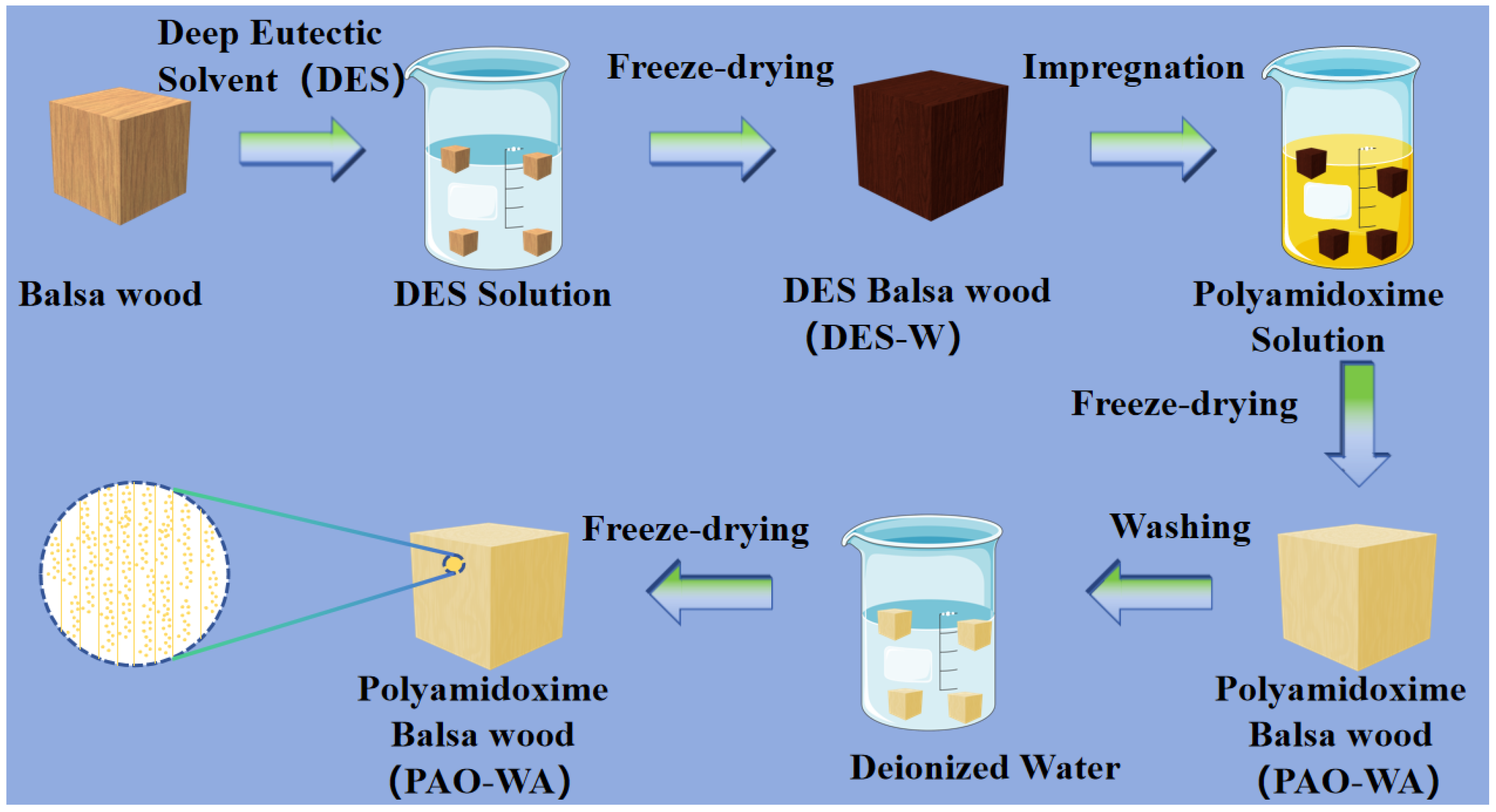
Choline chloride and lactic acid were mixed at a molar ratio of 1:5 and stirred at 60 °C until a homogeneous and transparent binary DES was obtained [13]. Balsa wood blocks (5 mm × 5 mm × 5 mm) were immersed in the prepared DES solution and treated at 120 °C for 6 h. The treated wood was washed repeatedly with ethanol until the effluent became colorless, followed by washing with deionized water [14]. The samples were then freeze-dried to obtain DES-treated wood (DES-W). Polyamidoxime (PAO) was prepared via the amidoximation of PAN [15]. Specifically, NH2OH·HCl (16.68 g), NaOH (2.88 g), and Na2CO3 (11.48 g) were dissolved in 180 mL of DMF at 45 °C. PAN (12.72 g) was then added, and the mixture was stirred for 30 min. The temperature was subsequently adjusted to 65 °C, and the reaction proceeded for 24 h. Afterward, additional NaOH (1.44 g) and Na2CO3 (5.74 g) were added, and the reaction continued at 65 °C for another 24 h. Finally, the supernatant was collected by centrifugation to serve as the PAO solution. The DES-W samples were immersed in the PAO solution under vacuum for 3 h, 5 h, 7 h, and 9 h, respectively. After removal, the surface PAO was gently washed off with DMF. The obtained samples were ultrasonicated in deionized water and freeze-dried to obtain PAO-WA. The preparation process of PAO-WAD is shown in Figure 1.

2.3. Characterization and Performance Testing

2.3.1. Characterization Methods

Fourier transform infrared spectroscopy (FTIR) was performed using a spectrometer (Thermo Fisher Scientific, Waltham, MA, USA) to analyze the chemical structures of the balsa wood and freeze-dried samples. The spectra were recorded with a resolution of 4 cm−1 and 32 scans per sample. The chemical structures were analyzed based on the positions of characteristic peaks corresponding to functional groups.
The microscopic morphology and elemental distribution of the samples were observed using a scanning electron microscope (SEM, Carl Zeiss, Oberkochen, Germany) equipped with an INCA 20 energy-dispersive X-ray spectrometer (EDS and mapping, Oxford Instruments, Abingdon, UK). The samples were sputter-coated with gold prior to observation, and the acceleration voltage was set to 10 kV.
X-ray photoelectron spectroscopy (XPS, K-Alpha, Thermo Fisher Scientific, Waltham, MA, USA) was employed to analyze the elemental composition and chemical valence states of the samples.
Inductively coupled plasma mass spectrometry (ICP-MS) was used to quantitatively analyze the uranium concentration in the solution before and after adsorption.
Hydrophilicity analysis: The wettability of each sample was observed using an optical contact angle meter (OCA11, Dataphysics, Filderstadt, Germany) to characterize its hydrophilicity.

2.3.2. Batch Adsorption Experiments

A stock solution of uranium (1000 mg/L) was prepared by dissolving 2.1092 g of uranyl nitrate hexahydrate (UO2(NO3)2·6H2O) in deionized water and diluting to 1 L in a volumetric flask. Working solutions with different uranium concentrations were prepared by diluting the stock solution with deionized water.
Batch adsorption experiments were conducted to evaluate the adsorption performance of PAO-WA. In a typical experiment, 30 mg of adsorbent (PAO-WA or DES-W) was added to a conical flask containing 80 mL of uranyl nitrate solution with a known initial concentration. The initial pH of the solution was adjusted to the desired value (ranging from 2.0 to 9.0) using negligible amounts of HNO3 or NaOH solutions. The flasks were placed in a thermostatic shaker and agitated at 160 rpm at 25 ± 1 °C. At predetermined time intervals (180, 360, 540, 720, 1440, 2160, 2880, 3600, 4320, 5040, and 5760 min), supernatant samples were withdrawn and filtered through a 0.22 μm aqueous membrane filter to separate the adsorbent. The uranium concentration in the filtrate was determined by ICP-MS. All experiments were performed in triplicate, and the average values were reported.
The equilibrium adsorption capacity (Qe, mg/g), instantaneous adsorption capacity (Qt, mg/g), and removal efficiency (R, %) were calculated using the following equations:
Q e = ( C 0 C e ) × V m
Q t = ( C 0 C t ) × V m
R % = ( C 0 C e ) C 0 × 100 %
where C0, Ce, and Ct (mg/L) represent the initial, equilibrium, and instantaneous uranium concentrations, respectively; V (L) is the volume of the solution; and m (g) is the mass of the adsorbent.
The linear forms of the pseudo-first-order and pseudo-second-order kinetic models are expressed as follows:
ln ( Q e Q t ) = ln Q e K 1 t
t Q t = t Q e + 1 K 2 Q e 2
where t (min) is the contact time; Qe (mg/g) is the maximum adsorption capacity at equilibrium; Qt (mg/g) is the adsorption capacity at time t; K1 (min−1) is the rate constant of the pseudo-first-order model; and K2 (g mg−1 min−1) is the rate constant of the pseudo-second-order model.
The linear forms of the Langmuir and Freundlich isotherm models are expressed as follows:
C e Q e = C e Q m + 1 K L Q m
ln Q e = ln K F + 1 n ln C e
where Ce (mg/L) is the equilibrium concentration of the adsorbate; Qe (mg/g) is the equilibrium adsorption capacity; Qm (mg/g) is the theoretical maximum adsorption capacity; KL (L/mg) is the Langmuir constant related to the affinity of binding sites; KF (L/g) is the Freundlich constant; and n is an empirical parameter related to adsorption intensity, with n values between 1 and 10 indicating favorable adsorption.

3. Results and Discussion

3.1. Chemical Structure Analysis

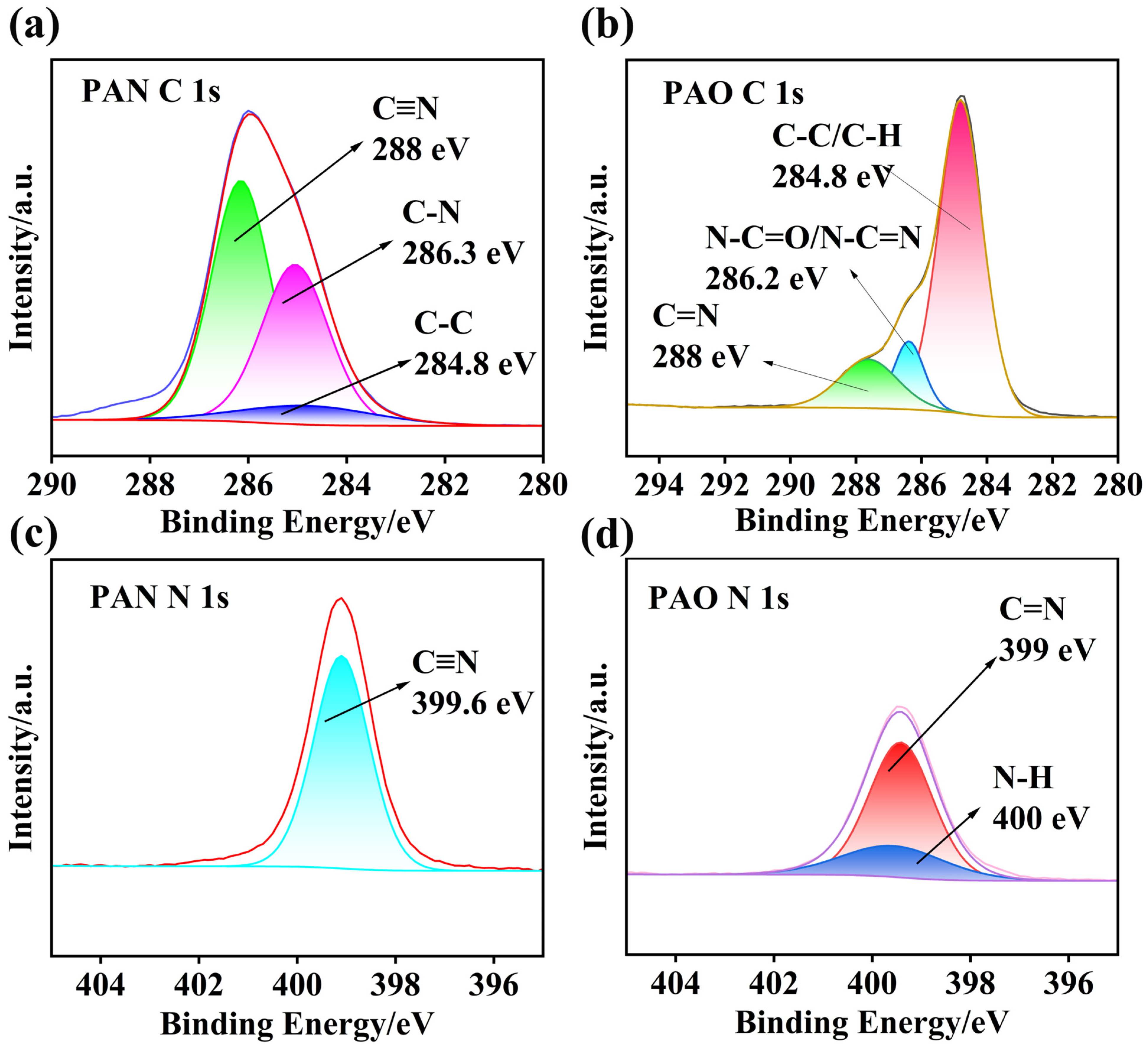
The X-ray photoelectron spectroscopy (XPS) survey spectra of PAN and PAO are shown in Figure S1. PAO exhibited a strong and distinct O 1s peak at 532 eV, the intensity of which was significantly higher than that of PAN. This is attributed to the introduction of hydroxyl groups (-OH) into the amidoxime groups during the amidoximation process [16]. The C 1s spectra of PAN and PAO are presented in Figure 2a and Figure 2b, respectively. In contrast to PAN, the intensity variation at 288 eV for PAO indicated the conversion of C≡N to C=NOH. As shown in Figure 2c, the N 1s spectrum of PAN displayed a single peak at 399.6 eV, which is assigned to the C≡N group. Conversely, the N 1s spectrum of PAO (Figure 2d) showed two peaks at 399 eV and 400 eV, corresponding to oxime nitrogen (C=NOH) and amine nitrogen (N-H), respectively [17]. These XPS analysis results confirm the successful conversion of PAN to PAO.
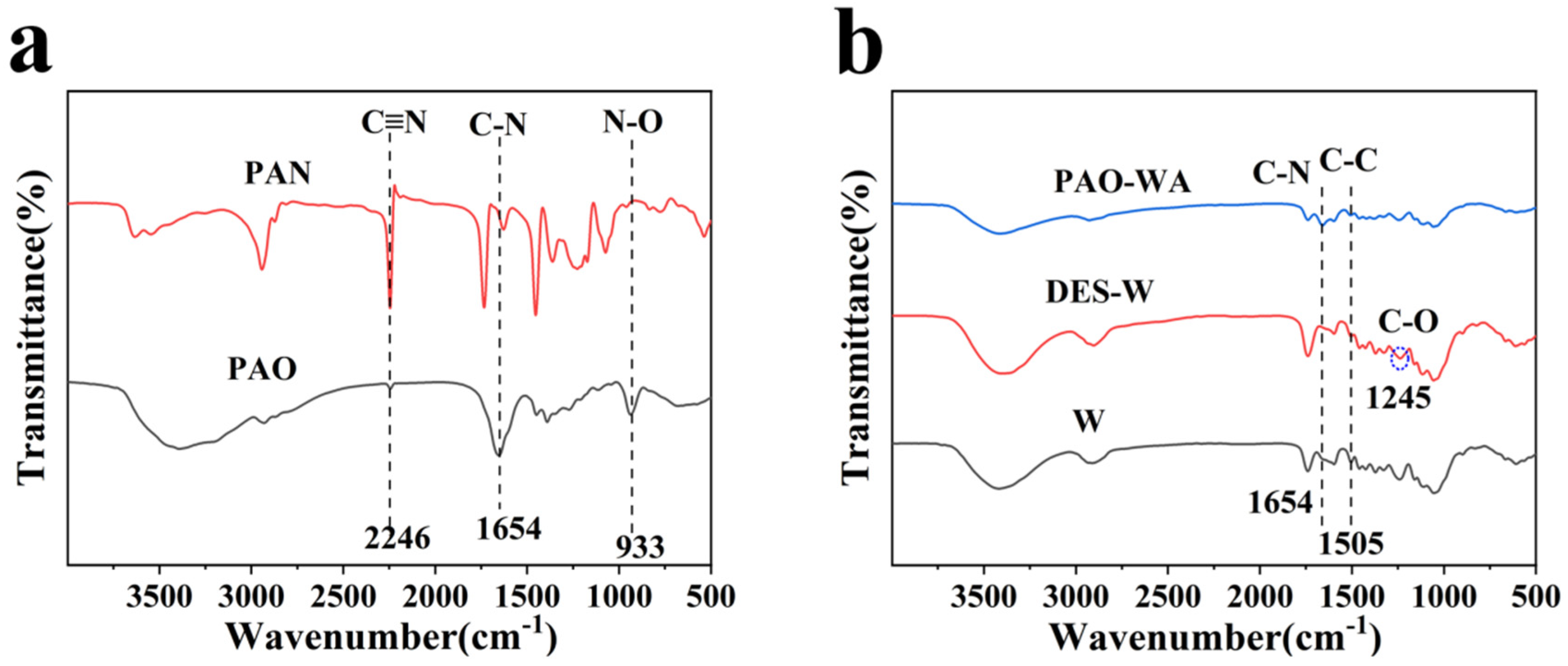
As depicted in Figure 3a, the FTIR spectrum of PAN exhibited a characteristic vibration peak of the C≡N bond at 2246 cm−1 [18]. Following amidoximation, this C≡N peak disappeared, while new peaks corresponding to the C–N and N–O bonds of the amidoxime group appeared at 1654 cm−1 and 933 cm−1, respectively. This transformation indicates the successful conversion of PAN into PAO. In comparison with natural balsa wood, the characteristic vibration peak of the lignin aromatic ring at 1505 cm−1 in the DES-W sample was significantly weakened. Moreover, the intensity of the lignin C–O stretching peak at 1245 cm−1 also decreased notably, confirming the effective removal of lignin by the DES treatment [19]. Furthermore, the FTIR spectrum of PAO-WA revealed the emergence of a C–N peak at 1654 cm−1, providing evidence of the successful loading of PAO onto the wood substrate.

3.2. Microscopic Morphology Analysis

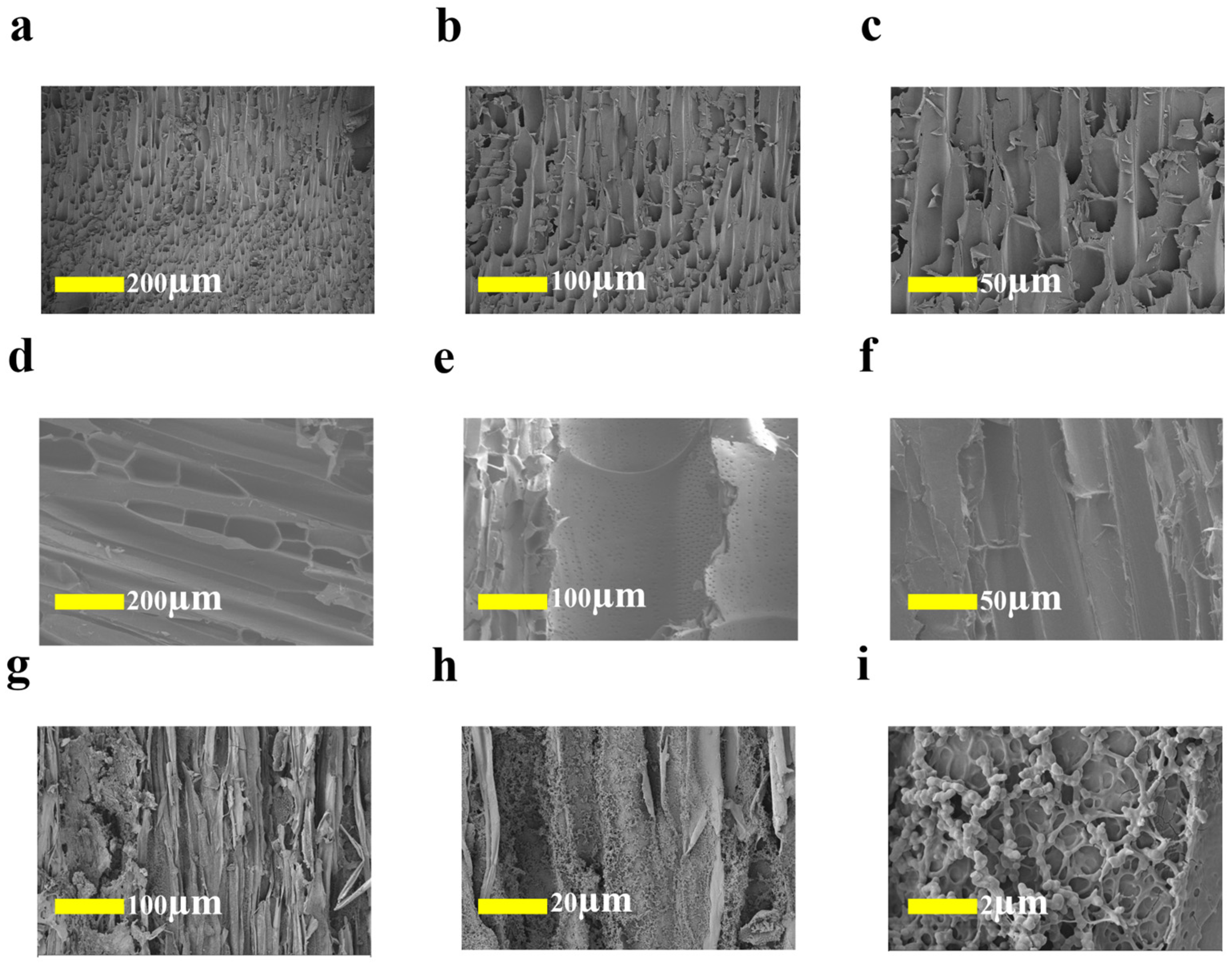
The micro-morphologies of pristine balsa wood, DES-treated balsa wood, and PAO-WA were investigated using scanning electron microscopy (SEM). As depicted in Figure 4a–c, the pristine balsa wood exhibits a typical natural wooden structure. After DES treatment (Figure 4d–f), the wood surface presents a cleaner and more distinct open three-dimensional porous network. This morphology is characteristic of a cellulose skeleton following delignification, confirming the successful removal of lignin from balsa wood by DES and providing structural space for subsequent polymer loading. Further observation of the microstructure of PAO-WA (Figure 4g–i) reveals a flocculent polyamidoxime coating covering the wood cell walls, with PAO forming a continuous network structure on the carrier. Such a network structure offers essential active sites for the capture of uranyl ions, thereby establishing the structural foundation for the highly efficient uranium adsorption by PAO-WA.

3.3. Wettability Analysis

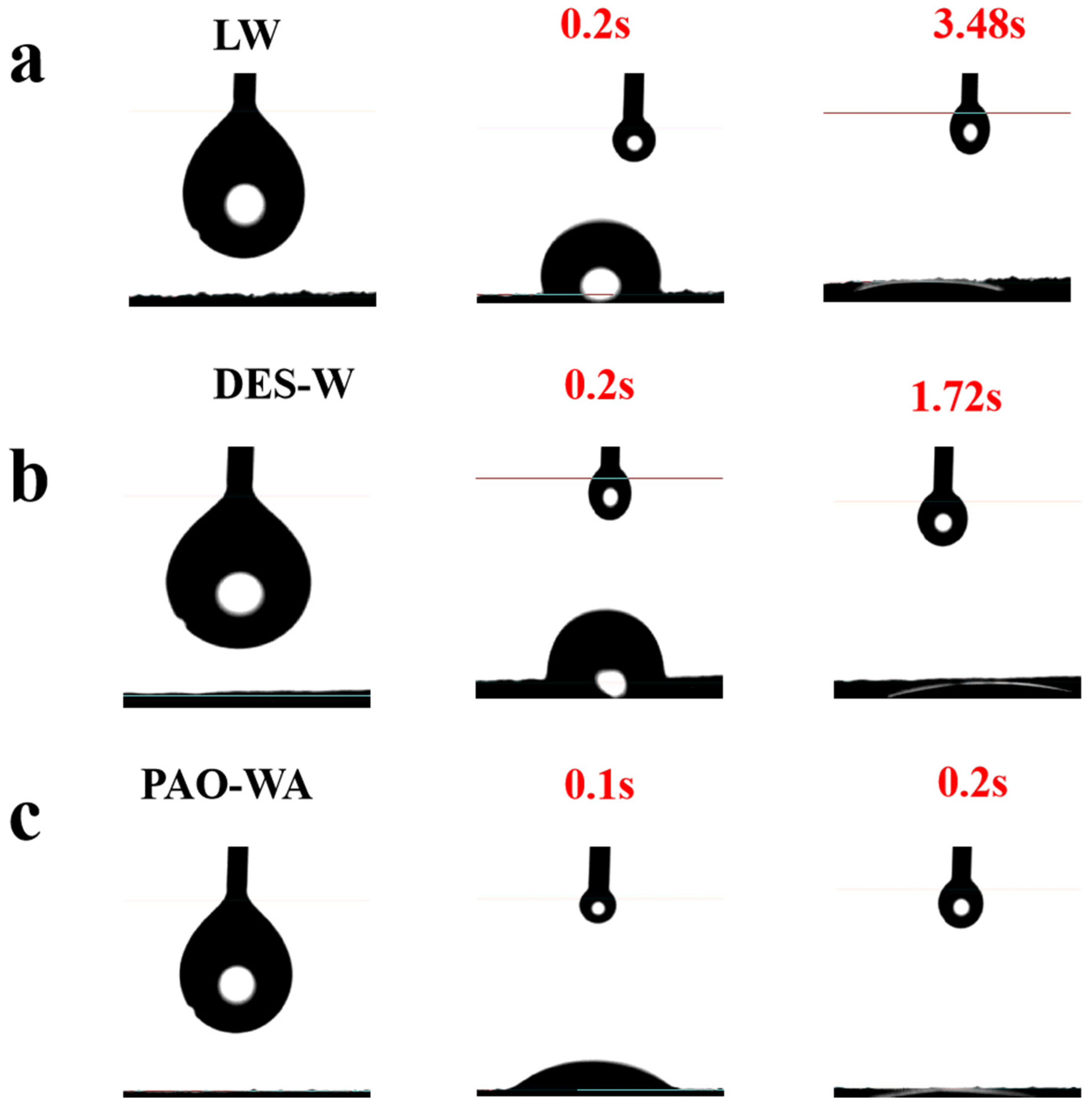
Wettability plays a crucial role in the uranium adsorption capacity of materials; enhancing hydrophilicity is beneficial for improving adsorption performance [8,20]. Consequently, the wettability of natural balsa wood, DES-W, and PAO-WA was analyzed using water contact angle measurements. Given that the adsorption process in wood primarily relies on the penetration of liquid into internal pores via the transverse section, this study focused on the wettability of this specific surface. As illustrated in Figure 5a, natural balsa wood, which is rich in hydrophilic hydroxyl and carboxyl groups, was completely wetted by water within 3.48 s. Figure 5b shows that the complete wetting time for the DES-W cross-section was shorter than that of the natural wood, indicating that the delignification treatment enhanced the wood’s wettability. Notably, as shown in Figure 5c, PAO-WA demonstrated the most rapid wetting time of only 0.2 s. This significant improvement is primarily attributed to the polyamidoxime introducing potent hydrophilic functional groups—particularly amidoxime groups—into the wood matrix, which can form strong hydrogen bonds with water molecules [21].

3.4. Uranium Adsorption Performance Analysis

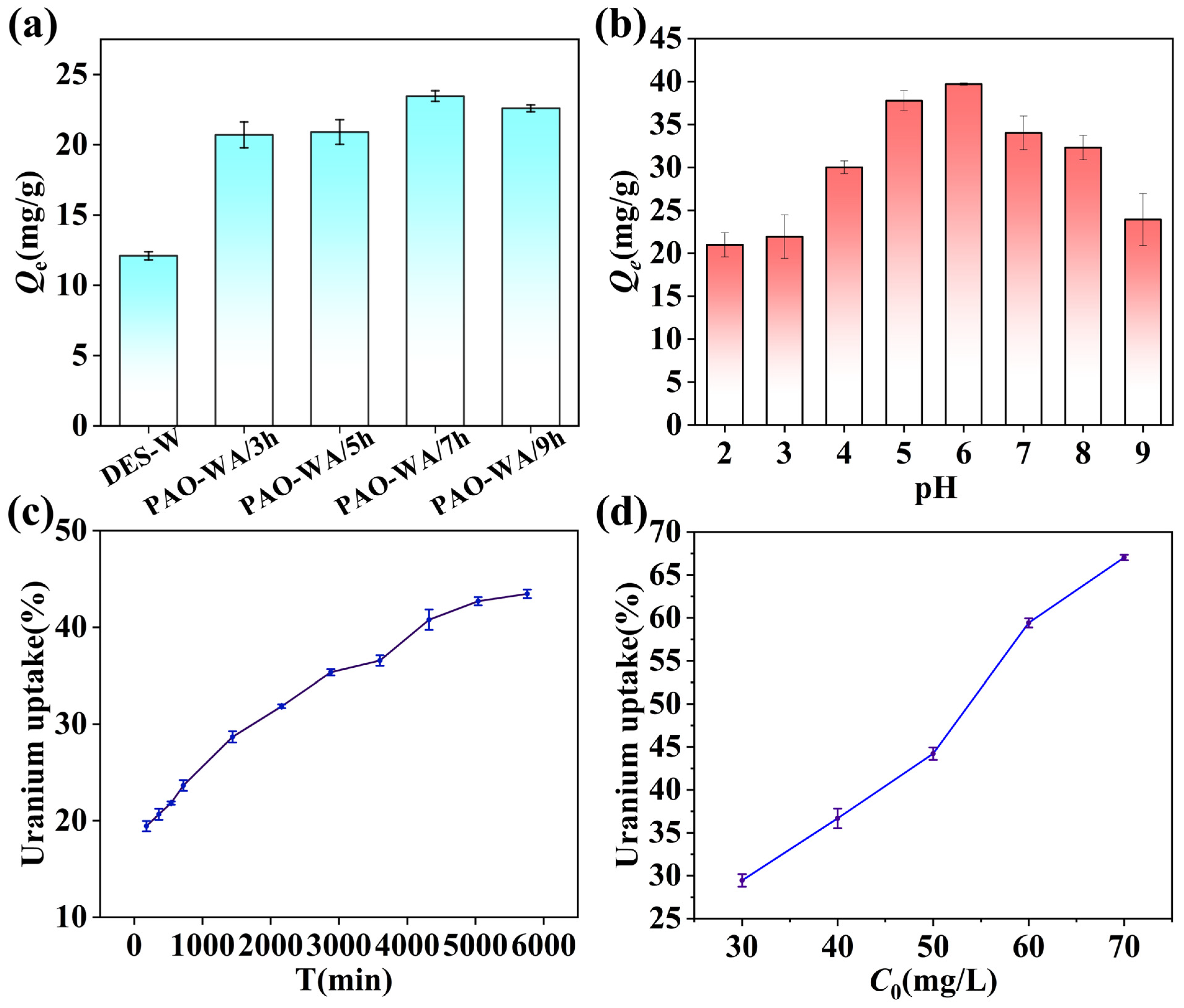
As shown in Figure 6a, the adsorption capacity of DES-W without PAO loading was relatively low. This is because the unmodified DES-W lacks specific adsorption functional groups and relies solely on a small amount of hydroxyl groups on the cellulose surface for physical adsorption, resulting in extremely low capacity [22]. In contrast, the adsorption capacity of PAO-loaded DES-W increased nearly twofold, indicating that the loading of PAO significantly enhanced the adsorption capability of the material. Furthermore, as the PAO loading time extended, the uranium adsorption capacity exhibited a trend of initially increasing and subsequently decreasing. This is attributed to the fact that when the loading time was too short, the amount of PAO loaded was insufficient, leading to a scarcity of active adsorption sites and resulting in poor adsorption performance. With an increase in loading time, a moderate amount of PAO was loaded onto the cellulose skeleton of the balsa wood, forming flocculent deposits which provided relatively complete coverage without blocking the pores, thereby achieving a balance between active sites and mass transfer efficiency. However, as the loading time was further prolonged, the adsorption capacity began to show a downward trend, possibly due to the excessive aggregation of PAO, which caused internal blockage and prevented the full utilization of active adsorption sites.
The variation in adsorption capacity of PAO-WA was further investigated within a pH range of 2.0 to 9.0 (t = 4 days, V = 70 mL, m ≈ 30 mg). As shown in Figure 6b, the adsorption capacity gradually increased as the pH rose from 2.0 to 6.0, reaching its maximum value at pH 6.0. Conversely, the capacity gradually decreased as the pH increased from 6.0 to 9.0. This phenomenon is primarily due to the protonation of nitrogen (N) and oxygen (O) atoms in the amidoxime groups (-C(NH2)=NOH) at low pH levels, where intense competition from H+ ions inhibits adsorption. At pH 6.0, the functional groups undergo moderate deprotonation and achieve an optimal coordination state, while the uranyl ions remain stable, thereby facilitating adsorption. However, as the pH continues to rise, uranyl ions undergo hydrolysis or form anionic complexes, leading to a decrease in effective concentration and coordination ability, thus weakening adsorption [23].
As shown in Figure 6c, the uranium removal rate of PAO-WA presented a slow upward trend as adsorption progressed, eventually reaching a maximum and tending towards equilibrium. During the adsorption process, the initial concentration acts as a crucial driving force, primarily serving to overcome the mass transfer resistance between the liquid and solid adsorbent. The adsorption process of PAO-WA for uranyl ions was further examined by setting different concentration gradients of uranium-containing solutions (t = 4 days, V = 80 mL, m ≈ 30 mg, pH = 6.0). The results, as shown in Figure 6d, indicate that the removal rate of uranium continued to increase with the increase in the initial concentration.

3.5. Adsorption Kinetics

To determine the time required for adsorption equilibrium and to reveal the underlying mechanism (e.g., surface adsorption versus intra-particle diffusion), the adsorption process was analyzed using pseudo-first-order and pseudo-second-order kinetic models. Adsorption kinetics describes how the adsorption capacity of an adsorbent changes over time at a specific temperature, given a fixed adsorbent dosage and initial uranium concentration, until equilibrium is reached.
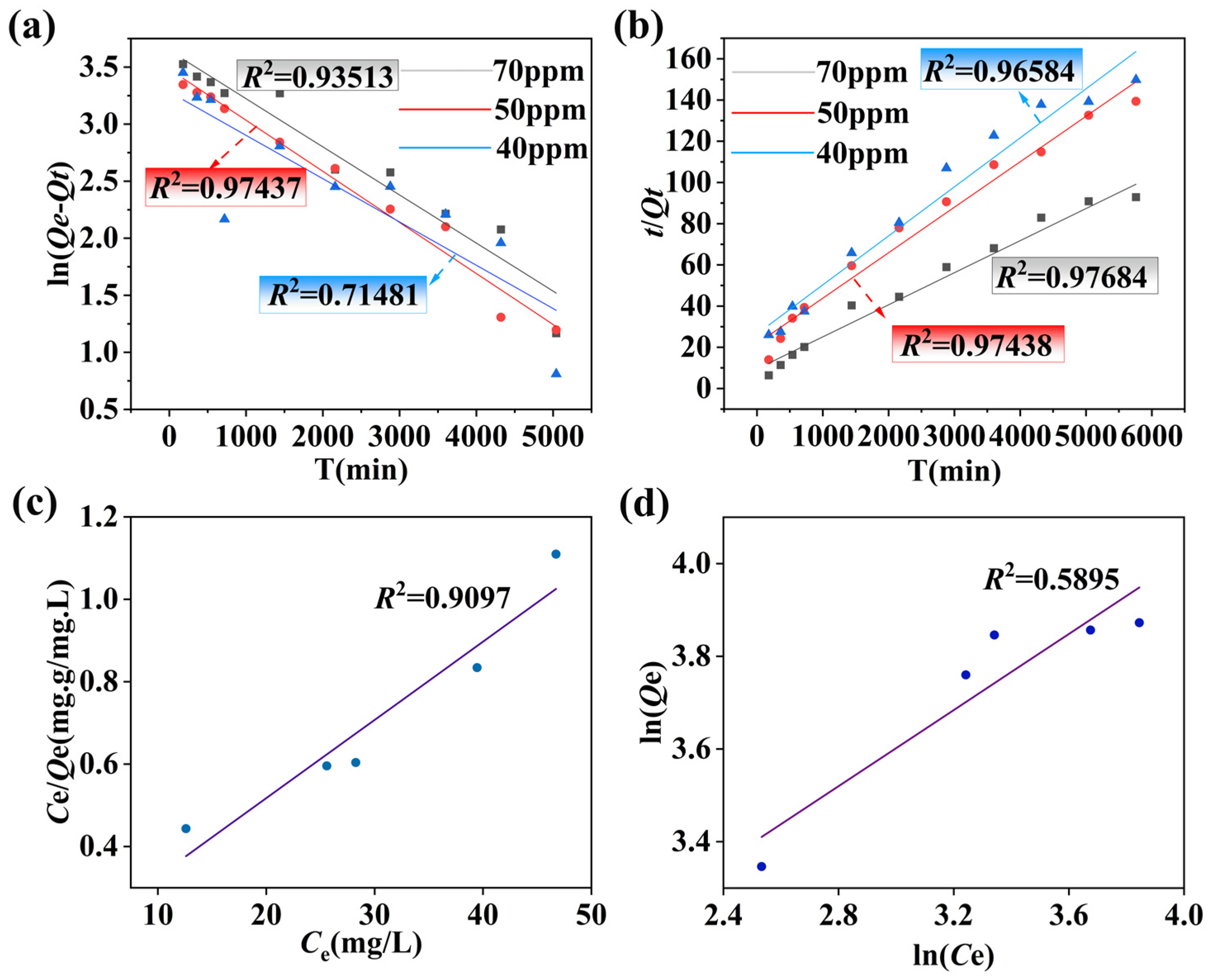
Kinetic fitting was performed according to Equations (4) and (5). The fitting curves are presented in Figure 7a,b, and the corresponding kinetic parameters are listed in Table 1. As indicated by the data, the pseudo-second-order kinetic model exhibited the highest correlation coefficient (R2 = 0.9768). Furthermore, the theoretical equilibrium adsorption capacity calculated from this model was closest to the experimental value. Therefore, the adsorption of uranium by PAO-WA aligns more closely with the pseudo-second-order kinetic model, suggesting that chemisorption is the primary rate-limiting step [24].

3.6. Adsorption Isotherms

To evaluate the maximum adsorption capacity of the material under specific conditions and to infer the interaction mode between the adsorbent and uranium, adsorption data were collected and analyzed using Langmuir and Freundlich adsorption isotherms. Adsorption isotherms describe the equilibrium relationship between the amount of uranium adsorbed and its concentration in the solution at a constant temperature.
Adsorption isotherm fitting was performed according to Equations (6) and (7). The fitting curves are shown in Figure 7c,d, and the corresponding isotherm parameters are listed in Table 2. The results clearly demonstrate that the R2 value for the Langmuir model (0.9097) is higher than that for the Freundlich model, indicating that the adsorption of uranium by PAO-WA is better described by the monolayer chemisorption model. The separation factor (RL) derived from the Langmuir constant KL was found to be between 0 and 1, confirming that the adsorption is a spontaneous process within the studied concentration range. Additionally, the Freundlich exponent n was determined to be 2.9, further indicating the high heterogeneity of the adsorbent surface and a strong adsorption affinity [25].

3.7. Uranium Adsorption Mechanism Analysis

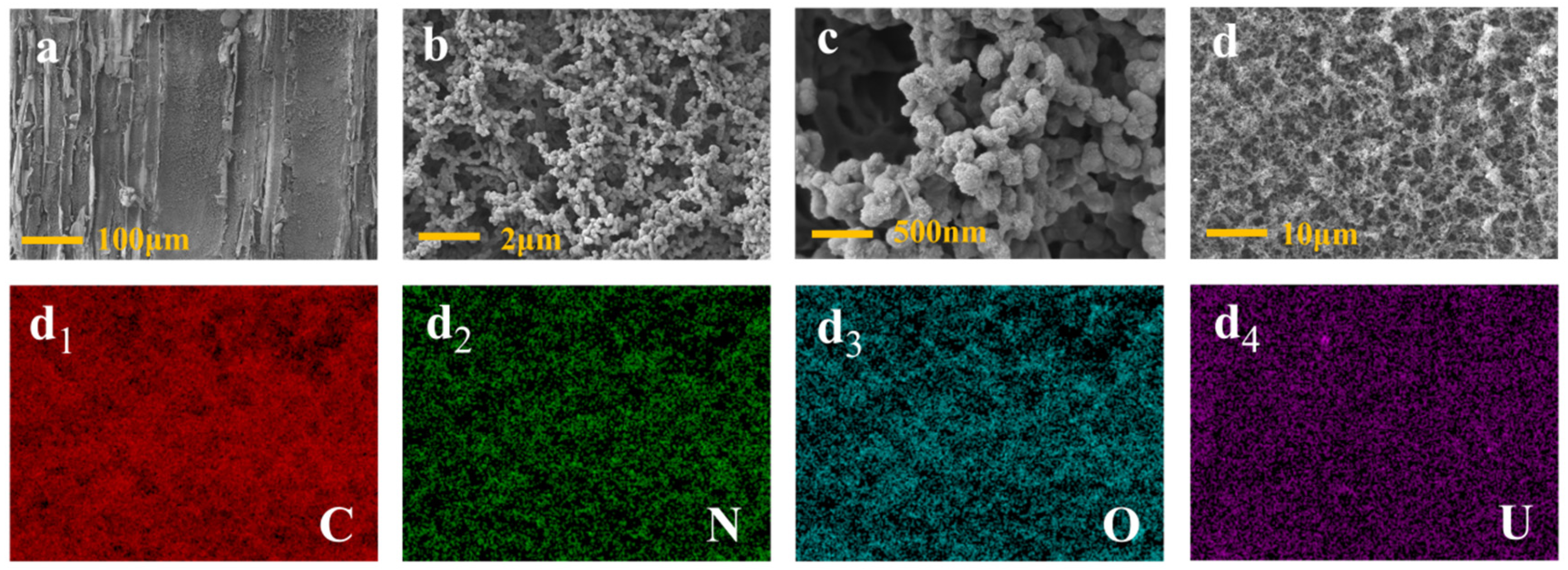
Figure 8 displays the SEM images and elemental mapping of PAO-WA following uranium adsorption. After adsorption, the surface of PAO-WA exhibited increased roughness and the presence of fine granular deposits, which are likely attributed to uranium complexes or precipitates. EDS analysis revealed the presence of nitrogen (N), confirming the successful loading of polyamidoxime. Additionally, the detection of uranium (U) provided direct evidence of the adsorption process [26].
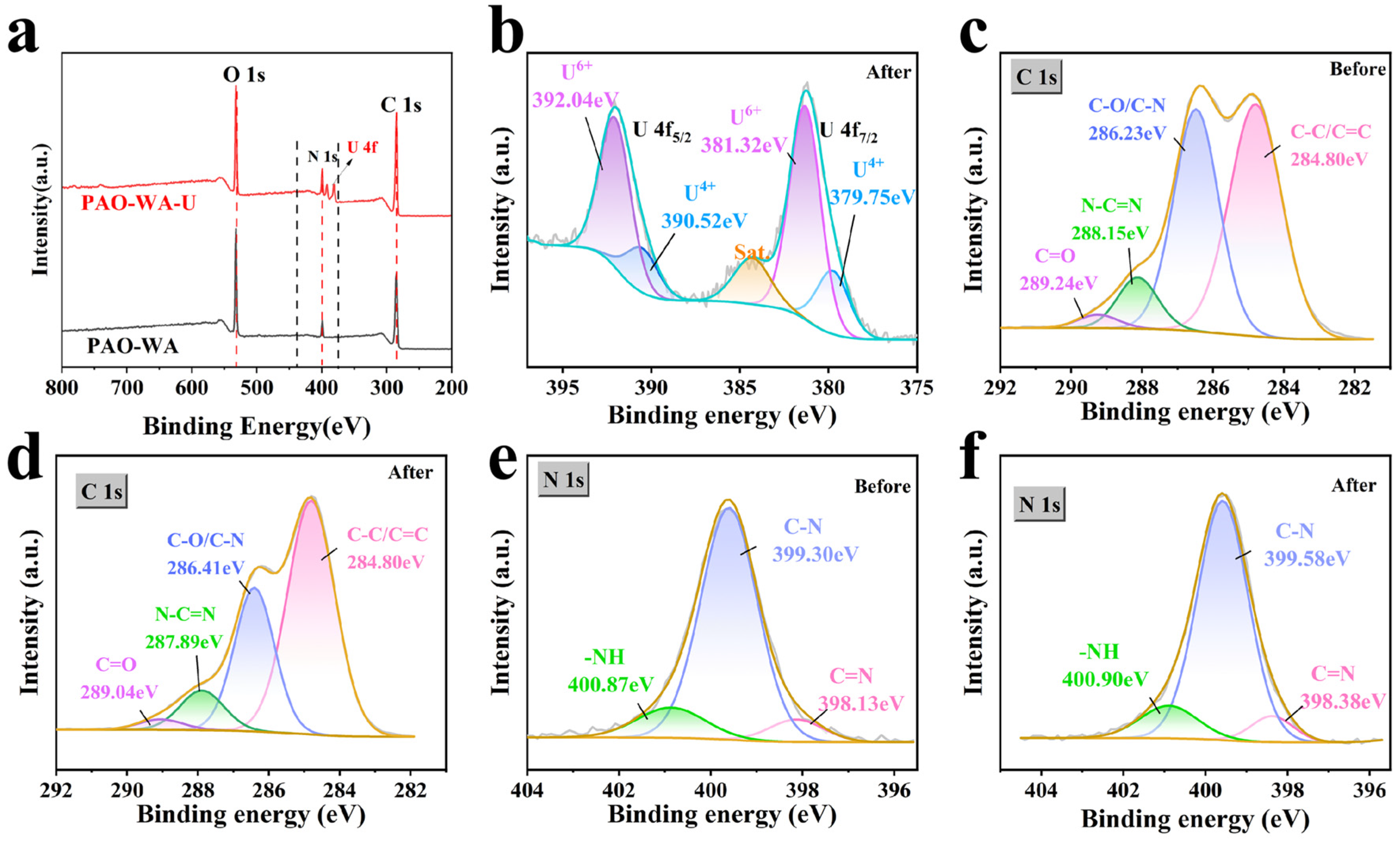
Figure 9a presents the XPS survey spectra of PAO-WA before and after uranium adsorption. In the survey spectrum following adsorption, the presence of the U 4f peak was clearly observed, indicating the successful adsorption of uranium ions [27]. As illustrated in Figure 9b, due to the strong coordination interaction between uranium ions in solution and polyamidoxime, the nitrogen and oxygen atoms in the polyamidoxime serve as electron donors, forming stable complexes with the positively charged uranium ions [23,28,29]. To further analyze the interaction between polyamidoxime and uranium ions, the C 1s, N 1s, and O 1s spectra of PAO-WA before and after uranium adsorption were subjected to deconvolution analysis. The C 1s spectrum of PAO-WA before uranium adsorption can be deconvoluted into four peaks. As shown in Figure 9c, the peaks at 284.80 eV, 286.23 eV, and 289.24 eV correspond to C–C/C=C, C–O/C–N, and C=O bonds in PAO-WA, respectively [30], while the peak at 288.15 eV is assigned to the carbon in the H2N-C=N structure of the PAO particles. After uranium adsorption, the peak at 288.15 eV shifted to 287.89 eV. This decrease in binding energy indicates an increase in electron cloud density, possibly because uranium ions withdraw electrons from the large Π-conjugated system of the entire amidoxime group via the nitrogen atom, resulting in increased electron density at the central carbon atom. Conversely, the peak at 286.23 eV shifted upward to 286.41 eV, signifying a decrease in electron cloud density. This peak primarily corresponds to C–O/C–N bonds connected to the amidoxime group; the coordination of uranium ions directly withdraws electrons from the nitrogen and oxygen atoms, leading to a reduction in electron cloud density on the adjacent carbon atoms [31] (Figure 9d).
As shown in Figure 9e,f, the chemical environments of all nitrogen atoms in the polyamidoxime groups underwent significant and consistent changes following uranium adsorption. Specifically, the binding energies of all characteristic nitrogen peaks increased, providing solid evidence for the direct coordination between uranium ions and the nitrogen atoms of the amidoxime groups [32]. The shift in the nitrogen of the C=N bond was the most pronounced, indicating that it serves as the primary coordination site, directly donating electron density to the uranium ions [33]. Similarly, Figure S2a,b displays the O 1s spectra of PAO-WA before and after uranium adsorption, revealing that the binding energies of both oxygen peaks decreased. Consequently, integrating the aforementioned C 1s, N 1s, and O 1s spectra with the U 4f spectrum establishes a comprehensive uranium adsorption mechanism model: the amidoxime groups of the polyamidoxime act as the primary adsorption sites, forming stable inner-sphere complexes with uranium ions via nitrogen and oxygen atoms; meanwhile, the carboxyl groups on the balsa wood substrate serve as auxiliary sites, capturing uranium ions through a rapid ion exchange mechanism [34].

4. Conclusions

In this study, an efficient and environmentally friendly adsorbent for uranium extraction from seawater was successfully developed using natural balsa wood as a substrate. Through green delignification followed by polyamidoxime functionalization, the resulting composite (PAO-WA) exhibited a porous structure, high hydrophilicity, and abundant active adsorption sites. The resulting adsorbent exhibits excellent uranium adsorption performance, demonstrating great potential for sustainable and large-scale seawater uranium extraction.
Adsorption experiments demonstrated that under conditions of pH 6.0 and an initial uranium concentration of 50 mg/L, the composite achieved an equilibrium adsorption capacity of 45.31 mg/g. The adsorption behavior aligned well with the pseudo-second-order kinetic model and the Langmuir isotherm model, the pseudo-second-order kinetic model (R2 > 0.97), and the Langmuir isotherm model R2 = 0.9097, revealing a mechanism dominated by monolayer chemisorption. The theoretical maximum adsorption capacity derived from the Langmuir model was 52.66 mg/g, further confirming the high efficiency of the material. Crucially, the adsorption mechanism was deeply analyzed using surface analysis techniques such as XPS. The results indicated that the capture of uranyl ions ( U O 2 2 + ) was primarily achieved through two pathways: first, specific coordination with amidoxime groups in PAO to form stable inner-sphere complexes, a process accompanied by electron transfer and potentially the partial reduction in U(VI) to the more stable U(IV); second, rapid fixation of uranium by residual carboxyl groups on the wood substrate via an ion exchange mechanism. This synergistic effect between natural wood components and synthetic polymers is key to the material’s excellent adsorption performance.

Supplementary Materials

The following supporting information can be downloaded at: https://www.mdpi.com/article/10.3390/pr14071161/s1, Figure S1. XPS survey spectra of PAO and PAN; Figure S2. X-ray photoelectron spectroscopy of PAO-WA: (a) O 1s spectra before adsorption, (b) O 1s spectra after U adsorption, (c) adsorption mechanism of U ions; Figure S3. Removal efficiency of various ions by PAO-WA; Table S1. Comparison of different materials [8,10,11,23]; Table S2. Selectivity of PAO-WA for uranium and other metal ions.

Author Contributions

Conceptualization, X.W. and Z.W.; methodology, X.W.; formal analysis, X.W. and Z.W.; investigation, X.W. and Y.W.; writing—original draft, X.W., Y.W. and H.X.; writing—review and editing, X.W., Z.W. and C.J.; visualization, X.W. and Z.W.; supervision, Z.W. and C.J. All authors have read and agreed to the published version of the manuscript.

Funding

National Key Research and Development Program (2023YFD2201403); National Natural Science Foundation of China (32001257).

Data Availability Statement

The original contributions presented in this study are included in the article/Supplementary Materials. Further inquiries can be directed to the corresponding author.

Acknowledgments

The authors gratefully acknowledge the technical support and characterization services provided by Scientific Compass www.shiyanjia.com. We also thank my supervisor, WANG Zhe, for valuable discussions and their assistance during the experiments. The authors have reviewed and edited the output and take full responsibility for the content of this publication.

Conflicts of Interest

The authors declare no conflicts of interest.

References

  1. Abney, C.; Mayes, R.; Piechowicz, M.; Lin, Z.; Bryantsev, V.; Veith, G.; Dai, S.; Lin, W. XAFS investigation of polyamidoxime-bound uranyl contests the paradigm from small molecule studies. Energy Environ. Sci. 2016, 9, 448–453. [Google Scholar] [CrossRef]
  2. Wang, X.; Zhou, J.; Zhang, Z.; Li, J.; Zhang, H. Synthesis of PAO NFs and the adsorption for uranium (VI) in alkaline solution. J. Radioanal. Nucl. Chem. 2022, 331, 491–505. [Google Scholar] [CrossRef]
  3. Adamantiades, A.; Kessides, I. Nuclear power for sustainable development: Current status and future prospects. Energy Policy 2009, 37, 5149–5166. [Google Scholar] [CrossRef]
  4. Yuan, Y.; Yu, Q.; Yang, S.; Wen, J.; Guo, Z.; Wang, X.; Wang, N. Ultrafast Recovery of Uranium from Seawater by Bacillus velezensis Strain UUS-1 with Innate Anti-Biofouling Activity. Adv. Sci. 2019, 6, 1900861. [Google Scholar] [CrossRef]
  5. Keener, M.; Hunt, C.; Carroll, T.; Kampel, V.; Dobrovetsky, R.; Hayton, T.; Ménard, G. Redox-switchable carboranes for uranium capture and release. Nature 2020, 577, 652–655. [Google Scholar] [CrossRef]
  6. Abney, C.; Mayes, R.; Saito, T.; Dai, S. Materials for the Recovery of Uranium from Seawater. Chem. Rev. 2017, 117, 13935–14013. [Google Scholar] [CrossRef]
  7. Kim, J.; Tsouris, C.; Mayes, R.; Oyola, Y.; Saito, T.; Janke, C.; Dai, S.; Schneider, E.; Sachde, D. Recovery of Uranium from Seawater: A Review of Current Status and Future Research Needs. Sep. Sci. Technol. 2013, 48, 367–387. [Google Scholar] [CrossRef]
  8. Bai, Z.; Liu, Q.; Zhang, H.; Liu, J.; Chen, R.; Yu, J.; Li, R.; Liu, P.; Wang, J. Mussel-inspired anti-biofouling and robust hybrid nanocomposite hydrogel for uranium extraction from seawater. J. Hazard. Mater. 2020, 381, 121048. [Google Scholar] [CrossRef] [PubMed]
  9. Flicker Byers, M.; Schneider, E. Optimization of the Passive Recovery of Uranium from Seawater. Ind. Eng. Chem. Res. 2016, 55, 4351–4361. [Google Scholar] [CrossRef]
  10. Lim, Y.; Goh, K.; Goto, A.; Zhao, Y.; Wang, R. Uranium and lithium extraction from seawater: Challenges and opportunities for a sustainable energy future. J. Mater. Chem. A 2023, 11, 22551–22589. [Google Scholar] [CrossRef]
  11. Wang, W.; Luo, Q.; Li, J.; Li, Y.; Wu, R.; Li, Y.; Huo, X.; Wang, N. Single-atom tungsten engineering of MOFs with biomimetic antibiofilm activity toward robust uranium extraction from seawater. Chem. Eng. J. 2022, 431, 134002. [Google Scholar] [CrossRef]
  12. Wiechert, A.; Ladshaw, A.; Kuo, L.; Pan, H.; Strivens, J.; Schlafer, N.; Wood, J.; Wai, C.; Gill, G.; Yiacoumi, S.; et al. Uranium Recovery from Seawater Using Amidoxime-Based Braided Polymers Synthesized from Acrylic Fibers. Ind. Eng. Chem. Res. 2020, 59, 13988–13996. [Google Scholar] [CrossRef]
  13. Hussain, M.; Ashraf, H.; Vasudev, V.; Yasin, S.; Jamil, M.; Saleem, M.; Aziz, T.; Al Afroz, E.; Feichao, Z.; Huapeng, Z.; et al. Deep eutectic solvents in biomass pretreatment for green approach: A comprehensive review. Polym. Bull. 2025, 82, 10513–10552. [Google Scholar] [CrossRef]
  14. Igbojionu, L.; Manayil, J.; Fernandez-Castane, A. A comparative study of effect of polyol-based and acid-based deep eutectic solvents pretreatment of rice straw under autoclave conditions on cellulose enrichment and digestibility. Biomass Convers. Biorefin. 2025, 15, 31107–31120. [Google Scholar] [CrossRef] [PubMed]
  15. Jiao, G.; Ma, J.; Zhang, J.; Zhai, S.; Sun, R. Efficient extraction of uranium from seawater by reticular polyamidoxime-functionalized oriented holocellulose bundles. Carbohydr. Polym. 2023, 300, 120280. [Google Scholar] [CrossRef]
  16. Li, W.; Liu, Q.; Liu, J.; Zhang, H.; Li, R.; Li, Z.; Jing, X.; Wang, J. Removal U(VI) from artificial seawater using facilely and covalently grafted polyacrylonitrile fibers with lysine. Appl. Surf. Sci. 2017, 403, 378–388. [Google Scholar] [CrossRef]
  17. Chen, H.; Shao, D.; Li, J.; Wang, X. The uptake of radionuclides from aqueous solution by poly(amidoxime) modified reduced graphene oxide. Chem. Eng. J. 2014, 254, 623–634. [Google Scholar] [CrossRef]
  18. Wen, S.; Sun, Y.; Liu, R.; Chen, L.; Wang, J.; Peng, S.; Ma, C.; Yuan, Y.; Gong, W.; Wang, N. Supramolecularly Poly(amidoxime)-Loaded Macroporous Resin for Fast Uranium Recovery from Seawater and Uranium-Containing Wastewater. ACS Appl. Mater. Interfaces 2021, 13, 3246–3258. [Google Scholar] [CrossRef]
  19. Jiao, G.; Ma, J.; Li, Y.; Jin, D.; Zhou, J.; Sun, R. Removed heavy metal ions from wastewater reuse for chemiluminescence: Successive application of lignin-based composite hydrogels. J. Hazard. Mater. 2022, 421, 126725. [Google Scholar] [CrossRef]
  20. Piechowicz, M.; Abney, C.; Thacker, N.; Gilhula, J.; Wang, Y.; Veroneau, S.; Hu, A.; Lin, W. Successful Coupling of a Bis-Amidoxime Uranophile with a Hydrophilic Backbone for Selective Uranium Sequestration. ACS Appl. Mater. Interfaces 2017, 9, 27894–27904. [Google Scholar] [CrossRef]
  21. Ye, Y.; Huang, X.; Li, H.; Zhao, R.; Xu, M. Polyamidoxime functional self-supporting porous carbon monoliths as capacitive deionization electrode for efficient uranyl ions recovery. Desalination 2026, 619, 118224. [Google Scholar] [CrossRef]
  22. Li, Z.; Li, N.; Zhong, X.; Lian, C.; Jiang, W.; Ma, H.; Teng, J.; Peng, L.; Huang, B. Enhanced hydroxyl adsorption and improved glycerol adsorption configuration for efficient glyceric acid production. J. Colloid Interface Sci. 2025, 680, 226–234. [Google Scholar] [CrossRef]
  23. Ahmad, M.; Chen, J.; Yang, K.; Shah, T.; Naik, M.; Zhang, Q.; Zhang, B. Preparation of amidoxime modified porous organic polymer flowers for selective uranium recovery from seawater. Chem. Eng. J. 2021, 418, 129310. [Google Scholar] [CrossRef]
  24. Zhou, Y.; Li, Y.; Wang, X.; Liu, D.; Liu, D. Preparation of amidoxime functionalized titanate nanosheets for efficient extraction of uranium from aqueous solution. J. Solid State Chem. 2020, 290, 121576. [Google Scholar] [CrossRef]
  25. Cheng, Y.; Li, F.; Liu, N.; Lan, T.; Yang, Y.; Zhang, T.; Liao, J.; Qing, R. A novel freeze-dried natural microalga powder for highly efficient removal of uranium from wastewater. Chemosphere 2021, 282, 130971. [Google Scholar] [CrossRef]
  26. Lv, L.; Deng, T.; Wang, L.; Peng, H.; Chen, H.; Li, X.; Chi, F. Hydrophilic modification and synergistic interaction of phosphate-amidoxime adsorbent for enhanced uranium extraction from seawater. Desalination 2025, 600, 118260. [Google Scholar] [CrossRef]
  27. He, N.; Li, H.; Li, L.; Cheng, C.; Lu, X.; Wen, J.; Wang, X. Polyguanidine-modified adsorbent to enhance marine applicability for uranium recovery from seawater. J. Hazard. Mater. 2021, 416, 125957. [Google Scholar] [CrossRef] [PubMed]
  28. Elsayed, N.H.; Alatawi, R.A.S.; Monier, M. Amidoxime modified chitosan based ion-imprinted polymer for selective removal of uranyl ions. Carbohydr. Polym. 2021, 256, 117509. [Google Scholar] [CrossRef] [PubMed]
  29. Wang, D.; Song, J.; Lin, S.; Wen, J.; Ma, C.; Yuan, Y.; Lei, M.; Wang, X.; Wang, N.; Wu, H. A Marine-Inspired Hybrid Sponge for Highly Efficient Uranium Extraction from Seawater. Adv. Funct. Mater. 2019, 29, 1907243. [Google Scholar] [CrossRef]
  30. Sun, Y.; Wang, Q.; Chen, C.; Tan, X.; Wang, X. Interaction between Eu (III) and Graphene Oxide Nanosheets Investigated by Batch and Extended X-ray Absorption Fine Structure Spectroscopy and by Modeling Techniques. Environ. Sci. Technol. 2012, 46, 6020–6027. [Google Scholar] [CrossRef]
  31. Hu, L.; Yan, X.; Yao, C.; Deng, S.; Gao, X.; Zhang, X.; Shan, D. Preparation of amidoximated coaxial electrospun nanofibers for uranyl uptake and their electrochemical properties. Sep. Purif. Technol. 2016, 171, 44–51. [Google Scholar] [CrossRef]
  32. Li, H.; He, N.; Cheng, C.; Dong, H.; Wen, J.; Wang, X. Antimicrobial polymer contained adsorbent: A promising candidate with remarkable anti-biofouling ability and durability for enhanced uranium extraction from seawater. Chem. Eng. J. 2020, 388, 124285. [Google Scholar] [CrossRef]
  33. Bai, J.; Chu, J.; Yin, X.; Wang, J.; Tian, W.; Huang, Q.; Jia, Z.; Wu, X.; Guo, H.; Qin, Z. Synthesis of amidoximated polyacrylonitrile nanoparticle/graphene composite hydrogel for selective uranium sorption from saline lake brine. Chem. Eng. J. 2020, 391, 123654. [Google Scholar] [CrossRef]
  34. Zhang, W.; Xin, Y.; Fang, C.; Han, X.; Liu, Y.; Li, H.; Li, F.; Fa, Y.; Liu, H. Dendritic bio-inspired multidentate coordination aerogels for efficient uranium adsorption. J. Colloid Interface Sci. 2026, 706, 139721. [Google Scholar] [CrossRef] [PubMed]
Figure 1. Flowchart for the Preparation of polyamidoxime-functionalized wood-based adsorbent (PAO-WA).
Processes 14 01161 g001
Figure 2. X-ray photoelectron spectroscopy of polyacrylonitrile (PAN) and polyamidoxime (PAO). (a) C 1s spectrum of PAN; (b) C 1s spectrum of PAO; (c) N 1s spectrum of PAN; (d) N 1s spectrum of PAO.
Processes 14 01161 g002
Figure 3. (a) Infrared spectroscopy of PAN and PAO; (b) Infrared spectroscopy of balsa wood, DES-W, and PAO-WA.
Processes 14 01161 g003
Figure 4. (ac) SEM images of Balsa wood; (df) SEM images of DES-W; (gi) SEM images of PAO-WA.
Processes 14 01161 g004
Figure 5. Wettability test results of balsa wood, DES-W, and PAO-WA. The test was conducted on the transverse section with a droplet volume of 5 μL. (a) Natural balsa wood, with a complete wetting time of 3.48 s; (b) DES-W, with a complete wetting time of 1.72 s; (c) PAO-WA, with a complete wetting time of only 0.2 s.
Processes 14 01161 g005
Figure 6. Influencing factors of adsorption capacity: (a) Effect of loading time; (b) Effect of pH; (c) Effect of contact time; (d) Effect of initial concentration.
Processes 14 01161 g006
Figure 7. Adsorption kinetics and isotherms for uranium adsorption onto PAO-WA. (a) Pseudo-first-order kinetic model fittings at initial U concentrations of 40, 50, and 70 mg/L. (b) Pseudo-second-order kinetic model fittings at initial U concentrations of 40, 50, and 70 mg/L. The pseudo-second-order model (R2 > 0.97) best describes the kinetics, suggesting chemisorption as the rate-limiting step. (c) Langmuir isotherm model fittings at 25 °C. (d) Freundlich isotherm model fittings at 25 °C. The Langmuir model (R2 = 0.9097) provides a superior fit, indicating monolayer adsorption with a calculated maximum capacity of 52.66 mg/g. Experimental conditions: adsorbent dose = 30 mg, solution volume = 80 mL, pH = 6.0, temperature = 25 ± 1 °C.
Processes 14 01161 g007
Figure 8. SEM images and corresponding EDS elemental mapping of PAO-WA after uranium adsorption. (a) Low-magnification SEM image; (b) intermediate-magnification SEM image; (c) high-magnification SEM image showing fine granular deposits (likely uranium complexes or precipitates). (d) EDS elemental map; (d1) EDS carbon (C) elemental map; (d2) EDS nitrogen (N) elemental map; (d3) EDS oxygen (O) elemental map; (d4) EDS uranium (U) elemental map.
Processes 14 01161 g008
Figure 9. X-ray photoelectron spectroscopy of PAO-WA before and after uranium adsorption: (a) full spectrum, (b) U 4f spectrum after adsorption, (c,e) C 1s, N 1s spectra before adsorption, (d,f) C 1s, N 1s spectra after U adsorption.
Processes 14 01161 g009
Table 1. Fitting parameters of uranium adsorption kinetic models.
C 0
(ppm)
Pseudo-First-Order Kinetic ModelPseudo-Second-Order Kinetic Model
Q e
(mg/g)
k 1
( m i n 1 )
R 2 Q e
(mg/g)
k 2
(g/mg∙min)
R 2
4026.623.80 × 10 4 0.7148142.042.13 × 10 5 0.96584
5032.284.47 × 10 4 0.9743745.312.24 × 10 5 0.97438
7038.274.21 × 10 4 0.9351364.112.57 × 10 5 0.97684
Table 2. Fitting parameters of uranium adsorption isotherm models.
T (°C)Langmuir IsothermFreundlich Isotherm
25 K L (L/mg) q m (mg/g) R 2 K F (L/g)n R 2
0.13852.660.90971.50742.9070.5895
Disclaimer/Publisher’s Note: The statements, opinions and data contained in all publications are solely those of the individual author(s) and contributor(s) and not of MDPI and/or the editor(s). MDPI and/or the editor(s) disclaim responsibility for any injury to people or property resulting from any ideas, methods, instructions or products referred to in the content.