Study on Risk Analysis of a Rotary Kiln-Based Activated Carbon Manufacturing Process Using Fuzzy-FMEA


Abstract
1. Introduction
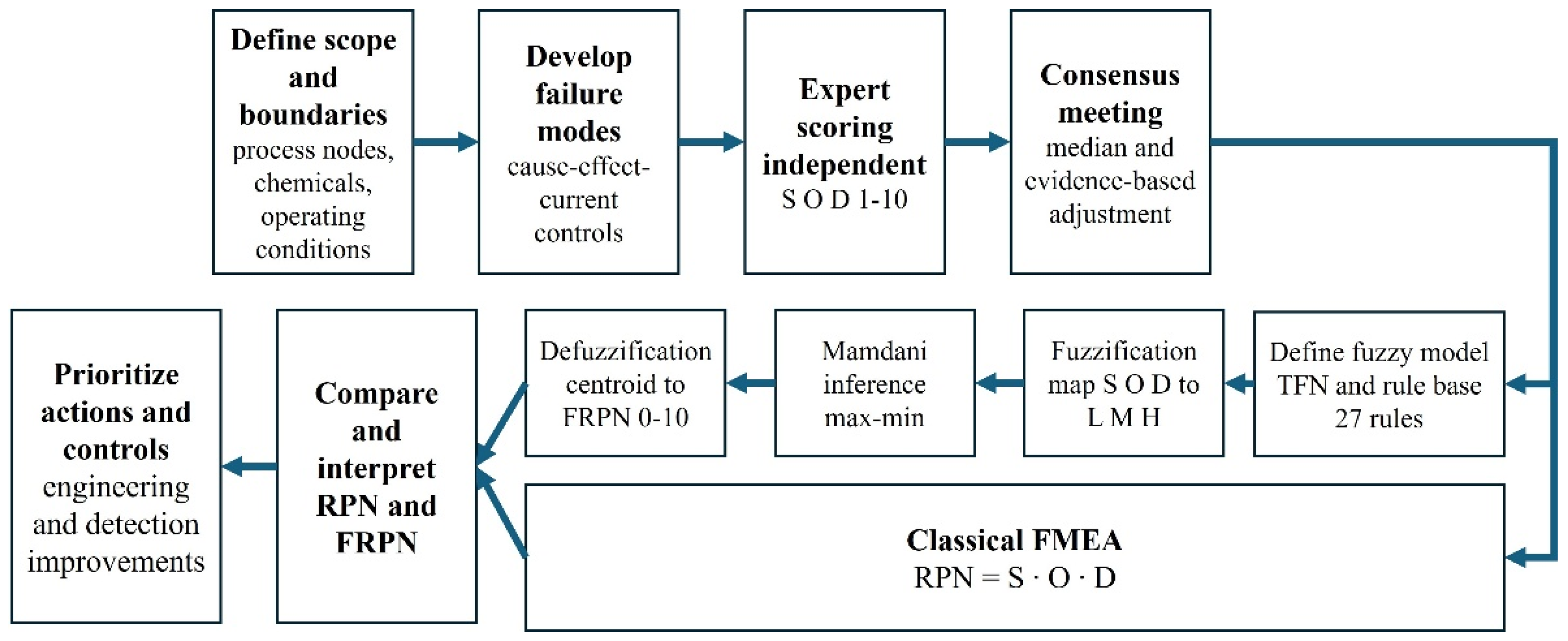
2. Materials and Methods
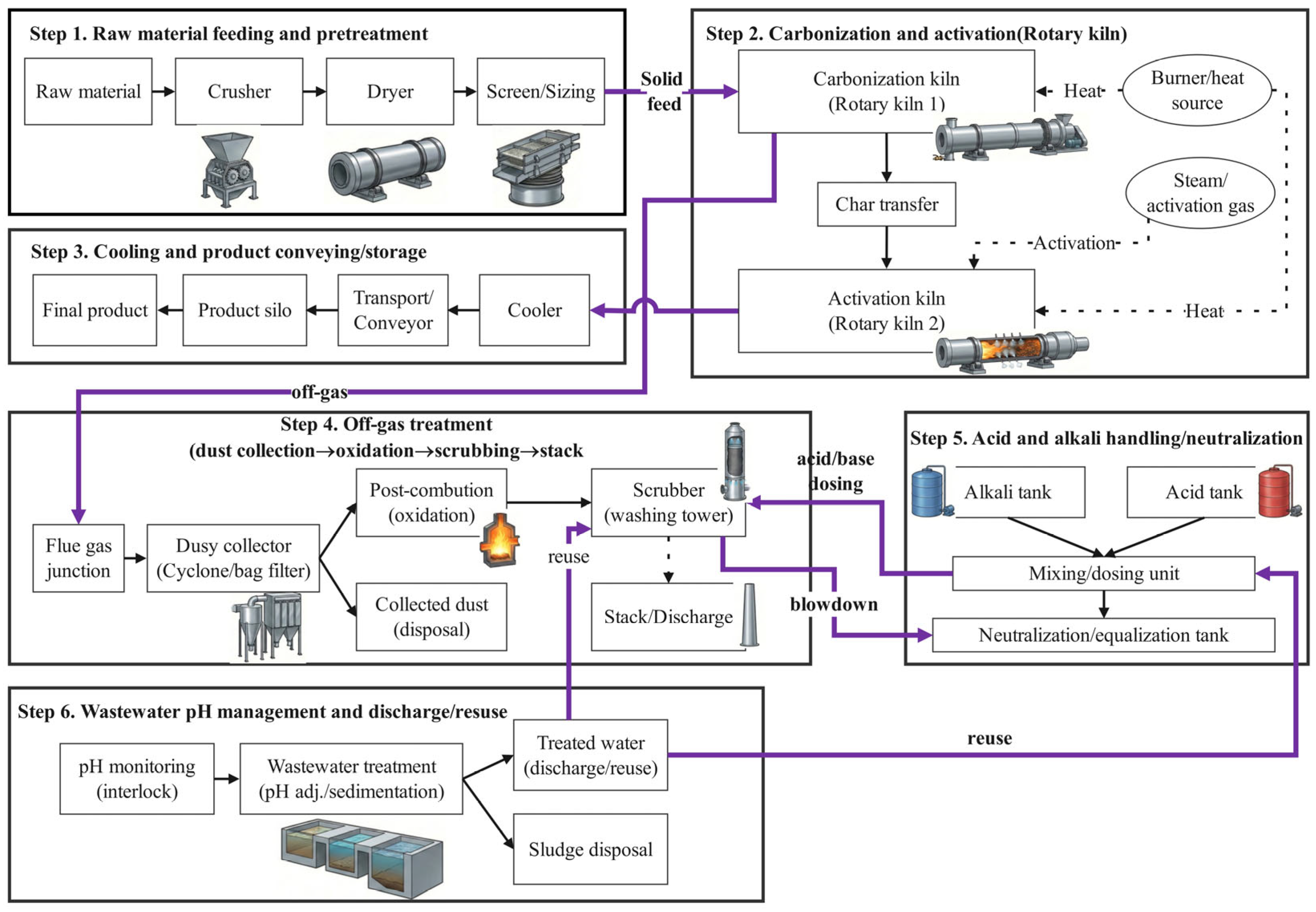
2.1. Process Scope and Definition of Failure Modes
2.2. Expert Panel and Evaluation Procedure
2.3. FMEA Scoring Framework and Ranking Approach
2.3.1. Criteria and Rationale for S/O/D Scoring
2.3.2. RPN Calculation and Auxiliary Comparison Index
2.4. Fuzzy-FMEA Method
2.4.1. Rationale for Adopting TFN–Mamdani–Centroid
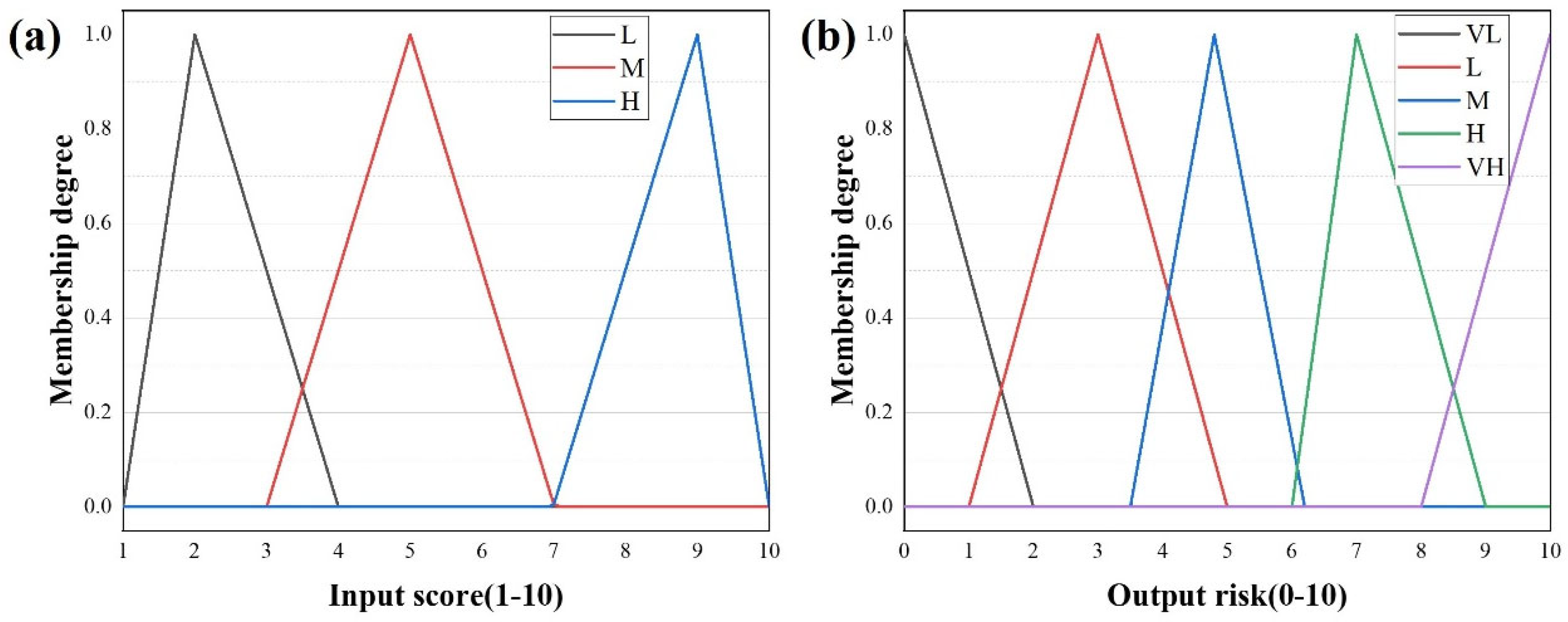
2.4.2. Membership Functions and TFN Parameters
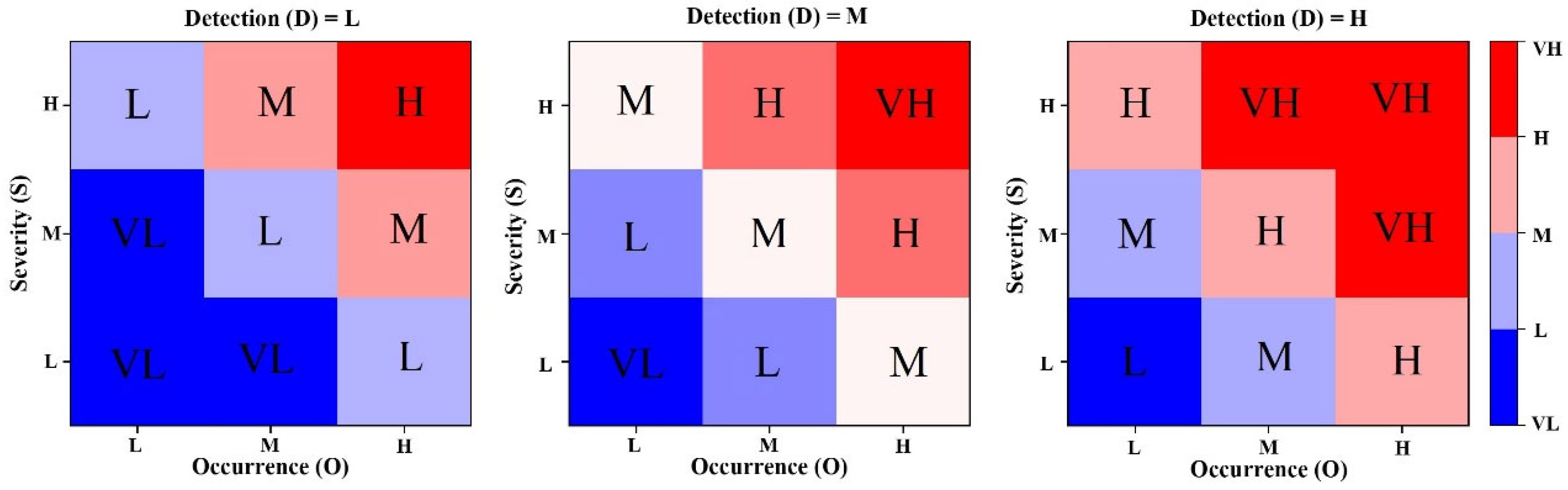
2.4.3. Rule Base Design Logic and Generation Rule
2.4.4. Mamdani Max–Min Inference and Centroid Defuzzification
3. Results and Discussion
3.1. Identified Hazards and Derived Failure Modes
3.2. Classical FMEA (RPN) Results and Interpretation
3.3. Fuzzy-FMEA (FRPN) Results and Interpretation
3.4. Meaning of the Differences Between RPN and FRPN Rankings
3.5. Category-Wise Risk Characteristics and Priority Improvement Measures
4. Conclusions
- (i)
- Dust explosion prevention, including dust collection, electrostatic control, and isolation measures;
- (ii)
- Off-gas leakage monitoring and system integrity management;
- (iii)
- Functional reliability of instrumentation and interlock systems, including verification, proof testing, and bypass control;
- (iv)
- Temperature control protection through independent protection layers, high–high shutdown logic, and early-warning diagnostics;
- (v)
- Acid/base leakage and corrosion management as the leading secondary risk cluster outside the top-tier FRPN group, supported by material selection, thickness monitoring, and inspection programs.
Author Contributions
Funding
Data Availability Statement
Conflicts of Interest
References
- Nor, N.M.; Lau, L.C.; Lee, K.T.; Mohamed, A.R. Synthesis of activated carbon from lignocellulosic biomass and its applications in air pollution control: A review. J. Environ. Chem. Eng. 2013, 1, 658–666. [Google Scholar] [CrossRef]
- Azam, K.; Shezad, N.; Shafiq, I.; Akhter, P.; Akhtar, F.; Jamil, F.; Shafique, S.; Park, Y.-K.; Hussain, M. A review on activated carbon modifications for the treatment of wastewater containing anionic dyes. Chemosphere 2022, 306, 135566. [Google Scholar] [CrossRef] [PubMed]
- Ammendola, P.; Raganati, F.; Chirone, R. CO2 adsorption on a fine activated carbon in a sound assisted fluidized bed: Thermodynamics and kinetics. Chem. Eng. J. 2017, 322, 302–313. [Google Scholar] [CrossRef]
- Srivastava, A.; Gupta, B.; Majumder, A.; Gupta, A.K.; Nimbhorkar, S.K. A comprehensive review on the synthesis, performance, modifications, and regeneration of activated carbon for the adsorptive removal of various water pollutants. J. Environ. Chem. Eng. 2021, 9, 106177. [Google Scholar] [CrossRef]
- Mopoung, S.; Dejang, N. Activated carbon preparation from eucalyptus wood chips using continuous carbonization–steam activation process in a batch intermittent rotary kiln. Sci. Rep. 2021, 11, 13948. [Google Scholar] [CrossRef]
- Ngernyen, Y.; Tangsathitkulchai, C.; Tangsathitkulchai, M. Porous properties of activated carbon produced from Eucalyptus and Wattle wood by carbon dioxide activation. Korean J. Chem. Eng. 2006, 23, 1046–1054. [Google Scholar] [CrossRef]
- Grewer, T.; Rogers, J. Exothermic secondary reactions. Thermochim. Acta 1993, 225, 289–301. [Google Scholar] [CrossRef]
- Dunjó, J.; Fthenakis, V.; Vílchez, J.A.; Arnaldos, J. Hazard and operability (HAZOP) analysis. A literature review. J. Hazard. Mater. 2010, 173, 19–32. [Google Scholar] [CrossRef]
- Dowell, A.M. Layer of protection analysis for determining safety integrity level. ISA Trans. 1998, 37, 155–165. [Google Scholar] [CrossRef]
- Liu, H.-C.; Liu, L.; Liu, N. Risk evaluation approaches in failure mode and effects analysis: A literature review. Expert Syst. Appl. 2013, 40, 828–838. [Google Scholar] [CrossRef]
- Liu, H.-C.; You, J.-X.; Fan, X.-J.; Lin, Q.-L. Failure mode and effects analysis using D numbers and grey relational projection method. Expert Syst. Appl. 2014, 41, 4670–4679. [Google Scholar] [CrossRef]
- Liu, H.-C.; Wang, L.-E.; Li, Z.; Hu, Y.-P. Improving risk evaluation in FMEA with cloud model and hierarchical TOPSIS method. IEEE Trans. Fuzzy Syst. 2019, 27, 84–95. [Google Scholar] [CrossRef]
- Zadeh, L.A. Fuzzy sets. Inf. Control 1965, 8, 338–353. [Google Scholar] [CrossRef]
- Mamdani, E.H.; Assilian, S. An experiment in linguistic synthesis with a fuzzy logic controller. Int. J. Man-Mach. Stud. 1975, 7, 1–13. [Google Scholar] [CrossRef]
- de Oliveira, J.V. A set-theoretical defuzzification method. Fuzzy Sets Syst. 1995, 76, 63–71. [Google Scholar] [CrossRef]
- Bowles, J.B.; Peláez, C.E. Fuzzy logic prioritization of failures in a system failure mode, effects and criticality analysis. Reliab. Eng. Syst. Saf. 1995, 50, 203–213. [Google Scholar] [CrossRef]
- Braglia, M.; Frosolini, M.; Montanari, R. Fuzzy TOPSIS approach for failure mode, effects and criticality analysis. Qual. Reliab. Eng. Int. 2003, 19, 425–443. [Google Scholar] [CrossRef]
- Liu, H.-C.; You, J.-X.; Shan, M.-M.; Shao, L.-N. Failure mode and effects analysis using intuitionistic fuzzy hybrid TOPSIS approach. Soft Comput. 2015, 19, 1085–1098. [Google Scholar] [CrossRef]
- Zou, Q.; Chen, Z.; Cheng, Z.; Liang, Y.; Xu, W.; Wen, P.; Zhang, B.; Liu, H.; Kong, F. Evaluation and intelligent deployment of coal and coalbed methane coupling coordinated exploitation based on Bayesian network and cuckoo search. Int. J. Min. Sci. Technol. 2022, 32, 1315–1328. [Google Scholar] [CrossRef]
- Li, Q.-E.; Zhang, B.J.; Lyu, S.-S.; Qi, Z. Spontaneous Combustion Characteristics of Activated Carbon Modified via Liquid Phase Impregnation during Drying. ACS Omega 2023, 8, 32752–32764. [Google Scholar] [CrossRef]
- Joseph, G. Chlorine transfer hose failure. J. Hazard. Mater. 2004, 115, 119–125. [Google Scholar] [CrossRef]
- Haghighi, A.; Chinniah, Y.A.; Jocelyn, S. Literature review on the incentives and solutions for the bypassing of guards and protective devices on machinery. Saf. Sci. 2019, 111, 188–204. [Google Scholar] [CrossRef]
- Marszal, E.M. You have safety instrumented system bypassed right now and don’t know it. Process Saf. Prog. 2022, 41, 85–94. [Google Scholar] [CrossRef]
- Torres-Echeverría, A.C.; Martorell, S.; Thompson, H.A. Modelling and optimization of proof testing policies for safety instrumented systems. Reliab. Eng. Syst. Saf. 2009, 94, 838–854. [Google Scholar] [CrossRef]
- Summers, A.E.; Raney, G. Common cause and common sense, designing failure out of your safety instrumented systems (SIS). ISA Trans. 1999, 38, 291–299. [Google Scholar] [CrossRef]
- Legg, S.W.; Benavides-Serrano, A.J.; Siirola, J.D.; Watson, J.P.; Davis, S.G.; Bratteteig, A.; Laird, C.D. A stochastic programming approach for gas detector placement using CFD-based dispersion simulations. Comput. Chem. Eng. 2012, 47, 194–201. [Google Scholar] [CrossRef]
- Eckhoff, R.K. Prevention and mitigation of dust explosions: A survey of recent research and development. J. Loss Prev. Process Ind. 1996, 9, 3–20. [Google Scholar] [CrossRef]
- Amyotte, P.R. Solid inertants and their use in dust explosion prevention and mitigation. J. Loss Prev. Process Ind. 2006, 19, 161–173. [Google Scholar] [CrossRef]
- Yuan, Z.; Khakzad, N.; Khan, F.; Amyotte, P. Risk-Based Design of Safety Measures to Prevent and Mitigate Dust Explosion Hazards. Ind. Eng. Chem. Res. 2013, 52, 18095–18108. [Google Scholar] [CrossRef]
- Taveau, J. Dust explosion propagation and isolation. J. Loss Prev. Process Ind. 2017, 48, 320–330. [Google Scholar] [CrossRef]
- Pinna, F.; Zucca, M.; Simoncelli, M.; Stochino, F. Explosion venting in dust collectors: A critical review of standards for reduced pressure and reaction force duration. J. Loss Prev. Process Ind. 2025, 97, 105670. [Google Scholar] [CrossRef]
- Lunn, G.A.; Cairns, F. The venting of dust explosions in a dust collector. J. Hazard. Mater. 1985, 12, 87–107. [Google Scholar] [CrossRef]
- Lunn, G.A.; Nicol, A.M.; Collins, P.D.; Hubbard, N.R. Effects of vent ducts on the reduced pressures from explosions in dust collectors. J. Loss Prev. Process Ind. 1998, 11, 109–121. [Google Scholar] [CrossRef]
- Matsusaka, S.; Maruyama, H.; Matsuyama, T.; Ghadiri, M. Triboelectric charging of powders: A review. Chem. Eng. Sci. 2010, 65, 5781–5807. [Google Scholar] [CrossRef]
- Peltonen, L.; Murtomaa, M.; Salonen, J. Measuring electrostatic charging of powders on-line during surface adhesion. J. Electrostat. 2018, 93, 53–57. [Google Scholar] [CrossRef]
- Schwindt, L.; von Pidoll, U.; Markus, D.; Klausmeyer, U.; Papalexandris, M.V.; Grosshans, H. Measurement of electrostatic charging during pneumatic conveying of powders. J. Loss Prev. Process Ind. 2017, 49, 461–471. [Google Scholar] [CrossRef]
- Eckhoff, R.K.; Randeberg, E. Electrostatic spark ignition of sensitive dust clouds of MIE < 1 mJ. J. Loss Prev. Process Ind. 2007, 20, 398–401. [Google Scholar] [CrossRef]
- Khalil, Y.F. Experimental investigation of the complex deflagration phenomena of hybrid mixtures of activated carbon dust/hydrogen/air. J. Loss Prev. Process Ind. 2013, 26, 1027–1038. [Google Scholar] [CrossRef]




| Category | Score | Criteria (Summary) |
|---|---|---|
| Severity (S) | 1–2 | Minor (quality impact or minor operational interruption); very low likelihood of human injury |
| 3–4 | Limited equipment damage or minor injury; short-term process impact | |
| 5–6 | Equipment damage and brief shutdown; potential for injury; possible environmental impact | |
| 7–8 | Major (potential escalation to fire/explosion; serious injury risk; extensive damage) | |
| 9–10 | Catastrophic (possible fatalities; large-scale explosion/toxic exposure; major regulatory violation) | |
| Occurrence (O) | 1–2 | Very low (almost never) |
| 3–4 | Low (rare) | |
| 5–6 | Medium (intermittent/potentially repetitive) | |
| 7–8 | High (repetitive) | |
| 9–10 | Very high (frequent/difficult to avoid) | |
| Detection (D) | 1–2 | Almost certainly detected (automatic monitoring/shutdown possible) |
| 3–4 | Relatively easy to detect | |
| 5–6 | Typical detectability (delays/misses possible) | |
| 7–8 | Difficult to detect (inefficient inspection or blind spots exist) | |
| 9–10 | Almost impossible to detect (preemptive control is difficult) |
| Variable | Linguistic Term | TFN (Triangular) Membership Parameters |
|---|---|---|
| Input (S/O/D), domain 1–10 | L | |
| M | ||
| H | ||
| Output (Risk), domain 0–10 | VL | |
| L | ||
| M | ||
| H | ||
| VH |
| ID | Process Node | Failure Mode | Main Causes (Examples) | Potential Effects (Examples) | Current Controls (Examples) |
|---|---|---|---|---|---|
| FM-K1 | Product/dust handling and dust collection | Activated carbon dust explosion | Dust accumulation, electrostatic/friction ignition | Explosion, fire, severe injury, equipment damage | Differential pressure (DP) monitoring, cleaning, grounding |
| FM-K2 | Rotary kiln (carbonization/activation) | Temperature control failure | Sensor drift, controller failure | Overheating, thermal runaway, refractory damage | Temperature monitoring, alarms, interlock |
| FM-K3 | Cooling/discharge | Incomplete cooling/air ingress | Poor sealing, insufficient purge | Oxidation of hot product/localized fire | Discharge temperature monitoring, sealing inspection |
| FM-K4 | Off-gas treatment | Reduced treatment performance | Filter damage, reduced scrubbing performance | Emission of hazardous/flammable gases | DP/flow/temperature monitoring |
| FM-K5 | Activation gas line | Deviation in flow/composition | Valve sticking, flowmeter failure | Reaction deviation, increased CO/H2 | Flow/pressure monitoring |
| FM-K6 | Conveying/rotating parts | Blockage/residence time deviation | Conveying blockage, increased torque | Overheating/quality degradation/local ignition | Torque/current monitoring |
| FM-C1 | Acid storage/transfer | Acid leakage | Flange/hose damage | Burns/corrosion/environmental contamination | Containment curb/tray, inspection |
| FM-C2 | Alkali storage/transfer | Alkali leakage | Valve packing degradation | Burns/corrosion/environmental contamination | Containment/inspection |
| FM-C3 | Dilution/mixing | Exothermic reaction/splattering | Water-acid mixing error | Splash burns/vapor generation | Work procedure, personal protective equipment (PPE) |
| FM-C4 | Neutralization tank | Abnormal neutralization/overflow | Poor pH control | Overflow/gas generation | pH monitoring, level management |
| FM-C5 | Piping/tank | Corrosion perforation | Inappropriate materials, accumulated corrosion | Large leakage/secondary accidents | Thickness measurement, material selection |
| FM-C6 | Wastewater | Discharge pH limit deviation | Poor control | Regulatory violations/complaints | pH interlock |
| FM-A1 | Duct/off-gas | Off-gas leakage (CO, etc.) | Sealing/duct damage | Poisoning/explosive mixture formation | Gas detection, ventilation |
| FM-A2 | Purge/inerting | Oxygen deficiency | Insufficient N2 purge, insufficient ventilation | Asphyxiation risk | O2 monitoring |
| FM-A3 | Duct/damper | Overpressure due to blockage | Damper sticking, dust accumulation | Overpressure rupture | Pressure monitoring, relief |
| FM-A4 | Burner/ignition | Flashback | Improper air ratio | Fire/explosion | Flame monitoring, shutoff |
| FM-A5 | Instrumentation/interlock | Instrumentation/interlock failure | Logic error/failure | Accident escalation | SIS/interlock testing |
| FM-A6 | Ignition source control | Failure to control electrostatic ignition sources | Poor grounding | Ignition of dust/gas | Grounding, humidity, housekeeping management |
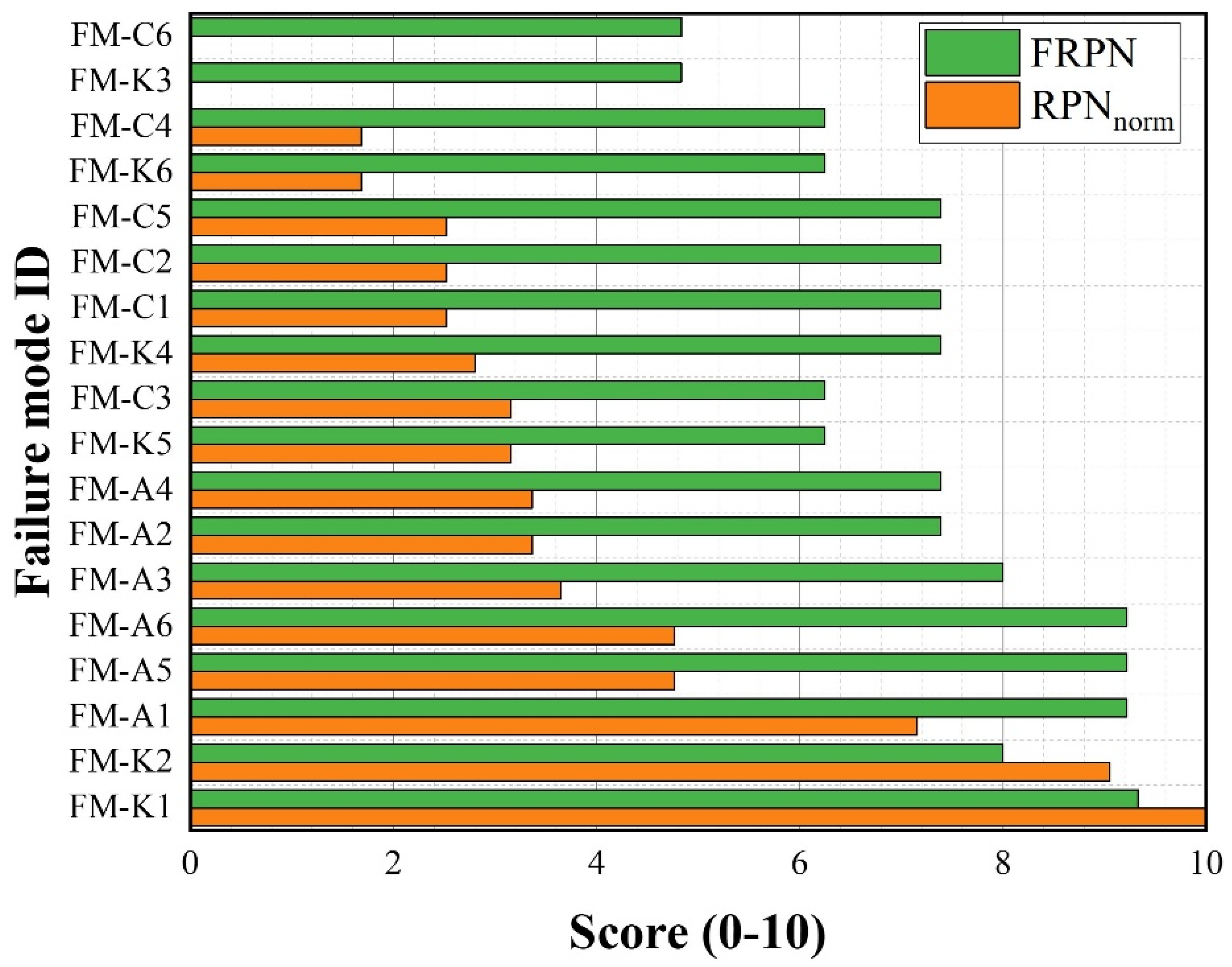
| ID | Category | Failure Mode | S | O | D | RPN | RPN Rank | FRPN | FRPN Rank |
|---|---|---|---|---|---|---|---|---|---|
| FM-K1 | Rotary kiln/activation | Activated carbon dust explosion | 9 | 5 | 9 | 405 | 1 | 9.332 | 1 |
| FM-K2 | Rotary kiln/activation | Temperature control failure | 9 | 6 | 7 | 378 | 2 | 8.000 | 5 |
| FM-A1 | Atmosphere/control | Off-gas leakage (CO, etc.) | 9 | 4 | 9 | 324 | 3 | 9.221 | 2 |
| FM-A5 | Atmosphere/control | Instrumentation/interlock failure | 8 | 4 | 8 | 256 | 4 | 9.221 | 2 |
| FM-A6 | Atmosphere/control | Failure to control electrostatic ignition sources | 8 | 4 | 8 | 256 | 4 | 9.221 | 2 |
| FM-A3 | Atmosphere/control | Overpressure due to blockage | 8 | 4 | 7 | 224 | 6 | 8.000 | 5 |
| FM-A2 | Atmosphere/control | Oxygen deficiency (inerting/purge) | 9 | 3 | 8 | 216 | 7 | 7.389 | 7 |
| FM-A4 | Atmosphere/control | Flashback | 9 | 3 | 8 | 216 | 7 | 7.389 | 7 |
| FM-K5 | Rotary kiln/activation | Deviation in activation gas flow/composition | 7 | 5 | 6 | 210 | 9 | 6.249 | 13 |
| FM-C3 | Acid/base | Exothermic reaction/splattering during dilution/mixing | 7 | 5 | 6 | 210 | 9 | 6.249 | 13 |
| FM-K4 | Rotary kiln/activation | Reduced off-gas treatment performance | 8 | 5 | 5 | 200 | 11 | 7.388 | 12 |
| FM-C1 | Acid/base | Acid leakage (storage/transfer) | 8 | 4 | 6 | 192 | 12 | 7.389 | 7 |
| FM-C2 | Acid/base | Alkali leakage (storage/transfer) | 8 | 4 | 6 | 192 | 12 | 7.389 | 7 |
| FM-C5 | Acid/base | Corrosion perforation | 8 | 3 | 8 | 192 | 12 | 7.389 | 7 |
| FM-K6 | Rotary kiln/activation | Blockage/residence time deviation | 7 | 4 | 6 | 168 | 15 | 6.249 | 13 |
| FM-C4 | Acid/base | Abnormal neutralization/overflow | 7 | 4 | 6 | 168 | 15 | 6.249 | 13 |
| FM-K3 | Rotary kiln/activation | Incomplete cooling/air ingress | 6 | 5 | 4 | 120 | 17 | 4.839 | 17 |
| FM-C6 | Acid/base | Discharge pH limit deviation | 6 | 4 | 5 | 120 | 17 | 4.839 | 17 |
| Metric | Value |
|---|---|
| Spearman rank correlation (ρ) | 0.871 |
| Kendall rank correlation (τ) | 0.752 |
| Top 5 overlap | 5/5 |
| Top 10 overlap | 8/10 |
| Mean |Δrank| | 2.06 |
| Max |Δrank| | 5 |
| ID | Category | Failure Mode | Escalation Mechanism | Key Vulnerable Barrier | Priority Improvement Package |
|---|---|---|---|---|---|
| FM-K1 | Rotary kiln/activation | Activated carbon dust explosion | Dust accumulation (collection/transfer/storage) + ignition sources (electrostatic discharge, friction, overheating) + oxygen ingress → rapid transition to explosion/fire | Dust is difficult to fully detect in advance, and escalation is rapid (high D vulnerability). Housekeeping/DP monitoring may be indirect indicators. | P (↓O): Minimize dead zones/pockets that promote dust holdup; improve cleaning access; design to reduce dust leakage; standardize vulnerable sections. D (↓D): Refine DP trend alarms; use motor current/torque and bearing temperature for early diagnostics and maintenance triggers. M (↓S/escalation cut): Consider explosion isolation and mitigation (venting/compartmentation) where feasible; strengthen ignition control (systematic grounding/bonding). |
| FM-A1 | Atmosphere/control | Off-gas leakage (CO, etc.) | Multiple leakage points along long ducts/seals/flanges/dampers → leakage → worker poisoning + (conditional) explosive mixture formation → ignition → accident escalation | Leakage points are dispersed, increasing management difficulty. If detect-alarm-shutdown remains only as alarms, escalation is hard to cut. | P (↓O): Standardize specs and inspection criteria for ducts/seals/joints; preventive replacement of degraded sections; focused inspection/leak management of vulnerable parts (dampers/expansion joints). D (↓D): Place CO (or key component) detectors at vulnerable points with calibration; monitor negative pressure/ventilation status. M (escalation cut): Link detection signals to ventilation reinforcement or safe shutdown (fuel cut-off/shutoff valves, etc.) to sever leak-accumulation-ignition. |
| FM-A5 | Atmosphere/control | Instrumentation/interlock failure (barrier failure) | Failure of detection-alarm-shutdown under abnormal states → accident escalation (amplifier of other risks) | Barrier failure is a common amplification factor for the entire process; bypass, insufficient testing, and poor MOC worsen D. | P (↓O): Redundancy and cross-check diagnostics for critical instrumentation; strengthen logic change MOC; improve alarm quality via alarm rationalization. D (↓D): Set and comply with proof test intervals; establish bypass control including approval/duration/return confirmation. M (escalation cut): Redefine functions from an IPL perspective as shutdown, not merely alarm, where necessary. |
| FM-A6 | Atmosphere/control | Failure to control electrostatic ignition sources | Poor grounding/bonding/non-conductive parts + dust/gas presence → electrostatic discharge ignition → rapid transition to explosion/fire | Ignition control becomes fatal when coupled with dust/gas hazards; field management may fragment into partial grounding. | P (↓O): Standardize grounding/bonding design (including mobile equipment); clarify criteria for electrostatic-vulnerable materials (hoses/gaskets); reduce friction sources (alignment/bearing condition). D (↓D): Periodic continuity/resistance checks; checklist-based controls during work/maintenance. M (escalation cut): Integrate with (K1) explosion isolation/mitigation measures as a package. |
| FM-K2 | Rotary kiln/activation | Temperature control failure | Sensor drift/controller or fuel-system anomalies/operating deviations → overheating, thermal runaway, and refractory damage → fire/process instability | Monitoring and alarms alone are insufficient for pre-escalation shutdown; without Hi-Hi shutdown/IPL, D becomes vulnerable. | P (↓O): Strengthen strategies for operating condition control (fuel/air ratio, etc.) and control system health. D (↓D): Temperature measurement redundancy + cross-check diagnostics; automatic fuel cut-off via Hi-Hi interlocks; interlock proof test and bypass control. M (escalation cut): Secure intervention time via ROC-based early warning; refine safe shutdown sequences from an IPL perspective where necessary. |
Disclaimer/Publisher’s Note: The statements, opinions and data contained in all publications are solely those of the individual author(s) and contributor(s) and not of MDPI and/or the editor(s). MDPI and/or the editor(s) disclaim responsibility for any injury to people or property resulting from any ideas, methods, instructions or products referred to in the content. |
© 2026 by the authors. Licensee MDPI, Basel, Switzerland. This article is an open access article distributed under the terms and conditions of the Creative Commons Attribution (CC BY) license.
Share and Cite
Kim, J.G.; Bai, B.C. Study on Risk Analysis of a Rotary Kiln-Based Activated Carbon Manufacturing Process Using Fuzzy-FMEA. Processes 2026, 14, 1071. https://doi.org/10.3390/pr14071071
Kim JG, Bai BC. Study on Risk Analysis of a Rotary Kiln-Based Activated Carbon Manufacturing Process Using Fuzzy-FMEA. Processes. 2026; 14(7):1071. https://doi.org/10.3390/pr14071071
Chicago/Turabian StyleKim, Jong Gu, and Byong Chol Bai. 2026. "Study on Risk Analysis of a Rotary Kiln-Based Activated Carbon Manufacturing Process Using Fuzzy-FMEA" Processes 14, no. 7: 1071. https://doi.org/10.3390/pr14071071
APA StyleKim, J. G., & Bai, B. C. (2026). Study on Risk Analysis of a Rotary Kiln-Based Activated Carbon Manufacturing Process Using Fuzzy-FMEA. Processes, 14(7), 1071. https://doi.org/10.3390/pr14071071