Article

Terrestrial Heat Flow and Crustal Thermal Structure of the Tazhong Uplift, Tarim Basin, Northwest China


1
Research Institute of Petroleum Exploration & Development, Beijing 100083, China
2
Bohai Rim Energy Research Institute, Northeast Petroleum University, Daqing 066004, China
3
College of Geoscience and Surveying Engineering, China University of Mining and Technology, Beijing 100083, China
4
Research Institute of Exploration and Development, Tarim Oilfield Company, PetroChina, Korla 841000, China
*
Author to whom correspondence should be addressed.
Processes 2026, 14(6), 980; https://doi.org/10.3390/pr14060980
Submission received: 19 January 2026 / Revised: 9 March 2026 / Accepted: 16 March 2026 / Published: 19 March 2026

Abstract

Geothermal field characteristics fundamentally control hydrocarbon generation, phase evolution, and preservation, and are particularly critical in deep to ultra-deep hydrocarbon exploration. The Tazhong Uplift is a key area for deep to ultra-deep hydrocarbon exploration in the Tarim Basin; however, its deep thermal regime and controlling factors remain inadequately characterized. This study aims to accurately characterize the geothermal field and crustal thermal structure of the Tazhong Uplift to provide thermal constraints for ultra-deep exploration. We systematically compiled system steady-state temperature data from 24 wells, bottom-hole temperature (BHT) data from 51 wells, and rock thermal property measurements. Using the one-dimensional steady-state heat conduction equation, present-day geothermal gradients at 0–5000 m depths and terrestrial heat flow were calculated, and formation temperatures were predicted at deep horizons (6000–10,000 m). Results show geothermal gradients at 0–5000 m of 18.5–26.7 °C/km (average 23.06 °C/km) and heat flow of 39.3–59.8 mW/m2 (average 48.1 mW/m2), both significantly higher than basin averages. The distribution of the geothermal field is jointly controlled by basement structure and rock thermophysical properties. Basement highs typically exhibit elevated geothermal gradients and high heat flow. The dual-layer structure of “upper clastic rocks (low thermal conductivity, high heat production) + lower carbonate rocks (high thermal conductivity, low heat production)” results in a vertical differentiation characterized by a “high-upper, low-lower” geothermal gradient. Notably, the thick Upper Ordovician mudstone acts as a regional “thermal blanket”, significantly reducing geothermal parameters in the northern slope area. Crustal thermal structure analysis indicates a “cold mantle” signature of cratonic basins, with a thermal lithosphere thickness of ~134–145 km and a Moho temperature of ~581 °C. These findings reveal that despite the ultra-deep burial (>8000 m), the “cold” thermal background and the thermal regulation of the overlying diverse lithologies maintain formation temperatures within a range favorable for liquid hydrocarbon preservation, significantly expanding the depth limit for oil exploration in the Tarim Basin.

1. Introduction

The Tarim Basin, a primary focus for deep to ultra-deep hydrocarbon exploration in China, is characterized by a complex subsurface temperature and pressure regime. This regime, a product of the basin’s prolonged geological evolution, exerts fundamental control on hydrocarbon generation, accumulation, and preservation. Consequently, the basin’s geothermal field has long been a central topic of research [1,2].
Previous studies have established that the Tarim Basin exhibits a relatively “cold” thermal background typical of cratonic basins, with present-day heat flow averaging 42–45 mW/m2 and geothermal gradients ranging from 18 to 22 °C/km across most of the basin [2,3,4]. This low thermal regime is attributed to its thick, stable Precambrian basement and limited tectonic–thermal activity since the Paleozoic [4]. However, significant spatial heterogeneity exists: uplift zones such as the Tabei and Bachu uplifts generally display elevated heat flow (45–55 mW/m2) compared to adjacent depressions [5,6,7], reflecting the influence of basement morphology on heat redistribution.
Recent advances in deep geophysical prospecting have progressively pushed exploration targets from shallow depths to Cambrian–Lower Ordovician carbonate reservoirs buried at depths exceeding 8000 m or even 10,000 m [8,9]. These technological breakthroughs have not only enabled major hydrocarbon discoveries in the deep formations of the Tazhong and Tabei uplifts [10,11] but also raised new demands for higher-precision characterization of deep thermal regimes—an essential prerequisite for predicting hydrocarbon phase behavior in these ultra-deep targets.
The basin’s geothermal field and its thermal evolution history strictly controls source rock hydrocarbon generation processes, reservoir preservation conditions, and deep fluid phase distribution [12,13,14], exerting decisive control on hydrocarbon generation and accumulation [15,16,17]. Given that deep to ultra-deep formations commonly undergo prolonged geological evolution and may experience sustained high-temperature environments, accurate characterization of geothermal field features is crucial for hydrocarbon resource assessment. In recent years, with the enrichment of deep to ultra-deep borehole temperature data, geothermal field research has gradually shifted from shallow to deep formations. Existing studies reveal that lithospheric thermal structure, basement topography, and variations in rock thermophysical properties are key factors determining the deep geothermal field distribution pattern in the Tarim Basin [3,5,6,7]. Notably, under the coupled influence of multiple geological factors, deep and shallow geothermal fields do not follow simple linear conduction patterns but exhibit pronounced vertical stratification and lateral heterogeneity. Examples include lateral redistribution of terrestrial heat flow caused by uplift–depression configurations, and geothermal gradient differentiation effects produced by deep high-conductivity carbonates versus shallow low-conductivity clastics [6].
Synthesizing existing achievements, previous studies have predominantly examined deep geothermal field characteristics of the Tarim Basin from a basin-wide macroscopic perspective [1,3,4,6], or focused detailed investigations at regional scales on the extensively explored Tabei Uplift and the Aman Transition Zone [5,6]. In contrast, fine characterization of the deep geothermal field in the Tazhong Uplift, a critical structural unit, remains inadequate. The complex deep structure of the Tazhong Uplift and its distinct thermal background compared to Tabei have constrained in-depth understanding of the area’s deep thermal state, thereby affecting accurate assessment of deep to ultra-deep hydrocarbon resource potential and exploration deployment.
Therefore, based on systematic compilation of high-quality borehole temperature data, measured rock thermal conductivity data, and radiogenic heat production data from the study area, this study calculates the geothermal gradient and terrestrial heat flow distribution at unified depths of 0–5000 m in the Tazhong Uplift using the one-dimensional steady-state heat conduction equation. Furthermore, extrapolating to greater depths, formation temperatures are predicted at depth interfaces of 6000 m, 8000 m, and 10,000 m, as well as at key horizons including the tops of the Cambrian, Ordovician, and Yuertusi Formation. On this basis, this study systematically analyzes the lateral distribution patterns and crustal thermal structure characteristics of the ultra-deep geothermal field in the study area, estimates lithospheric thermal thickness, explores in depth the controlling factors of geothermal characteristics, and reveals their control on deep hydrocarbon properties and phase evolution. The aim is to provide scientific thermal constraints for hydrocarbon exploration breakthroughs in the ultra-deep domain of the Tazhong Uplift.

2. Geological Setting

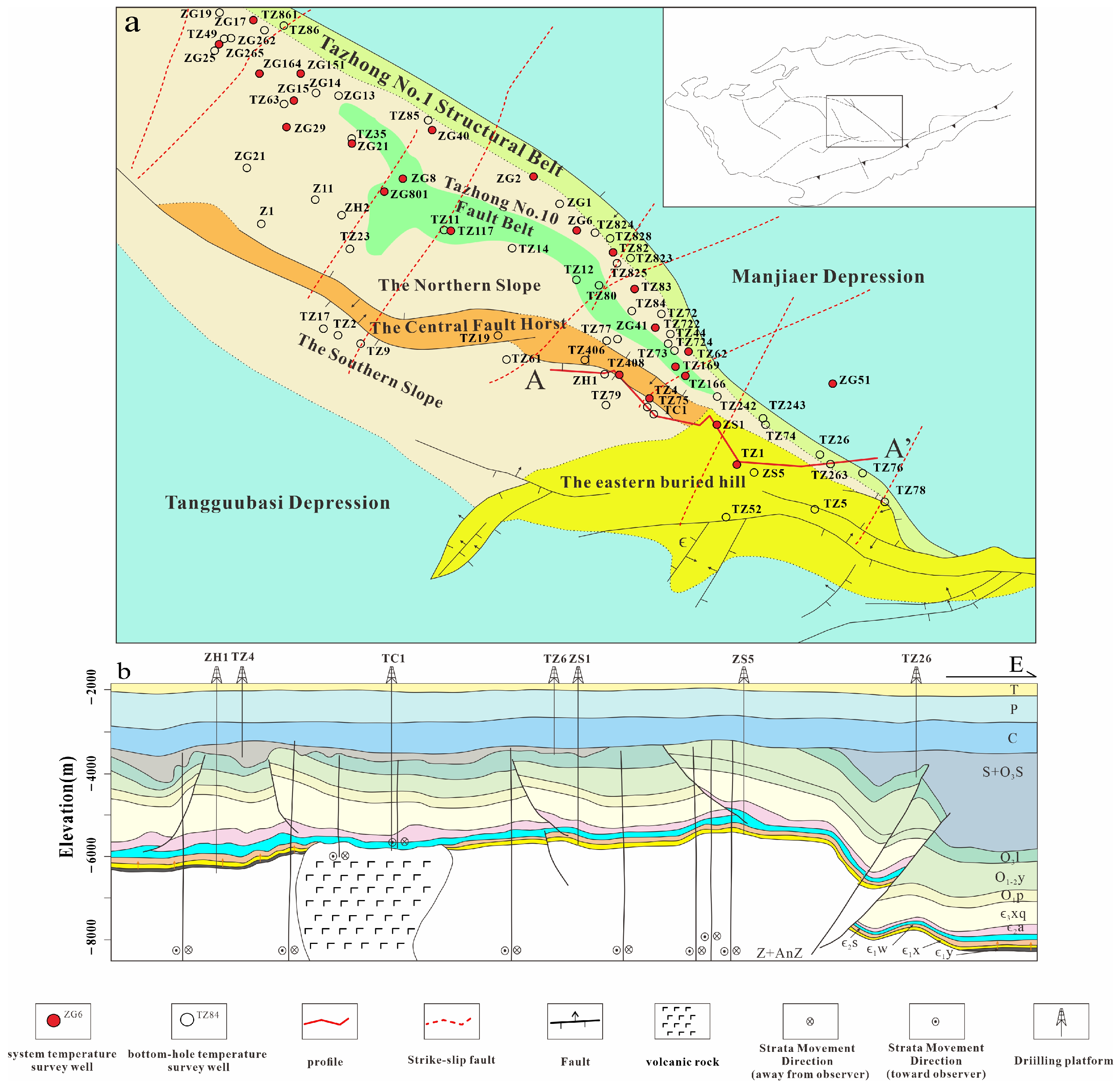
The Tazhong Uplift is located in the central part of the Central Uplift Belt in the Tarim Basin, bordered by the Manjar Depression to the north, the Tangguzibasi Depression to the south, the Bachu Uplift to the west, and bounded by the Tadong Low Uplift to the east. It trends NW–SE and represents a large-scale paleo-uplift with long-term inherited development within the Tarim Craton Basin [18,19,20]. As a significant hydrocarbon accumulation zone within the basin, the Tazhong area exhibits a structural framework characterized by “east-west segmentation and north-south zonation” in plan view, comprising secondary structural units including the Tazhong No. I Fault Zone, northern slope zone, central horst zone, southern slope zone, and the southern margin fault zone of Tazhong (Figure 1) [21,22,23,24,25].
The Tazhong Uplift has experienced superimposition and modification by multiple tectonic episodes, including the Caledonian, Hercynian, Indosinian, and Himalayan orogenies [18,19,26,27,28]. During the Early Paleozoic, influenced by the far-field effects of Proto-Tethys Ocean closure and collisional amalgamation of peripheral blocks (such as the Kunlun and Altyn terranes), the Tarim Basin transitioned from an earlier extensional setting to a compressional regime [19,29,30,31,32,33]. Particularly during the Middle–Late Ordovician, intense compressional uplift subjected the Tazhong area to severe erosion, forming multiple unconformity surfaces [34,35,36,37,38,39].
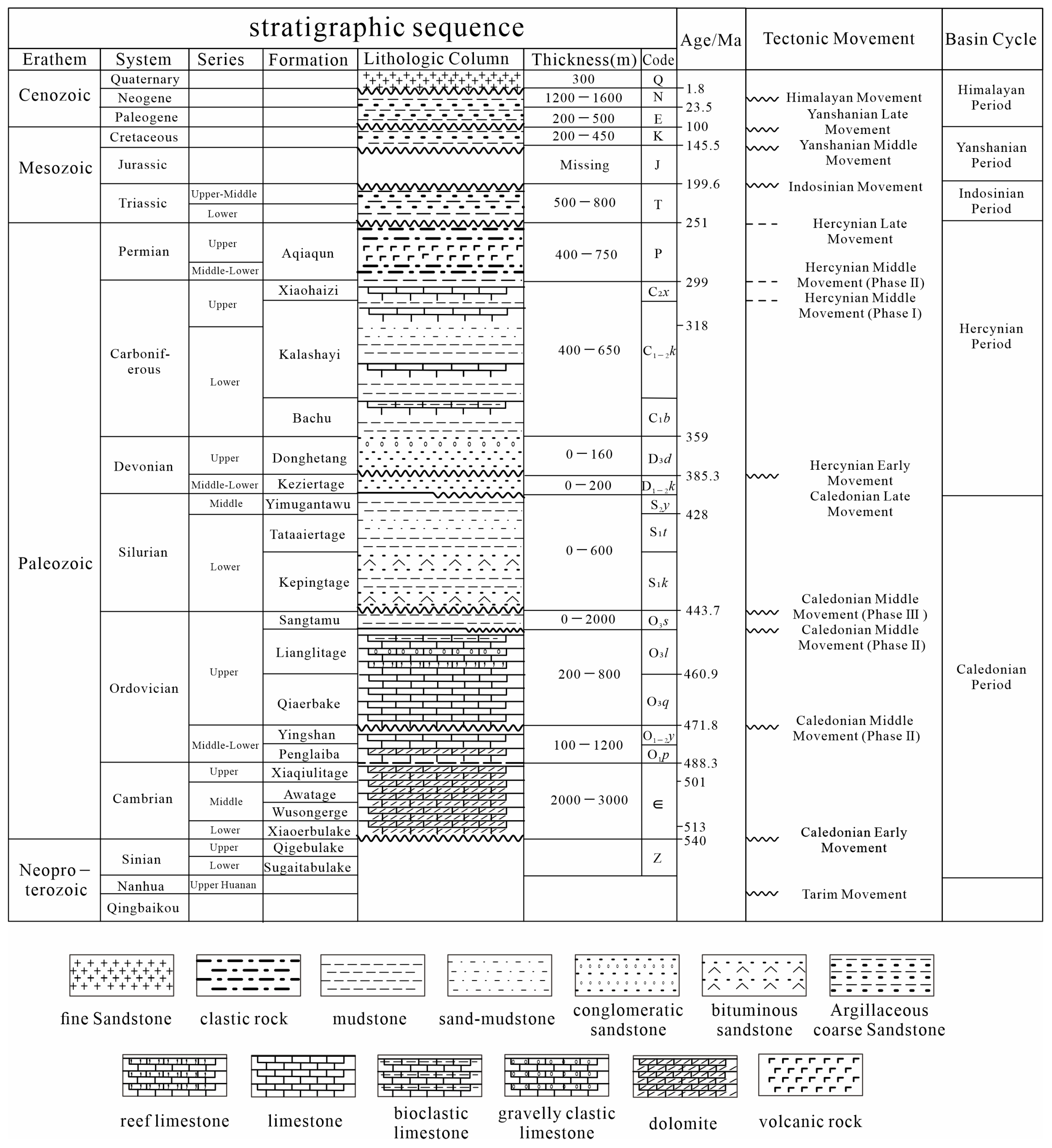
Regarding stratigraphic development, the Tazhong area possesses a complete Paleozoic sedimentary sequence (Figure 2). From the Cambrian to Middle Ordovician, an extremely thick carbonate platform succession was deposited, comprising from bottom to top the Lower Ordovician Penglaiba Formation (O1p) and Yingshan Formation (O1–2y), the Middle Ordovician Yijianfang Formation (O2yj), and the Upper Ordovician Lianglitage Formation (O3l) and Sangtamu Formation (O3s) [40,41,42]. Among these, the top of the Yingshan Formation developed extensive weathering crust karst reservoirs influenced by the Middle Caledonian tectonic movement, while the Lianglitage Formation primarily developed reef–shoal complexes distributed along the platform margin [43,44]. The extremely thick mudstone succession of the Upper Ordovician Sangtamu Formation constitutes a high-quality regional seal, forming excellent reservoir–seal assemblages with the underlying carbonate reservoirs [45,46].
Above the Sangtamu Formation, the Tazhong area developed a complete succession of Silurian, Devonian, Carboniferous, Permian, and Mesozoic–Cenozoic strata [22,25]. The Silurian–Devonian sequences consist predominantly of clastic rocks (sandstones and mudstones) deposited in marine to transitional environments. The Carboniferous and Permian strata include both clastic rocks and volcanic intervals related to Permian magmatic activity [10,47]. The Mesozoic–Cenozoic succession is largely preserved across the Tazhong Uplift and consists mainly of continental clastic deposits [18,20]. This complete stratigraphic record from Paleozoic to Cenozoic provides essential constraints for understanding the basin’s thermal evolution and its control on hydrocarbon generation and preservation.
The fault system represents one of the most prominent structural features in the Tazhong area, primarily comprising two fault systems: NW-trending thrust faults and NE-trending strike-slip faults [10,47,48]. The NW-trending faults (such as the Tazhong No. I Fault) are predominantly basement-involved thrust faults formed during the Middle Caledonian period, controlling the fundamental framework of the uplift [19,33,49]. In contrast, the NE-trending strike-slip faults mainly formed during the Silurian–Devonian, characterized by multi-stage activities. In cross-section, they commonly exhibit flower structures, while in plan view they develop various configuration styles including linear, feather-like, and en echelon patterns [27,49,50,51]. These strike-slip faults not only cut earlier thrust faults but also connected deep hydrothermal fluids with source rocks, playing a critical controlling role in karst modification of carbonate reservoirs and hydrocarbon migration and accumulation [26,41,46,52,53].

3. Data and Methodology

3.1. Borehole Temperature Data

Borehole temperature data, including system steady-state temperature measurements, well-test temperatures, and bottom-hole temperatures (BHTs), provide direct evidence for characterizing geothermal fields. System steady-state data are acquired after thermal equilibrium is reached, minimizing drilling disturbances and offering the highest reliability [54,55]. Well-test data, obtained after shut-in periods, also closely approximate true formation temperatures. BHTs, measured shortly after drilling cessation, are typically lower than equilibrium temperatures and require correction. This study utilizes two primary temperature datasets from the Tazhong Uplift: system steady-state temperature measurements from 24 wells and bottom-hole temperature data from 51 wells (Figure 1a).
The system steady-state temperature measurements were conducted using high-precision quartz pressure–temperature gauges (accuracy of ±0.1 °C). Measurements were taken after drilling fluid circulation had ceased for a minimum of 72 h (typically 4–7 days) to ensure thermal equilibrium between the borehole and surrounding formations, thereby minimizing drilling-induced thermal disturbances. Data acquisition followed a standardized protocol: temperature readings were recorded at 200–300 m depth intervals during wireline logging operations, with each measurement point stabilized for at least 30 s before recording. The system steady-state temperature measurement profiles from 24 wells span depths ranging from 0 to 6370 m and are distributed across all structural zones except the southern slope zone. Apart from the eastern buried-hill belt, which includes temperature data from the Cambrian, other structural zones lack Cambrian formation temperature measurements.
Bottom-hole temperature data were compiled from wireline logging records and final well reports. The BHTs were measured using maximum-recording thermometers attached to logging tools (accuracy ±1 °C) immediately after logging operations, typically 6–12 h after circulation ceased. BHT data are distributed across all structural zones, spanning depths ranging from 3253 to 8791 m. Except for the No. I Fault Zone, all structural zones include formation temperatures from the Cambrian.

3.2. Rock Thermal Conductivity and Heat Production Data

A total of 208 rock thermal conductivity measurements from the Sinian to Neogene in the Tarim Basin were compiled for this study [54,55,56,57,58,59]. These measurements were originally obtained by previous researchers using the optical scanning method or the divided-bar apparatus, both of which are standard techniques for determining thermal conductivity of rock samples under laboratory conditions.
To obtain representative thermal conductivity parameters for the Tazhong area, we first calculated the arithmetic mean thermal conductivity for each lithology within different stratigraphic intervals based on all available measurements. Subsequently, for each stratigraphic interval, the harmonic mean method was employed to determine the bulk thermal conductivity [3,55], weighted by the proportions of different lithologies within that interval as revealed by drilling and logging data. This harmonic averaging accounts for the fact that heat flow in sedimentary sequences is predominantly vertical conduction through layered media.
Radiogenic heat production rates for each well were calculated from natural gamma ray logs using the empirical formula proposed by Bücker and Rybach [60], which has been calibrated for the Tarim Basin [61,62]:
A = 0.0158 × ( q A P I 0.8 )
where A is the radiogenic heat production rate (μW/m3), and qAPI is the natural gamma ray log value (API units). The coefficient 0.0158 converts gamma ray intensity to heat production, and the constant 0.8 removes the background contribution from non-radiogenic minerals.
Gamma ray logs were first depth-matched to the formation tops for each well. Log values were then averaged over each stratigraphic unit to obtain a representative qAPI for that unit, which was subsequently converted to heat production using Equation (1).
Due to the limited number of boreholes penetrating the Cambrian (10 wells), which are primarily distributed in the eastern buried-hill belt, seismic profiles and structural maps were utilized to supplement stratigraphic divisions for wells that did not reach the Cambrian. By integrating seismic horizon interpretations with lithological information from adjacent wells, we obtained complete stratigraphic columns and thermophysical property distributions, ensuring the accuracy of subsequent deep formation temperature predictions.

3.3. Methodology

3.3.1. Geothermal Gradient and Terrestrial Heat Flow

Terrestrial heat flow values are indirectly calculated through two parameters: geothermal gradient and rock thermal conductivity. Given that continuous temperature measurement data and thermal conductivity profiles exhibit distinct segmentation, this study employed the thermal resistance method to calculate terrestrial heat flow values for both continuous system steady-state temperature measurement data and bottom-hole temperature data. The calculation formulas are as follows:
q s =   T i = 1 n z i K i
where qs represents terrestrial heat flow in mW/m2; ΔT is the temperature difference across the entire measured wellbore interval in °C; Ki is the thermal conductivity of the i-th interval in W/(m·K); and ΔZi is the depth difference in the i-th interval in m.
For different types of borehole temperature data, geothermal gradients can be calculated using different methods. For system steady-state temperature measurement data, geothermal gradients are calculated through linear regression. When temperature data exhibit obvious segmentation, the weighted average of segmented fitting results is used to characterize the average geothermal gradient of the well. Similarly, for wells with abundant and relatively continuous bottom-hole temperature data, linear fitting is applied. For wells with limited temperature data, this study calculates geothermal gradients using Formula (3) [5]:
G = T T 0 Z Z 0
where G represents geothermal gradient in °C/km; T is the measured temperature in °C; Z is the measurement depth in km; T0 is the constant temperature zone temperature in °C; and Z0 is the constant temperature zone depth in km. This study adopts a constant temperature zone depth Z0 of 20 m and temperature T0 of 12 °C [63].
Since borehole temperature measurements are often acquired at different depths, to ensure objectivity and scientific rigor in lateral comparisons, this study uniformly corrects geothermal gradients to 5000 m depth based on temperature measurement data, thereby enabling comparative analysis of geothermal gradient (G0–5000) distribution characteristics at the unified depth of 0–5000 m across the study area. The specific calculation procedure is as follows: for wells with temperature measurement data at 5000 m depth, geothermal gradients at the unified depth of 0–5000 m are calculated directly using linear regression of temperature–depth data and Formula (2). For wells where measurement depth does not reach 5000 m, seismic stratigraphic layering data are used to determine the formation subdivision from the well depth down to 5000 m. Then, thermal parameters from adjacent wells are assigned to the strata not penetrated by the drilling. Finally, the temperature at 5000 m depth is calculated using the one-dimensional steady-state heat conduction equation (Equation (4)), and the geothermal gradient for the unified 0–5000 m depth interval is subsequently derived also using Equation (4) [64].
T i b = T i t + q i × Z i K i A i × Z i 2 2 × K i
where i represents the structural layer number; T i b and T i t are the temperatures at the bottom and top interfaces of the i-th layer, respectively, in °C; qi is the terrestrial heat flow value at the top interface of the i-th layer in mW/m2; Zi is the formation thickness of the i-th layer in km; Ki is the rock thermal conductivity of the i-th layer in W/(m·K); and Ai is the radiogenic heat production rate of the i-th layer in μW/m3.

3.3.2. Deep Formation Temperature Prediction

Formation temperature holds significant implications for deep hydrocarbon exploration, as it strictly controls hydrocarbon phase behavior and whether crude oil undergoes secondary cracking. Previous kinetic studies indicate that the threshold temperature for the initiation of significant crude oil cracking is typically around 160 °C, with rapid conversion to dry gas occurring above 200 °C [65,66]. Therefore, establishing a precise deep thermal profile is a prerequisite for delineating the depth limits of liquid hydrocarbon preservation and predicting the distribution of condensate and gas reservoirs in ultra-deep formations. In the Tazhong area, the Cambrian and Ordovician formations are generally buried deeper than 6000 m, with the Lower Cambrian exceeding 10,000 m in the Tazhong No. 1 Fault Zone and northern slope Zone. However, measured temperature data from such depths are extremely scarce due to limited well penetration. To address this gap and provide a basis for ultra-deep temperature prediction in the Tazhong Uplift, this study employs Formula (4) to extrapolate deep formation temperatures from shallow measurements. Based on measured temperature and thermal conductivity data, present-day formation temperatures were calculated at depths of 6000 m, 8000 m, and 10,000 m, as well as at the tops of the Lower Paleozoic Ordovician carbonates, Cambrian, and Lower Cambrian.

3.3.3. Calculation Method for Lithosphere Thickness and Thermal Structure

The thermal lithosphere is typically defined as the lithospheric layer that transfers heat through thermal conduction, with the underlying asthenosphere dominated by thermal convection [67,68]. This study employs the one-dimensional steady-state heat conduction equation to calculate lithospheric temperature profiles with depth. The upper and lower limits of thermal lithosphere thickness are defined by the intersection depths of the geothermal curve with two Mantle Adiabat lines [69,70]. The empirical formulas for calculating the Mantle Adiabat are as follows:
T 1 = 1200   C + 0.5 ( C / k m ) × Z ( k m )   ( upper   limit )
T 2 = 1300   C + 0.4 ( C / k m ) × Z ( k m )   ( lower   limit )
Surface heat flow primarily comprises crustal radiogenic heat production, deep heat flow from the mantle, and tectonic heat from tectonic thermal events [71]. Since the Tarim Basin has not experienced large-scale tectonic thermal events since Permian basaltic magmatism, surface heat flow in this area is primarily composed of radiogenic heat production from sedimentary layers and crust, along with mantle heat flow. We employ a layered model and use the following formula to calculate top and bottom surface heat flow for each structural layer progressively:
q b = q t A i Z i
where qt represents heat flow at the layer top (mW/m2); qb represents heat flow at the layer bottom (mW/m2); Ai is the radiogenic heat production rate of the i-th layer (μW/m3); and Zi is the thickness of the i-th layer (km).
Calculating lithosphere thickness and thermal structure requires geological layering data and rock thermophysical parameters (radiogenic heat production rate A and thermal conductivity K). Integrated geophysical inversion combining gravity, magnetic, magnetotelluric, and seismic constraint data indicates that the average crustal thickness in the Tarim Basin is approximately 47.2 km, with thinner crust in uplift zones [72]. The average crustal thickness in the Tazhong Uplift is approximately 40.3 km, based on the same joint inversion results [7,72].
Integrating local measured data with these deep exploration results, this study divides the crustal structure of the Tazhong area into a four-layer model. The sedimentary cover thickness (7.2 km) is constrained by actual drilling results from Well Tacan 1—the deepest stratigraphic borehole in the central Tarim Basin, which penetrated the complete Phanerozoic succession and confirmed the depth to crystalline basement. The subdivision of the underlying crystalline crust into upper (14 km), middle (13 km), and lower (10 km) layers follows the seismic velocity structure derived from wide-angle reflection/refraction profiles across the central uplift belt [16,73], which reveal distinct velocity gradients corresponding to compositional changes with depth. The Moho depth is set at 44.2 km, consistent with the depth of the crust–mantle boundary interpreted from deep seismic sounding data and teleseismic receiver function studies in the Tazhong region [7,73].
The upper formations of the sedimentary cover (primarily clastic rocks) exhibit an average thermal conductivity of approximately 2.34 W/(m·K), while the lower formations (primarily carbonates) display higher average thermal conductivity of approximately 4.03 W/(m·K) [7]. These values are derived from the harmonic mean of measured rock thermal conductivities, as detailed in Section 4.1.2 [7].
For the deep crystalline crust, thermal conductivity cannot be directly measured and requires temperature correction according to the following formula:
K ( T ) = K 0 1 + c T
where K0 represents the initial thermal conductivity under surface conditions (W/(m·K)), and c is the temperature correction coefficient (in °C−1), which quantifies the rate at which thermal conductivity decreases with increasing temperature. Referring to the global standard continental crustal model, K0 values for the upper crust, middle crust, and lower crust are set at 2.3, 2.5, 2.5, and 3.4 W/(m·K), respectively, with the corresponding temperature correction coefficients c assigned as 0.001, 0.00025, and 0.00025 [16]. These coefficients correspond to the upper crust, middle crust, and lower crust, respectively, representing the sensitivity of thermal conductivity to temperature for different crustal layers.
The radiogenic heat production rate for sedimentary rocks is taken as the measured average value of 1.121 μW/m3, which is calculated from gamma ray logs as described in Section 4.1.2. Upper crustal heat production typically exhibits exponential decay with depth. The model can be written as A = A0 exp(−Z/D). D is heat producing layer depth scaling parameter (km) and A0 is near-surface rock heat production rate (1.080 μW/m3). This study sets A0 of the upper crust in Tazhong at 1.080 μW/m3, with a decay depth D of 10 km. Radiogenic heat production rates for the middle and lower crust are treated as constants, set at 0.29 μW/m3 and 0.18 μW/m3, respectively, while mantle radiogenic heat production rate is set at 0.03 μW/m3 [4].

4. Results and Discussion

4.1. Geothermal Field Distribution Characteristics in the Tazhong Area

4.1.1. Borehole Temperature and Geothermal Gradient Distribution Characteristics

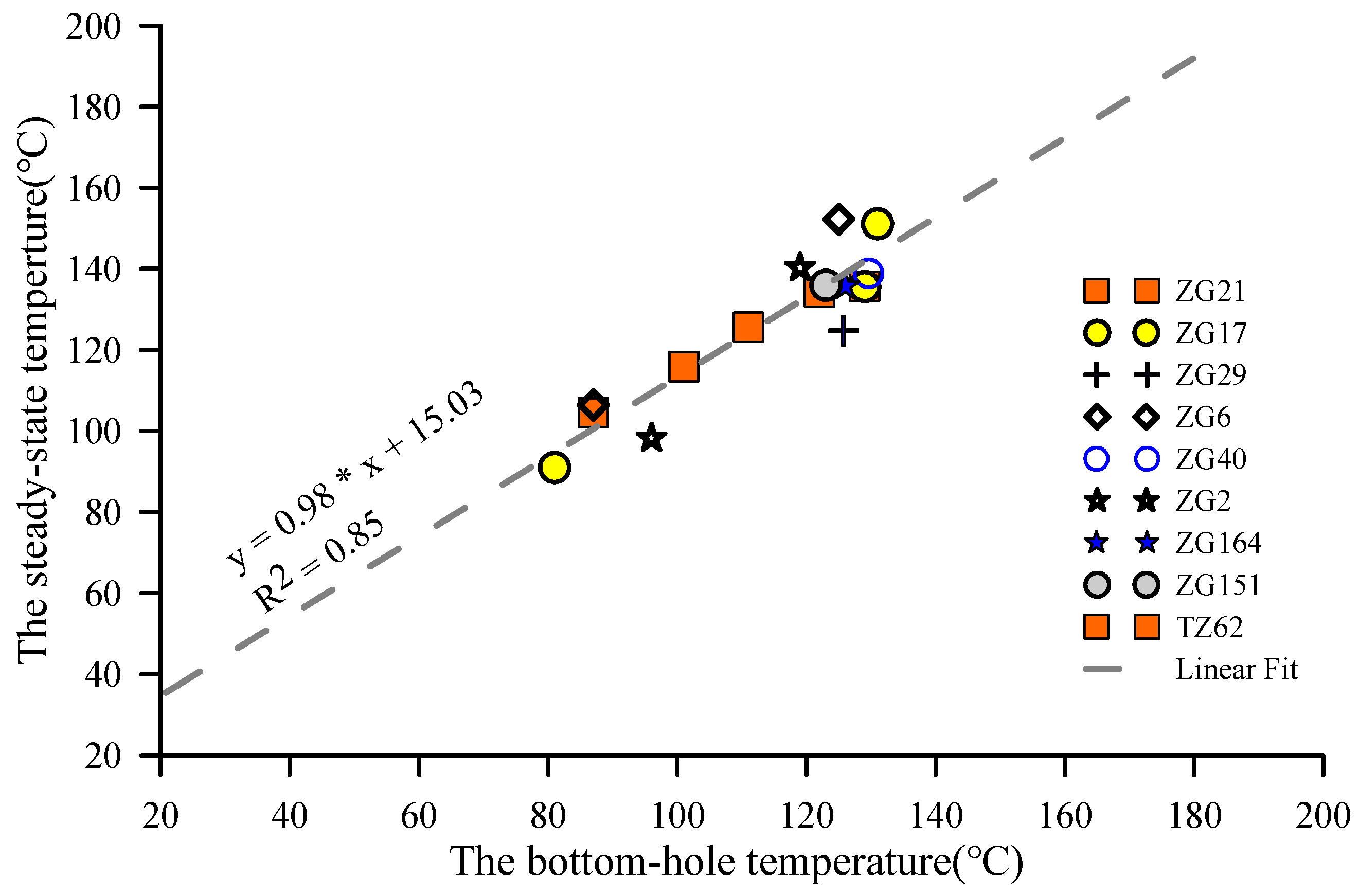
Since BHTs are systematically lower than equilibrium formation temperatures due to incomplete thermal recovery, we applied a linear correction method [6,55] to calibrate the BHTs. The correction formula was derived from 9 wells with both BHT and steady-state measurements in the study area (Figure 2): T = 0.98 × T0 + 15.03 (Figure 3), where T0 is the uncorrected BHT and T is the estimated equilibrium temperature. The correlation coefficient (R2 = 0.85) indicates high reliability of this correction.
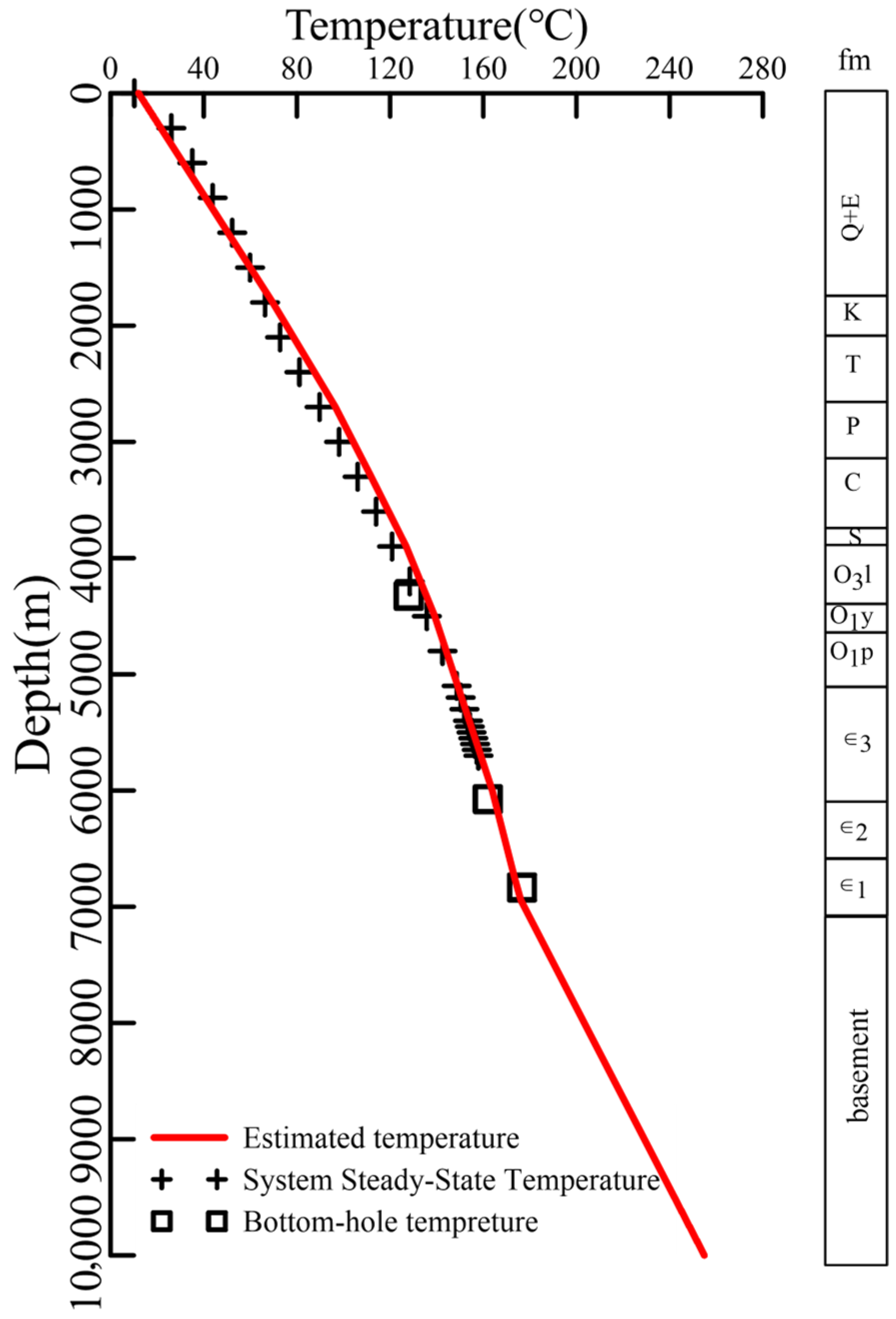
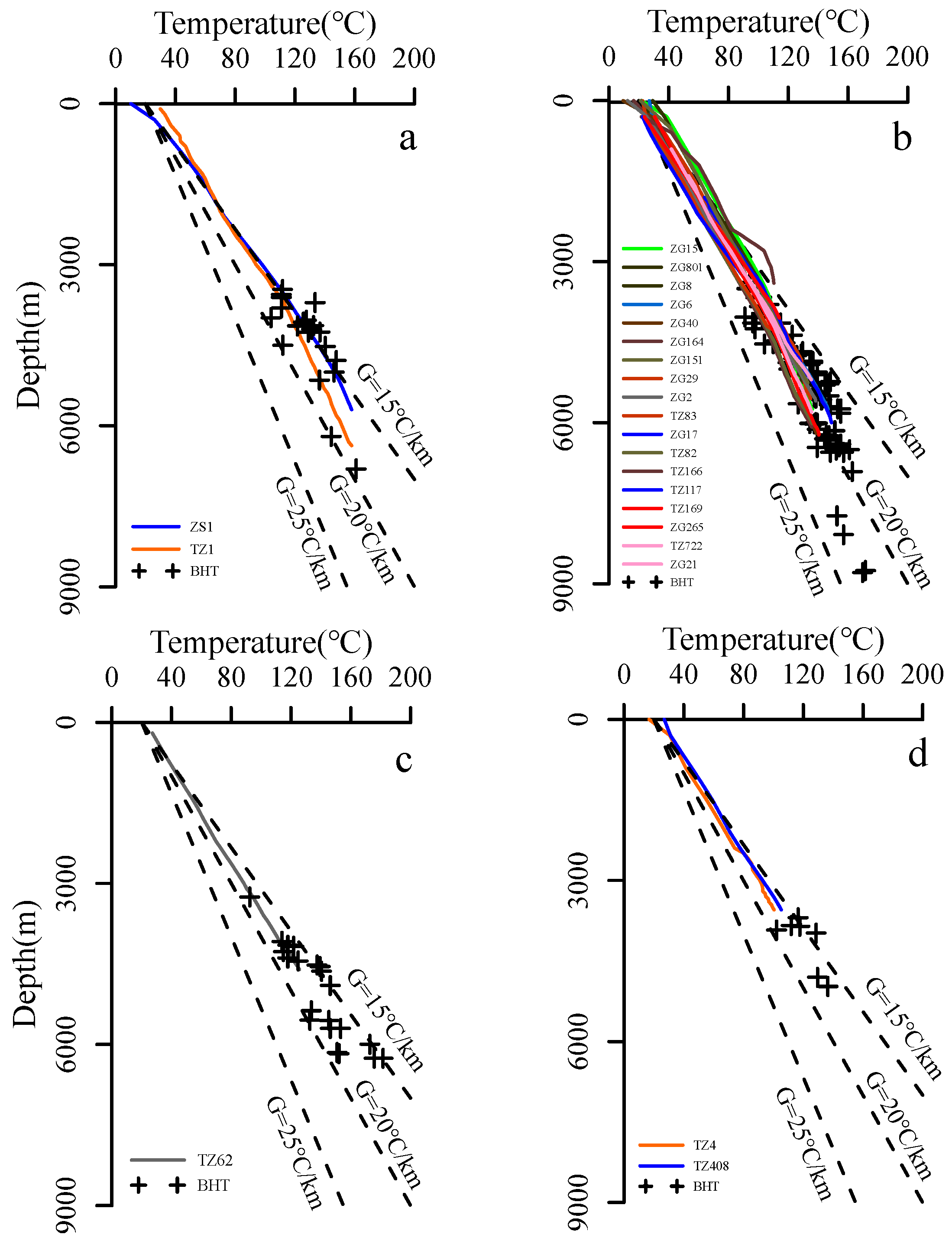
The temperature–depth profiles for representative wells in different structural zones are shown in Figure 4. The temperature profiles exhibit a near-linear temperature–depth relationship, indicating that heat transfer is predominantly conductive. Above 3000 m depth, formation temperature differences among different structural zones in the Tazhong area are relatively small (less than 20 °C). With increasing depth, formation temperatures in the eastern buried-hill belt, central horst zone, and No. I Fault Zone are generally comparable and consistently higher than those in the northern slope zone, with temperature differences exceeding 30 °C. For example, at 5500 m depth, Well ZS1 in the eastern buried-hill belt reaches 154 °C, well TZ823 in the No. I Fault Zone reaches 134 °C, while well ZG 8 in the northern slope zone of Tazhong records only 126 °C.
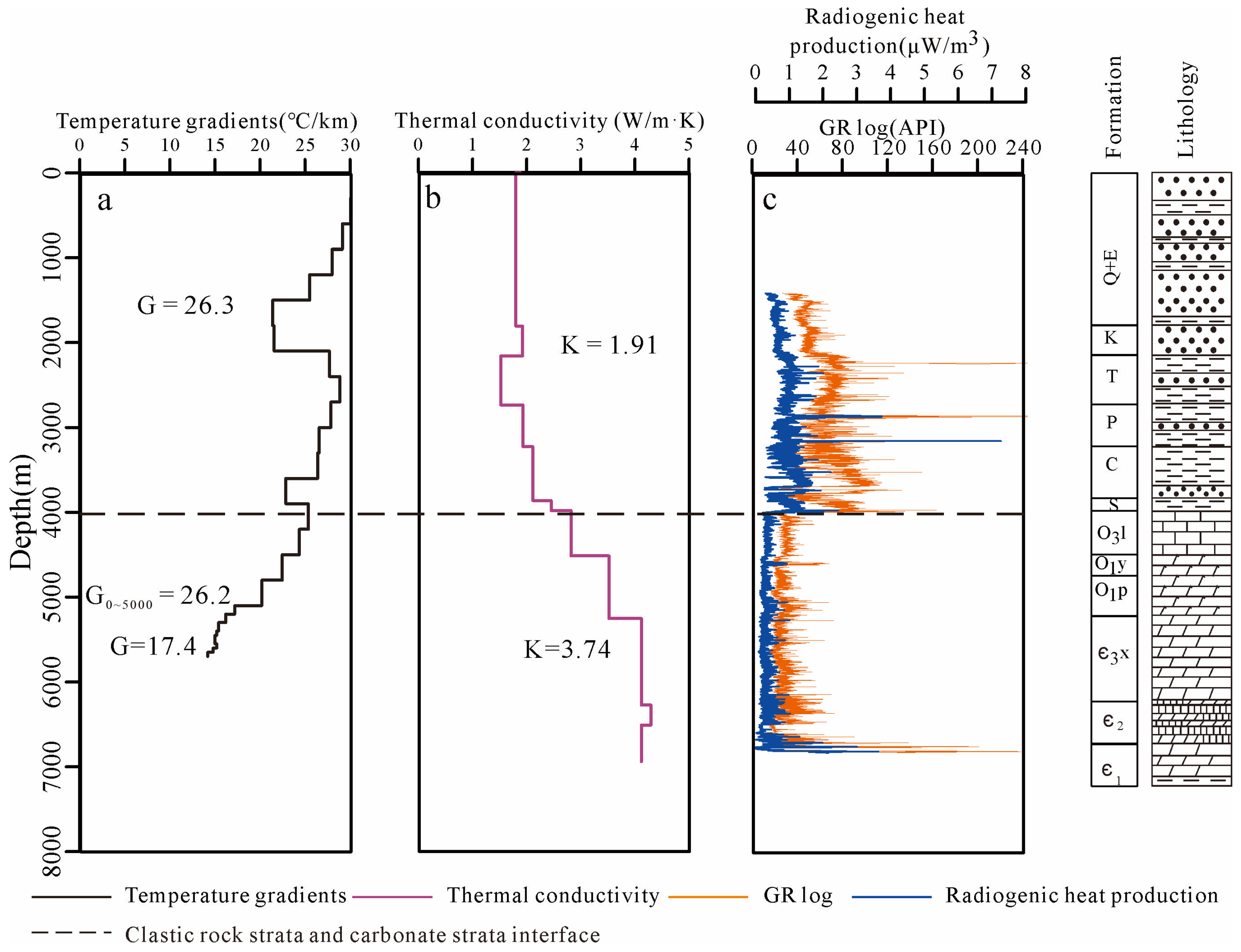
Figure 5a shows the geothermal gradient curve of Well ZS1 calculated using Equation (2). Meanwhile, we calculated the geothermal gradient G0–5000 for the 0–5000 m depth interval using Equation (3). As can be seen from Figure 5, the clastic rock sequences from the Quaternary to Silurian in Well ZS1 exhibit relatively high geothermal gradients, reaching up to 26.3 °C/km, while the carbonate sequences of the Ordovician and Cambrian show relatively low geothermal gradients of only 17.4 °C/km.
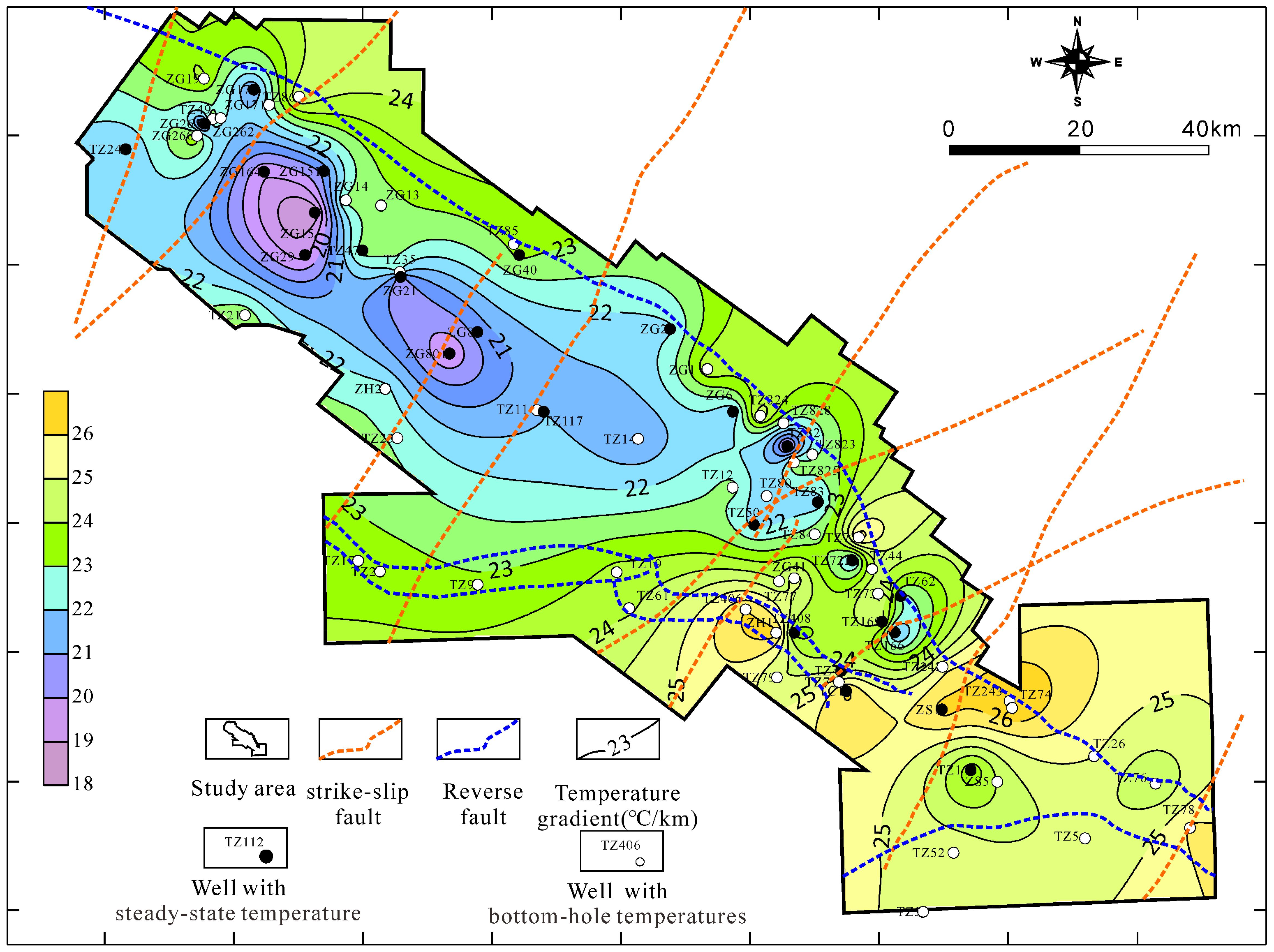
Based on system steady-state temperature measurement and bottom-hole temperature data, geothermal gradients at the unified depth of 0–5000 m were calculated (see Supplementary Material), and a plan-view distribution map of geothermal gradients (Figure 6) was generated through interpolation. Geothermal gradients in the Tazhong Uplift range from 18.5 to 26.7 °C/km, with an average value of 23.06 °C/km. In plan view, the geothermal gradient distribution in the Tazhong Uplift exhibits a trumpet-shaped pattern. High geothermal gradient zones are distributed in the eastern buried-hill belt, No. I Fault Zone, and central fault zone (geothermal gradients generally exceed 23 °C/km), while low geothermal gradient zones are distributed across the northern slope zone enclosed by these three areas (geothermal gradients generally below 22 °C/km). The eastern buried-hill belt exhibits the highest geothermal gradients, ranging from 23.1 to 26.2 °C/km, followed by the central fault zone and No. I Fault Zone.
The average geothermal gradient obtained in this study (23.06 °C/km) is consistent with previous estimates for the Tazhong area (20–25 °C/km) reported by Liu et al. [15] and Li et al. [14], but is notably higher than the basin-wide average of 20.8 °C/km reported by Qiu et al. [2]. This disparity is typical of cratonic basins, where uplift zones generally exhibit elevated thermal backgrounds due to basement heat flow refraction [4].
Regarding the relationship with basement configuration, both the eastern buried-hill belt and central fault zone exhibit relatively shallow basement burial, while the No. I Fault Zone and northern slope zone of Tazhong show deeper basement burial. Transitioning from the eastern buried-hill belt and central fault zone toward the northern slope zone, geothermal gradients display an inverse relationship with basement relief—as basement burial depth gradually increases, geothermal gradients progressively decrease. Conversely, transitioning from the No. I Fault Zone toward the northern slope zone, geothermal gradients exhibit the same trend as basement relief. This indicates that differences in geothermal gradients among structural subdivisions within the Tazhong Uplift are influenced not only by basement relief but also by other factors.

4.1.2. Results of Rock Thermal Conductivity and Heat Production

Table 1 presents the arithmetic mean thermal conductivity for each major lithology within various stratigraphic intervals, calculated based on 208 rock thermal conductivity measurements. Using the lithological proportions within each interval revealed by drilling and logging data, the harmonic mean method was employed to determine the average thermal conductivity for each stratigraphic interval. Figure 5b shows the calculated thermal conductivity profile for Well ZS1. The profile exhibits a clear two-segment pattern: the upper section (above the Ordovician Lianglitage Formation), dominated by clastic rocks, has a harmonic mean thermal conductivity of 1.91 W/(m·K); the lower section (Ordovician–Cambrian), dominated by carbonates, has a harmonic mean thermal conductivity of 3.74 W/(m·K). The overall average thermal conductivity for this well is 2.76 W/(m·K).
Figure 5c displays the calculated heat production profile for Well ZS1, showing a clear lithological control: clastic sequences (average 1.12 μW/m3) have significantly higher heat production than carbonate sequences below the Lianglitage Formation (average 0.58 μW/m3). The average radiogenic heat production rate for the Cambrian and overlying formations in this well is 0.93 μW/m3, consistent with previous measurements in the basin [56]. The calculated heat production values for each formation are listed in Table 1 and used in subsequent thermal modeling.

4.1.3. Terrestrial Heat Flow Distribution Characteristics

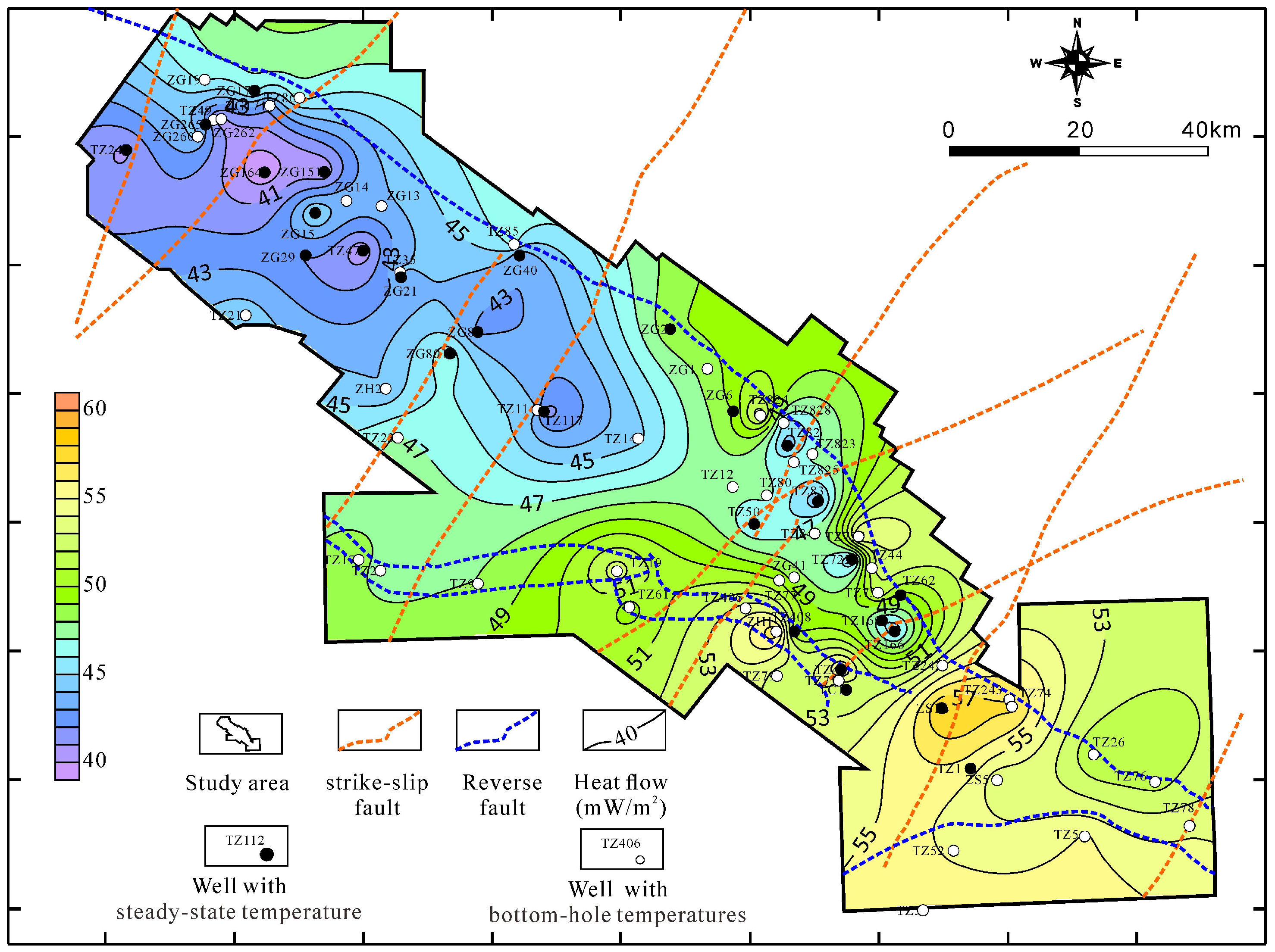
Calculated terrestrial heat flow values are listed in Supplementary Material. Feng et al. [54,74] obtained a measured heat flow value of 63.0 mW/m2 at well TZ1 in the Tazhong Uplift, closely matching the calculated value of 58.9 mW/m2 in this study, thereby validating the reliability of our calculations. Calculation results show that terrestrial heat flow in the Tazhong Uplift ranges from 39.3 to 59.8 mW/m2, with an average value of 48.1 mW/m2.
Regionally, the variation pattern of terrestrial heat flow exhibits a distinct spatial heterogeneity that closely mirrors the distribution of geothermal gradients. High heat flow values (typically >48 mW/m2) are observed in the eastern buried-hill belt, the central fault zone, and the No. I Fault Zone, with localized peaks approaching 60 mW/m2 at wells TZ1 and ZS2 (Figure 7). For example, wells TZ1 and ZS2 in the eastern buried-hill belt exhibit terrestrial heat flow approaching 60 mW/m2. In contrast, the northern slope zone, which is blanketed by thick sedimentary sequences, is characterized by consistently lower heat flow (<48 mW/m2).
Compared with other tectonic units in the Tarim Basin, the average heat flow of the Tazhong Uplift (48.1 mW/m2) is notably higher than that of the adjacent Tanggu Depression and Manxi Low Uplift (42–45 mW/m2) [15,54] and the Tabei Uplift (42–50 mW/m2) [5,68]. However, it is slightly lower than that of the Bachu Uplift and Gucheng Low Uplift (50–55 mW/m2) [16,54], despite all three being located within the same Central Uplift Belt. This intra-belt variation suggests that factors such as sedimentary cover thickness and lithology may modulate the surface expression of a common deep thermal source.
Notably, the heat flow values obtained in this study are consistent with the general thermal regime of cratonic basins, where surface heat flow typically ranges from 40 to 60 mW/m2 [2,4]. The spatial patterns observed in Tazhong—elevated heat flow on basement highs and reduced heat flow in areas with thick cover—mirror trends documented in other parts of the Tarim Basin [5,6] and in analogous cratonic settings worldwide [71].

4.1.4. The Influence of Thermal Convection on the Planar Distribution of the Geothermal Field

Geothermal gradients, terrestrial heat flow, and the estimated deep formation temperatures discussed later in the text were all calculated by interpolation to obtain their respective planar distributions. It should be noted that the extrapolation method described above assumes purely conductive heat transfer, which is valid for the predominantly low-permeability carbonate matrix in the study area. However, the Tazhong Uplift is characterized by extensive fault and fracture systems, particularly within the No. I Fault Zone and strike-slip fault zones [27,49]. In highly fractured intervals, fluid circulation could potentially induce convective heat transfer, thereby violating the conductive assumption and introducing uncertainties in the predicted deep temperatures [75]. Nevertheless, several lines of evidence suggest that conduction remains the dominant heat transfer mechanism in the Tazhong area: (1) the near-linear temperature–depth profiles observed in most wells (Figure 3) are characteristic of conductive regimes; (2) the thick mudstone sequences of the Upper Ordovician Sangtamu Formation act as regional aquitards that hydraulically isolate the underlying fractured carbonates from shallow meteoric circulation [45]; and (3) previous hydrogeochemical studies indicate that deep formation waters in the Tazhong area are predominantly stagnant brines with limited modern flow [28,53].

4.2. Deep Formation Temperature Distribution Characteristics

Well ZS1 offers a comprehensive dataset of systematic temperature measurements and logging geothermal data spanning from the Quaternary to the Cambrian. To validate our approach, we calculated its deep formation temperatures using Formula (4) with measured temperatures from 0 to 6734 m (Figure 8). The calculated temperature values differ from measured values by 0.11 °C to 6.78 °C, with relative errors of 1.8% to 7.44%, demonstrating good consistency and indicating that deep temperatures obtained using this method are reliable.

4.2.1. Temperature Distribution Characteristics at 6000–10,000 m Burial Depth

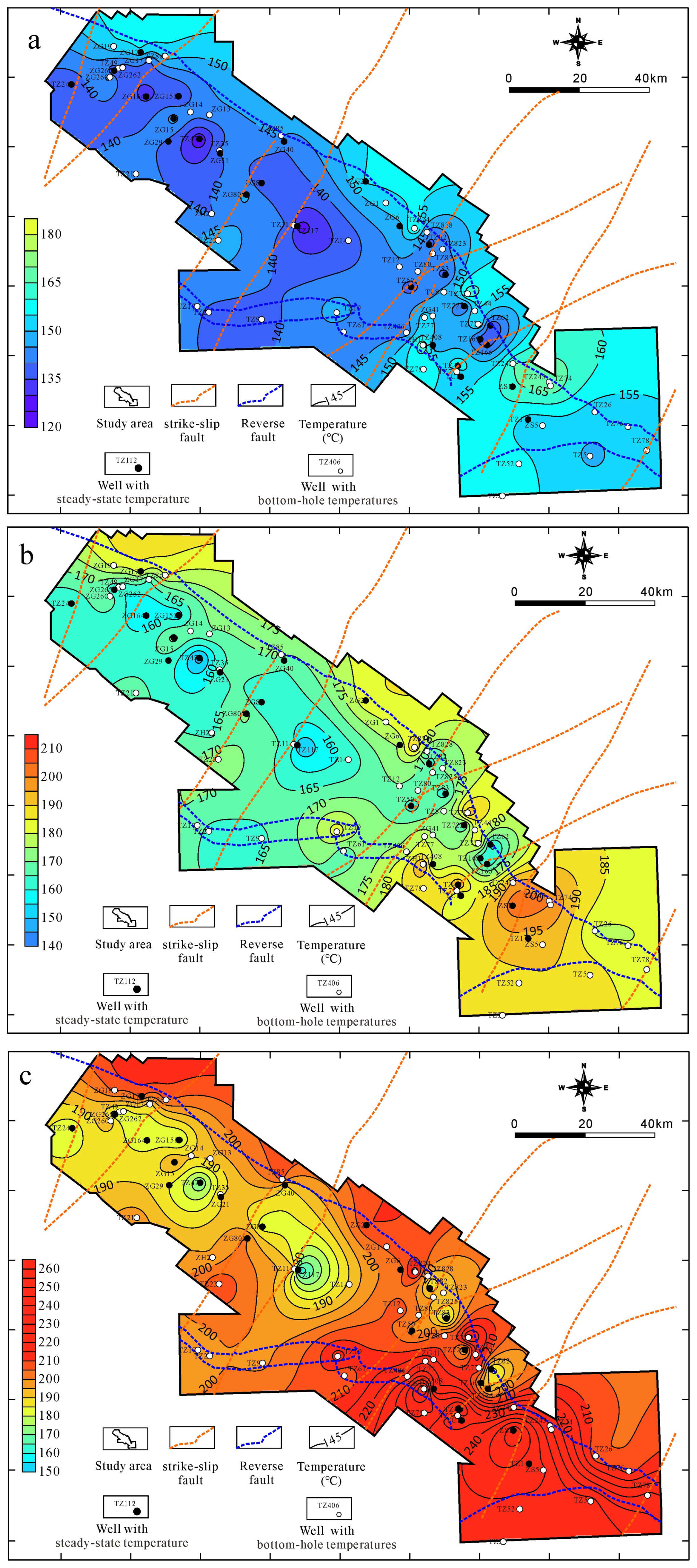
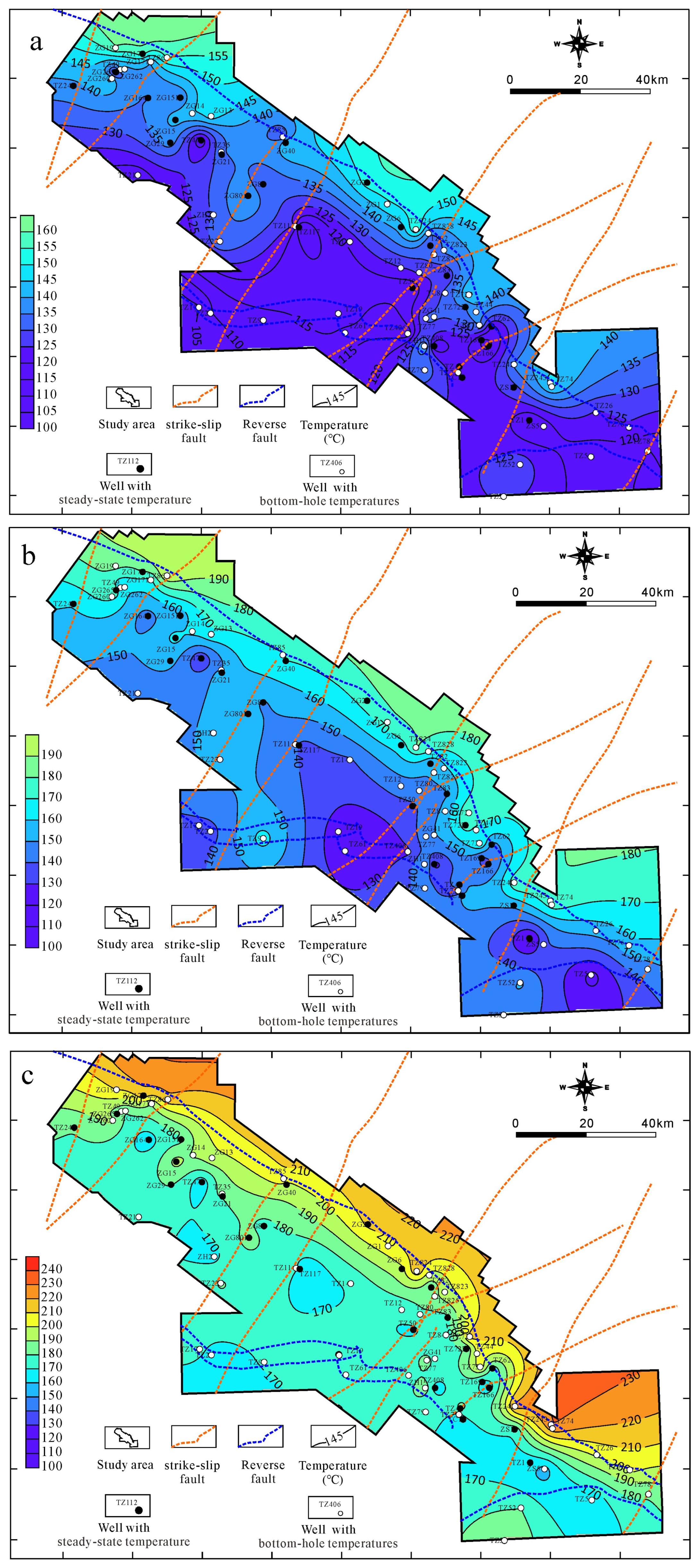
Figure 9 presents temperature distribution characteristics at burial depths of 6000 m, 8000 m, and 10,000 m in the Tazhong Uplift. Results indicate that formation temperatures at 6000 m burial depth in the Tazhong Uplift range from 125 to 178 °C, with an average of 146 °C (Figure 9a). The eastern buried-hill belt, No. I Fault Zone, and the eastern side of the central fault zone exhibit relatively high temperatures, reaching above 150 °C. The highest formation temperatures occur in areas around wells TZ243, TZ74, and ZS1, generally exceeding 160 °C. The northern slope zone and the western side of the central fault zone display lower temperatures, generally below 145 °C.
At 8000 m burial depth, temperatures range from 146 to 203 °C, with an average of 173 °C. The plan-view distribution resembles that at 6000 m; however, temperature increases exhibit variations among different structural zones. Formation temperatures in the eastern buried-hill belt and central fault zone generally increase by 30–40 °C, while temperature increases in the northern slope zone and No. I Fault Zone are generally less than 25 °C. This is primarily because the eastern buried-hill belt and central fault zone have predominantly transitioned from sedimentary rocks to granitic crystalline basement at 8000 m burial depth, whereas the northern slope zone and No. I Fault Zone still contain sedimentary rocks at 8000 m. For example, mud logging at well ZH2 indicates that the base of the sedimentary cover lies at 8776 m. As shown in Table 1, compared with overlying Lower Cambrian sedimentary rocks, the granitic crystalline basement exhibits lower thermal conductivity, resulting in higher geothermal gradients (Figure 9). This ultimately produces lateral variations in temperature increase from 6000 m to 8000 m burial depth.
At 10,000 m burial depth, formation temperatures in Tazhong range from 159 to 254 °C, with an average of 205 °C. The plan-view distribution resembles that at 8000 m, with the primary difference being that more areas have entered the low-thermal-conductivity granitic formations at 10,000 m burial depth. Consequently, the areal extent of high temperature increase zones has expanded.

4.2.2. Temperature Distribution Characteristics at Lower Paleozoic Stratigraphic Interfaces

After determining regional geothermal background parameters, deep formation temperatures can be estimated based on formation thickness and thermophysical parameters of each sedimentary layer. This holds significant importance for evaluating hydrocarbon generation, preservation, and phase behavior. This study calculated formation temperatures at the top of the Cambrian–Ordovician carbonate sequence (Figure 10a), top of the Cambrian (Figure 10b), and top of the Yuertusi Formation in Tazhong (Figure 10c), and generated plan-view distribution maps for each stratigraphic interface (Figure 10).
The Cambrian–Ordovician carbonate sequence in Tazhong represents the most important hydrocarbon-bearing interval. Temperatures at the top of this sequence (Figure 10a) range from approximately 109 to 159 °C, averaging 130 °C. The highest temperatures occur near the Tazhong No. I Fault Zone, with formation temperatures ranging from 140 to 160 °C. Notably, these temperatures straddle the threshold for significant oil cracking (~160 °C) [15,16], suggesting that the No. I Fault Zone may be a transitional zone for liquid hydrocarbon preservation.
The formation temperatures of northern slope zone of Tazhong range from 115 to 140 °C, ranking second only to the No. I Fault Zone and exceeding those in the eastern buried-hill belt and central fault zone. The lowest formation temperatures are located on the western side of the central fault zone, with temperatures below 110 °C. This inconsistency between formation temperatures and terrestrial heat flow reflects burial depth’s controlling influence on formation temperatures. Additionally, temperature contours near the Tazhong No. I Fault Zone are more densely developed, indicating a higher lateral temperature gradient in this region. This thermal “steep zone” is likely related to the fault-controlled structural style of the No. I Fault Zone, where rapid lateral changes in basement depth and stratigraphic thickness create focused heat flow.
Formation temperatures at the top of the Cambrian range from 116 to 200 °C, averaging 154 °C (Figure 10b), while temperatures at the top of the Yuertusi Formation range from 156 to 229 °C, averaging 185 °C (Figure 9c). The No. I Fault Zone remains a high formation temperature zone, with temperatures exceeding 170 °C and 190 °C at the tops of the Cambrian and Yuertusi Formation, respectively. A pronounced decreasing trend in formation temperatures is observed westward from the No. I Fault Zone. In the northern slope zone, central fault zone, and eastern buried-hill belt of Tazhong, formation temperatures are relatively low, with values below 160 °C and 180 °C at the tops of the Cambrian and Yuertusi Formation, respectively.
Temperatures at the Cambrian top (116–200 °C, avg. 154 °C) and Yuertusi Formation top (156–229 °C, avg. 185 °C) show similar distributions but higher values, with the fault zone remaining hottest (>170 °C and >190 °C, respectively). Temperatures decrease westward from the fault zone, mirroring basement dip [18,20]. In the northern slope, central fault, and eastern buried-hill zones, temperatures at these interfaces are relatively low (<160 °C and <180 °C). Despite >8000 m burial, these moderate temperatures reflect the region’s “cold” thermal background and overlying lithological regulation. Overall, burial depth dominates ultra-deep temperatures: the northern slope zone, despite lower heat flow, reaches temperatures comparable to or exceeding some structural highs. The Yuertusi Formation (primary source rock) has largely entered the gas window (>180–200 °C), while overlying Cambrian–Ordovician reservoirs retain liquid hydrocarbon potential where temperatures remain below 160 °C [46,55]. The discovery of oil reservoirs in the Middle Cambrian of Well ZS1 (6458–6478 m) and Well ZS5 (6562–6571 m) further supports this inference [76].

4.3. Thermal Lithosphere Thickness and Crustal Thermal Structure in the Tazhong Area

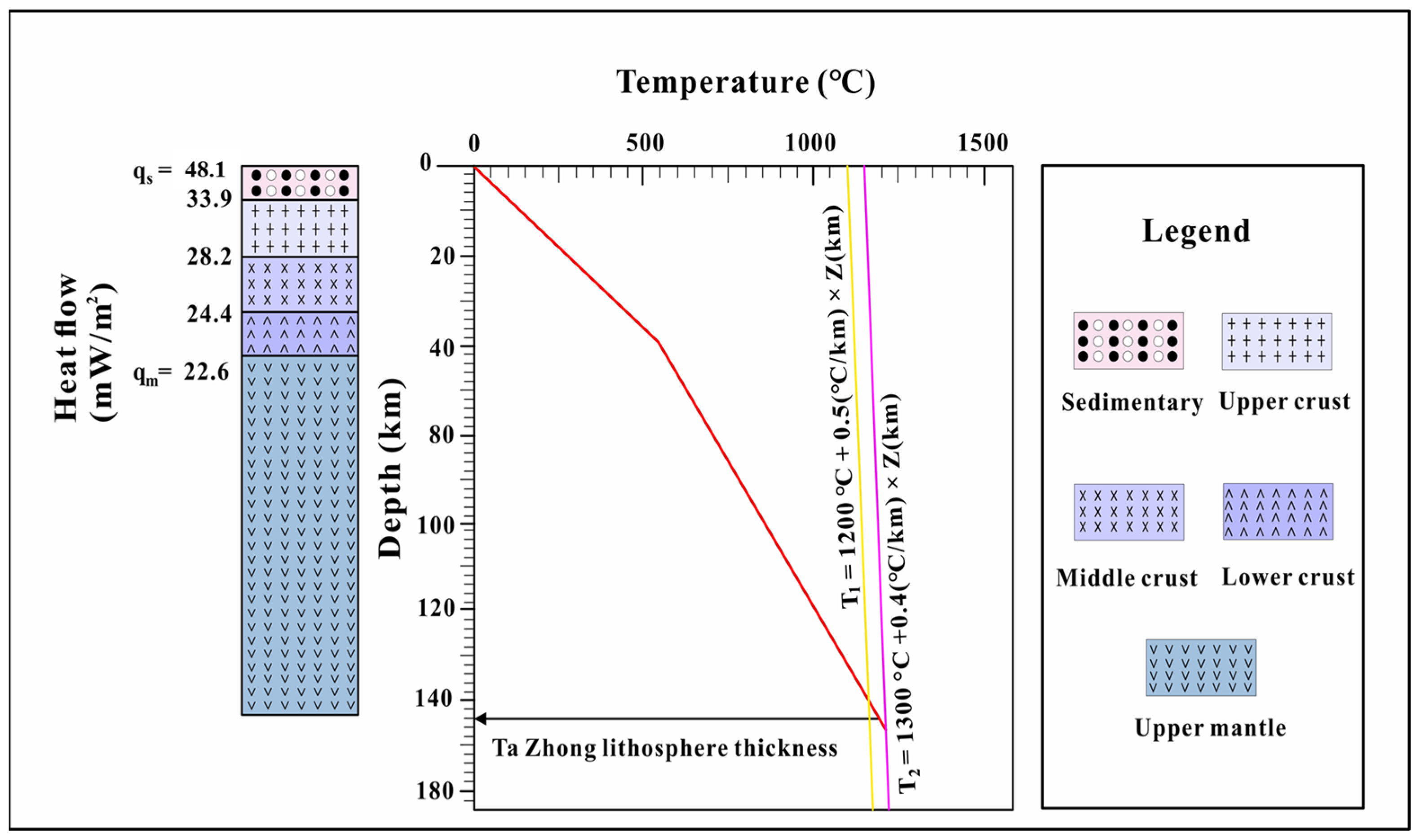
According to this study, terrestrial heat flow values in the Tazhong area primarily range from 39.3 to 59.8 mW/m2, with an average of 48.1 mW/m2, generally higher than the basin-wide average (42.5–43 mW/m2). Based on the thermophysical parameter settings in Section 3.3.3, the deep crustal temperature field and heat flow structure in this area were calculated (Figure 11).
Calculation results indicate that the thermal lithosphere thickness in the Tazhong area is approximately 134–145 km (averaging ~140 km), with a Moho temperature of approximately 581 °C. This lithospheric thickness is comparable to that of typical stable cratons globally (e.g., 150–200 km for the Siberian Craton, 120–180 km for the North American Craton) [70], but is slightly thinner than the average for Precambrian cratons, suggesting moderate thermal modification during the basin’s evolution. The Moho temperature (~581 °C) falls within the range typical for cratonic basins (500–650 °C) [2,4], indicating a relatively cool lower crust.
Regarding heat flow distribution, crustal radiogenic heat production contributes 25.5 mW/m2 to surface heat flow, accounting for 46.3%. The mantle heat flow q_m, calculated by subtracting crustal heat production from surface heat flow, is 22.6 mW/m2, representing 46.7% of surface heat flow. This near-equal partitioning between crustal and mantle contributions is characteristic of stable cratonic settings, where mantle heat flow is typically suppressed by thick, cold lithosphere [71].
Compared with other tectonic units in the Tarim Basin, the thermal lithosphere thickness in Tazhong (~140 km) is similar to that reported for the Tabei Uplift (135–145 km) [14] and the Bachu Uplift (140–150 km) [17], but thicker than that in the Manjiaer Depression (120–130 km) [15]. This variation reflects the differential tectonic stability across the basin: uplift zones generally preserve thicker lithosphere due to their long-term structural stability, while depressions may have experienced greater lithospheric thinning during basin evolution [4].
The heat flow distribution characteristics in the Tazhong area exhibit a typical low heat flow background of cratonic basins, with mantle heat flow (22.6 mW/m2) remaining at relatively low levels, consistent with the “cold mantle” thermal structure characteristic of Precambrian cratonic regions. This interpretation is supported by previous studies that have documented similar mantle heat flow values (20–25 mW/m2) in other stable cratonic basins worldwide, such as the West Siberian Basin and the Paris Basin [71]. The relatively low Moho temperature and thick lithosphere thickness reflect the deep structural stability of the Tazhong Uplift, which has acted as a rigid block resisting significant tectonic and thermal reworking since the Precambrian [18,19]. This thermal stability has important implications for hydrocarbon preservation, as it has maintained relatively moderate temperatures in deep source rocks and reservoirs over geological time [55].

4.4. Controlling Factors of the Geothermal Field in Deep to Ultra-Deep Formations of Tazhong

The geothermal field in sedimentary basins is typically controlled by the combined influence of deep factors (regional geological structure and mantle structure) and shallow factors (rock thermophysical properties, groundwater activity, fault activity, and volcanic activity). The geothermal field of the Tarim Basin exhibits a typical “high in uplifts, low in depressions” distribution pattern at the regional scale, clearly revealing its close association with basement relief [4]. This pattern is further refined and verified within the Tazhong Uplift. By comparing the plan-view distribution of geothermal gradients at the unified depth of 0–5000 m in the Tazhong Uplift, it is evident that the buried-hill belt and central fault zone with shallower basement burial exhibit high geothermal gradients, whereas the northern slope zone with greater basement burial depth corresponds to lower geothermal gradients. This indicates that basement burial depth and geothermal gradients generally exhibit a negative correlation—the greater the basement burial depth, the lower the geothermal gradient [55]. Therefore, the plan-view distribution of the geothermal field in the Tazhong Uplift is primarily controlled by basement structural morphology. Basement highs experience more pronounced vertical heat flow convergence, thereby forming relatively higher geothermal backgrounds.
Beyond basement structural control, the thermophysical properties of shallow formations constitute a critical intrinsic factor shaping the spatial differentiation of the geothermal field in the Tarim Basin. The basin commonly develops a dual-layer structure of “shallow clastic rocks + deep carbonate rocks”, which exhibits a distinct thermal contrast (Figure 5). Shallow clastic rocks (such as sandstone and mudstone) typically possess lower thermal conductivity and higher radiogenic heat production rates, whereas deep carbonate rocks (limestone and dolomite) display higher thermal conductivity and lower radiogenic heat production rates (Table 1) [4,55]. This thermophysical combination results in significantly higher geothermal gradients in shallow clastic intervals and relatively lower geothermal gradients in deep carbonate intervals. The direct consequence is the formation of a “high-upper, low-lower” geothermal gradient structure in the vertical direction [55], thereby exerting significant regulatory control on deep formation temperatures. Similar dual-layer thermal regulation has been documented in other sedimentary basins, such as Sicily [77], where the thermal contrast between clastic cover and carbonate reservoir produces comparable vertical gradient differentiation and lateral heat redirection, supporting the broader applicability of our findings. Despite the Lower Cambrian reaching burial depths of approximately 8000 m, its temperatures are predominantly maintained within a moderate range of 165–180 °C [55]. This phenomenon is not only related to the overall low heat flow background but also benefits from the thermal regulatory effect of the aforementioned dual-layer structure—shallow low-thermal-conductivity clastic rocks to some extent impede rapid upward heat flow dissipation, while deep high-thermal-conductivity carbonate rocks facilitate rapid deep heat flow dissipation, collectively maintaining a relatively moderate thermal environment despite substantial burial depths.
The Upper Ordovician Sangtamu Formation in the Tazhong area develops relatively thick mudstone sequences. Thick, low-thermal-conductivity mudstone often functions as a thermal blanket. The thickness distribution of this mudstone sequence varies considerably across the Tazhong Uplift and influences Lower Paleozoic geothermal field characteristics through thermal refraction and differential thermal resistance mechanisms. Specifically, areas where mudstone is absent or extremely thin (eastern buried-hill belt, central fault zone) directly become high-thermal-conductivity pathways. In these regions, the underlying high-conductivity carbonate basement is shallowly buried and lacks thermal insulation from low-conductivity mudstone, thereby manifesting as high geothermal gradients and high terrestrial heat flow values (e.g., well TZ1 approaching 60 mW/m2). The northern slope zone is covered by 150–700 m of mudstone, capable of forming an effective regional thermal barrier. This not only significantly increases vertical thermal resistance, reducing surface-observed geothermal gradients (generally <22 °C/km), but more importantly, its relatively complete and continuous distribution forces a portion of deep heat flow to undergo lateral diversion. Heat flow is diverted and converges toward surrounding high-conductivity zones where mudstone is thinner or absent (i.e., the aforementioned fault zones and buried-hill areas), resulting in generally lower terrestrial heat flow values in the northern slope zone (predominantly <48 mW/m2) even under equivalent deep heat source supply. This lateral heat diversion is crucial for the detailed characterization of the geothermal field distribution and requires further investigation using two- or three-dimensional models in the future.

5. Conclusions

The geothermal gradient in the Tazhong Uplift averages 23.06 °C/km, with terrestrial heat flow averaging 48.1 mW/m2. The geothermal field exhibits a spatial pattern characterized by “high values in the eastern buried-hill belt, central fault zone, and No. I Fault Zone, and low values in the northern slope zone”. Deep temperature predictions indicate that average formation temperatures at 6000 m, 8000 m, and 10,000 m depths reach 146 °C, 173 °C, and 205 °C, respectively, with temperatures at key Lower Paleozoic stratigraphic interfaces jointly controlled by burial depth and heat flow. The geothermal field distribution in the study area is primarily controlled by basement relief and vertical differentiation of rock thermophysical properties. Basement highs exhibit high geothermal backgrounds due to vertical heat flow convergence. The dual-layer structure of “upper clastic rocks (low thermal conductivity, high heat production) + lower carbonate rocks (high thermal conductivity, low heat production)” results in a “high-upper, low-lower” geothermal gradient characteristic, exerting significant regulatory control on deep temperatures. The thick mudstone sequence of the Upper Ordovician Sangtamu Formation, functioning as an effective regional thermal blanket, significantly influences the temperature field of underlying formations through thermal refraction and thermal resistance effects related to its thickness variation, representing the key shallow factor responsible for low geothermal gradients and low terrestrial heat flow in the northern slope zone. Lateral heat diversion is crucial for the detailed characterization of the geothermal field distribution and requires further investigation using two- or three-dimensional models in the future. The crustal thermal structure in the Tazhong area exhibits the “cold mantle” characteristic typical of cratonic basins, with a thermal lithosphere thickness of approximately 140 km and mantle heat flow contribution of approximately 46.7%, reflecting the long-term stability of deep structures in this region. In summary, the unique thermal regime of the Tazhong Uplift ensures that there remains potential for oil reservoir development within the deep to ultra-deep ancient strata.

Supplementary Materials

The following supporting information can be downloaded at: https://www.mdpi.com/article/10.3390/pr14060980/s1, Table S1: Calculation results of geothermal gradient and heat flow in the Tazhong Uplift of the Tarim Basin.

Author Contributions

Conceptualization, C.Y. and M.C.; methodology, C.Y.; software, M.C.; validation, Y.R., Q.Z. and K.Z.; formal analysis, C.Y.; investigation, Y.L. (Yunzhan Li); resources, validation, Y.L. (Yuyang Liu); data curation, C.Y. and M.C.; writing—original draft preparation, C.Y. and Y.R.; writing—review and editing, M.C.; visualization, J.S. and B.C.; supervision, C.Y.; project administration, J.S.; funding acquisition, C.Y. All authors have read and agreed to the published version of the manuscript.

Funding

This research was funded by National Science and Technology Major Project (No. 2025ZD1010301) and PetroChina Limited Science and Technology Project (2023ZZ0203).

Data Availability Statement

The original contributions presented in this study are included in the article/Supplementary Materials. Further inquiries can be directed to the corresponding author.

Conflicts of Interest

The authors declare no conflicts of interest.

References

  1. Zhu, S.; Liu, F.K.; Tan, Q.W.; Zhu, G.Y. Genesis of Low Geothermal Field in Tarim Basin and Differential Mechanisms Across Various Zones. Bull. Geol. Sci. Technol. 2025. online. [Google Scholar] [CrossRef]
  2. Qiu, N.; Chang, J.; Zhu, C.; Liu, W.; Zuo, Y.; Xu, W.; Li, D. Thermal Regime of Sedimentary Basins in the Tarim, Upper Yangtze and North China Cratons, China. Earth Sci. Rev. 2022, 224, 103884. [Google Scholar] [CrossRef]
  3. Liu, S.W.; Yang, X.Q.; Qiu, N.S.; Yang, S.; Li, X. Geothermal Effects of Salt Structures on Marine Sedimentary Basins and Implications for Hydrocarbon Thermal Evolution. Chin. Sci. Bull. 2017, 62, 1631–1644. [Google Scholar] [CrossRef]
  4. Liu, S.W.; Li, X.L.; Hao, C.Y.; Wu, X.; Wang, X.; Han, J.; Li, H.L. Heat Flow, Deep Formation Temperature and Thermal Structure of the Tarim Basin, Northwest China. Earth Sci. Front. 2017, 24, 41–55. [Google Scholar]
  5. Li, D.; Chang, J.; Qiu, N.S.; Wu, X.; Wang, X.; Han, J.; Li, H.L. Present-Day Superdeep Thermal Regime of the Tabei—Northern Aman Area in the Tarim Basin, Northwest China. Chin. J. Geophys. 2023, 66, 3353–3373. [Google Scholar] [CrossRef]
  6. Liu, Y.; Qiu, N.; Li, H.; Ma, A.; Chang, J.; Jia, J. Terrestrial Heat Flow and Crustal Thermal Structure in the Northern Slope of Tazhong Uplift in Tarim Basin. Geothermics 2020, 83, 101709. [Google Scholar] [CrossRef]
  7. Liu, Y.; Liu, B.; Fu, J.; Kang, L.; Li, S. Surface Heat Flow, Deep Formation Temperature, and Lithospheric Thickness of the Different Tectonic Units in Tarim Basin, Western China. Lithosphere 2022, 2022, 3873682. [Google Scholar] [CrossRef]
  8. Wang, Q.H.; Zhu, Y.F.; Tang, Y.G.; Yang, G.; Sun, C.H.; Chen, C. Oil and Gas Geological Conditions and Exploration Potential in Ultra-Deep Formations Below Ten Thousand Meters in Tarim Basin. Deep Earth Energy Sci. Technol. 2025, 1, 36–48. [Google Scholar]
  9. Yang, H.J.; Wang, C.S.; Yang, X.Z.; Zhang, Z.; Guo, X.G.; Sun, C.H.; Lv, X.G.; Liu, J.L. Technological Progress and Scientific Significance of the Drilling of the Ten-Thousand-Meter Ultra-Deep Well TK1, Tarim Basin, NW China. Pet. Explor. Dev. 2025, 52, 1180–1188. [Google Scholar] [CrossRef]
  10. Jiang, T.W.; Tian, W.Z. Main Enrichment Controlling Factors and Exploration Directions of Strike-Slip Fault-Controlled Oil and Gas Reservoirs in the Tarim Basin. Nat. Gas Ind. 2025, 45, 14–29. [Google Scholar] [CrossRef]
  11. Su, J.; Wang, X.M.; Zhang, C.D.; Yang, X.Z.; Li, J.; Yang, Y.P.; Zhang, H.Z.; Fang, Y.; Yang, C.L.; Fang, C.C. Source and Exploration Potential of the Ultra-Deep Cambrian Petroleum in Well XT-1, Tarim Basin, NW China. Pet. Explor. Dev. 2025, 52, 347–361. [Google Scholar] [CrossRef]
  12. Wu, X.; Li, D.; Zhu, X.X.; Wang, J.F. Influence of Geothermal Field on Ultra-Deep Ordovician Oil and Gas in Shunbei Field, Tarim Basin: A Case Study of Shunbei No. 5 Strike-Slip Fault. Pet. Geol. Exp. 2022, 44, 402–412. [Google Scholar] [CrossRef]
  13. Zhang, Z.; Zhu, G.; Han, J.; Jiang, S.; Li, J.; Chi, L. Tectono-Thermal Impacts on the Formation of a Heavy Oil in the Eastern Tarim Basin (China): Implications for Oil and Gas Potential. J. Pet. Sci. Eng. 2022, 208, 109353. [Google Scholar] [CrossRef]
  14. Ngia, N.R.; Hu, M.; Gao, D. Tectonic and Geothermal Controls on Dolomitization and Dolomitizing Fluid Flows in the Cambrian-Lower Ordovician Carbonate Successions in the Western and Central Tarim Basin, NW China. J. Asian Earth Sci. 2019, 172, 359–382. [Google Scholar] [CrossRef]
  15. Tissot, B.P.; Pelet, R.; Ungerer, P.H. Thermal History of Sedimentary Basins, Maturation Indices, and Kinetics of Oil and Gas Generation. AAPG Bull. 1987, 71, 1445–1466. [Google Scholar] [CrossRef]
  16. Barker, C. Thermal Modeling of Petroleum Generation: Theory and Applications; Geosciences Department, University of Tulsa: Tulsa, OK, USA, 1996. [Google Scholar]
  17. Förster, A.; Merriam, D.F. Geothermics in Basin Analysis. In Computer Applications in the Earth Sciences; Springer: Boston, MA, USA, 1999. [Google Scholar] [CrossRef]
  18. Jia, C.Z. Structural Characteristics and Oil/Gas Accumulative Regularity in Tarim Basin. Xinjiang Pet. Geol. 1999, 20, 177–183. [Google Scholar]
  19. Li, C.; Wang, X.; Li, B.; He, D. Paleozoic Fault Systems of the Tazhong Uplift, Tarim Basin, China. Mar. Pet. Geol. 2013, 39, 48–58. [Google Scholar] [CrossRef]
  20. Pang, X.; Zhou, X.; Yan, S.; Wang, Z.; Yang, H.; Jiang, F.; Shen, W.; Gao, S. Research Advances and Direction of Hydrocarbon Accumulation in the Superimposed Basins, China: Take the Tarim Basin as an Example. Pet. Explor. Dev. 2012, 39, 692–699. [Google Scholar] [CrossRef]
  21. Lan, X.; Lü, X.; Zhu, Y.; Yu, H. The Geometry and Origin of Strike-Slip Faults Cutting the Tazhong Low Rise Megaanticline (Central Uplift, Tarim Basin, China) and Their Control on Hydrocarbon Distribution in Carbonate Reservoirs. J. Nat. Gas Sci. Eng. 2015, 22, 633–645. [Google Scholar] [CrossRef]
  22. Han, J.F.; Mei, L.F.; Yang, H.J.; Wu, G.H.; Xu, Z.M.; Zhu, G.Y. The Study of Hydrocarbon Origin, Transport and Accumulation in Tazhong Area, Tarim Basin. Nat. Gas Geosci. 2007, 18, 426–435. [Google Scholar]
  23. Li, B.L.; Guan, S.W.; Li, C.X.; Wu, G.H.; Yang, H.J.; Han, J.F.; Luo, C.S.; Miao, J.J. Paleo-Tectonic Evolution and Deformation Features of the Lower Uplift in the Central Tarim Basin. Geol. Rev. 2009, 55, 521–530. [Google Scholar] [CrossRef]
  24. Zhai, G.M.; Wang, J.J. Analysis of Petroleum Geology in Tazhong Region. Acta Geol. Sin. 1999, 20, 1–6. [Google Scholar]
  25. Ding, C.H.; Zhou, H.B.; Lu, P.C.; Lü, D.; Xian, Q.; Wang, X.F. The Paleozoic structural features and its evolution in the Tazhong Low Uplift, Xinjiang. Geotecton. Metallog. 2009, 33, 148–153. [Google Scholar] [CrossRef]
  26. Ding, Z.; Wang, R.; Chen, F.; Yang, J.; Zhu, Z.; Yang, Z.; Sun, X.; Xian, B.; Li, E.; Shi, T.; et al. Origin, Hydrocarbon Accumulation and Oil-Gas Enrichment of Fault-Karst Carbonate Reservoirs: A Case Study of Ordovician Carbonate Reservoirs in South Tahe Area of Halahatang Oilfield, Tarim Basin. Pet. Explor. Dev. 2020, 47, 306–317. [Google Scholar] [CrossRef]
  27. Sun, Q.; Fan, T.; Gao, Z.; Wu, J.; Zhang, H.; Jiang, Q.; Liu, N.; Yuan, Y. New Insights on the Geometry and Kinematics of the Shunbei 5 Strike-Slip Fault in the Central Tarim Basin, China. J. Struct. Geol. 2021, 150, 104400. [Google Scholar] [CrossRef]
  28. Jia, L.; Cai, C.; Wang, Z.; Li, H.; Liu, L.; Luo, Q.; Jiang, L. Calcite Vein System and Its Importance in Tracing Paleowater Flow and Hydrocarbon Migration in the Ordovician Carbonates of the Tazhong Area, Tarim Basin, China. Bulletin 2020, 104, 2401–2428. [Google Scholar] [CrossRef]
  29. Li, S.; Zhao, S.; Liu, X.; Cao, H.; Yu, S.; Li, X.; Somerville, I.; Yu, S.; Suo, Y. Closure of the Proto-Tethys Ocean and Early Paleozoic Amalgamation of Microcontinental Blocks in East Asia. Earth-Sci. Rev. 2018, 186, 37–75. [Google Scholar] [CrossRef]
  30. Wu, H.; Zhao, M.; Zhuo, Q.; Lu, X.; Gui, L.; Li, W.; Xu, Z. Quantitative Analysis of the Effect of Salt on Geothermal Temperature and Source Rock Evolution: A Case Study of Kuqa Foreland Basin, Western China. Pet. Explor. Dev. 2016, 43, 602–610. [Google Scholar] [CrossRef]
  31. Wu, L.; Guan, S.; Ren, R.; Wang, X.; Yang, H.; Jin, J.; Zhu, G. The Characteristics of Precambrian Sedimentary Basin and the Distribution of Deep Source Rock: A Case Study of Tarim Basin in Neoproterozoic and Source Rocks in Early Cambrian, Western China. Pet. Explor. Dev. 2016, 43, 988–999. [Google Scholar] [CrossRef]
  32. Chen, D.Z. Structure-Controlled Hydrothermal Dolomitization and Hydrothermal Dolomite Reservoirs. Oil Gas Geol. 2008, 29, 614–622. [Google Scholar]
  33. Wu, G.H.; Li, Q.M.; Zhang, B.S.; Dong, L.S.; Zhang, Y.G.; Zhang, H.Q. Structural Characteristics and Exploration Fields of Faulted Slope Break Zone 1 in Tazhong Area. Acta Pet. Sin. 2005, 37, 27–30. [Google Scholar] [CrossRef]
  34. Lin, B.; Zhang, X.; Xu, X.; Yuan, J.; Neng, Y.; Zhu, J. Features and Effects of Basement Faults on Deposition in the Tarim Basin. Earth Sci. Rev. 2015, 145, 43–55. [Google Scholar] [CrossRef]
  35. Zhang, J.; Wang, Z.; Yang, H.; Xu, Z.; Xiao, Z.; Li, Z. Origin and Differential Accumulation of Hydrocarbons in Cambrian Sub-Salt Dolomite Reservoirs in Zhongshen Area, Tarim Basin, NW China. Pet. Explor. Dev. 2017, 44, 40–47. [Google Scholar] [CrossRef]
  36. Zhang, J.; Zhang, Y.; Gao, Y. Silurian Hydrocarbon Exploration Breakthrough and Its Implications in the Shajingzi Structural Belt of Tarim Basin, NW China. Pet. Explor. Dev. 2022, 49, 233–246. [Google Scholar] [CrossRef]
  37. Zhang, S.; Gao, Z.; Li, J.; Zhang, B.; Gu, Q.; Lu, Y. Identification and Distribution of Marine Hydrocarbon Source Rocks in the Ordovician and Cambrian of the Tarim Basin. Pet. Explor. Dev. 2012, 39, 305–314. [Google Scholar] [CrossRef]
  38. Zhang, S.; He, K.; Hu, G.; Mi, J.; Ma, Q.; Liu, K.; Tang, Y. Unique Chemical and Isotopic Characteristics and Origins of Natural Gases in the Paleozoic Marine Formations in the Sichuan Basin, SW China: Isotope Fractionation of Deep and High Mature Carbonate Reservoir Gases. Mar. Pet. Geol. 2018, 89, 68–82. [Google Scholar] [CrossRef]
  39. Zhang, Y.; Zwingmann, H.; Liu, K.; Todd, A.; Luo, X. Hydrocarbon Charge History of the Silurian Bituminous Sandstone Reservoirs in the Tazhong Uplift, Tarim Basin, China. Bulletin 2011, 95, 395–412. [Google Scholar] [CrossRef]
  40. Zhu, C.; Xiao, Z.; Zhang, B.; Jin, Y.; Sang, H.; Liu, Y.; Dang, Q. Upper Cambrian-Ordovician Reservoir Characteristics in Well Gucheng-4 Area, Tarim Basin. Pet. Explor. Dev. 2008, 35, 175–181. [Google Scholar] [CrossRef]
  41. Zhu, G.; Zhang, Z.; Milkov, A.V.; Zhou, X.; Yang, H.; Han, J. Diamondoids as Tracers of Late Gas Charge in Oil Reservoirs: Example from the Tazhong Area, Tarim Basin, China. Fuel 2019, 253, 998–1017. [Google Scholar] [CrossRef]
  42. Shen, W.; Chen, J.; Wang, Y.; Zhang, K.; Chen, Z.; Luo, G.; Fu, X. The Origin, Migration and Accumulation of the Ordovician Gas in the Tazhong III Region, Tarim Basin, NW China. Mar. Pet. Geol. 2019, 101, 55–77. [Google Scholar] [CrossRef]
  43. Wang, T.; Jin, Z.; Shi, Z.; Dai, X.; Cheng, R. Phanerozoic Plate History and Structural Evolution of the Tarim Basin, Northwestern China. Int. Geol. Rev. 2020, 62, 1555–1569. [Google Scholar] [CrossRef]
  44. Zhao, W.; Shen, A.; Zhou, J.; Wang, X.; Lu, J. Types, Characteristics, Origin and Exploration Significance of Reef-Shoal Reservoirs: A Case Study of Tarim Basin, NW China and Sichuan Basin, SW China. Pet. Explor. Dev. 2014, 41, 283–293. [Google Scholar] [CrossRef]
  45. Du, J.; Pan, W. Accumulation Conditions and Play Targets of Oil and Gas in the Cambrian Subsalt Dolomite, Tarim Basin, NW China. Pet. Explor. Dev. 2016, 43, 360–374. [Google Scholar] [CrossRef]
  46. Zhang, Z.; Zhang, Y.; Zhu, G.; Han, J.; Chi, L. Multiphase Pools Caused by Gas Invasion in Deep Ordovician Carbonates from the Tazhong Area, Tarim Basin, China. Bulletin 2024, 108, 817–848. [Google Scholar] [CrossRef]
  47. Ma, Q.Y.; Sha, X.G.; Li, Y.L.; Zhu, X.X.; Yang, S.J.; Li, H.L. Characteristics of Strike-Slip Fault and Its Controlling on Oil in Shuntuoguole Region, Middle Tarim Basin. Pet. Geol. Exp. 2012, 34, 120–124. [Google Scholar] [CrossRef]
  48. Liang, X.X. Study on the Strike-Slip Faults System and Its Formation Mechanism in the Tazhong Uplift, Tarim Basin. Master’s Thesis, China University of Petroleum-Beijing, Beijing, China, 2022. [Google Scholar]
  49. Wu, G.H.; Chen, Z.Y.; Qu, T.L.; Wang, C.H.; Li, H.W.; Zhu, H.Y. Characteristics of the Strike-Slip Fault Facies in Ordovician Carbonate in the Tarim Basin, and Its Relations to Hydrocarbon. Acta Geol. Sin. 2012, 86, 219–227. [Google Scholar]
  50. Wu, G.H.; Ma, B.S.; Han, J.F.; Guan, B.Z.; Chen, X.; Yang, P.; Xie, Z. Origin and Growth Mechanisms of Strike-Slip Faults in the Central Tarim Cratonic Basin, NW China. Pet. Explor. Dev. 2021, 48, 510–520. [Google Scholar] [CrossRef]
  51. Wu, G.H.; Li, H.H.; Zhang, L.P.; Wang, C.L.; Zhou, B. Reservoir-Forming Conditions of the Ordovician Weathering Crust in the Maigaiti Slope, Tarim Basin, NW China. Pet. Explor. Dev. 2012, 39, 144–153. [Google Scholar] [CrossRef]
  52. Wang, R.; Liu, K.; Shi, W.; Qin, S.; Zhang, W.; Qi, R.; Xu, L. Reservoir Densification, Pressure Evolution, and Natural Gas Accumulation in the Upper Paleozoic Tight Sandstones in the North Ordos Basin, China. Energies 2022, 15, 1990. [Google Scholar] [CrossRef]
  53. Zhou, X.; Pang, X.; Li, Q.; Pang, H.; Xiang, C.; Jiang, Z.; Li, S.; Liu, L. Advances and Problems in Hydrocarbon Exploration in the Tazhong Area, Tarim Basin. Pet. Sci. 2010, 7, 164–178. [Google Scholar] [CrossRef]
  54. Feng, C.G.; Liu, S.W.; Wang, L.S.; Li, C. Present-Day Geotemperature Field Characteristics in the Central Uplift Area of the Tarim Basin and Implications for Hydrocarbon Generation and Preservation. Earth Sci.—J. China Univ. Geosci. 2010, 35, 645–656. [Google Scholar]
  55. Qiu, N.S.; Wang, X.L.; Yang, H.B.; Xiang, Y. The Characteristics of Temperature Distribution in the Junggar Basin. Chin. J. Geol. 2001, 36, 350–358. [Google Scholar]
  56. Li, X.; Liu, S.; Feng, C. Thermal Properties of Sedimentary Rocks in the Tarim Basin, Northwestern China. AAPG Bull. 2019, 103, 1605–1624. [Google Scholar] [CrossRef]
  57. Wang, L.S.; Li, C.; Liu, S.W.; Li, H.; Xu, M.J.; Yu, D.Y.; Jia, C.Z. Terrestrial Heat Flow Distribution in Kuqa Foreland Basin, Tarim, NW China. Pet. Explor. Dev. 2005, 32, 79–83. [Google Scholar]
  58. Qiu, N.S. Characters of Thermal Conductivity and Radiogenic Heat Production Rate in Basins of Northwest China. Chin. J. Geol. 2002, 37, 196–206. [Google Scholar]
  59. Wei, D.W. Terrestrial Heat Flow on the Northern Side of Tarim Basin. Sci. Geol. Sin. 1992, 27, 93–96. [Google Scholar]
  60. Bücker, C.; Rybach, L. A Simple Method to Determine Heat Production from Gamma-Ray Logs. Mar. Pet. Geol. 1996, 13, 373–375. [Google Scholar] [CrossRef]
  61. Liao, K.Y.; Qiu, N.S.; Chang, J.; Li, D.; Li, H.L.; Ma, A.L.; Li, J.Y. Characteristics of Deep Geothermal Field in Shuntuoguole Area of Tarim Basin. Xinjiang Pet. Geol. 2025, 46, 163–171. [Google Scholar]
  62. Luo, X.; Zhu, C.Q.; Zhang, B.S.; Tang, B.N.; Chen, T.G. Heat production rate calculation using gamma ray logging of the sedimentary formation in the Tarim Basin, Northwest China. Acta Geol. Sin. 2020, 94, 2078–2088. [Google Scholar] [CrossRef]
  63. Xiong, J.; Lin, H.; Ding, H.; Pei, H.; Rong, C.; Liao, W. Investigation on Thermal Property Parameters Characteristics of Rocks and Its Influence Factors. Nat. Gas Ind. B 2020, 7, 298–308. [Google Scholar] [CrossRef]
  64. Hasterock, D.; Chapman, D.S. Heat production and geotherms for the continental lithosphere. Earth Planet. Sci. Lett. 2011, 307, 59–70. [Google Scholar] [CrossRef]
  65. Tian, H.; Xiao, X.; Wilkins, R.W.T.; Tang, Y. New Insights into the Volume and Pressure Changes during the Thermal Cracking of Oil to Gas in Reservoirs: Implications for the in-Situ Accumulation of Gas Cracked from Oils. AAPG Bull. 2008, 92, 181–200. [Google Scholar] [CrossRef]
  66. Schenk, H.J.; Di Primio, R.; Horsfield, B. The Conversion of Oil into Gas in Petroleum Reservoirs. Part 1: Comparative Kinetic Investigation of Gas Generation from Crude Oils of Lacustrine, Marine and Fluviodeltaic Origin by Programmed-Temperature Closed-System Pyrolysis. Org. Geochem. 1997, 26, 467–481. [Google Scholar] [CrossRef]
  67. Li, D. Thermal Evolution of Ultra-Deep Carbonates in the Platform of the Tarim Basin, Northwest China. Doctoral Dissertation, China University of Petroleum-Beijing, Beijing, China, 2024. [Google Scholar]
  68. Morgan, P. The Thermal Structure and Thermal Evolution of the Continental Lithosphere. Phys. Chem. Earth 1984, 15, 107–193. [Google Scholar] [CrossRef]
  69. Artemieva, I.M.; Mooney, W.D. Thermal Thickness and Evolution of Precambrian Lithosphere: A Global Study. J. Geophys. Res. Solid Earth 2001, 106, 16387–16414. [Google Scholar] [CrossRef]
  70. Zang, S.; Liu, Y.; Ning, J. Thermal Structure of Lithosphere in North China. Chin. J. Geophys. 2002, 45, 51–62. [Google Scholar] [CrossRef]
  71. Jaupart, C.; Mareschal, J.C.; Guillou-Frottier, L.; Davaille, A. Heat Flow and Thickness of the Lithosphere in the Canadian Shield. J. Geophys. Res. Solid Earth 1998, 103, 15269–15286. [Google Scholar] [CrossRef]
  72. Yang, M.; Yu, P.; Zhu, G.Y.; Zhang, L.L.; Yan, L.; Zhao, C.J.; Chen, Z.Y. Gravity-magnetic-magnetotelluric joint inversion method coupled with seismic constraint information and its application: Case study of the analysis of deep geological structure in Tarim Basin. Nat. Gas Geosci. 2022, 33, 168–179. [Google Scholar]
  73. Chang, J.; Qiu, N.; Xu, W. Thermal Regime of the Tarim Basin, Northwest China: A Review. Int. Geol. Rev. 2017, 59, 45–61. [Google Scholar] [CrossRef]
  74. Feng, C.G.; Liu, S.W.; Wang, L.S.; Li, C. Present-Day Geothermal Regime in Tarim Basin, Northwest China. Chin. J. Geophys. 2009, 52, 2752–2762. [Google Scholar] [CrossRef]
  75. Chen, C.; Zhu, C.; Zhang, B.; Tang, B.; Li, K.; Li, W.; Fu, X. Effect of Temperature on the Thermal Conductivity of Rocks and Its Implication for in Situ Correction. Geofluids 2021, 2021, 6630236. [Google Scholar] [CrossRef]
  76. Lin, T.; Wang, T.S.; Li, Z.S.; Yuan, W.F.; Ma, W.; Xu, Z.H.; Li, Q.F. Hydrocarbon filling evolution and exploration direction of the Middle-lower-Cambrian interval in Tazhong area, Tarim Basin. J. China Univ. Pet. (Ed. Nat. Sci.) 2021, 45, 42–54. [Google Scholar] [CrossRef]
  77. Trumpy, E.; Donato, A.; Gianelli, G.; Gola, G.; Minissale, A.; Montanari, D.; Santilano, A.; Manzella, A. Data integration and favourability maps for exploring geothermal systems in Sicily, southern Italy. Geothermics 2015, 56, 1–16. [Google Scholar] [CrossRef]
Figure 1. (a) Location, tectonic division, and distribution of geothermal wells in the Tazhong Uplift. (b) A-A′ geological cross-section (location shown in (a)) (modified from Ref. [22]).
Processes 14 00980 g001
Figure 2. Stratigraphic column of the Tazhong area (modified from Ref. [22]).
Processes 14 00980 g002
Figure 3. The relationship between the bottom-hole temperature and the steady-state temperature.
Processes 14 00980 g003
Figure 4. The system steady-state temperature curves (solid line) and bottom-hole temperature (Cross) data in Tazhong Uplift. (a) The eastern buried-hill belt; (b) the northern slope zone; (c) No. 1 structural belt; (d) the central fault horst.
Processes 14 00980 g004
Figure 5. Thermophysical properties of representative wells in the Tazhong area (Well ZS1). (a) Temperature gradient profile; (b) thermal conductivity profile; (c) calculated radiogenic heat production rates profile.
Processes 14 00980 g005
Figure 6. The distribution of geothermal gradient at the uniform depth of 5000 m in the Tazhong Uplift.
Processes 14 00980 g006
Figure 7. The distribution of heat flow in Tazhong Uplift.
Processes 14 00980 g007
Figure 8. The comparison between the measured temperature and the estimated temperature (ZS1).
Processes 14 00980 g008
Figure 9. Temperature distribution of 6000 m (a), 8000 m (b) and 10,000 m (c) in Tazhong Uplift.
Processes 14 00980 g009
Figure 10. Temperature distribution at key Lower Paleozoic stratigraphic interfaces in the Tazhong Uplift. (a) Temperature at the top of the Cambrian–Ordovician carbonate sequence (top of the Yingshan/Lianglitage formations). (b) Temperature at the top of the Cambrian. (c) Temperature at the top of the Yuertusi Formation (Lower Cambrian source rock).
Processes 14 00980 g010
Figure 11. Theoretical steady-state crustal geotherm in the Tazhong area. Columnar diagrams on both sides show the crustal layering model (sedimentary layer, upper/middle/lower crust, upper mantle) and each layer’s contribution to surface heat flow (mW/m2). qs = 48.1 mW/m2 is the measured average surface heat flow; qm = 22.6 mW/m2 is the mantle heat flow. The red solid line is the temperature–depth profile. Its intersections with the mantle adiabats (yellow and pink lines) define the thermal lithosphere thickness (~140 km).
Processes 14 00980 g011
Table 1. Thermal conductivity in Tarim Basin.
StrataLithologyThermal Conductivity (W/(m·K))Radiogenic Heat Production
Sample NumberAverage ± δμW/m2
Q + NMudstone81.99 ± 0.100.98
Sandstone41.79 ± 0.77
EMudstone21.79 ± 0.111.15
Sandstone21.88 ± 0.20
KMudstone51.7 ± 0.281.18
Sandstone132.15 ± 0.57
JMudstone31.91 ± 0.221.18
Sandstone41.78 ± 0.67
TMudstone31.62 ± 0.101.29
Sandstone61.42 ± 0.26
PMudstone12.331.15
Sandstone31.7 ± 0.46
CMudstone61.93 ± 0.570.99
Sandstone62.54 ± 0.78
DMudstone22.64 ± 0.091.18
Sandstone42.33 ± 0.85
SSandstone182.48 ± 1.081.22
Mudstone152.28 ± 0.96
OMudstone32.08 ± 0.761.22 for Clastic rock
Sandstone113.01 ± 1.28
Limestone562.82 ± 1.120.51 for Carbonate
Dolomite63.52 ± 1.10
Dolomite74.12 ± 0.770.64
Limestone23.72 ± 0.77
Gypsum84.52 ± 1.1
ZGranite32.23 ± 0.29/
Note: Q = Quaternary, N = Neogene, E = Paleogene, K = Cretaceous, J = Jurassic, T = Triassic, P = Permian, C = Carboniferous, D = Devonian, S = Silurian, O = Ordovician, ∈ = Cambrian, Z = Sinian.
Disclaimer/Publisher’s Note: The statements, opinions and data contained in all publications are solely those of the individual author(s) and contributor(s) and not of MDPI and/or the editor(s). MDPI and/or the editor(s) disclaim responsibility for any injury to people or property resulting from any ideas, methods, instructions or products referred to in the content.