Review

Physical State and Mass Transport of Metals in Liquid Cadmium Cathodes: A Review

Department of Radiochemistry, China Institute of Atomic Energy, Beijing 102413, China
*
Author to whom correspondence should be addressed.
Processes 2026, 14(6), 953; https://doi.org/10.3390/pr14060953
Submission received: 14 February 2026 / Revised: 13 March 2026 / Accepted: 14 March 2026 / Published: 17 March 2026
(This article belongs to the Topic Energy Extraction and Processing Science)

Abstract

Liquid metal cathodes, particularly liquid cadmium (Cd), are widely used in molten salt electrorefining and pyrochemical reprocessing of spent nuclear fuel due to their high electrical conductivity, strong affinity for actinides, and favorable alloying characteristics. During electrorefining, reduced metal species enter the liquid Cd phase and may exist as dissolved atoms, liquid alloys, or intermetallic compounds, all of which significantly influence deposition behavior, separation selectivity, and cathode performance. Although numerous experimental and theoretical studies have investigated metal solubility, alloy formation, and diffusion in liquid Cd systems, the current understanding remains fragmented. Thermodynamic phase behavior and mass transport kinetics are often discussed separately, and reported diffusion data show considerable discrepancies owing to variations in experimental techniques and interpretations. In addition, the relationship between phase stability, diffusion mechanisms, and electrochemical conditions in practical electrorefining environments has not yet been systematically clarified. This review aims to present an integrated thermodynamic–kinetic perspective on the behavior of metals in liquid Cd cathodes. Recent progress in dissolution behavior, alloy phase formation, and diffusion-controlled transport processes is critically summarized. The differences in solubility and precipitation behavior of actinides, rare-earth elements, and selected transition metals are analyzed in relation to binary phase diagrams and thermodynamic stability. Furthermore, experimental methods for determining diffusion coefficients, including capillary techniques and electrochemical approaches, are comparatively evaluated. By correlating thermodynamic phase stability with diffusion-driven mass transport, this work provides a coherent framework for understanding metal behavior in liquid Cd cathodes and offers insights for optimizing molten salt electrorefining and advanced nuclear fuel cycle technologies.

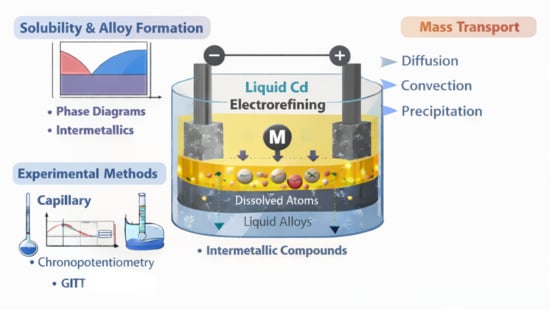
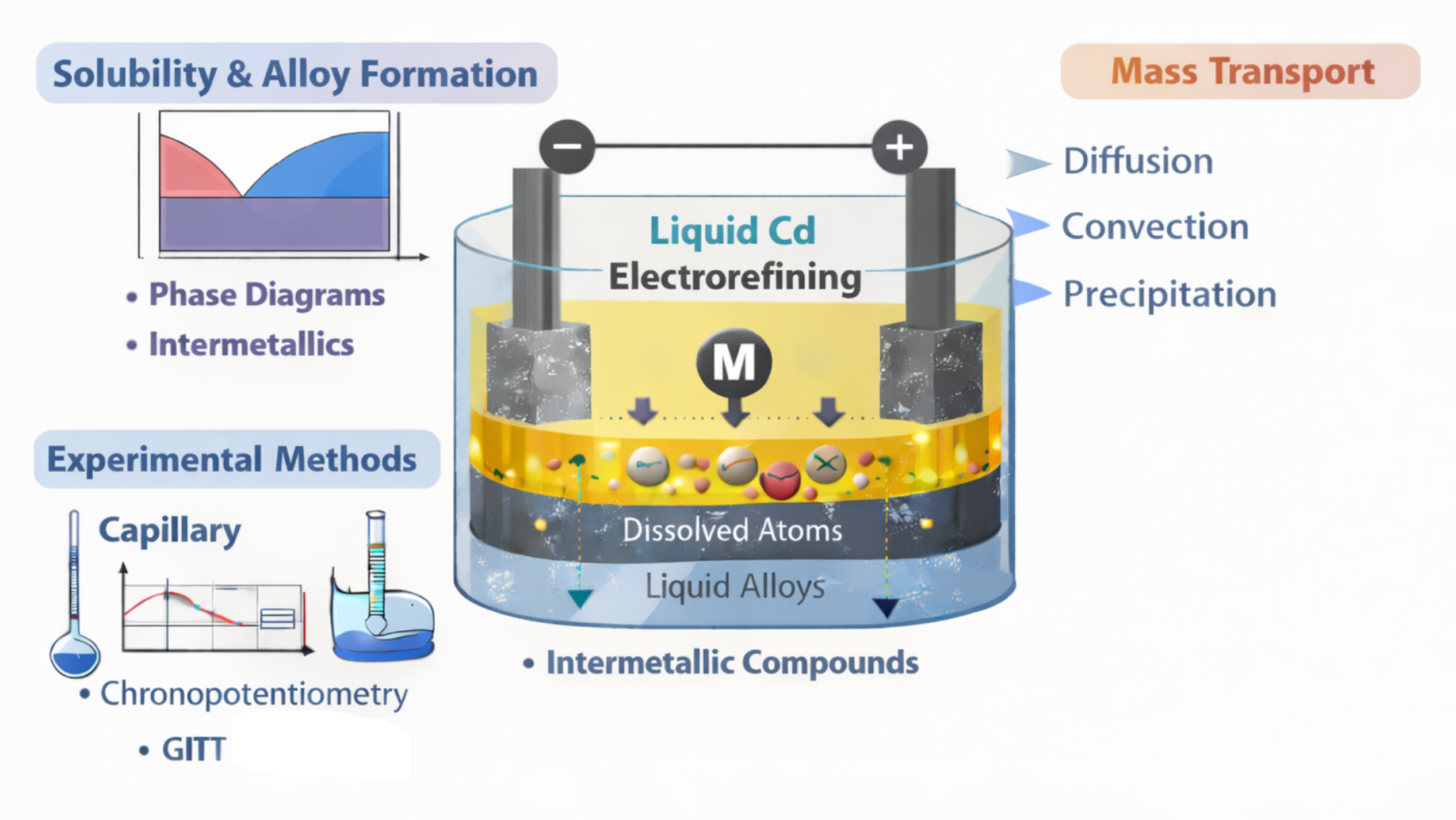
Graphical Abstract

1. Introduction

Liquid metal cathodes have received increasing attention in high-temperature electrochemical systems due to their unique physicochemical properties and distinct advantages over conventional solid electrodes. In molten salt electrolysis processes, solid cathodes often suffer from problems such as electrode passivation, poor adhesion of deposits, and limited reduction selectivity. Liquid metal cathodes, in contrast, exhibit high electrical conductivity, excellent metal solubility, and superior electrochemical stability, which enable continuous metal deposition and efficient mass transport in high-temperature molten salt environments. These characteristics make liquid metal cathodes particularly attractive for applications in materials metallurgy, electrochemical separation, and nuclear fuel reprocessing [1,2]
Among various liquid metal cathodes, liquid cadmium has been extensively investigated and widely employed due to its favorable electrochemical potential, low melting point (321 °C), and strong affinity for actinide elements. In molten LiCl–KCl-based electrolytes, liquid Cd exhibits high solubility for uranium, plutonium, and other actinides, while showing relatively low affinity for alkali and alkaline-earth fission products. Such selectivity allows for the effective separation of actinides from fission products during electrorefining, thereby reducing the volume and heat load of high-level radioactive waste. Consequently, liquid Cd cathodes play a crucial role in electrorefining processes developed for metallic fuel treatment and pyroprocessing [3,4,5,6,7,8,9]. In particular, pyroprocessing programs at Argonne National Laboratory (ANL) and Idaho National Laboratory (INL) demonstrated the use of liquid Cd cathodes to selectively recover plutonium and other transuranic elements from molten salts through alloy formation with cadmium, while uranium is predominantly deposited on solid cathodes [10,11]. Engineering-scale studies have further demonstrated that electrochemical recovery of kilogram-scale actinide products can be achieved at operating temperatures of approximately 773 K. After electrorefining, the collected actinide–Cd alloy is processed in a cathode processor, where cadmium is distilled and recycled for reuse as cathode material. These technologies were successfully demonstrated in the EBR-II fuel treatment program and subsequently implemented in the Fuel Conditioning Facility (FCF) [12].
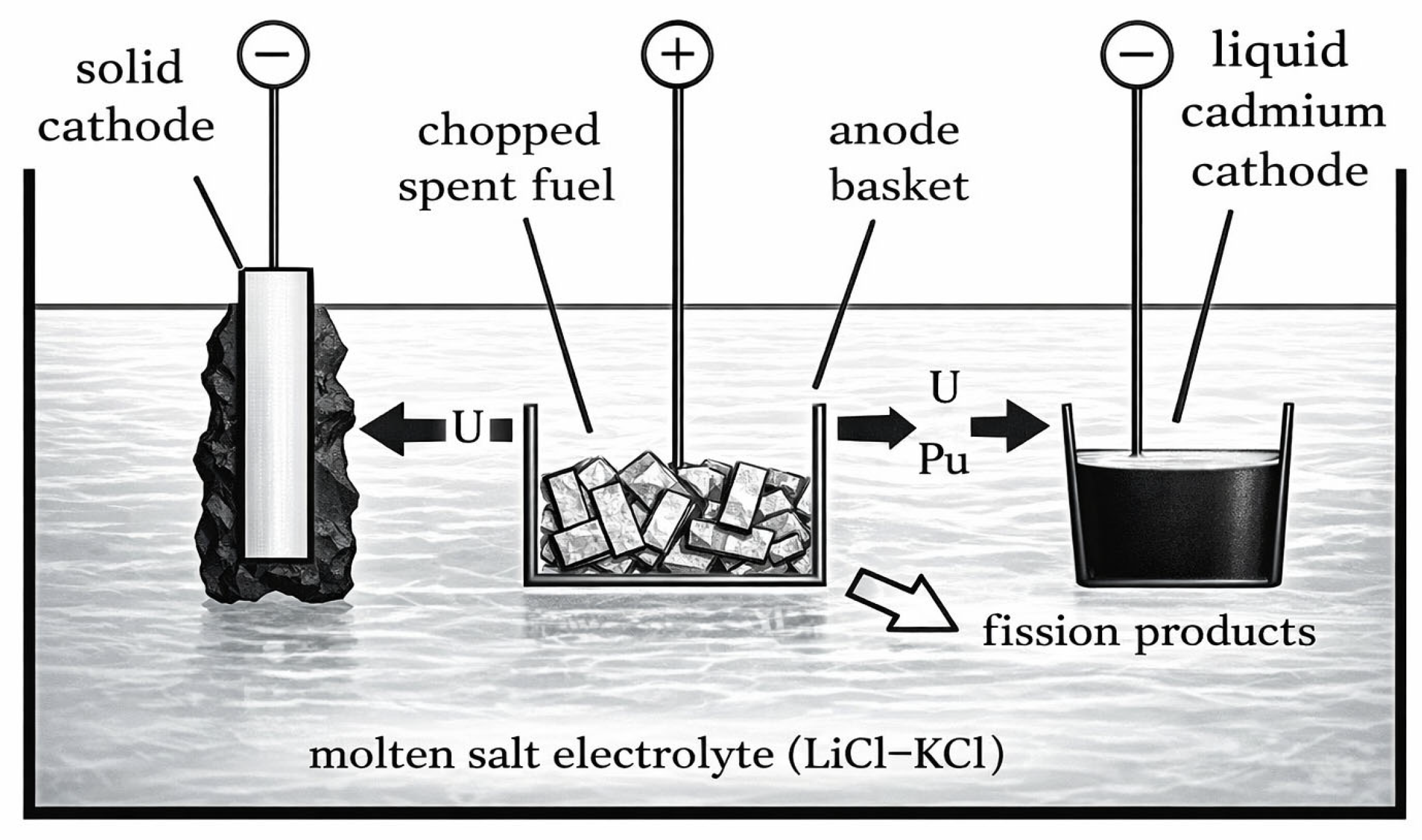
As shown in Figure 1, during electrorefining, metal ions dissolved in molten salt are electrochemically reduced at the cathode/electrolyte interface and subsequently enter the liquid Cd phase, where they may exist as dissolved atoms, liquid alloys, or intermetallic compounds depending on thermodynamic stability and concentration. The physical state of deposited metals in liquid Cd strongly influences deposition morphology, cathode loading capacity, and subsequent material handling processes such as distillation. In addition, the redistribution of metals within the liquid Cd cathode is governed by mass transport processes, which directly affect deposition kinetics, concentration gradients, and overall system stability. Therefore, a comprehensive understanding of both the physical state and mass transport behavior of metals in liquid Cd cathodes is essential for optimizing electrorefining performance.
Despite extensive experimental and theoretical efforts, the interfacial reaction pathways and transport mechanisms in liquid Cd cathodes remain incompletely understood, particularly under multicomponent and high-temperature conditions relevant to practical applications. Although diffusion is generally considered the dominant transport mechanism in liquid Cd, the effects of alloy formation, intermetallic compound precipitation, and local concentration accumulation on the effective transport behavior remain subjects of ongoing debate. Moreover, the available diffusion data are limited and often exhibit significant variability, mainly due to differences in experimental techniques, temperature ranges, and system compositions. To address these issues, various experimental techniques have been developed to investigate metal transport in liquid Cd, including classical capillary methods and electrochemical approaches. While each method provides valuable insights into transport behavior, they also present specific limitations when applied to high-temperature liquid metal systems [11,14,15,16,17,18]. Therefore, a critical assessment of these methods and the associated transport models is necessary to establish a coherent understanding of metal behavior in liquid Cd cathodes.
This review provides an integrated analysis of the physical state and mass transport behavior of metals in liquid Cd cathodes. The thermodynamic characteristics governing metal dissolution, alloy formation, and precipitation are first discussed based on M–Cd phase diagrams. Subsequently, diffusion-controlled mass transport mechanisms and theoretical descriptions of atomic migration in liquid Cd are analyzed. In addition, major experimental techniques used to determine diffusion coefficients in liquid metal systems are systematically summarized and critically compared, with emphasis on their methodological characteristics and applicability to molten salt electrorefining environments. By linking thermodynamic phase stability with diffusion-driven transport processes and experimental methodologies, this review aims to establish a coherent framework for understanding metal behavior in liquid Cd cathodes and to provide insights for optimizing electrorefining processes and advanced nuclear fuel cycle technologies.
The literature reviewed in this work is primarily collected from major scientific databases, including ScienceDirect, Web of Science, and Scopus, together with journals published by various scientific publishers such as the American Physical Society and IOP Publishing. The phase diagram data referenced in this work are obtained from the ASM Alloy Phase Diagram Database provided by ASM International. The literature search covers publications from 1970 to 2025 using keywords related to liquid cadmium electrode, diffusion, pyroprocessing, and molten salt electrorefining.

2. Mass Transfer Processes and Mechanisms of Metals at Liquid Cd Cathodes

Liquid cadmium cathodes are widely used in electrochemical processes such as nuclear fuel reprocessing (e.g., U, Pu) and rare metal extraction (e.g., Sm, Ce, Nd) owing to their liquid stability at moderate temperatures, electrochemical compatibility, and strong alloy-forming capability. The mutual solubility of different metals in liquid Cd plays a critical role in determining deposition behavior, separation selectivity, cathode loading capacity, and subsequent processes such as distillation and refining. The mass transfer process of metals at the liquid cadmium cathode can generally be described by three sequential steps [19,20,21,22,23]:
(1)
Interfacial Electrochemical Reduction: Metal ions dissolved in the molten salt electrolyte gain electrons at the cathode/electrolyte interface and are electrochemically reduced to neutral metal atoms.
(2)
Dissolution or Intermetallic Compound Formation: The newly formed metal atoms subsequently cross the interface and dissolve into the liquid cadmium phase, resulting in an increase in local concentration near the interface. Under certain conditions, nuclei may form and grow on the cathode surface, potentially resulting in the formation of a solid layer composed of intermetallic compounds or elemental metal.
(3)
Bulk diffusion and growth of deposited phases: The concentration gradient between the interface and the bulk liquid cathode serves as the primary driving force for mass transfer. Metal atoms migrate into the cathode interior through liquid-phase diffusion. Although natural or forced convection may influence macroscopic mass transfer, atomic diffusion generally remains the rate-controlling step. As the metal concentration increases and approaches the saturation solubility, intermetallic compounds may form with Cd, or the metal may precipitate as a solid phase. In some cases, a solid deposit layer may develop on the electrode surface, which can hinder further mass transport.
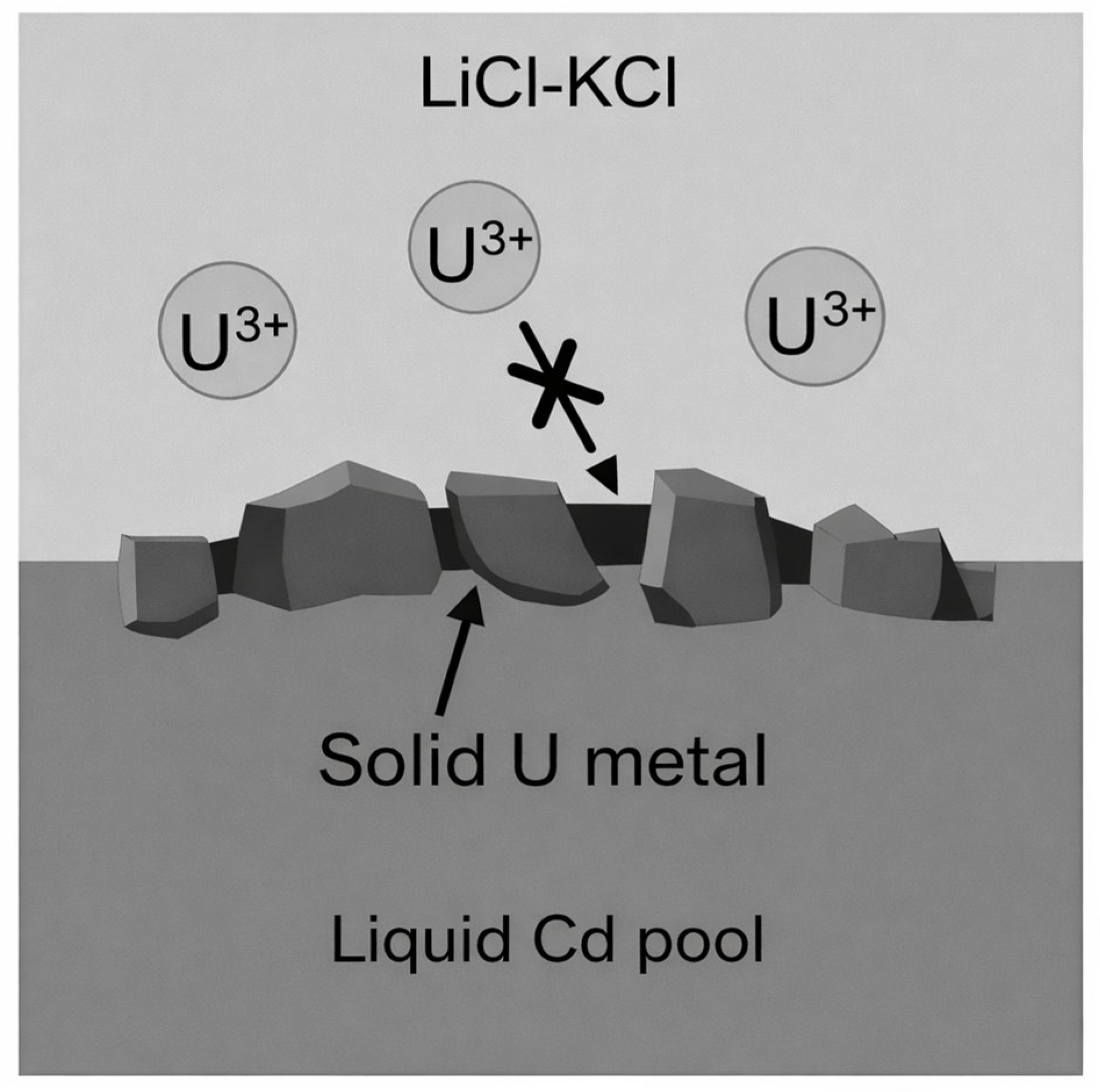
In electrorefining experiments employing a liquid cathode, uranium is electrochemically reduced from its ionic state to metallic uranium at the cathode surface. However, due to the extremely low dissolution rate of metallic uranium in the liquid cathode, the continuous generation of uranium during prolonged electrolysis may lead to its gradual accumulation on the cathode surface. This accumulation can partially or completely cover the electrochemical interface between the cathode and the electrolyte, thereby reducing the effective reaction area and eventually impeding further progress of the electrorefining process, as illustrated in Figure 2 [24,25,26,27]. Therefore, a systematic investigation of the dissolution behavior and underlying mechanisms of metals in liquid cathodes is essential for achieving a deeper understanding of the interfacial phenomena involved in electrorefining. Furthermore, when combined with phase diagram analysis, such investigations enable the prediction of thermodynamic behavior and precipitation tendencies of metals in cadmium across different systems. This provides important theoretical guidance for high-temperature molten salt systems, electrochemical separation processes, and nuclear fuel reprocessing technologies.
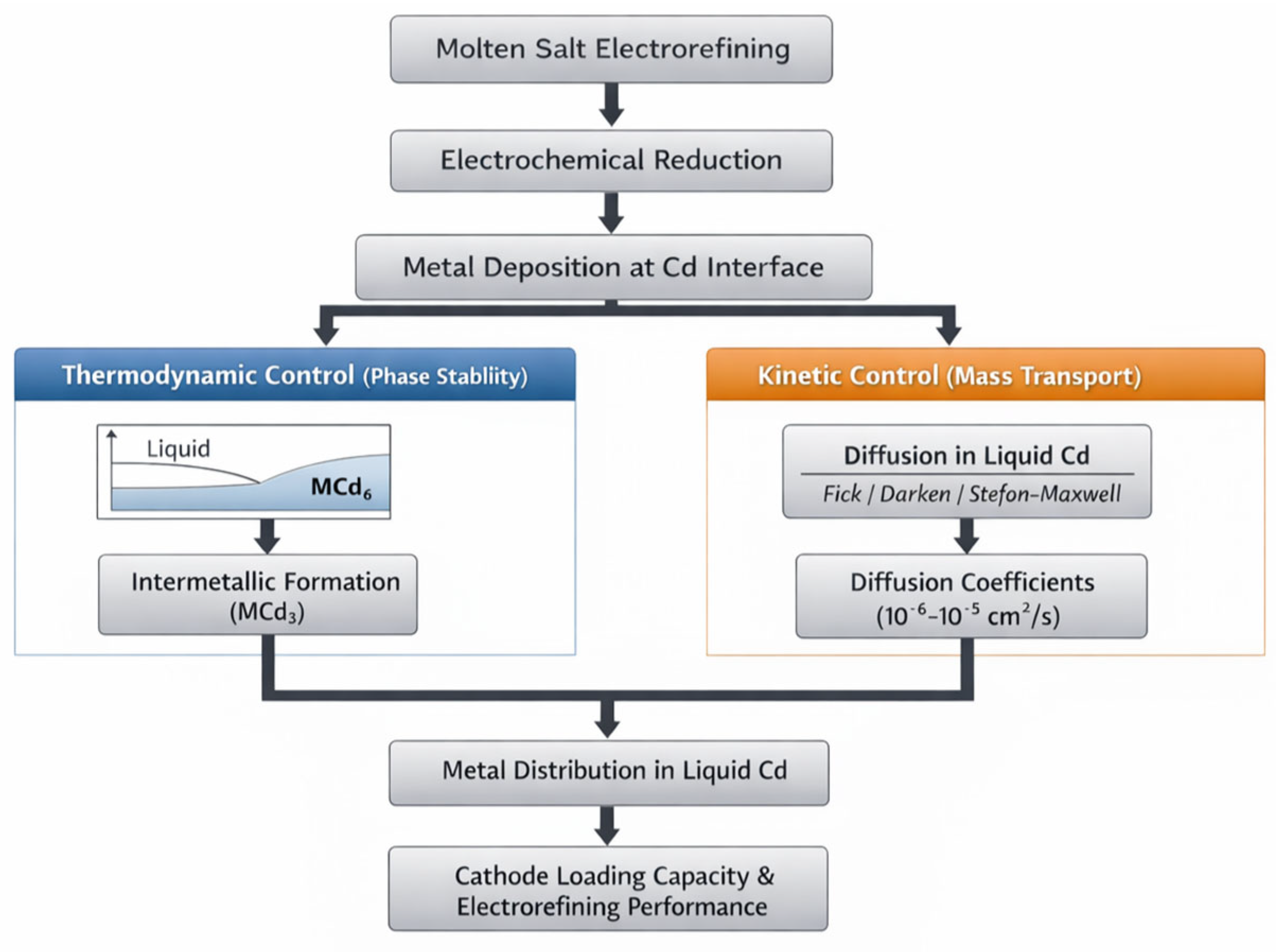
To provide a clearer description of metal behavior in the liquid cadmium cathode, a conceptual framework is proposed (Figure 3). Within this framework, metal ions are first electrochemically reduced at the cathode–electrolyte interface and subsequently introduced into the liquid cadmium phase in atomic form. The subsequent behavior of these metals is governed by the interplay between thermodynamic and kinetic factors. From a thermodynamic perspective, phase stability in the M–Cd system and the formation of intermetallic compounds determine the equilibrium state of the reduced metals in the cadmium phase. From a kinetic perspective, mass transport and diffusion within the liquid alloy control the redistribution of metal atoms inside the cathode. Specifically, thermodynamic phase equilibria determine whether the metal remains dissolved in liquid cadmium or forms intermetallic compounds, whereas diffusion processes regulate the spatial distribution of metal species within the cathode.
The coupling of these thermodynamic and kinetic processes ultimately governs the accumulation behavior of metals, thereby influencing the operational performance of the liquid cadmium cathode in molten-salt electrorefining systems. The underlying mechanisms of these processes are discussed in greater detail in the following sections.

2.1. Dissolution and Precipitation Mechanisms of Metals in Liquid Cd

The dissolution and precipitation behavior of metals in liquid cadmium is governed not only by fundamental thermodynamic principles but also by the alloy phase structures described in the M–Cd binary phase diagram. As summarized in Table 1, significant differences exist in the alloying behavior of various metals with Cd. The interactions between these metals and Cd determine their solubility in liquid cadmium, the formation of intermetallic compounds, and the structural characteristics associated with precipitation processes. Therefore, a precise understanding of the mixing characteristics of these alloy systems is essential for establishing a consistent relationship between experimental observations, theoretical predictions, and empirical models describing liquid alloy behavior [28,29,30,31,32].
In the molten salt electrolysis process, liquid cadmium acts not only as the cathode for metal ion reduction but also as an alloying medium, which directly influences the enrichment pattern and phase distribution of the metal after electrolysis. Within the liquid cadmium cathode, the electrochemically reduced metal M (e.g., Mn+ + ne → M0) enters the cadmium phase and undergoes alloying reactions through diffusion-driven mass transfer. Because Cd is liquid at the operating temperature, the metal does not immediately form a stable solid phase but instead enters the Cd phase as dissolved atoms or short-range ordered clusters. Subsequently, metal M undergoes alloying reactions in the cadmium phase through various possible chemical pathways, the specific form of which depends on the characteristics of the M–Cd binary phase diagram and the thermodynamic stability of the interactions. When the metal concentration in the Cd phase reaches the solubility limit, supersaturation may initially occur near the interface, triggering a phase transition. This series of processes, from dissolved state to solid phase, directly determines the deposition morphology of the metal and its distribution characteristics in the cathode. A comprehensive understanding of this process therefore requires integrated analysis of thermodynamic driving forces, atomic interactions, and alloy phase diagram characteristics [33,34,35].
Table 1. Solubility of Selected Actinides, Rare-Earth Elements, and Transition Metals in Liquid Cadmium at 773 K (500 °C).
ElementCategorySolubility in Liquid Cd (at%)Major Intermetallic
Compounds
References
UActinide1.11 UCd11[16,36]
PuActinide1.86 PuCd11, PuCd6; [37,38]
NpActinide2.20 NpCd11, NpCd6 [39]
AmActinide2.00AmCd6 [40,41]
LaLanthanide0.32LaCd11[42]
CeLanthanide0.60CeCd11, CeCd6[42]
NdLanthanide1.46NdCd11, NdCd6[43]
SmLanthanide2.23SmCd11, SmCd6[44]
ZnPost-transitionForms a continuous liquid alloyNo fixed-stoichiometry intermetallic compounds[45]
InPost-transitionForms a continuous liquid
alloy
Described by liquid/solid solution phases[46]
The fundamental reasons why metals in different M-Cd alloy systems exhibit precipitation, solid solution formation, or near-complete immiscibility lie in the differences in alloying tendencies determined by factors such as enthalpy of mixing, atomic size differences, electronic structure characteristics, and crystal structure compatibility [47,48,49,50]. Essentially, this behavior is the result of the synergistic interaction of thermodynamic driving forces (such as enthalpy of mixing and phase diagram characteristics) and kinetic conditions (including diffusion processes and reaction rates). Based on this understanding, the relevant metal systems can generally be categorized into three types, which are described below.

2.1.1. Alloy Systems Exhibiting Intermetallic Compound Formation or Base-Metal Precipitation at Saturation

In such systems, strong chemical interactions typically exist between constituent metal atoms, resulting in a significantly negative enthalpy of mixing. The system tends to lower its free energy through the formation of intermetallic compounds with fixed stoichiometric ratios and ordered crystal structures. This behavior is commonly observed in metal combinations with large differences in electronic structure, such as main group metals with transition metals, or f-electron metals with low-melting-point metals [51,52,53,54,55]. Due to the pronounced directionality of chemical bonding, solid solutions with randomly distributed atoms are often thermodynamically unstable, which promotes the preferential nucleation and growth of compound phases.
In these systems, the phase diagram usually contains multiple stable or metastable intermetallic compounds, which significantly limits the solubility of metals in the liquid phase due to compound phase equilibrium. Typical examples include rare earth-Cd systems such as Cd–Ce, Cd–Nd, and Cd–Sm, as well as actinide-Cd systems such as Cd–Pu and Cd–Np. These systems commonly form MCd6 and MCd11 type compounds, reflecting alloying characteristics dominated by the stability of ordered phases [32,43,44,56,57,58,59,60,61,62].
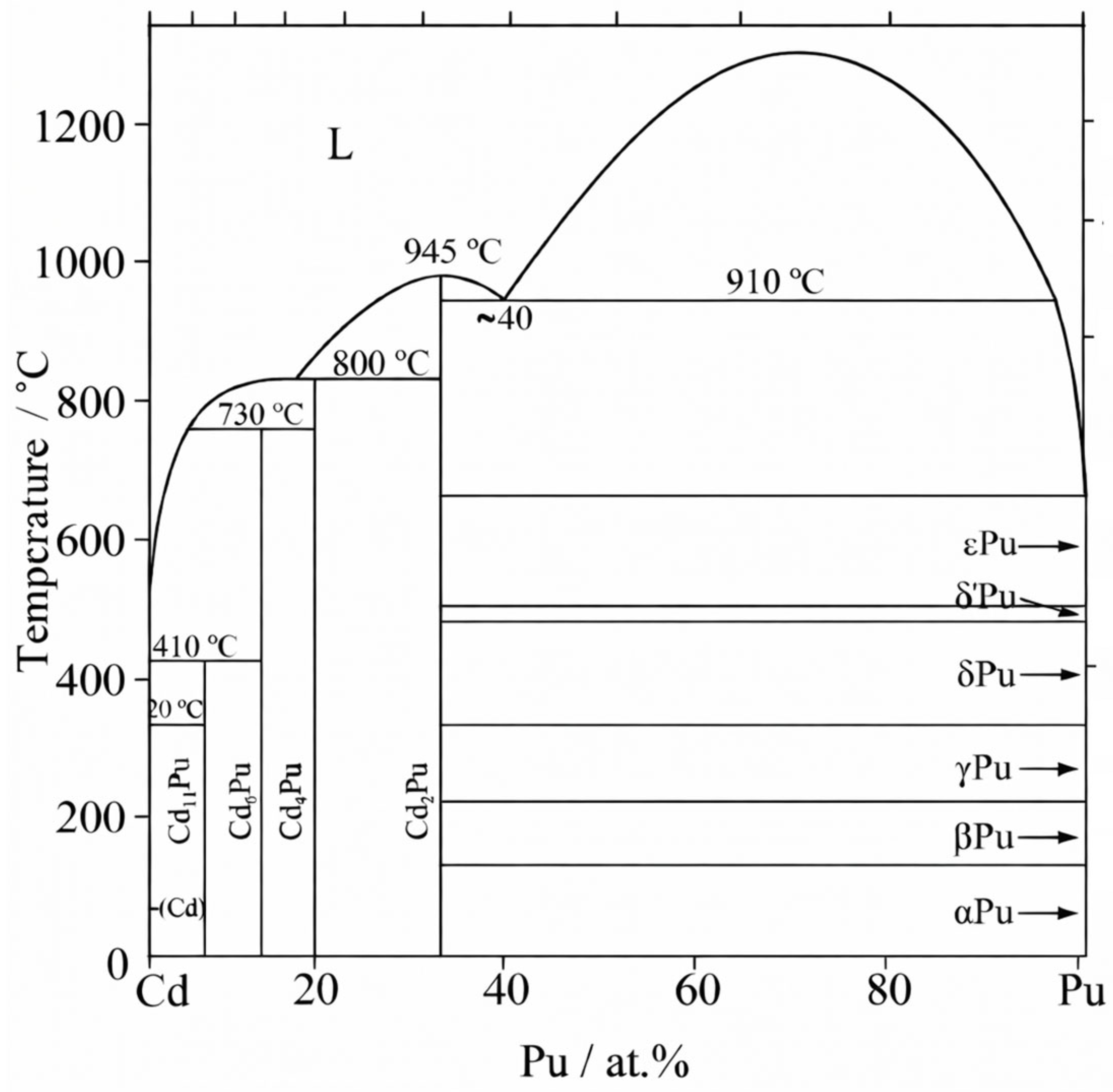
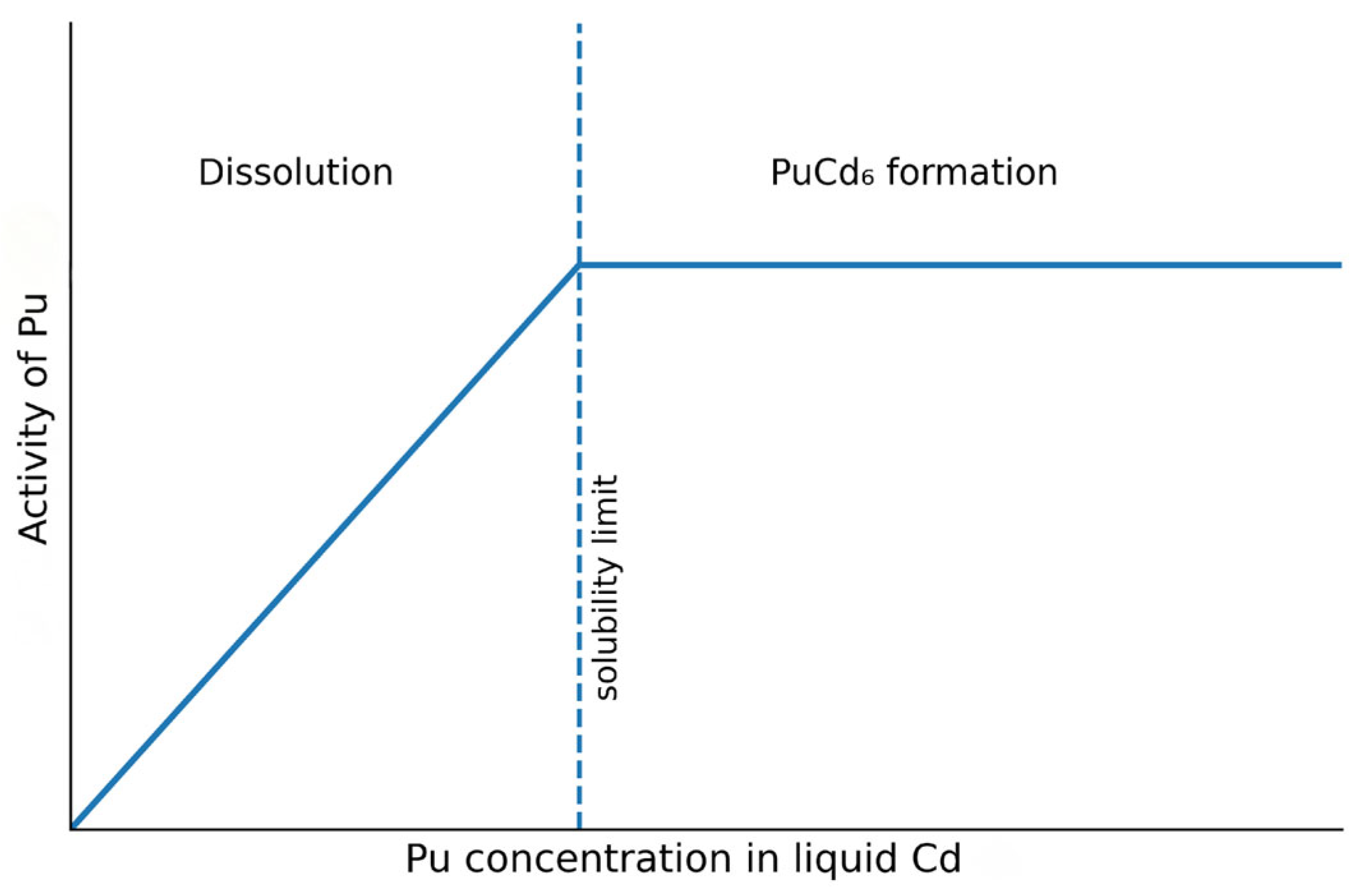
It should be noted that whether the precipitate formed after the dissolution process exceeds a certain threshold, corresponding to an intermetallic compound or elemental metal, must be determined according to the thermodynamic phase diagram of the metal–Cd system. Iizuka et al. [63] systematically investigated the recovery behavior of plutonium at a liquid cadmium cathode during molten-salt electrorefining, with particular emphasis on the effects of cathodic current density and plutonium concentration in the molten salt on the electrochemical reduction and collection characteristics of plutonium. Their results demonstrated that in a LiCl–KCl eutectic melt, when the cathodic current density is maintained within an appropriate range, plutonium can be stably reduced and efficiently dissolved into the liquid cadmium cathode even in the absence of cathode stirring, with a maximum plutonium loading of up to 7.75 wt% in the liquid cadmium cathode. The Pu–Cd binary phase diagram (Figure 4) indicates that at the experimental temperature of 773 K, once plutonium diffuses within the liquid cadmium cathode and reaches its saturation solubility, the system enters the L + PuCd6 region [64] rather than elemental plutonium metal. As shown in Figure 5, when the concentration of plutonium in liquid cadmium exceeds its solubility limit, plutonium no longer remains in the dissolved state but instead forms the intermetallic compound PuCd6, which subsequently accumulates and deposits at the bottom of the cathode.
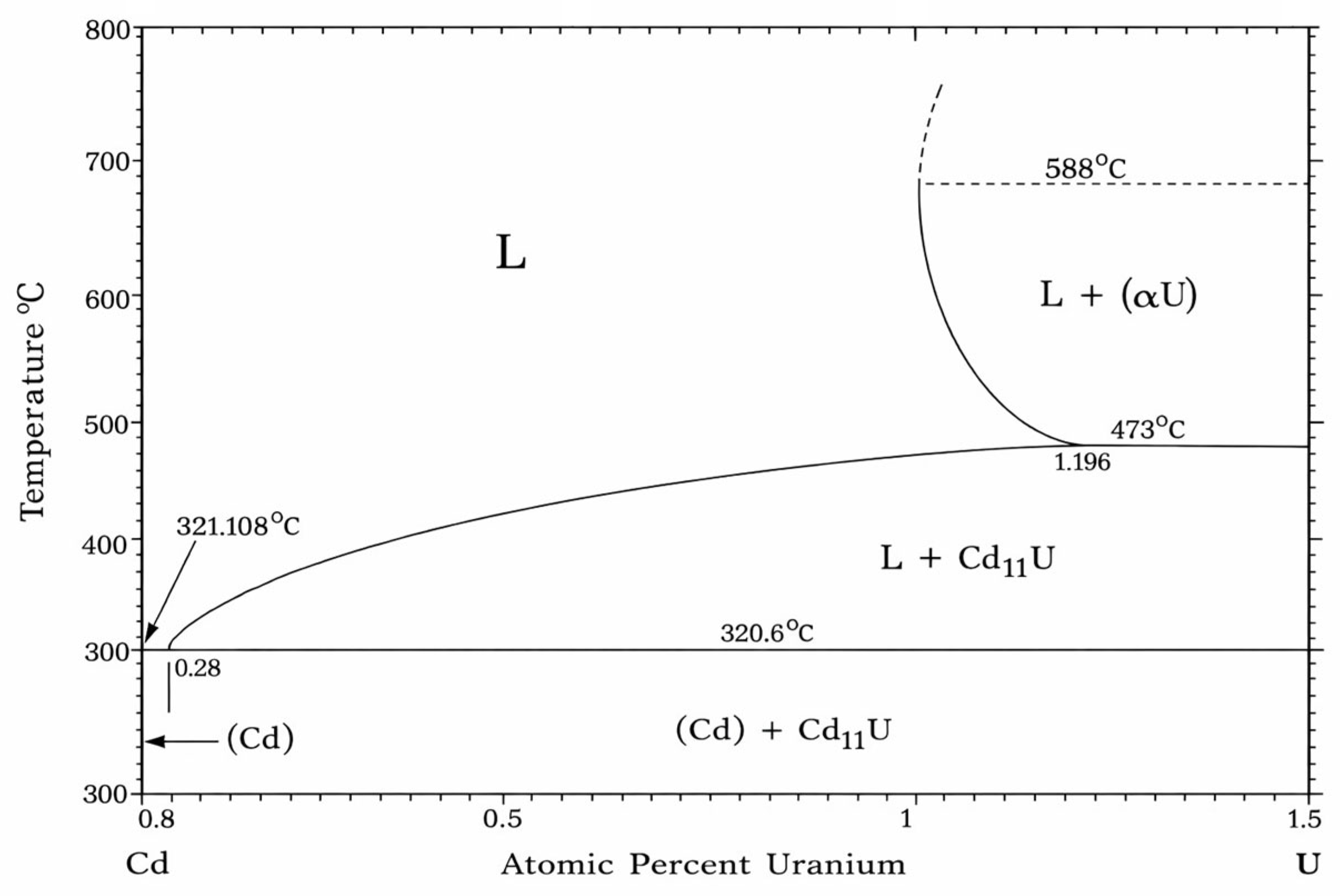
Paek et al. employed a mesh-type liquid cadmium cathode to investigate the electrodeposition behavior of uranium in molten LiCl–KCl–UCl3 salt at 773 K under various current densities [65]. During the electrorefining process, the experimental temperature is often higher than 773 K. Under such conditions, U diffuses into the liquid Cd cathode and, upon reaching its solubility limit, enters the L + (αU) region of the phase diagram (as shown in Figure 6), leading to the deposition of metallic U. After cooling, EPMA and XRD analyses confirmed that the solid deposit formed in the liquid cadmium cathode crucible corresponded to the intermetallic compound UCd11. This phenomenon can be explained by the phase evolution during cooling. When the temperature decreases below 745 K, the system transitions from the L + (αU) phase region to the L + UCd11 region in the U–Cd phase diagram, which results in the formation and precipitation of the intermetallic compound UCd11 [60].

2.1.2. Highly Miscible Liquid Alloy Systems

Certain metals exhibit high solubility in liquid Cd, forming molten alloys in which Cd acts as the solvent. After electrochemical reduction, these metal atoms rapidly dissolve into the Cd phase and undergo fast diffusion and homogenization driven by concentration gradients. Because such metals possess high solubility at operating temperatures and do not readily form stable intermetallic compounds, they generally do not enter the saturation precipitation regime; instead, mass transfer is primarily governed by diffusion within the Cd phase. Given the relatively large atomic diffusion coefficients in liquid metals, this diffusion process rarely becomes a rate-limiting step. Consequently, the overall electrochemical behavior of the cathode is typically controlled by ionic diffusion in the molten salt or by interfacial reaction kinetics, rather than by diffusion within the Cd phase [66].
At the atomic scale, these metals possess atomic radii comparable to that of Cd and relatively simple valence electronic structures, resulting in good structural and electronic compatibility with Cd and facilitating substitutional mixing in the liquid alloy. The enthalpy of mixing in such systems is typically weakly negative, indicating that chemical interactions alone are insufficient to stabilize ordered intermetallic compounds. Accordingly, phase diagrams commonly exhibit extensive mutual solubility in the high-temperature liquid phase, with the possible appearance of compound phases or precipitation at lower temperatures. Representative examples include the Cd–Zn and Cd–Ga alloy systems [67,68].
In studies of the liquid Cd–Zn alloy system, Koirala et al. [67] applied the Darken relation to systematically evaluate diffusion behavior at 800 K, with the aim of elucidating atomic coordination characteristics and tendencies toward phase separation based on diffusional properties. In addition, the variation in viscosity with the mole fraction of Cd in liquid Cd–Zn alloys was calculated. The results indicate that the system remains a highly miscible liquid alloy even at relatively high Zn contents.

2.1.3. Immiscible Systems

For metals that differ significantly from Cd with respect to electronic structure, atomic size, and crystal structure, the enthalpy of mixing with Cd is typically close to zero or even positive, indicating weak heteroatomic interactions and an insufficient thermodynamic driving force for the formation of stable alloy phases. Even under high-temperature liquid-state conditions, such systems generally exhibit extremely limited mutual solubility and tend to undergo phase separation rather than forming homogeneous solid solutions or ordered alloy phases [69,70,71,72].
From a thermodynamic perspective, the formation of liquid metal is typically accompanied by increases in lattice distortion energy and interfacial energy. In these systems, however, such unfavorable energetic contributions cannot be sufficiently compensated by configurational entropy or by the relatively weak chemical bonding between unlike atoms, rendering the mixed state thermodynamically unstable. As a result, the establishment of short-range atomic ordering is difficult, and each metal species tends to preserve its own local coordination environment, leading to macroscopic liquid–liquid or solid–liquid phase separation [73,74,75].
From a kinetic standpoint, the dissolution and diffusion of such metals in liquid Cd are generally very slow. The limited solubility arises not only from thermodynamic incompatibility but also from high interfacial reaction barriers and low probabilities of atomic exchange across the interface [76]. Consequently, under electrochemical reduction or molten-salt electrolysis conditions, these metals are more likely to exist as discrete metallic phases or particulate deposits, rather than participating in diffusion-driven mass transport and homogenization within the Cd phase [77,78].
Representative examples include iron-group metal–Cd systems such as Cd–Fe, Cd–Ni, and Cd–Cr, as well as high-melting-point transition metal–Cd systems such as Cd–Mo and Cd–W [76,79,80,81]. The corresponding phase diagrams typically exhibit extremely narrow mutual solubility ranges or near-complete immiscibility, clearly reflecting alloying behavior dominated by phase separation.

2.2. Mass Transport Behavior of Metals in Liquid Cd

Mass transport of metals in liquid Cd is a key physicochemical issue in liquid-cathode electrorefining and pyroprocessing technologies. Fundamentally, it involves the migration, redistribution, and interfacial exchange of metal atoms within the liquid Cd alloy phase. This process typically occurs under complex conditions characterized by high temperature, a liquid state, multiphase coexistence, and electrochemical driving forces, and therefore exhibits characteristics that differ markedly from mass transport in solid phases or molten salt media [82].
In high-temperature liquid metal systems, mass transport is primarily governed by diffusion driven by concentration gradients, while also being influenced by convection induced by thermal effects and, in some cases, by electromigration under an applied electric field. After metal ions are electrochemically reduced at the Cd surface, they are converted into neutral metal atoms, which subsequently diffuse within the liquid Cd from regions of high concentration to regions of low concentration as a result of thermal motion. This diffusion process is driven by concentration gradients, with its rate determined by the diffusion coefficient of the metal in Cd and being highly sensitive to temperature. Consequently, diffusion directly controls both the spatial uniformity of metal distribution and the rate at which saturation is reached in the liquid cathode [83,84].
Although convection is not the dominant mass transport mechanism in liquid Cd, it can significantly enhance mass transfer under certain conditions. As a low-melting-point metal, Cd is susceptible to local temperature gradients generated by the heat released during electrochemical reactions and by the deposition of heavy metals, which may induce natural convection within the cathode [85]. Moreover, forced convection may be generated by mechanical stirring, electrode vibration, or externally imposed thermal gradients, thereby accelerating the redistribution and homogenization of metal atoms in the Cd phase. Electromigration refers to the directional movement of charged species under the influence of an electric field. However, within the liquid Cd cathode, metal species exist predominantly as electrically neutral atoms following reduction and therefore do not respond significantly to the electric field. As a result, electromigration can generally be considered negligible within the Cd phase [84]. This mechanism is primarily relevant to the transport of metal ions in the molten salt phase rather than within the liquid Cd alloy itself. In summary, mass transport of metal species within a liquid Cd cathode is dominated by diffusion, with convection serving as an auxiliary mechanism under certain operating conditions, while electromigration plays a negligible role in this phase. This understanding provides an important theoretical basis for controlling metal behavior and optimizing process performance in liquid Cd cathode systems.
Mass transfer of metals in liquid Cd initially involves the diffusion of reduced metal atoms from the interface into the bulk liquid phase. At the liquid cathode surface, after metal ions are reduced by electrons and enter the Cd phase, a localized high-concentration solute region rapidly forms, resulting in a significant chemical potential gradient. This gradient drives the solute metal to migrate into the liquid Cd, thereby restoring thermodynamic homogeneity in the bulk phase. This process is governed by Fick’s law; in an isotropic medium, Fick’s first law states that J is proportional to the concentration gradient [86]:
J = D C x ,
where J is the diffusion flux of species, D is the diffusion coefficient of metal in liquid Cd, C is the concentration of metal in the Cd phase, and x denotes the distance normal to the electrolyte–Cd interface. The negative sign indicates that diffusion occurs in the direction of decreasing concentration.
For transient electrorefining processes or during the initial stage of metal accumulation in the liquid Cd cathode, the time-dependent concentration profile must be considered. In this case, the diffusion of metal species in liquid Cd is described by Fick’s second law [87,88],
C t = D · 2 C x 2 ,
and the initial condition C = 0 for a fresh liquid Cd cathode. The above equations can be combined with the electrochemical relationships within the liquid cathode to form an electrochemical reaction-diffusion coupled model, which can be used to quantitatively describe the uptake and redistribution of metal species within the liquid Cd cathode during electrorefining. Due to the isotropic nature of the liquid metal phase and the typically low solute concentration of metal species in Cd, the activity of the dissolved metal can be approximated as proportional to its concentration. Under such conditions, concentration gradients effectively represent chemical potential gradients, thereby justifying the applicability of Fickian diffusion.
In addition to being expressed in terms of concentration gradient using Fick’s law, diffusion behavior can also be described using the Darken equation [89]:
D = N B D A + N A D B
where D is the interdiffusion coefficient, DA and DB are the intrinsic diffusion coefficients of components A and B, respectively, and NA and NB represent their corresponding mole fractions. In liquid alloy systems, the driving force for mass transport is more rigorously described by gradients in chemical potential rather than by concentration alone. This distinction becomes particularly important in non-ideal liquid metal systems where strong solute–solvent interactions exist. When the system behaves as a non-ideal solution, the diffusion process is also influenced by the chemical potential gradient, and therefore a thermodynamic factor must be introduced into the diffusion expression. In this case, the Darken equation can be reformulated accordingly:
D = ( N B D A + N A D B ) ln α A / ln N A ,
By integrating experimentally obtained interdiffusion data with theoretical models, researchers can obtain deeper insight into atomic migration in multicomponent solid systems, thereby providing theoretical guidance for material design and performance optimization. Huang et al. [90] systematically investigated the relationship between self-diffusion and inter-diffusion in several binary liquid metal systems using molecular dynamics (MD) simulations combined with a long-capillary simulation approach. The study focused on four representative melts, namely Al80Ni20, Al80Cu20, La80Ni20, and La80Al20, covering systems with different atomic size ratios and mixing enthalpies. The results showed that for the Al80Cu20 melt, the inter-diffusion coefficient can be well described by the classical Darken equation, indicating weak dynamic cross-correlations between atomic species. In contrast, for the Al80Ni20, La80Ni20, and La80Al20 melts, significant deviations from the Darken relation were observed, which required the introduction of a dynamic cross-correlation factor (S) to accurately describe the diffusion behavior. The study further demonstrated that the magnitude of S is strongly correlated with the mixing enthalpy and structural ordering of the melts. Systems with small mixing enthalpy exhibit S values close to unity, whereas systems with stronger chemical interactions show pronounced deviations. This observation is consistent with the discussion in Section 2.1, which indicates that structural differences between different metals primarily influence the diffusion behavior in liquid alloys.

2.3. Multicomponent Diffusion in Liquid Cd

In electrorefining processes employing a liquid Cd cathode, the diffusion behavior of actinide species in the cathode phase plays a crucial role in determining the deposition kinetics and separation efficiency. For a single-component system, such as U dissolved in liquid Cd, mass transport in the cathode is primarily governed by the concentration gradient of the depositing species and can be described by Fickian diffusion. Under such conditions, the diffusion flux of uranium is mainly determined by its own concentration gradient, and the diffusion coefficient remains relatively constant, depending primarily on temperature and the thermodynamic interaction between U and Cd.
In contrast, the diffusion behavior in multicomponent systems, such as U–Pu–RE in liquid Cd, becomes significantly more complex due to the presence of coupled mass transport phenomena. In these systems, the diffusion flux of each species is influenced not only by its own concentration gradient but also by the gradients of other components in the alloy phase. Consequently, the diffusion process is more accurately described using multicomponent diffusion models, such as the Maxwell–Stefan formulation [91,92,93]. In this framework, the diffusion flux of each species depends not only on its own concentration gradient but also on interactions with other species in the mixture. The generalized Stefan–Maxwell equation for multicomponent diffusion can be expressed as
μ i = R T j i x j ( v i v j ) D i j ,
where μi is the chemical potential of component i, xj is the mole fraction of component j, vi and vj are the diffusion velocities, and Dij denotes the Maxwell–Stefan binary diffusion coefficient. This formulation highlights that the flux of a given component depends not only on its own concentration gradient but also on interactions with other alloy constituents.
Moreover, thermodynamic interactions among U, Pu, RE, and Cd significantly affect the chemical potentials of the individual components, thereby modifying the driving force for diffusion. Rare earth elements, which often accumulate in the liquid Cd cathode during electrorefining, may occupy available dissolution sites and increase the viscosity of the liquid metal phase, resulting in reduced atomic mobility. As a result, the effective diffusion coefficients of actinides in multicomponent Cd alloys are generally lower than those observed in single-component systems. Li et al. [94] investigated the recovery of actinides in LiCl–KCl molten salt containing high concentrations of rare earth chlorides. The results showed that uranium and transuranic elements could be simultaneously recovered in the Cd phase, while rare earth fission products such as Ce, Nd, La and Pr were co-deposited with the actinides, resulting in RE contamination levels of up to 6.7 wt%. The presence of rare earths had little effect on the separation efficiency among actinides but significantly reduced the selectivity between actinides and rare earth elements.
In electrorefining process, different types of liquid cathodes may also exhibit distinct influences on the deposition and diffusion behavior within the mixed molten salt electrolyte (U–Pu–RE–Cd). The differences in deposition potentials among various metals determine their deposition sequence. Jung et al. [95] systematically investigated the electrochemical behavior of uranium and several lanthanides (Nd, Ce, and La) in LiCl–KCl molten salt using bismuth and cadmium liquid metal electrodes. Their cyclic voltammetry results indicated that U is reduced at more positive potentials than the lanthanides, allowing preferential electrodeposition of U prior to Ln species. Chronopotentiometric deposition–dissolution experiments further revealed distinct dissolution sequences in the Bi system, where lanthanides dissolved from the Bi electrode before uranium, enabling time-controlled sequential separation of U and Ln from the molten salt. In contrast, the Cd liquid electrode exhibited simultaneous dissolution of U and Ln, indicating limited selectivity for element-specific separation.
Despite its importance for understanding actinide transport and optimizing electrorefining performance, quantitative diffusion data for multicomponent systems in liquid Cd remain limited. This limitation primarily arises from the experimental challenges associated with high-temperature molten salt systems and the presence of radioactive materials. As a result, many current models of electrorefining processes rely on diffusion coefficients measured in single-component systems, combined with thermodynamic activity models, to approximate mass transport behavior in multicomponent Cd alloys.
With the advancement of computational methods, atomistic simulations such as molecular dynamics (MD) have emerged as powerful tools for probing diffusion mechanisms in liquid metals from a microscopic perspective. By explicitly accounting for atomic interactions and local structural heterogeneities, MD simulations have provided valuable insights into the relationship between short-range order, dynamic correlations, and diffusion behavior [96,97,98,99]. Nevertheless, the accuracy of such simulations remains strongly dependent on the choice of interatomic potentials, and their applicability to complex systems involving actinides or heavy metal solutes is still limited. In practical applications, particularly in electrochemical reprocessing and molten salt electrorefining, liquid metal systems are rarely ideal or isolated. The presence of solute–solvent interactions, concentration gradients, and electrochemical boundary conditions introduces additional complexity that cannot be fully captured by classical self-diffusion theories. Consequently, diffusion in liquid metals under electrochemical environments is more appropriately described as an interdiffusion process coupled with interfacial reactions.

3. Experimental Study on Mass Transport in Liquid Cd Cathode

In studies of solidification kinetics, the diffusion coefficient of liquid alloys plays a crucial role because it directly determines the evolution of the alloy microstructure. The diffusion behavior of metals in liquid cadmium significantly influences processes such as alloy formation, metal precipitation, and interfacial reaction kinetics. Accurate determination of the diffusion coefficient is therefore not only fundamental to establishing mass transfer models but also represents a key step in optimizing electrolytic processes and elucidating reaction mechanisms. Over the years, researchers have developed and applied various measurement techniques, including the shear cell method [100,101,102,103], capillary method [104,105,106], neutron scattering method [107], radioactive tracer method [108,109], pulsed ion beam technology [110,111], and electrochemical methods [112,113,114]. These methods have been successfully applied to various liquid alloy systems. Among these techniques, the capillary method is considered a relatively mature experimental technique. In recent years, electrochemical techniques have also been increasingly employed to investigate diffusion behavior in liquid alloy systems, owing to their ability to provide in situ kinetic information under electrochemical operating conditions.

3.1. Capillary Method

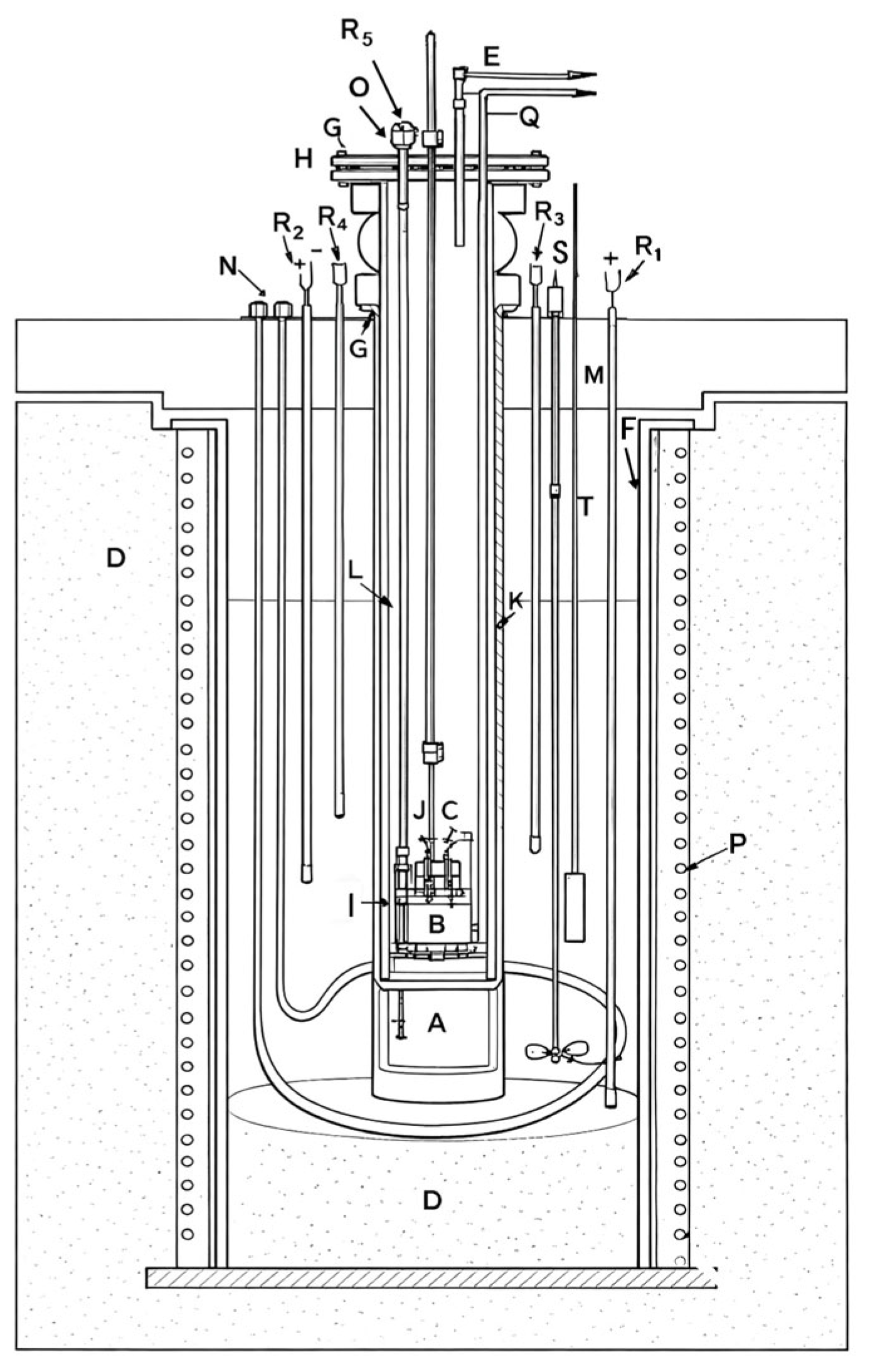
The capillary method is a classical and widely used technique for determining diffusion coefficients in liquid metals and alloys. Its core principle involves the use of a slender capillary tube (typically made of quartz, stainless steel, or corrosion-resistant metals) filled separately with a solute metal and a solvent metal (or liquid alloy). Under isothermal conditions, solute atoms are induced to undergo one-dimensional diffusion along the capillary. After a prescribed annealing time, the capillary is cooled and sectioned, and the axial concentration distribution of the solute element is subsequently analyzed. Common analytical techniques include EPMA, chemical titration, and ICP-MS. At present, most experimental data on diffusion in liquid metals reported in the literature have been obtained using the capillary technique. In 1949, Anderson and Saddington first proposed the capillary–reservoir method [115]. This apparatus consists of a capillary tube with a diameter of approximately 1 mm and a length of 2–10 cm, filled with a radioactive liquid metal and immersed in a bath of the same liquid metal composition but without radioactivity. Timing begins once the capillary is completely submerged in the liquid. The diffusion coefficient can be calculated by measuring the concentration distribution of the solute along the liquid metal medium inside the capillary or by tracking the time evolution of the diffusion front. In experiments, a capillary filled with the solute metal (typically 0.5–2 mm in diameter) is inserted into a temperature-controlled liquid Cd system. After being held for a certain period, the capillary is removed; following solidification, sampling, and chemical or radiometric analysis, the concentration gradient distribution is obtained.
The capillary method offers significant advantages in the study of diffusion in liquid metals and alloys [116,117,118]. Firstly, the method is simple and cost-effective, requiring only a constant-temperature furnace and a high-temperature-resistant capillary tube to conduct the experiment. Therefore, it was widely used in early research in metal physics and metallurgy. Secondly, the slender geometry of the capillary effectively suppresses natural convection and turbulence, allowing the mass transfer process to closely approximate ideal one-dimensional diffusion conditions, thereby enabling more accurate determination of diffusion coefficients. After the experiment, the cooled capillary can be cut into multiple segments, enabling measurement of the complete concentration-distance profile. This allows the experimental results to be directly fitted to Fick’s diffusion model with high accuracy. Furthermore, this method is well-suited for high-temperature systems and is applicable to metals with high melting points or strong chemical activity, such as liquid Cd, Bi, and Sn systems [119,120,121]. As shown in Table 2, the diffusion coefficients of several metals measured by the capillary method are typically on the order of 10−6–10−5 cm2 s−1. However, significant discrepancies exist among different studies. Part of these differences can be attributed to variations in experimental techniques. In addition, diffusion coefficients in liquid metals exhibit a strong temperature dependence and generally follow the Arrhenius relationship. Therefore, differences in experimental temperature represent another important factor contributing to the variability of the reported values.
Mirshamsi et al. systematically measured the self-diffusion coefficients of Cd and Pb in liquid Cd–Pb binary alloys in the temperature range of 290–480 °C using the capillary-reservoir method, as shown in Figure 7 [123]. The experimental results showed that the self-diffusion coefficients of both Cd and Pb increased significantly with increasing temperature, with magnitudes on the order of 10−5 cm2 s−1, and followed the Arrhenius relationship well over the entire temperature range investigated:
D   =   D 0 × exp Q R T ,
Trimble et al. systematically investigated the atomic diffusion behavior in the liquid Cd–Pb binary alloy system at 350 °C, determining the self-diffusion coefficients of cadmium and lead, as well as the interdiffusion coefficient of the system [124]. The study employed the capillary-reservoir method, based on Fick’s second law, to establish a quantitative relationship between the experimentally measured average concentration change and the corresponding diffusion coefficient. Radioactive tracer methods (Cd-115m, Pb-210) and chemical analysis (EDTA complexometric titration) were simultaneously used to independently measure the diffusion coefficients, and the experimental uncertainty was systematically evaluated through error propagation analysis. The results showed that the self-diffusion coefficient of pure lead at 400 °C was approximately 2.37 × 10⁻⁵ cm2·s−1, which is in excellent agreement with the value reported by Mirshamsi et al. (approximately 2.25 × 10⁻⁵ cm2·s−1), thus validating the reliability of the experimental method. At 350 °C, the self-diffusion coefficients of both cadmium and lead in the mixed system showed a significant non-linear dependence on composition, exhibiting extreme values in the intermediate cadmium mole fraction range, indicating that atomic migration behavior is significantly influenced by composition-dependent interactions.
Nevertheless, the capillary method still exhibits several inherent limitations. Because establishing a stable concentration gradient takes a considerable amount of time, the experimental cycle often lasts several hours to tens of hours, which can lead to issues with equipment stability and sample volatilization at high temperatures. This method requires extremely high precision in temperature control; even small fluctuations in furnace temperature can affect the calculated diffusion coefficient [128,129]. Although long, thin capillaries can reduce macroscopic convection, in metal systems with large density differences, convection driven by surface tension gradients may still occur, causing the apparent diffusion coefficient to deviate from the true value. For metals with high vapor pressure or high reactivity (such as Cd and Zn), sample encapsulation and sealing are difficult, increasing the complexity of the experiment [130,131,132]. Furthermore, the capillary method assumes ideal one-dimensional diffusion, whereas in practical systems, radial diffusion or interfacial reactions may also occur, which can interfere with accurate data interpretation.
In summary, the capillary method remains an important experimental technique for investigating the diffusion behavior of liquid metals and alloys, and it has been widely applied in related research. However, to further reduce convective interference, improve temperature field stability, and correct for non-ideal diffusion effects, it is necessary to combine this method with modern in situ characterization techniques, such as X-ray tomography or neutron imaging, as well as numerical simulation methods to enhance its applicability and data reliability in the study of liquid Cd cathodes and related systems.

3.2. Electrochemical Methods

Electrochemical methods offer distinct advantages for determining diffusion coefficients of metallic species in liquid metal cathodes owing to their non-destructive nature and high sensitivity. In particular, for studies on electrorefining and alloying processes in liquid Cd cathodes, electrochemical techniques enable the acquisition of diffusion-related kinetic parameters under actual operating conditions, thereby avoiding disturbances introduced by cooling or sampling procedures inherent to conventional physical methods. As early as 1969, Rickert pioneered the application of electrochemical techniques to investigate diffusion phenomena in liquid metals. However, his work was limited to the diffusion behavior of the non-metallic element oxygen in copper and silver, without addressing the diffusion of metallic species themselves. Subsequently, a number of studies focused on oxygen diffusion in liquid metals [133,134,135,136].
With regard to the electrochemical determination of chemical diffusion coefficients in binary liquid alloys, it was not until 2011 that Murakami reported the first successful application of an electrochemical method for measuring diffusion coefficients in liquid binary alloys. Murakami and Koyama proposed and validated an electrochemical approach based on chronopotentiometry under constant current to determine solute diffusion coefficients in liquid metals [137]. Using this method, the diffusion coefficients of La, Pr, Nd, Gd, Y, and Sc in liquid Cd were systematically measured, thereby filling a critical gap in the kinetic parameters required for dry reprocessing of spent nuclear fuel.
2 I τ 1 / 2 = n π 1 / 2 F A D 1 / 2 C
In this approach, the transition time τ corresponding to the complete anodic oxidation and depletion of rare-earth solutes in the liquid Cd electrode is recorded. The diffusion coefficient is then derived from the linear relationship between τ12 and C*/I (where C* is the initial solute concentration and I is the applied current), based on the semi-infinite diffusion model. As shown in Table 3, the experimental results exhibit excellent linearity, confirming the reliability and applicability of this electrochemical method for liquid metal systems.
Among electrochemical measurement techniques, the Galvanostatic Intermittent Titration Technique (GITT) was originally introduced by W. Weppner and R. A. Huggins in 1977 to determine the chemical diffusion coefficient of lithium in solid Li3Sb. Since then, GITT has become a widely adopted method for investigating ionic diffusion processes in solid-state electrode materials, particularly for evaluating chemical diffusion coefficients in cathode and anode materials for lithium-ion batteries [141].
The fundamental principle of GITT is based on maintaining the system close to equilibrium while applying a short-duration, low-amplitude constant-current pulse, thereby inducing a transient concentration gradient of the solute within the electrode. The subsequent open-circuit relaxation period allows observation of the dissipation of this gradient. By correlating the transient potential response during the current pulse with the steady-state potential change after relaxation, and by solving diffusion equations derived from Fick’s law, the diffusion coefficient of the solute within the electrode can be quantitatively determined [142,143,144,145]. In liquid metal cathode systems, electrochemical reactions are typically described as the dissolution or stripping of solute metals into or from the liquid metal phase. Under the assumptions of semi-infinite diffusion, low current density, and operation within the quasi-linear response regime, the diffusion coefficient can be evaluated using the classical GITT model. In this formulation, the potential variation term reflects the coupling between diffusion polarization and the thermodynamic state of the electrochemical system.
In 2013, Barriga re-derived the electrochemical treatment of diffusion processes by referencing the data analysis procedures proposed by Murakami and co-workers, and reformulated the expression for the chemical diffusion coefficient in binary liquid alloy systems [112]. This electrochemical approach incorporates both transient and steady-state measurements of the working electrode potential, enabling direct determination of diffusion coefficients in liquid alloys, since the electrode potential can be directly correlated with the surface solute concentration. By applying appropriate boundary conditions and solving Fick’s law governing mass transport at the cathode, a quantitative relationship between solute concentration and diffusion coefficient can be derived, as expressed in the following equation:
D m ( s ) = 1 π 2 n s V j 0 d E s d x m z m F n m + n s 2 d E d t 2 ,
Here, D denotes the chemical diffusion coefficient, π = 3.14, nₛ and nₘ represent the molar amounts of the solvent metal in the liquid metal cathode and the solute metal introduced by diffusion, respectively, V is the volume of the liquid metal cathode, j0 is the applied current density, Eₛ is the equilibrium potential during the relaxation stage, xₘ is the mole fraction of the diffusing species, zₘ is the number of electrons involved in the electrochemical reaction, F = 96,485 C·mol−1 is the Faraday constant, E is the electrode potential during the current pulse, and t is the pulse duration.
By performing piecewise fitting of the potential relaxation segments in the GITT curves, the slopes of concentration variation over different time intervals can be obtained. Combined with the analytical solution of Fick’s second law, the corresponding chemical diffusion coefficients D can be determined. This method is characterized by its non-destructive nature, high accuracy, and broad applicability, and is particularly suitable for investigating diffusion behavior at low solute concentrations [146,147,148]. During experiments, strict control of the current pulse width and relaxation time is required to ensure that the system reaches local thermodynamic equilibrium at each measurement step, thereby improving the accuracy of the diffusion coefficient determination. In studies of diffusion in liquid metals, GITT is often compared with continuous galvanostatic polarization methods. Compared with the continuous constant-current approach, GITT introduces intermittent open-circuit relaxation periods, which facilitate the separation of bulk diffusion contributions from interfacial electrochemical reactions, resulting in more reliable diffusion coefficients. However, this method generally requires longer testing durations and is sensitive to the selection of experimental parameters, such as pulse duration and current amplitude. Overall, under the assumptions of diffusion control and near-equilibrium conditions, GITT provides an accurate description of solute transport behavior in liquid metals [149,150,151,152].
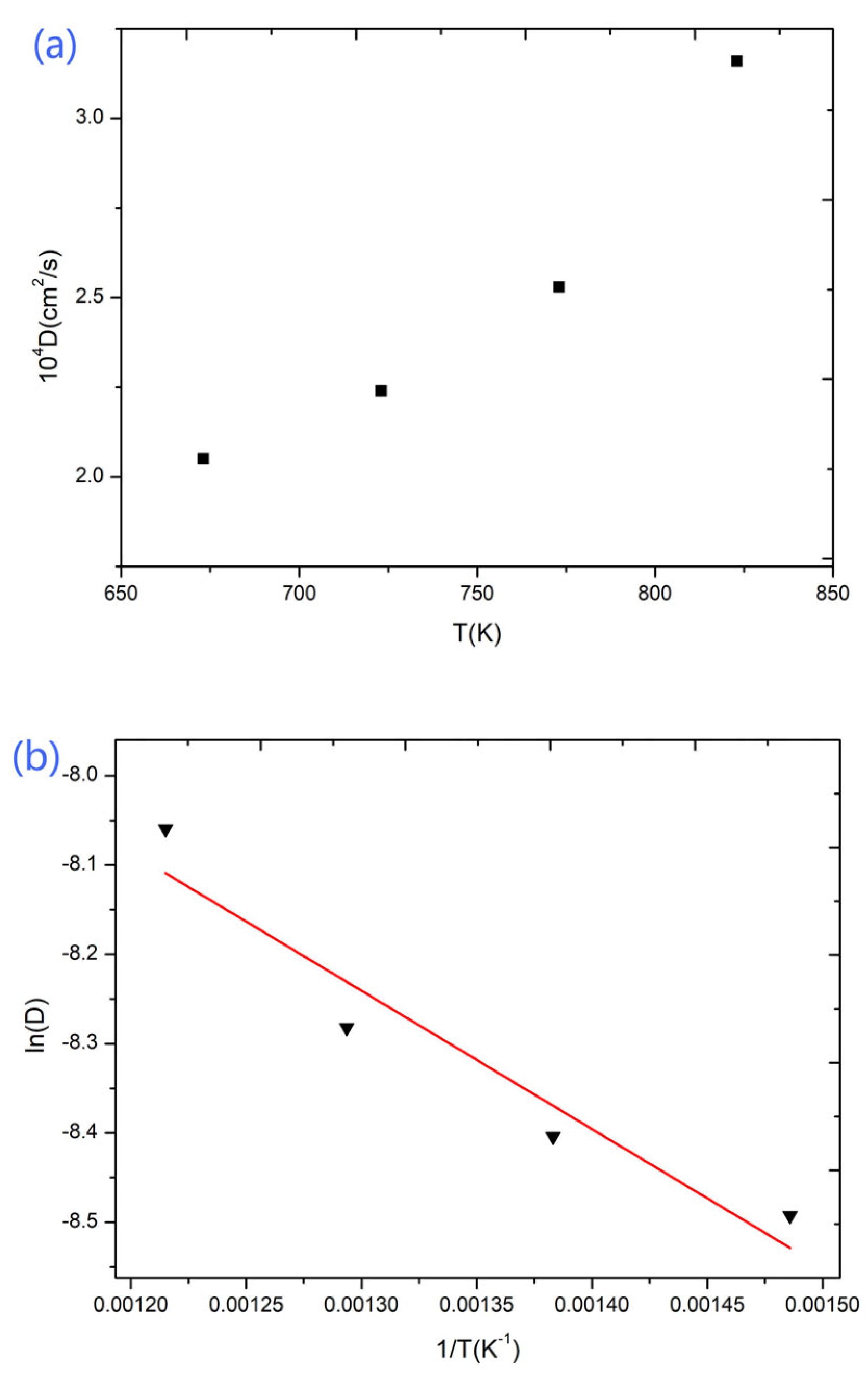
Using this approach, Liu et al. [153] systematically measured the chemical diffusion coefficients of uranium in liquid gallium over the temperature range of 673–873 K. As shown in Figure 8a, prior to reaching the saturation solubility of uranium in liquid gallium, the diffusion coefficients are on the order of 10−4 cm2·s−1 and exhibit an overall increasing trend with increasing temperature. The average diffusion coefficients at 673 K, 773 K, 823 K, and 873 K are approximately 2.05 × 10⁻⁴, 2.24 × 10⁻⁴, 2.53 × 10⁻⁴, and 3.16 × 10⁻⁴ cm2·s−1, respectively, indicating a pronounced thermally activated behavior. By plotting the natural logarithm of the diffusion coefficient against the reciprocal of temperature in Figure 8b, the authors confirmed that uranium diffusion in liquid gallium follows an Arrhenius relationship. Within the temperature range of 673–873 K, the temperature dependence can be expressed as
ln   D U G a = 6.90 ± 1.03 1.2 ± 0.8 × 10 3     T ,
The resulting diffusion activation energy was determined to be Eₐ = 11.0 ± 6.7 kJ·mol−1. This value is significantly lower than the diffusion activation energies typically reported for solid metals or solid alloys, indicating that uranium diffusion in liquid gallium is subject to relatively weak kinetic constraints. Such behavior is consistent with the inherently low atomic migration barriers characteristic of liquid metal systems. The low activation energy further implies that, under thermodynamically favorable conditions, mass transport of uranium in a liquid gallium cathode can proceed with a rapid kinetic response. This characteristic is advantageous for enhancing the overall rate and efficiency of electrochemical or chemical reduction–extraction processes.
From a methodological perspective, the prior investigation of the U–Ga system plays a crucial role in validating the applicability of the GITT in liquid metal environments. The established experimental framework—including optimization of pulse duration, identification of diffusion-controlled regions, and reliable extraction of Δ and ΔEs—provides a foundation for accurate diffusion measurements in other liquid alloy systems. Without this preliminary work, distinguishing between diffusion-controlled and reaction-controlled regimes in liquid cadmium systems would be considerably more challenging. The U–Ga system can serve as a reference system for parameter optimization and result interpretation. By further combining the intrinsic differences in the physicochemical properties of liquid metal systems, this method can be applied to the measurement and investigation of diffusion mass transfer processes in other liquid alloy systems.
In recent years, electrochemical techniques have become increasingly important for determining diffusion coefficients in liquid metal systems, particularly in studies related to molten salt electrorefining and pyroprocessing. Traditional approaches, such as the capillary method and radioactive tracer techniques, have historically provided reliable diffusion data and remain important for fundamental investigations of liquid alloy diffusion. However, the application of capillary methods to actinide-containing systems is limited by experimental complexity, including high-temperature operation, long diffusion times, and the requirement for post-experiment sampling and chemical analysis, which can be particularly challenging for radioactive materials [154]. Electrochemical methods, such as chronopotentiometry and the galvanostatic intermittent titration technique, have therefore become increasingly attractive for investigating actinide transport in liquid metal cathodes. These techniques allow in situ determination of chemical diffusion coefficients under realistic electrorefining conditions without the need for sampling. In addition, electrochemical approaches are more compatible with experiments involving radioactive elements because measurements can be performed within sealed electrochemical cells [155]. Although the interpretation of electrochemically derived diffusion coefficients relies on certain model assumptions, these methods provide practical and efficient tools for investigating diffusion processes in liquid Cd cathodes used in molten salt electrorefining systems.
Although diffusion coefficients of metals in liquid Cd have been reported in numerous studies, a direct analytical comparison between values obtained using different experimental techniques remains relatively limited. This is primarily because only a small number of studies have investigated the diffusion of the same element under identical experimental conditions using both classical diffusion methods and electrochemical approaches. Early investigations of diffusion in liquid metal systems were mainly conducted using capillary techniques, and the studied systems typically involved transition metal alloys such as Pb–Cd [156] or Sn–Bi [105]. In contrast, more recent studies employing electrochemical techniques have largely focused on rare-earth and actinide elements in liquid Cd cathodes due to their relevance to molten salt electrorefining and pyroprocessing applications. Consequently, the overlap of target elements investigated using different experimental methods is relatively limited. Murakami et al. [137,139] measured the diffusion coefficient of U in liquid Cd electrode at 773 K to be 1.9 × 10⁻⁵ cm2 s−1 using an electrochemical method. In contrast, earlier studies employing the capillary method reported a diffusion coefficient of 1.6 × 10⁻⁵ cm2 s−1 at the same temperature [157]. These results represent one of the few cases in which data obtained using electrochemical and classical diffusion methods can be directly compared.
The interpretation of diffusion coefficients obtained from these experimental methods requires careful consideration of the underlying diffusion model. Many analyses assume semi-infinite Fickian diffusion, which is generally valid at relatively low solute concentrations where the liquid alloy behaves approximately as an ideal solution. At higher solute concentrations, particularly near the solubility limit or in regions where intermetallic compounds may form, the diffusion process may deviate from simple Fickian behavior. In such cases, thermodynamic interactions and possible phase transformations can significantly influence the effective diffusion coefficient. Therefore, diffusion data obtained at high concentrations should be interpreted with caution and may require thermodynamic corrections or the application of more advanced diffusion models [158,159,160].

4. Conclusions

This paper systematically reviews recent research progress on the physical state and mass transport behavior of metals in liquid cadmium cathode systems. It focuses on the mechanisms of metal dissolution, alloy formation, and precipitation in liquid Cd, clarifies the characteristics of diffusion-dominated mass transfer processes, and summarizes the principal experimental techniques and theoretical models used to study this system.
The thermodynamic properties of M–Cd alloy systems play a fundamental role in determining the behavior of metals in liquid Cd cathodes. Phase equilibria and alloy thermodynamics govern both the solubility limits of metals and the formation of intermetallic compounds such as MCd6 and MCd11. These thermodynamic factors strongly influence metal accumulation behavior and ultimately determine the cathode loading capacity during electrorefining.
Mass transport processes within liquid Cd cathodes are predominantly controlled by diffusion under typical electrorefining conditions. Reported diffusion coefficients for actinides and rare-earth elements in liquid Cd generally fall within the range of 10−6–10−5 cm2 s−1 at temperatures between 723 and 823 K, indicating relatively high atomic mobility in the liquid metal phase. Experimental techniques such as capillary methods and electrochemical measurements provide complementary insights into diffusion behavior, although measurement methodologies, experimental conditions, and thermodynamic interactions can lead to variations in reported values.
In large-scale electrorefining systems, natural convection driven by temperature gradients, density differences, and electrochemical reactions may significantly influence mass transport within the liquid cathode. Moreover, long-term operation can lead to the gradual accumulation of actinides and rare-earth elements, potentially resulting in intermetallic phase formation that affects both cathode loading capacity and mass transport behavior. Safety and environmental considerations associated with cadmium handling, including its toxicity and relatively high vapor pressure at elevated temperatures, must also be carefully managed in industrial applications. Therefore, integrating thermodynamic understanding with transport modeling and engineering design considerations will be essential for the reliable deployment of liquid Cd cathodes in future pyroprocessing technologies.
Overall, the behavior of metals in liquid Cd cathodes is governed by the coupled effects of thermodynamic phase stability and atomic diffusion kinetics in liquid alloys. Future research should focus on systematic studies of multicomponent Cd alloy systems, the integration of thermodynamic modeling with kinetic transport analysis, and the application of advanced in situ characterization techniques and atomistic simulations. These efforts will help clarify the intrinsic relationships among alloy structure evolution, interfacial reactions, and mass transfer processes, thereby providing stronger scientific support for the engineering application of liquid metal cathodes in advanced nuclear fuel cycle technologies.

Author Contributions

Investigation, Writing—original draft, Y.W.; formal analysis, Y.J.; resources, investigation, Y.X.; Data curation, B.Y.; project administration, Supervision, writing—review and editing, H.H. All authors have read and agreed to the published version of the manuscript.

Funding

This research received no external funding.

Data Availability Statement

No new data were created or analyzed in this study.

Conflicts of Interest

The authors declare no conflicts of interest.

References

  1. Kim, H.; Boysen, D.A.; Newhouse, J.M.; Spatocco, B.L.; Chung, B.; Burke, P.J.; Bradwell, D.J.; Jiang, K.; Tomaszowska, A.A.; Wang, K. Liquid metal batteries: Past, present, and future. Chem. Rev. 2013, 113, 2075–2099. [Google Scholar] [PubMed]
  2. Li, H.; Yin, H.; Wang, K.; Cheng, S.; Jiang, K.; Sadoway, D.R. Liquid metal electrodes for energy storage batteries. Adv. Energy Mater. 2016, 6, 1600483. [Google Scholar] [CrossRef]
  3. Lin, R.; He, H.; Tang, H.; Ye, G. Progress and development of dry reprocessing technology of spent fuel in China. At. Energy Sci. Technol. 2020, 54, 115–125. [Google Scholar]
  4. Wang, J.; Wu, P.; Zhou, W.; Chen, Y.; Hou, L.; Ma, J. Research progress in pyrochemical reprocessing of spent nuclear fuel. Transit. Met. Chem. 2025, 50, 813–827. [Google Scholar] [CrossRef]
  5. Schmieder, H.; Galla, U. Electrochemical processes for nuclear fuel reprocessing. J. Appl. Electrochem. 2000, 30, 201–207. [Google Scholar] [CrossRef]
  6. Paviet-Hartmann, P.; Benedict, B.; Lineberry, M.J. Nuclear fuel reprocessing. In Nuclear Engineering Handbook; CRC Press: Boca Raton, FL, USA, 2009; pp. 333–384. [Google Scholar]
  7. Fredrickson, G.L.; Yoo, T.-S. Nuclear Fuels and Reprocessing Technologies: A US Perspective; U.S. Department of Energy Office of Scientific and Technical Information: Oak Ridge, TN, USA, 2021. [Google Scholar]
  8. Natarajan, R. Reprocessing of spent nuclear fuel in India: Present challenges and future programme. Prog. Nucl. Energy 2017, 101, 118–132. [Google Scholar] [CrossRef]
  9. Mirza, M.; Abdulaziz, R.; Maskell, W.C.; Wilcock, S.; Jones, A.H.; Woodall, S.; Jackson, A.; Shearing, P.R.; Brett, D.J. Electrochemical processing in molten salts—A nuclear perspective. Energy Environ. Sci. 2023, 16, 952–982. [Google Scholar]
  10. Fredrickson, G.L.; Yoo, T.-S. Engineering Scale Pyroprocessing Activities in the United States; Idaho National Laboratory (INL): Idaho Falls, ID, USA, 2023. [Google Scholar]
  11. Vaden, D.; Li, S.; Westphal, B.; Davies, K.; Johnson, T.; Pace, D. Engineering-scale liquid cadmium cathode experiments. Nucl. Technol. 2008, 162, 124–128. [Google Scholar] [CrossRef]
  12. Solbrig, C.; Westphal, B.; Johnson, T.; Li, S.; Marsden, K.; Goff, K. Pyroprocessing Progress at Idaho National Laboratory; Idaho National Laboratory (INL): Idaho Falls, ID, USA, 2007. [Google Scholar]
  13. Koyama, T.; Iizuka, M.; Shoji, Y.; Fujita, R.; Tanaka, H.; Kobayashi, T.; Tokiwai, M. An experimental study of molten salt electrorefining of uranium using solid iron cathode and liquid cadmium cathode for development of pyrometallurgical reprocessing. J. Nucl. Sci. Technol. 1997, 34, 384–393. [Google Scholar] [CrossRef]
  14. Kato, T.; Inoue, T.; Iwai, T.; Arai, Y. Separation behaviors of actinides from rare-earths in molten salt electrorefining using saturated liquid cadmium cathode. J. Nucl. Mater. 2006, 357, 105–114. [Google Scholar] [CrossRef]
  15. Iizuka, M.; Uozumi, K.; Inoue, T.; Iwai, T.; Shirai, O.; Arai, Y. Behavior of plutonium and americium at liquid cadmium cathode in molten LiCl–KCl electrolyte. J. Nucl. Mater. 2001, 299, 32–42. [Google Scholar]
  16. Uozumi, K.; Iizuka, M.; Kato, T.; Inoue, T.; Shirai, O.; Iwai, T.; Arai, Y. Electrochemical behaviors of uranium and plutonium at simultaneous recoveries into liquid cadmium cathodes. J. Nucl. Mater. 2004, 325, 34–43. [Google Scholar] [CrossRef]
  17. Kwon, S.; Kim, J.; Ahn, D.; Lee, H.; Ahn, H. A study on the evaporation of cadmium for the recovery of actinides from a liquid cathode. J. Radioanal. Nucl. Chem. 2010, 284, 143–149. [Google Scholar] [CrossRef]
  18. Wu, B.; Zhou, X.; Ding, X.; Çubuk, A.B.; Wang, Y.; Guo, S.; Lin, P. Electrochemical Drawdown of U3+ and Ce3+ in Molten LiCl-KCl Using a Liquid Cadmium Cathode. J. Electrochem. Soc. 2024, 171, 112504. [Google Scholar]
  19. Cussler, E.L. Diffusion: Mass Transfer in Fluid Systems; Cambridge University Press: Cambridge, UK, 2009. [Google Scholar]
  20. Koter, S.; Szczepański, P.; Mateescu, M.; Nechifor, G.; Badalau, L.; Koter, I. Modeling of the cadmium transport through a bulk liquid membrane. Sep. Purif. Technol. 2013, 107, 135–143. [Google Scholar] [CrossRef]
  21. Protopapas, P.; Andersen, H.C.; Parlee, N. Theory of transport in liquid metals. I. Calculation of self-diffusion coefficients. J. Chem. Phys. 1973, 59, 15–25. [Google Scholar] [CrossRef]
  22. Vrentas, J.S.; Vrentas, C.M. Diffusion and Mass Transfer; CRC Press: Boca Raton, FL, USA, 2016. [Google Scholar]
  23. Quattrini, F.; Galceran, J.; David, C.; Puy, J.; Alberti, G.; Rey-Castro, C. Dynamics of trace metal sorption by an ion-exchange chelating resin described by a mixed intraparticle/film diffusion transport model. The Cd/Chelex case. Chem. Eng. J. 2017, 317, 810–820. [Google Scholar] [CrossRef]
  24. Larsen, R. Dissolution of uranium metal and its alloys. Anal. Chem. 1959, 31, 545–549. [Google Scholar] [CrossRef]
  25. Ye, Y.; Fan, B.; Qin, Z.; Tang, X.; Feng, Y.; Lv, M.; Miao, S.; Li, H.; Chen, Y.; Chen, F. Electrochemical removal and recovery of uranium: Effects of operation conditions, mechanisms, and implications. J. Hazard. Mater. 2022, 432, 128723. [Google Scholar] [CrossRef]
  26. Hege, N.; Jackson, J.; Shafer, J. Fundamental uranium electrochemistry and spectroscopy in molten salt systems. J. Electrochem. Soc. 2023, 170, 016503. [Google Scholar] [CrossRef]
  27. Kindlimann, L.; Greene, N. Dissolution Kinetics of Nuclear Fuels 1. Uranium. Corrosion 1967, 23, 29–38. [Google Scholar] [CrossRef]
  28. Qin, A.; Wang, R.; Wang, Y.; Wang, J.; Liu, S.; Cheng, K.; Du, Y.; Sundman, B. Thermodynamic assessment of the Cd–X (X = Sn, Mn, Fe) systems. Calphad 2014, 47, 83–91. [Google Scholar] [CrossRef]
  29. Halimi, A.; Ferah, M. Thermodynamic description of the systems Cd-Te, Hg-Te and Cd-Hg-Te using the model of associated liquid solution. Int. J. Microstruct. Mater. Prop. 2008, 3, 77–85. [Google Scholar]
  30. Gokcen, N.A. Statistical Thermodynamics of Alloys; Springer Science & Business Media: Berlin/Heidelberg, Germany, 2012. [Google Scholar]
  31. Arzpeyma, G. Application of Engel-Brewer and Miedema Semi-Empirical Models Combined with Entropy Models to Thermodynamic Modeling of Binary Systems. Master’s Thesis, Concordia University, Montreal, QC, Canada, 2011. [Google Scholar]
  32. Adhikari, D.; Singh, B.; Jha, I. Energetics of Cd-based binary liquid alloys. J. Non-Cryst. Solids 2012, 358, 1362–1367. [Google Scholar]
  33. Erdem, M.; Tümen, F. A study on dissolution properties of the sludges from Cr (VI) reduction–precipitation processes. J. Environ. Sci. Health Part A 2004, 39, 253–267. [Google Scholar]
  34. Sulonen, M. Discontinuous mode of dissolution of a β phase precipitate into α Cu-Cd solid solutions. Acta Metall. 1960, 8, 669–676. [Google Scholar] [CrossRef]
  35. Samitsu, S.; Araki, J.; Kataoka, T.; Ito, K. New solvent for polyrotaxane. II. Dissolution behavior of polyrotaxane in ionic liquids and preparation of ionic liquid-containing slide-ring gels. J. Polym. Sci. Part B Polym. Phys. 2006, 44, 1985–1994. [Google Scholar] [CrossRef]
  36. Ahluwalia, R.K.; Hua, T.Q. Electrotransport of uranium from a liquid cadmium anode to a solid cathode. Nucl. Technol. 2002, 140, 41–50. [Google Scholar] [CrossRef]
  37. Kurata, M.; Sakamura, Y. Thermodynamic assessment of systems of actinide or rare earth with Cd. J. Phase Equilibria 2001, 22, 232–240. [Google Scholar] [CrossRef]
  38. Kato, T.; Iizuka, M.; Inoue, T.; Iwai, T.; Arai, Y. Distillation of cadmium from uranium–plutonium–cadmium alloy. J. Nucl. Mater. 2005, 340, 259–265. [Google Scholar]
  39. Shirai, O.; Uozumi, K.; Iwai, T.; Arai, Y. Electrode reaction of the Np3+/Np couple at liquid Cd and Bi electrodes in LiCl–KCl eutectic melts. J. Appl. Electrochem. 2004, 34, 323–330. [Google Scholar] [CrossRef]
  40. Sakamura, Y.; Shirai, O.; Iwai, T.; Suzuki, Y. Distribution behavior of plutonium and americium in LiCl–KCl eutectic/liquid cadmium systems. J. Alloys Compd. 2001, 321, 76–83. [Google Scholar]
  41. Zhang, J.; Lahti, E.A.; Zhou, W. Thermodynamic properties of actinides and rare earth fission products in liquid cadmium. J. Radioanal. Nucl. Chem. 2015, 303, 1637–1648. [Google Scholar] [CrossRef]
  42. Sakata, M.; Kurata, M.; Hijikata, T.; Inoue, T. Equilibrium distribution of rare earth elements between molten KCl-LiCl eutectic salt and liquid cadmium. J. Nucl. Mater. 1991, 185, 56–65. [Google Scholar]
  43. Vandarkuzhali, S.; Chandra, M.; Ghosh, S.; Samanta, N.; Nedumaran, S.; Reddy, B.P.; Nagarajan, K. Investigation on the electrochemical behavior of neodymium chloride at W, Al and Cd electrodes in molten LiCl-KCl eutectic. Electrochim. Acta 2014, 145, 86–98. [Google Scholar]
  44. Skołyszewska-Kühberger, B.; Reichmann, T.L.; Ipser, H. Phase equilibria in the neodymium–cadmium binary system. J. Alloys Compd. 2014, 606, 242–248. [Google Scholar][Green Version]
  45. Soon-Don, C. A thermodynamic analysis of the Cd-Zn system and calculation of the phase diagram. Calphad 1990, 14, 307–310. [Google Scholar] [CrossRef]
  46. Dutkiewicz, J.; Zabdyr, L.; Zakulski, W.; Moser, Z.; Salawa, J.; Horrocks, P.; Hayes, F.; Rand, M.H. Cd-In (cadmium-indium). J. Phase Equilibria 1992, 13, 261–269. [Google Scholar] [CrossRef]
  47. Christian, J. The Theory of Transformations in Metals and Alloys; Pergamon Press: Oxford, UK, 2002. [Google Scholar]
  48. Mehrer, H. Diffusion in Solids: Fundamentals, Methods, Materials, Diffusion-Controlled Processes; Springer: Berlin/Heidelberg, Germany, 2007. [Google Scholar]
  49. Turek, I.; Drchal, V.; Kudrnovský, J.; Sob, M.; Weinberger, P. Electronic Structure of Disordered Alloys, Surfaces and Interfaces; Springer Science & Business Media: Berlin/Heidelberg, Germany, 2013. [Google Scholar]
  50. Martin, R.M. Electronic Structure: Basic Theory and Practical Methods; Cambridge University Press: Cambridge, UK, 2020. [Google Scholar]
  51. Ferro, R.; Saccone, A. Intermetallic Chemistry; Elsevier: Amsterdam, The Netherlands, 2008; Volume 13. [Google Scholar]
  52. Mishra, R.; Dawar, R. Synthesis, Properties and Applications of Intermetallic Phases. In Handbook on Synthesis Strategies for Advanced Materials: Volume-III: Materials Specific Synthesis Strategies; Springer: Berlin/Heidelberg, Germany, 2021; pp. 741–784. [Google Scholar]
  53. Ikeuba, A.I.; Njoku, C.N.; Ekerenam, O.O.; Njoku, D.I.; Udoh, I.I.; Daniel, E.F.; Uzoma, P.C.; Etim, I.-I.N.; Okonkwo, B.O. A review of the electrochemical and galvanic corrosion behavior of important intermetallic compounds in the context of aluminum alloys. RSC Adv. 2024, 14, 31921–31953. [Google Scholar] [CrossRef]
  54. Martin, J.W.; Doherty, R.D.; Cantor, B. Stability of Microstructure in Metallic Systems; Cambridge University Press: Cambridge, UK, 1997. [Google Scholar]
  55. Faizan, M. Experimental Study and Modeling of Metal Dissolution and Intermetallic Compound Growth During Soldering. Ph.D. Thesis, University of Akron, Akron, OH, USA, 2007. [Google Scholar]
  56. Ghosh, S.; Ganesan, R.; Sridharan, R.; Gnanasekaran, T. Measurement of chemical activities of rare earths (RE: Ce, Pr, Sm and Eu) in cadmium alloy. J. Nucl. Mater. 2015, 467, 280–285. [Google Scholar] [CrossRef]
  57. Liu, J.; Huang, X.; Du, Q.; Ouyang, L.; Xiao, J.; Li, Y. Critical systematic investigation of the Cd–Ce system: Phase stability and Gibbs energies of formation and equilibria via thermodynamic description. Int. J. Mater. Res. 2023, 114, 1101–1110. [Google Scholar] [CrossRef]
  58. Gschneidner, K.; Calderwood, F. The Cd− Nd (Cadmium-Neodymium) system. J. Phase Equilibria 1988, 9, 128–130. [Google Scholar] [CrossRef]
  59. Qureshi, A.M.; Naz, S.; Athar, M.; Ali, M.; Rauf, A.; Sharif, A.; Ahmed, E.; Ashiq, M.N. Manganese doped Sm–Cd nanoalloys–their synthesis, characterisation and evaluation of electrical properties. J. Alloys Compd. 2016, 662, 593–597. [Google Scholar] [CrossRef]
  60. Kurata, M.; Uozumi, K.; Kato, T.; Iizuka, M. Thermodynamic evaluation of liquid Cd cathode containing U and Pu. J. Nucl. Sci. Technol. 2009, 46, 1070–1075. [Google Scholar] [CrossRef]
  61. Roy, J.; Grantham, L.; Grimmett, D.; Fusselman, S.; Krueger, C.; Storvick, T.; Inoue, T.; Sakamura, Y.; Takahashi, N. Thermodynamic properties of U, Np, Pu, and Am in molten LiCl-KCl eutectic and liquid cadmium. J. Electrochem. Soc. 1996, 143, 2487. [Google Scholar] [CrossRef]
  62. Fredrickson, G.L.; Yoo, T.-S. Liquid cadmium cathode performance model based on the equilibrium behaviors of U and Pu in molten LiCl–KCl/Cd system at 500 °C. J. Nucl. Mater. 2020, 528, 151883. [Google Scholar] [CrossRef]
  63. Iizuka, M.; Uozumi, K.; Inoue, T.; Iwai, T.; Shirai, O.; Arai, Y. Development of plutonium recovery process by molten salt electrorefining with liquid cadmium cathode. In Proceedings of the 6th Information Exchange Meeting on Actinide and Fission Product P&T, Madrid, Spain, 11–13 December 2000. [Google Scholar]
  64. Huang, Y.; Lu, Y.; He, Q.; Wang, Y.; Fang, W.; Liu, X.; Jia, J.; Wang, C. Thermodynamic assessment of the Be–Pu and Cd–Pu systems. Calphad 2016, 52, 120–124. [Google Scholar] [CrossRef]
  65. Paek, S.; Kim, S.-H.; Yoon, D.-S.; Lee, H.; Ahn, D.-H. Performance of the mesh-type liquid cadmium cathode structure for the electrodeposition of uranium from the molten salt. Radiochim. Acta 2010, 98, 779–783. [Google Scholar] [CrossRef]
  66. Battezzati, L.; Greer, A.L. The viscosity of liquid metals and alloys. Acta Metall. 1989, 37, 1791–1802. [Google Scholar] [CrossRef]
  67. Koirala, R.; Singh, B.; Jha, I.; Adhikari, D. Thermodynamic, structural and surface properties of liquid Cd–Zn alloys. J. Mol. Liq. 2013, 179, 60–66. [Google Scholar] [CrossRef]
  68. Moser, Z.; Fecht, H. Heat Capacity Measurements of Liquid Cd-Ga Alloys. Int. J. Mater. Res. 1986, 77, 377–379. [Google Scholar] [CrossRef]
  69. Chauhan, P.; Sharma, R.; Nehra, S.; Sharma, H.S.; Kumar, D. Advanced Materials for nickel-cadmium batteries. In Advanced Materials for Batteries; CRC Press: Boca Raton, FL, USA, 2024; pp. 317–335. [Google Scholar]
  70. Azza, H.; Selhaoui, N.; Bouirden, L. Thermodynamic Description of the Cadmium-Nickel System. IJARPS 2018, 5, 17–23. [Google Scholar]
  71. Han, J.-H.; Oda, T. Chemical states of 3d transition metal impurities in a liquid lead–bismuth eutectic analyzed using first principles calculations. Phys. Chem. Chem. Phys. 2017, 19, 9945–9956. [Google Scholar] [CrossRef]
  72. Daeneke, T.; Khoshmanesh, K.; Mahmood, N.; De Castro, I.A.; Esrafilzadeh, D.; Barrow, S.J.; Dickey, M.D.; Kalantar-Zadeh, K. Liquid metals: Fundamentals and applications in chemistry. Chem. Soc. Rev. 2018, 47, 4073–4111. [Google Scholar] [CrossRef]
  73. Kleppa, O. Thermodynamic analysis of binary liquid alloys of group II B metals—II The alloys of cadmium with gallium, indium, tin, thallium, lead and bismuth. Acta Metall. 1958, 6, 233–242. [Google Scholar] [CrossRef]
  74. Johnson, I.; Yonco, R.M. Thermodynamics of cadmium-and zinc-rich alloys in the Cd−La, Cd−Ce, Cd−Pr, Zn−La, Zn−Ce and Zn−Pr systems. Metall. Trans. 1970, 1, 905–910. [Google Scholar] [CrossRef]
  75. Hafner, J. Structure and thermodynamics of liquid metals and alloys. Phys. Rev. A 1977, 16, 351. [Google Scholar] [CrossRef]
  76. Chasanov, M.; Hunt, P.; Johnson, I.; Feder, H. Solubility of 3-d transition metals in liquid cadmium. Trans. Met. Soc. AIME 1962, 22, 4784949. [Google Scholar]
  77. Kerridge, D. The solubility of metals in liquid metals. J. Nucl. Energy Part B React. Technol. 1961, 1, 215–220. [Google Scholar] [CrossRef]
  78. Crawley, A. Densities and viscosities of some liquid alloys of zinc and cadmium. Metall. Trans. 1972, 3, 971–975. [Google Scholar] [CrossRef]
  79. Shunk, F.; Nash, P. The Cd− Ni (Cadmium-Nickel) system. J. Phase Equilibria 1987, 8, 122–124. [Google Scholar] [CrossRef]
  80. Pugachev, V.; Zakharov, Y.A.; Valnyukova, A.; Popova, A.; Khitsova, L.; Yashnik, S.; Ismagilov, Z. Phase transformations in Cd–Ni nanostructured system at elevated temperatures. Russ. Chem. Bull. 2019, 68, 17–23. [Google Scholar] [CrossRef]
  81. Jia, Y.; Chang, S.; Du, X.; Guo, S. Corrosion performance of commercial alloys and refractory metals in conditions for electrorefining of spent nuclear fuels. Crystals 2023, 13, 817. [Google Scholar] [CrossRef]
  82. Personnettaz, P. Simulations of Mass Transport in Liquid Metal Electrodes. Ph.D. Thesis, Technische Universität Dresden, Dresden, Germany, 2022. [Google Scholar]
  83. Monchoux, J.-P. Mass transport driving forces under electric current in the liquid Sn-Zn system. Scr. Mater. 2025, 255, 116349. [Google Scholar]
  84. Kumar, S.; Kumar, P.; Pratap, R. A model for electromigration induced flow in liquid metals. J. Phys. D Appl. Phys. 2017, 50, 39LT02. [Google Scholar]
  85. Shaw, R.E.; Verhoeven, J. Convection effects during electrotransport of liquid metals. Metall. Trans. 1973, 4, 2349–2355. [Google Scholar] [CrossRef][Green Version]
  86. Fick, A. On liquid diffusion. J. Membr. Sci. 1995, 100, 33–38. [Google Scholar] [CrossRef]
  87. Serin, B.; Ellickson, R. Determination of diffusion coefficients. J. Chem. Phys. 1941, 9, 742–747. [Google Scholar] [CrossRef]
  88. Guenneau, S.; Puvirajesinghe, T. Fick’s second law transformed: One path to cloaking in mass diffusion. J. R. Soc. Interface 2013, 10, 20130106. [Google Scholar] [CrossRef]
  89. Darken, L.S. Diffusion, mobility and their interrelation through free energy in binary metallic systems. Trans. AIME 1948, 175, 184–201. [Google Scholar]
  90. Huang, Y.; Chen, H.; Li, D.; Zhou, R.; Zhang, B. The relationship between inter-diffusion and self-diffusion of different liquid metals studied by molecular dynamics simulations. Phys. B Condens. Matter 2022, 638, 413844. [Google Scholar] [CrossRef]
  91. Krishna, R.; Wesselingh, J.A. The Maxwell-Stefan approach to mass transfer. Chem. Eng. Sci. 1997, 52, 861–911. [Google Scholar] [CrossRef]
  92. Van den Broeke, L.; Krishna, R. Experimental verification of the Maxwell-Stefan theory for micropore diffusion. Chem. Eng. Sci. 1995, 50, 2507–2522. [Google Scholar] [CrossRef]
  93. Rudd, R.E.; Cabot, W.H.; Caspersen, K.J.; Greenough, J.A.; Richards, D.F.; Streitz, F.H.; Miller, P.L. Self-diffusivity and interdiffusivity of molten aluminum-copper alloys under pressure, derived from molecular dynamics. Phys. Rev. E Stat. Nonlinear Soft Matter Phys. 2012, 85, 031202. [Google Scholar] [CrossRef] [PubMed]
  94. Li, S.X.; Herrmann, S.D.; Simpson, M.F. Experimental Investigations into U/TRU Recovery Using a Liquid Cadmium Cathode and Salt Containing High Rare Earth Concentrations; Idaho National Laboratory (INL): Idaho Falls, ID, USA, 2009. [Google Scholar]
  95. Jung, C.-Y.; Jeong, H.; Yeon, J.-W.; Bae, S.-E. Direct electrochemical separation of uranium and lanthanides (Nd, Ce, La) from LiCl-KCl molten salt by bismuth and cadmium liquid metal electrodes. Sep. Purif. Technol. 2025, 380, 135382. [Google Scholar] [CrossRef]
  96. Ju, Y.-Y.; Zhang, Q.-M.; Gong, Z.-Z.; Ji, G.-F. Molecular dynamics simulation of self-diffusion coefficients for liquid metals. Chin. Phys. B 2013, 22, 083101. [Google Scholar] [CrossRef]
  97. Lü, Y.; Cheng, H.; Chen, M. A molecular dynamics examination of the relationship between self-diffusion and viscosity in liquid metals. J. Chem. Phys. 2012, 136, 214505. [Google Scholar] [CrossRef]
  98. Gao, Y.; Takahashi, M.; Cavallotti, C.; Raos, G. Molecular dynamics simulation of metallic impurity diffusion in liquid lead-bismuth eutectic (LBE). J. Nucl. Mater. 2018, 501, 253–260. [Google Scholar] [CrossRef]
  99. Shiinoki, M.; Hirata, A.; Suzuki, S. Molecular Dynamics Simulation of Diffusion Behavior in Liquid Sn and Pb. Metall. Mater. Trans. B 2024, 55, 278–286. [Google Scholar] [CrossRef]
  100. Shiinoki, M.; Hashimoto, N.; Fukuda, H.; Ando, Y.; Suzuki, S. Self-diffusion measurements of liquid Sn using the shear cell technique and stable density layering. Metall. Mater. Trans. B 2018, 49, 3357–3366. [Google Scholar] [CrossRef]
  101. Suzuki, S.; Kraatz, K.-H.; Frohberg, G.; Roşu-Pflumm, R.; Müller-Vogt, G. Impurity diffusion measurements of Bi in liquid Sn using stable density layering and the shear cell technique. J. Non-Cryst. Solids 2007, 353, 3300–3304. [Google Scholar] [CrossRef]
  102. Yamada, N.; Suzuki, S.; Suzuki, K.; Tanaka, A.; Morita, R.; Che, C.; Frohberg, G. Investigation of the influence of different solute on Impurity Diffusion in Liquid Sn using the Shear cell technique. Int. J. Microgravity Sci. Appl. 2018, 35, 350402. [Google Scholar]
  103. Suzuki, S.; Kraatz, K.-H.; Frohberg, G. Diffusion experiments in liquid Sn-Bi and Al-Ni systems with a stable density layering using the FOTON shear cell under 1g conditions. Microgravity-Sci. Technol. 2005, 16, 120–126. [Google Scholar] [CrossRef]
  104. Verhoeven, J.; Gibson, E.; Griffith, R. Measurement of liquid metal diffusion coefficients from steady-state solidification experiments. Metall. Trans. B 1975, 6, 475–480. [Google Scholar] [CrossRef]
  105. Porth, C.; Cahoon, J. Interdiffusion of Bi in liquid Sn. J. Phase Equilibria Diffus. 2010, 31, 149–156. [Google Scholar] [CrossRef]
  106. Nowok, J.W. Analysis of atomic diffusion in liquid metals at melting temperatures in capillary-like media. Acta Metall. Mater. 1994, 42, 4025–4028. [Google Scholar] [CrossRef]
  107. Kargl, F.; Engelhardt, M.; Yang, F.; Weis, H.; Schmakat, P.; Schillinger, B.; Griesche, A.; Meyer, A. In situ studies of mass transport in liquid alloys by means of neutron radiography. J. Phys. Condens. Matter 2011, 23, 254201. [Google Scholar] [CrossRef]
  108. Egelstaff, P.A. Neutron scattering studies of liquid diffusion. Adv. Phys. 1962, 11, 203–232. [Google Scholar] [CrossRef]
  109. Springer, T.; Lechner, R.E. Diffusion studies of solids by quasielastic neutron scattering. In Diffusion in Condensed Matter: Methods, Materials, Models; Springer: Berlin/Heidelberg, Germany, 2005; pp. 93–164. [Google Scholar]
  110. Venkatesan, T.; Edelson, D.; Brown, W. Pulsed ion beam technique for measuring diffusion coefficient of a slow diffusant in polymers. Appl. Phys. Lett. 1983, 43, 364–366. [Google Scholar] [CrossRef]
  111. Rej, D.; Davis, H.; Olson, J.; Remnev, G.; Zakoutaev, A.; Ryzhkov, V.; Struts, V.; Isakov, I.; Shulov, V.; Nochevnaya, N. Materials processing with intense pulsed ion beams. J. Vac. Sci. Technol. A Vac. Surf. Film. 1997, 15, 1089–1097. [Google Scholar] [CrossRef]
  112. Barriga, S.A. An Electrochemical Investigation of the Chemical Diffusivity in Liquid Metal Alloys. Ph.D. Thesis, Massachusetts Institute of Technology, Cambridge, MA, USA, 2013. [Google Scholar]
  113. McCue, I.; Karma, A.; Erlebacher, J. Pattern formation during electrochemical and liquid metal dealloying. Mrs Bull. 2018, 43, 27–34. [Google Scholar] [CrossRef]
  114. Wen, C.; Ho, C.; Boukamp, B.; Raistrick, I.; Weppner, W.; Huggins, R. Use of electrochemical methods to determine chemical-diffusion coefficients in alloys: Application to ‘LiAI’. Int. Met. Rev. 1981, 26, 253–268. [Google Scholar] [CrossRef]
  115. Anderson, J.S.; Saddington, K. S 80. The use of radioactive isotopes in the study of the diffusion of ions in solution. J. Chem. Soc. (Resumed) 1949, S381–S386. [Google Scholar] [CrossRef]
  116. Geng, Y.; Zhu, C.; Zhang, B. A sliding cell technique for diffusion measurements in liquid metals. AIP Adv. 2014, 4, 037102. [Google Scholar] [CrossRef]
  117. Krishnamurthi, V.; Parker, C.J.; Nguyen, C.K.; Vaillant, P.H.; Hocking, R.K.; Haas, B.; Christofferson, A.J.; Russo, S.P.; Chiang, K.; Elbourne, A. A toolbox for investigating liquid metal systems. Cell Rep. Phys. Sci. 2024, 5, 101820. [Google Scholar] [CrossRef]
  118. Zhmud, B.; Tiberg, F.; Hallstensson, K. Dynamics of capillary rise. J. Colloid Interface Sci. 2000, 228, 263–269. [Google Scholar] [CrossRef]
  119. Chang, I.; Cai, Q. From simple binary to complex multicomponent eutectic alloys. Prog. Mater. Sci. 2022, 123, 100779. [Google Scholar] [CrossRef]
  120. Shu, J.; Lu, Y.; Wang, E.; Li, X.; Tang, S.-Y.; Zhao, S.; Zhou, X.; Sun, L.; Li, W.; Zhang, S. Particle-based porous materials for the rapid and spontaneous diffusion of liquid metals. ACS Appl. Mater. Interfaces 2020, 12, 11163–11170. [Google Scholar] [CrossRef] [PubMed]
  121. Cai, J.; Jin, T.; Kou, J.; Zou, S.; Xiao, J.; Meng, Q. Lucas–Washburn equation-based modeling of capillary-driven flow in porous systems. Langmuir 2021, 37, 1623–1636. [Google Scholar] [CrossRef]
  122. Porth, C.B. An Investigation of the Concentration Dependence of the Interdiffusion Coefficient in the Binary Liquid Aluminum-copper System. Ph.D. Thesis, University of Manitoba, Winnipeg, MB, Canada, 2016. [Google Scholar]
  123. Mirshamsi, M. Diffusion Phenomena in the Liquid Cadmium-Lead Binary System. Ph.D. Thesis, The University of Oklahoma, Norman, OK, USA, 1964. [Google Scholar]
  124. Trimble, L.; Pieper, W.; Canfield, F. Diffusion in liquid mixtures of cadmium and lead at 350 °C. Metall. Trans. 1971, 2, 1669–1673. [Google Scholar] [CrossRef]
  125. Niwa, K.; Kado, S.; Ohno, T. Diffusion of silver in molten copper and copper-silver alloy. Jpn. Inst. Met. Mater. 1962, 26, 726–730. [Google Scholar][Green Version]
  126. Porth, C.B. Interdiffusion of Bismuth and Zinc in Liquid Tin & the Effect of Capillary Diameter on the Diffusion Coefficient. Master’s Thesis, University of Manitoba, Winnipeg, MB, Canada, 2008. [Google Scholar]
  127. Robert, J. DüTusion Molten Metals Metailoids. Master’s Thesis, Queen’s University, Kingston, ON, Canada, 1999. [Google Scholar]
  128. Luk, C.; Nanis, L.; Litt, M. Improved Capillary Method for Diffusivity Measurements. Ind. Eng. Chem. Fundam. 1975, 14, 92–95. [Google Scholar] [CrossRef]
  129. Kurtuldu, G.; Jarry, P.; Rappaz, M. Influence of icosahedral short range order on diffusion in liquids: A study on Al-Zn-Cr alloys. Acta Mater. 2016, 115, 423–433. [Google Scholar] [CrossRef]
  130. Shirakata, K.; Yamamoto, T.; Takeda, T.; Unesaki, H. An improved cell calculation method for liquid-metal fast breeder reactor blanket analysis. Nucl. Sci. Eng. 1988, 98, 118–127. [Google Scholar] [CrossRef]
  131. Delgado, H.E.; Brown, G.H.; Bartels, D.M.; Rumbach, P.; Go, D.B. The scaling of kinetic and transport behaviors in the solution-phase chemistry of a plasma–liquid interface. J. Appl. Phys. 2021, 129, 083303. [Google Scholar] [CrossRef]
  132. Sanders, P.; Aziz, M. Self-diffusivity of liquid silicon measured by pulsed laser melting. J. Appl. Phys. 1999, 86, 4258–4261. [Google Scholar] [CrossRef]
  133. Heshmatpour, B.; Stevenson, D. An electrochemical study of the solubility and diffusivity of oxygen in the respective liquid metals indium, gallium, antimony and bismuth. J. Electroanal. Chem. Interfacial Electrochem. 1981, 130, 47–55. [Google Scholar]
  134. Chou, H.; Chow, T.; Tsay, S.; Chen, H. Diffusivity of oxygen in liquid Sn and Ba0.35Cu0.65 alloys. J. Electrochem. Soc. 1995, 142, 1814. [Google Scholar] [CrossRef]
  135. Ganesan, R.; Gnanasekaran, T.; Srinivasa, R.S. Diffusivity, activity and solubility of oxygen in liquid lead and lead–bismuth eutectic alloy by electrochemical methods. J. Nucl. Mater. 2006, 349, 133–149. [Google Scholar] [CrossRef]
  136. Sears, B.; Anderson, T.; Narayanan, R.; Fripp, A. The detection of solutal convection during electrochemical measurement of the oxygen diffusivity in liquid tin. Metall. Trans. B 1993, 24, 91–100. [Google Scholar] [CrossRef]
  137. Murakami, T.; Koyama, T. Application of electrochemical method to measure diffusion coefficient in liquid metal. J. Electrochem. Soc. 2011, 158, F147. [Google Scholar] [CrossRef]
  138. Novoselova, A.; Smolenski, V.; Mushnikov, P. Electrochemistry of uranium on liquid cadmium electrode in LiCl-KCl eutectic. J. Electrochem. Soc. 2024, 171, 042504. [Google Scholar] [CrossRef]
  139. Murakami, T.; Sakamura, Y.; Akiyama, N.; Kitawaki, S.; Nakayoshi, A.; Koyama, T. Electrochemical measurement of diffusion coefficient of actinides and rare earths in liquid Cd. Procedia Chem. 2012, 7, 798–803. [Google Scholar] [CrossRef]
  140. Yoon, D.; Phongikaroon, S.; Zhang, J. Electrochemical and thermodynamic properties of CeCl3 on liquid cadmium cathode (LCC) in LiCl-KCl eutectic salt. J. Electrochem. Soc. 2016, 163, E97–E103. [Google Scholar] [CrossRef]
  141. Weppner, W.; Huggins, R.A. Determination of the kinetic parameters of mixed-conducting electrodes and application to the system Li3Sb. J. Electrochem. Soc. 1977, 124, 1569. [Google Scholar] [CrossRef]
  142. Kim, J.; Park, S.; Hwang, S.; Yoon, W.-S. Principles and applications of galvanostatic intermittent titration technique for lithium-ion batteries. J. Electrochem. Sci. Technol. 2022, 13, 19–31. [Google Scholar] [CrossRef]
  143. Wang, P.; Leong, A.; Zhang, J. Electrochemical Methods for Fundamental Data Measurements in Molten Salts: Wang, Leong, and Zhang. JOM 2023, 75, 3687–3698. [Google Scholar] [CrossRef]
  144. Williams, T.; Shum, R.; Rappleye, D. Concentration measurements in molten chloride salts using electrochemical methods. J. Electrochem. Soc. 2021, 168, 123510. [Google Scholar] [CrossRef]
  145. Yin, T.; Liu, Y.; Yang, D.; Yan, Y.; Wang, G.; Chai, Z.; Shi, W. Thermodynamics and kinetics properties of lanthanides (La, Ce, Pr, Nd) on liquid bismuth electrode in LiCl-KCl molten salt. J. Electrochem. Soc. 2020, 167, 122507. [Google Scholar] [CrossRef]
  146. Mandzyuk, V.; Ivanichok, N.Y.; Solomoskyi, R. Li-ion Diffusion in Porous Carbon Electrode Materials by GITT Method. J. Nano-Electron. Phys. 2024, 16, 02024-1–02024-4. [Google Scholar] [CrossRef]
  147. Schied, T.; Nickol, A.; Heubner, C.; Schneider, M.; Michaelis, A.; Bobeth, M.; Cuniberti, G. Determining the diffusion coefficient of lithium insertion cathodes from GITT measurements: Theoretical analysis for low temperatures. ChemPhysChem 2021, 22, 885–893. [Google Scholar] [CrossRef] [PubMed]
  148. Julien, C.; Mauger, A. Diffusion. In Rechargeable Lithium Metal Batteries: Science and Technology; Springer: Berlin/Heidelberg, Germany, 2024; pp. 1–24. [Google Scholar]
  149. Nickol, A.; Schied, T.; Heubner, C.; Schneider, M.; Michaelis, A.; Bobeth, M.; Cuniberti, G. GITT analysis of lithium insertion cathodes for determining the lithium diffusion coefficient at low temperature: Challenges and pitfalls. J. Electrochem. Soc. 2020, 167, 090546. [Google Scholar] [CrossRef]
  150. Horner, J.S.; Whang, G.; Ashby, D.S.; Kolesnichenko, I.V.; Lambert, T.N.; Dunn, B.S.; Talin, A.A.; Roberts, S.A. Electrochemical modeling of GITT measurements for improved solid-state diffusion coefficient evaluation. ACS Appl. Energy Mater. 2021, 4, 11460–11469. [Google Scholar] [CrossRef]
  151. Ivanishchev, A.; Ivanishcheva, I. Ion transport in lithium electrochemical systems: Problems and solutions. Russ. J. Electrochem. 2020, 56, 907–928. [Google Scholar] [CrossRef]
  152. Nowak, A.P.; Rutecki, P.; Szkoda, M.; Trzciński, K. Determination of sodium ion diffusion coefficient in tin sulfide@ carbon anode material using GITT and EIS techniques. Energies 2024, 17, 3233. [Google Scholar] [CrossRef]
  153. Liu, K.; Gao, Y.; Fang, Z.; Zhou, X.; Ma, Y.; Wu, H.; Kang, M.; Wang, B. Determination of diffusion coefficients of uranium in liquid gallium by GITT. J. Electroanal. Chem. 2020, 879, 114711. [Google Scholar] [CrossRef]
  154. Fawcett, N.; Caton, R.D. Analysis of errors in the capillary method for determining diffusion coefficients. Anal. Chem. 1976, 48, 228–229. [Google Scholar] [CrossRef]
  155. Zoski, C.G. Handbook of Electrochemistry; Elsevier: Amsterdam, The Netherlands, 2007. [Google Scholar]
  156. Zhou, W.; Shen, Z.; Yin, X.; Zhang, Y.; Zhao, M. Effects of pressure on the eutectic or eutectoid temperatures of the CdPb, CdSn, PbSn and CdPbSn systems. J. Less Common Met. 1988, 143, 59–69. [Google Scholar] [CrossRef]
  157. Hesson, J.; Burris, L. Uranium diffusivity in liquid cadmium. Trans. AIME 1963, 227, 571–581. [Google Scholar]
  158. Carey, A.E.; Wheatcraft, S.W.; Glass, R.J.; O’Rourke, J.P. Non-Fickian ionic diffusion across high-concentration gradients. Water Resour. Res. 1995, 31, 2213–2218. [Google Scholar] [CrossRef]
  159. Goesele, U.; Laveant, P.; Scholz, R.; Engler, N.; Werner, P. Diffusion engineering by carbon in silicon. Mater. Res. Soc. Symp. 2000, 610, 711. [Google Scholar]
  160. Shampine, L. Concentration-dependent diffusion. Q. Appl. Math. 1973, 30, 441–452. [Google Scholar] [CrossRef][Green Version]
Figure 1. Schematic diagram of the electrorefining process in dry reprocessing of nuclear fuel [4,10,13].
Processes 14 00953 g001
Figure 2. Schematic diagram of metallic uranium formation and interfacial blocking at the surface of a liquid cathode.
Processes 14 00953 g002
Figure 3. Conceptual framework of metal behavior in liquid Cd cathodes.
Processes 14 00953 g003
Figure 4. Pu-Cd phase diagram. Redrawn based on data from the ASM Alloy Phase Diagram Database (ASM International, Materials Park, OH, USA).
Processes 14 00953 g004
Figure 5. Conceptual diagram of the compositional changes in Pu in liquid Cd at 773 K.
Processes 14 00953 g005
Figure 6. U-Cd phase diagram. Redrawn based on data from the ASM Alloy Phase Diagram Database (ASM International, Materials Park, OH, USA).
Processes 14 00953 g006
Figure 7. Schematic diagram of furnace and diffusion apparatus. A, salt; B, melt; C, capillary; D, insulation; E, gas outlet; F, steel vessel; G, rubber O-rings; H, brass flanges; I, graphite crucible; J, Capillary holder; K, brass container; L, glass container; M, Dresser coupling; N, control heater; O, Wilson seals; P, heating wire; Q, gas inlet and vacuum line; R (1 to 5), Chromel-Alumel thermocouple; S, temperature sensor for controller; T, mixer rod connected to constant-speed mixer.
Processes 14 00953 g007
Figure 8. (a) Diffusion coefficient (cm2·s−1) versus uranium mole fraction in liquid gallium cathode at different temperatures. (b) Verification of the Arrhenius relationship for the uranium diffusion coefficient in U-Ga alloy.
Processes 14 00953 g008
Table 2. Diffusion coefficients in some liquid metal systems measured using the capillary method.
SystemDiffusion TypeTemperature (K)Diffusion Coefficient D (m2·s−1)References
Cu → liquid AlSolute diffusion>933 K (liquid Al region)D = 1.05 (±0.15) ×10−7 exp[−(23.8 ± 1.3)/RT][122]
Cd–Pb liquid alloyChemical/mutual diffusion628–758 K(1.7–3.2) × 10−9[123]
Cd–Pb liquid alloyChemical/mutual diffusion623 K(0.2–2.0) × 10−9[124]
Ag → liquid BiSolute diffusion656–872 KD = (8.19 ± 0.79) × 10−8 exp[−(4100 ± 60)/RT] −1[125]
Ag → liquid CdSolute diffusion637–814 KD = (5.68 ± 0.90) × 10−8 exp[−(4380 ± 90)/RT] cm2·s−1[125]
Bi → liquid SnInterdiffusion773–873 KD = (11.56 ± 2.39) × 10−8 exp[−(2.29 ± 0.74)/RT][126]
Zn → liquid SnInterdiffusion773–873 KD = (1.34 ± 0.83) × 10−8 exp[−(6.86 ± 3.17)/RT][126]
Ag → liquid PbSolute diffusion583.15 K5.80 × 10−9[127]
Sb → liquid PbSolute diffusion583.15 K4.60 × 10−9[127]
Au → liquid PbSolute diffusion593.15 K2.45 × 10−9[127]
Table 3. Experimental diffusion coefficients (D) of Pr, Nd, Gd, Y, and Sc determined by chronopotentiometry.
UPuLaCePrNdGdYSc
D × 106
(cm2 s−1) for 738–743 K
17 (738 K)11 (723 K)1.9 (723 K)2.9 (723 K)3.2 (723 K)2.7 (743 K)3.2 (723 K)6.8 (743 K)6.5 (737 K)
D × 106
(cm2 s−1) for 773 K
19.9±0.7142.54.83.83.43.98.27.7
D × 106
(cm2 s−1) for 823 K
23163.4/4.33.94.39.38.0
References[138,139][139][137][140][137][137][137][137][137]
Uncertainty not reported in the original source Refs. [137,139,140].
Disclaimer/Publisher’s Note: The statements, opinions and data contained in all publications are solely those of the individual author(s) and contributor(s) and not of MDPI and/or the editor(s). MDPI and/or the editor(s) disclaim responsibility for any injury to people or property resulting from any ideas, methods, instructions or products referred to in the content.