Article

Research on High-Pressure Energy Injection and Response Mechanism in Tight Sandstone Reservoirs

1
School of Petroleum Engineering, China University of Petroleum (Beijing), Beijing 102249, China
2
State Key Laboratory of Petroleum Resources and Engineering, China University of Petroleum (Beijing), Beijing 102249, China
*
Author to whom correspondence should be addressed.
Processes 2026, 14(6), 945; https://doi.org/10.3390/pr14060945
Submission received: 10 February 2026 / Revised: 10 March 2026 / Accepted: 13 March 2026 / Published: 16 March 2026
(This article belongs to the Section Petroleum and Low-Carbon Energy Process Engineering)

Abstract

To reveal the energy transfer mechanism of water injection and the dynamic response characteristics of pore pressure in tight sandstone reservoirs, and to clarify the influence of lithology, injection pressure, and injection method on the energy enhancement effect of water injection, a high-pressure energy injection and response testing system and nuclear magnetic resonance (NMR) testing technology were used to conduct systematic water injection energy enhancement experiments on three rock types: mudstone, sandstone, and naturally fractured sandstone. Combined with pressure dynamic monitoring and pore structure evolution analysis, the pressure response characteristics and energy enhancement mechanism of rock samples under different experimental conditions were explored. The experimental results showed that the NMR T2 distribution of the three rock samples exhibited bimodal characteristics, corresponding to small pores (pore size < 1000 nm) and large pores/microcracks (pore size > 1000 nm), respectively. There were significant lithological differences in the evolution of pore structure during water injection, with a cumulative decrease of 7.2% in the proportion of large pores in mudstone and an increase of 9.3% in the proportion of large pores in sandstone with natural fracture development. There is a positive correlation between injection pressure and the energy enhancement effect. Under an injection pressure of 40 MPa, the pressure increment at the outlet end of sandstone with natural fracture development reaches 8.06 MPa, and the energy enhancement effect is 24% higher than that under the 30 MPa working condition, while the mudstone only increases by 15%. The energy enhancement effect of intermittent water injection is significantly better than that of depleted water injection, and the energy enhancement effects of the three rock samples are increased by 18.6%, 12.0%, and 6.9%, respectively. Overall, sandstone with natural fractures has the best energy enhancement effect, followed by sandstone, and mudstone has the worst. The connectivity of pores and the degree of fracture development are the core factors that dominate the water injection energy enhancement effect and pressure transmission efficiency. The research results can provide reliable experimental basis and theoretical support for optimizing water injection development plans, improving energy efficiency, and dynamically regulating stress fields in tight sandstone reservoirs.

1. Introduction

Under the background of global energy structure transformation, efficient development of unconventional oil and gas resources has become a core strategic issue to ensure energy security. Tight sandstone reservoirs, as an important component of unconventional oil and gas, have become a key area of oil and gas exploration and development at home and abroad due to their enormous resource reserve potential [1,2,3]. Tight sandstone reservoirs are widely distributed in China, with the proportion of newly discovered reserves rising to over 60%. However, these reservoirs have typical characteristics of low porosity, low permeability, and strong heterogeneity. Uneven development of natural fractures leads to high resistance to oil and gas flow, lack of original energy in the formation, and a generally low recovery rate of 10% under conventional development models, limiting development benefits [4,5,6]. Hydraulic fracturing is a core technology for efficient development, but the low formation pressure and insufficient energy before fracturing restrict the fracturing effect. Pre-fracturing water injection and energy replenishment technology has attracted much attention due to its ability to regulate the stress field in the near wellbore area. However, there is insufficient research on the stress field response mechanism under the coupling of the full flow path, and there is an urgent need for systematic exploration to support parameter optimization [7,8]. In addition, the low porosity and low permeability characteristics of tight oil reservoirs result in extremely high water injection pressure, which not only increases the energy consumption and loss of surface equipment, but also easily causes construction accidents such as well leakage and casing deformation, further restricting the effectiveness of water injection development [9]. Therefore, to break through the bottleneck of water injection development in tight oil reservoirs, the core lies in accurately grasping the changes in formation pressure during the water injection process, especially the stress distribution and dynamic changes in the stress-sensitive area near the wellbore. Based on this, the water injection scale can be optimized to achieve on-demand water injection and precise energy replenishment, ultimately improving the economy and effectiveness of water injection development.
The production of oil wells and the injection of fluids into water injection wells cause changes in the formation pressure field. According to the principle of effective stress, the magnitude and direction of reservoir stress will change accordingly, resulting in a production-induced stress field [10]. The production-induced stress field causes changes in the permeability and porosity of reservoirs near fractures, thereby affecting the productivity of oil wells and the injection capacity of injection wells. Additionally, the production-induced stress field may lead to a shift in formation stress. After the initial fracturing of oil and gas wells, the pressure forms an elliptical distribution area around the initial fracturing fracture. Due to the change in pressure gradient around the fracture in the formation, the overall stress of the reservoir changes, and the stress decreases more in the direction parallel to the fracture than perpendicular to it. For low-permeability formations with little difference in horizontal principal stress, the induced stress change will cause a 90° reversal of the local minimum stress [11,12]. In terms of pre-pressure water injection energy replenishment technology and mechanism research, foreign scholars early-focused on conventional low-permeability reservoirs, and verified the effectiveness of pre-pressure water injection energy replenishment in improving fracturing effects through indoor and field experiments. Injecting water before fracturing can significantly increase the pore pressure of the reservoir, reduce the threshold of rock fracture pressure, and lower the pumping pressure required for fracturing by 15% to 20%. At the same time, it effectively expands the extension range of fractures and the coverage area of fracture networks [13,14]. With the iteration and upgrading of unconventional oil and gas development technology, the research focus has gradually shifted to the impact mechanism of the special permeability law of unconventional reservoirs such as tight sandstone on the energy enhancement effect. Some scholars have confirmed through high-pressure displacement experiments that tight sandstone reservoirs have significant start-up pressure gradients and stress-sensitivity effects due to their complex pore structure. The coupling effect of the two will significantly inhibit the transfer efficiency of water injection energy [15,16]. When the injection pressure is lower than the starting pressure gradient, it is difficult for water to effectively infiltrate the matrix pores, and the range of energy enhancement is limited to natural or artificial fracture areas, forming “ineffective energy replenishment” [17]. The stress-sensitivity effect can lead to dynamic changes in reservoir permeability with increasing injection pressure, further exacerbating the heterogeneity of energy transfer, ultimately resulting in a 3% to 5% increase in the decline in the crude oil recovery rate [18]. In addition, for the optimization of water injection media, a comparative study on multimedia displacement and energy enhancement technologies such as CO2, natural gas, and foam was carried out [19,20,21]. Numerous studies have confirmed that CO2 pre-energy enhancement can utilize its low viscosity and high diffusivity to quickly replenish formation energy, reduce reservoir clay swelling damage, and improve fracturing fluid flowback efficiency. However, there are problems such as low viscosity, poor sand carrying capacity, high cost, and difficult safety control, which limit its large-scale industrial application [22,23,24,25]. In contrast, water injection energy enhancement technology is more universal in field applications due to its advantages of low cost, mature process, wide sources, and high safety, and is still the mainstream technology solution for water injection energy supplementation in tight sandstone reservoirs [26,27].
A large number of scholars have made significant progress in studying the evolution mechanism of the water injection-induced stress field, especially in low-permeability reservoirs such as tight sandstone. In terms of experimental research, researchers generally use high-precision true triaxial or cubic core testing systems, combined with multi physics field in situ monitoring methods, to quantitatively characterize the dynamic coupling relationship between pore pressure diffusion and stress response during the water injection process [28,29,30]. Alam et al. (2013) conducted constant velocity water injection experiments using standard tight sandstone cores under controlled confining pressure conditions, synchronously collecting pore pressure, axial/radial strain, and acoustic emission signals, revealing the correlation between water injection leading edge advancement and local shear band formation [31]. Li et al. (2020) further introduced digital image correlation (DIC) technology to visualize the surface displacement field caused by water injection in a transparent loading device, and found a significant time lag effect in the reduction of effective stress, indicating that the fluid–solid coupling process in dense media has strong non-equilibrium characteristics [32]. Some studies have used transparent polymer models or scaled physical models of centrifuges to visually reproduce the process of crack network activation and stress path deflection, providing experimental evidence for understanding the regulatory effect of natural cracks on water injection stress disturbance [33,34]. In terms of numerical simulation, the international mainstream method is based on Biot’s theory of pore elasticity, and various fully coupled thermal fluid–solid (THM) numerical models have been developed [35]. Stella (2022) successfully simulated the effective stress redistribution caused by pore pressure diffusion during water/CO2 injection using the TOUGH-FLAC3D platform and its control effect on fault stability, emphasizing the influence of heterogeneous permeability on pressure propagation anisotropy [36]. Deng (2017) proposed a finite element-based multiphase flow hole elastic coupling algorithm, which can accurately capture the nonlinear disturbance of a local stress field caused by the movement of a water–oil two-phase interface [37]. For tight reservoirs containing natural fractures, Zhang et al. (2025) coupled the 3D-GMTSN criterion with XFEM to achieve a dynamic simulation of water injection-induced micro-seismic events and stress- shielding effects [38]. With the development of data-driven methods, Yang et al. (2026) first applied convolutional neural networks (CNN) to micro-seismic monitoring data to invert three-dimensional stress disturbance fields, significantly improving the real-time perception ability of stress evolution during water injection [39]. Most existing studies focus on single lithotype or single-factor (e.g., injection pressure) impact on water injection energy enhancement, lacking systematic comparative analysis of different lithologies. The mechanistic link between pore structure evolution and pressure response in tight sandstone reservoirs is not fully clarified. Experimental designs often ignore the consistency between experimental parameters and in situ stress regimes, reducing the engineering applicability of the results. We have also clearly located our study in the scholarly context: this study aims to fill these gaps by conducting systematic experiments on three typical lithotypes, clarifying the lithology-controlled energy transfer mechanisms, and optimizing the experimental design to align with field conditions.
In order to study the energy transfer mechanism and stress field dynamic response characteristics of water injection in the real formation of tight sandstone reservoirs, underground rock cores from the Fuyu oil reservoir in the peripheral area of the Changyuan in the Songliao Basin were selected. Three different rock types, mudstone, tight sandstone, and sandstone with natural fracture development, were drilled. Referring to the actual flow process of injected water through fractures, near fracture matrix, and remote formations on site, a high-pressure energy injection and response testing system for tight rock cores was designed. Combined with nuclear magnetic resonance testing, the influence of rock type changes, water injection pressure, and soaking time on the pore results and energy enhancement effect of the formation was studied. The research results can provide theoretical guidance and technical support for differentiated water injection optimization strategies, water injection parameter optimization, and efficient water injection development in the development process of tight sandstone reservoirs.

2. Experimental Samples and Methods

2.1. Specimen Preparation

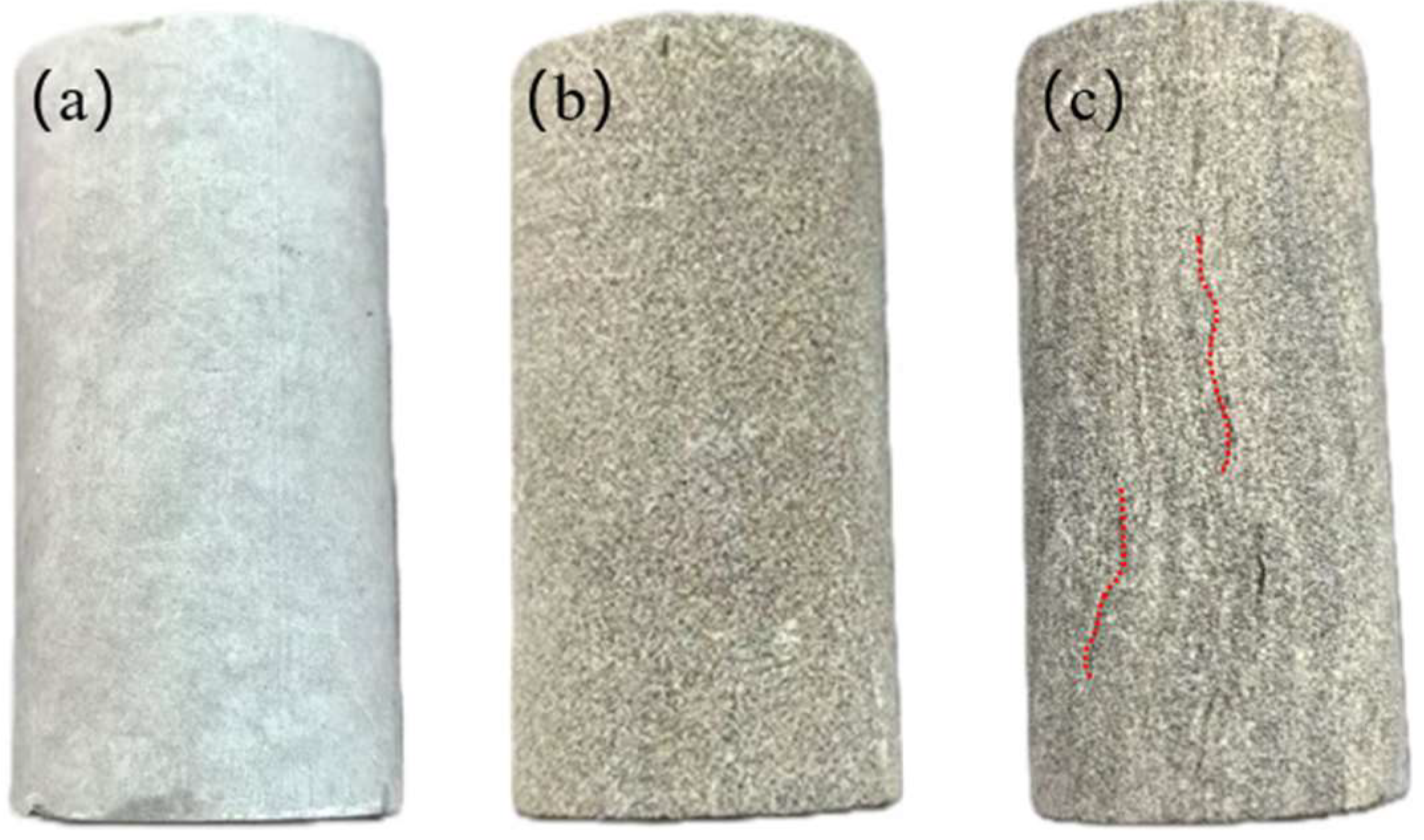
The samples used in this study were taken from underground rock cores of the tight oil reservoir in the Fuyu oil layer outside the Daqing Changyuan in the Songliao Basin of Heilongjiang Province, China. The sampling depth of the samples was 1500–1600 m, and the rock types of the samples were mudstone and tight sandstone. Some of the tight sandstone samples developed natural fractures. Drill, cut, and polish the full diameter rock blocks underground in the laboratory to produce standardized cylindrical samples with a diameter of 25 mm and a height of 50 mm (Figure 1). The locations of natural fractures in sandstone are marked with red dashed lines (Figure 1c), fracture aperture (0.15–0.25 mm), fracture orientation (nearly vertical, 85–90° with the core axis), and fracture density (2–3 fractures per cm). To avoid the influence of internal fluids on the experimental results, the prepared sample was first dried. The sandstone sample was dried in a 105 °C oven for 48 h until the quality stabilized. Then, the sample was vacuumed for 4 h using a vacuum device and immersed in distilled water for 48 h until the quality stabilized [40]. After oil washing and drying treatment, the core porosity, permeability, and average pore size were measured using helium gas testing and pulse attenuation testing, respectively. Any samples exhibiting abnormal results in rock properties were excluded from further examination. Finally, two samples each of mudstone, tight sandstone, and tight sandstone with natural fractures were tested. The basic parameters of core porosity, permeability, and average pore size are shown in Table 1. The slippery water used in the experiment is separated from the liquid extracted from the wellhead, and the liquid formula includes 0.1% drag reducing agent, 0.1% anti swelling agent, and 1% drainage aid.

2.2. High Voltage Energy Injection and Response Testing System

2.2.1. Experimental Apparatus

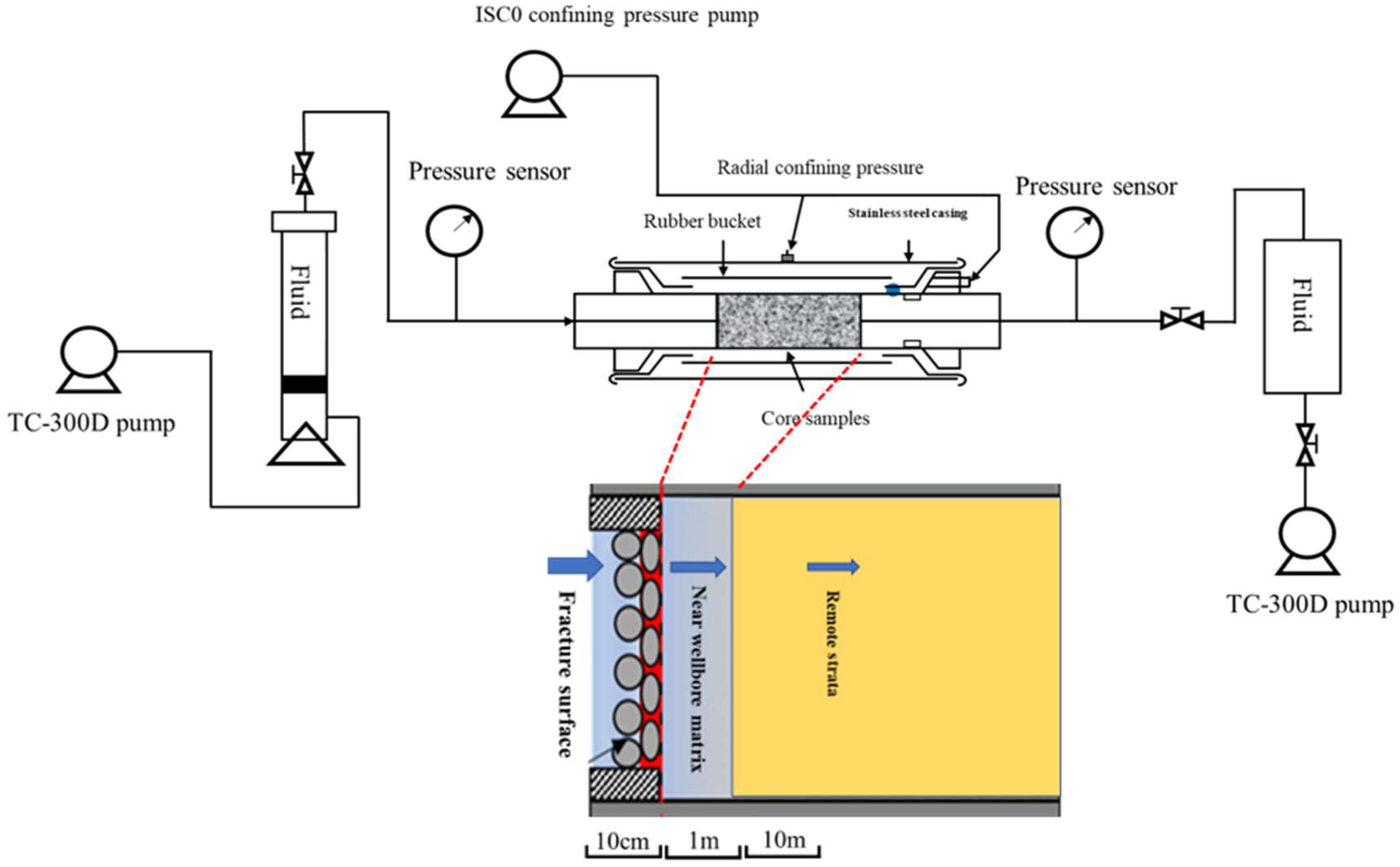
The experimental instruments include TC-300D dual cylinder constant speed and pressure pump, ZR-III high-temperature and high-pressure intermediate vessel, pressure sensor, HBQT-70 high-temperature and high-pressure multifunctional core displacement device, and ISC0 confining pressure pump, all of which are provided by Jiangsu Tuochuang Scientific Research Instrument Co., Ltd. in China (Hai’an City, Jiangsu Province). The experimental temperature was set to 50 °C, which is consistent with the actual formation temperature of the Fuyu oil reservoir (Songliao Basin, northern Daqing Changyuan) where the core samples were collected; the confining pressure was maintained at 20 MPa, corresponding to the actual in situ stress of the reservoir at the sampling depth (1500–1600 m), ensuring the consistency between experimental conditions and field geological environments. Build a high-pressure energy injection and response testing system for dense rock cores using the aforementioned instruments and equipment, as shown in Figure 2.

2.2.2. Experimental Plan and Steps

(1)
Six rock cores with a diameter of Ø 25.4 mm were subjected to oil washing treatment using the Soxhlet extraction method. The cores are now first saturated with simulated crude oil (consistent with the crude oil properties of the Fuyu oil reservoir) after vacuuming, and then the high-pressure water injection energy enhancement experiment is carried out, which is consistent with the actual process of water injection energy replenishment in oil-bearing tight sandstone reservoirs.
(2)
Measure parameters such as core height, diameter, mass, permeability, porosity, etc. The core sample in the testing system corresponds to the reservoir interval between the water injection well and the production well in the field, including the fracture zone, near-fracture matrix, and distant matrix: the natural fractured sandstone core simulates the fracture zone of the field reservoir, the ordinary sandstone core simulates the near-fracture matrix, and the mudstone core simulates the distant low-permeability matrix, which is consistent with the actual field water flow path (water flows through fractures to near-fracture matrix to distant formations).
(3)
Using the prepared simulated slippery water saturated core, assemble the instrument according to Figure 2, maintain the formation temperature and pressure conditions (temperature 50 °C, pressure 20 MPa), and drive the slickwater into the core at a constant speed until the outlet pressure of the core gripper stabilizes. The core samples were collected from the underground rock cores of the Fuyu oil reservoir in the peripheral area of the Changyuan in the Songliao Basin, with the same lithology, pore structure and mineral composition as the actual reservoir; the slickwater used in the experiment was configured in strict accordance with the field application standard of the Fuyu oil reservoir, ensuring the consistency of fluid properties. Maintain the temperature and pressure conditions and continue aging for 3000 min. The inlet end of the testing system corresponds to the field water injection wellbore, where the TC-300D dual cylinder constant speed and pressure pump simulates the high-pressure water injection process of field water injection equipment, and the injection pressure (30–40 MPa) is consistent with the actual field water injection pressure range of the Fuyu oil reservoir.
(4)
According to the experimental plan in Table 2, inject the fracturing fluid at a constant pressure into the inlet end of the rock core. When the inlet pressure reaches the preset pressure, close the injection valve and record the dynamic pressure changes of the entire rock core system in real time. The outlet end of the testing system corresponds to the field production wellbore, and the pressure monitoring at the outlet end simulates the dynamic pressure response of the distant formation in the field during water injection, which is the core index to evaluate the field water injection energy enhancement effect.
(5)
The confining pressure control module (ISC0 confining pressure pump) of the system simulates the in situ stress of the field reservoir, and the temperature control module maintains the experimental temperature consistent with the field formation temperature, further ensuring the correspondence between the experimental system and field operations. Measure the porosity and permeability of the core again after the experiment is completed.

2.3. NMR Test

This article evaluates the water content in rocks with different saturation levels using nuclear magnetic resonance technology, which enables rapid and accurate determination of the pore water content and distribution in rocks [41]. The same samples were characterized using a low field nuclear magnetic resonance core analysis system (MacroMR12-150H-I, Niumg Analytical Instrument Corp., China) before and after high-pressure injection of hydraulic fracturing fluid. The mechanism of nuclear magnetic resonance analysis involves measuring the T2 of hydrogen containing fluids in sandstone pores. Therefore, before nuclear magnetic resonance testing, the sandstone sample is completely saturated with water (hydrogen containing fluid). The T2 distribution can directly represent the pore size distribution of rock samples. The constant cutoff value of T2 corresponds to a fixed pore size, and the T2 value is positively correlated with the pore size. The relationship between pore radius and T2 can be expressed as [42]:
1 T 2 = F s ρ r
where ρ is the surface relaxivity (set to 10 nm/ms in this study); r is the radius of the pore, mm; FS is the pore shape factor (set to 2 for cylindrical pores, which is consistent with the pore shape characteristics of tight sandstone reservoirs).
The surface relaxivity ρ = 10 nm/ms is adopted based on widely accepted values for tight sandstone and mudstone in published NMR core analysis studies. Given the similar mineral composition and lithologic types in the study area, the same relativity is reasonable for comparative analysis of the three rock types. We note that slight differences in surface properties may bring minor uncertainty to absolute pore size, but the relative evolution trend remains reliable for comparative analysis. Based on the NMR T2 distribution curve, the peak area corresponding to different T2 intervals was integrated, and the proportion of pores with different sizes (small pores < 1000 nm, large pores/microcracks >1000 nm) was calculated by normalizing the peak area; the cumulative pore volume and pore size distribution width were calculated by integrating the T2 distribution curve.

3. Experimental Results and Analysis

3.1. Analysis of the Effect of Lithological Changes on Energy Enhancement

3.1.1. Analysis of the Energy Enhancement Effect of High-Pressure Water Injection

A high-pressure energy injection and response testing system was used to systematically test the energy enhancement effect of water injection on rock samples from three different rock formations. During the experiment, the injection pressure in the inlet section was set to 30 MPa, and the injection was stopped when the set pressure was reached. The outlet section is connected to the remote matrix, and its initial pressure is set at 20 MPa based on actual geological conditions. During the soaking period, the dynamic pressure changes at the inlet and outlet ends were recorded every 10 min. Among them, the inlet pressure represents the actual injection pressure during the water injection process, the outlet pressure represents the distal matrix pressure, and the energy enhancement efficiency and outlet pressure increment serves as the core evaluation index for quantifying the water injection energy enhancement effect. The energy enhancement efficiency η is defined as the normalized pressure increment coefficient:
η = P o u t , e q u i l P i n i t i a l P i n l e t P i n i t i a l × 100 %
where Pout,equil is outlet equilibrium pressure, MPa; Pinitial is initial formation pressure (20 MPa); Pinlet is injection pressure (30, 35, 40 MPa).
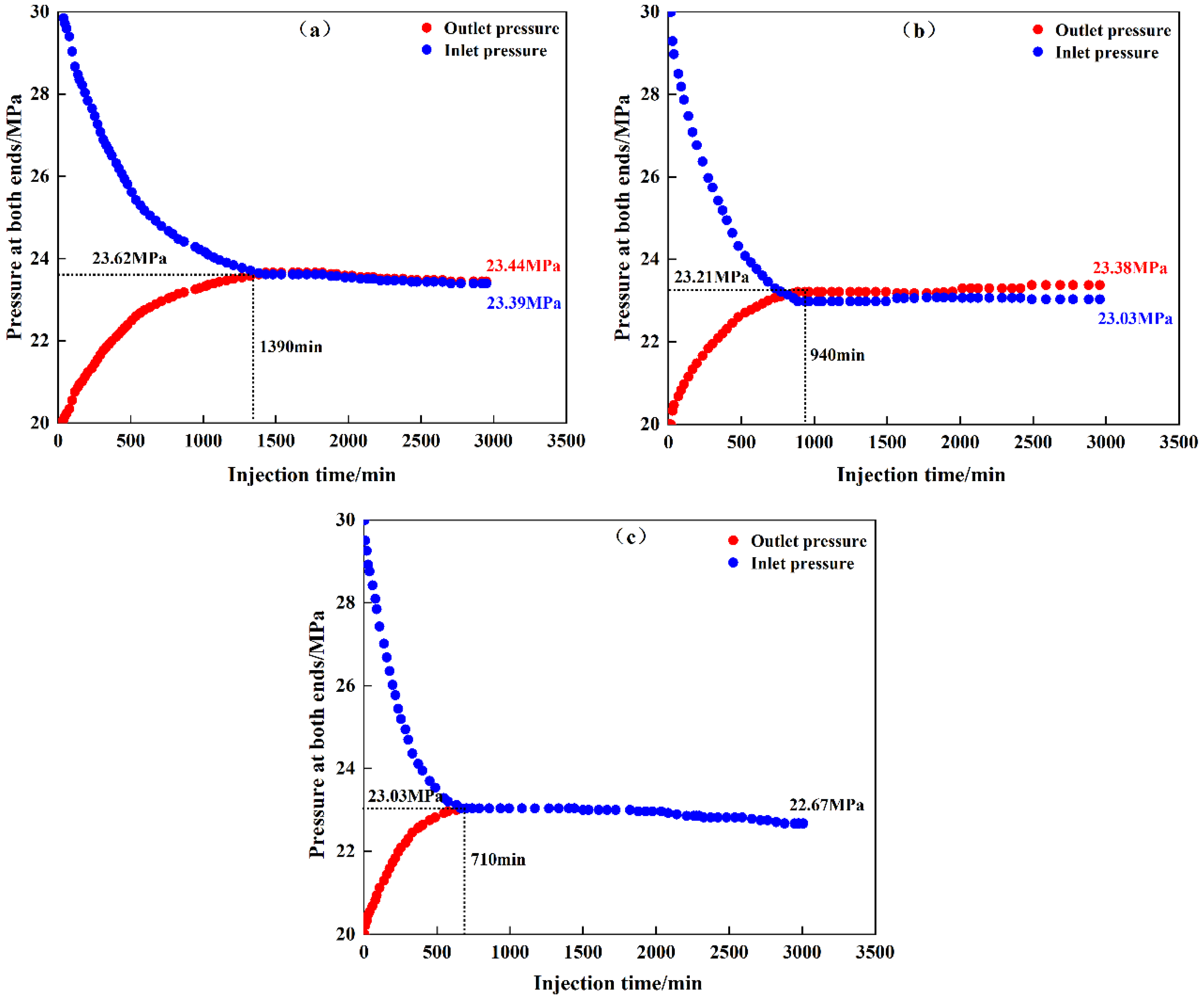
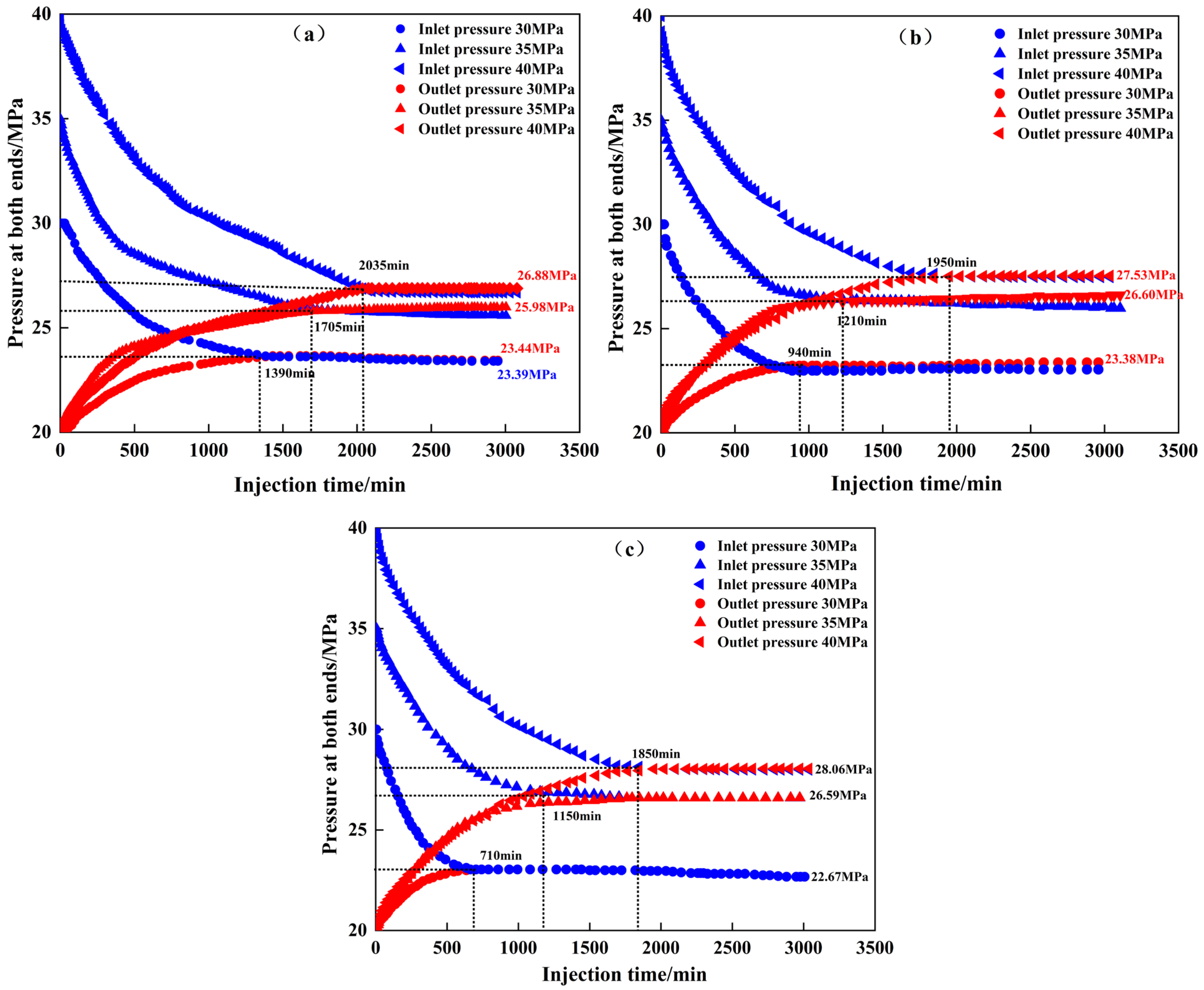
The evolution relationship of pressure at the inlet and outlet of three types of rock samples (mudstone, sandstone, and natural fracture developed rock samples) with the soaking time is shown in Figure 3. The pressure equilibrium time and the pressure changes at the inlet and outlet after pressure equilibrium are shown in Table 3. For the mudstone sample (Figure 3a), when the injection pressure reaches the preset 30 MPa and the injection is stopped, the inlet pressure shows a continuous downward trend, while the outlet pressure continues to rise synchronously. When the well was simmered for 1390 min, the pressure at the inlet and outlet tended to be consistent, both reaching 23.62 MPa, achieving pressure balance. Subsequently, due to the water absorption and expansion effect of clay minerals in mudstone, there was a slight decrease in pressure at both ends. When shut-in for 3000 min, under the action of capillary force, the outlet pressure (23.44 MPa) is slightly higher than the inlet pressure (23.39 MPa).
For the sandstone rock sample (Figure 3b), when the well is submerged for 940 min, the inlet and outlet pressures reach equilibrium, with equilibrium pressures of 23.21 MPa. After equilibrium, the induced cracks generated during the high-pressure injection process undergo slight expansion, resulting in slight fluctuations and a decrease in pressure at both ends [43]. When the well was simmered for 3000 min, the capillary force caused the outlet pressure (23.38 MPa) to be higher than the inlet pressure (23.03 MPa). It is worth noting that the pressure equilibrium time of sandstone samples (940 min) is shorter than that of mudstone samples (1390 min). The core reason for this is that the connectivity of sandstone pore systems is significantly better than that of mudstone, which is conducive to the rapid seepage and pressure transmission of injected water, thereby shortening the pressure equilibrium period. In addition, the pore volume of sandstone is larger than that of mudstone. During the process of increasing pore pressure, the pores undergo elastic expansion, which can store more injected fluid, resulting in a slightly lower equilibrium pressure at the outlet end of sandstone (23.38 MPa) than mudstone (23.44 MPa).
For natural fractured rock samples (Figure 3c), the pressure equilibrium rate is the fastest. When the well is submerged for 710 min, the inlet and outlet pressures reach equilibrium, with an initial equilibrium pressure of 23.03 MPa. During the subsequent continuous soaking process, the pressure at both ends tended to stabilize at 22.67 MPa. The development of natural fractures significantly improves the connectivity of the rock pore system, accelerates the flow and pressure transmission of injected water, and effectively weakens the influence of capillary force on the inlet pressure. The final equilibrium pressure of this type of rock sample (22.67 MPa) is lower than that of the ordinary sandstone rock sample (23.38 MPa), mainly due to the development of natural fractures.
Under the injection pressure of 30 MPa, the energy enhancement efficiencies of mudstone, sandstone, and sandstone with natural fractures are 52.04%, 48.49%, and 36.43%, respectively. Mudstone has the highest energy enhancement efficiency, while sandstone with natural fractures has the lowest. Under high pore pressure, the rock sample is prone to generate a large number of secondary induced fractures, significantly increasing the internal liquid storage space of the rock sample and further reducing the outlet pressure.

3.1.2. Pore Structure Changes During the Energy Enhancement Process

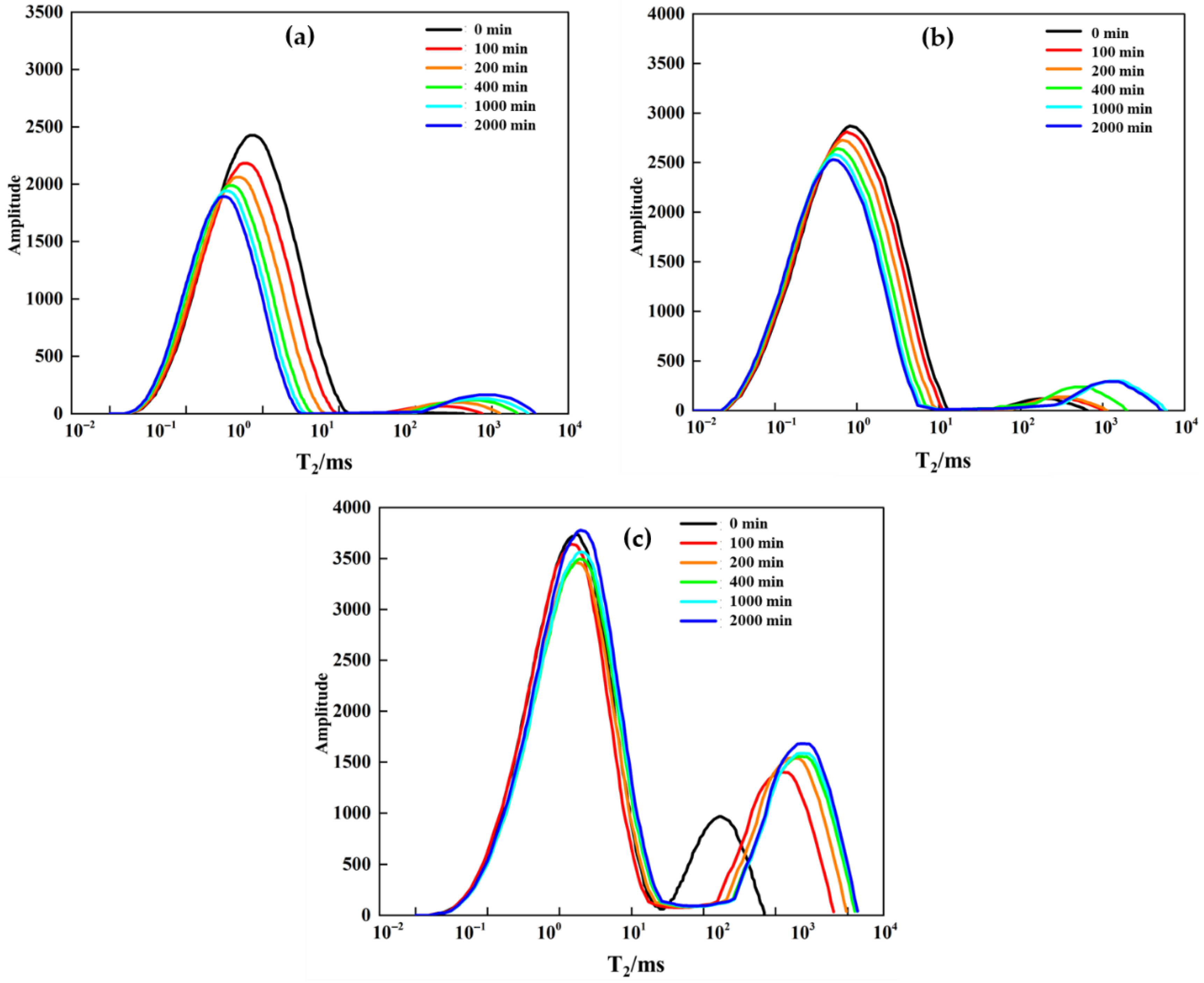
The nuclear magnetic resonance (NMR) T2 distribution characteristics of the three tested rock samples are shown in Figure 4. The NMR T2 distribution range of all rock samples is 0.01~10,000 ms, which can intuitively reflect the pore quantity and pore size distribution characteristics of the rock samples [43]. As shown in Figure 4, the T2 distribution curves of the three rock samples exhibit similar evolutionary trends, all showing typical bimodal distribution characteristics, with two characteristic peaks located in the ranges of 0.01–10 ms and 100–1000 ms, respectively. According to formula (1), the pore sizes corresponding to different transverse relaxation times (T2) can be calculated. The left characteristic peak corresponds to small pores (pore size < 1000 nm) inside the rock, while the right characteristic peak corresponds to large pores or microcracks (pore size > 1000 nm) in the rock.
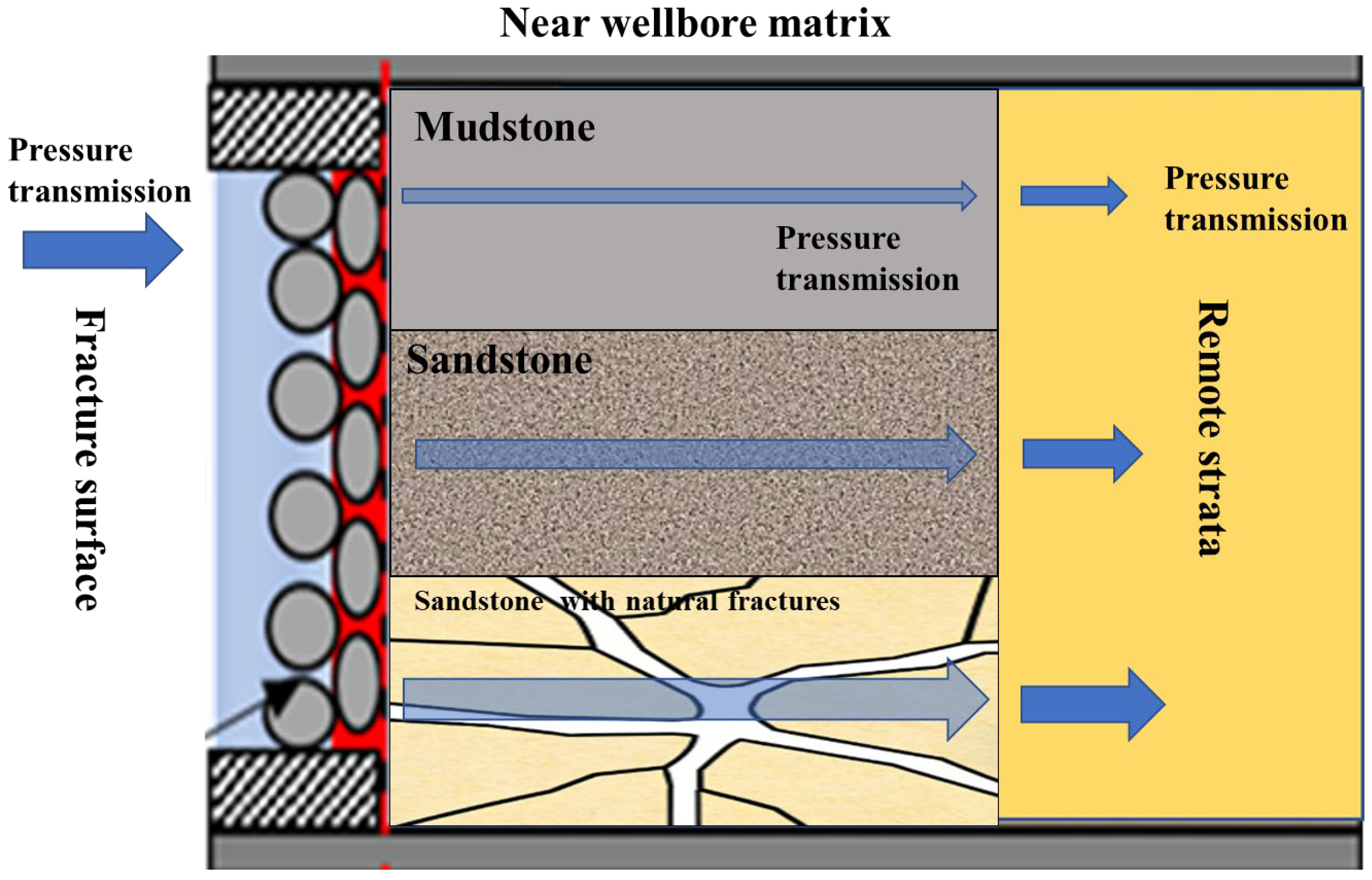
To clarify the lithology-controlled regimes of pressure transmission and energy transfer during high-pressure water injection in tight sandstone reservoirs, a conceptual framework is established based on systematic experimental observations and mechanism analysis (Figure 4). Mudstone is dominated by a matrix-controlled regime, which is characterized by slow pressure diffusion and significant clay-induced pore throat blockage due to its low porosity, low permeability, and high clay mineral content, leading to inefficient energy propagation; sandstone adopts a pore-matrix dual transport regime, where the interconnected pore network and relatively low clay content result in a moderate pressure transmission rate and balanced energy transfer efficiency; naturally fractured sandstone is governed by a fracture-dominated regime, in which the developed natural fractures and high pore connectivity form efficient fluid flow channels, enabling fast pressure channeling and the highest energy transfer efficiency among the three lithologies. This framework explicitly distinguishes the dominant transport mechanisms of different lithologies, providing a clear theoretical basis for understanding the differences in pressure response characteristics and energy enhancement effects observed in the experiments.
For the mudstone rock sample (Figure 5a), with the extension of water injection time, the left peak of the core NMR T2 spectrum shows a significant left shift trend. This is mainly due to the detachment of clay minerals during the water–rock reaction process, and the detachment particles block the internal pore throats of the rock sample, resulting in a decrease in the effective pore volume of the mudstone. In addition, the T2 spectrum of mudstone exhibits discontinuous bimodal characteristics, indicating poor connectivity between its internal pores and microcracks, with some pores in a relatively closed state [44], consistent with the experimental phenomenon of the slow pressure transmission rate mentioned earlier. For sandstone samples (Figure 5b), after the injection of sliding water, the left peak of the T2 spectrum also showed a left shift phenomenon, but the decrease in pore size was significantly smaller than that of mudstone, indicating that sandstone has better resistance to pore throat blockage than mudstone. At the same time, the right peak area of sandstone T2 spectrum shows a significant increase trend, which is attributed to the increase in pore pressure during the water injection process, inducing a small number of secondary cracks inside the rock sample, resulting in an increase in the number of large pores and micro cracks, further supporting the mechanism analysis of high-pressure injection-induced cracks mentioned earlier. For the sandstone sample with natural fracture development (Figure 5c), with the extension of water injection time, the left peak of the T2 spectrum of the core shows a right shift trend, and the amplitude of the right peak movement is significantly greater than the other two rock samples. This feature indicates that the increase in pore pressure caused by high-pressure water injection promotes the development of natural fractures and the generation of a large number of induced fractures inside the rock sample. At the same time, it significantly improves the connectivity between pores and fractures, making the fluid transport channels inside the rock sample smoother, which is in good agreement with the experimental results of the fastest pressure equilibrium rate in this type of rock sample mentioned earlier.
Based on the NMR T2 distribution test results, quantitative analysis was conducted on the ratio changes of small pores to large pores in rock samples of different rock types at different injection times. The specific data is shown in Table 4. For mudstone samples, the proportion of macropores showed a rapid decrease during the initial stage of liquid injection (<400 min), and by 400 min, the proportion of macropores decreased from 23.7% to 17.3%, a decrease of 6.4%. When continuously injected for 2000 min, the proportion of large pores further decreased to 16.5%, with a cumulative decrease of 7.2%, indicating that pore throat blockage during water injection has a significant inhibitory effect on the development of large pores in mudstone. For ordinary sandstone samples, when water is injected for 200 min, the proportion of large pores decreases by 3.8% compared to the initial value, and the reduction in large pores is much lower than that of mudstone samples, reflecting that the phenomenon of sandstone pore throat blockage is less common, and the destructive effect of water injection on its pore structure is relatively weak. For sandstone samples with natural fracture development, high-pressure water injection has a significant promoting effect on the development of large pores and micro fractures. When continuously injected for 2000 min, the proportion of large pores increased by 9.3% compared to the initial value. This is mainly due to the induction of a large number of secondary induced fractures by high-pressure water injection, and the interconnection between natural and induced fractures significantly increases the volume proportion of large pores and micro fractures, which is consistent with the significant shift of the right peak in the NMR T2 spectrum mentioned earlier.

3.2. Analysis of the Impact of Water Injection Methods on Energy Transfer Efficiency

3.2.1. Water Injection Intensity

The energy enhancement effect of water injection is closely related to the injection pressure, and there are significant differences in the energy enhancement response of various rock samples under different water injection energy enhancement intensities. Increasing the injection pressure of the initial energy enhancing fluid can effectively enhance the effect of reservoir pressure rise, thereby improving the overall efficiency of water injection energy enhancement. The pressure response curves of the inlet and outlet ends of three types of rock samples under different injection pressures with injection time are shown in Figure 6. It can be seen from the figure that as the initial injection pressure increases, the stable pressure of the distal formation after reaching equilibrium shows a synchronous increasing trend. Under the injection pressures (30–40 MPa) and low permeability matrix conditions, the flow remains dominated by Darcy’s law, and obvious inertial effects are not observed.
From the quantitative comparison of energy enhancement effects, sandstone with natural fracture development shows the best energy enhancement performance. When the injection pressure is increased to 40 MPa, the outlet pressure increases by 8.06 MPa compared to the initial formation pressure (20 MPa). Compared to the 30 MPa injection pressure condition, the energy enhancement effect increases by 24% (see Table 5). The energy enhancement effect of mudstone is the worst. Under the same injection pressure of 40 MPa, the outlet pressure only increases by 6.88 MPa, which is only 15% higher than the injection pressure condition of 30 MPa. The injection pressure affects the energy enhancement efficiency of different rock types in the bottom layer. When the injection pressure is 30 MPa, the energy enhancement efficiency of mudstone is the highest, at 52.04%. When the injection pressure increases to 35 MPa, the sandstone pores with natural fractures have the best connectivity, and the energy enhancement efficiency reaches 77.72%. As the injection pressure continues to increase to 40 MPa, the induced fractures generated by high-pressure injection increase the fluid retention inside the rock sample, and the energy enhancement efficiency at the outlet end decreases compared to 35 MPa. Through comparative experiments, it is known that when the injection pressure is 35 MPa, the energy enhancement efficiency of mudstone, sandstone, and naturally fractured sandstone reaches its peak.
There is a positive correlation between injection pressure and injection time required for pressure equilibrium, that is, the higher the injection pressure, the longer the injection time required for the rock sample to reach pressure equilibrium. Among them, mudstone has the longest injection time to reach pressure equilibrium, followed by ordinary sandstone. An increase in macropore proportion improves pore connectivity and reduces flow resistance, thereby shortening pressure equilibration time. Pore structure redistribution (especially the expansion of macropore and fracture systems) directly improves effective permeability. For naturally fractured samples, although fracture geometry and aperture affect flow, the overall regime still approximates linear Darcy flow under the experimental pressure range. Mudstone has high storage but low transmissivity, while fractured sandstone has both high transmissivity and efficient energy transfer. The development of natural fractures can significantly optimize pressure transmission efficiency and greatly shorten the water injection equilibrium time, which is consistent with the pressure transmission characteristics caused by the differences in pore connectivity of different rock types mentioned earlier.

3.2.2. Water Injection Method

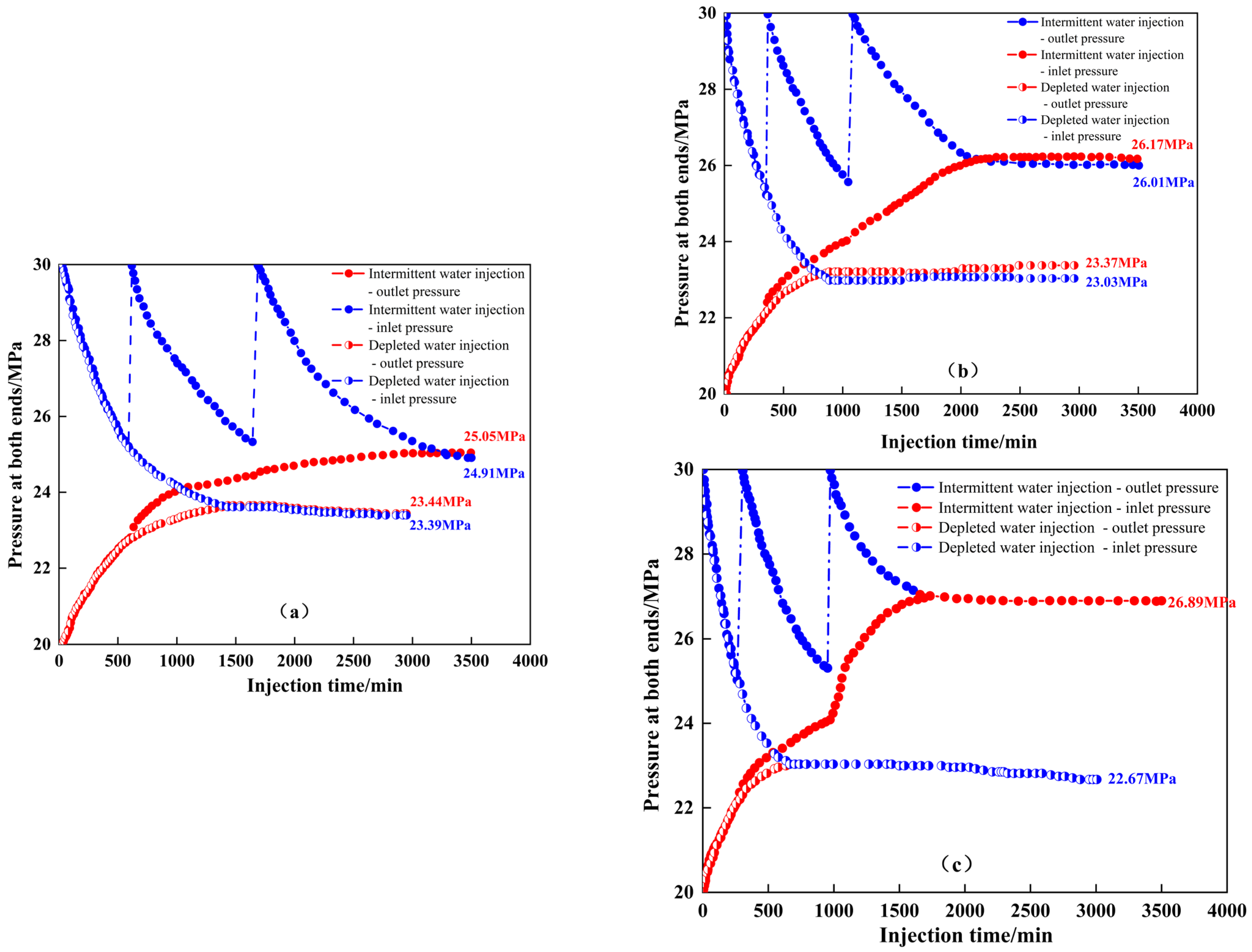
The water injection method has a significant impact on the energy enhancement effect, among which the depletion-type water injection lacks continuous energy replenishment and has limited pressure rise in the remote formation, resulting in poor energy enhancement effect. Intermittent water injection, through periodic pressure supplementation, can effectively alleviate energy loss in the formation and significantly improve formation pressure and energy efficiency. The evolution curves of pressure response at the inlet and outlet of three rock types with injection time under two methods of depleted water injection and intermittent water injection are shown in Figure 7. The experimental results show that intermittent energy supplementation can effectively increase formation pressure, and compared with depleted water injection, the outlet pressure of various rock samples has been significantly improved. The outlet pressure of intermittent water injection in mudstone is 1.61 MPa higher than that of depleted water injection, and the outlet pressure of intermittent water injection in sandstone is 2.79 MPa higher. The outlet pressure of intermittent water injection in sandstone with natural fractures is the most significant, reaching 4.22 MPa. From the quantitative comparison of the outlet pressures of different rock types, it can be seen that the energy enhancement performance of natural fractured reservoirs is still the best, with a formation pressure increase of 6.89 MPa compared to the initial value. Sandstone comes second, with an increase in formation pressure of 6.17 MPa. The mudstone reservoir has the worst outlet pressure, with a formation pressure increase of only 5.05 MPa. Comparing the energy enhancement efficiency of different rock types under different injection methods, intermittent injection of supplementary energy significantly improved the energy enhancement efficiency of sandstone with natural fracture development, increasing from 36.43% in depletion injection to 221.54%. The specific data is shown in Table 6.

4. Discussion

This article clarifies the influence of lithology differences, injection pressure gradients, and injection method optimization on the energy enhancement effect of water injection in tight sandstone reservoirs through systematic indoor experiments. Pressure propagation in tight cores under high-pressure injection can be reasonably interpreted within a diffusion-dominated framework, consistent with low permeability porous media flow. Permeability and pore connectivity dominate the pressure equilibration rate: higher connectivity shortens the time required for pressure diffusion and equilibrium. Three lithologies correspond to distinct dominant transfer regimes: ① Mudstone: matrix-dominated, slow diffusion; ② Sandstone: matrix pore dual system; ③ Naturally fractured sandstone: fracture-dominated fast transport. It reveals the inherent relationship between pore structure evolution and pressure response, providing empirical support for the optimization of water injection energy enhancement technology. However, there are still several shortcomings that need to be improved in the research process. The experiment only focused on indoor rock cores of a single specification as the research object, without fully considering the three-dimensional heterogeneity of the on-site formation, dynamic changes in formation temperature, and the coupling effect of water–rock chemistry caused by long-term water injection. There is a certain deviation between the experimental conditions and the actual development environment on site, which leads to the need to further improve the on-site adaptability of the research results; these limitations are also the key directions of our follow-up research. At the same time, there is a lack of in-depth exploration of the quantitative correlation between the dynamic expansion, closure, and stress field response of cracks during water injection, and the internal mechanism of stress field evolution during energy transfer is not fully explained, resulting in a lack of targeted quantitative characterization methods. The next step of research will combine the actual geological and development conditions on site, introduce a high-temperature and high-pressure visualization experimental system, and accurately simulate the entire process of water injection and energy enhancement in real geological environments. The focus should be on conducting water–rock chemistry mechanics coupling experiments, quantifying the influence of water–rock reactions on pore fracture structure and stress field, and establishing a quantitative correlation model between fracture dynamic evolution and stress field response. In addition, by deeply integrating indoor experimental results with numerical simulation technology, optimizing key development parameters such as injection pressure and injection cycle, and improving the mechanism of water injection energy transfer, more accurate and reliable theoretical and technical support will be provided for the on-site optimization and efficient implementation of water injection energy enhancement schemes for tight sandstone reservoirs.

5. Conclusions

(1)
Pore connectivity and fracture development degree are the core factors dominating the water injection energy enhancement effect and pressure transmission efficiency in tight sandstone reservoirs. Experiments have shown that the order of the three lithological energy enhancement effects is: natural fracture developed sandstone > ordinary sandstone > mudstone. The equilibrium pressure increase of sandstone with natural fracture development reaches 6.89 MPa, ordinary sandstone is 6.17 MPa, and mudstone is only 5.05 MPa. The pore connectivity and fracture development degree directly determine the pressure equilibrium rate and energy increase amplitude. It is recommended to prioritize the identification and targeted utilization of fractured reservoirs during on-site development, and deploy water injection wells to fully leverage their advantages of fast pressure transmission and good energy enhancement. At the same time, optimize water injection strategies for mudstone development sections to improve overall energy enhancement uniformity.
(2)
The injection pressure is significantly positively correlated with the energy enhancement effect of water injection. Appropriately increasing the initial injection pressure can effectively lift the equilibrium pressure of the remote formation, but it is necessary to balance the cost of soaking time and the risk of reservoir damage. Experiments have shown that when the injection pressure is increased from 30 MPa to 40 MPa, the energy enhancement effect of natural fracture development sandstone increases by 24%, while mudstone only increases by 15%. Moreover, the higher the injection pressure, the longer the soaking time required to reach pressure equilibrium. It is recommended to control the on-site water injection pressure within the range of 30–40 MPa and dynamically adjust it based on the pressure response characteristics of different rock types to achieve a balance between energy enhancement, development efficiency, and reservoir protection. This study systematically revealed the coupling effect of lithology, injection pressure, and injection method on energy transfer and pressure response, and supplemented the quantitative correlation between pore structure evolution and pressure response, which fills the research gap of insufficient understanding of multi-factor coupling mechanism in existing studies.
(3)
Intermittent water injection has a significantly better energy enhancement effect than depletion water injection, which can effectively alleviate the energy loss of the formation and avoid the problems of pore throat blockage or energy loss caused by a single water injection method. Experimental data shows that compared with depleted water injection, intermittent water injection can increase the energy enhancement effect of natural fracture developed sandstone, ordinary sandstone, and mudstone by 18.6%, 12.0%, and 6.9%, respectively. It is recommended to design differentiated intermittent water injection cycles for reservoirs of different rock types. For natural fractured reservoirs, the cycle can be appropriately shortened to enhance the sustainability of energy enhancement. For mudstone reservoirs, the cycle can be optimized to reduce pore throat blockage caused by water rock reactions. For sandstone reservoirs, a medium cycle can be used to balance energy efficiency and cost.
(4)
Based on the shortcomings of this study and the needs of on-site development, it is recommended to fully consider the actual heterogeneity of the formation, temperature dynamic changes, and water rock chemical interactions during on-site development. By combining reservoir logging and well-testing data, the water injection process parameters should be optimized to enhance the on-site adaptability of research results. At the same time, follow-up research needs to supplement high-temperature and high-pressure water–rock chemical mechanical coupling experiments, deeply explore the influence of water–rock reactions on pore fracture structure and stress field, establish a quantitative model of fracture dynamic evolution and stress field response, deeply integrate indoor experimental results with numerical simulation technology, further improve the energy transfer mechanism of water injection in tight sandstone reservoirs, and provide more accurate and reliable theoretical and technical support for on-site optimization and efficient implementation of water injection energy enhancement schemes.

Author Contributions

Conceptualization, L.L., Y.Z. and S.Z.; methodology, L.L. and S.Z.; validation, L.L.; formal analysis, L.L.; resources, X.M.; data curation, Y.Z.; writing—original draft, L.L.; writing—review and editing, L.L.; visualization, L.L. and X.M.; supervision, X.M. and S.Z.; project administration, X.M., Y.Z. and S.Z.; funding acquisition, X.M. and S.Z. All authors have read and agreed to the published version of the manuscript.

Funding

This research received no external funding.

Data Availability Statement

The original contributions presented in this study are included in the article. Further inquiries can be directed to the corresponding author.

Conflicts of Interest

Authors Li Liu, Xinfang Ma, Yushi Zou, and Shicheng Zhang were employed by State Key Laboratory of Petroleum Resources and Engineering, China University of Petroleum, Beijing, China. The authors declare that the research was conducted in the absence of any commercial or financial relationships that could be construed as potential conflicts of interest.

References

  1. Sun, L.D.; Zou, C.N.; Jia, A.L.; Wei, Y.S.; Zhu, R.K.; Wu, S.T.; Guo, Z. Development characteristics and orientation of tight oil and gas in China. Pet. Explor. Dev. 2019, 46, 1073–1087. [Google Scholar] [CrossRef]
  2. Azeem, R.; Mohammad, K.A.; Tawfik, A.S. Advanced developments in shale inhibitors for oil production with low environmental footprints—A review. Fuel 2019, 247, 237–249. [Google Scholar] [CrossRef]
  3. Dai, J.X.; Dong, D.Z.; Ni, Y.Y.; Gong, D.Y.; Huang, S.P.; Hong, F.; Zhang, Y.L.; Liu, Q.Y.; Wu, X.Q.; Feng, Z.Q. Distribution patterns of tight sandstone gas and shale gas. Pet. Explor. Dev. 2024, 51, 767–779. [Google Scholar] [CrossRef]
  4. Jia, C.Z.; Zou, C.N.; Li, J.Z.; Li, D.H.; Zheng, M. Evaluation criteria, major types, characteristics and resource prospects of tight oil in China. Pet. Res. 2016, 1, 1–9. [Google Scholar] [CrossRef]
  5. Yang, H.; Li, S.X.; Liu, X.Y. Characteristics and resource prospects of tight oil in Ordos Basin, China. Pet. Res. 2016, 1, 27–38. [Google Scholar] [CrossRef]
  6. Yan, B.; Liu, H.Y.; Peng, X.Y. Scenario analysis to evaluate the economic benefits of tight oil resource development in China. Energy Strategy Rev. 2024, 51, 101318. [Google Scholar] [CrossRef]
  7. Savitski, A.A.; Detournay, E. Propagation of a penny-shaped fluid-driven fracture in an impermeable rock: Asymptotic solutions. Int. J. Solids Struct. 2002, 39, 6311–6337. [Google Scholar] [CrossRef]
  8. Vilarrasa, V.; Laloui, L. Potential fracture propagation into the caprock induced by cold injection in normal faulting stress regimes. Geomech. Energy Environ. 2015, 2, 22–31. [Google Scholar] [CrossRef]
  9. Jing, W.; Liu, J.G.; Li, Z.G.; Li, H.C.; Zhang, J.S.; Li, W.Q.; Zhang, Y.L.; Ping, Y.; Yang, H.Y.; Wang, P. Synchronous injection production energy replenishment for a horizontal well in an ultra-low permeability sandstone reservoir: A case study of Changqing oilfield in Ordos Basin, NW China. Pet. Explor. Dev. 2020, 47, 827–835. [Google Scholar] [CrossRef]
  10. Elbel, J.L.; Mack, M.G. Refracturing Observations and Theories. In Proceedings of the SPE Production Operations Symposium, Oklahoma City, OA, USA, 21–23 March 1992. [Google Scholar]
  11. Wright, C.A.; Conant, R.A.; Golich, G.M. Hydraulic Fracture Orientation and Production/Injection Induced Reservoir Stress Changes in Diatomite. In Proceedings of the SPE Western Regional Meeting, Bakersfield, CA, USA, 8–10 March 1995. [Google Scholar]
  12. Gupta, J.; Zielonka, M.; Albert, R.A. Integrated Methodology for Optimizing Development of Unconventional Gas Resources. In Proceedings of the SPE Hydraulic Fracturing Technology Conference, The Woodlands, TX, USA, 6–8 February 2012. [Google Scholar]
  13. Roussel, N.P.; Florez, H.; Rodriguez, A.A. Hydraulic Fracture Propagation from Infill Horizontal Wells. In Proceedings of the SPE Annual Technical Conference and Exhibition, New Orleans, LA, USA, 30 September–2 October 2013. [Google Scholar]
  14. Li, X.; Wang, J.; Elsworth, D. Stress redistribution and fracture propagation during restimulation of gas shale reservoirs. J. Pet. Sci. Eng. 2017, 154, 150–160. [Google Scholar] [CrossRef]
  15. Gan, Q.; Elsworth, D.; Zhao, Y.X.; Grippa, A.; Hurst, A. Coupled hydro-mechanical evolution of fracture permeability in sand injectite intrusions. J. Rock Mech. Geotech. Eng. 2020, 12, 742–751. [Google Scholar] [CrossRef]
  16. Fernandes, F.B.; Braga, A.M.B.; Souza, A.L.S.A.; Soares, C. Mechanical formation damage control in permeability Biot’s effective stress-sensitive oil reservoirs with source/sink term. J. Pet. Sci. Eng. 2023, 220, 111180. [Google Scholar] [CrossRef]
  17. Ingraham, M.D.; Bauer, S.J.; Issen, K.A.; Dewers, T.A. Evolution of permeability and Biot coefficient at high mean stresses in high porosity sandstone. Int. J. Rock Mech. Min. Sci. 2017, 96, 1–10. [Google Scholar] [CrossRef]
  18. Liu, Y.X.; Cheng, J.X.; Wang, G.; Gao, Y.; Jiang, C.R.; Xu, J. Deterioration mechanism of sandstone under coupling compression-shear stress and local borehole water pressure. J. Appl. Geophys. 2025, 243, 105984. [Google Scholar] [CrossRef]
  19. Li, N.; Jin, Z.; Wang, H.; Zou, Y.; Zhang, S.; Li, F.; Zhou, T.; Jiang, M. Investigation into shale softening induced by water/CO2-rock interaction. Int. J. Rock Mech. Min. Sci. 2023, 161, 105299. [Google Scholar] [CrossRef]
  20. Ding, S.; Tang, S.B.; Jia, H.L.; Li, Y.B. The influence of water on the failure characteristics of sandstone under uniaxial compres-sion conditions by acoustic emission and NMR observation. Eng. Geol. 2023, 322, 107173. [Google Scholar] [CrossRef]
  21. Ding, Y.G.; Qiao, L.; Li, Z.H.; Luo, R.B.; Han, G.D.; Tan, J.Q.; Liu, X. Experimental study on oil recovery characteristics of different CO2 flooding methods in sandstone reservoirs with NMR. Fuel 2025, 385, 134124. [Google Scholar] [CrossRef]
  22. Zou, Y.S.; Li, N.; Ma, X.F. Experimental study on the growth behavior of supercritical CO2-induced fractures in a layered tight sandstone formation. J. Nat. Gas Sci. Eng. 2018, 49, 145–156. [Google Scholar] [CrossRef]
  23. Ishida, T.; Aoyagi, K.; Niwa, T. Acoustic emission monitoring of hydraulic fracturing laboratory experiment with super critical and liquid CO2. Geophys. Res. Lett. 2012, 39, L16309. [Google Scholar] [CrossRef]
  24. Li, S.H.; Zhang, S.C.; Zou, Y.S. Pore structure alteration induced by CO2-brine-rock interaction during CO2 energetic fracturing in tight oil reservoirs. J. Pet. Sci. Eng. 2020, 191, 107147. [Google Scholar] [CrossRef]
  25. Ribeiro, L.H.; Li, H.N.; Bryant, J.E. Use of a CO2-hybrid fracturing design to enhance production from unpropped-fracture networks. SPE Prod. Oper. 2017, 32, 28–40. [Google Scholar] [CrossRef]
  26. Liu, K.X.; Chen, G.L.; Wang, P.F.; Chen, Y.; Huang, F.; Luo, Y.F. Experimental investigation of surfactant-enhanced water injection in coal seams. J. Mol. Liq. 2025, 436, 128237. [Google Scholar] [CrossRef]
  27. Chen, K.; Zhang, J.R.; Xu, S.Y.; Yin, M.Z.; Zhang, Y.; Zhao, Y.C.; Song, Y.C. Review of carbonated water injection as a promising technology to enhance oil recovery in the petroleum industry: Challenges and prospects. Pet. Sci. 2024, 21, 4100–4118. [Google Scholar] [CrossRef]
  28. Zeng, L.P.; Akhondzadeh, H.; Iqbal, M.A. Effect of fluid-shale interactions on shales micromechanics: Nanoindentation experiments and interpretation from geochemical perspective. J. Nat. Gas Sci. Eng. 2022, 101, 104545. [Google Scholar] [CrossRef]
  29. Li, S.H.; Zhang, S.C.; Ma, X.F. Hydraulic fractures induced by water-/carbon dioxide-based fluids in tight sandstones. Rock Mech. Rock Eng. 2019, 52, 3323–3340. [Google Scholar] [CrossRef]
  30. Xu, R.Z.; Yang, S.L.; Xiao, Z.P. Quantitatively study on imbibition of fracturing fluid in tight sandstone reservoir under high temperature and high pressure based on NMR technology. J. Pet. Sci. Eng. 2022, 208, 109623. [Google Scholar] [CrossRef]
  31. Chen, G.; Chen, M.; Lu, Y.H.; Chen, B.B.; Sun, F.R.; Lou, E.B.; Wang, K.X. Experimental Investigation on Mechanical Properties and Failure Mode of Natural Fractured Sandstone. Presented at the SPE Argentina Exploration and Production of Unconventional Resources Symposium, Neuquen, Argentina, 14–16 August 2018. [Google Scholar] [CrossRef]
  32. Li, D.; Li, Y.; Zhu, W. Analytical Modelling of Load–Displacement Performance of Cable Bolts Incorporating Cracking Propagation. Rock Mech. Rock Eng. 2020, 53, 3471–3483. [Google Scholar] [CrossRef]
  33. Liu, T.F.; Wang, G.; Wang, C.S.; Jiang, Y.J.; Wu, X.Z.; Zhang, F.L.; Zheng, W.; Chang, D.T. Experimental and numerical study on the mechanical and failure characteristics of red sandstone with hole–fissure defects under biaxial compression. Theor. Appl. Fract. Mech. 2025, 140, 105124. [Google Scholar] [CrossRef]
  34. Fu, J.W.; Labuz, J.F.; Guo, M.D.; Cheng, H.X.; Hou, R.B. Experimental and numerical investigations on hydraulic fracture growth using rock-like resin material containing an injecting inner pre-crack. J. Pet. Sci. Eng. 2022, 213, 110424. [Google Scholar] [CrossRef]
  35. Qiu, C.; Yang, Y.G.; Chen, Y.; Huang, B.X.; Shang, R.P.; Cai, C.Z.; Liu, W. Pore-fracture evolution and seepage behavior in sandstone under triaxial stress: Insights from real-time CT imaging. Int. J. Rock Mech. Min. Sci. 2025, 195, 106292. [Google Scholar] [CrossRef]
  36. Eyitayo, S.I.; Gamadi, T.I.I.; Kolawole, O.; Watson, M.C. Produced water integration in CO2 storage using different injection strategies: The effect of salinity on rock petrophysical, mineralogy, wettability and geomechanical properties. J. Environ. Manag. 2024, 372, 123307. [Google Scholar] [CrossRef]
  37. Deng, Q.; Ginting, V.; McCaskill, B.; Torsu, P. A locally conservative stabilized continuous Galerkin finite element method for two-phase flow in poroelastic subsurfaces. J. Comput. Phys. 2017, 347, 78–98. [Google Scholar] [CrossRef]
  38. Zhang, Y.H.; Ju, Y. Integrating the 3D-GMTSN criterion with XFEM to simulate the spatial propagation trajectory of hydraulic fractures interacting with natural fractures. Eng. Fract. Mech. 2025, 329, 111605. [Google Scholar] [CrossRef]
  39. Yang, D.; Xu, S.; Liu, B.C.; Guo, Y.X.; Wang, Y.F.; Wen, K.; Jia, Y.R.; Li, Q.Q.; Nie, J.H. A critical review of pore pressure–stress coupling: Mechanisms, modeling, and implications for subsurface energy systems. Geoenergy Sci. Eng. 2026, 260, 214388. [Google Scholar] [CrossRef]
  40. Eberhardt, E.; Stead, D.; Stimpson, B. Quantifying progressive pre-peak brittle fracture damage in rock during uniaxial compression. Int. J. Rock Mech. Min. Sci. 1999, 36, 361–380. [Google Scholar] [CrossRef]
  41. Li, H.R.; Qiao, Y.F.; He, M.C.; Shen, R.X.; Gu, Z.J.; Cheng, T.; Tang, J. Effect of water saturation on dynamic behavior of sandstone after wetting-drying cycles. Eng. Geol. 2023, 319, 107105. [Google Scholar] [CrossRef]
  42. Lu, Y.Y.; Chen, X.Y.; Tang, J.R.; Li, H.L.; Zhou, L.; Han, S.B.; Ge, Z.L.; Xia, B.W. Relationship between pore structure and mechanical properties of shale on supercritical carbon dioxide saturation. Energy 2019, 172, 270–285. [Google Scholar] [CrossRef]
  43. Su, Y.; Lai, J.; Dang, W.L.; Bie, K.; Zhao, Y.D.; Zhao, X.J. Pore structure characterization and reservoir quality prediction in deep and ultra-deep tight sandstones by integrating image and NMR logs. J. Asian Earth Sci. 2024, 272, 106232. [Google Scholar] [CrossRef]
  44. Zhou, J.P.; Yang, K.; Tian, S.F.; Zhou, L.; Xian, X.F.; Jiang, Y.D.; Liu, M.H.; Cai, J.C. CO2-water-shale interaction induced shale microstructural alteration. Fuel 2020, 263, 116642. [Google Scholar] [CrossRef]
Figure 1. Image of standard core sample used in the experiment: (a) silty mudstone; (b) sandstone; (c) sandstone with natural fracture.
Processes 14 00945 g001
Figure 2. High pressure energy injection and response testing system for dense rock cores.
Processes 14 00945 g002
Figure 3. Changes in mineral compositions of mudstone and sandstone after the soaking treatment: (a) silty mudstone; (b) sandstone; (c) sandstone with natural fracture.
Processes 14 00945 g003
Figure 4. NMR spectra of three types of rock samples with different water injection times.
Processes 14 00945 g004
Figure 5. NMR spectra of three types of rock samples with different water injection times: (a) silty mudstone; (b) sandstone; (c) sandstone with natural fracture.
Processes 14 00945 g005
Figure 6. Pressure response curves of inlet and outlet under different injection pressures: (a) silty mudstone; (b) sandstone; (c) sandstone with natural fracture.
Processes 14 00945 g006
Figure 7. Pressure response curves of inlet and outlet under different injection methods: (a) silty mudstone; (b) sandstone; (c) sandstone with natural fracture.
Processes 14 00945 g007
Table 1. Basic physical parameters of experimental rock samples.
Type of RockSample NumberQuality
/G
Diameter
/mm
Length
/mm
Permeability
/mD
Porosity
/%
Median Pore Diameter/nm
MudstoneM154.2525.349.50.595.64315.26
M253.6425.149.20.645.81301.44
SandstoneS153.3524.750.11.0813.561689.21
S253.2224.950.31.0212.981768.45
Sandstone with natural fractureNS153.1525.249.91.4517.532365.78
NS253.2725.150.51.3816.882298.01
Table 2. Experimental plan for high voltage energy injection and response testing.
Sample NumberInjection Pressure/MPaInjection Method
M130, 35, 40Depleted water injection
S130, 35, 40Depleted water injection
NS130, 35, 40Depleted water injection
M230Intermittent water injection
S230Intermittent water injection
NS230Intermittent water injection
Table 3. Energy enhancement effect of high-pressure water injection on different rock samples.
Type of RockInjection Pressure/MPaBalance Pressure at the Inlet End/MPaBalance Pressure at the Outlet End/MPaPressure Equilibrium Time/minEnergy Enhancement Efficiency/%
Mudstone3023.3923.44139052.04
Sandstone3023.0323.3894048.49
Sandstone with natural fracture3022.6722.6771036.43
Table 4. Changes in the ratio of small pores to large pores in rock samples of different rock types at different injection times.
Type of RockInjection Time/minMicropore (<1000 nm)Macropore (>1000 nm)
Proportion/%Increasing Rate/%Proportion/%Increasing Rate/%
Mudstone076.3023.70
10079.63.320.4−3.3
20081.51.918.5−1.9
40082.71.217.3−1.2
100083.10.416.9−0.4
200083.50.416.5−0.4
Sandstone061.4038.60
10062.71.337.3−1.3
20063.50.836.5−0.8
40064.30.835.7−0.8
100064.90.635.1−0.6
200065.20.334.8−0.3
Sandstone with natural fracture056.4043.60
10052.9−3.547.13.5
20049.6−3.350.43.3
40048.2−1.451.81.4
100047.5−0.752.50.7
200047.1−0.452.90.4
Table 5. Pressure response characteristics at the outlet end under different injection pressures.
Type of RockInjection Pressure/MPaBalance Pressure at the Inlet End/MPaBalance Pressure at the Outlet End/MPaPressure Equilibrium Time/minEnergy Enhancement Efficiency/%
Mudstone3023.3923.44139050.04
3525.8225.98170565.14
4026.8426.88203552.28
Sandstone3023.0323.3894048.49
3526.4526.6121077.19
4027.5327.53195060.38
Sandstone with natural fracture3022.6722.6771036.43
3526.5626.56115077.72
4028.0628.06185067.50
Table 6. Characteristics of pressure response at the outlet end under different injection methods.
Type of RockWater Injection MethodBalance Pressure at the Inlet End/MPaBalance Pressure at the Outlet End/MPaPressure Equilibrium Time/minEnergy Enhancement Efficiency/%
MudstoneDepleted water injection23.3923.44139052.04
Intermittent water injection24.9125.05/99.21
SandstoneDepleted water injection23.0323.3894048.49
Intermittent water injection26.0126.17/154.64
Sandstone with natural fractureDepleted water injection22.6722.6771036.43
Intermittent water injection26.8926.89/221.54
Disclaimer/Publisher’s Note: The statements, opinions and data contained in all publications are solely those of the individual author(s) and contributor(s) and not of MDPI and/or the editor(s). MDPI and/or the editor(s) disclaim responsibility for any injury to people or property resulting from any ideas, methods, instructions or products referred to in the content.