Research on High-Pressure Energy Injection and Response Mechanism in Tight Sandstone Reservoirs


Abstract
1. Introduction
2. Experimental Samples and Methods
2.1. Specimen Preparation
2.2. High Voltage Energy Injection and Response Testing System
2.2.1. Experimental Apparatus
2.2.2. Experimental Plan and Steps
- (1)
- Six rock cores with a diameter of Ø 25.4 mm were subjected to oil washing treatment using the Soxhlet extraction method. The cores are now first saturated with simulated crude oil (consistent with the crude oil properties of the Fuyu oil reservoir) after vacuuming, and then the high-pressure water injection energy enhancement experiment is carried out, which is consistent with the actual process of water injection energy replenishment in oil-bearing tight sandstone reservoirs.
- (2)
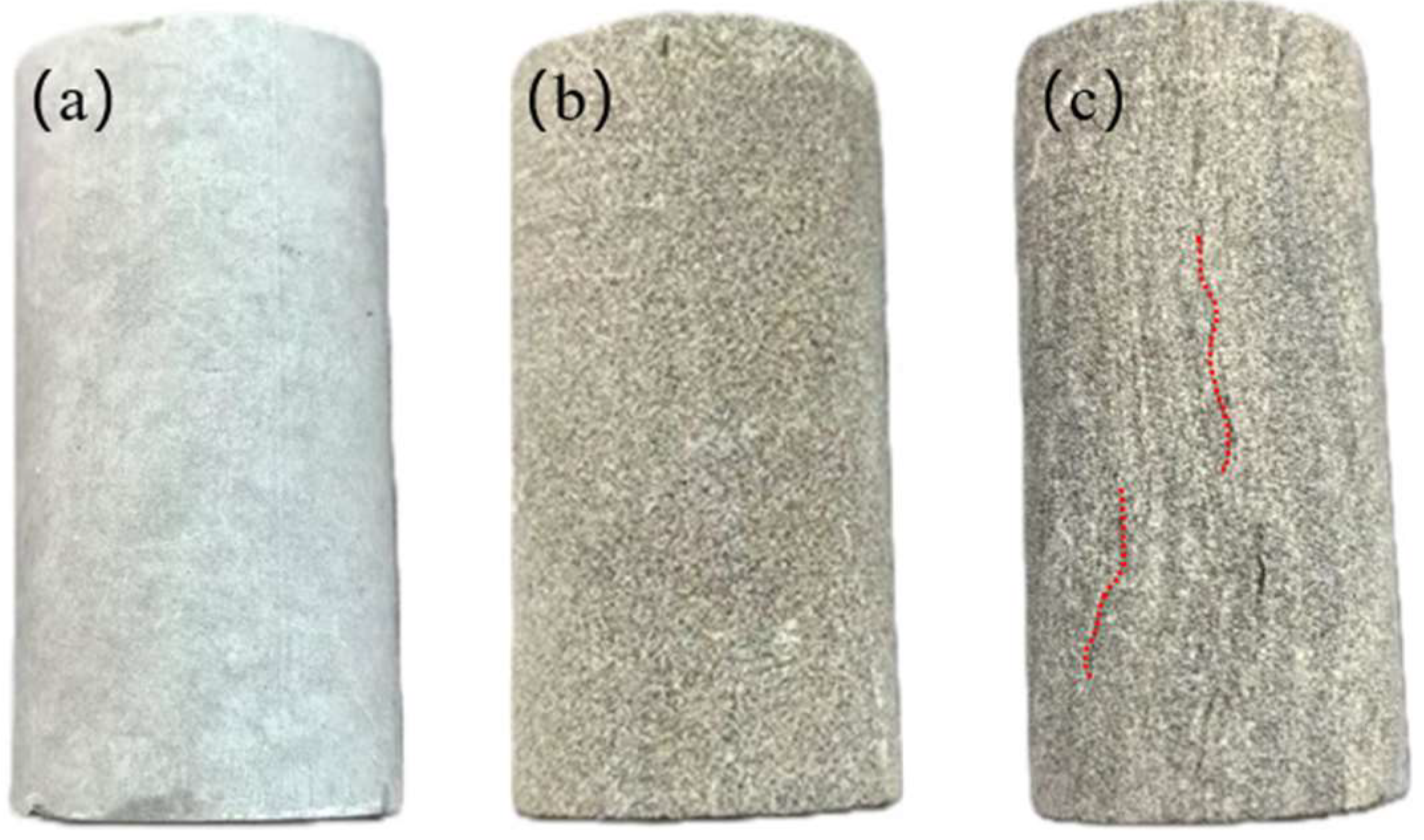
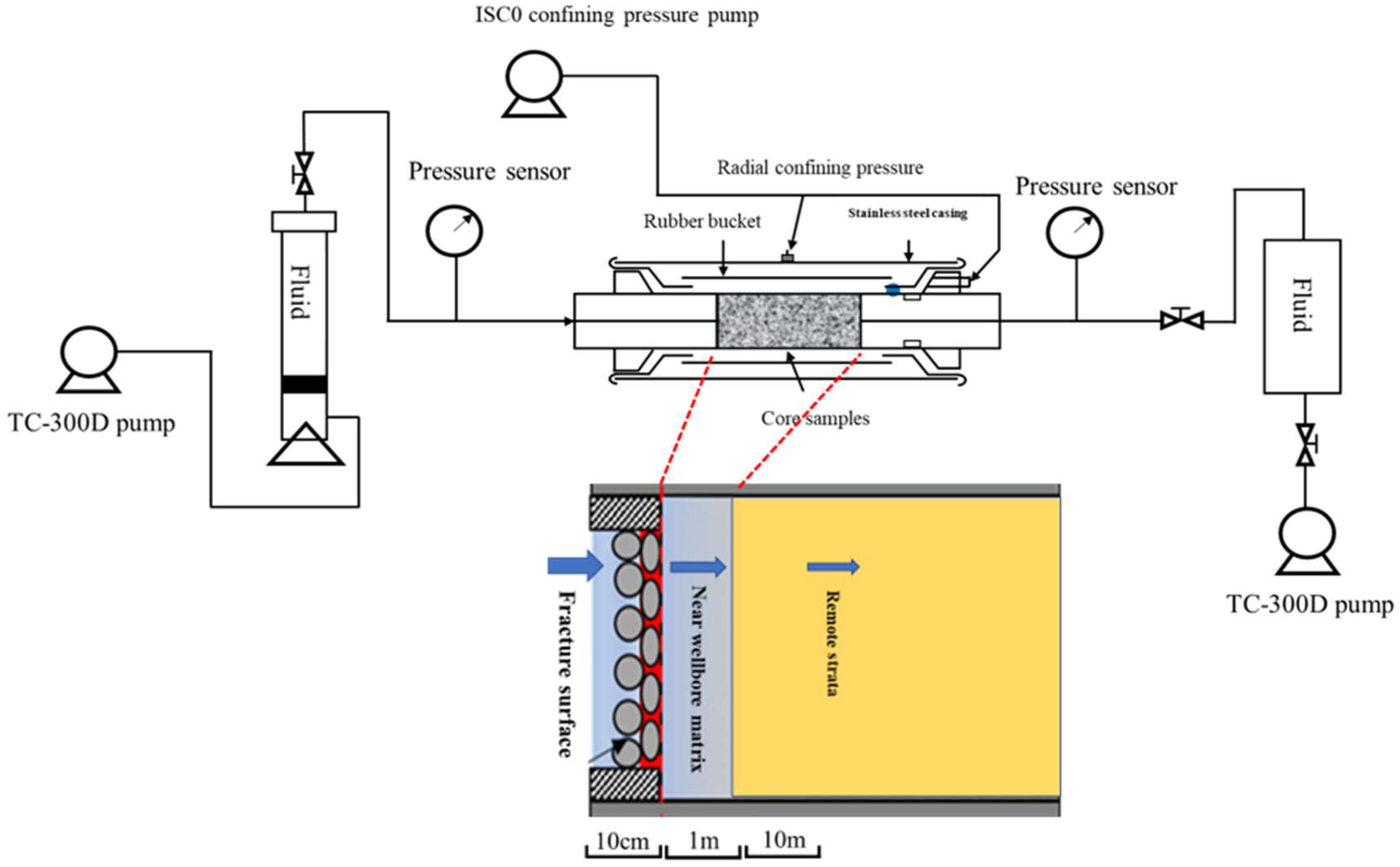
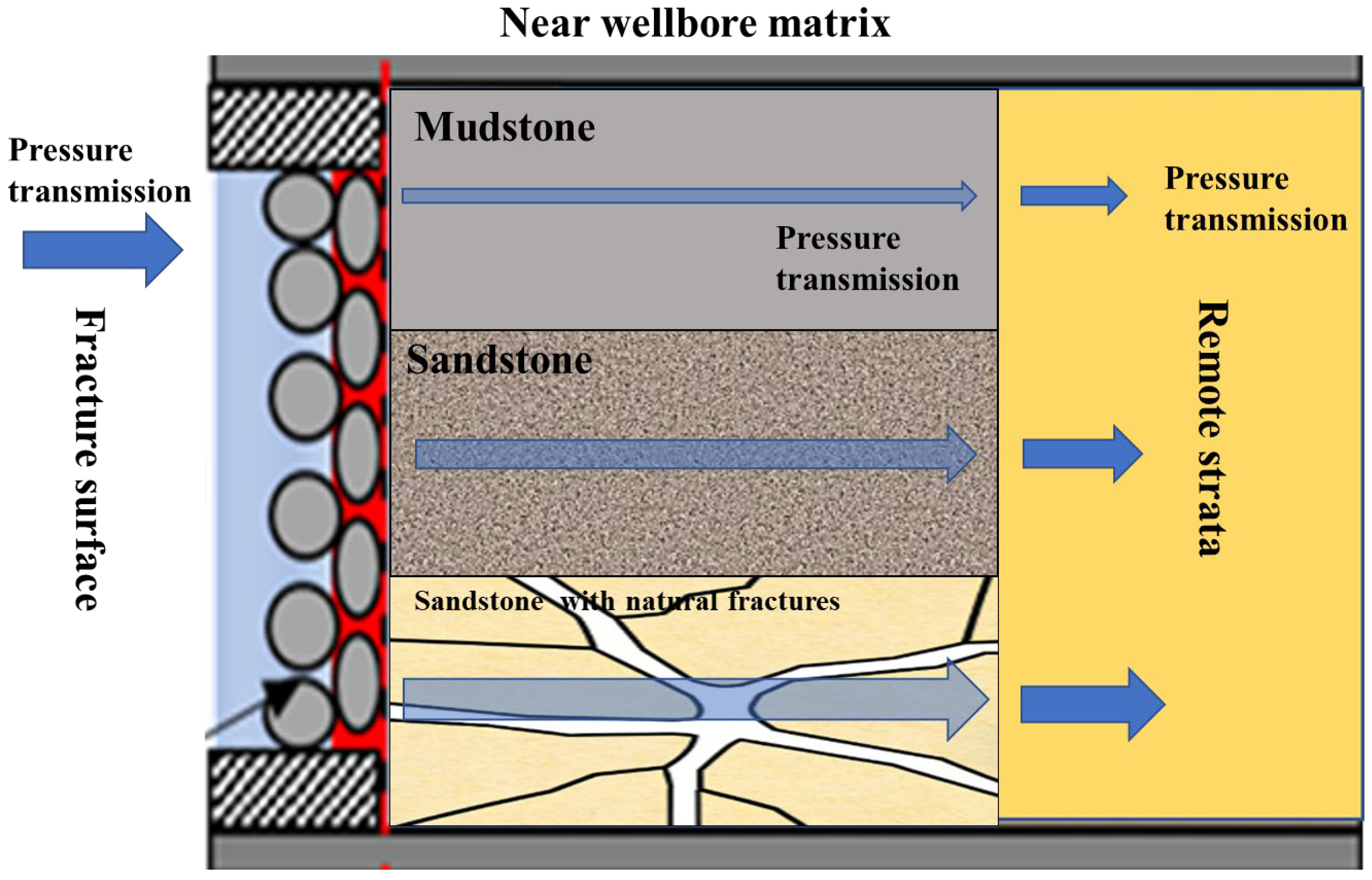
- Measure parameters such as core height, diameter, mass, permeability, porosity, etc. The core sample in the testing system corresponds to the reservoir interval between the water injection well and the production well in the field, including the fracture zone, near-fracture matrix, and distant matrix: the natural fractured sandstone core simulates the fracture zone of the field reservoir, the ordinary sandstone core simulates the near-fracture matrix, and the mudstone core simulates the distant low-permeability matrix, which is consistent with the actual field water flow path (water flows through fractures to near-fracture matrix to distant formations).
- (3)
- Using the prepared simulated slippery water saturated core, assemble the instrument according to Figure 2, maintain the formation temperature and pressure conditions (temperature 50 °C, pressure 20 MPa), and drive the slickwater into the core at a constant speed until the outlet pressure of the core gripper stabilizes. The core samples were collected from the underground rock cores of the Fuyu oil reservoir in the peripheral area of the Changyuan in the Songliao Basin, with the same lithology, pore structure and mineral composition as the actual reservoir; the slickwater used in the experiment was configured in strict accordance with the field application standard of the Fuyu oil reservoir, ensuring the consistency of fluid properties. Maintain the temperature and pressure conditions and continue aging for 3000 min. The inlet end of the testing system corresponds to the field water injection wellbore, where the TC-300D dual cylinder constant speed and pressure pump simulates the high-pressure water injection process of field water injection equipment, and the injection pressure (30–40 MPa) is consistent with the actual field water injection pressure range of the Fuyu oil reservoir.
- (4)
- According to the experimental plan in Table 2, inject the fracturing fluid at a constant pressure into the inlet end of the rock core. When the inlet pressure reaches the preset pressure, close the injection valve and record the dynamic pressure changes of the entire rock core system in real time. The outlet end of the testing system corresponds to the field production wellbore, and the pressure monitoring at the outlet end simulates the dynamic pressure response of the distant formation in the field during water injection, which is the core index to evaluate the field water injection energy enhancement effect.
- (5)
- The confining pressure control module (ISC0 confining pressure pump) of the system simulates the in situ stress of the field reservoir, and the temperature control module maintains the experimental temperature consistent with the field formation temperature, further ensuring the correspondence between the experimental system and field operations. Measure the porosity and permeability of the core again after the experiment is completed.
2.3. NMR Test
3. Experimental Results and Analysis
3.1. Analysis of the Effect of Lithological Changes on Energy Enhancement
3.1.1. Analysis of the Energy Enhancement Effect of High-Pressure Water Injection
3.1.2. Pore Structure Changes During the Energy Enhancement Process
3.2. Analysis of the Impact of Water Injection Methods on Energy Transfer Efficiency
3.2.1. Water Injection Intensity
3.2.2. Water Injection Method
4. Discussion
5. Conclusions
- (1)
- Pore connectivity and fracture development degree are the core factors dominating the water injection energy enhancement effect and pressure transmission efficiency in tight sandstone reservoirs. Experiments have shown that the order of the three lithological energy enhancement effects is: natural fracture developed sandstone > ordinary sandstone > mudstone. The equilibrium pressure increase of sandstone with natural fracture development reaches 6.89 MPa, ordinary sandstone is 6.17 MPa, and mudstone is only 5.05 MPa. The pore connectivity and fracture development degree directly determine the pressure equilibrium rate and energy increase amplitude. It is recommended to prioritize the identification and targeted utilization of fractured reservoirs during on-site development, and deploy water injection wells to fully leverage their advantages of fast pressure transmission and good energy enhancement. At the same time, optimize water injection strategies for mudstone development sections to improve overall energy enhancement uniformity.
- (2)
- The injection pressure is significantly positively correlated with the energy enhancement effect of water injection. Appropriately increasing the initial injection pressure can effectively lift the equilibrium pressure of the remote formation, but it is necessary to balance the cost of soaking time and the risk of reservoir damage. Experiments have shown that when the injection pressure is increased from 30 MPa to 40 MPa, the energy enhancement effect of natural fracture development sandstone increases by 24%, while mudstone only increases by 15%. Moreover, the higher the injection pressure, the longer the soaking time required to reach pressure equilibrium. It is recommended to control the on-site water injection pressure within the range of 30–40 MPa and dynamically adjust it based on the pressure response characteristics of different rock types to achieve a balance between energy enhancement, development efficiency, and reservoir protection. This study systematically revealed the coupling effect of lithology, injection pressure, and injection method on energy transfer and pressure response, and supplemented the quantitative correlation between pore structure evolution and pressure response, which fills the research gap of insufficient understanding of multi-factor coupling mechanism in existing studies.
- (3)
- Intermittent water injection has a significantly better energy enhancement effect than depletion water injection, which can effectively alleviate the energy loss of the formation and avoid the problems of pore throat blockage or energy loss caused by a single water injection method. Experimental data shows that compared with depleted water injection, intermittent water injection can increase the energy enhancement effect of natural fracture developed sandstone, ordinary sandstone, and mudstone by 18.6%, 12.0%, and 6.9%, respectively. It is recommended to design differentiated intermittent water injection cycles for reservoirs of different rock types. For natural fractured reservoirs, the cycle can be appropriately shortened to enhance the sustainability of energy enhancement. For mudstone reservoirs, the cycle can be optimized to reduce pore throat blockage caused by water rock reactions. For sandstone reservoirs, a medium cycle can be used to balance energy efficiency and cost.
- (4)
- Based on the shortcomings of this study and the needs of on-site development, it is recommended to fully consider the actual heterogeneity of the formation, temperature dynamic changes, and water rock chemical interactions during on-site development. By combining reservoir logging and well-testing data, the water injection process parameters should be optimized to enhance the on-site adaptability of research results. At the same time, follow-up research needs to supplement high-temperature and high-pressure water–rock chemical mechanical coupling experiments, deeply explore the influence of water–rock reactions on pore fracture structure and stress field, establish a quantitative model of fracture dynamic evolution and stress field response, deeply integrate indoor experimental results with numerical simulation technology, further improve the energy transfer mechanism of water injection in tight sandstone reservoirs, and provide more accurate and reliable theoretical and technical support for on-site optimization and efficient implementation of water injection energy enhancement schemes.
Author Contributions
Funding
Data Availability Statement
Conflicts of Interest
References
- Sun, L.D.; Zou, C.N.; Jia, A.L.; Wei, Y.S.; Zhu, R.K.; Wu, S.T.; Guo, Z. Development characteristics and orientation of tight oil and gas in China. Pet. Explor. Dev. 2019, 46, 1073–1087. [Google Scholar] [CrossRef]
- Azeem, R.; Mohammad, K.A.; Tawfik, A.S. Advanced developments in shale inhibitors for oil production with low environmental footprints—A review. Fuel 2019, 247, 237–249. [Google Scholar] [CrossRef]
- Dai, J.X.; Dong, D.Z.; Ni, Y.Y.; Gong, D.Y.; Huang, S.P.; Hong, F.; Zhang, Y.L.; Liu, Q.Y.; Wu, X.Q.; Feng, Z.Q. Distribution patterns of tight sandstone gas and shale gas. Pet. Explor. Dev. 2024, 51, 767–779. [Google Scholar] [CrossRef]
- Jia, C.Z.; Zou, C.N.; Li, J.Z.; Li, D.H.; Zheng, M. Evaluation criteria, major types, characteristics and resource prospects of tight oil in China. Pet. Res. 2016, 1, 1–9. [Google Scholar] [CrossRef]
- Yang, H.; Li, S.X.; Liu, X.Y. Characteristics and resource prospects of tight oil in Ordos Basin, China. Pet. Res. 2016, 1, 27–38. [Google Scholar] [CrossRef]
- Yan, B.; Liu, H.Y.; Peng, X.Y. Scenario analysis to evaluate the economic benefits of tight oil resource development in China. Energy Strategy Rev. 2024, 51, 101318. [Google Scholar] [CrossRef]
- Savitski, A.A.; Detournay, E. Propagation of a penny-shaped fluid-driven fracture in an impermeable rock: Asymptotic solutions. Int. J. Solids Struct. 2002, 39, 6311–6337. [Google Scholar] [CrossRef]
- Vilarrasa, V.; Laloui, L. Potential fracture propagation into the caprock induced by cold injection in normal faulting stress regimes. Geomech. Energy Environ. 2015, 2, 22–31. [Google Scholar] [CrossRef]
- Jing, W.; Liu, J.G.; Li, Z.G.; Li, H.C.; Zhang, J.S.; Li, W.Q.; Zhang, Y.L.; Ping, Y.; Yang, H.Y.; Wang, P. Synchronous injection production energy replenishment for a horizontal well in an ultra-low permeability sandstone reservoir: A case study of Changqing oilfield in Ordos Basin, NW China. Pet. Explor. Dev. 2020, 47, 827–835. [Google Scholar] [CrossRef]
- Elbel, J.L.; Mack, M.G. Refracturing Observations and Theories. In Proceedings of the SPE Production Operations Symposium, Oklahoma City, OA, USA, 21–23 March 1992. [Google Scholar]
- Wright, C.A.; Conant, R.A.; Golich, G.M. Hydraulic Fracture Orientation and Production/Injection Induced Reservoir Stress Changes in Diatomite. In Proceedings of the SPE Western Regional Meeting, Bakersfield, CA, USA, 8–10 March 1995. [Google Scholar]
- Gupta, J.; Zielonka, M.; Albert, R.A. Integrated Methodology for Optimizing Development of Unconventional Gas Resources. In Proceedings of the SPE Hydraulic Fracturing Technology Conference, The Woodlands, TX, USA, 6–8 February 2012. [Google Scholar]
- Roussel, N.P.; Florez, H.; Rodriguez, A.A. Hydraulic Fracture Propagation from Infill Horizontal Wells. In Proceedings of the SPE Annual Technical Conference and Exhibition, New Orleans, LA, USA, 30 September–2 October 2013. [Google Scholar]
- Li, X.; Wang, J.; Elsworth, D. Stress redistribution and fracture propagation during restimulation of gas shale reservoirs. J. Pet. Sci. Eng. 2017, 154, 150–160. [Google Scholar] [CrossRef]
- Gan, Q.; Elsworth, D.; Zhao, Y.X.; Grippa, A.; Hurst, A. Coupled hydro-mechanical evolution of fracture permeability in sand injectite intrusions. J. Rock Mech. Geotech. Eng. 2020, 12, 742–751. [Google Scholar] [CrossRef]
- Fernandes, F.B.; Braga, A.M.B.; Souza, A.L.S.A.; Soares, C. Mechanical formation damage control in permeability Biot’s effective stress-sensitive oil reservoirs with source/sink term. J. Pet. Sci. Eng. 2023, 220, 111180. [Google Scholar] [CrossRef]
- Ingraham, M.D.; Bauer, S.J.; Issen, K.A.; Dewers, T.A. Evolution of permeability and Biot coefficient at high mean stresses in high porosity sandstone. Int. J. Rock Mech. Min. Sci. 2017, 96, 1–10. [Google Scholar] [CrossRef]
- Liu, Y.X.; Cheng, J.X.; Wang, G.; Gao, Y.; Jiang, C.R.; Xu, J. Deterioration mechanism of sandstone under coupling compression-shear stress and local borehole water pressure. J. Appl. Geophys. 2025, 243, 105984. [Google Scholar] [CrossRef]
- Li, N.; Jin, Z.; Wang, H.; Zou, Y.; Zhang, S.; Li, F.; Zhou, T.; Jiang, M. Investigation into shale softening induced by water/CO2-rock interaction. Int. J. Rock Mech. Min. Sci. 2023, 161, 105299. [Google Scholar] [CrossRef]
- Ding, S.; Tang, S.B.; Jia, H.L.; Li, Y.B. The influence of water on the failure characteristics of sandstone under uniaxial compres-sion conditions by acoustic emission and NMR observation. Eng. Geol. 2023, 322, 107173. [Google Scholar] [CrossRef]
- Ding, Y.G.; Qiao, L.; Li, Z.H.; Luo, R.B.; Han, G.D.; Tan, J.Q.; Liu, X. Experimental study on oil recovery characteristics of different CO2 flooding methods in sandstone reservoirs with NMR. Fuel 2025, 385, 134124. [Google Scholar] [CrossRef]
- Zou, Y.S.; Li, N.; Ma, X.F. Experimental study on the growth behavior of supercritical CO2-induced fractures in a layered tight sandstone formation. J. Nat. Gas Sci. Eng. 2018, 49, 145–156. [Google Scholar] [CrossRef]
- Ishida, T.; Aoyagi, K.; Niwa, T. Acoustic emission monitoring of hydraulic fracturing laboratory experiment with super critical and liquid CO2. Geophys. Res. Lett. 2012, 39, L16309. [Google Scholar] [CrossRef]
- Li, S.H.; Zhang, S.C.; Zou, Y.S. Pore structure alteration induced by CO2-brine-rock interaction during CO2 energetic fracturing in tight oil reservoirs. J. Pet. Sci. Eng. 2020, 191, 107147. [Google Scholar] [CrossRef]
- Ribeiro, L.H.; Li, H.N.; Bryant, J.E. Use of a CO2-hybrid fracturing design to enhance production from unpropped-fracture networks. SPE Prod. Oper. 2017, 32, 28–40. [Google Scholar] [CrossRef]
- Liu, K.X.; Chen, G.L.; Wang, P.F.; Chen, Y.; Huang, F.; Luo, Y.F. Experimental investigation of surfactant-enhanced water injection in coal seams. J. Mol. Liq. 2025, 436, 128237. [Google Scholar] [CrossRef]
- Chen, K.; Zhang, J.R.; Xu, S.Y.; Yin, M.Z.; Zhang, Y.; Zhao, Y.C.; Song, Y.C. Review of carbonated water injection as a promising technology to enhance oil recovery in the petroleum industry: Challenges and prospects. Pet. Sci. 2024, 21, 4100–4118. [Google Scholar] [CrossRef]
- Zeng, L.P.; Akhondzadeh, H.; Iqbal, M.A. Effect of fluid-shale interactions on shales micromechanics: Nanoindentation experiments and interpretation from geochemical perspective. J. Nat. Gas Sci. Eng. 2022, 101, 104545. [Google Scholar] [CrossRef]
- Li, S.H.; Zhang, S.C.; Ma, X.F. Hydraulic fractures induced by water-/carbon dioxide-based fluids in tight sandstones. Rock Mech. Rock Eng. 2019, 52, 3323–3340. [Google Scholar] [CrossRef]
- Xu, R.Z.; Yang, S.L.; Xiao, Z.P. Quantitatively study on imbibition of fracturing fluid in tight sandstone reservoir under high temperature and high pressure based on NMR technology. J. Pet. Sci. Eng. 2022, 208, 109623. [Google Scholar] [CrossRef]
- Chen, G.; Chen, M.; Lu, Y.H.; Chen, B.B.; Sun, F.R.; Lou, E.B.; Wang, K.X. Experimental Investigation on Mechanical Properties and Failure Mode of Natural Fractured Sandstone. Presented at the SPE Argentina Exploration and Production of Unconventional Resources Symposium, Neuquen, Argentina, 14–16 August 2018. [Google Scholar] [CrossRef]
- Li, D.; Li, Y.; Zhu, W. Analytical Modelling of Load–Displacement Performance of Cable Bolts Incorporating Cracking Propagation. Rock Mech. Rock Eng. 2020, 53, 3471–3483. [Google Scholar] [CrossRef]
- Liu, T.F.; Wang, G.; Wang, C.S.; Jiang, Y.J.; Wu, X.Z.; Zhang, F.L.; Zheng, W.; Chang, D.T. Experimental and numerical study on the mechanical and failure characteristics of red sandstone with hole–fissure defects under biaxial compression. Theor. Appl. Fract. Mech. 2025, 140, 105124. [Google Scholar] [CrossRef]
- Fu, J.W.; Labuz, J.F.; Guo, M.D.; Cheng, H.X.; Hou, R.B. Experimental and numerical investigations on hydraulic fracture growth using rock-like resin material containing an injecting inner pre-crack. J. Pet. Sci. Eng. 2022, 213, 110424. [Google Scholar] [CrossRef]
- Qiu, C.; Yang, Y.G.; Chen, Y.; Huang, B.X.; Shang, R.P.; Cai, C.Z.; Liu, W. Pore-fracture evolution and seepage behavior in sandstone under triaxial stress: Insights from real-time CT imaging. Int. J. Rock Mech. Min. Sci. 2025, 195, 106292. [Google Scholar] [CrossRef]
- Eyitayo, S.I.; Gamadi, T.I.I.; Kolawole, O.; Watson, M.C. Produced water integration in CO2 storage using different injection strategies: The effect of salinity on rock petrophysical, mineralogy, wettability and geomechanical properties. J. Environ. Manag. 2024, 372, 123307. [Google Scholar] [CrossRef]
- Deng, Q.; Ginting, V.; McCaskill, B.; Torsu, P. A locally conservative stabilized continuous Galerkin finite element method for two-phase flow in poroelastic subsurfaces. J. Comput. Phys. 2017, 347, 78–98. [Google Scholar] [CrossRef]
- Zhang, Y.H.; Ju, Y. Integrating the 3D-GMTSN criterion with XFEM to simulate the spatial propagation trajectory of hydraulic fractures interacting with natural fractures. Eng. Fract. Mech. 2025, 329, 111605. [Google Scholar] [CrossRef]
- Yang, D.; Xu, S.; Liu, B.C.; Guo, Y.X.; Wang, Y.F.; Wen, K.; Jia, Y.R.; Li, Q.Q.; Nie, J.H. A critical review of pore pressure–stress coupling: Mechanisms, modeling, and implications for subsurface energy systems. Geoenergy Sci. Eng. 2026, 260, 214388. [Google Scholar] [CrossRef]
- Eberhardt, E.; Stead, D.; Stimpson, B. Quantifying progressive pre-peak brittle fracture damage in rock during uniaxial compression. Int. J. Rock Mech. Min. Sci. 1999, 36, 361–380. [Google Scholar] [CrossRef]
- Li, H.R.; Qiao, Y.F.; He, M.C.; Shen, R.X.; Gu, Z.J.; Cheng, T.; Tang, J. Effect of water saturation on dynamic behavior of sandstone after wetting-drying cycles. Eng. Geol. 2023, 319, 107105. [Google Scholar] [CrossRef]
- Lu, Y.Y.; Chen, X.Y.; Tang, J.R.; Li, H.L.; Zhou, L.; Han, S.B.; Ge, Z.L.; Xia, B.W. Relationship between pore structure and mechanical properties of shale on supercritical carbon dioxide saturation. Energy 2019, 172, 270–285. [Google Scholar] [CrossRef]
- Su, Y.; Lai, J.; Dang, W.L.; Bie, K.; Zhao, Y.D.; Zhao, X.J. Pore structure characterization and reservoir quality prediction in deep and ultra-deep tight sandstones by integrating image and NMR logs. J. Asian Earth Sci. 2024, 272, 106232. [Google Scholar] [CrossRef]
- Zhou, J.P.; Yang, K.; Tian, S.F.; Zhou, L.; Xian, X.F.; Jiang, Y.D.; Liu, M.H.; Cai, J.C. CO2-water-shale interaction induced shale microstructural alteration. Fuel 2020, 263, 116642. [Google Scholar] [CrossRef]



| Type of Rock | Sample Number | Quality /G | Diameter /mm | Length /mm | Permeability /mD | Porosity /% | Median Pore Diameter/nm |
|---|---|---|---|---|---|---|---|
| Mudstone | M1 | 54.25 | 25.3 | 49.5 | 0.59 | 5.64 | 315.26 |
| M2 | 53.64 | 25.1 | 49.2 | 0.64 | 5.81 | 301.44 | |
| Sandstone | S1 | 53.35 | 24.7 | 50.1 | 1.08 | 13.56 | 1689.21 |
| S2 | 53.22 | 24.9 | 50.3 | 1.02 | 12.98 | 1768.45 | |
| Sandstone with natural fracture | NS1 | 53.15 | 25.2 | 49.9 | 1.45 | 17.53 | 2365.78 |
| NS2 | 53.27 | 25.1 | 50.5 | 1.38 | 16.88 | 2298.01 |
| Sample Number | Injection Pressure/MPa | Injection Method |
|---|---|---|
| M1 | 30, 35, 40 | Depleted water injection |
| S1 | 30, 35, 40 | Depleted water injection |
| NS1 | 30, 35, 40 | Depleted water injection |
| M2 | 30 | Intermittent water injection |
| S2 | 30 | Intermittent water injection |
| NS2 | 30 | Intermittent water injection |
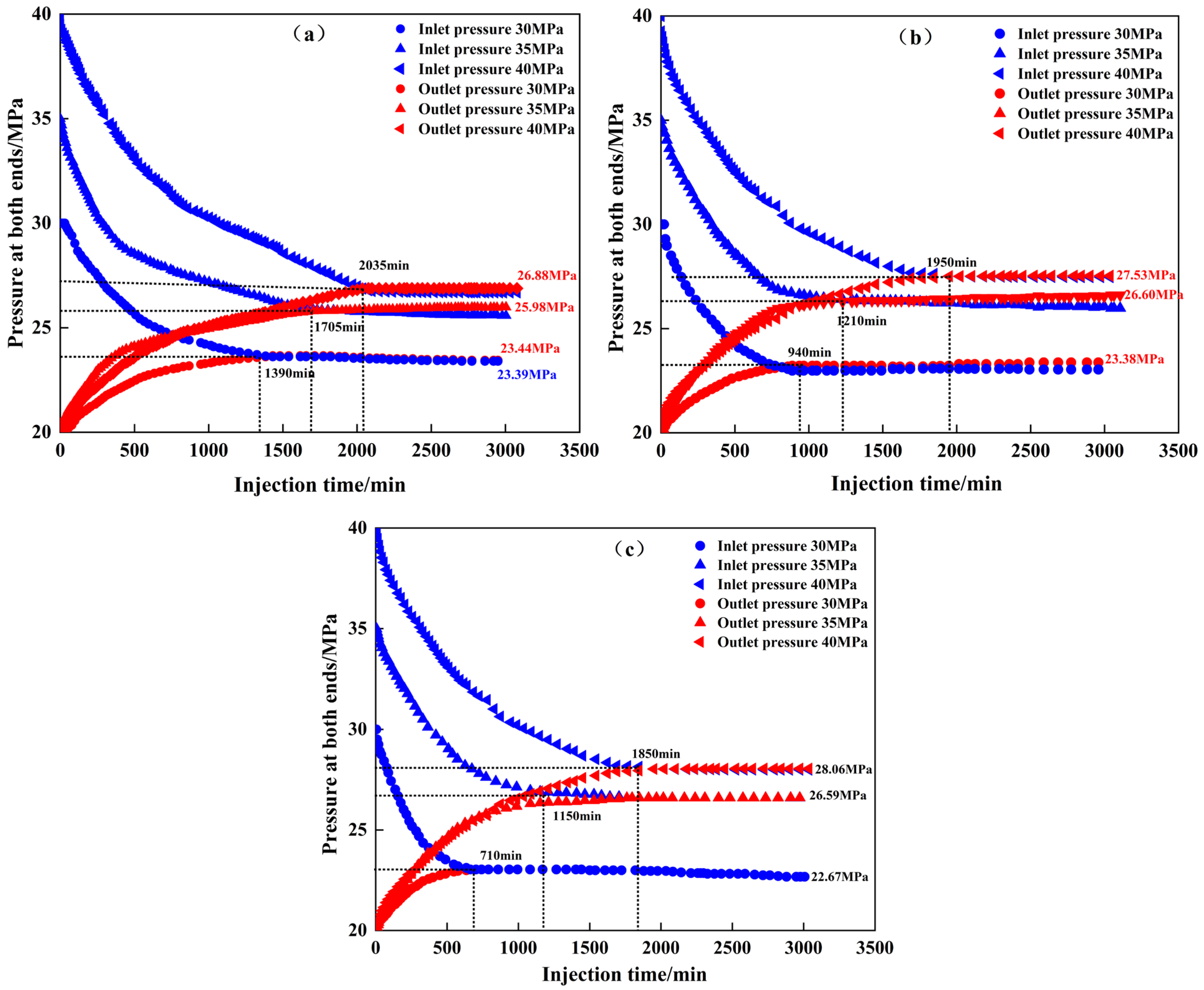
| Type of Rock | Injection Pressure/MPa | Balance Pressure at the Inlet End/MPa | Balance Pressure at the Outlet End/MPa | Pressure Equilibrium Time/min | Energy Enhancement Efficiency/% |
|---|---|---|---|---|---|
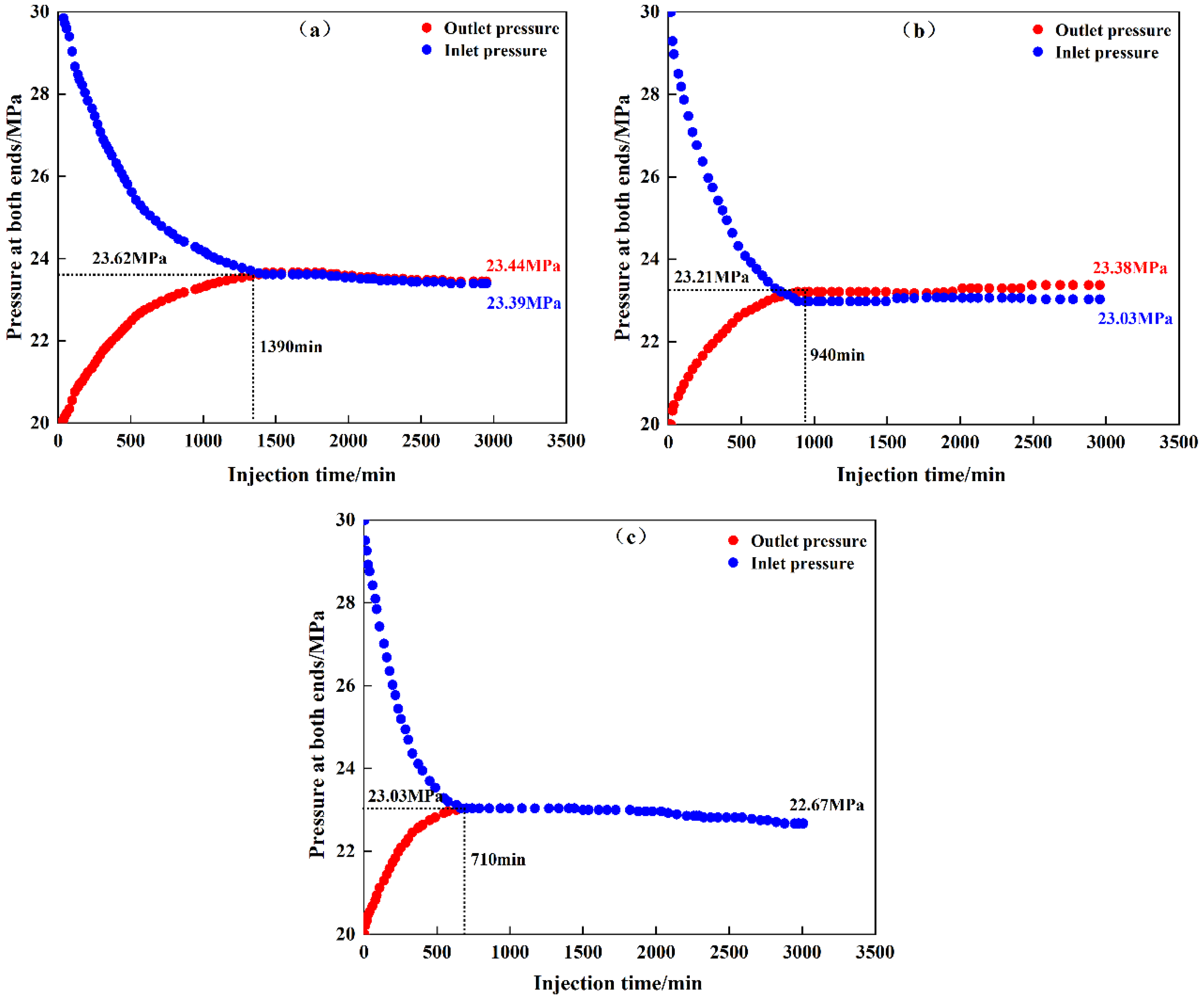
| Mudstone | 30 | 23.39 | 23.44 | 1390 | 52.04 |
| Sandstone | 30 | 23.03 | 23.38 | 940 | 48.49 |
| Sandstone with natural fracture | 30 | 22.67 | 22.67 | 710 | 36.43 |
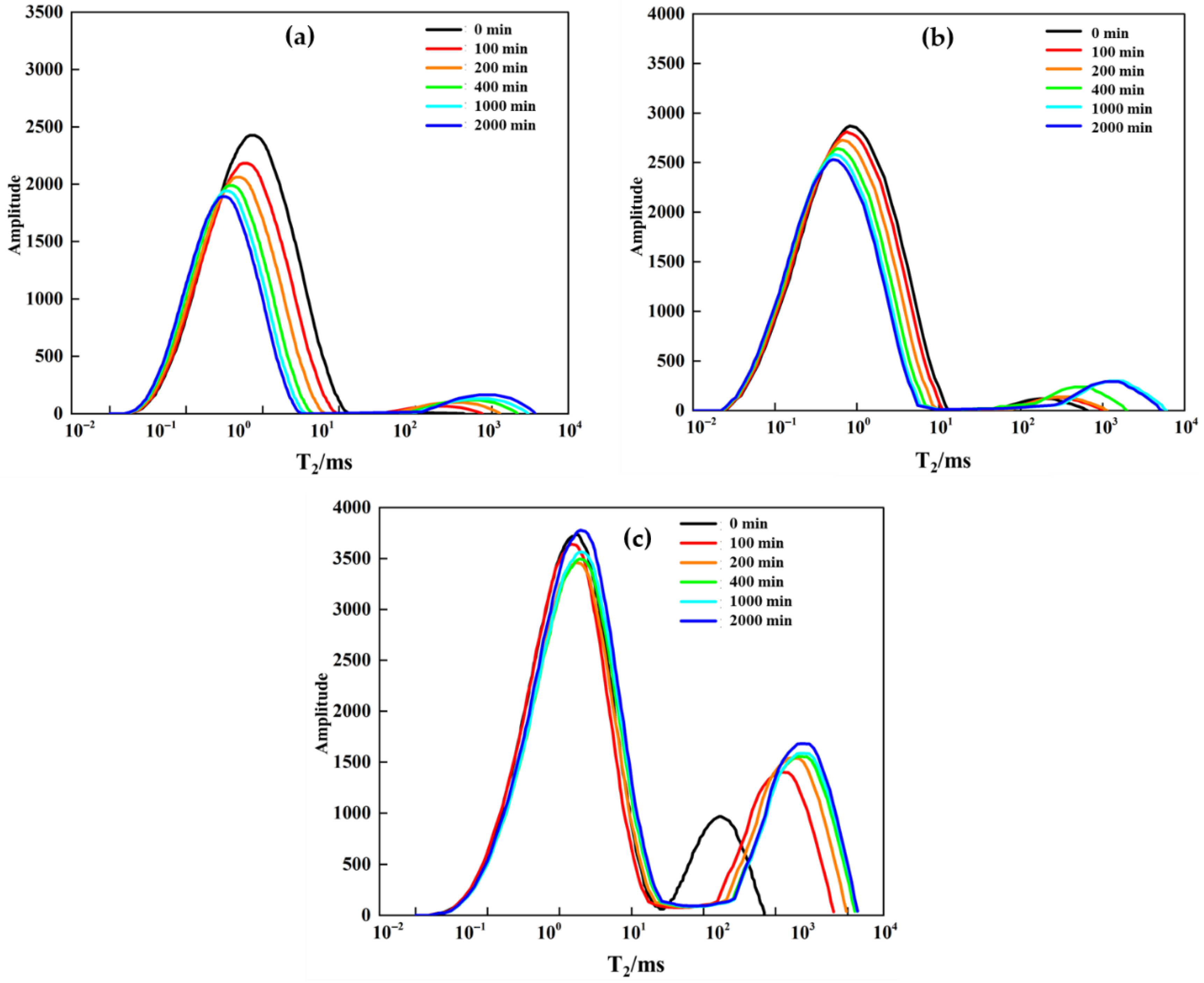
| Type of Rock | Injection Time/min | Micropore (<1000 nm) | Macropore (>1000 nm) | ||
|---|---|---|---|---|---|
| Proportion/% | Increasing Rate/% | Proportion/% | Increasing Rate/% | ||
| Mudstone | 0 | 76.3 | 0 | 23.7 | 0 |
| 100 | 79.6 | 3.3 | 20.4 | −3.3 | |
| 200 | 81.5 | 1.9 | 18.5 | −1.9 | |
| 400 | 82.7 | 1.2 | 17.3 | −1.2 | |
| 1000 | 83.1 | 0.4 | 16.9 | −0.4 | |
| 2000 | 83.5 | 0.4 | 16.5 | −0.4 | |
| Sandstone | 0 | 61.4 | 0 | 38.6 | 0 |
| 100 | 62.7 | 1.3 | 37.3 | −1.3 | |
| 200 | 63.5 | 0.8 | 36.5 | −0.8 | |
| 400 | 64.3 | 0.8 | 35.7 | −0.8 | |
| 1000 | 64.9 | 0.6 | 35.1 | −0.6 | |
| 2000 | 65.2 | 0.3 | 34.8 | −0.3 | |
| Sandstone with natural fracture | 0 | 56.4 | 0 | 43.6 | 0 |
| 100 | 52.9 | −3.5 | 47.1 | 3.5 | |
| 200 | 49.6 | −3.3 | 50.4 | 3.3 | |
| 400 | 48.2 | −1.4 | 51.8 | 1.4 | |
| 1000 | 47.5 | −0.7 | 52.5 | 0.7 | |
| 2000 | 47.1 | −0.4 | 52.9 | 0.4 | |
| Type of Rock | Injection Pressure/MPa | Balance Pressure at the Inlet End/MPa | Balance Pressure at the Outlet End/MPa | Pressure Equilibrium Time/min | Energy Enhancement Efficiency/% |
|---|---|---|---|---|---|
| Mudstone | 30 | 23.39 | 23.44 | 1390 | 50.04 |
| 35 | 25.82 | 25.98 | 1705 | 65.14 | |
| 40 | 26.84 | 26.88 | 2035 | 52.28 | |
| Sandstone | 30 | 23.03 | 23.38 | 940 | 48.49 |
| 35 | 26.45 | 26.6 | 1210 | 77.19 | |
| 40 | 27.53 | 27.53 | 1950 | 60.38 | |
| Sandstone with natural fracture | 30 | 22.67 | 22.67 | 710 | 36.43 |
| 35 | 26.56 | 26.56 | 1150 | 77.72 | |
| 40 | 28.06 | 28.06 | 1850 | 67.50 |
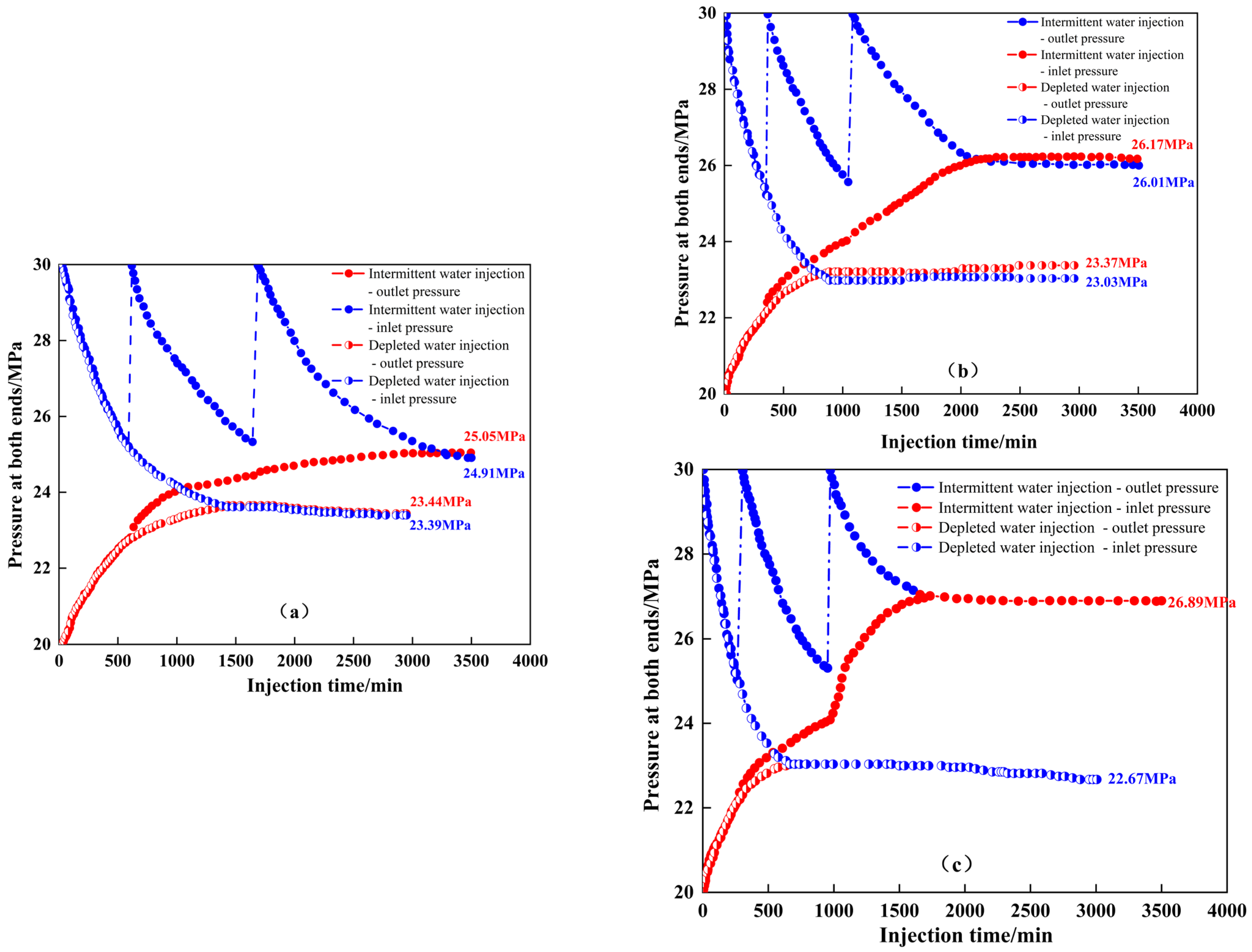
| Type of Rock | Water Injection Method | Balance Pressure at the Inlet End/MPa | Balance Pressure at the Outlet End/MPa | Pressure Equilibrium Time/min | Energy Enhancement Efficiency/% |
|---|---|---|---|---|---|
| Mudstone | Depleted water injection | 23.39 | 23.44 | 1390 | 52.04 |
| Intermittent water injection | 24.91 | 25.05 | / | 99.21 | |
| Sandstone | Depleted water injection | 23.03 | 23.38 | 940 | 48.49 |
| Intermittent water injection | 26.01 | 26.17 | / | 154.64 | |
| Sandstone with natural fracture | Depleted water injection | 22.67 | 22.67 | 710 | 36.43 |
| Intermittent water injection | 26.89 | 26.89 | / | 221.54 |
Disclaimer/Publisher’s Note: The statements, opinions and data contained in all publications are solely those of the individual author(s) and contributor(s) and not of MDPI and/or the editor(s). MDPI and/or the editor(s) disclaim responsibility for any injury to people or property resulting from any ideas, methods, instructions or products referred to in the content. |
© 2026 by the authors. Licensee MDPI, Basel, Switzerland. This article is an open access article distributed under the terms and conditions of the Creative Commons Attribution (CC BY) license.
Share and Cite
Liu, L.; Ma, X.; Zou, Y.; Zhang, S. Research on High-Pressure Energy Injection and Response Mechanism in Tight Sandstone Reservoirs. Processes 2026, 14, 945. https://doi.org/10.3390/pr14060945
Liu L, Ma X, Zou Y, Zhang S. Research on High-Pressure Energy Injection and Response Mechanism in Tight Sandstone Reservoirs. Processes. 2026; 14(6):945. https://doi.org/10.3390/pr14060945
Chicago/Turabian StyleLiu, Li, Xinfang Ma, Yushi Zou, and Shicheng Zhang. 2026. "Research on High-Pressure Energy Injection and Response Mechanism in Tight Sandstone Reservoirs" Processes 14, no. 6: 945. https://doi.org/10.3390/pr14060945
APA StyleLiu, L., Ma, X., Zou, Y., & Zhang, S. (2026). Research on High-Pressure Energy Injection and Response Mechanism in Tight Sandstone Reservoirs. Processes, 14(6), 945. https://doi.org/10.3390/pr14060945