1. Introduction
Gas turbines possess advantages such as high power output, compact size, light weight, rapid start-up, excellent acceleration performance, and strong maneuverability, thereby demonstrating remarkable value in their application within the power industry [
1]. Compared with traditional coalfired power generation, modern gas turbines exhibit higher thermal efficiency, enabling more efficient conversion of fuel energy into electrical energy and reducing energy waste. This high-efficiency energy conversion capability renders gas turbines particularly crucial for supporting the stable operation of power grids and addressing peak electricity demand, effectively enhancing the operational efficiency of power grids and the quality of power generation [
2].
Rapid start-up, shutdown, and acceleration–deceleration operations are the primary operating modes of modern gas turbines. However, in land-based microgrids and marine isolated power grids, transient load mutations can occur due to factors such as the start-stop of high-power equipment and sudden increases or decreases in load [
3]. Under such circumstances, the metal components—originally in thermal equilibrium with the working fluid in the flow path—exhibit a significantly slower temperature response than the flow path working fluid, which is attributed to thermal inertia caused by heat capacity [
4]. This characteristic leads to a noticeable temperature difference between the flow path working fluid and the metal components during the transient process between two operating conditions; consequently, a non-negligible heat transfer effect arises between them during this period. Furthermore, this heat transfer effect causes changes in the temperature of the flow path working fluid and subsequent variations in aerodynamic parameters, ultimately resulting in deviations in the actual operating characteristics of the gas turbine [
5]. Such deviations can severely affect the operational performance and stability of the gas turbine.
Understanding the dynamic characteristics of gas turbines under these operating conditions is crucial for the successful operation and maintenance of power grids [
6]. To obtain accurate dynamic characteristics of marine gas turbines during transient operating conditions, it is necessary to conduct refined simulations of the internal heat transfer effects of gas turbines that closely align with real physical processes and to establish a simulation model for the entire gas turbine system.
At the component level of gas turbines, computational fluid dynamics (CFD) software (e.g., ANSYS CFX 2023 R1, ANSYS FLUENT 2023 R1) can be utilized to perform three-dimensional (3D) modeling and simulation for most gas turbine components [
7]. The use of 3D simulation enables the representation of component characteristics across axial, radial, and circumferential dimensions, the description of 3D interactions between components and flow paths, as well as the investigation of complex physical phenomena and flow field distributions inside the components. However, at the full gas turbine system level, 3D simulation has not yet become the mainstream approach [
8].
The primary reason is that a complete gas turbine constitutes a transient and complex system composed of hundreds or thousands of components. It involves transient modeling of a multi-component and multi-disciplinary integration, including components with different structures and functions, the flow of various fluids, and a variety of non-pure flow phenomena. Currently, CFD simulation software remains incapable of handling such complexity and workload [
9]. Moreover, even if successful modeling is achieved using CFD tools, the computational cycle would be unacceptably long due to the enormous computational load.
Our previous experimental study conducted 40 continuous cycles of transient tests (start-up, acceleration, deceleration, shutdown) on a two-shaft gas turbine, quantitatively revealing that thermal inertia induces remarkable response lags—with a temperature lag rate of up to 88% during cold start [
10]. This study confirmed that thermal inertia significantly alters the dynamic characteristics of gas turbines, laying a solid experimental foundation for subsequent simulation research.
Building on this experimental data, we further established a 3D CFD simulation model of gas turbine impeller components to investigate the coupling mechanism between thermal inertia and component performance. The simulation results verified that heat transfer between the working fluid and metal components converts 6–15% of the exchanged heat into technical work changes and clarified the characteristic curve shift law of compressors and turbines under different thermal conditions. This component-level simulation quantitatively described the internal temperature field distribution and heat transfer rules, but the 3D simulation cannot be directly applied to the full-system simulation of gas turbines due to excessive computational load [
11].
Therefore, in full-system-level simulation studies, a reasonable balance must be struck between the accuracy of component models and the complexity of the entire gas turbine system [
12]. A common approach involves using one-dimensional (1D) or zero-dimensional (0D) simplified models for modeling and simulation, with a focus on the overall performance of the system and the general role of individual components during the dynamic changes of the system [
13]. This approach, however, inevitably sacrifices a detailed investigation of complex flow and heat transfer phenomena inside the gas turbine to a certain extent.
While this simplification can significantly reduce the required computational load and shorten the calculation cycle, it introduces a limitation. Specifically, the simulation results obtained from such simplified 1D/0D models typically can only represent the average values of temperature, flow velocity, or pressure in a specific section of the gas turbine flow path at a given moment, and they fail to capture the detailed distributions of the temperature field and flow field. This limitation tends to introduce significant errors when studying relatively complex flow and thermal inertia problems [
14].
To address this challenge and ensure simulation accuracy in thermal inertia studies of gas turbines while minimizing computational cost, data scaling technology presents a viable solution. This technique can be employed to couple the 3D simulation results of the impeller component flow path with the 1D models of other gas turbine components. This approach enables the true establishment of a multi-dimensional full-gas-turbine model, thereby achieving a more accurate dynamic simulation model of the gas turbine without significantly increasing the computational load [
15,
16].
The fundamental concept of data scaling technology in gas turbine simulation research is to achieve data interoperability between 3D models of key gas turbine components (e.g., compressors, turbines) and low-dimensional full-system models through specific methods, thereby realizing the integration of component models across different dimensions.
In 3D models, simulation data exist in the form of 3D fields. If all data at grid points in the 3D field were converted into lattice data and directly transmitted to the 1D model for calculation, the data volume would be extremely large (the number of data points equals the grid count of the 3D CFD model). Furthermore, as the number of iterations of the 1D model itself increases, the computational load induced by this data would grow exponentially, and the calculation cycle would be prolonged to an unacceptable extent. Therefore, data dimensionality reduction is necessary when transmitting data to the 1D model—specifically, converting the 3D field data into representative point/line-form data to facilitate its application in the low-dimensional model.
A critical aspect of investigating thermal inertia lies in focusing on the distribution of and variation in temperature. Different temperature fields on the surface of metal components influence the amount of heat transferred between the metal and the working fluid, thereby affecting the dynamic performance of the gas turbine [
17]. Therefore, a method is needed that can efficiently search for sampling points representing temperature gradient changes in complex temperature fields.
Genetic algorithms (GAs), which simulate the processes of selection, crossover, and mutation in biological evolution, enable rapid search and optimization without being constrained by specific problem characteristics. Moreover, GAs adopt a probabilistic optimization approach, which allows dynamic adjustment of the search direction. This effectively prevents trapping in local optimal solutions and endows GAs with excellent global search capabilities [
18].
Against this background, to ensure that the sampling point density can be adjusted according to the gradient of the temperature distribution while obtaining simulation data that closely approximate real-world conditions with as few sampling points as possible, this study proposes a temperature-gradient-guided dynamic genetic optimization sampling algorithm (TDGA) to address the bottleneck of temperature field data interoperability between 3D CFD and 1D models. The core innovations of this study are threefold:
- (1)
Proposing a temperature gradient-guided dynamic genetic optimization sampling algorithm integrating a dynamic encoding mechanism and a temperature gradient weight matrix, realizing adaptive sampling of the temperature field based on gradient distribution;
- (2)
Establishing a fully coupled simulation framework of the gas turbine 3D CFD turbine flow path model and 1D metal component heat transfer model, enabling the integration of detailed temperature field information from 3D models into 1D full-system simulations;
- (3)
Designing dynamic weight coefficients and adaptive crossover/mutation probabilities for the multi-objective optimization function, effectively balancing the global exploration and local exploitation capabilities of the algorithm during the optimization process.
2. Establishment of 3D and 1D Simulation Models for Gas Turbines
2.1. 3D Simulation Model of Gas Turbine Flow Paths
The study focuses on a two-shaft gas turbine, with the turbine section—where thermal inertia effect are most pronounced—selected for detailed modeling. To account for varying heat transfer conditions, a 3D simulation model capable of reflecting thermal inertia effects within the flow path is established.
The commercial solver ANSYS CFX is used to solve the 3D compressible viscous Reynolds-averaged Navier–Stokes equations. An unstructured mesh is generated using ANSYS TURBOGRID software. Accurate resolution of the boundary layer development, critical for heat transfer prediction, is achieved by implementing layers of prismatic elements near all solid walls, despite the general use of tetrahedral cells in the bulk flow, as prismatic elements offer superior accuracy for boundary layers.
The turbine section includes a single-stage high-pressure turbine and a two-stage power turbine. Separate 3D CFD models are established for each due to differences in their geometry and operating characteristics. To simulate various thermal conditions, different wall heat flux densities (
Φ) are set as boundary conditions, corresponding to a range of dimensionless heat transfer coefficient (
q*) values, as detailed in
Table 1.
The power turbine consists of two rows of rotors and two rows of stators arranged alternately. Due to differences in the radius of stators and rotors at each stage, as well as in the geometric characteristics of blade profiles, the number of blades in the four rows of turbines varies. Therefore, for a single-flow passage in the CFD simulation, flux-related parameters (such as mass flow rate, volume flow rate, and heat flux) at each stage need to be multiplied by the number of blades at the corresponding stage.
Because the sampling region of this study is the inner wall surface of the casing, the flow state in the central region of the fluid has little impact on the wall surface. To simplify the calculation steps and shorten the computation cycle, the model was simplified to a straight blade without radial twist. The total number of meshes is approximately 1.2 million, with a minimum orthogonality angle of 22.30°.
Boundary layers were added to the blade surface, the inner wall surface of the cooling air cavity, and the internal channel of the film cooling holes. The thickness of the first boundary layer was set to 1 × 10
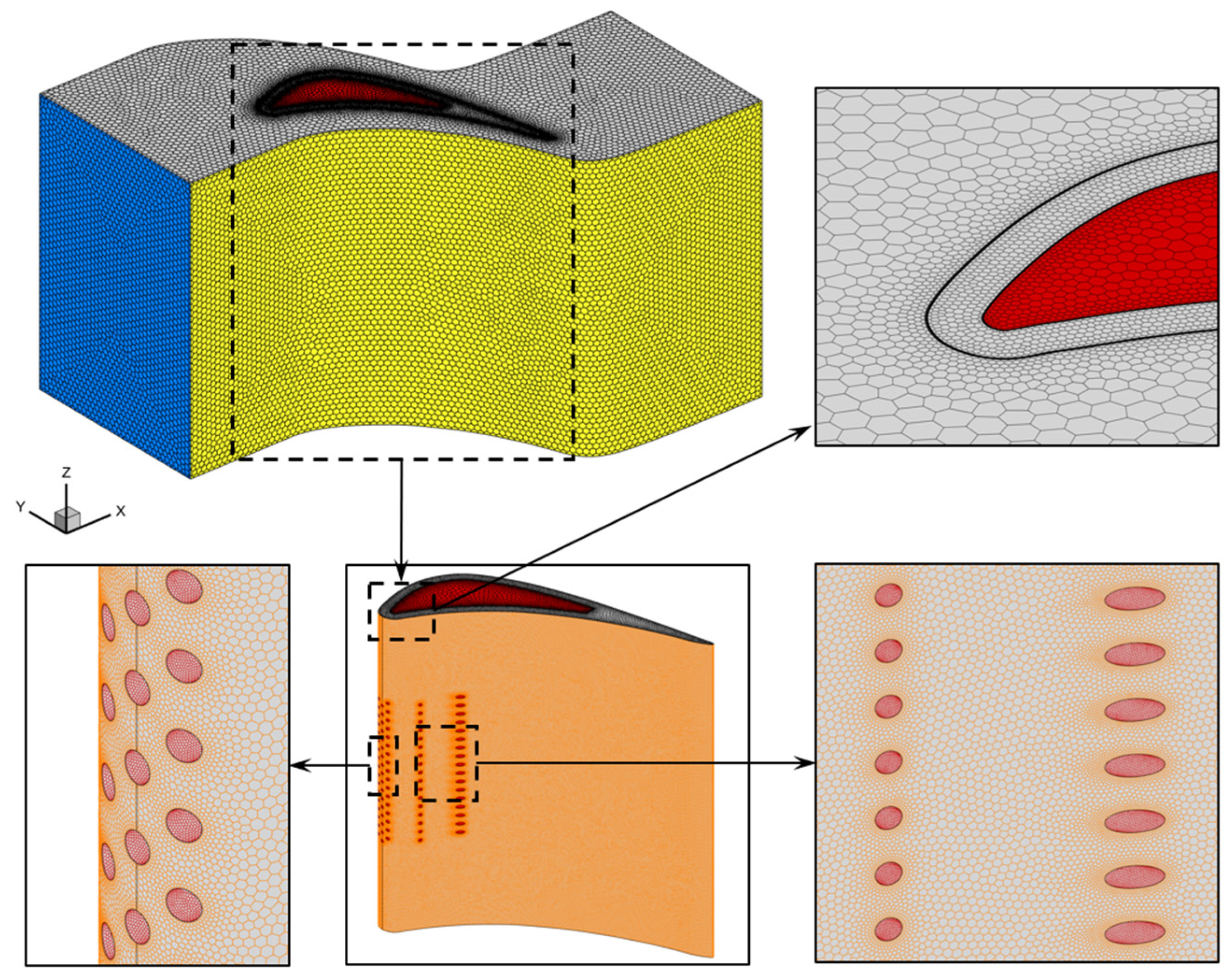
−3 mm with a growth rate of 1.2. The number of boundary layer layers was 18, 16, and 18 for the three locations, respectively. Meanwhile, mesh refinement was performed in the above-mentioned regions to ensure that the y+ value was less than 1. The mesh configuration of a single blade is shown in
Figure 1.
The high-pressure turbine component was modeled using a 3D CFD simulation containing approximately 860,000 meshes, featuring a minimum orthogonality angle of 22.30° and a maximum stretch ratio of 2.5. The same boundary layer mesh refinement method as that used for the power turbine was adopted.
Depending on the respective regions of the stator and rotor, the stator region is set to a stationary state, while the rotor region is configured to rotate at the rated speed. The left and right interfaces of each region are defined as periodic boundaries, meaning they are circumferentially arrayed along the Z axis according to the number of blades. For the interface between the rotor and stator, the Conservative Coupling by Pitchwise Row method is employed to transfer data between adjacent blade cascades.
In addition, since the inlets and outlets of the regions formed by each blade cascade are not completely aligned, leaving gaps between them, the fluid mixing effect must be considered. Thus, the Stage (Mixing-Plane) interface model was adopted. To prevent the working fluid flow field at the inlets and outlets from interfering with the internal flow of the blade cascades, a transition region with a length equivalent to 20% of the moving blade chord length was set at both the inlets and outlets transition areas of the overall component.
The boundary conditions were set as follows: inlet total temperature = 1552.6 K, inlet Mach number = 0.0898, inlet mass flow rate = 0.655 kg/s, outlet static pressure = 673,451 Pa, and rotational speed = 10,420 r/min.
For the solver settings, the convection term of the energy equation was solved using the High-Resolution scheme; the convection term of the turbulent transport equation was discretized via the first-order upwind scheme; and the convergence criterion for the calculation was defined as the root mean square (RMS) residual of iterations being less than 10−6.
2.2. 1D Simulation Model of Gas Turbine Metal Components
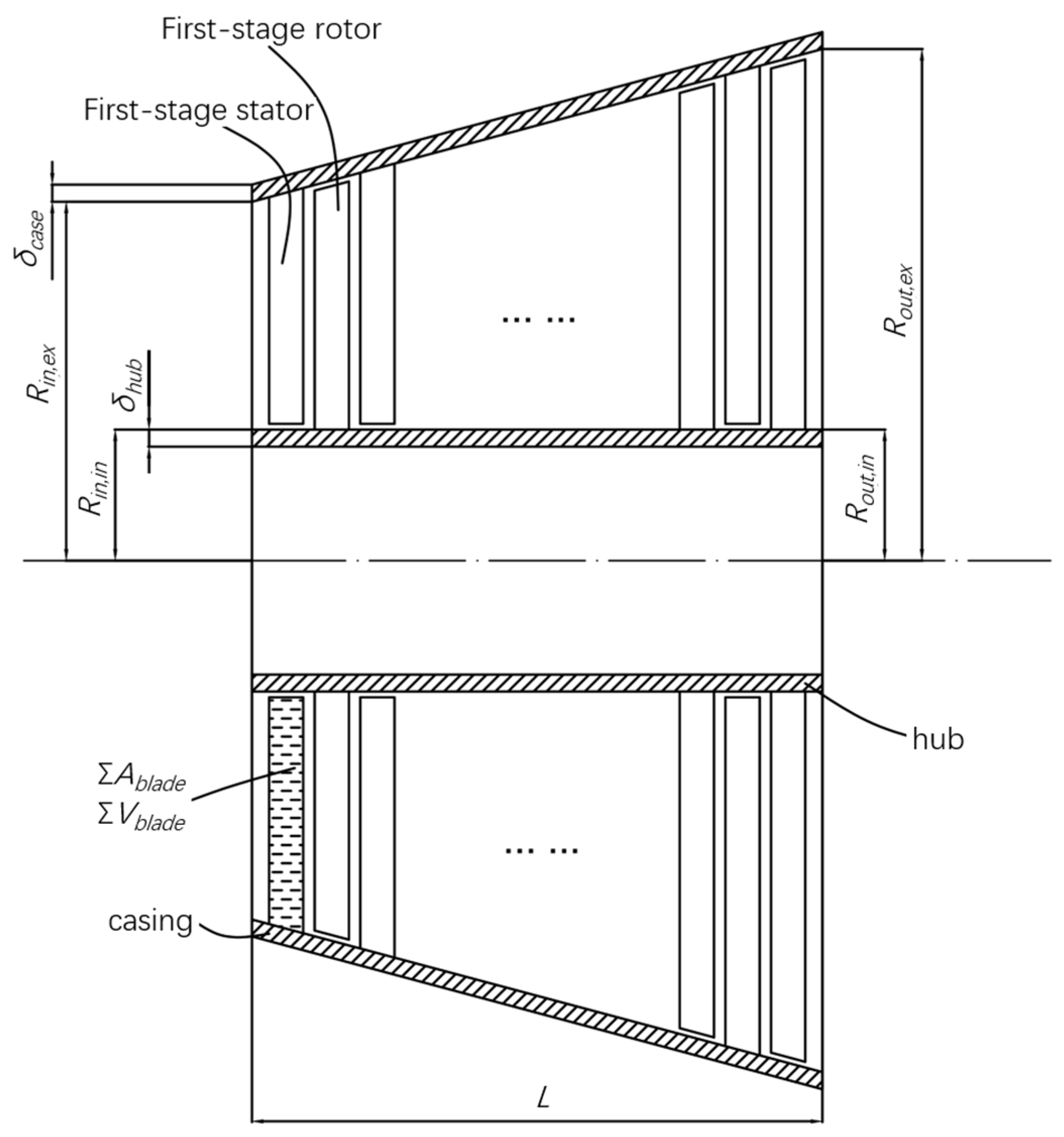
To accurately calculate the heat transfer of metal components during the transient process of a gas turbine, it is necessary to consider factors such as the geometric structure and heat transfer characteristics of the metal components and solve the problem by integrating results from 3D simulations. Although a CFD simulation model for the fluid domain of turbine components has been established in the previous section, for the 1D model, metal components (e.g., the casing and hub) still require the acquisition of specific geometric dimensions of their corresponding parts, as well as the development of simplified characteristic models. This facilitates the heat transfer calculation of the casing and hub components in the 1D model. For the turbine, its geometric structure is abstracted into a simplified geometric model, as illustrated in
Figure 2.
Metal walls that directly exchange heat with the flow path working fluid include blades, casings, and hubs. Owing to the blades’ characteristics of thin thickness and high thermal conductivity, the lumped parameter method (LPM) was adopted for the blade section. Specifically, the blade was simplified into a single mass point, and the temperature distribution of the metal surface in contact with the working fluid was used as the initial condition to simulate of the blade’s metal temperature [
19,
20].
For metal components with larger geometric dimensions—such as the casing and hub—the finite difference method (FDM) was employed. Specifically, the thickness of the metal components is divided into several segments in the radial direction; then, the differential equations are converted into a finite set of algebraic equations, which are solved to obtain the radial gradient temperature distribution inside the metal components (e.g., the casing and hub). This further enables the calculation of the specific heat transfer characteristics of these metal components.
The initial condition for the FDM is also the temperature distribution of the metal surface in contact with the working fluid. However, unlike the LPM, the FDM allows further segmentation along the axial direction with a length equivalent to one-tenth of the blade width. The segmented small elements can fully utilize the temperature field distribution information at the fluid-solid interface through interpolation, thereby establishing initial temperature boundary conditions that can reflect spatial distribution differences.
After establishing the 3D CFD simulation model for the turbine flow path and the 1D simulation model for the metal components, it is necessary to extract the temperature field distribution at the fluid–solid interface and transfer it to the 1D model as the initial boundary condition. In the 3D simulation model, the inner walls of the casing and hub serve as the sampling surfaces. Treating the casing and hub as integral solids made of specific metals, the heat conduction process from the inner metal walls to the outer walls can be regarded as a linear heat transfer process. This entire process depends only on the following factors: the initial temperatures of the inner and outer surfaces, the convective heat transfer coefficients of the inner and outer surfaces, the specific heat capacity of the metal itself, and its geometric structure (primarily the variation in radial cross-sectional thickness).
The continuous 3D temperature field data are converted into representative point set data using the data scaling technology, which are then input into the heat transfer calculation module of the 1D model. Using these data as the boundary condition, the average flow area inside the turbine and the heat transfer area of each metal surface are calculated based on the existing geometric information. Combined with the thermophysical property curves of the metal, the 1D heat transfer simulation calculation for the gas turbine metal components can thus be performed.
3. Temperature-Gradient-Guided Dynamic Genetic Optimization Sampling Algorithm
3.1. Principle of the Data Scaling Technique
For the data scaling technique, the key to achieving the coupling of simulation models for components or subsystems with different dimensions lies in realizing data interoperability between these multi-dimensional simulation models. Based on the differences in data interoperability methods, implementation of the data scaling technique can be categorized into three types—weak coupling, iterative coupling, and full coupling [
21]—described as follows:
- (1)
Weak coupling replaces the general characteristic maps in a low-dimensional system model with detailed maps precalculated from high-dimensional CFD simulations.
- (2)
Iterative coupling establishes a feedback loop, where low-dimensional system simulations provide boundary conditions for high-dimensional component simulations, and the resulting performance differences are used to iteratively correct the low-dimensional model parameters until consistency is achieved.
- (3)
Full coupling directly embeds the high-dimensional component model into the system simulation loop, effectively replacing the corresponding simplified model and participating in the transient solution in real time.
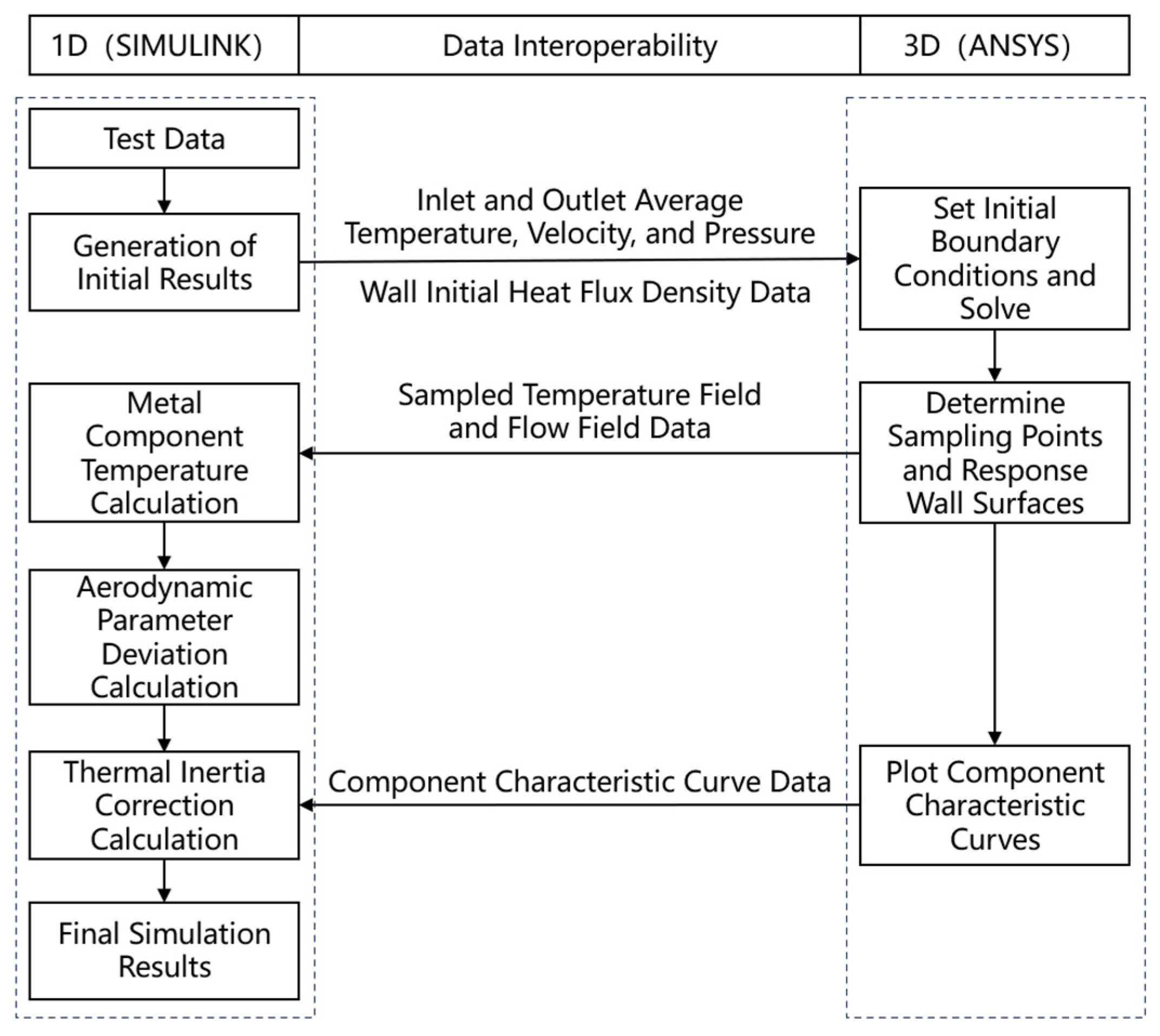
Given the complexity of gas turbine thermal inertia research, this study adopts the full coupling method, where the 3D simulation results of the turbine flow path completely replace the results of the 1D model simulation. For other components represented by the 1D model (such as the internal heat transfer of the casing and hub metals), the simulation results from the 3D model will also be used as the initial boundary conditions. The process is shown in
Figure 3.
3.2. Establishment of the Data Transfer Interface
The 3D CFD simulation model of impeller components in this study was primarily developed using ANSYS CFX 2023 R1. A data interoperability interface needs to be developed to enable data exchange between this 3D model and the 1D model. As illustrated in
Figure 3, there are three categories of data that require interoperability between the 1D and 3D models:
The initial calculation results of the 1D simulation model are transmitted to the 3D model to serve as its initial boundary conditions.
The sampled results from the 3D simulation model are transmitted to the 1D model to serve as the temperature boundary conditions for metal components.
The characteristic curves obtained from the 3D simulation, which account for thermal inertia, are transmitted to the 1D model to serve as the basis for the thermal inertia correction module.
According to the definition of data scaling, the first and third categories of data can be directly input into the subsequent simulation model because their data dimension before transmission is less than or equal to that after transmission [
22]. For the second data transmission, however, since data with a higher dimension is transmitted to a lower-dimensional model, dimensionality reduction through sampling is required before transmission.
One of the prerequisites for data dimensionality reduction sampling is to identify the corresponding “key points” between the two models, ensuring that the data before and after transmission are applied to the correct positions in the model. Taking blades as an example, it is necessary to determine
Bi (where
i is cascade stage number) as the key points for data sampling near each stage of blades in the 3D model and set response walls on the corresponding upper and lower end walls of the blades. These response walls are made to correspond one-to-one with the positions of each stage of cascades in the 1D model, thereby determining the initial positions for data sampling and transmission [
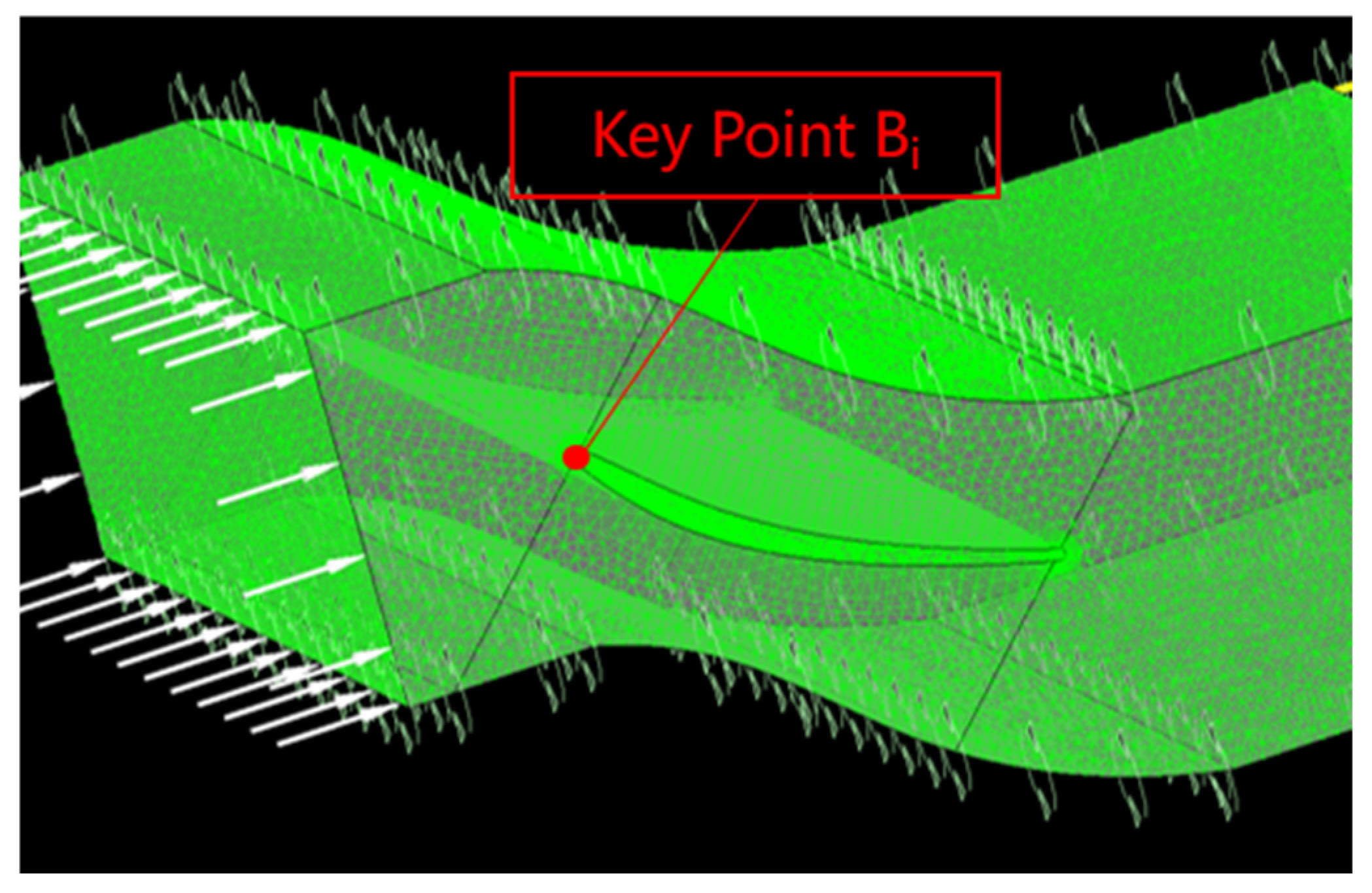
23]. As shown in
Figure 4, in this study, the leading-edge vertices at the blade root of each stage of blades are taken as the key points for that stage of blades.
ANSYS enables integration with other applications through journal scripts, UDF (User-Defined Function) programs, and supplementary custom code. For SIMULINK, the software used for the 1D simulation model, integration can be achieved via the S-Function interface within MATLAB/Simulink R2023b. This interface allows users to customize the data sources and behaviors of the simulation model. By developing a sampling program for the S-Function interface that interacts with ANSYS, sampling functions can be defined, and the sampled data can be imported into specific interfaces of SIMULINK to serve as boundary conditions for the 1D model.
Since the 3D simulation model in this study is non-real time, the coupling between multi-dimensional simulation models was done offline. Specifically, after determining the key points, MATLAB is used to call the APDL script within ANSYS to re-execute the simulation calculations. The calculation results of the temperature/pressure fields on the inner surface of the casing are then exported as CSV files. These files are sampled by the sampling program of the S-Function interface to generate MAT-format files containing sampled point data, which can be directly invoked by MATLAB. Finally, these files are imported into MATLAB-SIMULINK for subsequent simulation calculations.
3.3. Overall Framework of the Algorithm
Due to the high complexity of the flow and temperature field within the gas turbine flow path, it is necessary to avoid two key issues: insufficient sampling density in regions with significant temperature gradient variations (e.g., the high-temperature zone at the blade leading edge), which would lead to large errors in boundary condition transmission, and redundant sampling points in regions with gentle temperature changes (e.g., the air extraction section), which would increase computational load.
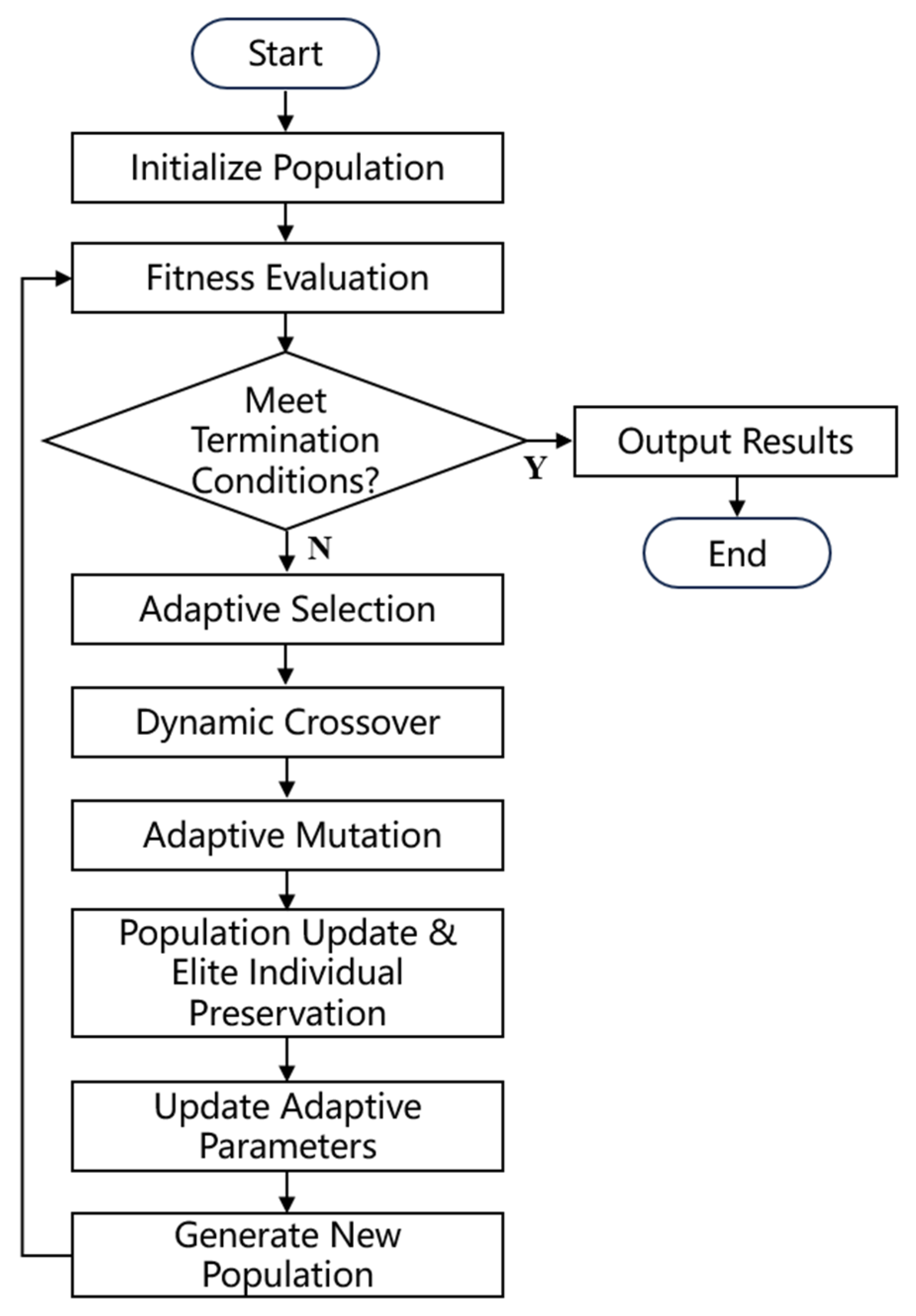
To resolve this tradeoff, this study proposes a temperature-gradient-guided dynamic genetic optimization sampling algorithm for sampling temperature field data. By dynamically balancing accuracy and efficiency, this algorithm prioritizes dense sampling in regions with significant temperature gradient variations (e.g., near extreme points) and dynamically adjusts the weight coefficients of each component as the optimization phase progresses. This makes the sampling points more representative and the results more reliable. The algorithm offers several key advantages: rational distribution of sampling points, reliable data values, no omission of extreme points, and a significant reduction in the volume of subsequently transmitted data while ensuring the accuracy of temperature field reconstruction. Its overall framework is illustrated in
Figure 5.
The algorithm includes three primary inputs: temperature field data, maximum number of iterations tmax = 150, and initial population Np. It yields two primary outputs: the reconstruction error function MSE* and the optimal sampling point set S* = {(xi,yi,ai)}, where ai∈{0, 1} serves as the unit activation bit that controls whether the unit participates in sampling.
The initial population is randomly generated with a uniform distribution. First, lattice data on the inner surface of the blade tip casing and the inner surface of the blade root hub, corresponding to the key points Bi on the blades in the temperature field data, are extracted. Subsequently, 50 distinct individuals—each containing sampling points accounting for 20% of the total lattice points—are randomly generated to form the initial population, which is subsequently encoded. A temperature gradient weight matrix and other constraint terms are constructed and incorporated into the Mean Squared Error (MSE) function to obtain a multi-objective optimization function.
A dynamic strategy governs the optimization: During the early iterations (exploration phase), weights are assigned to prioritize accuracy; during the later iterations (exploitation phase), weights shift to prioritize sparsity. In the crossover and mutation phases, the unit activation bits ai undergo probabilistic flipping, with the mutation probability dynamically adjusted according to temperature gradient variations in different regions.
After sorting the population by fitness in descending order, the top 20% of individuals are retained as elite individuals, while the remainder undergo further crossover and mutation to generate new individuals. A new population is formed after updating the dynamic parameters, and fitness evaluation is repeated. This loop continues until specified termination criteria are satisfied, at which point the optimal sampling set is output. Finally, the data associated with these optimal points are imported into the metal component units at the key points Bi in the gas turbine 1D model. Following interpolation, this reconstructed field serves as the thermal boundary condition for the subsequent 1D heat transfer calculations.
3.4. Temperature-Gradient-Guided Dynamic Encoding Mechanism
To address the limitations of traditional genetic algorithms where fixed-length encoding overly constrains both the quantity and spatial distribution of sampling points, this study adopts a method that dynamically adjusts chromosome structures and activation states. This enables efficient sampling in high-gradient regions of the temperature field and rational distribution in low-gradient regions.
In this scheme, each potential sampling point within an individual is defined by floating-point coordinates (
xi,
yi) and is associated with a unit activation bit
ai∈{0, 1} that controls whether the point participates in sampling. Thus, the genetic encoding of a single individual can be expressed as:
where k denotes the maximum allowable number of sampling points. When
ai = 1, it indicates that the point is activated and will participate in sampling.
Following the encoding phase, dynamic rules for adding or removing the sampling set—based on local gradient magnitude—are incorporated.
Condition for adding sampling points: If the fitness improvement of the optimal individual over five consecutive generations is less than 1%, one sampling point shall be added at the location with the maximum magnitude of the unactivated temperature gradient. The relationship between the activation expectation of sampling points and the temperature gradient is as follows:
where ‖∇
Ti‖ denotes the magnitude of the temperature gradient vector at point
i, and its formula is as follows:
Condition for removing sampling points: If the contribution degree ci of a point is less than 0.001, its activation bit ai is set to 0. Here, the contribution degree ci is defined as the partial derivative of the objective function F with respect to ai. For an unactivated point (ai = 0), ci is not considered in the removal judgment. For an unactivated point (ai = 1): If ci > 0.001, it remains activated; if ci < 0.001, it indicates that the point contributes minimally to temperature field reconstruction and is therefore removed.
3.5. Construction of the Objective Function
3.5.1. Basic Framework of the Objective Function
In accordance with the requirements of data scaling technology and the complexity of temperature fields in gas turbine flow paths, the optimization objective of this study is defined as follows: minimizing the number of sampling points while ensuring the reconstruction accuracy in regions with high temperature gradients.
This constitutes a multi-objective optimization problem where the central challenge lies in balancing reconstruction accuracy against sampling point sparsity. The primary metric is the MSE function, which quantifies the discrepancy between the interpolated temperature field and the original field. It is formulated as:
where
N represents the total number of grid points in an individual,
Ti denotes the temperature value of point
i in the original temperature field, and
Ti′ stands for the temperature value at the same point after interpolation reconstruction.
To achieve the dual goals of adapting sampling density to local temperature gradient variation and minimizing the total number of points, it is necessary to incorporate a gradient weight matrix, a density penalty term, and a quantity penalty term into the MSE function. Additionally, dynamic weight coefficients are assigned to each term to control the relative weights between reconstruction accuracy and sampling sparsity throughout the optimization process. An additional regularization term is included to prevent overfitting.
The overall expression of the objective function is as follows:
where
Wi denotes the temperature gradient weight matrix,
Pd represents the density penalty term,
Na stands for the quantity penalty term, Ω
L is the regularization term, and
α,
β,
γ, and
η are the corresponding dynamic weight coefficients.
3.5.2. Temperature Gradient Weight Matrix
The temperature gradient weight matrix is used to amplify the error penalty in high-gradient regions within the MSE calculation, thereby increasing the objective function’s sensitivity to reconstruction inaccuracies where the temperature field varies most rapidly.
The gradient magnitude is calculated as shown in Equation (3). To prevent numerical imbalance arising from order-of-magnitude differences between terms, the raw gradient magnitudes are normalized to the interval [0, 1] to construct the weight matrix. Meanwhile, a smoothing factor
ε = 10
−3 is introduced to simulate the continuous nature of real temperature fields. The formula for the normalized weight matrix is as follows:
where the denominator is the sum of gradient magnitudes across the entire temperature field, ensuring that
ΣWi = 1. This formulation guarantees that the penalty for reconstruction error scales proportionally with the local temperature gradient.
3.5.3. Density Penalty Term
The role of the density penalty term is to enforce a correlation between the spatial distribution of sampling points and the underlying temperature gradient field. Its core objectives are as follows: (1) to promote a higher density of points in high-gradient regions and discourage redundant sampling in low-gradient areas and (2) to prevent the optimization from over-prioritizing a single objective at the expense of overall accuracy.
In this study, the Maximum Mean Discrepancy (MMD) formula is employed to quantify the dissimilarity between the sampling point density and temperature gradient distribution. MMD works by mapping two sets of original data into a high-dimensional Reproducing Kernel Hilbert Space (RKHS) through a kernel function
k(
x,
y) and calculating the distance between their mean embeddings [
24].
Let the set of sampling point coordinates in an individual be
S = {
x1,
x2, …,
xm} and the set of gradient field locations be ∇
T = {
y1,
y2, …,
yn}. Then, the discrete MMD calculation formula for finite samples is as follows:
The kernel function
k(
x,
y) adopts the Gaussian kernel function. This function ensures that the MMD is non-negative and can effectively capture local similarity. For example, in a temperature field, points in adjacent high-gradient regions all have relatively high kernel function values. The formula of the Gaussian kernel function is as follows:
where ‖
x −
y‖ denotes the Euclidean distance between two points, and σ is the bandwidth parameter, which controls the sensitivity of the kernel function. A larger
σ makes the kernel function smoother and less sensitive to small differences. The bandwidth parameter σ of the Gaussian kernel function is typically set to 5~15% of the characteristic length of the computational domain in the field of fluid mechanics temperature field sampling and spatial distribution optimization [
25]. The research team conducted comparative simulations of σ values of 5%, 10%, and 15% of the axial side length. The results show that when σ = 10%, the Gaussian kernel function achieves the smallest mean squared error (MSE) of temperature field reconstruction in the proposed algorithm, which is 2.13 K. Therefore, in this study, σ was set to 10% of the axial length of the computational domain.
To prevent an extreme scarcity of points in low- or zero-gradient regions, which would lead to loss of temperature information, a density balancing term B
d is introduced:
where
λ is the density balancing coefficient and is set to 0.1 in this study. This relatively small value ensures that the penalty term mitigates insufficient sampling in low-gradient regions. In summary, the formula for the density penalty term is as follows:
3.5.4. Quantity Penalty Term and Regularization Term
The quantity penalty term directly penalizes the number of sampling points, explicitly guiding the optimization towards sparser solutions. It is formulated as the ratio of activated points to the maximum allowed:
where
k represents the maximum allowable number of sampling points and is set to 20% of the total grid count.
Given the high-dimensional search space and the relatively small initial population, overfitting is a concern. A typical manifestation of this would be the excessive clustering of sample points within a limited high-gradient region, at the expense of exploring other areas. To mitigate this issue, an L2 regularization term is incorporated to smooth the optimization landscape [
26]:
3.5.5. Allocation of Dynamic Weight Coefficients for Each Term
To adjust the degree of influence of each operational term on the results at different stages of the optimization process, dynamic weight coefficients for each term are designed as follows:
α: Dynamic weight coefficient for the weighted temperature error term.
β: Dynamic weight coefficient for the density penalty term.
γ: Dynamic weight coefficient for the quantity penalty term.
η: Dynamic weight coefficient for the regularization term.
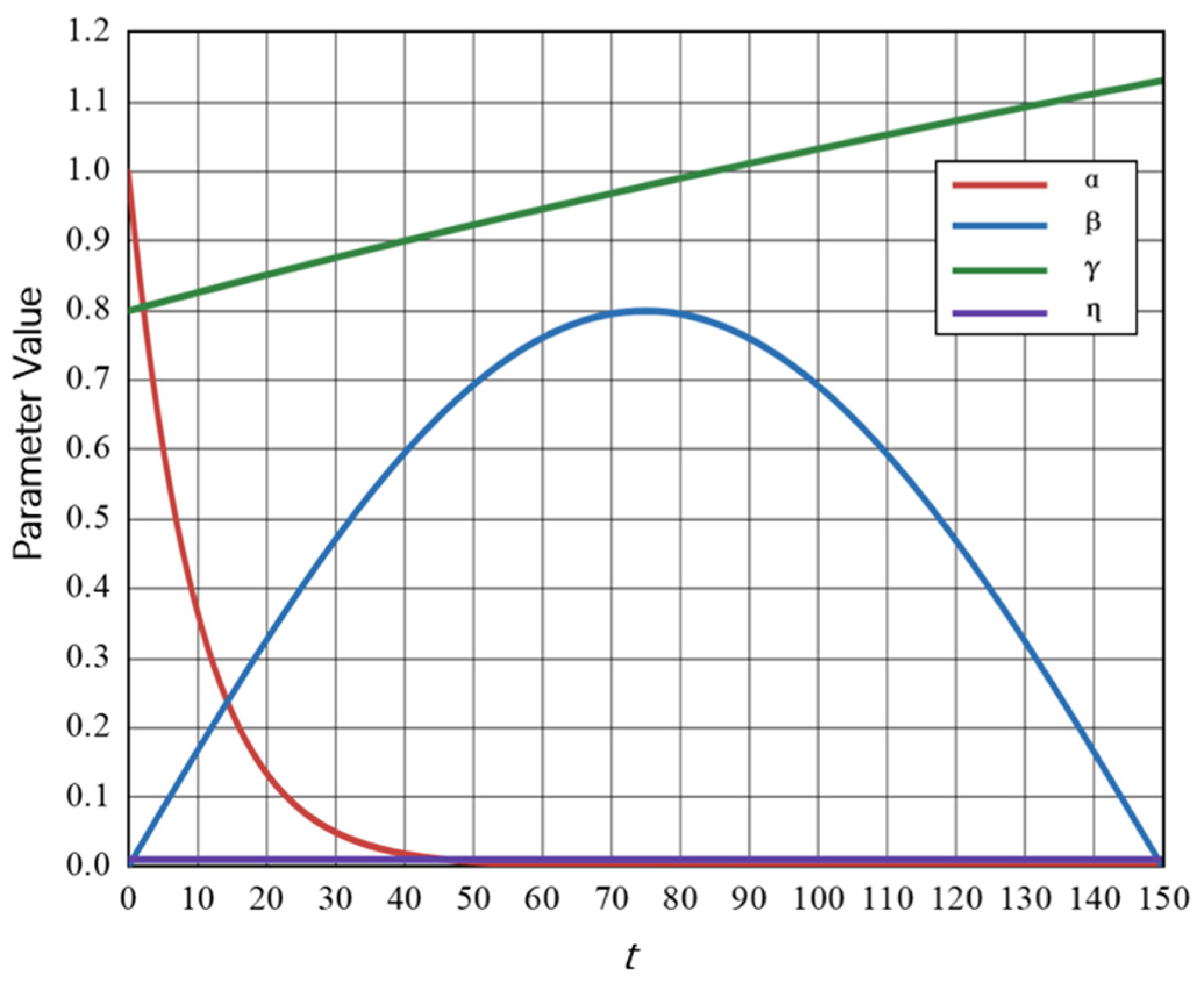
The weighting strategy is phase-dependent: During early iterations (global exploration), the emphasis is on accuracy (high α, low β and γ). In the middle phase, gradient matching is prioritized (high β, balanced α and γ). During late iterations (local exploitation), sparsity is enforced (high γ, low α and β).
Each dynamically varying coefficient follows a sub-linear change rule to ensure stable convergence. The specific formulas are:
where
α0 = 1 represents the initial weight,
w = 0.1 denotes the decay rate, and
t stands for the current number of iterations.
The dynamic weight coefficient
β for the density penalty term is set as follows:
where
β0 = 0.8 represents the initial weight, and
tmax stands for the maximum number of iterations.
The dynamic weight coefficient
γ for the quantity penalty term is set as follows:
where
γ0 = 0.8 represents the initial weight, and
a = 0.1 denotes the increase index.
The regularization term coefficient
η remains constant at 0.01 throughout the entire optimization process. The variation process of each weight coefficient with the number of iterations
t is shown in
Figure 6:
3.6. Design of the Dynamic Selection Operator
Dynamic selection is a key strategy in genetic algorithms for dynamically balancing population diversity and convergence speed. Its underlying principle is to adjust the selection pressure at different optimization stages through a synergistic mechanism combining gradient-aware weighting and fitness feedback. The specific implementation method is as follows: In the exploration stage (early iterations), selection pressure is reduced to allow more non-optimal solutions to participate in crossover and mutation, thereby expanding the search range. In the exploitation stage (late iterations), selection pressure is increased to focus on high-fitness individuals and accelerate convergence toward the global optimum [
27]. The dynamic selection probability formula is as follows:
where
τ denotes the dynamic balance coefficient, and its formula is as follows:
Fitnessᵢ represents the fitness value of an individual, which is derived from the objective function
F as:
To prevent premature convergence by accepting certain inferior solutions with a controlled probability, a simulated annealing mechanism is incorporated. The acceptance probability for a lower-fitness solution is defined as:
3.7. Design of Dynamic Crossover and Mutation Operators
Crossover operators generate new individuals by recombining genetic information from parent individuals and are fundamental to the global search capability in genetic algorithms. Mutation operators enable the algorithm to escape local optima by adding small perturbations, serving to prevent genetic homogenization of the population and reintroduce useful genes that have been eliminated. Their combination action maintains population diversity and drives the optimization toward the global solution [
28].
3.7.1. Design of the Crossover Operator
The design of the crossover operator needs to combine temperature gradient information with changes in dynamic weights. It must ensure a higher sampling density in high-gradient regions while avoiding redundant sampling in low-gradient regions.
First, two parent individuals are selected from the current population using the roulette wheel selection method, where the selection probability is proportional to the individual’s fitness value (
Fitnessᵢ). The probability of selecting a specific gene as a crossover point is then biased by the local temperature gradient, with a higher probability assigned to points in high-gradient regions:
where
Pe denotes the current crossover probability,
Pe0 is the base crossover probability, which varies with the optimization stage, and ‖∇
Te‖ represents the magnitude of the temperature gradient near the crossover point in the parent individuals.
Subsequently, the crossover point e(xe,ye,ae) is randomly selected according to Equation (20). The gene segments after crossover point e in the two parent individuals are exchanged to generate two new individuals. To prevent the loss of excellent individuals during the crossover process, the top 20% of individuals with the highest fitness are directly carried over to the next generation after each crossover.
The baseline crossover probability
Pe0 is adjusted according to the optimization stage. A higher crossover probability is used in the early stage to enhance global search capability, while a lower crossover probability is adopted later to improve local optimization efficiency. Let
Pe01 be the base crossover probability for the early optimization stage (0 ≤
t ≤ 50) and
Pe02 be the base crossover probability for the later optimization stage (50 <
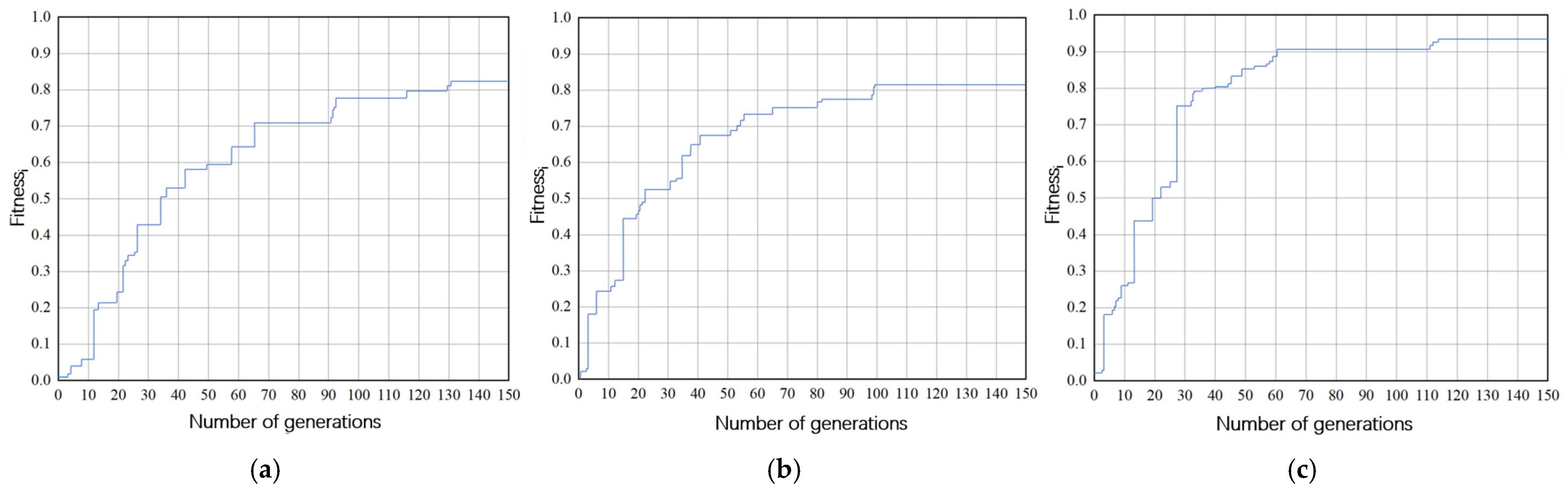
t ≤ 150). Three common probability combinations were tested. The resulting fitness progression of offspring (
Figure 7) demonstrates that the combination
Pe01 = 0.9 and
Pe02 = 0.4 yields the fastest convergence and the highest final average fitness.
3.7.2. Design of the Mutation Operator
For each sampling point of each individual, mutation is determined by the mutation probability
Pm. Similar to the crossover probability,
Pm is also proportional to the local temperature gradient magnitude:
where
Pm0 is the base mutation probability, with an initial value of 0.2, which gradually decreases as the number of iterations increases. ‖∇
Tm‖ represents the magnitude of the temperature gradient near the mutation point in the parent individual.
Once a point is selected for mutation, its activation bit
ai is flipped: if
ai = 0, the point is activated; otherwise, the point is deactivated. To enhance convergence, the base mutation probability
Pm0 decays exponentially as iterations progress:
3.7.3. Termination Conditions
According to the sampling requirements, the termination conditions are set as follows:
- (1)
The fitness improvement of the optimal individual is less than 1% over 20 consecutive generations.
- (2)
The number of sampling points does not exceed 20% of the total grid points.
- (3)
The fitness of the optimal individual is greater than 0.8.
If no individual meets all conditions upon reaching the maximum iteration count tmax = 150, the individual with the highest fitness is output as the final result.
4. Optimization Results and Analysis
4.1. Output Results and Comparison of Quantitative Indicators
The output result is the optimal set of sampling points S*. The temperature data at the activated points in S* are collected and transferred to the 1D model through the data interface. After interpolation and reconstruction, the data can be used as the initial boundary condition for wall heat transfer in the 1D model.
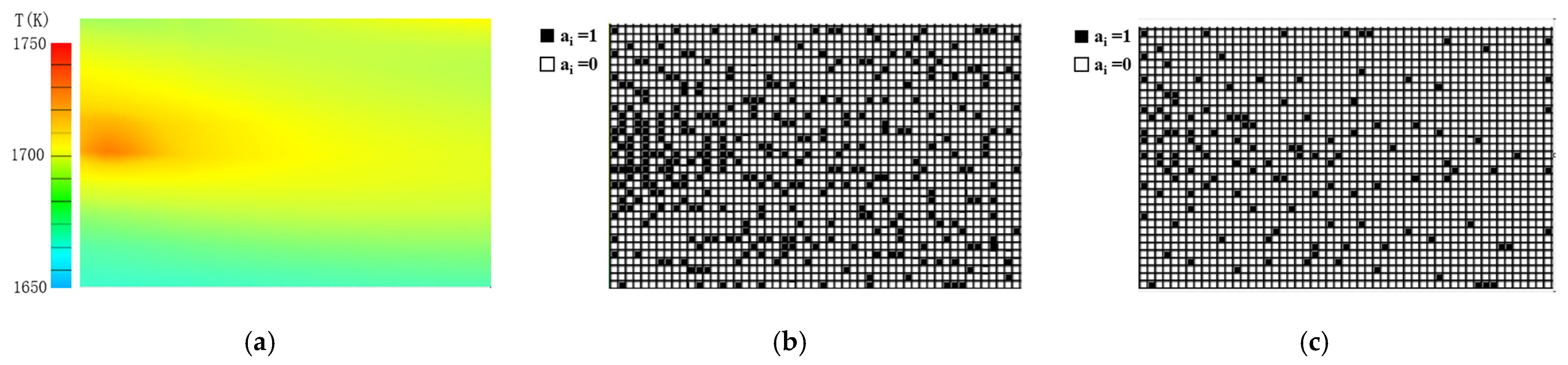
Figure 8 presents a comparative visualization for a representative region near the trailing edge of a high-pressure turbine stator vane, showing the original 3D temperature field, the sampling point set at an intermediate iteration (
t = 50), and the finally optimized set.
The results in
Figure 8 demonstrate that the proposed sampling method successfully achieves the goal of adjusting the sampling point density according to the local temperature gradient while maintaining necessary coverage in low-gradient and uniform-temperature regions. A comprehensive quantitative comparison was conducted using the turbine components of a dual-shaft gas turbine (including two-stage power turbines and a single-stage high-pressure turbine). The core quantitative indicators of the proposed TDGA were evaluated against two traditional sampling methods (Latin Hypercube Sampling and Bootstrap Sampling). The results are summarized in
Table 2.
Table 2 clearly shows that the proposed TDGA achieves a significant MSE and demonstrates markedly higher sensitivity in allocating points to high-gradient regions compared to traditional methods. Moreover, it attains this superior accuracy with a reduced total number of sampling points, thereby lowering the computational load for subsequent 1D simulations.
The data transfer time per turbine stage for the TDGA is significantly longer than that of traditional sampling methods due to the iterative optimization process. However, this computational overhead (approximately 20 min per stage) remains acceptable when contrasted with the weeks or even months required for a full 3D simulation of the entire turbine model.
4.2. Verification of Simulation Effect
The fully coupled framework (“3D turbine flow path model + 1D metal component model”) was employed to conduct dynamic simulations of the gas turbine from start-up to steady-state operation. The fluid–solid interface temperature data, obtained using different sampling techniques, served as the initial boundary condition for the 1D model. After obtaining the wall temperature variation data through the simulation calculation of the one-dimensional casing-hub model, a comparative verification was conducted against the gas turbine experimental data.
The experimental scheme is as follows:
Experimental platform: A two-shaft gas turbine prototype with a high-pressure turbine, power turbine, combustor, compressor, and auxiliary systems. The casing wall temperature measurement points were arranged at eight circumferential positions of the high-pressure turbine casing.
Measurement instruments: K-type thermocouples (accuracy class = 0.5, measurement range = −50–1150 °C) were used for temperature measurement, with a data acquisition frequency of 4 Hz. The thermocouples were calibrated using a standard temperature calibrator (uncertainty = ±0.3 K) before the test.
Test procedure: The gas turbine was operated through a complete start-up transient process (from cold start to steady-state operation at 100% rated load), with continuous recording of casing wall temperature, exhaust gas temperature, rotational speed, and other key parameters. A total of 40 repeated tests were conducted to ensure data repeatability.
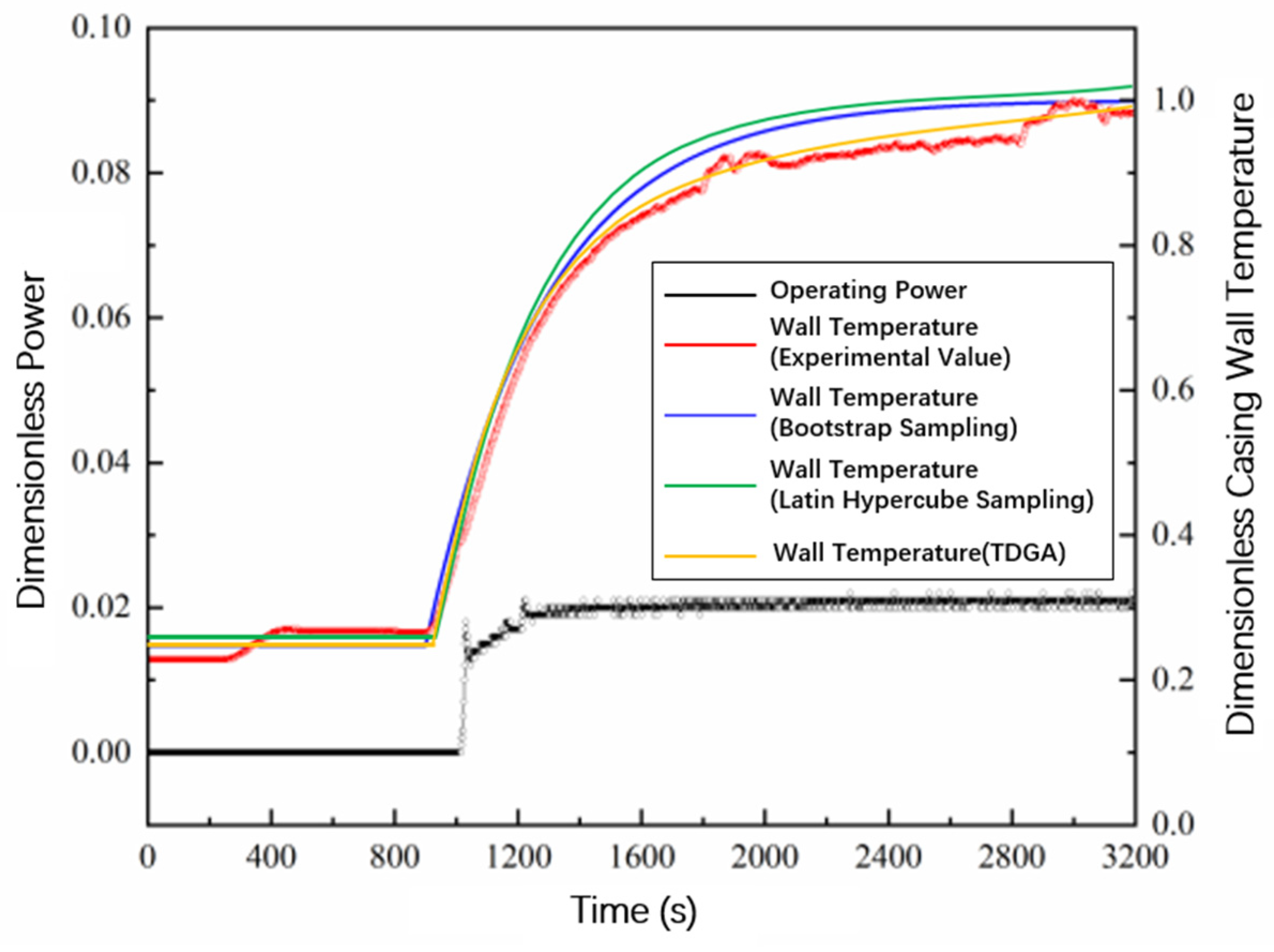
Focusing on the casing wall temperature as a core parameter, the simulation accuracy of each method was validated against our unpublished experimental data (Author’s own data, 2026), as shown in
Figure 9.
As shown in
Figure 9, the simulation results from all three methods are in close agreement with experimental data during the initial start-up phase (1000–1400 s) and the steady-state phase (after 3000 s). However, a significant divergence occurs during the middle start-up phase (1400–3000 s), a period characterized by intense heat exchange between the high-temperature and high-speed gas and the still relatively cool metal components, creating a complex and transient thermal field. In this critical regime, the simulation results from traditional sampling methods gradually deviate from the experimental values, whereas the proposed TDGA maintains high accuracy due to its enhanced sensitivity to temperature gradients.
The superior performance of the TDGA during this complex transient phase can be attributed to its core design principles. The dynamic weight adaptation shifts the focus from pure accuracy (early iterations) to gradient-aware sampling (mid-stage) and finally to sparsity (late-stage). This allows the algorithm to preferentially capture the rapidly evolving, high-gradient thermal fronts at the fluid–solid interface during intense heat exchange, which are often smoothed over or missed by the static sampling distributions of LHS and Bootstrap methods.
Quantitatively, during the middle start-up phase, the TDGA reduced the average simulation error by 17.4% and 13.3% compared to Latin Hypercube Sampling and Bootstrap Sampling, respectively. This indicates the strong adaptability of the proposed method to dynamic processes with complex heat transfer, which is precisely the regime where the effect of thermal inertia is most pronounced.
5. Conclusions
This study addresses the significant deviations between simulation and experiment observed in traditional sampling methods during dynamic thermal inertia simulation of gas turbines. To this end, a temperature-gradient-guided dynamic genetic optimization sampling algorithm (TDGA) has been proposed and integrated within a multi-dimensional simulation framework for turbine components. The core achievements are summarized as follows:
- (1)
A specific data transmission process for turbine components across dimensions was defined, and a data exchange interface between SIMULINK and ANSYS was established. The MSE function served as the foundational framework for the objective function.
- (2)
A multi-objective optimization algorithm was designed. It constrains sampling points distribution by incorporating a temperature gradient weight matrix, a density penalty term, a quantity penalty term, and a regularization term. Dynamic weight coefficients assigned to each term are adjusted throughout the optimization. Furthermore, dynamic probability functions govern the crossover and mutation operations, enabling the algorithm to prioritize different objectives (exploration vs. exploitation) at distinct optimization stages.
- (3)
The proposed TDGA and traditional sampling methods were implemented, and their performance was validated against experimental data. The results confirm that the TDGA exhibits excellent adaptability to dynamic processes involving complex flow fields and intense heat transfer. During the middle stage of the gas turbine start-up process, the TDGA reduced the average simulation error by 17.4% and 13.3% compared to traditional Latin Hypercube Sampling and Bootstrap Sampling, respectively.
The proposed framework demonstrates direct practical utility for gas turbine engineering. Beyond enabling high-fidelity coupled simulations, the optimally sampled data points generated by the TDGA can serve as a high-quality training dataset for developing efficient Reduced-Order Models (ROMs). Such ROMs are crucial for applications requiring rapid predictions, such as real-time performance monitoring, control system design optimization, and digital twin implementations. Future research will explore this pathway, extending the algorithm’s validation to compressor and combustor components to achieve a system-wide, multi-physics-optimized sampling strategy.
In addition to the gas turbine transient thermal analysis, the proposed TDGA can also be extended to other engineering fields involving multi-dimensional simulation and temperature field sampling, such as aero-engine thermal inertia simulation, where it can realize efficient data transfer between 3D flow path models and 1D metal component models; nuclear power plant heat exchanger dynamic simulation to optimize the sampling of temperature field data in complex heat transfer processes; automotive engine cooling system simulation, improving the accuracy of temperature field reconstruction with fewer sampling points; and industrial boiler thermal process simulation, realizing the coupling of 3D combustion field models and 1D heat transfer system models.