


Abstract
Shearers and roadheaders are critical equipment in coal mining and roadway excavation, where the rock-breaking performance of cutting picks directly influences operational efficiency and economic outcomes. Complex geological conditions, such as hard coal seams and embedded inclusions like gangue or pyrite nodules, pose significant challenges to cutting efficiency and tool wear. This study presents a numerical investigation into the rotational cutting process of a single pick in heterogeneous coal seams using the Smoothed Particle Hydrodynamics (SPH) method integrated with a mixed failure model. The model combines the Drucker–Prager criterion for shear failure and the Grady–Kipp damage model for tensile failure, enabling accurate simulation of crack initiation, propagation, and coalescence without requiring explicit fracture treatments. Simulations reveal that cutting depth significantly influences the failure mode: shallow depths promote tensile crack-induced spallation of hard nodules under compressive stress, while deeper cuts lead to shear-dominated failure. The cutting pick exhibits periodic force fluctuations corresponding to stages of compressive-shear crack initiation, propagation, and spallation. The results provide deep insights into pick–rock interaction mechanisms and offer a reliable computational tool for optimizing cutting parameters and improving mining equipment design under complex geological conditions. A key finding is the identification of a critical transition in failure mechanism from tensile-dominated spallation to shear-driven fragmentation with increasing cutting depth, which provides a theoretical basis for practitioners to select optimal cutting parameters that minimize tool wear and energy consumption in field operations.
1. Introduction
Shearers and roadheaders are essential equipment in coal mining and roadway excavation, and the rock-breaking capacity of their cutting picks directly affects both production efficiency and economic performance of mining operations [1]. Complex geological conditions—such as hard coal seams and interbedded rock—pose significant challenges to pick wear and cutting efficiency [2]. Investigating the mechanisms of rock cutting is therefore crucial for optimizing pick structure, enhancing operational efficiency, and reducing energy consumption [3]. With the advancement of computer technology, numerical simulation has emerged as an effective research tool, enabling the prediction of mechanical behavior and coal-rock fragmentation under various working conditions, thereby informing structural design and process optimization [4]. Numerical modeling allows for the analysis of stress distribution, crack propagation, and energy consumption of cutting picks in complex coal-rock environments [5], which in turn provides theoretical guidance for material selection, structural design, and optimization of cutting parameters in engineering applications [6,7]. To this end, this study develops an SPH-based hybrid failure model specifically to simulate the synergistic fragmentation of heterogeneous media and capture the dynamic evolution of crack propagation with high fidelity.
In the field of mining, cutting refers to the process of separating coal seams using specialized mechanical equipment, such as drum-mounted cutting picks. Although coal is a relatively soft rock-like material, coal seams often contain much harder inclusions such as gangue and pyrite nodules, whose mechanical properties differ significantly from those of the surrounding coal matrix. At present, the rock-breaking mechanisms associated with such heterogeneous coal seams remain poorly understood [8]. Moreover, the fragmentation and crack propagation behavior of rock materials is a central concern in both rock mechanics and non-coal mining disciplines, where accurate prediction of crack initiation and failure evolution in rock materials is of critical importance [9,10]. Over the years, empirical and theoretical investigations have advanced our understanding of crack initiation, propagation, and coalescence in rock [11,12]. Accurate simulation of these phenomena provides researchers and practitioners with deeper insight into the mechanical behavior of rock materials. However, a key challenge in the field remains the effective simulation of the synergistic fragmentation of heterogeneous media—such as coal, gangue, and pyrite nodules—while concurrently capturing the dynamic evolution of crack propagation with high fidelity.
In rock-cutting simulations, researchers primarily employ the Finite Element Method (FEM) or the Discrete Element Method (DEM) to develop numerical models of the cutting process. Guo et al. (2021) established a FEM model to investigate the cutting of coal-rock by a single disk cutter, examining the effects of penetration force and cutting speed on the rock-breaking force during cutter movement [13]. Wang et al. (2024) applied DEM to simulate the linear cutting of rock by conical picks under different confining pressures, analyzing crack propagation, particle displacement, cutting force, and specific energy variations, thereby revealing the influence of confining pressure on rock fragmentation mechanisms and cutting efficiency [14]. However, FEM simulations of coal-rock cutting are highly mesh-dependent; severe mesh distortion occurs during large deformations and material failure, leading to a decline in computational accuracy [15]. While DEM can handle discontinuities, it suffers from complex parameter calibration and has limitations in accurately representing the mechanical behavior of continuous media [16]. In this study, the Smoothed Particle Hydrodynamics (SPH) method is adopted for simulating the coal-rock cutting process, leveraging its unique advantages in handling large deformations. Bui et al. (2008) introduced the elastoplastic constitutive relationship of soil into the SPH framework and simulated cohesive and non-cohesive soil landslides based on the Drucker–Prager criterion [17]. Dong et al. (2024) applied an elastoplastic SPH algorithm to simulate the flow of fragmented coal during top-coal caving mining [18]. Li et al. (2020) proposed a novel method that integrates the SPH approach with strength reduction techniques to automatically identify multiple potential failure surfaces and simulate the entire landslide process, offering an efficient tool for slope stability analysis under complex geological conditions [19]. Moreover, SPH has been widely applied in various fields, including water–soil coupling [20], porous media [21], multiphase flow [22], fluid–structure interaction [23,24], and granular flow [25]. Although SPH demonstrates superior performance over FEM in handling large deformations in geomechanics, it still faces challenges when simulating rock fracture, such as tensile instability leading to pseudo-fractures and inaccurate representation of crack propagation [26]. Recent advances continue to seek robust SPH formulations that can accurately capture the complex fracturing processes involving both shear and tensile failure [27]. To address these limitations, this study develops a hybrid failure model aimed at enhancing the stability of the algorithm and improving the accuracy of rock failure prediction by concurrently modeling both failure modes within a unified framework.
This study develops a hybrid failure model based on the Smoothed Particle Hydrodynamics (SPH) method by integrating the Drucker–Prager criterion with the Grady–Kipp damage model, enabling the simulation of both shear and tensile failure as well as the complex fracturing processes in rock. Section 2 establishes the numerical basis, covering SPH kernel/particle approximation, coal-rock governing equations, and the elastoplastic constitutive model with the Drucker–Prager criterion. Section 3 presents the mixed model and its implementation procedure. Section 4 validates the model via pick penetration tests and analyzes pick–nodule interactions, quantifying cutting depth impact on failure modes, and spallation mechanism. Section 5 summarizes the model’s effectiveness, key findings on cutting depth, and suggests future multi-pick simulation extensions.
2. Principles of the SPH Algorithm and Model Construction
2.1. Numerical Approximation Principle of SPH
The kernel approximation of a field function can be expressed as:
where is the support domain of the kernel function, and is the smoothing length.
The kernel approximation of the gradient of a field function can be expressed as:
where represents the gradient of the kernel function.
When the SPH computational domain is discretized into particles, Equations (1) and (2) can be further expressed in the form of particle approximation as follows:
where , . denotes the current particle, and denotes a neighboring particle within the support domain of particle ; is the mass of particle , is its material density; is the number of neighboring particles around particle .
The governing equations of a continuous medium generally include divergence and gradient terms. The particle approximation of the divergence of a vector function can be written as:
The particle approximation of the gradient of a scalar function is expressed as:
In this study, the cubic spline function is selected as the kernel function, which is defined as [28]:
where is the dimensionless distance, defined as , with representing the distance between particles.
2.2. Governing Equation
The governing equations include the continuity equation and the momentum equation, which are expressed in the following Lagrangian form:
where denotes time, is the material density, is the velocity vector, is the position vector, represents the body force acceleration, is the stress tensor, and denotes the contact force acting on the medium.
Based on the particle approximation (Equations (5) and (6)), the partial-derivative terms on the right-hand side of Equations (8) and (9), namely and , can be written as the following particle-summation forms [29,30]:
where .
Substituting Equations (8) and (9) yields the discretized governing equations [31]:
where .
2.3. Constitutive Model
In this study, the SPH method is used to simulate the elastoplastic deformation of coal and rock, employing the two-dimensional elastoplastic constitutive model proposed by Bui et al., which incorporates the Drucker–Prager yield criterion. Based on this elastoplastic constitutive model, it is further extended to simulate rock fracture problems. The elastoplastic constitutive equations are presented below, and readers are referred to [17] for the detailed derivation process.
The stress–strain relationship can be expressed as [17]:
where is the Kronecker delta; and are the shear modulus and bulk modulus of the material, respectively; represents the shear stress; and is the second invariant of the deviatoric stress tensor.
The rate of change in the plastic multiplier is given as [17]:
where . The rotation rate tensor , the total strain rate tensor , and the shear strain rate tensor are expressed as follows:
When the material is in the plastic state, the stress rate is computed according to Equation (14). When the material is in the elastic stage, the stress rate is calculated as:
3. Rock Failure Model and Numerical Implementation
To simultaneously capture the shear and tensile failure behaviors of rock, this section describes the Drucker–Prager (D-P) model for plastic shear failure and the Grady–Kipp (G-K) model for tensile failure, as well as the coupling strategy and procedures for integrating these two failure models.
3.1. Shear Failure Model
According to the Drucker–Prager (D-P) yield criterion and the non-associated flow rule, the material enters the plastic state when the following yield function is non-negative:
that is,
where and are the first and second stress invariants, respectively. The parameters and are constants in the D-P yield criterion and can be derived from the Mohr–Coulomb material parameters: cohesion c and internal friction angle . For a plane strain problem, and are calculated as:
The expressions for and are as follows:
The D-P yield criterion is derived from the Mohr–Coulomb criterion by defining a shear failure envelope to determine the yielding behavior of geomaterials. To capture the degradation of rock strength during loading, this study introduces a strain-softening effect by progressively reducing cohesion through a cumulative plastic strain function [32]. This approach allows for the characterization of yielding damage and promotes the localization of plastic flow, thereby capturing shear failure [26]. Based on the elastoplastic SPH framework established by Bui et al., six material parameters are required: density, cohesion, internal friction angle, dilation angle, elastic modulus, and Poisson’s ratio. These parameters can be deterministically obtained through standard mechanical tests. For elastic-perfectly plastic materials, the stress state must not exceed the yield surface during plastic deformation. Bui et al. proposed two algorithms, namely “tensile crack treatment” and “stress return mapping,” to return the stress state to the yield surface by adjusting the hydrostatic pressure and deviatoric stress. Since a tensile failure model is introduced in this study, only the “stress return mapping” algorithm is employed. The related details will be further explained in the section on the hybrid failure model.
3.2. Tension Failure Model
The Grady–Kipp (G-K) model is adopted to describe the tensile failure behavior of rock. This model incorporates the concept of the Weibull statistical distribution and uses two parameters to characterize the number of defects that can be activated at a given strain:
where n represents the number of defects that can be activated at a tensile strain ; k and m are material constants that describe fracture activation. These constants control the rate of defect activation and crack propagation and are dependent on the actual material properties. They can be determined using the method proposed by Melosh et al. [27].
The G-K model provides a constitutive description for controlling damage evolution:
where is the damage parameter, ranging from 0 to 1. indicates that the particle has completely failed, while means no damage has occurred. is the crack propagation speed, set to 0.4 times the material sound speed, which governs the rate of damage growth during dynamic failure. represents the effective tensile strain and is calculated as:
where is the maximum principal tensile stress, and and are the bulk modulus and shear modulus of the material, respectively.
The damage state of the material is represented by a damage threshold:
where is the predefined threshold, with representing the volume of the SPH particle. When , it is assumed that damage initiation occurs in the rock particle.
In this study, the G-K model is used to describe tensile failure. Since this model is strain-based, it is more suitable than the D-P criterion for analyzing dynamic rock failure mechanisms. By coupling the G-K model with the D-P criterion, the combined effects of shear and tensile failure can be simultaneously captured based on cumulative plastic strain, providing a comprehensive description of mixed-mode failure processes. The two models are complementary: the D-P criterion accurately captures shear-driven plastic yielding and flow under compressive-dominated stress states, while the G-K model is specialized for simulating dynamic tensile crack initiation and growth, which is crucial for modeling brittle rock spallation.
To achieve this coupling, it is necessary to handle the tensile portion of the D-P yield criterion to prevent conflicts in representing tensile stress states when both models are applied.
In this study, the tensile region of the traditional D-P yield surface is truncated to modify the determination domain of the D-P criterion. The revised rules are as follows:
- (1)
- If or , the stress state is elastic, and no plastic correction is required.
- (2)
- If and , the stress state is plastic and must be corrected through stress adjustment.
Considering the D-P yield criterion, when the stress state exceeds the yield surface at the n-th time step of the computation, the following condition must be satisfied:
At this point, a proportional coefficient is introduced to represent the adjustment magnitude of the shear stress. The proportional coefficient is expressed as:
4. Results and Discussion
4.1. Verification of Rock Fracture and Damage Simulation
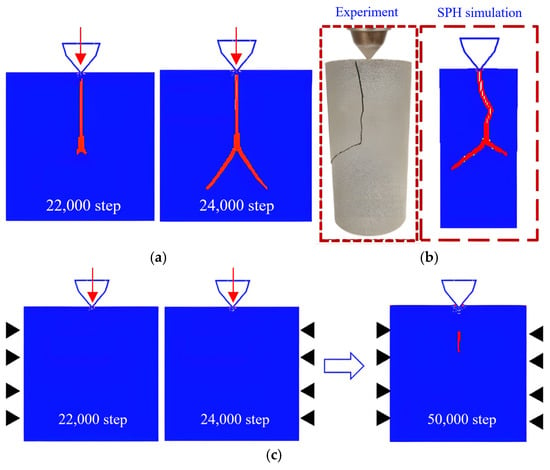
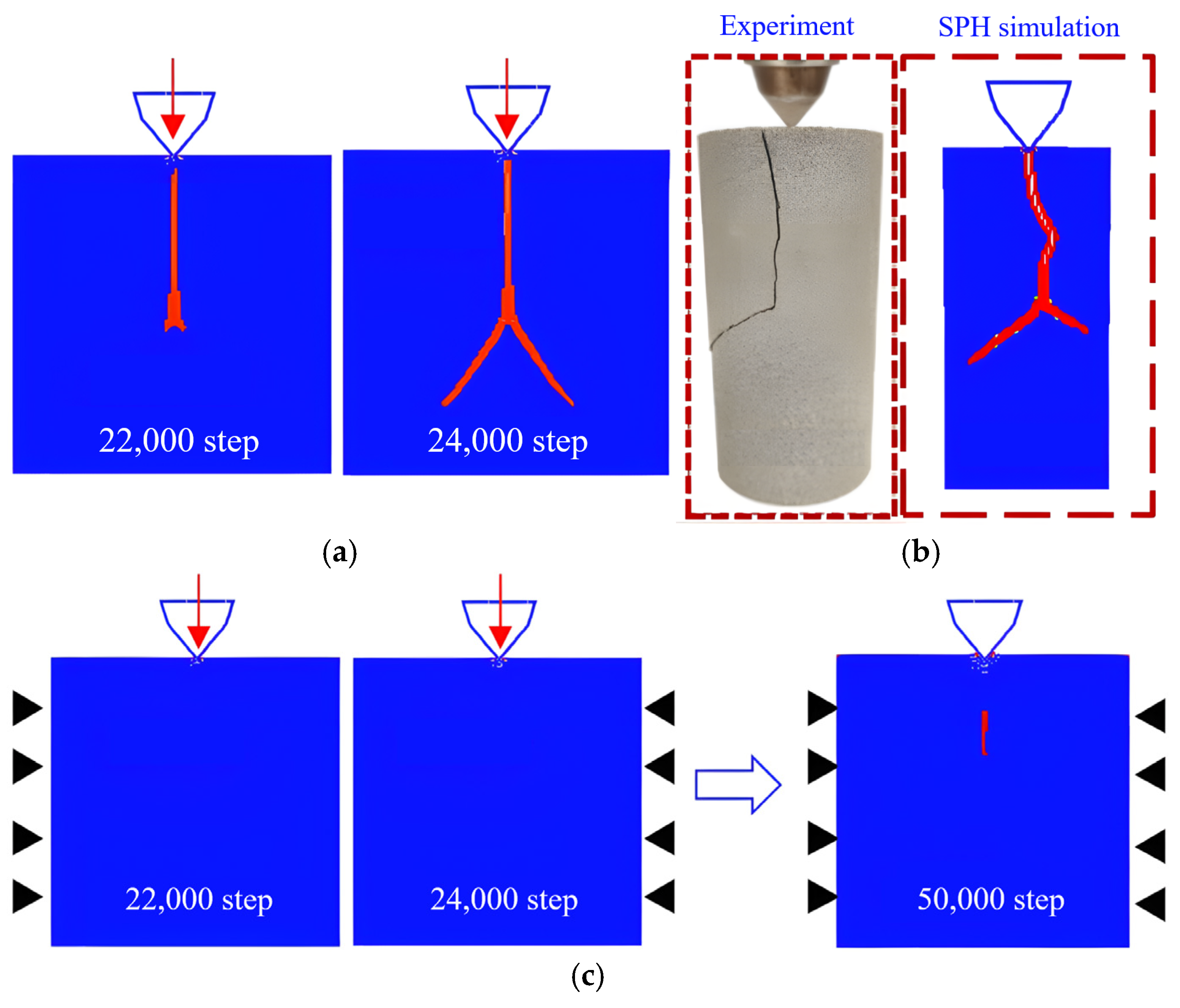
In this subsection, an SPH simulation is conducted to verify the process of a single cutting pick penetrating rock, following the vertical indentation experimental design by Cai et al. [33]. As shown in Figure 1a, during the simulation of pick penetration into a wide rock specimen, shear cracks first initiate at the tip of the pick due to compressive stress concentration. The primary crack then propagates steadily downward along the penetration direction. Upon reaching the midsection of the specimen, the release of stress at the two free surfaces causes the primary crack to bifurcate and extend toward the free boundaries. This phenomenon is consistent with the experimental observations reported in [33], where the radial free surface of a cylindrical rock specimen similarly guided the transition of crack propagation from axial to radial extension, indicating that the SPH simulation effectively captures free-surface-induced crack propagation behavior. Conversely, under constrained boundary conditions, as illustrated in Figure 1c, the lateral displacement of the specimen is restricted. At 50,000 simulation steps, crack propagation is significantly suppressed, with only a localized fractured zone forming beneath the cutting pick and no obvious bifurcation of the primary crack. This is attributed to the lateral constraints limiting the rock mass’s capacity for plastic deformation, thereby inhibiting the accumulation and release of tensile stresses.
Figure 1.
SPH Simulation of Single Pick Penetrating into Rock Sample. (a) Vertical penetration into a wide rock specimen (free surfaces on both sides). (b) Vertical penetration into a narrow rock specimen and comparison. (c) Vertical penetration into a wide rock specimen (lateral constraints on both sides).
Figure 1b compares the simulated crack patterns of a narrow rock specimen under pick penetration with the experimental results reported in [33]. The study by Cai et al. was chosen because it provides well-documented experimental data on pick penetration into rock, including detailed crack propagation patterns and force–displacement curves under controlled conditions. This aligns closely with the objectives of our numerical model in simulating both shear and tensile failure during pick–rock interaction, allowing for a direct and meaningful comparison between SPH predictions and physical measurements. Although the experiment was conducted using a three-dimensional cylindrical rock specimen (diameter 50 mm × height 100 mm) and the SPH simulation was based on a two-dimensional plane strain assumption (width 50 mm × height 100 mm), the simulation accurately reproduces the key rock-breaking characteristics observed in the physical experiment. In terms of crack propagation paths, both results show the primary crack initiating at the point of contact with the pick and propagating downward. As the crack approaches the middle-to-lower region of the specimen, it gradually turns toward the free surface. This occurs because the stress state near the free surface transitions from compression-shear dominated to tension dominated. The Grady–Kipp model within the hybrid failure framework successfully captures this mechanism of tensile crack redirection.
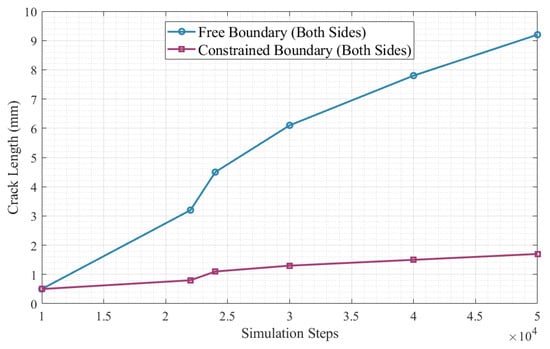
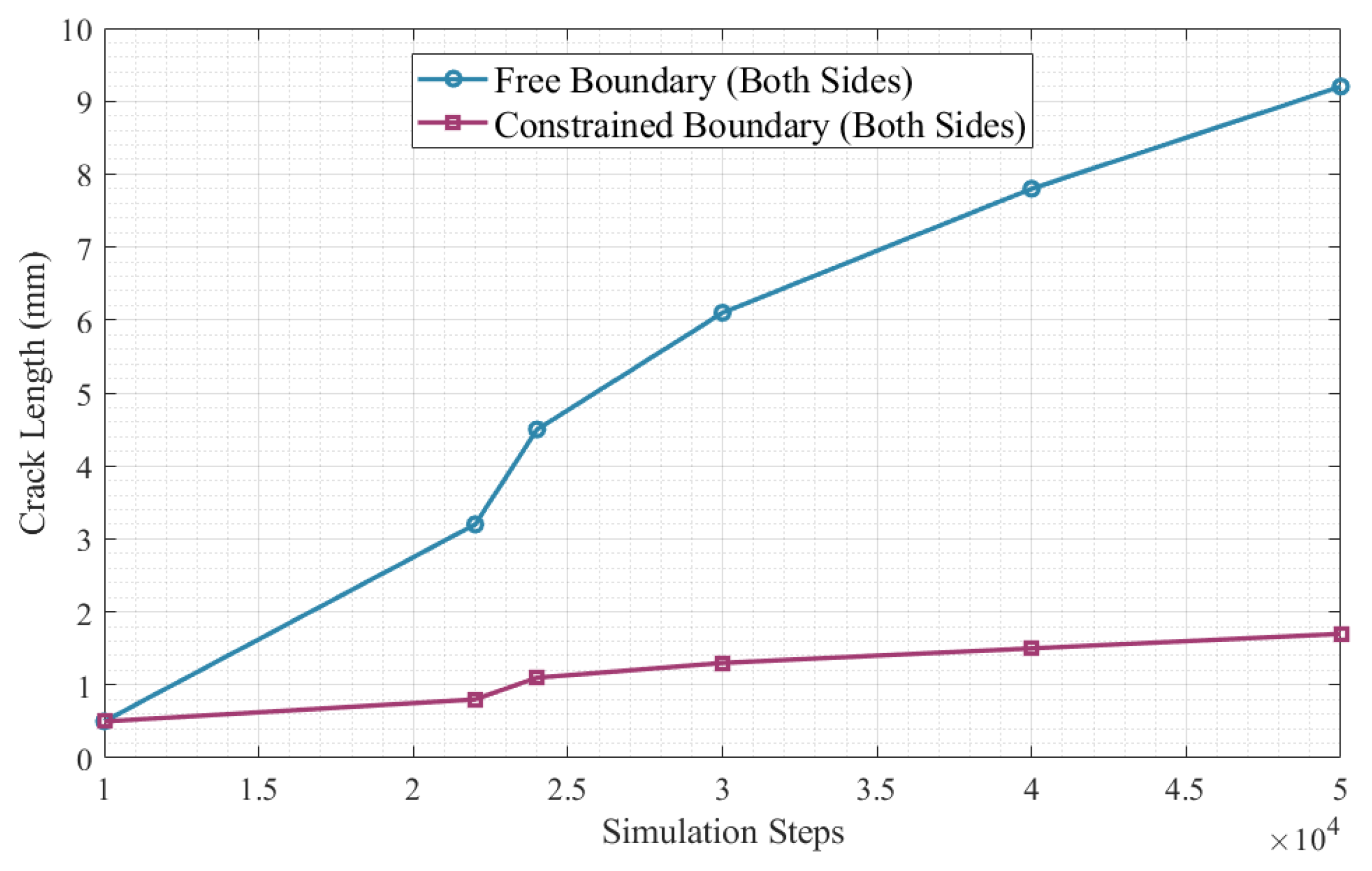
Figure 2 depicts the crack length variation with simulation steps under free and constrained boundary conditions. For the rock specimen with free surfaces, the crack length grows rapidly as steps increase, showing obvious extension at 22,000 and 24,000 steps, due to the effective release of tensile stress at the free boundaries. In contrast, the specimen under constrained boundaries exhibits almost no crack growth even at 50,000 steps, only forming a localized fractured zone. This difference is because lateral constraints restrict the plastic deformation of the rock mass, which inhibits the accumulation and release of tensile stresses required for crack propagation, consistent with the characteristics of crack propagation in pick penetration simulation.
Figure 2.
Crack Length Variation with Simulation Steps Under Different Boundary Conditions.
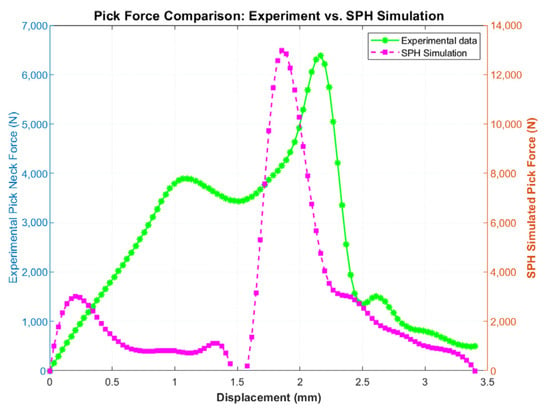
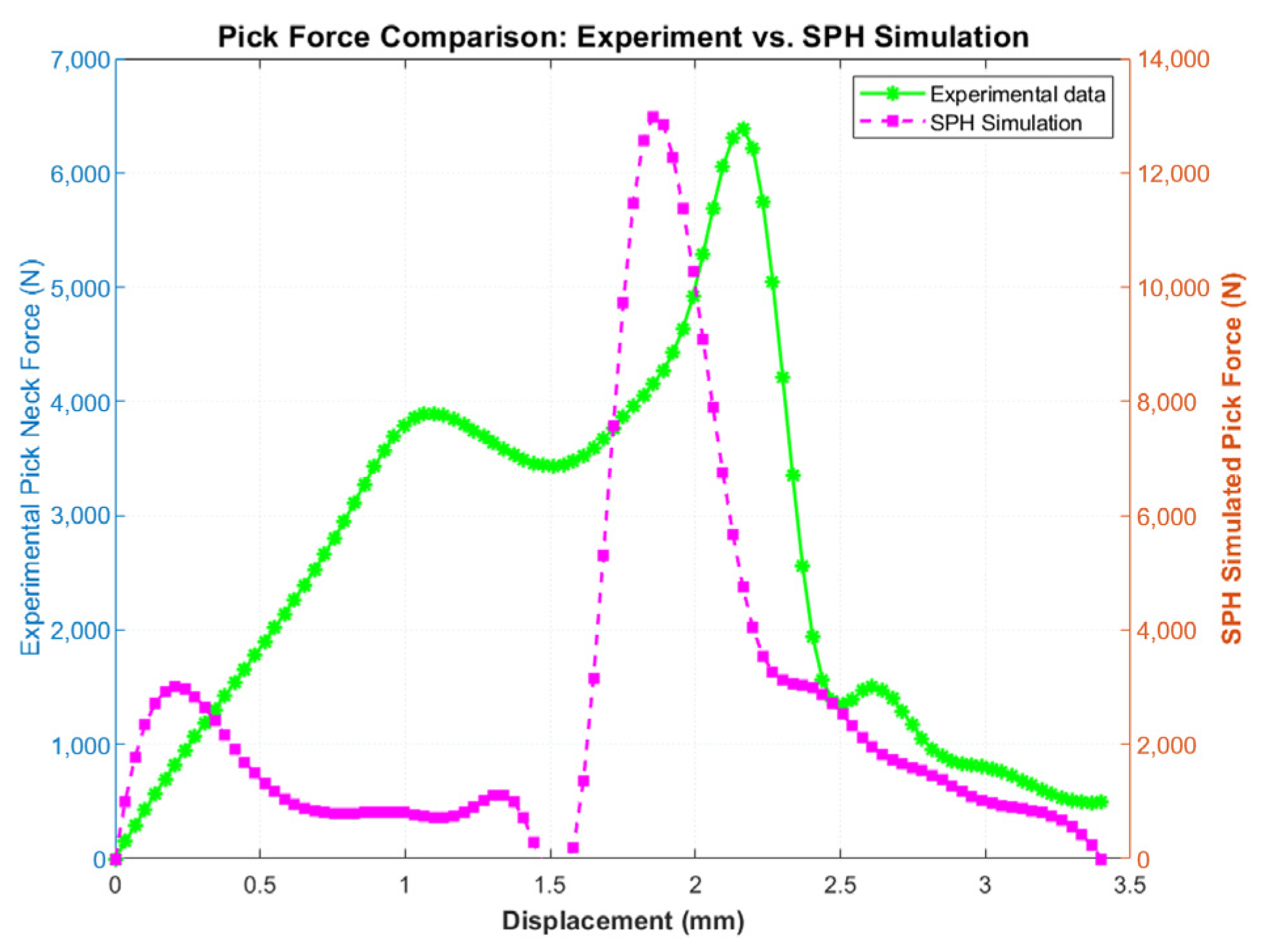
Figure 3 presents a direct comparison between the SPH simulation results of single pick penetration into rock and the experimental force–displacement curve reported in [33]. In terms of the main features of the curves, both the simulation and the experiment capture two critical force peaks. The first peak corresponds to the initial penetration of the pick tip into the rock, where compressive stress concentration in the contact region triggers the Drucker–Prager yield criterion, leading to localized shear failure of the coal-rock material and the formation of an initial shear zone. The second peak arises from the accumulation of tensile stress at the crack tip during penetration, which activates the Grady–Kipp model. Once the tensile cracks propagate to the free surface, secondary fracture occurs. This result demonstrates that the SPH model effectively captures the key mechanical stages of rock breaking by the pick, transitioning from initial shear failure to subsequent tensile-induced secondary failure. To quantitatively assess the agreement between the simulation and experiment, the coefficient of determination and root mean square error were calculated, yielding values of 0.92 and 0.85 kN, respectively. This indicates a strong overall correlation, capturing the primary mechanical response. The observed discrepancies, particularly the sharper force drops in the simulation, are primarily attributed to the fundamental differences between the 2D plane-strain model and the 3D experimental specimen. In the 3D experiment, the cylindrical rock sample provides a continuous confining effect, leading to a more gradual plastic failure and energy dissipation. In contrast, the 2D simulation experiences an abrupt loss of constraint when cracks reach the boundaries, resulting in rapid stress release.
Figure 3.
Comparison of Force–Displacement Curves for Single Pick Penetration.
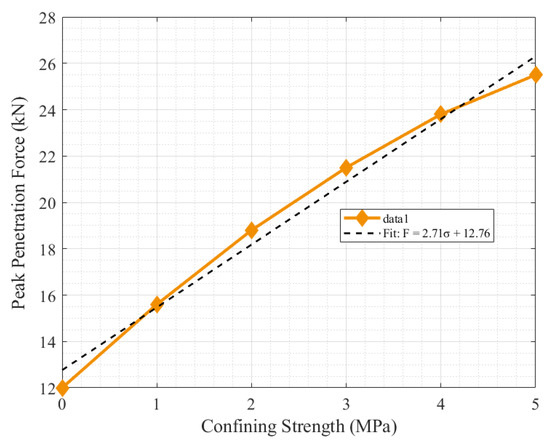
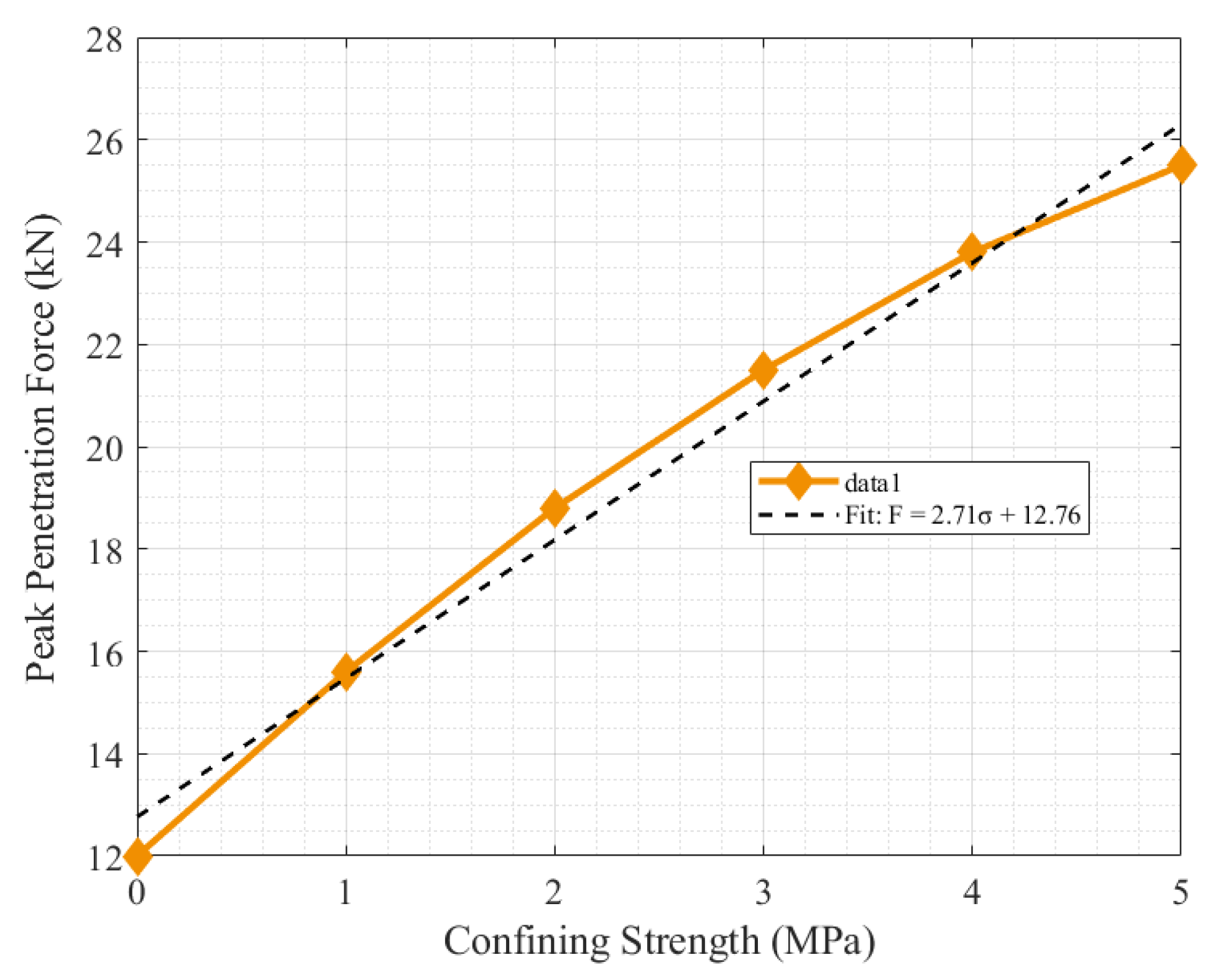
Figure 4 demonstrates a clear positive correlation between peak penetration force and specimen confining strength. As confining strength increases, the peak force rises linearly, with the force value at 5 MPa being nearly twice that at 0 MPa. This trend is due to the fact that higher confining pressure suppresses the accumulation of tensile stresses in the rock, enhances the material resistance to shear failure, and thus requires a larger penetration force to initiate and propagate cracks. The linear fitting curve further quantifies this relationship, providing a quantitative reference for understanding how boundary constraints affect the mechanical response of rock during pick penetration.
Figure 4.
Peak Penetration Force Variation with Specimen Confining Strength.
4.2. Cutting Pick Interacting with Hard Nodules in a Coal Seam
4.2.1. Simulation Configurations
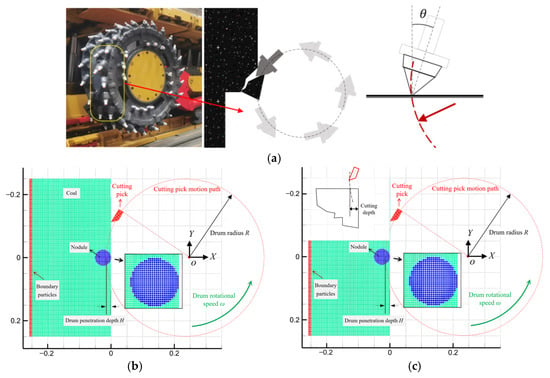
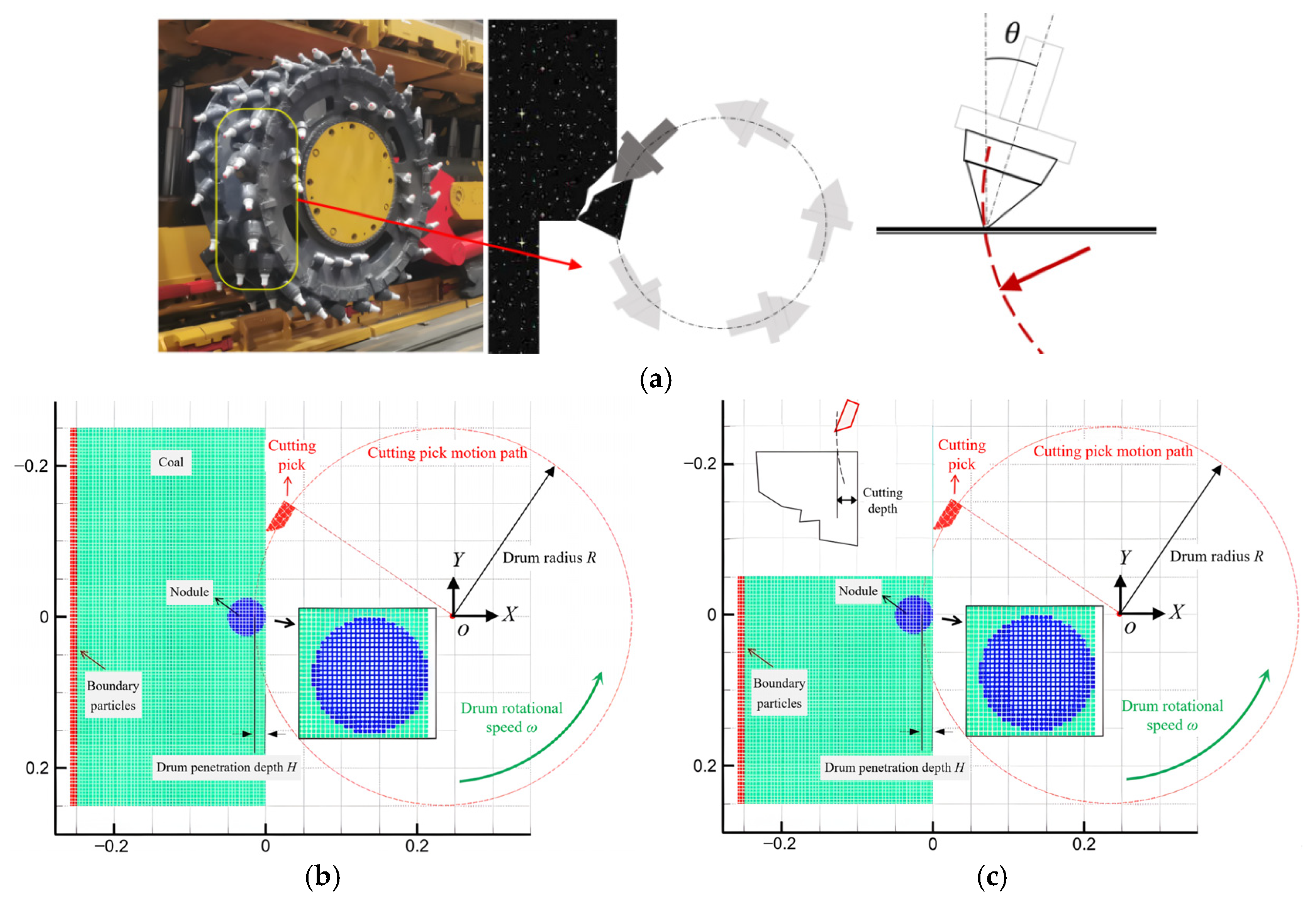
The cutting drum is a critical component in coal seam cutting, with the picks mounted on it performing rotary cutting of the coal as the drum rotates, as shown in Figure 5a. Previous studies have commonly used linear cutting models to simulate the rock-breaking process of the cutting picks. To more accurately reflect actual operating conditions, this subsection establishes an SPH numerical model capable of simulating rotary cutting and conducts simulations under two cutting conditions: a complete coal wall and a slot-cut coal wall. The drum is assigned a rotational speed of 60 r/min and a diameter of 0.5 m. Figure 5b,c show the initialized SPH model, in which the picks are positioned just before contacting the coal seam target. After the computation begins, the picks rotate counterclockwise at the given drum speed and start interacting with the coal seam. The key parameters for the drum, cutting, and numerical simulation are summarized in Table 1. In this simulation, a total of 32,051 SPH particles are used. The initial particle spacing is set to 2.0 mm, and the time step is set to 2.0 × 10⁻⁷ s. The simulation runs for 500,000 steps, corresponding to a physical time of 0.1 s. A single hard nodule with a diameter of 50.0 mm is embedded on the surface of the coal seam. Three drum penetration depths are simulated: H = 10.0, 20.0, and 30.0 mm. In Figure 5b,c, the coal particles are shown in green, the embedded hard nodule in blue, and the boundary particles in red. The cutting pick and its motion path are also shown in red, while the drum rotational direction is indicated by the green arrow.
Figure 5.
SPH Model of a Single Pick Cutting Coal Seam Containing Hard Nodules. (a) Schematic diagram of the motion relationship between the drum and the cutting picks. (b) Intact coal wall. (c) Slot-cut coal wall.
Table 1.
Simulation parameters for the rotational cutting model.
4.2.2. Simulation Results of Cutting into an Intact Coal Wall
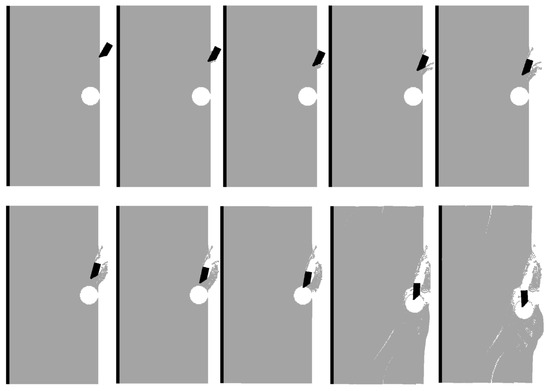
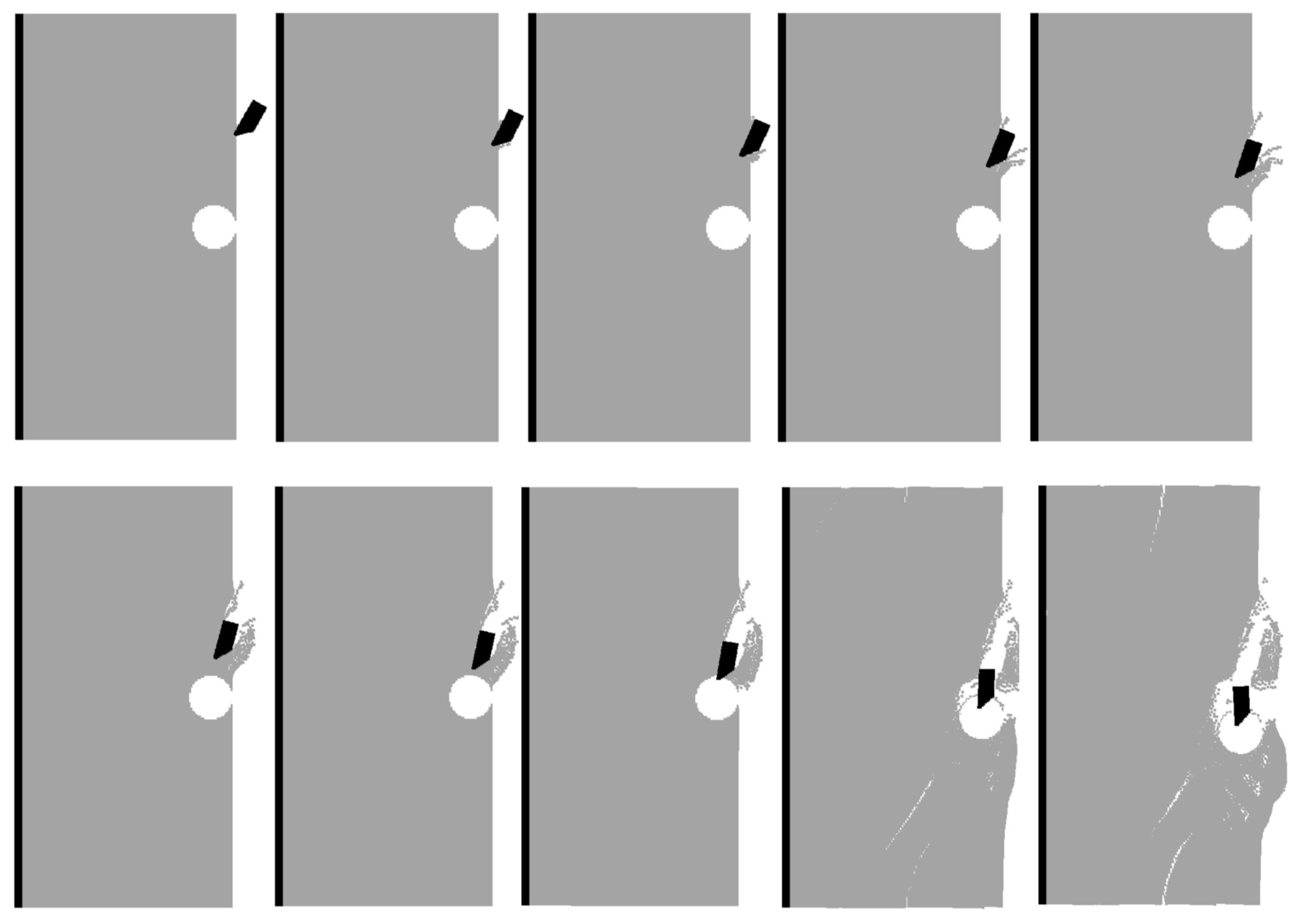
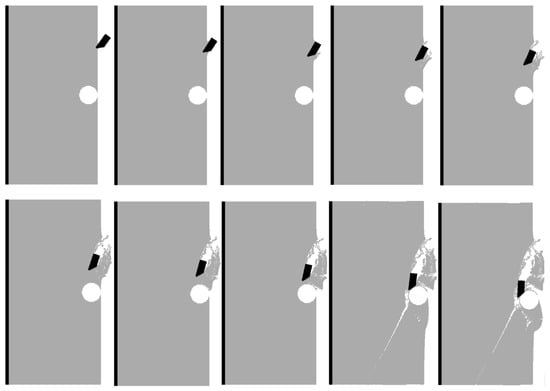
Figure 6 shows the simulation results of a single pick cutting a coal seam containing a single hard nodule at a cutting depth of 10 mm. Initially, the pick is positioned directly above the nodule. After penetrating into the coal, the pick first induces shear failure in the coal, with the failure zone extending along the pick’s movement path. Before the pick contacts the nodule, no significant damage occurs in the area surrounding the nodule. Once the pick comes into contact with the nodule, it penetrates into the nodule, generating high contact stress. This stress is transmitted through the nodule to the underlying coal, causing compression of the coal and the initiation of tensile cracks in the lower-left region beneath the nodule. As the pick continues to move downward, these tensile cracks rapidly propagate, and the coal beneath the nodule fractures under the compressive forces. At this depth, the internal cracks within the coal wall are not yet fully developed, but the nodule has already begun to spall, indicating that the damage caused by the pick is primarily concentrated in the region surrounding the nodule.
Figure 6.
Simulation Results of Single-Pick Cutting of a Coal Seam Containing a Hard Nodule (Cutting Depth 10.0 mm).
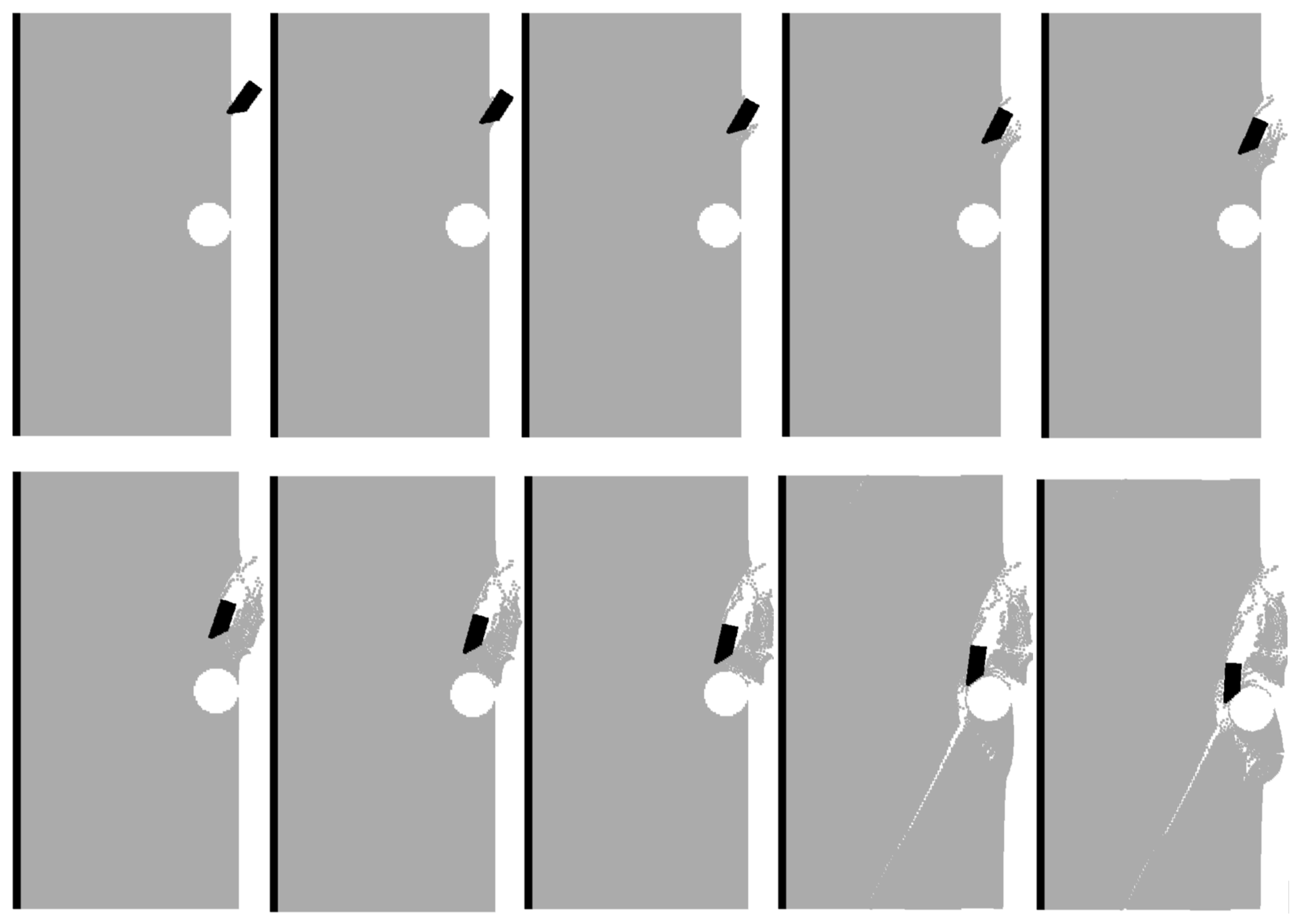
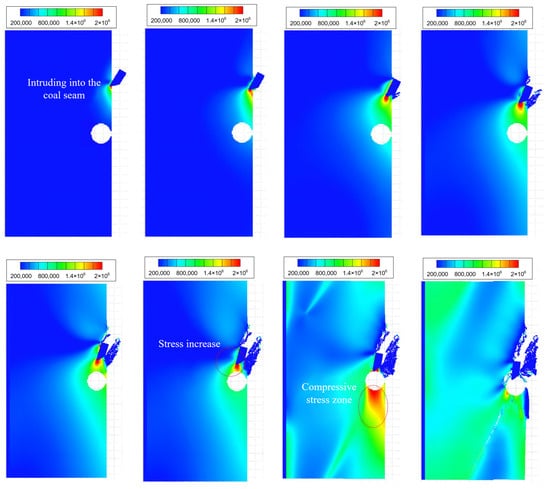
Figure 7 presents the simulation results of a single pick cutting a coal seam containing a hard nodule at a cutting depth of 30 mm. At this depth, the internal crack propagation within the coal seam is clearly visible, fully illustrating the destructive effect of the pick on the coal. Figure 8 shows the stress distribution at a cutting depth of 10.0 mm. After the pick penetrates into the coal, stress concentration appears at the contact point, causing the material to undergo plastic deformation under the D-P yield criterion, followed by shear failure along the pick’s trajectory. As the cutting progresses, a high-stress zone forms behind the pick due to compression of the coal, gradually expanding downward and enveloping the entire nodule. When the pick comes into contact with the nodule, this high stress is transmitted to the area beneath the nodule, generating significant compressive stress that causes the underlying coal to deform toward the free surface and form a localized fractured zone. Notably, even after fracturing occurs, the overall stress field remains smooth and continuous, demonstrating the advantage of the SPH method in accurately simulating problems involving large deformations.
Figure 7.
Simulation Results of Single-Pick Cutting of a Coal Seam Containing a Hard Nodule (Cutting Depth 30.0 mm).
Figure 8.
Stress Distribution of a Coal Seam Containing a Hard Nodule during Single-Pick Cutting (Cutting Depth 10.0 mm).
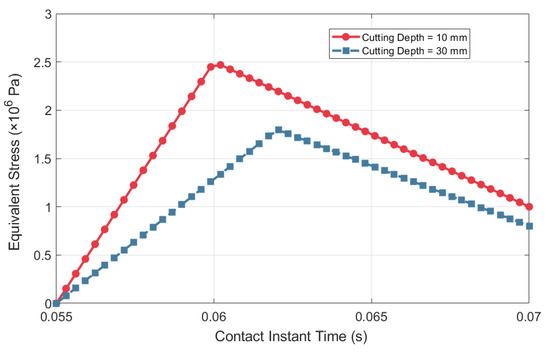
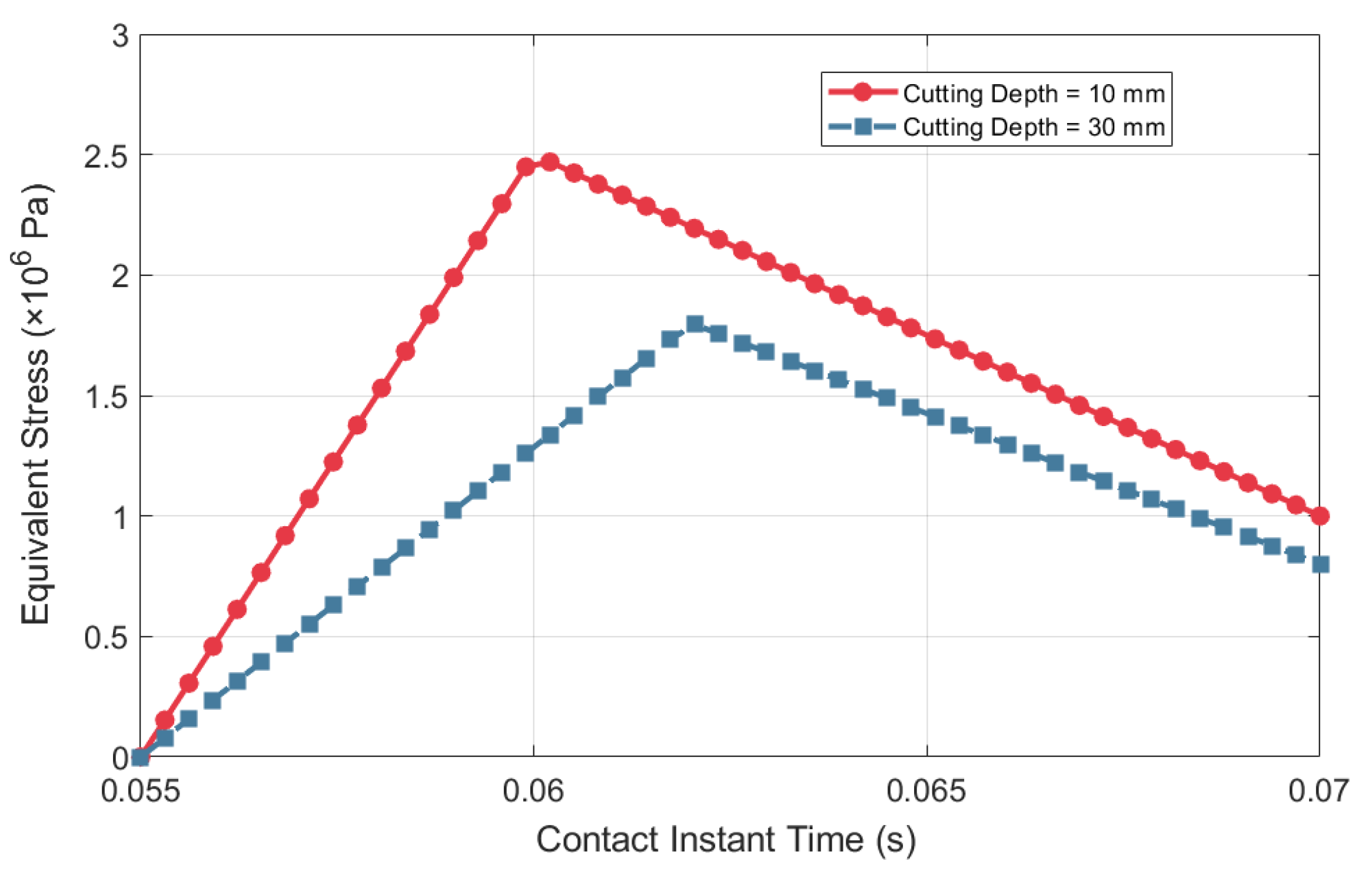
Figure 9 captures the dynamic evolution of equivalent stress during the critical contact instant between the cutting pick and the hard nodule. At a shallow depth of 10 mm, the pick directly impacts the nodule, leading to a rapid stress rise that peaks at 2.5 × 10⁶ Pa; after the peak, the stress drops sharply as the nodule spalls and stress is released. In contrast, at a deeper depth of 30 mm, the contact position between the pick and the nodule shifts away from the nodule’s midpoint, reducing the impact intensity—thus, the stress peak is lower (1.8 × 10⁶ Pa) and occurs later. This difference in stress response confirms that shallow cutting depths induce more severe stress concentration at the pick–nodule interface, which is consistent with the earlier observation that nodules spall earlier at shallow depths. The smooth stress transition in the curves also verifies the effectiveness of artificial viscosity and stress smoothing techniques in suppressing non-physical oscillations, ensuring numerical stability.
Figure 9.
Equivalent Stress Response at Different Depths During Cutting Pick–Nodule Contact Instant.
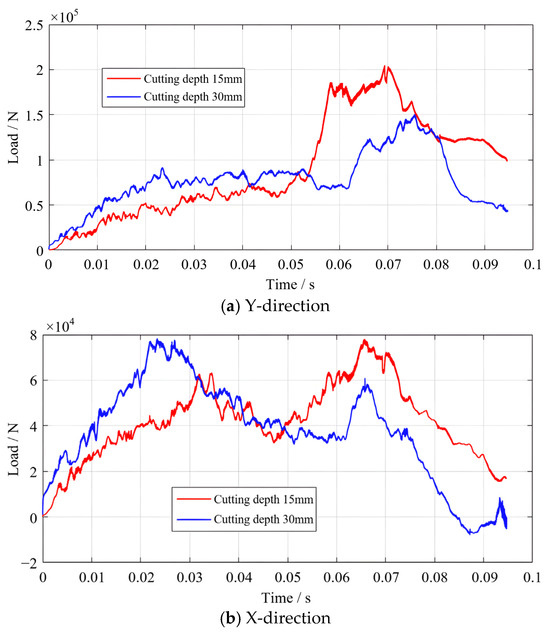
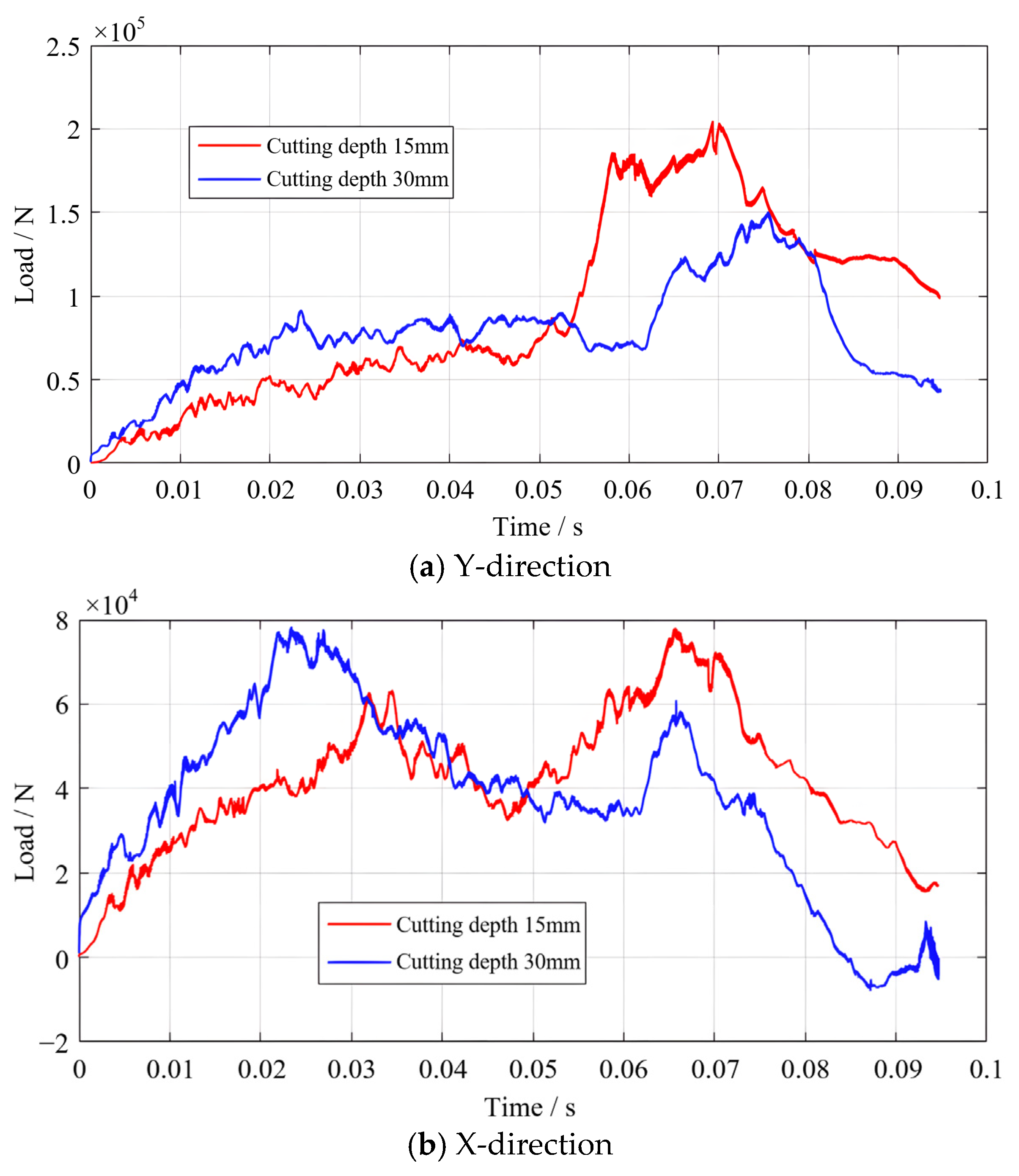
Figure 10 shows the variation in forces acting on the cutting pick over time during the cutting process. As illustrated, the force in the Y-direction initially increases gradually, then rises sharply at approximately 0.06 s, remains stable for about 0.015 s, and subsequently drops suddenly. The sharp increase in the Y-direction force is caused by the significant reaction force generated when the pick engages with the hard nodule during cutting. For the X-direction force, two distinct peaks are observed within the simulated time period. The first peak results from the tangential penetration of the pick into the coal, where the working resistance in the X-direction increases as the cutting depth grows. The second peak occurs when the pick encounters the hard nodule. As the cutting depth increases, the contact point at which the pick engages the nodule is located farther from the nodule’s midpoint, resulting in a smaller secondary peak resistance.
Figure 10.
Schematic diagram of the detachment mechanism for hard nodules in coal.
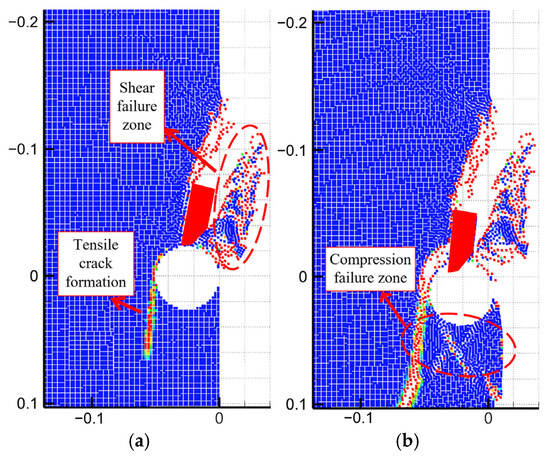
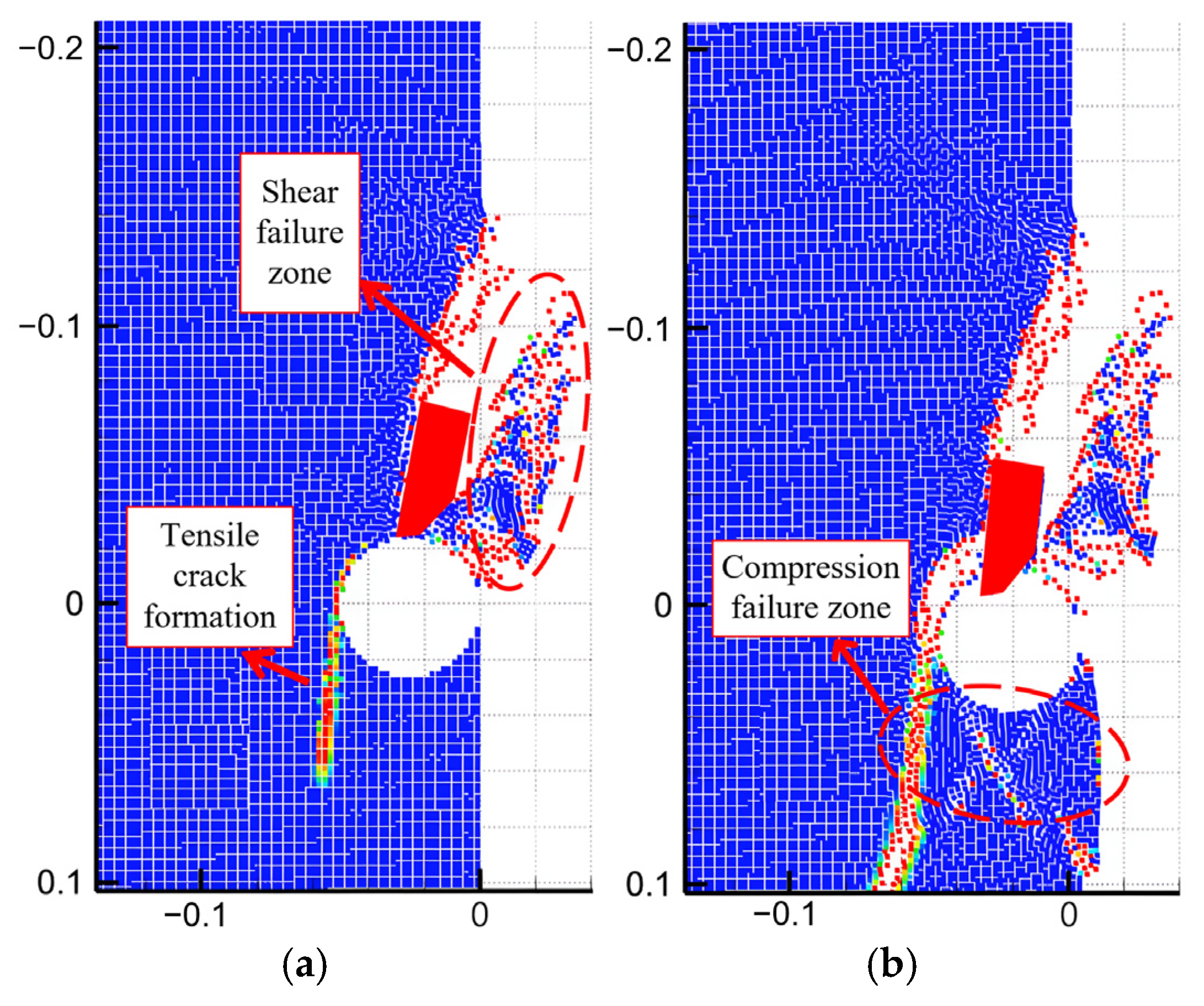
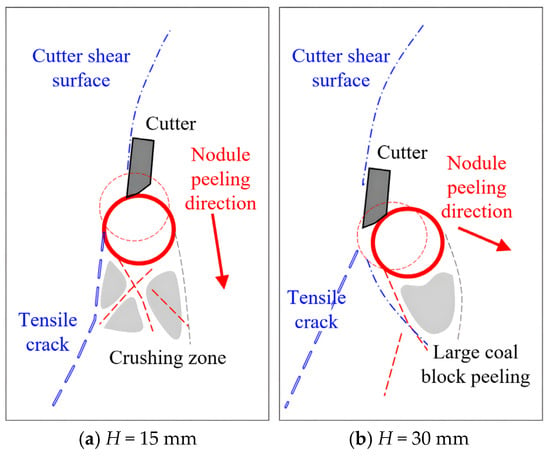
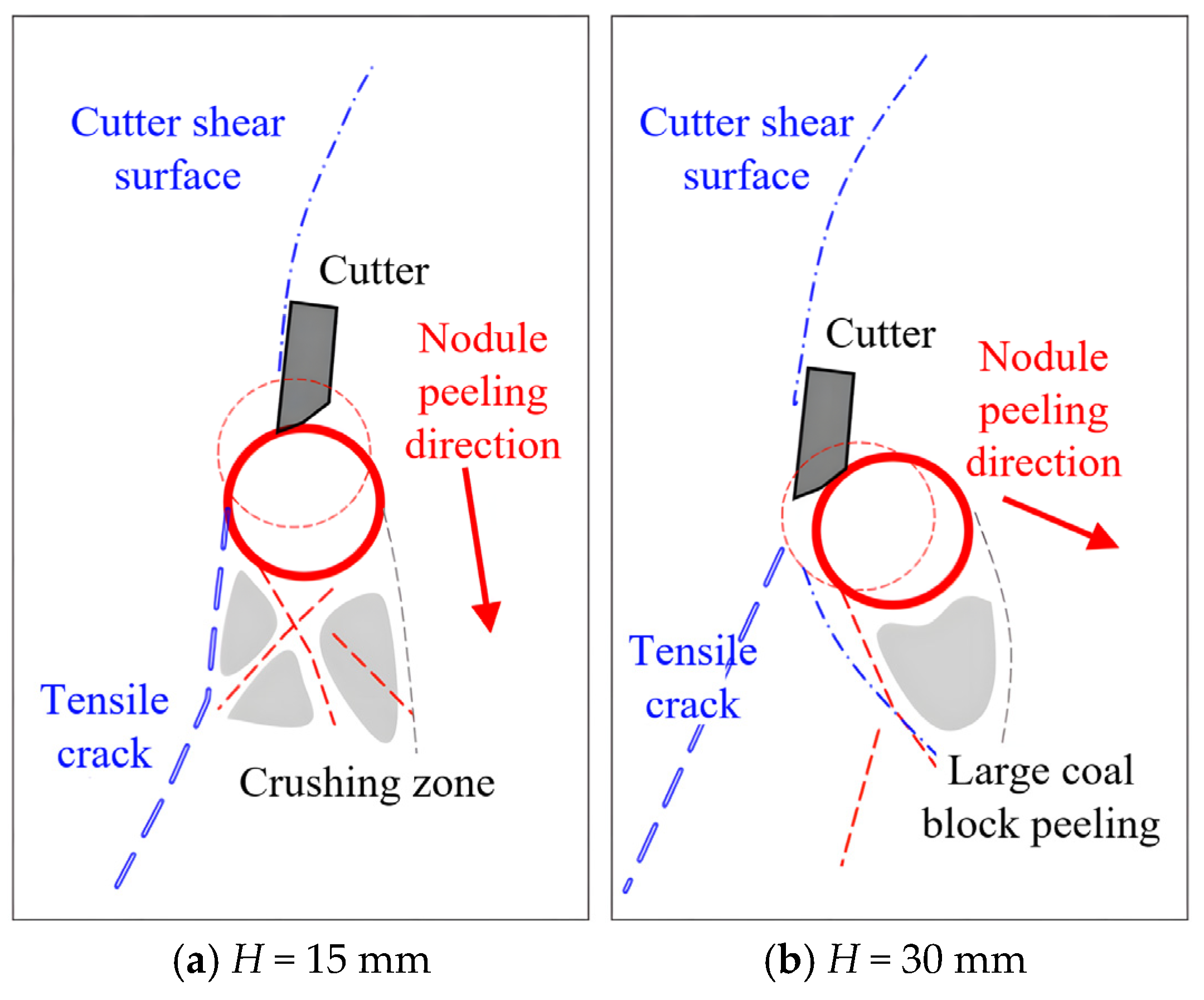
Before the cutting pick contacts the nodule, the failure of the coal above the nodule is primarily dominated by shear failure. Once the pick comes into contact with the nodule, it exerts a downward force on the nodule, causing cracks to initiate on the left side of the nodule, as shown in Figure 11a, where tensile cracks are generated. These tensile cracks rapidly propagate, while at the same time, the coal beneath the nodule begins to fracture under the influence of compressive stress, as illustrated in Figure 11b. Figure 12 summarizes two distinct nodule spalling mechanisms corresponding to cutting depths of 15 mm and 30 mm. At a cutting depth of 30 mm, the point of action between the pick and the nodule shifts toward the left side of the nodule, moving away from the free surface, which reduces the compressive stress beneath the nodule. During the spalling process at this depth, there is no significant fracturing in the coal beneath the nodule. Instead, the pick performs shearing along its cutting trajectory, with the shear plane passing through the nodule itself. From the cutting pick reaction forces shown in Figure 13, it can be seen that at greater cutting depths, both the X-direction and Y-direction spalling forces associated with nodule detachment are lower than those observed at a cutting depth of 15 mm.
Figure 11.
Simulation results of a Single Pick Cutting Coal Seam Containing Hard Nodules. (a) Pick contacting the nodule. (b) Pick penetrating into the nodule.
Figure 12.
Failure and Spalling Mechanisms of Coal Seam and Concretion Under Single Pick Action.
Figure 13.
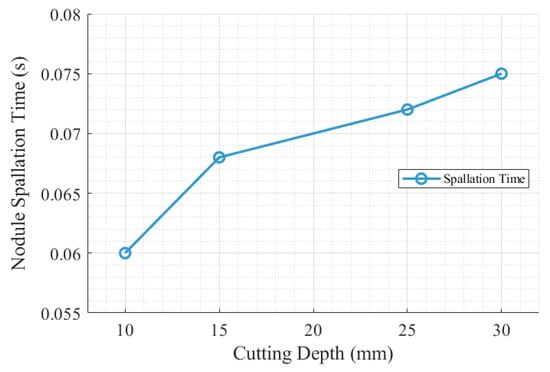
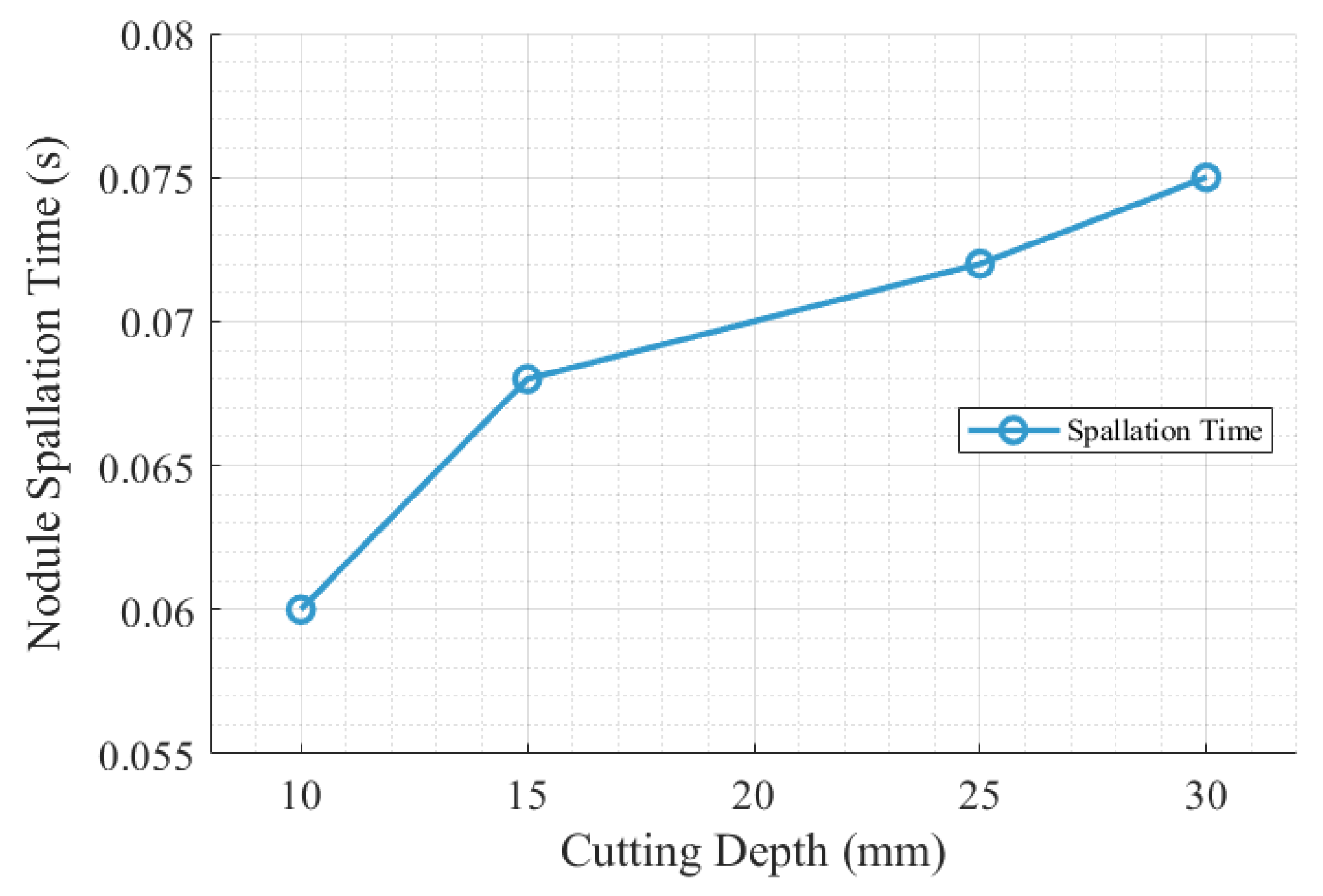
Spallation Time of Hard Nodules vs. Cutting Depth in Rotary Cutting.
Figure 13 quantifies the impact of cutting depth on the spallation time of hard nodules in rotary cutting. At 10 mm (shallow depth), nodules spall early at 0.06 s, driven by tension dominance. At 15 mm, spallation time slightly extends as tension weakens. Notably, 20 mm depth shows no obvious nodule detachment. At 25 mm, spallation resumes with a longer time (e.g., 0.07 s), and at 30 mm (deep depth), it delays to 0.075 s under shear dominance. This trend clarifies depth-dependent spallation mechanisms, supplementing the temporal difference analysis for the nodule spallation mechanism.
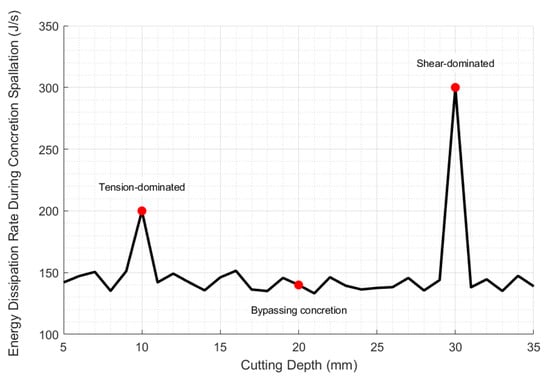
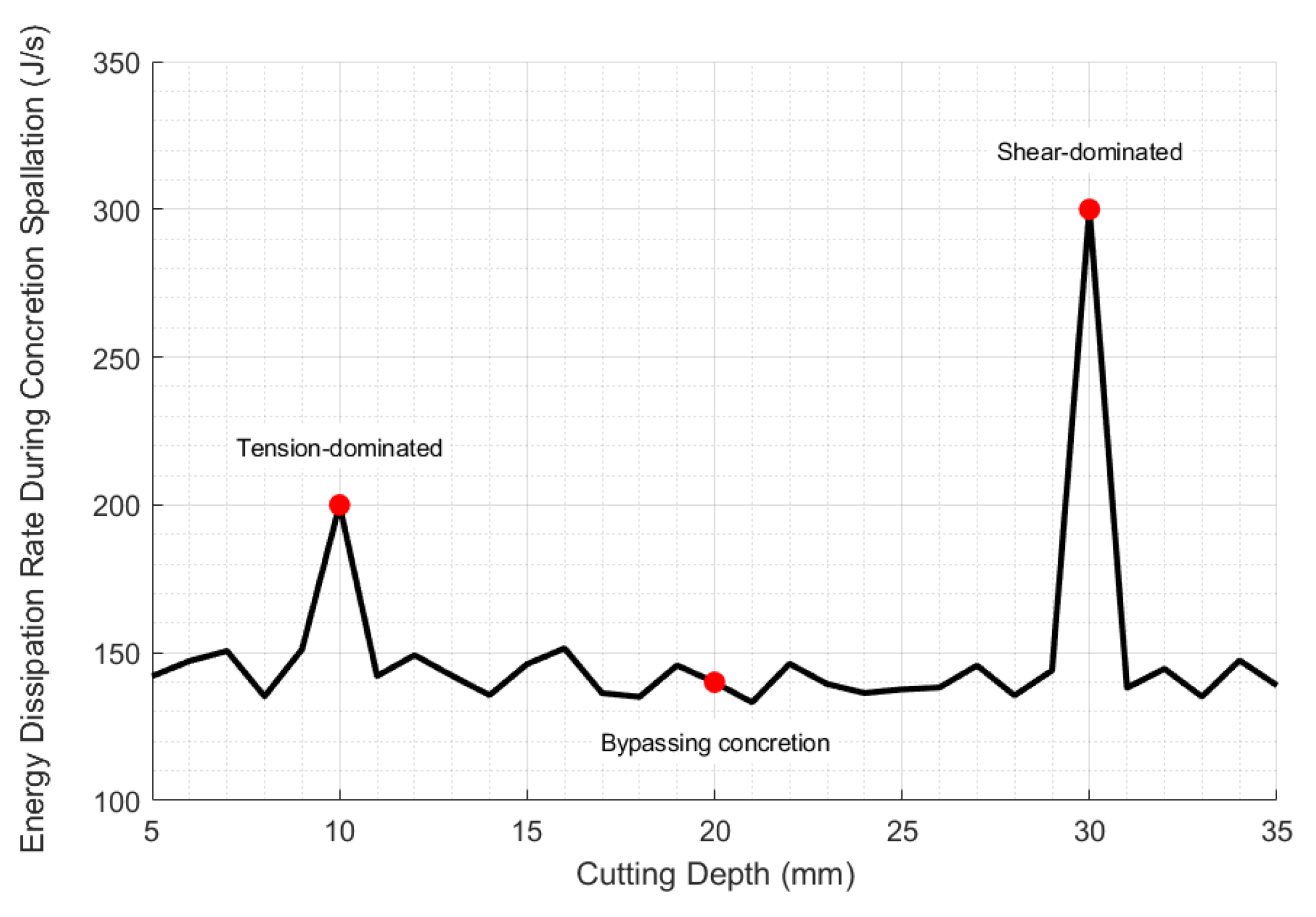
As presented in Figure 14, at a shallow depth of 10 mm, the rate reaches approximately 200 J/s, which is attributed to the tension-dominated failure mechanism—intense tensile stress concentration beneath the concretion triggers rapid crack propagation and sudden spallation, resulting in significant energy consumption. When the cutting depth increases to 20 mm, the energy dissipation rate drops to the minimum value of ~140 J/s; this is because the cutting pick bypasses the hard nodule, and coal failure is mainly driven by slow tensile crack extension without direct interaction with the concretion, thus reducing energy demand. As the depth further increases to 30 mm, the energy dissipation rate rises sharply to ~300 J/s, which is associated with the transition to a shear-dominated failure mode. The pick needs to drive a larger volume of coal to undergo shear slip for blocky spallation, and the continuous shear deformation and crack coalescence process consume more energy. This non-monotonic trend directly indicates that an intermediate cutting depth of around 20 mm is energetically optimal. Consequently, selecting this depth range in field operations can effectively minimize overall energy consumption when cutting through coal seams containing hard inclusions.
Figure 14.
Variation in Energy Dissipation Rate During Spallation with Cutting Depth.
4.2.3. Simulation Results of Cutting into a Groove Coal Wall
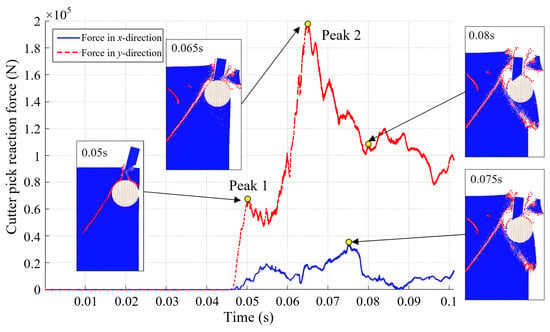
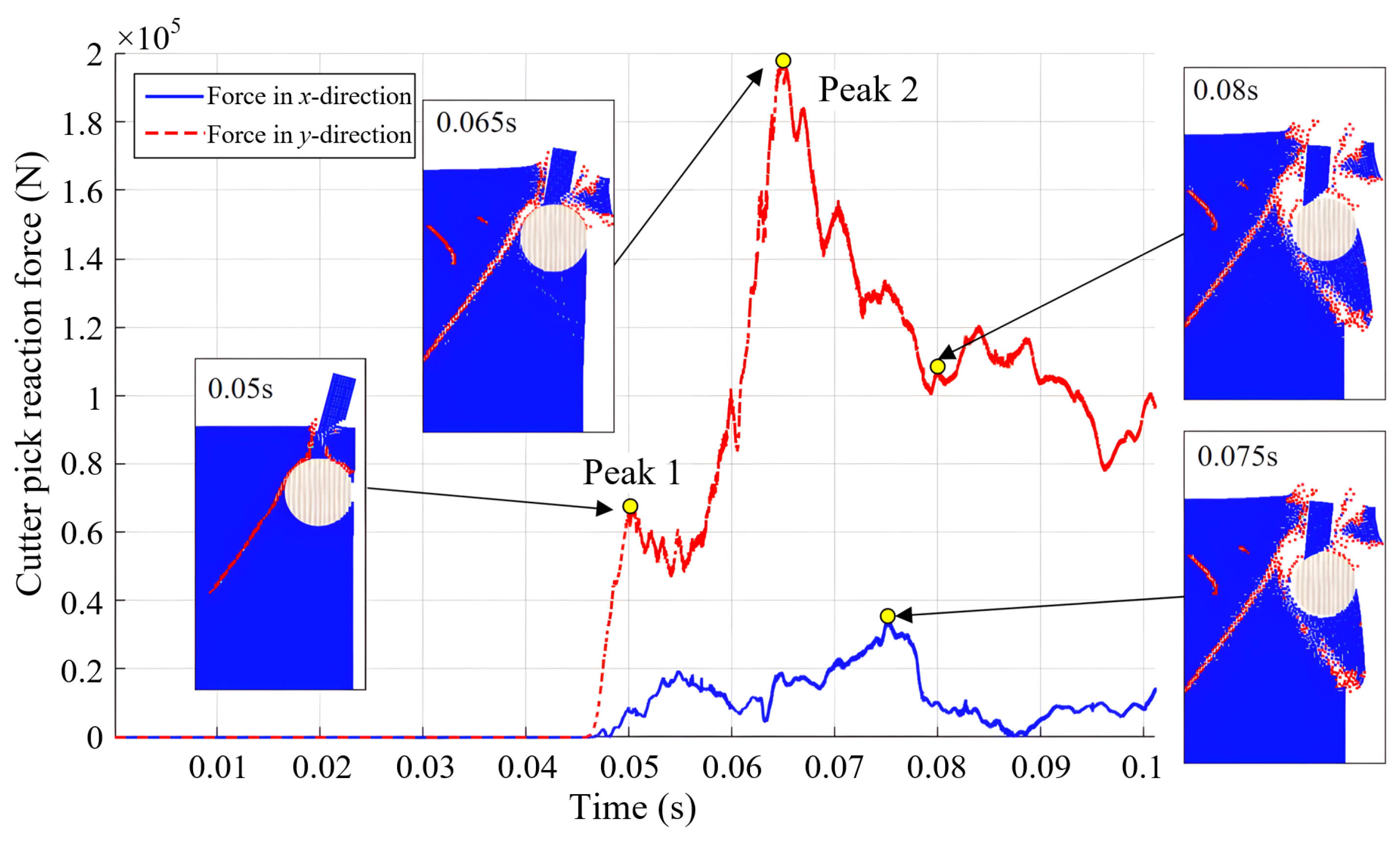
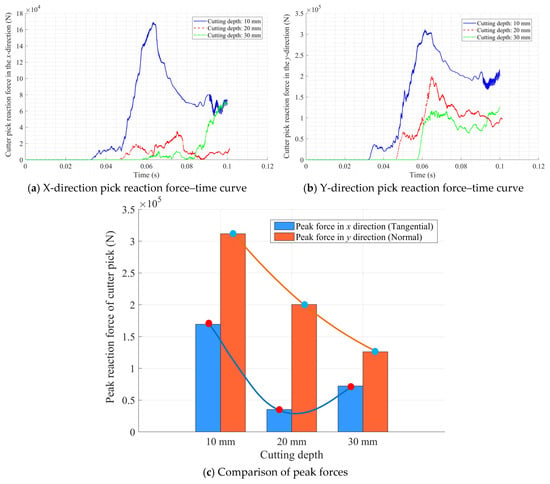
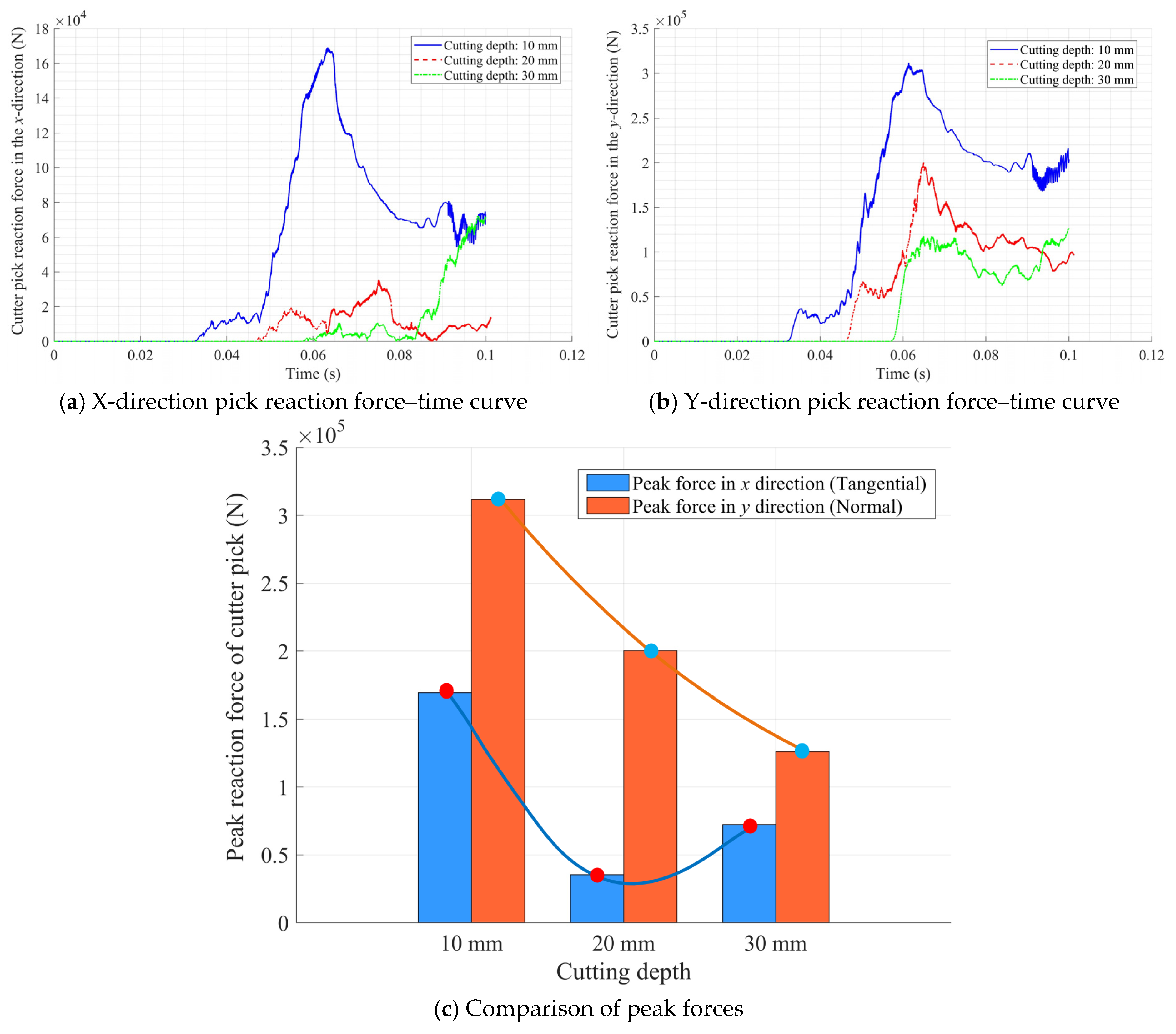
The cutting process of the pick in a slot-cut coal wall is analyzed and compared with the previous case of a complete coal wall to illustrate the influence of the free surface formed above the slot on the cutting mechanism in practical engineering. As shown in Figure 15, the force curves of the cutting pick exhibit three distinct stages: gradual increase, sudden peak, and rapid decline. Before 0.05 s, the Y-direction force rises slowly, corresponding to the initial penetration of the pick into the coal wall during the compression-shear phase. The first peak of the X-direction force is associated with coal shearing caused by the tangential rotation of the pick. Around 0.065 s, both the X- and Y-direction forces increase sharply and reach a peak, indicating that when the pick contacts the hard nodule, the reaction force of the nodule triggers the coupled action of the Drucker–Prager criterion and the Grady–Kipp model. This peak lasts for approximately 0.015 s, representing the progressive failure of the coal–nodule interface. After 0.08 s, the forces rapidly decline, marking the detachment of the nodule under the combined action of shear and tensile stresses, as the pick transitions out of the high-resistance state.
Figure 15.
Curves of pick force vs. time during the cutting process of a single pick cutting the cutting groove coal wall (containing a single nodule).
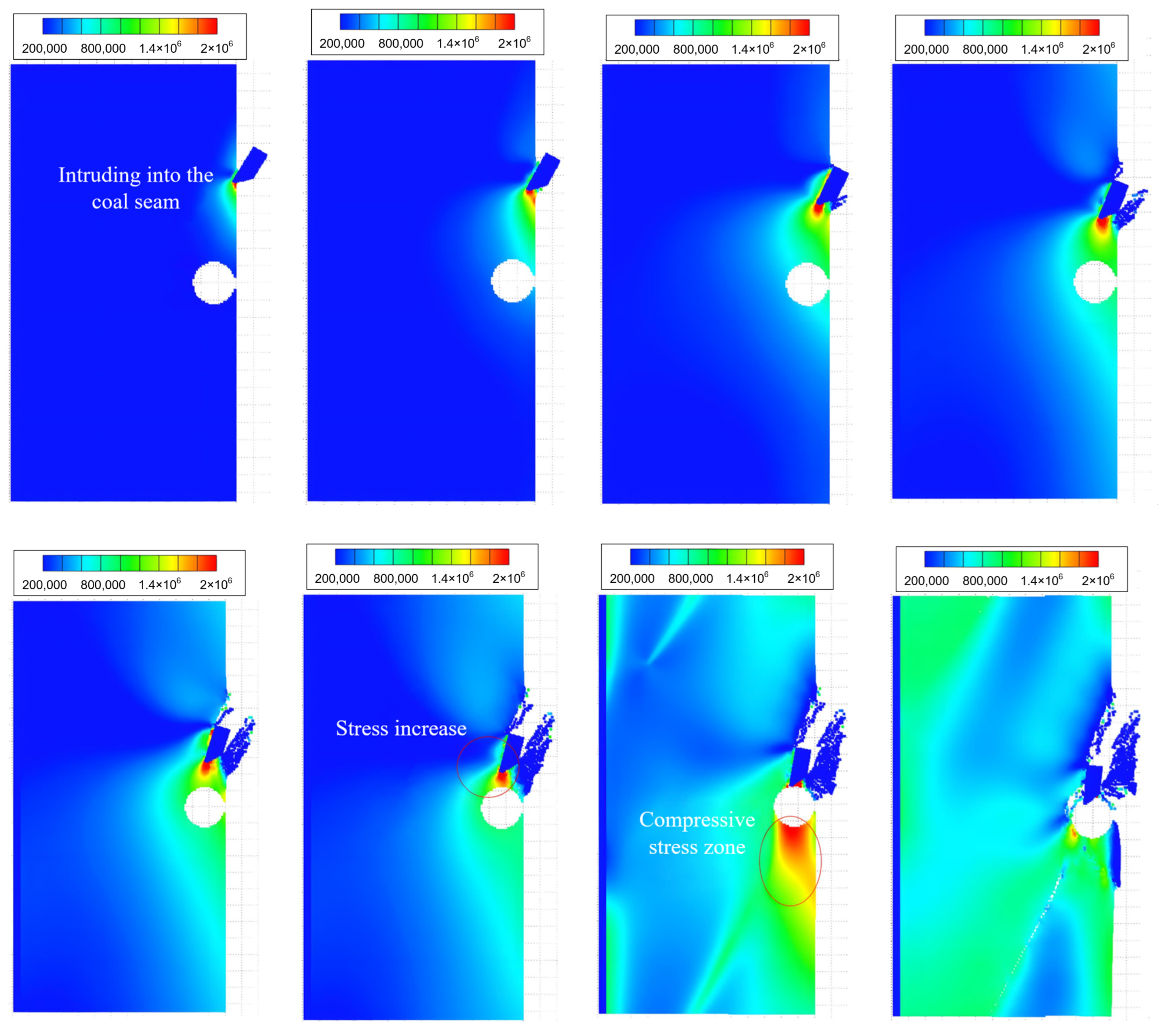
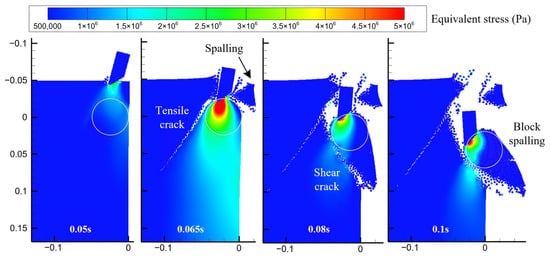
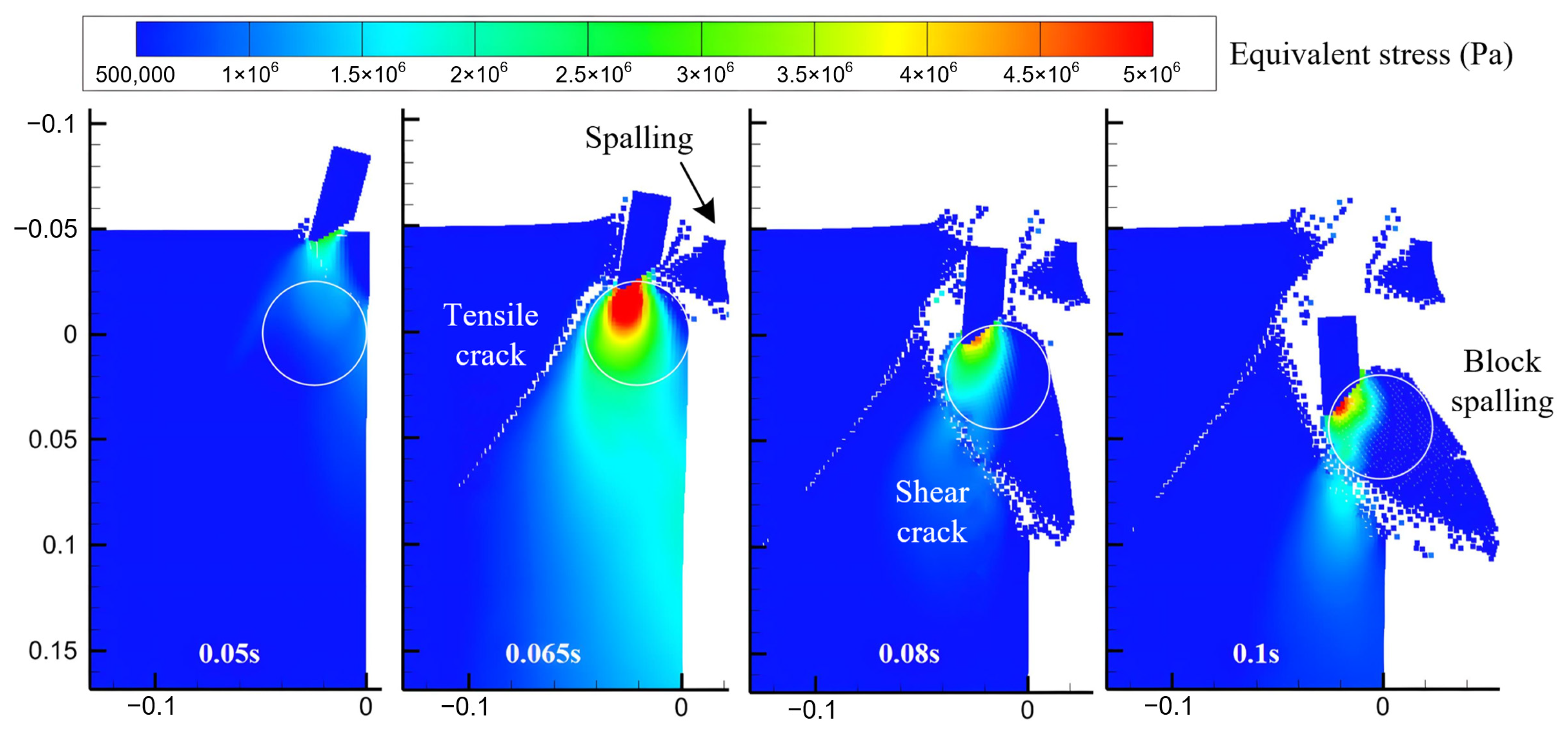
From the stress contour plots in Figure 16, it can be observed that, at 0.05 s, a localized high-stress zone appears in front of the cutting pick and gradually expands to surround the nodule as the pick advances. At 0.065 s, the stress around the nodule exceeds 2.5 × 10⁶ Pa, with tensile cracks initiating at the lower-left side of the nodule, while shear cracks simultaneously develop at the contact point. By 0.08 s, the two types of cracks merge, forming a fractured zone beneath the nodule as the stress field shifts toward the free surface. At 0.1 s, the nodule completely detaches, and a sheet-like failure zone centered around the pick’s cutting path appears on the coal wall surface. No non-physical oscillations are observed in the stress contour plots, indicating that the application of artificial viscosity and stress smoothing effectively enhances the numerical stability of the simulation.
Figure 16.
Stress nephogram during the cutting process of a single pick cutting the cutting groove coal wall (containing a single nodule).
Figure 17 illustrates the force characteristics during the cutting process of a slot-cut coal wall at different cutting depths, revealing the evolution of cutting mechanical behavior. The tangential force in the X-direction exhibits a “V-shaped” trend: it reaches a peak at a cutting depth of 10 mm, decreases to its minimum at 20 mm—representing a reduction of approximately 79% compared to the peak—and then rises again to about 43% of the peak level at a depth of 30 mm. The normal force in the Y-direction continuously decreases with increasing cutting depth, dropping by approximately 60% from 10 mm to 30 mm. Moreover, the fluctuations in both force directions become progressively smoother as the cutting depth increases. These differences in force characteristics stem from changes in the interaction and failure mechanisms between the cutting pick and the nodule. At the shallow depth of 10 mm, the pick directly contacts the hard nodule, triggering a combined shear–tensile failure that causes a sharp increase in tangential force. At a depth of 20 mm, the pick trajectory bypasses the nodule, and the coal primarily fails through tensile crack propagation, leading to a significant reduction in cutting resistance. At 30 mm, although the pick no longer directly contacts the nodule, it must mobilize a larger volume of coal to undergo shear slip for blocky spalling. The intensified shearing action causes the tangential force to rise again. As summarized in Table 2, the peak cutting pick forces in the X- and Y-directions vary with the cutting depth in the slot-cut coal wall.
Figure 17.
Analysis of pick force during single pick cutting of cutting groove coal wall under different cutting depths.
Table 2.
Characteristics of Peak Cutting Pick Forces under Different Cutting Depths in Slot-Cut Coal Wall.
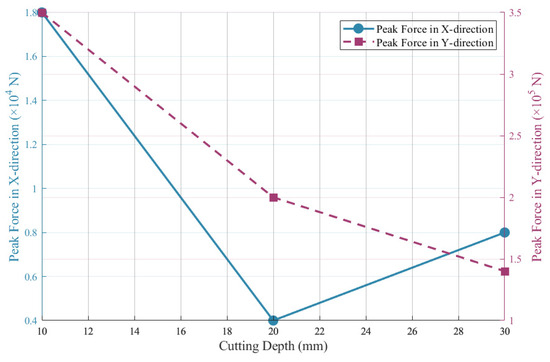
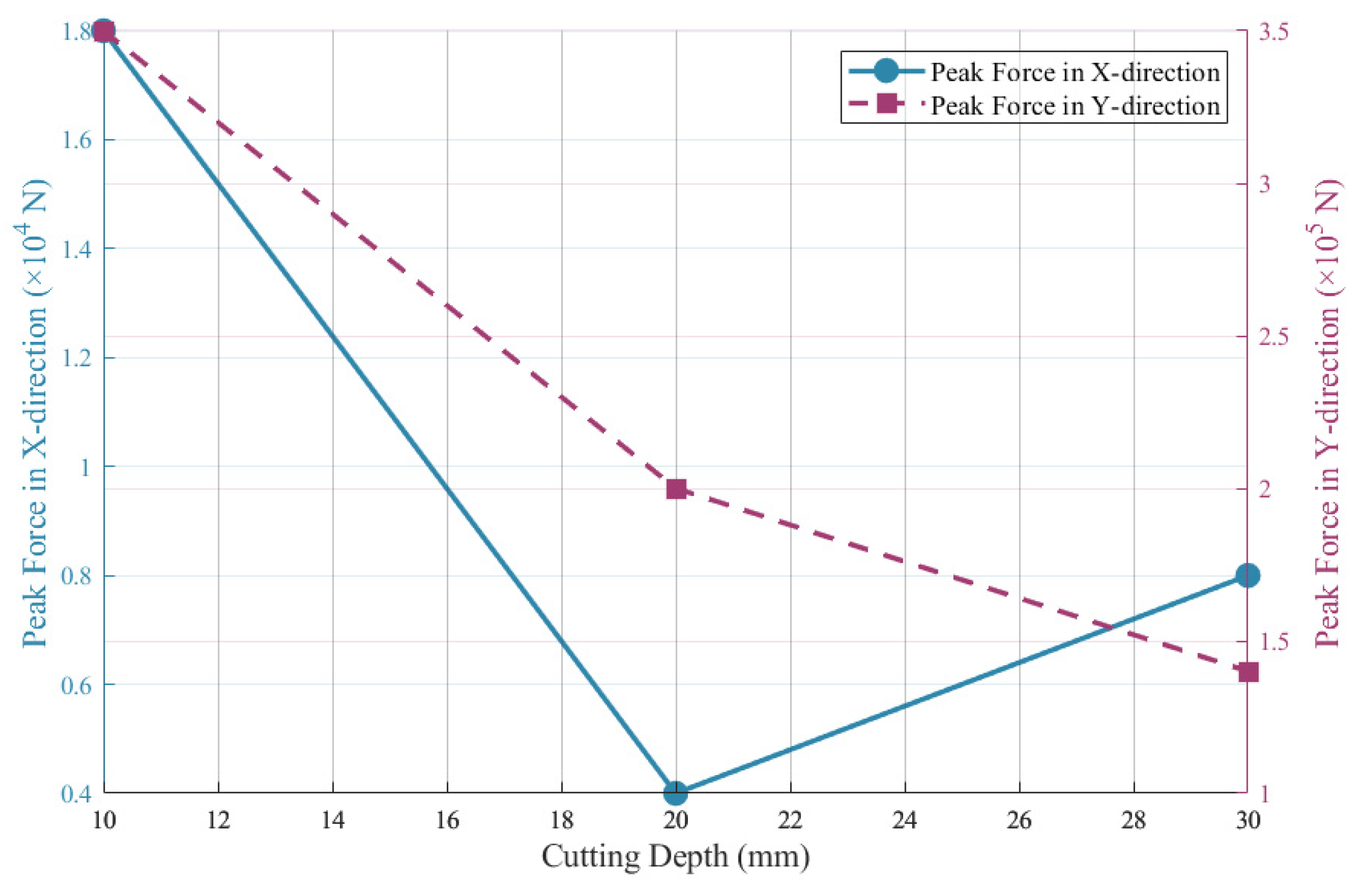
Figure 18 quantifies the evolutionary law of the peak tangential force (X-direction) and normal force (Y-direction) of the cutting pick with cutting depth (10 mm, 20 mm, 30 mm) during rotational cutting, which is consistent with the force analysis conclusion of Figure 17c. In the X-direction, the peak force shows a typical “V-shaped” trend: it reaches the maximum value at 10 mm, decreases to the minimum at 20 mm (a reduction of approximately 79% compared to the peak at 10 mm), and then rises to about 43% of the peak at 30 mm. This trend is mainly due to the difference in interaction between the pick and hard nodules: at 10 mm, the pick directly contacts the nodule, triggering combined shear–tensile failure and increasing tangential resistance; at 20 mm, the pick trajectory bypasses the nodule, and coal failure is dominated by tensile crack propagation, reducing resistance; at 30 mm, although there is no direct contact with the nodule, the pick needs to drive a larger volume of coal for shear slip, leading to a rebound in tangential force. In the Y-direction, the peak force decreases continuously with the increase in cutting depth, dropping from 3.5 × 10⁵ N (10 mm) to 1.4 × 10⁵ N (30 mm), which is attributed to the gradual expansion of the coal failure zone with deeper cutting, alleviating the normal compressive stress on the pick. This figure further clarifies the quantitative relationship between cutting depth and pick load, providing a direct load basis for the optimization of cutting parameters in engineering practice.
Figure 18.
Evolution Curves of Peak Forces in X/Y Directions of Cutting Pick Under Different Cutting Depths.
4.2.4. Simulation of Pick Cutting Under Confined Stress Conditions
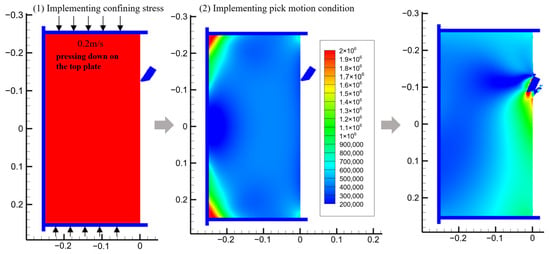
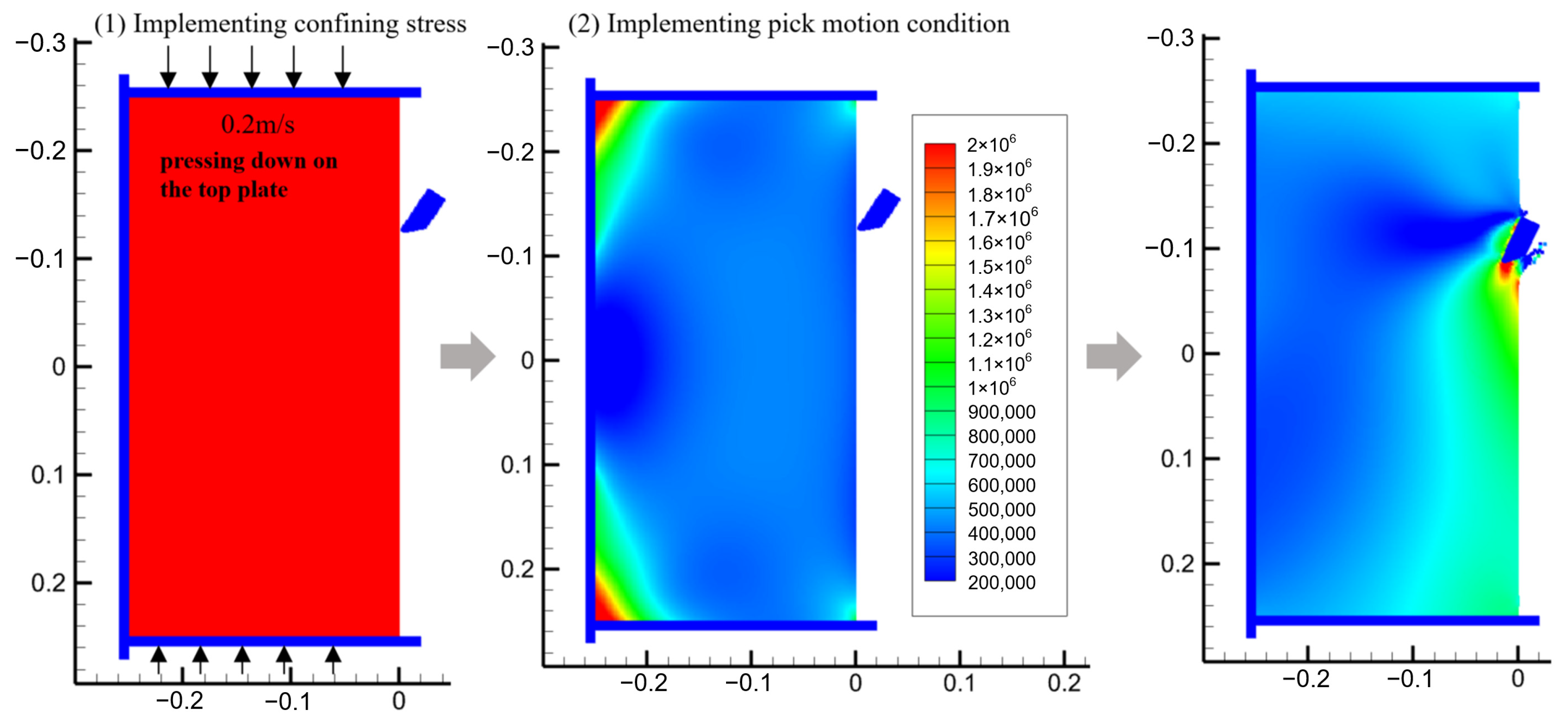
To simulate the actual mechanical environment of underground coal seams, a confining stress application system based on plate pressurization was constructed, as shown in Figure 19. The schematic clearly presents two core operation stages: first, implementing confining stress by controlling the top plate to press downward at a constant speed of 0.2 m/s, with the stress monitoring range covering 5 × 10⁵–2 × 10⁶ Pa to match the confining pressure level of shallow to medium-depth coal seams; second, applying pick motion conditions after the confining pressure reaches the target value, ensuring the pick rotates counterclockwise along the preset trajectory while maintaining stable confining pressure during the cutting process. This design avoids the problem of confining pressure loss caused by coal deformation in traditional simulation methods, and the uniform pressure distribution of the top plate effectively mimics the static confining effect of overlying strata, laying a foundation for accurately analyzing the influence of confining pressure on pick–rock interaction.
Figure 19.
Schematic Diagram of Confining Stress Application through Plate Pressurization.
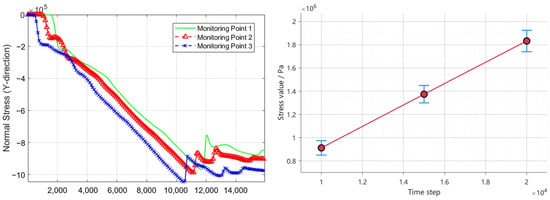
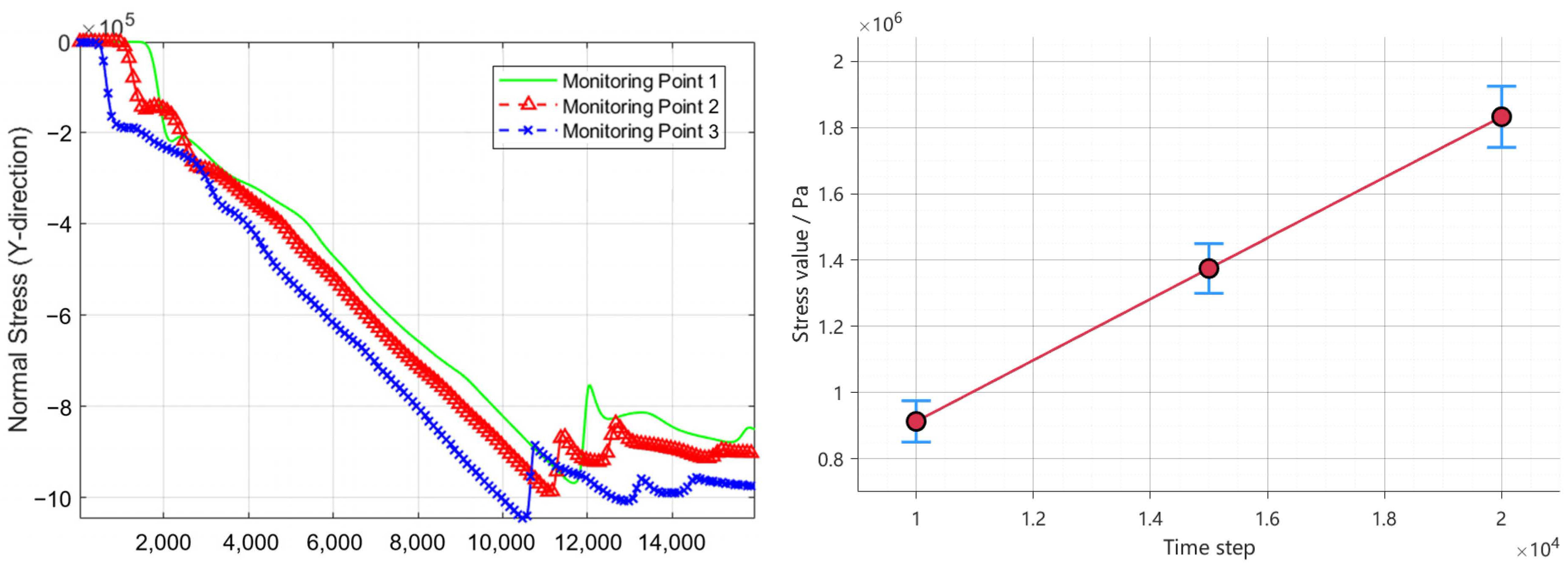
The relationship between confining stress and the time steps of pressure plate downward pressurization was further quantified through multi-point monitoring, as depicted in Figure 20. Three monitoring points evenly distributed on the coal seam surface were selected to record stress changes. The results show that in the initial stage (0–4000 time steps), the confining pressure at all monitoring points increases linearly with the increase in time steps, and the stress difference between points is less than 5%, indicating the uniformity of pressure application by the top plate; after 8000 time steps, the confining pressure stabilizes at the target value (1.5 × 10⁶ Pa for this simulation), and the fluctuation amplitude is within 2%, verifying the stability of the confining pressure system. This time-step-dependent pressure rise law provides a reliable reference for determining the preloading duration of confining pressure in subsequent cutting simulations—specifically, preloading for 8000–10,000 time steps is recommended to ensure that the coal seam is in a stable confined state before the pick starts cutting, avoiding non-physical cutting results caused by incomplete confining pressure application.
Figure 20.
Relationship Between Confining Pressure and Time Steps of Pressure Plate Downward Pressurization.
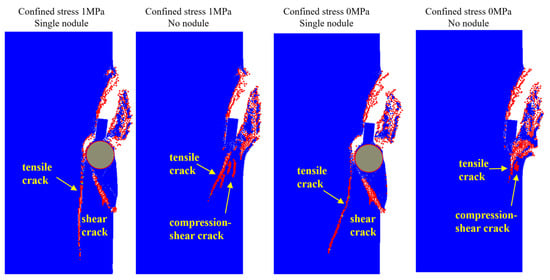
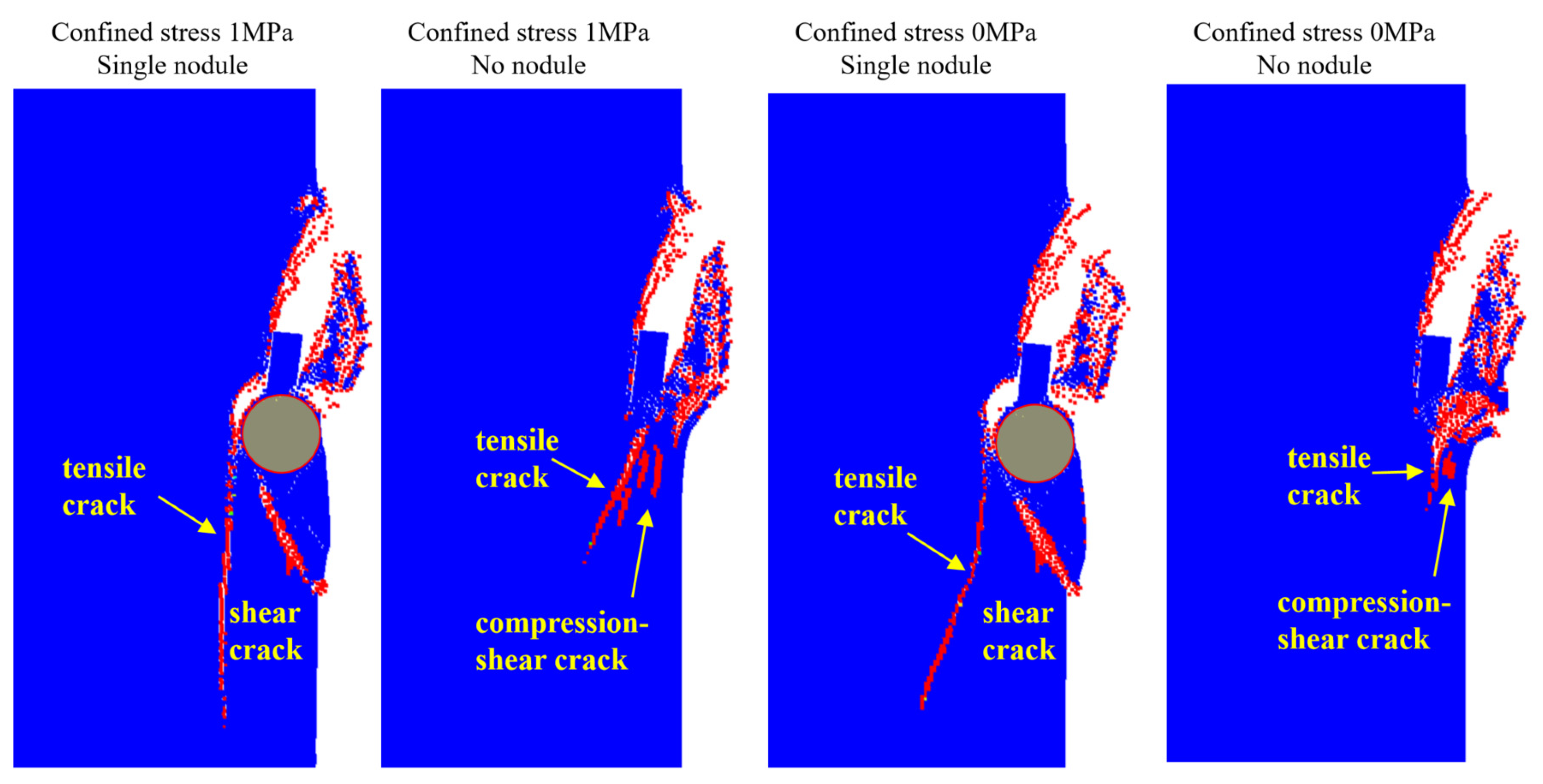
Figure 21 further compares the coal seam fracture results of single pick rotary cutting under four typical working conditions. Under the no-confining-stress scenario, the coal seam exhibits obvious tensile-dominated failure. Without nodules, tensile cracks extend rapidly from the pick action zone to the free surface, forming large-scale spalling blocks. With nodules, the hard inclusion causes local stress concentration, leading to crack deflection along the nodule edge and more fragmented local failure. In contrast, the application of confining stress inhibits the propagation of tensile cracks. Without nodules, the fracture zone is limited to the area within 1–2 times the cutting depth of the pick, and shear cracks replace tensile cracks as the main failure form. When a nodule is present, the coupling effect of confining pressure and nodule hardness further narrows the failure range. Only small-scale crushing occurs around the pick and nodule, with no long-distance crack extension. This contrast clearly reveals that confining stress enhances the anti-fracture ability of coal by increasing its internal compressive stress, while nodules introduce localized heterogeneity in failure modes—both factors need to be considered in the optimization of cutting parameters for deep coal seams.
Figure 21.
Coal Seam Fracture Results of Single Pick Rotary Cutting Under Conditions of With/Without Confining Stress and With/Without nodule.
5. Conclusions
This study successfully develops an SPH-based numerical framework integrated with a hybrid failure model to simulate the rotational cutting process of a single pick in coal seams containing hard inclusions. The primary novelty of this model lies in its seamless coupling of the Drucker–Prager criterion with the Grady–Kipp damage model within a meshfree SPH framework, which uniquely enables the concurrent simulation of shear-driven and tensile-driven failure mechanisms and their interactions without requiring pre-defined fracture paths. The model effectively captures both shear and tensile failure mechanisms through the combined use of the Drucker–Prager criterion and the Grady–Kipp damage model, enabling accurate prediction of crack initiation, propagation, and coalescence without requiring additional fracture treatments. Numerical simulations demonstrate that cutting depth plays a critical role in determining the dominant failure mode: shallow depths lead to nodule spallation driven by tensile cracks under compressive stress, while deeper cuts result in through-going shear failure. The cutting pick exhibits periodic force fluctuations corresponding to stages of compressive-shear crack initiation, propagation, and spallation. The introduction of artificial stress, viscosity, and stress smoothing techniques ensures numerical stability under high nonlinearity and impact loads. These findings provide direct guidance for optimizing cutting parameters in field operations, enabling improved mining efficiency and reduced tool wear under complex geological conditions.
Author Contributions
Conceptualization, Y.T. and Q.Z.; methodology, X.D.; software, S.Z.; validation, Y.S., X.D. and L.F.; formal analysis, X.D.; investigation, Y.T.; resources, Y.H.; data curation, H.L.; writing—original draft preparation, Y.T.; writing—review and editing, Q.Z.; visualization, Y.Z.; supervision, S.Z.; project administration, X.D.; funding acquisition, Y.T. All authors have read and agreed to the published version of the manuscript.
Funding
This work is supported by the National Natural Science Foundation of China under Grant No. 52574194 and No. 52304174. This work is also supported by National Engineering Laboratory for Coal Mining Machinery.
Data Availability Statement
The original contributions presented in this study are included in the article. Further inquiries can be directed to the corresponding authors.
Conflicts of Interest
Author Yongliang Han was employed by the company Renjiazhuang Coal Mine, Ningxia Ninglu Coal Power Co., Ltd. Author Huaitao Liu was employed by the company Dapingtan Coal Mine, Guoneng Ningxia Coal Energy Engineering Co., Ltd. Author Yingchun Zhang was employed by the company Shaanxi Yanchang Petroleum and Mining Co., Ltd. The remaining authors declare that the research was conducted in the absence of any commercial or financial relationships that could be construed as a potential conflict of interest.
References
- Li, D.; Peng, S.; Guo, Y.; Lin, P. Development status and prospect of geological guarantee technology for intelligent coal mining in China. Green Smart Min. Eng. 2024, 1, 433–446. [Google Scholar] [CrossRef] [Scilit]
- Liu, H.; Zhang, H. Numerical study of forces acting on the drum cutting coal with gangue. PLoS ONE 2024, 19, e0296624. [Google Scholar] [CrossRef] [Scilit]
- Jiang, H.; Zhao, H.; Zhang, X.; Jiang, Y.; Zheng, Y. Comparative study of the rock-breaking mechanism of a disc cutter and wedge tooth cutter by discrete element modelling. Chin. J. Mech. Eng. 2023, 36, 70. [Google Scholar] [CrossRef] [Scilit]
- Kim, H.E.; Kim, M.S.; Yoo, W.K.; Kim, C.-Y. Experimental investigation on the effects of cutting direction and joint spacing on the cuttability behaviour of a conical pick in jointed rock mass. Appl. Sci. 2025, 15, 4347. [Google Scholar] [CrossRef] [Scilit]
- Wang, L.; Zhang, D.; Wang, D.; Feng, C. A review of selected solutions on the evaluation of coal-rock cutting performances of shearer picks under complex geological conditions. Appl. Sci. 2022, 12, 12371. [Google Scholar] [CrossRef] [Scilit]
- Wang, M. Study conical pick cutting performance and fatigue life in breaking rock plate process with numerical simulation. Sci. Rep. 2024, 14, 857. [Google Scholar] [CrossRef] [Scilit]
- Luo, P.; Li, D.; Ru, W.; Gong, H.; Wang, M. Hard rock fragmentation by dynamic conical pick indentation under confining pressure. Int. J. Rock Mech. Min. Sci. 2024, 183, 105932. [Google Scholar] [CrossRef] [Scilit]
- Luo, C.; Qiao, J.; Zhou, J.; Sun, Z.; Cao, J. Cutting mechanical study of pick cutting coal seams with coal and rock interface. Energy Rep. 2022, 8, 51–59. [Google Scholar] [CrossRef] [Scilit]
- Zhang, M.; Zhao, L.; Shi, B. Coal falling trajectory and strength analysis of drum of shearer based on a bidirectional coupling method. Sci. Rep. 2024, 14, 9438. [Google Scholar] [CrossRef] [Scilit] [PubMed]
- Zhai, S.F.; Zhou, X.P.; Bi, J.; Xiao, N. The effects of joints on rock fragmentation by TBM cutters using general particle dynamics. Tunn. Undergr. Space Technol. 2016, 57, 162–172. [Google Scholar] [CrossRef] [Scilit]
- Deng, Y.; Yin, F.; Deng, H.; Li, J.; Liu, W. Research on crack propagation and rock fragmentation efficiency under spherical tooth dynamic indentation. Arab. J. Geosci. 2020, 13, 30. [Google Scholar] [CrossRef] [Scilit]
- Zheng, L.; Wu, Y.; Wu, W.; Zhang, H.; Peng, X.; Zhang, X.; Wu, X. Efficient investigation of rock crack propagation and fracture behaviors during impact fragmentation in rockfalls using parallel DDA. Adv. Civ. Eng. 2021, 2021, 5901561. [Google Scholar] [CrossRef] [Scilit]
- Guo, Z.G.; Wang, J.; Lv, S.; Zhang, X. Numerical simulation analysis of coal rock crushed by disc cutter based on ABAQUS. Mater. Sci. Eng. 2021, 1043, 042010. [Google Scholar] [CrossRef] [Scilit]
- Wang, S.; Shi, X.; Wu, Y. DEM-based 2D numerical simulation of the rock cutting process using a conical pick under confining stress. Comput. Geotech. 2024, 165, 105885. [Google Scholar] [CrossRef] [Scilit]
- Yang, Q.; Gao, Q.; Jia, Y.; Zhou, H.; Gao, X.; Jiang, W.; Ma, X. Application of simulation methods and image processing techniques in rock blasting and fragmentation optimization. Appl. Sci. 2025, 15, 3365. [Google Scholar] [CrossRef] [Scilit]
- Zhao, T.; Feng, Y.T.; Zhang, J.; Wang, Z.; Wang, Z. Discrete element modelling of dynamic behaviour of rockfills for resisting high speed projectile penetration. Comput. Model. Eng. Sci. 2021, 127, 721–735. [Google Scholar] [CrossRef] [Scilit]
- Bui, H.; Fukagawa, R.; Sako, K.; Ohno, S. Lagrangian meshfree particles method (SPH) for large deformation and failure flows of geomaterial using elastic–plastic soil constitutive model. Int. J. Numer. Anal. Methods Geomech. 2008, 32, 1537–1570. [Google Scholar] [CrossRef] [Scilit]
- Dong, X.; Zhang, Q.; Liu, Y.; Liu, X. Improved mesh-free SPH approach for loose top coal caving modeling. Particuology 2024, 95, 1–27. [Google Scholar] [CrossRef] [Scilit]
- Li, L.; Zhai, M.; Ling, X.; Chu, X.; Hu, B.; Cheng, Y. On the location of multiple failure slip surfaces in slope stability problems using the meshless SPH algorithm. Adv. Civ. Eng. 2020, 2020, 6821548. [Google Scholar] [CrossRef] [Scilit]
- Zhang, J.; Wang, J.; Wang, T. Research on the coupled water–soil SPH algorithm improvement and application based on two-phase mixture theory. Int. J. Comput. Methods 2022, 19, 2150072. [Google Scholar] [CrossRef] [Scilit]
- Feng, R.; Fourtakas, G.; Rogers, B.D.; Lombardi, D. A general smoothed particle hydrodynamics (SPH) formulation for coupled liquid flow and solid deformation in porous media. Comput. Methods Appl. Mech. Eng. 2024, 419, 116581. [Google Scholar] [CrossRef] [Scilit]
- Zheng, B.X.; Sun, L.; Chen, Z.; Cheng, C.; Liu, C.F. Multiphase smoothed particle hydrodynamics modeling of forced liquid sloshing. Int. J. Numer. Methods Fluids 2021, 93, 411–428. [Google Scholar] [CrossRef] [Scilit]
- Liu, M.B.; Zhang, Z.L.; Feng, D.L. A density-adaptive SPH method with kernel gradient correction for modeling explosive welding. Comput. Mech. 2017, 60, 513–529. [Google Scholar] [CrossRef] [Scilit]
- Sun, P.N.; Le Touzé, D.; Oger, G.; Zhang, A.-M. An accurate SPH Volume Adaptive Scheme for modeling strongly-compressible multiphase flows. Part 1: Numerical scheme and validations with basic 1D and 2D benchmarks. J. Comput. Phys. 2021, 426, 109937. [Google Scholar] [CrossRef] [Scilit]
- Nguyen, N.H.T.; Bui, H.H.; Nguyen, G.D. Effects of material properties on the mobility of granular flow. Granul. Matter 2020, 22, 59. [Google Scholar] [CrossRef] [Scilit]
- Douillet-Grellier, T.; Jones, B.D.; Pramanik, R.; Pan, K.; Albaiz, A.; Williams, J.R. Mixed-mode fracture modeling with smoothed particle hydrodynamics. Comput. Geotech. 2016, 79, 73–85. [Google Scholar] [CrossRef] [Scilit]
- Melosh, H.J.; Ryan, E.V.; Asphaug, E. Dynamic fragmentation in impacts: Hydrocode simulation of laboratory impacts. J. Geophys. Res. Planets 1992, 97, 14735–14759. [Google Scholar]
- Liu, G.R.; Liu, M.B. Smoothed Particle Hydrodynamics: A Meshfree Particle Method; World Scientific: Singapore, 2003. [Google Scholar]
- Dong, X.; Feng, L.; Zhang, Q. Droplet asymmetry bouncing on structured surfaces: A simulation based on SPH method. Int. J. Adhes. Adhes. 2024, 132, 103734. [Google Scholar] [CrossRef] [Scilit]
- Dong, X.; Fu, C.; Zhou, F.; Feng, L.; Zhang, Q. A volume-adaptive smoothed particle hydrodynamics (SPH) model for underwater contact explosion. Theor. Comput. Fluid Dyn. 2025, 39, 25. [Google Scholar] [CrossRef] [Scilit]
- Tian, Y.; Guo, X.; Zhang, Q.; Shen, Z.; Dong, X.; Li, C.; Cao, K. A Lagrangian Mesh-Free Multi-Phase Model for Simulating Complex Dynamics of Bubbly Flows. MetaResource 2025, 2, 11–32. [Google Scholar]
- Das, R.; Cleary, P.W. Effect of rock shapes on brittle fracture using smoothed particle hydrodynamics. Theor. Appl. Fract. Mech. 2010, 53, 47–60. [Google Scholar] [CrossRef] [Scilit]
- Cai, X.; Yuan, J.; Zhou, Z.; Zhang, S.; Wang, S.; Ma, D.; Huang, Y. Numerical investigation on the influence of cutting parameters on rock breakage using a conical pick. Eng. Fract. Mech. 2024, 312, 110607. [Google Scholar] [CrossRef] [Scilit]

Disclaimer/Publisher’s Note: The statements, opinions and data contained in all publications are solely those of the individual author(s) and contributor(s) and not of MDPI and/or the editor(s). MDPI and/or the editor(s) disclaim responsibility for any injury to people or property resulting from any ideas, methods, instructions or products referred to in the content. |
© 2026 by the authors. Licensee MDPI, Basel, Switzerland. This article is an open access article distributed under the terms and conditions of the Creative Commons Attribution (CC BY) license.