1. Introduction
Traditional Chinese Medicine plays an indispensable role in global healthcare.
Ophiocordyceps sinensis, a renowned and valuable medicinal fungus, possesses unique pharmacological properties and tonic effects, including anti-aging [
1], anti-inflammatory [
2], and antioxidant [
3] activities.
Ophiocordyceps sinensis is famous as one of the “three treasures of Chinese medicine”, along with ginseng and pilose antler [
4]. However, factors such as climate change and over-excavation have led to a decline in wild
Ophiocordyceps sinensis resources, with the species being included in the International Union for Conservation of Nature (IUCN) Red List of Threatened Species in 2020 [
5]. The limited supply, coupled with increasing market demand, has driven the development of cultivated alternatives. Industrial-scale cultivation has been successfully established, with an annual output now exceeding 30 tons [
6].
Ophiocordyceps sinensis is predominantly distributed in the Tibetan Plateau region of China and typically grows at altitudes ranging from 3000 to 5000 m [
7]. Its natural growth environment is characterized by low temperatures, strong ultraviolet radiation, and hypoxic conditions. Through long-term evolution,
Ophiocordyceps sinensis has developed a unique life cycle that enables adaptation to these extreme alpine environments. Zhang et al. studied
Ophiocordyceps sinensis in the extreme environment of the Tibetan Plateau and confirmed the evolutionary relationship between the fungus and its host insect genotypes, providing insights for artificial cultivation through the selection of suitable host insects [
8]. In recent years, significant progress has been made in the artificial induction of sexual fruiting bodies of
Ophiocordyceps sinensis through cultivation on artificial media or inoculation of host insect larvae, providing important material support for scientific research and industrial development [
9].
Cultivated
Ophiocordyceps sinensis shares the same host insect species, fungus, life cycle, infection process, and even macroscopic and microscopic morphology with its wild counterpart [
10]. Nevertheless, there has been no comprehensive review detailing the differences between wild and cultivated
Ophiocordyceps sinensis [
11]. The substantial disparity in economic value has, however, incentivized the fraudulent sale of cultivated products as wild, creating market confusion. Their visual similarity makes a reliable distinction by consumers nearly impossible, thereby undermining market integrity.
Current methods for authenticating wild and cultivated
Ophiocordyceps sinensis include protein composition analysis [
12] and adenosine profiling [
13]. These techniques typically require complex sample preparation and are inherently destructive, limiting their practical application. Consequently, identifying a more accurate, rapid, and feasible identification method is imperative. Hyperspectral technology, with its multi-band, high-resolution capabilities, presents a potential solution in this context [
14]. Recognized for its speed and non-destructive nature [
15], it has been successfully deployed in fields ranging from geological survey [
16], environmental monitoring, and medical diagnosis [
17]. Within the domain of Chinese medicinal materials, it has been effectively applied to the identification of
Panax ginseng,
Salvia miltiorrhiza, and
Radix glycyrrhizae, for purposes such as geographical origin and age determination [
18,
19,
20,
21,
22].
Compared with traditional identification techniques for
Ophiocordyceps sinensis, hyperspectral technology offers significant advantages due to its narrow spectral bandwidths and high spectral resolution, enabling comprehensive characterization of material properties [
23]. When light interacts with different substances, specific wavelengths are selectively absorbed, reflected, or scattered, forming unique spectral signatures that can be exploited to analyze material composition and physiological status. In recent years, hyperspectral and related spectroscopic techniques have been increasingly applied across various fields. Zhang et al. employed near-infrared spectroscopy (NIRS) combined with portable instruments and model transfer algorithms to achieve rapid, non-destructive in situ identification of wild
Ophiocordyceps sinensis [
24], while Du et al. utilized Fourier-transform infrared photoacoustic spectroscopy (FTIR-PAS) for fast and non-destructive identification and traceability of natural specimens [
25]. Beyond medicinal materials, hyperspectral imaging covering the 350–2500 nm spectral range has also been successfully applied under field conditions for rapid, non-destructive prediction and evaluation of key yield and quality parameters in crops such as alfalfa [
26].
These advances demonstrate the considerable potential of hyperspectral technology in the authentication of traditional Chinese medicinal materials. However, for anisotropic materials such as Ophiocordyceps sinensis, structural differences between dorsal, ventral, and lateral aspects may introduce spectral variability during data acquisition. This practical factor has rarely been systematically examined in existing studies, and the influence of specimen orientation on hyperspectral identification accuracy remains unclear, representing an important gap between laboratory research and real-world instrument deployment.
Ophiocordyceps sinensis comprises two parts: the caterpillar or the base, which is a fungus-filled endosclerotium, and the top fruiting body or stroma [
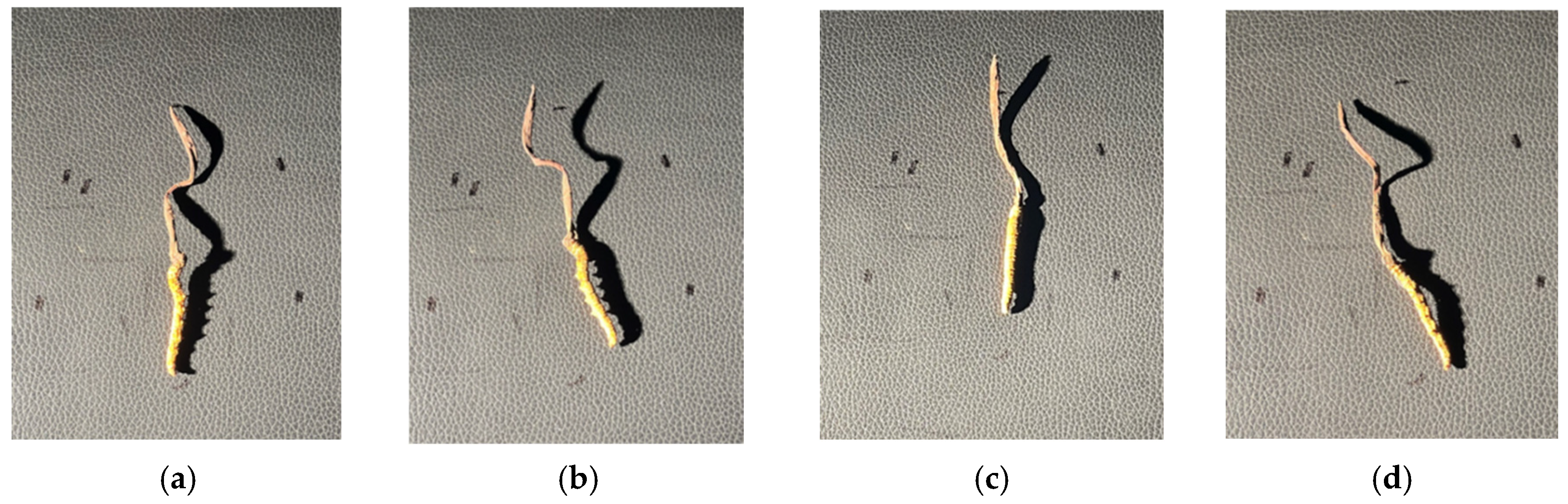
27]. The caterpillar measures 3–5 cm in length and 0.3–0.8 cm in diameter. Its surface exhibits 20–30 annulations, with those near the head being finer. Eight pairs of legs are present, with the four central pairs being most distinct. Visually, the caterpillar is not isotropic, displaying clear differentiation between its dorsal and ventral aspects. To date, no study has systematically investigated whether the selection of different specimen orientations (e.g., dorsal, ventral, and lateral) during identification influences the outcome. The four specimen orientations of
Ophiocordyceps sinensis are illustrated in
Figure 1.
Therefore, this study aims to utilize hyperspectral technology, machine learning and deep learning to systematically evaluate the impact of different specimen orientations on the identification accuracy of wild and cultivated Ophiocordyceps sinensis. The core objective is to determine whether an optimal specimen orientation exists, thereby providing direct, reliable data support and a theoretical foundation for the subsequent hardware design of hyperspectral discriminators and the standardization of their operational workflows.
2. Materials and Methods
2.1. Sample Preparation and Sources
A total of 1121
Ophiocordyceps sinensis samples were used in this study, categorized into two classes: 681 authenticated wild samples and 440 cultivated samples. Detailed sources and quantities are provided in
Table 1.
The collected samples were sourced and obtained from geographic origins by personnel dispatched from the Xizang Institute for Food and Drug Control. Xizang, is a provincial autonomous region in China, is a major production area for wild
Ophiocordyceps sinensis [
28], located in the southwest of the Tibetan Plateau. and the wild samples in this study originated from five prefecture-level cities within the region. Variations in altitude, climate, and local ecology among these areas effectively encompass the natural diversity present within wild populations. All wild samples were authenticated by experts. The cultivated
Ophiocordyceps sinensis samples were sourced from multiple commercial brands in several production regions, including Qinghai, Zhejiang, and Sichuan Provinces, among others. These samples represent the standardized output of commercial cultivation. Post-collection, all samples underwent only surface cleaning to remove dust and loose debris, with no further processing applied, ensuring the specimens remained undamaged. The sample collection process was conducted rigorously to ensure the conclusions drawn are based on a comprehensive and authentic dataset.
2.2. Hyperspectral Image Acquisition and Specimen Orientation Definition
Despite the evident advantages of hyperspectral technology, its engineering application faces specific operational challenges. During the development of an Ophiocordyceps sinensis identification instrument, a critical yet unresolved question emerged: what specimen orientation should the sample be placed in to achieve optimal identification accuracy? The answer directly determines whether the hardware requires a customized platform or mechanism to constrain the sample’s orientation with a specific surface facing upward, and it influences the formulation of end-user operational protocols. If spectral information varies significantly across different specimen orientations, standardizing an optimal specimen orientation would be necessary. Conversely, if no such difference exists, instrument design could be simplified, allowing arbitrary sample placement. However, this aspect has not been systematically explored.
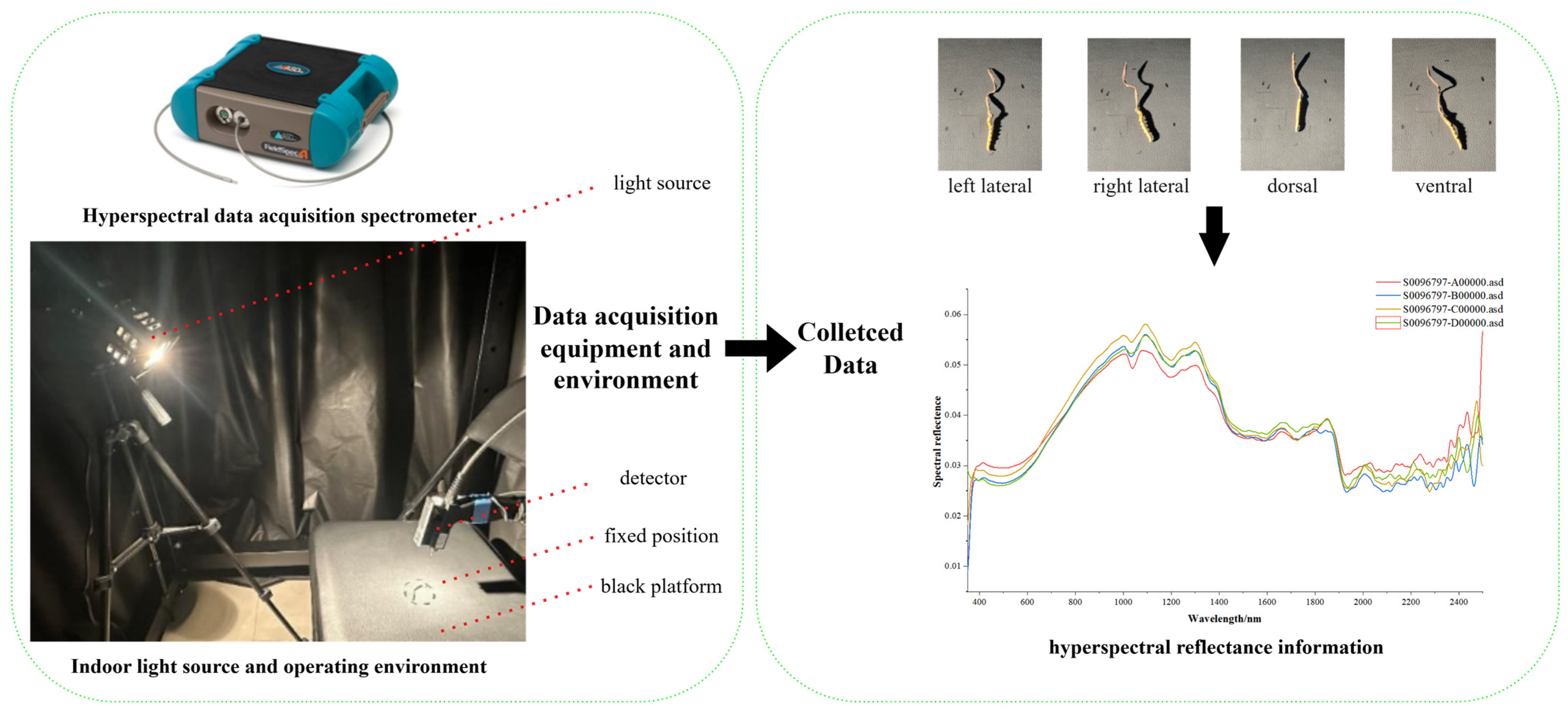
To investigate the optimal specimen orientation for hyperspectral identification, a systematic specimen orientation data acquisition protocol was implemented. Each sample was sequentially placed on the acquisition platform in four standard specimen orientations (left lateral, right lateral, dorsal, and ventral), and its hyperspectral data were captured separately. For subsequent analysis and traceability, the acquired data were labeled using a standardized naming convention: suffixes “A”, “B”, “C”, and “D” were appended to the sample name, corresponding to left lateral, right lateral, dorsal, and ventral orientations, respectively. The workflow for hyperspectral data acquisition is illustrated in
Figure 2.
Hyperspectral data were acquired using an ASD FieldSpec4 spectroradiometer. ASD is a brand of the UK-based company Malvern Panalytical. The instrument comprises three discrete detectors: VNIR (Visible and Near-Infrared, 350–1000 nm), SWIR1 (Short-Wave Infrared 1, 1000–1800 nm), and SWIR2 (Short-Wave Infrared 2, 1800–2500 nm), enabling high-precision full-spectrum acquisition. The spectroradiometer was installed within a controlled darkroom environment, configured with quartz tungsten halogen lamps, and maintained under consistent ambient conditions. The arrangement of the spectroradiometer, light source, and operational environment is illustrated in
Figure 2.
Data acquisition was performed in the darkroom following this procedure: the instrument was warmed up for 30 min, followed by baseline calibration using a standard white reference panel, with reflectance defined as the radiance of the sample divided by that of the spectral on the white panel; the sample was fixed on the testing platform in the predetermined specimen orientation, maintaining consistent probe distance and illumination angle; five consecutive spectral measurements were taken for each specimen orientation, and after removing outliers, the average was computed as the effective spectral reflectance curve for that specimen orientation; this process was repeated for all samples and specimen orientations, resulting in four averaged hyperspectral reflectance curves for each Ophiocordyceps sinensis sample.
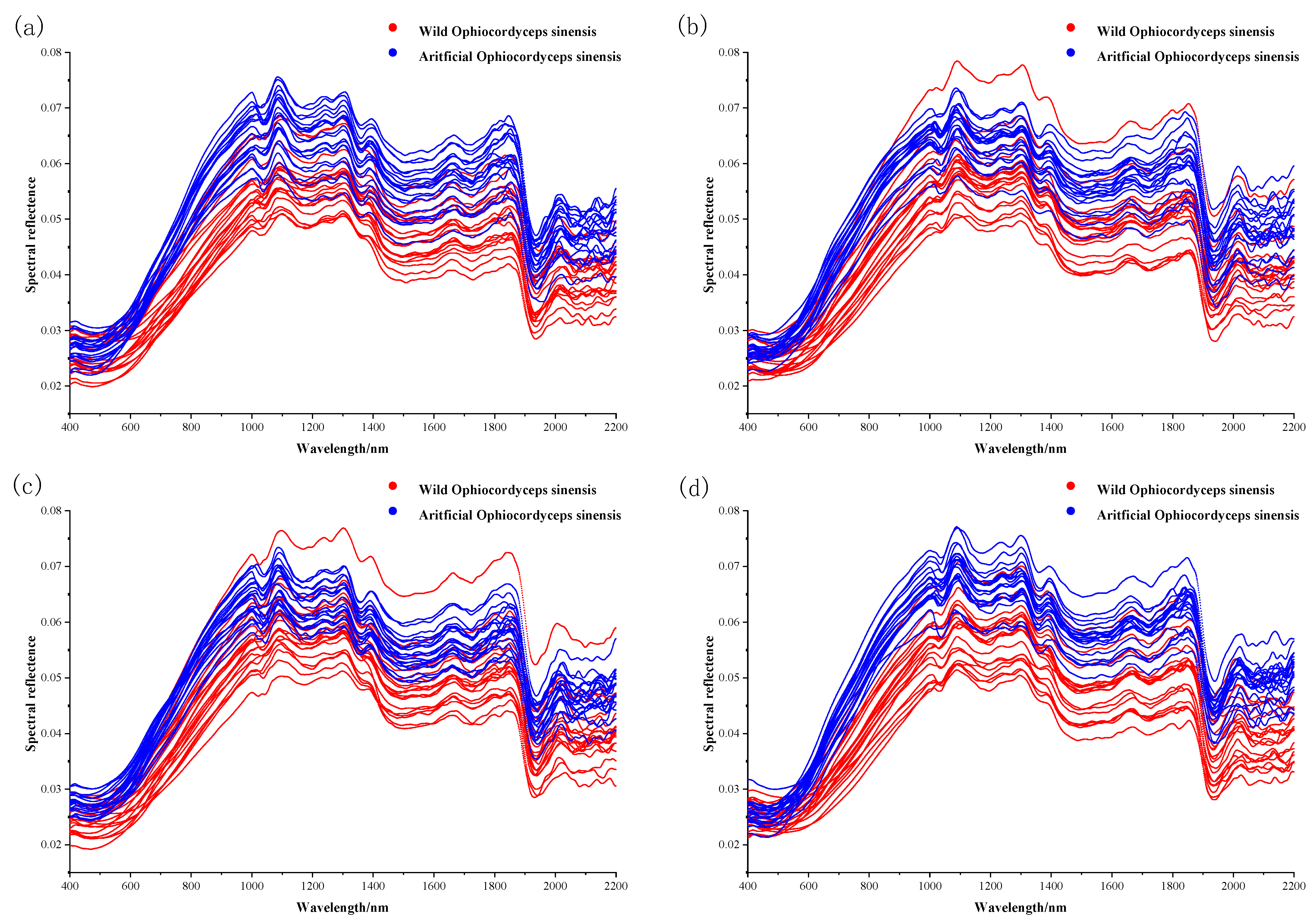
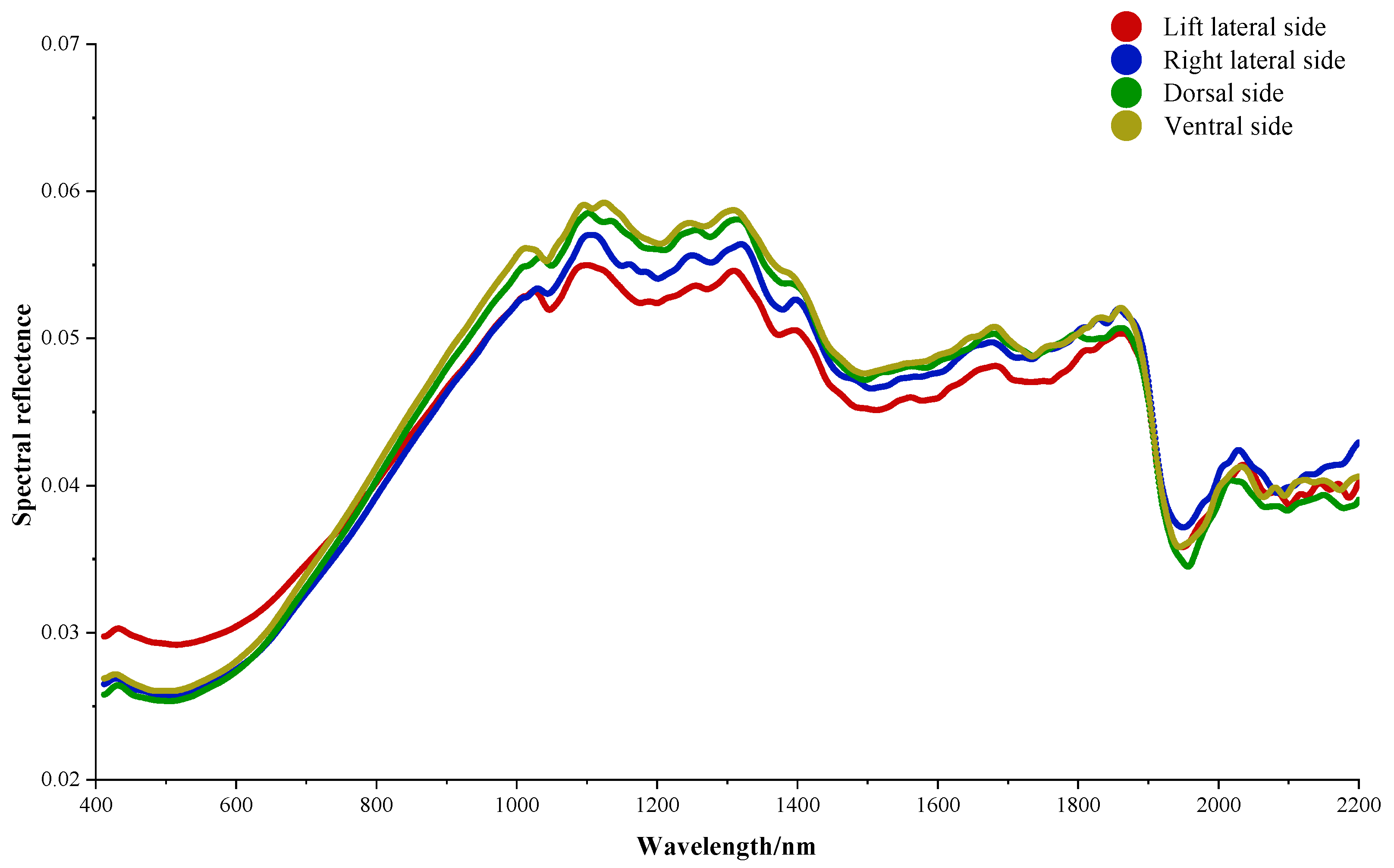
Due to significant noise observed in the 350–400 nm and 2200–2500 nm wavelength ranges, along with large amplitude fluctuations, only hyperspectral reflectance information within the 400–2200 nm range was selected for analysis. The Savitzky–Golay smoothing was subsequently applied to suppress high-frequency noise. Reflectance curves for the four specimen orientations of 20 randomly selected samples are presented in
Figure 3.
The acquired data were used for subsequent comparative analysis. By training and evaluating the classification performance of models on data from each specimen orientation, the impact of specimen orientation on identification accuracy was quantitatively assessed.
2.3. Machine Learning Methods
Random Forest (RF), Support Vector Machine (SVM), and Logistic Regression (LR) were selected as classification models for distinguishing wild and cultivated Ophiocordyceps sinensis, with the ultimate goal of identifying an optimal model for potential deployment in a dedicated identification instrument. These models were chosen because they are classical, well-established machine learning algorithms widely applied in hyperspectral analysis and offer a favorable balance between computationally efficiency and interpretability.
RF is a powerful and widely used ensemble learning algorithm [
29]. It operates by constructing multiple decision trees and aggregating their predictions to form a robust model for classification tasks. The core principle involves training each tree on a random subset of the training data and a random subset of features. Predictions from individual trees are combined through voting or averaging to produce the final output.
SVM is fundamentally based on finding an optimal hyperplane within the data space to separate samples of different classes [
30]. Its distinctiveness lies in its reliance on support vectors—the training samples closest to the hyperplane—which critically determine model performance and generalization capability. By employing kernel functions, SVM can project data into higher-dimensional spaces, enabling effective handling of nonlinear classification problems.
LR models the probability of an event occurrence based on the logistic function and is commonly employed for binary prediction [
31]. The core idea involves mapping a linear combination of input features to a probability between 0 and 1. Key advantages of LR include its linear nature, which contributes to relatively fast training and prediction speeds, making it suitable for large datasets. In addition, LR provides feature coefficients, facilitating model interpretation and the identification of variables with significant influence on classification outcomes.
2.4. Deep Learning Methods
The Fully Connected Neural Network (FCNN), often referred to as the Multilayer Perceptron (MLP), is a foundational deep learning architecture. It comprises an input layer, multiple hidden layers, and an output layer, characterized by dense connections where each neuron connects to every neuron in the subsequent layer. By incorporating non-linear activation functions, FCNNs can map input data to high-dimensional feature spaces, effectively capturing complex non-linear relationships. Model training relies on the backpropagation algorithm, which iteratively optimizes weights via gradient descent to minimize prediction error.
2.5. Validation
The hyperspectral recognition system for wild and cultivated Ophiocordyceps sinensis was developed in Python 3.11, with machine learning models constructed using scikit-learn version 1.0.2. To ensure reproducibility, the random state for all machine learning models was fixed at 42. For the RF model, the number of estimators was set to 500 to enhance model stability and robustness. The SVM classifier utilized the Radial Basis Function kernel to handle non-linear relationships, with the regularization parameter set to 1.0, kernel coefficient set to ‘scale’, and tolerance set to 0.001. The LR model employed the L-BFGS solver with L2 regularization. To guarantee convergence on the high-dimensional hyperspectral data, the maximum number of iterations was increased to 10,000.
In this study, a FCNN model was constructed, comprising a specific architecture with 9 hidden layers and 1 output layer. The neuron configuration for the hidden layers was set to [512, 1024, 512, 256, 1024, 1024, 1024, 512, 16], respectively. This design aims to extract complex features through high-dimensional mapping, while the intermediate “bottleneck” layers facilitate effective feature dimensionality reduction. To mitigate gradient vanishing and accelerate convergence, the Rectified Linear Unit (ReLU) activation and Batch Normalization (BN) were applied after each fully connected operation.
To mitigate the vanishing gradient problem in deep networks and accelerate convergence, the Rectified Linear Unit (ReLU) is employed as the activation function for all hidden layers. Furthermore, a Batch Normalization (BN) layer is introduced following each fully connected operation. Given the substantial number of model parameters, L2 regularization and Dropout techniques are incorporated into the hidden layers to enhance generalization ability and prevent overfitting.
The output layer consists of 2 neurons and utilizes the Softmax function to output the classification probabilities for wild and cultivated Ophiocordyceps sinensis. The model parameters are updated using the Adam optimizer, whose adaptive learning rate mechanism effectively handles sparse gradients. The initial learning rate was set to 0.001. The Cross-Entropy Loss function is selected to measure the divergence between the predicted probability distribution and the ground truth labels. Considering the sample characteristics of the hyperspectral dataset, the training batch size was set to 6 to increase the stochasticity during optimization. The model was trained for a total of 800 epochs.
The appropriate partitioning of a dataset is fundamental to ensuring model validity. During this process, it is crucial to maintain both the balance and representativeness between the training and test sets. The training set must be sufficiently large to enable the model to learn the underlying patterns within the data, while the test set must also be adequately sized to provide a statistically robust performance evaluation. In related research, Zhao et al. employed an 8:2 ratio split for their dataset when using RF for the year identification of ginseng [
20]. Similarly, Gámez et al. utilized a 7:3 ratio split when applying various machine learning models to discriminate quality parameters in alfalfa [
26]. Therefore, both an 8:2 and a 7:3 partitioning ratio will be used for the dataset. The results obtained from two ratios will be compared to determine which is more suitable for the experiment.
The dataset of 1121 samples was randomly split into training and test sets at two different ratios: 8:2 (resulting in 897 training and 224 test samples) and 7:3 (resulting in 785 training and 336 test samples). The test set was held out from model training and used solely for independent validation. The splitting process ensured a balanced distribution of both sample classes within the test set.
To enhance result stability, the random splitting procedure described above was independently repeated 10 times. For each repetition, training and test sets were generated, and the performance of different models across different specimen orientations was evaluated.
Prior to model training, all data underwent standardization. This involved calculating the mean and variance for each feature within the training set, followed by normalizing both the training and test sets using these computed statistics to ensure consistent scaling during training and validation.
Performance evaluation primarily employed accuracy as the metric, reflecting the proportion of correctly classified samples. The final reported performance values represent the average of the 10 independent validation runs. This approach mitigates potential bias arising from a single random partition, yielding a more stable reflection of the models’ true performance.
where
TP: True Positives (wild samples correctly predicted as wild);
TN: True Negatives (cultivated samples correctly predicted as cultivated);
FP: False Positives (cultivated samples incorrectly predicted as wild);
FN: False Negatives (wild samples incorrectly predicted as cultivated).
where:
N: Number of independent experiments;
: Accuracy from the k-th experiment.
3. Results
3.1. Single-Orientation Classification Results
Initially, RF, SVM, LR, and FCNN models were trained separately on hyperspectral data acquired from each of the four specimen orientations of
Ophiocordyceps sinensis. This was done to systematically evaluate the performance of machine learning in discriminating wild from cultivated samples and to assess the influence of observation orientation. All results represent the mean accuracy from 10 independent random splits. The results for the dataset split at an 8:2 ratio are presented in
Table 2,
Table 3,
Table 4 and
Table 5.
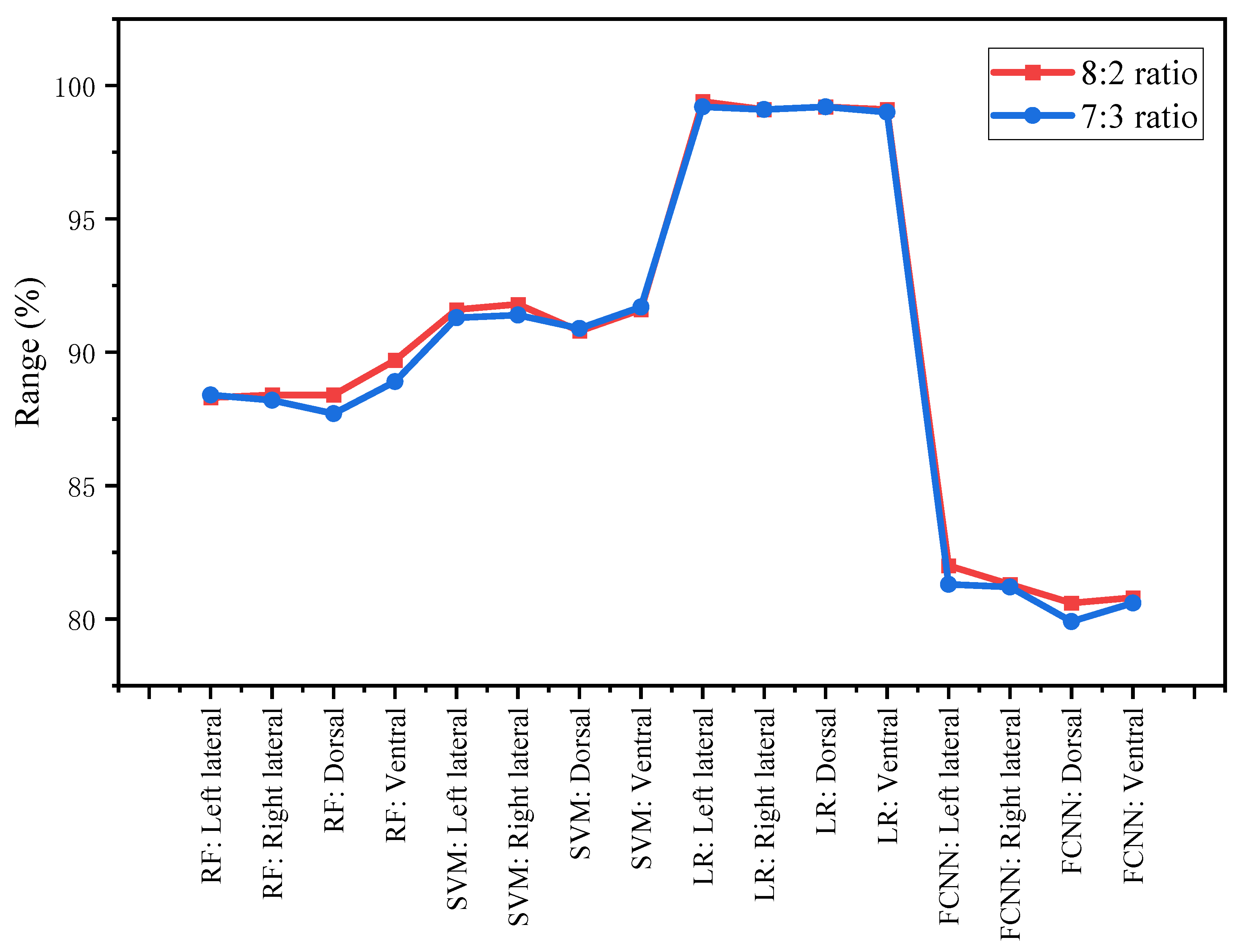
A comparison was conducted between the experimental results obtained using 8:2 and 7:3 dataset splits, and the comparative results are shown in
Figure 4.
Under four models and four specimen orientations, the mean identification accuracies obtained using two dataset split ratios (8:2 and 7:3) were compared for each model and orientation. The results indicate that the performance gap between the two ratios is minimal, with the difference in mean identification accuracy ranging from 0 to 1.2%. Notably, the 8:2 ratio shows a slight advantage over the 7:3 ratio. Therefore, the subsequent experiments in this study primarily adopt the 8:2 dataset split ratio.
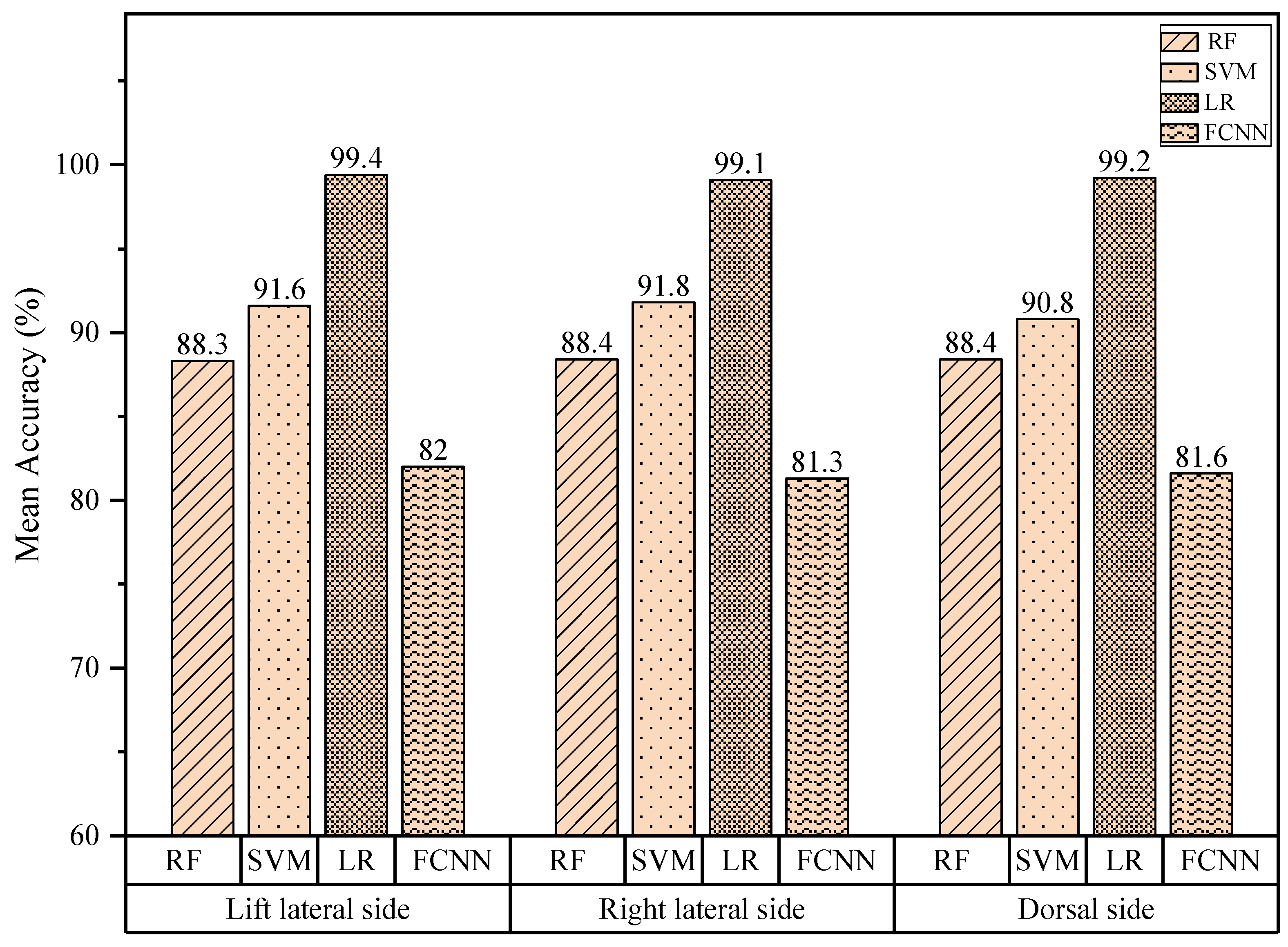
A systematic analysis of the above experimental results for the dataset split at an 8:2 ratio was conducted to evaluate the effects of different models and specimen orientations on hyperspectral identification. The mean accuracy comparison of four models is shown in
Figure 5.
The LR model demonstrated the best accuracy and most stable identification performance across all specimen orientations, achieving the highest mean accuracy (up to 99.4%), with the lowest being 99.1%. In contrast, RF, SVM and FCNN models performed comparatively lower, with maximum accuracies reaching only 89.7%, 91.8% and 82%, respectively.
Comparing model performances reveals that the LR model exhibits significantly superior identification capability compared to RF, SVM and FCNN. Its mean accuracy remains consistently above 99.1%, with minimal fluctuation across the 10 runs, indicating exceptional performance for this hyperspectral identification task.
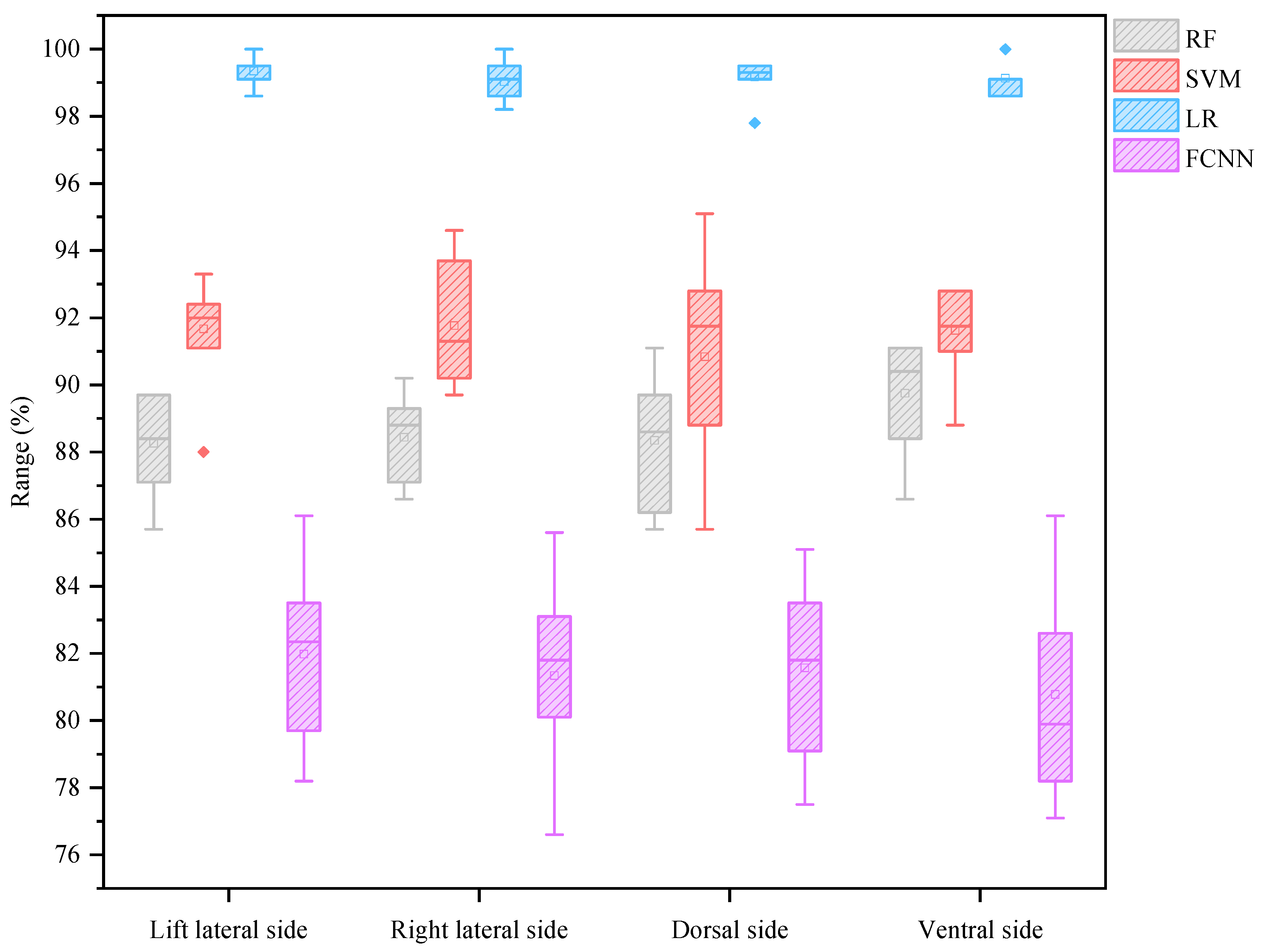
To assess the impact of different specimen orientations on the identification of
Ophiocordyceps sinensis, we performed a comprehensive comparison of the ten validation results for each of the four orientations across the four models, as shown in
Figure 6.
Analyzing the effect of specimen orientation shows that for any given model, the mean identification accuracies obtained from different specimen orientations are remarkably similar. For instance, in the optimal LR model, the range (difference between the highest and lowest) of mean accuracy across the four specimen orientations is merely 0.3%. This indicates that, within the context of this hyperspectral identification framework, the specimen orientation of Ophiocordyceps sinensis is not a critical variable influencing identification accuracy.
3.2. Multi-Orientation Data Fusion Results
To further investigate the influence of specimen orientation on model performance, a mixed-orientation dataset was constructed. The construction method was as follows: for each sample, one specimen orientation was randomly selected from its four available hyperspectral data records. The randomly selected data from all samples were then aggregated to form a new dataset. Ten such experiments were conducted, with a new mixed-orientation dataset constructed for each. The distribution of specimen orientation counts within the mixed-orientation datasets across the ten experiments is shown in
Table 10.
In the ten mixed-orientation data experiments, the four models were retrained and evaluated to simulate model performance in scenarios where specimen orientation is uncertain or random, as might occur in practical applications. The training methodology was as follows: the four models were trained on the mixed-orientation dataset, followed by ten independent validation runs per experiment. The mean accuracy from these ten runs was taken as the performance metric for that specific experiment. This process was repeated for ten distinct experiments, and the final performance for each model under mixed-orientation conditions was calculated as the mean accuracy across these ten experiments. The results are presented in
Table 11. For more detailed experimental results, please refer to
Table A1,
Table A2,
Table A3 and
Table A4 in the
Appendix A.
The results show that the LR model maintains the best performance on the fused dataset, achieving a mean accuracy of 98.9%. Furthermore, its results across the ten experiments are highly concentrated, again confirming its excellent stability. The mean accuracies for RF, SVM and FCNN models on the fused data are 90.3%, 91.0% and 81.7%, respectively, still showing a clear performance gap compared to LR.
Compared to the previous results based on single-orientation training, the performance of all models on the fused data did not exhibit significant fluctuation or decline. This observation, on one hand, further substantiates the conclusion that specimen orientation does not affect identification performance. On the other hand, it indicates that, even when specimen orientation is not perfectly uniform or is random in practical instrument use, the models can maintain stable and reliable classification capability. This provides additional justification for simplifying instrument operation and hardware design.
4. Discussion
The superior performance of the relatively simple LR model over the more complex RF, SVM and FCNN models suggests that the differences between wild and cultivated Ophiocordyceps sinensis within the high-dimensional hyperspectral feature space might be effectively separable by a near-linear decision boundary. The inherent simplicity, reduced propensity for overfitting, and built-in regularization of LR may contribute to its superior generalization, particularly when handling hyperspectral data characterized by high multicollinearity.
Concurrently, this study demonstrates that the specimen orientation of
Ophiocordyceps sinensis samples does not significantly influence the accuracy of their hyperspectral identification. This conclusion carries important positive implications for advancing the development of identification instruments. Spectral reflectance similarity across four specimen orientations of a representative sample in
Figure 7.
Although the caterpillar body of Ophiocordyceps sinensis exhibits morphological anisotropy, hyperspectral data reflect the comprehensive absorption and scattering characteristics of light by the material, which encode chemical composition information. The lack of significant accuracy variation across the four specimen orientations may be attributed to the relatively uniform distribution of key chemical constituents (e.g., adenosine, polysaccharides, characteristic proteins) within the cross-section of the caterpillar body. Consequently, the spectroradiometer captures these core chemical signatures regardless of the acquisition geometry.
This finding greatly simplifies the hardware design philosophy and operational procedures for hyperspectral discriminators of Ophiocordyceps sinensis. It implies that complex mechanical positioning systems designed to constrain samples to a specific pose are unnecessary, thereby reducing manufacturing costs, system complexity, and potential failure rates. Furthermore, future standardized protocols will not require stringent directional alignment; simply placing the sample stably within the detection field will suffice. This lowers the technical threshold for operators and enhances high-throughput detection efficiency.
While specimen orientation selection is not a stringent requirement, maintaining data acquisition remains crucial for ensuring model generalizability and result comparability. This includes stable illumination conditions, fixed probe distance, uniform background, and standardized calibration procedures. Our study shifts the focus of device development and operational Operation specification “how to precisely position” to “how to ensure consistent and standardized acquisition conditions.”
From a practical application standpoint, this research empirically demonstrates that hyperspectral-based identification of Ophiocordyceps sinensis does not require strict adherence to a specific sample specimen orientation. This lays a solid theoretical foundation for developing a low-cost, easy-to-operate, and efficient portable identification instrument.
Future research will focus on two main directions. First, beyond specimen orientation, the effects of factors such as production year, storage conditions, and moisture content on hyperspectral characteristics will be further investigated. In the present study, these variables were rigorously controlled, and more systematic and in-depth analyses are planned in subsequent work. Second, deep learning approaches have demonstrated considerable advantages in hyperspectral image analysis. In future studies, larger-scale datasets and increased computational resources will be employed to explore deep learning–based identification methods.
5. Conclusions
This study, through systematic acquisition of hyperspectral data from four specimen orientations of Ophiocordyceps sinensis and analysis using four models, clarifies the impact of specimen orientation on the identification accuracy of its wild and cultivated forms. The principal conclusions are as follows: Firstly, the Logistic Regression (LR) model demonstrated optimal performance for this task, achieving a mean accuracy exceeding 98% with notable stability. Secondly, for all tested models, no statistically significant difference in identification accuracy was observed between different specimen orientations, indicating that specimen orientation does not affect the outcome of hyperspectral identification for Ophiocordyceps sinensis.
Based on these findings, subsequent development of a hyperspectral discriminator for Ophiocordyceps sinensis need not enforce placement of the sample in a specific specimen orientation. The instrument hardware can omit complex orientation-fixing or flipping mechanisms, employing a simple sample stage that accommodates natural specimen orientation. Corresponding user operational protocols can also be simplified, requiring only that the sample be placed within the detection area to initiate measurement.
From an engineering perspective, this study eliminates a key uncertainty in the transition from laboratory research to instrument development. It provides a robust theoretical and practical foundation for creating cost-effective, user-friendly, and high-throughput identification devices. These findings may also serve as a reference for the non-destructive testing of other morphologically anisotropic medicinal materials. Future work will focus on optimizing hardware design based on the above conclusions to ensure consistent and standardized acquisition conditions while reducing development costs and establishing a more extensive sample library to further validate the broad applicability of these results.





 ,
,