Article

Experimental Study on Electrolytic Simulation of Production Capacity Interference in Asymmetric Fishbone Wells

1
College of Petroleum Engineering, China University of Petroleum, Beijing 102249, China
2
Exploration and Development Research Institute of Shengli Oilfield, SINOPEC, Dongying 257029, China
3
National Key Laboratory of Petroleum Resources and Engineering, China University of Petroleum (Beijing), Beijing 102249, China
4
Taizhou Oil Production Plant, East China Oil and Gas Company, SINOPEC, Taizhou 225300, China
*
Author to whom correspondence should be addressed.
Processes 2026, 14(1), 179; https://doi.org/10.3390/pr14010179
Submission received: 4 December 2025 / Revised: 24 December 2025 / Accepted: 30 December 2025 / Published: 5 January 2026

Abstract

As a type of multilateral wells, fishbone wells have the advantages of expanding oil drainage areas and increasing single well controlled reserves. However, there exists obvious productivity interference between branches of fishbone wells. In order to study the influence of fishbone wellbore structural parameters on productivity interference between branches, the method of water-electricity simulation experiments was adopted in this paper. The concepts of productivity interference coefficient and pressure propagation coefficient were proposed. The dependence of the productivity interference coefficient on wellbore morphological parameters was quantified. Research shows that the productivity interference coefficients of fishbone wells increase with the increase in the number of branches and decrease with the increase in branch length and branch angle. The productivity interference phenomenon between branches is caused by pressure interference. Increasing branch spacing by changing morphological parameters is the key to controlling productivity interference. The research results verify the productivity prediction model of fishbone wells and they also have important guiding significance for reasonable well placement and optimization design.

1. Introduction

As a type of multilateral wells, fishbone well has the advantages of expanding the oil drainage area, increasing the single well controlled reserves, saving ground occupation area, and reducing investment [1,2,3,4]. The application effect of improving productivity and recovery rate in the field is obvious. As fishbone wells can effectively develop marginal oilfields at a lower cost, their application is becoming more and more widespread worldwide. Pilot tests have been carried out in Shengli oilfield, Liaohe oilfield, and Bohai oilfield in China [5,6,7,8,9]. However, by tracking the application effect of fishbone wells, it was found that there were obvious differences in the development effects between different fishbone wells [10].
Due to the differences in reservoir parameters and well structure parameters, the production of multilateral wells is not equal to the sum of the production of each well when multiple horizontal wells are drilled separately, which confirms the existence of interference between the main wellbore and branches, as well as between branches in fishbone wells. Many scholars have studied the productivity interference of fishbone wells by using field tests, laboratory experiments, numerical simulations, and other methods. Sun Chenglong introduced the concept of interference coefficient in establishing a productivity evaluation model for multilateral wells to describe the impact of microscopic heterogeneity differences on the final recovery degree [11]. Hou Dapeng used reservoir engineering methods and numerical simulation methods to analyze the influencing factors of productivity interference in multilateral wells, and established a productivity prediction model based on this [12]. Wang Tuqiang analyzed the pressure drop curve near the wellbore through experiments, and used the concept of unit length productivity to evaluate the branch interference phenomenon in symmetric fishbone wells [13]. The results show that increasing the branch spacing by comprehensively changing the morphological parameters is the key to controlling the interference between branches. Yue deduced the coupling model of wellbore flow in fishbone multilateral wells in bottom water drive reservoirs [14]. The new model considers a large number of parameters that may have significant effects on productivity and pressure drop, including fishbone structure, length of main well and branch well, spacing of branch well, radius of wellbore, etc. Li Yanchang took the means of water-electricity simulation experiments to study the influencing factors of interference between branches in multilateral wells [14]. The results show that the number, length, and angle of branches are all important factors affecting pressure and productivity interference, and the optimal coal seam gas mining efficiency can be achieved by controlling its wellbore structural parameters. Moreover, in the study of tight oil horizontal wells, the variation pattern of post-fracturing production capacity was analyzed through hydroelectric simulation experiments.
The results indicated that a higher production pressure differential after fracturing corresponds to a greater production capacity; however, the rate of increase gradually decelerates [15,16,17,18,19].
The current research has only found the phenomenon of branch interference, but has not clearly quantified the degree of interference between pressure and productivity between branches, and has not clarified its variation law. Based on the theory of multi-porous media fluid mechanics, this paper studies the influence of wellbore structural parameters on the productivity interference between branches in fishbone wells from the perspective of water-electricity simulation experiments. The variation law of productivity interference is quantified by introducing productivity interference coefficients. The research results can be used to verify the productivity prediction model of fishbone wells, and they also have important guiding significance for reasonable well placement and optimization of branch morphology.

2. Experiment Methods

2.1. Experimental Principle

This experimental simulation is confined to a homogeneous reservoir and does not account for the effects of gravity or multiphase flow. The principle of electrolytic simulation experiments is that there is similarity between the differential equation describing electric charge flow through conductive materials and the differential equation describing underground incompressible fluid flow through porous media, that is, Ohm’s law describing the electric field and Darcy’s law describing fluid flow through porous media both satisfy the Laplace equation [1,2,3,4,5,6,7,8,9,10,11,12,13,14,20,21,22,23]. There are proportional relationships between the parameters of the physical model that is modeled in lab and the corresponding parameters of the prototype, which is in the real reservoir, which are called similarity criteria, including several similarity coefficients as shown in Table 1 [24].
Where X m , Y m , Z m , L m is the geometric size of physical model, X r , Y r , Z r , L r is the length of reservoir; ( Δ U ) m is the voltage in physical model; ( Δ P ) r is the pressure difference in reservoir; R m is the resistance of electrolyte solution; ( R f ) r is the fluid flow resistance of formation; I m is the electric current; Q r is the well productivity (or injection rate); ρ m is the conductivity of solution in physical model; k is the permeability of reservoir; and μ is the crude oil viscosity.
According Ohm’s law Δ U I R m = 1 and Darcy’s law Δ p Q R f o = 1 :
Δ U / Δ p I / Q · R / R f = 1
The similarity coefficients satisfy the following relational expressions:
C p C q C r = 1
C r = 1 C ρ C L
where C p is the pressure similarity coefficient; C q is the rate similarity coefficient; C r is the drag coefficient; C ρ is the flow similarity coefficient; and C L is the geometric similarity coefficient.

2.2. Experimental Apparatus

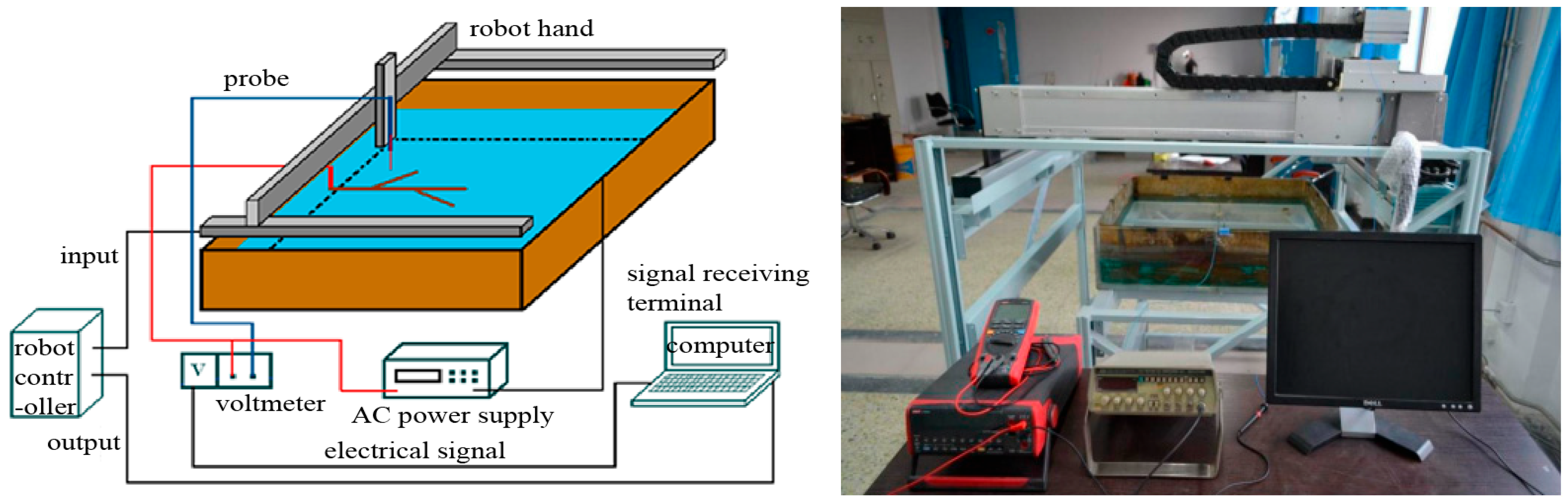
The self-developed intelligent electrolytic simulation experimental device is adopted in this experiment. The device is designed and improved on the basis of traditional electrolytic simulation experimental equipment. It can control the three-axis robot arm through computer to complete the electric signal measurement and collection at any position, and enable real-time measurement of pressure at different locations around the fishbone well, ensuring the integrity of experimental data measurement. The intelligent electrolytic simulation device consists of four parts: reservoir simulation system, low voltage circuit system, measuring point positioning system, and data acquisition system, as shown in Figure 1. The measurement of current is completed by manual measurement with a multimeter. Since the current field can reach stability instantly, the experiment simulates the stable percolation process of single-phase fluid, so the time difference in measuring voltage around the fishbone well can be ignored.
The experimental tank dimensions were 0.8 m × 0.8 m × 0.1 m (L × W × H). Boundary electrodes were made of pure copper strips (2 mm thick) covering two opposite sides of the tank. The fishbone well models were fabricated from 1 mm diameter pure copper wire, with a conductivity (5.96 × 10⁷ S/m) significantly higher than the electrolyte, ensuring a nearly uniform potential along the wellbore. The electrolyte was a Copper Sulfate (CuSO4) solution with a concentration of 0.1 mol/L. Its conductivity was measured as 356 μS/cm using a portable conductivity meter (accuracy ± 1%).

2.3. Experimental Steps

Productivity and pressure tests were carried out on fishbone wells through the electrolytic analogy experimental device to explore the influence of wellbore structure parameters on the productivity interference between fishbone well branches. The specific experimental steps are as follows:
(1)
Experimental model making. The model material was 1 mm diameter thin copper wire to make fishbone well models.
(2)
Supply boundary and CuSO4 electrolyte solution preparation. The material of supply boundary was purple copper strip, sized according to the actual specifications of water tank; Configure corresponding CuSO4 solutions according to the required electric conductivity in the experiment.
(3)
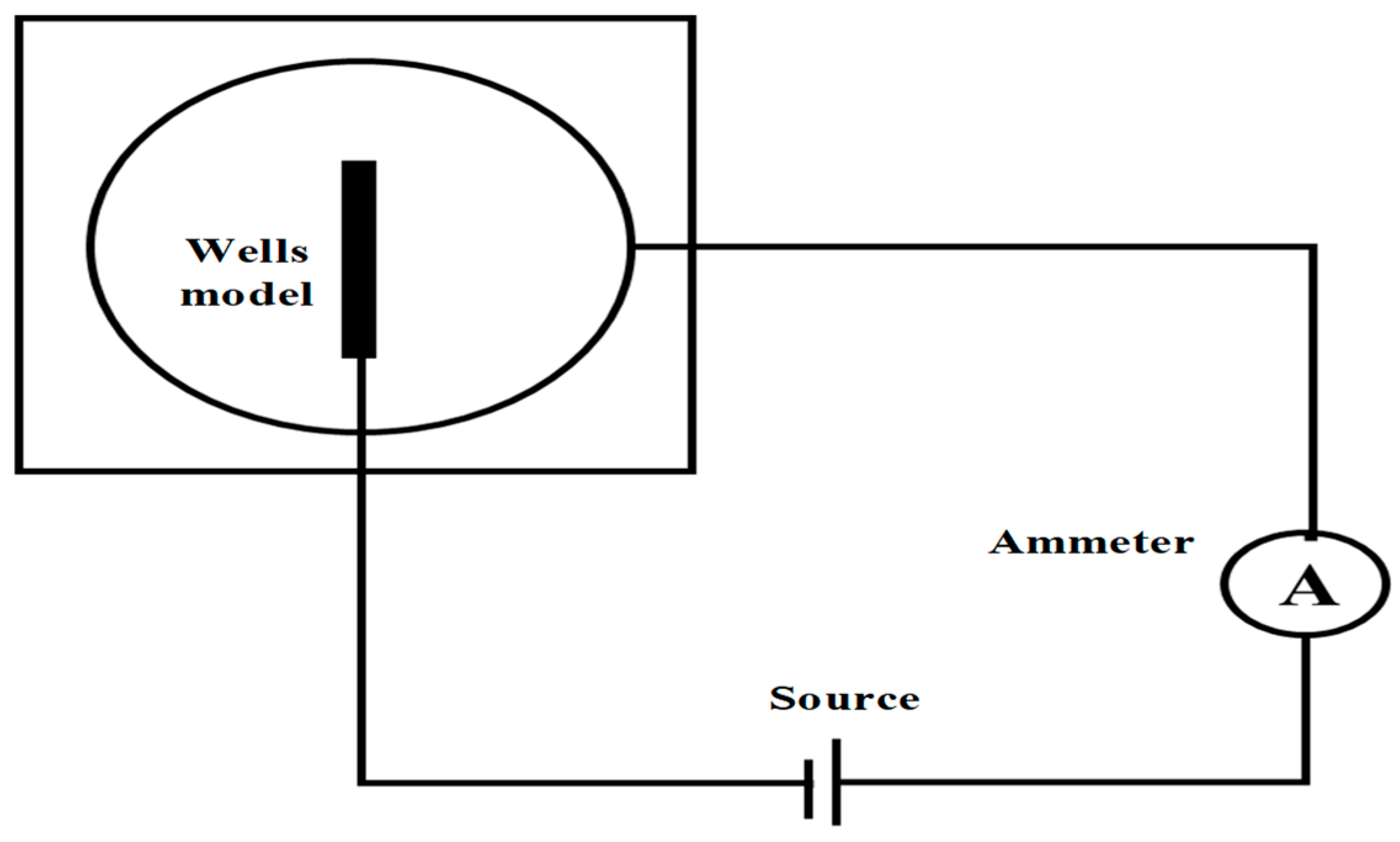
Connect the circuit according to the circuit diagram shown in Figure 2, turn on the circuit and measure the total current through the well.
(4)
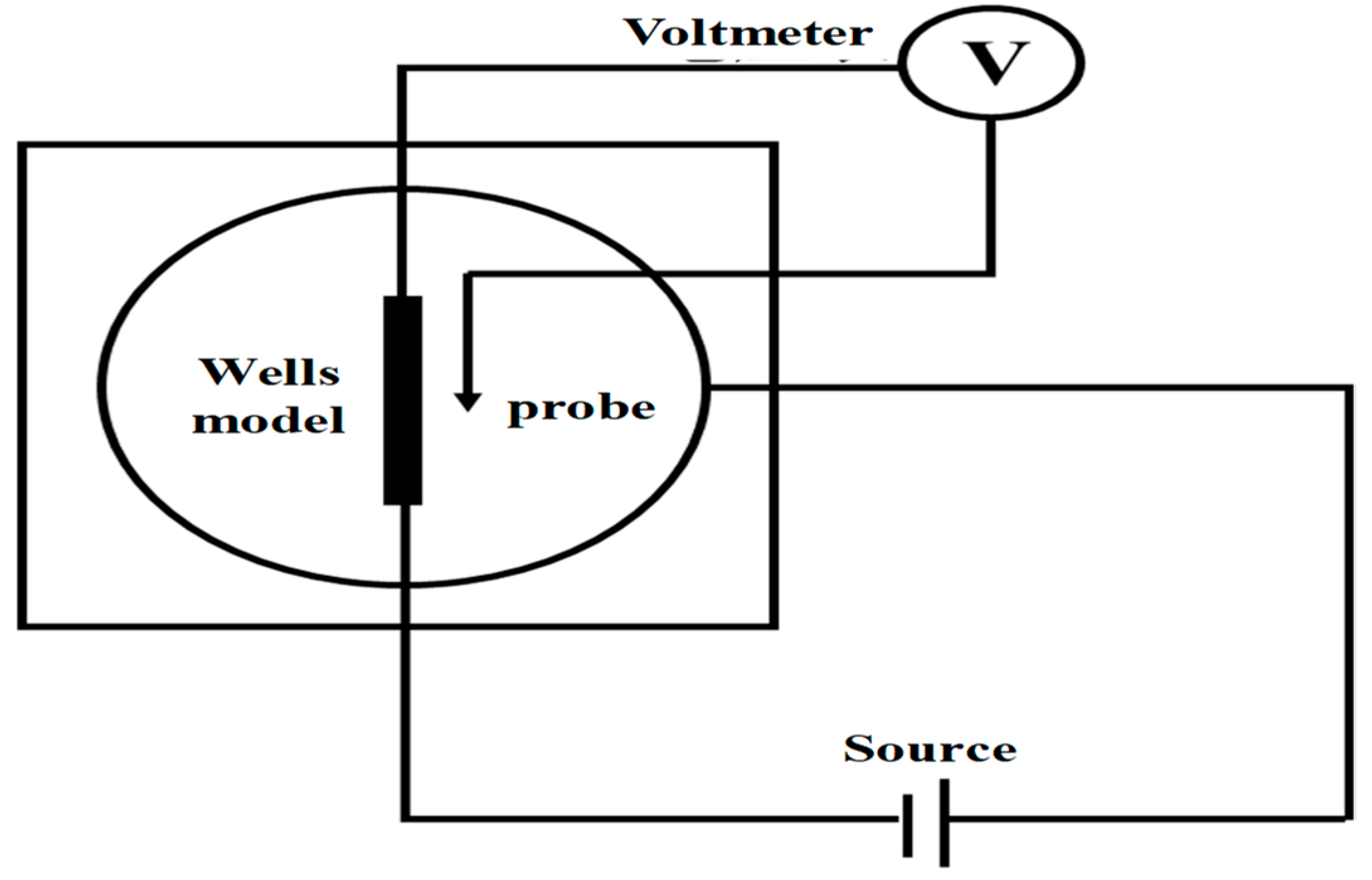
Connect the circuit according to the circuit diagram shown in Figure 3, turn on the circuit and measure voltage.
(5)
Data acquisition. Set relevant parameters such as test pitch and test distance of mechanical arm controller program according to relevant requirements such as number and position of measuring points, run the program, and test voltage around the fishbone well. The measurement points were arranged on a uniform grid with a spacing of 5 cm in both the X and Y directions. Data were recorded once both the voltage and current readings had stabilized, and the values reported represent the average of three repeated measurements to ensure reliability.
(6)
Drawing equipotential lines. Process relevant data and draw equipotential lines by Surfer12.
(7)
Convert the measured current values into corresponding well productivity according to similarity principles and compare productivity among different well types.
(8)
Change various structural parameters of the fishbone well and repeat the above experimental steps.
The ideal productivity of fishbone wells is introduced in this paper to compare with the actual productivity of fishbone wells and analyze the phenomenon of productivity interference. The measurement method in the experiment is to separately measure the current value when the main wellbore and each branch of the fishbone well produce independently and then calculate to obtain, in the measurement, the non-producing section is wrapped with insulating rubber to achieve independent production of any section.
In order to further analyze the pressure field distribution characteristics during fishbone well production, this paper also measured the pressure field distribution of horizontal well percolation with the same length as the main wellbore of fishbone well, which is used to contrast with the percolation of fishbone well. The specific steps are the same as those mentioned above.

2.4. Experimental Condition

2.4.1. Experimental Parameters

The parameter values of the reservoir are taken from a certain block in Shengli Oilfield, China. The experimental parameters are set based on the equipment allowed for selection. The corresponding relationship between relevant actual reservoir parameters and model parameters is shown in Table 2. Calculate each similarity coefficient according to the definitions in Table 1, and the results are shown in Table 3.

2.4.2. Experimental Model Design

Voltage measurement was performed using a copper probe mounted on a three-axis robotic arm with a positioning accuracy of ±0.5 mm. A uniform measurement grid of 5 cm × 5 cm was used, which was refined to 2.5 cm × 2.5 cm in the near-wellbore region (within 50 mm of the well). Readings at each point were taken 30 s after closing the circuit, by which time voltage fluctuations were less than 0.01 V, indicating steady-state conditions. Each configuration was tested 3 times. The data presented are the mean values, with error bars representing the standard deviation.
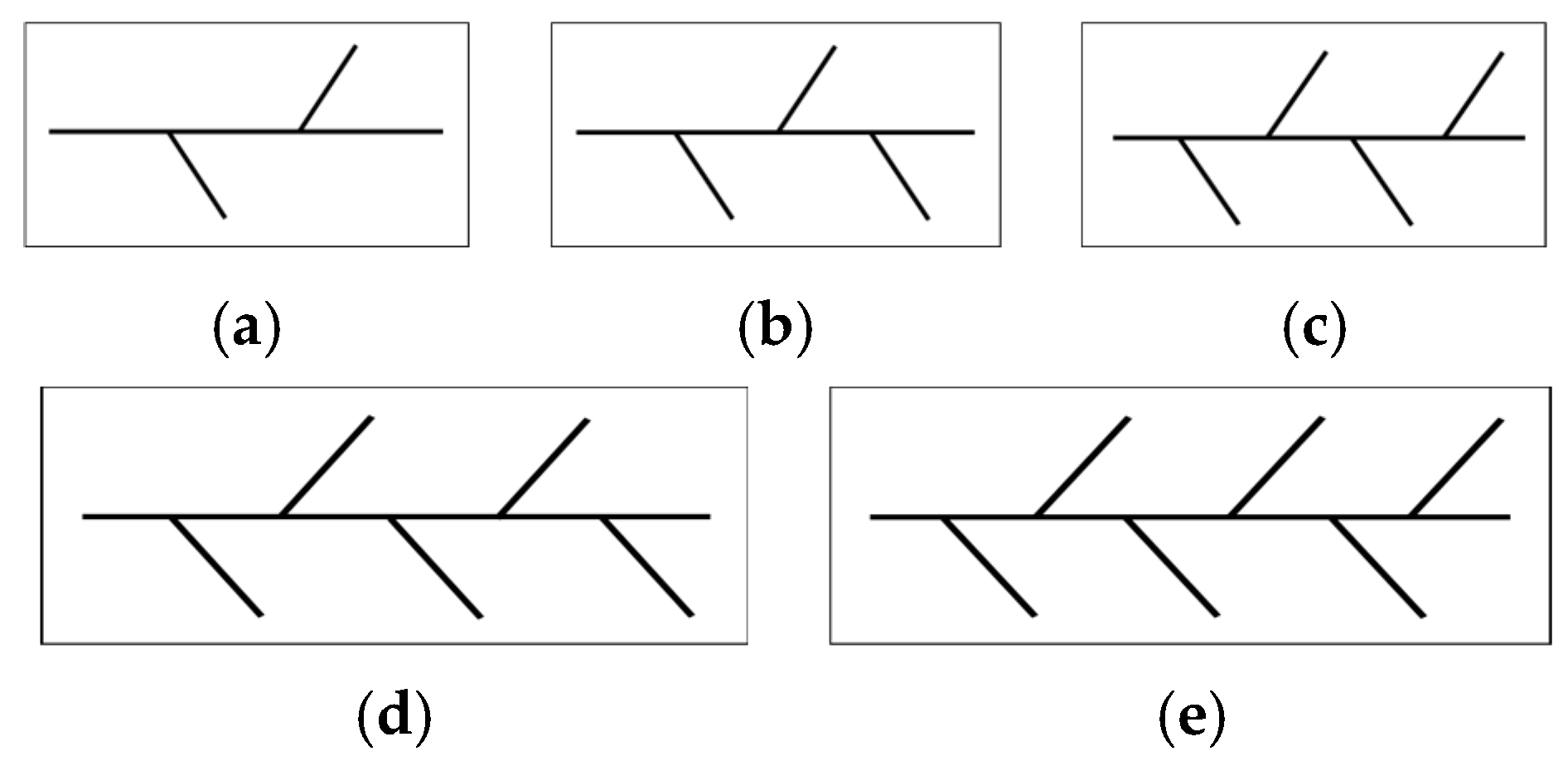
To study the influence of the number of branches on fishbone well productivity interference, the number of branches was taken as 2, 3, 4, 5 and 6, respectively. The angle between the horizontal wellbore and the branch wellbore of the fishbone well was 60°, the branch length was 200 mm, and the branches were evenly distributed on both sides. The layout of branches with different numbers in the experiment is shown in Figure 4.
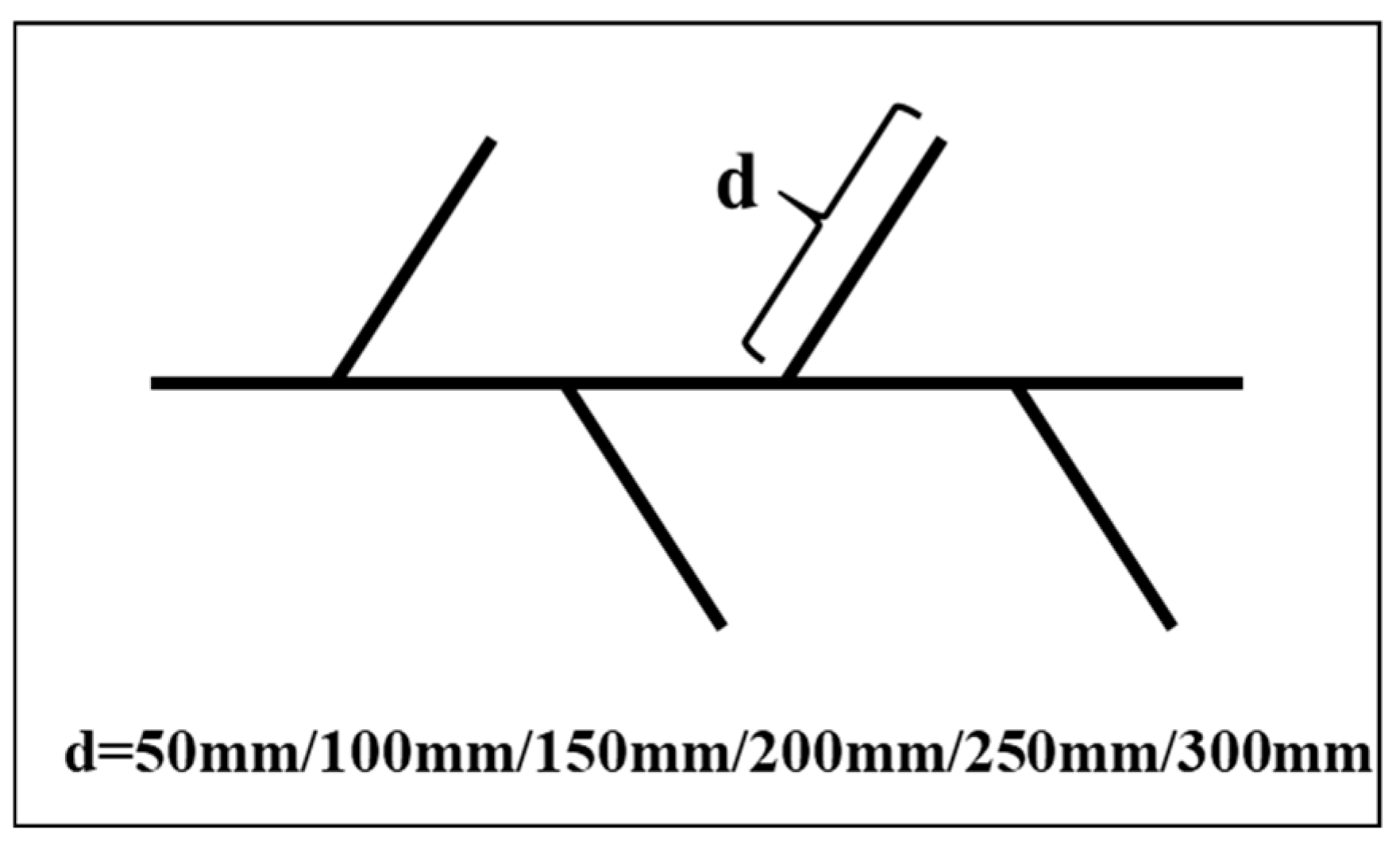
To better study the influence of branch length on productivity interference between fishbone well branches, the length of branches was changed while the length of the main wellbore remained unchanged. The length of branches was taken as 50 mm, 100 mm, 150 mm, 200 mm, 250 mm and 300 mm, respectively. The number of fishbone well branches was 4, the branch angle was 60°, and the four branches were evenly distributed at equal distances on both sides. The layout of branches with different lengths in the experiment is shown in Figure 5.
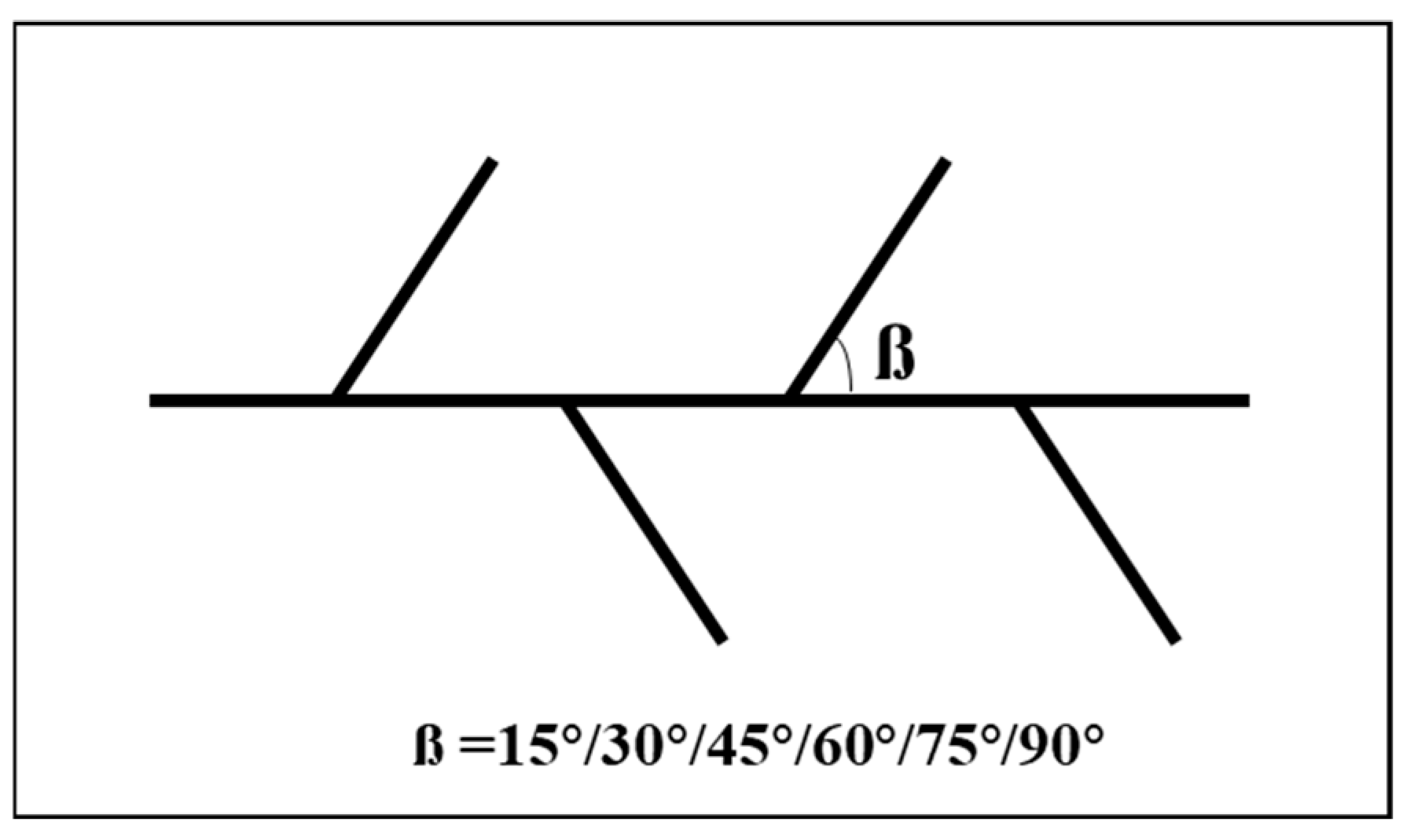
To study the influence of branch angle on productivity interference between fishbone well branches, the branch angle was taken as 15°, 30°, 45°, 60°, 75° and 90°, respectively. The number of branches was 4, the branch length was 200 mm, and the four branches were evenly distributed at equal distances on both sides. The layout of branches with different angles in the experiment is shown in Figure 6.

3. Results and Discussion

3.1. The Productivity Interference Characteristics of Fishbone Well

3.1.1. Definition of Productivity Interference Coefficient

Regarding the research on productivity interference, it is mostly concentrated on interlayer interference between reservoirs. Relevant scholars have conducted a lot of research on the influencing factors, evaluation methods and other aspects of interlayer interference through field tests, laboratory experiments, numerical simulations, and other methods. Interlayer interference is often expressed as interlayer productivity interference, that is, the interlayer productivity interference coefficient, which indicates the percentage of the difference between single layer productivity and combined layer productivity to single layer productivity, and its expression is as follows:
A q = Q d i Q h Q d i
where
A q is the productivity interlayer interference coefficient, dimensionless;
Q d i is the single layer productivity of layer i in single layer development, m3 d−1;
Q h is the multi-layer productivity in joint development, m3 d−1.
The interlayer productivity interference coefficient describes the loss ratio of production capacity during multi-layer combined mining. The larger the value, the greater the degree of productivity affected by interlayer interference. Referring to the definition of existing interlayer productivity interference coefficients, this paper defines the productivity interference coefficient of multilateral wells to characterize the productivity interference between their branches. After definition, the productivity interference coefficient between branches of multilateral wells is defined as follows:
A F = Q i Q a Q i
where
AF is the productivity interference coefficient of fishbone well, dimensionless;
Qi is the ideal productivity of fishbone well, the superposition of productivities when each wellbore produces separately, m3 d−1;
Qa is the actual productivity of fishbone well, m3 d−1.
The productivity interference coefficient of fishbone wells represents the percentage of difference between ideal productivity and actual productivity to ideal productivity. Its physical meaning is the degree of branch interference on productivity during fishbone well development. The productivity interference coefficient can clearly quantify the productivity interference degree of fishbone wells under different wellbore structure parameters. The smaller the productivity interference coefficient, the better the development effect of multilateral wells. The ideal productivity of fishbone wells refers to the superimposition of productivities when the main wellbore and branch wellbores produce separately.

3.1.2. Influence of Number of Branches on Fishbone Well Productivity Interference

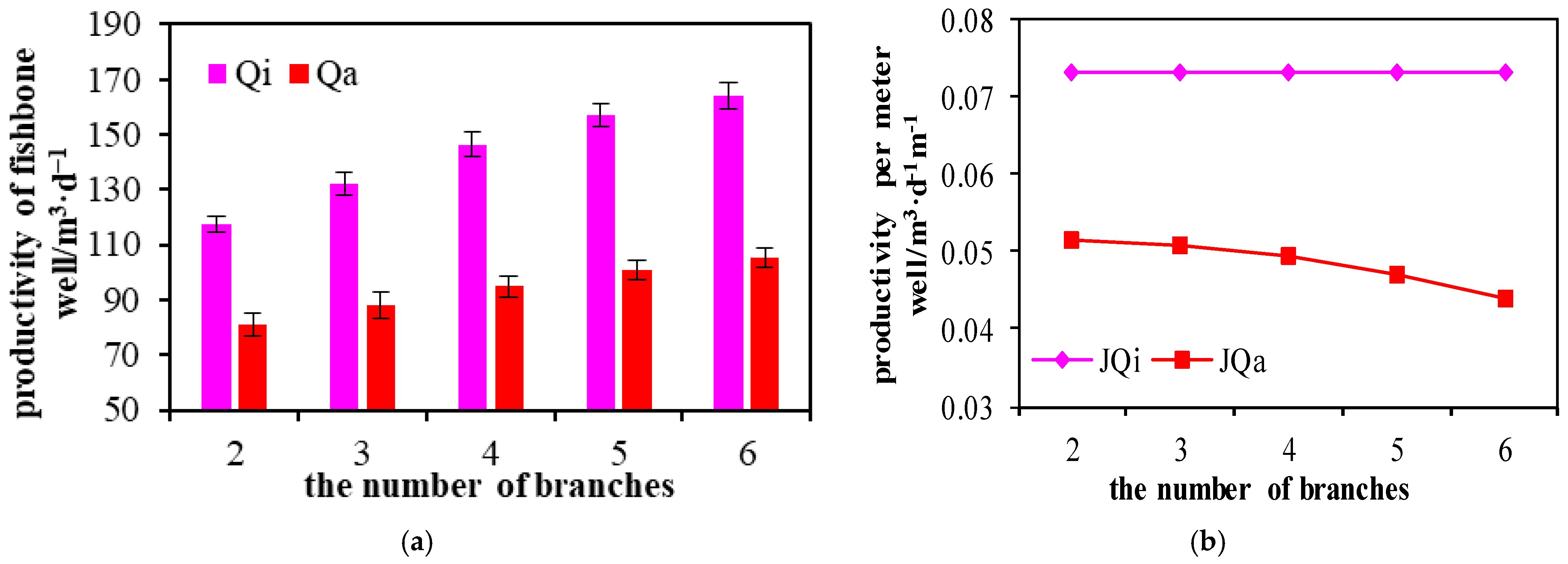
Comparing the ideal productivity and actual productivity of fishbone wells under different number of branches, and calculating the contribution of corresponding unit length productivity, the results are shown in Figure 7a and Figure 7b, respectively. As can be seen from Figure 7a, the actual productivity and ideal productivity increase with the increase in the number of branches, but the actual productivity gradually stabilizes. As can be seen from Figure 7b, for the ideal productivity, it increases linearly with the increase in the number of branches, and the contribution of unit length productivity remains almost unchanged. For the actual productivity of fishbone wells, when the number of branches is small, the contribution of unit length productivity decreases slightly with the increase of branches. When the number of branches is greater than 4, the amplitude of decline increases. This shows that when the number of branches is small, the interference is weak. Increasing the number of branches has a significant effect on improving productivity. When the number of branches reaches a certain number, the increase in branches will weaken the income due to the enhancement of interference.
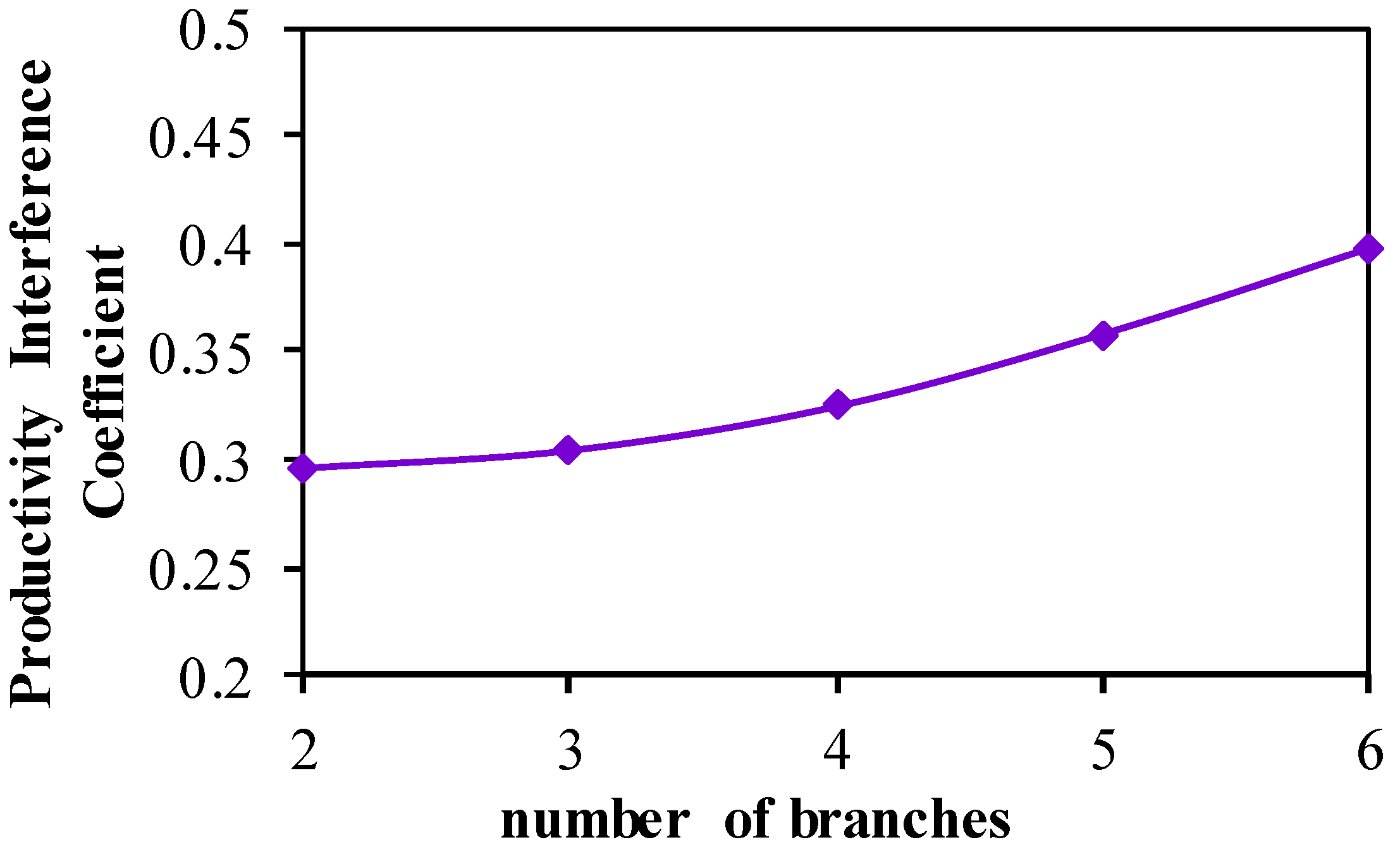
The productivity interference coefficients of fishbone wells under different number of branches are calculated. The results are shown in Figure 8. It can be seen from the figure that with the increase in the number of branches, the productivity interference coefficient of fishbone wells increases continuously. As the number of branches increased from 2 to 6, the productivity interference coefficient rose from 0.296 to 0.397, an increase of approximately 34%. The contribution of productivity per unit length decreased significantly when the branch count exceeded 4 (Figure 7b), indicating diminishing marginal returns for additional branches. This is due to the reduction in inter-branch spacing, which intensifies the overlap of their pressure fields. It can be seen that the more branches are not the better, and the number should be reasonably optimized according to the main wellbore length.

3.1.3. Influence of Branch Length on Fishbone Well Productivity Interference

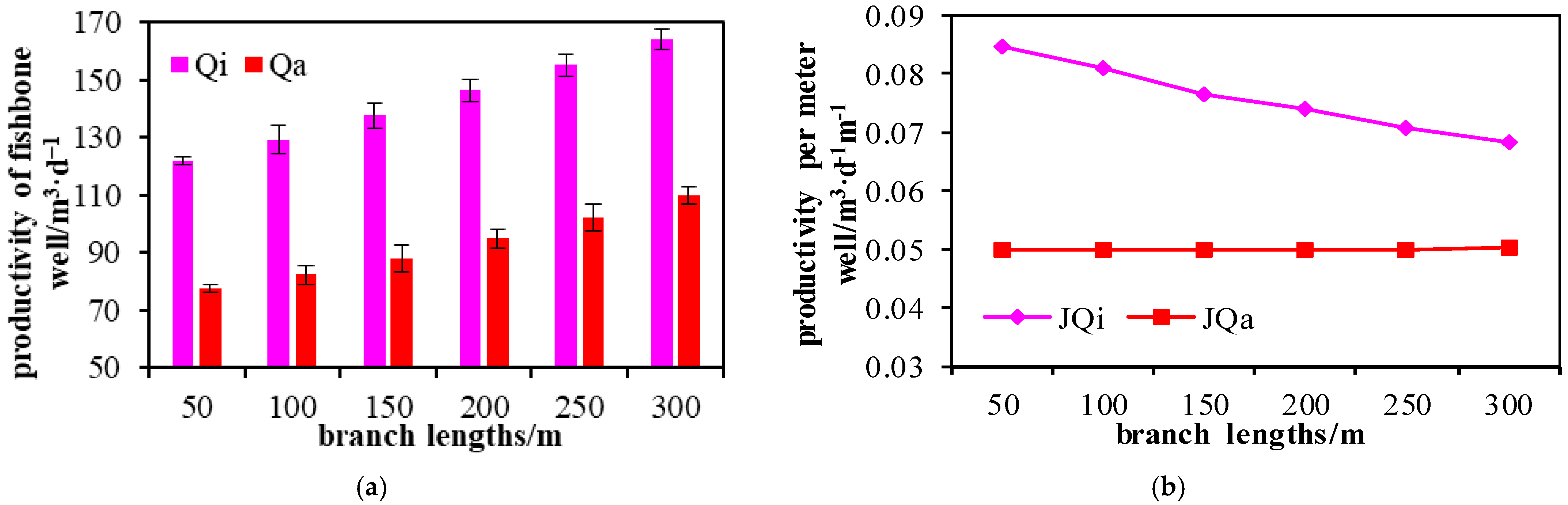
Comparing the ideal productivity and actual productivity of fishbone wells under different branch lengths, and calculating the contribution of corresponding unit length productivity, the results are shown in Figure 9a and Figure 9b, respectively. As can be seen from Figure 9a, both the actual productivity and the ideal productivity increase significantly with the increase in branch length. As can be seen from Figure 9b, with the increase in branch length, the contribution rate of unit length productivity of the ideal productivity of fishbone wells shows a downward trend, which is the same as the law of horizontal wells, but the contribution rate of unit length productivity of actual productivity shows an upward trend, which is mainly due to the weakening of interference as the branches lengthen.
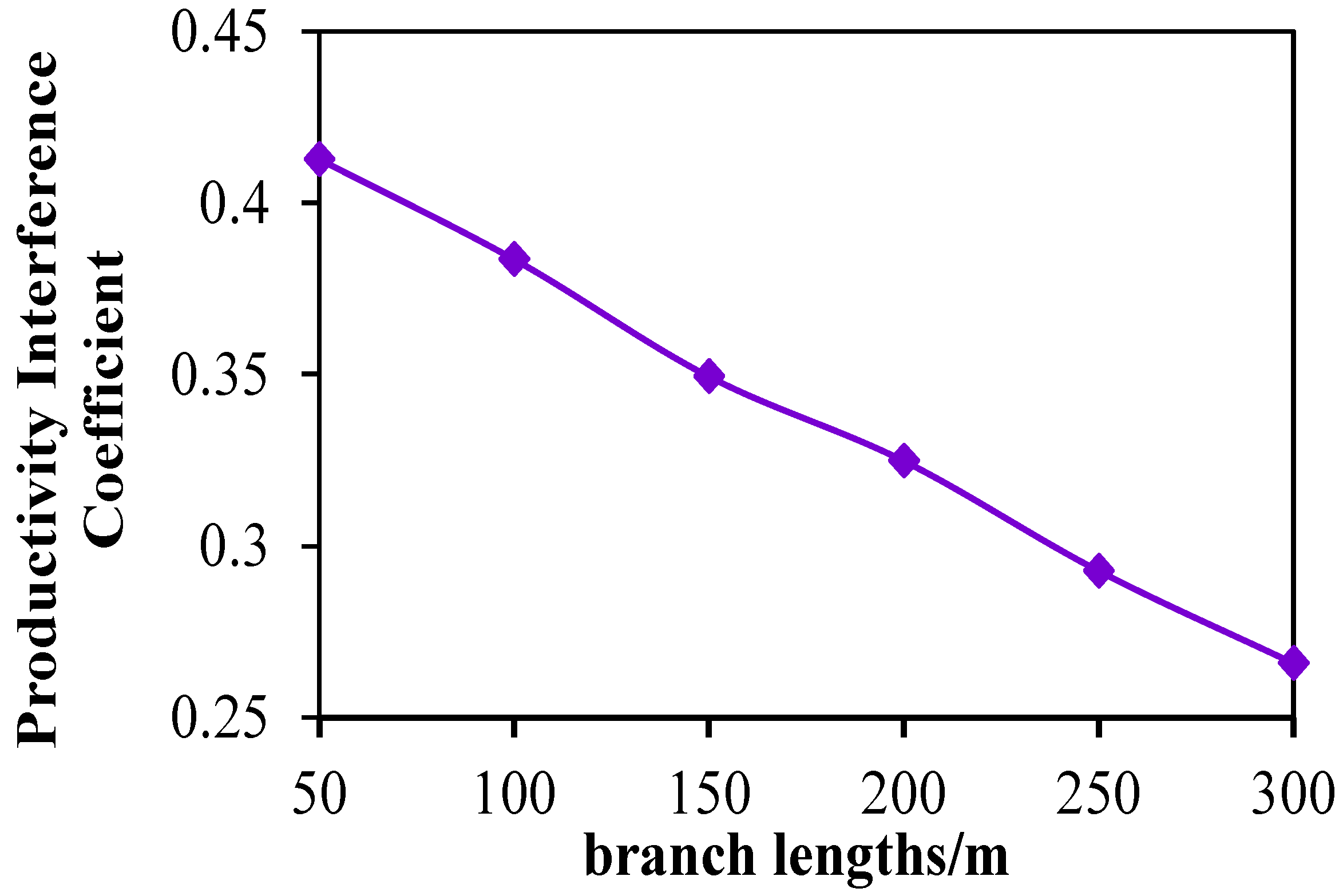
The productivity interference coefficients of fishbone wells under different branch lengths are calculated. The results are shown in Figure 10. It can be seen from the figure that with the increase in branch length, the degree of productivity interference between branches of fishbone wells basically shows a linear downward trend. The maximum productivity interference coefficient is 0.413 and the minimum is 0.266. This is because the longer the branch length, the greater the distance between the branch and the main wellbore, and the smaller the interference between the branches. When the branch angle remains unchanged, the distance between the branch and the main wellbore increases linearly with the increase in branch length, so the degree of productivity interference basically presents the same trend.

3.1.4. Influence of Branch Angle on Fishbone Well Productivity Interference

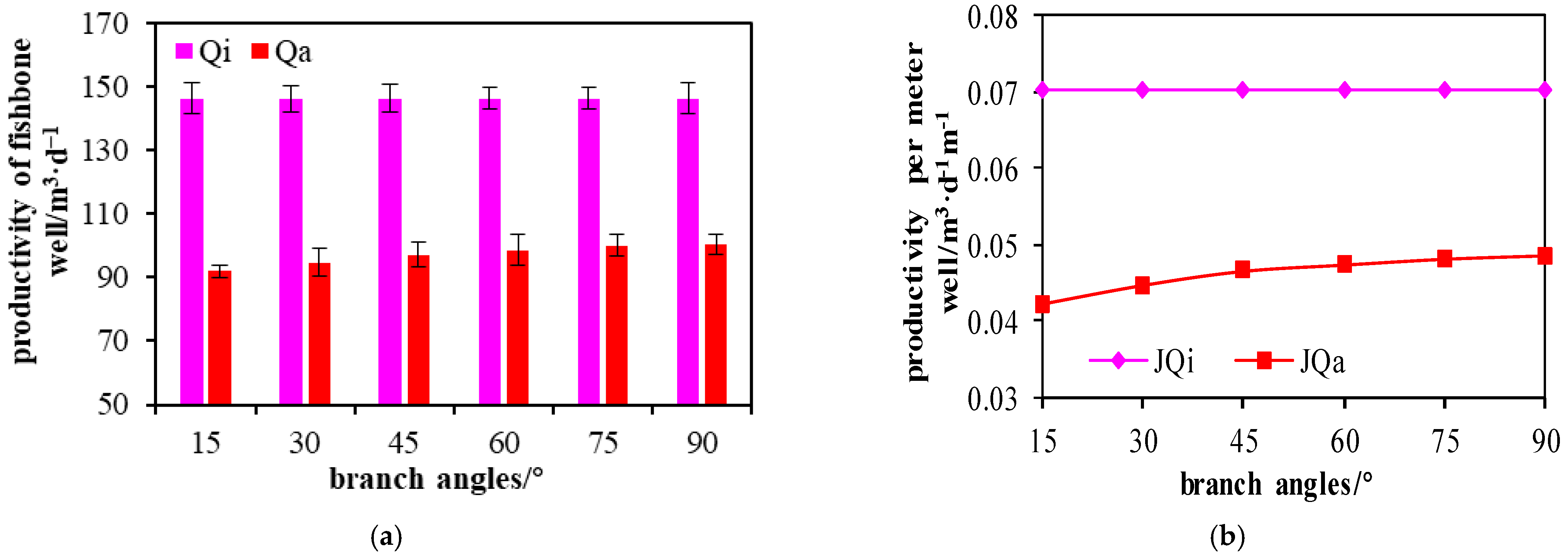
Comparing the ideal productivity and actual productivity of fishbone wells under different branch angles, and calculating the contribution of corresponding unit length productivity, the results are shown in Figure 11a and Figure 11b, respectively. As can be seen from Figure 11a, with the increase in branch angle, the ideal productivity of fishbone wells remains unchanged, while the actual productivity first increases and then tends to stabilize. As can be seen from Figure 11b, with the increase in branch angle, the contribution of unit length productivity of actual productivity of fishbone wells first increases and then tends to stabilize, which is due to the weakening of interference between branches in fishbone wells as the branch angle increases.
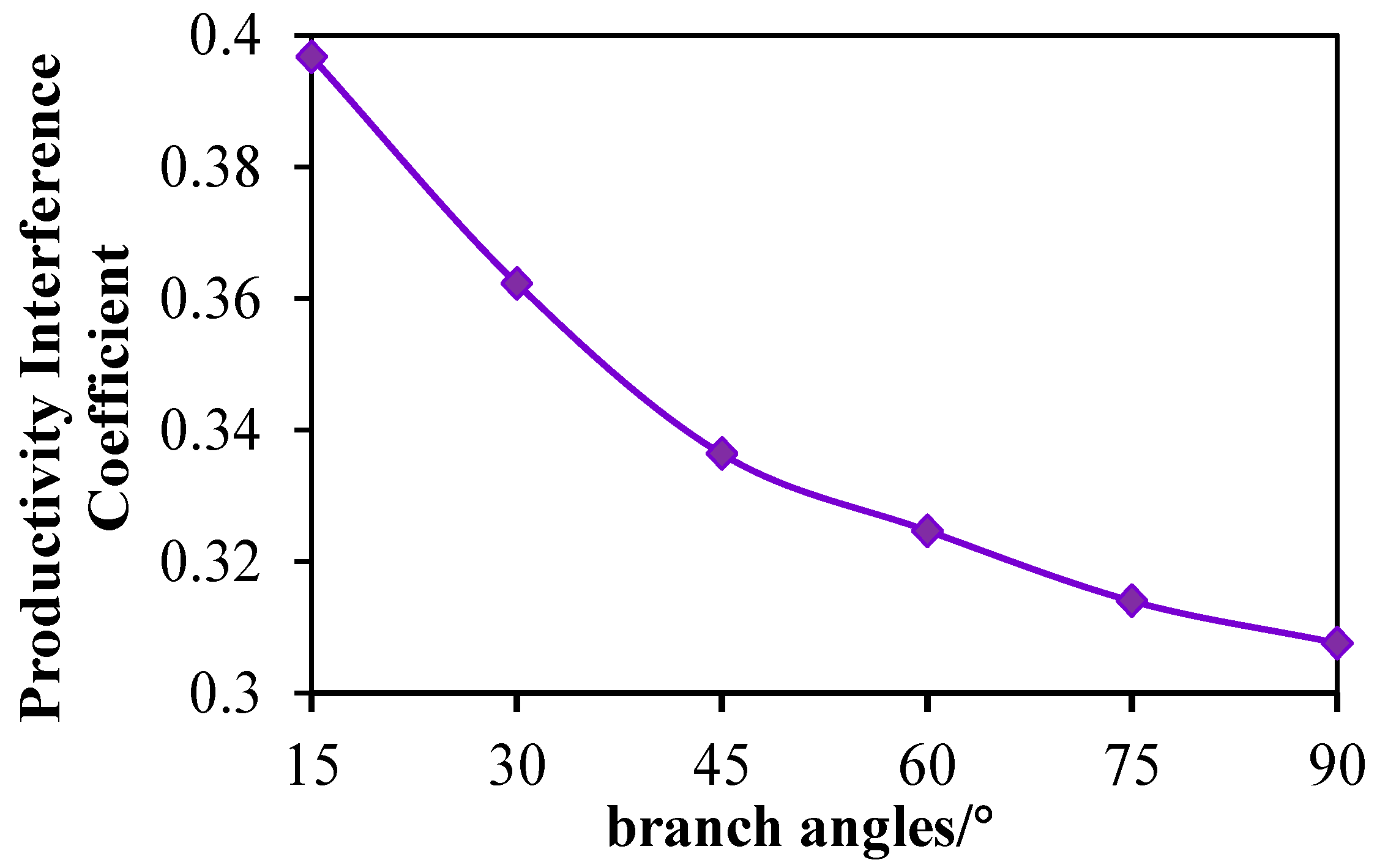
The productivity interference coefficients of fishbone wells under different branch angles are calculated. The results are shown in Figure 12. It can be seen from the figure that with the increase in branch angle, the productivity interference coefficient of fishbone wells becomes smaller. The maximum productivity interference coefficient is 0.397 and the minimum is 0.307. This is because the larger the branch angle, the farther the distance between the branch and the main wellbore, and the weaker the interference between the branches. When the branch length remains unchanged, increasing the branch angle increases the distance between the branch and the main wellbore according to the sine function. Therefore, as the branch angle approaches 90°, the amplitude of decrease in the productivity interference coefficient slows down.

3.2. The Pressure Distribution Characteristics of Fishbone Well

Compared with horizontal wells, fishbone wells have larger drainage areas. At the same time, the percolation of fishbone wells has obvious differences between the near-well zone and the far-well zone. The pressure distribution characteristic is the most direct reflection of the percolation mechanism. In order to further study the productivity interference law of fishbone wells, some experimental results were selected to analyze the pressure field distribution characteristics during fishbone well production, and study the relationship between pressure distribution and productivity interference.

3.2.1. Definition of Pressure Propagation Coefficient of Fishbone Well

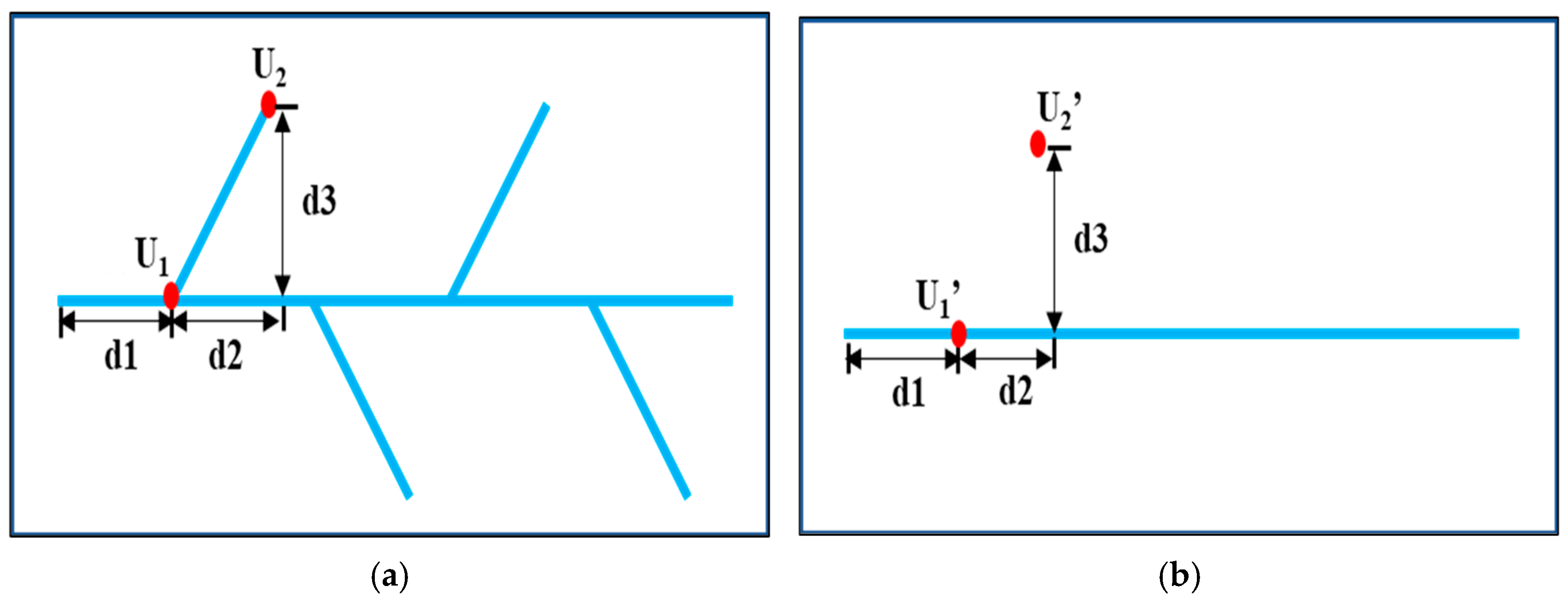
In order to better analyze the influence of different parameters on the pressure distribution of fishbone wells, the concept of pressure reach coefficient is introduced in this paper. The pressure reach coefficients of the near-well zone and far-well zone are calculated by Formulas (5) and (6), respectively. Its physical meaning is the pressure change in the near-well zone and far-well zone of multilateral wells compared with horizontal wells of the same length during mining. The pressure reach coefficient can clearly quantify the pressure change amplitude of multilateral wells under different wellbore structural parameters. Generally speaking, the greater the pressure reach, the greater the formation pressure difference, the larger the drainage area, and the better the development effect of multilateral wells. The experimental testing method of fishbone well pressure reach coefficient is shown in Figure 13.
F 1 = U 1 U 1 U 1
F 2 = U 2 U 2 U 2
where
F1, F2 are the pressure propagation coefficients of near-well zone and far-well zone, dimensionless;
U1, U2 are the pressure values for the near and far zones of the fishbone well, MPa;
U1′, U2′ are the pressure values for the near and far zones of the corresponding horizontal well of the fishbone well, MPa.

3.2.2. Analysis of Influence of Branch Length on Pressure Propagation of Fishbone Well

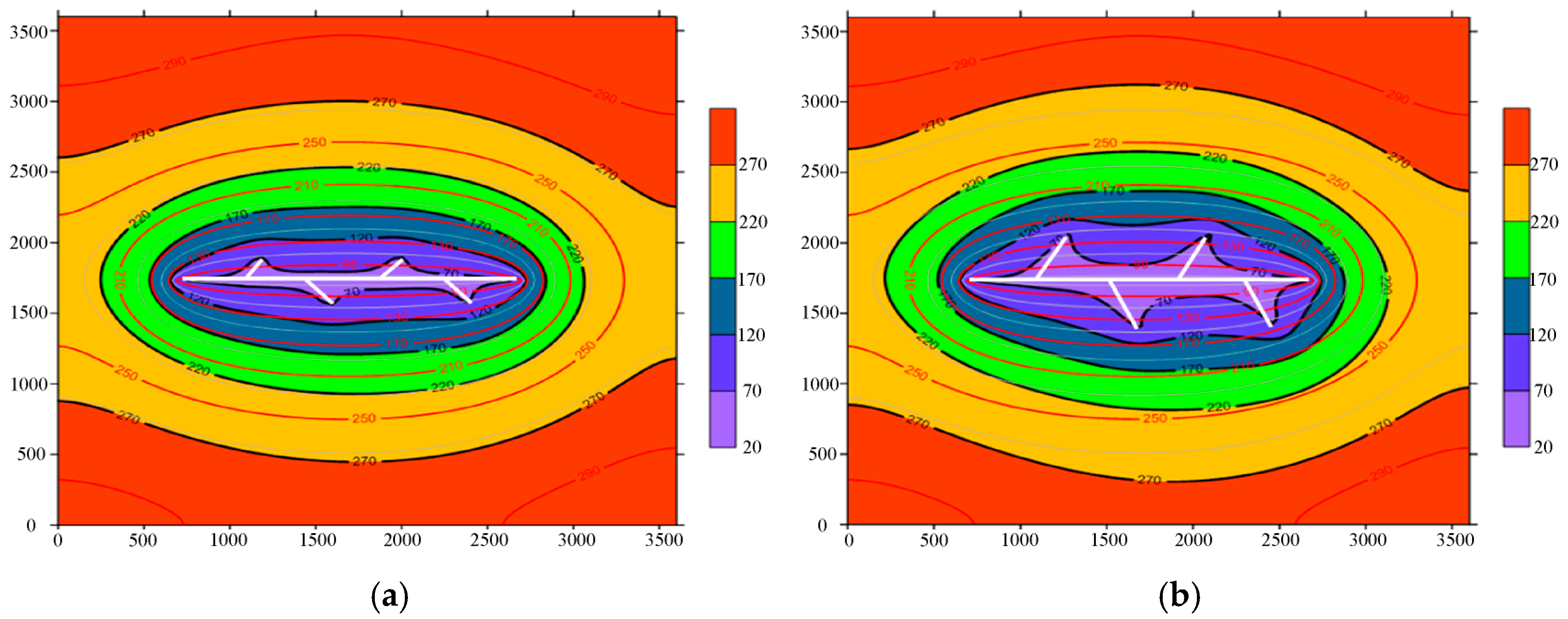
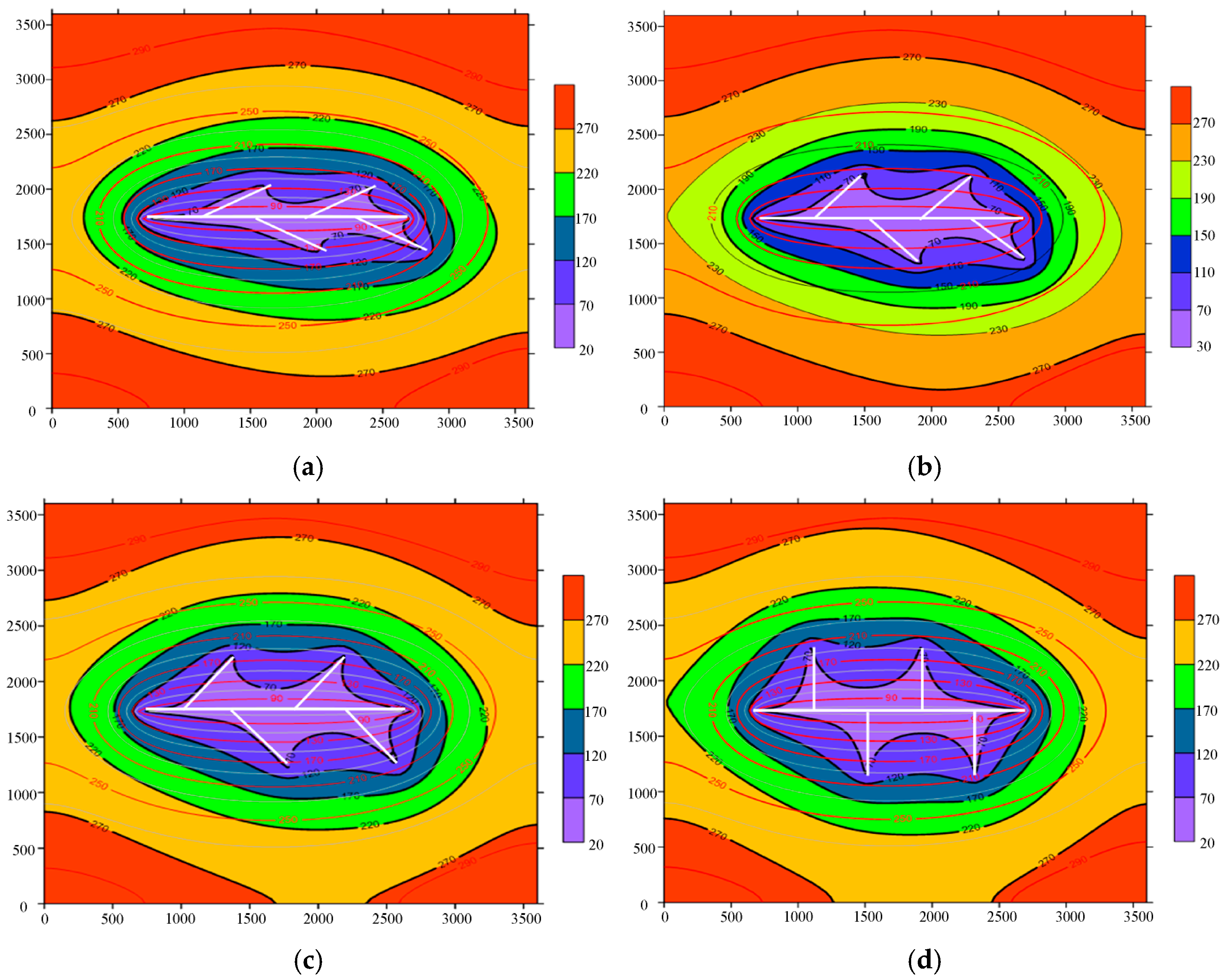
By superimposing the isobaric maps of fishbone wells and horizontal wells, the pressure distribution differences between them are compared to better analyze the laws of pressure propagation in fishbone wells. The specific method is to take the isobaric line of horizontal well as the benchmark and draw the isobaric line of fishbone well on this benchmark. Taking the branch angle of 60° as an example, the pressure changes in fishbone wells when the branch lengths are 50 m, 100 m, 150 m, and 200 m are shown in Figure 14. The black lines are the isobaric lines of fishbone wells, and the red lines are the isobaric lines of corresponding horizontal wells.
From Figure 14, it can be seen that the pressure field characteristics of the near-well zone of fishbone well are remarkably similar to the morphology of fishbone well. Isobaric lines envelop fishbone well and radiate outward. As the distance from wellbore increases, the distribution characteristics of isobaric lines gradually approach that of horizontal wells. The distribution of isobaric lines is denser at the branch end points, indicating a larger pressure gradient and larger inflow at the end points of fishbone well than other parts of wellbore. Under the same coordinates, the pressure value decreases as the branch length increases. As the branch length increases from 50 m to 200 m, the low pressure area in the near-well zone of fishbone well continues to expand, that is, the drainage area continues to expand. To quantify the expansion of the drainage area, the isobar corresponding to 95% of the boundary pressure was digitized from Figure 14d (branch length = 200 m). The enclosed area was calculated and compared to that of the branch length = 200 m horizontal well. The fishbone well configuration increased the drainage area by approximately 52%, providing direct quantitative evidence that longer branches enhance reservoir contact and sweep efficiency.
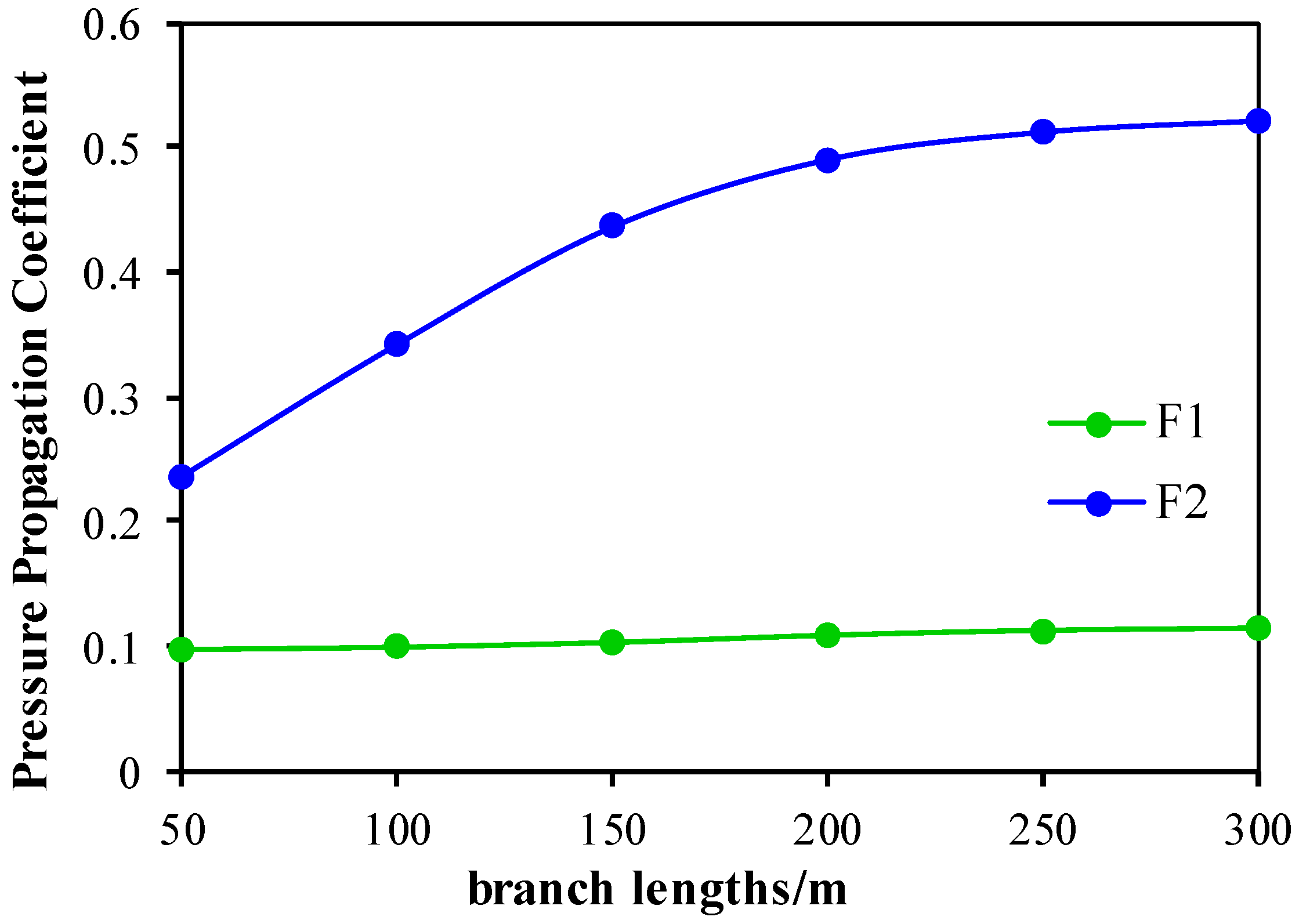
The pressure values of its near-well zone and far-well zone are taken to calculate the pressure reach coefficients of the near-well zone and far-well zone of fishbone wells with different branch lengths, as shown in Table 4 and Figure 15. It can be seen from Table 4 and Figure 15 that with the increase in branch length, the pressure reach coefficients of both the near-well zone and far-well zone of fishbone wells show an increasing trend, and the pressure reach coefficient of the far-well zone is always greater than that of the near-well zone. Among them, the pressure reach coefficient of the near-well zone only increased slightly. The pressure interference reach coefficient increased by only 0.018 as the branch length increased from 50 m to 300 m. This shows that the pressure distribution of fishbone wells in the near-well zone is basically the same as that of horizontal wells. Increasing the branch length has little effect on the percolation of fishbone wells in the near-well zone. The change amplitude of the pressure reach coefficient in the far-well zone is larger. With the increase in branch length, the pressure reach coefficient increases rapidly first, and then the increase amplitude slows down, and continues to increase slowly. This shows that increasing the branch length can effectively increase the pressure reach range of fishbone wells, that is, the drainage area, resulting in the above-mentioned change trend of pressure reach coefficients. The reason is that as the branch length increases, the distance between the branch endpoint and the main wellbore increases, and the pressure interference from the near-well zone decreases rapidly, but the pressure interference still exists. Continuing to increase the branch length, the pressure reach coefficient will continue to increase slowly.

3.2.3. Analysis of Influence of Branch Angle on Pressure Propagation of Fishbone Well

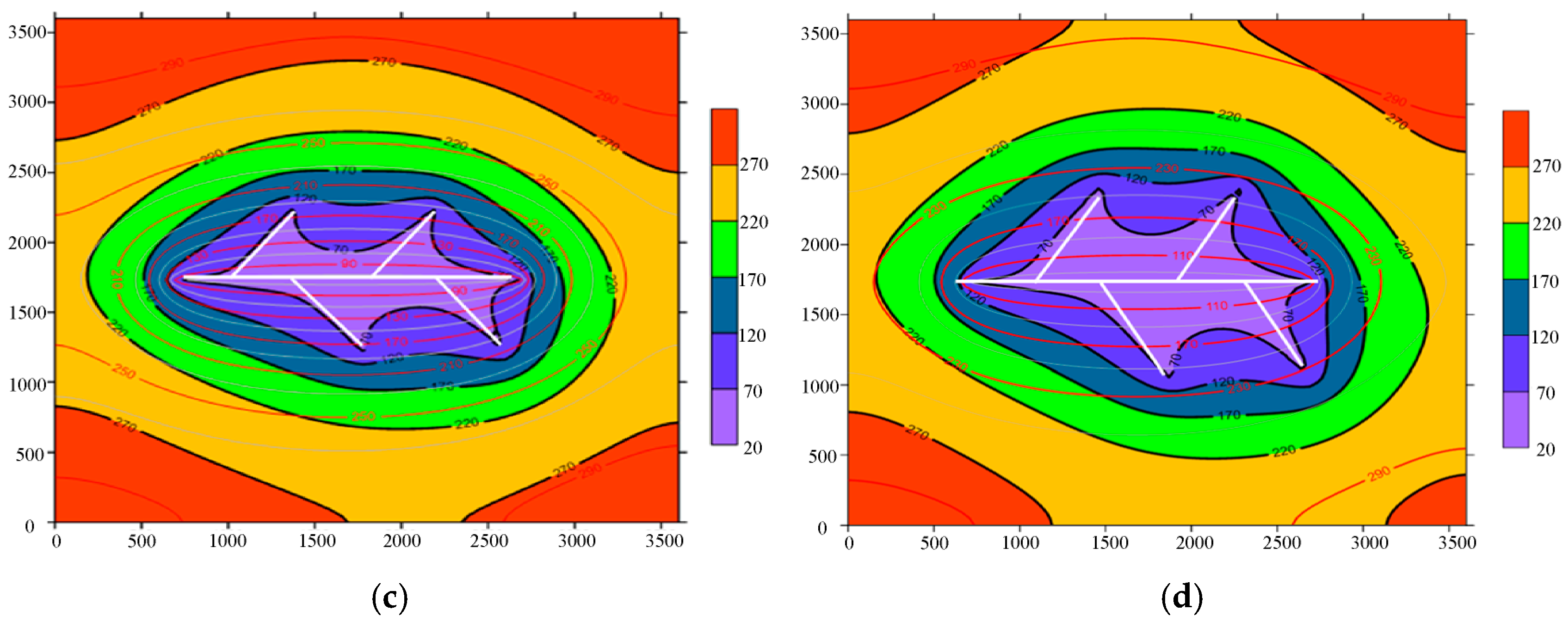
Taking the branch length of 200 m as an example, the isobaric diagrams of fishbone wells with branch angles of 30°, 45°, 60°, and 90° are drawn as shown in Figure 16 by the method in the previous section. The black lines are the isobaric lines of fishbone wells and the red lines are the isobaric lines of corresponding horizontal wells. The results show that as the branch angle increases from 30° to 90°, under the same coordinates, the corresponding pressure value decreases with the increase in branch angle, the drainage area controlled by the same pressure increases, and the amplitude of change in isobaric lines also increases with the increase in branch angle. A comparative analysis of Figure 16a and Figure 16d reveals that increasing the branch angle from 30° to 90° expands the area controlled by the same pressure drawdown (e.g., 90% of boundary pressure) by about 35%. This quantifies the benefit of larger angles in improving volumetric sweep.
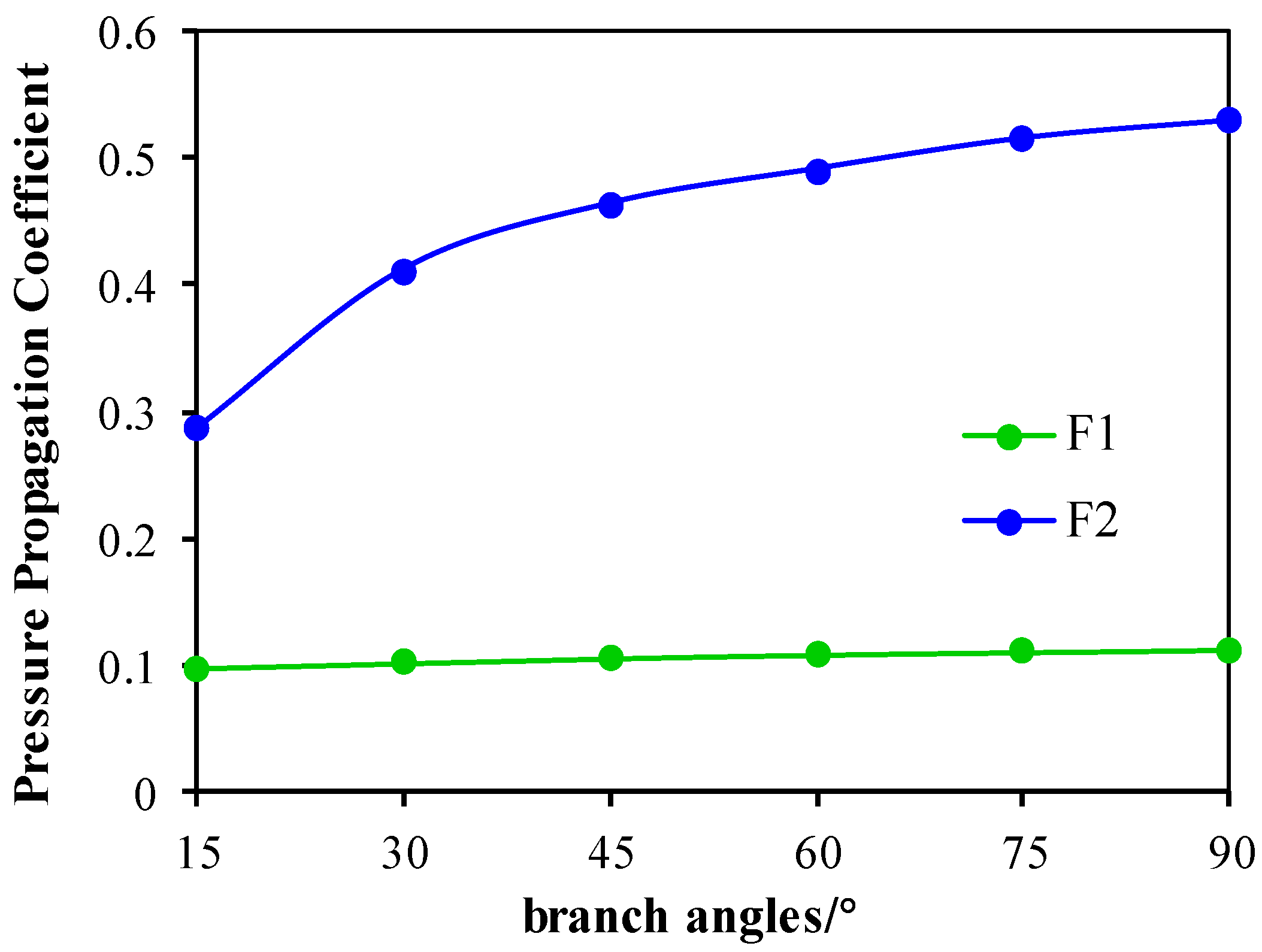
The pressure propagation coefficients of the near-well zone and far-well zone of fishbone wells with different branch angles are calculated as shown in Table 5 and Figure 17. The pressure propagation coefficients in both the near-well and far-well zones show a continuous increase with larger branch angles, and the far-well zone consistently demonstrates higher coefficients than the near-well zone. With the same change law as Section 3.2.2, the pressure reach coefficient of the near-well zone does not change significantly with the change in branch angle, while the far-well zone first increases rapidly and then slows down. When the branch angle exceeds 45°, the change amplitude of the pressure reach coefficient in the far-well zone of the fishbone well slows down, and the maximum pressure reach coefficient is 0.528.

3.2.4. Analysis of Influence of Pressure Propagation Coefficient of Fishbone Well on Productivity

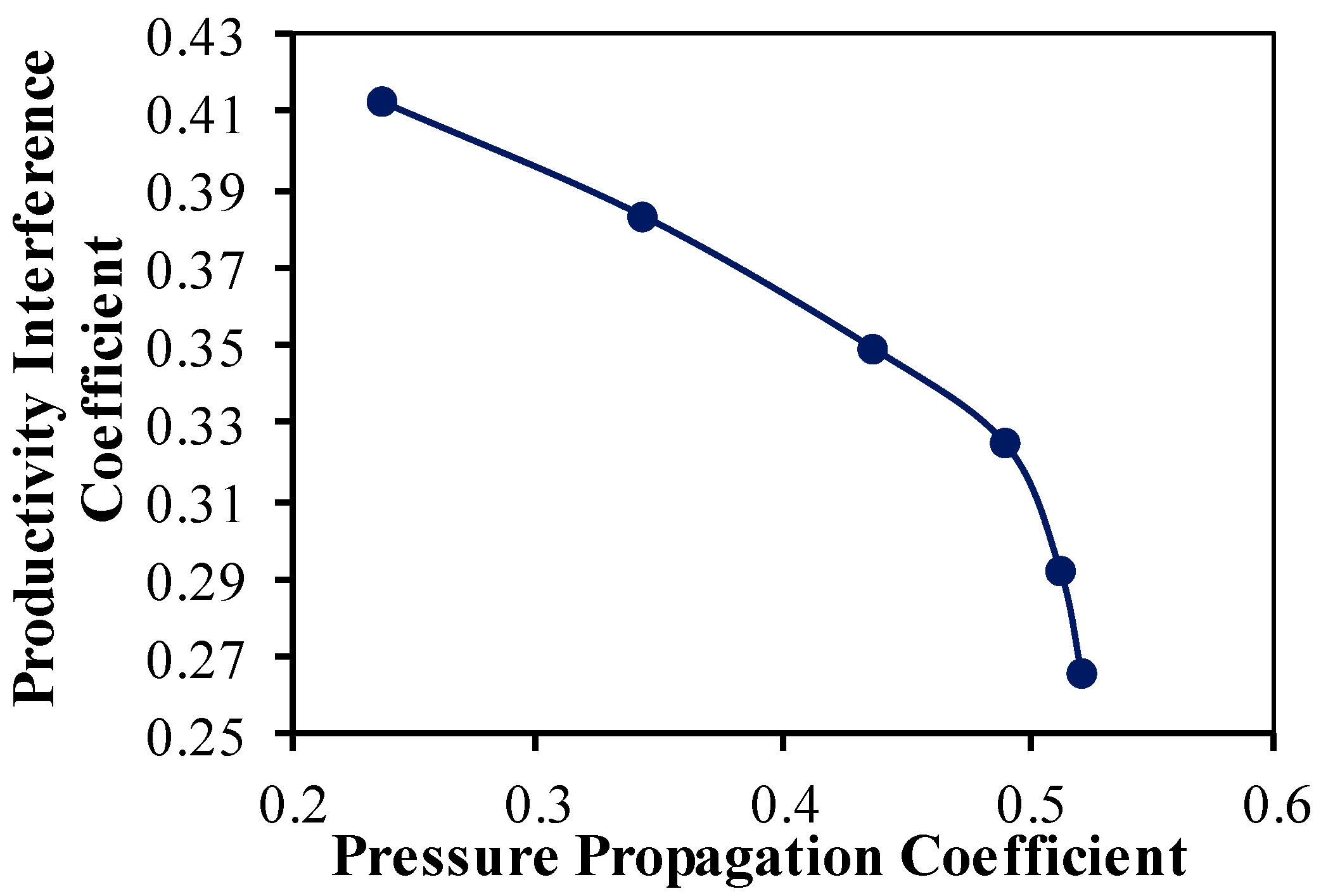
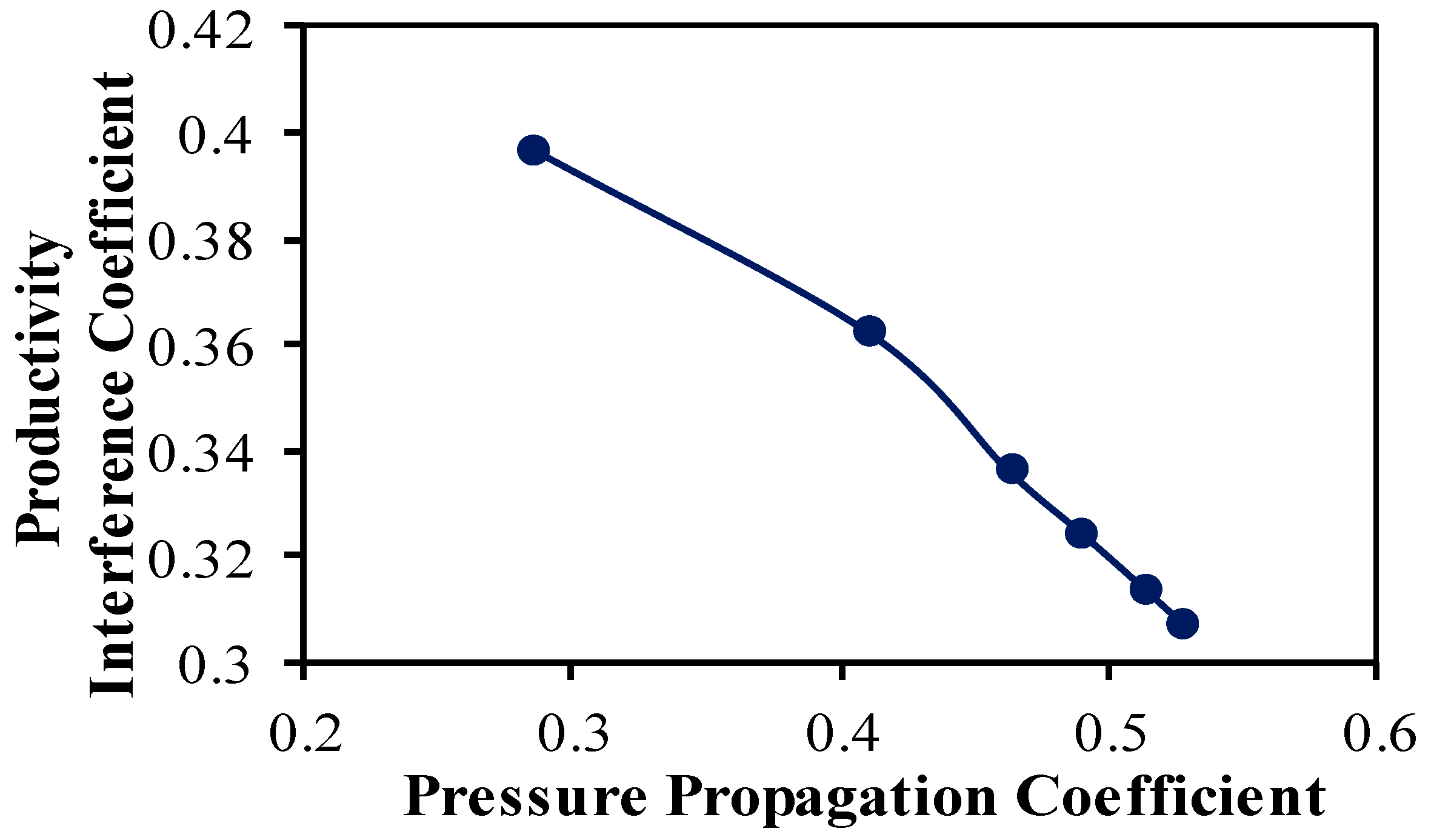
The above analysis shows that the pressure reach coefficients of the near-well zone change little with the change in branch length and branch angle, but changing the morphological parameters of fishbone wells can significantly change the pressure reach coefficient of the far-well zone. The relational curves between the pressure reach coefficient of the far-well zone and the corresponding productivity interference coefficient under the same branch angle condition and under the same branch length condition are drawn, as shown in Figure 18 and Figure 19, respectively.
It can be seen from Figure 18 that as the pressure reach coefficient increases, the productivity interference coefficient of fishbone wells decreases. This indicates that the reason for inter-branch production capacity interference is pressure interference. Increasing the branch angle or increasing the branch length both increase the range of pressure waves, reduce pressure interference, and thus reduce production capacity interference. Figure 18 and Figure 19 show a significant negative correlation between the far-field pressure propagation coefficient and the productivity interference coefficient. The underlying physical mechanism is that increasing the effective inter-branch spacing (via length or angle) reduces the overlap of pressure shadows between branches. This weakening of pressure interference is ultimately reflected in the decrease in the productivity interference coefficient. Therefore, maximizing effective branch spacing is key to mitigating interference in fishbone well design. When designing fishbones, it is difficult to obtain the ideal production capacity of the fishbone well mentioned earlier. Therefore, numerical simulation and other methods can be used to calculate the pressure ripple coefficient to determine the degree of production capacity interference of the fishbone well and guide the optimization design of the fishbone well.
The observed pressure field morphology—where isobars envelop the branches in the near-wellbore region and gradually converge towards a horizontal well pattern in the far-field (Figure 14)—is fundamentally consistent with a potential flow field described by the Laplace equation. Although a separate numerical simulation was not conducted in this study, the experimental results are in strong qualitative agreement with classical seepage theory. This agreement reinforces the theoretical validity of the identified mechanism: pressure interference is the root cause of productivity interference. The proposed productivity and pressure propagation coefficients are thus grounded in physical principles. Future work could directly employ a 2D numerical Laplace solver to replicate these isobars and parameterize the prediction of interference coefficients

4. Conclusions

In this paper, the water-electricity simulation experiment method is used to study the influence law of fishbone wellbore structural parameters on the productivity interference between branches. The following conclusions are obtained:
  • The concepts of productivity interference coefficient and pressure propagation coefficient are proposed to quantify the productivity interference degree and pressure propagation range of fishbone wells.
  • With the increase in the number of branches, the productivity interference coefficient between branches increases continuously. The productivity interference coefficients decrease with the increase in branch length and branch angle.
  • The pressure propagation coefficients of both near-well zone and far-well zone increase with the increase in branch length and branch angle. The overall pressure propagation coefficient of far-well zone is greater than that of near-well zone.
  • Productivity interference between branches is caused by pressure interference. By increasing the spacing between branches, the pressure propagation range expands and the productivity interference degree reduces.

Author Contributions

Conceptualization, S.H.; Methodology, S.H.; Validation, M.J.; Resources, L.Z.; Writing—original draft, X.D.; Writing—review & editing, B.Y. All authors have read and agreed to the published version of the manuscript.

Funding

This research was funded by Key Research Initiative of SINOPEC (P25040).

Data Availability Statement

The original contributions presented in this study are included in the article. Further inquiries can be directed to the corresponding authors.

Conflicts of Interest

Authors Xu Dang, Liang Zhai, Bin Yuan and Mengchen Jian were employed by the SINOPEC. Also Dang Xu is also a Ph.D. candidate at China University of Petroleum (Beijing). The remaining authors declare that the research was conducted in the absence of any commercial or financial relationships that could be construed as a potential conflict of interest. The SINOPEC had no role in the design of the study; in the collection, analyses, or interpretation of data; in the writing of the manuscript, or in the decision to publish the results.

References

  1. Du, B.; Cheng, L.; Huang, S. Study on electrolytic simulation experiment of segmented multi-cluster fractured horizontal well in tight oil reservoir. Sci. Technol. Eng. 2013, 13, 3267–3270. [Google Scholar]
  2. Denney, D. Multilateral Well in Low-Productivity Zones. J. Pet. Technol. 1998, 50, 42–44. [Google Scholar] [CrossRef]
  3. Mody, R.K.; Coronado, M.P. Multilateral Wells: Maximizing Well Productivity. In Pumps and Pipes: Proceedings of the Annual Conference; Springer: Boston, MA, USA, 2010; pp. 71–86. [Google Scholar]
  4. Li, Y.; Liu, H.; Jia, J. Hydroelectric simulation test of coalbed methane in symmetric multi branch horizontal wells. Coal Sci. Technol. 2023, 50, 135–142. [Google Scholar]
  5. Cavender, T. Summary of Multilateral Completion Strategies Used in Heavy Oil Field Development. In Proceedings of the SPE Western Regional Meeting, Bakersfield, CA, USA, 16–18 March 2004; p. SPE-86926-MS. [Google Scholar]
  6. Xing, G.; Guo, F.; Song, C.; Sun, Y.; Yu, J.; Wang, G. Fishbone Well Drilling and Completion Technology in Ultra-Thin Reservoir. In Proceedings of the IADC/SPE Asia Pacific Drilling Technology Conference and Exhibition, Tianjin, China, 9–11 July 2012; p. SPE-155958-MS. [Google Scholar]
  7. Geng, Y.; Hai, L.; Wang, A.; Wu, M. Technique of horizontal multilateral Well CB26B-ZP1 in Shengli Oilfield. Pet. Drill. Tech. 2007, 35, 52. [Google Scholar]
  8. Zhu, J. Drilling and completion technology of two-branch multi-lateral Xiao35-H1Z well in Liaohe Oilfield. Oil Drill. Prod. Technol. 2008, 30, 17–20. [Google Scholar]
  9. Zhang, Y.; Zhao, C.; Tong, K.; Zhou, F. Research on Flow Mechanism of Fishbone Well in Heavy Oil Field and Evaluate Its Development in Bohai Bay Heavy Oil Fields. Phys. Numer. Simul. Geotech. Eng. 2016, 24, 84–94. [Google Scholar]
  10. Liu, S.; Li, J.; Lv, D.; Kok, J.; Han, S.Y. Succeeding with Multilateral Wells in Complex Channel Sands. In Proceedings of the SPE Asia Pacific Oil and Gas Conference and Exhibition, Jakarta, Indonesia, 30 October 2007; p. SPE-110240-MS. [Google Scholar]
  11. Sun, C. Productivity Evaluation and Injection-Production Optimization of Multilateral Wells. Master’s Thesis, China University of Petroleum (East China), Dongying, China, 2010. [Google Scholar]
  12. Hou, D. Research on the Deliverability and Interference of Multilateral Well. Master’s Thesis, Northeast Petroleum University, Daqing, China, 2015. [Google Scholar]
  13. Wang, T.; Huang, Y. Electrical simulation experiment of the seepage of zone near the borehole in symmetric herringbone wells. Contemp. Chem. Ind. 2017, 46, 3. [Google Scholar]
  14. Yue, P.; Zhou, J.; Kang, L.; Liu, P.; Jia, C.; Chen, X. Reservoir and wellbore flow coupling model for fishbone multilateral wells in bottom water drive reservoirs. J. Energy Resour. Technol. 2021, 143, 143. [Google Scholar] [CrossRef]
  15. Yin, J.W. Experimental study on hydraulic fracturing simulation of horizontal well fracturing on well production. Energy Environ. Prot. 2017, 39, 167–170. [Google Scholar]
  16. Su, G.D.; Zhang, P.; Gu, X.; Han, B.Y.; Yi, P.; Li, M.Y. Design of Virtual Teaching Platform for Hydroelectric Simulation Experiment. Lab. Res. Explore 2018, 37, 105–109. [Google Scholar]
  17. Ji, G.F.; Zhou, Y.; Wang, M.; Xu, C.Z. Electric simulation of seepage flow for tight-oil horizontal well staged fracturing and considering start-up pressure. Energy Environ. Prot. 2019, 41, 64–67. [Google Scholar]
  18. Sun, X.C.; Liu, Z.L.; Ji, G.F.; Liu, Z.T.; Xu, Z. Hydro-electric Simulation of the Influence of Fracture Parameters on Seepage in Horizontal Wells After Fracturing in Tight Oil Reservoirs. Contemp. Chem. Ind. 2020, 49, 2736–2741. [Google Scholar]
  19. Lu, T.D. Study on Flow Law of Complex Fracture Network in Tight Reservoir. Master’s Thesis, China University of Petroleum, Beijing, China, 2020. [Google Scholar]
  20. Zhu, M.; Wu, X.; Han, G.; Gao, F.; Xu, L.; Cao, G. Study on multi-lateral wells productivity based on electric analogy. Sci. Technol. Eng. 2012, 45, 4. [Google Scholar]
  21. Wu, X.; Sui, X.; An, Y.; Zhang, F.; Chen, Y. Electrolytic simulation experiment of fractured horizontal well. Acta Pet. Sin. 2009, 30, 740–743, 748. [Google Scholar]
  22. Xu, L.; Han, G.; Zhang, R.; Zhao, H.; Song, Y. A new approach of 3D potential distribution experiment for multi-lateral wells. J. Southwest Pet. Univ. (Sci. Technol. Ed.) 2015, 37, 7. [Google Scholar]
  23. Li, K.; Zhang, J.; Zhu, G.; Zhou, W.; Wang, K.; Liang, H. A new method for calculating the characteristic shape of the water ridge under horizontal production wells in marine sandstone heavy oil reservoirs with bottom water. Chem. Technol. Fuels Oils 2021, 57, 690–697. [Google Scholar] [CrossRef]
  24. Ji, G.F.; Liu, Z.Q.; Zhao, W.W.; Nan, C.Y. Similarity simulation of tight oil horizontal well post-fracturing productivity based on principle of hydropower similarity. J. Heilongjiang Univ. Sci. Technol. 2024, 34, 440–445. [Google Scholar]
Figure 1. Diagram of intelligent hydropower simulation experimental device.
Processes 14 00179 g001
Figure 2. Current measurement circuit diagram.
Processes 14 00179 g002
Figure 3. Voltage measurement circuit diagram.
Processes 14 00179 g003
Figure 4. Schematic diagram of the number of branches of fishbone models. (a) 2 branches; (b) 3 branches; (c) 4 branches; (d) 5 branches; (e) 6 branches.
Processes 14 00179 g004
Figure 5. Schematic diagram of the branch length of fishbone well models.
Processes 14 00179 g005
Figure 6. Schematic diagram of the branch angle of fishbone well models.
Processes 14 00179 g006
Figure 7. Productivity of fishbone wells with different number of branches. (a) Curve between actual and ideal productivity with different number of branches. (b) Curve between actual and ideal productivity per meter with different number of branches.
Processes 14 00179 g007
Figure 8. Curve of productivity interference coefficients with different number of branches.
Processes 14 00179 g008
Figure 9. Productivity of fishbone wells with different branch lengths. (a) Curve between actual and ideal productivity with different branch lengths. (b) Curve between actual and ideal productivity per meter with different branch lengths.
Processes 14 00179 g009
Figure 10. Curve of productivity interference coefficients with different branch lengths.
Processes 14 00179 g010
Figure 11. Productivity of fishbone wells with different branch angles. (a) Curve between actual and ideal productivity with different branch angles. (b) Curve between actual and ideal productivity per meter with different branch angles.
Processes 14 00179 g011
Figure 12. Curve of productivity interference coefficients with different branch angles.
Processes 14 00179 g012
Figure 13. Schematic diagram of pressure measurement of fishbone well and corresponding horizontal well. (a) fishbone well; (b) corresponding horizontal well.
Processes 14 00179 g013
Figure 14. Isobaric diagram of fishbone wells with different branch lengths: (a) branch length = 50 m; (b) branch length = 100 m; (c) branch length = 150 m; (d) branch length = 200 m.
Processes 14 00179 g014aProcesses 14 00179 g014b
Figure 15. Variety of pressure propagation coefficient with different branch lengths.
Processes 14 00179 g015
Figure 16. Isobaric diagram of fishbone wells with different branch angles: (a) branch angle = 30°; (b) branch angle = 45°; (c) branch angle = 60°; (d) branch angle = 90°.
Processes 14 00179 g016
Figure 17. Variety of pressure propagation coefficient with different branch angles.
Processes 14 00179 g017
Figure 18. Relationship curves between the far-well zone pressure propagation coefficient and the corresponding productivity (when branch angle is 60°).
Processes 14 00179 g018
Figure 19. Relationship curves between the far-well zone pressure propagation coefficient and the corresponding productivity (when branch length is 200 m).
Processes 14 00179 g019
Table 1. Table of similarity coefficients.
Similarity Coefficient NameDefinition
Geometric similarity coefficient C L = X m X r = Y m Y r = Z m Z r = L m L r
Pressure similarity coefficient C p = ( Δ U ) m ( Δ P ) r
Drag coefficient C r = R m ( R f ) r
Rate similarity coefficient C q = I m Q r
Flow similarity coefficient C ρ = ρ m k / μ
Table 2. Comparison of experimental model and corresponding actual reservoir parameters.
Reservoir ParametersValueExperimental ParametersValue
Reservoir scale/m160 × 160 × 20Model size/m0.8 × 0.8 × 0.1
Wellbore diameter/mm2000Wellbore diameter/mm1
Main branch length/m1200Main wellbore length/m0.6
Permeability/×10−3 μm21000Solution conductivity/μs·cm−1356
Drawdown pressure/MPa1.5Supply voltage/V12
Viscosity(crude)/mPa·s10
Table 3. Similarity coefficient used in Experiment.
Similarity Coefficient NameValue
Geometric similarity coefficient/µm2·[(mPa·s)·(µs/cm)]−15 × 10−3
Drag coefficient Cr/µm2·[(mPa·s)·(µs/cm)]−146.81
Pressure similarity coefficient Cp/V·(Mpa)−18
Rate similarity coefficient Cρ/(µs/cm)·[mPa·s·(10−3 µm2)−1]0.171
Flow similarity coefficient4.272
Table 4. Calculation results of pressure propagation coefficients with different branch lengths.
Branch LengthsF1F2
50 m0.0970.236
100 m0.0990.342
150 m0.1030.436
200 m0.1090.49
250 m0.1130.512
300 m0.1150.521
Table 5. Calculation results of pressure propagation coefficients with different branch angles.
Branch AnglesF1F2
15°0.0980.286
30°0.1020.411
45°0.1060.463
60°0.1090.49
75°0.1110.514
90°0.1130.528
Disclaimer/Publisher’s Note: The statements, opinions and data contained in all publications are solely those of the individual author(s) and contributor(s) and not of MDPI and/or the editor(s). MDPI and/or the editor(s) disclaim responsibility for any injury to people or property resulting from any ideas, methods, instructions or products referred to in the content.