Abstract
Polypropylene (PP) is a highly sought-after synthetic polymer. Due to its properties, it has wide applications in a number of industries. One-dimensional molded materials (fibers and strands) are widely used in the textile and construction sectors. Concrete reinforcing using PP fiber is an intriguing use in construction. Fiber can be provided in two forms: fine fibers (microfiber) and extrudates (macrofiber). The macrofiber has a length of up to 60 mm and a thickness of up to 300 microns. The aim of the work was to obtain PP-based macrofibers from recycled polymer using the natural antioxidant tocopherol. The initial polymer is used to produce the fiber, whereas, in this work, it is proposed to use a secondary PP. Vitamin E, a natural antioxidant, was added to the system to stabilize the melts. It has been demonstrated that adding up to 0.5% Vitamin E reduces the heat degradation of the polymer and yields melts with the appropriate viscoelastic characteristics. Rheological data was used to determine the fiber’s formability window. Macrofibers were derived from melts with varying histories. Their structure was investigated using X-ray structural analysis and IR spectroscopy, and their mechanical characteristics were assessed.
1. Introduction
According to [1], cement refers to materials that produce a significant quantity of CO2, accounting for 8% of total carbon dioxide emissions. To minimize carbon dioxide emissions while using cement, the Global Cement and Concrete Association recommends placing an emphasis on the manufacture of low-carbon cement composites [2]. Fillers in concrete limit the propagation of microcracks [3,4], allowing composite systems to be built with less cement.
The percentage of fibers introduced is determined such that the stresses in the concrete structure do not cause their destruction. The polymer phase in the form of fibers serves as a structure-forming mechanism, preventing the spread of material degradation [5]. In [6], Mustafaraj showed that the use of polypropylene (PP) fibers significantly improves the in-plane load-carrying capacity of the masonry. At the same time as improving the mechanical properties, the introduction of PP fibers into cement allows for reducing the weight of the structure, increasing its corrosion resistance, reducing cost, and improving material processing.
The appeal of PP stems from its chemical structure and the operational properties of the materials obtained on its basis [6,7,8]. Among the many advantages of PP, we will focus on its high mechanical strength, rigidity, chemical resistance, temperature resistance, and low density. All of these characteristics are critical for the development and use of composite materials reinforced with PP fibers.
Currently, there is a substantial number of studies supporting the use of PP fibers to improve the characteristics of concrete structures [9,10,11,12,13,14,15]. Because moisture is removed during the construction of concrete buildings and the concrete dries with increasing strength, stresses arise in it, resulting in the formation of microcracks. Cracks can emerge when a concrete building is loaded; they frequently appear on the surface [16]. The introduction of a dispersed phase in the form of one-dimensional materials allows for the restraining of these processes while retaining structural stability [17].
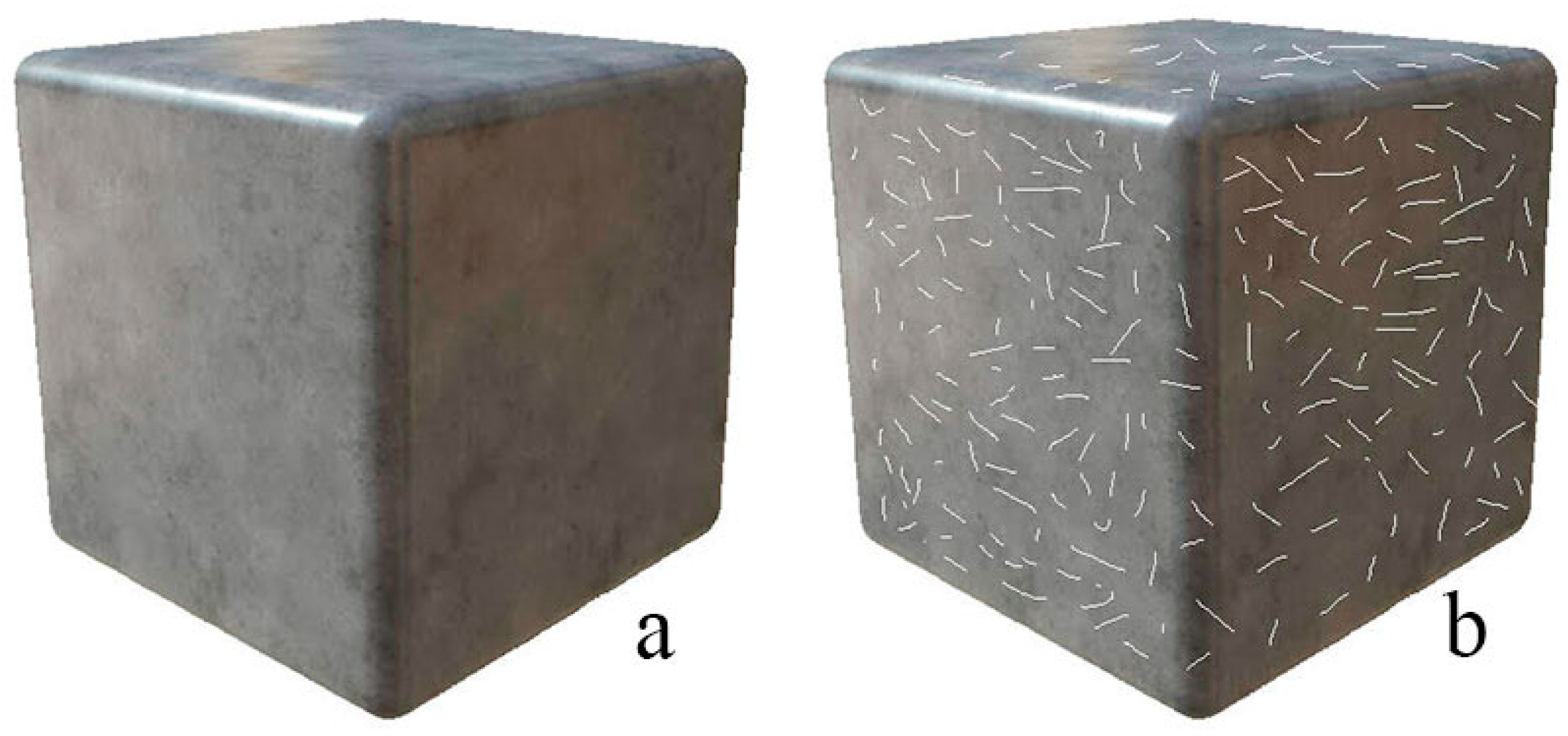
The main task is to evenly distribute the fibers in the volume of concrete, while the fibers themselves do not have a predominant orientation in the matrix. Schematically, the concept of the reinforcement of a concrete matrix can be represented as randomly distributed monofilaments that do not form agglomerates and have contact with each other like a sparse mesh of meshes (Figure 1).
Figure 1.
A schematic illustration of the original (a) and fiber-reinforced (b) concrete.
Evenly dispersed fibers can boost the strength properties of concrete, as seen in [18], where the addition of 1 kg/m3 PP fibers increases strength by 40%. The addition of 1.5% by weight PP fiber in concrete increases compressive strength by 16% [19]. In their work, Shah and Rangan [20] showed that the fiber-dispersed phase does not have a significant effect before cracks appear. However, a small amount of filler significantly improves the strength and ductility of concrete after cracking. Furthermore, the use of a fibrous filler is intended to inhibit crack propagation by minimizing the breadth and distance between them. As a result, the risk of water and abrasive liquids entering fissures and causing structural collapse is minimized [21].
Currently, various types of fibers are used as one-dimensional fillers for concrete. Since the environmental requirements for the material used are currently increasing, preference is given to fibers from renewable raw materials.
To increase cement quality, Refs. [22,23,24,25,26,27,28] propose using cellulose fibers from bleached kraft pulp and lignocellulose fibers. Unfortunately, natural fibers, unlike synthetic ones, have a wide diameter distribution, which can reach 50–100% of the average values [29]. Large deviations from the average diameter values make the mechanical response of the structure poorly predictable.
Steel fiber has a number of advantages over natural fibers. Auwal [30,31,32,33,34] showed that using up to 2% metal cord separated from old tires in concrete may greatly enhance its structural properties. Since steel fiber is characterized by its rigidity, its uniform distribution in the matrix is not a trivial task, which is solved by introducing additives in small portions and the constant mixing of the mass.
Another popular concrete filler is polypropylene fiber. Its introduction into the matrix does not increase the weight of the mixture or create difficulties associated with uniform distribution of the material and is easily achieved by mixing compared to steel fiber. The uniform distribution of fibers within the mortar slows the formation of microcracks, reducing the likelihood of cracks caused by concrete shrinkage during drying.
Since polypropylene is widely used and its features have previously been fully described, we see that the broad usage of polymer products results in their accumulation in huge numbers. As a result, ecosystems are actively polluted, and non-renewable fossil resources used in plastic synthesis are exploited irrationally. The involvement of recycled thermoplastic raw materials has demonstrated its advantages, and within the framework of the problem considered in the current work, it is of interest to process PP into fiber for concrete reinforcement. Hence, the research hypothesis is formed that it is possible to use secondary PP for forming polymer fibers.
It is known that the PP recycling process has a thermomechanical effect on the polymer. For PP, processing temperatures can reach 240 °C in the absence of oxygen and high shear stresses [35]. Harsh processing conditions can act as a catalyst for polymer degradation, primarily thermal oxidative degradation [36]. During processing, a radical chain reaction is triggered, leading to the rupture of macromolecules (a decrease in molecular weight) and the formation of new chemical groups (carbonyl groups). In parallel, the processes of mechanical degradation occur, caused by the destruction of macromolecules under the action of shear stresses.
Chemical transformations and a decrease in molecular weight affect the performance properties of PP-based materials (mechanical strength decreases, melt viscosity decreases, elastic properties of the system change, formability deteriorates, the polymer acquires a yellowish color, and transparency decreases). The weak point of PP is the hydrogen atom of the tertiary carbon atom, which has a lower dissociation energy (~322 kJ/mol), making it more labile and which detach when exposed to external forces. The presence of oxygen in contact with the polymer accelerates the destruction processes of polypropylene. If additives are introduced into the system that block oxygen access (collapsing upon heating), then PP degradation will decrease [37]. The wood-dispersed phase, which releases volatile compounds when heated, can act as such additives.
Complex systems of stabilizers (antioxidants) are used in industries to suppress the PP destruction described above. Primary antioxidants (Irganox 1010 or 1076) function as radical traps. Secondary antioxidants (phosphites and phosphonites, Irgafos 168 or TNR) act by a different mechanism, acting as destroyers of hydroperoxides. The use of synthetic antioxidants to produce PP fiber from recycled materials is possible and does not raise a number of issues related to the migration of stabilizers or changes in polymer properties with the introduction of additives. However, natural stabilizers are of greater interest, primarily because of environmental issues. In [38], it is proposed to use vitamin E (tocopherol) as a natural stabilizer. Its molecule is a naturally occurring phenolic compound with a chromane cycle and a long aliphatic side chain. As an antioxidant, vitamin E works by the mechanism of a hydrogen donor, effectively ending chain reactions of oxidation. The stability of vitamin E can be maintained at high temperatures up to 180–250 °C, which corresponds to the temperature range of PP processing.
Despite the potential of Vitamin E as a PP melt stabilizer, its use in recycled PP systems has not yet been adequately studied. Furthermore, there are few studies in the literature on the rheological behavior of melts containing Vitamin E and its effect on viscoelastic properties. This raises the question of how the Vitamin E dosage would alter the rheological behavior of PP melts throughout repeated processing (at least five cycles).
Currently, PP processors do not have clear standards for the use of stabilizing additives. The types and properties of such additives vary greatly depending on the polymer processing conditions chosen by the manufacturer. Natural stabilizers are not always used in PP processing. In the case of secondary processing, information on the amount of additives previously added is completely unknown. Therefore, it is important to understand how the melt will behave in the presence of natural stabilizers in amounts of at least 0.5%. This is one of the goals of this study.
Thus, PP fiber is a sought-after material that can be obtained from the initial polymer with additives of antioxidants of various natures. Vitamin E is proposed to be considered as a promising natural supplement. It is possible to expand the previous hypothesis; the introduction of Vitamin E into the volume of secondary PP can affect the stability of polymer melts and will stably produce fiber, which can then be used as a reinforcing phase. Hence, the purpose of this work was to obtain PP-based compositions with Vitamin E additives, perform multiple cyclic processing of melts with fiber formation, study the rheological behavior of melts with Vitamin E and without stabilizer, and study the structure and properties of the resulting fibers.
2. Materials and Methods
The work used a polypropylene homopolymer of the Balen 01030 brand (Ufaorgsintez, Ufa, Russia), designed for injection molding and extrusion to produce fibers, filaments, and films. Melt flow index: 3.0 g/10 min (230 °C/2.16 kg). Density: 0.9 g/cm3. Melting point: ~165 °C.
This PP’s usage is governed by its widespread use, property stability, and purity (the absence of turbidifying additives or specialized stabilizers in the composition), allowing for an objective assessment of the impact of the Vitamin E.
Vitamin E (alpha-Tocopherol) in powder form (VITAJOY, Moscow, Russia) was used as a stabilizing additive. The particle size of the powder did not exceed 10 microns.
The use of secondary PP is modeled by cyclic mechanical recycling using virgin material.
The viscosity and elastic properties of the melts were evaluated using an MCR 702 rheometer (Anton Paar GmbH, Graz, Austria) (cone-plane geometry, 20 mm, 1°) under continuous deformation conditions in the shear rate range from 10−3 to 103 s−1. Dynamic tests were carried out in the frequency range (ω) of 0.1–100 Hz at a constant set stress of 10 Pa. The tests were carried out at a temperature of 185 °C.
2.1. Macrofiber Spinning
The compositions were prepared by mechanically mixing 0.5% by weight of Vitamin E with polypropylene granules. Mixing was carried out in a laboratory mixer at room temperature for 15 min until visual homogeneity was achieved. The resulting mixtures were then used for loading into a twin-screw extruder.
Mixed systems were prepared on a HAAKE Minilab II twin-screw laboratory mixer (Thermo Fisher Scientific, Waltham, MA, USA) at a temperature of 185 °C and a screw rotation speed of 30 rpm in mixing mode for 15 min.
The quality of the melts was evaluated using a polarization microscope with a heated stage (microscope “Boetius”, VEB Kombinat Nadema, Ruhla, Germany, former GDR).
The melt was then pushed through a die to obtain PP macrofiber. The formed extrudates were wound onto a drum at a winding speed of 0.6 m/min.
The second and subsequent passes were performed according to the following algorithm. The sample was crushed into granules with a size of no more than 3 mm. They were then placed in a twin-screw extruder (Vitamin E was added as needed), actively stirred at 185 °C for 15 min, and the resultant melt was passed through a die to create a macrofiber.
2.2. Characterization of Polypropylene Macrofibers
IR spectra of the samples were recorded on a HYPERION-2000 IR (Bruker, Billerica, MA, USA) microscope coupled with an IFS-66 v/s Bruker IR Fourier spectrometer (crystal-Ge, scan 50, resolution 2 cm−1, range 4000–600 cm−1) (Bruker Optik, Ettlingen, Germany). The attenuated total reflectance method was used. Software—Opus (7.5).
The structure of the macrofibers was studied using X-ray diffraction analysis (XRD) and IR spectroscopy. The X-ray diffraction study of macrofibers was carried out using a TD-3700 diffractometer (Dandong Tongda Science & Technology Co. Ltd., Dandong, China) equipped with a ceramic sealed X-ray tube with a copper anode (linear focus 1 × 10 mm, source operating mode 40 kV-30 mA, characteristic X-ray wavelength CuKa λ = 1.542 Å) and a linear semiconductor detector. Diffraction patterns were recorded at room temperature in the “transmission” mode according to the Bragg–Brentano scheme in the continuous θ-θ scanning mode in the angular range of 5–35°, a scanning step of 0.02°, and an intensity accumulation time of 1 s per point.
The mechanical properties of the macrofibers were evaluated using an Instron 1122 tensile testing machine (Instron, Norwood, MA, USA). The macrofibers’ deformation rate was 500 mm/min. The macrofibers for tensile testing were cut into staple fibers with lengths of 30 mm. The initial distance between grips was 10 mm. The diameter of the macrofiber was measured using a MITUTOYO Digimatic IP65 electronic micrometer (Mitutoyo Digimatic, Kanagawa, Japan).
3. Results and Discussions
3.1. Morphology of the Melts
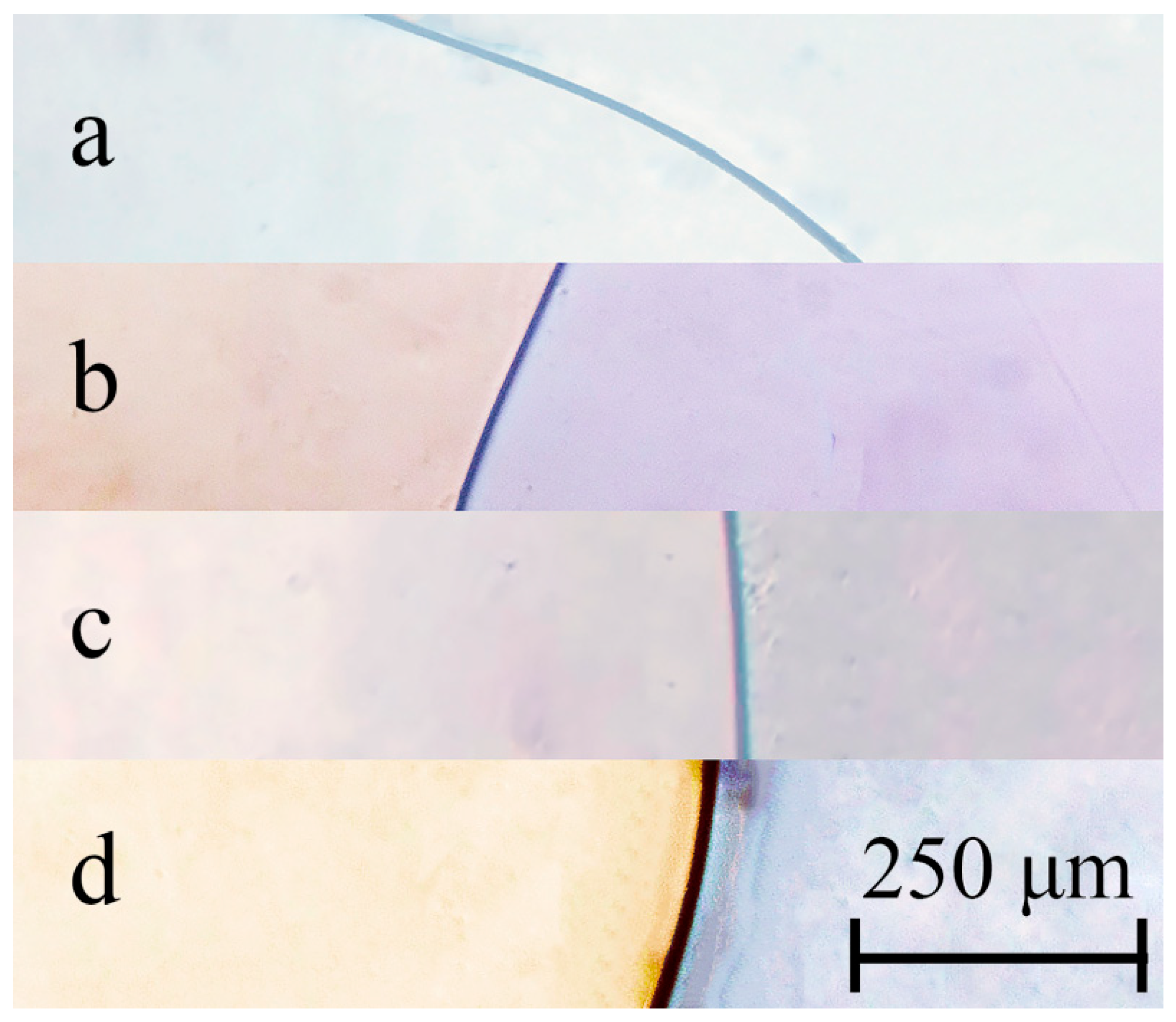
During the repeated processing of polymers, their color may change, which is associated with chemical reactions occurring at high temperatures and a decrease in the length of the macromolecule. It is known that the PP melt has no color and is transparent; with an increase in the number of polymer processing cycles, it acquires a yellowness that intensifies with each pass [39]. Figure 2 shows the morphology of PP melts with Vitamin E supplements and without stabilizer.
Figure 2.
Morphology of PP melts without stabilizer (a,b) and with Vitamin E (c,d), after 1 (a,c) and 5 (b,d) processing passes.
The initial polymer acquires a slight yellowness after the first processing cycle. After five PP processing cycles, the yellowness intensifies, but the melt still has transparency. When using vitamin E, the melts were radically different in color from the control melts of PP. The addition of tocopherol to PP contributed to the formation of a homogeneous morphology of the melt without visible heterogeneities and agglomerates. After five passes, accompanied by exposure to high temperatures and mechanical deformation of the samples, melts with Vitamin E are also characterized by a yellow color. Various secondary products can be formed during the repeated processing of melts with a stabilizer. For LDPE systems, these are stereoisomers of various oxidation products, for example, dihydroxydimers, spirodimers, trimers, and aldehydes [40]. Higher concentrations of tocopherol lead to higher levels of polymer color change [41]. Thus, the introduction of more tocopherol into the system leads to a pronounced change in the color of the melt, which is associated, among other things, with the formation of secondary products in the system, the concentration of which increases with the proportion of additives. Although the color change indicates changes in the polymer, it does not limit its processing. It is important to note that the Vitamin E additive is uniformly distributed, as evidenced by the homogeneous morphological pattern of the melts. Therefore, melt spinnability will not be complicated by residual additive particles and will be determined by the viscoelastic properties of the system.
When defining systems based on PP and Vitamin E, the literature only considers three processing cycles. According to the work of Al-Malaika [42], the excellent stabilizing effect of tocopherol is especially noticeable at very low concentrations, for example, 150 ppm. The higher stabilizing effect observed at higher concentrations of tocopherol is accompanied by a higher retention rate (up to >90%) of the initial antioxidant in the polymer. However, in this study, the concentration of Vitamin E did not exceed 900 ppm, which is much lower than the concentrations considered in the current study.
3.2. Rheological Properties
The stabilizer concentration for polypropylene depends on its type and purpose, usually ranging from 0.1% to 2.0% [43,44,45]. It is important to select the concentration while taking into account the characteristics of a particular product, its operating conditions, and the type of stabilizer. The most effective antioxidants are active at low concentrations from 50 to 500 ppm (0.005–0.05%). Since the concentration of the stabilizer is often used when using a secondary polymer and its type is not known, the total concentration of the antioxidant may increase with increasing numbers of passes. Hence, it is of interest to study the behavior of melts with a higher proportion of antioxidants than described in traditional studies.
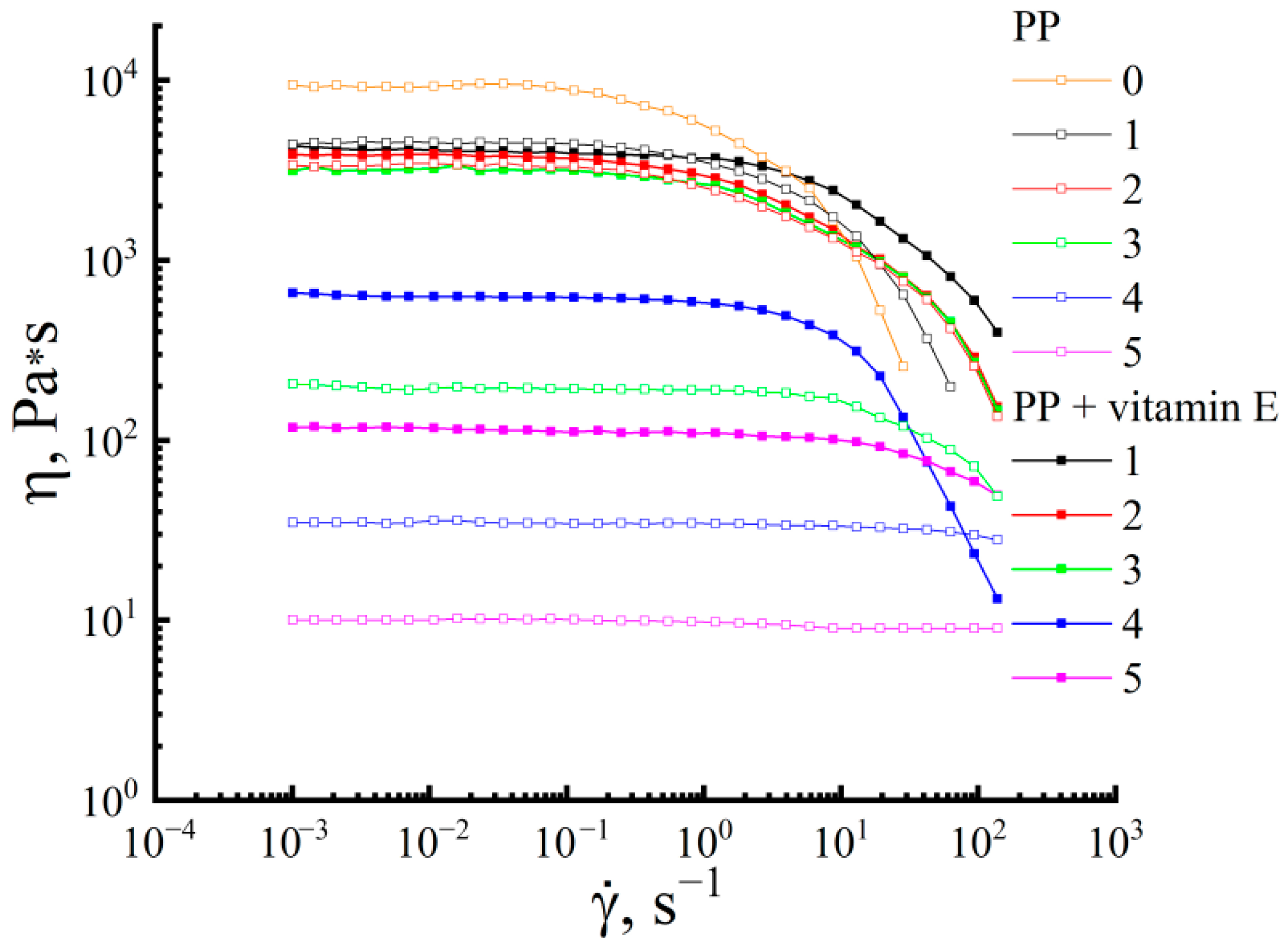
The degradation of polypropylene affects its rheological behavior, namely, a decrease in complex viscosity and apparent viscosity. The melt flow index, on the contrary, increases significantly with a decrease in the molecular weight of the polymer. The initial state of the system is polypropylene without stabilizer additives, which exhibits rheological properties typical of thermoplastics—its melt is a pseudoplastic liquid, that is, the viscosity decreases with increasing shear rate. During repeated thermomechanical processing, pure PP undergoes oxidative degradation. High temperatures and mechanical stress lead to the rupture of polymer chains, which causes a gradual decrease in the average molecular weight and, as a result, an irreversible and gradual decrease in melt viscosity from cycle to cycle. Figure 3 shows the flow curves of PP melts with different prehistories.
Figure 3.
Flow curves of the melts of the initial PP, with Vitamin E and without stabilizer. The number of passes is indicated in the figure, T = 185 °C.
The flow curve of the initial PP has the traditional form for melts and consists of a Newtonian region where the viscosity does not depend on the shear rate and structural branch. The structural branch, on the flow curve, begins with the shear rate at which the viscosity begins to decrease, i.e., the internal structure of the melt collapses when it is deformed. For the initial PP (0 passes), the melt viscosity is about 104 Pa·s. After deformation of PP in the extruder for 15 min, its viscosity changes slightly. After five PP passes, the viscosity decreases by almost three orders of magnitude and is about 101 Pa·s, which is associated with polymer degradation. Decomposed polypropylene exhibits more Newtonian properties than the initial polymer and is a more shear-thinning (pseudoplastic) polymer.
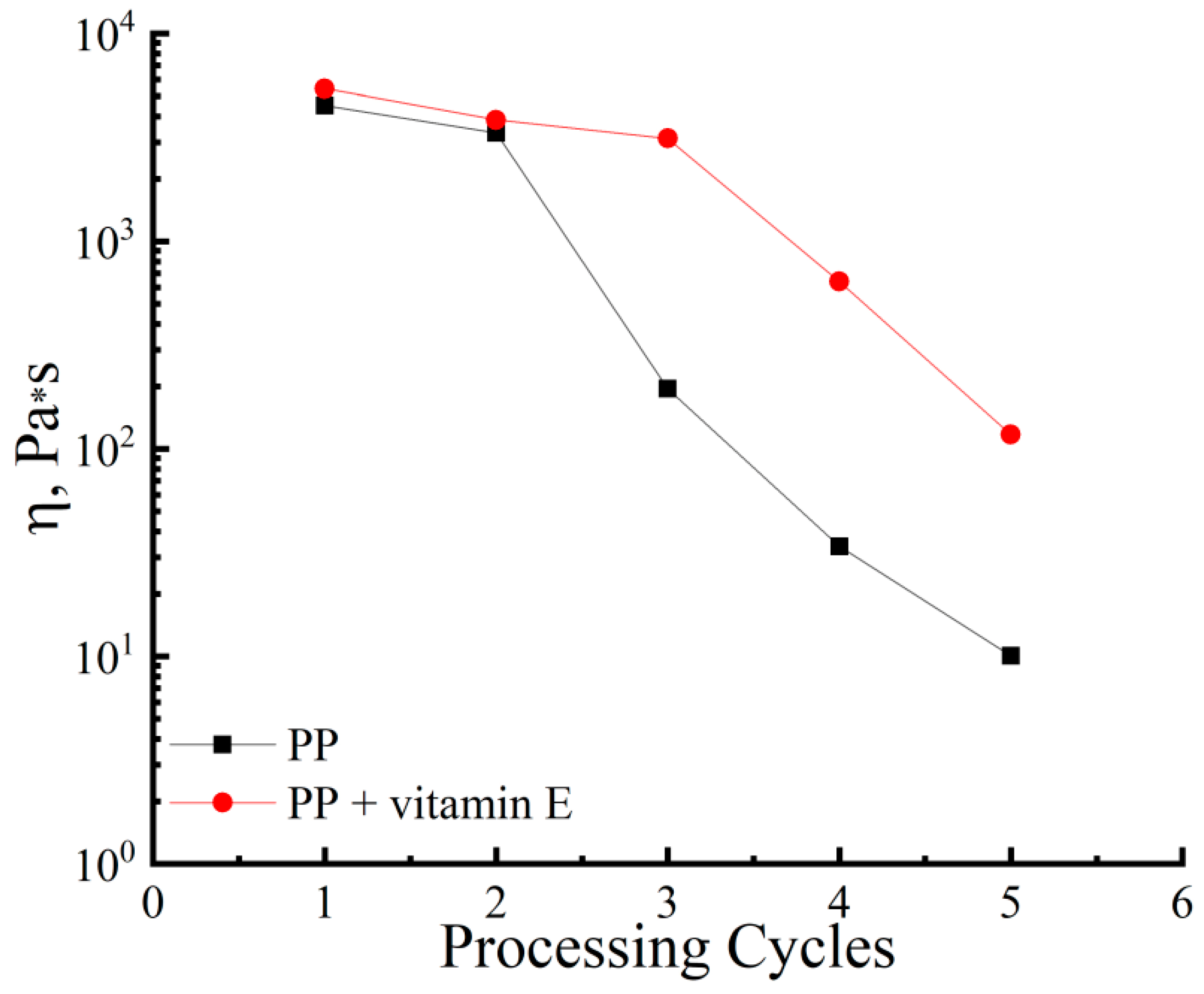
Complex and multiphase rheological behavior is observed when Vitamin E is introduced into the system. The viscosity of the melt decreases after the first processing pass. Despite the decrease in viscosity, the flow curves have a similar character as for melts without additives. During the two subsequent processing passes, the viscosity of the melt decreases slightly, which is probably due to the activity of the stabilizer. Starting from the fourth processing cycle, the viscosity decreases noticeably and drops by almost two orders of magnitude at pass 5. As the number of passes increases, the Newtonian domain extends to high shear rates. The evolution of viscosity depending on the number of processing cycles can be observed in Figure 4.
Figure 4.
Dependence of the viscosity of melts on the number of processing cycles, T = 185 °C.
After the first pass, the viscosity of the PP melt does not decrease critically. This is probably due to the short-term mechanical impact on the system and the low temperature of polymer processing. However, after just the second pass, the viscosity decreases by almost half. The reduction in viscosity then becomes more significant, reaching 10 Pa·s after five cycles. For systems with Vitamin E, although the viscosity decreases already during the first processing cycle, then changes slightly up to three passes, that is, a new portion of Vitamin E introduced during each pass allows you to maintain the viscosity of the melt, at passes 4 and 5, the viscosity decreases sharply and almost reaches 100 Pa·s.
The observed changes in viscosity, depending on the history of melt production, are probably related to a complex of competing processes: a physical plasticizing effect that reduces viscosity, and a chemical antioxidant effect that temporarily stabilizes the polymer structure and counteracts a drop in viscosity.
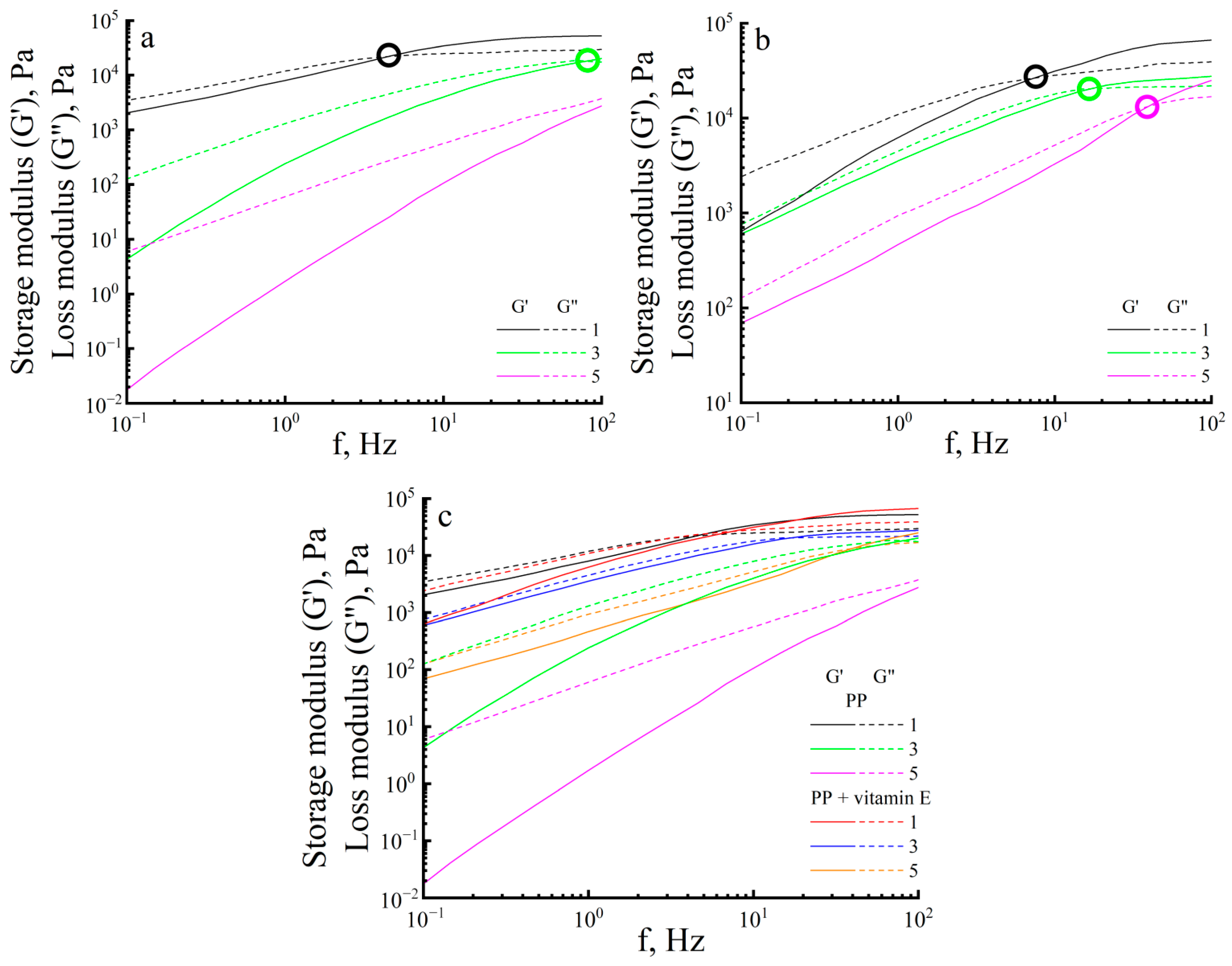
To evaluate the viscoelastic behavior of melts, the frequency dependences of the storage modulus (G′) and the loss modulus (G″) were obtained (Figure 5).
Figure 5.
Dependences of the storage modulus (G′) and the loss modulus (G″) on the frequency for PP melts (a) and systems with Vitamin E (b) after several passes; (c) combined data. The number of passes of the systems is indicated in the figure.
At low deformation frequencies, the loss modulus is greater than the elastic modulus in all examined systems. Depending on the prehistory of the melts, there is a shift in the crossover point, where G′ = G″, to the region of high frequencies. This point determines the transition of the material from viscous (G″ dominates) to elastic behavior (G′ dominates). Its position is inversely proportional to the characteristic relaxation time of the polymer system, which is the average time it takes for a polymer chain to break out of its entangled state and begin to flow irreversibly. The shift in the crossover point to the right, towards high frequencies, clearly indicates a decrease in relaxation time. This may be due to the plasticizing effect of the low-molecular-weight phase of Vitamin E or a decrease in the molecular weight of the polymer. A decrease in the crossover point along the y axis may indicate the formation of a wider molecular weight distribution in the system.
Thus, the displacement of the crossover point serves as an independent and visual rheological proof of the mechanism of action of Vitamin E during repeated processing of the system. It confirms at the molecular level that the additive affects the viscosity values of the system and fundamentally changes the relaxation properties of the melt, making it less elastic and more mobile at high strain rates or short observation times. This is completely consistent with the observed initial drop in viscosity.
According to the literature, there are two forms of PP fiber used for concrete reinforcement: microfiber and macrofiber [46]. Obtaining macrofiber has a number of advantages. For example, with the same rheological properties of the secondary polymer melt, molding will be more stable at lower speeds (draw ratio). Microfibers introduced into concrete are able to effectively control the formation of cracks during plastic shrinkage [47], which occur due to the shrinkage of fresh concrete during the first day after laying due to excessive evaporation of released water [48]. However, as a rule, they do not have a noticeable effect on the properties of hardened concrete, as reported by Pelisser and Habib [49,50]. Therefore, the production of macrofiber from recycled materials is more preferable and predictable.
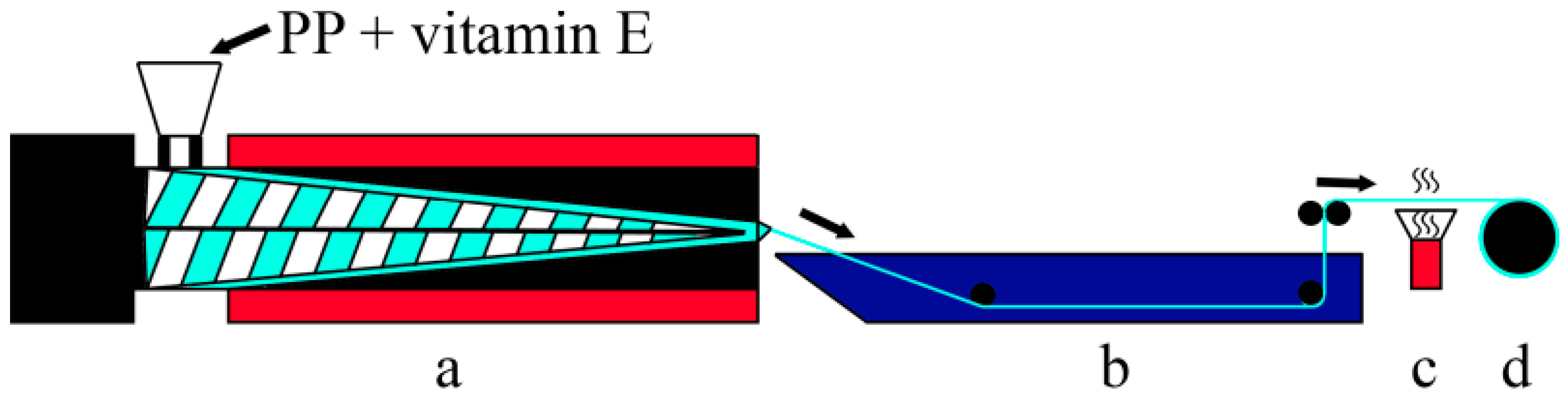
The modes of producing macrofibers were selected using rheological research data on a laboratory stand equipped with a twin-screw extruder (Figure 6).
Figure 6.
Macrofiber forming stand: (a) twin-screw extruder, (b) strand cooling bath with guide rollers, (c) drying, and (d) winding shaft.
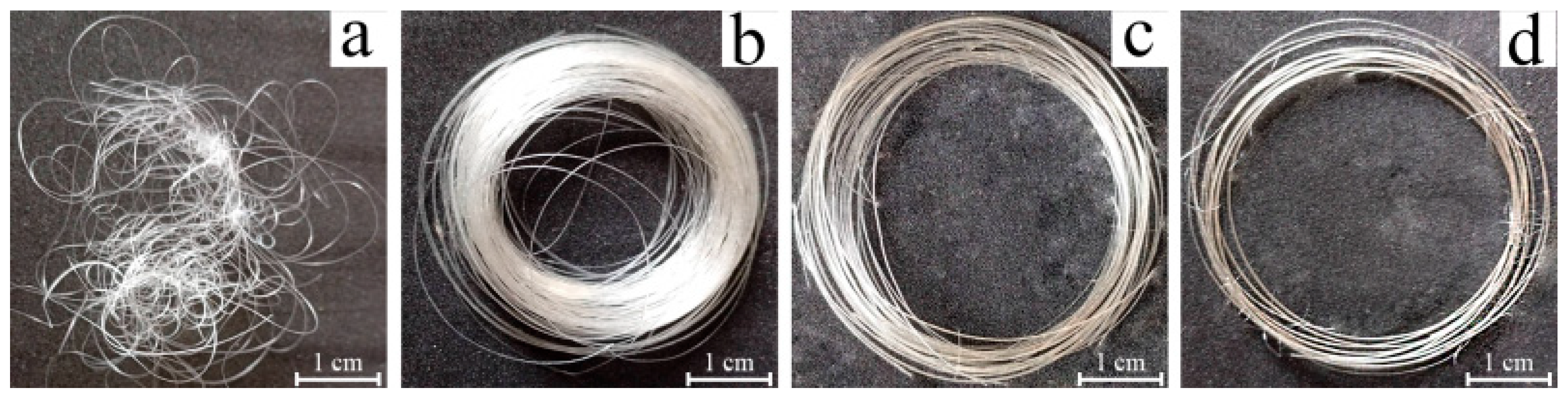
The melts with Vitamin E and without stabilizer were passed through a single-channel die and then sent to a cooling bath. After leaving the bath, the strand was dried and wound onto the shaft. Regardless of the prehistory of the melts, the strands were formed stably. The resulting strands are shown in Figure 7.
Figure 7.
Photographs of spun strands without stabilizer (a,b) and with Vitamin E (c,d), after 1 (a,c) and 5 (b,d) passes.
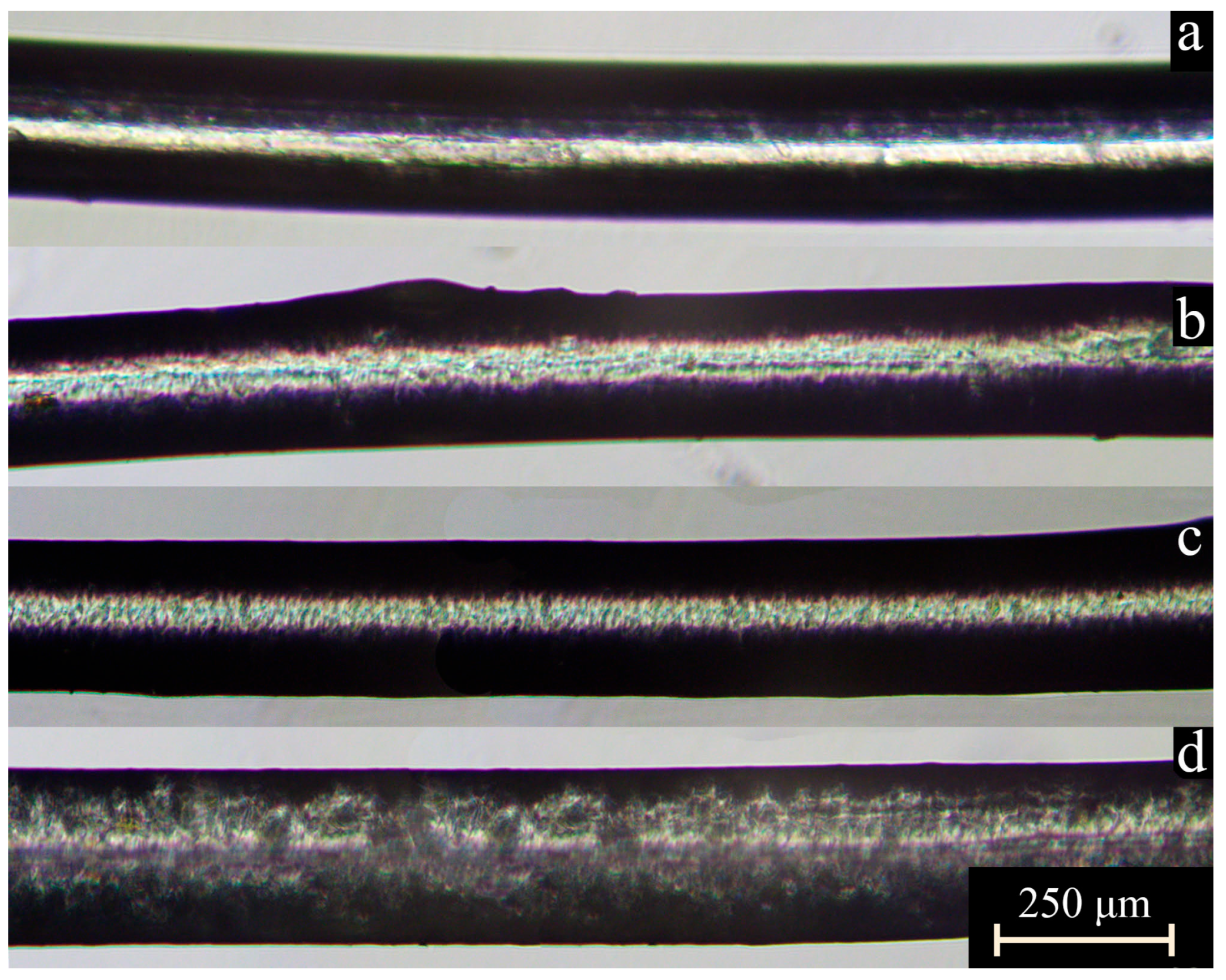
A more detailed morphology of the macrofibers is shown in Figure 8.
Figure 8.
Photographs of macrofibers spun without stabilizer (a,b) and with Vitamin E (c,d), after 1 (a,c) and 5 (b,d) passes.
The photos show that the average diameter of macrofibers is around 200 microns. Along the fiber axis, the strand diameter varies only slightly, indicating stable spinning. No obvious defects are observed on the macrofiber’s surface.
3.3. Fourier Transform Infrared Spectroscopy (FT-IR)
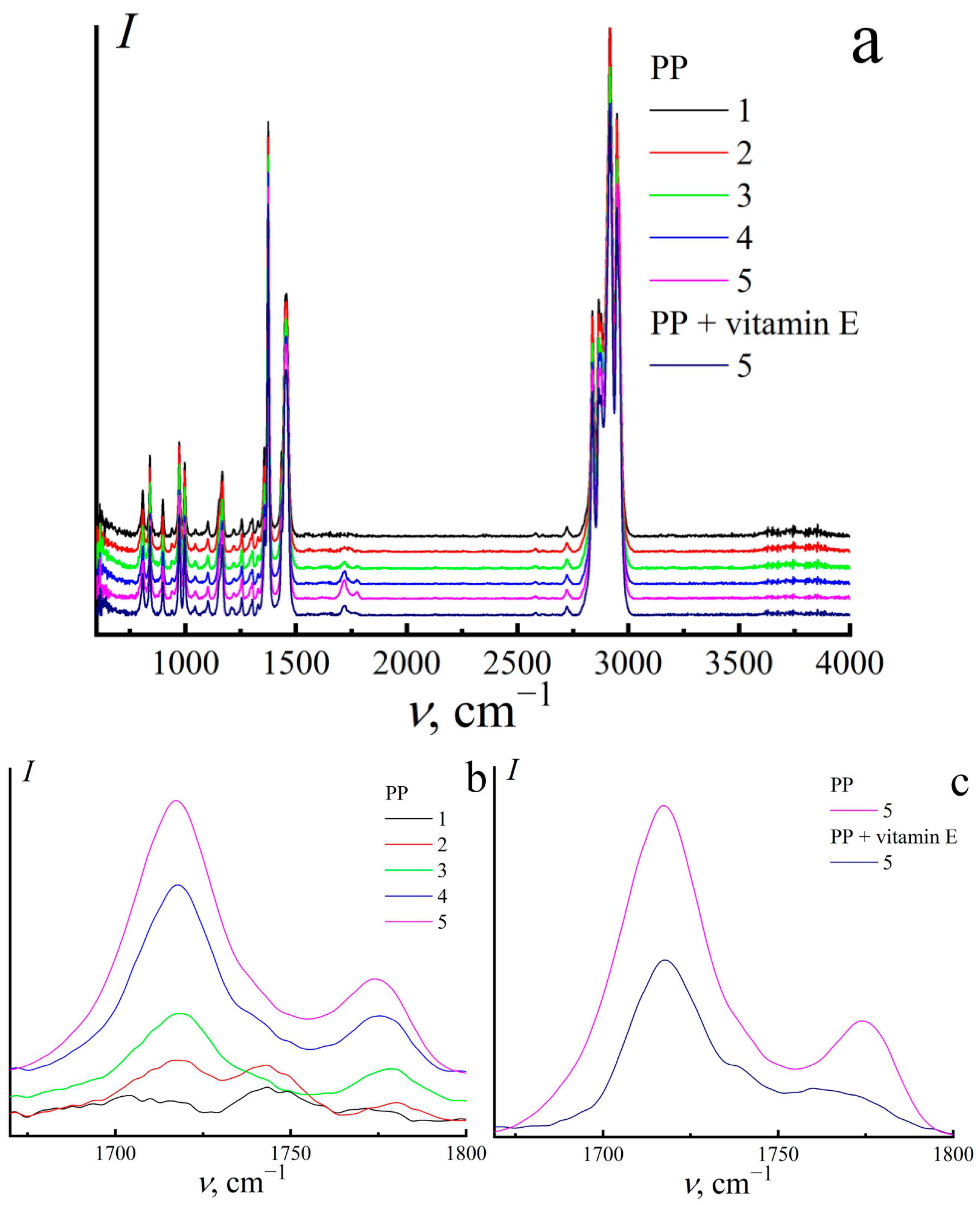
According to [51], the following characteristic bands are present in the IR spectra of PP 2950, 2914, 2860, 2836, 1457, 1376, 1355, 1166, 997, 974, 898, 841, and 810 cm−1. These bands correspond to various molecular vibrations: the asymmetrical stretching of CH3, asymmetrical stretching of CH2, symmetrical stretching of CH3, symmetrical stretching of CH2, asymmetrical bending of CH3, symmetrical bending of CH3, wagging vibration of CH2CH, asymmetrical stretching and rocking wagging vibration of C-CCH3C-H, asymmetrical rocking of CH3, asymmetrical rocking and stretching of CH3C-C, asymmetrical rocking and symmetrical stretching of CH3C-C, rocking vibration of CH2, and rocking vibration of CH2, respectively. Figure 9 shows the spectra for PP samples without antioxidant additives and with Vitamin E.
Figure 9.
IR spectra of PP macrofibers with different production history (a) and (b,c) enlarged regions of the 1650–1800 cm−1 spectrum.
Bands in the region of 800–1000 cm−1 are observed for all spectra, which indicates the preservation of an ordered supramolecular structure in PP due to conformational regularity. The presence of peaks in this region indicates a slight degradation in the system [52]. The intensity of the bands 1452 and 1375 cm−1 (by asymmetric deformation vibrations of the methylene and methyl groups, respectively) increases with the increasing number of treatment cycles, which may indicate a break in the polymer chain during repeated treatment of the system [53]. Thus, the short processing time of PP at 185 °C is reflected in the presented spectra, but to a lesser extent than under more severe conditions (higher temperatures). According to [53], at a higher number of processing cycles, the intensity of the carbonyl group at 1720 cm−1 increased due to the oxidative degradation. As can be seen from the presented spectra for melts without Vitamin E, the intensity of the band at 1720 cm−1 increased gradually with the number of processing cycles (Figure 9b). The maximum intensity of this band is achieved at the fifth processing cycle. For systems with Vitamin E, after five cycles, the intensity of this band is lower compared to the melt without the antioxidant with the same number of processing cycles (Figure 9c).
3.4. X-Ray Diffraction (XRD)
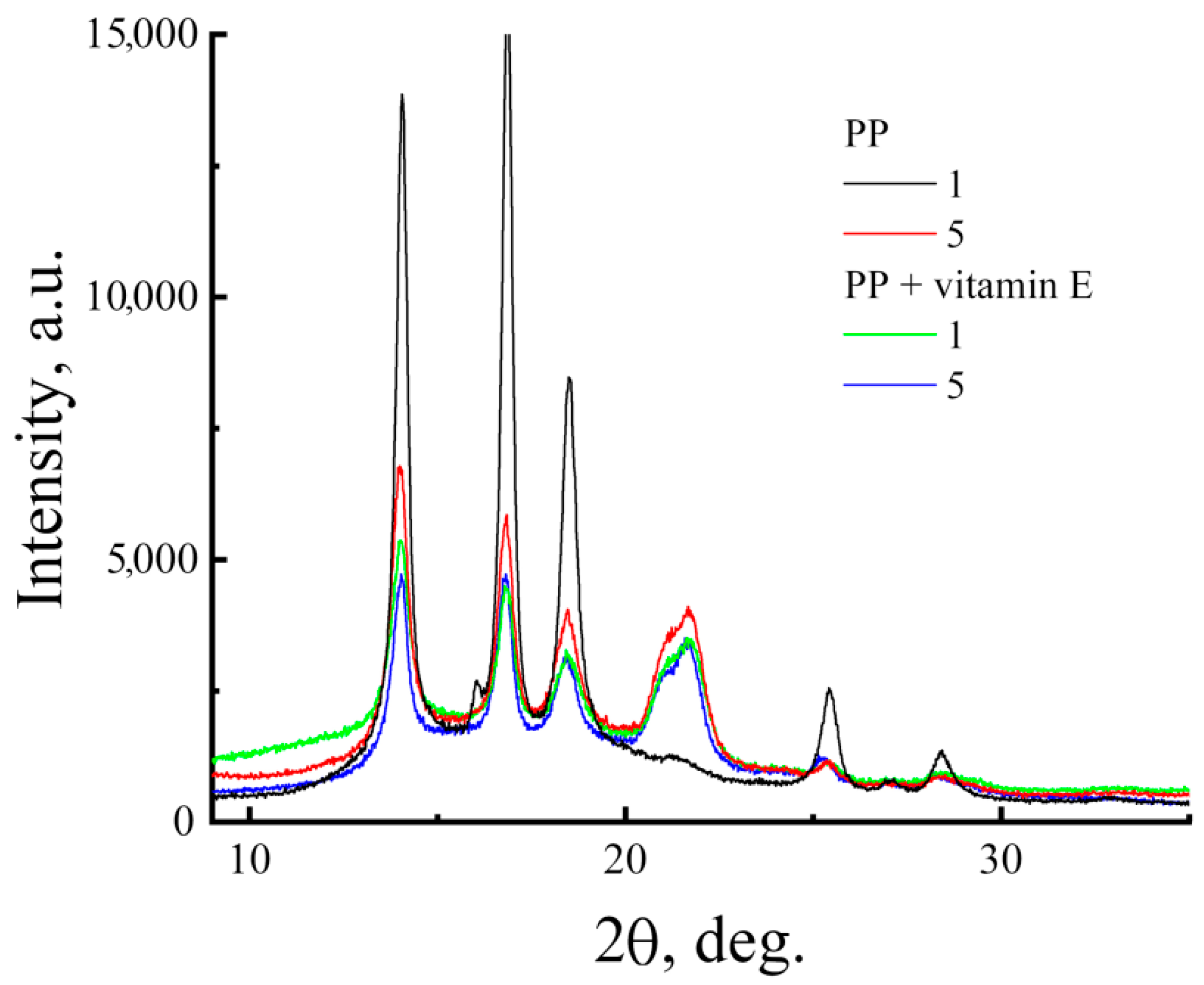
After a few passes, the XRD transmission patterns of PP macrofibers and macrofibers containing Vitamin E show comparable curves (Figure 10). The presented diffractograms for macrofibers show characteristic reflexes for the α-crystalline phase of polypropylene in the 2θ region 14.3°, 17.1°, 18.7°, 21.8°, and 25.7°, corresponding to the planes (110), (040), (130), (131)/(041), and (060), respectively [54,55]. The intensity of reflexes decreases significantly with an increase in the number of PP passes without a stabilizer. For vitamin E systems, an increase in the number of processing cycles leads to a slight change in the intensity of reflexes.
Figure 10.
Diffractograms of PP strands spun on a laboratory stand.
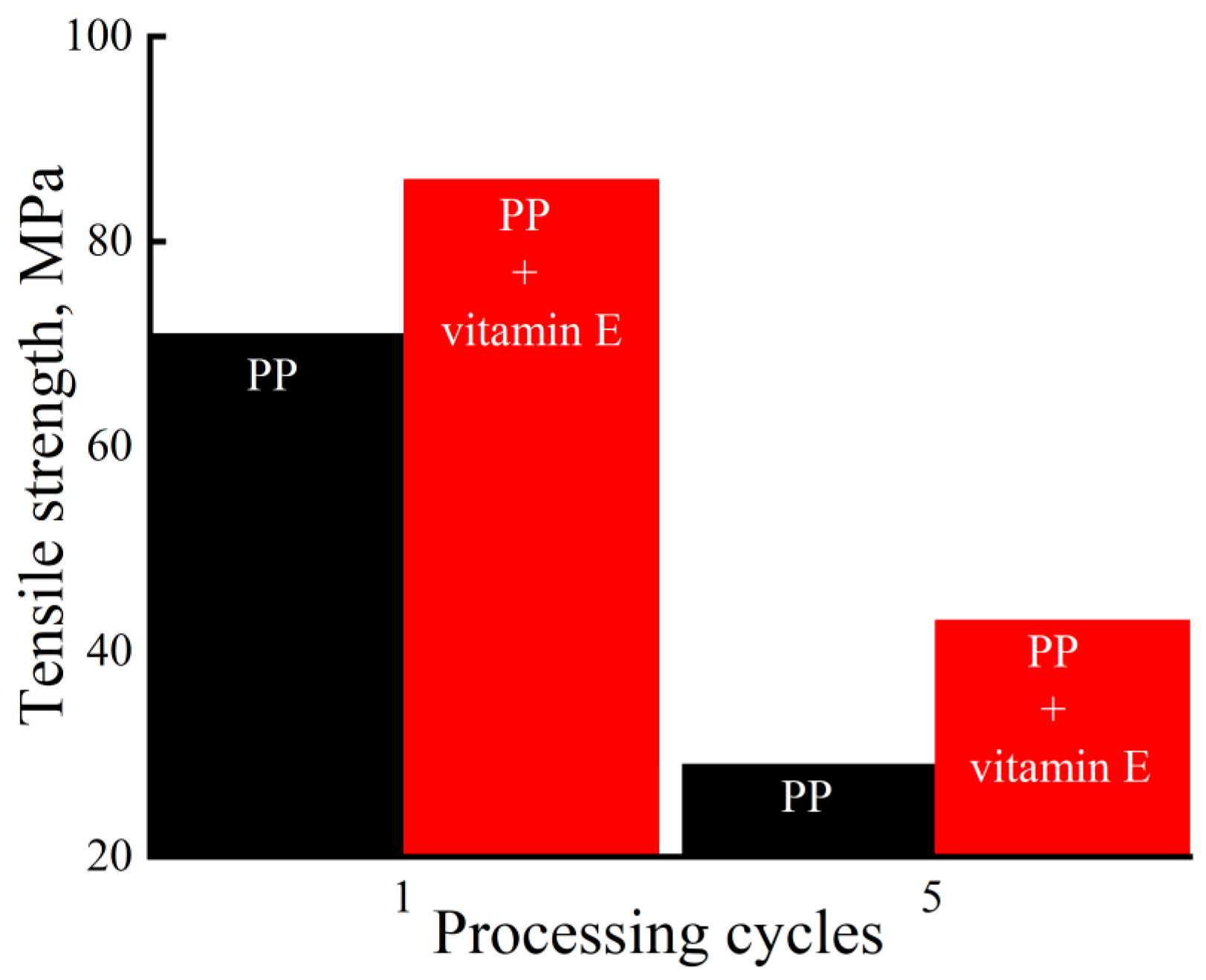
Mechanical properties were investigated for all spun macrofibers. It is shown that the prehistory of melt processing (the number of cycles and the presence of a stabilizer), although they contribute to the formed properties of the strands, remain at a decent level (Figure 11).
Figure 11.
Tensile strength of PP macrofibers spun without stabilizer and with Vitamin E after 1 and 5 passes.
The diagram shows that macrofibers spun with Vitamin E exhibit higher strength than samples produced without the stabilizing additive. After the first processing cycle, the observed difference is approximately 20%. Augmenting the number of melt processing cycles to five elevates the disparity to about 50%. However, the observed strength values for macrofibers with Vitamin E also decrease to 43 MPa compared to 86 MPa after the first pass. The revealed strength values of PP fibers are consistent with those described previously in the literature [56]. The decent mechanical properties of macrofiber make it possible to consider it in the future as a composite additive for concrete reinforcement.
4. Conclusions
The presented paper considers several issues related to the processing of secondary polymer materials, the evolution of the rheological properties of melts, the formability of systems with and without stabilizer additives, the effect of natural antioxidants on fiber production processes, and its structure and properties. Since the background of the material is not always known, Vitamin E was used in the amount of 0.5% by weight, which is significantly higher than the concentrations described earlier in the literature. It has been shown that repeated processing of PP with stabilizer additives leads to a decrease in viscosity by two orders of magnitude to 100 Pa·s, which is probably due to the simultaneous action of a low-molecular-weight additive and its stabilizing (antioxidant) effect. Dynamic studies have revealed a decrease in the elastic properties of melts with an increase in the number of passes. The position of the crossover point indicates an increase in the molecular weight distribution.
For the first time, it has been demonstrated that Vitamin E can be used as a stabilizing additive. Adding Vitamin E to PP does not limit its processing into macrofibers. It has been shown that, although the rheological properties of the melts change with repeated processing cycles, fiber formation from them is still possible. After five processing cycles, macrofiber formation is stable. The prehistory of the melt affects the mechanical properties of the fibers. For all the obtained batches of macrofiber, the revealed strength properties are at an acceptable level.
In the future, we plan to investigate the behavior of PP melts with mixed antioxidants based on Vitamin E and traditional stabilizers, to evaluate the optimal dosages of additives and the formability of the obtained systems. Based on the data from [57], in the future, the obtained macrofibers could be used to produce concrete-based composites.
Author Contributions
Conceptualization, M.V. and G.M.; methodology, M.V.; software, G.S. and D.K.; validation, A.K. (Altynay Kalauova) and R.I.; formal analysis, Z.K., A.K. (Altynay Kalauova), and R.I.; investigation, Z.K., A.K. (Altynay Kalauova), and S.L.; resources, A.K. (Alexander Korshunov); data curation, R.I., A.K. (Alexander Korshunov), and G.S.; writing—original draft preparation, M.V.; writing—review and editing, G.M.; visualization, M.V., A.K. (Altynay Kalauova), and D.K.; supervision, A.K. (Altynay Kalauova) and G.M.; project administration, G.S. All authors have read and agreed to the published version of the manuscript.
Funding
This research was funded by the Committee of Science of the Ministry of Science and Higher Education of the Republic of Kazakhstan (Grant No. BR28713197).
Data Availability Statement
The original contributions presented in this study are included in the article. Further inquiries can be directed to the corresponding author.
Conflicts of Interest
The funders had no role in the design of the study; in the collection, analyses, or interpretation of data; in the writing of the manuscript; or in the decision to publish the results.
References
- Barbhuiya, S.; Kanavaris, F.; Das, B.B.; Idrees, M. Decarbonising Cement and Concrete Production: Strategies, Challenges and Pathways for Sustainable Development. J. Build. Eng. 2024, 86, 108861. [Google Scholar] [CrossRef]
- GCCA (Global Cement and Concrete Association). Concrete Future. The GCCA 2050 Cement and Concrete Industry Roadmap for Net Zero Concrete. Available online: https://gccassociation.org/concretefuture/ (accessed on 30 October 2025).
- Slate, F.O.; Hover, K.C. Microcracking in concrete. In Fracture Mechanics of Concrete: Material Characterization and Testing; Carpinteri, A., Ingraffea, A.R., Eds.; Engineering Application of Fracture Mechanics; Springer: Dordrecht, The Netherlands, 1984; Volume 3. [Google Scholar] [CrossRef]
- Pakravan, H.R.; Ozbakkaloglu, T. Synthetic fibers for cementitious composites: A critical and in-depth review of recent advances. Constr. Build. Mater. 2019, 207, 491–518. [Google Scholar] [CrossRef]
- Tiberti, G.; Minelli, F.; Plizzari, G.A.; Vecchio, F.J. Influence of concrete strength on crack development in SFRC members. Cem. Concr. Compos. 2014, 45, 176–185. [Google Scholar] [CrossRef]
- Aizenshtein, E.M.; Efremov, V.N. Production and use of polypropylene fibres and yarn. Fibre Chem. 2006, 38, 5. [Google Scholar] [CrossRef]
- Andreassen, E.; Myrhe, O.J.; Hinrichsen, E.L.; Grøstad, K. Effects of processing parameters and molecular weight distribution on the tensile properties of polypropylene fibers. J. Appl. Polym. Sci. 1994, 52, 10. [Google Scholar] [CrossRef]
- Bajer, K.; Braun, U. Different aspects of the accelerated oxidation of polypropylene at increased pressure in an autoclave with regard to temperature, pretreatment and exposure media. Polym. Test. 2014, 37, 102–111. [Google Scholar] [CrossRef]
- Saberian, M.; Tajaddini, A.; Li, J.; Zhang, G.; Wang, L.; Sun, D.; Maqsood, T.; Roychand, R. Mechanical properties of polypropylene fibre reinforced recycled concrete aggregate for sustainable road base and subbase applications. Constr. Build. Mater. 2023, 405, 133352. [Google Scholar] [CrossRef]
- Blazy, J.; Blazy, R. Polypropylene fiber reinforced concrete and its application in creating architectural forms of public spaces. Case Stud. Constr. Mater. 2021, 14, e00549. [Google Scholar] [CrossRef]
- Hedjazi, S.; Castillo, D. Utilizing Polypropylene Fiber in Sustainable Structural Concrete Mixtures. CivilEng 2022, 3, 562–572. [Google Scholar] [CrossRef]
- Saeed, M.K.; Rahman, M.K.; Baluch, M.H. Influence of steel and polypropylene fibers on cracking due to heat of hydration in mass concrete structures. Struct. Concr. 2018, 20, 808–822. [Google Scholar] [CrossRef]
- Islam, G.M.S.; Das, S. Evaluating plastic shrinkage and permeability of polypropylene fiber reinforced concrete. Int. J. Sustain. Built Environ. 2016, 5, 345–354. [Google Scholar] [CrossRef]
- Pangestuti, E.K.; Handayani, S.; Adila, H.; Primerio, P. The Effect of Polypropylene Fiber Addition to Mechanical Properties of Concrete. IOP Conf. Ser. Earth Environ. Sci. 2021, 700, 012057. [Google Scholar] [CrossRef]
- Latifi, M.R.; Biricik, Ö.; Aghabaglou, A.M. Effect of the addition of polypropylene fiber on concrete properties. J. Adhes. Sci. Technol. 2022, 36, 345–369. [Google Scholar] [CrossRef]
- Lura, P.; Terrasi, G.P. Reduction of fire spalling in high-performance concrete by means of superabsorbent polymers and polypropylene fibers: Small scale fire tests of carbon fiber reinforced plastic-prestressed self-compacting concrete. Cem. Concr. Compos. 2014, 49, 36–42. [Google Scholar] [CrossRef]
- Soroushian, P.; Bayasi, Z. Concept of Fiber Reinforced Concrete. In Proceedings of the International Seminar on Fiber Reinforced Concrete, Madras, India, 16–19 December 1987; Michigan State University: East Lansing, MI, USA, 1987. [Google Scholar]
- Khairizal, Y.; Kurniawandy, A.; Kamaldi, A. Pengaruh Penambahan Serat Polypropylene Terhadap Sifat Mekanis Beton Normal. J. Online Mhs. Fak. Tek. Univ. Riau 2015, 2, 1–11. [Google Scholar]
- Sohaib, N.; Seemab, F.; Sana, G.; Mamoon, R. Using Polypropylene Fibers in Concrete to achieve Maximum Strength. In Proceedings of the 8th International Conference on Advances in Civil and Structural Engineering–CSE, Kuala Lumpur, Malaysia, 4 February 2018; pp. 37–42. [Google Scholar]
- Shah, S.P.; Rangan, B.V. Fiber reinforced concrete properties. ACI J. 1971, 68, 126–137. [Google Scholar]
- Johnston, C.D. Fibre-Reinforced Cements and Concretes; Gordon and Breach Science Publishers: Ottawa, ON, Canada, 2001; 372p. [Google Scholar]
- Turoboś, P.; Przybysz, P. Comparative Study of Cement Composites Reinforced with Cellulose and Lignocellulose Fibers. Fibers 2025, 13, 128. [Google Scholar] [CrossRef]
- Abdalla, J.A.; Thomas, B.S.; Hawileh, R.A. Use of Hemp, Kenaf and Bamboo Natural Fiber in Cement-Based Concrete. Int. Conf. Adv. Constr. Mater. Struct. 2022, 65, 2070–2072. [Google Scholar] [CrossRef]
- Rahimi, M.; Omran, A.; Tagnit-Hamou, A. Role of Homogenization and Surface Treatment of Flax Fiber on Performance of Cement-Based Composites. Clean. Mater. 2022, 3, 100037. [Google Scholar] [CrossRef]
- Li, Z.; Guo, T.; Chen, Y.; Yang, W.; Wang, J.; Jin, L. Preparation and Properties of Pretreated Jute Fiber Cement-Based Composites. Ind. Crops Prod. 2024, 210, 118090. [Google Scholar] [CrossRef]
- Zaid, O.; Al-Dala’ien, R.N.; Arbili, M.M.; Alashker, Y. Optimizing Natural Fiber Content and Types for Enhanced Strength and Long-Term Durability in High-Performance Concrete. Clean. Eng. Technol. 2025, 26, 100983. [Google Scholar] [CrossRef]
- Makarov, I.S.; Golova, L.K.; Vinogradov, M.I.; Egorov, Y.E.; Kulichikhin, V.G.; Mikhailov, Y.M. New Hydrated Cellulose Fiber Based on Flax Cellulose. Russ. J. Gen. Chem. 2021, 91, 1807–1815. [Google Scholar] [CrossRef]
- Makarov, I.S.; Golova, L.K.; Smyslov, A.G.; Vinogradov, M.I.; Palchikova, E.E.; Legkov, S.A. Flax Noils as a Source of Cellulose for the Production of Lyocell Fibers. Fibers 2022, 10, 45. [Google Scholar] [CrossRef]
- Makarov, I.S.; Shkurenko, S.A.; Shubin, R.B.; Palchikova, E.E.; Vinogradov, M.I.; Kulanchikov, Y.O.; Kulichikhin, V.G. Hemp-based lignocellulosic mass as a basis for producing textile fibers. Int. J. Biol. Macromol. 2025, 318, 145035. [Google Scholar] [CrossRef] [PubMed]
- Huynh, T.P.; Le, T.H.M.; Ngan, N.V.C. An experimental evaluation of the performance of concrete 516 reinforced with recycled fibers made from waste plastic bottles. Results Eng. 2023, 18, 101205. [Google Scholar] [CrossRef]
- Gul, A.; Alam, B.; Iqbal, M.J.; Ahmed, W.; Shahzada, K.; Javed, M.H.; Khan, E.A. Impact of Length and Percent Dosage 507 of Recycled Steel Fibers on the Mechanical Properties of Concrete. Civil. Eng. J. 2021, 7, 1650–1666. [Google Scholar] [CrossRef]
- Suleman, M.; Ahmad, N.; Khan, S.U.; Ahmad, T. Investigating Flexural Performance of Waste Tires Steel Fibers-Reinforced Cement-Treated Mixtures for Sustainable Composite Pavements. Constr. Build. Mater. 2021, 15, 122099. [Google Scholar] [CrossRef]
- Liew, K.M.; Akbar, A. The Recent Progress of Recycled Steel Fiber Reinforced Concrete. Constr. Build. Mater. 2020, 232, 117232. [Google Scholar] [CrossRef]
- Tu’ma, N.H.; Aziz, M.R. Flexural Performance of Composite Ultra-High-Performance Concrete-Encased Steel Hollow Beams. Civil. Eng. J. 2019, 5, 1289–1304. [Google Scholar] [CrossRef]
- Wang, K.; Addiego, F.; Bahlouli, N.; Ahzi, S.; Rémond, Y.; Toniazzo, V.; Muller, R. Analysis of thermomechanical reprocessing effects on polypropylene/ethylene octene copolymer blends. Polym. Degrad. Stab. 2012, 97, 1475–1484. [Google Scholar] [CrossRef]
- Yin, S.; Tuladhar, R.; Shi, F.; Shanks, R.A.; Combe, M.; Collister, T. Mechanical reprocessing of polyolefin waste: A review. Polym. Eng. Sci. 2015, 55, 2899–2909. [Google Scholar] [CrossRef]
- Esmizadeh, E.; Tzoganakis, C.; Mekonnen, T.H. Degradation Behavior of Polypropylene during Reprocessing and Its Biocomposites: Thermal and Oxidative Degradation Kinetics. Polymers 2020, 12, 1627. [Google Scholar] [CrossRef]
- Al-Malaika, S.; Issenhuth, S.; Burdick, D. The antioxidant role of vitamin E in polymers V. Separation of stereoisomers and characterization of other oxidation products of dl-α-tocopherol formed in polyolefins during melt processing. Polym. Degrad. Stab. 2001, 73, 491–503. [Google Scholar] [CrossRef]
- Allen, N.S.; Edge, M.; Hussain, S. Perspectives on yellowing in the degradation of polymer materials: Inter-relationship of structure, mechanisms and modes of stabilisation. Polym. Degrad. Stab. 2022, 201, 109977. [Google Scholar] [CrossRef]
- Al-Malaika, S.; Ashley, H.; Issenhuth, S. The antioxidant role of α-tocopherol in polymers. I. The nature of transformation products of α-tocopherol formed during melt processing of LDPE. J. Polym. Sci. Part A Polym. Chem. 1994, 32, 3099–3113. [Google Scholar] [CrossRef]
- Al-Malaika, S.; Issenhuth, S. The antioxidant role of α-tocopherol in polymers III. Nature of transformation products during polyolefins extrusion. Polym. Degrad. Stab. 1999, 65, 143–151. [Google Scholar] [CrossRef]
- Al-Malaika, S.; Goodwin, C.; Issenhuth, S.; Burdick, D. The antioxidant role of α-tocopherol in polymers II. Melt stabilising effect in polypropylene. Polym. Degrad. Stab. 1999, 64, 145–156. [Google Scholar] [CrossRef]
- Takacs, K.; Nemeth, M.A.; Renkecz, T.; Tatraaljai, D.; Pukanszky, B. Stabilization of PE with the natural antioxidant t-resveratrol: Interaction of the primary and the secondary antioxidant. Polym. Degrad. Stab. 2024, 230, 111046. [Google Scholar] [CrossRef]
- Frank, H.P.; Frenzel, R. Solubility of additives in polypropylene. Eur. Polym. J. 1980, 16, 647–649. [Google Scholar] [CrossRef]
- Zheng, Q.; Fang, W.; Fan, J. Determination of Antioxidant Irganox 1010 in Polypropylene by Infrared Spectrometry. IOP Conf. Ser. Earth Environ. Sci. 2020, 514, 052046. [Google Scholar] [CrossRef]
- Birol, T.; Avcıalp, A. Impact of Macro-Polypropylene Fiber on the Mechanical Properties of Ultra-High-Performance Concrete. Polymers 2025, 17, 1232. [Google Scholar] [CrossRef]
- Soutsos, M.N.; Le, T.T.; Lampropoulos, A.P. Flexural performance of fibre reinforced concrete made with steel and synthetic fibres. Constr. Build. Mater. 2012, 36, 704–710. [Google Scholar] [CrossRef]
- Guneyisi, E.; Gesoglu, M.; Mohamadameen, A.; Alzeebaree, R.; Algin, Z.; Mermerdas, K. Enhancement of shrinkage behavior of lightweight aggregate concretes by shrinkage reducing admixture and fiber reinforcement. Constr. Build. Mater. 2014, 54, 91–98. [Google Scholar] [CrossRef]
- Pelisser, F.; Neto, A.B.D.S.; La Rovere, H.L.; Pinto, R.C.D. Effect of the addition of synthetic fibers to concrete thin slabs on plastic shrinkage cracking. Constr. Build. Mater. 2010, 24, 2171–2176. [Google Scholar] [CrossRef]
- Habib, A.; Begum, R.; Alam, M.M. Mechanical properties of synthetic fibers reinforced mortars. Int. J. Sci. Eng. Res. 2013, 4, 923–927. [Google Scholar]
- Karaoui, M.; Fiore, V.; Elhamri, Z.; Kharchouf, S.; Alami, M.; Assouag, M. Study of the Physico-Chemical Properties of Injection-Molded Polypropylene Reinforced with Spent Coffee Grounds. J. Compos. Sci. 2025, 9, 257. [Google Scholar] [CrossRef]
- Zefirov, V.V.; Elmanovich, I.V.; Stakhanov, A.I.; Pavlov, A.A.; Stakhanova, S.V.; Kharitonova, E.P.; Gallyamov, M.O. A New Look at the Chemical Recycling of Polypropylene: Thermal Oxidative Destruction in Aqueous Oxygen-Enriched Medium. Polymers 2022, 14, 744. [Google Scholar] [CrossRef]
- Spicker, C.; Rudolph, N.; Kühnert, I.; Aumnate, C. The use of rheological behavior to monitor the processing and service life properties of recycled polypropylene. Food Packag. Shelf Life 2019, 19, 174–183. [Google Scholar] [CrossRef]
- Yan, X.; Cayla, A.; Salaün, F.; Devaux, E.; Liu, P.; Huang, T. A green method to fabricate porous polypropylene fibers: Development toward textile products and mechanical evaluation. Text. Res. J. 2019, 90, 547–560. [Google Scholar] [CrossRef]
- Besco, S.; Bosio, A.; Brisotto, M.; Depero, L.E.; Lorenzetti, A.; Bontempi, E.; Bonora, R.; Modesti, M. Structural and Mechanical Characterization of Sustainable Composites Based on Recycled and Stabilized Fly Ash. Materials 2014, 7, 5920–5933. [Google Scholar] [CrossRef] [PubMed]
- Richaud, E.; Fayolle, B.; Davies, P. Handbook of Properties of Textile and Technical Fibres, 2nd ed.; The Textile Institute Book Series; Woodhead Publishing: Cambridge, UK, 2018; pp. 515–543. [Google Scholar] [CrossRef]
- Mobasher, B.; Dey, V.; Bauchmoyer, J.; Mehere, H.; Schaef, S. Reinforcing Efficiency of Micro and Macro Continuous Polypropylene Fibers in Cementitious Composites. Appl. Sci. 2019, 9, 2189. [Google Scholar] [CrossRef]
Disclaimer/Publisher’s Note: The statements, opinions and data contained in all publications are solely those of the individual author(s) and contributor(s) and not of MDPI and/or the editor(s). MDPI and/or the editor(s) disclaim responsibility for any injury to people or property resulting from any ideas, methods, instructions or products referred to in the content. |
© 2025 by the authors. Licensee MDPI, Basel, Switzerland. This article is an open access article distributed under the terms and conditions of the Creative Commons Attribution (CC BY) license (https://creativecommons.org/licenses/by/4.0/).