Next Article in Journal
Physical-Guided Dynamic Modeling of Ultra-Supercritical Boiler–Turbine Coordinated Control System Under Wet-Mode Operation
Next Article in Special Issue
Holistic Estuarine Monitoring: Data-Driven and Process-Based Coupling of Biogeochemical Cycles of Per- and Polyfluoroalkyl Substances
Previous Article in Journal
Development of Rock-Based Geopolymers for Oilwell Cementing Applications—Utilizing Brazilian Rock Precursor
Previous Article in Special Issue
Phenomenological Comparison of Vacuum Membrane Distillation for VOC Removal and Desalination
 
 
Due to scheduled maintenance work on our servers, there may be short service disruptions on this website between 11:00 and 12:00 CEST on March 28th.
Article

Chitosan Composites Functionalized with Green-Synthesized Silver Nanoparticles from Manacá-da-Serra Flowers for the Disinfection of Industrial Wastewater

by
Axel John Pascal Jacquot
1,2,
Wellington Vieira de Souza
1,
Giovanna Machado
3,
Mariana Roesch-Ely
4,
Janaina da Silva Crespo
1,
Jordana Bortoluz
1 and
Marcelo Giovanela
1,*
1
Área do Conhecimento de Ciências Exatas e Engenharias, Universidade de Caxias do Sul, Rua Francisco Getúlio Vargas, 1130, Caxias do Sul 95070-560, RS, Brazil
2
École Européenne d’Ingénieurs em Génie des Matériaux, 6 rue Bastien-Lepage, BP 10630, F-54010 Nancy Cedex, France
3
Centro de Tecnologias Estratégicas do Nordeste (Cetene), Laboratório de Materiais Nanoestruturados (LMNano), Recife 50740-545, PE, Brazil
4
Instituto de Biotecnologia, Área do Conhecimento de Ciências da Vida, Universidade de Caxias do Sul, Rua Francisco Getúlio Vargas, 1130, Caxias do Sul 95070-560, RS, Brazil
*
Author to whom correspondence should be addressed.
Processes 2025, 13(11), 3622; https://doi.org/10.3390/pr13113622
Submission received: 13 September 2025 / Revised: 31 October 2025 / Accepted: 6 November 2025 / Published: 8 November 2025
(This article belongs to the Special Issue Advances in Water Resource Pollution Mitigation Processes)

Abstract

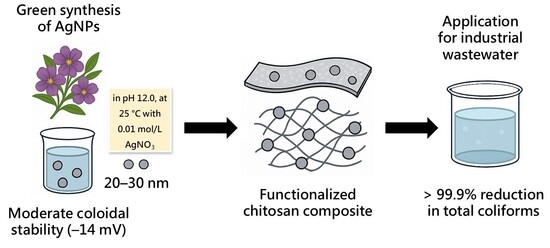
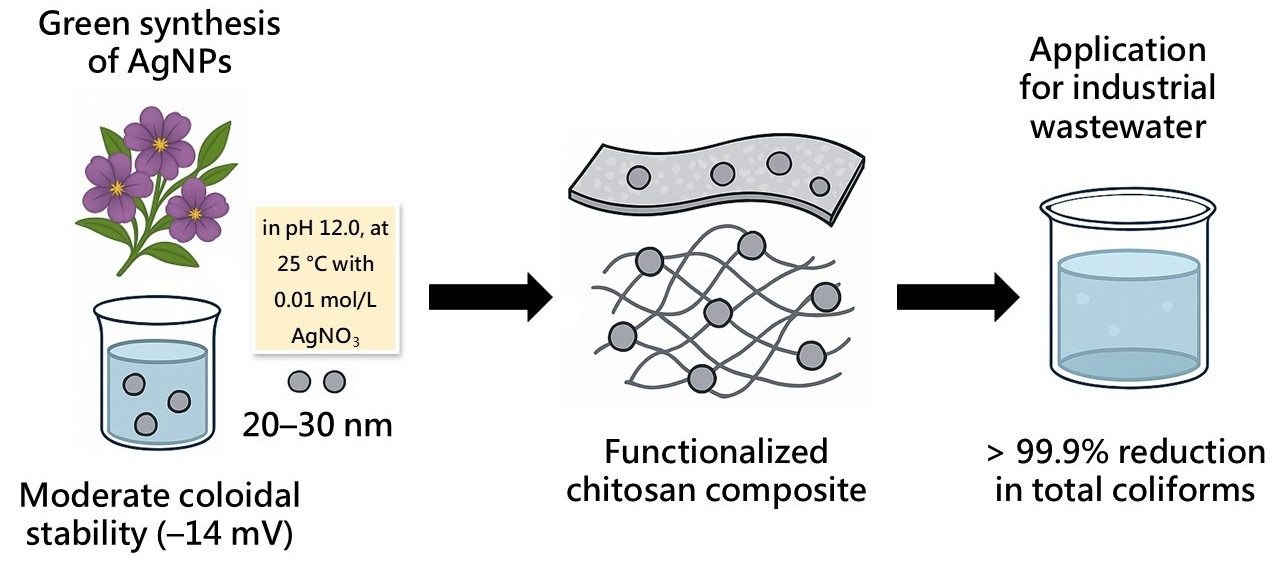
Green silver nanoparticles (AgNPs) have been increasingly recognized for their antimicrobial properties and environmental compatibility. In this study, AgNPs were synthesized using an aqueous extract of Manacá-da-Serra (Pleroma sellowianum) flowers as a natural reducing and stabilizing agent and subsequently incorporated into a chitosan matrix to produce functionalized composites for industrial wastewater disinfection. Optimal synthesis conditions were achieved at pH 12.0, 25 °C, and 0.01 mol/L AgNO3, yielding uniformly dispersed spherical NPs (20–30 nm) with moderate colloidal stability (zeta potential ≈ −14 mV) and a minimum inhibitory concentration of 5 μL/mL against Escherichia coli and Staphylococcus aureus. The effective integration of AgNPs into the biopolymer was verified by Fourier-transform infrared spectroscopy (FTIR), thermogravimetric analysis (TGA), transmission electron microscopy (TEM), and energy dispersive spectroscopy (EDS). The interaction between AgNPs and chitosan was confirmed by the data, while successful NP incorporation was further supported by homogeneous Ag distribution and improved thermal stability. Inhibition zones of 11 ± 1 mm (S. aureus) and 9 ± 1 mm (E. coli) were revealed by antimicrobial assays. For industrial wastewater disinfection, a total coliform reduction of >99.9% was achieved within 180 min, with Ag release remaining at 0.01 mg/L, below the regulatory threshold. The synergistic effect between chitosan and green-synthesized AgNPs was highlighted by these findings, demonstrating the potential of this environmentally friendly material for efficient, safe, and sustainable wastewater disinfection and reuse.

Graphical Abstract

1. Introduction

Over the past half-century, profound climate and biological crises have been experienced by our planet, making environmental preservation a critical global priority. In response to these challenges, and in efforts to achieve the ambitious goals outlined in national and international climate agreements, increasing attention has been directed toward the development of greener, more innovative, and sustainable processes and products. Through these initiatives, the volume of waste generated by human activities and the associated negative environmental impacts are expected to be drastically reduced. In this context, wastewater treatment and subsequent reuse have been recognized as essential strategies for environmental conservation [1,2]. Immediate and sustained attention has also been required by the immense scale of the global water crisis. In 2022, it was estimated that 2.2 billion people lacked access to safely managed drinking water, 3.5 billion were without safe sanitation, and 2 billion had no access to adequate hygiene facilities. Without substantial progress, it has been projected that by 2030, basic access to drinking water will still be lacking for approximately 785 million people [3].
In light of these challenges, tertiary treatment has been regarded as a crucial stage in wastewater management, as it enables water reuse through the removal of residual pollutants and pathogenic microorganisms, primarily by disinfection methods such as chlorination, ozonation, and ultraviolet (UV) radiation. Distinct advantages and limitations have been identified for each of these conventional techniques. Chlorination has been recognized as one of the most widely applied and cost-effective methods for large-scale disinfection; however, the formation of harmful chlorinated by-products, such as trihalomethanes and haloacetic acids has been reported, and these compounds are known to pose risks to both human health and aquatic ecosystems. Ozonation, in turn, has been demonstrated to be highly effective in the inactivation of microorganisms and oxidation of organic compounds, although significant energy input and strict operational control are required due to ozone’s instability and potential toxicity. A clean and chemical-free disinfection pathway is provided by UV radiation, which leaves no residual disinfectants, yet its efficiency is diminished in turbid waters, and regular maintenance as well as continuous energy supply are necessary to sustain operation [4]. Because industrial wastewater is typically composed of complex mixtures of organic and inorganic contaminants, its treatment is often conducted through multi-step processes [5,6], which are associated with several drawbacks, including high operational costs, substantial energy consumption, and the generation of toxic secondary products [7,8]. These constraints have underscored the pressing need for the development of more efficient, cost-effective, and environmentally sustainable disinfection technologies. Within this context, nanomaterial-based systems have emerged as promising alternatives, particularly polymeric composites functionalized with green-synthesized metallic nanoparticles (NPs), in which antimicrobial activity, adsorption capacity, and chemical stability are integrated within a single, low-energy process.
Among recent advancements, considerable interest has been directed toward metallic NPs, particularly those composed of copper, zinc, and silver, owing to their effective antimicrobial properties [9]. However, despite extensive investigation, the precise mechanisms by which these NPs, particularly AgNPs, exert their antimicrobial effects have not yet fully elucidated and remain the subject of ongoing debate [10]. Several hypotheses have been proposed to explain the interaction or penetration of bacterial membranes by AgNPs, including disruption of membrane integrity [11], intracellular penetration followed by reactive oxygen species (ROS) generation and enzyme inhibition [12], and interference with cellular metabolism and DNA replication caused by released Ag+ ions [13,14]. Because these mechanisms remain uncertain, additional research is still required to clarify them in detail and to optimize the practical applications of these nanomaterials.
AgNPs have been synthesized through various physicochemical methods, including top-down and bottom-up approaches [11]. Although large quantities of highly pure NPs have been obtained by these techniques, they are typically energy-intensive, and the use of hazardous chemicals is generally required, raising concerns regarding environmental sustainability and human health risks [15]. To address these issues, green synthesis methods using plant-derived materials such as leaves [16], flowers [17,18,19], and fruits [20] have been developed by several researchers. Various advantages have been offered by these environmentally friendly approaches, including low cost, use of renewable resources, and environmental compatibility [11,12,21,22].
Although environmentally friendly, significant challenges have still been encountered in the green synthesis methods. Agglomeration of AgNPs has frequently been observed due to their high surface energy, and control over their size and morphology has remained difficult to achieve. Moreover, the potential toxicity of AgNPs, particularly those chemically synthesized, has continued to be regarded as a matter of concern, as accumulation in biological systems or environmental compartments may occur in the event of leaching [10,22]. An additional challenge has been posed by the use of freshly prepared plant extracts, whose bioactivity is rapidly lost over time, thereby limiting their effectiveness as reducing and stabilizing agents.
To overcome these issues, various polymeric matrices such as polyvinylpyrrolidone (PVP), polyvinyl alcohol (PVA), and polylactic acid (PLA) have been investigated as supports for AgNPs [10,23]. Among natural alternatives, cellulose [24], alginate [25], and particularly chitosan, have been demonstrated to possess significant potential [10]. Chitosan, a biopolymer obtained from the exoskeletons of crustaceans and insects or fungal cell walls, has increasingly been considered due to its ability to form a variety of structures, including films, hydrogels, membranes, and pellets, demonstrating biodegradability, biocompatibility, and strong antimicrobial activity [26,27,28]. Consequently, chitosan-based composites functionalized with metallic NPs have been widely studied for antimicrobial applications in wastewater treatment. Excellent antimicrobial activity has been demonstrated against both Gram-positive and Gram-negative strains, with microbial removal rates above 80% [29,30,31]. Furthermore, crosslinking agents such as glutaraldehyde, glyoxal, and benzoquinone have commonly been employed to enhance the chemical stability of chitosan-based materials and improve their performance.
The potential of chitosan-metal nanocomposites for antimicrobial and wastewater treatment applications has been emphasized in recent studies. Chitosan beads coated with ZnO–Ag NPs were synthesized by Chatterjee et al. [32] and were successfully applied to the disinfection of secondary-treated sewage, resulting in effective microbial inactivation and demonstrating the feasibility of chitosan/silver systems in real wastewater environments. Similarly, a green-synthesized chitosan-iron@silver nanocomposite was developed by Olajire and Bamigbade [33], and significant improvements in biochemical oxygen demand (BOD), chemical oxygen demand (COD), and total dissolved solids (TDS) removal from industrial wastewater were achieved compared with neat chitosan. More recently, chitosan-AgNPs pellets were prepared by Sartori et al. [34], resulting in complete E. coli inactivation in real industrial wastewater. Collectively, the synergy between chitosan and metallic NPs has been reinforced by these studies, emphasizing the enhancement of antimicrobial and physicochemical properties, while highlighting the importance of green synthesis routes and real-wastewater validation.
Based on these findings, a composite consisting of a chitosan-based matrix and green-synthesized AgNPs obtained from the floral extract of Manacá-da-Serra (Pleroma sellowianum) was developed and characterized for industrial wastewater disinfection. Accordingly, key NP synthesis parameters (pH, temperature, and silver salt concentration) were optimized, followed by an extensive physicochemical and morphological characterization of the composite, which was performed using multiple techniques, including UV-Visible (UV-Vis) spectroscopy, Fourier transform infrared (FTIR) spectroscopy, transmission electron microscopy (TEM), field emission gun scanning electron microscopy (FEG-SEM), energy dispersive spectroscopy (EDS), and thermogravimetric analysis (TGA). Furthermore, the amount of Ag released into treated industrial wastewater was quantified by inductively coupled plasma optical emission spectroscopy (ICP-OES). The antimicrobial performance of the composite was also evaluated through agar diffusion assays against E. coli and S. aureus. Finally, the disinfection efficacy of the composite was validated using real industrial wastewater, demonstrating its safe reuse in compliance with current environmental regulations.

2. Materials and Methods

2.1. Materials

For the characterization of the floral extract of Manacá-da-Serra, the following materials were used: Folin–Ciocalteu reagent 2N (Dinâmica Química Contemporânea Ltd., Indaiatuba, Brazil), calcium carbonate P.A. (Dinâmica Química Contemporânea Ltd., Indaiatuba, Brazil), tris-hydrochloride (≥99.0%, Sigma-Aldrich, São Paulo, Brazil), 1,1-diphenyl-2-picrylhydrazyl (DPPH, Sigma-Aldrich, São Paulo, Brazil), and 99% ethanol (Dinâmica Química Contemporânea Ltd., Indaiatuba, Brazil). Silver nitrate (AgNO3) (Sigma-Aldrich, São Paulo, Brazil) and deionized water, obtained using a Millipore Direct-Q 3 UV system (Darmstadt, Germany), were used in the green synthesis of AgNPs. E. coli (Gram-negative, ATCC 25922) and S. aureus (Gram-positive, ATCC 25923) strains were employed to assess the antimicrobial activity of the AgNPs. Mueller–Hinton agar (K25-1058, Kasvi, Madrid, Spain) and Mueller–Hinton broth (K25-1214, Kasvi, Madrid, Spain) were used for bacterial cultivation.

2.2. Collection and Preparation of Manacá-da-Serra Flowers

The Manacá-da-Serra, an endemic plant of the Brazilian Atlantic Forest biome, was selected mainly because, to the best of our knowledge, no reports have been identified in the literature regarding its use for the green synthesis of AgNPs. In this sense, flowers were collected on the campus of the University of Caxias do Sul (Rio Grande do Sul, Brazil, geographical coordinates 29.16264° S, 51.15098° O) (Figure 1) in quantities sufficient to fill two 5 L polyethylene collection bags, thereby ensuring sample homogeneity. Botanical identification was performed after collection and confirmed as Pleroma sellowianum (Cham.) P.J.F. Guim. & Michelang., a species belonging to the family Melastomataceae.
After collecting, the flowers were carefully washed to remove surface impurities, initially with tap water and then with deionized water. The cleaned flowers were then frozen at −20 °C and lyophilized for 48 h to ensure complete drying while preserving the phytochemical compounds required for the synthesis of AgNPs [35]. Once lyophilization was complete, the dried material was ground in a blender to obtain a homogeneous powder, which was stored in a desiccator until it was used to prepare the aqueous extract. The residual plant biomass generated after this procedure has been considered environmentally safe, as it can be stored for future applications without posing ecological risks.

2.3. Preparation of the Floral Extract

Approximately 2.5 g of floral powder was dispersed in 100 mL of deionized water under constant magnetic stirring and heated to 70 °C for 10 min. The extract concentration used for the synthesis of AgNPs was set at 2.5 g/100 mL (Table 1). These initial conditions were established based on a comprehensive literature review concerning plant extract preparation for the synthesis of AgNPs [16,19,21,36,37,38,39]. After extraction, the suspension was filtered, and the resulting extract was stored in an amber flask at 10 °C for a few minutes before being fully characterized and used for the synthesis of AgNPs.

2.4. Characterization of the Floral Extract

2.4.1. Total Phenolic Content

The Folin–Ciocalteu colorimetric method was employed to determine the total phenolic content of the Manacá-da-Serra extract. For this purpose, 150 μL of the extract, 750 μL of 10% Folin–Ciocalteu reagent, and 600 μL of 7.5% sodium carbonate solution were combined [40,41]. The reaction mixture was subsequently incubated at 55 °C for 5 min, and the phenolic content was quantified using a UV-Vis spectrophotometer (Shimadzu, model UV-2600i, Kyoto, Japan). An external calibration curve, previously established using known concentrations of gallic acid (GA) ranging from 0 to 100 μg/mL, was applied. The samples were analyzed at 760 nm, and the results were expressed as micrograms of gallic acid equivalents (GAE) per milliliter of extract.

2.4.2. Antioxidant Activity

The antioxidant activity of the extract was assessed using the DPPH radical scavenging assay. In this procedure, 400 μL of tris-hydrochloride buffer (0.1 mol/L, pH 7.0) and 500 μL of a 0.5 mmol/L DPPH solution were added to test tubes containing 100 μL of the pure extract [42]. The control sample was prepared by replacing the extract with deionized water. After homogenization, the samples were kept protected from light for 20 min. The presence of antioxidant compounds in the extract was evidenced by the color change in the solution, shifting from violet to yellow. Subsequently, the absorbance was recorded at 517 nm using a UV-Vis spectrophotometer (Shimadzu, model UV-2600i, Kyoto, Japan). The percentage of inhibition was calculated according to Equation (1):
%   inhibition = A c o n t r o l A s a m p l e A c o n t r o l × 100 %
where Acontrol represents the absorbance of the control sample and Asample corresponds to that of the extract-containing sample.

2.5. Green Synthesis of AgNPs

The green synthesis of AgNPs was performed by adding 6 mL of the previously obtained extract to 40 mL of an aqueous AgNO3 solution (0.01 mol/L). The mixture was continuously stirred at 25 °C for 1.5–2 h without pH adjustment. The formation of AgNPs was confirmed by the visible color change in the solution to dark yellow/brown.

Optimization and Influence of Experimental Parameters

Following the initial synthesis, the green synthesis of AgNPs was optimized by evaluating key parameters, including silver salt concentration, pH, and temperature, on the reaction mixture. The effect of silver salt concentration (Synthesis 14) was examined using different concentrations of AgNO3. To assess the influence of pH, a range of conditions was tested, from acidic to basic environments, between pH 3.5–4.0 and 12.0 (Synthesis 2; 512), using the previously defined silver concentration of 0.01 mol/L. Initial measurements of the reaction mixture indicated a naturally acidic pH between 3.5 and 4.0. pH adjustment was performed using a 1.0 mol/L NaOH solution. These experiments were designed to determine whether increasing the pH would promote or accelerate NP formation, since optimal synthesis conditions have been reported in most of the literature protocols [21] under basic environments, typically between pH 8.0 and 10.0. Furthermore, three temperatures were investigated: 25, 35, and 50 °C (Synthesis 2; 1314, respectively). The upper temperature limit of 50 °C was established to prevent degradation of thermosensitive phytochemical compounds present in the extract [19,38,43].
Although slight temperature variations may have occurred during synthesis and sample preparation steps, all UV-Vis measurements were performed at room temperature to ensure consistent analytical conditions. For these analyses, deionized water was employed as the blank solution and maintained under the same temperature conditions as the corresponding samples. Each sample was diluted as necessary until suitable absorbance values were obtained according to the Lambert–Beer law, thereby preventing signal saturation and ensuring linearity within the detector range. Quartz cuvettes with a 1 cm optical path length were used in all UV-Vis measurements.
At the end of each synthesis, the resulting solutions were analyzed using a UV-Vis spectrophotometer, and the influence of the evaluated parameters on the intensity and width of the characteristic surface plasmon resonance (SPR) band of the NPs was assessed. The experimental conditions and corresponding parameter variations are summarized in Table 1.

2.6. Characterization of the Green AgNPs

2.6.1. UV-Vis Spectroscopy

In addition to the visible color change, the reduction of Ag+ ions to metallic silver (Ag0) was monitored by UV-Vis spectroscopy within the wavelength of 300–600 nm, using a 10 mm optical path length. This analysis was performed to verify the effective formation of AgNPs in the reaction mixture and to identify potential silver oxide contamination. For each measurement, 600 µL of the synthesized AgNPs sample was diluted with deionized water in a quartz cuvette to a final volume of 3 mL.

2.6.2. Transmission Electron Microscopy (TEM) Analysis

The morphology, size, and dispersion of AgNPs synthesized under different pH conditions were characterized by TEM analysis. Samples were prepared at three pH levels: acidic (4.0–5.0), neutral (7.0), and basic (12.0). For pH adjustment, AgNPs samples were treated with HCl or NaOH, followed by dilution of 10 μL of each solution in 10 mL of deionized water and subsequent sonication for 30 min. The resulting solutions were then used for TEM grid preparation.
For TEM sample preparation, the procedure was established to minimize NP aggregation during drying and to ensure the formation of a thin and uniform film. Instead of direct deposition of the diluted suspension onto the copper grid, a platinum wire handle was utilized to create a thin film of the AgNPs solution on its surface, which was subsequently transferred onto a 300-mesh copper grid coated with a Formvar film. The grids were allowed to dry at room temperature for 24 h prior to analysis. TEM images were obtained using a FEI Morgagni 268D transmission electron microscope (FEI Company, Hillsboro, OR, USA) operated at an accelerating voltage of 80 kV. Particle size measurements were carried out using ImageJ 1.53 software. Data were collected from multiple regions of the grids, covering at least seven random fields. In total, approximately 150 NPs were analyzed, corresponding to about 300 diameter measurements (two orthogonal measurements per particle), thereby ensuring statistical robustness.

2.6.3. Zeta Potential (ZP) Analysis

The surface colloidal stability of the synthesized AgNPs was evaluated by ZP measurements, which were carried out on the day following synthesis using a Particle Metrix Stabino analyzer (Particle Metrix GmbH, Meerbusch, Germany) over a pH range of 3.0–12.0. As the AgNPs were synthesized under optimal conditions (pH = 12.0 at 25 °C), the resulting solution was therefore intrinsically basic. Prior to analysis, the pH of the AgNPs solutions was adjusted to the desired values using a 1.0 mol/L HCl solution. All measurements were taken at room temperature, with 20 readings recorded at intervals of 5 s for each pH condition.

2.6.4. Evaluation of the Antimicrobial Activity of the Synthesized AgNPs

The antimicrobial activity of the synthesized AgNPs was evaluated against E. coli and S. aureus strains. The assays were conducted in a liquid medium, following the standardized procedures described in the Clinical & Laboratory Standards Institute (CLSI) M7-A6 [44], which specifies the methods for broth dilution antimicrobial susceptibility testing.
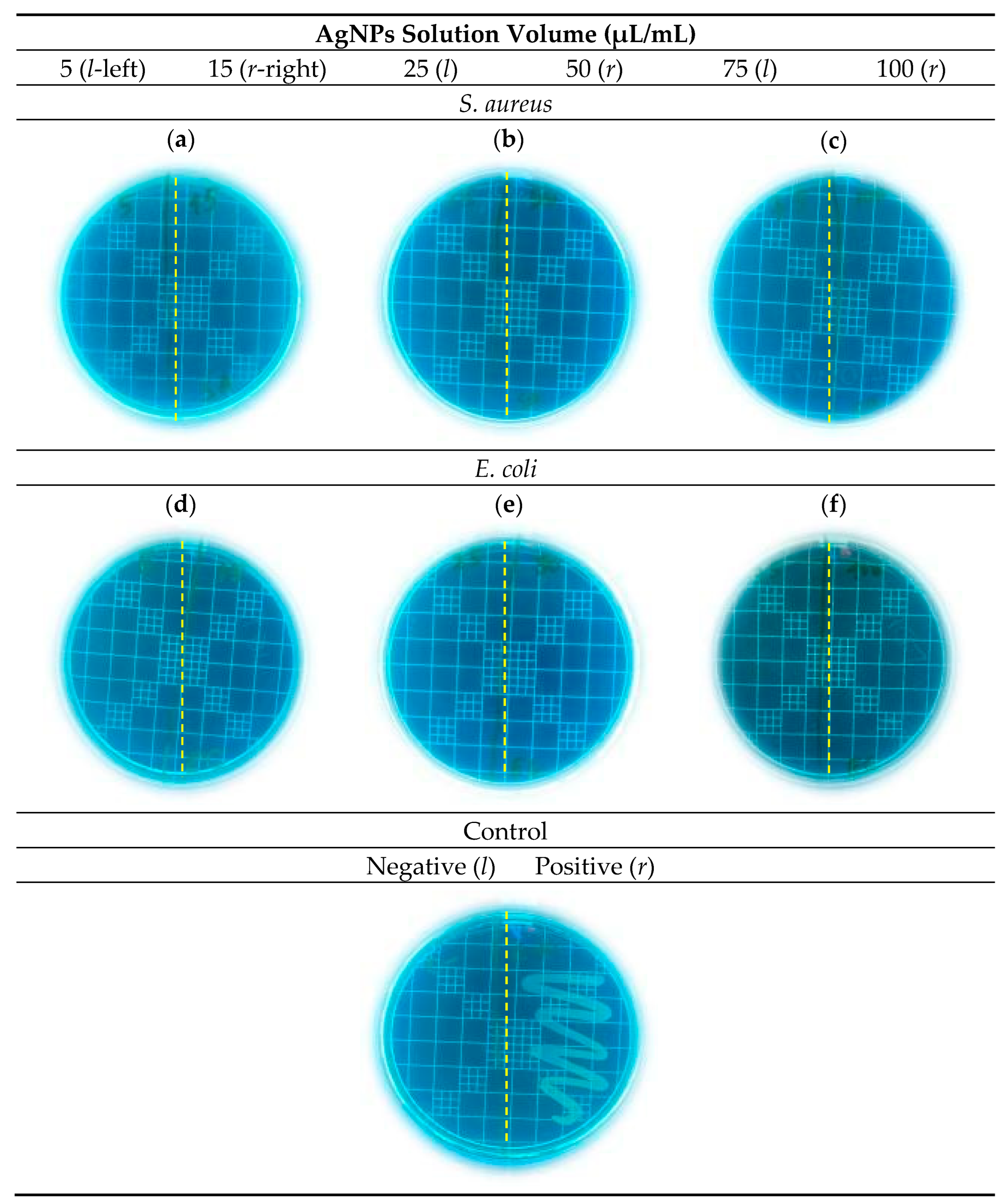
The broth dilution assay was performed to evaluate the antimicrobial activity of the AgNPs and to establish the minimum inhibitory concentration (MIC) against the tested bacterial strains. The bacterial inocula were prepared in Falcon-type plates containing Mueller–Hinton broth at a concentration of 1.0 × 10⁴ colony-forming units per milliliter (CFU/mL). The AgNPs solution (Synthesis 2, 0.01 mol/L of AgNO3) was added to the wells at varying concentrations (5, 15, 25, 50, 75, and 100 μL/mL), followed by incubation at 37 °C for 24 h. Because of the intense color of the AgNPs, which hindered visual assessment of turbidity as an indicator of bacterial growth, a complementary procedure was applied. After incubation, aliquots were collected with sterile swabs and streaked onto Mueller–Hinton agar plates, followed by an additional incubation for 24 h at 37 °C. The bacterial growth was then visually assessed and recorded.

2.7. Incorporation of AgNPs in the Chitosan Matrix

The AgNPs obtained after optimization of the experimental parameters were incorporated into a chitosan matrix to produce a functionalized composite. Initially, 1.5 g of chitosan was dissolved in 100 mL of 0.75 mol/L ethanoic acid solution and subjected to magnetic stirring for 15 min. The resulting solution was then left to rest for 24 h at room temperature to ensure complete polymer dissolution and the removal of air bubbles introduced during mixing.
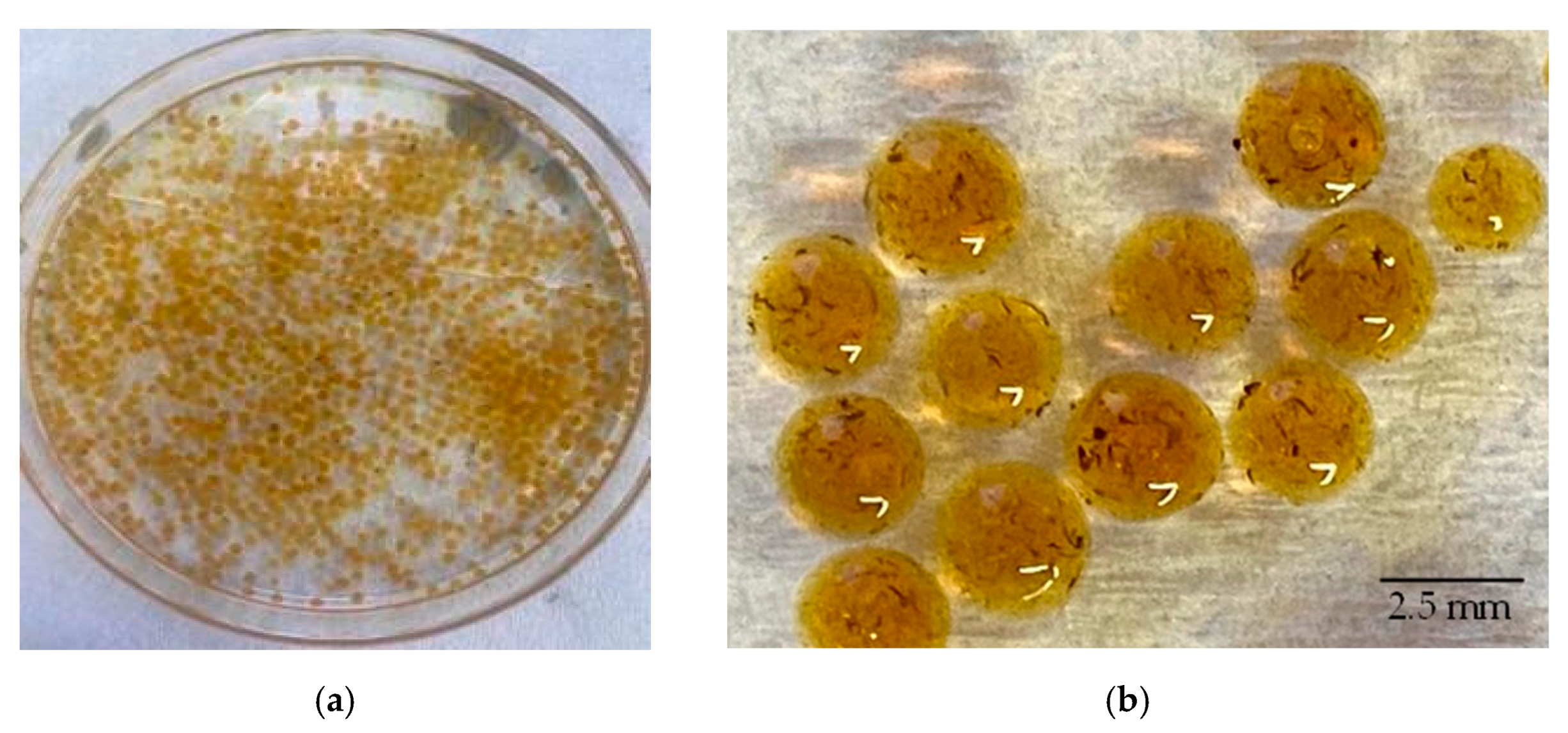
Following this step, 7 g of the solubilized chitosan was combined with 3 mL of AgNPs solution (from Synthesis 12, Table 1). This mixture was then pelletized by injecting through a fine needle into a coagulation bath containing 1.5 mol/L NaOH solution and 60 μL of glutaraldehyde. The surface of the pellets was reinforced by the crosslinking process, thereby improving their mechanical stability while maintaining structural integrity during wastewater treatment. After formation, the pellets (Figure 2) were thoroughly washed and stored in deionized water until further use.

2.8. Characterization of the Chitosan/AgNPs Composite

2.8.1. FEG-SEM and EDS Analysis

The morphology of both chitosan and the composite was examined by FEG-SEM analyses. Prior to imaging, the samples were sputter-coated with a thin layer of gold for approximately 3 min to improve conductivity. FEG-SEM micrographs were then acquired using a Tescan MIRA3 (Tescan Orsay Holding, Brno, Czech Republic) electron microscope operated at an accelerating voltage of 20 kV. Concurrently, EDS was performed with FEG-SEM to qualitatively determine the elemental composition of the composite.

2.8.2. FTIR Analysis

FTIR was performed to identify the functional groups present in the composite and to evaluate the molecular interactions between the AgNPs and the chitosan matrix. After composite preparation, the suspension was uniformly spread onto a Petri dish and dried in an oven at 60 °C until complete water evaporation. The resulting dry film recovered from the Petri dish was directly analyzed using a Nicolet iS10 infrared spectrometer (Thermo Scientific, Waltham, MA, USA) equipped with an attenuated total reflectance (ATR) accessory. The spectra were recorded in transmittance mode within the range of 4000–400 cm−1, with a resolution of 2 cm−1 and an average of 128 scans.

2.8.3. TGA Analysis

The thermal stability of both chitosan and the composite was evaluated using a Shimadzu TGA-50 thermogravimetric analyzer (Kyoto, Japan). Approximately 10 mg of each sample was analyzed under a nitrogen atmosphere (flow rate of 50 mL/min) in a platinum sample holder. The temperature was raised from 25 to 900 °C at a heating rate of 10 °C/min.

2.9. Evaluation of the Antimicrobial Activity of the Chitosan/AgNPs Composite

The antimicrobial activity of the chitosan/AgNPs composite was evaluated against E. coli and S. aureus strains. The assays were carried out on solid medium, following the standardized procedures described in the CLSI M2-A8 [45], which specifies the methods for disk diffusion antimicrobial susceptibility testing.
The agar diffusion assay was performed to assess the antimicrobial activity of the chitosan/AgNPs composite by measuring inhibition halos formed around the samples. Petri dishes containing Mueller–Hinton agar were inoculated with each bacterial strain at a concentration of 1.0 × 10⁶ CFU/mL. Three composite pellets were positioned on each plate, which was subsequently incubated at 37 °C for 24 h in a bacteriological oven. After incubation, the inhibition halos were visually examined, and digital photographs of the plates were acquired to record the results.

2.10. Industrial Wastewater Treatment

Chitosan–AgNPs composite was tested using industrial wastewater collected from a local company (northeastern region of Rio Grande do Sul, Brazil) engaged in the manufacture of kitchenware, tools, and furniture. For confidentiality reasons, the company’s identity is not disclosed in this study.
The disinfection process was carried out by stirring 150 mL of wastewater with 30 composite pellets in an orbital shaker at 200 rpm for periods ranging from 15 to 240 min at 25 °C. A control flask containing only untreated wastewater was also prepared and subjected to microbiological analysis to determine the initial microbial load. At predetermined time intervals (15, 30, 60, 90, 120, 150, 180, and 240 min), each flask was removed from the shaker, and the contents were filtered to separate the composite pellets. The treated wastewater was divided into two aliquots, with 100 mL being used for total coliform counts and 50 mL being used for Ag release quantification by ICP-OES.
Total coliforms were determined according to Method 9223-B, while Ag release was quantified following Method 3120-B, both from the Standard Methods for the Examination of Water and Wastewater [46]. The latter analysis was considered essential for assessing the potential reuse of the treated wastewater, since the Ag concentration must not exceed 0.1 mg/L to comply with World Health Organization (WHO) guidelines and current Brazilian legislation [47].

3. Results and Discussion

3.1. Characterization of the Floral Extract

3.1.1. Total Phenolic Content

A preliminary visual analysis of the color intensity across different extract dilutions was performed, providing a qualitative estimation of phenolic concentration, which indicated a range of 50–100 μg GAE/mL. This estimation was based on the observation that the undiluted extract exhibited a markedly darker coloration than the sample diluted at a ratio of 50:1 yet remained lighter than the 100 μg GAE/mL standard solution. Precise quantification was subsequently carried out using the calibration curve described in Section 2.4.1, and the phenolic content was determined to be 3185 μg GAE/mL.
According to the literature criteria [48], phenolic contents from 1 to 5 mg GAE/mL are classified as intermediate, whereas values above 5 mg GAE/mL are considered high. The measured value therefore falls within the intermediate-to-high range, suggesting that the extract contains a substantial amount of phenolic compounds. Consequently, the Manacá-da-Serra extract can be regarded as a viable and effective reducing agent for use in the green synthesis of AgNPs.
It should be noted that phenolic content in plant extracts may vary substantially, depending on factors such as plant species, cultivation conditions, extraction procedure, analytical technique, and synthesis parameters [21]. Reported values have ranged from 154.4 μg GAE/mL in Capsicum chinense leaf extracts to 8850 μg GAE/mL in Juglans regia bark extracts [37,49]. This wide variability highlights the critical influence of the phytochemical composition of the source material on its effectiveness as a reducing agent.
The phenolic content measured for the Manacá-da-Serra extract (3185 μg GAE/mL) indicates a relatively high level compared with other plant-derived sources, demonstrating its potential as a dual-function reducing and stabilizing agent for the sustainable synthesis of AgNPs. In green metallic NP synthesis, the reduction of metal ions and the stabilization of the resulting nanostructures are mediated by phenolic compounds, which enhance colloidal stability and promote narrower size distributions. Overall, higher phenolic content has been positively correlated with improved synthesis efficiency [43].

3.1.2. Antioxidant Activity

The antioxidant potential of the Manacá-da-Serra extract was confirmed by the characteristic color change observed in the DPPH-containing solution, indicating effective free radical scavenging activity. This activity was shown to be concentration-dependent, with radical inhibition increasing proportionally with extract concentration. The mean inhibition value was determined to be 83.5 ± 2.90% when 200 μL of extract was used. This performance is comparable to, and in some cases exceeds, those reported for other plant extracts employed in the green synthesis of AgNPs, including strawberry pomace waste (55–71%) and Parkia speciosa leaves (up to 92%) [37,50].
The antioxidant constituents, predominantly polyphenols and flavonoids, acted not only as reducing agents, facilitating the conversion of Ag+ ions into Ag0, but also as stabilizing agents, thereby preventing NP aggregation and enhancing colloidal stability and size uniformity [21]. As previously mentioned, the antioxidant activity of Manacá-da-Serra has not been reported, which emphasizes the novelty of this finding. Nevertheless, this behavior is consistent with the recognized antioxidant potential of other Melastomataceae species, whose phenolic and flavonoid compositions have been associated with their radical scavenging capacity [51]. These combined properties contribute to both the efficiency and environmental sustainability of the synthesis process while also improving the functional performance of the resulting AgNPs, particularly their antimicrobial activity, which is crucial for wastewater disinfection and related applications.

3.2. Green Synthesis of AgNPs

3.2.1. Optimization and Influence of Experimental Parameters

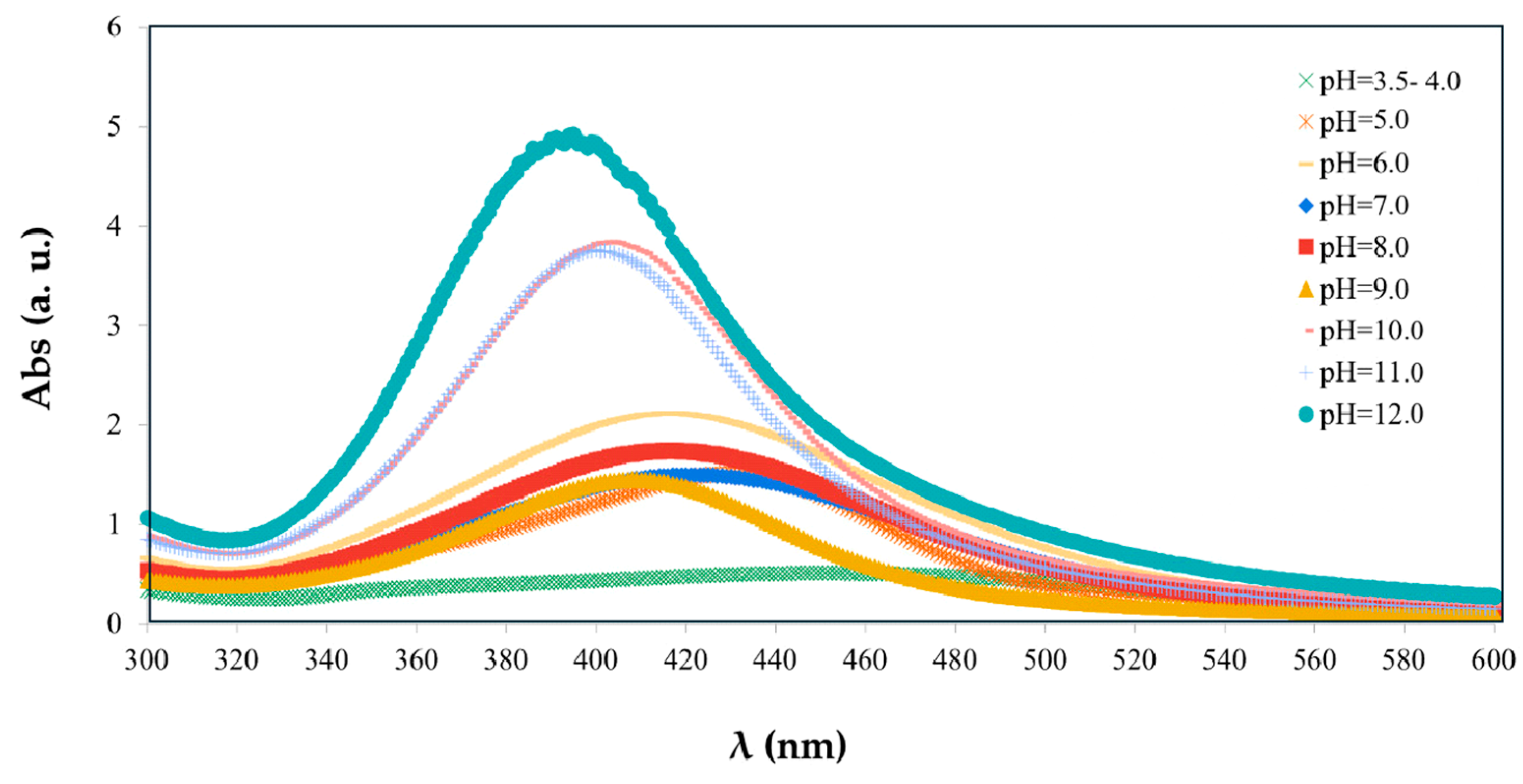
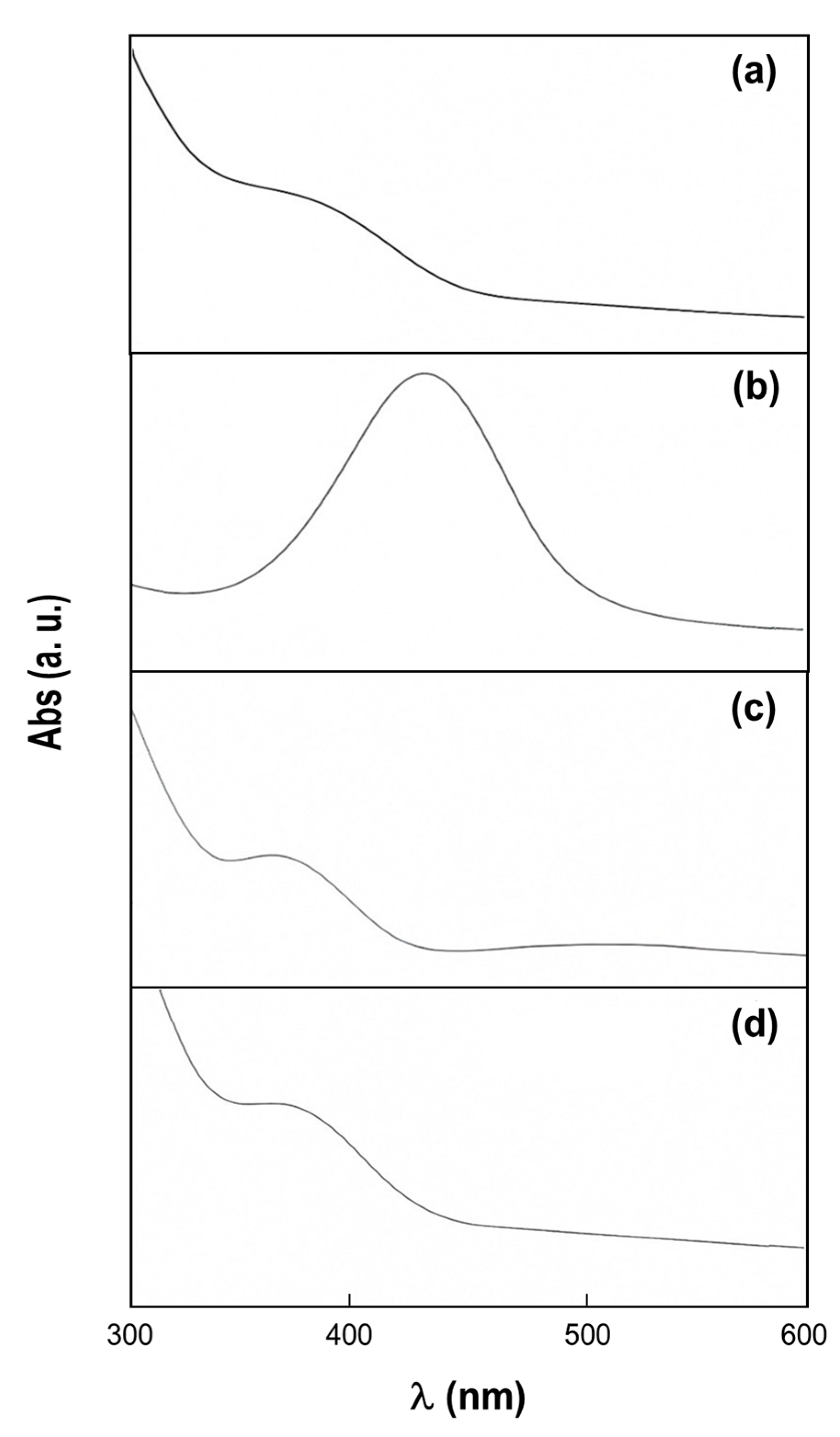
The optimization of the green synthesis, performed under the previously defined conditions (Synthesis 2), was evaluated based on two main criteria: the visual color change in the reaction medium and UV-Vis spectroscopy analysis for the detection of the characteristic SPR band of AgNPs. In general, a gradual color transition was observed during the reaction, evolving from the initial light pink hue of the Manacá-da-Serra flower extract to a pale yellow after approximately 40 min, and subsequently stabilizing into a yellowish-brown coloration after approximately 2 h. This color evolution has been recognized as a qualitative indicator of AgNPs formation, corresponding to the reduction of Ag+ ions to Ag0 [52]. Following the initial visual observation, UV-Vis spectroscopy, using deionized water as the blank solution, was employed to confirm the green synthesis of AgNPs. A distinct absorption band at 410–420 nm was observed in the spectrum (Figure 3b), consistent with SPR range typically reported for AgNPs, thus providing strong evidence of successful synthesis of predominantly spherical AgNPs.
Additional AgNO3 concentrations (0.001, 0.05, and 1.0 mol/L) were subsequently evaluated (Figure 3a, Figure 3c and Figure 3d, respectively). However, regardless of the silver salt concentration tested, a well-defined absorption band near 400 nm [21] was not observed in the UV-Vis spectra. Instead, only broad, low-intensity signals with poorly resolved contours were detected, indicating inefficient NP formation. A clear and distinct SPR band at 410–420 nm was observed exclusively under the conditions established for Synthesis 2, confirming this combination as the most favorable condition for AgNPs synthesis. Using these optimized conditions, further investigations were conducted to evaluate the influence of additional parameters such as pH and temperature, which are discussed in the following subsections.
The influence of pH on the green synthesis of AgNPs was evaluated within the range of 3.5–4.0 to 12.0 (Synthesis 2; 512), since lower pH values have been reported to promote the formation of silver agglomerates [53]. An immediate color change was observed upon the addition of NaOH, confirming its role as a reaction initiator in the reduction of Ag+ ions [21,54]. UV-Vis spectra (Figure 4) revealed that increasing pH resulted in narrower absorption bands and a shift toward lower wavelengths, indicating the formation of smaller, more uniformly distributed, stable, and predominantly spherical NPs, in agreement with previous studies [23,55]. This behavior was attributed to the higher concentration of hydroxide ions (OH), which accelerate the reduction kinetics of Ag+ ions and enhance the colloidal stability of the NPs [21,56]. Consequently, the blue shift observed with increasing pH reflects the size-dependent optical properties of AgNPs, wherein smaller particles exhibit SPR bands at shorter wavelengths.
However, potential drawbacks were associated with increasing the pH, as excessive high values can induce the formation of silver oxides (e.g., Ag2O, AgO). In contrast to the spectra obtained at elevated temperatures, no additional absorption bands were observed, indicating that the synthesis of AgNPs was effectively promoted under basic conditions without the generation of undesirable byproducts. Overall, pH was identified as a critical factor influencing NP formation and morphology, as corroborated by TEM analyses.
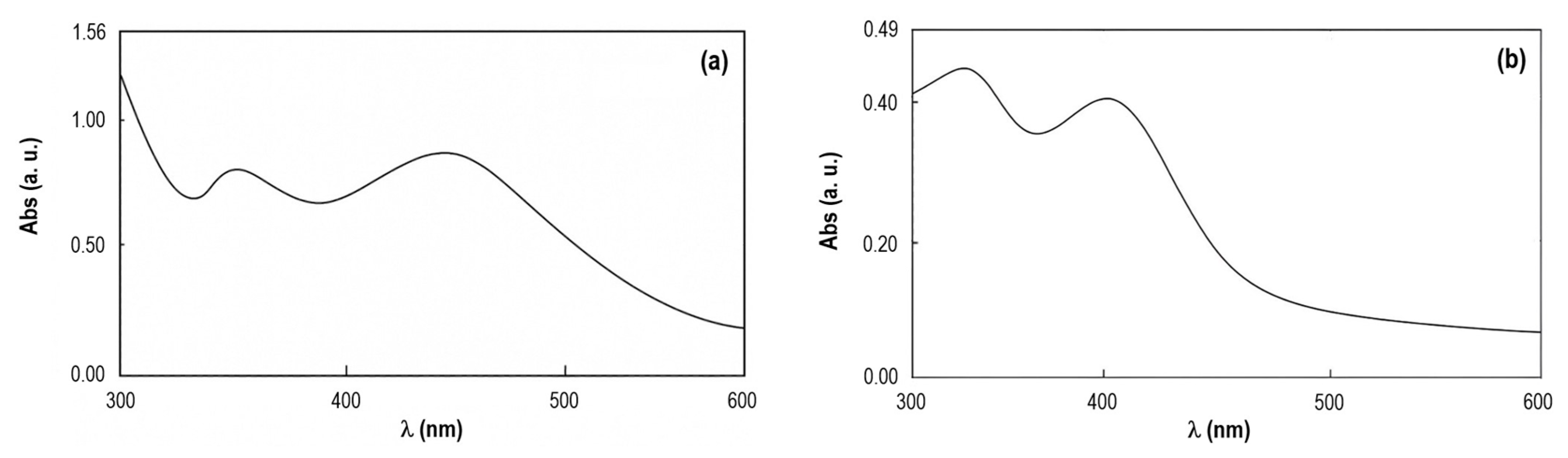
The influence of temperature on the green synthesis of AgNPs was investigated at 25, 35, and 50 °C (Synthesis 2; 1314) under the previously optimized conditions (AgNO3 0.01 mol/L and floral extract at 2.5 g/100 mL). NP formation at all tested temperatures was confirmed by UV-Vis spectra through the appearance of the characteristic SPR band at 410–420 nm. However, at elevated temperatures, particularly 35 and 50 °C (Figure 5a and Figure 5b, respectively), an additional absorption band appeared in the range of 300–400 nm, suggesting the presence of residual Ag+ ions and the formation of Ag agglomerates.
The detection of bands at 320–325 nm at 35 and 50 °C further indicated that higher temperatures were associated with the formation of undesired species rather than well-defined AgNPs [57]. Therefore, although the reduction of Ag+ ions was accelerated at elevated temperatures, the colloidal stability and morphological uniformity of the NPs were adversely affected. Based on these findings, the temperature of 25 °C was established as the optimal condition for subsequent synthesis experiments to ensure the production of stable and monodispersed AgNPs. A summary of the experiments performed immediately after synthesis, highlighting the variations in experimental parameters and their corresponding outcomes, is presented in Table 2. The same time interval between synthesis and measurement was maintained for all samples to ensure result comparability.

3.2.2. TEM Analysis

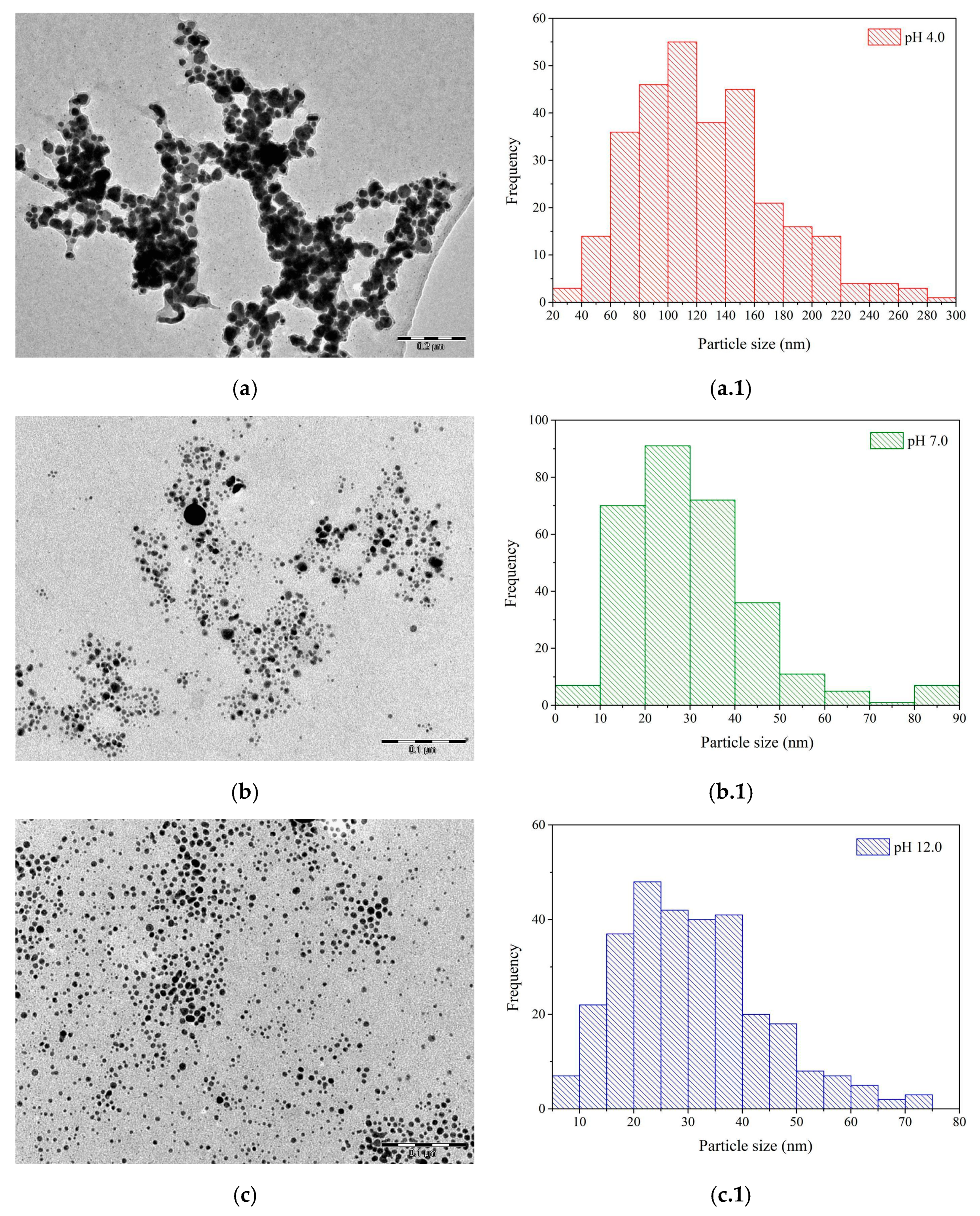
TEM analysis (Figure 6) was performed to assess the influence of varying pH conditions on the structural properties of the synthesized AgNPs. Under acidic conditions (pH 3.5–4.0, Synthesis 2), corresponding to the natural pH of the reaction mixture, predominantly aggregated AgNPs with irregular shapes and broad size heterogeneity were observed in the TEM images (Figure 6a,a.1). The applicability of such NPs in processes such as wastewater disinfection is limited by their irregular morphologies and wide size distribution, as antimicrobial activity has been correlated with small particle size and good dispersion.
When the pH was adjusted to neutral (pH 7.0, Synthesis 7), a morphological transition toward more spherical particles was revealed by TEM analyses, accompanied by markedly improved dispersion (Figure 6b). A more homogeneous size distribution was achieved compared with the acidic condition (Figure 6b.1), although some morphological irregularities persisted. These characteristics indicate enhanced antimicrobial potential at neutral pH, although still constrained by residual heterogeneity. Under basic conditions (pH 12.0, Synthesis 12), well-defined, uniformly sized, and highly dispersed spherical AgNPs were obtained (Figure 6c,c.1). Such features are considered advantageous for antimicrobial applications, particularly wastewater treatment, where colloidal stability and high specific surface area are essential.
The direct influence of pH on AgNPs synthesis was further corroborated by the size distribution analysis (Figure 6a.1,b.1,c.1). In acidic media, average particle diameters ranged from 100 to 120 nm, whereas smaller and more uniform NPs were formed under neutral and basic conditions, with predominant diameters of 10–40 nm and 20–30 nm, respectively. Such uniformity is especially desirable for applications in which antimicrobial performance and surface reactivity are critical [10].
Previous studies on green synthesis of AgNPs using plant extracts derived from flowers, fruits, and roots have demonstrated a wide variety of NP morphologies. Predominantly spherical AgNPs with an average size of 46 nm and low size dispersion were, for example, produced using Tagetes erecta extract [19]. Similarly, spherical particles ranging from 40 to 100 nm with good polydispersity were obtained using Malus domestica extract [36]. Extracts from Ferula gumosa, Ferula latisecta, Teucrium polium, and Trachomitum venetum have also been reported to yield spherical AgNPs between 5 and 30 nm in diameter, with an average of approximately 20 nm [38].
Beyond size and uniformity, the significant role of the phytochemical composition of the plant extracts on the shape of NPs has been emphasized by several investigations. Although spherical morphologies are the most frequently reported, alternative shapes, including rods, triangles, hexagons, and irregular forms, have also been documented. These variations are determined by the nature and concentration of the reducing and capping agents present in the plant matrix [58,59,60,61]. Such structural differences strongly influence surface area, reactivity, and ultimately antimicrobial efficacy. Overall, the present findings are consistent with previous reports concerning the morphology and size of plant-mediated AgNPs.

3.2.3. ZP Analysis

ZP is a widely applied parameter for evaluating the colloidal stability of metallic NPs, including AgNPs. It represents the magnitude of electrostatic repulsion between adjacent, similarly charged particles in a dispersion and is directly associated with their tendency to either agglomerate or remain dispersed over time. According to classical colloid theory, dispersions exhibiting |ZP| values below 10 mV are generally regarded as unstable, since the electrostatic repulsion is insufficient to prevent aggregation. Moderate stability is typically associated with |ZP| values between 10 and 30 mV, whereas values exceeding ±30 mV are indicative of good colloidal stability due to strong electrostatic repulsion among particles.
In the context of green synthesis, various phytochemicals such as flavonoids, polyphenols, tannins, and reducing sugars present in plant extracts act simultaneously as reducing agents and capping/stabilizing agents during AgNPs formation. These biomolecules are adsorbed onto the NP surface, imparting surface charge and steric hindrance, which together result in enhanced colloidal stability. AgNPs synthesized using plant-based extracts have frequently been reported to exhibit negative ZP values ranging from −20 to −40 mV, consistent with stable colloidal behavior [19,21,38,49,61,62,63].
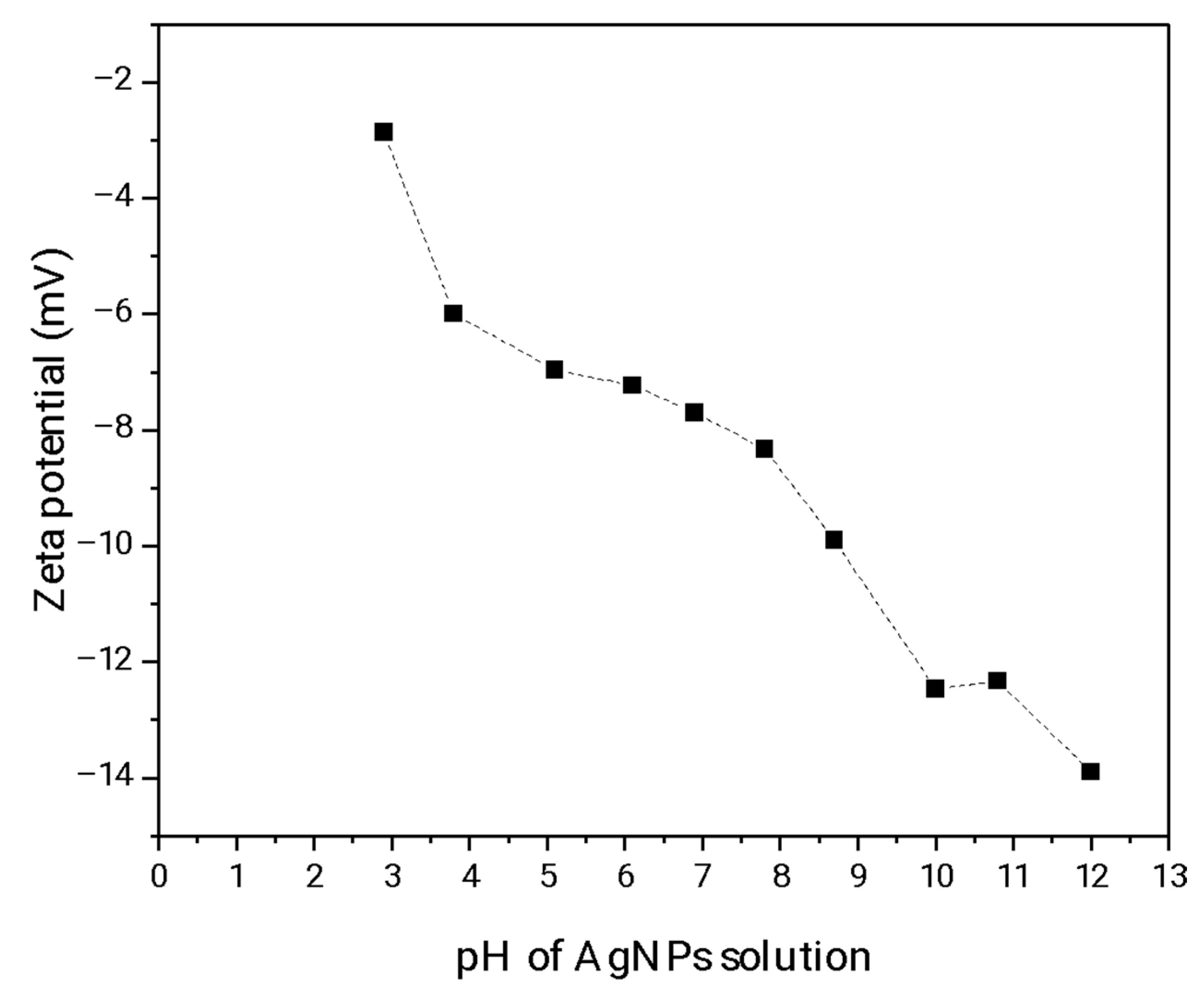
In this study, the ZP of the AgNPs was determined as a function of pH over the range 3.0–12.0, as shown in Figure 7. As observed, all measured values were negative, ranging from approximately −2 to −14 mV, suggesting the presence of negatively charged phytochemicals adsorbed onto the NP surface. Although the values remained negative, measurements obtained under basic conditions (−10 to −14 mV) indicated moderate colloidal stability. The ZP values did not exceed the threshold of −30 mV, which is generally associated with strong electrostatic stabilization, implying that while aggregation is not immediate, some degree of flocculation may occur over time.
This behavior was attributed to the nature and density of functional groups (e.g., carboxyl, hydroxyl, or phenolic groups) present in the floral extract, which influence both surface charge and capping efficiency. In summary, the negative ZP values confirmed that the synthesized AgNPs were electrostatically stabilized, maintaining adequate dispersion to ensure short- to medium-term stability.

3.2.4. Evaluation of the Antimicrobial Activity of the Synthesized AgNPs

The antimicrobial activity of AgNPs synthesized at 25 °C using 0.01 mol/L AgNO3 and floral extract at 2.5 g/100 mL, under acidic (pH 3.5–4.0) (Figure 8) and basic (pH 12.0) conditions was evaluated using the broth dilution method (liquid medium). After 24 h of exposure to the AgNPs-containing medium, complete inhibition of microbial growth was observed for both conditions, confirming that a pronounced antimicrobial effect had been achieved.
In general, the results obtained in this study were consistent with, and in some cases superior to, those previously reported in the literature [64]. The green synthesis of AgNPs employing Manacá-da-Serra extract was demonstrated to be highly effective, revealing considerable potential for application in wastewater disinfection.

3.3. Characterization of the Chitosan/AgNPs Composite

3.3.1. FEG-SEM and EDS Analysis

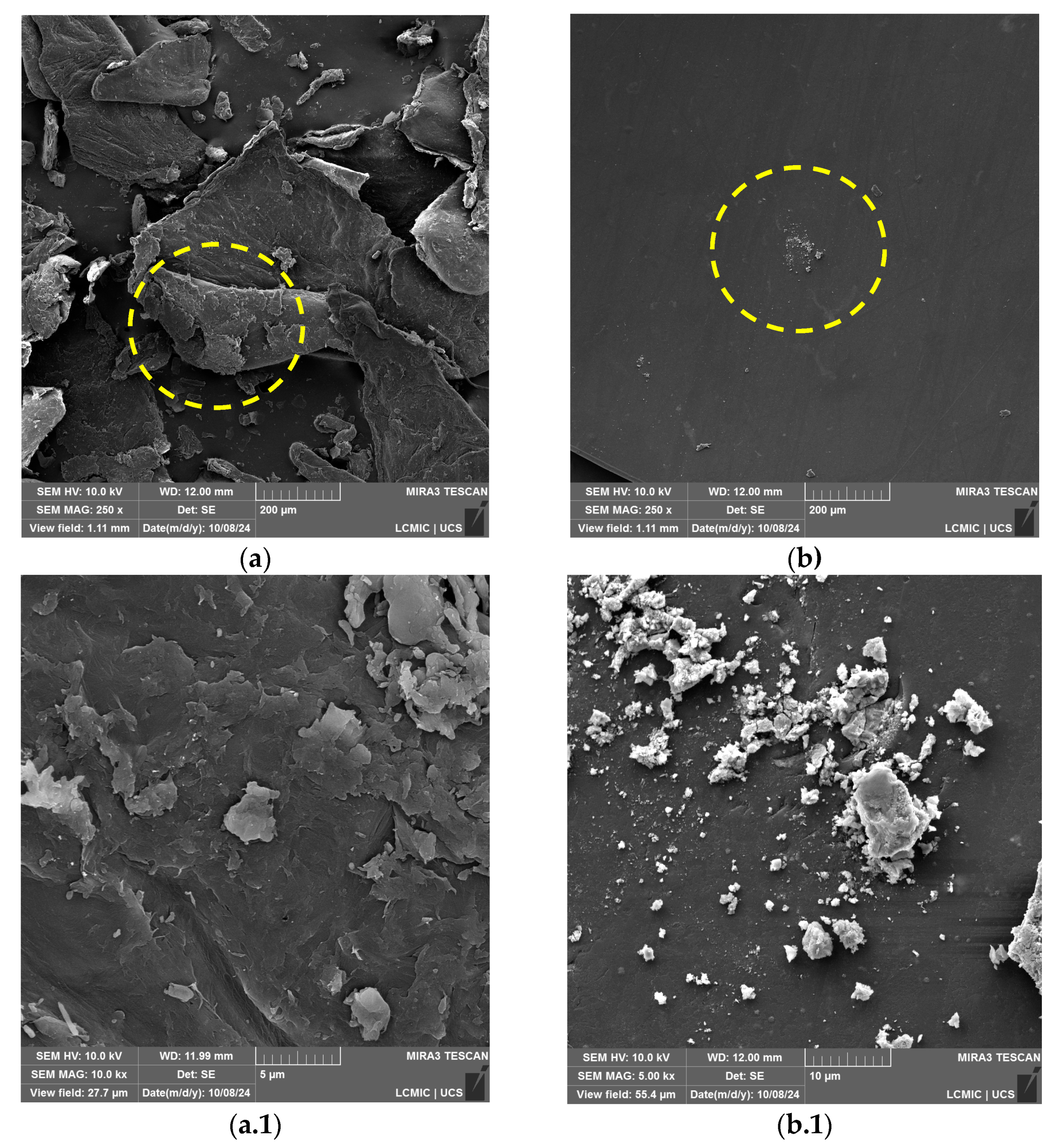
The surface morphology of chitosan and the chitosan/AgNPs composite was investigated by FEG-SEM at different magnifications (250× and 10 k×, respectively) to assess the effect of AgNPs incorporation on the chitosan matrix. The chitosan exhibited an irregular and heterogeneous morphology characterized by micrometric particles arranged in platelet-like assemblies, resembling a layered, clay-like texture (Figure 9a). A predominantly rough topography interspersed with smoother domains and porosity was observed (Figure 9a.1), suggesting a high specific surface area conducive to enhanced physicochemical interactions within the composite. Similar morphological features have been reported in previous studies, in which chitosan particles were described as displaying variable shape and size distributions, often featuring rounded edges and non-uniform surfaces [65,66].
In contrast, a noticeably smooth surface was revealed in the FEG-SEM micrographs of the chitosan/AgNPs composite (Figure 9b), confirming that the polymeric matrix morphology had been modified by the incorporation of AgNPs. Micrometric particles dispersed across the composite surface were also observed (Figure 9b.1). Based on their dimensions, these features were interpretated as residual chitosan domains that were not fully solubilized during dissolution in ethanoic acid rather than as nanoscale AgNPs. The morphological heterogeneity induced by AgNPs incorporation is expected to enhance functional properties such as interfacial interactions, reactivity, and antimicrobial performance by increasing the effective contact area between the polymer and the NPs.
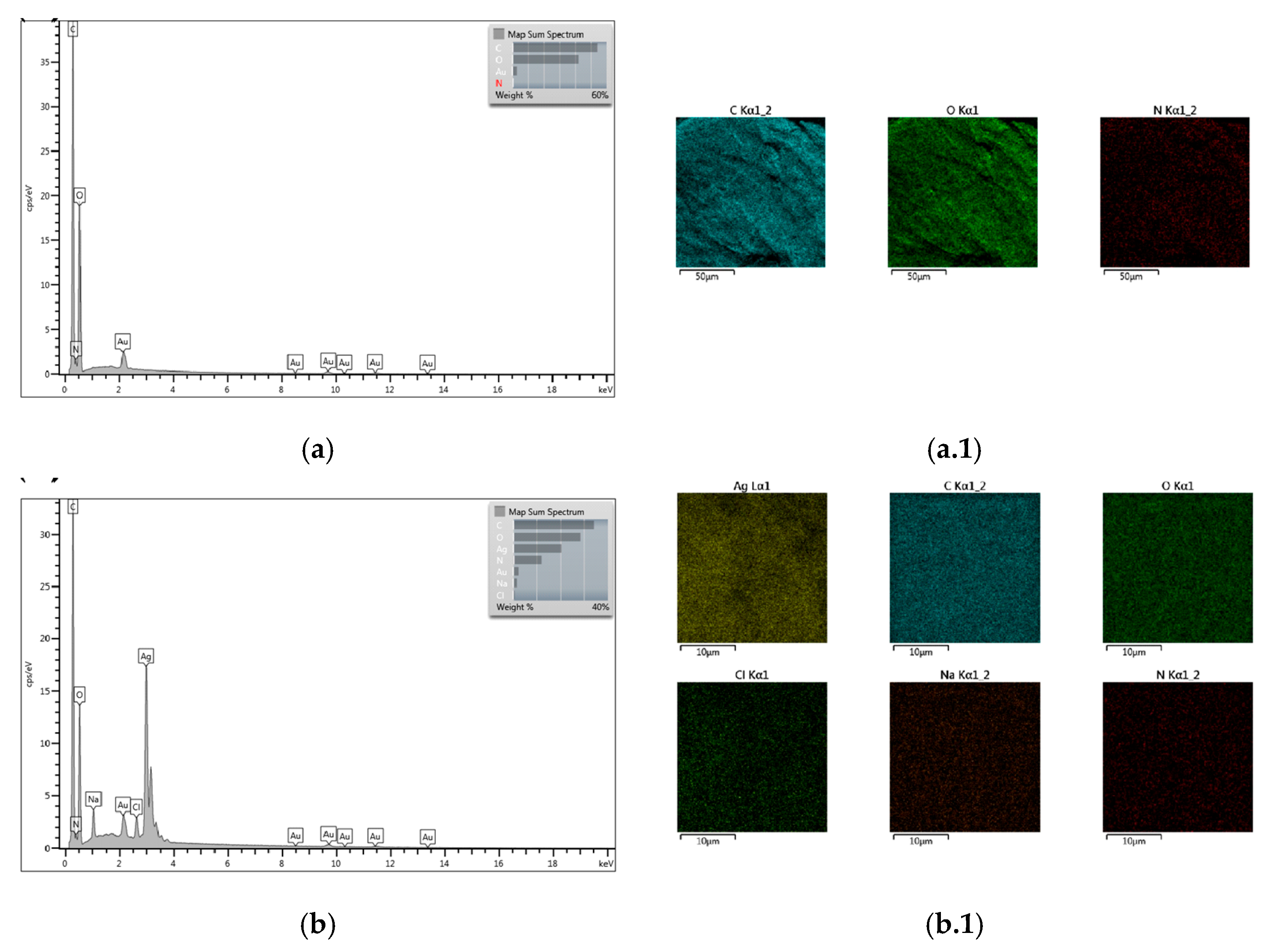
EDS analysis was performed to conduct both qualitative and semi-quantitative assessments of the elemental composition of the chitosan/AgNPs composite. For comparison purposes, an EDS spectrum of the unmodified chitosan was also recorded (Figure 10a). Characteristic peaks corresponding to oxygen (O Kα at 0.525 keV), carbon (C Kα at 0.277 keV), and nitrogen (N Kα at 0.392 keV) were revealed by the elemental analysis of chitosan, consistent with the polymer’s chemical structure. The polysaccharide backbone is composed primarily by carbon, while nitrogen arises from the –NH2 groups involved in cross-linking interactions, and oxygen mainly originates from the –OH groups distributed along the polymer chain (Figure 10a.1). A signal for gold (Au) was also detected, attributable to the thin conductive coating applied to the sample surface prior to analysis (Figure 10a.1).
Upon AgNPs incorporation, additional elemental signals were observed in the EDS spectrum of the chitosan/AgNPs composite (Figure 10b). The successful green synthesis and incorporation of AgNPs within the chitosan matrix were confirmed by a prominent Ag Lα1 peak at 2.984 keV [36,39]. A secondary feature slightly to the right of this signal (approximately 3.1–3.4 keV) corresponded to Ag Lβ and partially Lγ transitions, which belong to the same Ag L series rather than to a different element. Sodium (Na Kα at 1.041 keV) was also detected, most likely originating from NaOH used during composite preparation and not completely removed during washing. A distinct chlorine (Cl Kα at 2.622 keV) signal was likewise observed, plausibly associated with trace Cl ions naturally present in the Manacá-da-Serra floral extract and with residual chloride from the washing water used during synthesis. Although EDS cannot directly resolve chemical speciation, the low relative intensity of the Cl signal and its absence of co-localization with Ag in the elemental mapping suggested that chlorine was present only as a minor residual species rather than as stoichiometric AgCl.
A silver content of approximately 20 wt% was determined for the composite using semi-quantitative analysis, making it one of the dominant elements along with carbon (32 wt%) and oxygen (28.0 wt%) (Figure 10b.1). These findings are consistent with those reported in previous studies on green-synthesized chitosan-AgNPs composites [49,67], which exhibited similar elemental compositions. A homogeneous dispersion of Ag throughout the chitosan matrix, with no evidence of aggregation, was confirmed by the Ag elemental mapping (Figure 10b.1). This uniform distribution is essential for optimizing antimicrobial efficacy, maintaining mechanical integrity, and ensuring consistent performance of the composite. Although minor, the residual presence of Na and Cl underscores the need for adequate washing after composite formation. Additional rinsing steps could be applied to further minimize these impurities, thereby improving the overall composition and functional performance of the final composite.

3.3.2. FTIR Analysis

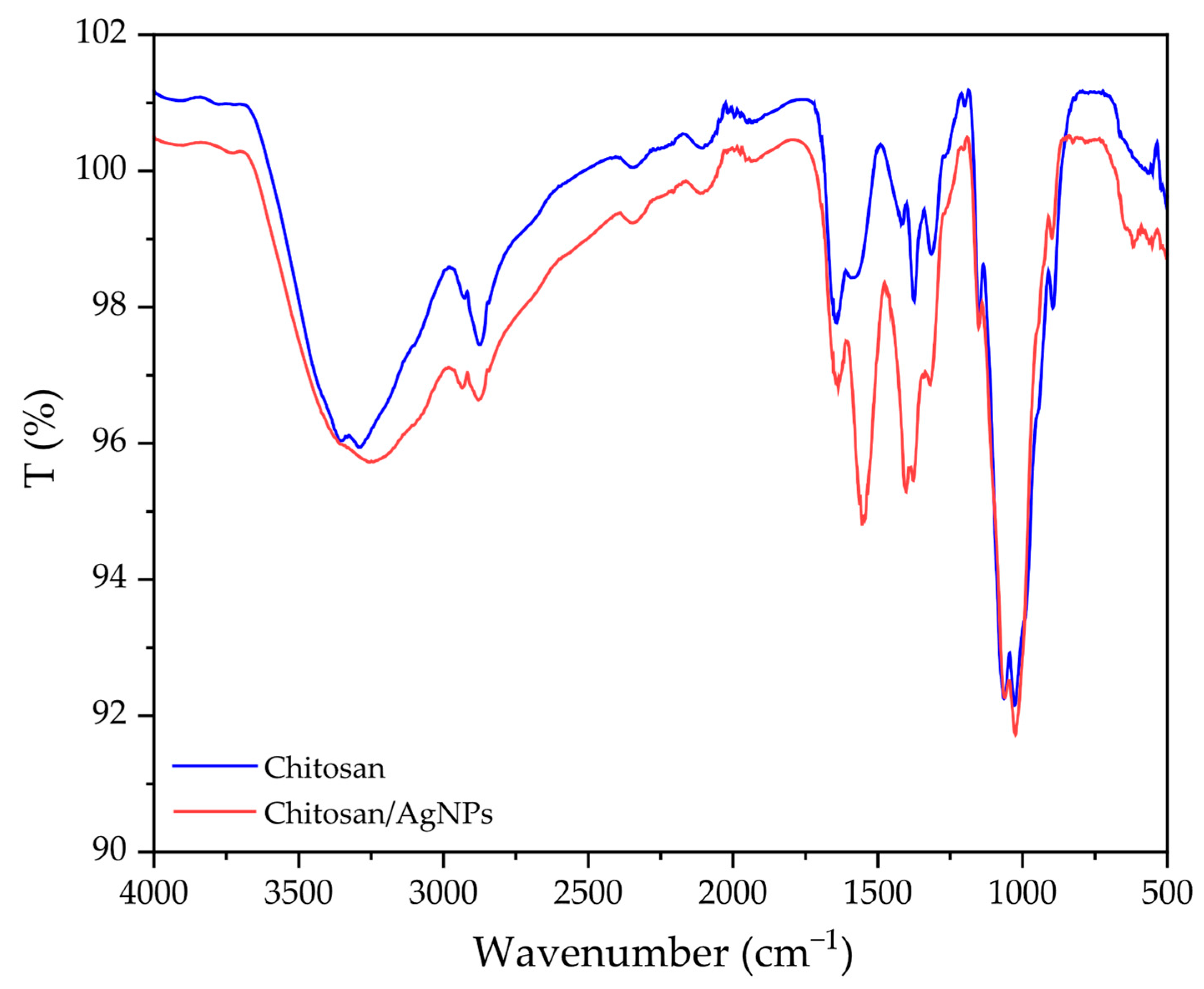
FTIR spectroscopy was employed to elucidate the molecular structure of the chitosan matrix and the chitosan/AgNPs composite, with the aim to identify functional groups and evaluate chemical interactions between the AgNPs and the polymer. Characteristic absorption bands were observed in the FTIR spectrum of the chitosan (Figure 11, blue line), including sharp bands at 1060 and 1023 cm−1, which were assigned to C–O and C–O–C stretching vibrations within the polysaccharide backbone [67]. A distinct amide I band was detected at approximately 1630 cm−1, corresponding to the C=O stretching vibration of residual acetylated units from chitin [68], whereas the bands near 2930 and 2850 cm−1 were attributed to the asymmetric and symmetric aliphatic C–H stretching vibrations, respectively, of CH2 groups.
In the FTIR spectrum of the chitosan/AgNPs composite (Figure 11, red line), attenuated signals at 3358 cm−1 (O–H and N–H stretching) and 1561 cm−1 (N–H bending) were indicative of specific interactions between the primary –NH2 groups of the polymer and the AgNPs surfaces [69]. Additional bands were observed at 1400 cm−1 (–OH bending), 1342 cm−1 (CH2 wagging), 1061 cm−1 (C–O and/or C–N stretching). The latter remained unchanged relative to the chitosan matrix, suggesting that these vibrational modes were not significantly influenced by NP incorporation, consistent with previous reports [10]. A marked decrease in the intensity of the C–H stretching band was also observed, supporting the occurrence of interactions between the aliphatic chains of the polymer and the AgNPs surfaces. Such interactions were inferred to modify the local molecular environment and weaken C–H vibrational modes, thereby confirming successful NP integration. A pronounced spectral modification was noted in the broad absorption region around 3358 cm−1, where overlapping –OH and –NH2 stretching vibrations produced a diminished and poorly resolved band. This broadening was primarily attributed to the presence of water molecules employed as solvent during the green synthesis of AgNPs, which can mask individual vibrational contributions [70]. Nevertheless, the observed increase in hydration was indicative of modifications in the hydrogen-bonding network of the composite.
Comparable vibrational profiles for AgNPs-loaded chitosan systems have been reported in the literature [10,71], in which shifts in amine-related bands or the disappearance of specific bands were interpreted as indicators of polymer modification [72]. In agreement with these findings, chemical interactions involving –NH2 and C–H groups were confirmed in the present spectrum, demonstrating that AgNPs incorporation induced molecular-level modifications in the matrix.
Overall, FTIR analysis confirmed the successful integration of AgNPs into the polymer network and identified specific functional group interactions responsible for the modified structural organization. These molecular-level modifications were inferred to enhance the composite’s physicochemical properties, including stability, reactivity, and antimicrobial performance.

3.3.3. TGA Analysis

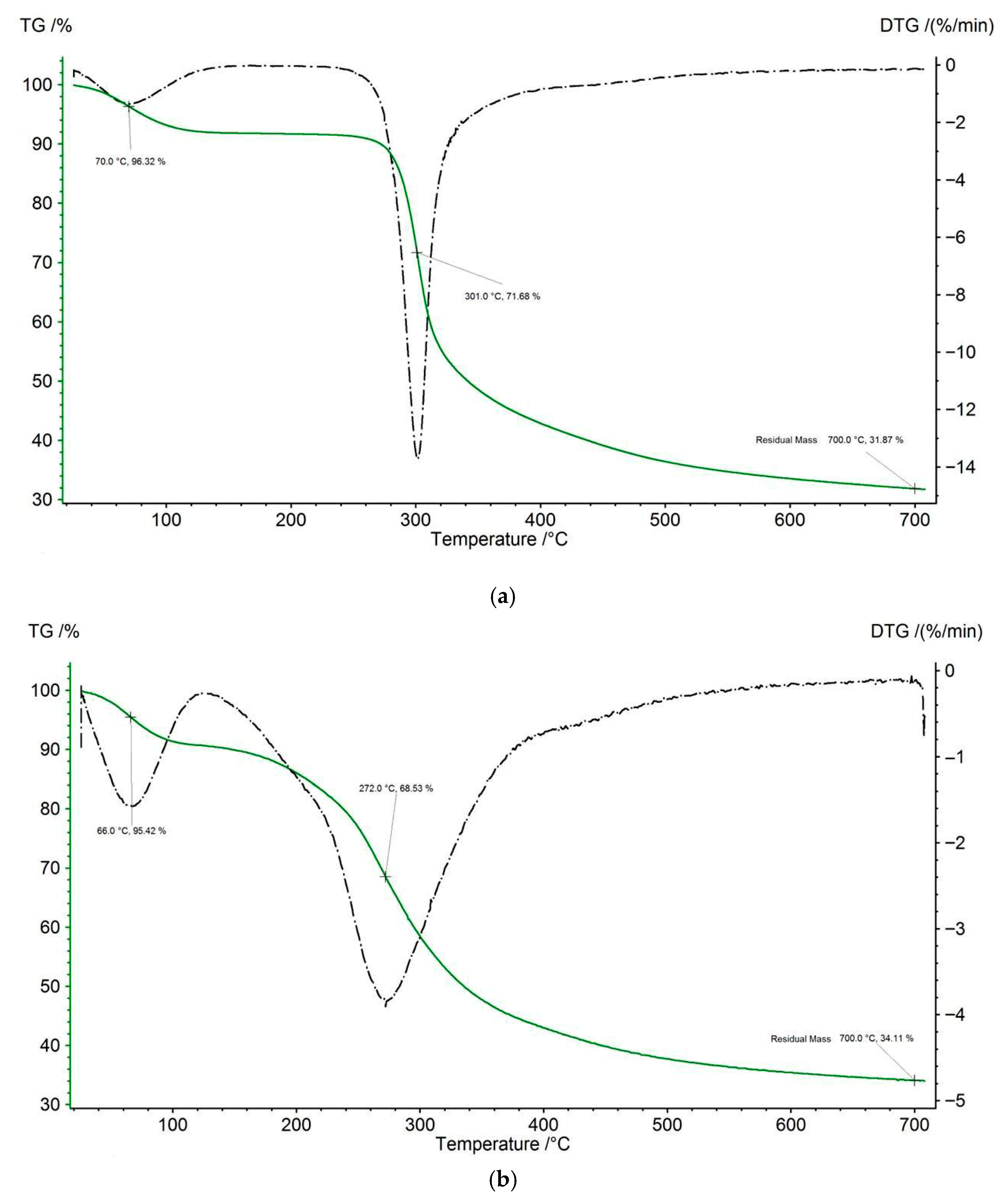
The thermal stability and degradation behavior of chitosan and chitosan/AgNPs composite were evaluated by TGA coupled with derivative thermogravimetry (DTG). For the composite (Figure 12b), two main weight loss events were identified. The first occurred at approximately 66 °C, corresponding to a mass loss of 4.58%, which was attributed to the evaporation of physically adsorbed water. This event was evidenced in the DTG profile by a low-intensity peak, indicating that minimal structural change had occurred. The second and most pronounced degradation stage was recorded at 272 °C, with a mass loss of about 27%. This event was associated with the thermal breakdown of the chitosan backbone, involving depolymerization and deacetylation reactions. A sharp DTG peak at this temperature confirmed it as the principal decomposition event of the polymer matrix.
Above 400 °C, the composite exhibited thermal stabilization, with only gradual weight loss extending up to 700 °C. At the end of the heating process, the residual mass was 34% of the initial sample weight, corresponding mainly to thermally stable inorganic matter such as AgNPs and other mineral residues. No additional DTG peaks were detected above 400 °C, suggesting that no further major degradation processes occurred. A higher char yield, along with a slight shift in the onset of thermal decomposition, was observed, indicating that the thermal stability of the polymer had been enhanced by AgNPs incorporation (Figure 12a), probably as a result of restricted chain mobility and polymer reinforcement.
These observations are consistent with those reported in the literature for AgNPs-loaded chitosan systems, in which two distinct stages are typically observed: water loss below 100 °C and polysaccharide degradation near 270 °C [13,65,73]. The increased residual mass in the composite has been widely attributed to the presence of AgNPs, which reduces the overall weight loss relative to neat chitosan [70]. Furthermore, higher AgNO3 concentrations have been reported to promote the formation of a greater number of AgNPs, thereby increasing the final residue after thermal treatment. The thermal behavior observed in the present study was therefore consistent with the patterns described for similar systems [66,73,74].

3.3.4. Evaluation of the Antimicrobial Activity of the Chitosan/AgNPs Composite

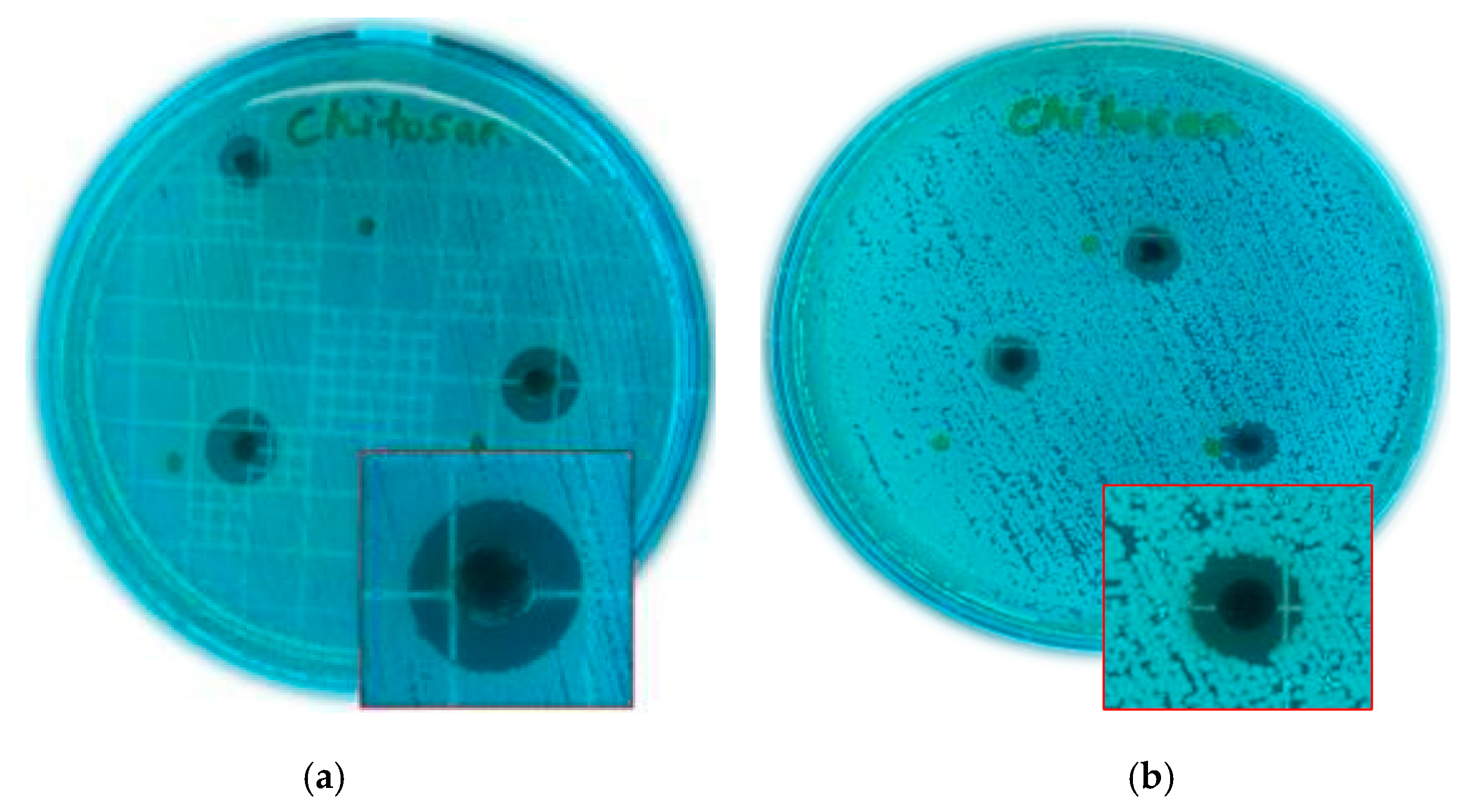
The antimicrobial activity of the chitosan/AgNPs composite was assessed using the disc diffusion method against S. aureus and E. coli, both cultured on nutrient agar. After 24 h of incubation, clear inhibition zones were observed around the composite, confirming that bacterial growth had been effectively inhibited (Figure 13).
The average diameters of the inhibition zones are summarized in Table 3 and correspond to the mean values obtained from two independent experiments that exhibited excellent reproducibility, with variations below 5%. Greater antimicrobial activity was recorded against S. aureus (11 ± 1 mm) than E. coli (9 ± 1 mm). This difference was attributed to the structural characteristics of Gram-negative bacteria, particularly the presence of an outer membrane and a more complex cell wall, which are known to confer increased resistance to antimicrobial agents [75]. According to established evaluation criteria, inhibition zones exceeding 10 mm are indicative of strong antimicrobial activity [76], thereby supporting the high efficacy of the composite, especially against Gram-positive strains.
Comparable inhibition zone diameters have been reported for AgNPs synthesized through green routes using plant-derived extracts, such as Teucrium polium leaves and stems [38], Malus domestica fruit extract [36], and Cassia fistula [74] and Clitoria ternatea [77] flowers. Variations in inhibition zone size among different studies have been ascribed to differences in NP synthesis conditions, phytochemical composition of the extracts, and assay parameters. Overall, the chitosan/AgNPs composite was demonstrated to exhibit significant antimicrobial activity, with performance consistent with that reported in the literature, thereby confirming its potential for antimicrobial applications.

3.4. Industrial Wastewater Treatment

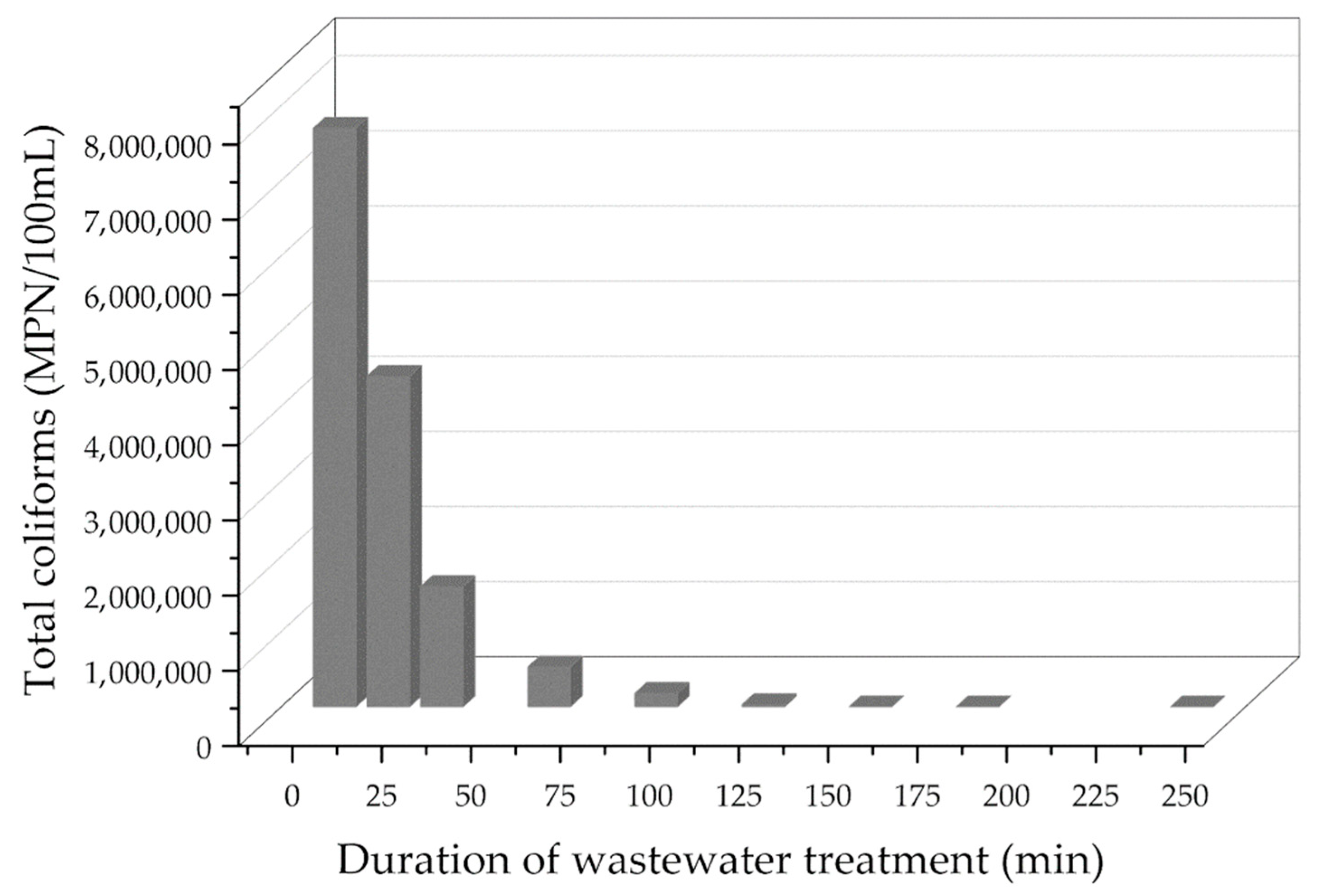
The antimicrobial performance of the chitosan/AgNPs composite was evaluated under conditions simulating an industrial wastewater treatment process. The composite was applied in preformed pellets, and its efficacy was assessed based on the reduction in total coliform counts over time (Figure 14). These values correspond to the mean results obtained from two independent experiments, which exhibited excellent reproducibility, with variations below 5%.
The initial concentration of total coliforms in the untreated wastewater was 7.7 × 10⁶ MPN/100 mL (most probable number per 100 mL). Upon contact with the composite, a sharp exponential decline in bacterial load was recorded within the first two hours, with counts decreasing to 4.4 × 10⁶ at 15 min, 1.6 × 10⁶ at 30 min, 5.3 × 10⁵ at 60 min, 1.8 × 10⁵ at 90 min, and 2.9 × 10⁴ MPN/100 mL at 120 min. After 180 min, a value of 1.2 × 10³ MPN/100 mL was reached, corresponding to the limit of quantification of the method (1.8 MPN/100 mL). A total coliform reduction exceeding 99.9% was thus achieved, confirming the high antimicrobial efficiency of the composite.
During the wastewater treatment assays, the structural integrity of the chitosan/AgNPs composite pellets was preserved, with no visible dissolution or fragmentation being detected. This stability was attributed to the crosslinking of the chitosan matrix with glutaraldehyde, which effectively prevented swelling and solubilization under aqueous conditions. Although a minor contribution of chitosan to the antimicrobial activity cannot be completely excluded, the primary activity was attributed to the presence of AgNPs. It has been widely reported that chitosan alone exhibits limited antimicrobial efficacy under near-neutral pH conditions, markedly lower than that of AgNPs-containing systems. Consequently, even though a chitosan-only control was not included in this study, the pronounced total coliform reduction (>99.9%) observed here can be predominantly ascribed to the bactericidal action of the AgNPs.
Silver release during treatment was monitored by ICP-OES. A consistently low Ag concentration of approximately 0.01 mg/L was measured in the treated wastewater, corresponding to a value one order of magnitude below the maximum permissible limit of 0.1 mg/L established by the WHO and Brazilian regulations. This minimal release was indicative of the effective immobilization of AgNPs within the polymer matrix, which was likely facilitated by glutaraldehyde-induced cross-linking. Such structural reinforcement restricted nanoparticle leaching while maintaining antimicrobial performance.
These findings are consistent with trends reported in the recent literature for AgNPs-based antimicrobial systems. For instance, a 47% reduction in total coliforms after 60 min was observed for chitosan pellets containing AgNPs synthesized from grape pomace extract [78], while a 90% reduction in E. coli after 360 min was achieved using thin films of poly (allylamine hydrochloride) and poly (acrylic acid) and AgNPs, with a subsequent increase to 93% in a second treatment cycle attributed to enhanced Ag leaching [79]. A 98.5% reduction in total coliforms within 90 min was also described for a hybrid of montmorillonite, alginate, and AgNPs [80].
In comparison, a >99.9% reduction in total coliforms was achieved after 180 min using the composite developed in the present study, with Ag release remaining remarkably low (0.01 mg/L). Although faster bacterial inactivation has been reported in some studies, the composite evaluated here provided a more favorable balance between disinfection efficiency and environmental safety. This performance was attributed to the synergistic interaction between the chitosan matrix and the green-synthesized AgNPs derived from Manacá-da-Serra floral extract, combined with the enhanced NP retention conferred by crosslinking. Consequently, despite requiring slightly longer treatment times, the composite demonstrated sustained antimicrobial efficacy with minimal ecological impact, establishing its potential as a safe and efficient material for wastewater disinfection.

4. Conclusions

The successful green synthesis of AgNPs using Manacá-da-Serra floral extract and their incorporation into a chitosan matrix resulted in the formation of a functional composite for wastewater disinfection. The antioxidant-rich phytochemicals present in the extract, particularly phenolic compounds, acted as natural reducing and stabilizing agents, thereby eliminating the need for toxic chemicals and ensuring an environmentally friendly process.
Systematic optimization revealed a strong influence of pH and temperature on NP morphology and dispersion, with basic conditions favoring the formation of spherical, well-dispersed AgNPs. Uniformly distributed spherical AgNPs with an average size of 20–30 nm and moderate colloidal stability (ZP ≈ −14 mV) were obtained under optimal conditions (pH 12.0, 25 °C, 0.01 mol/L AgNO3). Furthermore, the synthesized AgNPs exhibited high antimicrobial efficacy, with a MIC of 5 μL/mL against both E. coli and S. aureus.
Comprehensive characterization confirmed the effective integration of AgNPs within the chitosan matrix. FEG-SEM/EDS analysis revealed a homogeneous Ag distribution (~20 wt%) throughout the polymer network. FTIR results indicated interactions between AgNPs and –NH2 groups, contributing to structural stabilization, while glutaraldehyde-induced crosslinking minimized NP agglomeration. Enhanced thermal stability with a residual char yield of 34% was demonstrated by TGA, and antimicrobial assays confirmed inhibition zones of 11 ± 1 mm for S. aureus and 9 ± 1 mm for E. coli.
When applied in a simulated wastewater treatment system, strong antimicrobial activity was achieved by the chitosan/AgNPs composite, resulting in a >99.9% reduction in total coliforms within 180 min. A decrease in microbial counts from 7.7 × 10⁶ MPN/100 mL to the quantification limit of the method was recorded, while Ag release remained at 0.01 mg/L, well below regulatory thresholds, confirming both efficacy and environmental safety.
This study therefore demonstrates that the synergy between green-synthesized AgNPs and chitosan constitutes a highly promising strategy for tertiary industrial wastewater treatment, consistent with sustainable materials development and water reuse objectives. Future research should focus on scalability, long-term NP stability, and potential ecotoxicological impacts to enable the translation of these laboratory-scale results into practical environmental applications.

Author Contributions

Conceptualization, A.J.P.J., J.B. and M.G.; methodology, A.J.P.J., W.V.d.S., G.M., M.R.-E., J.d.S.C., J.B. and M.G.; validation, A.J.P.J., W.V.d.S., G.M., M.R.-E., J.d.S.C., J.B. and M.G.; formal analysis, A.J.P.J., W.V.d.S., G.M., M.R.-E., J.d.S.C., J.B. and M.G.; investigation, A.J.P.J., J.B. and M.G.; resources, G.M., M.R.-E., J.d.S.C. and M.G.; data curation, M.G.; writing—original draft preparation, A.J.P.J., W.V.d.S., G.M., M.R.-E., J.d.S.C., J.B. and M.G.; writing—review and editing, A.J.P.J., W.V.d.S., G.M., M.R.-E., J.d.S.C., J.B. and M.G.; visualization, A.J.P.J., J.d.S.C., J.B. and M.G.; supervision, M.G.; project administration, M.G.; funding acquisition, M.G. All authors have read and agreed to the published version of the manuscript.

Funding

The authors acknowledge the Coordenação de Aperfeiçoamento de Pessoal de Nível Superior (CAPES—Finance Code 001) for providing the scholarship.

Institutional Review Board Statement

The biological material used in this study corresponds to Pleroma sellowianum (Naudin) Triana (syn. Tibouchina sellowiana), commonly known as Manacá-da-Serra, an endemic species from the Brazilian Atlantic Forest biome. The flowers were collected on the main campus of the University of Caxias do Sul (UCS), Caxias do Sul, Rio Grande do Sul, Brazil, and taxonomically identified by specialists from the Herbarium of the University of Caxias do Sul (HUCS). A voucher specimen has been deposited under number HUCS 58263, and the corresponding record is publicly available at https://specieslink.net/rec/301/58263 (accessed on 15 September 2025). Access to the genetic heritage was registered in the Brazilian National System for the Management of Genetic Heritage and Associated Traditional Knowledge (SisGen) under registration number A619694, in compliance with Law No. 13.123/2015 and Decree No. 8.772/2016. This research activity was carried out exclusively for scientific and technological development purposes, without involving endangered or genetically modified species. All procedures were performed in accordance with Brazilian environmental regulations and institutional ethical standards.

Data Availability Statement

Data will be made available upon request.

Conflicts of Interest

The authors declare no conflicts of interest.

Abbreviations

The following abbreviations are used in this manuscript:
AgNPsSilver Nanoparticles
ATRAttenuated Total Reflection
BODBiochemical Oxygen Demand
CFUColony Forming Units
CODChemical Oxygen Demand
CLSIClinical and Laboratory Standards Institute
DNADeoxyribonucleic Acid
DPPH2,2-diphenyl-1-picrylhydrazyl
DTGDerivative Thermogravimetry
EDSEnergy Dispersive Spectroscopy
FEG-SEMField Emission Gun Scanning Electron Microscopy
FTIRFourier Transform Infrared
GAGallic Acid
GAEGallic Acid Equivalent
ICP-OESInductively Coupled Plasma Optical Emission Spectroscopy
MICMinimum Inhibitory Concentration
MPN Most Probable Number
NPsNanoparticles
PLAPolylactic Acid
PVAPolyvinyl Alcohol
PVPPolyvinylpyrrolidone
SPRSurface Plasmon Resonance
TDSTotal Dissolved Solids
TEMTransmission Electron Microscopy
TGAThermogravimetric Analysis
UV-VisUltraviolet-Visible Spectroscopy
WHOWorld Health Organization

References

  1. Bouaich, F.Z.; Maherzi, W.; El-Hajjaji, F.; Abriak, N.E.; Benzerzour, M.; Taleb, M.; Rais, Z. Reuse of treated wastewater in the manufacture of concrete: Major challenge of environmental preservation. Mater. Sustain. Dev. 2022, 29, 146–157. [Google Scholar] [CrossRef]
  2. Jhansi, S.C.; Mishra, S.K. Emerging technology in urban areas of developing countries for sustainable wastewater treatment and reuse. Consilience 2013, 10, 1–15. [Google Scholar] [CrossRef]
  3. ONU. World Water Development Report: Water for Prosperity and Peace; UNESCO: Paris, France, 2024; Available online: https://www.un.org/sustainabledevelopment/water-and-sanitation/ (accessed on 15 June 2025).
  4. Gelete, G.; Gokcekus, H.; Ozsahin, D.U.; Uzun, B.; Gichamo, T. Evaluating disinfection techniques of water treatment. Desalin. Water Treat. 2020, 177, 408–415. [Google Scholar] [CrossRef]
  5. Crini, G.; Lichtfouse, E. Advantages and disadvantages of techniques used for wastewater treatment. Environ. Chem. Lett. 2019, 17, 145–155. [Google Scholar] [CrossRef]
  6. Moulin, S.; Rozen-Rechels, D.; Stankovic, M. Traitement Des Eaux Usées [Report]; CERES-ERTI, 2013. Available online: https://ceres.ens.psl.eu/IMG/Traitement.pdf (accessed on 15 October 2024).
  7. Amin, M.M.; Hashemi, H.; Boyini, A.M. A review on wastewater disinfection. Int. J. Environ. Health Eng. 2013, 2, 22. [Google Scholar] [CrossRef]
  8. Collivignarelli, M.C.; Abbà, A.; Benigna, I.; Sorlini, S.; Torretta, V. Overview of the main disinfection processes for wastewater and drinking water treatment plants. Sustainability 2017, 10, 86. [Google Scholar] [CrossRef]
  9. Yaqoob, A.A.; Parveen, T.; Umar, K.; Ibrahim, M.N.M. Role of nanomaterials in the treatment of wastewater: A review. Water 2020, 12, 495. [Google Scholar] [CrossRef]
  10. Kumar-Krishnan, S.; Prokhorov, E.; Hernández-Iturriaga, M.; Mota-Morales, J.D.; Vázquez-Lepe, M.; Kovalenko, Y.; Sánchez, I.C.; Luna-Bárcenas, G. Chitosan/silver nanocomposites: Synergistic antibacterial action of silver nanoparticles and silver ions. Eur. Polym. J. 2015, 67, 242–251. [Google Scholar] [CrossRef]
  11. Bruna, T.; Maldonado-Bravo, F.; Jara, P.; Caro, N. Silver nanoparticles and their antibacterial applications. Int. J. Mol. Sci. 2021, 22, 7202. [Google Scholar] [CrossRef]
  12. Saleh, T.A. Nanomaterials: Classification, properties, and environmental toxicities. Environ. Technol. Innov. 2020, 20, 101067. [Google Scholar] [CrossRef]
  13. Sun, D.; Turner, J.; Jiang, N.; Zhu, S.; Zhang, L.; Falzon, B.; McCoy, C.; Maguire, P.; Mariotti, D.; Sun, D. Atmospheric pressure microplasma for antibacterial silver nanoparticle/chitosan nanocomposites with tailored properties. Compos. Sci. Technol. 2020, 186, 107911. [Google Scholar] [CrossRef]
  14. Shukla, R.K.; Badiye, A.; Vajpayee, K.; Kapoor, N. Genotoxic potential of nanoparticles: Structural and functional modifications in DNA. Front. Genet. 2021, 12, 728250. [Google Scholar] [CrossRef]
  15. Galatage, S.T.; Hebalkar, A.S.; Dhobale, S.V.; Mali, O.R.; Kumbhar, P.S.; Nikade, S.V.; Killedar, S.G. Silver Nanoparticles: Properties, Synthesis, Characterization, Applications and Future Trends; IntechOpen: London, UK, 2021. [Google Scholar] [CrossRef]
  16. Ajith, P.; Murali, A.S.; Sreehari, H.; Vinod, B.S.; Anil, A.; Smitha, C.S. Green synthesis of silver nanoparticles using Calotropis gigantea extract and its applications in antimicrobial and larvicidal activity. Mater. Today Proc. 2019, 18, 4987–4991. [Google Scholar] [CrossRef]
  17. Chidambaram, S.M.; Sharita, K.; Maheswari, R.; Muzammil, M.S. Efficacy of green synthesis of silver nanoparticles using flowers of Calendula officinalis. Chem. Sci. Trans. 2014, 3, 773–777. [Google Scholar] [CrossRef]
  18. Surya, S.; Kumar, G.D.; Rajakumar, R. Green synthesis of silver nanoparticles from flower extract of Hibiscus rosa-sinensis and its antibacterial activity. Int. J. Innov. Res. Sci. Eng. Technol. 2016, 5, 5242–5247. Available online: https://www.ijirset.com/upload/2016/april/129_Green.pdf (accessed on 5 November 2025).
  19. Padalia, H.; Moteriya, P.; Chanda, S. Green synthesis of silver nanoparticles from marigold flower and its synergistic antimicrobial potential. Arab. J. Chem. 2015, 8, 732–741. [Google Scholar] [CrossRef]
  20. Jayaprakash, N.; Judith Vijaya, J.; Kaviyarasu, K.; Kombaiah, K.; Kennedy, L.J.; Ramalingam, R.J.; Munusamy, M.A.; Al-Lohedan, H.A. Green synthesis of Ag nanoparticles using tamarind fruit extract for antibacterial studies. J. Photochem. Photobiol. B Biol. 2017, 169, 178–185. [Google Scholar] [CrossRef]
  21. Alharbi, N.S.; Alsubhi, N.S.; Felimban, A.I. Green synthesis of silver nanoparticles using medicinal plants: Characterization and application. J. Radiat. Res. Appl. Sci. 2022, 15, 109–124. [Google Scholar] [CrossRef]
  22. Dawadi, S.; Katuwal, S.; Gupta, A.; Lamichhane, U.; Thapa, R.; Jaisi, S.; Lamicchane, G.; Bhattarai, D.P.; Parajuli, N. Current research on silver nanoparticles: Synthesis, characterization, and applications. J. Nanomater. 2021, 2021, 687290. [Google Scholar] [CrossRef]
  23. Velgosova, O.; Mačák, L.; Lisnichuk, M.; Vojtko, M. Synthesis and analysis of polymorphic silver nanoparticles and their incorporation into the polymer matrix. Polymers 2022, 14, 2666. [Google Scholar] [CrossRef]
  24. Ahmad, H. Celluloses as support materials for antibacterial agents: A review. Cellulose 2021, 28, 2715–2761. [Google Scholar] [CrossRef]
  25. Belattmania, B.; Rahou, A.; Smaili, A. Biosynthesis and characterization of silver nanoparticles using sodium alginate from the invasive macroalga Sargassum muticum. Bionanoscience 2018, 8, 617–623. [Google Scholar] [CrossRef]
  26. Bakshi, P.S.; Selvakumar, D.; Kadirvelu, K.; Kumar, N.S. Chitosan as an environment friendly biomaterial: A review on recent modifications and applications. Int. J. Biol. Macromol. 2020, 150, 1072–1083. [Google Scholar] [CrossRef]
  27. Khubiev, O.M.; Egorov, A.R.; Kirichuk, A.A.; Khrustalev, V.N.; Tskhovrebov, A.G.; Kritchenkov, A.S. Chitosan-based antibacterial films for biomedical and food applications. Int. J. Mol. Sci. 2023, 24, 10738. [Google Scholar] [CrossRef] [PubMed]
  28. Azmana, M.; Mahmood, S.; Hilles, A.R.; Rahman, A.; Arifin, M.A.B.; Ahmed, S. A review on chitosan and chitosan-based bionanocomposites: Promising material for combatting global issues and its applications. Int. J. Biol. Macromol. 2021, 185, 832–848. [Google Scholar] [CrossRef] [PubMed]
  29. Kadam, D.; Momin, B.; Palamthodi, S.; Lele, S.S. Physicochemical and functional properties of chitosan-based nanocomposite films incorporated with biogenic silver nanoparticles. Carbohydr. Polym. 2019, 211, 124–132. [Google Scholar] [CrossRef]
  30. Marin-Silva, D.A.; Romano, N.; Damonte, L.; Giannuzzi, L.; Pinotti, A. Hybrid materials based on chitosan functionalized with green synthesized copper nanoparticles: Physico-chemical and antimicrobial analysis. Int. J. Biol. Macromol. 2023, 242, 124898. [Google Scholar] [CrossRef]
  31. Lu, H.; Wang, J.; Stoller, M.; Wang, T.; Bao, Y.; Hao, H. An overview of nanomaterials for water and wastewater treatment. Adv. Mater. Sci. Eng. 2016, 2016, 4964828. [Google Scholar] [CrossRef]
  32. Chatterjee, P.; Ghangrekar, M.M.; Rao, S. Disinfection of secondary treated sewage using chitosan beads coated with ZnO-Ag nanoparticles to facilitate reuse of treated water. J. Chem. Technol. Biotechnol. 2017, 92, 2334–2341. [Google Scholar] [CrossRef]
  33. Olajire, A.A.; Bamigbade, L.A. Green synthesis of chitosan-based iron@silver nanocomposite as adsorbent for wastewater treatment. Water Resour. Ind. 2021, 26, 100158. [Google Scholar] [CrossRef]
  34. Sartori, P.; Delamare, A.P.L.; Machado, G.; Devine, D.M.; Crespo, J.S.; Giovanela, M. Synthesis and characterization of silver nanoparticles for the preparation of chitosan pellets and their application in industrial wastewater disinfection. Water 2023, 15, 190. [Google Scholar] [CrossRef]
  35. Vidinamo, F.; Fawzia, S.; Karim, M.A. Effect of drying methods and storage with agro-ecological conditions on phytochemicals and antioxidant activity of fruits: A review. Crit. Rev. Food Sci. Nutr. 2022, 62, 353–361. [Google Scholar] [CrossRef] [PubMed]
  36. Mariadoss, A.V.A.; Ramachandran, V.; Shalini, V.; Agilan, B.; Franklin, J.H.; Sanjay, K.; Alaa, Y.G.; Tawfiq, M.A.-A.; Ernest, D. Green synthesis, characterization and antibacterial activity of silver nanoparticles by Malus domestica and its cytotoxic effect on (MCF-7) cell line. Microb. Pathog. 2019, 135, 103609. [Google Scholar] [CrossRef]
  37. Abbasi, Z.; Feizi, S.; Taghipour, E.; Ghadam, P. Green synthesis of silver nanoparticles using aqueous extract of dried Juglans regia green husk and examination of its biological properties. Green Process. Synth. 2017, 6, 477–485. [Google Scholar] [CrossRef]
  38. Mohammadi, F.; Yousefi, M.; Ghahremanzadeh, R. Green synthesis, characterization, and antimicrobial activity of silver nanoparticles (AgNPs) using leaves and stems extract of some plants. Adv. J. Chem. Sect. A 2019, 2, 266–275. [Google Scholar] [CrossRef]
  39. Ravichandran, V.; Vasanthi, S.; Shalini, S.; Shah, S.A.A.; Tripathy, M.; Paliwal, N. Green synthesis, characterization, antibacterial, antioxidant and photocatalytic activity of Parkia speciosa leaves extract mediated silver nanoparticles. Results Phys. 2019, 15, 102565. [Google Scholar] [CrossRef]
  40. Singleton, V.L.; Orthofer, R.; Lamuela-Raventós, R.M. Analysis of total phenols and other oxidation substrates and antioxidants by means of Folin-Ciocalteu reagent. Methods Enzymol. 1999, 299, 152–178. [Google Scholar] [CrossRef]
  41. Pires, J.S.; Torres, P.B.; dos Santos, D.Y.A.C.; Chow, F. Ensaio em Microplaca de Substâncias Redutoras Pelo Método do Folin-Ciocalteu Para Extratos de Algas; Instituto de Biociências, Universidade de São Paulo: São Paulo, Brazil, 2017; ISBN 978-85-85658-70-0. [Google Scholar]
  42. Yamaguchi, T.; Takamura, H.; Matoba, T.; Terao, J. HPLC method for evaluation of the free radical-scavenging activity of foods by using 1,1-diphenyl-2-picrylhydrazyl. Biosci. Biotechnol. Biochem. 1998, 62, 1201–1204. [Google Scholar] [CrossRef]
  43. Vanlalveni, C.; Lallianrawna, S.; Biswas, A.; Selvaraj, M.; Changmai, B.; Rokhum, S.L. Green synthesis of silver nanoparticles using plant extracts and their antimicrobial activities: A review of recent literature. RSC Adv. 2021, 11, 2804–2837. [Google Scholar] [CrossRef]
  44. Clinical and Laboratory Standards Institute (CLSI). Methods for Dilution Antimicrobial Susceptibility Tests for Bacteria That Grow Aerobically, 12th ed.; CLSI: Wayne, PA, USA, 2024; pp. 1–118. [Google Scholar]
  45. Clinical and Laboratory Standards Institute (CLSI). Performance Standards for Antimicrobial Disk Susceptibility Tests, 14th ed.; CLSI: Wayne, PA, USA, 2024; pp. 1–96. [Google Scholar]
  46. American Public Health Association (APHA); American Water Works Association (AWWA); Water Environment Federation (WEF). Standard Methods for the Examination of Water and Wastewater, 24th ed.; APHA/AWWA/WEF: Washington, DC, USA, 2022; pp. 1–1516. [Google Scholar]
  47. CONAMA. Resolução nº 430, de 13 de maio de 2011; Ministério do Meio Ambiente—Conselho Nacional do Meio Ambiente (Brasil): Brasília, Brazil, 2011; Available online: https://www.legisweb.com.br/legislacao/?id=114770 (accessed on 22 June 2025).
  48. Chowdhury, A.; Tuhin, M.N.; Ahmad, M.; Quader, M.F.B. From herb to dessert: Unveiling Swertia chirata’s impact on orange jelly dynamics. Health Dyn. 2024, 1, 178–186. [Google Scholar] [CrossRef]
  49. Alam, M. Analyses of biosynthesized silver nanoparticles produced from strawberry fruit pomace extracts in terms of biocompatibility, cytotoxicity, antioxidant ability, photodegradation, and in-silico studies. J. King Saud Univ. Sci. 2022, 34, 102327. [Google Scholar] [CrossRef]
  50. Lomelí-Rosales, D.A.; Zamudio-Ojeda, A.; Reyes-Maldonado, O.K.; López-Reyes, M.E.; Basulto-Padilla, G.C.; Lopez-Naranjo, E.J.; Zuñiga-Mayo, V.M.; Velázquez-Juárez, G. green synthesis of gold and silver nanoparticles using leaf extract of Capsicum chinense plant. Molecules 2022, 27, 1692. [Google Scholar] [CrossRef]
  51. Serna, D.M.O.; Martínez, J.H.I. Phenolics and polyphenols from Melastomataceae species. Molecules 2015, 20, 17818–17847. [Google Scholar] [CrossRef] [PubMed]
  52. Abbas, R.; Luo, J.; Qi, X.; Naz, A.; Khan, I.A.; Liu, H.; Yu, S.; Wei, J. Silver nanoparticles: Synthesis, structure, properties and applications. Nanomaterials 2024, 14, 1425. [Google Scholar] [CrossRef] [PubMed]
  53. Gontijo, L.A.P.; Raphael, E.; Santos Ferrari, D.P.; Ferrari, J.L.; Lyon, J.P.; Schiavon, M.A. pH effect on the synthesis of different size silver nanoparticles evaluated by DLS and their size-dependent antimicrobial activity. Rev. Mater. 2020, 25, e-12845. [Google Scholar] [CrossRef]
  54. Meshram, S.M.; Bonde, S.R.; Gupta, I.R.; Gade, A.K.; Rai, M.K. Green synthesis of silver nanoparticles using white sugar. IET Nanobiotechnol. 2013, 7, 28–32. [Google Scholar] [CrossRef]
  55. Anigol, L.B.; Charantimath, J.S.; Gurubasavaraj, P.M. Effect of Concentration and ph on the size of silver nanoparticles synthesized by green chemistry. Org. Med. Chem. Int. J. 2017, 3, 555622. [Google Scholar] [CrossRef]
  56. Chutrakulwong, F.; Thamaphat, K. Green synthesis of silver nanoparticles using durian rind extract and optical characteristics of surface plasmon resonance–based optical sensor for the detection of hydrogen peroxide. Green Process. Synth. 2023, 12, 20230070. [Google Scholar] [CrossRef]
  57. Linnert, T.; Mulvaney, P.; Henglein, A.; Weller, H. Long-lived nonmetallic silver clusters in aqueous solution: Preparation and photolysis. J. Am. Chem. Soc. 1990, 112, 4657–4664. [Google Scholar] [CrossRef]
  58. Ansari, M.A.; Kalam, A.; Al-Sehemi, A.G.; Alomary, M.N.; AlYahya, S.; Aziz, M.K.; Srivastava, S.; Alghamdi, S.; Akhtar, S.; Almalki, H.D. Counteraction of Biofilm Formation and Antimicrobial Potential of Terminalia catappa Functionalized Silver Nanoparticles Against Candida albicans and Multidrug-Resistant Gram-Negative and Gram-Positive Bacteria. Antibiotics 2021, 10, 725. [Google Scholar] [CrossRef]
  59. Salayová, A.; Bedlovičová, Z.; Daneu, N.; Baláž, M.; Lukáčová Bujňáková, Z.; Balážová, Ľ.; Tkáčiková, Ľ. Green synthesis of silver nanoparticles with antibacterial activity using various medicinal plant extracts: Morphology and antibacterial efficacy. Nanomaterials 2021, 11, 1005. [Google Scholar] [CrossRef]
  60. Reddy, N.V.; Li, H.; Hou, T.; Bethu, M.S.; Ren, Z.; Zhang, Z. Phytosynthesis of silver nanoparticles using Perilla frutescens leaf extract: Characterization and evaluation of antibacterial, antioxidant, and anticancer activities. Int. J. Nanomed. 2021, 16, 15–29. [Google Scholar] [CrossRef] [PubMed]
  61. Riaz, M.; Mutreja, V.; Sareen, S.; Ahmad, B.; Faheem, M.; Zahid, N.; Jabbour, G.; Park, J. Exceptional antibacterial and cytotoxic potency of monodisperse greener AgNPs prepared under optimized pH and temperature. Sci. Rep. 2021, 11, 2866. [Google Scholar] [CrossRef]
  62. Wypij, M.; Czarnecka, J.; Dahm, H.; Rai, M. Synthesis, Characterization and evaluation of antimicrobial and cytotoxic activities of biogenic silver nanoparticles synthesized from Streptomyces xinghaiensis OF1 strain. World J. Microbiol. Biotechnol. 2018, 34, 23. [Google Scholar] [CrossRef]
  63. Alahmad, A.; Al-Zereini, W.A.; Hijazin, T.J.; Al-Madanat, O.Y.; Alghoraibi, I.; Al-Qaralleh, O.; Al-Qaraleh, S.; Feldhoff, A.; Walter, J.-G.; Scheper, T. Green synthesis of silver nanoparticles using Hypericum perforatum L. aqueous extract with the evaluation of its antibacterial activity against clinical and food pathogens. Pharmaceutics 2022, 14, 1104. [Google Scholar] [CrossRef]
  64. Devanesan, S.; AlSalhi, M.S. Green synthesis of silver nanoparticles using the flower extract of Abelmoschus esculentus for cytotoxicity and antimicrobial studies. Int. J. Nanomed. 2021, 16, 3343–3356. [Google Scholar] [CrossRef]
  65. Abdullah Al Balushi, K.S.; Devi, G.; Al Gharibi, A.S.R.K.; Adeeb, M.A.S.; Al Hudaifi, A.S.M.; Al Shabibi, S.S.K. Extraction of bio polymers from crustacean shells and its application in refinery wastewater treatment. Walailak J. Sci. Technol. 2021, 18, 11543. [Google Scholar] [CrossRef]
  66. Grabska-Zielińska, S.; Sionkowska, A.; Olewnik-Kruszkowska, E.; Reczyńska, K.; Pamuła, E. Is Dialdehyde chitosan a good substance to modify physicochemical properties of biopolymeric materials? Int. J. Mol. Sci. 2021, 22, 3391. [Google Scholar] [CrossRef] [PubMed]
  67. Senthilkumar, P.; Yaswant, G.; Kavitha, S.; Chandramohan, E.; Kowsalya, G.; Vijay, R.; Sudhagar, B.; Kumar, D.S.R.S. Preparation and characterization of hybrid chitosan–silver nanoparticles (Chi-Ag NPs): A potential antibacterial agent. Int. J. Biol. Macromol. 2019, 141, 290–298. [Google Scholar] [CrossRef]
  68. Fernandes Queiroz, M.; Melo, K.R.T.; Sabry, D.A.; Sassaki, G.L.; Rocha, H.A.O. Does the use of chitosan contribute to oxalate kidney stone formation? Mar. Drugs 2015, 13, 141–158. [Google Scholar] [CrossRef] [PubMed]
  69. Panda, P.K.; Yang, J.; Chang, Y. Water-induced shape memory behavior of poly (vinyl alcohol) and p-coumaric acid-modified water-soluble chitosan blended membrane. Carbohydr. Polym. 2021, 257, 117633. [Google Scholar] [CrossRef] [PubMed]
  70. Elmehbad, N.Y.; Mohamed, N.A. Designing, Preparation and evaluation of the antimicrobial activity of biomaterials based on chitosan modified with silver nanoparticles. Int. J. Biol. Macromol. 2020, 151, 92–103. [Google Scholar] [CrossRef]
  71. An, J.; Luo, Q.; Yuan, X.; Wang, D.; Li, X. Preparation and characterization of silver–chitosan nanocomposite particles with antimicrobial activity. J. Appl. Polym. Sci. 2010, 120, 3180–3189. [Google Scholar] [CrossRef]
  72. Aranaz, I.; Navarro-García, F.; Morri, M.; Acosta, N.; Casettari, L.; Heras, A. Evaluation of Chitosan Salt Properties in the Production of AgNPs Materials with Antibacterial Activity. Int. J. Biol. Macromol. 2023, 235, 123849. [Google Scholar] [CrossRef]
  73. Chen, J.; Fan, L.; Yang, C.; Wang, S.; Zhang, M.; Xu, J.; Luo, S. Facile synthesis of Ag nanoparticles-loaded chitosan antibacterial nanocomposite and its application in polypropylene. Int. J. Biol. Macromol. 2020, 161, 1286–1295. [Google Scholar] [CrossRef]
  74. Raghavendra, G.M.; Jung, J.; Kim, D.; Seo, J. Microwave-assisted antibacterial chitosan-silver nanocomposite films. Int. J. Biol. Macromol. 2016, 84, 281–288. [Google Scholar] [CrossRef]
  75. Silhavy, T.J.; Kahne, D.; Walker, S. The bacterial cell envelope. Cold Spring Harb. Perspect. Biol. 2010, 2, a000414. [Google Scholar] [CrossRef]
  76. Pham, X.N.; Nguyen, H.T.; Pham, N.T. Green synthesis and antibacterial activity of HAp@Ag nanocomposite using Centella asiatica (L.) urban extract and eggshell. Int. J. Biomater. 2020, 2020, 841221. [Google Scholar] [CrossRef]
  77. Kaliaperumal, K.; Subramanian, K.; Thirunavukkarasu, R.; Varadharajan, R.K.; Binsuwaidan, R.; Alabdallah, N.M.; Alshammari, N.; Saeed, M.; Anbarasu, K.; Karunakaran, R. Antibacterial wound dressing with hydrogel from chitosan and polyvinyl alcohol from the red cabbage extract loaded with silver nanoparticles. Green Process. Synth. 2023, 12, 20230035. [Google Scholar] [CrossRef]
  78. Raota, C.S.; Cerbaro, A.F.; Salvador, M.; Delamare, A.P.L.; Echeverrigaray, S.; Crespo da Silva, J.; Silva, T.B.; Giovanela, M. Green synthesis of silver nanoparticles using an extract of Ives cultivar (Vitis labrusca) pomace: Characterization and application in wastewater disinfection. J. Environ. Chem. Eng. 2019, 7, 103383. [Google Scholar] [CrossRef]
  79. Zarpelon, F.; Galiotto, D.; Aguzzoli, C.; Carli, L.N.; Figueroa, C.A.; Baumvol, I.J.R.; Machado, G.; Crespo da Silva, J.; Giovanela, M. Removal of coliform bacteria from industrial wastewaters using polyelectrolytes/silver nanoparticles self-assembled thin films. Environ. Chem. Eng. 2016, 4, 137–146. [Google Scholar] [CrossRef]
  80. Lovatel, R.H.; Neves, R.M.; Oliveira, G.R.; Mauler, R.S.; Crespo, J.S.; Carli, L.N.; Giovanela, M. Disinfection of biologically treated industrial wastewater using montmorillonite/alginate/nanosilver hybrids. Water Process Eng. 2015, 7, 273–279. [Google Scholar] [CrossRef]
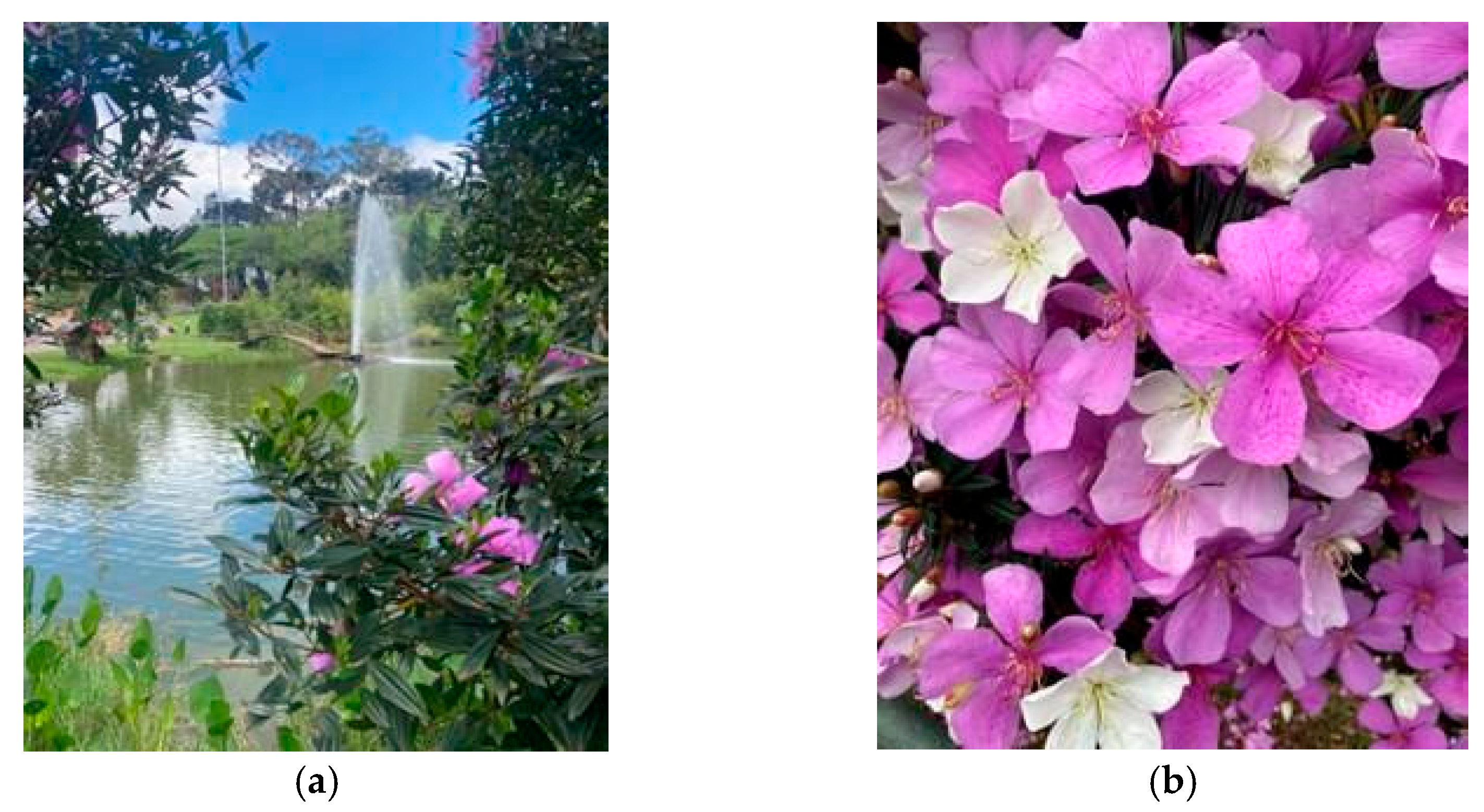
Figure 1. (a) Manacá-da-Serra tree and (b) flowers used for the green synthesis of AgNPs.
Processes 13 03622 g001
Figure 2. (a) Chitosan/AgNPs composite in a Petri dish and (b) close-up view of (a).
Processes 13 03622 g002
Figure 3. UV–Vis spectra of AgNPs synthesized at 25 °C from AgNO3 solutions at concentrations of (a) 0.001, (b) 0.01, (c) 0.05, and (d) 1.0 mol/L (Synthesis 14, respectively).
Processes 13 03622 g003
Figure 4. UV–Vis spectra of AgNPs synthesized at 25 °C using 0.01 mol/L AgNO3 and floral extract at 2.5 g/100 mL under different pH conditions (Synthesis 2; 512).
Processes 13 03622 g004
Figure 5. UV–Vis spectra of AgNPs synthesized using 0.01 mol/L AgNO3 and floral extract at 2.5 g/100 mL, pH 3.5–4.0, at (a) 35 °C and (b) 50 °C (Synthesis 13 and 14, respectively).
Processes 13 03622 g005
Figure 6. TEM images and size distribution of AgNPs synthesized at 25 °C using 0.01 mol/L AgNO3 and floral extract at 2.5 g/100 mL at different pH conditions: (a,a.1) acidic (pH 3.5–4.0), (b,b.1) neutral (pH 7.0), and (c,c.1) basic (pH 12.0) (Synthesis 2, 7, and 12, respectively).
Processes 13 03622 g006
Figure 7. Average ZP values of the green synthesized AgNPs (at 25 °C, using 0.01 mol/L AgNO3 and floral extract at 2.5 g/100 mL) at different pH values.
Processes 13 03622 g007
Figure 8. Petri dishes after 24 h incubation with varying volumes of AgNPs synthesized at 25 °C and pH 3.5–4.0 using 0.01 mol/L AgNO3 and floral extract at 2.5 g/100 mL: (a,d) 5 and 15 μL, (b,e) 25 and 50 μL, and (c,f) 75 and 100 μL. The right (r) and left (l) sides of each Petri dish were better indicated by the yellow dashed line.
Processes 13 03622 g008
Figure 9. FEG-SEM images showing surface morphology of the (a,a.1) chitosan matrix and (b,b.1) chitosan/AgNPs composite. The yellow circles highlight the regions that were further magnified.
Processes 13 03622 g009
Figure 10. EDS spectra and surface chemical mappings of (a,a.1) chitosan and (b,b.1) chitosan/AgNPs composite.
Processes 13 03622 g010
Figure 11. FTIR spectra of chitosan (blue line) and of the chitosan/AgNPs composite (red line).
Processes 13 03622 g011
Figure 12. Thermograms and DTG curves of the (a) chitosan and (b) chitosan/AgNPs composite.
Processes 13 03622 g012
Figure 13. Inhibition zones observed against (a) S. aureus and (b) E. coli strains using chitosan/AgNPs composite.
Processes 13 03622 g013
Figure 14. Evolution of total coliform counts in treated wastewater as a function of treatment time using the chitosan/AgNPs composite.
Processes 13 03622 g014
Table 1. Summary of optimization tests for the green synthesis of AgNPs using Manacá-da-Serra extract.
SynthesisTemperature (°C)pH[AgNO3] (mol/L)
1253.5–4.00.001
20.01
30.05
41.0
5255.00.01
66.0
77.0
88.0
99.0
1010.0
1111.0
1212.0
13353.5–4.00.01
1450
Table 2. Summary of AgNPs green synthesis optimization.
SynthesisParameterVariation Main Observations
1[AgNO3]
(mol/L)
0.001Color change from pink to yellowish-brown coloration. Characteristic SPR band at 410–420 nm detected using AgNO3 0.01 mol/L; absent at other concentrations. Salt concentration is a relevant parameter, but it must be optimized in conjunction with a suitable reagent ratio to be effective and to ensure synthesis efficiency
20.01
30.05
41.0
5pH5.0Color change from pink to yellowish-brown coloration. Characteristic SPR band at 410–420 nm. Synthesis successful. pH is the most influential factor, favoring the formation of smaller and more uniform NPs, indicating a positive influence on the final product quality
66.0
77.0
88.0
99.0
1010.0
1111.0
1212.0
13Temperature
(°C)
35Color change from pink to yellowish-brown coloration. Characteristic SPR band at 410–420 nm and an additional band at 300–400 nm (silver oxides) at 35 and 50 °C. Synthesis not completely successful. Temperature, although relevant, requires simultaneous optimization with other parameters to ensure process selectivity and stability
1450
Table 3. Antimicrobial activity of the chitosan/AgNPs composite, expressed as the average diameter of the inhibition zones (mm) against the tested bacterial strains.
Bacterial StrainAverage Diameter of Inhibition Zone (mm)
S. aureus11 ± 1
E. coli9 ± 1
Disclaimer/Publisher’s Note: The statements, opinions and data contained in all publications are solely those of the individual author(s) and contributor(s) and not of MDPI and/or the editor(s). MDPI and/or the editor(s) disclaim responsibility for any injury to people or property resulting from any ideas, methods, instructions or products referred to in the content.