
Knowledge Organization of Buddhist Learning Resources for Tourism: Virtual Tour of Wat Phra Pathom Chedi




Abstract
1. Introduction
2. Related Literature
2.1. Knowledge Organization of Buddhist Learning Resources for Tourism
2.1.1. Knowledge Organization
2.1.2. Introduction to Metadata
- (1)
- Content: The story or content recorded in the resource (intrinsic).
- (2)
- Context: This identifies who did what, where, how, access rights, preservation, and details about how the resource was created. Context is determined from outside the information resource (extrinsic).
- (3)
- Structure: This relates to the external appearance of the information resource and is the set of relationships within the information resource or between information resources. This set of relationships can be either content based (intrinsic) or contextual (extrinsic) relationships outside the information resource, or both. For example, a book’s content is organized into chapters, each chapter comprising different topics, or one book is related to another by being organized under the same subject.
2.1.3. Metadata of Buddhist Learning Resources for Tourism
- (1)
- CDWA, short for Categories for the Description of Works of Art, is a metadata standard for works of art used in museum management. It was developed by the Art Information Task Force (AITF). The framework for describing works of art and material culture is a set of descriptions comprising 31 elements. These elements help identify differences in data used to describe artifacts and facilitate information retrieval [35].
- (2)
- The Fine Arts Department’s survey model for historical sites. This standard requires each historical site to collect data for use in registering as a historical site. It comprises 26 components [36].
- (3)
- The Fine Arts Department’s Antiquities and Artifacts Registration Model is a standard that requires all national museums to record a total of 19 items of data [37].
2.2. Development of Virtual Tours
2.2.1. Use of Virtual Reality Technology in Tourism
- Using Virtual Reality (VR) technology to develop platforms for effective public relations, such as simulations of Thai historical sites that are not open to the public. and add value to the travel experience.
- Creating an online travel experience instead of physical travel (Online Travel Experience), which has been initiated both domestically and internationally over the past year. Examples include visiting museums, zoos, and tourist attractions via videoconferencing; organizing online concerts; organizing online Red Cross Fairs; and organizing online exhibitions in 3D virtual space format, including images, audio, and video.
2.2.2. Interactive Multimedia System Design and Development Model (IMSDD)
- System Requirements: This is the initial stage of analyzing user needs.
- Design: This is the stage of designing the system to meet user needs. The steps are as follows: (1) Metaphor Design: This involves designing the user interface to create user-computer interaction. (2) Information Design: This involves defining the format and characteristics of various media, including text, still images, animation, audio, and video, to ensure they are appropriate for presentation and efficient dissemination to end users. (3) Design Navigation: This involves defining the format and characteristics of links to enable users to control and access information in various sections independently and comprehensively. (4) Design System Control: This involves defining the necessary requirements. Or, if used together within the system, it can effectively control operations.
- System Development and Installation Implementation involves taking the results of the design, developing, and installing the system to ensure it meets the specified specifications and formats.
- Evaluation: After the system has been installed, an evaluation is required to assess the system’s efficiency and effectiveness in accordance with the system’s design objectives.
3. Materials and Methods
- (1)
- System requirements were studied by user groups: curators, virtual tour designers, and system developers. These three user groups covered the content and visual design of the virtual tour.
- (2)
- Design to meet user needs:
- (2.1)
- Content Design: The researcher analyzed data to develop a dataset for cataloging Wat Phra Pathom Chedi resources. The data contained appropriate fields to describe the details of the resources on display at Wat Phra Pathom Chedi.
- (2.2)
- Design of an information storage and retrieval system, including a virtual tour user interface.
- (3)
- Creation and development of an information storage and retrieval system, including the creation of the virtual tour.
- (4)
- Evaluation of the information storage and retrieval system to ensure that the developed metadata contained all key components and was accurate. Users can easily understand and use the system. This evaluation aims to assess the effectiveness of the virtual tour by experts and system users.
4. Results
4.1. Results of Knowledge Organization at Wat Phra Pathom Chedi, a Buddhist Learning Center for Tourism
4.1.1. Metadata Analysis of Religious Sites
4.1.2. Metadata Analysis of Religious Artifacts
4.2. The Wat Phra Pathom Chedi Virtual Tour: A Case Study in Developing a Model for Buddhist Tourism
4.2.1. Requirements Analysis and User Study
4.2.2. Content and Metadata Schema Design
4.2.3. Virtual Tour Design
- (1)
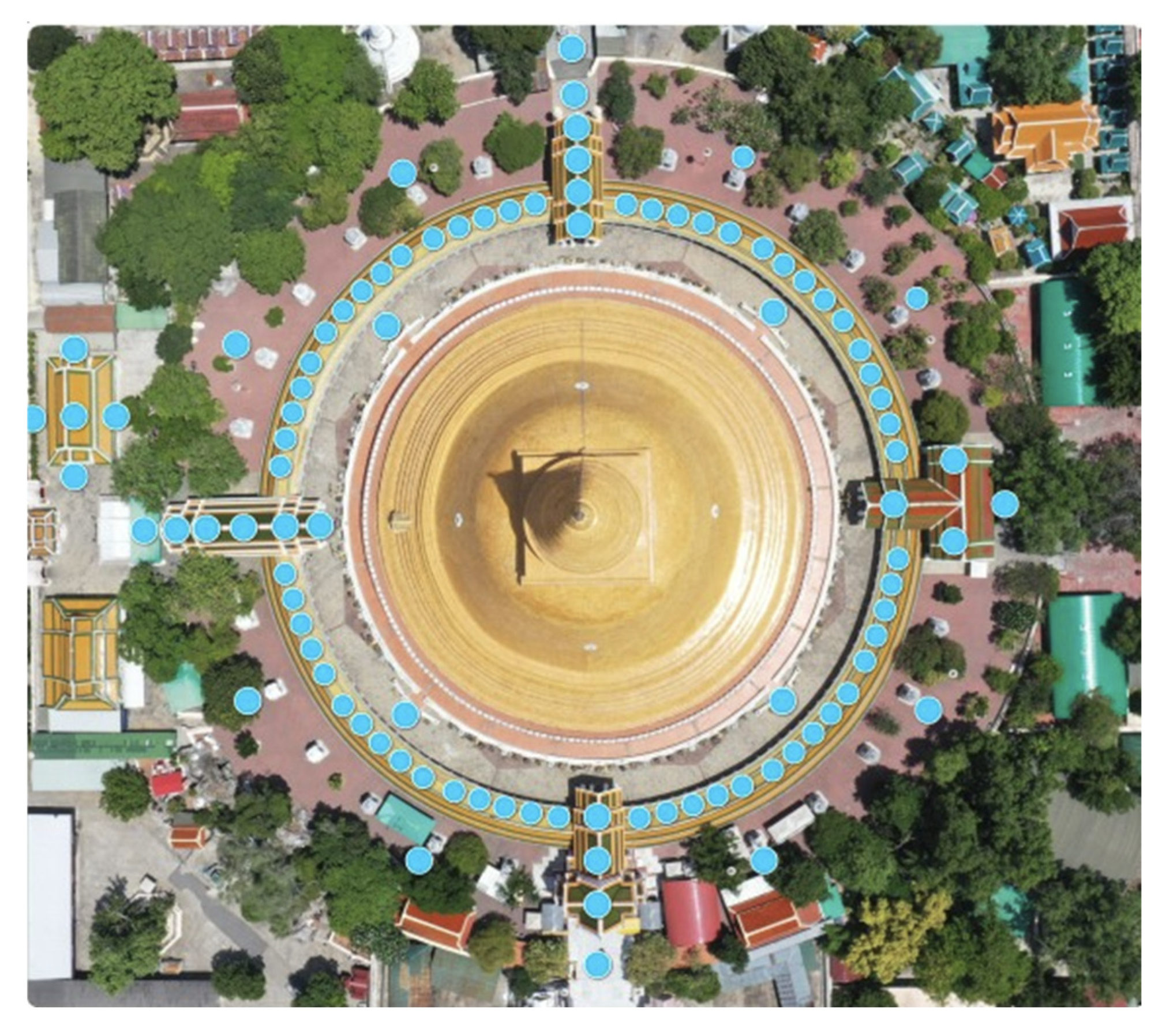
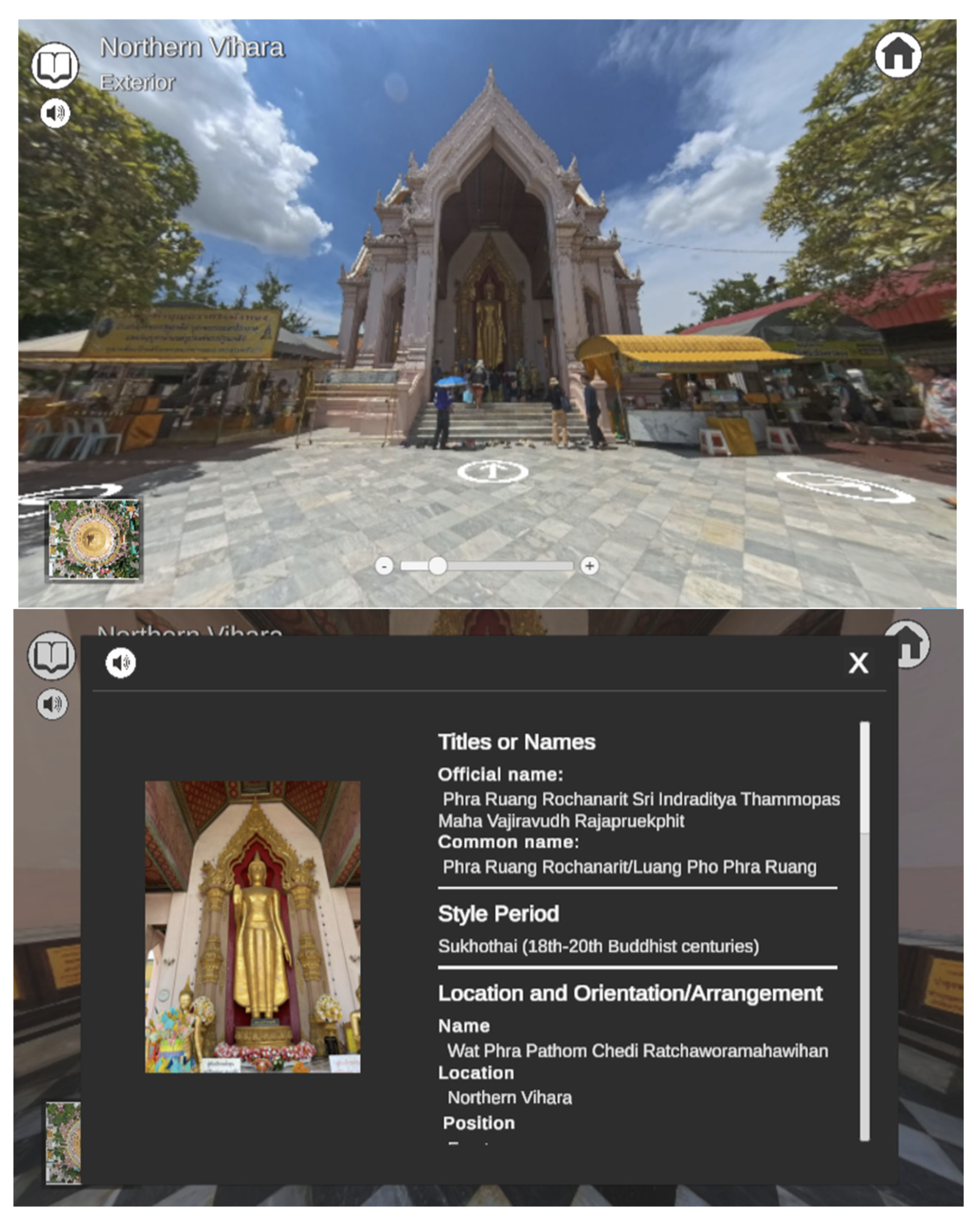
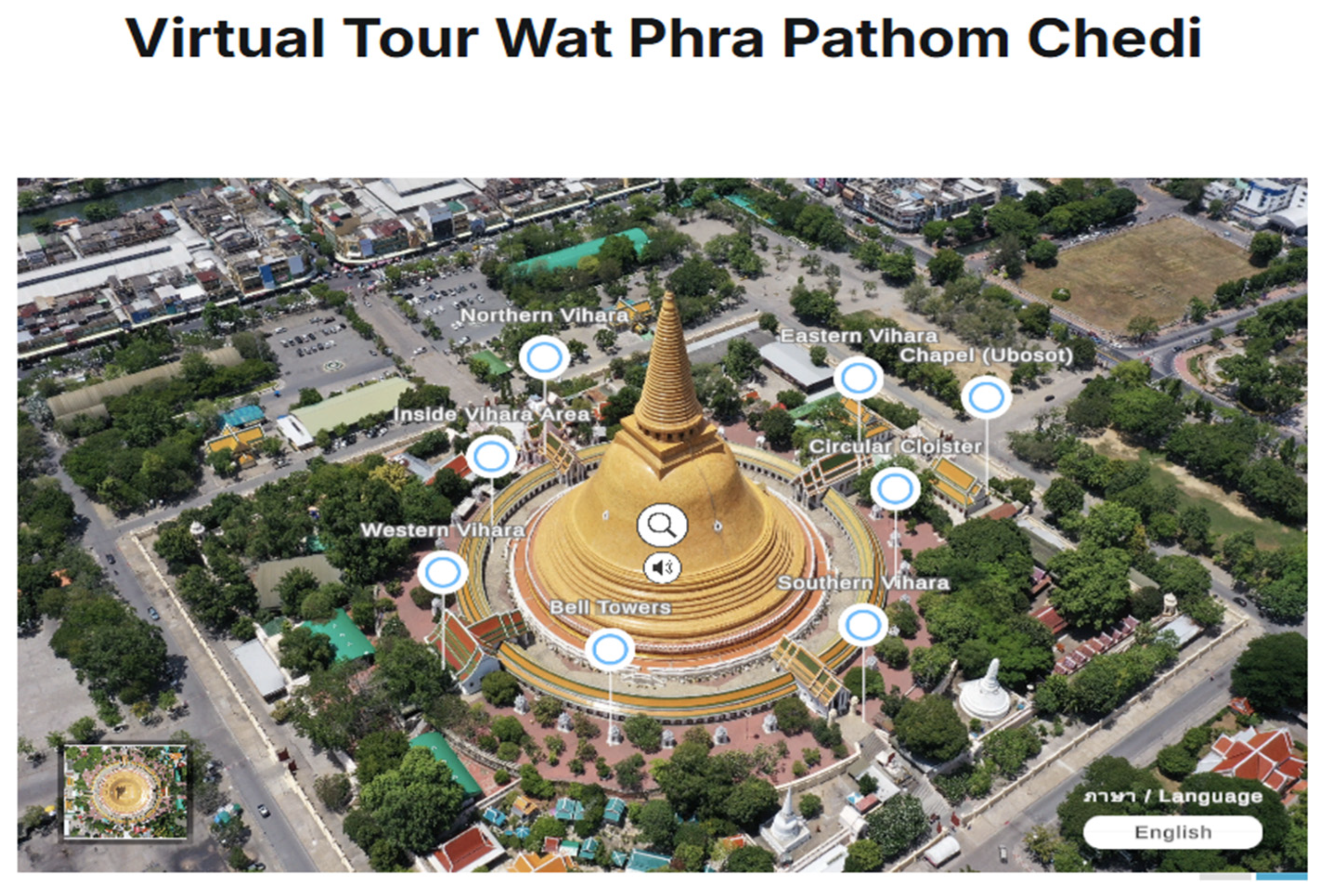
- Navigation Design: This design involved designing a navigation system structure for users to navigate important religious sites around Phra Pathom Chedi. Details are shown in Figure 3. The blue circles represent interactive navigation nodes (hotspots) that users can click to move between different viewpoints and sections within the virtual tour of Wat Phra Pathom Chedi. They indicate accessible locations and directional links that structure the user’s movement path around and within the monument, enabling systematic exploration of the site.
- (2)
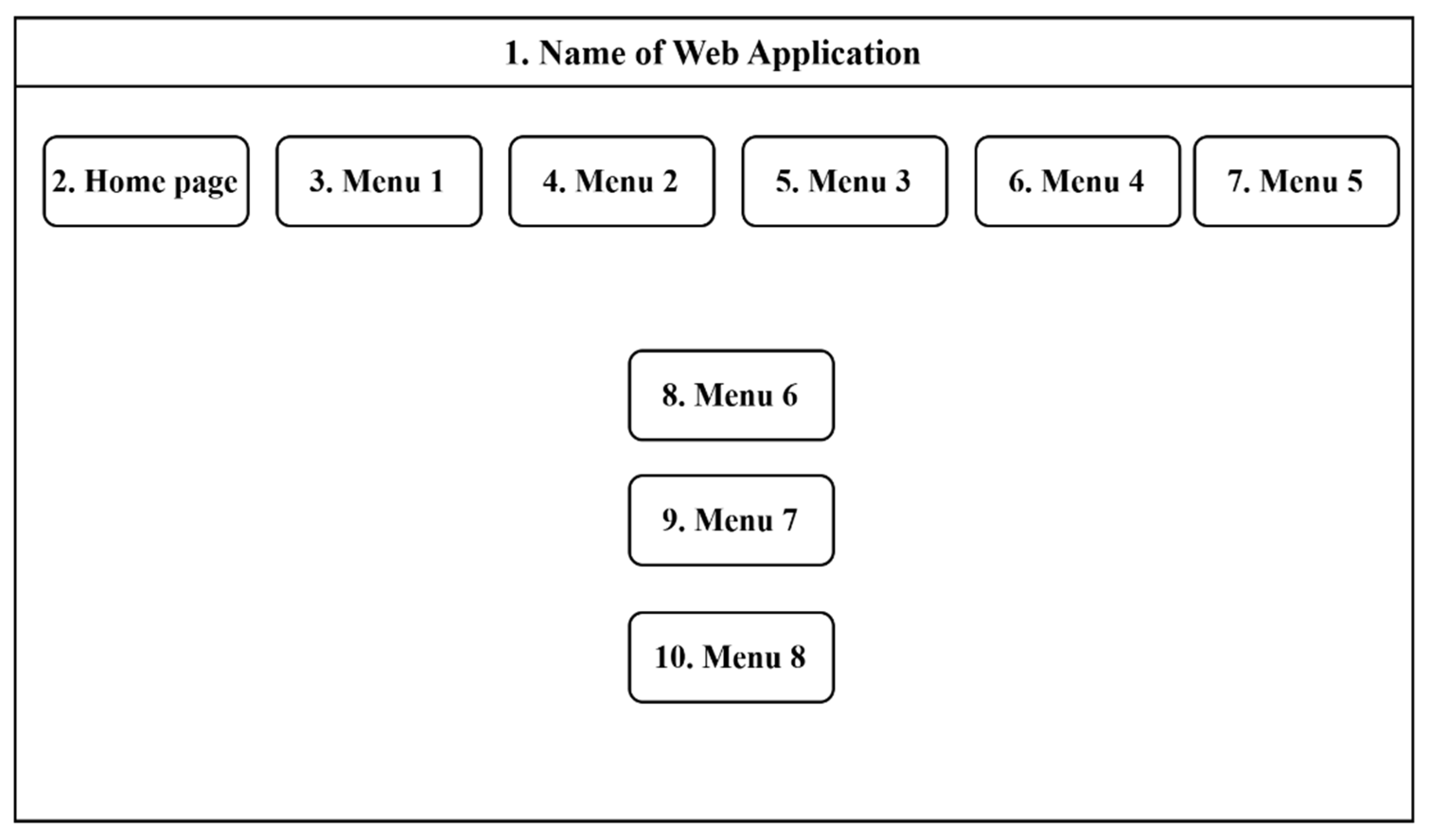
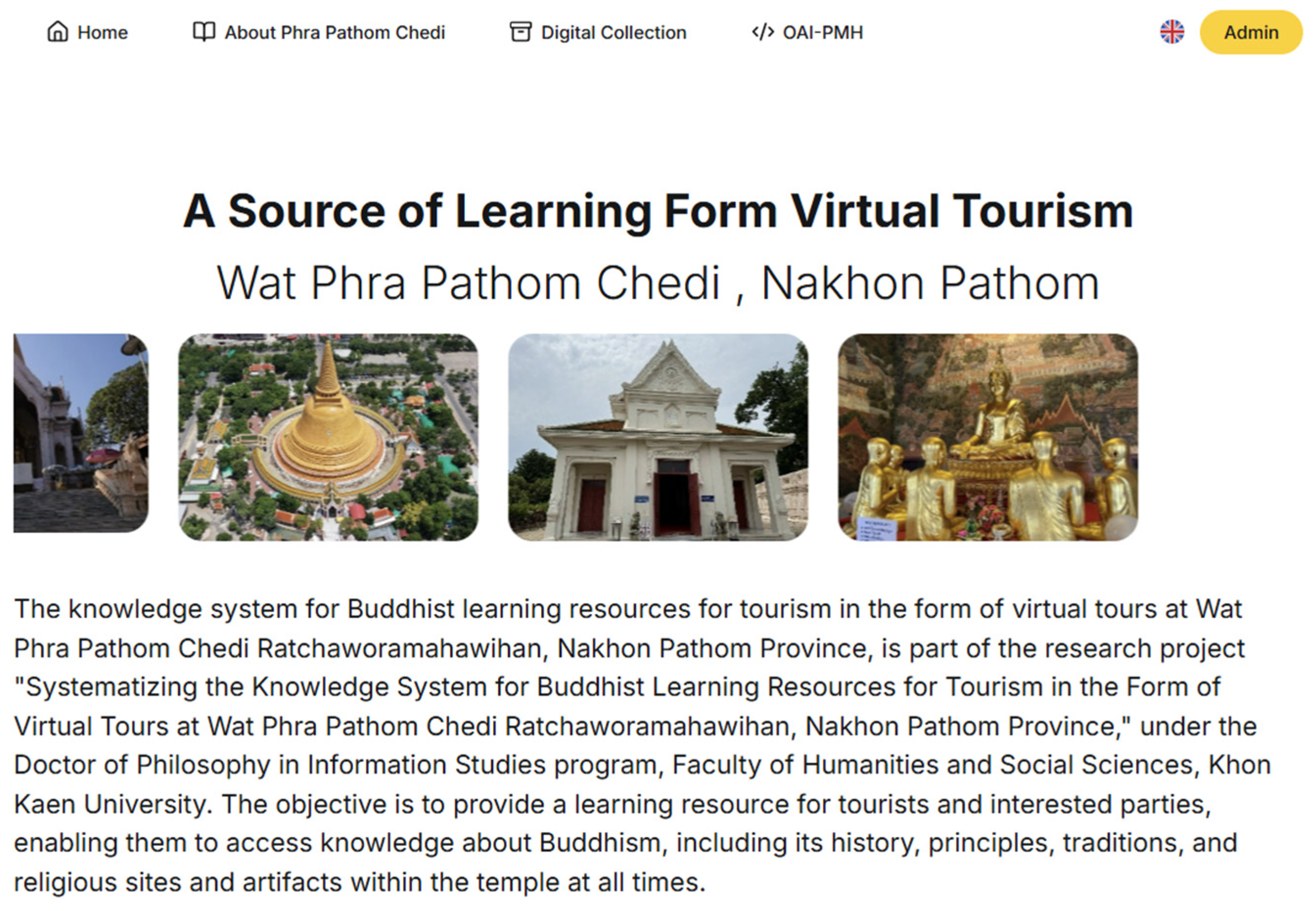
- Wire frame design is a design of the structure of the web application for the Buddhist learning center for tourism in the form of a virtual tour of Wat Phra Pathom Chedi. It is divided into a main page, which shows the data groups of the web application as shown in Figure 4.
- (1)
- Name of Web Application.
- (2)
- Home page: Displays the homepage of the web application, stating the research objectives.
- (3)
- Menu 1: About Wat Phra Pathom Chedi, linking to information pages about Wat Phra Pathom Chedi, location, opening and closing times, and displaying the temple’s coordinates on Google Maps, traditions, Dharma practice/meditation activities at Wat Phra Pathom Chedi, activities within the temple, and other learning resources within Phra Pathom Chedi Temple.
- (4)
- Menu 2: Information Search, linking to a page for searching information by category, type, and era, and allowing searches using names, places, and keywords.
- (5)
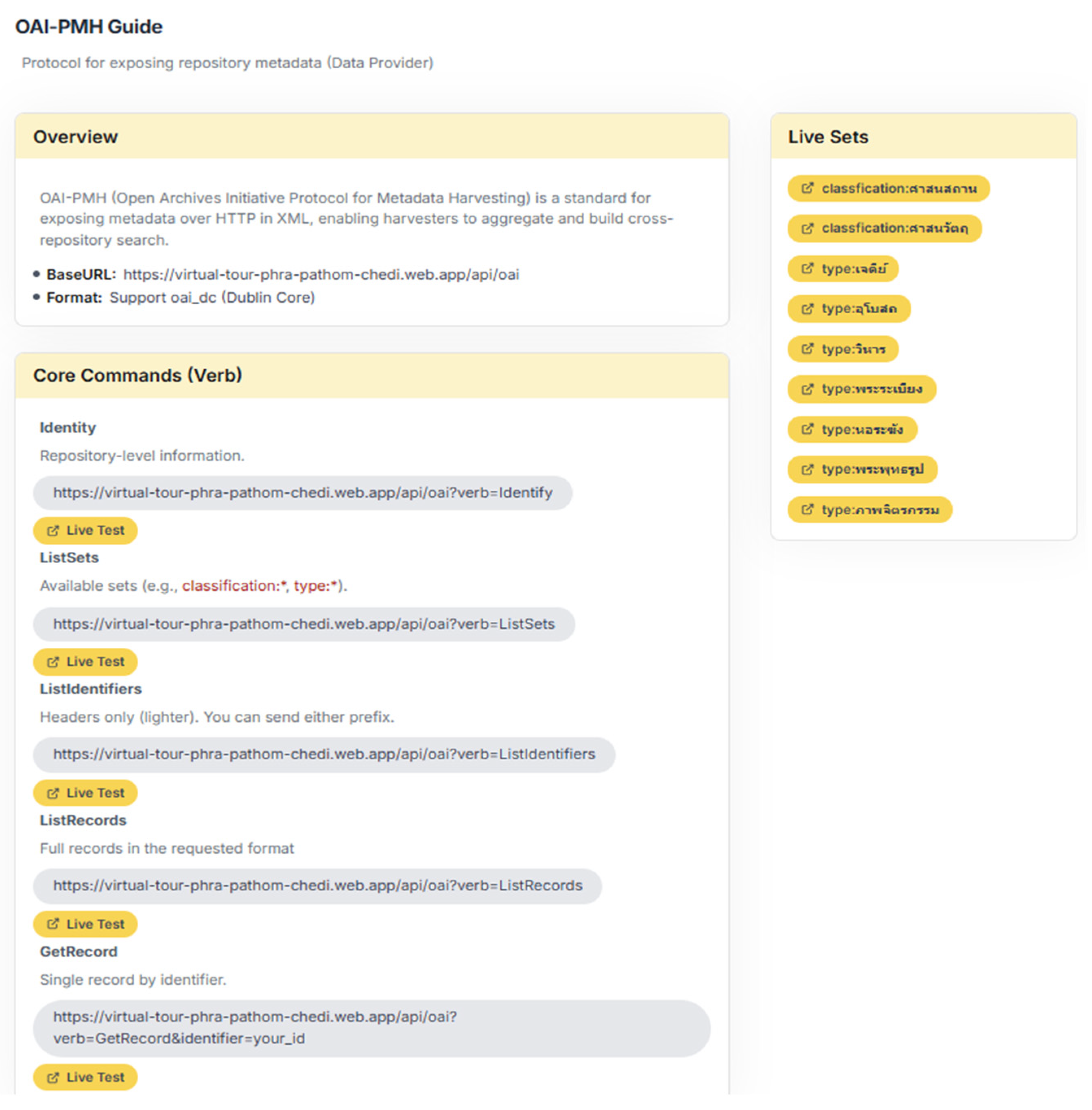
- Menu 3: OAI-PMH Guide service.
- (6)
- Menu 4: Language change button (Thai and English).
- (7)
- Menu 5: For administrators, linking to the administrator page. It serves the function of managing digital resource information for both religious sites and religious artifacts of Wat Phra Pathom Chedi.
- (8)
- Menu 6: Virtual Tour of Wat Phra Pathom Chedi Ratchaworamahavihara. Links to the page for the virtual tour of Wat Phra Pathom Chedi Ratchaworamahavihara.
- (9)
- Menu 7: User Manual. Provides an explanation of mouse controls and menu descriptions for the Wat Phra Pathom Chedi virtual tour system.
- (10)
- Menu 8: Digital Resources. Links to the page for digital resources of religious sites and religious artifacts of Wat Phra Pathom Chedi.
- (3)
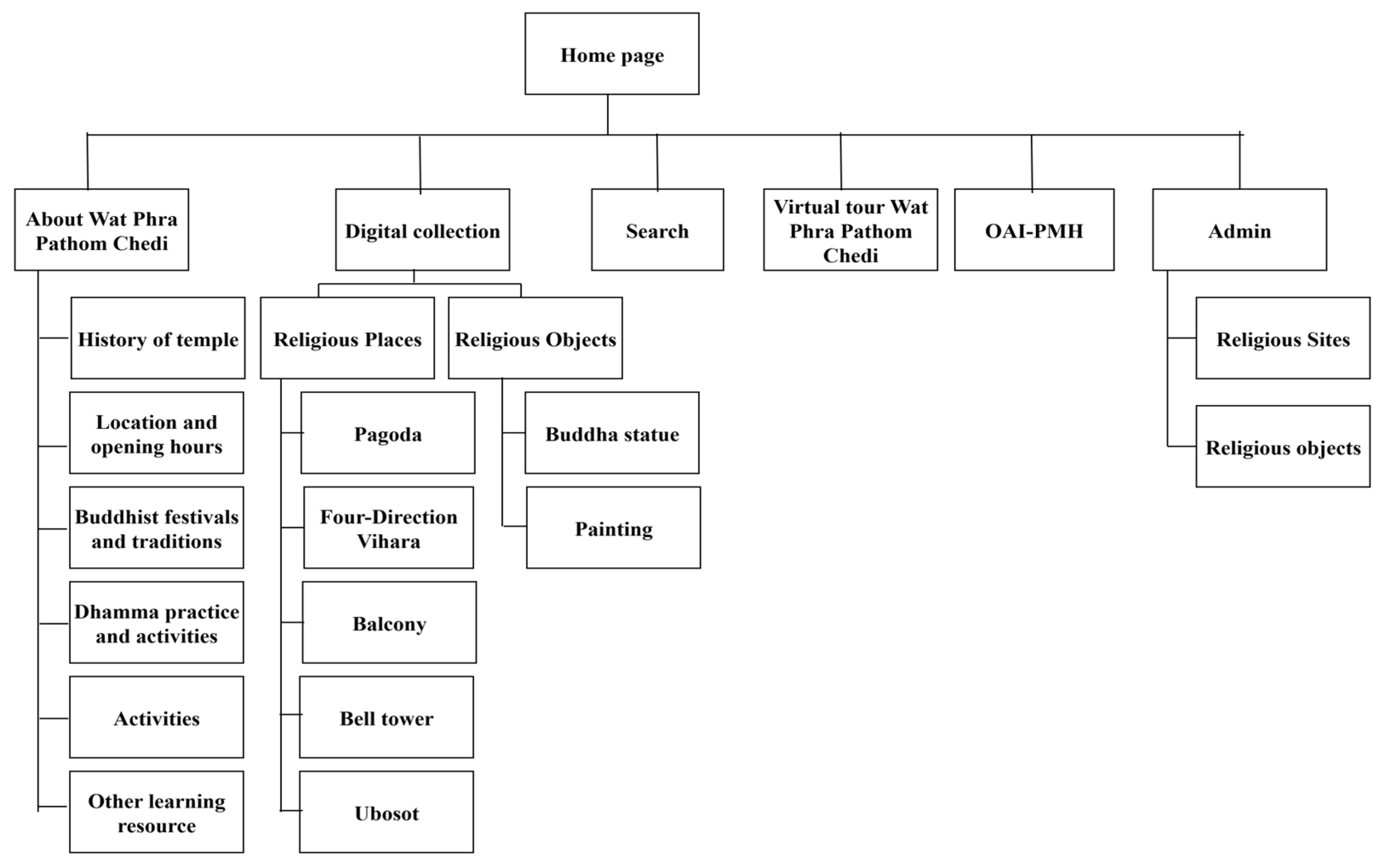
- A site map is a structure showing the connection of data to create understanding between the designer and the content of the web application. The researcher has shown the connection of each part of the data as shown in Figure 5.
- (4)
4.2.4. Evaluation of the Virtual Tour of Wat Phra Pathom Chedi, Nakhon Pathom Province, a Model Buddhist Learning Center for Tourism
5. Discussion
5.1. Knowledge System at Wat Phra Pathom Chedi, a Buddhist Tourism Learning Center
5.2. Virtual Tour of Wat Phra Pathom Chedi, Nakhon Pathom Province, a Model Buddhist Learning Center for Tourism
6. Conclusions
Author Contributions
Funding
Institutional Review Board Statement
Informed Consent Statement
Data Availability Statement
Acknowledgments
Conflicts of Interest
References
- Phraathikarnnatthawat poonyakamo (thaweevorakiat) Boondo, S.; Anothai, S. The Application of The Sappãya 4 In Developing Temples for Buddhist Tourism. MCU Ubonratchathani J. Buddh. Stud. 2025, 7, 185–196. [Google Scholar]
- Ruaengmaneeya, P.; Pochakorn, P.; Pongsuwan, P. Tourism Management Policy on Buddhism in The Eastern Special Development Zone. J. Interdiscip. Innov. Rev. 2022, 5, 140–149. [Google Scholar]
- Nakhon Pathom Provincial Office. History of Nakhon Pathom Province. 2022. Available online: https://www.nakhonpathom.go.th/content/history (accessed on 28 July 2022).
- Wachirapirak, A. Management Policy Suggestions Concerning Temple Tourist Attraction Development as Creative Learning Resources. Ph.D. Thesis, Silpakorn University, Nakhon Pathom, Thailand, 2018. Available online: http://ithesis-ir.su.ac.th/dspace/handle/123456789/2205 (accessed on 22 July 2022).
- Cameron, F.; Kenderdine, S. (Eds.) Theorizing Digital Cultural Heritage: A Critical Discourse; MIT Press: Cambridge, MA, USA, 2007. [Google Scholar]
- Parry, R. Museums in a Digital Age; Routledge: Oxfordshire, UK, 2010. [Google Scholar]
- Gnoli, C. Introduction to Knowledge Organization; Facet Publishing: London, UK, 2020. [Google Scholar]
- Petras, V.; Stiller, J.; Gäde, M. Building for Success? Evaluating Digital Libraries in the Cultural Heritage Domain. 2013. Available online: https://edoc.hu-berlin.de/bitstream/handle/18452/24446/Building-for-Success__-Evaluating-Digital-Libraries-in-the-Cultural-Heritage-Domain.pdf?sequence=1 (accessed on 28 January 2023).
- Aljalahmah, S.H. The Status of The Organization of Knowledge in Cultural Heritage Institutions in Arabian Gulf Countries. Ph.D. Thesis, University of North Texas, Denton, TX, USA, 2021. Available online: https://digital.library.unt.edu/ark:/67531/metadc1833519/ (accessed on 22 July 2022).
- Golub, K.; Ziolkowski, P. Organizing subject access to cultural heritage in Swedish online museums. J. Doc. 2022, 78, 211–247. [Google Scholar] [CrossRef]
- Styliani, S.; Fotis, L.; Kostas, K.; Petros, P. Virtual museums, a survey and some issues for consideration. J. Cult. Herit. 2009, 10, 520–528. [Google Scholar] [CrossRef]
- Tali, K. A model for presenting local museum content based on the concept of present to the past through digital technology: A case study of Ang Sila Local Museum. Ph.D. Thesis, Burapha University, Saen Suk, Thailand, 2017. Available online: https://buuir.buu.ac.th/xmlui/handle/1234567890/8530 (accessed on 22 July 2022).
- Lo, J.H.; Wu, S.D.; You, M.J. Interactive Virtual Reality Touring System: A Case Study of Shulin Ji’an Temple in Taiwan. Mob. Inf. Syst. 2021, 1, 6651916. [Google Scholar] [CrossRef]
- Luca, D.V.; Marcantonio, G.; Barba, M.C.; Paolis, L.T. A Virtual Tour for the Promotion of Tourism of the City of Bari. Information 2022, 13, 339. [Google Scholar] [CrossRef]
- Wu, Y.; Jiang, Q.; Liang, H.; Ni, S. What Drives Users to Adopt a Digital Museum? A Case of Virtual Exhibition Hall of National Costume Museum. SAGE Open 2022, 12, 21582440221082105. [Google Scholar] [CrossRef]
- National Tourism Board. National Tourism Development Plan No. 3 (2023–2027); Ministry of Tourism and Sports: Bangkok, Thailand, 2022. Available online: https://province.mots.go.th/ewtadmin/ewt/ranong/download/article/article_20230418122435.pdf (accessed on 21 March 2023).
- Bangkok Bank. Virtual Tour: Reviving the Tourism Industry in the COVID Era, Adapting the Thai Tourism Business. 2022. Available online: https://bangkokbanksme.com/en/virtual-tour-tourism-industry (accessed on 20 January 2022).
- Office of Knowledge Management and Development (Public Organization). Travel in a New Way, Virtual Tour. 2021. Available online: https://www.okmd.or.th/okmd-kratooktomkit/4112/ (accessed on 19 January 2023).
- Khaenphet, W. The Development Guidelines for Tourism in Thailand to Value Added in The Digital Age. J. Innov. Manag. 2021, 6, 148–160. Available online: https://so03.tci-thaijo.org/index.php/journalcim/article/view/249382/172969 (accessed on 19 January 2023).
- Hjørland, B. What is Knowledge Organization (KO)? Knowl. Organ. 2008, 35, 86–101. [Google Scholar] [CrossRef]
- Hjørland, B. Nine Principles of Knowledge Organization. 1994. Available online: https://repository.arizona.edu/handle/10150/106195 (accessed on 21 March 2023).
- Chansanam, W.; Tuamsuk, K.; Chaikhambung, J. Linked Open Data Framework for Ethnic Groups in Thailand Learning. Int. J. Emerg. Technol. Learn. 2020, 15, 140–156. [Google Scholar] [CrossRef]
- Chulrod, P.; Panthukampol, P. Development of cultural tourism ontology of temples in Muang District, Chiang Mai Province. J. Humanit. Soc. Sci. Univ. Phayao 2022, 10, 320–337. [Google Scholar]
- Pinto, A.; Cardinale, Y.; Dongo, I.; Regina, T.H. An Ontology for Modeling Cultural Heritage Knowledge in Urban Tourism. IEEE Access 2022, 10, 61820–61842. [Google Scholar] [CrossRef]
- Kabmala, M. Information and Knowledge Organization in Digital Environment; Faculty of Humanities and Social Sciences, Khon Kaen University: Khon Kaen, Thailand, 2022; Available online: https://online.anyflip.com/nyyoj/uudx/mobile/ (accessed on 13 October 2025).
- Hider, P. Information Resource Description Creating and Managing Metadata; Facet Publishing: London, UK, 2018. [Google Scholar]
- Riley, J. Understanding Metadata; National Information Standards Organization: Baltimore, MD, USA, 2017. [Google Scholar]
- Baca, M.; Getty Research Institute. Introduction to Metadata; Getty Research Institute: Los Angeles, CA, USA, 2016. [Google Scholar]
- Zeng, M.L.; Qin, J. Metadata; American Library Association: Chicago, IL, USA, 2016. [Google Scholar]
- Haynes, D. Metadata for Information Management and Retrieval: Understanding Metadata and Its Use; Facet Publishing: London, UK, 2018. [Google Scholar]
- Davison, S.; McAulay, E.; Baca, M. Museum materials in a digital library context and beyond. In Proceedings of the 8th ACM/IEEE-CS Joint Conference on Digital Libraries, Pittsburgh, PA, USA, 16–20 June 2008; Volume 5, p. 448. [Google Scholar] [CrossRef]
- Qarabolaq, Z.F.; Seifi, I.M.; Hafezi, H.A.; Tabaei, A.N. The role of PREMIS Preservation metadata in information management in virtual museums. Procedia Soc. Behav. Sci. 2013, 73, 396–402. [Google Scholar] [CrossRef][Green Version]
- Wijesundara, C.; Sugimoto, S. Metadata Model for Organizing Digital Archives of Tangible and Intangible Cultural Heritage and Linking Cultural Heritage Information in Digital Space. Libres 2018, 28, 58–80. [Google Scholar] [CrossRef]
- Getty. Categories for the Description of Works of Art (CDWA). 2022. Available online: https://www.getty.edu/research/publications/electronic_publications/cdwa/definitions.pdf/ (accessed on 28 January 2023).
- Paul Getty Trust; College Art Association. CDWA List of Categories and Definitions. 2022. Available online: https://www.getty.edu/research/ (accessed on 28 January 2023).
- Office of Archaeology, Fine Arts Department. (n.d.). Technical Knowledge for Surveying and Mapping for Registration of Ancient Monuments. Available online: https://www.finearts.go.th/storage/contents/2021/07/detail_file/eO9JJwWc5jvsuPiYp45zqWUeFZecTkvHPRrF1JyT.pdf (accessed on 28 January 2023).
- Office of National Museums, Fine Arts Department. Manual for the Registration of Antiques and Art Objects. 2008. Available online: https://finearts.go.th/storage/contents/detail_file/1WsWxgESixfCL5TxmNZa1oY1SZL8OGcIcUfPIJKC.pdf (accessed on 28 January 2023).
- Wimala, S.; Khuenkam, Y.; Raksakunkan, N. Community Heritage Management of the Community Museum Network with Open Source Software. 2020. Available online: https://cloud-3001.lib.cmu.ac.th/knowledge/client/file/63708f4803e707341c7bc683 (accessed on 2 March 2023).
- Pipe, T.T. Development of Metadata Schema for Myanmar Pagodas’ Information Management. Int. J. Relig. 2024, 5, 2469–2483. [Google Scholar] [CrossRef]
- Ahmad, A.; Sharma, S. Sustainable Digital Preservation and Access of Heritage Knowledge in India: A Review. J. Libr. Inf. Technol. 2020, 40, 321–325. [Google Scholar] [CrossRef]
- Hjørland, B. Reviews of Concepts in Knowledge Organization. Knowl. Organ. 2018, 45, 54–78. [Google Scholar]
- Chernbumroong, S.; Ariya, P.; Yolthasart, S.; Wongwan, N.; Intawong, K.; Puritat, K. Comparing the Impact of Non-Gamified and Gamified Virtual Reality in Digital Twin Virtual Museum Environments: A Case Study of Wieng Yong House Museum, Thailand. Heritage 2024, 7, 1870–1892. [Google Scholar] [CrossRef]
- Trakullertyot, T. Virtual Reality. 2016. Available online: https://www.scimath.org/article-technology/item/4818-virtual-reality (accessed on 19 January 2023).
- Arago, N.; Guzman, D.V.; Leon, N.A.; Esteves, R.; Pepino, T.L.; Socorro, L.D.; Amado, T.; Amon, V.M.; Fernandez, E.O.; Quijano, J.F.C.; et al. MNL Tour: A Web and Mobile Application for Virtual Tour System of Select Tourist Spots Around Manila Using 360-degree Imagery and Virtual Reality Technology. In Proceedings of the IEEE 14th International Conference on Humanoid, Nanotechnology, Information Technology, Communication and Control, Environment, and Management (HNICEM), Boracay Island, Philippines, 1–4 December 2022. [Google Scholar] [CrossRef]
- Dastbaz, M. Designing Interactive Multimedia Systems; McGraw-Hill: Columbus, OH, USA, 2002. [Google Scholar]
- ISO 8601; Date and Time Format. International Organization for Standardization: Geneva, Switzerland, 2019.
- Garrett, J.J. The Elements of User Experience: User-Centered Design for the Web and Beyond; Pearson Education: London, UK, 2011. [Google Scholar]
- Baloian, N.; Biella, D.; Luther, W.; Pino, J.A. Designing, Realizing, Running, and Evaluating Virtual Museum–a Survey on Innovative Concepts and Technologies. J. Univers. Comput. Sci. 2021, 27, 1275–1299. [Google Scholar] [CrossRef]
- Masci, M.E.; Santis, A.; Fernie, K.; Pletinckx, D. Providing Europeana with 3D Content for the Archaeological and Architectural Heritage: The Pompeii Case Study. In Proceedings of the 18th International Conference on Virtual Systems and Multimedia, Milan, Italy, 2–5 September 2012; pp. 227–234. [Google Scholar] [CrossRef]
- Bruce, T.R.; Hillman, D.I. The Continuum of Metadata Quality: Defining, Expressing, Exploiting. In Metadata in Practice; Hillmann, D.I., Elaine, L., Eds.; American Library Association: Chicago, IL, USA, 2004. [Google Scholar]
- Phusa, T.; Kaewsai, P.; Chaochan, P.; Chaisuk, P. Ayutthaya Metaverse: Development of Virtual Tourism of Temples in Phra Nakhon Si Ayutthaya Province; Research Report; Mahachulalongkornrajavidyalaya University: Ayutthaya, Thailand, 2023; Available online: http://mcuir.mcu.ac.th:8080/jspui/handle/123456789/1350 (accessed on 22 July 2024).





| Elements | Experts | Total | IOC | Suggestions | ||||
|---|---|---|---|---|---|---|---|---|
| 1 | 2 | 3 | 4 | 5 | ||||
| 1. Serial Number | +1 | +1 | +1 | +1 | +1 | 5 | 1.0 | |
| 2. Image | +1 | +1 | +1 | +1 | +1 | 5 | 1.0 | |
| 3. Classification | +1 | +1 | +1 | +1 | +1 | 5 | 1.0 | |
| 4. Object/Work Type | +1 | +1 | +1 | +1 | +1 | 5 | 1.0 | |
| 5. Titles or Names | +1 | +1 | +1 | +1 | +1 | 5 | 1.0 | |
| 6. Style Period | +1 | +1 | +1 | +1 | +1 | 5 | 1.0 | |
| 7. Status of the ancient site | +1 | +1 | +1 | +1 | +1 | 5 | 1.0 | Elements 7 and 8 can be combined (P4 and P5). |
| 8. Gazette Announcement | +1 | +1 | +1 | +1 | +1 | 5 | 1.0 | |
| 9. Location | +1 | +1 | +1 | +1 | +1 | 5 | 1.0 | Consideration should be given to specifying geographic coordinates for greater precision (P1). Consideration should be given to adding geographic coordinates (latitude/longitude) to support map-based UI display (P2). |
| 10. Custodian/Possessor | +1 | +1 | +1 | +1 | +1 | 5 | 1.0 | |
| 11. Measurements | +1 | +1 | +1 | +1 | +1 | 5 | 1.0 | |
| 12. Materials/Techniques | +1 | +1 | +1 | +1 | +1 | 5 | 1.0 | |
| 13. Physical Description | +1 | +1 | +1 | +1 | +1 | 5 | 1.0 | Descriptions should describe objects from top to bottom or bottom to top to ensure consistency in the description (P5). |
| 14. History of archaeological and conservation operations | +1 | +1 | +1 | +1 | +1 | 5 | 1.0 | Archaeological details, with possible references for future retrieval (P3). |
| 15. Provenance | +1 | +1 | +1 | +1 | +1 | 5 | 1.0 | Archaeological details, with possible references for future retrieval (P3). |
| 16. Inscriptions | +1 | 0 | +1 | +1 | +1 | 4 | 0.8 | |
| 17. Words of Worship | +1 | +1 | +1 | +1 | +1 | 5 | 1.0 | |
| 18. Subject Matter | +1 | +1 | +1 | +1 | +1 | 5 | 1.0 | This section allows for the inclusion of references for future retrieval (P3). |
| 19. Important things in the ancient site | 0 | +1 | +1 | +1 | +1 | 4 | 0.8 | It might be worthwhile to clearly specify the selection criteria or examples of the “important” things that the researcher will collect data from (P1). |
| 20. Subject | +1 | +1 | +1 | +1 | +1 | 5 | 1.0 | |
| 21. Source of Information | +1 | +1 | +1 | +1 | +1 | 5 | 1.0 | |
| 22. Name and date of data recording | +1 | +1 | +1 | +1 | +1 | 5 | 1.0 | This is appropriate because it allows for traceability (P2 and P3). |
| Elements | Experts | Total | IOC | Suggestions | ||||
|---|---|---|---|---|---|---|---|---|
| 1 | 2 | 3 | 4 | 5 | ||||
| 1. Serial Number | +1 | +1 | +1 | +1 | +1 | 5 | 1.0 | |
| 2. Image | +1 | +1 | +1 | +1 | +1 | 5 | 1.0 | |
| 3. Classification | +1 | +1 | 0 | +1 | +1 | 4 | 0.8 | |
| 4. Object/Work Type | +1 | +1 | 0 | +1 | +1 | 4 | 0.8 | |
| 5. Titles or Names | +1 | +1 | +1 | +1 | +1 | 5 | 1.0 | |
| 6. Style Period | +1 | +1 | +1 | +1 | +1 | 5 | 1.0 | |
| 7. Physical Description | +1 | +1 | +1 | +1 | +1 | 5 | 1.0 | |
| 8. Material | +1 | +1 | +1 | +1 | +1 | 5 | 1.0 | |
| 9. Measurements | +1 | 0 | +1 | +1 | +1 | 4 | 0.8 | Determining the precise dimensions of murals is difficult because, due to their age and the restoration and alterations made bypasses the original size of the paintings. Buddha images, however, can be measured as they have a definite size (P1, P2). While measurements of murals are generally preferred, they are mostly based on the size of the Buddha images themselves. Measuring murals is not common because they are mostly painted on the walls of buildings, which are of varying sizes and shapes. Therefore, precise sizing is challenging and may not fully reflect the overall picture of the artwork (P4). The size of the mural itself is less important than its historical, cultural, or religious context; thus, measuring murals is not a common practice (P5). |
| 10. Location | +1 | +1 | +1 | +1 | +1 | 5 | 1.0 | |
| 11. Orientation/Arrangement | +1 | +1 | +1 | +1 | +1 | 5 | 1.0 | It should be present but can be integrated as the 10th element (P4, P5). |
| 12. Provenance | +1 | +1 | +1 | +1 | +1 | 5 | 1.0 | Archaeological details, with possible references for future retrieval (P3). |
| 13. Inscription | +1 | +1 | +1 | +1 | +1 | 5 | 1.0 | |
| 14. Subject Matter | +1 | +1 | +1 | +1 | +1 | 5 | 1.0 | Archaeological details, with possible references for future retrieval (P3). |
| 15. Words of Worship | +1 | +1 | +1 | +1 | +1 | 5 | 1.0 | |
| 16. Subject | +1 | +1 | +1 | +1 | +1 | 5 | 1.0 | |
| 17. Source of information | +1 | +1 | +1 | +1 | +1 | 5 | 1.0 | |
| 18. Name and date of data recording | +1 | +1 | +1 | +1 | +1 | 5 | 1.0 | This section allows for the inclusion of references for future retrieval (P3). |
| Elements | Description |
|---|---|
| 1. Serial Number | Identify the abbreviations and sequential numbers of all religious structures within the temple. For example, for religious structure number 1, use the abbreviation “ศส.” followed by the sequence number, such as “ศส.001”. |
| 2. Image | Images representing religious sites. |
| 3. Classification | Identified as a religious site/religious artifact. |
| 4. Object/Work Type | Identify the type of religious site, such as temple, chapel, pagoda, corridor, bell tower. |
| 5. Titles or Names 5.1 Official name 5.2 Common name 5.3 Original name | Names of religious sites, including official, common, and old names:
|
| 6. Style Period | The periods/ages in the Buddhist centuries associated with religious sites include: Dvaravati (12th–16th centuries), Srivijaya (13th–18th centuries), Lopburi (17th–19th centuries), Sukhothai (18th–20th centuries), Lanna (19th–23rd centuries), Ayutthaya (20th–23rd centuries), and Rattanakosin (24th century to the present). |
| 7. Status of the ancient site and Gazette Announcement 7.1 Status 7.2 Gazette Announcement | Information regarding the registration of historical sites.
|
| 8. Location 8.1 Name 8.2 Address 8.3 Geographic Location | The name of the religious site, including the address according to the administrative divisions of the Ministry of Interior, such as house number…village…subdistrict/district…amphoe/district…province…
|
| 9. Custodian/Possessor | The person responsible for maintaining the religious site, which may or may not be the owner. |
| 10. Measurements | Specify the dimensions of the religious site, including width, length, and height, in meters. |
| 11. Materials/Techniques 11.1 Materials 11.2 Techniques |
|
| 12. Physical Description | Describing the characteristics or properties of something from a physical perspective, such as shape, color, texture, and other elements that can be seen or touched by the senses, such as sight or touch. The description should be done from the bottom up. |
| 13. History of archaeological and conservation operations | Specify the year (in the Buddhist calendar) of restoration or the period during which the restoration was carried out, identify the person or organization responsible, and describe the events, steps, or actions taken in the repair or conservation work. |
| 14. Provenance | Historical background and significance of the religious site, such as who built it, when it was built, what its purpose was, and the importance of the builder and the site itself. |
| 15. Inscriptions | Letters, descriptions, text, or labels that are part of a religious site. |
| 16. Words of Worship | Letters or text are used to pay homage to sacred entities. |
| 17. Subject Matte 17.1 Buddhist principles 17.2 The history of Buddha 17.3 Related legends 17.4 Related traditions | Content Groups from Religious Sites:
|
| 18. Important things in ancient site 18.1 Name 18.2 Illustration | What are some of the important things found within the religious site, and what are they that the researcher studied for this research?
|
| 19. Subject 19.1 Keyword | Words or phrases designated to represent the content of a religious site for search purposes include name, content group, event, place, person, and organization related to the religious site. Examples include Phra Pathom Chedi, Phra Pathom Chedi (main pagoda), Phra Thom Chedi (pagoda), related legends, and the North Vihara (temple). |
| 20. Source of Information | List of references for the sources used in preparing the report. |
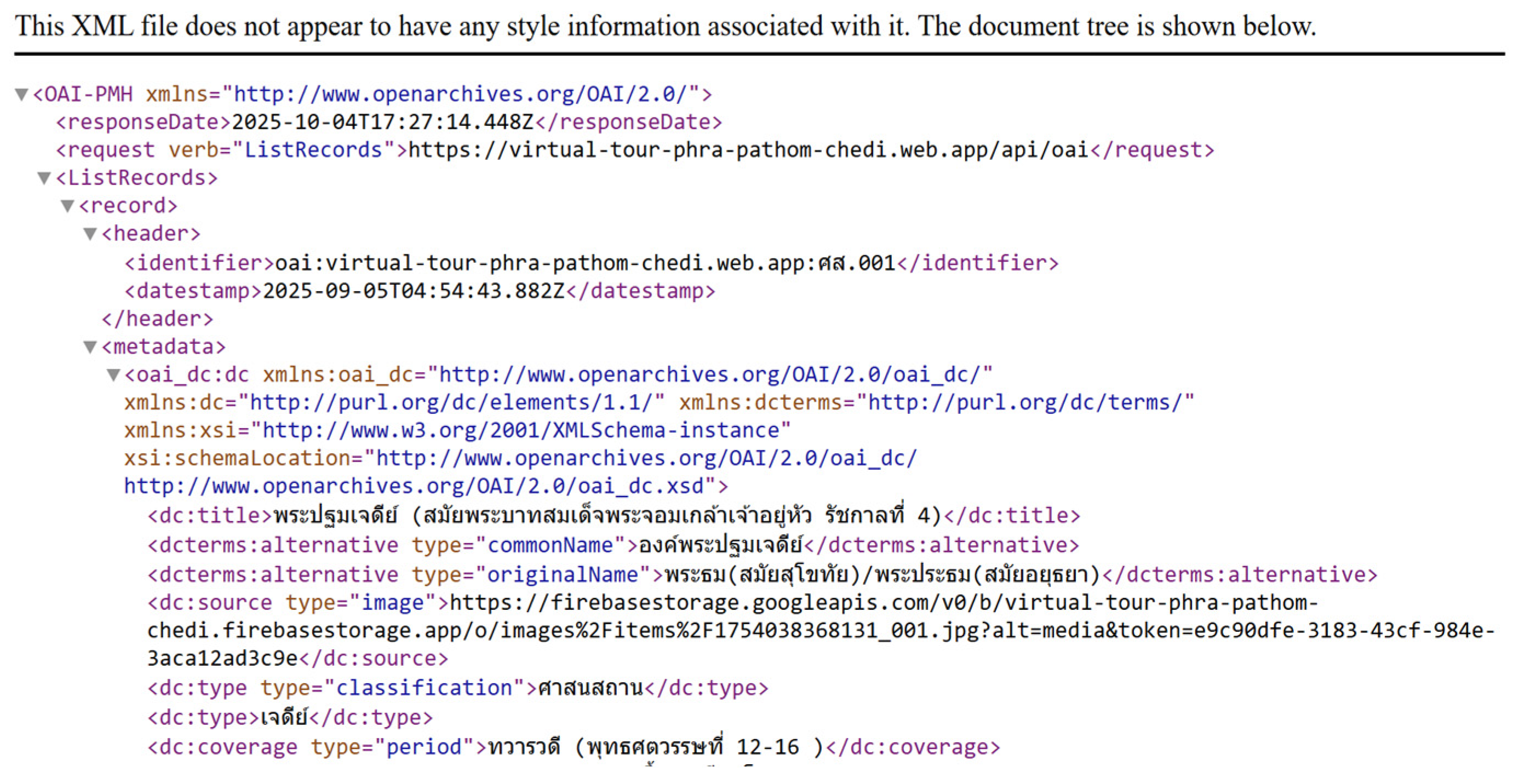
| 21. Name and date of data recording 21.1 The data recorder’s name 21.2 Date of data recording | Specify the full name of the person who recorded the data. Specify the date, month, year, and time the data was entered into the system, using the YYYY-MM-DD date format as per ISO 8601 standard [46]. |
| Elements | Description |
|---|---|
| 1. Serial Number | Identify the abbreviations and sequential numbers of all religious artifacts in the temple. For example, the serial number for artifact number 1 should be abbreviated as ศว. followed by the sequence number, such as ศว.001. |
| 2. Image | Images representing religious objects. |
| 3. Classification | Identified as a religious site/religious artifact. |
| 4. Object/Work Type | Types of religious objects, such as Buddha images, Paintings |
| 5. Titles or Names 5.1 Official name 5.2 Common name 5.3 Original name | Names of religious objects, including official, common, and original names:
|
| 6. Style Period | The periods/ages associated with religious artifacts in the Buddhist centuries include: Dvaravati (12th–16th centuries), Srivijaya (13th–18th centuries), Lopburi (17th–19th centuries), Sukhothai (18th–20th centuries), Lanna (19th–23rd centuries), Ayutthaya (20th–23rd centuries), and Rattanakosin (24th century—present). |
| 7. Location and Orientation/Arrangement 7.1 Name 7.2 Location 7.3 Position | Location of Buddha images/paintings and their positions:
|
| 8. Measurements | In the case of Buddha images, the dimensions of the Buddha image include width, length, height, and lap width, measured in meters. In the case of paintings, an example of how to enter a quotation is “-”. |
| 9. Material 9.1 Material_bs 9.2 Material_p | Materials used in creating Buddha images/paintings:
|
| 10. Physical Description 10.1 Physical 10.2 Description | Identifying the style of Buddha images/paintings and describing their characteristics:
|
| 11. Provenance | Historical significance of Buddha images/paintings (history, creator, discoverer). |
| 12. Inscriptions | Inscriptions on Buddha statues/paintings. |
| 13. Words of Worship | Letters or text are used to pay homage to sacred entities. |
| 14. Subject Matte 14.1 The history of Buddha 14.2 History and spread of Buddhism 14.3 The construction of archaeological sites and artifacts 14.4 Related legends and tales | The content group from religious artifacts consists of texts that describe the subject matter appearing on the artifacts:
|
| 15. Subject 15.1 Keyword | Words or phrases designated to represent the content of religious artifacts for research purposes include names, content groups, events, places, people, and organizations related to the artifacts, such as “Parinirvana Buddha statue”, “Eastern Vihara”, and “Northern Vihara”. |
| 16. Source of information | List of references for the sources used in preparing the report. |
| 17. Name and date of data recording 17.1 The data recorder’s name 17.2 Date of data recording | Specify the full name of the person who recorded the data. Specify the date, month, year, and time the data was entered into the system, using the YYYY-MM-DD date format as per ISO 8601 standard [46]. |
| Metadata of Religious Sites | Dublin Core | Metadata of Religious Artifacts | Dublin Core |
|---|---|---|---|
| 1. Serial Number | Identifier | 1. Serial Number | Identifier |
| 2. Image | Format | 2. Image | Format |
| 3. Classification | Type | 3. Classification | Type |
| 4. Object/Work Type | Type | 4. Object/Work Type | Type |
| 5. Titles or Names 5.1 Official name 5.2 Common name 5.3 Original name | Title | 5. Titles or Names 5.1 Official name 5.2 Common name 5.3 Original name | Title |
| 6. Style Period | Coverage | 6. Style Period | Coverage |
| 7. Status of the ancient site and Gazette Announcement 7.1 Status 7.2 Gazette Announcement | Rights | 7. Location and Orientation/Arrangement 7.1 Name 7.2 Location 7.3 Position | Coverage |
| 8. Location 8.1 Name 8.2 Address 8.3 Geographic Location | Coverage | 8. Measurements | Format |
| 9. Custodian/Possessor | Contributor | 9. Material 9.1 Material_bs 9.2 Material_p | Format |
| 10. Measurements | Format | 10. Physical Description 10.1 Physical 10.2 Description | Description |
| 11. Materials/Techniques 11.1 Materials 11.2 Techniques | Format | 11. Provenance | Description |
| 12. Physical Description | Description | 12. Inscriptions | Description |
| 13. History of archaeological and conservation operations | Description | 13. Words of Worship | Description |
| 14. Provenance | Description | 14. Subject Matte 14.1 The history of Buddha 14.2 History and spread of Buddhism 14.3 The construction of archaeological sites and artifacts 14.4 Related legends and tales | Subject |
| 15. Inscriptions | Description | 15. Subject 15.1 Keyword | Subject |
| 16. Words of Worship | Description | 16. Source of information | Source |
| 17. Subject Matte 17.1 Buddhist principles 17.2 The history of Buddha 17.3 Related legends 17.4 Related traditions | Subject | 17. Name and date of data recording 17.1 The data recorder’s name 17.2 Date of data recording | Contributor Date |
| 18. Important things in ancient site 18.1 Name 18.2 Illustration | Description | ||
| 19. Subject 19.1 Keyword | Subject | ||
| 20. Source of Information | Source | ||
| 21. Name and date of data recording 21.1 The data recorder’s name 21.2 Date of data recording | Contributor Date |
| Metadata of Religious Sites | [39] | Metadata of Religious Artifacts | [38] |
|---|---|---|---|
| 1. Serial Number | 1. Serial Number | Object identifier | |
| 2. Image | 2. Image | ||
| 3. Classification | 3. Classification | ||
| 4. Object/Work Type | 4. Object/Work Type | Work type | |
| 5. Titles or Names 5.1 Official name 5.2 Common name 5.3 Original name | Pagoda Name | 5. Titles or Names 5.1 Official name 5.2 Common name 5.3 Original name | Object name Alternate titles (other names of artifacts) |
| 6. Style Period | 6. Style Period | ||
| 7. Status of the ancient site and Gazette Announcement 7.1 Status 7.2 Gazette Announcement | 7. Location and Orientation/Arrangement 7.1 Name 7.2 Location 7.3 Position | Location/Repository Set | |
| 8. Location 8.1 Name 8.2 Address 8.3 Geographic Location | Location | 8. Measurements | Measurements (size/dimension of artifacts such as width, length, and height) |
| 9. Custodian/Possessor | 9. Material 9.1 Material_bs 9.2 Material_p | Materials/techniques | |
| 10. Measurements | Measurement | 10. Physical Description 10.1 Physical 10.2 Description | Description/Descriptive Note (Details of the object) |
| 11. Materials/Techniques 11.1 Materials 11.2 Techniques | Decoration | 11. Provenance | |
| 12. Physical Description | Physical Description | 12. Inscriptions | |
| 13. History of archaeological and conservation operations | Damage and Conservation | 13. Words of Worship | |
| 14. Provenance | Founding Information | 14. Subject Matte 14.1 The history of Buddha 14.2 History and spread of Buddhism 14.3 The construction of archaeological sites and artifacts 14.4 Related legends and tales | |
| 15. Inscriptions | Inscription Details | 15. Subject 15.1 Keyword | Subjects/keywords |
| 16. Words of Worship | - | 16. Source of information | |
| 17. Subject Matte 17.1 Buddhist principles 17.2 The history of Buddha 17.3 Related legends 17.4 Related traditions | Ritual Information | 17. Name and date of data recording 17.1 The data recorder’s name 17.2 Date of data recording | |
| 18. Important things in ancient site 18.1 Name 18.2 Illustration | Buddha Statue | ||
| 19. Subject 19.1 Keyword | |||
| 20. Source of Information | Related Information | ||
| 21. Name and date of data recording 21.1 The data recorder’s name 21.2 Date of data recording | Management and Authority |
Disclaimer/Publisher’s Note: The statements, opinions and data contained in all publications are solely those of the individual author(s) and contributor(s) and not of MDPI and/or the editor(s). MDPI and/or the editor(s) disclaim responsibility for any injury to people or property resulting from any ideas, methods, instructions or products referred to in the content. |
© 2026 by the authors. Licensee MDPI, Basel, Switzerland. This article is an open access article distributed under the terms and conditions of the Creative Commons Attribution (CC BY) license.
Share and Cite
Kulavijit, B.; Chansanam, W.; Intawong, K.; Puritat, K. Knowledge Organization of Buddhist Learning Resources for Tourism: Virtual Tour of Wat Phra Pathom Chedi. Informatics 2026, 13, 9. https://doi.org/10.3390/informatics13010009
Kulavijit B, Chansanam W, Intawong K, Puritat K. Knowledge Organization of Buddhist Learning Resources for Tourism: Virtual Tour of Wat Phra Pathom Chedi. Informatics. 2026; 13(1):9. https://doi.org/10.3390/informatics13010009
Chicago/Turabian StyleKulavijit, Bulan, Wirapong Chansanam, Kannikar Intawong, and Kitti Puritat. 2026. "Knowledge Organization of Buddhist Learning Resources for Tourism: Virtual Tour of Wat Phra Pathom Chedi" Informatics 13, no. 1: 9. https://doi.org/10.3390/informatics13010009
APA StyleKulavijit, B., Chansanam, W., Intawong, K., & Puritat, K. (2026). Knowledge Organization of Buddhist Learning Resources for Tourism: Virtual Tour of Wat Phra Pathom Chedi. Informatics, 13(1), 9. https://doi.org/10.3390/informatics13010009