


Abstract
This study curates and structures knowledge concerning Buddhist learning resources for tourism, presenting it through a virtual tour of Wat Phra Pathom Chedi Ratchaworamahawihan in Nakhon Pathom Province. Employing a mixed-methods approach that integrates both qualitative and quantitative methodologies, the research first establishes a structured knowledge base. This involves developing a comprehensive metadata schema for cataloging the temple’s diverse resources, including both sacred sites and artifacts, to enhance their searchability and accessibility. Subsequently, this knowledge is rendered into a virtual tour, which serves as an exemplary model of a Buddhist digital learning resource for tourism. The findings reveal the extensive diversity of resources within the temple. The developed virtual tour platform allows users an immersive exploration of the site via 360-degree panoramic views. This research presents significant implications for relevant agencies, offering a scalable model for the digital dissemination of cultural heritage. It is anticipated that this initiative will expand global access to and appreciation of the temple’s cultural value, thereby fostering international interest in visitation. Such engagement is poised to stimulate the local economy and bolster Thailand’s image as a premier cultural tourism destination.
1. Introduction
Buddhist temples serve as learning centers for Buddhist tourism. Temples are places where visitors can gain knowledge about Buddhism, including its history, Buddha images, sacred artifacts, religious principles, customs, and traditions. They also offer insights into temple architecture, sculptures, and paintings. Consequently, temples have become important learning centers and tourist attractions, attracting numerous Thai and international tourists for both educational and recreational purposes [1,2].
Nakhon Pathom Province is an ancient city with a history of prosperity dating back to the Suvarnabhumi period. It was a major capital during the Dvaravati period, serving as a center for the spread of Buddhism from India and a center for religious knowledge, art, and culture [3]. Wat Phra Pathom Chedi is a popular tourist attraction in Nakhon Pathom Province, attracting many tourists due to its numerous religious sites and artifacts, which are valuable cultural resources of historical and archaeological value.
Research studies have identified problems and weaknesses in managing tourism at Wat Phra Pathom Chedi include: a lack of systematic information dissemination, insufficient information on the history of Phra Pathom Chedi, a lack of basic information on ancient artifacts such as ancient Buddha images and architecture, inadequate publicity and exhibitions highlighting the importance of the Phra Pathom Chedi worship festival, insufficient information on local culture of Nakhon Pathom province such as the Phra Pathom Chedi cloth-covering procession, local officials overlooking the importance of Thai cultural traditions, the absence of a database, a strategic plan for Buddhist tourism, and a lack of cooperation in managing Buddhist tourism [4]. These issues indicate a lack of a systematic knowledge management system at Wat Phra Pathom Chedi, which aligns with the current context of cultural heritage information systems, often characterized by fragmented data storage, a lack of narrative context, and an inability to interact with users [5,6]. To address these limitations, the concept of knowledge system organization [7] is applied as a metadata-driven virtual tour. This approach uses structured metadata to describe works of art and architecture [8] and connects scattered knowledge by adapting international standards [9] such as the CDWA standard for describing works of art [10]. The result is an experience in which users can freely explore and interact with cultural heritage [11], enhancing engagement and promoting equitable and sustainable access to knowledge.
The integration of virtual reality technology into knowledge management enables individuals to perceive and learn appropriately, understand content, foster imagination, and create inspiration [12]. Similarly, research by [13,14,15] states that using virtual reality to enhance learning resources and tourism allows people to access and utilize available information. This aligns with the Third National Tourism Development Plan (2023–2027), which outlines a strategy to elevate the tourism experience by providing engaging experiences to tourists even before they decide to travel, through the promotion of virtual reality in services to create novelty and lasting impressions [16]. Currently, the government promotes and supports the use of virtual reality, or virtual tours, in Buddhist tourism to showcase the art, culture, traditions, way of life, and religious sites and artifacts within temples [17].
Virtual tours are becoming an increasingly popular travel trend because they offer a new travel experience that doesn’t require leaving home. With just a computer or smartphone and internet access, tourists can explore the world with a touch of their finger. They can virtually tour the place before visiting it. Thailand has already adopted virtual tour technology for tourism, such as at Vimanmek Palace, Bang Pa-in Palace, and Prasat Sdok Kok Thom in Sa Kaeo Province, Phimai Historical Park in Nakhon Ratchasima Province, Wat Si Chum in Sukhothai Province, and Wat Mahathat Nakhon Si Thammarat in Nakhon Si Thammarat Province, among others. The advantages of virtual tours include the ability to visit anytime, anywhere; spending as much time as needed at each location; receiving experience and information like being in person; and saving travel time and entrance fees [18]. It is evident that information systems are being developed using virtual reality technology to align with the current behavior of tourists who prefer using digital media to search for information about various tourist destinations [19]. Based on the above-mentioned problems and importance, this research aims to organize knowledge about Buddhist learning resources for tourism in the form of virtual tours at Wat Phra Pathom Chedi Ratchaworamahaviharn, Nakhon Pathom Province. This will allow everyone to search for and access information about Wat Phra Pathom Chedi at any time and promote tourism and preserve culture for generations to come.
Despite the growing adoption of virtual tours and digital heritage platforms, existing systems often emphasize visual immersion or heritage conservation, while providing limited support for structured knowledge representation and interoperability with formal metadata. Prior studies frequently rely on generic metadata schemes or project-specific descriptions, which restrict semantic richness, reuse across systems, and educational value. Moreover, Buddhist learning resources—particularly those integrating religious principles, historical narratives, rituals, and material culture—remain underrepresented in formal knowledge organization research. To address this gap, this study proposes and validates a domain-specific metadata schema tailored to Buddhist religious sites and artifacts, integrates it with international interoperability standards, and operationalizes it within a virtual tour environment. This approach advances knowledge organization research by demonstrating how structured metadata can transform cultural heritage sites into scalable, reusable, and pedagogically meaningful digital learning resources.
2. Related Literature
2.1. Knowledge Organization of Buddhist Learning Resources for Tourism
2.1.1. Knowledge Organization
Knowledge organization refers to the collection and organization of knowledge into a structured system, enabling users to access information within an organization [7]. Meanwhile, ref. [20] explains that knowledge organization refers to activities related to knowledge analysis to produce knowledge structures in various formats that can be used to develop tools for searching and accessing knowledge content efficiently and appropriately. A key fundamental principle is that knowledge organization is developed according to the intended use and must clearly state the system’s goals and objectives. Knowledge organization should be linked and differentiated from other related knowledge or disciplines. It should clearly define the scope of knowledge and be developed by those with knowledge and expertise in that field [21,22].
A study of research related to organizing knowledge about Buddhist learning resources for tourism, it was found that the research of [23] used content analysis from collecting data sources available at religious sites using a classification theory of cultural tourism information of temples in Mueang District, Chiang Mai Province, including studying tourists’ search behavior for information on temples. In addition, the research of [24] studied ontology for modeling cultural heritage knowledge for urban tourism. It found that cultural heritage knowledge was categorized according to the UNESCO concept for tourism in Arequipa, Peru, and was divided into tangible and intangible cultural heritage, including places, works of art, performing arts, music, and traditions. In addition, experts were asked about the information needed to describe the components of cultural heritage for urban tourism. The necessary information included information about time: date, period, and event (rituals, traditions, and festivals); information about places: location and spatial information; information about individuals or groups: authors and creators; information about exhibitions and displays; information about additional information descriptions; and information about materials, colors, and shapes. Knowledge organization is important for searching from the definition of the content of the category. Metadata is a tool for organizing content within a group at a detailed level [25]. Knowledge organization of cultural heritage artifacts involves collecting, organizing, and defining metadata to enable users to search for information and background on cultural heritage artifacts. Therefore, knowledge organization must begin with studying user needs and content, which includes four formats of content: text, images, audio, and video. Metadata is also used to describe artifacts so that users can access and search for the desired information [8].
2.1.2. Introduction to Metadata
Currently, several scholars have defined the term “metadata” as follows:
Refs. [26,27] explain that metadata refers to data that describes a specific object or resource’s dataset, including information about item creation, title, topic, attributes, and so on. Metadata is key to the operation of content storage systems, enabling users to search for items of interest, record necessary information, and share that information with others.
Ref. [25] states that metadata is structured information used to describe information in terms of content characteristics and context, including physical characteristics and information production, as well as relationships between elements used in describing the information. The purpose of metadata is to support search and management functions, including specifying access rights, defining intellectual property protection and preservation.
In addition, Refs. [28,29] explained that metadata describes information based on the components of an information resource, including:
- (1)
- Content: The story or content recorded in the resource (intrinsic).
- (2)
- Context: This identifies who did what, where, how, access rights, preservation, and details about how the resource was created. Context is determined from outside the information resource (extrinsic).
- (3)
- Structure: This relates to the external appearance of the information resource and is the set of relationships within the information resource or between information resources. This set of relationships can be either content based (intrinsic) or contextual (extrinsic) relationships outside the information resource, or both. For example, a book’s content is organized into chapters, each chapter comprising different topics, or one book is related to another by being organized under the same subject.
Based on the definitions mentioned above, metadata can be summarized as structured data that describes the content and context of information resources for use in storing and retrieving information.
Today, information resources are increasing rapidly. The development of metadata to facilitate information retrieval and as a tool for describing digital information has made information retrieval more accurate. Metadata also enables the management and exchange of information between applications and the exchange of information between agencies to be more efficient [30].
2.1.3. Metadata of Buddhist Learning Resources for Tourism
Knowledge organization in the form of metadata for architecture and artifacts in learning resources is to help users in searching for information resources. There are many types of metadata schema for managing information resources, such as Dublin Core (DC), MODS (Metadata Object Description Schema), CDWA (Categories for the Description of Works of Art), and VRA (Visual Resources Association–Core Categories for Visual Resources) [31]. General metadata descriptions of information resources are associated with the characteristics of each object, which consist of general fields. However, specialized metadata schema, in which the fields described are specific to each object. It is necessary to analyze to get the appropriate data fields for those resources [32]. In line with the concept of [33], it is explained that the organization of knowledge of tangible and intangible cultural heritage should use one-to-one metadata to help organize the digital tangible and intangible cultural heritage information by clearly distinguishing between the physical and digital data areas or environments of cultural heritage artifacts. The appropriate metadata convention for cataloging cultural artifacts and information resources that cover architecture in terms of building design is CDWA (Categories for the Description of Works of Art). In addition, CDWA represents a complex set of structural elements/categories. There is a set of best practices for cataloging and describing works of art, architecture, other material culture, groups and collections of works, and related images [34].
This research aims to organize knowledge at Wat Phra Pathom Chedi, Nakhon Pathom Province, a Buddhist tourism learning center. Therefore, the researchers chose to use the CDWA metadata, a survey model for historical sites, and a registration model for ancient artifacts and artifacts from the Fine Arts Department, as it is appropriate for the temple’s resources, which include both historical sites and artifacts. Furthermore, the data fields can be adjusted to align with the resources within the learning center as appropriate. Details are as follows:
- (1)
- CDWA, short for Categories for the Description of Works of Art, is a metadata standard for works of art used in museum management. It was developed by the Art Information Task Force (AITF). The framework for describing works of art and material culture is a set of descriptions comprising 31 elements. These elements help identify differences in data used to describe artifacts and facilitate information retrieval [35].
- (2)
- The Fine Arts Department’s survey model for historical sites. This standard requires each historical site to collect data for use in registering as a historical site. It comprises 26 components [36].
- (3)
- The Fine Arts Department’s Antiquities and Artifacts Registration Model is a standard that requires all national museums to record a total of 19 items of data [37].
Research on the use of metadata for cataloging artifacts to ensure accessibility for information users reveals that research by [38] applied the CDWA metadata standard and the CCO cataloging standard to catalog artifacts in local museums in communities to create a network. There are 19 components in total. Ref. [39] research created metadata for Myanmar pagodas by applying CDWA metadata to catalog pagodas in Myanmar. It has 16 main components and 71 sub-components. In addition, ref. [40] describe the application of standards for digitization, accessibility, and preservation in the digital process by institutions in India. India is an ancient city with cultural literature in the form of manuscripts. These heritage resources need to be documented and preserved by digitization and kept safe for future generations and to make them accessible to a wide audience. It also explores the possibility of creating a national metadata standard for the sustainable preservation and retrieval of digital heritage resources nationwide by illustrating and comparing the relationship between the components of metadata frameworks, namely CDWA, MARC, MODS, Dublin Core, and EAD and [10] studied the management of subject matter for access to cultural heritage in Swedish online museums. They stated that the CDWA metadata standard consists of a set of best practices for cataloging and describing works of art, architecture, other material culture, groups, and collections of works. And related images CDWA is a conceptual framework that may be used for designing data models and databases as well as accessing data.
Summary of knowledge organization for Wat Phra Pathom Chedi. The researcher analyzed the knowledge by applying the knowledge organization concept of [41]. They stated that knowledge organization is an activity related to describing information and knowledge details and creating tools for storing, retrieving, and accessing information. Knowledge is organized according to the type of resource and describes artifacts in metadata format by analyzing information characteristics of the content, context, and structure of religious sites and religious artifacts in Wat Phra Pathom Chedi [28,29]. And developed metadata by considering existing metadata standards, including CDWA [35], the Fine Arts Department’s historical site survey model [36], and the antique registration model. Fine Arts Department’s artifacts [37] because they are appropriate and consistent with the religious artifacts and religious sites of the temple and can provide detailed information on the resources in the temple to tourists to lead to the development of digital resource repositories and virtual tours of Buddhist learning resources for tourism at Wat Phra Pathom Chedi Ratchaworamahawihan, Nakhon Pathom Province.
While standards such as Dublin Core and CIDOC CRM support broad cultural heritage interoperability, they often lack the granularity required to represent religious doctrines, ritual functions, and worship-related narratives embedded in Buddhist sites. CDWA, in contrast, provides artifact-centered descriptive depth, which this study extends by incorporating religious knowledge components validated by domain experts.
2.2. Development of Virtual Tours
2.2.1. Use of Virtual Reality Technology in Tourism
Virtual Reality (VR) refers to a computer-generated simulation that mimics the real world, allowing users to interact with the simulation. For example, a simulation of a Thai house allows viewers to explore various rooms as if they were there [42]. This aligns with [43], who explains that virtual reality (VR) is a technology that creates a virtual environment that makes users feel like they are in a different world than the real world.
Currently, Thailand has implemented a variety of digital technology applications in the tourism sector. These include the use of Virtual Reality (VR) technology to assist tourists with travel and location searches via real-time applications, simulations of Thai historical sites that are not open to the public and enriching the travel experience. The use of 5G technology to support other areas, increasing accuracy and speed of communication, coupled with the Internet of Things (IoT) and cloud systems, will further enhance services for tourists. Examples of digital technology applications in tourism include [16]:
- Using Virtual Reality (VR) technology to develop platforms for effective public relations, such as simulations of Thai historical sites that are not open to the public. and add value to the travel experience.
- Creating an online travel experience instead of physical travel (Online Travel Experience), which has been initiated both domestically and internationally over the past year. Examples include visiting museums, zoos, and tourist attractions via videoconferencing; organizing online concerts; organizing online Red Cross Fairs; and organizing online exhibitions in 3D virtual space format, including images, audio, and video.
Meanwhile, the Third National Tourism Development Plan (2023–2027) has established the third strategy to enhance tourism experience (Tourism Experience). This involves providing tourists with travel experience even before they decide to travel, promoting the use of virtual reality technology in services to create novelty and impress tourists.
A study of research related to the use of virtual reality technology to encourage interested individuals to learn from learning resources revealed that the authors of [44] studied MNLTour, which is a web and mobile application for virtual tours of selected tourist attractions around Manila using virtual reality technology. The objective was to develop a web and mobile application for virtual tours of selected tourist attractions throughout Manila using 360-degree images of these attractions, including Rizal Park, Fort Santiago, San Agustin Church, and Baluarte de San Diego. The development of a virtual tour system would benefit the tourism industry in the Philippines, particularly in Manila. The virtual tour system was developed using Unity, a WebGL-based program, using the JavaScript API, which allows developers to display applications created in Unity in web browsers without the need for additional tools or plugins. Thirty users evaluated the web application in four dimensions: functionality, performance, usability, and performance and satisfaction. The evaluation results showed high user satisfaction across all aspects. Furthermore, ref. [14] studied virtual tours to promote tourism in Bari, southern Italy. The results showed that a virtual tour application for Bari was developed, allowing users to take on the role of tourists around the city and view information about its architecture, influenced by centuries of rule. This tool allows users to visit normally inaccessible places and view 360-degree panoramic videos or photographs. The application was developed using 360-degree virtual photography and created as a virtual tour using Unity. After the application was developed, a test was conducted with 30 users completing a questionnaire. The respondents who tried the application had no experience with virtual reality and no specific technological background. The results showed that users were very satisfied in terms of usability, engagement, visual quality, and sense of presence. This research utilizes an image-based VR model, created using real images using panoramic image technology, to present a virtual tour of Wat Phra Pathom Chedi.
Although prior virtual tour studies consistently report high levels of usability, engagement, and user satisfaction, they frequently treat content as static descriptions rather than as structured knowledge objects. As a result, deeper learning support, semantic reuse, and cross-platform interoperability are often underexplored. This limitation highlights the need for metadata-driven virtual learning environments in which cultural heritage content is systematically organized, semantically enriched, and designed for reuse beyond standalone visualization or experiential purposes.
2.2.2. Interactive Multimedia System Design and Development Model (IMSDD)
The Interactive Multimedia System Design and Development Model (IMSDD) describe the process and steps of multimedia design [45]. The process is divided into four steps:
- System Requirements: This is the initial stage of analyzing user needs.
- Design: This is the stage of designing the system to meet user needs. The steps are as follows: (1) Metaphor Design: This involves designing the user interface to create user-computer interaction. (2) Information Design: This involves defining the format and characteristics of various media, including text, still images, animation, audio, and video, to ensure they are appropriate for presentation and efficient dissemination to end users. (3) Design Navigation: This involves defining the format and characteristics of links to enable users to control and access information in various sections independently and comprehensively. (4) Design System Control: This involves defining the necessary requirements. Or, if used together within the system, it can effectively control operations.
- System Development and Installation Implementation involves taking the results of the design, developing, and installing the system to ensure it meets the specified specifications and formats.
- Evaluation: After the system has been installed, an evaluation is required to assess the system’s efficiency and effectiveness in accordance with the system’s design objectives.
Therefore, to develop a virtual tour of Wat Phra Pathom Chedi, the researcher applied [45] Model of Interactive Multimedia System Design and Development (IMSDD) to develop a virtual tour of Phra Pathom Chedi Temple. Metadata was used to catalog the temple’s resources for data storage and retrieval. The system requirements were studied through user studies. Design to meet user needs included content design; information storage and retrieval system design, including the virtual tour media interface; system creation and development; and evaluation of the information storage and retrieval system, including the virtual tour.
3. Materials and Methods
This research investigated the knowledge organization of a Buddhist learning resource for tourism in the form of a virtual tour at Wat Phra Pathom Chedi Ratchaworamahawihan, Nakhon Pathom Province. This research utilized a mixed-methods research approach, both qualitative and quantitative. The researcher conducted two phases of research, which can be described as follows:
Phase 1: Knowledge base organization to create metadata for cataloging resources at Wat Phra Pathom Chedi.
Research Methodology: Expert interviews were used to group the temple’s information resources for presentation in a virtual tour format. Document analysis was conducted to synthesize existing metadata using the Categories for the Description of Works of Art (CDWA) metadata standard, the historical site survey model, and the Fine Arts Department’s registration model for ancient objects and artifacts. Appropriate fields were selected for cataloging the religious sites and artifacts at Wat Phra Pathom Chedi. A resource storage and retrieval system was established, and a virtual tour of Wat Phra Pathom Chedi was created to serve as a Buddhist learning resource for tourism. Furthermore, an Index of Conformity (IOC) was assessed for the developed metadata to confirm its accuracy and appropriateness.
Informants: For the process of grouping temple information resources, three experts were interviewed: an archaeologist from the Fine Arts Department Region 2, the curator of the Phra Pathom Chedi National Museum, and an academic. For the assessment of the metadata index of consistency (IOC) for cataloging developed by the experts, the researcher purposively selected five experts: three academics, one archaeologist, and one curator.
Tools and Data Collection: The tools used included (1) a structured interview form where the researcher interviewed the experts and (2) an online assessment form of the metadata. The researcher submitted the assessment form to the experts for evaluation and returned it.
Data Analysis: Qualitative data analysis was employed to transcribe the interview data, systematically code and analyze the responses, synthesize and summarize emerging themes, and organize and interpret the findings in alignment with the study’s research focus. In addition, quantitative analysis of the assessment forms was conducted to calculate the Index of Item–Objective Congruence (IOC). The detailed results are presented in Table 1 and Table 2.
Table 1.
The results of the Index of Consistency (IOC) assessment of the metadata used to catalog religious sites by experts.
Table 2.
The results of the Index of Consistency (IOC) assessment of the metadata used to catalog religious artifacts by experts.
Phase 2: Development of a Virtual Tour of Wat Phra Pathom Chedi, Nakhon Pathom Province, a model Buddhist learning center for tourism.
Research Methodology: A systems development research methodology was applied, applying the Interactive Multimedia System Design and Development (IMSDD) model [45] to the design and development of the virtual tour of Wat Phra Pathom Chedi. The process involved the following:
- (1)
- System requirements were studied by user groups: curators, virtual tour designers, and system developers. These three user groups covered the content and visual design of the virtual tour.
- (2)
- Design to meet user needs:
- (2.1)
- Content Design: The researcher analyzed data to develop a dataset for cataloging Wat Phra Pathom Chedi resources. The data contained appropriate fields to describe the details of the resources on display at Wat Phra Pathom Chedi.
- (2.2)
- Design of an information storage and retrieval system, including a virtual tour user interface.
- (3)
- Creation and development of an information storage and retrieval system, including the creation of the virtual tour.
- (4)
- Evaluation of the information storage and retrieval system to ensure that the developed metadata contained all key components and was accurate. Users can easily understand and use the system. This evaluation aims to assess the effectiveness of the virtual tour by experts and system users.
Informants: The system requirements study involved three users: a curator, a virtual tour media designer, and a system developer. These three user groups covered the design of the data storage and retrieval system, including the content, interface design, and media layout. The evaluation of the system, including the storage, retrieval, and virtual tour, included 70 users in the trial group of the Phra Pathom Chedi virtual tour system: 10 experts who are academics/researchers using data from Buddhist learning resources, 30 tourists who visited Phra Pathom Chedi, and 30 undergraduate students from the Faculty of Education, Silpakorn University, enrolled in a course on local learning resources. The informants comprised experts in knowledge organization systems, as well as scholars in philosophy, history, and the social sciences; undergraduate students enrolled in local learning courses; and male and female tourists visiting Phra Pathom Chedi Temple.
Tools and Data Collection: The tools used included (1) structured interviews to study user needs. The researcher interviewed users: curators, virtual tour media designers, and system developers. (2) an evaluation form for the Phra Pathom Chedi virtual tour system, conducted by 10 academics/researchers using data from Buddhist learning resources and undergraduate students from the Faculty of Education, Silpakorn University. Thirty students enrolled in the Local Learning Resources course were recruited. The researcher collected data by submitting an online assessment form, and the survey period was from 1 September 2025, to 10 September 2025, until the designated sample size was reached. The sample consisted of 30 tourists visiting Wat Phra Pathom Chedi. Simple random sampling was used. The researcher and research assistants distributed the assessment forms to the tourists. iPads were provided for them to try out and evaluate the system from 1 September 2025, to 10 September 2025, until the designated sample size was reached.
Data Analysis: Two methods were used: (1) Data obtained from interviews. The researcher used a qualitative data analysis method. The interview data were transcribed, coded, analyzed, and synthesized. The data were summarized, grouped, and interpreted according to the study theme. (2) Data obtained from the system assessment form. The researcher used descriptive statistics to describe the data characteristics, including percentages, arithmetic means, and standard deviations. The interpretation of mean scores obtained from the questionnaire analysis was based on a five-level Likert scale. Mean values ranging from 4.21 to 5.00 indicated most satisfied, 3.41 to 4.20 indicated very satisfied, 2.61 to 3.40 indicated moderately satisfied, 1.81 to 2.60 indicated less satisfied, and 1.00 to 1.80 indicated least satisfied.
4. Results
4.1. Results of Knowledge Organization at Wat Phra Pathom Chedi, a Buddhist Learning Center for Tourism
Findings from the knowledge organization initiative at Wat Phra Pathom Chedi, a designated Buddhist Learning Center for Tourism in Nakhon Pathom, indicate a bifurcated classification of information resources into two domains: religious sites and religious artifacts. The presentational framework is structured hierarchically, beginning with the principal religious sites, such as Phra Pathom Chedi, the Four-Direction Vihara, Phra Rabiang, the Ubosot, and the Bell Tower. Information pertinent to religious artifacts within these respective locations is subsequently arranged to cohere with the narrative and structural logic of the virtual tour format.
4.1.1. Metadata Analysis of Religious Sites
The researcher analyzed the characteristics of religious sites in terms of content, context, and structure. The researcher synthesized existing metadata using the Categories for the Description of Works of Art (CDWA) metadata standard, comprising 31 elements (11 elements). The Fine Arts Department’s Historical Site Survey Model comprises 26 elements (10 elements). Analyzing the CDWA metadata and the Fine Arts Department’s historical site survey model yielded a 21-element cataloging model. And from the study of the knowledge of temples that are learning centers of Buddhist ways for tourism, it was found that there is one additional related component, namely, worship words, and 4 sub-components were added to the main subject component (Subject Matter), namely, Buddhist principles, knowledge of the life of the Buddha, related legends or tales, and related traditions, which are content groups with explanations. Therefore, there are 22 main components used to list religious sites. Experts were asked to evaluate the Index of Conformity (IOC) of the metadata used to list religious sites. Experts agreed that it was appropriate and suggested combining the components of the status of the ancient site and the announcement in the Royal Gazette, because if the religious site is registered as an ancient site, information on the announcement in the Royal Gazette must also appear in the same component, so it can be combined in the same component. And added a sub-component of geographic coordinates to the main component of location. Therefore, it can be concluded that the metadata for religious sites consists of 21 key elements suitable for cataloging religious sites at Wat Phra Pathom Chedi. Table 3 presents a detailed breakdown of the metadata fields used in this study.
Table 3.
The summary of the Metadata Schema for Religious Sites at Wat Phra Pathom Chedi.
Beyond achieving high completeness and expert agreement, the proposed metadata schema contributes to knowledge organization by explicitly modeling religious knowledge dimensions—such as Buddhist principles, worship texts, ritual practices, and historical narratives—alongside physical and architectural descriptions. This layered structure enables semantic linking between sites and artifacts, supports multilingual access, and facilitates interoperability through Dublin Core mapping and OAI-PMH harvesting. As a result, the schema functions not only as a descriptive tool but also as a reusable knowledge infrastructure that supports education, research, and digital heritage exchange.
4.1.2. Metadata Analysis of Religious Artifacts
The researcher analyzed the characteristics of religious artifacts in terms of content, context, and structure. The researcher synthesized existing metadata using the Categories for the Description of Works of Art (CDWA) metadata standard, which consists of 31 elements. The researcher selected 13 elements and the Fine Arts Department’s registration model for ancient artifacts, which consists of 19 elements. The researcher selected 5 elements from the analysis of CDWA metadata and the registration model for ancient artifacts. The Fine Arts Department’s artifact cataloging model consists of 18 main components. A study of the knowledge base of temples serving as learning centers for Buddhist tourism revealed one additional component: words of worship. Four additional components were added to the subject matter: knowledge of the life of the Buddha, the spread of Buddhism, the events surrounding the construction of religious sites and artifacts, and related legends or tales, which form a group of content with explanations. Therefore, there are 18 main components used to catalog religious artifacts. Experts assessed the Index of Conformity (IOC) of the metadata used to catalog religious artifacts. Experts found it appropriate and suggested combining the location and position components. Therefore, it can be concluded that the metadata for religious artifacts consists of 17 main components suitable for cataloging. The metadata fields used in this study and their detailed descriptions are summarized in Table 4.
Table 4.
The summary of the Metadata Schema for Religious Artifacts at Wat Phra Pathom Chedi.
4.2. The Wat Phra Pathom Chedi Virtual Tour: A Case Study in Developing a Model for Buddhist Tourism
This research employed a systems development methodology for the creation of a virtual tour of Wat Phra Pathom Chedi, envisioned as a model for Buddhist tourism. This research was guided by the Interactive Multimedia System Design and Development (IMSDD) model proposed by [45]. The developmental process comprised four distinct phases: (1) requirements analysis; (2) system design; (3) system implementation; (4) evaluation. The principal findings from the initial phases are presented below.
4.2.1. Requirements Analysis and User Study
The initial phase determined that the temple’s informational assets should be categorized into two primary classes for presentation within the virtual tour: religious sites and religious artifacts. A user needs analysis further informed the organizational structure, leading to the identification of 8 principal religious sites: Phra Pathom Chedi, the Northern Vihara, the Western Vihara, the Gallery, the Bell Tower, and the Ubosot (Ordination Hall). In addition to the sites, the scope encompassed significant religious artifacts, such as a collection of 25 prominent Buddha images and paintings distributed across these locations.
4.2.2. Content and Metadata Schema Design
In the design phase, a comprehensive metadata schema was formulated by synthesizing established standards, including Categories for the Description of Works of Art (CDWA), alongside the Fine Arts Department’s models for historical site surveys and artifact registration. This bespoke schema was specifically engineered to catalog the temple’s resources. It incorporated 21 distinct fields to capture descriptive details for religious sites and 17 fields for religious artifacts. All structured data populates a central digital repository, which serves to store and dynamically present information within the virtual tour.
Furthermore, after identifying the elements used to describe religious sites and objects, the researchers mapped these elements to the Dublin Core Metadata Element Set (DCMES). This mapping was used to develop an OAI-PMH-based system, enabling efficient metadata harvesting and dissemination in compliance with international standards. The detailed mappings are presented in Table 5.
Table 5.
Mapping to the Dublin Core Metadata Element Set (DCMES) standard.
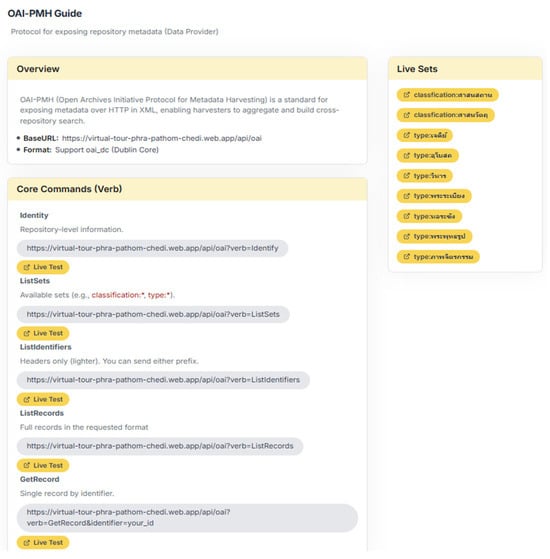
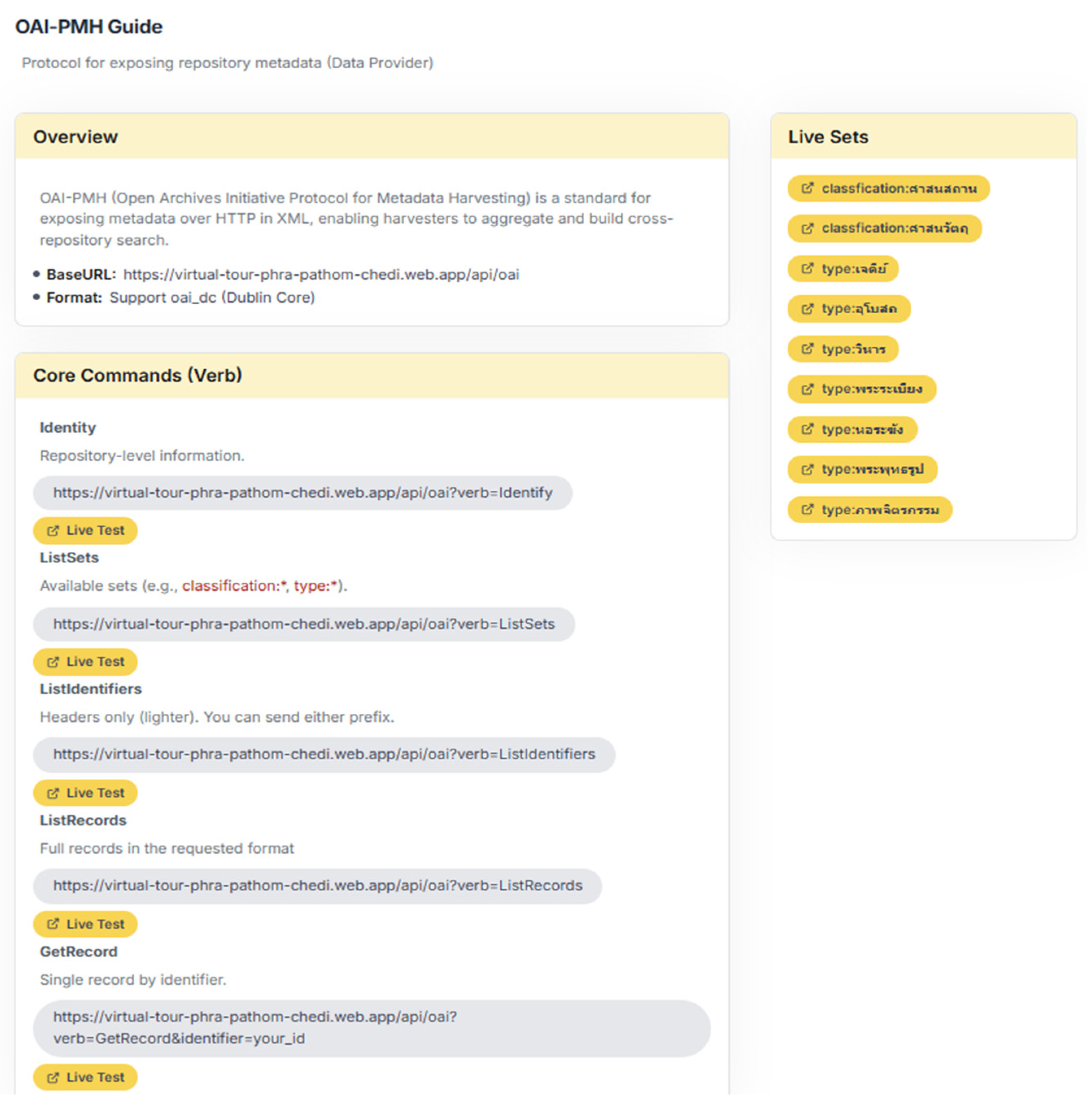
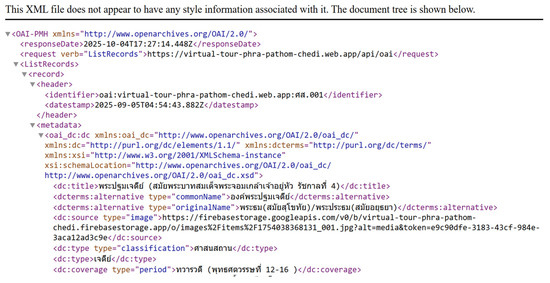
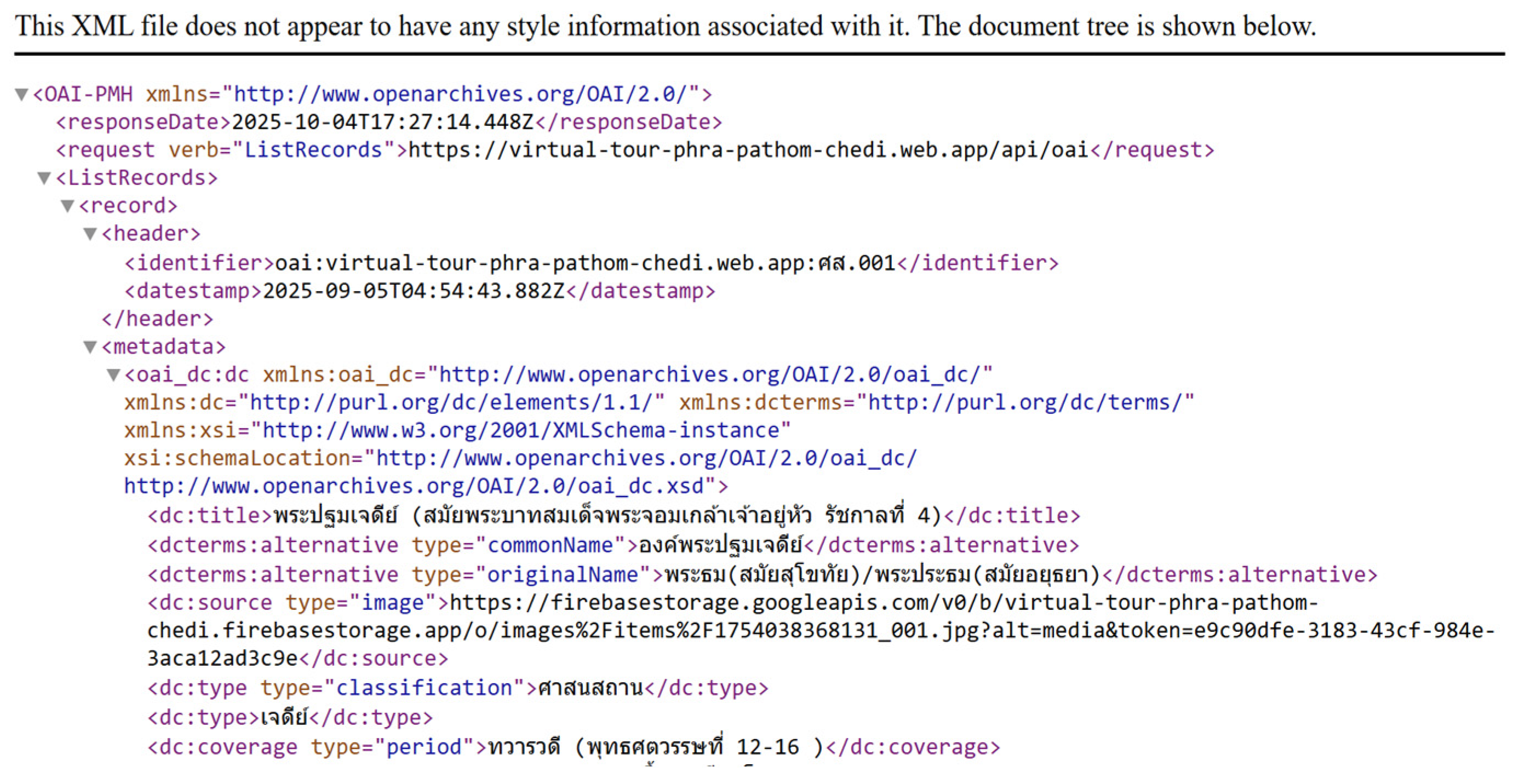
Additionally, there is OAI-PMH, which uses XML for verb-based commands and the Dublin Core Metadata standard to enable data in the database to be shared with other systems using international standards, as shown in Figure 1 and Figure 2.
Figure 1.
Shows the OAI-PMH page available on the web. * The asterisk indicates a required/mandatory metadata element in the OAI-PMH XML record.
Figure 2.
Shows an example of a ListRecord command used to request all records.
4.2.3. Virtual Tour Design
The researcher applied the Elements of User Experience [47] concept to the design of a web application for Buddhist learning resources aimed at tourism, featuring a virtual tour of Wat Phra Pathom Chedi. The design consisted of:
- (1)
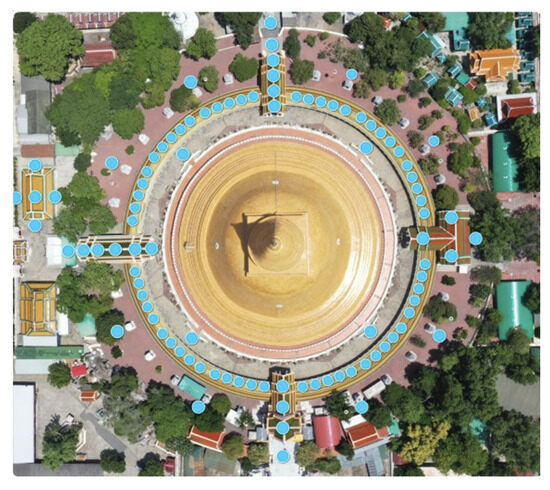
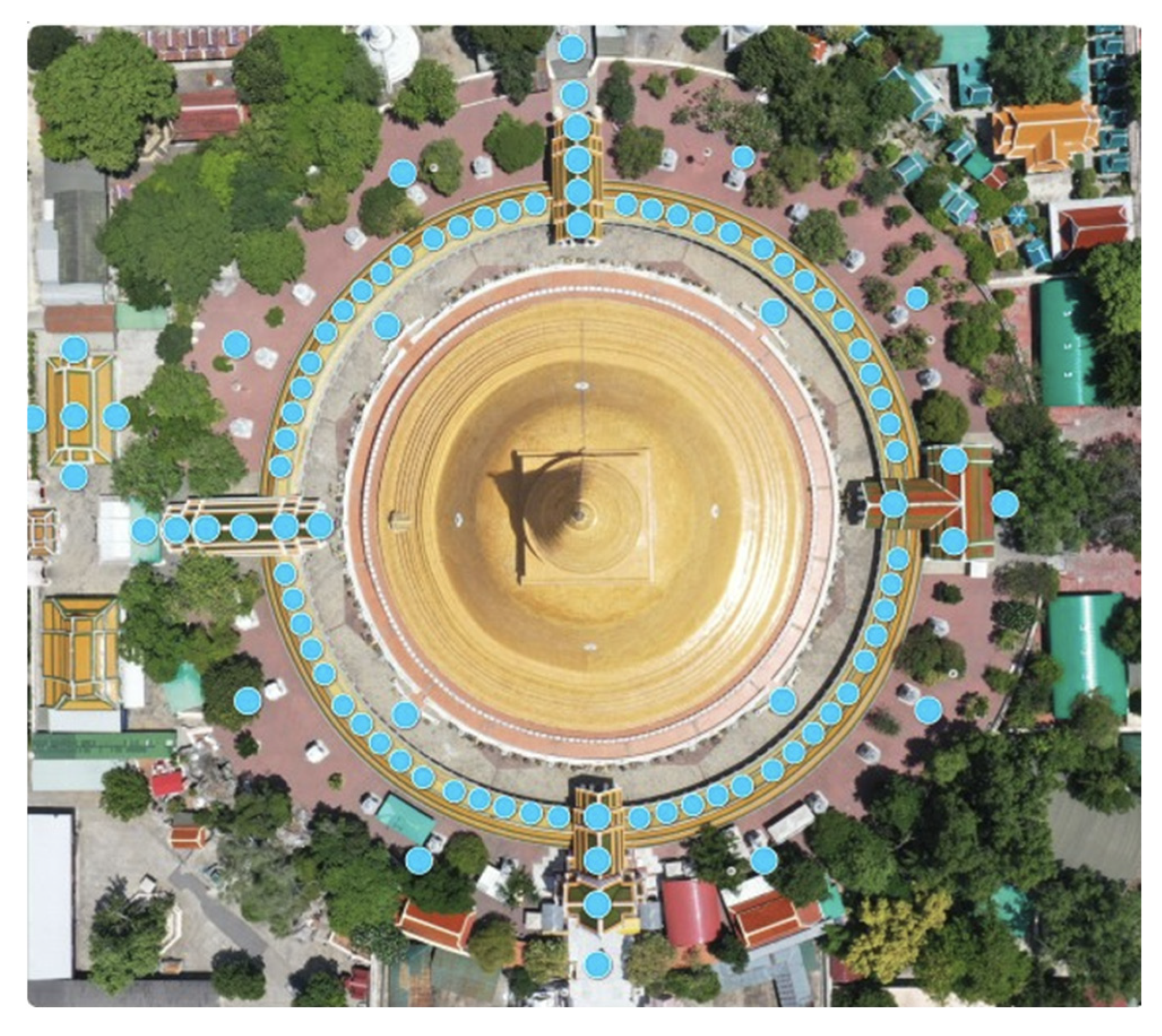
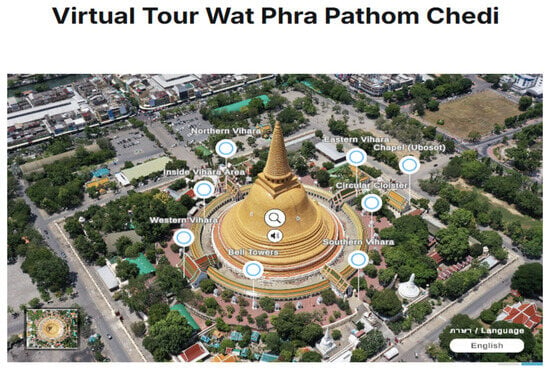
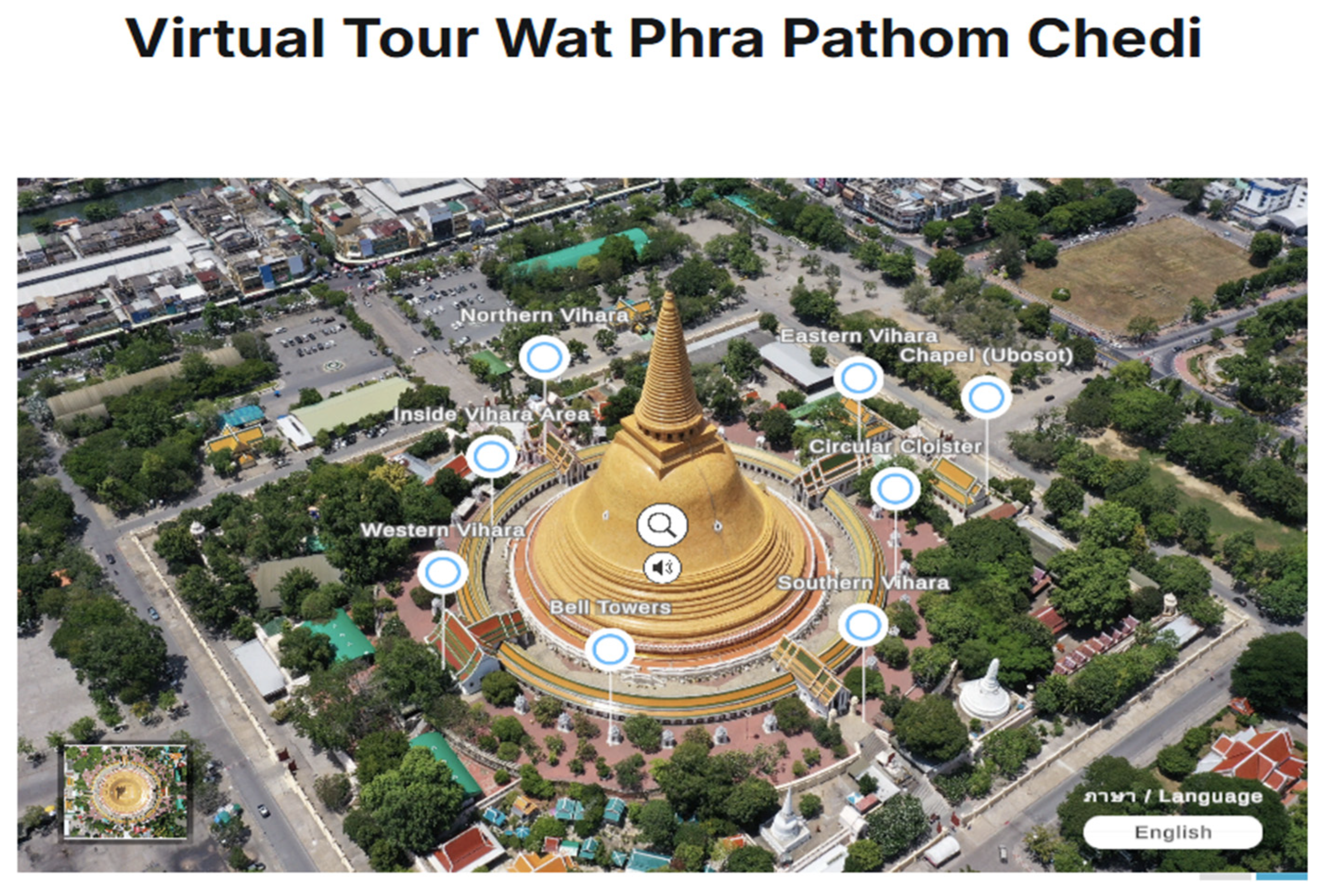
- Navigation Design: This design involved designing a navigation system structure for users to navigate important religious sites around Phra Pathom Chedi. Details are shown in Figure 3. The blue circles represent interactive navigation nodes (hotspots) that users can click to move between different viewpoints and sections within the virtual tour of Wat Phra Pathom Chedi. They indicate accessible locations and directional links that structure the user’s movement path around and within the monument, enabling systematic exploration of the site.Figure 3. Shows the navigation system structure for users of the virtual tour of Wat Phra Pathom Chedi.
- (2)
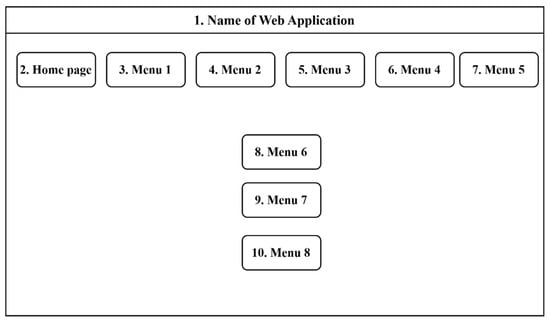
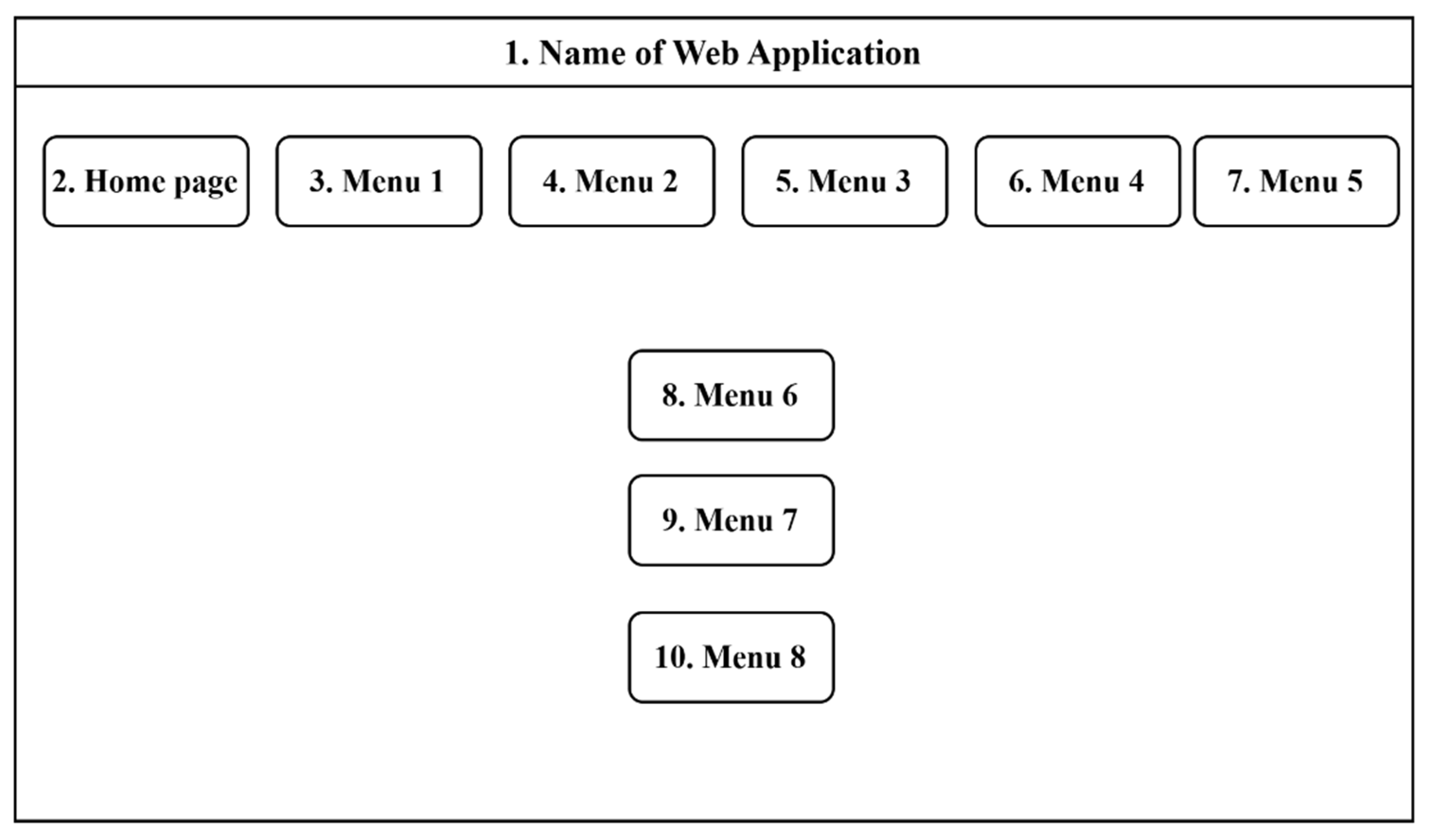
- Wire frame design is a design of the structure of the web application for the Buddhist learning center for tourism in the form of a virtual tour of Wat Phra Pathom Chedi. It is divided into a main page, which shows the data groups of the web application as shown in Figure 4.Figure 4. Shows the wire frame design of the main menu page of the Buddhist learning center for tourism at Wat Phra Pathom Chedi.
The structure and components of the main menu designed for the Buddhist virtual learning resource related to Phra Pathom Chedi Temple are described as follows:
- (1)
- Name of Web Application.
- (2)
- Home page: Displays the homepage of the web application, stating the research objectives.
- (3)
- Menu 1: About Wat Phra Pathom Chedi, linking to information pages about Wat Phra Pathom Chedi, location, opening and closing times, and displaying the temple’s coordinates on Google Maps, traditions, Dharma practice/meditation activities at Wat Phra Pathom Chedi, activities within the temple, and other learning resources within Phra Pathom Chedi Temple.
- (4)
- Menu 2: Information Search, linking to a page for searching information by category, type, and era, and allowing searches using names, places, and keywords.
- (5)
- Menu 3: OAI-PMH Guide service.
- (6)
- Menu 4: Language change button (Thai and English).
- (7)
- Menu 5: For administrators, linking to the administrator page. It serves the function of managing digital resource information for both religious sites and religious artifacts of Wat Phra Pathom Chedi.
- (8)
- Menu 6: Virtual Tour of Wat Phra Pathom Chedi Ratchaworamahavihara. Links to the page for the virtual tour of Wat Phra Pathom Chedi Ratchaworamahavihara.
- (9)
- Menu 7: User Manual. Provides an explanation of mouse controls and menu descriptions for the Wat Phra Pathom Chedi virtual tour system.
- (10)
- Menu 8: Digital Resources. Links to the page for digital resources of religious sites and religious artifacts of Wat Phra Pathom Chedi.
- (3)
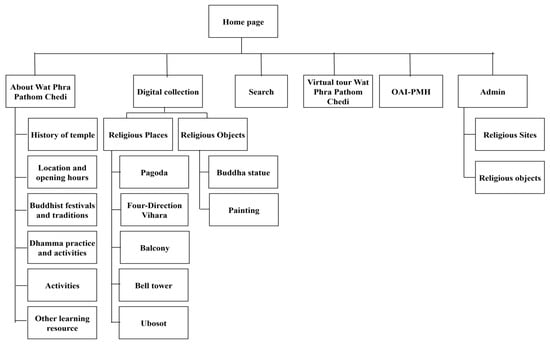
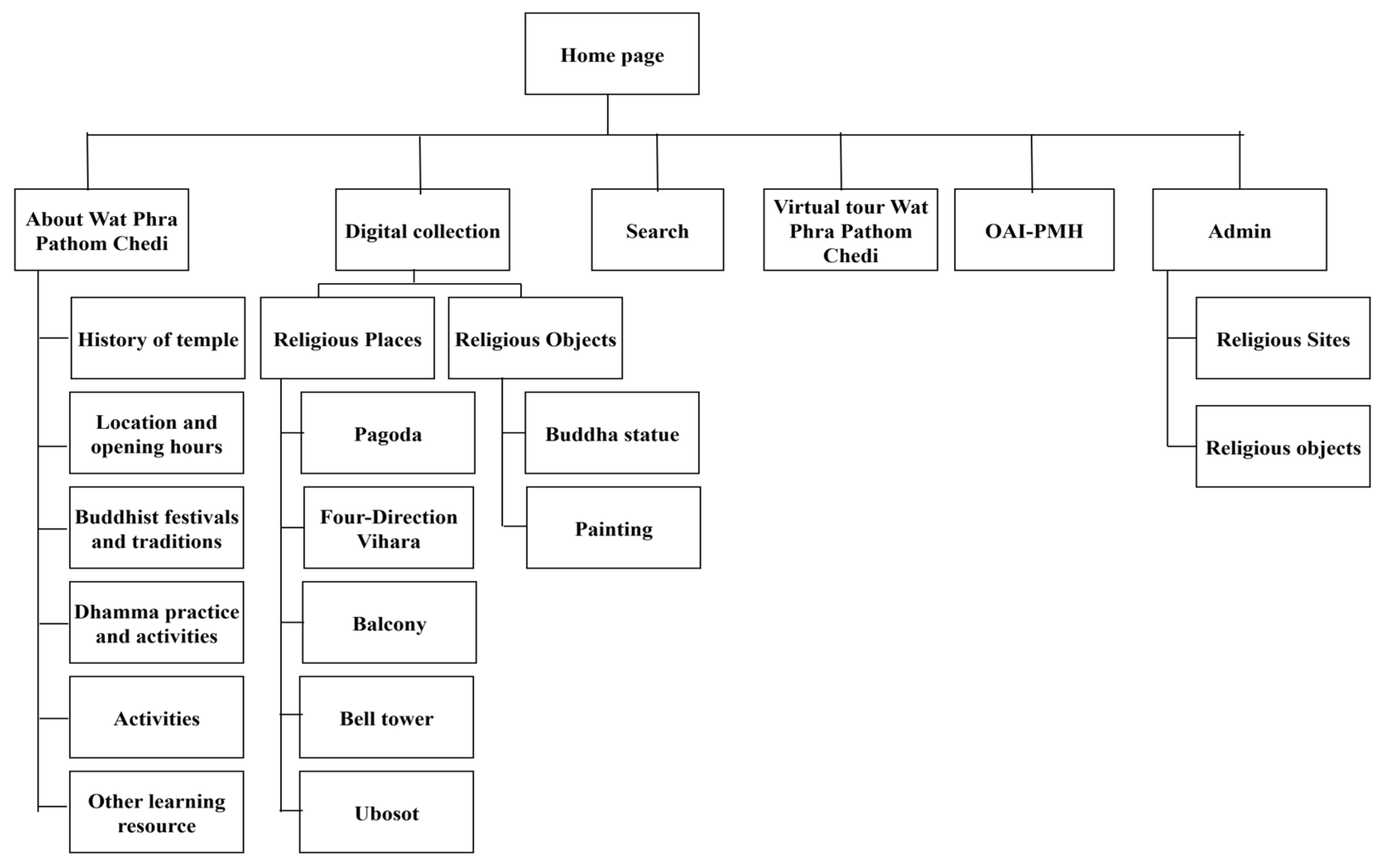
- A site map is a structure showing the connection of data to create understanding between the designer and the content of the web application. The researcher has shown the connection of each part of the data as shown in Figure 5.Figure 5. Shows the data connection structure of the content in the web application.
- (4)
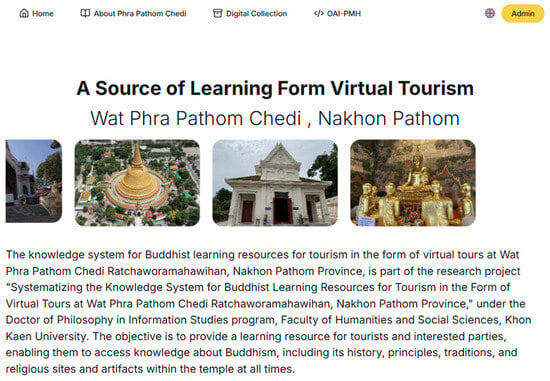
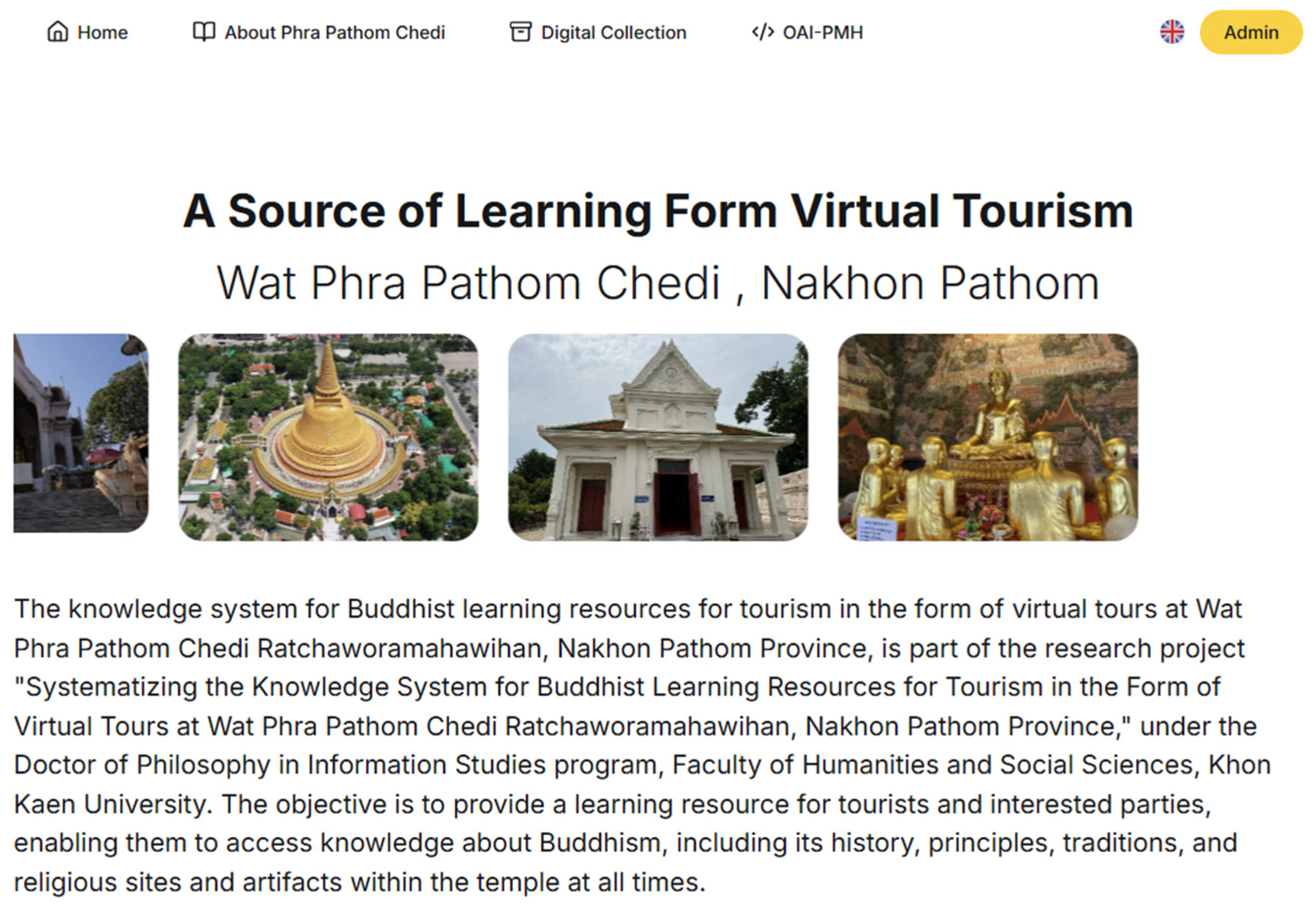
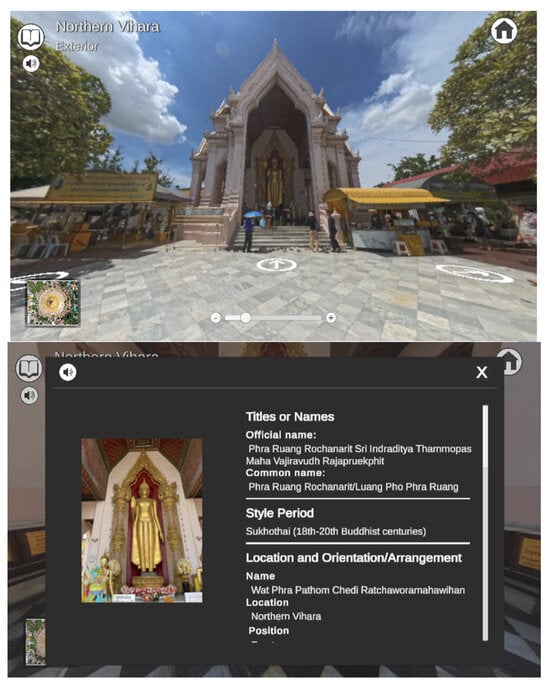
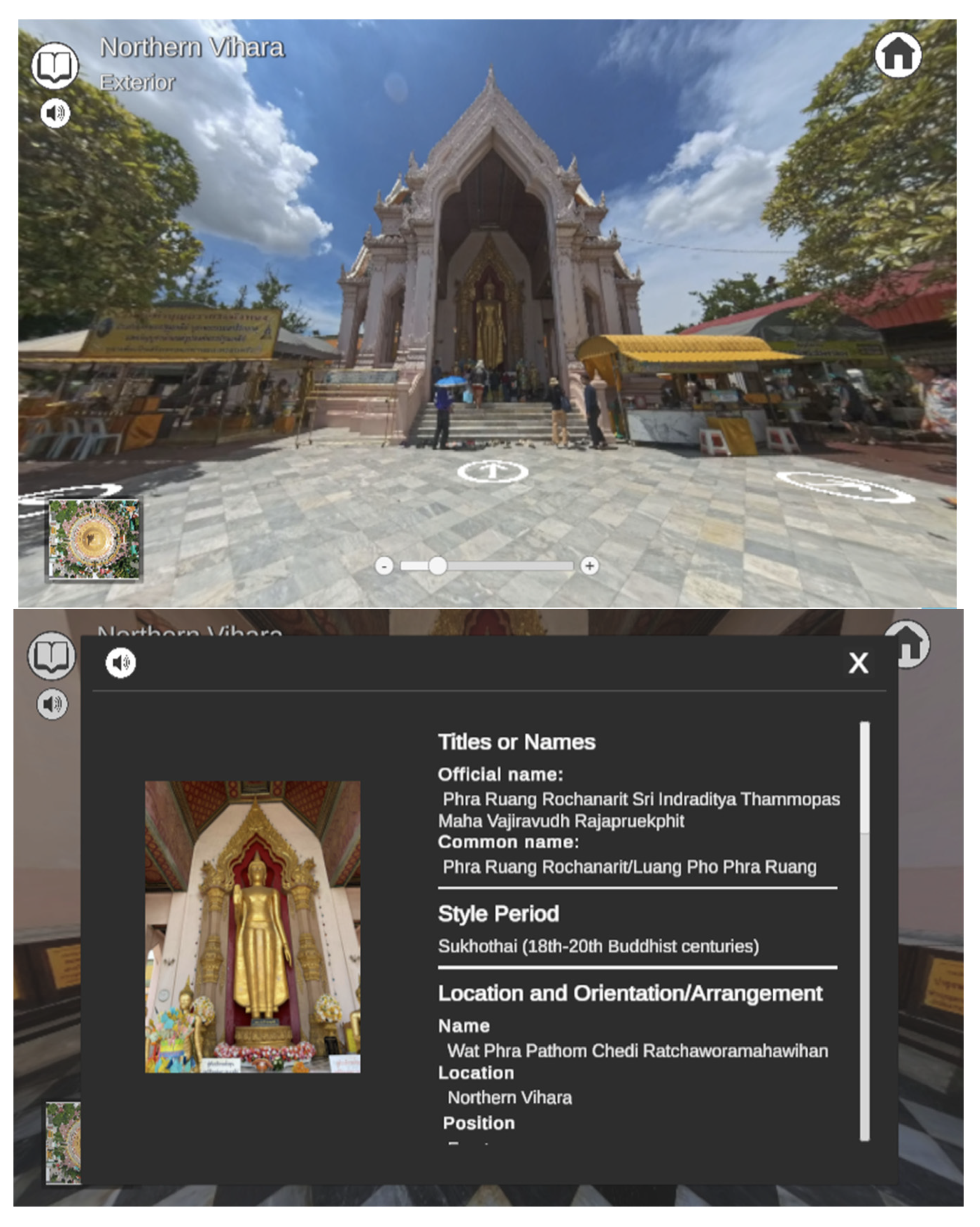
- Visual Design is the design of the appearance of the media, including graphics, illustrations, colors, art composition, and sound, to make the media interesting and beautiful. It will adhere to the principles of user interface design (User Interface Design) as shown in Figure 6 and Figure 7.Figure 6. Screenshot of the main interface of the Buddhist learning center web application for virtual tourism at Wat Phra Pathom Chedi.Figure 7. Example of the web page of the Buddhist learning center application for tourism at Wat Phra Pathom Chedi.
Researchers developed a web application and digital resource repository for Wat Phra Pathom Chedi. The resource is organized into categories, categorizing the temple’s important religious sites and artifacts for storage. Content is presented in metadata and static images. The virtual tour of Wat Phra Pathom Chedi is presented in 360-degree panoramic images with a user-friendly interface. The virtual tour facilitates user communication, making it convenient and easy to learn. Users can learn at any time. The virtual tour of Wat Phra Pathom Chedi can be used as a learning resource for Buddhist tourism within Wat Phra Pathom Chedi via web browsers and as a prototype for further development of virtual tours at other temples.
4.2.4. Evaluation of the Virtual Tour of Wat Phra Pathom Chedi, Nakhon Pathom Province, a Model Buddhist Learning Center for Tourism
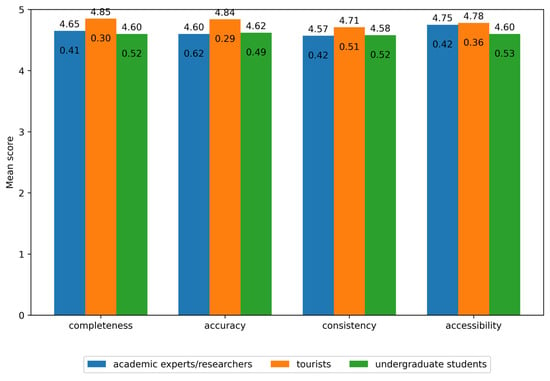
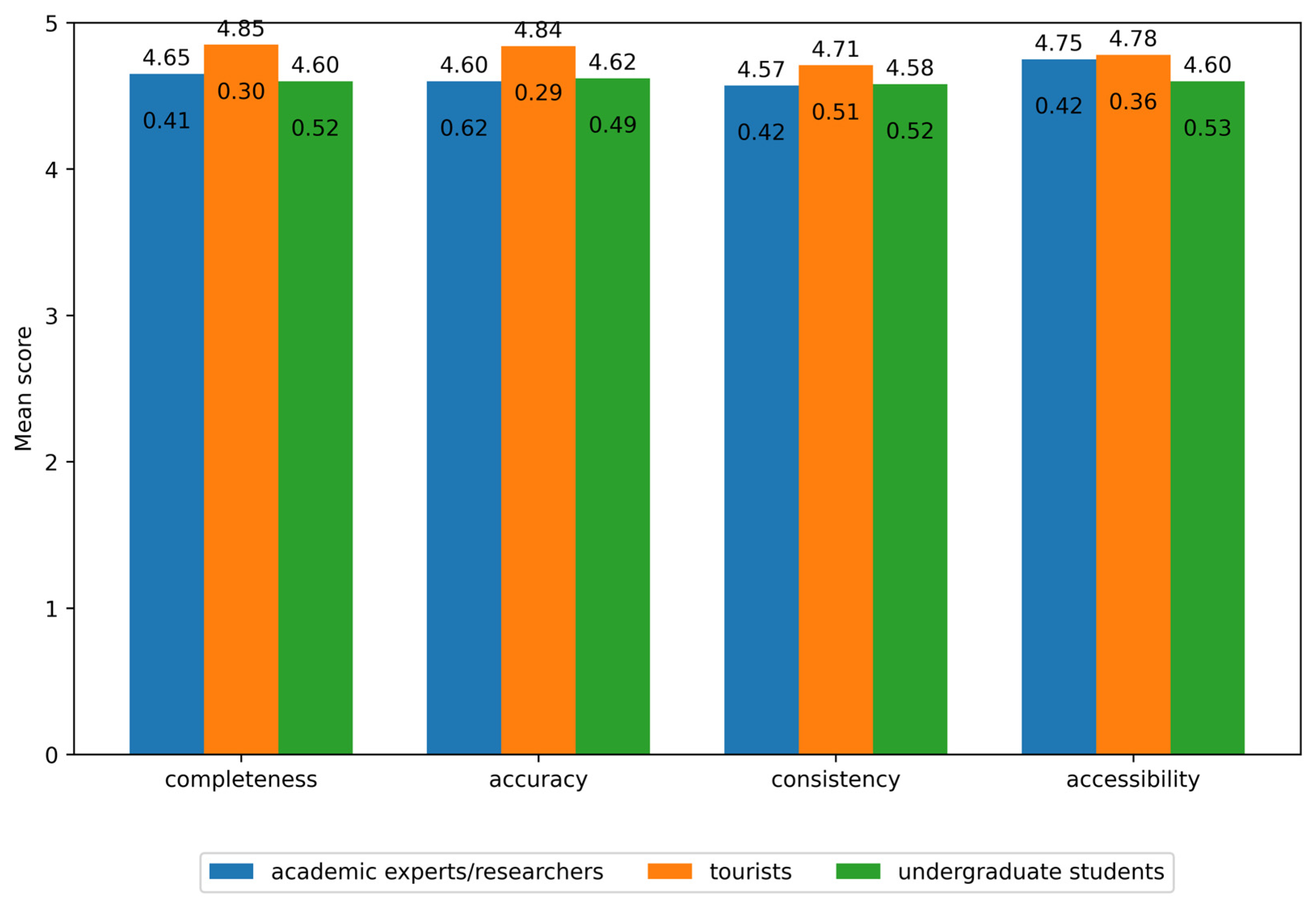
To ensure that the virtual tour of Wat Phra Pathom Chedi, Nakhon Pathom Province, a model Buddhist learning center for tourism, can be used in accordance with its development objectives, meet user needs, and comply with the system development process, the quality of the metadata providing resource information and the effectiveness of the virtual tour were assessed by users. Users were divided into three groups: (1) academic experts/researchers; (2) tourists visiting Wat Phra Pathom Chedi; (3) undergraduate students. The evaluation of the quality of the metadata providing resource information revealed that academics/researchers, tourists, and students were highly satisfied with the overall quality of the metadata of digital information resources of religious sites and artifacts. When considering each aspect, academics/researchers were most satisfied with accessibility, due to language and descriptions that were easy for users to understand. Tourists were most satisfied with the completeness, with data coverage necessary for searching or explaining resources. Students were most satisfied with the accuracy of the data used and references from reliable sources. Details are summarized in Figure 8.
Figure 8.
Average satisfaction with the quality of metadata of digital information resources of religious sites and religious artifacts among users.
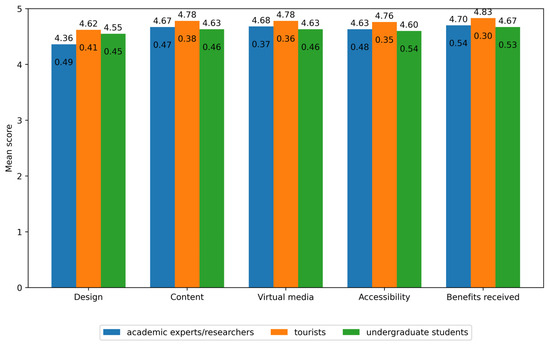
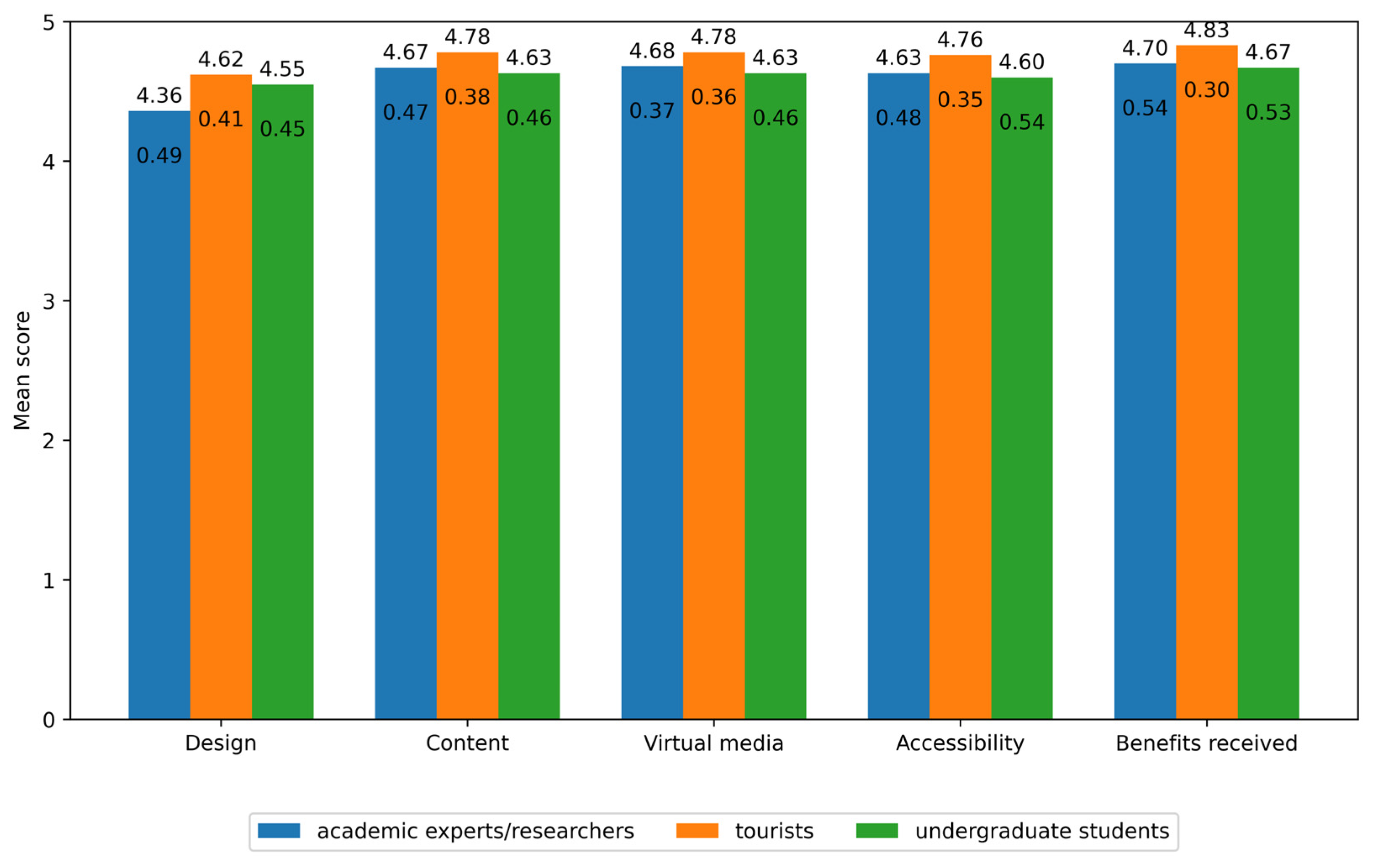
As for the evaluation of the efficiency of the virtual tour of Wat Phra Pathom Chedi, the evaluation results found that academics/researchers, tourists, and students were at the highest level of overall satisfaction in all aspects of using the virtual tour of Phra Pathom Chedi Temple. When considering each aspect, it was found that academics/researchers, tourists, and students were the most satisfied with the benefits they received. Details are summarized in Figure 9.
Figure 9.
Average satisfaction level of users towards using the virtual tour of Wat Phra Pathom Chedi.
Therefore, it can be concluded that the Buddhist learning center for tourism in the form of a virtual tour of Wat Phra Pathom Chedi has been successful and can be further developed to be more complete and utilized as a learning resource for Buddhism and history, where users can access information at any time. Furthermore, it also has academic value in the area of information studies.
5. Discussion
5.1. Knowledge System at Wat Phra Pathom Chedi, a Buddhist Tourism Learning Center
The results of knowledge organization at Wat Phra Pathom Chedi, Nakhon Pathom Province, a Buddhist tourism learning center, revealed that the temple’s information resources can be grouped according to resource type and divided into religious sites and religious artifacts. Information is presented according to the main religious sites, including Phra Pathom Chedi, the Four-Direction Vihara, the Phra Rabiang, Ubosot, and the Bell Tower. Information on religious artifacts within each site is then presented, aligning with the presentation of information in a virtual tour format. This aligns with the concepts of [7,41], who explain that knowledge organization is the process of collecting and organizing knowledge into a structured system. The information and knowledge details are explained, and tools are developed for storing, retrieving, and accessing information and knowledge, enabling users to access existing information. Ref. [25] stated that knowledge organization is crucial for searching, from defining content categories to defining metadata as a tool for organizing content within groups at a detailed level. Consistent with [48] study of virtual museum design, the study found that virtual museums require categorizing museum resources by resource type, format, and period. Metadata is used to facilitate user access to object and site information. The scope of virtual museum creation is education, entertainment, visitor experience, promotion, research, gaming, and learning. Ref. [49] research showcased three-dimensional content of Pompeii’s architecture, organizing knowledge by resource type, such as monuments, buildings, artifacts, and digital resources such as images, text, video, audio, and 3D images.
The knowledge system at Wat Phra Pathom Chedi in Nakhon Pathom Province, a Buddhist tourism learning center, describes information resources in the form of metadata linked to the characteristics of each object, consisting of fields. Each field is specific to each object, requiring analysis to determine the appropriate fields for each resource. The cataloging of Wat Phra Pathom Chedi resources was based on CDWA metadata analysis, the historical site survey model, and the Fine Arts Department’s registration model for ancient artifacts and artifacts. The fields were adjusted to suit the context of the temple’s religious site. The system comprises 21 main components, while the religious artifacts of Phra Pathom Chedi Temple consist of 17 main components. This structure is consistent with previous studies, including research that applied Categories for the Description of Works of Art (CDWA) metadata to catalog artifacts in local community museums for network development [43], as well as research that employed CDWA metadata to create structured metadata for pagodas in Myanmar [44]. A summary of these components is presented in Table 6.
Table 6.
Consistency of the metadata with other research.
The results of this research are consistent with the concept of [32], who explained that the description of information resources in the form of general metadata will be linked to the characteristics of each object consisting of general data fields. But the specific metadata schemes in which the described fields are specific to each object need to be analyzed to obtain the appropriate fields for those resources. It is also consistent with the concept of [33], who explained that the organization of knowledge of tangible and intangible cultural heritage should use a one-to-one metadata approach to help organize tangible and intangible digital cultural heritage information by clearly distinguishing between the physical and digital data areas or environments of cultural heritage artifacts. The appropriate metadata scheme for cataloging cultural artifacts and information resources covering architecture in terms of building design is CDWA (Categories for the Description of Works of Art). As [10] studied the management of subject areas for accessing cultural heritage in Swedish online museums, they stated that the CDWA metadata standard consists of a set of best practices for cataloging and describing works of art, architecture, and other material culture. The CDWA, groups and collections of works and related images, provides a conceptual framework that may be used for designing, modeling, and evaluating data and databases, as well as for accessing information. Furthermore, the CDWA represents a complex set of structural elements/categories. It provides a set of best practices for cataloging and describing works of art, architecture, and other material culture; groups and collections of works; and related images [34].
5.2. Virtual Tour of Wat Phra Pathom Chedi, Nakhon Pathom Province, a Model Buddhist Learning Center for Tourism
The researcher applied the Elements of User Experience [47] concept to the design of a web application for Buddhist learning for tourism in the form of a virtual tour of Wat Phra Pathom Chedi. The design consisted of (1) Navigation Design, which designed a navigation system structure for users to navigate important religious sites around Phra Pathom Chedi. (2) Wire Frame Design, which designed the structure of the web application for Buddhist learning for tourism in the form of a virtual tour of Wat Phra Pathom Chedi. (3) Site Map, which provides a structure showing data connections to enhance understanding between the designer and the content of the web application. (4) Visual Design, which designed the visual appearance of the media, including graphics, illustrations, colors, artistic composition, and sound, to create an engaging and aesthetically pleasing presentation. This approach adheres to user interface design principles. The researcher developed a web application and digital resource repository for Wat Phra Pathom Chedi, which grouped resources into important religious sites and artifacts of Wat Phra Pathom Chedi for storage, presentation of content in metadata and static images, and display within the virtual tour of Wat Phra Pathom Chedi. The tour is presented in a 360-degree panoramic format, a development of an image-based virtual environment. Photographs are stitched together to create a panoramic virtual image. Zooming in/out, hot-spot hopping, and 360-degree panning are also possible. In the virtual tour, users can walk around following the arrows and click on images to learn about religious sites and artifacts. The information is presented in the form of still images with captions and buttons explaining how to use the tour, considering the ease of communication between users, making it easy to learn. Manual movement control and mouse control are used to adjust the perspective, as if you were moving around the site.
The results of the development of the virtual tour of Wat Phra Pathom Chedi, a model Buddhist learning center for tourism, were analyzed using the four dimensions of metadata quality assessment [50]: (1) completeness, (2) accuracy, (3) consistency, and (4) accessibility. Users were found to be highly satisfied with all four dimensions. This aligns with [34] research, which explains that metadata quality assessment is crucial for improving user information retrieval. A comprehensive framework is presented that assesses three key aspects: completeness, accuracy, and consistency. These aspects are crucial to ensure that Metadata supports efficient retrieval and access to cultural heritage resources. Furthermore, it is important to consider other dimensions, such as accessibility and timeliness, which may also influence overall metadata quality. The highest level of user satisfaction with metadata quality may be due to the researcher analyzing the characteristics of both religious sites and artifacts and organizing the data to obtain appropriate fields for cataloging and displaying information for users to study in the virtual tour. Users also commented that the data provided was complete and suitable for searching.
Furthermore, the results of the evaluation of the virtual tour’s effectiveness across five dimensions—(1) design, (2) content, (3) virtual media, (4) accessibility, and (5) usefulness—revealed that users, most of whom had little experience using virtual tours, were highly satisfied with all five dimensions. This is consistent with the research of [14], who studied a virtual tour to promote tourism in Bari, southern Italy. A questionnaire was administered to 30 users. Respondents were inexperienced with virtual reality and lacked a specific technological background. The results revealed that users were highly satisfied with the usability, engagement, visual quality, and sense of presence. Furthermore, research by [51] assessed satisfaction with the use of virtual tours at temples in Phra Nakhon Si Ayutthaya Province. By collecting data from a sample group of 35 people, most of whom, 57 percent, were users who had never used it.
While the evaluation results empirically demonstrate high usability, accessibility, and user satisfaction, the broader tourism and economic impacts discussed here should be understood as anticipated outcomes, informed by stakeholder feedback and existing tourism development frameworks.
The research results revealed that the designed virtual tour of Wat Phra Pathom Chedi effectively met user needs, even though most users had no experience using virtual tours. This aligns with user feedback that the interface design was user-friendly and intuitive, resulting in the highest level of satisfaction among academics/researchers, tourists, and students. Academics/researchers and students agreed that virtual tours were a good alternative for those unable to physically visit the site. Tourists also agreed that virtual tours encouraged them to visit the site. Furthermore, users suggested that virtual tours informed the history and significance of the site, providing a realistic image to aid decision-making. The virtual tour of Wat Phra Pathom Chedi can be used as a learning resource for Buddhist tourism at Wat Phra Pathom Chedi via web browsers and can be used as a prototype system for further development of virtual tours at other temples.
6. Conclusions
This study presents a knowledge system for a Buddhist learning center for tourism in the form of a virtual tour of Wat Phra Pathom Chedi. Unlike conventional heritage systems that primarily focus on conservation, the proposed system develops a dedicated metadata set to support Buddhist learning resources, thereby demonstrating a high degree of originality. By integrating religious content, historical narratives, traditions, and mechanisms of knowledge transmission, religious sites and artifacts are transformed into dynamic learning resources for communities, academics, students, tourists, and the general public. Consequently, the metadata set is well-suited for storing, linking, and enriching information about religious heritage, enabling deeper learning beyond its function as a tourist attraction.
The system delivers information through a virtual tour interface that allows users to explore the site using 360-degree panoramic views, navigate via interactive arrows, and access detailed descriptions of locations and artifacts through still images. Manual navigation enables users to control movement and viewing angles, creating an experience comparable to an on-site visit. Evaluation results indicate high levels of data quality and user satisfaction across all three user groups—academics/researchers, undergraduate students, and tourists. Overall satisfaction with both the quality of digital information on religious and archaeological sites and the virtual tour system was rated at the highest level, particularly regarding perceived benefits. Academics and students viewed virtual tours as an effective alternative for those unable to visit the physical site. At the same time, tourists reported that the virtual tour increased their motivation to visit the site in person.
This research contributes to the academic literature in several ways. Firstly, it develops a metadata structure tailored explicitly to Buddhist historical sites and artifacts, thereby establishing standardized mechanisms for data storage and exchange. Secondly, it proposes and implements a prototype integrated digital archive capable of efficiently managing religious heritage data. Thirdly, it applies virtual tour technology to temple contexts to enhance accessibility and provide a realistic and immersive learning experience. Finally, empirical evidence from user satisfaction evaluations supports the findings, demonstrating the proposed platform’s usefulness and effectiveness.
Finally, since this research primarily focused on the important religious sites and artifacts of Wat Phra Pathom Chedi, as revealed through documents, related research, and expert interviews, to further develop the research and development of Buddhist learning resources for tourism purposes at the temple, it may be necessary to expand the study of other resources by adding artifacts displayed in the virtual tour, such as Buddha images around the corridor and trees within the temple.
In the future, media design for virtual tours may incorporate more advanced and diverse technologies, such as 3D imagery and video presentations about tourist attractions, to further enhance the learning experience. In addition to creating virtual tours of the temple, this knowledge could be developed into games or simulations of various events at Wat Phra Pathom Chedi, such as annual traditional events, to enhance the visitor experience. Future research may extend this work by empirically examining learning outcomes, such as knowledge retention or conceptual understanding, to complement the usability-focused evaluation presented in this study.
Author Contributions
Conceptualization, B.K. and W.C.; methodology, B.K., W.C., K.I. and K.P.; software, B.K., W.C., K.I. and K.P.; validation, B.K., W.C., K.I. and K.P.; formal analysis, B.K., W.C., K.I. and K.P.; investigation, B.K., W.C., K.I. and K.P.; resources, B.K.; data curation, B.K.; writing—original draft preparation, B.K., W.C., K.I. and K.P.; writing—review and editing, B.K., W.C., K.I. and K.P.; visualization, B.K. and W.C.; supervision, W.C.; project administration, B.K. and W.C. All authors have read and agreed to the published version of the manuscript.
Funding
This research received no external funding.
Institutional Review Board Statement
This study was approved by the Human Research Ethics Committee of Khon Kaen University (approval ID No. HE673011; date: 8 February 2024).
Informed Consent Statement
This study obtained informed consent from all study participants; however, the data collected was minimal and no personal identifiable information was collected.
Data Availability Statement
The original contributions presented in this study are included in the article. Further inquiries can be directed at the corresponding author.
Acknowledgments
We would like to thank the researchers and authors of the articles and various sources referenced in this research and the experts in the field who provided valuable assessments and in-depth comments on the research results.
Conflicts of Interest
The authors declare no conflicts of interest.
References
- Phraathikarnnatthawat poonyakamo (thaweevorakiat) Boondo, S.; Anothai, S. The Application of The Sappãya 4 In Developing Temples for Buddhist Tourism. MCU Ubonratchathani J. Buddh. Stud. 2025, 7, 185–196. [Google Scholar]
- Ruaengmaneeya, P.; Pochakorn, P.; Pongsuwan, P. Tourism Management Policy on Buddhism in The Eastern Special Development Zone. J. Interdiscip. Innov. Rev. 2022, 5, 140–149. [Google Scholar]
- Nakhon Pathom Provincial Office. History of Nakhon Pathom Province. 2022. Available online: https://www.nakhonpathom.go.th/content/history (accessed on 28 July 2022).
- Wachirapirak, A. Management Policy Suggestions Concerning Temple Tourist Attraction Development as Creative Learning Resources. Ph.D. Thesis, Silpakorn University, Nakhon Pathom, Thailand, 2018. Available online: http://ithesis-ir.su.ac.th/dspace/handle/123456789/2205 (accessed on 22 July 2022).
- Cameron, F.; Kenderdine, S. (Eds.) Theorizing Digital Cultural Heritage: A Critical Discourse; MIT Press: Cambridge, MA, USA, 2007. [Google Scholar]
- Parry, R. Museums in a Digital Age; Routledge: Oxfordshire, UK, 2010. [Google Scholar]
- Gnoli, C. Introduction to Knowledge Organization; Facet Publishing: London, UK, 2020. [Google Scholar]
- Petras, V.; Stiller, J.; Gäde, M. Building for Success? Evaluating Digital Libraries in the Cultural Heritage Domain. 2013. Available online: https://edoc.hu-berlin.de/bitstream/handle/18452/24446/Building-for-Success__-Evaluating-Digital-Libraries-in-the-Cultural-Heritage-Domain.pdf?sequence=1 (accessed on 28 January 2023).
- Aljalahmah, S.H. The Status of The Organization of Knowledge in Cultural Heritage Institutions in Arabian Gulf Countries. Ph.D. Thesis, University of North Texas, Denton, TX, USA, 2021. Available online: https://digital.library.unt.edu/ark:/67531/metadc1833519/ (accessed on 22 July 2022).
- Golub, K.; Ziolkowski, P. Organizing subject access to cultural heritage in Swedish online museums. J. Doc. 2022, 78, 211–247. [Google Scholar] [CrossRef] [Scilit]
- Styliani, S.; Fotis, L.; Kostas, K.; Petros, P. Virtual museums, a survey and some issues for consideration. J. Cult. Herit. 2009, 10, 520–528. [Google Scholar] [CrossRef] [Scilit]
- Tali, K. A model for presenting local museum content based on the concept of present to the past through digital technology: A case study of Ang Sila Local Museum. Ph.D. Thesis, Burapha University, Saen Suk, Thailand, 2017. Available online: https://buuir.buu.ac.th/xmlui/handle/1234567890/8530 (accessed on 22 July 2022).
- Lo, J.H.; Wu, S.D.; You, M.J. Interactive Virtual Reality Touring System: A Case Study of Shulin Ji’an Temple in Taiwan. Mob. Inf. Syst. 2021, 1, 6651916. [Google Scholar] [CrossRef] [Scilit]
- Luca, D.V.; Marcantonio, G.; Barba, M.C.; Paolis, L.T. A Virtual Tour for the Promotion of Tourism of the City of Bari. Information 2022, 13, 339. [Google Scholar] [CrossRef] [Scilit]
- Wu, Y.; Jiang, Q.; Liang, H.; Ni, S. What Drives Users to Adopt a Digital Museum? A Case of Virtual Exhibition Hall of National Costume Museum. SAGE Open 2022, 12, 21582440221082105. [Google Scholar] [CrossRef] [Scilit]
- National Tourism Board. National Tourism Development Plan No. 3 (2023–2027); Ministry of Tourism and Sports: Bangkok, Thailand, 2022. Available online: https://province.mots.go.th/ewtadmin/ewt/ranong/download/article/article_20230418122435.pdf (accessed on 21 March 2023).
- Bangkok Bank. Virtual Tour: Reviving the Tourism Industry in the COVID Era, Adapting the Thai Tourism Business. 2022. Available online: https://bangkokbanksme.com/en/virtual-tour-tourism-industry (accessed on 20 January 2022).
- Office of Knowledge Management and Development (Public Organization). Travel in a New Way, Virtual Tour. 2021. Available online: https://www.okmd.or.th/okmd-kratooktomkit/4112/ (accessed on 19 January 2023).
- Khaenphet, W. The Development Guidelines for Tourism in Thailand to Value Added in The Digital Age. J. Innov. Manag. 2021, 6, 148–160. Available online: https://so03.tci-thaijo.org/index.php/journalcim/article/view/249382/172969 (accessed on 19 January 2023).
- Hjørland, B. What is Knowledge Organization (KO)? Knowl. Organ. 2008, 35, 86–101. [Google Scholar] [CrossRef] [Scilit]
- Hjørland, B. Nine Principles of Knowledge Organization. 1994. Available online: https://repository.arizona.edu/handle/10150/106195 (accessed on 21 March 2023).
- Chansanam, W.; Tuamsuk, K.; Chaikhambung, J. Linked Open Data Framework for Ethnic Groups in Thailand Learning. Int. J. Emerg. Technol. Learn. 2020, 15, 140–156. [Google Scholar] [CrossRef] [Scilit]
- Chulrod, P.; Panthukampol, P. Development of cultural tourism ontology of temples in Muang District, Chiang Mai Province. J. Humanit. Soc. Sci. Univ. Phayao 2022, 10, 320–337. [Google Scholar]
- Pinto, A.; Cardinale, Y.; Dongo, I.; Regina, T.H. An Ontology for Modeling Cultural Heritage Knowledge in Urban Tourism. IEEE Access 2022, 10, 61820–61842. [Google Scholar] [CrossRef] [Scilit]
- Kabmala, M. Information and Knowledge Organization in Digital Environment; Faculty of Humanities and Social Sciences, Khon Kaen University: Khon Kaen, Thailand, 2022; Available online: https://online.anyflip.com/nyyoj/uudx/mobile/ (accessed on 13 October 2025).
- Hider, P. Information Resource Description Creating and Managing Metadata; Facet Publishing: London, UK, 2018. [Google Scholar]
- Riley, J. Understanding Metadata; National Information Standards Organization: Baltimore, MD, USA, 2017. [Google Scholar]
- Baca, M.; Getty Research Institute. Introduction to Metadata; Getty Research Institute: Los Angeles, CA, USA, 2016. [Google Scholar]
- Zeng, M.L.; Qin, J. Metadata; American Library Association: Chicago, IL, USA, 2016. [Google Scholar]
- Haynes, D. Metadata for Information Management and Retrieval: Understanding Metadata and Its Use; Facet Publishing: London, UK, 2018. [Google Scholar]
- Davison, S.; McAulay, E.; Baca, M. Museum materials in a digital library context and beyond. In Proceedings of the 8th ACM/IEEE-CS Joint Conference on Digital Libraries, Pittsburgh, PA, USA, 16–20 June 2008; Volume 5, p. 448. [Google Scholar] [CrossRef] [Scilit]
- Qarabolaq, Z.F.; Seifi, I.M.; Hafezi, H.A.; Tabaei, A.N. The role of PREMIS Preservation metadata in information management in virtual museums. Procedia Soc. Behav. Sci. 2013, 73, 396–402. [Google Scholar] [CrossRef] [Scilit]
- Wijesundara, C.; Sugimoto, S. Metadata Model for Organizing Digital Archives of Tangible and Intangible Cultural Heritage and Linking Cultural Heritage Information in Digital Space. Libres 2018, 28, 58–80. [Google Scholar] [CrossRef] [Scilit]
- Getty. Categories for the Description of Works of Art (CDWA). 2022. Available online: https://www.getty.edu/research/publications/electronic_publications/cdwa/definitions.pdf/ (accessed on 28 January 2023).
- Paul Getty Trust; College Art Association. CDWA List of Categories and Definitions. 2022. Available online: https://www.getty.edu/research/ (accessed on 28 January 2023).
- Office of Archaeology, Fine Arts Department. (n.d.). Technical Knowledge for Surveying and Mapping for Registration of Ancient Monuments. Available online: https://www.finearts.go.th/storage/contents/2021/07/detail_file/eO9JJwWc5jvsuPiYp45zqWUeFZecTkvHPRrF1JyT.pdf (accessed on 28 January 2023).
- Office of National Museums, Fine Arts Department. Manual for the Registration of Antiques and Art Objects. 2008. Available online: https://finearts.go.th/storage/contents/detail_file/1WsWxgESixfCL5TxmNZa1oY1SZL8OGcIcUfPIJKC.pdf (accessed on 28 January 2023).
- Wimala, S.; Khuenkam, Y.; Raksakunkan, N. Community Heritage Management of the Community Museum Network with Open Source Software. 2020. Available online: https://cloud-3001.lib.cmu.ac.th/knowledge/client/file/63708f4803e707341c7bc683 (accessed on 2 March 2023).
- Pipe, T.T. Development of Metadata Schema for Myanmar Pagodas’ Information Management. Int. J. Relig. 2024, 5, 2469–2483. [Google Scholar] [CrossRef] [Scilit]
- Ahmad, A.; Sharma, S. Sustainable Digital Preservation and Access of Heritage Knowledge in India: A Review. J. Libr. Inf. Technol. 2020, 40, 321–325. [Google Scholar] [CrossRef] [Scilit]
- Hjørland, B. Reviews of Concepts in Knowledge Organization. Knowl. Organ. 2018, 45, 54–78. [Google Scholar]
- Chernbumroong, S.; Ariya, P.; Yolthasart, S.; Wongwan, N.; Intawong, K.; Puritat, K. Comparing the Impact of Non-Gamified and Gamified Virtual Reality in Digital Twin Virtual Museum Environments: A Case Study of Wieng Yong House Museum, Thailand. Heritage 2024, 7, 1870–1892. [Google Scholar] [CrossRef] [Scilit]
- Trakullertyot, T. Virtual Reality. 2016. Available online: https://www.scimath.org/article-technology/item/4818-virtual-reality (accessed on 19 January 2023).
- Arago, N.; Guzman, D.V.; Leon, N.A.; Esteves, R.; Pepino, T.L.; Socorro, L.D.; Amado, T.; Amon, V.M.; Fernandez, E.O.; Quijano, J.F.C.; et al. MNL Tour: A Web and Mobile Application for Virtual Tour System of Select Tourist Spots Around Manila Using 360-degree Imagery and Virtual Reality Technology. In Proceedings of the IEEE 14th International Conference on Humanoid, Nanotechnology, Information Technology, Communication and Control, Environment, and Management (HNICEM), Boracay Island, Philippines, 1–4 December 2022. [Google Scholar] [CrossRef] [Scilit]
- Dastbaz, M. Designing Interactive Multimedia Systems; McGraw-Hill: Columbus, OH, USA, 2002. [Google Scholar]
- ISO 8601; Date and Time Format. International Organization for Standardization: Geneva, Switzerland, 2019.
- Garrett, J.J. The Elements of User Experience: User-Centered Design for the Web and Beyond; Pearson Education: London, UK, 2011. [Google Scholar]
- Baloian, N.; Biella, D.; Luther, W.; Pino, J.A. Designing, Realizing, Running, and Evaluating Virtual Museum–a Survey on Innovative Concepts and Technologies. J. Univers. Comput. Sci. 2021, 27, 1275–1299. [Google Scholar] [CrossRef] [Scilit]
- Masci, M.E.; Santis, A.; Fernie, K.; Pletinckx, D. Providing Europeana with 3D Content for the Archaeological and Architectural Heritage: The Pompeii Case Study. In Proceedings of the 18th International Conference on Virtual Systems and Multimedia, Milan, Italy, 2–5 September 2012; pp. 227–234. [Google Scholar] [CrossRef] [Scilit]
- Bruce, T.R.; Hillman, D.I. The Continuum of Metadata Quality: Defining, Expressing, Exploiting. In Metadata in Practice; Hillmann, D.I., Elaine, L., Eds.; American Library Association: Chicago, IL, USA, 2004. [Google Scholar]
- Phusa, T.; Kaewsai, P.; Chaochan, P.; Chaisuk, P. Ayutthaya Metaverse: Development of Virtual Tourism of Temples in Phra Nakhon Si Ayutthaya Province; Research Report; Mahachulalongkornrajavidyalaya University: Ayutthaya, Thailand, 2023; Available online: http://mcuir.mcu.ac.th:8080/jspui/handle/123456789/1350 (accessed on 22 July 2024).

Disclaimer/Publisher’s Note: The statements, opinions and data contained in all publications are solely those of the individual author(s) and contributor(s) and not of MDPI and/or the editor(s). MDPI and/or the editor(s) disclaim responsibility for any injury to people or property resulting from any ideas, methods, instructions or products referred to in the content. |
© 2026 by the authors. Licensee MDPI, Basel, Switzerland. This article is an open access article distributed under the terms and conditions of the Creative Commons Attribution (CC BY) license.