Abstract
The study of random graphs has become very popular for real-life network modeling, such as social networks or financial networks. Inhomogeneous long-range percolation (or scale-free percolation) on the lattice , , is a particular attractive example of a random graph model because it fulfills several stylized facts of real-life networks. For this model, various geometric properties, such as the percolation behavior, the degree distribution and graph distances, have been analyzed. In the present paper, we complement the picture of graph distances and we prove continuity of the percolation probability in the phase transition point. We also provide an illustration of the model connected to financial networks.
1. Introduction
Random graph theory has become very popular to model real-life networks. Real-life networks may be understood as sets of particles that are possibly linked with each other. Such networks appear, for example, as virtual social networks, see [1], as financial networks such as the banking system, see [2,3], or the network of interbank transactions, see [4,5]. In the latter example, banks are modeled by particles and two banks are linked if one bank transacts a payment to the other one. The connectivity of the network plays a crucial role on the spread of information and the development of default cascades, the latter being crucial for macroeconomic stability, see [6]. It is, therefore, of major interest to understand the geometry of such networks. Using empirical data one has observed several stylized facts about large real-life networks, for a detailed outline we refer to [1,7], and Section 1.3 in [8]:
- Distant particles are typically connected by very few links, i.e., although there are possibly a lot of particles in the network, any two particles are typically connected through only a few other particles. This is called the “small-world effect”. For example, there is the observation that most particles in real-life networks are connected by at most six links, see also [9]. For the Facebook network with 721 million users, where there is a link between two users if they are “friends” on Facebook, the average number of minimal links that connect any two users is around , while around of all users are connected by at most six links, see [10]. For the movie actor network, where there is a link between two actors if they appeared in the same film, the average number of minimal links that connect any two actors is also around , while the number of actors in the network is over two hundred thousand. See [7] for more examples.
- Linked particles tend to have common friends, which is called the “clustering property”. For instance, if x is friend of both y and z, then it is likely that y and z are also friends. As an example, [10] discovers the following in the Facebook network: given a user with 100 friends, about of the possible friendships among his friends exist.
- The degree distribution, that is, the distribution of the number of links of a given particle, is heavy-tailed, i.e., its survival probability has a power law decay. It is observed that in real-life networks the (power law) tail parameter τ is often between 1 and 2. For instance, for the movie actor network τ is estimated to be around . For more explicit examples we refer to [7,8].
Since it is too complicated to model large networks particle by particle, many different random graph models have been developed and their properties were analyzed. A well studied model in the literature is the homogeneous long-range percolation model on , . In this model, the particles are the vertices of . For fixed , any two particles are linked with probability which behaves as for , i.e., the closer particles are the more likely they are connected. This model has therefore a local clustering property. Moreover, for values of α not too large, the graph distance between , that is, the minimal number of links that connect x and y, behaves roughly logarithmically as tends to infinity, see [11]. This behavior can be interpreted as a version of the small-world effect in the sense that if two particles are separated by large (Euclidean) distance , they are connected by only roughly links. But homogeneous long-range percolation does not fulfill the stylized fact of having heavy-tailed degree distributions, which makes this model less attractive for real-life network modeling. Therefore, [12] introduced the inhomogeneous long-range percolation model (also known as scale-free percolation model) on which extends the homogeneous model in such a way that the degree distributions turn out to be heavy-tailed. In this extended model one assigns to each particle a positive random weight whose distribution is heavy-tailed with tail parameter . Given the weights , two particles are then linked with probability being approximately for large . Note that is decreasing in the distance between particles x and y and increasing in their weights. This implies that the weights make particles more or less attractive, i.e., if a given particle x has a large weight , it plays the role of a hub in the network. This extension of the homogeneous model is very natural since the existence of hubs in real-life networks is often observed. For instance, the number of friends of a famous person on Facebook is typically clearly above average, or large banks do much more transactions than small banks. Therefore, this model can be used to model real-life networks where the possibility of a link mainly depends on the “sizes” of particles and their separations. As a concrete example, we illustrate a financial network in Section 4. The inhomogeneous model has by definition a local clustering property. Moreover, depending on the values of α and β, the degree distribution is heavy-tailed with tail parameter , see Theorem 2.2 in [12]. Hence, in contrast to the homogeneous model, it fulfills the stylized fact of having heavy-tailed degree distributions. For real-life applications the interesting case is and in this case the graph distance between two particles is of doubly logarithmical order as their separation tends to infinity, see [12] and Theorem 8 below. This is again a version of the small-world effect and it says, for instance, that if we increase the (Euclidean) distance between two particles by a factor 1000, their graph distance only grows by roughly 2. One goal of this paper is to complement the picture about graph distances of [12] by providing analogous results to [11,13,14,15] for inhomogeneous long-range percolation.
In homogeneous long-range percolation it is known that there is a critical constant such that there is an infinite connected component of particles for , and there is no such component for , i.e., in the former case there is an infinite connected network in . Such phase transitions appear in many random graph models and they play an important role in the stability of networks, see for instance the banking system modeled in [6]. The phase transition picture in homogeneous long-range percolation can be traced back to the work of [16,17,18]. Later work concentrated more on the geometrical properties of percolation like graph distances, see [11,14,15,19,20]. A good overview of the literature for long-range percolation is provided in [11,21]. For homogeneous long-range percolation it is known that for there is an infinite connected component for all , and therefore . This infinite connected component contains all particles of , a.s., i.e., in that case we have a completely connected network of all particles of , which is not of interest for real-life network applications. In the case we have and there is no infinite connected component at criticality , see [22]. In view of the banking system modeled in [6], this means that the banking system is still stable at criticality. This result combined with Proposition 1.3 of [23] shows continuity of the percolation probability, that is, the probability that a given particle belongs to an infinite connected component is continuous in the choice of parameter λ. In particular, given that there exists an infinite connected network, the probability that a given particle belongs to this network can still be arbitrarily small for appropriate choices of λ. This is important for network modeling as the following example illustrates. Assume we model a population where a link between two individuals has the following interpretation: if one of the two individuals has a disease, it infects the other individual. Assume that initially none of the individuals have a disease and choose uniformly at random one individual in a given (arbitrarily large) finite area to have a disease. Then, the probability that this individual infects infinitely many other individuals is still small for close to . For , the problem is still open, except in the case and because in that latter case there does not exist an infinite connected component for any choice .
In inhomogeneous long-range percolation the conditions for the existence of a non-trivial critical percolation constant were derived in [12], see also Theorems 1 and 2 below. The continuity of the percolation probability was conjectured in that article. One main goal of the present work is to prove this conjecture for . The crucial technique to prove this conjecture is the renormalization method presented in [22]. This technique will also allow to complement the picture of graph distances provided in [12], which in particular allows to analyze the small-world effects for different networks.
Organization of this article. In Section 2, we describe the model assumptions and notations. We also state the conditions that are required for a non-trivial phase transition. In Section 3, we state the main results of the article. Namely, we show the continuity of the percolation function in Theorem 5 which is based on a finite box estimate stated in Theorem 6. We also complement the picture about graph distances of [12], see Theorem 8 below. In Section 4, we discuss a concrete financial application of the model, compare the results to homogeneous long-range percolation model results and we discuss open problems. Finally, we provide all proofs of our results in Section 5.
2. Model Assumptions and Phase Transition Picture
We define the inhomogeneous long-range percolation model of [12] in a slightly modified version. The reason for this modification is that the model becomes easier to handle but it keeps the essential features of inhomogeneous long-range percolation. In particular, all results of [12] only depend on the asymptotic behavior of survival probabilities. Therefore, we choose an explicit distributional example which on the one hand has the right asymptotic behavior and on the other hand is easy to handle. This, of course, does not harm the generality of the results.
Consider the lattice for fixed with vertices and edges for . Assume are i.i.d. Pareto distributed weights with parameters and , i.e., the weights have i.i.d. survival probabilities
Conditionally given these weights , we assume that edges are independently from each other either occupied or vacant. The conditional probability of an occupied edge (or link) between x and y is chosen as
For we choose the Euclidean norm. Note that is approximately for large . If there is an occupied edge between x and y we write ; if there is a finite connected path of occupied edges between x and y we write and we say that x and y are connected. Clearly . We define the cluster of to be the connected component
which denotes all particles that can be reached within the network. Our aim is to study the size of the cluster and to investigate its percolation properties as a function of and , that is, as a function of the edge probabilities . The percolation probability is defined by
which is the probability that the connected component of a given particle contains infinitely many particles. This is non-decreasing in λ and non-increasing in α. For given , the critical value is defined as
Note that and also depend on β, but this parameter will be kept fixed.
Trivial case. For , we have . This comes from the fact that for any
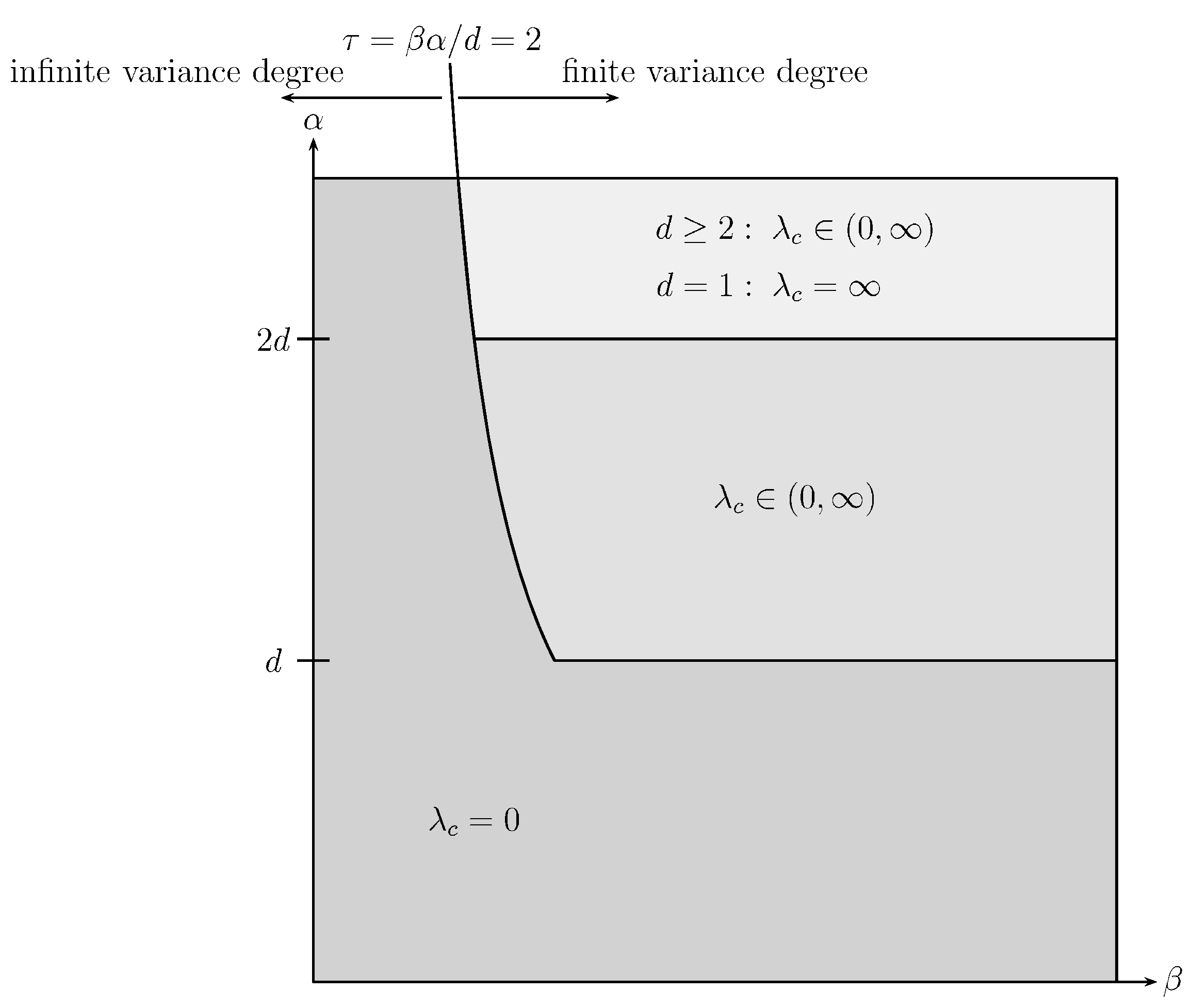
see Theorem 2.1 in [12]. This says that the degree distribution of a given vertex is infinite, a.s., and therefore there is an infinite connected component, a.s. In the trivial case, all particles have infinitely many links which is, of course, not interesting for real-life network applications. For this reason we only consider the non-trivial case . In this latter case the degree distribution is heavy-tailed with tail parameter , see Theorem 2.2 of [12], which is in line with the stylized facts. In particular, if and , we have that the degree distribution is heavy-tailed with (power law) tail parameter . According to the stylized facts this latter case is of special interest for real-life network applications. Theorems 1 and 2 give the phase transition pictures for in the non-trivial case , see Figure 1 for an illustration.
Theorem 1 (upper bounds) Fix . Assume .
- (a)
- If , then .
- (b)
- If and , then .
- (c)
- If and , then .
Theorem 2 (lower bounds) Fix . Assume .
- (a)
- If , then .
- (b)
- If , then .
The phase transition pictures differ for and in that the former has a region where and the latter does not. Note that corresponds to infinite variance of the degree distribution and to finite variance of the degree distribution. In particular, for the interesting case for real-life network applications we have . This implies that there is no phase transition and the network will always have an infinite connected component, a.s., for any .
Figure 1.
phase transition picture for .
Figure 1.
phase transition picture for .

3. Main Results
3.1. Continuity of Percolation Probability
We say that there exists an infinite cluster if there is an infinite connected component for some . Since the model is translation invariant and ergodic, the event of having an infinite cluster is a zero-one event. Thus, for there exists an infinite cluster, a.s. Moreover, from Theorem 1.3 in [22] we know that an infinite cluster is unique, a.s. This justifies the notation for the infinite cluster in the case of percolation and implies that we have a unique infinite connected network, a.s. As an example, the largest connected component in the Facebook network studied by [10] covers of all 721 million users while the second largest component covers only around 2000 users. The following theorem shows that there is no infinite connected component at criticality whenever and .
Theorem 3 Assume and . Choose with . There exist and such that
In particular, is an open interval in , and there does not exist an infinite cluster at criticality .
Note that for we have , hence there is no infinite connected component at criticality. Theorems 2 and 3 therefore imply the following corollary.
Corollary 4 Assume and . There is no infinite cluster at criticality .
Next we state continuity of the percolation probability in λ which was conjectured in [12].
Theorem 5 For and , the percolation probability is continuous.
This theorem exactly supports the example of spread of disease mentioned in the introduction.
3.2. Percolation on Finite Boxes
For integers and define the box centered at x with total side length by and abbreviate . Let be the largest connected component in box (with a fixed deterministic rule if there is more than one largest connected component in ).
Theorem 6 Assume and . Choose with . For each there exist and such that for all we have
This is the analog to the statement in homogeneous long-range percolation, see Theorem 3.2 in [11]. It says that in case of percolation largest connected components in finite boxes cover a positive fraction of these box sizes with high probability for large n, or in other words, the number of particles belonging to the largest connected network in is proportional to . For instance, assume we model a population where a link between two individuals has the following interpretation: if one of the two individuals has a disease, it transmits its disease to the other individual. Assume that initially all individuals in a large finite area do not have a disease and choose uniformly at random one individual to have a disease. Then, the above result implies that the probability that a positive fraction of all individuals in this area will get infected is strictly positive.
Let be the vertices in that are connected with x within box . For and we denote by
the set of vertices which are -dense, i.e., surrounded by sufficiently many connected vertices in , see also Definition 2 in [11].
Corollary 7 Under the assumptions of Theorem 6 we have the following.
- (i)
- There exists such that for any
- (ii)
- For any there exist and such that for any ℓ and n with
This result can be interpreted as local clustering in that with high probability (for large n) particles are surrounded by many other particles belonging to the same connected network. In the sense of the above example this says that an infected individual will transmit its disease to a positive fraction of all individuals in his (Euclidean) neighborhood. Corollary 7 is the analog to Corollaries 3.3 and 3.4 in [11]. Once the proofs of Theorem 6 and Lemma 10 (a), below, are established it follows from the derivations in [11].
3.3. Graph Distances
For we define to be the minimal number of occupied edges which connect x and y, and we set for . The value is called graph distance or chemical distance between x and y, and it denotes the minimal number of occupied edges that need to be crossed from x to y (and vice versa). If typically is small for distant x and y, then we say that the network has the small-world effect.
Theorem 8 Assume .
- (a)
- (infinite variance of degree distribution). Assume . For any there exists such that for every
- (b1)
- (finite variance of degree distribution case 1). Assume and . For any and any
- (b2)
- (finite variance of degree distribution case 2). Assume . There exists such that
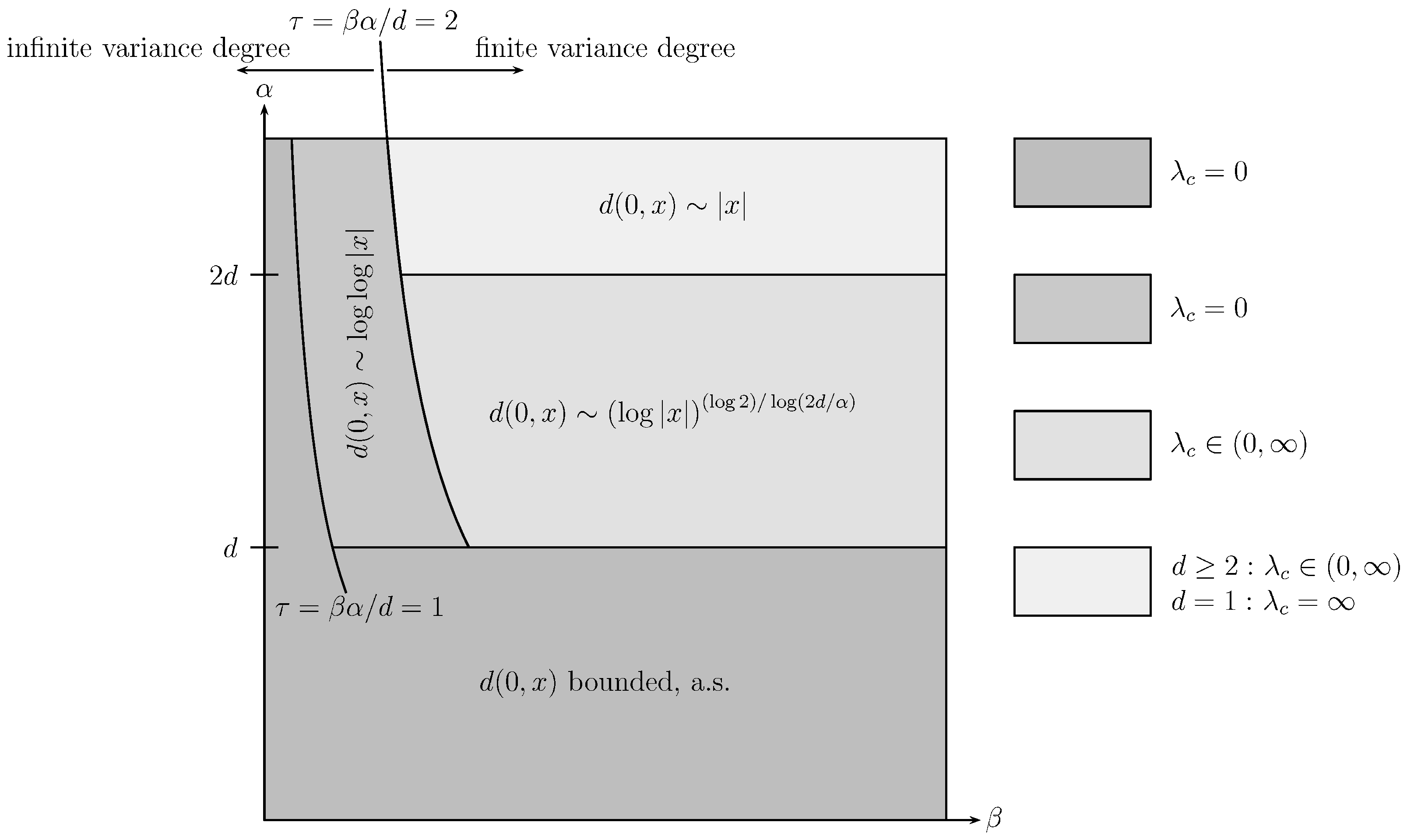
From Theorem 8 (a) we conclude that in the case , which is the interesting one for real-life network applications due to the stylized facts, we have a small-world effect and the graph distance is of order as . This, for instance, says that if we increase the (Euclidean) distance between two particles in the network by a factor 1000, their graph distance only grows by roughly of order 2. In the case and (for ) the small-world effect is less pronounced in that the graph distance is conjectured to be of order for . Note that this is a conjecture because the bounds in Theorem 8 (b1) are not sufficiently sharp to obtain the exact power . Finally, in the case we do not have the small-world effect and graph distance behaves linearly in the Euclidean distance. In Figure 2 we illustrate Theorem 8 and we complete the conjectured picture about the graph distances.
Case (a) of Theorem 8 was proved in Theorems 5.1 and 5.3 of [12]. Statement (b1) proves upper and lower bounds in case 1 of finite variance of the degree distribution. The lower bound was proved in Theorem 5.5 of [12]. The upper bound will be proved below in Proposition 11. Finally, the lower bound in (b2) improves the one given in Theorem 5.6 of [12].
Figure 2.
picture about the graph distances (partly as conjecture).
Figure 2.
picture about the graph distances (partly as conjecture).

4. Example and Discussion
As an application of the inhomogeneous long-range percolation model we consider the interbank network studied in [4]. This network analyzes the interbank payments transferred between 7584 commercial banks over the Fedwire Funds Service in the United States in the first quarter of 2004. 62 daily networks were studied, where particles represent banks and where there is a link between two banks if at least one transaction between these banks takes place during the day considered. To model such a daily network we use inhomogeneous long-range percolation in , where particles and links have the above interpretation. The observations of [4] allow to calibrate model parameters and to interpret the results of Section 3.
In fact, [4] considers directed links, meaning that each link also indicates which of the two connected banks sends the payment and which bank receives the payment. This leads to two types of degrees of a given bank: out-degrees (number of banks to which it sends a payment to) and in-degrees (number of banks from which it receives a payment). [4] observes that the distribution of each type is heavy-tailed with estimated tail parameters and , respectively. In particular, the degree distribution is heavy-tailed with a tail parameter τ which can directly be estimated from the data (ignoring the direction of the links). The estimates of and suggest that the tail parameter is between 1 and 2, which is in line with the stylized fact of having heavy-tailed degree distributions with finite mean and infinite variance.
Moreover, [4] observes that the total number of payments sent from a given bank to its business partners is heavy-tailed with estimated tail parameter . We relate this quantity to the size of a bank and we assume that the weight of a bank has the same tail behavior as the total number of payments it sends out. Therefore, we choose as a calibration of β. Data on the asset sizes of the banks would allow to calibrate β differently, but the number of transactions can also serve as a good measure for the size of the bank, and the role of a hub function in the network.
The largest connected component consists of around 6490 banks on average, i.e., the network has a giant connected component that contains about of the individual banks on average. This observation supports Theorem 6. Moreover, the average directed graph distance between any two banks is around on average, while the maximal directed graph distance is at most 7 in all of the 62 daily networks. Note that the directed graph distance dominates the graph distance of our model and, therefore, we observe that the network shares the stylized fact of having a small-world effect. Theorem 8 allows us to calibrate α in such a way that we get reasonable upper bounds on the graph distances. The theorem states that the graph distances are at most if we assume that all banks are in a box of side length . Observe that this bound is sensitive in the choice of for fixed . If we choose such that , the bound is , while it is for and . Choosing gives and the graph distances are bounded by roughly , which provides a calibration that fits to the observations in [4].
Although one might think that the physical distances between banks have no direct influence on transactions because transactions are done over the Fedwire Funds Service, [5] observes that the physical separation of banks has an influence on the transactions. Namely, [5] splits the network into different districts and finds that there are much more (in terms of value) transactions within a district or transactions between districts that share a common border, compared to transactions between districts that do not share a common border. It is observed that small banks lend money to regional banks which then lend money to big banks. In other words, short links are typically the result of short physical distances, while long links typically arise between large players in the network, and the fact that big banks play the role of hubs. This is in line with the definition of and its local clustering property. In particular, this justifies the use of a model where also physical distances between particles are incorporated.
We conclude that our model can be calibrated to the network of transactions over the Fedwire Funds Service. We choose , and which gives tail parameter . These parameters provide percolation for any , i.e., there is a giant connected component that contains a positive fraction of all banks. Graph distances are then bounded by roughly which coincides with the observations of [4], i.e., we have the small-world effect. Moreover, we have local clustering and power law degrees with .
In this article, we complemented the picture of graph distances provided in [12] and proved continuity of the percolation probability for which was conjectured in that article. We see that the model fulfills the stylized fact of having a small-world effect for appropriate model parameters. Moreover, we proved that in case of percolation, the largest connected components in large finite boxes cover a positive faction of these box sizes with high probability. This shows that the model, restricted to a finite box, has a giant connected component. We also showed that the model exhibits a local clustering property in the sense that with high probability, particles are surrounded by many other particles belonging to the same connected component. An important difference in the inhomogeneous long-range percolation model compared to the homogeneous model is that the former fulfills the stylized fact of having heavy-tailed degree distributions. Therefore, the inhomogeneous model is an appealing framework for real-life network modeling, in particular for where we obtain an infinite connected network for any and graph distances in the infinite connected network behave doubly logarithmically. Moreover, the above example shows how the model can be applied to financial networks.
In percolation theory one important problem is to understand the behavior of the model at criticality . In nearest-neighbor Bernoulli bond percolation on , where nearest-neighbor edges are vacant or occupied with probability , it is known that for and for there is no percolation at criticality and hence the percolation function is continuous at the critical value (see [24,25] for more details). In cases this question is still open. In the homogeneous long-range percolation model it was shown by [22] that there is no percolation at criticality for . It is believed that the long-range percolation model behaves similarly to the nearest-neighbor Bernoulli percolation model when and, thus, showing continuity for such values and remains a difficult problem. In addition, in our model the case for is still open which is conjectured to behave as nearest-neighbor Bernoulli percolation, and hence is not of interest for real-life network modeling.
Another problem which remains to be answered in both homogeneous and inhomogeneous long-range percolation is the continuity of the critical parameter as a function of α and also as a function of parameter β, the exponent of the power law in weights (in case of the inhomogeneous model).
There was quite some work done to understand the geometry of the homogeneous long-range percolation model. In particular, there are five different behaviors depending on and , for a review of existing results see discussion in [21]. In some of these cases, like (for ) and , the results are not yet fully known. The case and was resolved recently in [26]. It is clear that in the case of inhomogeneous long-range percolation the complexity even increases due to having more parameters and, hence, degrees of freedom. For instance, the understanding of the graph distance behavior is still poor for , though we believe that it should behave similarly to nearest-neighbor Bernoulli bond percolation.
Moreover, for real-life network applications it will be important to (at least) get reasonable bounds on the percolation probability and the optimal constants in Theorem 8. This will allow for model calibration of real-life networks so that (asymptotic) network properties can be studied.
5. Proofs
5.1. Bounds on Percolation on Finite Boxes
The basis for all the proofs of the previous statements is Lemma 9 below which determines large connected components on finite boxes. For integers and we define the box of size and lower left corner x by , and we abbreviate . Let be the largest connected component in box (with a fixed deterministic rule if there is more than one largest connected component in ).
Lemma 9 Assume and . Choose with and let . For every and there exists such that for all
where is the largest connected component in box .
Sketch of proof of Lemma 9. This lemma corresponds to Lemma 2.3 of [22] in our model. Its proof is based on renormalization arguments which only depend on the fact that and that the edge probabilities are bounded from below by for any . Using that for all , a.s., we see by stochastic dominance that the renormalization holds also true for our model. Renormalization shows that for m sufficiently large, the probability of { contains at least a positive fraction of vertices that are connected within a fixed enlargement of } is bounded by a multiple of the probability of the same event but on a much smaller scale. To bound the latter probability we then use the fact that the model is percolating, and from this we can conclude Lemma 9. We skip the details of the proof of Lemma 9 and refer to the proof of Lemma 2.3 of [27] for the details, in particular, the bound on in our homogeneous percolation model (see proof of Lemma 2.3 in [27]) also applies to the inhomogeneous percolation model.
Although the above lemma does not allow the connected component to have size proportional to the size of box , it is useful because it allows to start a new renormalization scheme to improve these bounds. This results in our Theorem 6 and is done similar as in Section 3 of [11]. For the proof of Theorem 6 we use the following lemma which has two parts. The first one gives the initial step of the renormalization and the second one gives a standard site-bond percolation model result. Once the lemma is established the proof of Theorem 6 becomes a routine task.
Let denote the largest connected component in box (with a fixed deterministic rule if there is more than one largest connected component in ). For , we say that boxes and are pairwise attached, write , if there is an occupied edge between a vertex in and a vertex in .
Lemma 10
- (a)
- Assume and . Choose such that . For each and there exist and an integer such thatfor all .
- (b)
- [Lemma 3.6, [11]] Let and consider the site-bond percolation model on with sites being alive with probability and sites are attached with probability where and . Let be the size of the largest attached cluster of living sites in box . For each there exist , and such thatholds for all whenever and .
Proof of Lemma 10 (a). We adapt the proof of Lemma 3.5 of [11] to our model. Fix and . Choose such that
note that this differs from choice (3.13) in [11]. Lemma 9 then provides that there exists such that for all
For the choice the first part of the result follows. For the second part we choose . For and we have upper bound, using that for all , a.s.,
a.s., where the latter no longer depends on the weights . For our choices of δ and ρ, Equation (2) implies
This shows the second inequality of part (a). For part (b) we refer to Lemma 3.6 in [11].
Proof of Theorem 6. The proof follows as in Theorem 3.2 of [11], we briefly sketch the main argument. Choose the constants , , , and as in Lemma 10, and note that it is sufficient to prove the theorem for , where and m is chosen (fixed) as in Lemma 10 (a). In this set up can be viewed as a disjoint union of for . There are such disjoint boxes. We call alive if and we say that disjoint and are pairwise attached if their largest connected components and share an occupied edge. Part (a) of Lemma 10 provides that is alive with probability exceeding r and and are pairwise attached with probability exceeding for living boxes and with (note that in this site-bond percolation model the attachedness property is only considered between living vertices because these form the clusters). For any , let be the event that box contains a connected component formed by attaching at least of the living boxes. On event we have for the largest connected component in
thus, the volume of the largest connected component in box is proportional to the volume of that box and there remains to show that this occurs with sufficiently large probability. Part (b) of Lemma 10 and stochastic dominance provide (note that we scale from Lemma 10 (a) to the site-bond percolation model on in Lemma 10 (b))
Choosing provides
This finishes the proof of Theorem 6.
Proof of Corollary 7. The proofs of and of Corollary 7 follow completely analogous to the proofs of Corollaries 3.3 and 3.4 in [11] (note that Lemma 10 (a) replaces Lemma 3.5 of [11] and Theorem 6 replaces Theorem 3.2 of [11]).
5.2. Proof of Continuity of the Percolation Probability
The key to the proofs of the continuity statements is again Lemma 9.
Proof of Theorem 3. Note that and imply that . Therefore, there exists with . For these choices of we have a unique infinite cluster , a.s., and we can apply Lemma 9.
We consider the same site-bond percolation model on as in Lemma 10 (b). Choose , and and define the model as follows: the following events are independent and every site is alive with probability and sites are attached with probability . For given we choose the parameters such that there exists an infinite attached cluster of living vertices, a.s., which is possible (see proof of Theorem 2.5 in [22]).
The proof is now similar to the one of Theorem 6. Choose such that . From Lemma 9 we know that for all m sufficiently large and any
where denotes the largest connected component in . The latter events define alive vertices x on the lattice (which due to scaling is equivalent to the above aliveness in the site-bond percolation model on ). Note that this aliveness property is independent between different vertices . Attachedness , for , is then used as in the proof of Theorem 6 and we obtain in complete analogy to the proof of the latter theorem
where in the last step we used the choice of ρ and the fact that . Since we get percolation and there exists an infinite cluster , a.s., which implies . Of course, this is no surprise because of the choice with .
Note that the probability of a vertex being alive depends only on finitely many edges of maximal distance (they all lie in the box ) and therefore this probability is a continuous function of λ and α. This implies that we can choose and so small that
where is the measure where for occupied edges we replace parameters λ by and α by . As above we obtain, note ,
Since we get percolation and there exists an infinite cluster , a.s., which implies that . This finishes the proof of Theorem 3.
Proof of Theorem 5. We need to modify Proposition 1.3 of [23] because in our model, edges are not occupied independently induced by the random choices of weights . (i) From Theorem 3 it follows that for all , which proves continuity of on .
(ii) Next we show that is left-continuous on , that is,
To prove this we couple all percolation realization as λ varies. This is achieved by randomizing the percolation constant λ, see [23,28]. Conditionally given the i.i.d. weights , define a collection of independent exponentially distributed random variables , indexed by the edges , which have conditional distribution
compare to Equation (1). We denote the probability measure of by in order to distinguish this coupling model. We say that an edge is ℓ-open if , and we define the connected cluster of the origin to be the set of all vertices which are connected to the origin by an ℓ-open path. Note that we have a natural ordering in ℓ, i.e., for we obtain . Moreover for , the λ-open edges are exactly the occupied edges in this coupling (note that the exponential distribution Equation (4) is absolutely continuous). This implies for
By countable subadditivity of and the increasing property of in ℓ we have
Moreover, the increasing property of in ℓ provides . Therefore, to prove Equation (3) it suffices to show that
Choose . Since there is a unique infinite cluster for , a.s., there exists an infinite cluster on the set . If the origin belongs to then the proof is done. Otherwise, because is a subgraph of , there exists a finite path π of λ-open edges connecting the origin with an edge in . By the definition of λ-open edges we have for all edges . Since π is finite we obtain the strict inequality . Choose and it follows that . This completes the proof for the left-continuity in λ.
(iii) Finally, we need to prove right-continuity of on . For integers we consider boxes centered at the origin, see also Theorem 6. We define the events , i.e., the connected component of the origin leaves box . Note that is the decreasing limit of as . Therefore, it suffices to show that is a continuous function in λ. We write to indicate on which parameter λ the probability law depends. We again denote by the connected component of the origin connected within box , see Corollary 7. Then, we have
Choose , then we have for all and all
We bound the two terms on the right-hand side of Equation (5).
(a) First we prove that for all there exists such that for all
This is done as follows. For we define the following events
This implies for that
Moreover, note that is decreasing in ,
We prove Equation (6) by contradiction. Assume that Equation (6) does not hold true, i.e., . Then the first lemma of Borel-Cantelli implies
The latter implies that the degree distribution has an infinite mean. This is a contradiction to Theorem 2.2 of [12] saying that for the survival function of the degree distribution has a power-law decay with rate which provides a finite mean. Therefore, Equation (6) holds true.
(b) For all and all there exists such that for all
Note that only contains finitely many edges of finite distance. Therefore, continuity in λ is straightforward which provides Equation (7).
5.3. Proofs of the Graph Distances
In this section, we prove Theorem 8. Statement (a) of Theorem 8 is proved in Theorems 5.1 and 5.3 of [12], the lower bound of statement (b1) is proved in Theorem 5.5 of [12]. Therefore, there remain the proofs of the upper bound in (b1) and of the lower bound in (b2) of Theorem 8.
The proof of the upper bound in Theorem 8 (b1) follows from the following proposition and the fact that is a continuous function. The following proposition corresponds to Proposition 4.1 in [11] in the homogeneous long-range percolation model.
Proposition 11 Let and and . For each and each , there exists such that
holds for all with .
Sketch of proof of Proposition 11. We only sketch the proof because it is almost identical to the one in [11]. Definition 1 and Figure 1 of [11] define for a hierarchy of depth connecting x and y as the following collection of vertices:
is a hierarchy of depth connecting x and y if
- (1)
- and ,
- (2)
- and for all and ,
- (3)
- for all and and such that the edge between and is occupied,
- (4)
- each bond specified in (3) appears only once in .
The pairs of vertices and are called gaps. The proof is then based on the fact that for large distances the event of the existence of a hierarchy of depth m that connects x and y through points which are dense is very likely (m appropriately chosen), see Lemma 4.3 in [11], in particular formula (4.18) in [11] (where the key is Corollary 7 ). On this likely event , Lemma 4.2 of [11] then proves that the graph distance cannot be too large, see (4.8) in [11]. We can now almost literally translate Lemmas 4.2 and 4.3 of [11] to our situation. The only changes are that in formulas (4.16) and (4.21) of [11] we need to replace of [11]’s notation by λ in our notation and we need to use that the weights are at least one, a.s. We refrain from giving more details.
There remains the proof of the lower bound in (b2) of Theorem 8. We use a renormalization technique which is based on a scheme introduced by [13]. Choose an integer valued sequence , , and define the box lengths as follows: set and for ,
Define the n-stage boxes, , by
For , the children of n-stage box are the disjoint -stage boxes
We are going to define good n-stage boxes , note that we need a different definition from Definition 2 of [13].
Definition 12 (good n-stage boxes) Choose and fixed.
- 0-stage box is good under a given edge configuration if there is no occupied edge in with size larger than .
- n-stage box , , is good under a given edge configuration if for all
- (a)
- there is no occupied edge in with size larger than ; and
- (b)
- among the children of there are at most that are not good.
Lemma 13 Assume . For all there exist and a constant such that for all and all ,
Proof of Lemma 13. Let and be two independent random variables each having a Pareto distribution with parameters and . For we have, using integration by parts in the first step,
where the last step follows by distinguishing between the cases , and . Choose so large that which, together with the above calculations, implies that for all and with ,
where the second inequality holds for all with large enough. It follows that for all , using ,
Hence, for an appropriate constant and for all with sufficiently large,
which finishes the proof of Lemma 13.
Lemma 14 Assume . For , , and sufficiently large we have
This lemma is the analog in our model to Lemma 1 of [13] and provides a Borel-Cantelli type of result that eventually the boxes are good, a.s., for all n sufficiently large.
Proof of Lemma 14. We prove by induction that is summable. Choose and set . For sufficiently large we obtain by Lemma 13,
where the last step holds true for sufficiently large. Because has only one child (because ) we get for sufficiently large
For the induction step we note that n-stage box is not good if at least one of the translations , , fails to have property (a) or (b) of Definition 12. Using translation invariance and Lemma 13 we get for all and for all sufficiently large, set ,
Note that the event in the probability above ensures that there are at least two children and of that are not good and are separated by at least Euclidean distance . Therefore, using , , the two boxes and are well separated in the sense that the events and are independent. Note that for the latter we need to make sure that and are disjoint for all , which is the case because and have at least distance . The independence implies the following bound
It follows that there is such that for all for all and large enough
and we can choose so large that Equation (10) holds true also for all . We claim that for all sufficiently large and all ,
which will imply Lemma 14 because the right-hand side is summable. Indeed, Equation (11) is true for by Equations (8) and (9). Assuming that Equation (11) holds for all with we get, using Equation (10),
where the last step follows since and .
The following lemma is the analog of Proposition 3 of [13] and it depends on Lemma 2 of [13] and Lemma 14. Since its proof is completely similar to the one of Proposition 3 of [13] once Lemma 14 has been established we skip this proof.
Lemma 15 (Proposition 3 of [13]) Choose for . There exists a constant such that for every n sufficiently large, if for every the n-stage box is good and for every the l-stage boxes centered at are good, then if satisfy then .
Proof of Theorem 8 (b2). Lemma 14 says that, a.s., the l-stage boxes are eventually good for all . Moreover, from Lemma 15 we obtain the linearity in the distance for these good boxes which says that, a.s., for n sufficiently large and we have .

Acknowledgments
We thank Noam Berger and Remco van der Hofstad for helpful discussions and comments. R. S. H. acknowledges support from Swiss National Science Foundation, grant 132909.
Author Contributions
All authors contributed significantly to all aspects of this work.
Conflicts of Interest
The authors declare no conflict of interest.
References
- M.E.J. Newman, D.J. Watts, and S.H. Strogatz. “Random graph models of social networks.” Proc. Natl. Acad. Sci. USA 99 (2002): 2566–2572. [Google Scholar] [CrossRef] [PubMed]
- H. Amini, R. Cont, and A. Minca. “Stress testing the resilience of financial networks.” Int. J. Theor. Appl. Finance 15 (2012): 1250006–1250020. [Google Scholar] [CrossRef]
- R. Cont, A. Moussa, and E.B. Santos. “Network structure and systemic risk in banking system.” SSRN Server., 2010. [Google Scholar] [CrossRef]
- K. Soramäki, M. Bech, J. Arnold, R. Glass, and W. Beyeler. “The topology of interbank payment flows.” Phys. A 379 (2007): 317–333. [Google Scholar] [CrossRef]
- M. Bech, and E. Atalay. “The topology of the federal funds market.” Phys. A 389 (2010): 5223–5246. [Google Scholar] [CrossRef]
- R. Grilli, G. Tedeschi, and M. Gallegati. “Bank interlinkages and macroeconomic stability.” Int. Rev. Econ. Finance 34 (2014): 72–88. [Google Scholar] [CrossRef]
- R. Albert, and A.L. Barabási. “Statistical mechanics of complex networks.” Rev. Modern Phys. 74 (2002): 47–97. [Google Scholar] [CrossRef]
- R. Durrett. Random Graph Dynamics. New York, NY, USA: Cambridge University Press, 2007. [Google Scholar]
- D.J. Watts. Six Degrees: The Science of a Connected Age. New York, NY, USA: W.W. Norton, 2003. [Google Scholar]
- J. Ugander, K. Karrer, L. Backstrom, and C. Marlow. “The anatomy of the Facebook social graph.” , 2011. arXiv:1111.4503v1. [Google Scholar]
- M. Biskup. “On the scaling of the chemical distance in long-range percolation models.” Ann. Probab. 32 (2004): 2938–2977. [Google Scholar] [CrossRef]
- M. Deijfen, R. van der Hofstad, and G. Hooghiemstra. “Scale-free percolation.” Ann. Inst. Henri Poincaré Probab. Stat. 49 (2013): 817–838. [Google Scholar] [CrossRef]
- N. Berger. “A lower bound for the chemical distance in sparse long-range percolation models.” , 2008. arXiv:math/0409021v1. [Google Scholar]
- M. Biskup. “Graph diameter in long-range percolation.” Random Struct. Algorithms 39 (2011): 210–227. [Google Scholar] [CrossRef]
- P. Trapman. “The growth of the infinite long-range percolation cluster.” Ann. Probab. 38 (2010): 1583–1608. [Google Scholar] [CrossRef]
- M. Aizenman, and C.M. Newman. “Discontinuity of the percolation density in one-dimensional 1/|x-y|2 percolation models.” Comm. Math. Phys. 107 (1986): 611–647. [Google Scholar] [CrossRef]
- C.M. Newman, and L.S. Schulman. “One dimensional 1/|j-i|s percolation models: the existence of a transition for s ≤ 2.” Comm. Math. Phys. 104 (1986): 547–571. [Google Scholar] [CrossRef]
- L.S. Schulman. “Long-range percolation in one dimension.” J. Phys. A 16 (1983): L639–L641. [Google Scholar] [CrossRef]
- I. Benjamini, and N. Berger. “The diameter of long-range percolation clusters on finite cycles.” Random Struct. Algorithms 19 (2001): 102–111. [Google Scholar] [CrossRef]
- D. Coppersmith, D. Gamarnik, and M. Sviridenko. “The diameter of a long-range percolation graph.” Random Struct. Algorithms 21 (2002): 1–13. [Google Scholar] [CrossRef]
- S. Chatterjee, and P.S. Dey. “Multiple phase transitions in long-range first-passage percolation on square lattices.” , 2013. arXiv:1309.5757. [Google Scholar] [CrossRef]
- N. Berger. “Transience, recurrence and critical behavior for long-range percolation.” Comm. Math. Phys. 226 (2002): 531–558. [Google Scholar] [CrossRef]
- M. Aizenman, H. Kesten, and C.M. Newman. “Uniqueness of the infinite cluster and continuity of connectivity functions for short- and long-range percolation.” Comm. Math. Phys. 111 (1987): 505–531. [Google Scholar] [CrossRef]
- T. Hara, and G. Slade. “Mean-field critical behavior for percolation in high dimensions.” Comm. Math. Phys. 128 (1990): 333–391. [Google Scholar] [CrossRef]
- G.R. Grimmett. Percolation, 2nd ed. New York, NY, USA: Springer, 1999. [Google Scholar]
- J. Ding, and A. Sly. “Distances in critical long range percolation.” , 2013. arXiv:1303.3995. [Google Scholar]
- N. Berger. “Transience, recurrence and critical behavior for long-range percolation.” , 2014. arXiv:math/0110296v3. [Google Scholar] [CrossRef]
- J. Van den Berg, and M. Keane. “On the continuity of the percolation probability function.” Contemp. Math. 26 (1984): 61–65. [Google Scholar]
© 2015 by the authors; licensee MDPI, Basel, Switzerland. This article is an open access article distributed under the terms and conditions of the Creative Commons Attribution license (http://creativecommons.org/licenses/by/4.0/).