1. Unaccounted Optionality
1.1. A Note on Model Nonlinearity as Fragility
Fragility to model error has been mapped in terms of convexity redby
Taleb and Douady (
2013), and its heuristic testing presented below applied among others by the IMF to gauge portfolio risks of banks; see
Taleb et al. (
2018).
The logic is as follows. Having the right model but being subjected to parameter uncertainty will invariably lead to an expected increase in model error in the presence of convexity and nonlinearities, particularly when the second-order effect is not negligible. Assume
is an estimated function with domain
,
where
a is a fixed parameter. Let
be the average or expected parameter, taking
u as the distribution of
a over its domain
:
The mere fact that
a is uncertain (since it is estimated) might lead to a bias if we perturb from the outside (of the integral), i.e., stochasticize the parameter deemed fixed. Accordingly, fragility to model error
is easily measured as the difference between (a)
f integrated across values of potential
a and (b)
f estimated for a single value of
a deemed to be its average. The convexity bias
becomes
This can be approximated by an interpolated estimate obtained with two values of
a separated from a mid-point by
, the mean deviation of
a, and estimating the convexity bias
Furthermore, particularly in the case of options, even if a pricing approximation is used, the result may not illuminate us on option valuation but will give us a degree of model risk. Under the principle in
Taleb and Douady (
2013), a bad ruler might not give us the precise height of a growing child, but will inform us of whether the child is growing. As we are looking for fragilities, this allows us some approximations that work well with otherwise computationally onerous American options.
1.2. Application to American Options
American options differ from their European counterparts in allowing early exercise. This single feature introduces a set of nonlinearities and latent exposures that remain largely invisible to conventional risk systems.
A standard option
is a function
where
S is the underlying security price at time 0,
K the strike price,
the volatility,
T the time to nominal expiration,
the funding rate, and
the “carry” of the underlying (which could be the discrete dividend or continuous foreign rate).
Under conventional pricing models (starting with
Bachelier 1900), only
S is stochastic. In further refinements and adaptations,
is treated as stochastic, with a rich literature,
Derman and Kani (
1994);
Dupire (
1994,
1997); see
Gatheral (
2006) for a review. We note that the stochasticity of an additional variable entails additional parameters, particularly the centering and scale of the stochastic variable. Our focus in this paper is on numerically investigating the hidden optionality utilizing the metric in Equation (
3) as a measure of the convexity of American options in the real world. This seems to be a highly overlooked topic in the literature. We only identified works that compare the sensitivity of the American options to that of Europeans without looking at the effect of the stochasticity of the parameters (e.g.,
Carr et al. 1992).
European options do not heed the stochasticity of , or rather the differential between , as it is entirely inherited in the volatility of the forward , which can be captured by expert operators who typically use the volatility of the latter (at the nominal maturity) instead of that of the spot. However, American options are especially—and seriously—affected by both and . In what follows, after discussing some empirical episodes, we will focus on injecting the dynamics of and .
The remaining part of this article is organized as follows. We present the real-world problems as encountered by option operators in
Section 2, discuss their typology in
Section 3, briefly link model error to fragility in
Section 1.1, and present the master equation and the various possible dynamics and probability distributions for pricing in
Section 4. We perform a broad set of calculations under different models, showing the robustness of our findings in the final sections.
2. Illustrative Practitioner Episodes
Practitioner Episode 1: The Currency Interest Rate Flip: Not only can the sign of vary, but it can flip from positive to negative—and the tradition for option pricing and hedging systems is to use a flag to price either the put or the call as if it were European since the early exercise feature can be ignored.
During the 1980s, German interest rates were generally lower than those in the United States. In such a configuration—where the foreign rate is below the domestic rate—standard pricing systems value the American put on a currency pair higher than its European counterpart while assigning identical values to the corresponding calls.
When interest rates later converged, and subsequently reversed following the post-reunification rise in German yields, many believed they were executing an arbitrage-free trade by selling the American option and buying the European one. Initially, their mark-to-model valuations appeared profitable, as the systems treated both options as equivalent. However, when interest rate differentials inverted, the mark-to-market values diverged dramatically. The models, which had ignored the early-exercise possibility of such options, failed to capture the exposure. Several trading desks incurred significant losses before realizing that the American call carried embedded optionality on the path of the rate differential.
Similar opportunities reappeared during subsequent currency crises and devaluations, whenever interest rates became unstable. The pattern was recurrent: volatility in the rate differential would amplify the hidden optionality of the American instrument (in excess of the accompanying rise in standard deviation as stochastic rates create added variability), while the European remained constrained by its terminal payoff structure.
Option operators were unaware of the risks since both the academic literature and option software designers (an overlapping community) did not account for it—even stochastic volatility was not even implemented then prior to the late 1990s (
Taleb 1997).
Practitioner Episode 2: The Stock Squeeze: In the early 2000s, the corresponding author was confronted with a problematic position: his desk was long listed American calls on an Argentinian stock and short the corresponding delta amount (that is, the hedge ratio) in the underlying shares. The stock, an obscure American Depositary Receipt (ADR), was delisted unexpectedly, forcing an urgent buy-in. No liquidity was available, and attempts to borrow the stock—ironically through the firm Bear Stearns at the time—proved futile.
The resolution was conceptually simple yet operationally decisive: exercise the calls up to the amount of the short (by the hedge ratio). By doing so, the trader obtained the shares and neutralized the squeeze. Had the options been European, early exercise would have been impossible, and the losses potentially catastrophic. The episode demonstrated that the American call possesses not only market optionality but also “model error optionality”—the ability to adapt to unexpected discontinuities in the underlying or in the market microstructure. We note that such optionality can be modeled with a jump in the financing rate.
Practitioner Episode 3: The Equity Index Squeeze: A related mispricing witnessed by the corresponding author occurred in the period covering 1998–1999 (in the wake of the failure of the hedge fund Long Term Capital Management). It concerned long-dated, over-the-counter European call options on an equity index. These instruments traded at prices corresponding to volatility levels far below any plausible historical measure. Traders would long the calls and short the index futures, continuously rebalancing as the market rose slowly but substantially. The problem is that the rebalancing led to an increase in short futures. They lost on the futures (which for these contracts were to be settled daily with an outflow of cash) but were unable to monetize gains on the options, which remained heavily discounted.
At one point, the options were offered below their intrinsic value relative to the forward (at a standard funding rate)—an apparent market inefficiency. Yet, capital constraints prevented arbitrage, as carrying the long position required margin and funding, not available to risky positions during that period. Earlier, during the crash of 1987, similar distortions were observed when the cash-futures discount widened to nearly 10%—an arbitrage that failed to attract operators, owing to the stress on the financial system.
With European options, such dislocations can become terminal for a trading desk, that is, they threaten extinction. By contrast, the American contract provides a lower bound to adverse mark-to-market movements (and an option on funding rates): its early-exercise right effectively caps the degree of mispricing to which the holder can be exposed. This feature embodies an additional, often unrecognized, layer of convexity.
3. Differential Valuation Cases
Case 1: Convexity to Changes in the Carry: Consider an underlying forward and spot both initially at 100, and a one-year at-the-money European and American call. Under conventional pricing systems, both instruments will be marked identically.
If the underlying rallies to 140, both options converge to parity, each worth $40. However, assume that interest rates rise to 10%. The European option’s value becomes the discounted intrinsic value–approximately $36.36—while the American option, which can be exercised immediately, retains a value of $40.
Thus, a change in the carry—here, the discounting environment—benefits the American option disproportionately. The European price is anchored to a fixed maturity, while the American’s exercise flexibility preserves nominal value under higher rates.
Case 1B: Asymmetric Rate Shifts: Assume now that only the domestic rate increases to 10%, with the spot unchanged at 140. The forward declines to roughly 126. The European call, valued off this forward, drops to approximately the present value of 26, or $23.64. The American call, which may be exercised immediately, remains worth $26.
In both scenarios, the American option systematically outperforms the European because it benefits from convexity to the interest rate differential. Any model that prices the two identically under changing carry assumptions is misspecified.
From this, a general principle follows: if option A is worth at least as much as option B in all scenarios, and strictly more in some, it is suboptimal to sell option A and buy option B at equal prices. Yet this qualitative inequality still leaves open the quantitative question—how much more should one pay for the flexibility?
Case 2: Sensitivity to Changes in the Foreign or Dividend Rate: Let with both domestic and foreign rates initially at zero. Again, the European and American options start at the same model price. Suppose the domestic rate rises sharply to 15%. The forward now appreciates to roughly .
The European call, lacking early exercise, is now worth only about $16 (its discounted intrinsic value). The American call, however, retains the full intrinsic value of $40. The rationale is straightforward: the American option dynamically selects the more favorable exercise basis—cash or forward—depending on which maximizes its immediate payoff. It “chooses” the superior underlying, adapting endogenously to the change in rate environment.
Case 3: Sensitivity to the Yield Curve Slope: Consider now a non-flat term structure, such as those frequently observed around year-end or policy rollovers. When the yield curve contains inflection points, the conventional valuation using only the terminal forward rate becomes unreliable.
Intermediate fluctuations in the carry can significantly affect the American option’s value, as the optimal exercise point may occur precisely at one of those kinks. A pricing or risk-management system that collapses the full term structure into a single terminal forward will therefore misprice the American option—often marking it equal to the European, when in fact it should be higher.
The intuition is clear: an American option allows the holder to “lock in” the forward at any intermediate date, capturing transient peaks in synthetic carry. The European option, constrained to final maturity, lacks such adaptability.
4. Pricing Implementations
The preceding examples illustrate that the value differential between American and European options grows with the volatility of interest rates and the curvature of the term structure. The greater the uncertainty in the path of the carry, the larger the unpriced optionality embedded in the American contract.
First, using the earlier notation in Equation (5), we write down the price of an American option at time 0 and underlying price
S
where
is the payoff function (intrinsic value) at exercise
where
for a call option and
for a put option,
is the set of all stopping times
such that
almost surely,
is the conditional expectation under the risk-neutral probability measure
, given the information available at time
t and, finally,
is the risk-neutral (equivalent martingale) measure. Now Equation (
6), the “master” equation, does not specify methodologies.
Owing to the path dependence of American options, their pricing has always been fraught with difficulties, even in the very standard situation when only S is stochastic.
Note that conventional Monte Carlo methods are ill-suited to capturing this additional stochasticity, as the stopping time is path-dependent and endogenous. More sophisticated numerical approaches—such as least-squares Monte Carlo or hybrid analytical methods—are required to quantify the magnitude of this latent premium. In practice, however, even ordinal (directional) comparisons can reveal substantial model risk when early-exercise rights are ignored.
Some complexity arises from the uncertainty of the hedge horizon for the underlying. The effective forward hedge of an American option is unknown since the exercise time is stochastic. The situation resembles that of a barrier option with an uncertain trigger: termination depends on multiple stochastic variables, including volatility, the base rate, and the rate differential.
A hidden risk arises from the following. Intuitively, the “smart” American option positions itself, in principle, at the point on the forward curve that maximizes its discounted value. A risk-management system that allocates all forward delta exposure to the terminal maturity—treating the forward as if exercise can occur only at T—commits a structural error. Such systems underestimate the embedded additional optionality and misstate both value and hedge sensitivities.
In summary, American options possess multiple layers of unaccounted convexity beyond their explicit early-exercise feature. These include sensitivity to stochastic rates, curvature in the term structure, model error, and liquidity constraints. Properly accounting for these requires stochasticizing the underlying rate processes and evaluating expected value under the distribution of exercise times—a problem intimately linked to the concept of the fugit.
In the rest of the paper, we will consider both the effect of stochasticity on American vs. American for the general convexity (that is, all gains from variations in rates) and, in addition, we will use as control the European option of the same nominal maturity to extract the specific convexity specifically associated with stopping time.
Remark 1. The difference between various computational methods should be minor compared to parameter uncertainty. We are looking for the first-order effect of the stochasticity in rates, largely to gauge the magnitude of the hidden risk ignored so far.
Risk management is about scenario analyses across a parameter set, not precise pricing; our approach allows parametrization.
5. Integrating an American Option Across Stochastic Rates
In short, in what follows, we try the following simplified heuristics in
Box 1 to grasp the hidden exposure. All are based on a separation of
using a separation of the sort used in Equation (
3), that is, integrating
across
or
.
Box 1. Heuristics to assess hidden optionality.
Method 1—One single integration of across stochastic rates at a distribution of optimal stopping times, the “fugit-based heuristic”.
Method 2—Multiple integrations of across stochastic rates at a given optimal stopping time , the “fugit”.
Let us use the shortcut
to denote the price of an American option computed under a deterministic foreign or dividend rates
using any standard numerical method (binomial lattice, PDE, or least-squares Monte Carlo). We wish to approximate the price of the same option when either
or
is stochastic, by integrating over the distribution of the stochastic rate(s) at the
effective exercise time. We note that perturbations for
can cover squeezes of financing (in
Section 3), while
can cover changes in the security yield, which includes dividends.
We note that by adopting the separability heuristic, we are ignoring the correlation between the underlying asset price and the interest rate. We are aware of the importance of capturing correlations among the model parameters in certain market settings. However, we also believe that the independence setting we adopt is defendable in other markets. Moreover, the independence assumption is often used in the literature as a first attempt to reveal useful insights, such as the hidden optionality of American options that we deal with here, without the heavy computational burden involved in capturing correlations. In general, the literature on multi-factor (multi-asset) pricing models that account for parameter correlations (i) is quite involved technically, (ii) requires a heavy computational overhead, and (iii) is plagued with errors in estimation a correlation matrix which is hard to gauge in the real world. We choose to defer this complexity in this first piece on hidden optionality to simplify the presentation.
5.1. Various Stopping Time Methodologies
We first proceed by assuming that one of the rates is stochastic, then expand for assuming either independence or some correlation between the rates.
5.1.1. Single Expected Stopping Time
The “fugit”-based heuristic, see
Taleb (
1997), is as follows. Let
be the expected discounted stopping time of the American option, measured in risk-neutral time units. If
denotes the random stopping time (optimal exercise), then the fugit is defined as
which can be interpreted as the “effective maturity” or the time-to-exercise that discounts equivalently to the American payoff. For European options,
; for deep-in-the-money Americans,
is substantially shorter.
This quantity can be estimated directly from a binomial or finite-difference grid as the expectation of discounted time spent before exercise.
A trick is proposed by
Taleb (
1997) as a “shortcut method… to find the right duration (i.e., expected time to termination) for an American option”. Taleb terms this result “Omega”. The formula is
where
t is the nominal time to expiration,
and
are “Rhos”, the sensitivities of the American and European options to changes in the underlying nominal carry yield.
5.1.2. The Stochastic Fugit: Distribution of Exercise Times
A deterministic-rate American pricer (binomial, finite-difference, or least-squares Monte Carlo) naturally yields:
A discrete set of candidate exercise times ;
The corresponding exercise probabilities .
This defines the
stochastic fugit:
The classical deterministic fugit is merely the expectation, conditional on early exercise,
By retaining the full distribution , we preserve the time convexity inherent in the early-exercise feature.
The fugit provides a principled estimate of the
expected exercise horizon for use in the rate distribution. It adjusts automatically to the option’s moneyness. This heuristic captures first-order effects of rate uncertainty without solving a full two-factor PDE. It can be extended by integrating over a discrete distribution of fugit times
from a Bermudan exercise histogram,
where
is the density of the stochastic rate evaluated at the stopping time
, and we allow interest rates to take on negative values, which is possible in practice.
5.1.3. Fugit-Weighted Integration Heuristic
We define the fugit-weighted American price under rate stochasticity as
where
is the density of the stochastic rate evaluated at the expected stopping time
. This represents a weighted average of deterministic-rate American prices, with the weights given by the probability distribution of the relevant rate at the fugit time.
5.2. Extension to Two Stochastic Rates
When both rates
and
are stochastic, possibly correlated, the extension is immediate:
where
is the joint density of the funding and carry rates. If independence is assumed,
5.3. Various Distributions of Rates
Let the funding rate or carry rate follow one of the canonical short-rate dynamics:
- (a)
Bachelier or normal world:
- (b)
Vasicek/Hull–White world:
- (c)
Lognormal world:
The end result for us is testing, where denotes stochasticity over parameter r, and , the extra optionality, after clearing a few hurdles.
We will perform tests to establish whether the fugit shortcut represents a good enough approximation and whether various rate dynamics (presented in
Section 6) make a difference for the convexity bias.
6. Main Numerical Implementation
We work throughout these simulations with options with—to normalize—a maturity of one year, hence no loss of generality. We consider equity puts, currency puts, and currency calls with a stochastic local rate.
In our base example, we consider a generic at-the-money American equity put option on a high-volatility stock, with the following common parameters: volatility (which is on the upper end of common values),
, maturity,
months, initial underlying asset value,
, strike price,
, and a stochastic interest rate with an initial value
. (With respect to the notation in
Section 1.2 of this paper, this is an American option with
and
.) For the stochastic rate, we assume that it follows a Bachelier process (that is, normally distributed as defined in
Section 5.3), with mean
and standard deviation
at maturity. These parameters align with recent values of the 1-year US treasury rate. Specifically, we consider the 1-year treasury yield over the past three years (
FRED 2025) where the yield is reported at the end of every month from January 2022 until March 2025. The parameters of the interest rate process are determined based on matching the first two moments of the rate at maturity,
, with
and
. Under the normally distributed interest rate we consider here, the drift and volatility are obtained by moment matching as
and
.
We start by computing the stopping time distribution of the classical fugit as explained in
Section 5.1.2. Accordingly, we compute the American option value,
, under a normal interest rate using (
9). The binomial lattice is used to compute the American option price for a fixed interest rate, taking into consideration the early exercise feature. Then, using the Gauss–Hermite quadrature, we approximate the expectation of this price with respect to the stochastic interest rate by evaluating the lattice-based price at a finite number of carefully chosen interest rate realizations and aggregating them using predetermined weights. More details about the approach can be found in
Section 7. We compare the results with the corresponding deterministic price of an American option, with the local rate being equal to the average interest rate at the expected fugit
,
. We then estimate
as a measure of the gain from the hidden optionality of the American option. Specifically, in (
12), the deterministic benchmark
is computed by evaluating the option value with an interest rate
, where we utilize the heuristic in (
7) to estimate
. The option value that accounts for the stochasticity of the rate, and
, is obtained using the full fugit distribution in (
9). (Under the normally distributed interest rate, the deterministic benchmark rate is
.)
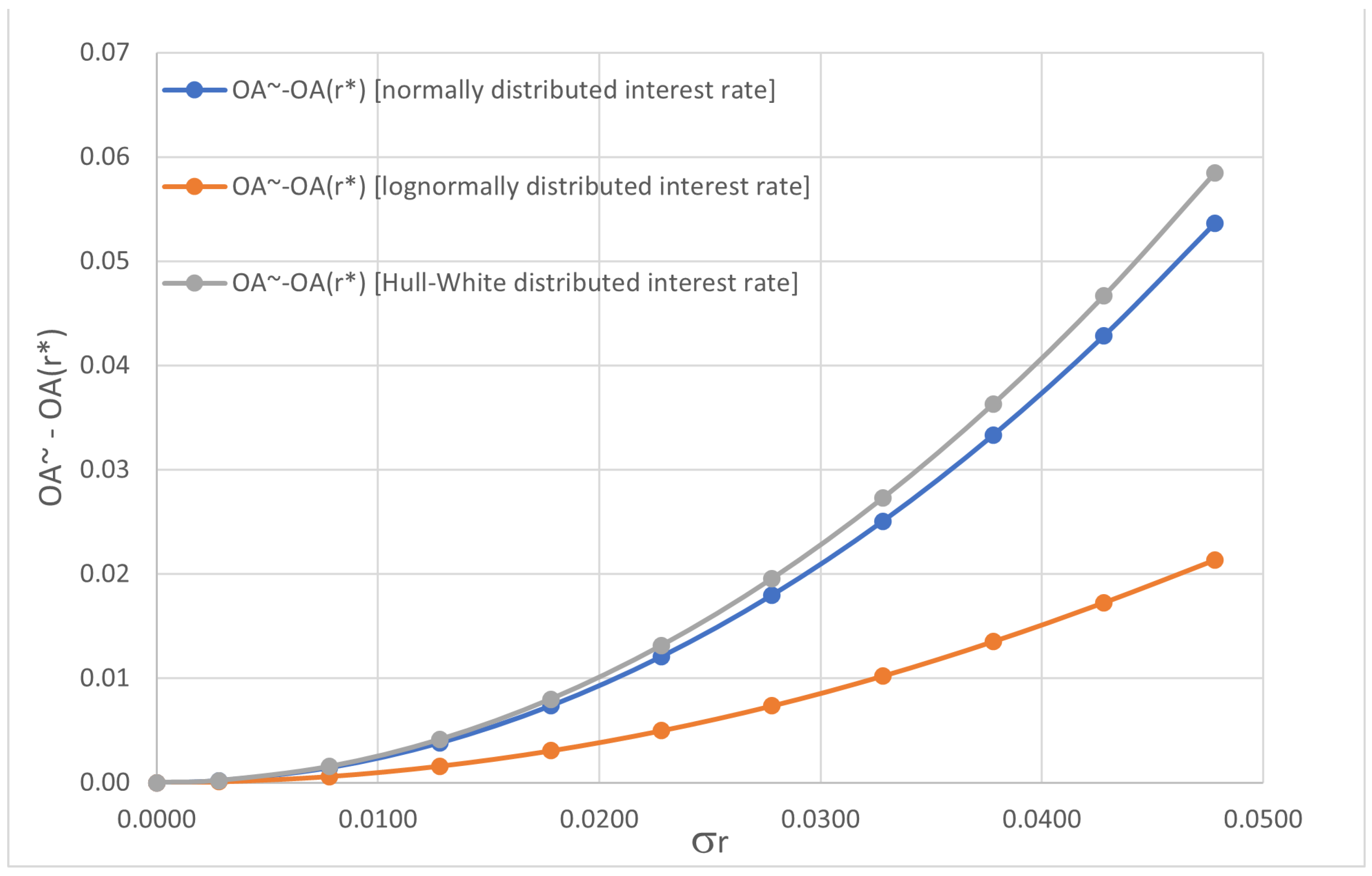
We compute
and present the results in
Table 1. To investigate the impact of interest-rate uncertainty, we vary the standard deviation parameter of the interest-rate process
. As expected, the difference
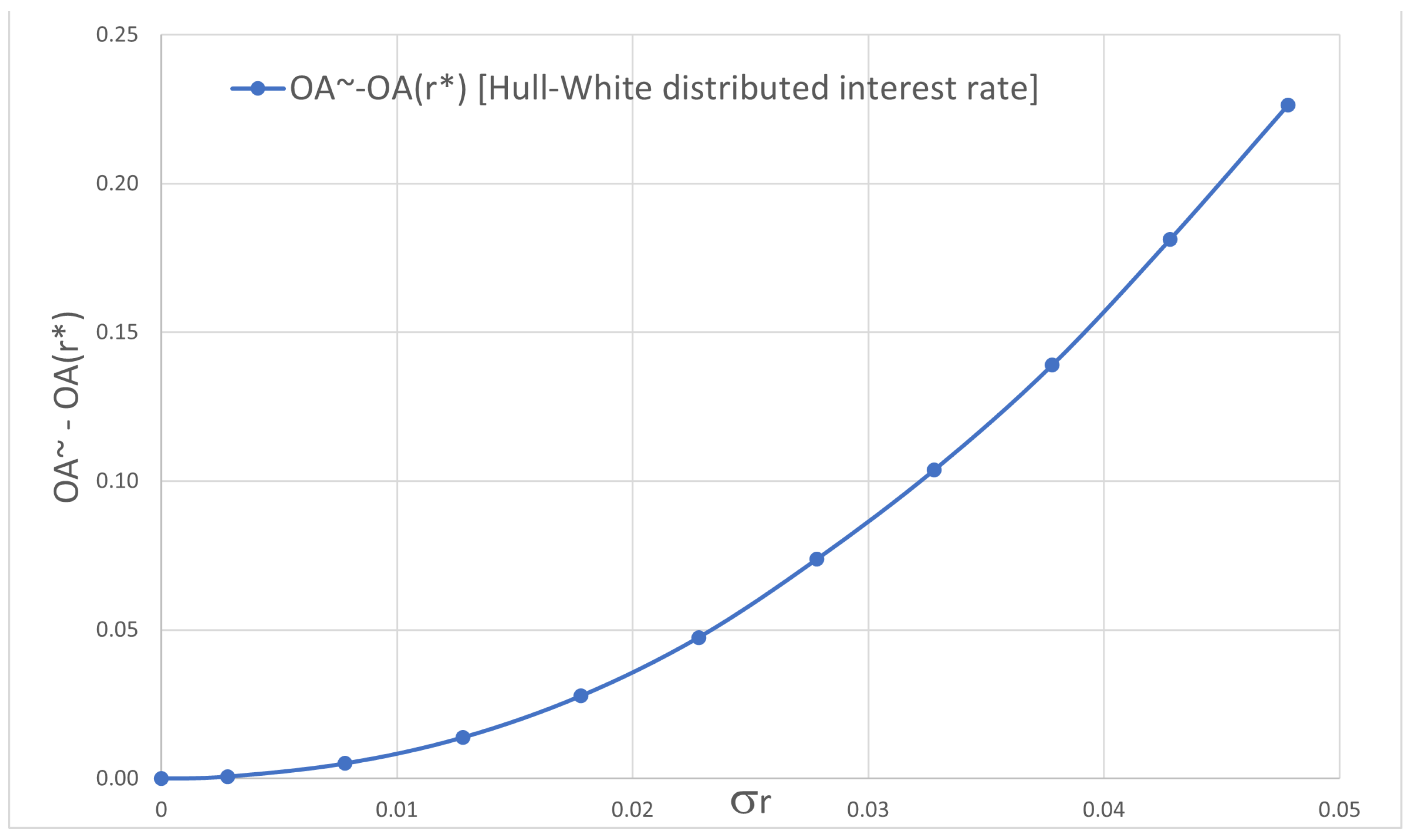
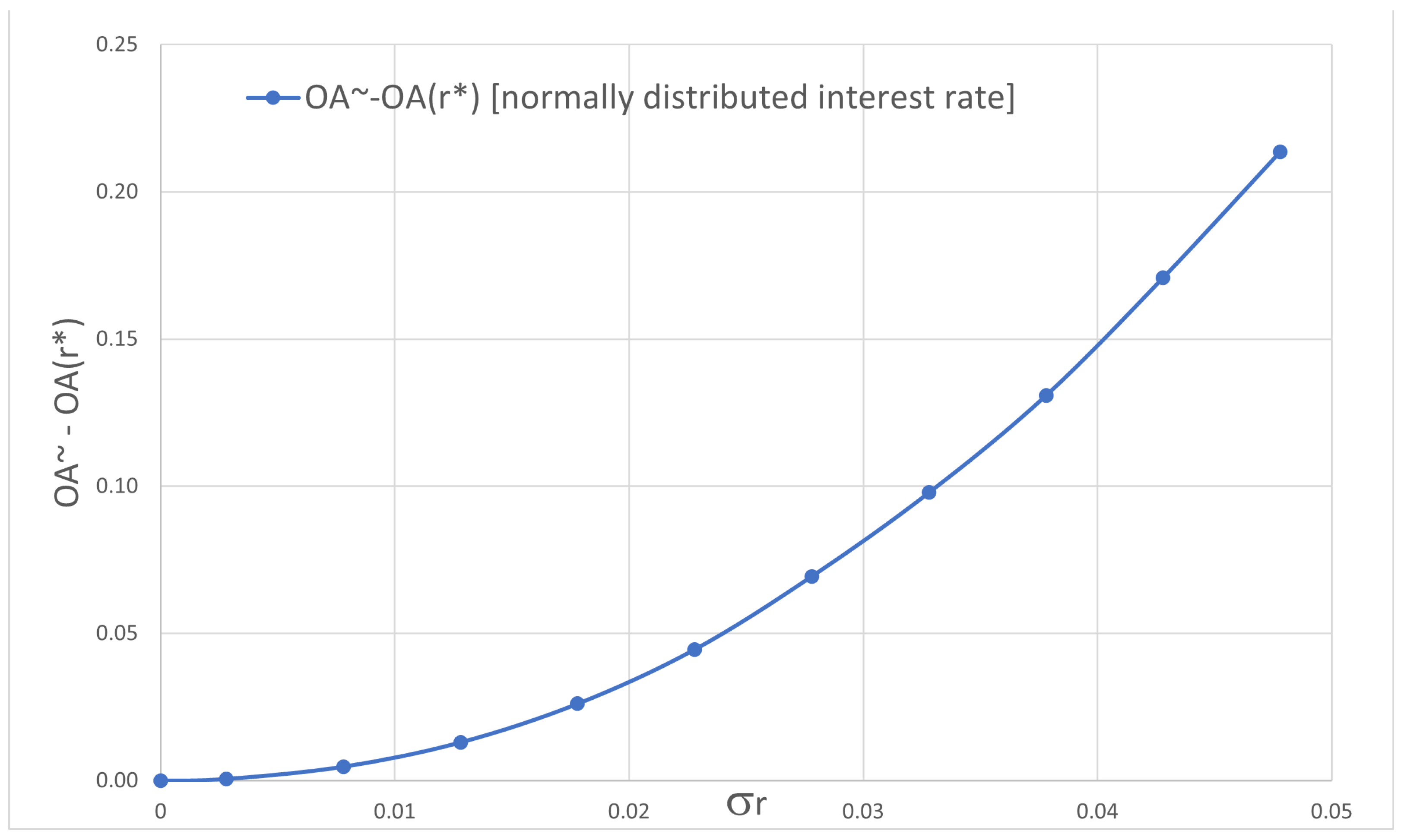
increases with the variability of the interest rate. When the volatility is set to zero, the stochastic model converges to the deterministic case and the difference becomes exactly zero. This monotonic increase in
as standard deviation rises is clearly observed in
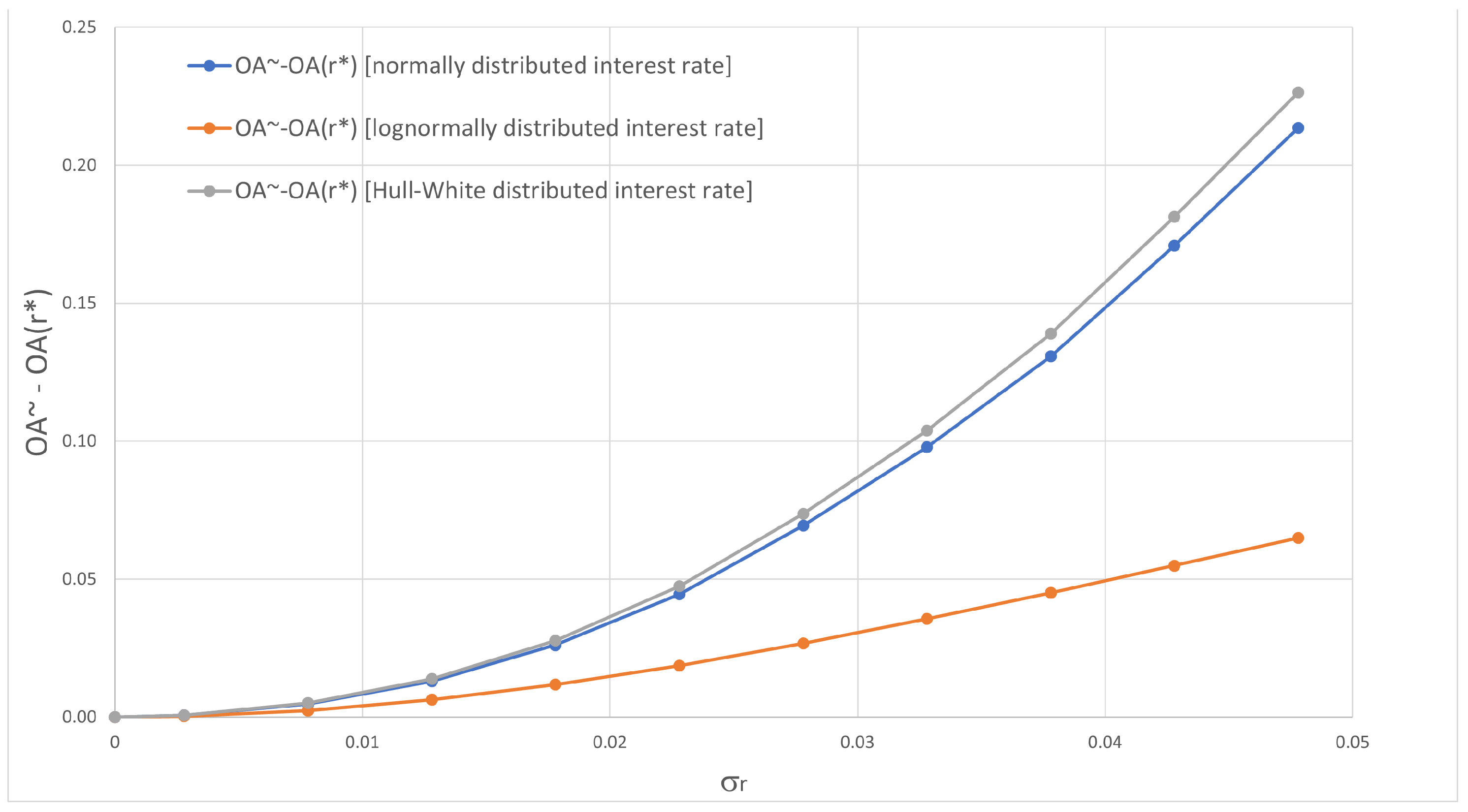
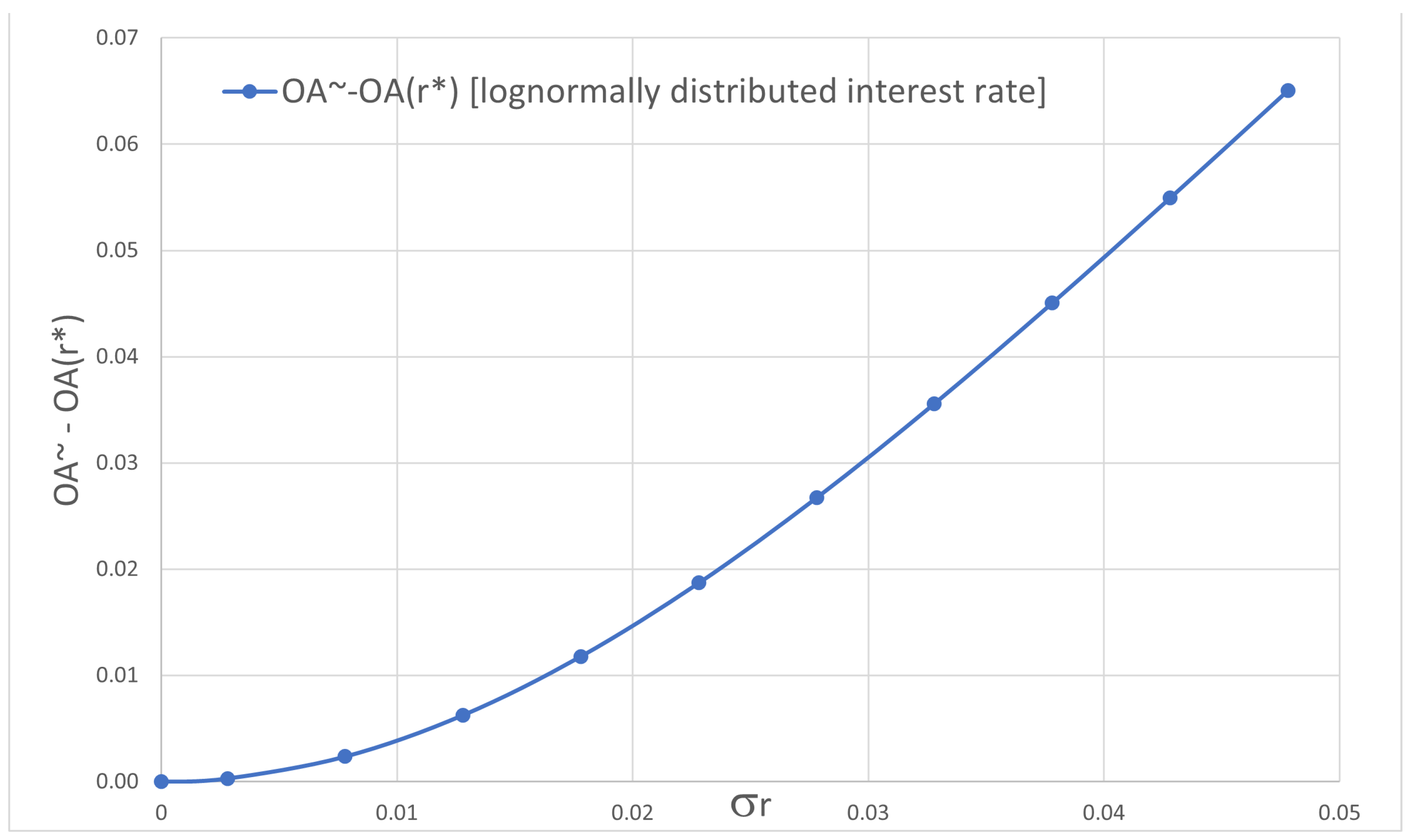
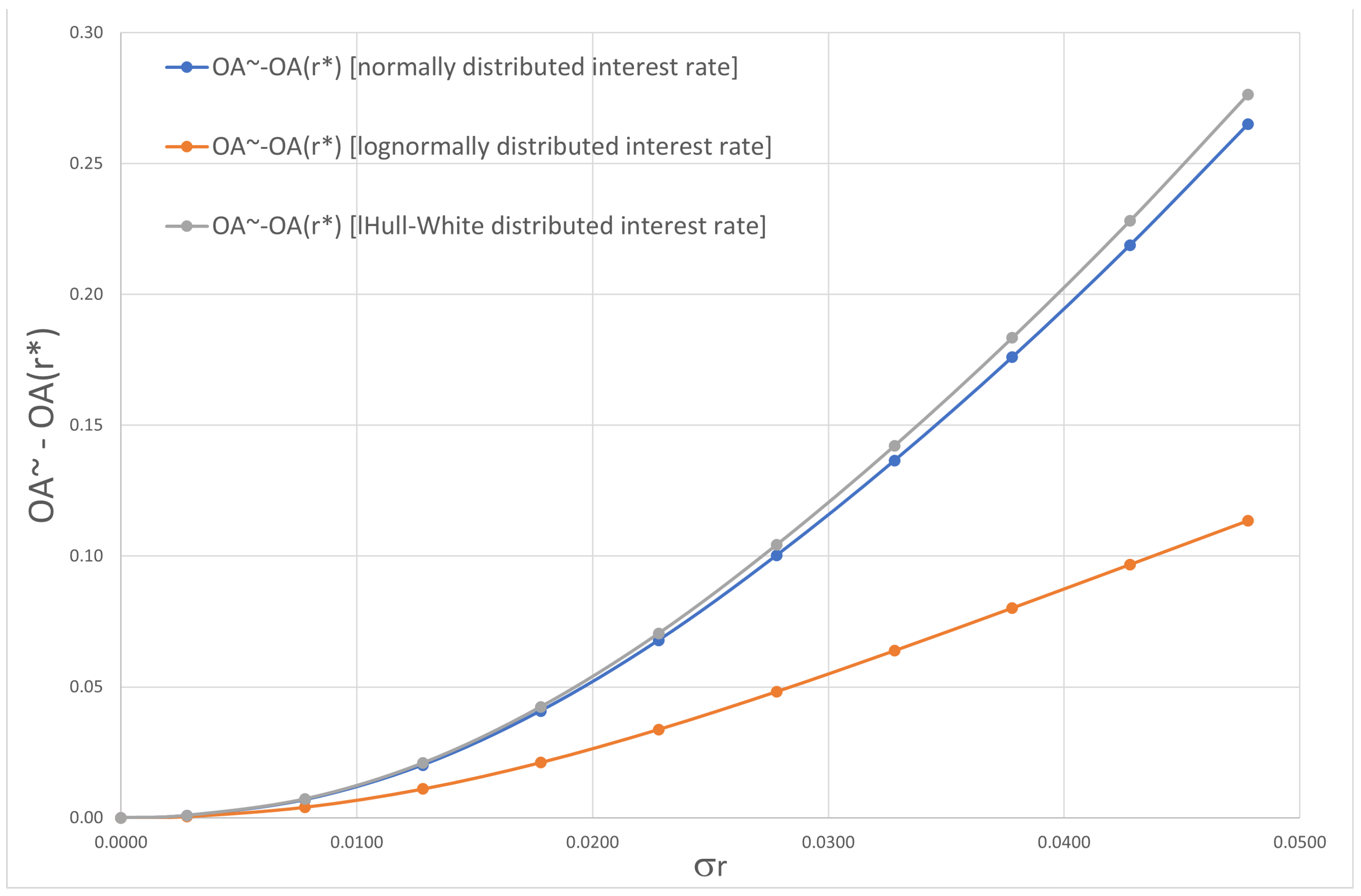
Figure 1. We repeat the same numerical experiments under a local rate following Geometric Brownian motion and Hull–White processes, as defined in
Section 5.3, and present the results in
Figure 2 and
Figure 3, respectively. We observe a similar behavior, as discussed in more details in
Section 7. The numerical values in
Table 1 and subsequent results (e.g., in
Figure 3) indicate that hidden optionality may reach 2% of the deterministic benchmark price. Such a gain is significant in trading strategies with positions reaching billions of dollars.
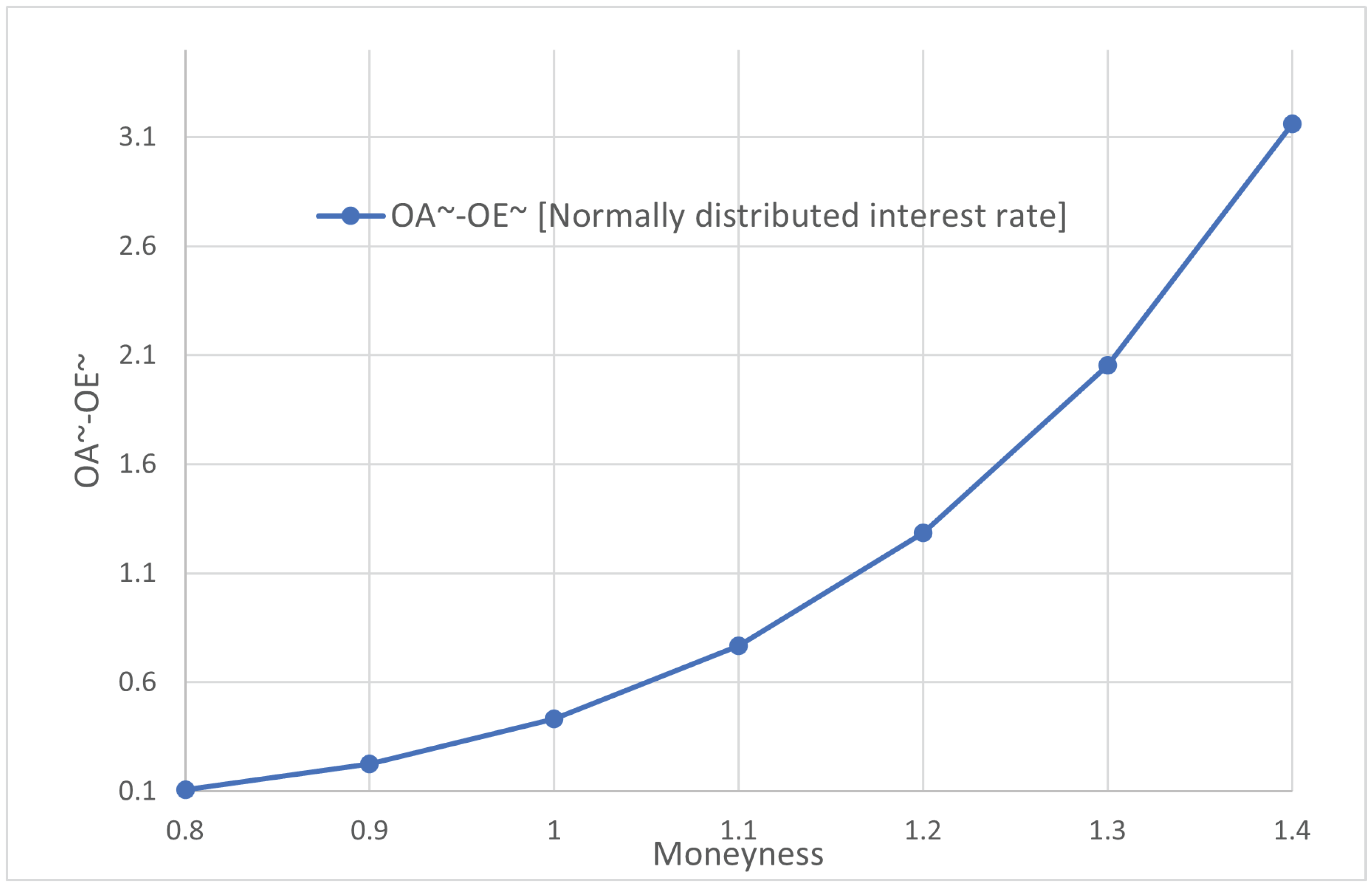
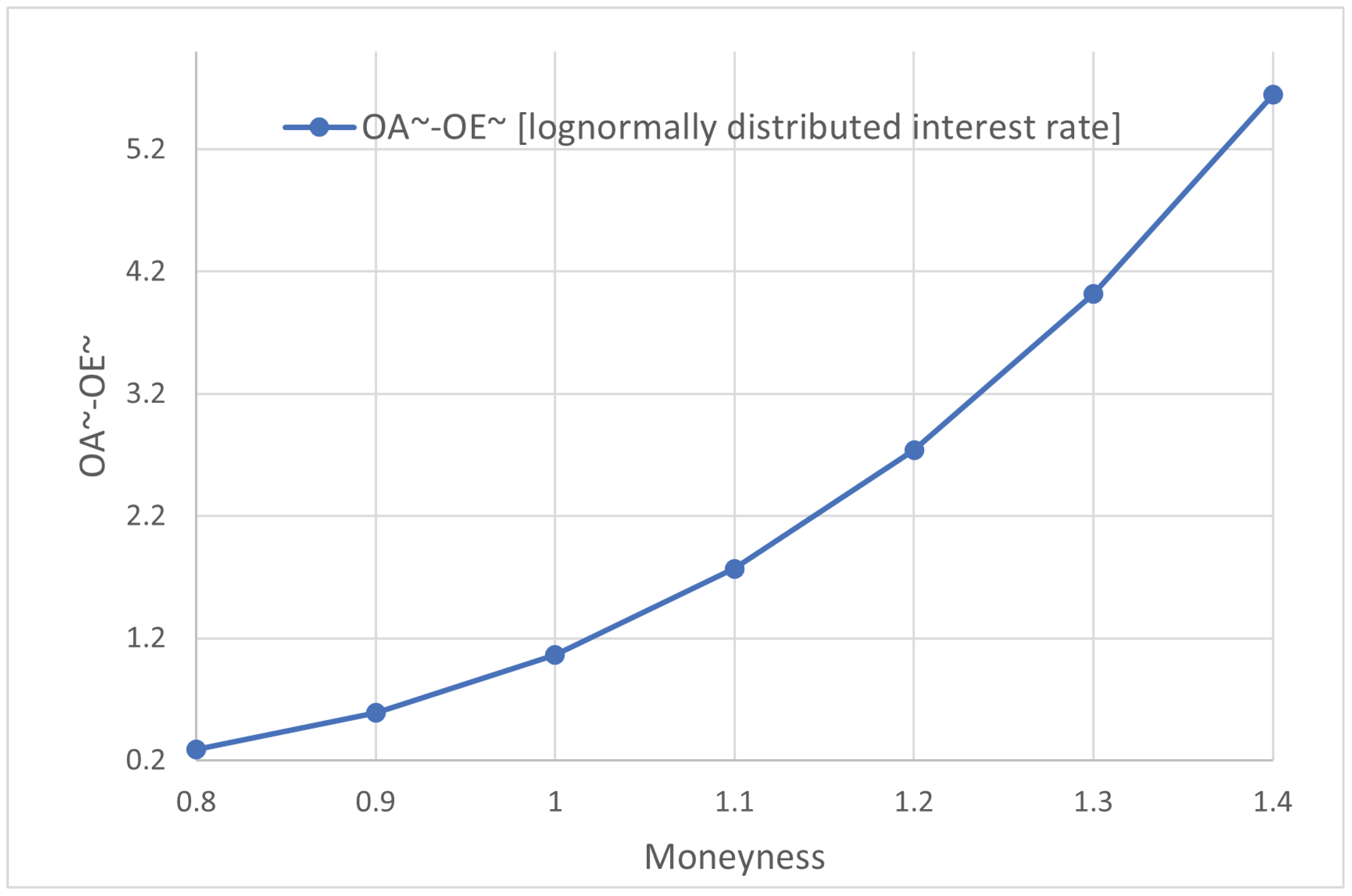
As an alternative measure of hidden optionality, we can compute the stochasticized American option value,
, under a normal interest rate, and compare it with the corresponding European price, estimated as
where
is the density of the interest rate at the option maturity,
T. We then estimate
as a measure of the optionality of the American option which is
controlled on the European one. We compute
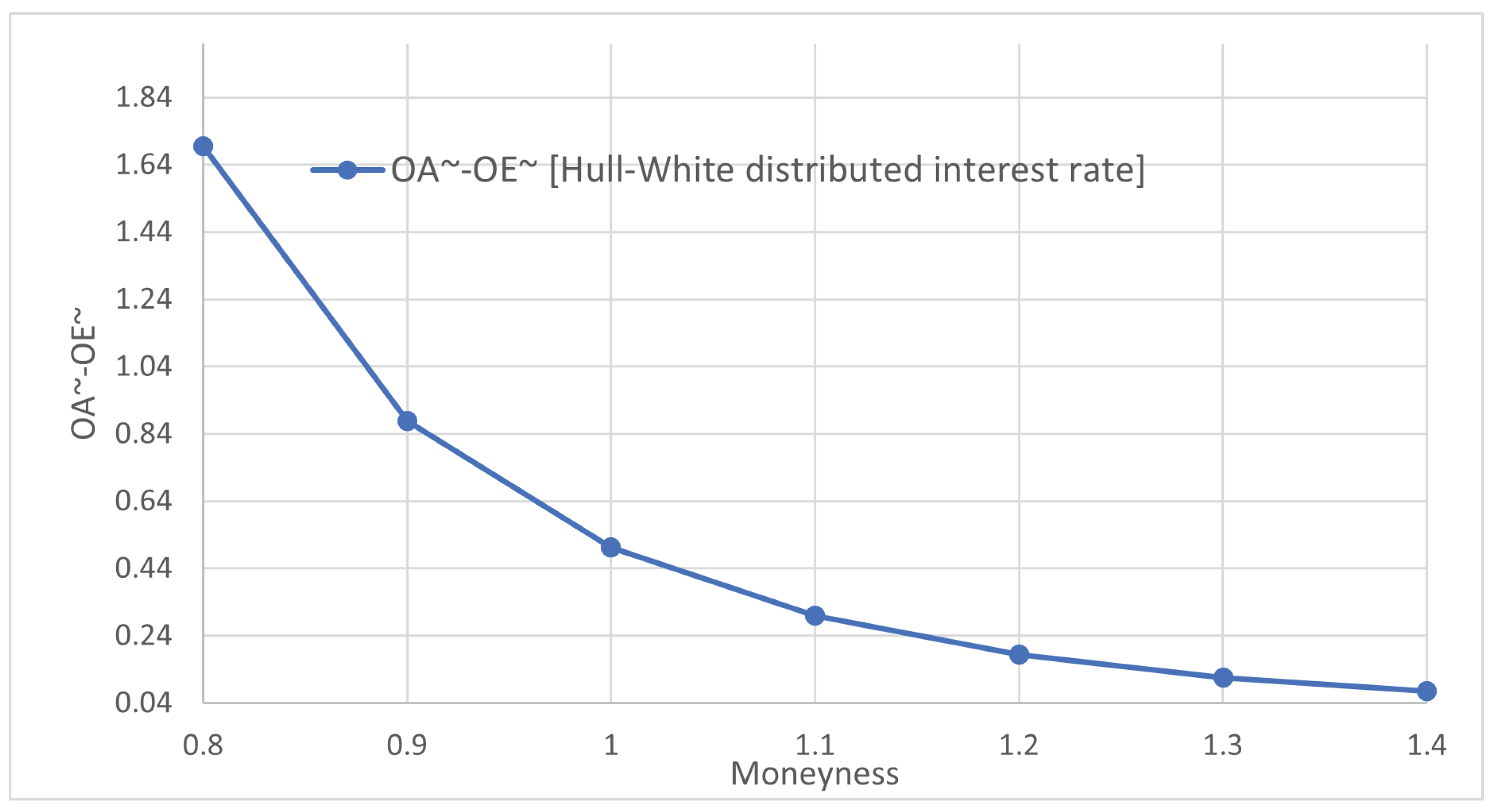
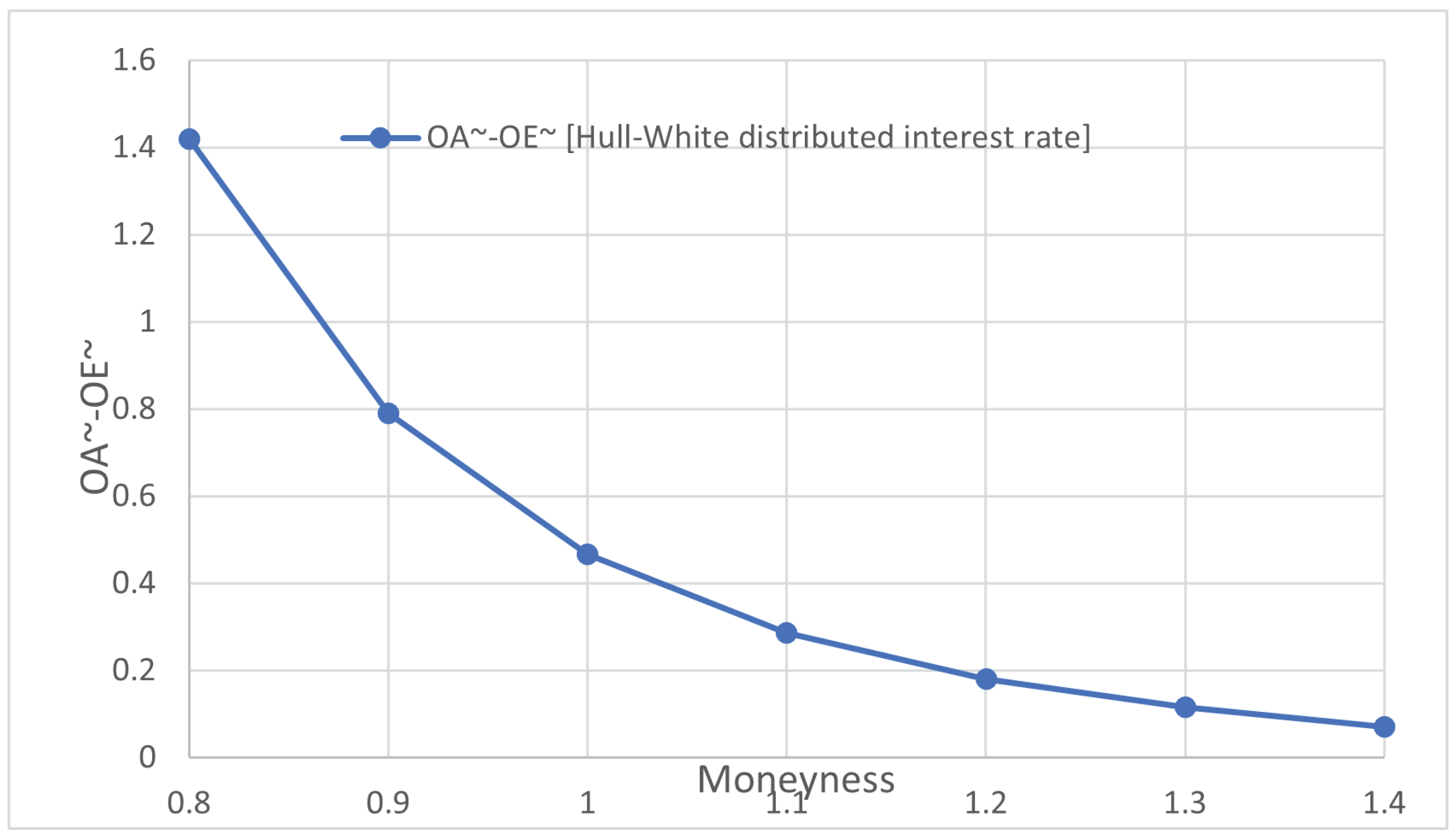
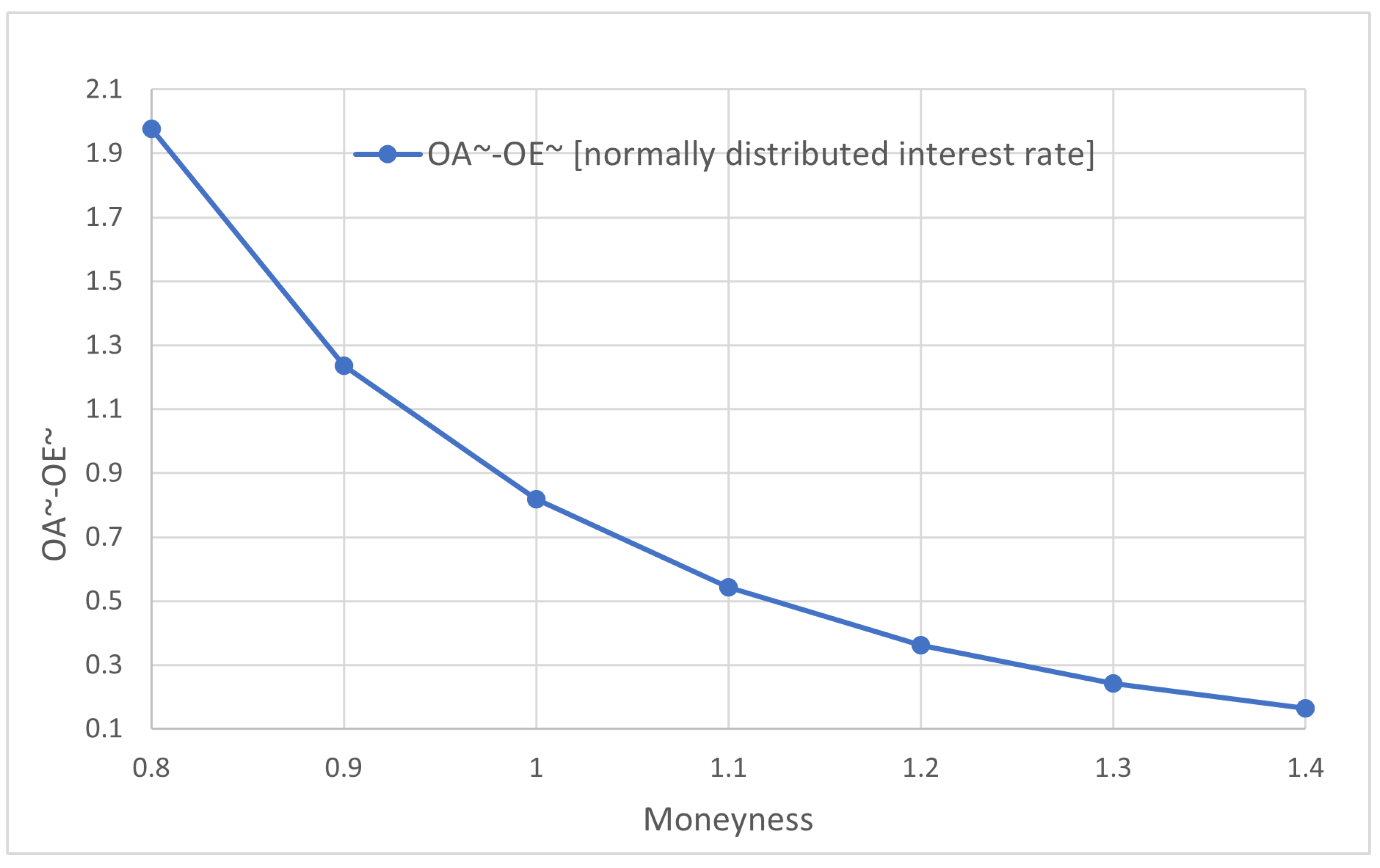
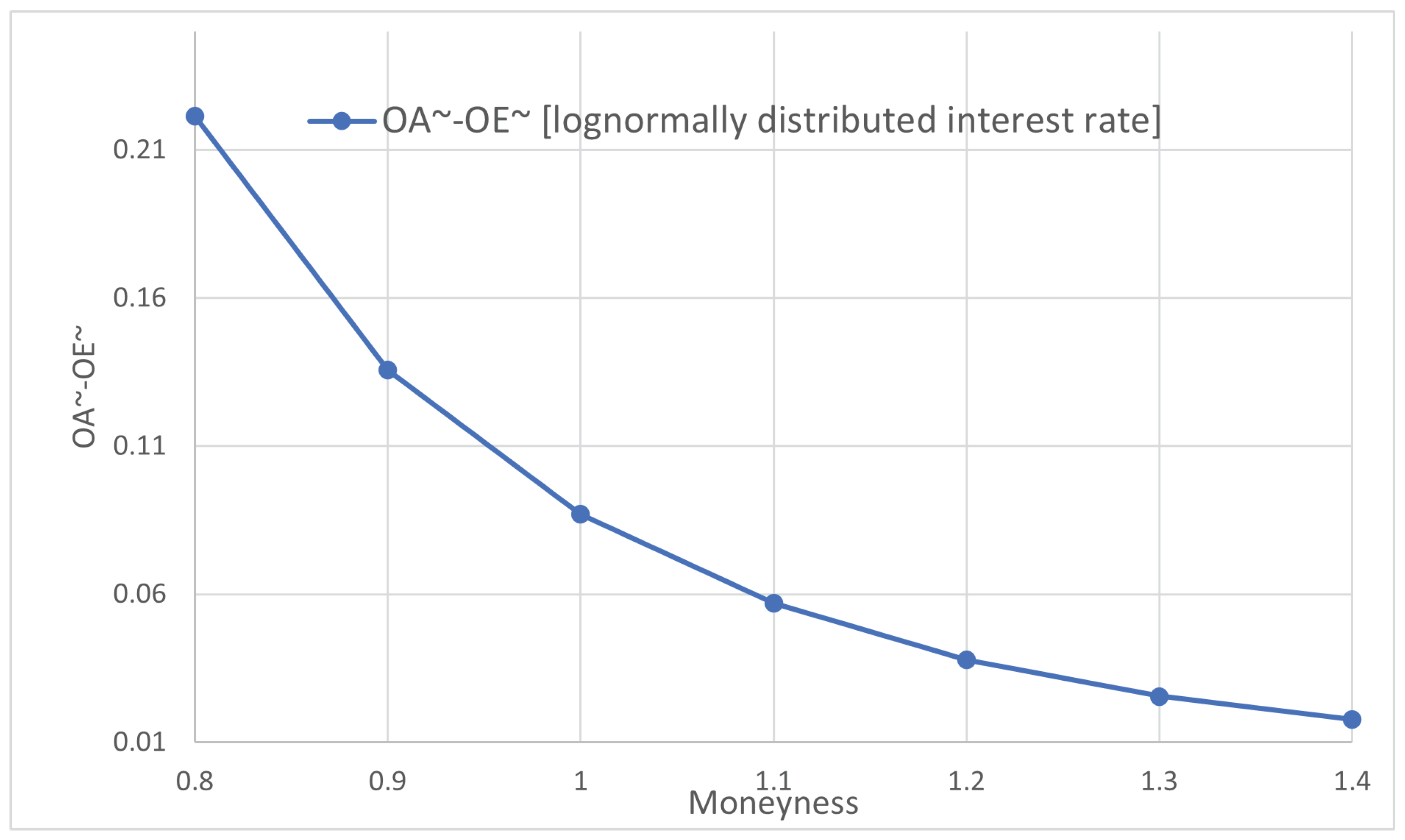
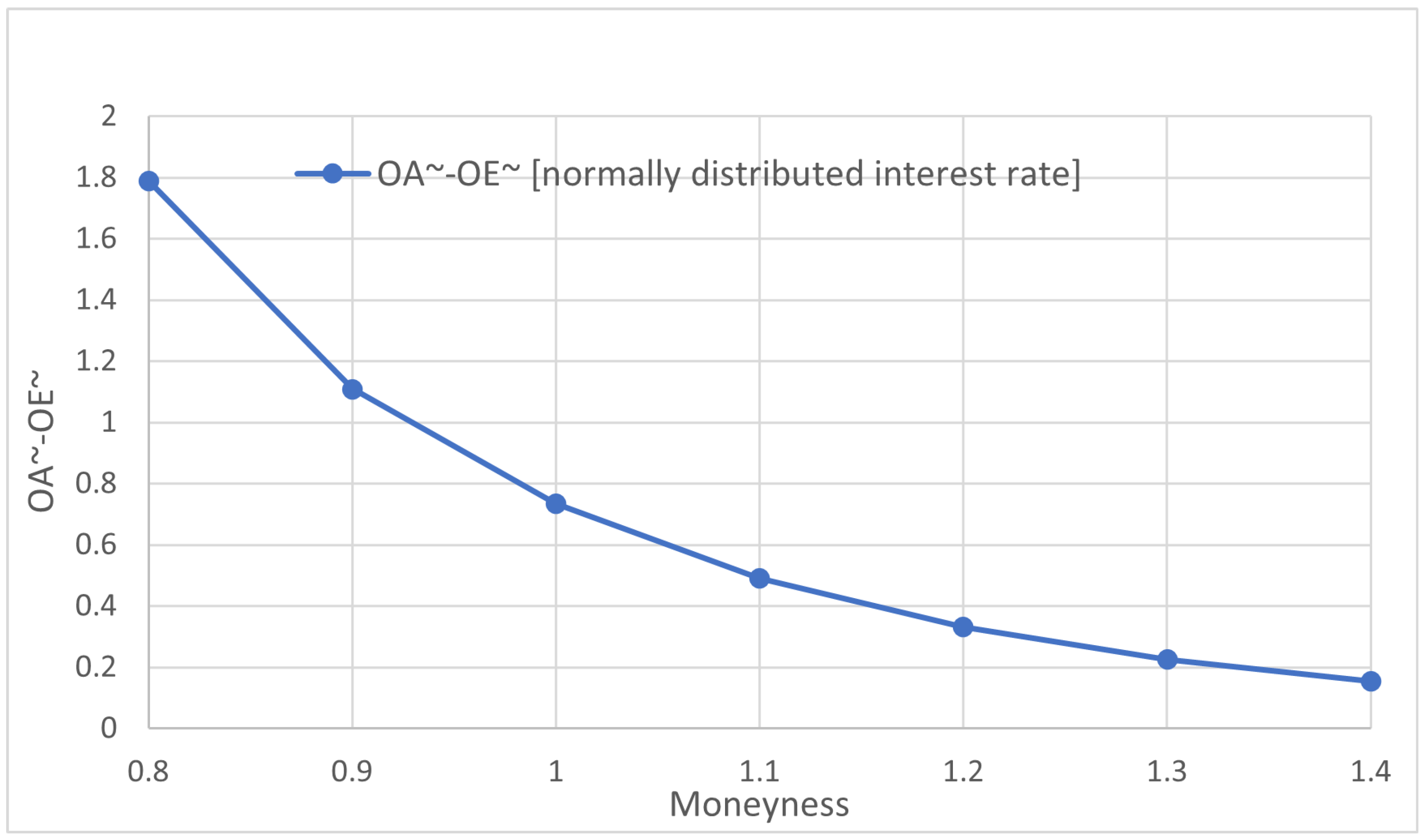
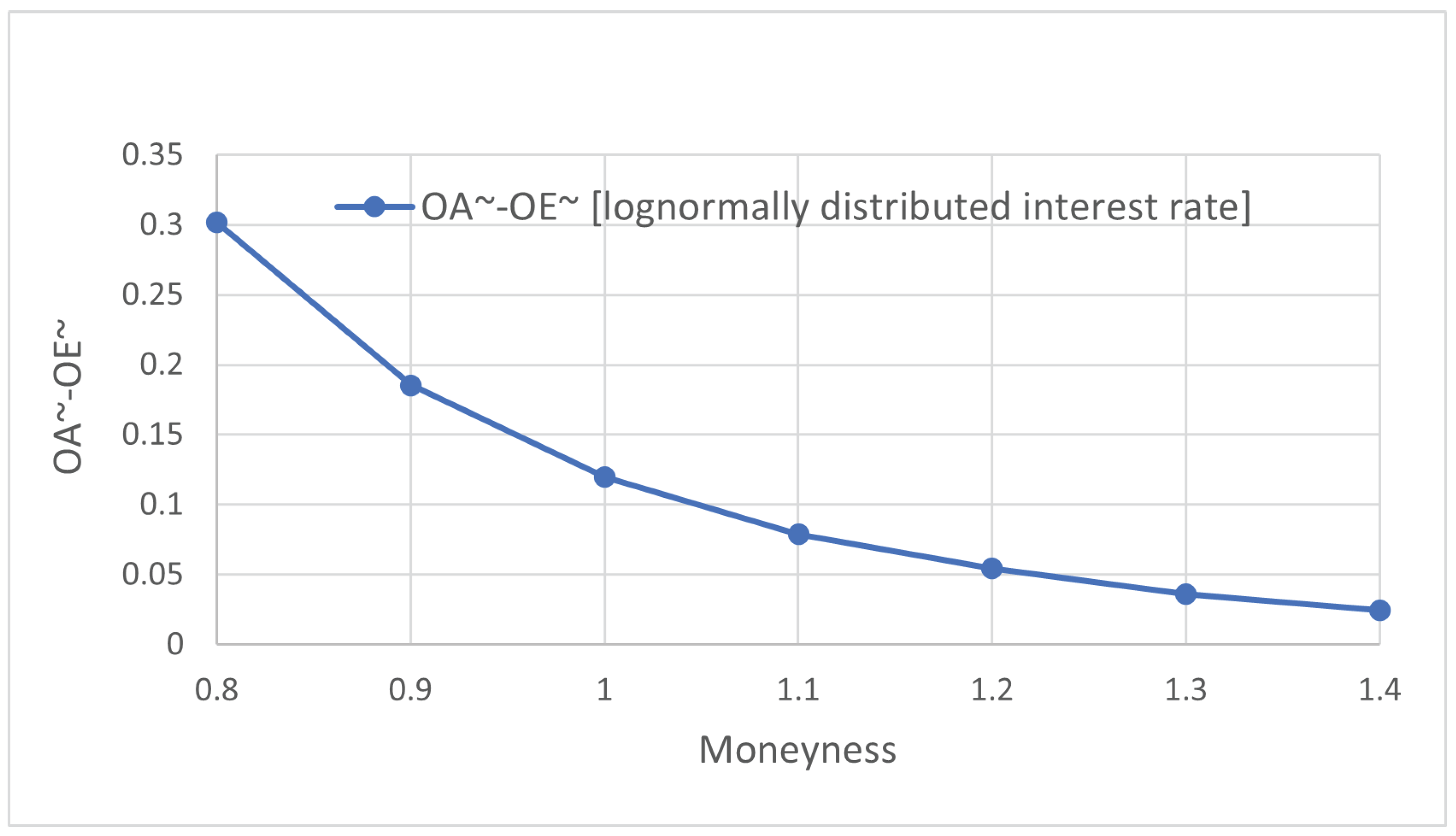
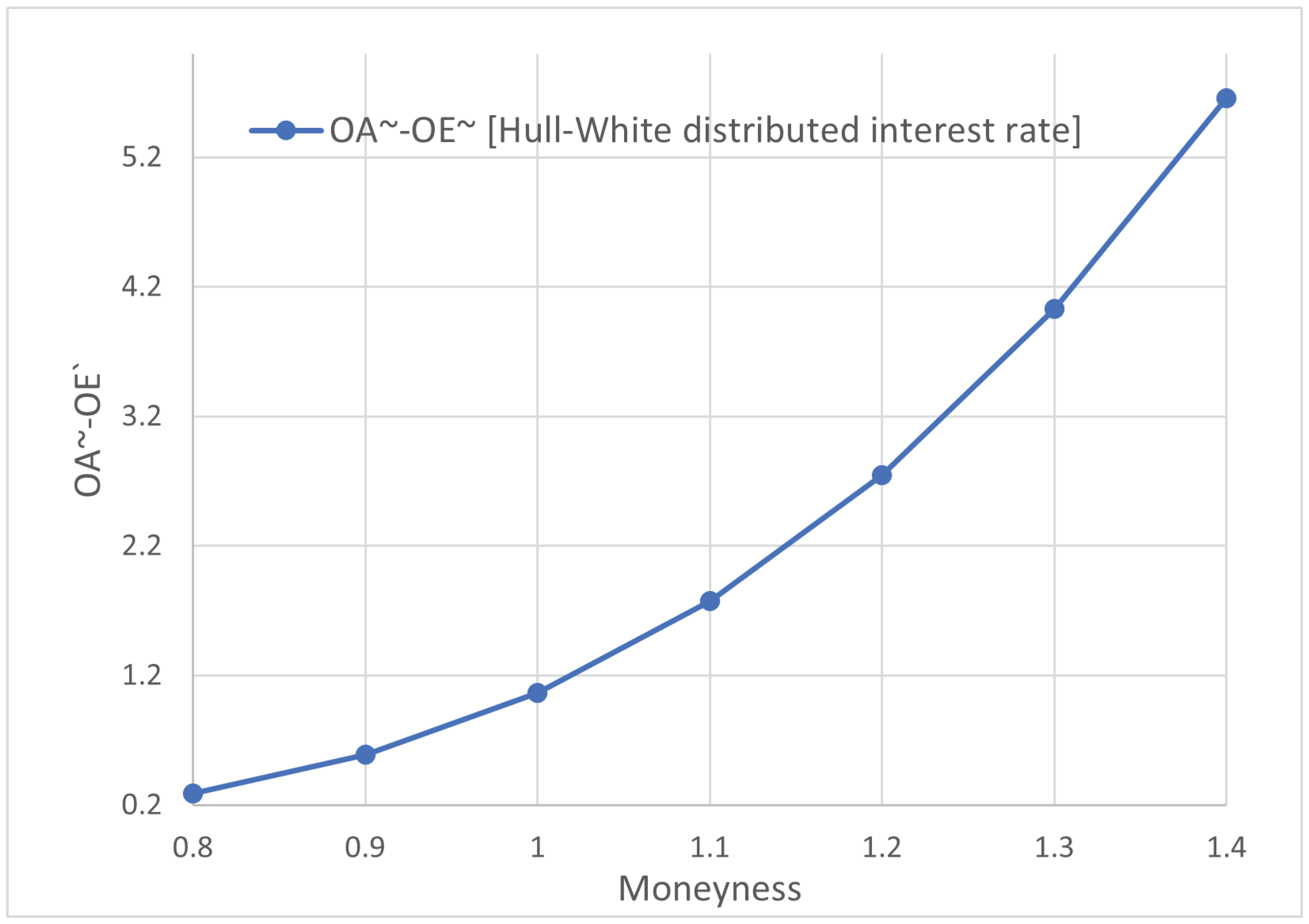
for various moneyness levels for an equity put. We present the results in
Figure 4,
Figure 5 and
Figure 6 for normally distributed interest rates, lognormal interest rates, and Hull–White rates, respectively. The results show consistent positive
values, indicating that the American option is less vulnerable to interest rate stochasticity than the European one. In addition, we observe that the lower the moneyness level, the greater the optionality (and implicitly the robustness) of the American option over the European one. Similar results have been observed, sporadically, in the literature, e.g.,
Medvedev and Scaillet (
2010).
7. Further Numerical Results and Technical Details
In
Section 7.1, we briefly discuss the binomial lattice method (
Cox et al. 1979) used to compute the integration and to obtain the fugit distribution. In
Section 7.2, we investigate the proposed heuristics in (
7) and then compare the results with the expected fugit estimated from the lattice in
Section 7.1, which can be seen as the “exact” baseline. In
Section 7.3, we study how changes in the dynamics of interest rate, under alternative distributional assumptions, affect our results.
7.1. Binomial Lattice and Fugit Distribution
This section presents the numerical framework used throughout the paper. The starting point is the computation of of the distribution optimal stopping time of an American option using the classical fugit given in
Section 5.1.2 utilizing a binomial lattice.
Following the notation described in
El Hassan and Maddah (
2026), we briefly recall the elements of the lattice that are required for the computation of the fugit distribution and the subsequent numerical valuation for an American put. (For a call, a symmetrical procedure exists). Let the maturity
T be divided into
time steps of length
. In accordance with
El Hassan and Maddah (
2026), we set
, which provides stable and accurate numerical results. The stock price evolves on the lattice according to the multipliers
and
, with a risk-neutral probability
. Starting with
, the stock price at time step
i and state
j (denoting the number of times the stock price has increased up to time
i), the American option value at each time and state,
, can be obtained through backward recursion. At maturity,
, the final payoff is
. For
, the value of the option is the maximum between the exercise payoff and the continuation value,
, where the continuation value is given by
.
The backward recursion simultaneously determines the optimal exercise region. Accordingly, we can define an early exercise indicator
with corresponding point in time
.
To compute the distribution of the fugit , the probability mass function is propagated forward through the lattice while enforcing the optimal stopping rule. Let denote the probability of reaching node without prior exercise, with initialization , and , otherwise. Moreover, the fugit distribution is also initialized at . For each time step , the below strategy is followed:
If
and
, the probability evolves according to the risk-neutral recursive dynamics,
If and , the probability is added to the exercise probability at time i, , and the recursion is not propagated further, leading to = , at time .
Algorithm 1 is a complete algorithm to compute the fugit pmf
and expected value
in (
8) is presented next. While the algorithm is straightforward, we could not identify any similar approaches in the literature. There are some online forums hinting to it without enough details. The following complete algorithm can be seen as a side contribution of this paper.
| Algorithm 1 Estimating the fugit distribution |
|
Step 1.
Input the values for S, K, T, , , , and , where = 1 for a call and for a put. |
Set . Evaluate the lattice parameters , , , and .
Step 2.
Build the recombining stock-price lattice . |
| Set . |
| For to |
| Set |
| For to i |
| Set . |
|
Step 3.
Initialize the terminal option values at maturity: |
| For to , set . |
|
Step 4.
Backward recursion (pricing and exercise indicator): |
| For down to 0 |
| For to i |
| Set . |
| Set . |
If set , else set .
Step 5. Forward recursion (probabilities of reachable nodes and stopping distribution): |
| Set , for and , and for . |
| For ,to |
| For to i |
| If and , set (stop here). |
| If and , propagate, |
| , |
.
Step 6. Maturity handling: |
| For to if and , |
set .
Step 7. Output the option premium and fugit characteristics: |
| Return the option premium |
| Set SWT = 0 and SW = 0. |
| For to |
| Set |
| Return the fugit pmf |
| Set and . |
| Return the expected fugit . |
Once the expected fugit has been obtained, the same binomial lattice is used to evaluate the optimality measure
, as explained in
Section 6, with the integration in (
9) evaluated numerically using the Gauss–Hermite quadrature (e.g.,
Stoer and Bulirsch 2013). This numerical integration method approximates the expectation by a weighted sum of lattice prices evaluated at optimally chosen rate nodes.
7.2. Expected Stopping Time
In this section, we compare the effective stopping time developed by
Taleb (
1997) using (
7) and using the expectation of the classical deterministic fugit in (
8), for an equity put, currency put, and currency call.
7.2.1. Equity Put
We consider an equity put option with the input parameters mentioned in
Table 1. We estimate
from the binomial lattice method, at the deterministic benchmark, as explained in
Section 7.2.1 . The European call
is valued based on the Black-Scholes-Merton formula (
Black and Scholes 1973). We first estimate the American and European option sensitivities with respect to the interest rate,
and
, using a common heuristic based on central difference method,
We use the values of
and
to obtain the effective stopping time associated with the early exercise feature of an American option using (
7). We also compute the stopping time using expectation of the classical fugit using (
8). We obtain close results, as shown in
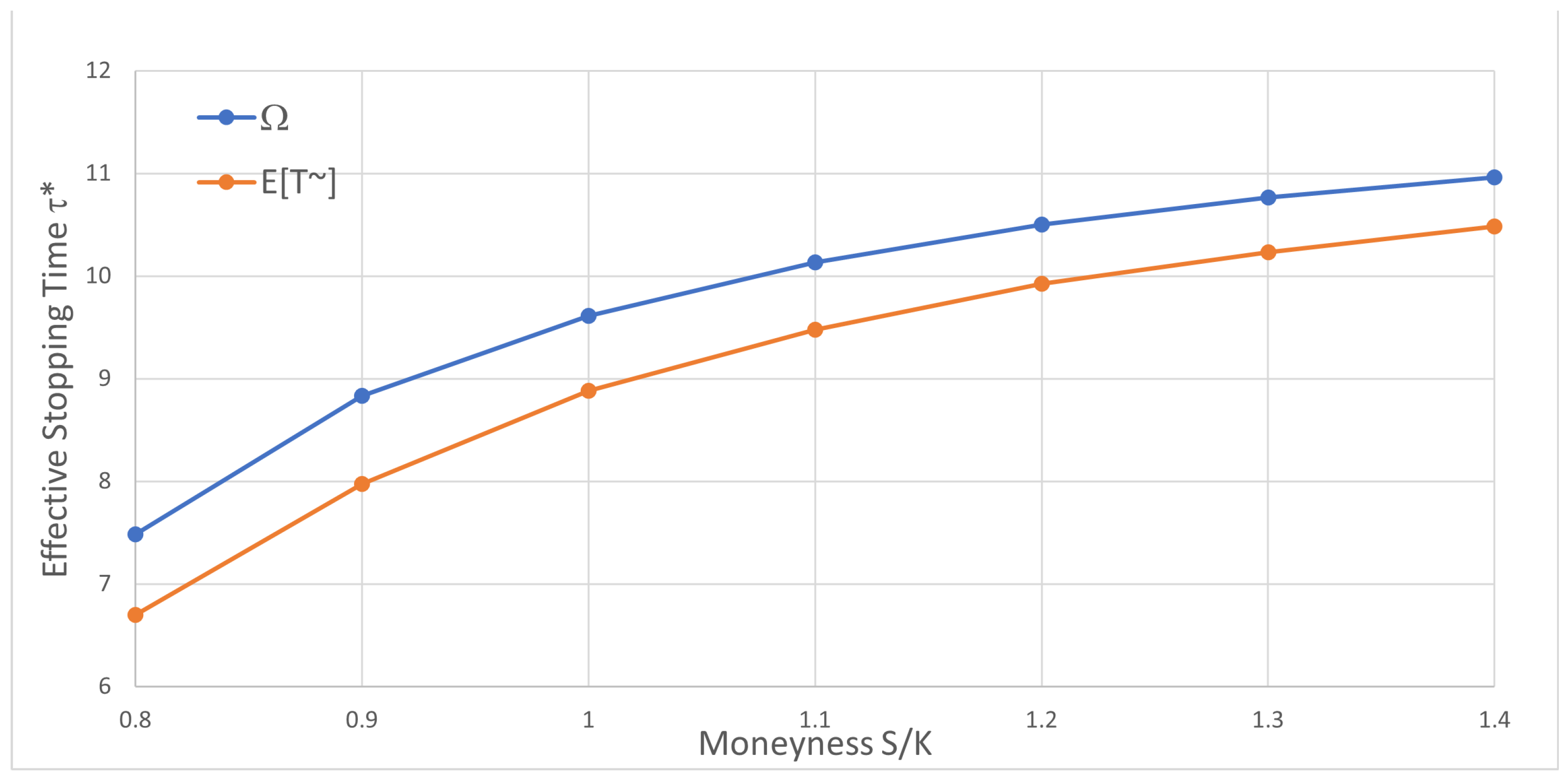
Table 2, which confirm the validity of the heuristics approach suggested by
Taleb (
1997). The results also show how
changes with moneyness. As expected, a lower moneyness level implies an earlier exercise time, i.e., the expected fugit is increasing in the moneyness.
Figure 7 also demonstrates this graphically.
7.2.2. Currency Put
In this section, we consider a currency put with base parameter values similar to those in
Section 6, with a foreign rate
. These parameters are given in
Table 3 for completeness.
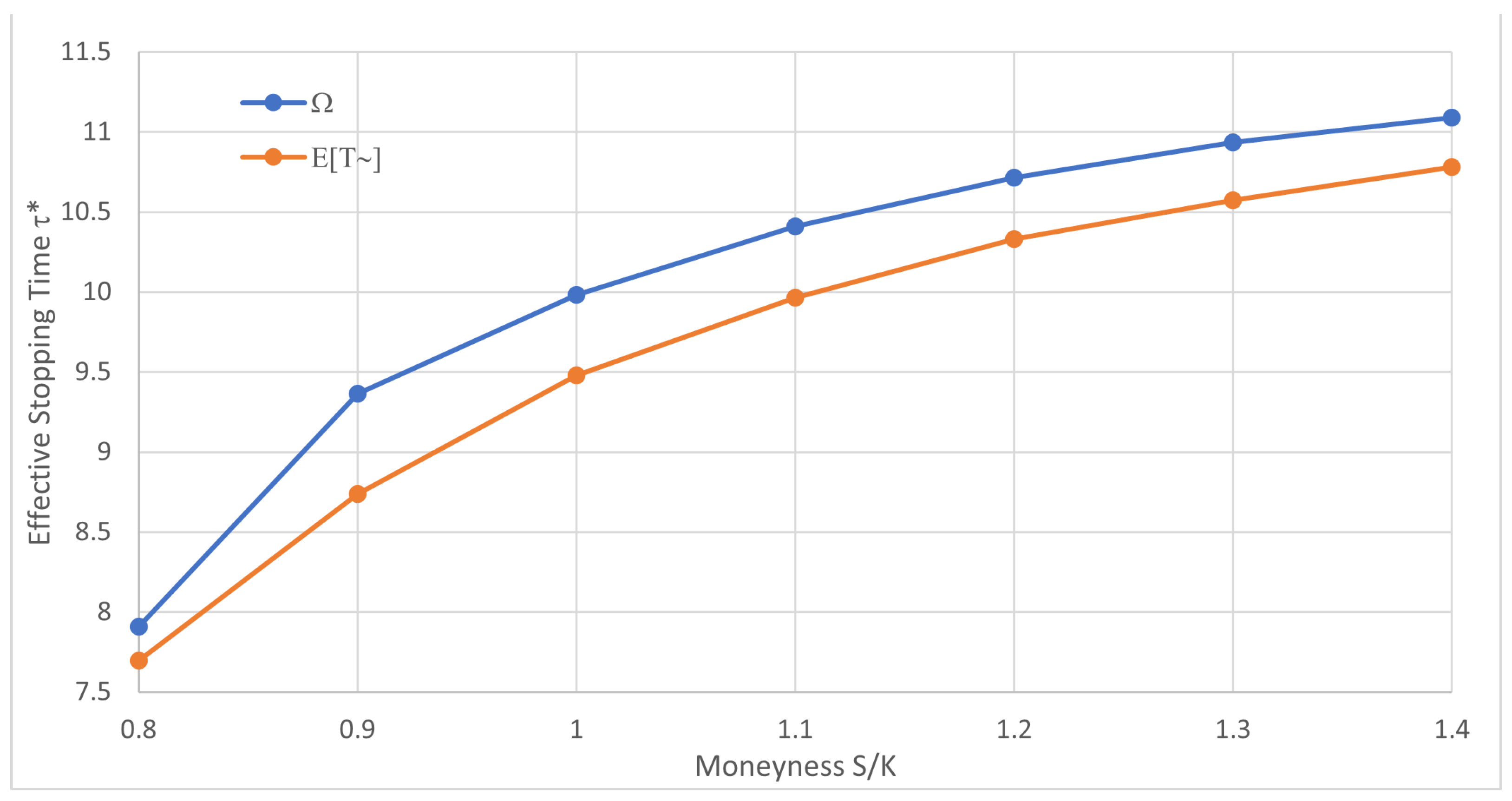
Similar to equity puts, we determine the effective stopping time
for the American currency put using (
7) and (
8). The results are presented in
Table 4 and
Figure 8 for different moneyness levels. We obtain again similar results as in the case of an equity put option, confirming the validity of Taleb’s heuristic in (
7).
7.2.3. Currency Call
We study a currency call option with parameters similar to those of the currency put above but with a foreign rate
. We present these input parameters in
Table 5. The observations we make here are also applicable to call options with dividends, which have a similar pricing structure.
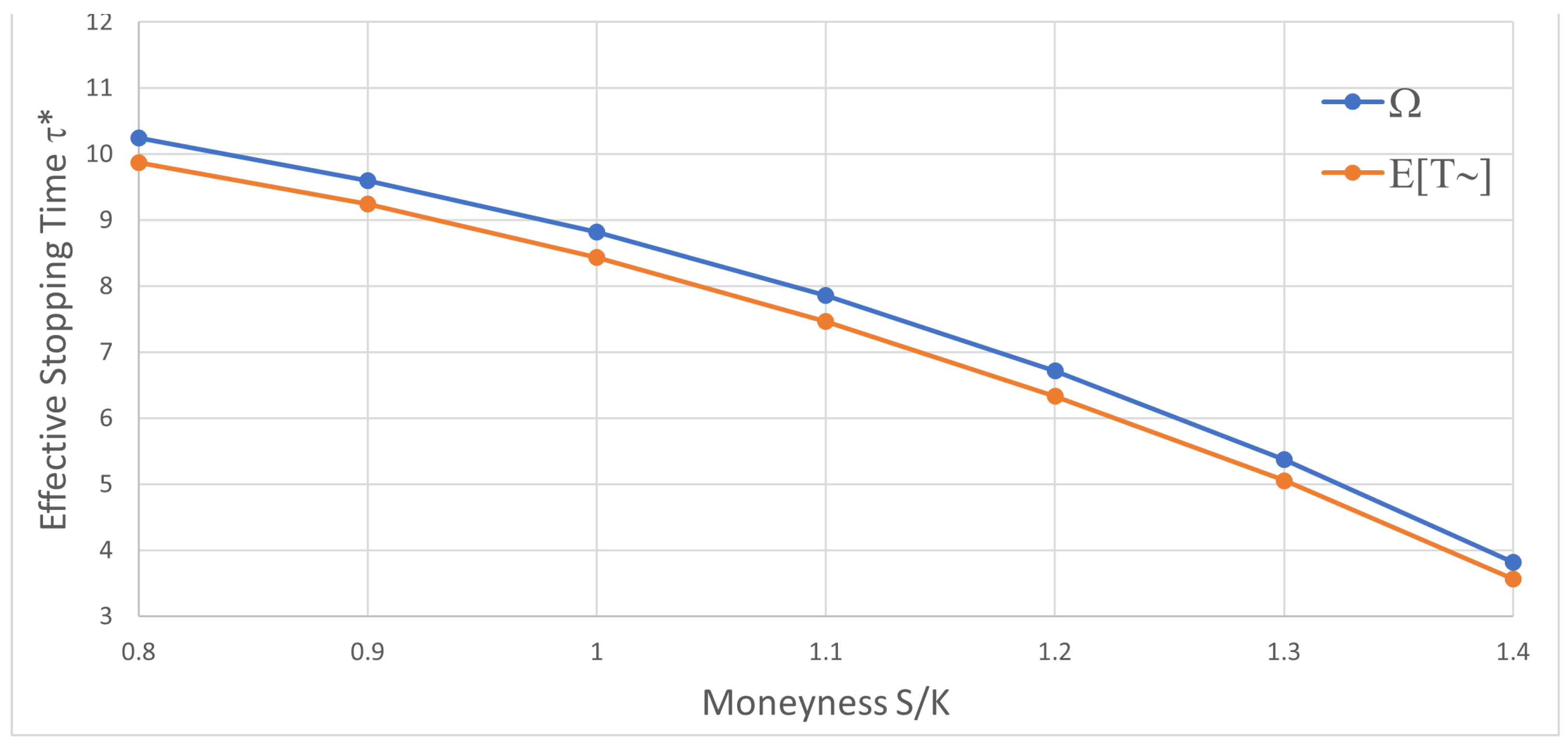
1 The results in
Table 6 and
Figure 9 again validate the heuristic (
7).
7.3. Different Rate Dynamics and Moneyness Levels
In this section, we evaluate the hidden optionality of American equity puts, currency puts, and currency calls, under different rate dynamics. Similar to
Section 6, we start by considering a normally distributed interest rate, and then extend the analysis to a lognormally and Hull–White distributed rate.
7.3.1. Equity Put
In this section, we consider the American equity put with the same parameters as in
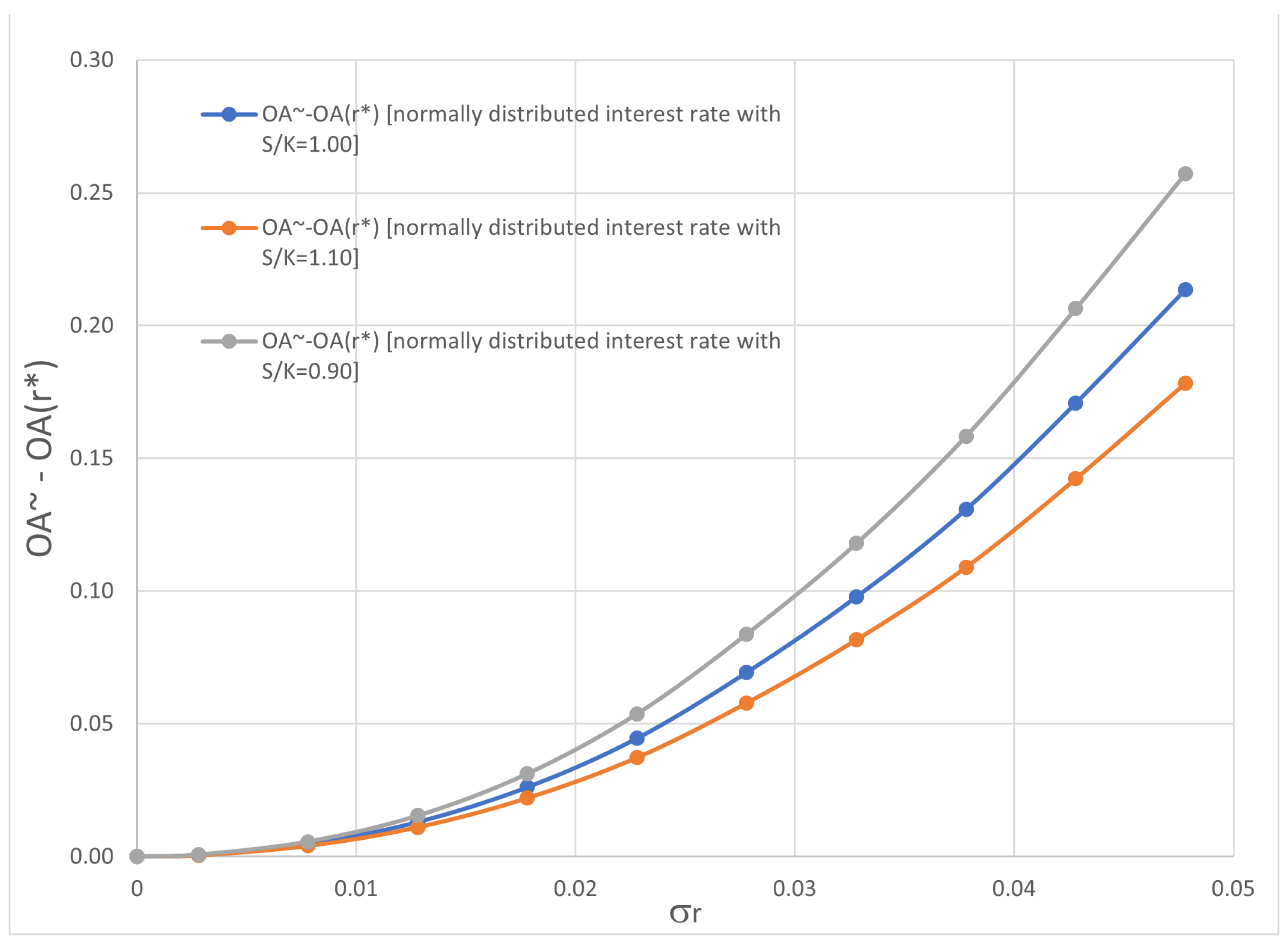
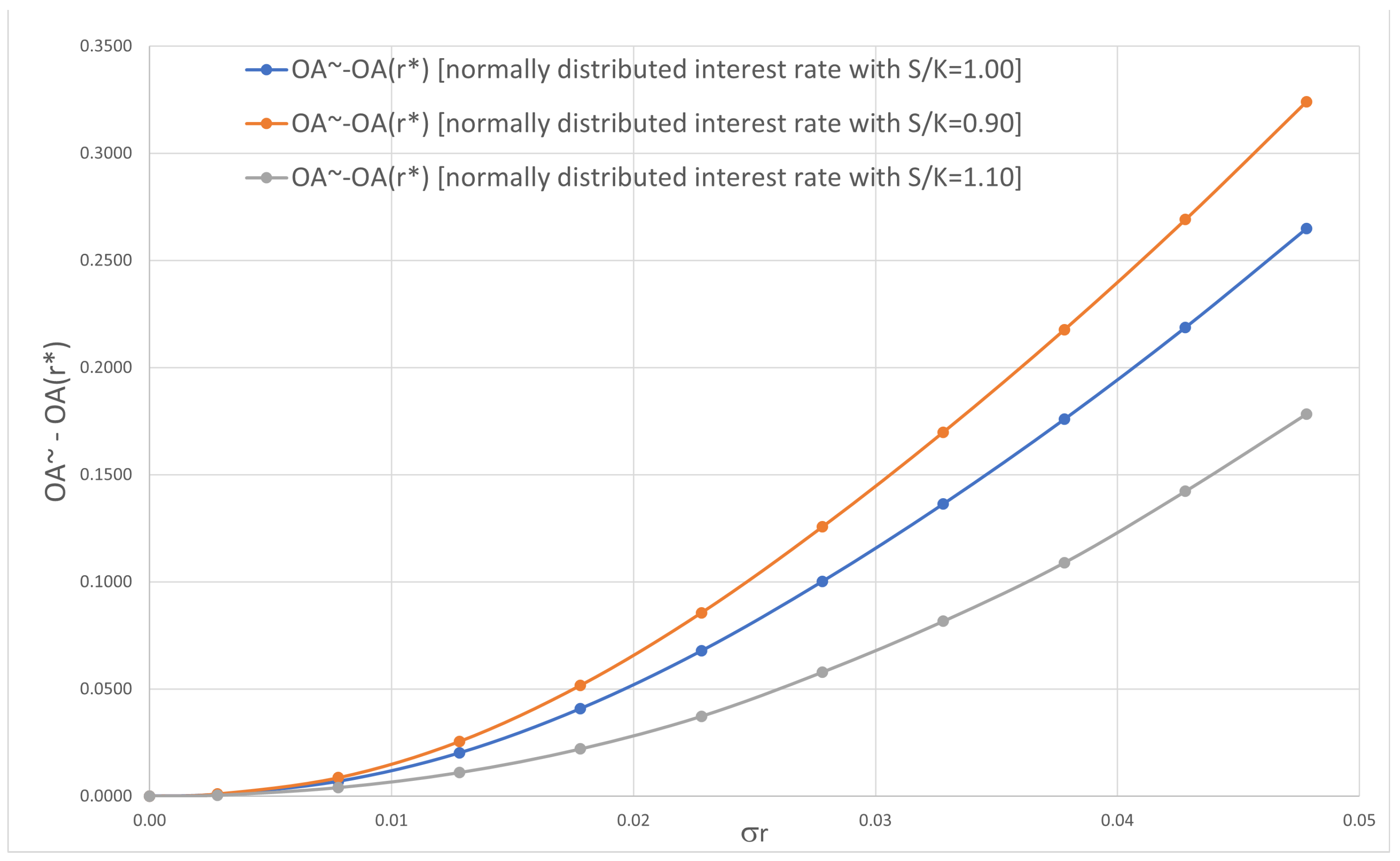
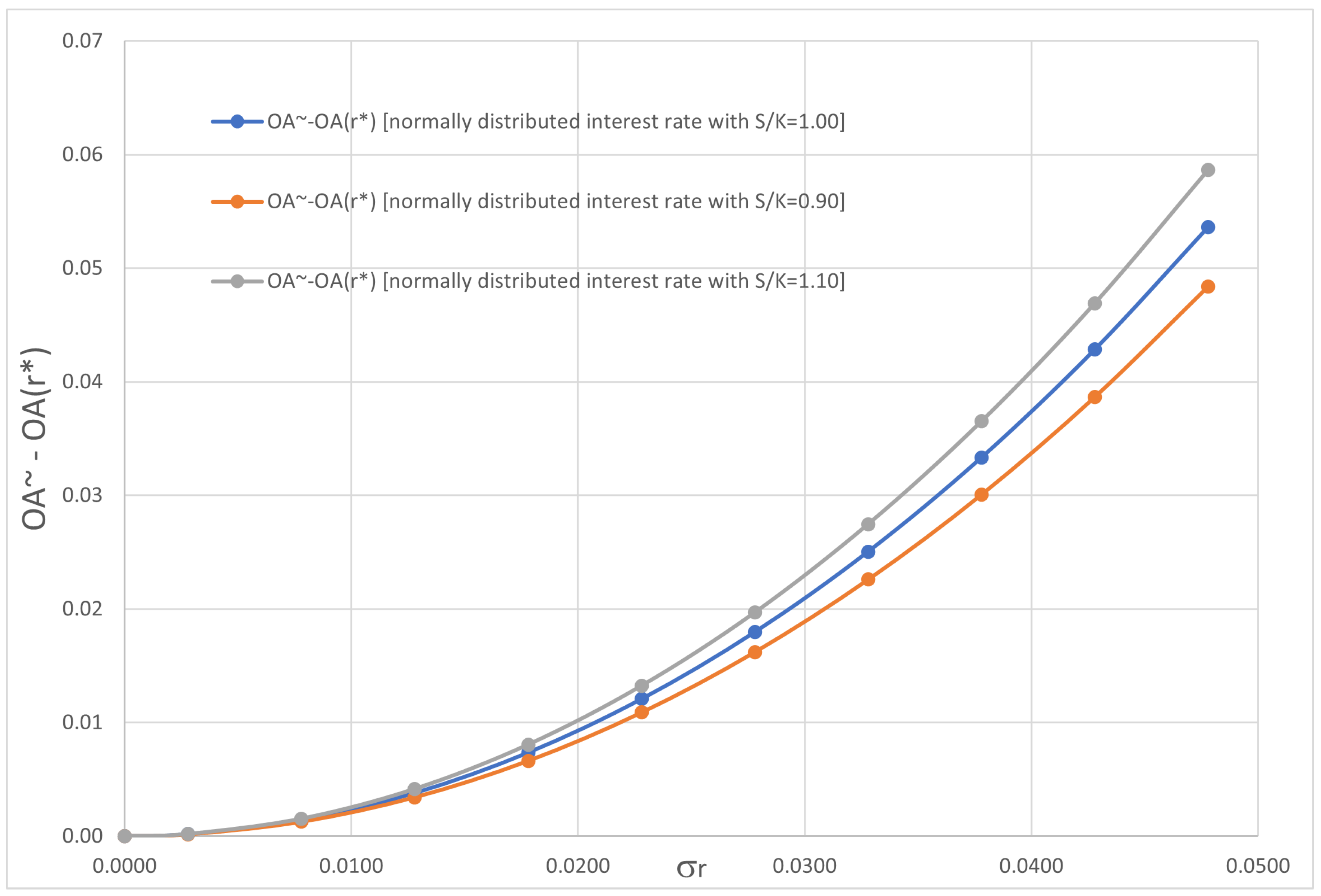
Section 6. We begin by extending the normal interest rate framework through additional experiments on the hidden optionality measure
, using two other fixed values of
, and we present the corresponding results in
Figure 10. We observe that the lower the moneyness levels, the greater the optionality.
Then, we consider a stochastic rate that is Hull-Whiteand lognormally distributed, with the same parameters and with the interest rate dynamic parameters obtained by moment matching at maturity similar to
Section 6. The results are reported in
Figure 11. We observe a behavior similar to that under a normal distribution: as the standard deviation
increases, the level of hidden optionality becomes more pronounced. Again, the results show consistent monotone optionality values,
, as a function of the interest rate volatility.
7.3.2. Currency Put
In this section, we further study the optionality of the American currency put, with the base parameters listed in
Table 3. For
and under a local rate
, which is (i) normally, (ii) log-normally and (iii) Hull–White distributed, the optionality metric
is computed similar to the case equity puts in
Section 6. We vary again the standard deviation of the interest rate
and evaluate the resulting
, which increases with
, as illustrated in
Figure 12. Moreover, we compute the optionality measure
for three different moneyness levels and we present the results in
Figure 13. The results confirm once again that the deeper the option is in the money, the greater the optionality.
Moreover, we study optionality under a stochastic local rate using the controlled optionality measure
similar to what we do in
Section 6. Under a local rate,
which is (i) normally, (ii) log-normally and (iii) Hull–White distributed, the value of an American option and a European option,
and
, are computed as done before for equity puts, and so is the value of the optionality,
, for various moneyness levels. We present the results in
Figure 14,
Figure 15 and
Figure 16. The results confirm once again that the deeper the option is in the money, the greater the optionality of the American option in hedging model uncertainty.
7.3.3. Currency Call
Next, we explore currency call options using similar parameters to those in
Section 7.2.3, and under various local rate distributions.
Figure 17 confirms a consistent monotonic behavior of the optionality metric
as a function of the rate volatility. Then, we consider three different moneyness levels and repeat the same experiments. The results in
Figure 18 reveal again that depth in the money currency calls (with high values of the moneyness
) exhibits higher optionality.
Finally, we evaluate the optionality in the context of currency calls using the metric
. Similar to the previous sections, we again first use a normal distribution for the local rate
, then a lognormal distribution, and finally a Hull–White distribution. We present the results in
Figure 19,
Figure 20 and
Figure 21. We again observe that optionality, gauged via
, is most pronounced for deep-in-the-money options.
8. Discussion
This paper uncovered significant hidden convexity in American options and presented a technique for pricing and uncovering hidden risks so far ignored in the literature. While our approach was near-exhaustive, by focusing on one single interest rate, even simpler techniques can be applied on the fly. For example, in Equation (
4),
could be immediately computed by moving either rate.
Our work constitutes a first attempt to quantify the hidden optionality of American options, which we show can be substantial in a trading setting. Our main contribution is showcasing this optionality numerically for a wide range of instruments (equity puts and calls with dividends and currency options) and under common interest rate processes (Bachelier, Geometric Brownian motion, and Hull–White), and demonstrating its significant value for all these variants. Our work also makes secondary contributions to analyzing plain vanilla American options (with all parameters being deterministic), where we demonstrate, via sufficient numerical evidence, that the heuristic for determining the expected exercise time proposed by
Taleb (
1997) is highly valid. Our pricing framework under the separability assumption (assuming independence of the rates and the underlying distribution) may be also useful in practice as a reasonable approximation of the complex reality, or as offering a starting point for more elaborate schemes.
In the other direction, we note that further extensions could broaden the model with a nonheuristic treatment, with the stochasticization of all parameters that can possibly affect the pricing. It would entail, in addition to variances, the incorporation of a broad set of correlations. That would require the building of a matrix involving (a) the underlying security, (b) the volatility, (c) the funding rate, and (d) the foreign rate, with six cross-terms to estimate in addition to the four diagonal standard deviations. This could be a tall order, as estimation errors and the real-world uncertainty about future parameters would pollute what benefits can be obtained from our method that lies in uncovering and understanding model vulnerabilities.