1. Introduction
Microfinance institutions (MFIs) are important for low-income borrowers who are usually excluded from traditional banking due to no or limited collateral, poor credit histories, or irregular income streams (
Boiquaye and Protter 2024;
Ledgerwood 1999;
Sakyi-Yeboah et al. 2025). By expanding access to finance, MFIs have promoted job creation and helped households manage their income (
Matul 2006;
Sakyi-Yeboah et al. 2025). The theoretical foundation of microfinance rests on the premise that credit constraints limit entrepreneurial activity among the poor, and that properly structured lending contracts can relax these constraints without exacerbating default risk (
Morduch 1999;
Morduch and Beatriz 2005). Most microfinance institutions (MFIs) operate on a financially sustainable basis and therefore charge interest rates that reflect high operational and monitoring costs associated with small-scale lending. While such pricing is necessary for sustainability, excessively high interest rates can increase borrowers’ repayment burdens and, under certain conditions, increase default risk through adverse selection, moral hazard, or income shocks (
Gonzalez 2007). This mechanism is consistent with the classic credit rationing framework of (
Stiglitz and Weiss 1981), where higher lending rates may worsen borrower selection and incentivize riskier project choice.
Most MFIs are faced with difficulties in balancing social outreach with financial sustainability (
Hermes et al. 2011). When they focus on only serving poor people without proper risk management, it can threaten the long-term sustainability (
Morduch and Beatriz 2005). To be able to sustain this business, it requires monitoring, appropriate loan pricing, effective borrower screening, and strong portfolio risk management (
Argüello et al. 2013). Some of the tools that are used to reduce default and also help minimize the cost of lending are digital financial technologies, credit scoring, flexible repayment arrangements, and loan portfolio diversification (
Giné et al. 2010). Recent empirical evidence from randomized evaluations further shows that repayment incentives, contract design, and borrower screening materially affect default outcomes in microcredit markets (
Banerjee et al. 2015).
Despite all of these improvements, MFIs continue to face significant challenges related to credit risk, which is primarily caused by borrower behavior and moral hazard. Borrower characteristics, institutional procedures, and general economic conditions all have an impact on loan default (
Crabb and Keller 2006;
Ibtissem and Bouri 2013). Borrowers may default due to inadequate financial planning, unforeseen circumstances, or strategic default (
Sakyi-Yeboah et al. 2025). Strategic default is frequently caused by high interest rates, inadequate supervision, little oversight, or misuse of loans (
Giné et al. 2010;
Stiglitz and Weiss 1981). In unsecured lending, this issue is more severe because recovery possibilities may be limited.
There are two primary ways that moral hazard occurs in MFIs: ex-ante and ex-post. Ex-ante moral hazard is the process whereby borrowers, with low risk of default, move to riskier projects after obtaining a loan, while ex-post is strategically delaying repayment or defaulting despite having the means to do so (
Bester 1987;
Morduch and Beatriz 2005;
Stiglitz and Weiss 1981). Borrowers can change how they use a loan after obtaining it, even if they initially agreed to invest in a safer project. After reassessing the expected returns, risk, and repayment obligations, some borrowers may switch to a riskier investment that will offer higher returns. This behavior increases credit risk, which can lead to that investment falling below the amount to be repaid, thereby leading to default. These actions could undermine MFI sustainability, put pressure on financial resources, and increase default risk. In this situation, collateral has little impact on MFIs even if it could reduce moral hazard in traditional lending due to the fact that many borrowers lack physical assets (
Yunus and Yusus 2007). This trade-off between limited collateral availability and incentive-compatible contract design remains one of the central structural challenges in microfinance credit markets.
Managerial oversight plays an important role in decreasing credit risk in MFIs by increasing loan monitoring and imposing repayment discipline, thereby reducing moral hazard. This helps identify early warning indicators of project underperformance, loan fund mismanagement, and strategic default, which have a direct impact on individual credit risk outcomes. It also acts as an institutional replacement for collateral in contexts of asymmetric information, especially in unsecured loan agreements. Ex-ante and ex-post supervision tasks are both part of loan monitoring. Ex-ante oversight includes borrower screening, loan purpose verification, and credit assessment, while ex-post oversight includes frequent follow-ups, site visits, repayment monitoring, and performance evaluations. These actions limit the borrower’s capacity to transfer money from planned low-risk projects to riskier ones, lowering default risks and restricting endogenous project switching. Monitoring reduces information asymmetry and limits moral-hazard behavior by restricting the borrower’s feasible post-disbursement actions.
To mitigate these risks, MFIs have implemented group lending, progressive lending, and dynamic incentives. Joint liability and peer monitoring were introduced in group lending to reduce moral hazard and adverse selection (
Morduch 1999;
Morduch and Beatriz 2005). These factors have been proven to enhance repayment performance, especially for female borrowers (
D’espallier et al. 2011;
Saravia-Matus and Saravia-Matus 2012). Nevertheless, free-riding behavior, contagion effects, and social tensions are some of the obstacles that it must overcome in order to be effective (
Morduch and Beatriz 2005). This is the reason why many MFIs now depend on individual lending, which in turn increases borrower risk again. The gradual shift from group-based to individual lending structures has reintroduced classical principal–agent problems into microfinance credit allocation.
Furthermore, inflation, interest rate fluctuations, and financial crises reduce borrowers’ ability to repay loans and put them at risk for uncertainties (
Brown et al. 2009;
Sakyi-Yeboah et al. 2025). In all, researchers modeled these factors, viewing default as a fixed variable. However, much of the existing microfinance literature treats project returns deterministically or under static risk assumptions. In contrast, stochastic modeling of borrower investment dynamics remains relatively underdeveloped in microfinance, despite its prominence in structural credit risk theory (
Duffie and Singleton 2003;
Merton 1994). To introduce randomness in investment returns, this study employs an Ornstein–Uhlenbeck (OU) process to model the dynamics of risky assets and to identify conditions under which borrowers switch from secured to unsecured investments (
Bachelier 1900). The OU framework is particularly suitable because it captures mean-reversion in small-scale business returns while allowing volatility-induced deviations that may trigger strategic switching behavior. The objective is to examine the probability of consumer default in both secured and unsecured lending by focusing on borrower behavior and the role of moral hazard in shaping individual credit risk. In particular, we analyze how post-disbursement investment choices, such as reallocating loan funds between secured and unsecured projects under limited lender supervision, affect default outcomes, recognizing that credit risk assessment involves behavioral factors that are difficult to quantify. By integrating stochastic return dynamics with endogenous borrower switching, this paper makes three novel contributions to the microfinance credit-risk literature. First, it provides a structural, borrower-incentive interpretation of default risk that is not imposed exogenously but arises from post-disbursement project choice under limited supervision. Second, it offers an analytically tractable link between return uncertainty, repayment burden, and risk-shifting incentives, showing how volatility and pricing can jointly intensify moral hazard even when average returns are unchanged. Third, it delivers a unified framework that compares secured and unsecured lending within the same behavioral structure, allowing the role of collateral to be interpreted not only as a loss-recovery device but also as an incentive constraint that reduces the attractiveness of strategic switching. In this sense, the model bridges canonical microfinance contract mechanisms (monitoring, collateral, and incentives) with continuous-time structural credit risk modeling, yielding testable implications for risk management and loan design.
The rest of this paper is as follows:
Section 2 models the individual credit risk default. It compares secured and unsecured asset investments with their probability of default.
Section 3 shows the behavior of borrowers in investing in secured and unsecured projects.
Section 4 presents the credit default risk in microfinance, and
Section 5 concludes it.
2. Modeling Individual Credit Risk Default
In microfinance, where loans are often unsecured and given to low-income borrowers with inadequate collateral, default risk is a major issue for lenders since it impacts the sustainability and profitability of financial institutions (
Giné et al. 2010).
Here, we assume that there are two projects, Project B (secured) and Project A (unsecured), that a borrower can invest in. We further assume that MFIs are not aware of the high risk associated with Project A and default will occur if the investment fails. Since there is no collateral for unsecured assets, repayment is entirely dependent on the borrower’s ability to obtain profit, making them riskier. Conversely, secured investments need collateral, which reduces risk by giving lenders an asset that may be recovered in the case of default.
Let
be the expected return from investing in Project
A, where
is the project’s return factor and
is the expected return on investment from Project
B. The borrower can redirect money from Project
B to Project
A under unsecured lending once the loan is disbursed without facing immediate penalties. Since repayment depends on the investment’s success, the borrower only bears the upside risk and partially transfers the downside risk to the lender. On the contrary, with secured lending, collateral
M is pledged ex-ante. In the event that the borrower reallocates funds to Project
A and the investment fails, the lender recovers value through the collateral. Therefore, the borrower’s payoff is
which significantly reduces the incentive to switch. Here,
is the expected benefits from investing in Project
A at time
t,
represents the sum of the principal and interest to be paid at time
t,
is the likelihood of Project
A being successful, and
M represents the value of collateral pledged by the borrower.
2.1. Default Risk for Unsecured Assets
Investing in unsecured assets has inherent risks due to a lack of collateral. According to (
Merton 1994), in the presence of moral hazard, the expected benefits follow the relationship:
where
V evolves according to an Ornstein–Uhlenbeck (OU) process:
Here,
represents the speed of mean reversion,
is the long-term mean of
,
is the volatility parameter, and
is a standard Brownian motion. The solution to this stochastic differential equation is
Assume
; then,
, which gives
where
is a standard Brownian motion. Substituting Equation (
3) into Equation (
2), we obtain
This shows that . Here, is the initial estimated return of the project.
Define the probability of default by considering:
Using the fact that
and substituting
from Equation (
4), we can simplify the expression to obtain the probability that Project
A is successful:
where
is the standard normal cumulative distribution function. If Project
A fails, the probability of consumer credit default,
, can be estimated as:
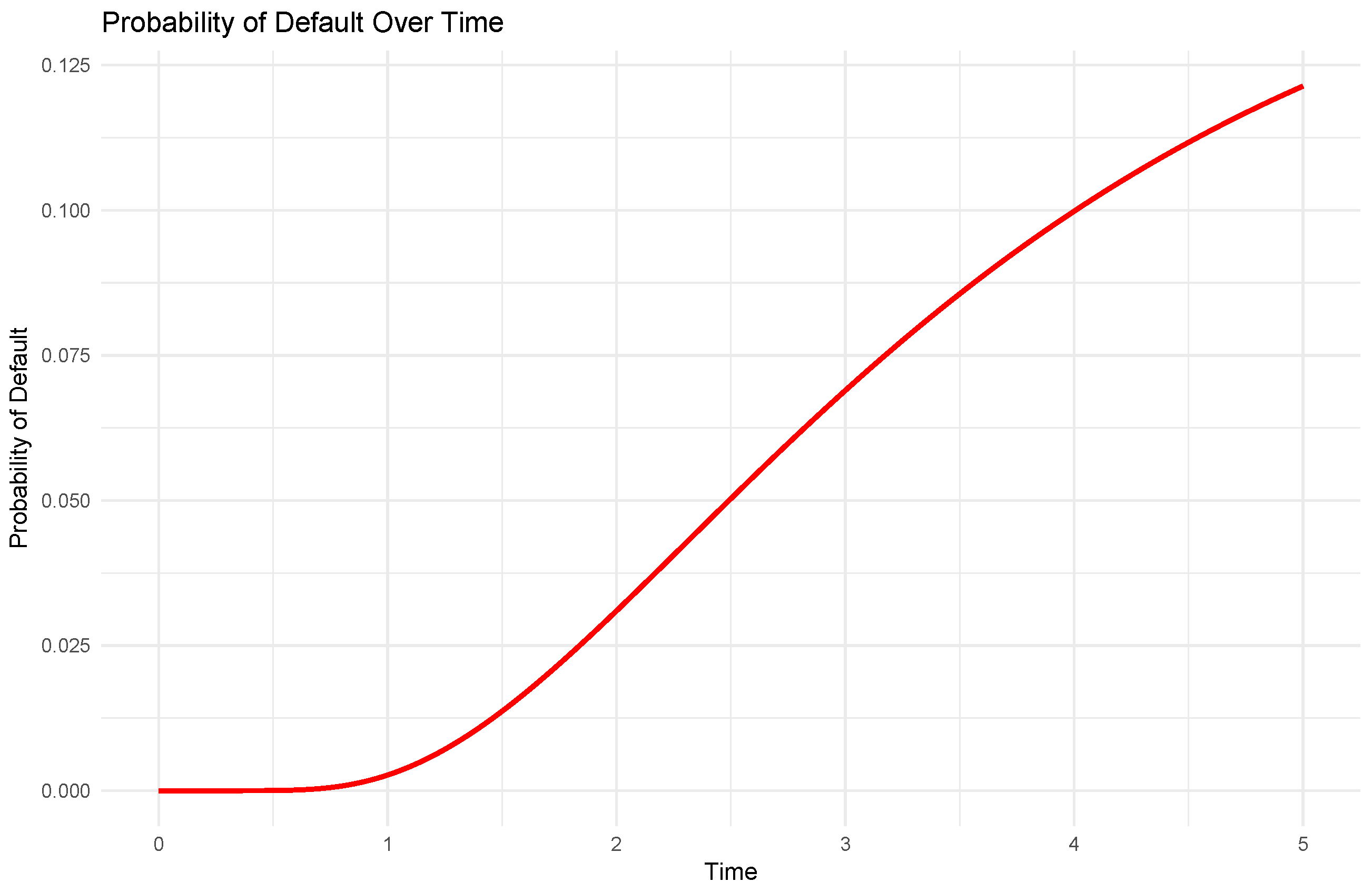
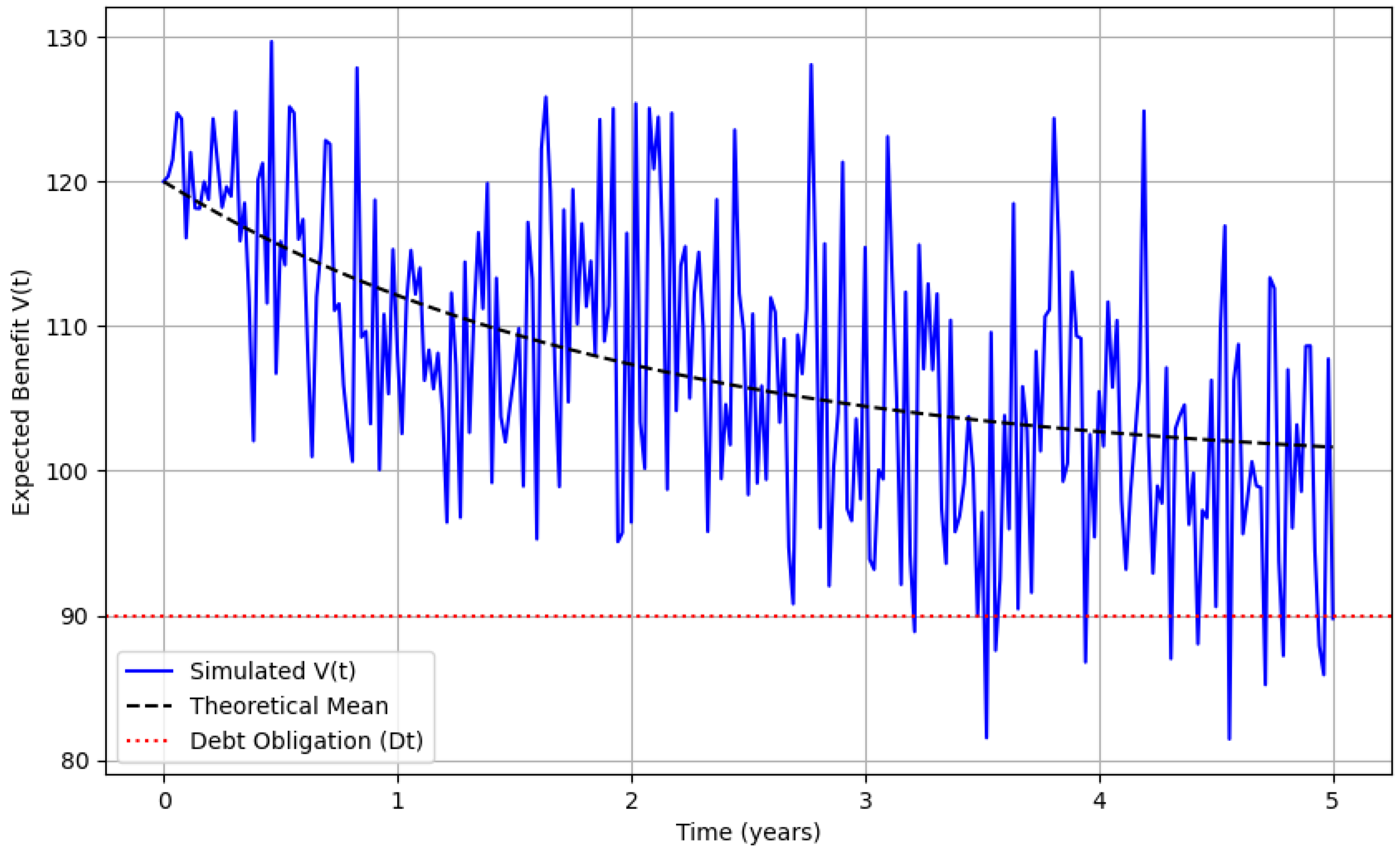
Next, we set various parameters and simulate them to examine how the expected benefits change over time, as well as the impact on the probability of default.
Assume that
is how the expected return reverts to the long-term mean.
is the average return the investment tends to stabilize at over time, and
is the level of randomness in the investment return process. The initial estimated return
at
and
represents the sum of the principal and interest that must be repaid at time
years with a weekly repayment period. An OU process to model the evolution of investment returns for unsecured assets using Equation (
4) is simulated. The probability of default for a given loan based on borrower behavior and risk factors using Equation (
7) is then computed. We plot the simulated return process over time as well as the probability of default over time to observe risk evolution, as shown in
Figure 1 and
Figure 2, respectively.
Figure 1 illustrates that the investment return begins at
, which is higher than the long-term mean
.
gradually decreases to 100, suggesting that returns tend toward a stable average, which may not be sustainable over time. Additionally, borrowers may feel comfortable holding onto their positions if
is high. On the other hand, a downward trend would indicate that the asset value is declining, which could trigger risk-averse actions like diversification or hedging. Furthermore, the theoretical mean begins at 120 and gradually declines over time. Increasing the repayment time significantly affects the expected return, even while the debt obligation is maintained at 90 (red line). Also, with time, the expected return can eventually fall below the debt obligation level, which could lead to financial loss. This may increase default risk due to the fact that the borrower can find it difficult to fulfill their repayment obligations. This is in line with findings from (
Brown et al. 2009;
Dehejia et al. 2012) that returns in small businesses are often volatile but eventually stabilize.
Figure 2 shows how the probability of default rises over time. This is because the expected investment return is mean-reverting toward a long-term level, which is below the debt obligation. In the graph, the default is close to zero in the beginning stages since the borrower’s returns are high relative to the debt relative to the debt obligation. As the time increases, the probability of default increases. This is because the returns fall short of the debt obligation. This finding is in line with (
Morduch and Beatriz 2005), which demonstrates how high debt obligations might force borrowers to make riskier investment decisions when expected returns are insufficient to cover repayment requirements. As seen in
Figure 2, the repayment burden rises in our context when expected returns fall below the debt obligation, increasing the likelihood of default over time.
2.2. Default Risk for Secured Assets
Project
A is defined as successful in secured assets if
. Assume that the financial strength is
k; then,
When
M is assessed, then the borrowers’ likelihood of default is
In this case,
is a decreasing function of
k, and
is the default probability if a borrower invests in Project A.
is defined as a concave function
for
. Credit default becomes inevitable if the investment fails, meaning that
when
. Thus,
The concavity of
is in line with empirical results in credit risk modeling, which demonstrate that, even at a declining rate, a better financial position (
k increasing) results in a lower likelihood of default (
Duffie and Singleton 2003).
Assume that
is 90,
,
and that
for
. When
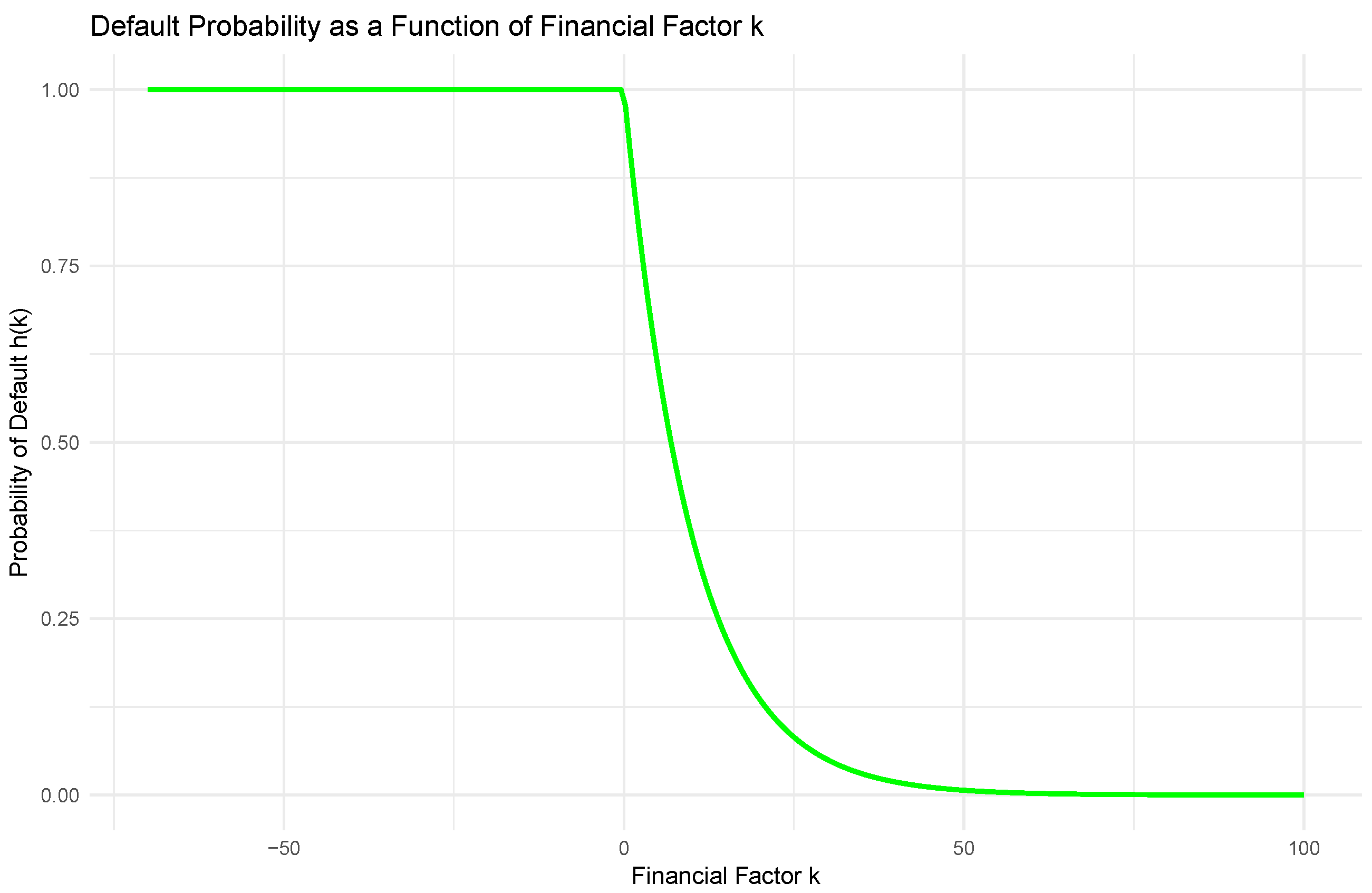
, the default probability is set to 1. We then use Equations (
8) and (
10) to simulate the probability of default versus the financial strength as seen in
Figure 3.
The relationship between the probability of default
and the financial strength
k is shown in
Figure 3. The expected investment returns and collateral value in relation to debt obligations are represented by
k. The graph exhibits a concave downward slope (as in the green line), meaning that as
k increases, the probability of default decreases. The probability of default is 1 when
, indicating that the borrower does not have enough collateral or investment returns to satisfy repayment obligations. This relates to high-risk borrowers and is consistent with credit risk theory, which suggests that when financial coverage is insufficient, default is unavoidable (
Stiglitz and Weiss 1981;
Vig 2013). The probability of default drastically decreases as
k rises above zero. A larger
k suggests that the borrower has greater financial capability, increasing the likelihood that they will be able to pay back loans. This pattern is in line with empirical credit risk models, which conclude that borrowers who are financially stable have a low default risk (
Duffie and Singleton 2003).
3. Borrower Behavior and Credit Risk
A mathematical model for understanding borrower behavior following loan acquisition, with a special emphasis on investment returns, risk appetite, and moral hazard in personal credit, is proposed. This study includes probability distributions, projected returns, and scenarios in which borrowers may redirect loan funds to riskier projects.
Here, the borrower chooses whether to adhere to the terms of the contract or transfer funds to Project A after obtaining a loan meant for Project B. The borrower’s risk tolerance and expected net returns have an impact on the decision they make. Instead of modeling switching as an external assumption, we represent it as an endogenous decision. In particular, if and only if Project A’s expected return surpasses Project B’s, the borrower will transfer funds from Project B to Project A.
Here, we assume that each borrower obtains a loan from only one MFI at any given time. All investment and repayment decisions, including potential reallocation of funds between projects, are made based solely on this single loan. Borrowing from multiple institutions simultaneously is not considered in this model. Also, investment returns are normally distributed, borrowers behave completely rationally, repayment amounts are fixed, and returns follow an Ornstein–Uhlenbeck process. These make the model feasible and enable us to investigate moral hazard, including the motivation to move from secured to unsecured projects and its impact on default risk.
3.1. Expected Net Return from Loan Investment
Let
denote the amount borrowed at an interest rate
i and invested in an operational project
B. The expected return on investment in project
B is
and it is a random variable conditioned on
with distribution function
and density function
. The expected net return is given by:
where the lower limit
represents the minimum return required to break even and the upper limit
is the highest possible return on investment. The term
represents the net profit when the return is
.
Using integration by parts, we derive an alternative form as
A rational investor will reallocate funds from Project
B to Project
A if the expected returns of
A exceed those of
B, resulting in moral hazard in credit allocation.
Lemma 1. Moral hazard occurs when borrowers invest in a riskier project than intended. The condition for moral hazard in personal credit is given by:where denotes the return per unit of investment for project A and γ is the individual’s risk appetite factor. Proof. Suppose that the investment
in project
B always yields the maximum possible return
with no variability. That is, the return always reaches the upper limit
with certainty, and the probability of any return less than
is zero, then
and Equation (
12) becomes
If an individual borrows
from a microfinance company for Project
B and then invests it in Project
A, the expected return of Project
A will be given by
In the event that
the borrower switches projects. The borrower’s best course of action under moral hazard is represented by this inequality. When it is strictly enforced, the borrower shifts risk, making the lender more vulnerable to default.
Suppose that the investor is indifferent between the two projects in terms of expected returns. This serves as a switching condition, where the borrower will only divert funds to Project
A (creating moral hazard) if the expected return from
A is at least as high as that from
B; then
. This implies that
Using
as a risk adjustment factor yields:
□
The right-hand side provides an upper bound based on the expected return from project B, adjusted by the borrower’s risk appetite factor and the probability of project A succeeding. A higher interest rate i will increase , lowering the borrower’s expected net return and making moral hazard more attractive. Also, a higher probability of project success lowers the denominator, increasing the incentive to divert funds. In Lemma 1, the condition only holds if the borrower is not restricted by collateral. If collateral is required, the borrower’s expected payoff from Project A is reduced by the expected loss of M.
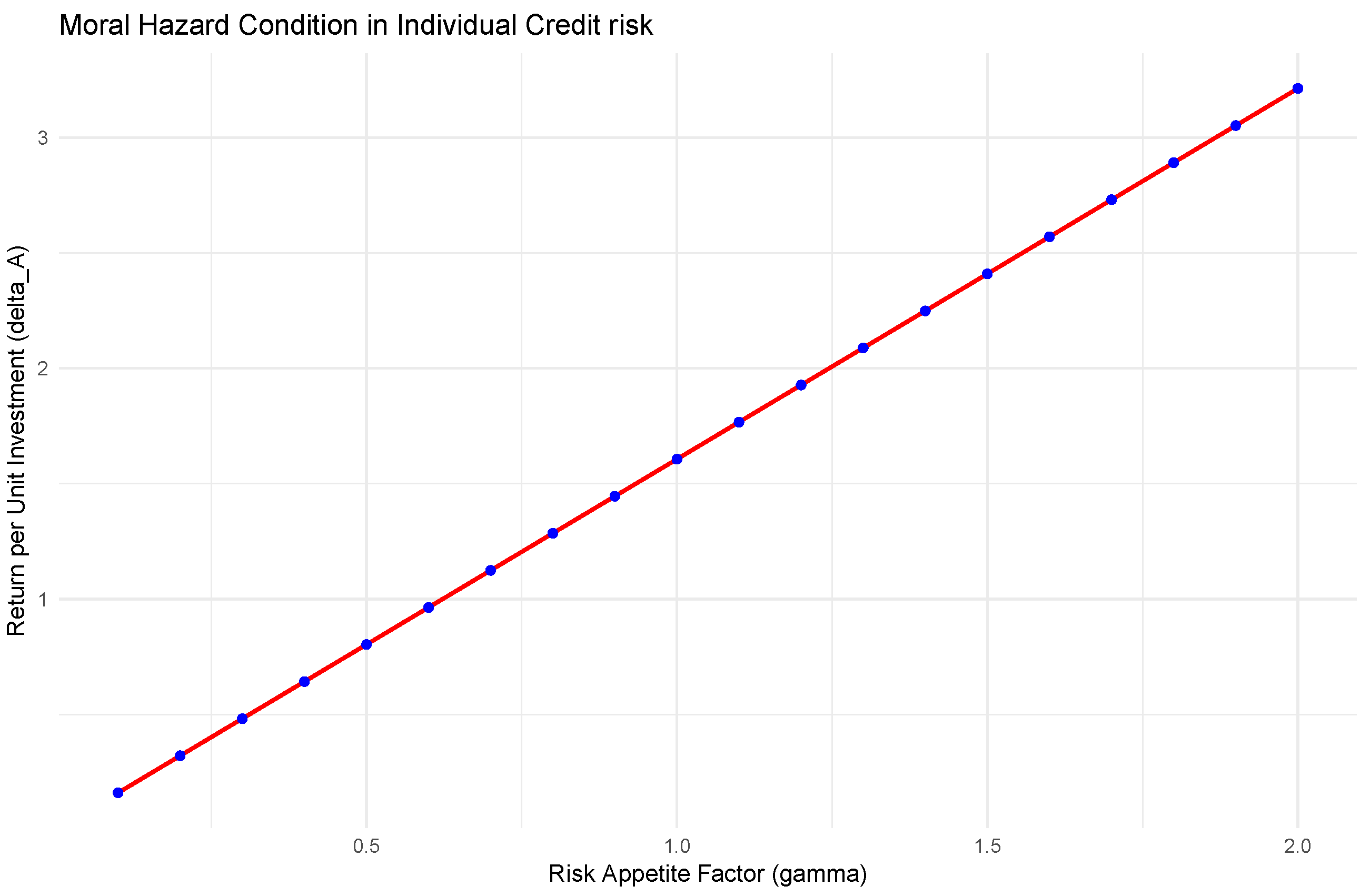
Next, we set precise values to the parameters in Lemma 1 to assess the impact of the individual’s risk appetite factor on the return on investment.
Consider a risk appetite factor
, an interest rate of 0.05, and a borrowed amount
. Assume the investment provides an estimated return of 150 with an 80% probability of success for project
A. Assume that
has a normal distribution with mean
and standard deviation 20. Using Lemma 1, we simulate how the individual’s risk appetite factor impacts the return per unit investment
, as illustrated in
Figure 4.
Figure 4 depicts how the return per unit investment varies with an individual’s risk appetite. When
, the borrower is considered neutral or risk-seeking. Borrowers who value risk
are more likely to engage in moral hazard, as they are ready to take on higher risks for potentially greater returns. Borrowers who are risk-averse
show moral hazard only when the alternative project
A provides much higher returns. In view of this, lenders can design loan terms, monitoring programs, or strategies for reducing risk to reduce moral hazard by understanding these situations, and regulators can learn more about the behavioral factors influencing credit risk and any shortcomings in lending processes.
Proposition 1. The likelihood of project failure for B should be lower than that of A. Specifically, the probability that B’s project fails, given an investment return rate i, should satisfy:where represents the probability distribution function of project failure given initial investment . Proof. From Lemma 1, we define the function
as follows:
Differentiating it with respect to
i and using the Leibniz rule for differentiation under the integral sign gives
Now, when the probability of project
B failing, that is,
, is smaller than project
A, we have:
□
Here, the cost of borrowing is represented by the interest rate
i, which determines how much the borrower must repay,
. When the interest rate increases, the required repayment also increases, lowering the borrower’s expected profit from any investment. As discussed in
Section 2 and
Section 3, higher borrowing costs make it more likely that
will fall below the required repayment, thereby increasing the probability of default.
We assign values to the parameters in Proposition 1 to evaluate how the probability of failure varies with various investment return rates.
We assume that
follows a normal distribution with mean
and standard deviation of 20, investment return rates
, a base interest rate of 0.05, and a borrowed amount
with an 80% success probability for project
A. We simulate it to see how the probability of failure changes with different investment return rates, based on Proposition 1, as shown in
Figure 5.
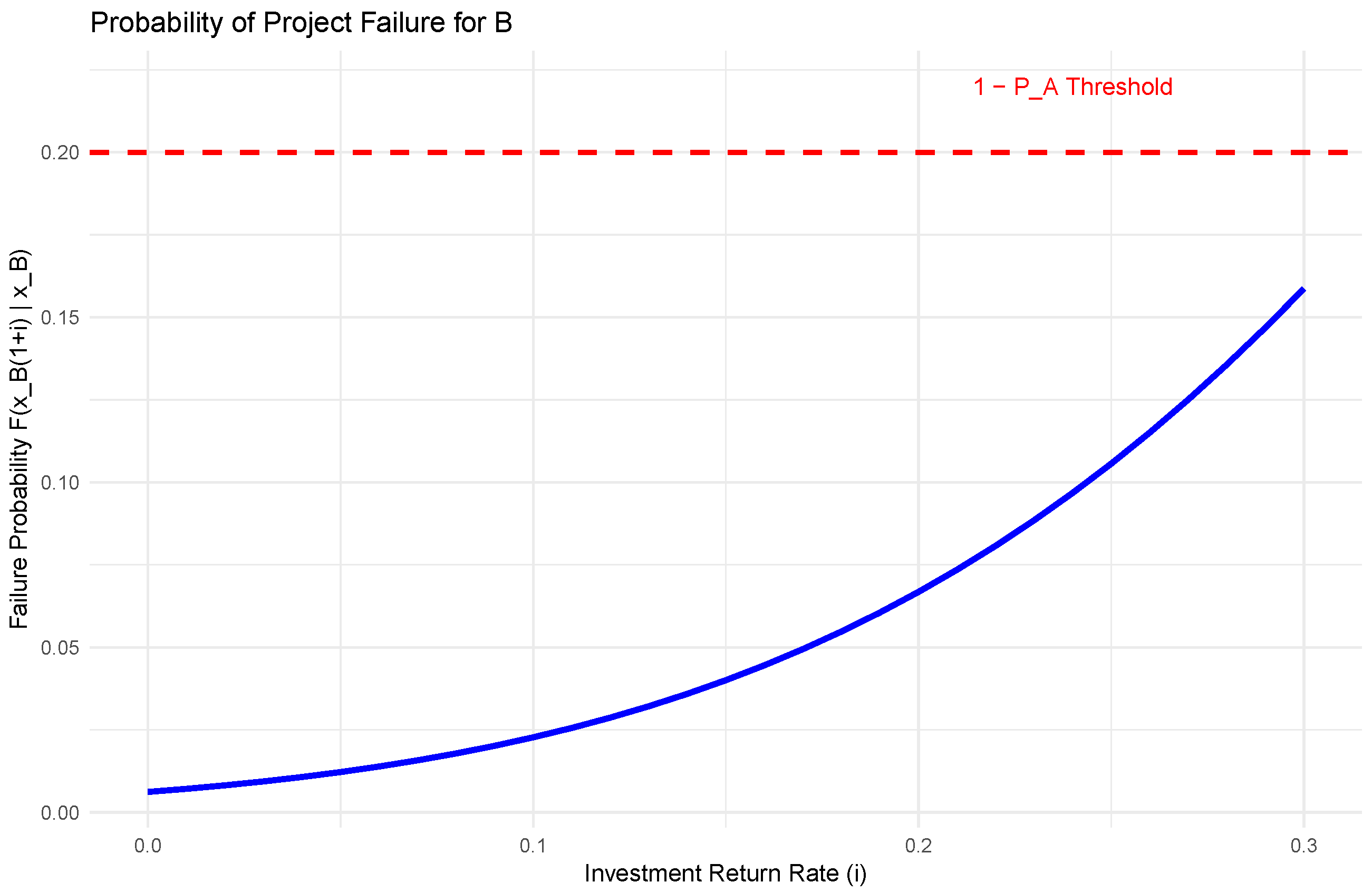
In
Figure 5, the red dashed line denotes the threshold,
, while the blue curve shows how the failure probability changes with return rates. Increased risk is often correlated with higher
i, which raises the likelihood of failure. If
is smaller than
, project
B is considered less risky. This will help determine suitable return rates that align with the organization’s investment objectives and risk tolerance. This demonstrates that, depending on their levels of risk, projects and borrowers should be handled differently. Lenders can determine which projects are safer by comparing the failure probability with the criterion
. This enables them to select return rates that align with their risk tolerance and allocate loans more effectively.
Our findings in Lemma 1 and Proposition 1 illustrate that the net return of safe projects reduces as interest rates rise. This might make riskier projects more appealing, especially for borrowers who are ready to take on risk (
). This is in line with findings in the literature. According to
Ledgerwood (
1999), risk-taking or strategic defaults can result from borrowers’ sensitivity to interest rates.
Gonzalez (
2007) also point out that high interest rates could increase the default rates and cause goal shifts.
Moral Hazard and Borrower Switching Under Return Uncertainty
Suppose we have a borrower who switches from the safe project to the riskier one when the expected net payoff from Project
A is greater than that of Project
B. That is,
The expected net return from Project
A at time
t can be written as:
We use Equation (
5) to simulate the OU process under the following parameter settings to quantify the effect of volatility on borrower behavior:
representing low-, moderate-, and high-volatility scenarios,
,
, resulting in a debt obligation of
The simulation uses weekly intervals (
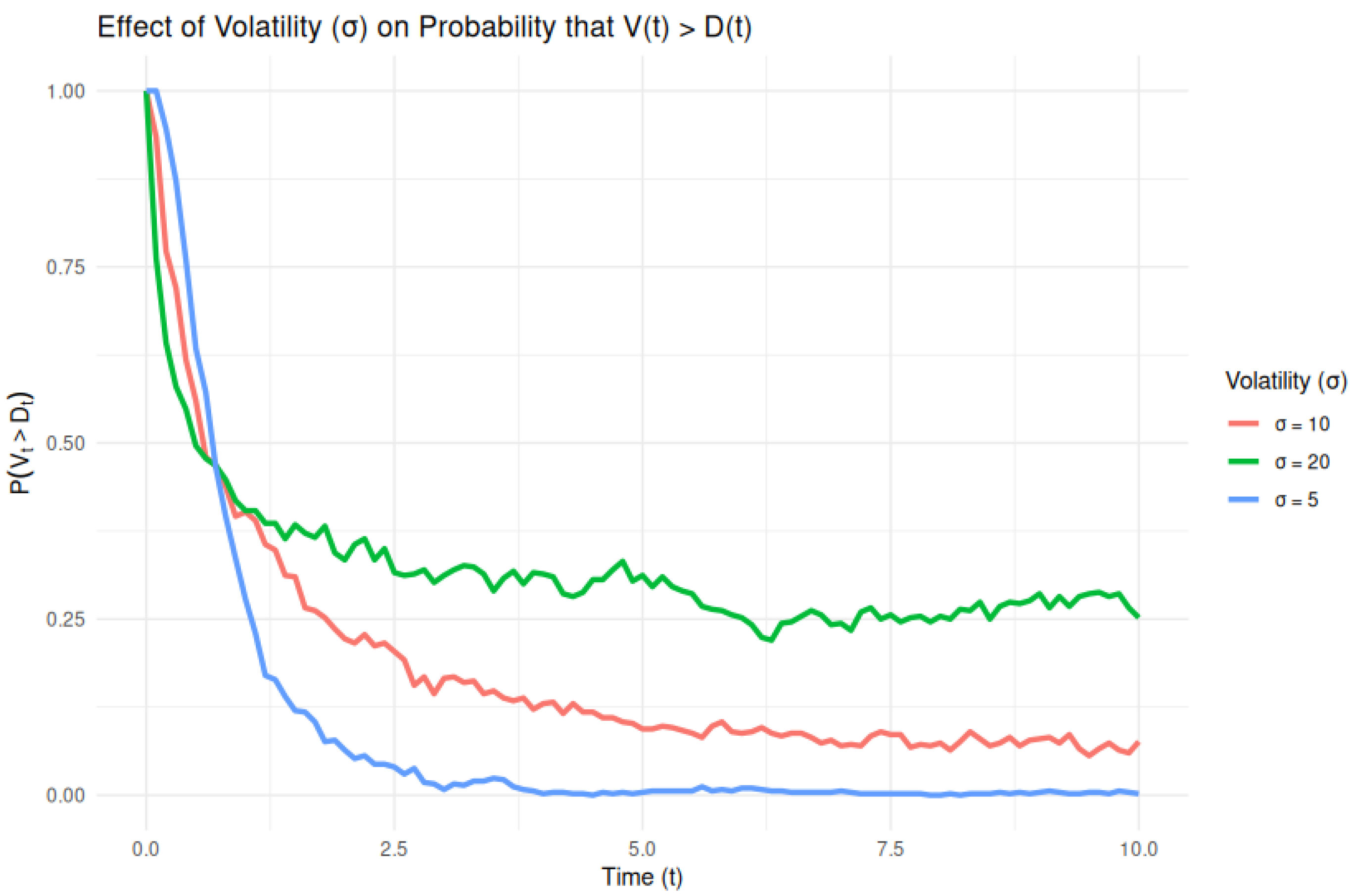
) to run over a ten-year horizon. As seen in
Figure 6, we generate 500 Monte Carlo pathways for each
and estimate the probability that the return on investment exceeds the debt obligation
.
The probability that
changes over time at various volatility levels is illustrated in
Figure 6. The graph is relatively stable when
, meaning there is a low probability of going over the debt obligation. As
rises from 10 to 20, the graph increases significantly. This means that when the volatility is high, moral hazard will occur. This is because borrowers will be encouraged to move from safer to riskier projects.
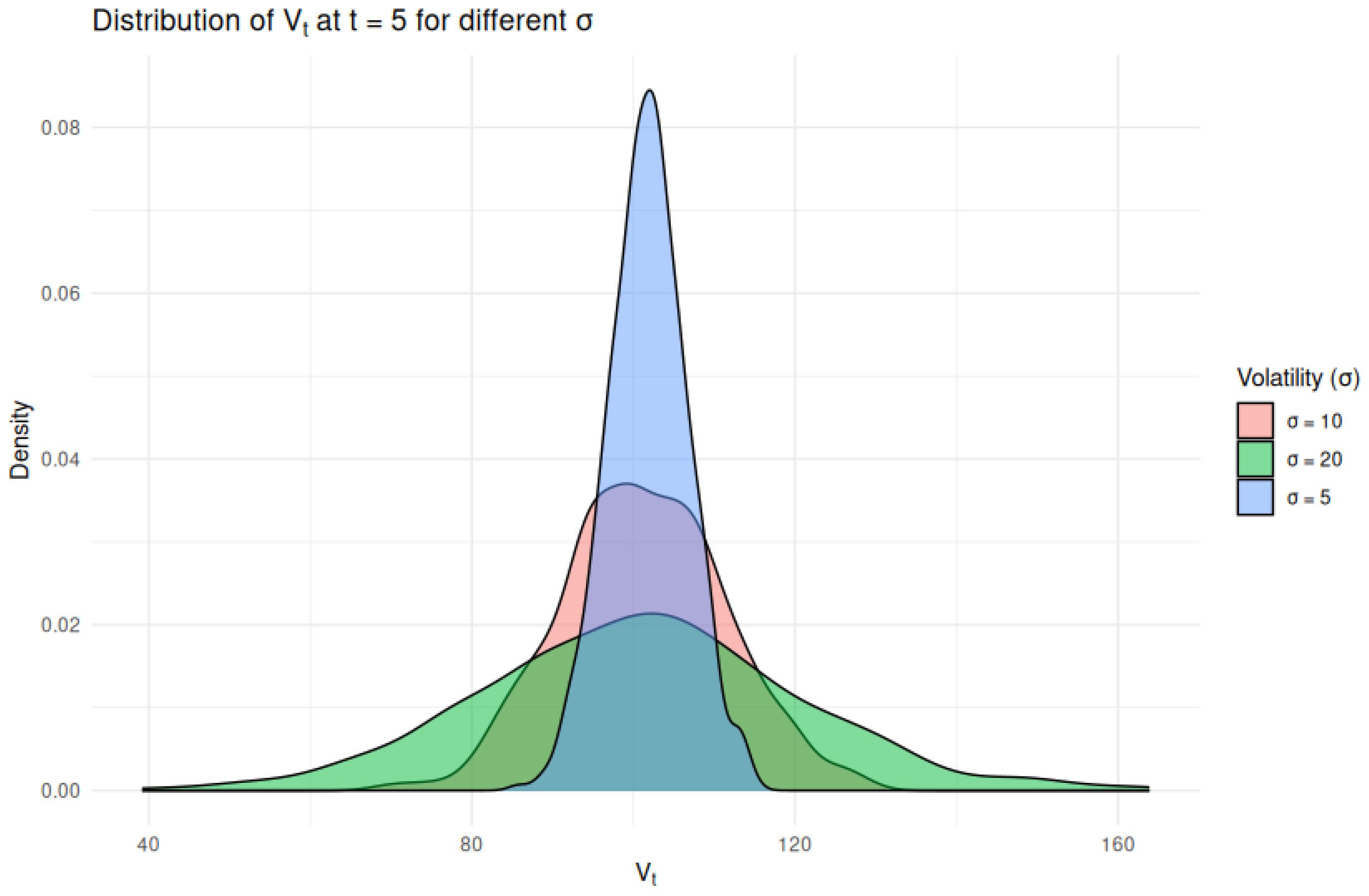
Also, to assess the impact of volatility, we examine the distribution of at a fixed horizon years, using 1000 simulations per .
Figure 7 presents the density distribution of
under different volatility scenarios. Here, returns are clustered around a high value when volatility is low (
), which suggests more steady and predictable outcomes. The distribution of returns widens at a moderate volatility level (
), resulting in the possibility of both profits and losses. Also, returns are dispersed across a wide range when volatility is high (
), which implies that there is a considerable likelihood of extremely high or extremely low outcomes. This is because they can gain from high returns but may default if returns are insufficient. This makes borrowers be tempted to take on riskier projects like Project
A under such circumstances, especially under unsecured lending. This implies that increased volatility has a significant impact on borrowers’ perceptions of risk and reward, even if the average return remains constant. Borrowers are more inclined to take excessive risks in extremely unpredictable circumstances, particularly when loans are unsecured or inadequately regulated. This conduct exposes lenders to higher losses and increases the likelihood of default. This result is in line with the theory of asymmetric information between lenders and borrowers, which might cause borrowers to choose riskier projects (
Stiglitz and Weiss 1981).
4. Credit Default Risk in Microfinance
At the point when an individual borrows from an MFI at an interest rate
i, the probability that the institution faces a consumer credit default can be expressed as:
where
represents the risk that Project
A will fail when there is a moral hazard in consumer loans. The risk that Project
B will fail in the absence of moral hazard in consumer loans is
.
Fixed values are assigned to the parameters in Equation (
20) to analyze how the risk of default changes under different moral hazard conditions. Given a sequence of investment return rates
, a base interest rate of 0.05, and a borrowed amount
with an 80% success probability for project
A a, we suppose that
follows a normal distribution with mean
and standard deviation of 20. We simulate Equation (
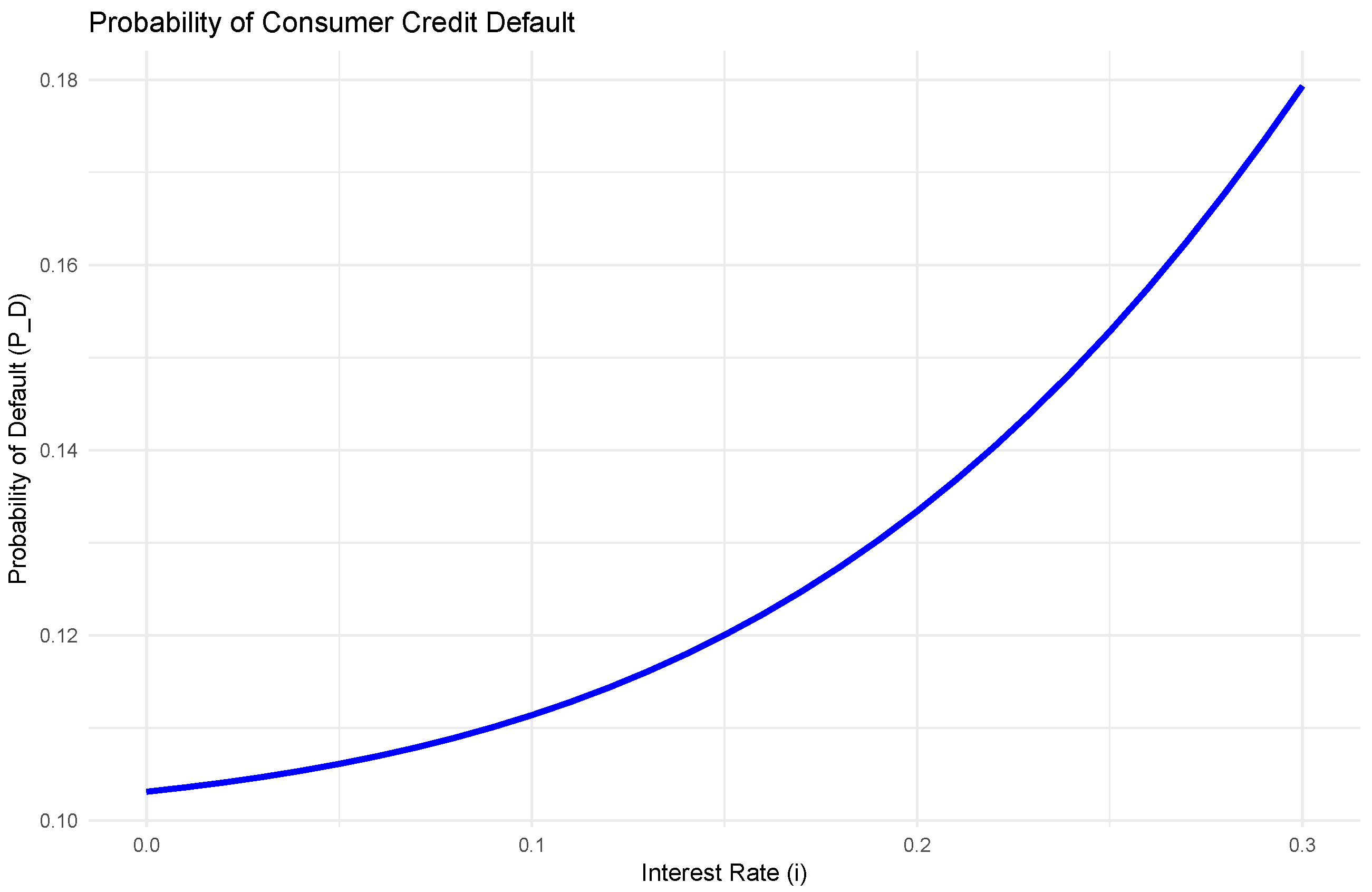
20) to observe how the interest rate affects the probability of consumer credit default (
), assuming a 50% likelihood of moral hazard (
) as shown in
Figure 8.
The graph in
Figure 8 shows that as interest rates rise, borrowing becomes more expensive. This increases borrowers’ financial burden, makes loan repayment more difficult, and raises the likelihood of consumer default.
It is important to note that when the likelihood of moral hazard increases, the probability of default, , does not always increase monotonically. Rather, it relies on the risk of Project B and the likelihood that Project A will be a profitable investment (). Notably:
When there is no risk of moral hazard in consumer lending (), the probability of default depends solely on the failure rate of Project B.
Conversely, when is high, the likelihood of default depends more on the borrower’s financial discipline and investment decisions rather than inherent project risk.
Let
. Using Equation (
20), we can calculate the likelihood of moral hazard in consumer credit markets in proportion to the default rate as:
When the default constraints and are constant, it implies that there is an increase in the consumer default rate , which is associated with higher moral hazard risk . The interval limits the degree of moral hazard and defines the range of potential default outcomes. While a tighter gap increases risk and leads to financial instability, a broader interval suggests a more stable lending market with less moral hazard. More borrowers shift toward the upper bound during times of economic crisis, thereby increasing the risk of default and moral hazard, which will result in stricter lending conditions.
To analyze the changing risk of moral hazard, lenders and regulators should observe the changes in
,
, and
. Also, moral hazards may be reduced by extending the default rate restriction period by financial stability measures (such as higher risk assessments, borrower screening, and economic stimulus programs). In addition, lenders may restrict loan availability if moral hazard concerns arise, which could worsen economic downturns by decreasing consumer borrowing, which is in line with the findings in (
Guérin et al. 2014).
Limitations of the Model
The model used in this study makes the assumption that borrowers are rational. In reality, bounded rationality, behavioral biases, social influence, and liquidity limitations may all have an impact on borrower behavior, causing them to not always make optimal decisions. Additionally, extreme occurrences, unforeseen circumstances, asymmetric shocks, and structural changes like economic crises are not captured by the mean-reversion nature of the Ornstein–Uhlenbeck process. Future studies can relax the rational-borrower assumptions and also extend the Ornstein–Uhlenbeck model to capture extreme events and structural breaks through jump-diffusion.
5. Conclusions
This study provides a behavioral and structural approach to default risk in microfinance by combining stochastic investment returns with endogenous borrower switching under limited lender supervision. The results show that unsecured lending is more exposed to strategic risk shifting and experiences more frequent and severe default outcomes than secured lending. Collateral reduces default risk not only through recovery value but also by weakening incentives to reallocate funds into riskier projects. Simulations further indicate that higher return volatility increases the attractiveness of risk shifting, while higher borrowing costs raise repayment burden and increase default likelihood.
These findings support several practical recommendations for MFIs and regulators. First, MFIs should strengthen ex-post monitoring and loan-use verification, especially for unsecured loans through structured follow-ups, targeted site visits, and digital monitoring tools, since limited supervision is a key channel through which risk shifting arises. Second, loan pricing should account for behavioral risk: where monitoring capacity is weak, or volatility exposure is high, MFIs should avoid repayment burdens that intensify strategic default incentives, and instead combine risk-sensitive pricing with stronger screening and progressive lending. Third, where physical collateral is scarce, MFIs should expand collateral substitutes such as partial guarantees, savings-linked requirements, and contract features that reward verified project compliance. Fourth, portfolio controls should differentiate exposure by contract type—using tighter limits, shorter tenors, or enhanced oversight in segments where unsecured lending is unavoidable—so that moral-hazard risk is not concentrated in a small borrower segment. Finally, regulators and industry bodies can promote stability by strengthening pricing transparency, supporting borrower financial literacy, and encouraging standardized risk-management practices that reduce over-indebtedness and reinforce repayment discipline.