Promoting Functional Mobility in Individuals with Non-Ambulatory Cerebral Palsy: A Scoping Review of the MOVE Programme

 , , , and
Highlights
- MOVE has been implemented for almost 40 years in a wide variety of clinical and educational settings to enhance functional mobility with non-ambulatory individuals.
- There is currently more descriptive rather than experimental evidence published in relation to the MOVE programme.
- MOVE can be considered an activity-based approach that may be used to facilitate family-centred goals and enhance participation in meaningful activities in line with contemporary theories and clinical guidelines.
- Further experimental research is required to elucidate the programme’s mechanisms and further establish its effectiveness.
Abstract
1. Introduction
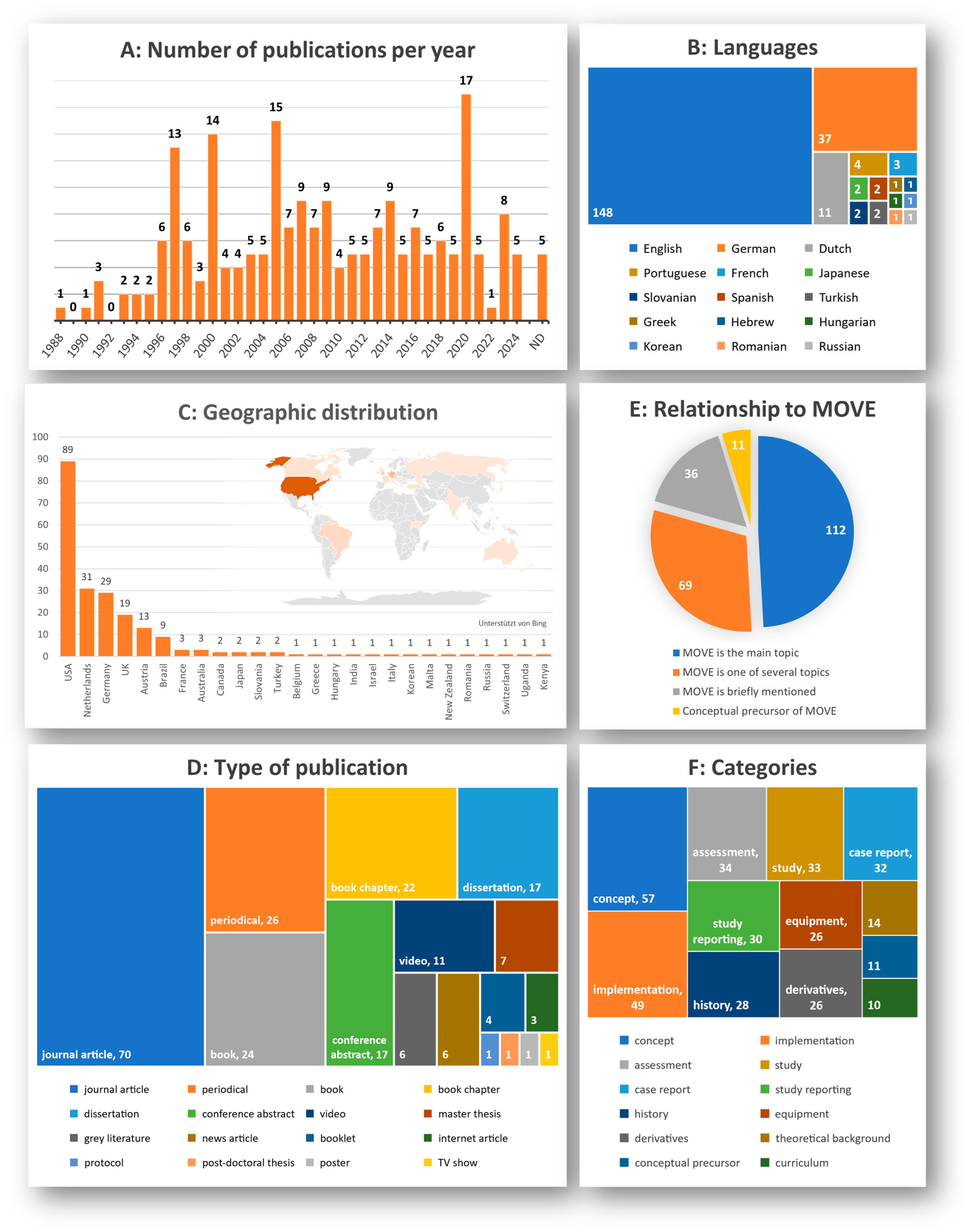
- What are the literature characteristics regarding publication year, language, geographic location, publication type, and relationship to MOVE?
- How is MOVE characterised, including history and development, concept, conceptual precursors and theoretical foundations, role of assessments and equipment?
- What recommendations and material for implementation exist?
- How has MOVE been adapted across various populations and settings?
2. Materials and Methods
3. Results
3.1. History and Development
3.2. Concept
3.2.1. Target Group
3.2.2. Structure
3.2.3. Teaching Methods
3.2.4. Teamwork
3.3. Assessment
3.4. Conceptual Precursors
3.5. Theoretical Background
- 1.
- 2.
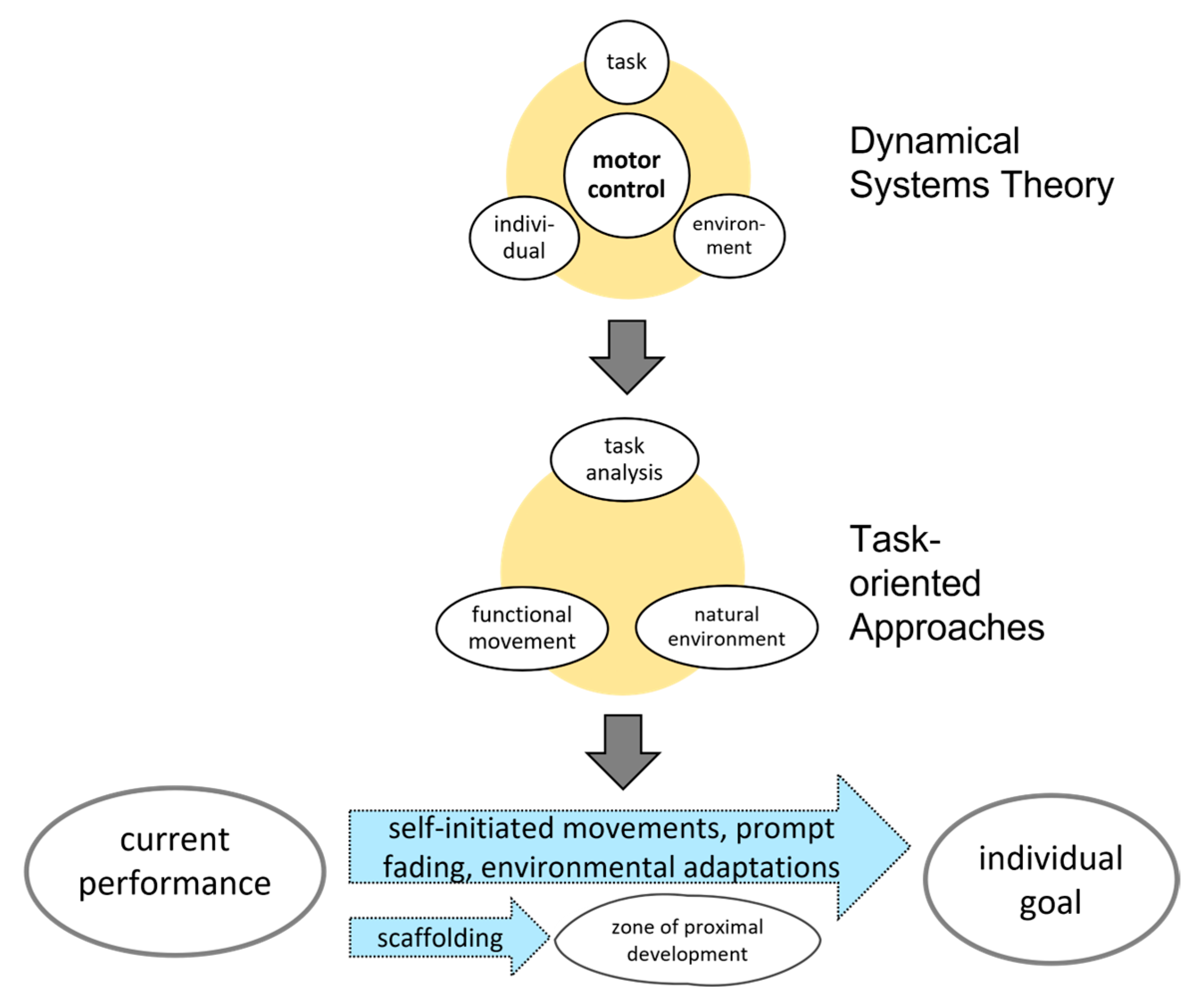
- Task-oriented approaches: Focus on functional use of movement, task-analysis, and natural environments [99];
- 3.
- 4.
3.6. Implementation
3.7. Equipment
3.8. Adoption in Educational Curricula
3.9. Adaptations and Derivatives
4. Discussion
5. Limitations
6. Conclusions
Supplementary Materials
Author Contributions
Funding
Institutional Review Board Statement
Informed Consent Statement
Data Availability Statement
Acknowledgments
Conflicts of Interest
Abbreviations
| GMFCS | Gross Motor Function Classification System—expanded and revised |
| HIC | High-income countries |
| LMIC | Low- and middle-income countries |
| MOTA | Mobilitätstest für alte Menschen [Mobility Test for Elderly] |
| MOPTA | Mobility Test for Patients in Acute Care |
| MOVE, M.O.V.E. | Mobility Opportunities Via Education |
| PRISMA-ScR | Preferred Reporting Items for Systematic reviews and Meta Analysis extension for Scoping Reviews |
| TDMMT | Top-Down Motor Milestones Test |
References
- McIntyre, S.; Goldsmith, S.; Webb, A.; Ehlinger, V.; Hollung, S.J.; McConnell, K.; Arnaud, C.; Smithers-Sheedy, H.; Oskoui, M.; Khandaker, G.; et al. Global prevalence of cerebral palsy: A systematic analysis. Dev. Med. Child Neurol. 2022, 64, 1494–1506. [Google Scholar] [CrossRef] [PubMed]
- Palisano, R.J.; Rosenbaum, P.; Bartlett, D.; Livingston, M.H. Content validity of the expanded and revised Gross Motor Function Classification System. Dev. Med. Child Neurol. 2008, 50, 744–750. [Google Scholar] [CrossRef]
- Chagas, P.S.C.; Lemos, A.G.; Ayupe, K.M.A.; Toledo, A.M.; Camargos, A.C.R.; Longo, E.; Morais, R.L.S.; Leite, H.R.; Palisano, R.J.; Rosenbaum, P.; et al. Functioning profile and related impairments of children and adolescents with cerebral palsy—PartiCipa Brazil preliminary results. BMC Pediatr. 2024, 24, 719. [Google Scholar] [CrossRef]
- Jahan, I.; Muhit, M.; Hardianto, D.; Laryea, F.; Chhetri, A.B.; Smithers-Sheedy, H.; McIntyre, S.; Badawi, N.; Khandaker, G. Epidemiology of cerebral palsy in low- and middle-income countries: Preliminary findings from an international multi-centre cerebral palsy register. Dev. Med. Child Neurol. 2021, 63, 1327–1336. [Google Scholar] [CrossRef]
- Verschuren, O.; Darrah, J.; Novak, I.; Ketelaar, M.; Wiart, L. Health-enhancing physical activity in children with cerebral palsy: More of the same is not enough. Phys. Ther. 2014, 94, 297–305. [Google Scholar] [CrossRef] [PubMed]
- Bania, T.A.; Taylor, N.F.; Baker, R.J.; Graham, H.K.; Karimi, L.; Dodd, K.J. Gross motor function is an important predictor of daily physical activity in young people with bilateral spastic cerebral palsy. Dev. Med. Child Neurol. 2014, 56, 1163–1171. [Google Scholar] [CrossRef]
- Peterson, M.D.; Gordon, P.M.; Hurvitz, E.A. Chronic disease risk among adults with cerebral palsy: The role of premature sarcopoenia, obesity and sedentary behaviour. Obes. Rev. 2013, 14, 171–182. [Google Scholar] [CrossRef] [PubMed]
- Miller, F. (Ed.) Physical Therapy of Cerebral Palsy; Springer: New York, NY, USA, 2007. [Google Scholar]
- Jackman, M.; Sakzewski, L.; Morgan, C.; Boyd, R.N.; Brennan, S.E.; Langdon, K.; Toovey, R.A.M.; Greaves, S.; Thorley, M.; Novak, I. Interventions to improve physical function for children and young people with cerebral palsy: International clinical practice guideline. Dev. Med. Child Neurol. 2022, 64, 536–549. [Google Scholar] [CrossRef]
- Novak, I.; Morgan, C.; Fahey, M.; Finch-Edmondson, M.; Galea, C.; Hines, A.; Langdon, K.; Namara, M.M.; Paton, M.C.; Popat, H.; et al. State of the Evidence Traffic Lights 2019: Systematic Review of Interventions for Preventing and Treating Children with Cerebral Palsy. Curr. Neurol. Neurosci. Rep. 2020, 20, 3. [Google Scholar] [CrossRef]
- Novak, I.; Berry, J. Home program intervention effectiveness evidence. Phys. Occup. Ther. Pediatr. 2014, 34, 384–389. [Google Scholar] [CrossRef]
- van Bentum-Schouwink, D.A.; van der Burg, J.J.W.; Ceelen, K.A.M.; van Beneden, M.M.O.; van Munster, J.C.; Groen, B.E. Exploring experiences of parents of young children with cerebral palsy with a standing frame program promoting hip development. Disabil. Rehabil. 2025, 48, 369–378. [Google Scholar] [CrossRef] [PubMed]
- van der Putten, A.A.J. Motor activation in people with profound intellectual and multiple disabilities in daily practice. J. Intellect. Dev. Disabil. 2017, 42, 1–11. [Google Scholar] [CrossRef]
- Chiaramonte, R.; Civello, T.; Laganga Senzio, G.; Longo, L.; de Caro, A.S.; Li Gotti, F.; Vecchio, M. Multidimensional Stratification of Severe Disability: Demographic, Clinical, Geographic, Socio-Economic Profiles and Healthcare Pathways in a Cross-Sectional Italian Cohort. Healthcare 2025, 13, 3200. [Google Scholar] [CrossRef]
- Peters, M.D.J.; Marnie, C.; Tricco, A.C.; Pollock, D.; Munn, Z.; Alexander, L.; McInerney, P.; Godfrey, C.M.; Khalil, H. Updated methodological guidance for the conduct of scoping reviews. JBI Evid. Synth. 2020, 18, 2119–2126. [Google Scholar] [CrossRef]
- Tricco, A.C.; Lillie, E.; Zarin, W.; O’Brien, K.K.; Colquhoun, H.; Levac, D.; Moher, D.; Peters, M.D.J.; Horsley, T.; Weeks, L.; et al. PRISMA Extension for Scoping Reviews (PRISMA-ScR): Checklist and Explanation. Ann. Intern. Med. 2018, 169, 467–473. [Google Scholar] [CrossRef]
- Baumgart, D.; Brown, L.; Pumpian, I.; Nisbet, J.; Ford, A.; Sweet, M.; Messina, R.; Schroeder, J. Principle of Partial Participation and Individualized Adaptations in Educational Programs for Severely Handicapped Students. J. Assoc. Sev. Handic. 1982, 7, 17–27. [Google Scholar]
- Bax, M. Aims and Outcomes of Therapy for the Cerebral Palsied Child. Dev. Med. Child Neurol. 1986, 28, 695–696. [Google Scholar] [CrossRef]
- Bleck, E.E.; Nagel, D.A. (Eds.) Physically Handicapped Children: A Medical Atlas for Teachers, 2nd ed.; Grune & Stratton: New York, NY, USA, 1982. [Google Scholar]
- Bobath, K.; Bobath, B. The Neurodevelopmental Treatment. In Management of the Motor Disorders of Children with Cerebral Palsy; Scrutton, D., Ed.; Blackwell: Oxford, UK, 1984; pp. 6–18. [Google Scholar]
- Brown, L.; Branston, M.B.; Hamre-Nietupski, S.; Pumpian, I.; Certo, N.; Gruenewald, L. A Strategy for Developing Chronological-Age-Appropriate and Functional Curricular Content for Severely Handicapped Adolescents and Young Adults. J. Spec. Educ. 1979, 13, 81–90. [Google Scholar] [CrossRef]
- Campbell, P.H. Physical Management and Handling Procedures with Students with Movement Dysfunction. In Systematic Instruction of Persons with Severe Handicaps, 3rd ed.; Snell, M.E., Ed.; Merrill: New York, NY, USA, 1987; pp. 174–187. [Google Scholar]
- Campbell, P.H. Programming for Students with Dysfunction in Posture and Movement. In Systematic Instruction of Persons with Severe Handicaps, 3rd ed.; Snell, M.E., Ed.; Merrill: New York, NY, USA, 1987; pp. 188–211. [Google Scholar]
- Campbell, P.H.; McInerney, W.F.; Cooper, M.A. Therapeutic programming for students with severe handicaps. Am. J. Occup. Ther. 1984, 38, 549–602. [Google Scholar] [CrossRef][Green Version]
- Mulcahy, C.M.; Pountney, T.E.; Nelham, R.L.; Green, E.M.; Billington, G.D. Adaptive Seating for The Motor Handicapped—Problems, a solution, assessment and prescription. Physiotherapy 1988, 74, 531–536. [Google Scholar] [CrossRef]
- Scrutton, D. (Ed.) Management of the Motor Disorders of Children with Cerebral Palsy; Blackwell: Oxford, UK, 1984. [Google Scholar]
- Snell, M.E. (Ed.) Systematic Instruction of Persons with Severe Handicaps, 3rd ed.; Merrill: New York, NY, USA, 1987. [Google Scholar]
- Barnes, S.B. Kids on the MOVE: Holm Elementary MOVE Program; Kern County Superintendent of Schools: Bakersfield, CA, USA, 1997. [Google Scholar]
- Barnes, S.B. The MOVE(TM) Curriculum: An Application of Contemporary Theories of Physical Therapy and Education. Ph.D. Thesis, University of West Florida, Pensacola, FL, USA, 1999. [Google Scholar]
- Barnes, S.B.; Whinnery, K.W. MOVE from Theory to Practice. In Moving Towards Inclusion, MOVE Conference Proceedings, Chatsworth House, 8 March 2000; The Disability Partnership, Ed.; The Disability Partnership: London, UK, 2000; pp. 22–27. [Google Scholar]
- Barnes, S.B.; Whinnery, K.W. Effects of Functional Mobility Skills Training for Young Students with Physical Disabilities. Except. Child. 2002, 68, 313–324. [Google Scholar] [CrossRef]
- Bidabe, D.L. Mobility opportunities via education. In Psychomotor Domain Training and Serious Disabilities, 4th ed.; Jansma, P., Ed.; University Press of America: Lanham, MD, USA, 1993; pp. 145–149. [Google Scholar]
- Bidabe, D.L. MOVE—Verbesserung der Motorik bei Kindern mit Mehrfachbehinderungen [MOVE—Improving Motor Skills in Children with Multiple Disabilities]. In Rehabilitation durch Sport. 1. Internationaler Kongreß des Deutschen Behinderten-Sportbundes 1995 [Rehabilitation Through Sports: 1st International Congress of the German Disabled Sports Federation, 1995]; Weiss, M., Ed.; Kilian: Marburg, Germany, 1997; pp. 96–105. [Google Scholar]
- Bidabe, D.L.; Lollar, J.M. M.O.V.E. Mobility Opportunities via Education; Kern County Superintendent of Schools: Bakersfield, CA, USA, 1990. [Google Scholar]
- Bidabe, D.L.; Lollar, J.M. M.O.V.E.: Mobilitätstraining für Kinder und Erwachsene mit Behinderung; Verlag Modernes Lernen: Dortmund, Germany, 1993. [Google Scholar]
- Bidabe, D.L.; Lollar, J.M. M.O.V.E.: Procesos de Mejora en la Movilidad Mediante una Educación Integral [M.O.V.E.: Processes for Improving Mobility Through Comprehensive Education]; Distesa: Madrid, Spain, 1994. [Google Scholar]
- Bidabe, D.L.; Martin, M.; Yates, R.; Binns, C. Standing room only. New South Wales J. Spec. Educ. 1988, 5, 15–20. [Google Scholar]
- Bidabe, D.L.; Voll, C. No Ordinary Move: A Memoir; Plough Publishing House: Farmington, MN, USA, 2001. [Google Scholar]
- Bossink, L. A Move Ahead: Research into the Physical Activity Support of People with (Severe or Profound) Intellectual Disabilities. Ph.D. Thesis, University of Groningen, Groningen, The Netherlands, 2019. [Google Scholar]
- Brach, M.; Schomerus, R. MOVE Research: A Survey of Different Approaches. In Moving Towards Inclusion, MOVE Conference Proceedings, Chatsworth House, 8 March 2000; The Disability Partnership, Ed.; The Disability Partnership: London, UK, 2000; pp. 37–40. [Google Scholar]
- Case-Smith, J.; O’Brien, J.C. Occupational Therapy for Children and Adolescents; Elsevier: St. Louis, MO, USA, 2014. [Google Scholar]
- De Campos, A.C.; Hidalgo-Robles, Á.; Longo, E.; Shrader, C.; Paleg, G. F-words and early intervention ingredients for non-ambulant children with cerebral palsy: A scoping review. Dev. Med. Child Neurol. 2024, 66, 41–51. [Google Scholar] [CrossRef]
- De Campos, A.C.; Hidalgo-Robles, Á.; Longo, E.; Shrader, C.; Paleg, G. F-words e ingredientes das intervenções precoces para crianças com paralisia cerebral não deambuladoras: Uma revisão de escopo. Dev. Med. Child Neurol. 2024, 66, e12–e22. [Google Scholar] [CrossRef]
- De Campos, A.C.; Hidalgo-Robles, Á.; Longo, E.; Shrader, C.; Paleg, G. F-words e ingredientes de las intervenciones tempranas dirigidas a niños no ambulantes con parálisis cerebral: Una revisión exploratoria. Dev. Med. Child Neurol. 2024, 66, e1–e11. [Google Scholar] [CrossRef]
- De Campos, A.C.; Hidalgo-Robles, Á.; Longo, E.; Shrader, C.; Paleg, G. F-Wörter und Interventionsinhalte in der Frühförderung nicht gehfähiger Kinder mit Cerebralparese: Eine umfangreiche Literaturübersicht. Dev. Med. Child Neurol. 2024, 66, e23–e34. [Google Scholar] [CrossRef]
- Elkins, K.M. A Comparison Between the Achievement of Students with Severe Multiple Disabilities Using a Functional Mobility Curriculum Versus Traditional Programs. Ph.D. Thesis, University of La Verne, La Verne, CA, USA, 1994. [Google Scholar]
- Gaiatto, E. Research in Italy. In Moving Towards Inclusion, MOVE Conference Proceedings, Chatsworth House, 8 March 2000; The Disability Partnership, Ed.; The Disability Partnership: London, UK, 2000; pp. 11–14. [Google Scholar]
- Galdin, M.; Robitaille, L.; Dugas, C. Les interventions concernant l’activité physique et la motricité des personnes polyhandicapées: Revue de littérature [Motor function in multiple disabilities: A review]. Rev. Francoph. Déf. Intellect. 2010, 21, 177–191. [Google Scholar]
- Garrett, K. Class Act: Sacramento COE Helpst Students MOVE Toward a Richer Life. Available online: https://www.csba.org/en/Newsroom/CASchoolsMagazine/2012/Spring/Departments/ClassAct_Spring2012#gsc.tab=0 (accessed on 25 August 2024).
- Gebhard, B. Therapeutische und pädagogische Möglichkeit der Förderung. [Therapeutic and educational opportunities to developmental support]. In Motorische Behinderungen. Grundlagen, Zusammenhänge und Förderungsmöglichkeiten. [Motor Disabilities: Fundamentals, Interrelationships, and Opportunities for Support]; Leyendecker, C., Ed.; Kohlhammer: Stuttgart, Germany, 2005; pp. 182–224. [Google Scholar]
- Jacob, J.; Cabana, C.; Caballero, V.A.G. MOVE to improve motor skills for adults with severe mental and functional disabilities. J. Israel Phys. Ther. Soc. 2022, 24, 35–44. [Google Scholar]
- Graff, B. Die Bedeutung des MOVE-Programms bei der Entwicklungsförderung mehrfach behinderter Menschen—Aufgezeigt am Beispiel einer Trainingsgruppe. [The Significance of the MOVE Program in Developmental Support for People with Multiple Disabilities: Illustrated by the Example of a Training Group]. Master’s Thesis, University of Cologne, Cologne, Germany, 1996. [Google Scholar]
- Haigh, G. Moving mountains. Times Educational Supplement, 31 October 1991; pp. 4–5. [Google Scholar]
- Houwen, S.; van der Putten, A.A.J. A systematic review of the effects of motor interventions to improve motor, cognitive and/or social functioning in people with severe or profound intellectual disabilities. Res. Dev. Disabil. 2014, 35, 2093–2116. [Google Scholar] [CrossRef]
- Houwen, S.; van der Putten, A.A.J.; Vlaskamp, C. Bewegingsgeoriënteerde interventies voor personen met (zeer) ernstige verstandelijke beperkingen: Een literatuuronderzoek. Neuropraxis [Neuro Pract.] 2015, 19, 121–129. [Google Scholar] [CrossRef]
- Jean, S.D. An Exploration on the Perceptions of Educators Using the MOVE Program. Ph.D. Thesis, Concordia University Chicago, River Forest, IL, USA, 2020. [Google Scholar]
- Kern County Superintendent of Schools. Freedom to MOVE; Kern County Superintendent of Schools: Bakersfield, CA, USA, 2006. [Google Scholar]
- Kern County Superintendent of Schools. Big Strides Through Small Steps; Kern County Superintendent of Schools: Bakersfield, CA, USA, 2008. [Google Scholar]
- Kern County Superintendent of Schools. MOVE Hygiene and Toileting Program: Vol. 1; Kern County Superintendent of Schools: Bakersfield, CA, USA, 2009. [Google Scholar]
- Kern County Superintendent of Schools. MOVE Hygiene and Toileting Program: Vol. 3; Kern County Superintendent of Schools: Bakersfield, CA, USA, 2009. [Google Scholar]
- Kern County Superintendent of Schools. MOVE Hygiene and Toileting Program: Vol. 2; Kern County Superintendent of Schools: Bakersfield, CA, USA, 2009. [Google Scholar]
- Kern County Superintendent of Schools. MOVE Basic Provider Training Manual—Adults; Kern County Superintendent of Schools: Bakersfield, CA, USA, 2010. [Google Scholar]
- Kern County Superintendent of Schools. Cameron’s Story; Kern County Superintendent of Schools: Bakersfield, CA, USA; Available online: https://kern.org/ (accessed on 25 August 2024).
- Kingsbury, K. Moving Experiences Severely Handicapped Children Make Miraculous Strides in a Common-Sense Classroom Program. Los Angeles Times, 2 May 1991. [Google Scholar]
- Kozleski, L. Bucks Program for nonambulatory people changes lives in ways not imagined before.: MOVE helps increase independence whether sitting, standing, walking. Morning Call, 24 May 2001. [Google Scholar]
- Kuriakidou, E. Enischysi ton epikoinoniakon symperiforon meso tou programmatos PLAIN se periptosi paidiou me varies h/kai pollaples anapiries. [Strengthening Communication Behaviors Through the PLAIN Program in the Case of a Child with Severe and/or Multiple Disabilities]. Master’s Thesis, University of Makedonia, Thessaloniki, Greece, 2013. [Google Scholar]
- Lehoux, M.-C. Rapport D’évaluation sur des Activités Contributives, Valorisantes et Stimulantes pour les Adultes Âgés de 22 ans et Plus Présentant un Polyhandicap [Evaluation Report on Contributive, Rewarding, and Stimulating Activities for Adults Aged 22 Years and Older with Multiple Disabilities]; Institut Universitaire en Déficience Intellectuelle et en Trouble du Spectre de L’autisme: Trois-Rivières, QC, Canada, 2018. [Google Scholar]
- Levy, R. Mobility Opportunities via Education/Experience (MOVE): Healthcare Impact Assessment: Clinical Trial Protocol. 2023. Available online: https://clinicaltrials.gov/study/NCT05862662 (accessed on 12 August 2025).
- Livingstone, R.; Paleg, G. Measuring Outcomes for Children with Cerebral Palsy Who Use Gait Trainers. Technologies 2016, 4, 22. [Google Scholar] [CrossRef]
- Livingstone, R.; Paleg, G. Use of Overground Supported-Stepping Devices for Non-Ambulant Children, Adolescents, and Adults with Cerebral Palsy: A Scoping Review. Disabilities 2023, 3, 165–195. [Google Scholar] [CrossRef]
- Low, S.A.; McCoy, S.W.; Beling, J.; Adams, J. Effects of the MOVE (Mobility Opportunities Via Education) Curriculum on range of motion, motor skills, and functional mobility of children with severe multiple disabilities: A pilot program. Pediatr. Phys. Ther. 2005, 17, 94–95. [Google Scholar]
- Lucey, D.; Goen, B. MOVE to Independence. How’d They Do That, CBS. Available online: https://m2iportal.co.uk/ (accessed on 25 August 2024).
- Maes, B. Quality-enhancing interventions for people with profound intellectual and multiple disabilities: A review of the empirical research literature. J. Intellect. Dev. Disabil. 2007, 32, 163–178. [Google Scholar] [CrossRef]
- Mensch, S.M. Movakic, Motor Abilities in Children with Severe Multiple Disabilities—Small Steps, Big Changes. Ph.D. Thesis, Erasmus Universiteit, Rotterdam, The Netherlands, 2017. [Google Scholar]
- Mensch, S.M.; Rameckers, E.A.A.; van den Boogaard, P.; Ketelaar, M. Het mogelijk nut van zes meetinstrumenten ter evaluatie von motorische vaardigheden van kinderen met ernstig meercoudig complexe beperkingen [The possible use of six measurement instruments for evaluating motor skills of children with severe multiple complex disabilities]. Kinderfysiotherapie 2005, 12–17. Available online: https://www.researchgate.net/publication/46664596_Het_mogelijk_nut_van_zes_meetinstrumenten_ter_evaluatie_van_motorische_vaardigheden_van_kinderen_met_ernstig_meervoudig_complexe_beperkingen (accessed on 25 August 2024).
- Mensch, S.M.; Rameckers, E.A.A.; Echteld, M.A.; Evenhuis, H.M. Instruments for the evaluation of motor abilities for children with severe multiple disabilities: A systematic review of the literature. Res. Dev. Disabil. 2015, 47, 185–198. [Google Scholar] [CrossRef] [PubMed]
- Mercieca, D.P. Living Otherwise: Students with Profound and Multiple Learning Disabilities as Agents in Educational Contexts; Sense Publishers: Rotterdam, The Netherlands, 2013. [Google Scholar]
- MOVE—Bewegung fürs Leben. Das MOVE Programm. Mobilitätstraining für Menschen mit Behinderungen. [The MOVE Program: Mobility Training for People with Disabilities]; MOVE—Bewegung fürs Leben: Leonding, Austria, 2024. [Google Scholar]
- MOVE Austria. MOVE Trainer’s Guide; MOVE Austria: Leonding, Austria, 2019. [Google Scholar]
- Nakken, H.; Reynders, K.; Vlaskamp, C.; Procee, A.I. Behandelingsvormen voor ernstig meervoudig gehandicapten. Een wegwijzer. [Treatment Approaches for Individuals with Severe Multiple Disabilities: A Guide]; Lemniscaat: Rotterdam, The Netherlands, 1998. [Google Scholar]
- Paleg, G. Mathew Michael case. PT & OT Today 1997, 5, 10–12, 23. [Google Scholar]
- Paleg, G. Mobility Opportunities Via Education (The MOVE story). Tomorrows PT 1997, 10–11. Available online: https://www.dcs.edu/page/mobility-opportunities-via-education (accessed on 25 August 2024).
- Paleg, G. Teaching older children with cerebral palsy to sit, stand and walk. Dev. Med. Child Neurol. 1997, 39, 10–11. [Google Scholar] [CrossRef]
- Paleg, G.; Livingstone, R. Outcomes of gait trainer use in home and school settings for children with motor impairments: A systematic review. Clin. Rehabil. 2015, 29, 1077–1091. [Google Scholar] [CrossRef]
- Penn, C. Die Familie im Mittelpunkt des Teams. [The family in the centre of the team]. Heilpädagogik [Remedial Educ.] 2020, 63, 26–28. [Google Scholar]
- Penn, C. MOVE—Bewegung fürs Leben. Highlights aus Österreich und Deutschland [MOVE—Mobility for life. Highlights from Austria and Germany]. Heilpädagogik [Remedial Educ.] 2020, 63, 2–3. [Google Scholar]
- Ramos, M. A Project Proposal for Designing a Management Information System to Report the Effectiveness of the MOVE Program. Master’s Thesis, California State University, Bakersfield, CA, USA, 2013. [Google Scholar]
- Reis, C.T. Avaliacao da abordagem do protocolo MOVE em uma escola de educacao especial na cidade de Paulinia-SP [Evaluation of the MOVE Protocol Approach in a Special Education School in the City of Paulínia, SP]. Ph.D. Thesis, State University of Campinas, Campinas, Brazil, 2011. [Google Scholar]
- Reis, C.T.; Rubo de Souza Nobre, M.I. As Percepções dos Profissionais Sobre a Abordagem do Protocolo MOVE®. Available online: https://www.scielo.br/j/fp/a/QGNqzDPvpHBfnSHXsYVxKTK/?lang=pt&format=pdf (accessed on 25 August 2024).
- Reis, C.T.; Rubo de Souza Nobre, M.I. Assessment of the Move Curriculum approach in the city of Paulínia-SP. In Proceedings of Braga 2014: Embracing Inclusive Approaches for Children and Youth with Special Education Needs Conference, 10–17 July 2014; Research Center on Education, Ed.; University of Minho: Braga, Portugal, 2014; p. 329. [Google Scholar]
- Reis, C.T.; Rubo de Souza Nobre, M.I. The Professionals’ Perceptions About the MOVE® Curriculum Approach. Available online: https://www.scielo.br/j/fp/a/QGNqzDPvpHBfnSHXsYVxKTK/?lang=en (accessed on 25 August 2024).
- Reynders, K. De hersenen lopen altijd achter bij de vingers [The Brain Always Lags Behind the Fingers]. In Interventies in de orthopedagogiek [Interventions in Special Needs Education]; van der Meulen, B., Vlaskamp, C., van den Bos, K.P., Eds.; Lemniscaat: Rotterdam, The Netherlands, 2005; pp. 147–159. [Google Scholar]
- Roseman, E. Small Steps for Eddie. NEA Today 2005, 23, 24. [Google Scholar]
- Sarimski, K. Frühförderung bei schwerster Behinderung. Ein familienorientiertes Konzept für die Praxis. [Early Intervention for Children with Profound Disabilities: A Family-Centred Concept for Practice], 1st ed.; Kohlhammer: Stuttgart, Germany, 2021. [Google Scholar]
- Schomerus, R. MOVE als bewegungsorientierte Fördermaßnahme bei geistigbehinderten Kindern mit zerebraler Bewegungsstörung—Eine praxisorientierte Studie. [MOVE as a Movement-Based Intervention for Children with Intellectual Disabilities and Cerebral Motor Disorders—A Practice-Oriented Study]. Master’s Thesis, Dortmund University, Dortmund, Germany, 1996. [Google Scholar]
- Schomerus, R. MOVE—Ein Konzept zur Bewegungsförderung bei körperlich schwerstbehinderten Menschen [MOVE—A Concept for Promoting Movement in People with Severe Physical Disabilities]. Z. Heilpädagogik 1998, 49, 549–553. [Google Scholar]
- Segal, A. The Effects of a Therapeutic Riding Program at Oak Park School: A Descriptive Case Study. Ed. D. Thesis, University of Sarasota, Sarasota, FL, USA, 1998. [Google Scholar]
- Tedla, J.S.; Ganesan, S.; Katregadda, S. Inter-rater reliability of the Top Down Motor Milestone Test: A cross-sectional study. Clin. Rehabil. 2009, 23, 725–729. [Google Scholar] [CrossRef]
- Thomson, G. Children with Severe Disabilities and the MOVE Curriculum: Foundations of a Task-Oriented Therapy Approach; East River Press: Chester, UK, 2005. [Google Scholar]
- Trepanier, A.M. Can Adults with Multiple Disabilities Demonstrate Gains in Functional Mobility? Evaluation of a BrAAC Pilot Project Incorporating COMPONENTS of the MOVE® Program; 2008. [Google Scholar]
- van der Putten, A.A.J. Children with profound multiple disabilities: To Move or not to Move? In Moving Towards Inclusion, MOVE Conference Proceedings, Chatsworth House, 8 March 2000; The Disability Partnership, Ed.; The Disability Partnership: London, UK, 2000. [Google Scholar]
- van der Putten, A.A.J. Movement skill assessment in children with profound multiple disabilities: A psychometric analysis of the top down motor milestone test. Clin. Rehabil. 2005, 19, 635–643. [Google Scholar] [CrossRef] [PubMed]
- van der Putten, A.A.J. Moving Towards Independence? Evaluation of the ‘Mobility Opportunities Via Education’ Curriculum with Children with Profound Intellectual and Multiple Disabilities. Ph.D. Thesis, University of Groningen, Groningen, The Netherlands, 2005. [Google Scholar]
- van der Putten, A.A.J. Het meten van motorische vaardigheden bij kinderen met ernstige verstandelijke en meervoudige beperkingen. Een psychometrische analyse van de ‘Top Down Motor Milestone Test’ [Measuring Motor Skills in Children with Severe Intellectual and Multiple Disabilities: A Psychometric Analysis of the ‘Top Down Motor Milestone Test’]. Nederl. Tijdschr. Kinderfysiother. 2006, 9–15. Available online: https://research.rug.nl/en/publications/het-meten-van-motorische-vaardigheden-bij-kinderen-met-ernstige-v/ (accessed on 25 August 2024).
- van der Putten, A.A.J. Evaluation of the mobility opportunities via education curriculum. Nederl. Tijdschr. Fysiother. 2007, 117, 88–89. [Google Scholar]
- van der Putten, A.A.J. Evaluation des ‘Mobility Opportunities Via Education’ Curriculums bei Kindern mit sehr schweren geistigen und mehrfachen Behinderungen [Evaluation of the ‘Mobility Opportunities via Education’ Curriculum in Children with Very Severe Intellectual and Multiple Disabilities]. Z. Heilpädagogik [J. Spec. Educ.] 2008, 59, 332–341. [Google Scholar]
- van der Putten, A.A.J.; Homeijer, N.; Vlaskamp, C. Bewegen richting zelfstandigheid. Feit of fictie? Onderzoek van het MOVE-curriculum voor kinderen met zeer ernstige verstandelijke en meervoudige beperkingen [Moving Towards Independence: Fact or Fiction? Evaluation of the MOVE Curriculum for Children with (Very) Severe Intellectual and Multiple Disabilities]. Nederl. Tijdschr. Ergother. 2006, 34, 106–113. [Google Scholar]
- van der Putten, A.A.J.; Reynders, K.; Vlaskamp, C.; Nakken, H. A Functionally Focused Curriculum for Children with Profound Multiple Disabilities: A Goal Analysis. J. Appl. Res. Intellect. Disabil. 2004, 17, 71–75. [Google Scholar] [CrossRef]
- van der Putten, A.A.J.; Vlaskamp, C. Beweegredenen: Redenen om te bewegen. Evaluatie van het curriculum ‘Mobility Opportunities Via Education’ bij kinderen met zeer ernstige verstandelijke en meervoudige beperkingen [Motivations to Move: Reasons for Movement. Evaluation of the ‘Mobility Opportunities Via Education’ Curriculum for Children with (Very) Severe Intellectual and Multiple Disabilities]. Nederl. Tijdschr. Kinderfysiother. 2007, 19, 8–14. [Google Scholar]
- van der Putten, A.A.J.; Vlaskamp, C.; Reynders, K.; Nakken, H. Children with profound intellectual and multiple disabilities: The effects of functional movement activities. Clin. Rehabil. 2005, 19, 613–620. [Google Scholar] [CrossRef]
- van der Putten, A.A.J.; Reynders, K.; Vlaskamp, C.; Nakken, H. The Effects of Movement-Oriented Activities on Joint Motion and Active Motor Function in Children with Profound Multiple Disabilities, unpublished manuscript. 2005.
- Van keer, I.; Maes, B. Contextual factors influencing the developmental characteristics of young children with severe to profound intellectual disability: A critical review. J. Intellect. Dev. Disabil. 2018, 43, 183–201. [Google Scholar] [CrossRef]
- Whinnery, K.W.; Whinnery, S.B. Mobility training using the MOVE curriculum: A Parent’s View. Teach. Except. Child. 2002, 34, 44–50. [Google Scholar] [CrossRef]
- Whinnery, S.B.; Whinnery, K.W. MOVE: Hope for People with Significant Movement Disorders. Except. Parent 2004, 34, 68–71. [Google Scholar]
- Whinnery, K.W.; Whinnery, S.B. MOVE: Systematic programming for early motor intervention. Infants Young Child. 2007, 20, 102–108. [Google Scholar] [CrossRef]
- Whinnery, S.B.; Whinnery, K.W. Effects of functional mobility skills training for adults with severe multiple disabilities. Educ. Train. Autism Dev. Disabil. 2011, 46, 436–453. [Google Scholar] [CrossRef]
- Whinnery, S.B.; Whinnery, K.W. Effects of Increased Mobility Skills on Meaningful Life Participation for an Adult with Severe Multiple Disabilities. Phys. Disabil. 2012, 31, 27–40. [Google Scholar]
- Barrell, A. Interpretation of Assessment Results as a Basis for Intervention and Outcome Measures. In Learning Disability: Physical Therapy Treatment and Management: A Collaborative Approach, 2nd ed.; Rennie, J., Ed.; Wiley: Hoboken, NJ, USA, 2007. [Google Scholar]
- Brach, M. Sport- und Bewegungstherapie in einer stationären Einrichtung für alte Menschen [MOTA—A Mobility Test for Older Adults]. Gesundheitssport Sport. [Health Sports Sports Ther.] 1997, 13, 44–48. [Google Scholar]
- Bundy, A.; Hemsley, B.; Brentnall, J.; Marshall, E. Therapy Services in the Disability Sector: Literature Review. Available online: https://www.researchgate.net/publication/224934707 (accessed on 13 August 2025).
- Cavanaugh, L.K. Intellectual disabilities. In Adapted Physical Education and Sport, 4th ed.; Winnick, J.P., Porretta, D.L., Eds.; Human Kinetics: Champaign, IL, USA, 2005. [Google Scholar]
- Chen, D. Who are young children whose multiple disabilities include visual impairment? In Starting Points: Instructional Practices for Young Children Whose Multiple Disabilities Include Visual Impairment; Chen, D., Dote-Kwan, J., Eds.; Blind Children’s Center: Los Angeles, CA, USA, 1995; pp. 1–14. [Google Scholar]
- Cook, R.E.; Klein, M.D.; Chen, D. Adapting Early Childhood Curricula for Children with Special Needs, 8th ed.; Pearson: London, UK, 2013. [Google Scholar]
- Corbeil, T. Relever le pari de l’educabilité pur l’elève polyhandicapé: L’émergence d’un accompagnement [Meeting the Challenge of Educability for the Student with Multiple Disabilities: The Emergence of Support]. Ed. D. Thesis, University of Quebec, Montréal, QC, USA, 2016. [Google Scholar]
- Gartmann, J.; Jungmann, T. Überall steckt Bewegung drin: Alltagsintegrierte Förderung motorischer Kompetenzen für 3- bis 6-jährige Kinder [Movement Is Everywhere: Integrating Motor Skill Development into Everyday Life for Children Aged 3 to 6]; Ernst Reinhardt Verlag: München, Germany, 2021. [Google Scholar]
- Gosselin, D.J. The Impact of Unpredictability on the Biomechanical Variables of Gait and Mobility-Based Participation of Children with Cerebral Palsy. Ph.D. Thesis, University of Otago, Dunedin, New Zealand, 2021. [Google Scholar]
- Hrčová, J. K niektorým prístupom na podporu senzoriky a motoriky v edukačnom procese žiakov s ťažkým a viacnásobným postihnutím [To Some Approaches for Support of Sensorics and Motorics in Education of Pupils with Severe and Multiple Disabilities]. Stud. Sci. Fac. Paedagog. Univ. Cathol. Ružomberok 2018, 17, 52–62. [Google Scholar]
- Hrčová, J. Analýza vybraných determinantov edukačného procesu žiakov s ťažkým a viacnásobným postihnutím v Slovenskej republike [Analysis of Selected Determinants of the Educational Process of Students with Severe and Multiple Disabilities in the Slovak Republic]. Ph.D. Thesis, Masaryk University, Brno, Czech Republic, 2016. [Google Scholar]
- Kamenopoulou, L. Inclusion Education for Learners with Multi-Sensory Impairment: Best Practices and Research Priorities; Open University Press: Maidenhead, UK, 2023. [Google Scholar]
- Levitt, S.; Addison, A. Treatment of Cerebral Palsy and Motor Delay, 6th ed.; Wiley: Hoboken, NJ, USA; Chichester, UK, 2019. [Google Scholar]
- Long, T.M.; Brady, R. Educating Students with Physical Disabilities. In Educating Students with Severe and Multiple Disabilities: A Collaborative Approach, 5th ed.; Orelove, F.P., Sobsey, D., Gilles, D.L., Eds.; Paul H. Brookes Publishing: Baltimore, MD, USA, 2017; pp. 61–98. [Google Scholar]
- McQuin, R.U. Understanding Special Education in America: Perspectives Concerning Our Past, Present, and Future. Ph.D. Thesis, Capella University, Minneapolis, MN, USA, 2005. [Google Scholar]
- Mensch, S.M.; Rameckers, E.A.A.; Echteld, M.A.; Penning, C.; Evenhuis, H.M. Design and content validity of a new instrument to evaluate motor abilities of children with severe multiple disabilities: Movakic (Part-I). Phys. Med. Rehabil. Int. 2015, 2, 1068–1073. [Google Scholar]
- Morton, R.E.; Billings, K.; Hankinson, J.; Hart, D.; Nicholson, J.; Rowlands, A.; Saunders, R.; Walter, A. Individual responsibilities in multidisciplinary working. Curr. Paediatr. 2003, 13, 23–29. [Google Scholar] [CrossRef]
- Nakken, H. Targets halen in het onderzoek naar problemen bij het opvoeden van kinderen die in hun ontwikkeling worden belemmerd [Setting Targets in Research on Problems in Raising Children Who Are Hindered in Their Development]. Available online: https://pure.rug.nl/ws/files/14560288/nakken.pdf (accessed on 12 February 2026).
- Nalbant, S. Haftalık fiziksel aktivite programının Down Sendromlu çocukların motor gelişimleri ve günlük yaşam aktiviteleri üzerindeki etkisinin incelenmesi [14-Week Physical Activity Programme for Motor Development and Activities of Daily Living in Children with Down Syndrome]. Ph.D. Thesis, Akdeniz University, Ankara, Turkey, 2011. [Google Scholar]
- Niyisabwa, O. Strategies for Enhancing Access and Retention of Learners with Visual Impairments in Universal Primary Education Schools in South Western Uganda Region. Ph.D. Thesis, Kenyatta University, Nairobi, Kenya, 2016. [Google Scholar]
- Orr, R. My Right to Play: A Child with Complex Needs; McGraw Hill: New York, NY, USA, 2003. [Google Scholar]
- Paleg, G. Moving Toward Mobility. Except. Parent 2002, 32, 67–69. [Google Scholar]
- Pratt, B.; Peterson, M.L. The role of physical therapists in advancing special education. In Interdisciplinary Connections to Special Education: Key Related Professionals Involved; Obiakor, F.E., Bakken, J.P., Eds.; Emerald: Bingley, UK, 2015; pp. 47–66. [Google Scholar]
- Pyo, Y.H. Jeonmun-ga gan-ui hyeobryeokjeok team jeopgeun joenja yeongchal jangae yeongyu-a-reul wihan gyosa wa gwallyeon seobiseu munga gan-ui hyeobryeokjeok team jeopgeun joenja yeongchal [A Review on Research Regarding Collaborative Team Approach Intervention for the Young Children with Disabilities]. Teuksu Gyoyuk [Spec. Educ. Res.] 2011, 10, 55–77. [Google Scholar]
- Şanli, B.B. Az gören çoklu engelli çocuklarin postür, yürüyüş, denge ve fiziksel performanslarinin katilima olan etkisinin incelenmesi [Examining the Effect of Posture, Gait, Balance, and Physical Performance of Children with Multiple Disabilities on Participation]. Master’s Thesis, Hacettepe University, Ankara, Turkey, 2020. [Google Scholar]
- Schack, T.; Pollmann, D. Entwicklungsförderung der kindlichen Motorik [Promoting the Development of Children’s Motor Skills]. Monatsschr. Kinderheilkd. 2020, 168, 215–221. [Google Scholar] [CrossRef]
- Scullion, I. A Scottish Perspective on Developing a Holistic Educational Provision for Children with Profound and Complex Needs: The Journey to Excellence in Oaklands School, Edinburgh. Available online: https://www.icevi-europe.org/dublin2009/ICEVI2009_Paper_119.doc (accessed on 13 August 2025).
- Strapasson, A.M.; Harnisch, G.S.; Kishimoto, S.T. Protocolos de avaliação da coordenação motora para pessoas com deficiência intelectual [Motor Coordination Assessment Protocols for People with Intellectual Disabilities]. Conexões 2017, 15, 272–292. [Google Scholar] [CrossRef][Green Version]
- van Alphen, H.J.M.; Waninge, A.; Minnaert, A.; van der Putten, A.A.J. Content and Quality of Motor Initiatives in the Support of People with Profound Intellectual and Multiple Disabilities. J. Policy Pract. Intellect. Disabil. 2019, 16, 325–341. [Google Scholar] [CrossRef]
- van Alphen, H.J.M.; Waninge, A.; Minnaert, A.; van der Putten, A.A.J. Towards evidence-based support in motor activation of people with profound intellectual and multiple disabilities. J. Policy Pract. Intellect. Disabil. 2023. [Google Scholar] [CrossRef]
- Vlaskamp, C. Missing in execution therapies and activities for individuals with profound multiple disabilities. Br. J. Dev. Disabil. 1999, 45, 99–109. [Google Scholar] [CrossRef]
- Vlaskamp, C.; Nakken, H. Therapeutic Interventions in the Netherlands and Belgium in Support of People with Profound Intellectual and Multiple Disabilities. Educ. Train. Dev. Disabil. 2008, 43, 334–341. [Google Scholar] [CrossRef]
- Wang’ang’a, A.R.W. Teaching Strategies Used by Teachers to Enhance Learning to Learners with Multiple Disabilities in Four Selected Counties in Kenya. Ph.D. Thesis, Kenyatta University, Nairobi, Kenya, 2014. [Google Scholar]
- Zoltan, L. Spasztikus cerebrális paretikus tanulók felső végtagi mozgásainak fejlődése egy tanév alatt: Vizsgálati lehetőségek pedagógiai színtéren és egyes mérhető változások [Development of Upper Limb Movements in Students with Spastic Cerebral Palsy Over One Academic Year: Opportunities for Assessment in Educational Settings and Some Measurable Changes]. Ph.D. Thesis, Eötvös Loránd University, Budapest, Hungary, 2019. [Google Scholar]
- Benson, K.; Capone, K.; Duch, K.; Palmer-Casey, C. Mobility Supports in Educational Curriculum for Children and Youth with Cerebral Palsy. In Cerebral Palsy, 2nd ed.; Miller, F., Bachrach, S.J., Lennon, N., O’Neil, M.E., Eds.; Springer: Cham, Switzerland, 2020; pp. 2903–2916. [Google Scholar]
- Bidabe, D.L. MOVE Pilot and Initial Research. In Moving Towards Inclusion, MOVE Conference Proceedings, Chatsworth House, 8 March 2000; The Disability Partnership, Ed.; The Disability Partnership: London, UK, 2000; pp. 2–4. [Google Scholar]
- Bidabe, D.L. Do you want to move? NEA Today 2002, 20, 22. [Google Scholar]
- Bidabe, D.L.; Barnes, S.B.; Whinnery, K.W. M.O.V.E.: Raising Expectations. Phys. Disabil. 2001, 20, 31–48. [Google Scholar]
- French, J. The MOVE Programme: Report of a Study tour of USA. PMLD Link 1996, 8, 13–15. [Google Scholar]
- French, J. Introduction to this conference proceeding document. In Moving Towards Inclusion, MOVE Conference Proceedings, Chatsworth House, 8 March 2000; The Disability Partnership, Ed.; The Disability Partnership: London, UK, 2000; pp. 1–2. [Google Scholar]
- Herndon, C.L. A Program Proposal to Address Lack of Mobility in the Elderly Population. Master’s Thesis, California State University, Bakersfield, CA, USA, 1997. [Google Scholar]
- Homeijer, N. It takes a team to MOVE. Tijdschrift van de Vereniging van Artsen in de Zorg voor Mensen met een Verstandelijke Handicap [J. Assoc. Phys. Care People Intellect. Disab.] 2000, 18, 12–15. [Google Scholar]
- Kingsbury, K. Deja View: An updated look at some of the people places and programs featured in Valley View during the year: Disabled Children: MOVE Program Makes Inroads in Special Education. Los Angeles Times, 26 December 1991. [Google Scholar]
- Education for All Handicapped Children Act of 1975. Available online: https://www.gao.gov/products/113316 (accessed on 24 January 2026).
- Goebel, T.; McClary, B. Creating Functional Seating Strategies Using the Move Curriculam (sic). In 23rd International Seating Symposium 2007, Moving into the Age of Accountability, Orlando; Department of Rehabilitation Science and Technology, University of Pittsburgh, Ed.; 2007; pp. 95–96. Available online: https://www.seatingsymposium.us/wp-content/uploads/2019/08/ISS_2007.pdf (accessed on 25 August 2024).
- Barry, M.J. Physical Therapy Interventions for Patients with Movement Disorders due to Cerebral Palsy. J. Child Neurol. 1996, 11, S51–S59. [Google Scholar] [CrossRef]
- Best, A. Management Issues in Multiple Disabilities. In Visual Impairment: Access to Education for Children and Young People; Mason, H., McCall, S., Eds.; David Fulton Publishers: London, UK, 1997; pp. 377–386. [Google Scholar]
- Capone, K.; Hoopes, D.; Kiser, D. M.O.V.E.™ (Mobility Opportunities via Education) Curriculum. In Cerebral Palsy; Miller, F., Ed.; Springer: New York, NY, USA; Heidelberg, Germany, 2005. [Google Scholar]
- Capone, K.; Hoopes, D.; Kiser, D.; Rolph, B. M.O.V.E.™ (Mobility Opportunities via Education) Curriculum. In Physical Therapy of Cerebral Palsy; Miller, F., Ed.; Springer: New York, NY, USA, 2007; pp. 368–370. [Google Scholar]
- Ellis, J. MOVE Program Enables Children To Develop Functional Ambulatory Skills. PT Bull. 1996, 4–5. [Google Scholar]
- Fox, M. Including Children 3–11 with Physical Disabilities: Practical Guidance for Mainstream Schools; David Fulton Publishers: Oxford, UK, 2004. [Google Scholar]
- Freivogel, S. Infantile Zerebralparesen [Cerebral Palsy in Children]. Neuroreha 2018, 10, 113–118. [Google Scholar]
- French, J. The MOVE (Mobility Opportunities via Education) Programme. APCP 1997, 15–21. Available online: https://www.cpunlimited.org/programs-and-services/m-o-v-e-mobility-opportunities-via-education-experience/#:~:text=The%20M.O.V.E.%20(Mobility%20Opportunities%20via%20Education/Experience)%20program,wheelchairs%20become%20more%20independent%2C%20healthier%2C%20and%20self%2Dreliant (accessed on 25 August 2024).
- Goldsmith, J.; Goldsmith, L. Physical management. In People with Profound & Multiple Learning Disabilities: A Collaborative Approach to Meeting Complex Needs; Lacey, P., Oyvry, C., Eds.; CRC Press: Boca Raton, FL, USA, 2013; pp. 15–28. [Google Scholar]
- Hart, M.A.; Shaughnessy, M.F. Assessment of the Psychomotor Skills and Physical Fitness. In Accessing the General Physical Education Curriculum for Students with Sensory Deficits; Davidson, R., Laman, E., Shaughnessy, M.F., Eds.; Nova Science: New York, NY, USA, 2006; pp. 45–59. [Google Scholar]
- Hussey, D. Curriculum issues. In Visual Impairment: Access to Education for Children and Young People; Mason, H., McCall, S., Eds.; David Fulton Publishers: London, UK, 1997; pp. 366–376. [Google Scholar]
- Ikeda, Y. Jūdō jūfuku shōgai no aru kodomo no asesumento to kyōiku shien [Assessment and Educational Support for Children with Severe and Multiple Disabilities]. Kyōiku kenkyū jissen hōkoku-shi [J. Educ. Res. Pract.] 2021, 5, 24–33. [Google Scholar]
- Imray, P.; Hinchcliffe, V. Curricula for Teaching Children and Young People with Severe or Profound and Multiple Learning Difficulties: Practical Strategies for Educational Professionals; Routledge: Abingdon, UK, 2013. [Google Scholar]
- Kopriva, P. MOVE International. In Encyclopedia of Special Education, Volume 3: A Reference for the Education of Children, Adolescents, and Adults Disabilities and Other Exceptional Individuals, 4th ed.; Reynolds, C.R., Vannest, K.J., Fletcher-Janzen, E., Eds.; Wiley: Somerset, UK, 2018; p. 1729. [Google Scholar]
- Lambert, M. Conductive Education and MOVE: A descriptive comparison. Learn. Resour. J. 1998, 14, 14–17. [Google Scholar]
- Laughlin, M.K. Effects of an Adapted Physical Education Teaching Model on Special Educator Teaching Approaches for Students with Low Incidence Disabilities. Ph.D. Thesis, University of Hawai’i, Mānoa, HI, USA, 2013. [Google Scholar]
- Maier-Michalitsch, N.J. Physiotherapie an Schulen für Körperbehinderte—Im Spannungsfeld von Medizin und Pädagogik: Eine theoretische und empirische Auseinandersetzung; Athena: Oberhausen, Germany, 2009. [Google Scholar]
- Miller, F.; Bachrach, S.J. Cerebral Palsy: A Complete Guide for Caregiving, 2nd ed.; Johns Hopkins University Press: Baltimore, MD, USA, 2006. [Google Scholar]
- Penn, C. MOVE—Idee und Konzept [MOVE—Idea and Concept]. Heilpädagogik [Remedial Educ.] 2020, 63, 5–10. [Google Scholar]
- Pruckler, B. Stages of Learning and the MOVE Program; Kern County Superintendent of Schools: Bakersfield, CA, USA. Available online: https://kern.org/ (accessed on 25 August 2024).
- Schack, T.; Guthke, J. Dynamic testing. Int. J. Sport Exerc. Psychol. 2003, 1, 40–60. [Google Scholar] [CrossRef]
- Schack, T.; Pollmann, D. Motorik. In Entwicklungsförderung im Kindesalter. Grundlagen, Diagnostik und Intervention [Developmental Support in Childhood: Basics, Diagnostics and Intervention]; Lohaus, A., Glüer, M., Eds.; Hogrefe: Göttingen, Germany, 2014; pp. 45–62. [Google Scholar]
- Schomerus, R.; Penn, C. MOVE—Schritte in Richtung Selbstständigkeit und Teilhabe [MOVE—Steps Towards Independence and Participation]. Sonderpädagogische Förderung NRW 2023, 63, 10–13. [Google Scholar]
- Shaw, C. MOVE towards greater collaboration: Integrating school education and therapy. Int. J. Ther. Rehabil. 2008, 15, 524–525. [Google Scholar] [CrossRef]
- Toyama, T.A. Nōsei mahi no saikin no wadai: [Recent topics in cerebral palsy]. Rihabiriteshon Igaku [Nippon Rehabil. Med.] 2003, 40, 587–592. [Google Scholar]
- Vermeer, A.; Tamboer, T.; Groenhuijzen, G. De behoefte aan een ontwikkelings-programma in een centrum voor kinderen met neurologische stoornissen in landelijk Zuid-Afrika: Een inventariserend onderzoek [The Need for a Developmental Programme in a Centre for Children with Neurological Disorders in Rural South Africa: An Exploratory Study]. In Interventies in de orthopedagogiek [Interventions in Special Needs Education]; van der Meulen, B., Vlaskamp, C., van den Bos, K.P., Eds.; Lemniscaat: Rotterdam, The Netherlands, 2005; pp. 223–241. [Google Scholar]
- Williams, L.; Wharton, L. I like to MOVE it. PMLD Link 2020, 32, 41–43. [Google Scholar]
- Penn, C. MOVE in der Assistenz. [MOVE with teaching assistants]. Heilpädagogik [Remedial Educ.] 2020, 63, 23. [Google Scholar]
- Ringer-Neumann, E. MOVE—Das fehlende Bindeglied. [MOVE—The Missing link]. Heilpädagogik [Remedial Educ.] 2020, 63, 22–23. [Google Scholar]
- Ammann-Reiffer, C.; Bastiaenen, C.H.G.; de Bie, R.A.; van Hedel, H.J.A. Measurement Properties of Gait-Related Outcomes in Youth With Neuromuscular Diagnoses: A Systematic Review. Phys. Ther. 2014, 94, 1067–1082. [Google Scholar] [CrossRef] [PubMed]
- Bidabe, D.L. MOVE Hygiene and Toileting Program; Kern County Superintendent of Schools: Bakersfield, CA, USA, 2009. [Google Scholar]
- Block, M.; Hornbaker, J.L.; Klavina, A. Functional assessment of students with severe disabilities. Palaestra 2006, 22, 25–28. [Google Scholar]
- Burton, A.W.; Miller, D.E. Movement Skill Assessment; Human Kinetics: Champaign, IL, USA, 1998. [Google Scholar]
- Dincher, A.; Dincher, L.M. Motor Screenings for Primary School Children—A Review. Arch. Clin. Trials Case Rep. 2023, 2, 123–132. [Google Scholar] [CrossRef] [PubMed]
- Dumas, H.M.; Fragala-Pinkham, M.A.; Moed, R. Scoping Review of Judgment-Based Measures of Ambulation with Assistive Devices for Children and Youth. Phys. Occup. Ther. Pediatr. 2021, 41, 120–137. [Google Scholar] [CrossRef]
- Kern County Superintendent of Schools. MOVE Toileting Care; Kern County Superintendent of Schools: Bakersfield, CA, USA, 2014. [Google Scholar]
- Reichenbach, C. Testbatterien und Testprofile zur Erfassung von Komponenten der motorischen Leistungsfähigkeit: Diagnostische Verfahren für Kinder und Jugendliche mit Entwicklungsbeeinträchtigungen [Test batteries and test profiles for assessing components of motor performance: Diagnostic procedures for children and adolescents with developmental disabilities]. In Handbuch motorische Tests: Sportmotorische Tests, motorische Funktionstests, Fragebögen zur körperlich-sportlichen Aktivität und sportpsychologische Diagnoseverfahren [Handbook of Motor Tests: Sport Motor Tests, Motor Function Tests, Questionnaires on Physical-Sport Activity, and Sport-Psychological Diagnostic Methods]; 3th rev. and exp. ed.; Bös, K., Ed.; Hogrefe: Göttingen, Germany, 2017; pp. 236–272. [Google Scholar]
- Ross, S.M.; Case, L.; Leung, W. Aligning physical activity measures with the international classification of functioning, disabilities and health framework for childhood disabilities. Quest 2016, 69, 521–535. [Google Scholar] [CrossRef]
- Schack, T. Dynamic assessment in sport. In Measurement in Sport and Exercise Psychology; Tenenbaum, G., Eklund, R.C., Kamata, A., Eds.; Human Kinetics: Champaign, IL, USA, 2012; pp. 91–102. [Google Scholar]
- Torkildson, L. Pediatric Physical Therapy Assessment Tool Utilization by Therapists in Minnesota and North Dakota. Master’s Thesis, University of North Dakota, Grand Forks, ND, USA, 2001. [Google Scholar]
- Vlaskamp, C. Assessing People with Profound Intellectual and Multiple Disabilities. In Assessing Adults with Intellectual Disability: A Service Provider’s Guide; Hogg, J., Langa, A., Eds.; Blackwell: Malden, MA, USA, 2008; pp. 152–163. [Google Scholar]
- Barnes, S.B. Promoting Motor Skill Development through the MOVE Curriculum. In Annual International Convention of the Council for Exceptional Children (74th, Orlando, April 1–5, 1996); Council for Exceptional Children, Ed.; Council for Exceptional Children: Arlington, TX, USA, 1996. [Google Scholar]
- Barnes, S.B.; Whinnery, K.W. Mobility Opportunities Via Education (MOVE): Theoretical Foundations. Phys. Disabil. 1997, 16, 33–46. [Google Scholar]
- Bühnen, M. MOVE als tragfähiges Programm für die individuelle Lern- und Entwicklungsbegleitung von Schülerinnen und Schülern mit einer Körperbehinderung [MOVE as a sustainable program for individual learning and development support of students with physical disabilitie]. Heilpädagogik [Remedial Educ.] 2020, 63, 3–5. [Google Scholar]
- Schomerus, R. Adaptational Motor Development as a Theoretical Background for MOVE. In Moving Towards Inclusion, MOVE Conference Proceedings, Chatsworth House, 8 March 2000; The Disability Partnership, Ed.; The Disability Partnership: London, UK, 2000; pp. 18–21. [Google Scholar]
- Thelen, E. A Dynamic Systems Approach to the Development of Cognition and Action; MIT Press: Cambridge, MA, USA, 1994. [Google Scholar]
- Carr, J.H.; Shepherd, R.B. A Motor Learning Model for Rehabilitation. In Movement Science: Foundations for Physical Therapy in Rehabilitation; Carr, J.H., Shepherd, R.B., Eds.; Aspen Publishers: Rockville, MD, USA, 1987; pp. 31–91. [Google Scholar]
- Horak, F.B. Assumption underlying motor control for neurogic rehabilitation. In Contemporary Management of Motor Control Problems. Proceeding of IISTEP Conference; The Foundation for Physical Therapy, Ed.; The Foundation for Physical Therapy: Alexandria, VA, USA, 1991. [Google Scholar]
- Shumway-Cook, A.; Woollacott, M. Motor Control: Translating Research into Clinical Practice, 6th ed.; Lippincott Williams & Wilkins: Philadelphia, PA, USA, 2023. [Google Scholar]
- Adams, L. Infusing MOVE into IEP Goals; Kern County Superintendent of Schools: Bakersfield, CA, USA, 2007. [Google Scholar]
- Ashdown, R.; Darlington, C. Special school reorganization by a local unitary authority: Some lessons learned. Support Learn. 2007, 22, 137–144. [Google Scholar] [CrossRef]
- Bush, A. Implications for students, parents, carers, therapists and classroom staff. In Moving Towards Inclusion, MOVE Conference Proceedings, Chatsworth House, 8 March 2000; The Disability Partnership, Ed.; The Disability Partnership: London, UK, 2000; pp. 4–6. [Google Scholar]
- Gumprich, A. Let’s move!! Lernen Konkret [Learn. Concr.] 2003, 22, 8–10. [Google Scholar]
- Haslhofer, B. Die Lebensqualität aller Beteiligten steigt. Heilpädagogik [Remedial Educ.] 2020, 63, 18–19. [Google Scholar]
- Kern County Superintendent of Schools. M.O.V.E Assessment Profile; Kern County Superintendent of Schools: Bakersfield, CA, USA, 1999. [Google Scholar]
- Kern County Superintendent of Schools. Lifting and Transferring People with Disabilities Using the MOVE Approach; Kern County Superintendent of Schools: Bakersfield, CA, USA, 2000. [Google Scholar]
- McGuire, K. Inclusion: An Implementer’s Experience. In Moving Towards Inclusion, MOVE Conference Proceedings, Chatsworth House, 8 March 2000; The Disability Partnership, Ed.; The Disability Partnership: London, UK, 2000; pp. 6–8. [Google Scholar]
- MOVE—Bewegung fürs Leben. Das Brandneue Qualitätssiegel: Wo stufen Sie sich ein? [The Brandnew Quality Mark: Where Do You Place Yourself?]. MOVE—Bewegung fürs Leben: Leonding, Austria. Available online: https://www.move-austria.com/ (accessed on 25 August 2024).
- Praxmarer, S. MOVE am Elisabethinum in Axams. [MOVE at the Elisabethinum in Axams]. Heilpädagogik [Remedial Educ.] 2020, 63, 2. [Google Scholar]
- Rasmussen, B. Not for School for Life. In Moving Towards Inclusion, MOVE Conference Proceedings, Chatsworth House, 8 March 2000; The Disability Partnership, Ed.; The Disability Partnership: London, UK, 2000; pp. 8–10. [Google Scholar]
- Schmidtke-Wasels, B. Möglichkeiten sehen—Träume verwirklichen. [Seeing Possibilities—Making Dreams Come True]. Sonderpädagogische Förderung NRW 2023, 63, 14–16. [Google Scholar]
- Schmidtke-Wasels, B. Schulalltag mit MOVE an der Hugo-Kükelhaus-Schule, Leverkusen [Everyday School Life with MOVE at the Hugo Kükelhaus School, Leverkusen]. Heilpädagogik [Remedial Educ.] 2020, 63, 11–14. [Google Scholar]
- Schreiberhuber, P. Der Weg zu Selbsttätigkeit, Selbstbestimmung und Autonomie [The Path to Initiative, Self-Determination, and Autonomy]. Heilpädagogik [Remedial Educ.] 2020, 63, 20–21. [Google Scholar]
- Schweitl-Öztürk, B. MOVE als optimale Erweiterung des Förderplans in I-Klassen [MOVE as an Optimal Extension of the Support Plan in Inclusive Classes]. Heilpädagogik [Remedial Educ.] 2020, 63, 16–17. [Google Scholar]
- Urschütz, T.; Bernhofer, B. MOVE als Schlüssel zur Selbstbestimmung—Schule für körperbehinderte Kinder, Salzburg: [MOVE as a Key to Self-Determination—School for Children with Physical Disabilities, Salzburg]. Heilpädagogik [Remedial Educ.] 2020, 63, 15. [Google Scholar]
- Whinnery, S.B. Parent Interview Demonstrating Step 1 & 2 in the MOVE Program; Kern County Superintendent of Schools: Bakersfield, CA, USA, 2004. [Google Scholar]
- Kern County Superintendent of Schools. Hygiene and Toileting Posters; Kern County Superintendent of Schools: Bakersfield, CA, USA, 2009. [Google Scholar]
- Low, S.A. Pediatric physical therapists’ use of support walkers for children with disabilities: A nationwide survey. Pediatr. Phys. Ther. 2011, 23, 381–389. [Google Scholar] [CrossRef]
- Noble, E. Using Prompts to Improve Toilet Training for Children with Physical Disabilities. Available online: www.rifton.com (accessed on 12 August 2025).
- Pruckler, B. How MOVE Works: A Duck Story; Kern County Superintendent of Schools: Bakersfield, CA, USA, 2004. [Google Scholar]
- Blândul, V.C. Integrarea elevilor cu dizabilităţi–între adaptare curriculară şi acceptare socială. [Integration of students with disabilities—Between curriculum adaptation and social acceptance]. Educatia 2010, 21, 151–161. [Google Scholar]
- Ministry of Education and Science of the Russian Federation. Pis’mo No. VK-452/07 ot 11 marta 2016 g. O vvedenii FGOS OVZ [Letter No. VK-452/07 Dated March 11, 2016. On the Introduction of the Federal State Educational Standards for students with Special Educational Needs (SEN)]; Ministry of Education and Science of the Russian Federation: Moscow, Russia, 2016. [Google Scholar]
- Ott, D.D.; Effgen, S.K. Occurrence of gross motor behaviors in integrated and segregated preschool classrooms. Pediatr. Phys. Ther. 2000, 12, 164–172. [Google Scholar] [CrossRef] [PubMed]
- Walker, P.M.; Carson, K.L.; Jarvis, J.M.; McMillan, J.M.; Noble, A.G.; Armstrong, D.J.; Bissaker, K.A.; Palmer, C.D. How do Educators of Students With Disabilities in Specialist Settings Understand and Apply the Australian Curriculum Framework? Australas. J. Spec. Incl. Educ. 2018, 42, 111–126. [Google Scholar] [CrossRef]
- Brach, M. MOTA—Ein Mobilitätstest für alte Menschen [MOTA—A Mobility Test for Older Adults]. Ergother. Rehabil. [Occup. Ther. Rehabil.] 1997, 37, 104–107. [Google Scholar]
- Brach, M. Evaluationsforschung bei präventiven, klinischen und rehabilitativen Bewegungsprogrammen für alte Menschen [Evaluation Research on Preventive, Clinical, and Rehabilitative Exercise Programs for Older Adults]. Postdoctoral Thesis, Karlsruhe Institute for Technology, Karlsruhe, Germany, 2010. [Google Scholar]
- Brach, M.; Hasenritter, J.; Kirchner, E.; Bauder-Mißbach, H.; Betschon, E.; Eisenschink, A.M.; Drabner, A.; Panfli, E. Painful movements and mobility after urological surgery: Studying the feasibility of pre-operative exercise: A new mobility test and a randomised controlled trial protocol with cystectomy patients. Webmed Cent. Nurs. 2012, 3, WMC003102. [Google Scholar]
- Brach, M.; Jekosch, S.; Schulz, H.; Dierbach, O.; Heck, H. Objektivität und Reliabilität eines neuen Mobilitätstests für Hochbetagte in einer stationären Einrichtung [Objectivity and reliability of a new mobility test for the very elderly in a residential care facility]. In Sport im Lebenslauf. 12. Sportwissenschaftlicher Hochschultag der dvs. [Sport in the Course of Life. 12th Conference of the German Association of Sport Science (dvs), Frankfurt am Main]; Schmidtbleicher, D., Bös, K., Müller, A.F., Eds.; Czwalina: Hamburg, Germany, 1995. [Google Scholar]
- Brach, M.; Jekosch, S.; Heck, H. Motor Milestones for Elderly People in Institutional Care: Adapting MOVE to a New Target Group. In Moving Towards Inclusion, MOVE Conference Proceedings, Chatsworth House, 8 March 2000; The Disability Partnership, Ed.; The Disability Partnership: London, UK, 2000; pp. 15–17. [Google Scholar]
- Brach, M.; Wissemann, A.; Schulz, H.; Dierbach, O.; Heck, H. Entwicklung eine Mobilitätstest für Hochbetagte in einer stationären Einrichtung. [Development of a mobility test for the very elderly in a residential care facility]. In Rehabilitation durch Sport. 1. Internationaler Kongreß des Deutschen Behinderten-Sportbundes 1995 [Rehabilitation through Sports: 1st International Congress of the German Disabled Sports Federation, 1995]; Weiss, M., Ed.; Kilian: Marburg, Germany, 1997; pp. 86–89. [Google Scholar]
- Jekosch, S.; Brach, M.; Schulz, H.; Dierbach, O.; Heck, H. Prüfung der Gütekriterien bei einem neuen Mobilitätstest für hochbetagte Menschen [Examination of the Psychometric Properties of a New Mobility Test for the Very Elderly]. In Sport mit Älteren—Markt der Möglichkeiten: Ergebnisse der Aktionswoche und des Kongresses “Gesundes Altern, Aktivität und Sport” [Sports with Older Adults—Marketplace of Opportunities: Results of the Action Week and the Congress Healthy Ageing, Activity, and Sport]; Rieder, H., Ed.; Bundesministerium für Familie, Senioren, Frauen und Jugend: Bonn, Germany, 1998; pp. 103–109. [Google Scholar]
- Kern County Superintendent of Schools. MOVE Assessment Profile for Adults; Kern County Superintendent of Schools: Bakersfield, CA, USA, 2009. [Google Scholar]
- Kern County Superintendent of Schools. MOVE Hygiene & Toileting Profile; Kern County Superintendent of Schools: Bakersfield, CA, USA, 2009. [Google Scholar]
- Mensch, S.M.; von der Möhlen-Tonino, M. Van Anna naar MOVAKIC [From Anna to MOVAKIC]. Tijdschr. Artsen Verstand. Gehandicap. [J. Phys. Intellect. Disab.] 2006, 24, 44–47. [Google Scholar]
- Wallace, N.; Burgwin, K.; Burton, J. Implementing a New and Successful Toileting Program in the Educational Setting. Available online: https://www.rifton.com/education-center/articles/toileting-program-special-needs-students (accessed on 13 August 2025).
- Young, B. A Collaborative Effort Allows People with Disabilities to Experience the Joy of Horseback Riding. Except. Parent 2008, 38, 32–33. [Google Scholar]
- Latash, M.L.; Krishnamoorthy, V.; Scholz, J.P.; Zatsiorsky, V.M. Postural synergies and their development. Neural Plasticity 2005, 12, 119–130; discussion 263–272. [Google Scholar] [CrossRef]
- Zai, W.; Xu, N.; Wu, W.; Wang, Y.; Wang, R. Effect of task-oriented training on gross motor function, balance and activities of daily living in children with cerebral palsy: A systematic review and meta-analysis. Medicine 2022, 101, e31565. [Google Scholar] [CrossRef]
- Dewar, R.; Love, S.; Johnston, L.M. Exercise interventions improve postural control in children with cerebral palsy: A systematic review. Dev. Med. Child Neurol. 2015, 57, 504–520. [Google Scholar] [CrossRef] [PubMed]



| History and development | lack of educational programmes for students with severe disabilities | Bidabe’s practical experience with students with severe disabilities | pilot programme with positive outcomes | publication of the MOVE programme |
| Concept | target group: children and adolescents with non-ambulatory disabilities; expanded to younger children and | implementation in six steps: testing, setting goals, task-analysis, prompt assessment, prompt reduction, teaching skills | family-centred team-approach; individual, client-chosen goals; practice embedded into natural settings; motor learning approach; use of assistive mobility devices as learning tools | criticised by some authors for pivoting away from postural care |
| Assessment | TDMMT developed in cooperation with parents | 16 functional mobility categories | 72 items across 4 levels of success | programming tool, not intended as outcome measure |
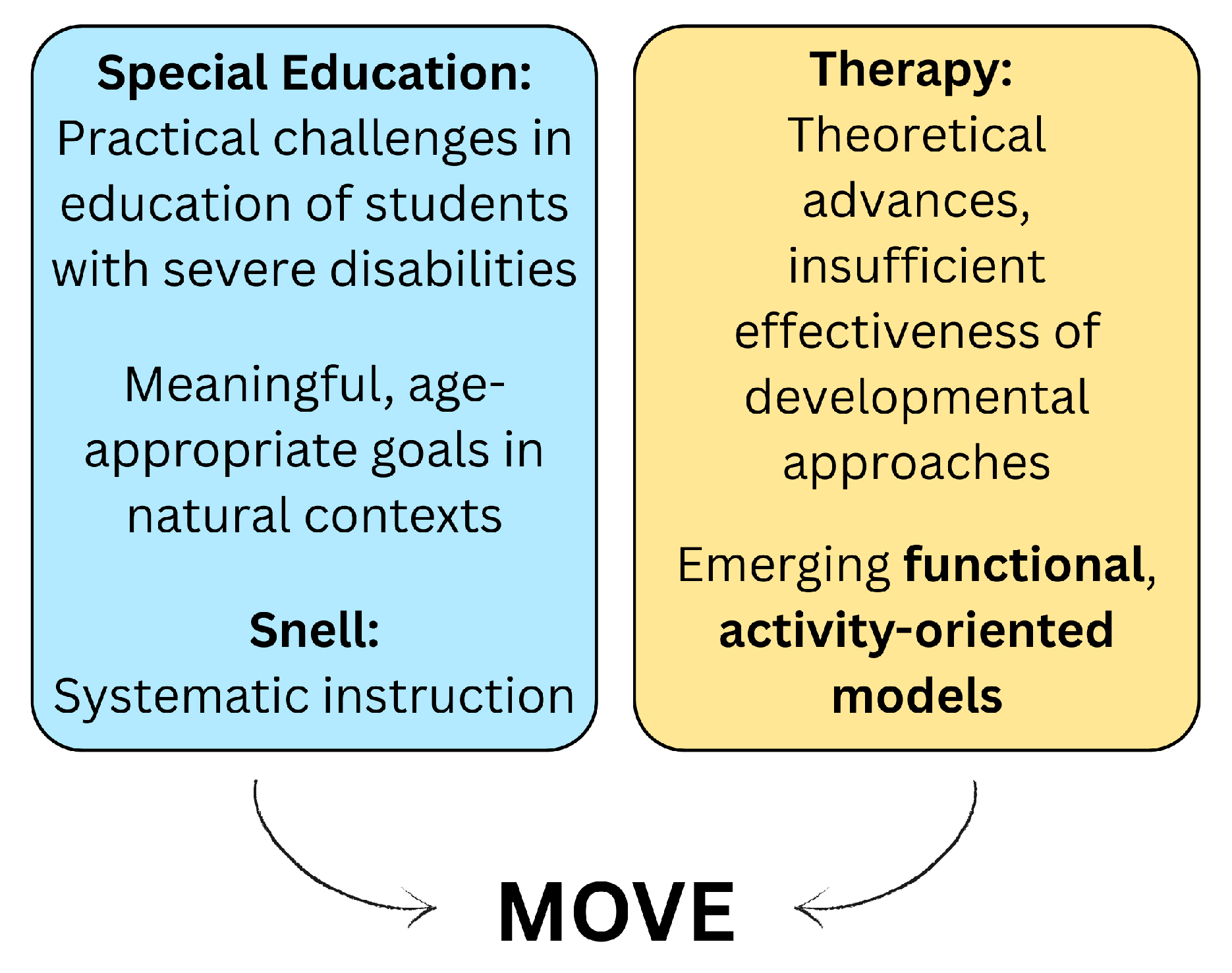
| Conceptual precursors | education: age-appropriate education of students with severe disabilities | education: partial participation, contextual programming, scaffolding | education: systematic instruction (M. Snell) | physiotherapy: functional, activity-oriented approaches |
| Theoretical background | retrospectively developed | dynamic systems theory | task-oriented interventions | motor learning concepts |
| Implementation | guided by training material and courses | quality insurance through quality marks | implemented across various settings | deviations from concept reported |
| Equipment | based on prototypes developed by Bidabe’s team | front-leaning chair, mobile stander, front-leaning walker | developed as instructive aids with easy prompt adaptation | supports independence, exploration, and choice-making |
| Adoption in educational curricula | adoption in various countries to supplement national curricula | integrated into regional and local curricula | considered for students with sensory impairments | adopted in physical education curriculum |
| Adaptations and derivatives | Standing room only: pilot study focussing on equipment | MOVE for adults—Mobility Opportunities via Experience | MOVE Hygiene and Toileting programme: independence in hygiene | MOVE for the elderly: proposed but not implemented |
Disclaimer/Publisher’s Note: The statements, opinions and data contained in all publications are solely those of the individual author(s) and contributor(s) and not of MDPI and/or the editor(s). MDPI and/or the editor(s) disclaim responsibility for any injury to people or property resulting from any ideas, methods, instructions or products referred to in the content. |
© 2026 by the authors. Licensee MDPI, Basel, Switzerland. This article is an open access article distributed under the terms and conditions of the Creative Commons Attribution (CC BY) license.
Share and Cite
Schomerus, R.; Paleg, G.S.; Livingstone, R.W.; Dawal, B.; Bächler, L. Promoting Functional Mobility in Individuals with Non-Ambulatory Cerebral Palsy: A Scoping Review of the MOVE Programme. Children 2026, 13, 292. https://doi.org/10.3390/children13020292
Schomerus R, Paleg GS, Livingstone RW, Dawal B, Bächler L. Promoting Functional Mobility in Individuals with Non-Ambulatory Cerebral Palsy: A Scoping Review of the MOVE Programme. Children. 2026; 13(2):292. https://doi.org/10.3390/children13020292
Chicago/Turabian StyleSchomerus, Riclef, Ginny S. Paleg, Roslyn W. Livingstone, Britta Dawal, and Liane Bächler. 2026. "Promoting Functional Mobility in Individuals with Non-Ambulatory Cerebral Palsy: A Scoping Review of the MOVE Programme" Children 13, no. 2: 292. https://doi.org/10.3390/children13020292
APA StyleSchomerus, R., Paleg, G. S., Livingstone, R. W., Dawal, B., & Bächler, L. (2026). Promoting Functional Mobility in Individuals with Non-Ambulatory Cerebral Palsy: A Scoping Review of the MOVE Programme. Children, 13(2), 292. https://doi.org/10.3390/children13020292