1. Introduction
Mucous stools are a common clinical finding in infancy and are most often evaluated within the spectrum of non–IgE-mediated food allergies, particularly food protein–induced allergic proctocolitis (FPIAP) [
1,
2,
3,
4]. Although this condition is generally considered to be limited to the gastrointestinal tract and transient in nature, in clinical practice many infants presenting with mucous stools simultaneously exhibit atopic features such as eczema, wheezing, or a family history of atopy. This observation suggests that mucous stools may represent an early clinical manifestation of a broader underlying immunological predisposition [
3,
4,
5,
6].
Although atopic diseases may manifest in different organ systems, they are generally regarded as dynamic expressions of a shared immunological background [
7,
8,
9,
10]. The concept of the “atopic march” describes the progression from early mucosal and cutaneous manifestations in infancy toward the later development of allergic diseases, particularly respiratory atopy [
9,
10]. Within this framework, gastrointestinal inflammatory findings such as mucous stools in early infancy are biologically plausible as early reflections of the systemic atopic predisposition that later gives rise to respiratory allergic diseases [
7,
8,
11].
In the existing literature, mucous stools have predominantly been investigated in relation to short-term gastrointestinal outcomes, whereas their association with long-term respiratory atopic risk remains insufficiently explored [
5,
6]. In particular, it remains unclear whether the severity of mucous stools or the presence of concomitant early atopic manifestations can predict the development of respiratory atopic phenotypes later in life [
1,
6]. This gap suggests that infants presenting with mucous stools constitute a heterogeneous group, within which certain subgroups may carry a higher systemic atopic risk [
5,
6].
Early-life gastrointestinal mucosal inflammation has been linked to epithelial barrier dysfunction and immune activation that may contribute to later atopic disease in susceptible infants [
7,
8,
11]. Accordingly, mucous stools may represent not merely a localized gastrointestinal symptom, but rather an early clinical manifestation of a systemic atopic predisposition [
3,
9,
12].
The aim of this study was to evaluate the risk of developing respiratory atopy (asthma and/or allergic rhinitis) over a four-year follow-up period in infants presenting with mucous stools during the first year of life, and to determine whether early clinical indicators can predict this predisposition.
2. Materials and Methods
2.1. Study Design and Setting
This study is a retrospective, observational cohort study in which the clinical records of infants who presented with mucous stools within the first 12 months of life were reviewed and four-year clinical outcomes were evaluated. The study was conducted in the general pediatrics, pediatric allergy, and pediatric gastroenterology outpatient clinics of a tertiary-care university hospital. Baseline clinical and laboratory data were obtained from standardized assessment forms completed as part of routine clinical practice and from the electronic medical record system. Four-year clinical outcomes were retrospectively ascertained from outpatient follow-up records and the hospital information system.
2.2. Study Population
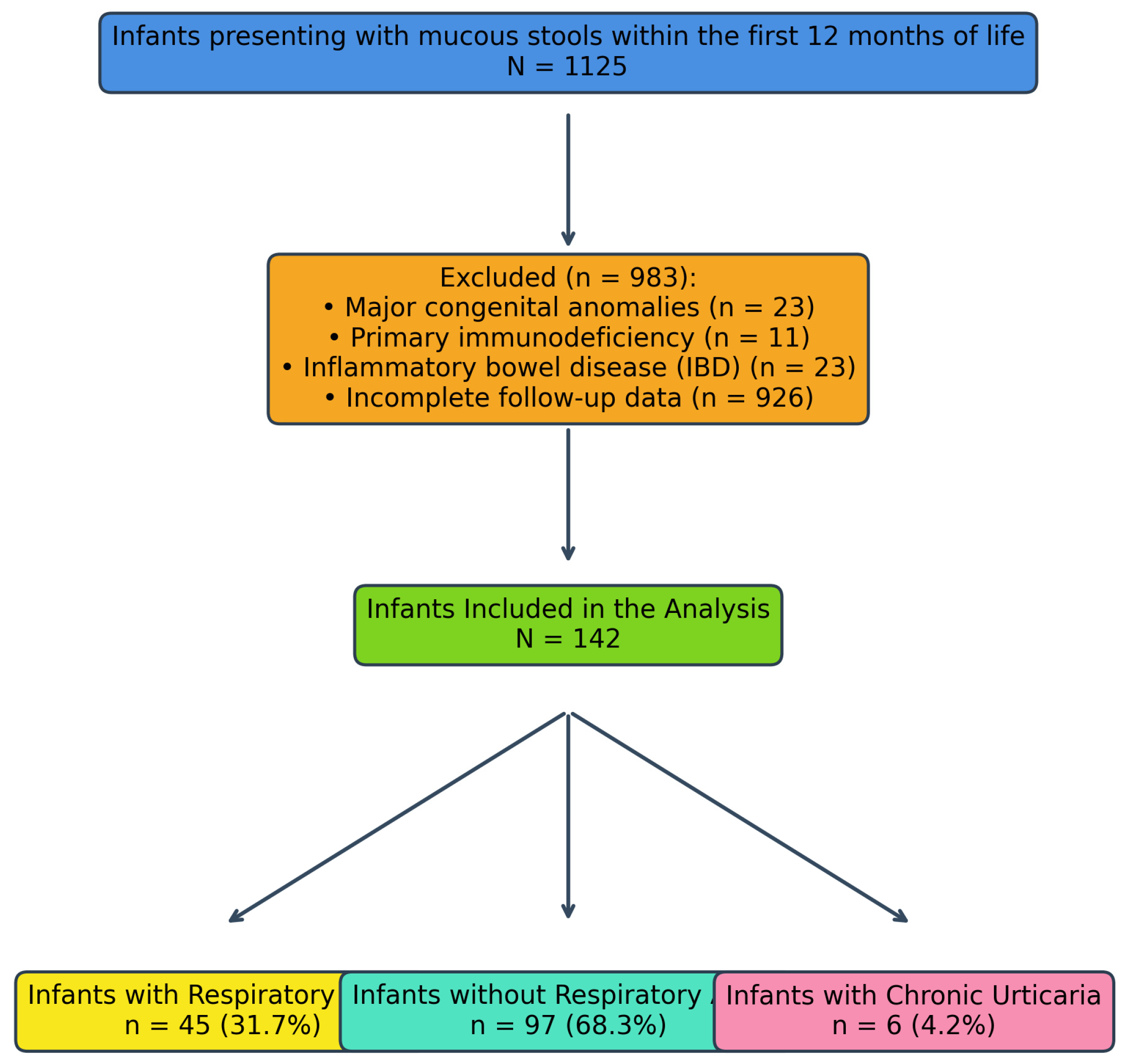
Infants who presented with macroscopic mucous stools within the first 12 months of life and who had no major congenital anomalies, primary immunodeficiency, inflammatory bowel disease, or organic gastrointestinal disease at baseline or during follow-up were eligible for inclusion. The presence of mucous in the stool was defined based on parental report at presentation and confirmation by the clinician through visible mucous on physical examination. All cases meeting the inclusion criteria within the specified time period were screened, and 142 infants with complete four-year outcome data constituted the final analytic cohort [
Figure 1].
2.3. Baseline Assessment
At the initial presentation, demographic and perinatal characteristics, environmental factors (including antibiotic exposure and tobacco smoke exposure), feeding patterns, and family history of atopy were recorded. Laboratory assessments, including total IgE, specific IgE, skin prick testing, and peripheral blood eosinophil counts, were performed according to routine clinical practice protocols. The diagnosis of IgE-mediated food allergy was established by a pediatric allergist based on clinical history and test results in accordance with internationally accepted diagnostic criteria [
13].
2.4. Mucus Score
The severity of mucous stools was graded at the initial presentation on a 0–3 scale (0 = none, 1 = mild, 2 = moderate, 3 = severe), based on parental report and clinician confirmation. The mucus score was not used as an objective biomarker but rather as a pragmatic, clinically based indicator of disease burden intended to reflect real-life pediatric practice [
14]. Although not formally validated, this approach mirrors common bedside assessment in pediatric gastroenterology and allergy clinics and aims to capture clinically meaningful disease burden rather than laboratory-based severity metrics. The mucus score was not intended as a validated diagnostic or prognostic instrument but as a pragmatic, clinically oriented measure reflecting real-life pediatric practice. Formal assessment of inter-observer reliability was not performed, and this should be considered a methodological limitation. Accordingly, the mucus score was interpreted cautiously and evaluated primarily as a descriptive indicator of intestinal symptom burden rather than a definitive biomarker.
Outcome Definition and Diagnostic Ascertainment
The primary outcome was physician-diagnosed asthma and/or allergic rhinitis documented in routine outpatient follow-up records at the 4-year time point. Given the retrospective nature of the study, outcome diagnoses were based on the treating physician’s clinical judgment and standard clinical documentation rather than a uniform, protocol-driven diagnostic algorithm.
For asthma, diagnoses were recorded according to age-appropriate clinical criteria commonly used in pediatric practice, including recurrent wheezing episodes and response to bronchodilator therapy, recognizing that objective lung function testing is often not feasible or routinely performed at this age. Allergic rhinitis was defined based on persistent or recurrent rhinitis symptoms with clinical features consistent with allergic etiology, as documented by the treating physician. No requirement for mandatory spirometry or allergy testing was imposed for outcome definition.
2.5. Outcomes and Statistical Analysis
The primary outcome was defined as physician-diagnosed asthma and/or allergic rhinitis. After group comparisons, multivariable logistic regression was performed for the primary outcome. Covariates entered into the model (including age at presentation, family history of atopy, wheezing, mucus score, and eczema) were selected not solely based on statistical significance but also on biological plausibility and evidence from the literature. For secondary outcomes with low event numbers, Firth penalized logistic regression was used to reduce small-sample bias. Model discrimination was assessed using the area under the receiver operating characteristic (ROC) curve (AUC). Dietary interventions (elimination diet, probiotic use, and formula type) were tested in sensitivity analyses and did not materially alter effect estimates. Age refers to the age at initial presentation with mucous stools.
Covariates included in the multivariable logistic regression model were selected based not only on statistical associations but also on clinical applicability, biological plausibility from the literature, and the risk of multicollinearity. Although total IgE levels and eosinophil counts differed between groups, they were not included in the model in order to preserve bedside applicability without requiring additional laboratory testing. Moreover, these biomarkers did not provide clinically meaningful cut-off values capable of discriminating individual risk for respiratory atopy, and their distributions overlapped substantially between groups.
3. Results
3.1. Study Population
All 142 infants completed the four-year follow-up period and were included in the analyses of both primary and secondary outcomes. At baseline, 55.6% of the cohort were male, and the median age at presentation was 2 months (interquartile range [IQR], 1–3) (
Table 1).
3.2. Four-Year Clinical Outcomes
At the four-year follow-up, asthma was identified in 20 infants (14.1%), allergic rhinitis in 34 infants (23.9%), and coexisting asthma and allergic rhinitis in 9 infants (6.3%). Overall, respiratory atopy (asthma and/or allergic rhinitis) was observed in 45 infants (31.7%). Chronic urticaria was detected in 6 infants (4.2%) and was evaluated as an exploratory outcome (
Table 2).
3.3. Comparisons According to Baseline Characteristics
Infants who developed respiratory atopy had a higher prevalence of family history of atopy compared with those who did not (57.8% vs. 30.9%, p = 0.002), and wheezing was significantly more frequent in this group (42.2% vs. 17.5%, p = 0.002). The median mucus score was higher in the respiratory atopy group (p = 0.042); however, when mucus burden was dichotomized (scores 0–1 vs. 2–3), no significant difference was observed between groups (p = 0.135).
Total IgE levels and peripheral blood eosinophil counts were higher in the respiratory atopy group, but these parameters exhibited wide distributions and did not yield a clear discriminative cut-off between groups. There were no significant differences between infants with and without respiratory atopy with respect to maternal elimination diet, use of hypoallergenic formula, excluded foods (e.g., milk, egg, and other foods), probiotic use, or parental concern level (all
p > 0.05). Likewise, no statistically significant differences were observed between groups for other demographic, perinatal, or environmental variables, including sex, prematurity, cesarean delivery, early antibiotic exposure, passive smoke exposure, visible blood in the stool, eczema, and poor weight gain (
Table 1).
3.4. Regression Analysis for the Primary Outcome (Respiratory Atopy)
In univariable logistic regression analyses, wheezing (OR 3.44, 95% CI 1.56–7.58,
p = 0.002), family history of atopy (OR 3.06, 95% CI 1.47–6.35,
p = 0.003), and each one-point increase in the mucus score (OR 1.53, 95% CI 1.02–2.30,
p = 0.039) were associated with respiratory atopy (
Table 3).
In multivariable analysis, only family history of atopy (adjusted OR [aOR] 2.68, 95% CI 1.20–5.98,
p = 0.016) and wheezing (aOR 3.74, 95% CI 1.56–8.94,
p = 0.003) remained independent predictors of respiratory atopy. Mucus score, visible blood in stool, eczema, and IgE-mediated food allergy were not independently associated with the primary outcome in the multivariable model (
Table 4). Total IgE levels, eosinophil counts, dietary factors, probiotic use, and parental concern were not retained in the final model because their inclusion did not materially change the results.
3.5. Secondary Outcomes
In multivariable analysis for asthma, age at presentation (aOR 1.81,
p = 0.008) and wheezing (aOR 7.64,
p < 0.001) were significant predictors. For allergic rhinitis, only family history of atopy was an independent determinant (aOR 3.25,
p = 0.007), whereas the mucus score showed a borderline association (
p = 0.063). In the penalized regression analysis for the severe phenotype defined by the coexistence of asthma and allergic rhinitis, both age at presentation (aOR 2.32,
p = 0.020) and mucus score (aOR 6.20,
p = 0.017) were associated with the outcome. Age at presentation was also associated with asthma and the combined asthma-and-rhinitis phenotype (
Table 5). Given the limited number of events, these results should be interpreted as hypothesis-generating. For chronic urticaria, the number of events was too low to detect any meaningful associations with clinical, dietary, or laboratory variables.
4. Discussion
In this retrospective cohort study, approximately one-third of infants who presented with mucous stools within the first 12 months of life (31.7%,
n = 45/142) were found to have developed respiratory atopy (asthma and/or allergic rhinitis) by the end of follow-up. The proportion of respiratory atopy observed among infants presenting with mucous stools was higher than that reported in previously published cohort studies, which may indicate a risk-enriched clinical phenotype; however, direct risk quantification versus infants without mucous stools was not possible in this design [
15,
16]. Therefore, the comparison should be interpreted as contextual rather than as a population-level risk estimate.
Although the mucus score was associated with the development of respiratory atopy in univariable analyses, this association lost independence in multivariable logistic regression, indicating that mucus burden likely reflects a shared underlying atopic diathesis captured by stronger clinical predictors such as wheezing and family history of atopy. The model demonstrated good discrimination (AUC = 0.769), with evidence of potential miscalibration (Hosmer–Lemeshow p = 0.015), indicating that predicted probabilities should be interpreted as relative risk stratification rather than absolute individual risk. In this context, the mucus score should be regarded not as a tool for generating precise individual probabilities, but rather as a pragmatic clinical marker for identifying infants at higher risk of an early atopy-prone clinical phenotype. Consistent with this interpretation, age at presentation emerged as a relevant factor for asthma-related secondary outcomes, but not for the primary outcome of respiratory atopy.
4.1. Atopic March and Immunological Mechanisms
Our findings are compatible with the atopic-march framework in the sense that infants presenting with mucous stools may represent a clinically risk-enriched subgroup in whom later respiratory atopy is more frequently observed [
17,
18,
19,
20,
21]. However, the present retrospective design does not allow causal inference, and mucous stools should be considered a clinical correlate rather than proof of a mechanistic pathway.
Accordingly, a gastrointestinal-onset atopic phenotype should be regarded as a hypothesis-generating concept supported by associative clinical observations. Prospective studies incorporating objective biomarkers of intestinal barrier function and immune activation are needed to clarify whether early gastrointestinal inflammation contributes independently to subsequent respiratory atopy.
4.2. Analysis of Risk Factors
In multivariable analyses, family history of atopy (aOR 2.68, 95% CI 1.20–5.98,
p = 0.016) and wheezing at presentation (aOR 3.74, 95% CI 1.56–8.94,
p = 0.003) emerged as the strongest independent predictors of respiratory atopy. These findings are consistent with the established central role of early-life wheezing and genetic predisposition in asthma prediction models [
22,
23,
24]. Although the mucus score was associated with respiratory atopy in univariable analyses, this association did not persist after adjustment for established clinical predictors in multivariable models. This finding suggests that mucus burden may reflect an underlying atopy-prone clinical context rather than acting as an independent determinant of future respiratory atopy. Therefore, the mucus score should be interpreted as a supportive clinical feature within a broader risk profile, rather than as a standalone predictive marker. In contrast, early wheezing and a family history of atopy emerged as the strongest independent predictors, highlighting their central role in early risk stratification [
19].
The emergence of clinical phenotypic features (family history and wheezing) as stronger predictors than laboratory biomarkers underscores the sufficiency of a noninvasive and cost-effective approach to prognostic assessment in infants with mucous stools. The exclusion of total IgE and eosinophil counts from the multivariable model preserved its generalizability and bedside applicability across heterogeneous clinical settings. This reinforces the interpretation of mucous stools as a clinical signal within the atopic march rather than a laboratory-defined abnormality. The discrepancy between the ordinal and dichotomized mucus score analyses may indicate a graded association rather than a clear threshold effect; however, this observation should be interpreted cautiously.
4.3. Comparison with the Literature and Clinical Implications
In the existing literature, mucous stools have primarily been addressed within the framework of food allergy and allergic proctocolitis [
15]. However, in our study, IgE-mediated food allergy did not independently predict respiratory atopy (aOR 0.95,
p = 0.901), suggesting that this phenotype may belong to a broader non–IgE-mediated atopic spectrum rather than classical IgE-driven sensitization [
11,
12]. Clinically, these findings indicate that infants presenting with mucous stools should not be managed solely with dietary modification and symptom control, but should also be evaluated for future atopic risk [
11,
25,
26,
27,
28]. In particular, infants with wheezing and a family history of atopy should be considered “high-risk atopic candidates” and followed with a multidisciplinary approach [
22,
23,
24,
29].
The lack of association between chronic urticaria and any clinical or biological variable suggests that the atopic risk signaled by mucous stools is linked to a respiratory-specific atopic pathway rather than to a generalized mast cell–mediated disease spectrum.
The retrospective design and single-center setting limit the generalizability of our findings; however, the observed effect sizes highlight the potential prognostic relevance of mucous stools in early life. These findings should be interpreted as associative and hypothesis-generating. Future prospective studies incorporating objective biomarkers of intestinal barrier function and immune activation are required to clarify whether early gastrointestinal inflammation contributes independently to subsequent respiratory atopy and to further delineate its role within the atopic march.
4.4. Strengths and Limitations
This study has several strengths, including a well-defined clinical cohort of infants presenting with mucous stools in early life, a standardized four-year follow-up period, and comprehensive assessment of clinically relevant outcomes using routinely available data. The focus on pragmatic clinical predictors enhances the real-world applicability of the findings.
Several limitations should also be acknowledged. The retrospective design precludes causal inference and limits control over potential confounders. The absence of a mucous-stool–free comparison group restricts direct risk quantification relative to the general population. Outcome diagnoses were based on routine clinical documentation, and diagnostic variability—particularly for asthma at preschool age—cannot be fully excluded. The mucus score represents a pragmatic, non-validated measure without formal assessment of inter-observer reliability and should therefore be interpreted cautiously. Finally, the limited number of events for certain secondary outcomes necessitates cautious interpretation of these analyses as hypothesis-generating. Because the analytic cohort was restricted to infants with complete four-year outcome documentation, selection or follow-up bias cannot be excluded, and infants with incomplete follow-up may have differed in baseline severity or referral patterns.
5. Conclusions
Among infants presenting with mucous stools in the first year of life, respiratory atopy was observed in nearly one-third by age 4. In adjusted analyses, early wheezing and a family history of atopy were the strongest independent predictors, whereas the mucus score did not retain independent predictive value. In the absence of a mucous-stool–free comparison group, these findings should be interpreted as associative and hypothesis-generating. Clinically, infants with mucous stools accompanied by wheezing or familial atopy may warrant closer follow-up for subsequent respiratory allergic disease.
Author Contributions
F.K. contributed to study design, clinical interpretation, and critical revision of the manuscript. A.G. conceptualized the study, performed data collection and statistical analyses, and drafted the manuscript. All authors have read and agreed to the published version of the manuscript.
Funding
No external funding was received for this study.
Institutional Review Board Statement
This study was approved by the Institutional Clinical Research Ethics Committee of Malatya Turgut Özal University. The study was conducted in accordance with the principles of the Declaration of Helsinki (code: SBBA-2026/33, date: 12 November 2025).
Data Availability Statement
The datasets generated and/or analyzed during the current study are available from the corresponding author upon reasonable request.
Conflicts of Interest
The authors declare no conflicts of interest.
References
- Mennini, M.; Fiocchi, A.G.; Cafarotti, A.; Montesano, M.; Mauro, A.; Villa, M.P.; Di Nardo, G. Food protein–induced allergic proctocolitis in infants: Literature review and proposal of a management protocol. World Allergy Organ. J. 2020, 13, 100471. [Google Scholar] [CrossRef] [Scilit] [PubMed]
- Coppola, S.; Carucci, L.; Anania, C.; Auricchio, R.; Baldassarre, M.; Calvani, M.; Cecere, G.; D’AUria, E.; Decimo, F.; Malamisura, M.; et al. Diagnosis and management of food protein–induced allergic proctocolitis in the pediatric age: Italian position paper. Pediatr. Allergy Immunol. 2025, 36, e70264. [Google Scholar] [CrossRef] [Scilit] [PubMed]
- Caubet, J.C.; Szajewska, H.; Shamir, R.; Nowak-Węgrzyn, A. Non-IgE-mediated gastrointestinal food allergies in children. Pediatr. Allergy Immunol. 2017, 28, 6–17. [Google Scholar] [CrossRef] [Scilit] [PubMed]
- Nowak-Węgrzyn, A. Food protein–induced enterocolitis syndrome and allergic proctocolitis. Allergy Asthma Proc. 2015, 36, 172–184. [Google Scholar] [CrossRef] [Scilit]
- Arvola, T.; Ruuska, T.; Keränen, J.; Hyöty, H.; Salminen, S.; Isolauri, E. Rectal bleeding in infancy: Clinical, allergological, and microbiological examination. Pediatrics 2006, 117, e760–e768. [Google Scholar] [CrossRef] [Scilit]
- Lake, A.M.; Whitington, P.F.; Hamilton, S.R. Dietary protein-induced colitis in breast-fed infants. J. Pediatr. 1982, 101, 906–910. [Google Scholar] [CrossRef] [Scilit]
- Barni, S.; Sarti, L.; Mori, F.; Giovannini, M.; Liotti, L.; Mastrorilli, C.; Pecoraro, L.; Saretta, F.; Castagnoli, R.; Arasi, S.; et al. Food protein-induced allergic proctocolitis (FPIAP): New insights into pathogenesis and implications. Life 2023, 13, 1824. [Google Scholar] [CrossRef] [Scilit]
- Vassilopoulou, E.; Feketea, G.; Konstantinou, G.N.; Xypolias, D.Z.; Valianatou, M.; Petrodimopoulou, M.; Vourga, V.; Tasios, I.; Papadopoulos, N.G. Food protein-induced allergic proctocolitis: The effect of maternal diet during pregnancy and breastfeeding. Front. Nutr. 2022, 9, 843437. [Google Scholar] [CrossRef] [Scilit]
- Hill, D.J.; Hosking, C.S. The atopic march: The journey from atopic dermatitis to asthma. J. Allergy Clin. Immunol. 2004, 114, 1265–1268. [Google Scholar] [CrossRef] [Scilit]
- Bantz, S.K.; Zhu, Z.; Bain, T. The atopic march: Progression from atopic dermatitis to allergic rhinitis and asthma. J. Clin. Cell Immunol. 2014, 5, 202. [Google Scholar] [CrossRef]
- Wahn, U. What drives the allergic march? Allergy 2000, 55, 591–599. [Google Scholar] [CrossRef] [Scilit] [PubMed]
- Eigenmann, P.A. The spectrum of non-IgE-mediated food allergy. Pediatr. Allergy Immunol. 2005, 16, 170–174. [Google Scholar] [CrossRef] [Scilit]
- Sicherer, S.H.; Sampson, H.A. Food allergy: Epidemiology, pathogenesis, diagnosis, and treatment. J. Allergy Clin. Immunol. 2014, 133, 291–307. [Google Scholar] [CrossRef] [Scilit] [PubMed]
- Miceli Sopo, S.; Monaco, S.; Bersani, G.; Romano, A.; Fantacci, C. Proposal for management of the infant with suspected food protein-induced allergic proctocolitis. Pediatr. Allergy Immunol. 2018, 29, 215–218. [Google Scholar] [CrossRef] [Scilit] [PubMed]
- Illi, S.; von Mutius, E.; Lau, S.; Nickel, R.; Grüber, C.; Niggemann, B.; Wahn, U. Multicenter Allergy Study Group. The natural course of atopic dermatitis from birth to age 7 years and the association with asthma. J Allergy Clin Immunol. 2004, 113, 925–931. [Google Scholar] [CrossRef]
- Savino, F.; Castagno, E.; Bretto, R.; Brondello, C.; Palumeri, E.; Oggero, R. A prospective 10-year study on children who had severe infantile colic. Acta Paediatr. 2005, 94, 129–132. [Google Scholar] [CrossRef] [Scilit]
- Spergel, J.M.; Paller, A.S. Atopic dermatitis and the atopic march. J. Allergy Clin. Immunol. 2003, 112, S118–S127. [Google Scholar] [CrossRef] [Scilit] [PubMed]
- Dharmage, S.C.; Lowe, A.J.; Matheson, M.C.; Burgess, J.A.; Allen, K.J.; Abramson, M.J. Atopic dermatitis and the atopic march revisited. Allergy 2014, 69, 17–27. [Google Scholar] [CrossRef] [Scilit] [PubMed]
- Czaja-Bulsa, G.; Bulsa, K.; Łokieć, M.; Drozd, A. Can faecal zonulin and calprotectin be used in infants with FPIAP? Nutrients 2024, 16, 2949. [Google Scholar] [CrossRef] [Scilit]
- Belgrave, D.C.; Granell, R.; Simpson, A.; Guiver, J.; Bishop, C.; Buchan, I.; Henderson, A.J.; Custovic, A. Developmental profiles of eczema, wheeze, and rhinitis: Two population-based birth cohort studies. PLoS Med. 2014, 11, e1001748. [Google Scholar] [CrossRef] [Scilit] [PubMed] [PubMed Central]
- Spergel, J.M. Atopic march: Link to upper airways. Curr. Opin. Allergy Clin. Immunol. 2005, 5, 17–21. [Google Scholar] [CrossRef] [Scilit] [PubMed]
- Lack, G. Update on risk factors for food allergy. J. Allergy Clin. Immunol. 2012, 129, 1187–1197. [Google Scholar] [CrossRef] [Scilit] [PubMed]
- Papadopoulos, N.G.; Arakawa, H.; Carlsen, K.; Custovic, A.; Gern, J.; Lemanske, R.; Le Souef, P.; Mäkelä, M.; Roberts, G.; Wong, G.; et al. International consensus on (ICON) pediatric asthma. Allergy 2012, 67, 976–997. [Google Scholar] [CrossRef] [Scilit] [PubMed]
- Martinez, F.D.; Wright, A.L.; Taussig, L.M.; Holberg, C.J.; Halonen, M.; Morgan, W.J.; The Group Health Medical Associates. Asthma and wheezing in the first six years of life. N. Engl. J. Med. 1995, 332, 133–138. [Google Scholar] [CrossRef] [Scilit]
- Martin, V.M.; Virkud, Y.V.; Seay, H.; Hickey, A.; Ndahayo, R.; Rosow, R.; Southwick, C.; Elkort, M.; Gupta, B.; Kramer, E.; et al. Prospective assessment of pediatrician-diagnosed food protein-induced allergic proctocolitis by gross or occult blood. J. Allergy Clin. Immunol. Pract. 2020, 8, 1692–1699.e1. [Google Scholar] [CrossRef] [Scilit]
- Luyt, D.; Ball, H.; Makwana, N.; Green, M.R.; Bravin, K.; Nasser, S.M.; Clark, A. T BSACI guideline for the diagnosis and management of cow’s milk allergy. Clin. Exp. Allergy 2014, 44, 642–672. [Google Scholar] [CrossRef] [Scilit]
- Fox, A.; Brown, T.; Walsh, J.; Venter, C.; Meyer, R.; Nowak-Wegrzyn, A.; Levin, M.; Spawls, H.; Beatson, J.; Lovis, M.-T.; et al. An update to the milk allergy in primary care guideline. Clin. Transl. Allergy 2019, 9, 40. [Google Scholar] [CrossRef] [Scilit]
- Bognanni, A.; Fiocchi, A.; Arasi, S.; Chu, D.K.; Ansotegui, I.; Assa’ad, A.H.; Bahna, S.L.; Canani, R.B.; Bozzola, M.; Dahdah, L.; et al. WAO DRACMA guideline update. World Allergy Organ. J. 2023, 16, 100825. [Google Scholar] [CrossRef] [Scilit]
- Nowak-Węgrzyn, A.; Chehade, M.; Groetch, M.E.; Spergel, J.M.; Wood, R.A.; Allen, K.; Atkins, D.; Bahna, S.; Barad, A.V.; Berin, C.; et al. International consensus guidelines for the diagnosis and management of food protein-induced enterocolitis syndrome. J. Allergy Clin. Immunol. 2017, 139, 1111–1126.e4. [Google Scholar] [CrossRef] [Scilit]
| Disclaimer/Publisher’s Note: The statements, opinions and data contained in all publications are solely those of the individual author(s) and contributor(s) and not of MDPI and/or the editor(s). MDPI and/or the editor(s) disclaim responsibility for any injury to people or property resulting from any ideas, methods, instructions or products referred to in the content. |