


Abstract
Lentiviral vectors have demonstrated promising results in clinical trials that target cells of the hematopoietic system. For these applications, they are the vectors of choice since they provide stable integration into cells that will undergo extensive expansion in vivo. Unfortunately, integration can have unintended consequences including dysregulated cell growth. Therefore, lentiviral vectors that do not integrate are predicted to have a safer profile compared to integrating vectors and should be considered for applications where transient expression is required or for sustained episomal expression such as in quiescent cells. In this review, the system for generating lentiviral vectors will be described and used to illustrate how alterations in the viral integrase or vector Long Terminal Repeats have been used to generate vectors that lack the ability to integrate. In addition to their safety advantages, these non-integrating lentiviral vectors can be used when persistent expression would have adverse consequences. Vectors are currently in development for use in vaccinations, cancer therapy, site-directed gene insertions, gene disruption strategies, and cell reprogramming. Preclinical work will be described that illustrates the potential of this unique vector system in human gene therapy.
1. Introduction
Gene therapy using lentiviral vectors (LV) holds great promise for the treatment of a wide variety of disorders. The major advantage of these vectors is their ability to stably integrate into target cells, thus providing genetic modification of the cell and all of its progeny. Other advantages of LVs include low immunogenicity, a lack of prior immunity, a relatively large packaging capacity, and an ability to be pseudotyped with alternative envelopes thus altering vector tropism [1,2,3,4,5,6,7,8]. To date, the predominant use of these vectors has been ex vivo modification of hematopoietic stem cells, T cells or other targets where the transduced cell is expected to expand in vivo. For example, early clinical trials have shown evidence of disease correction or delay of onset including treatment for thalassemia, adrenoleukodystrophy, chronic lymphocytic leukemia, metachromatic leukodystrophy, and Wiskott Aldrich syndrome [9,10,11,12,13].
A number of potential lentiviral vector applications will not require stable integration, including their use in immunizations, cytotoxic cancer therapies, or delivery to sites such as the central nervous system. In these settings, it may be advantageous to express the vector transgenes episomally to mitigate the risk of insertional mutagenesis. The phenomenon of insertional mutagenesis occurs when regulatory regions in the vector activate surrounding genes involved with cell growth or the integration disrupts genes resulting in growth dysregulation or genetic instability [9,14,15].
In this review, we will reveal how the unique life-cycle of the lentivirus permits the design of non-integrating lentiviral vectors. Specifically, modifying integrase and/or its binding site allows the development of episomally expressed vectors that retain the ability to infect target cells and express the transgene(s) of choice. We also describe the use of non-integrating lentiviral vectors in gene therapy applications, their limitations, and current advances intended to improve upon clinical utility.
1.1. Lentiviral Vector Design
Lentiviral vectors derived from the human immunodeficiency virus type 1 (HIV-1) have the ability to integrate efficiently into quiescent or non-dividing cells [16]. As depicted in Figure 1A, LVs were advanced by removing non-essential sequences and genomic regions involved with viral replication and virulence from the wild-type lentiviral genome (e.g., nef, vif, vpr, and vpu). The end result is a replication defective vector containing the necessary elements for packaging and processing but still capable of integration [17,18]. Vector particles are generated using a series of plasmids that express the vector genome and the viral proteins required for particle formation. The technology for packaging vector particles continues to evolve, but the commonly used “third generation” systems utilize a series of four vector plasmids that are introduced into cells by transient transfection (Figure 1B) [19]. In addition to the transgene plasmid containing the vector genome, the system uses a plasmid expressing the gag and pol gene regions that produce the HIV-1 structural proteins required for capsid formation and genome integration. A plasmid expressing HIV-1 rev is also included to activate the rev responsive element engineered into the transgene and gag/pol plasmids. This facilitates nuclear transport and is also included as a safety feature. The fourth plasmid expresses an envelope glycoprotein that engages receptors on the target cells. As the native HIV-1 glycoprotein is generally restricted to CD4 positive cells, investigators utilize alternative envelopes, most commonly the Vesicular Stomatitis Virus G glycoprotein [20] (VSV-G), to facilitate uptake into a wide variety of species and cell types. The use of multiple plasmids and the requirement for rev are included to minimize recombination events that would lead to the development of a replication competent virus.
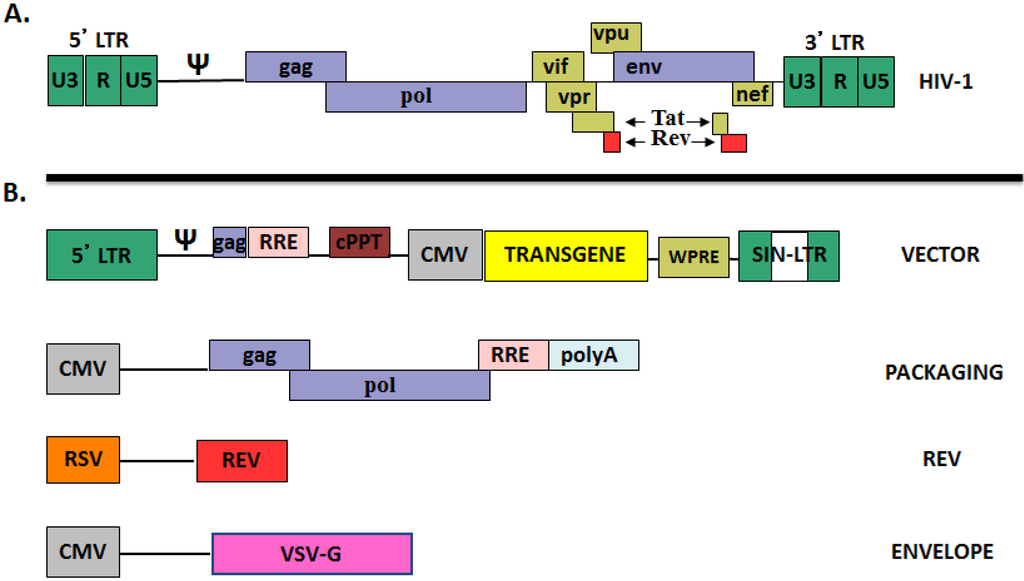
Figure 1.
Schematic of HIV-1 and Third Generation Lentiviral Packaging System. (A) The HIV-1 Virus contains three gene regions gag, pol, and env along with accessory proteins and the flanking Long Terminal Repeats (LTR); (B) The lentiviral components found in the four plasmids used in generating third generation lentiviral vectors. The vector plasmid contains a self-inactivating 3' LTR (SIN-LTR), a Rev responsive element (RRE), a central polypurine tract (cPPT), and the Woodchuck Hepatitis Virus Post-Transcriptional Response Element. The psi sequence (Ψ) allows for efficient incorporation of the vector RNA genome into particles. In this schematic, the CMV early promoter is used for transgene expression but other promoters are commonly substituted. The packaging plasmid expresses the gag and pol gene regions of HIV-1 which encode proteins required for virion formation and vector processing. This plasmid also contains a RRE. A plasmid expressing rev is provided to facilitate nuclear transport of RRE containing transcripts. The fourth plasmid is the envelope plasmid. Lentiviral vectors are commonly pseudotyped with the Vesicular Stomatitis Virus G glycoprotein (VSV-G) as an alternative to the native HIV-1 envelope to increase the range of cell types and animal species susceptible to vector transduction.
Figure 1.
Schematic of HIV-1 and Third Generation Lentiviral Packaging System. (A) The HIV-1 Virus contains three gene regions gag, pol, and env along with accessory proteins and the flanking Long Terminal Repeats (LTR); (B) The lentiviral components found in the four plasmids used in generating third generation lentiviral vectors. The vector plasmid contains a self-inactivating 3' LTR (SIN-LTR), a Rev responsive element (RRE), a central polypurine tract (cPPT), and the Woodchuck Hepatitis Virus Post-Transcriptional Response Element. The psi sequence (Ψ) allows for efficient incorporation of the vector RNA genome into particles. In this schematic, the CMV early promoter is used for transgene expression but other promoters are commonly substituted. The packaging plasmid expresses the gag and pol gene regions of HIV-1 which encode proteins required for virion formation and vector processing. This plasmid also contains a RRE. A plasmid expressing rev is provided to facilitate nuclear transport of RRE containing transcripts. The fourth plasmid is the envelope plasmid. Lentiviral vectors are commonly pseudotyped with the Vesicular Stomatitis Virus G glycoprotein (VSV-G) as an alternative to the native HIV-1 envelope to increase the range of cell types and animal species susceptible to vector transduction.
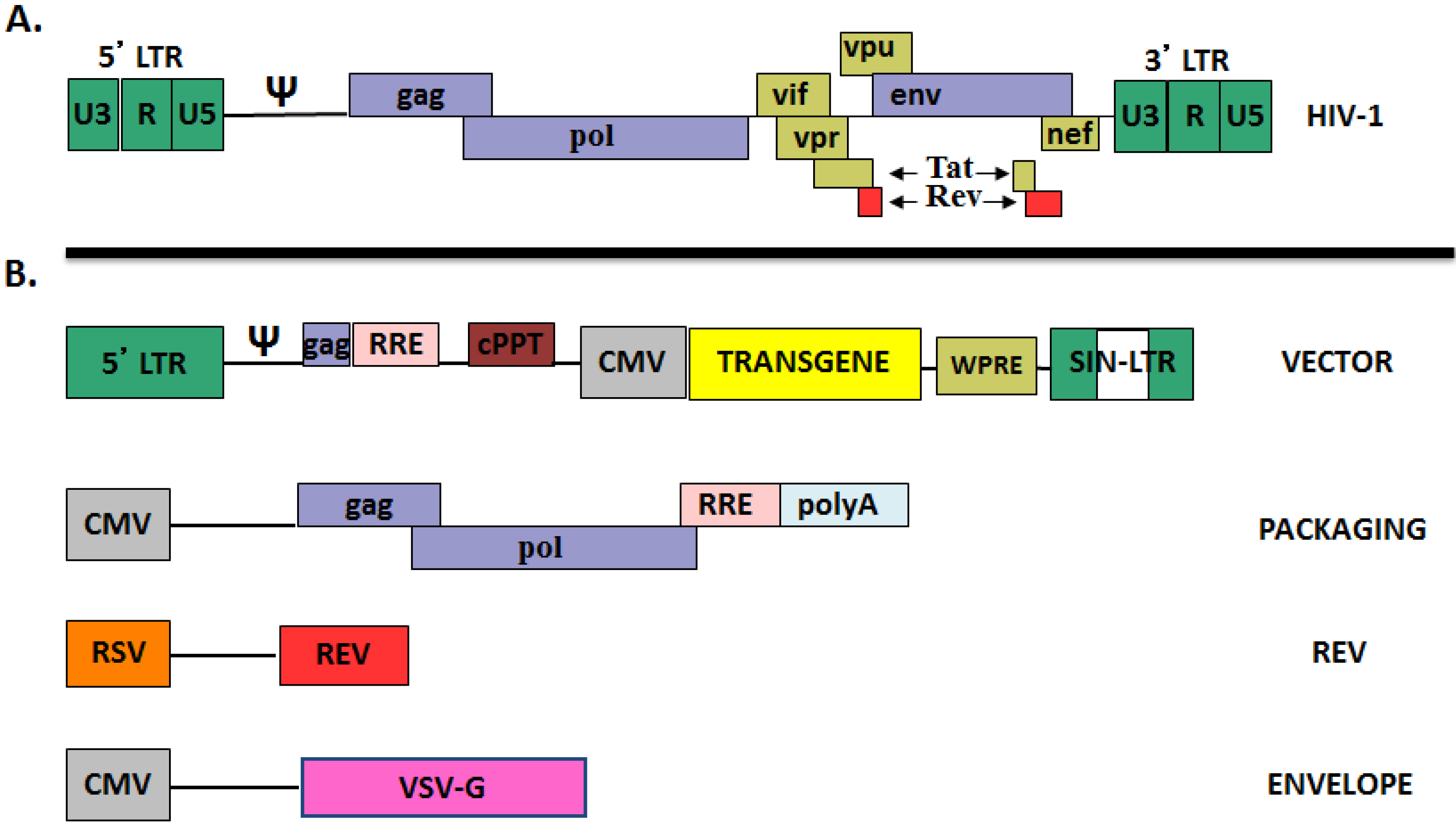
For efficient integration, viral particles must contain the proteins encoded in the HIV-1 pol region which are necessary for vector processing including reverse transcriptase, polymerase and protease. Cellular proteins important in efficient transduction include cyclophilin A and integrase interactor 1 which are also packaged within the capsid structure [21,22,23,24,25,26,27,28]. Vector particles also contain two copies of a single-stranded RNA genome. As shown in Figure 1A, each end of the RNA genome contains a long-terminal repeat (LTR), with an untranslated 5' and 3' segment (U5/U3) flanking a repeat region (R). Most vectors retain certain components of the HIV-1 genome including the psi signal that markedly increases the packaging of the genome into the mature virion. A short portion of gag sequence which is critical for generating high titer vector is also retained.
The transgene plasmid contains the minimal components of HIV-1 required for vector production and integration. The transgene of interest is 3' to a promoter element that regulates expression. The choice of the specific promoter is driven by the intended use. Common examples include tissue specific promoters, enhancers, insulators, or microRNA regions. Additional elements are added to increase vector production and/or expression including a polypurine tract [29,30] and the Woodchuck Hepatitis Virus Post-Transcriptional Response Element (WPRE) [31,32].
An important safety feature of most LVs is the inclusion of a Self-Inactivating Long Terminal Repeat (SIN-LTR). This feature minimizes the risk of producing a replication-competent lentivirus by recombination with wild-type viruses. The mechanism involves taking advantage of the normal replication cycle of HIV-1. In wild-type HIV-1, the viral promoter is within the U3 region of the 5' LTR and is required to generate the full length viral transcript. The U3 region is also present in the 3' LTR but is not essential in the DNA form of the virus. During viral replication, the RNA genome is reverse transcribed and the 3' LTR is utilized in formation of both the 5' and 3' LTR of the daughter virus. By incorporating a large deletion into the U3 region of the 3' LTR any progeny will contain two inactivated LTR after reverse transcription [17,33]. Transgene expression is dependent solely on the internal promoter (for example, the CMV promoter engineered into the vector plasmid as illustrated in Figure 1B).
1.2. Retaining Key Parts of the Life Cycle during Non-Integrating Lentiviral Vector Design
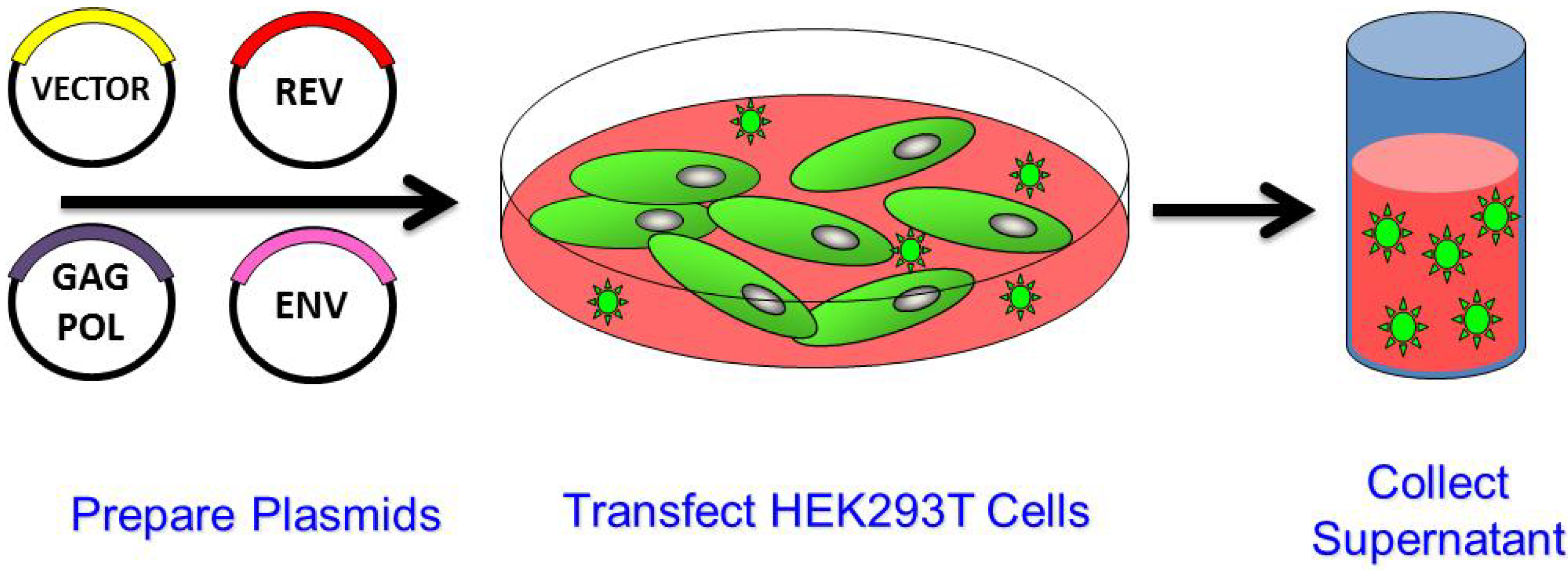
LVs are generated by introducing the transgene and packaging plasmids into cells, most commonly HEK293T cells (Figure 2). Vector supernatant is collected from the media and typically contains between 105 and 107 infectious units per milliliter. This is dependent on the vector design as the addition or deletion of elements to vector design can affect vector titer. LV can be concentrated by ultracentrifugation and clinical vector products are usually purified using a combination of chromatography, tangential flow filtration and diafiltration [34,35,36].
In order to effectively transduce a target cell, both integrating and non-integrating lentiviral vectors (NILV) must retain the ability to readily enter the cell, form a pre-integration complex, be transported into the nucleus and efficiently express its genetic payload. Depending on the envelope pseudotype used the membrane bound LV particles enter cells either by direct fusion with the plasma membrane [2] or via a receptor-mediated endosomal pathway [20]. In the direct fusion pathway the LV is uncoated upon entry to release the viral contents into the cytoplasm. This allows for reverse transcription of the viral RNA into linear cDNA and development of the pre-integration complex (PIC). The PIC consists of the reverse transcribed viral cDNA complexed with integrase, matrix, reverse transcriptase, and nucleocapsid proteins [37,38,39,40]. The endosomal pathway is dependent upon the pH within the endosome for membrane fusion, subsequent uncoating, and PIC formation within the cytoplasm. The transportation of the PIC to the nucleus is not completely understood, but is believed to occur by an ATP-dependent process [41] via nucleoporins [42,43] using nuclear localization signals and cellular transport mechanisms [44]. Certain of the known localization signals have been removed during LV design; nevertheless, the transduction of quiescent cells by LV is well documented.
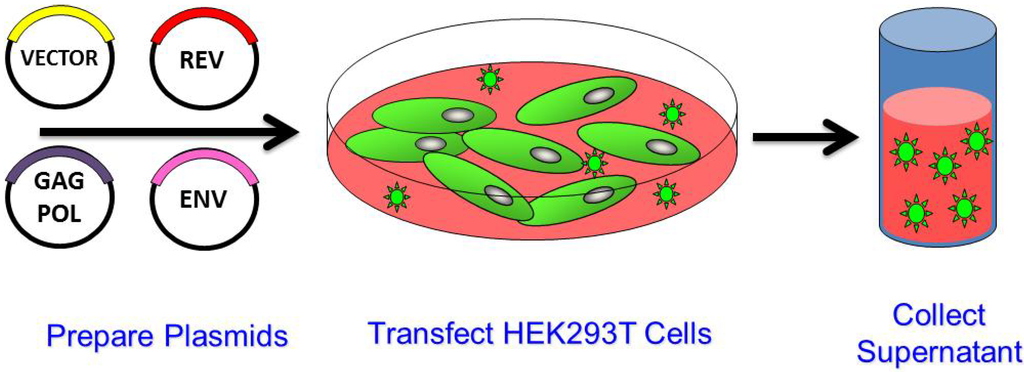
Figure 2.
Generation of Lentiviral Vector by Transient Transfection. The four packaging plasmids are transfected into cells that have a high capacity for vector production. The most commonly used cell line is HEK293T. Maximal vector production occurs 48–72 h after transfection. The vector particles are released into the media which is collected and clarified of cell debris. Vector particles can be further purified and/or concentrated.
Figure 2.
Generation of Lentiviral Vector by Transient Transfection. The four packaging plasmids are transfected into cells that have a high capacity for vector production. The most commonly used cell line is HEK293T. Maximal vector production occurs 48–72 h after transfection. The vector particles are released into the media which is collected and clarified of cell debris. Vector particles can be further purified and/or concentrated.
Understanding the processing of the LV cDNA after reverse transcription is important when designing NILV. Normally the linear LV cDNA generated during reverse transcription enters the nucleus with the linear 2-LTR form [45] representing the preferred substrate for integration [46,47]. A small portion of LV genomes can persist episomally as linear cDNA, 2-LTR circular forms or 1-LTR circular forms. The majority of 2-LTR circles are formed through non-homologous end-joining of the 5' and 3' LTRs [46,48,49]. The majority of 1-LTR circles are formed by homologous recombination between the LTRs [49,50,51,52,53,54], as an aberrant product of incomplete reverse transcription [55,56,57,58,59], or through alternative mechanisms such as autointegration [60]. It is these episomal forms that allow for the stable expression of the vector transgene without integration in non-dividing cells [61,62,63,64].
2. Designing Non-Integrating Lentiviral Vectors
2.1. Inhibiting Integration/Developing NILV
When designing NILV it is important that modifications maintain the vectors ability to enter their target cells, perform reverse transcription, transport the PIC into the nucleus and efficiently express their transgene product. This entails selectively inhibiting or altering only the aspects of the vectors lifecycle that lead to integration. As integrase-mediated catalysis is the primary means of integration for LV, the inhibition of its function is necessary in the development of NILV.
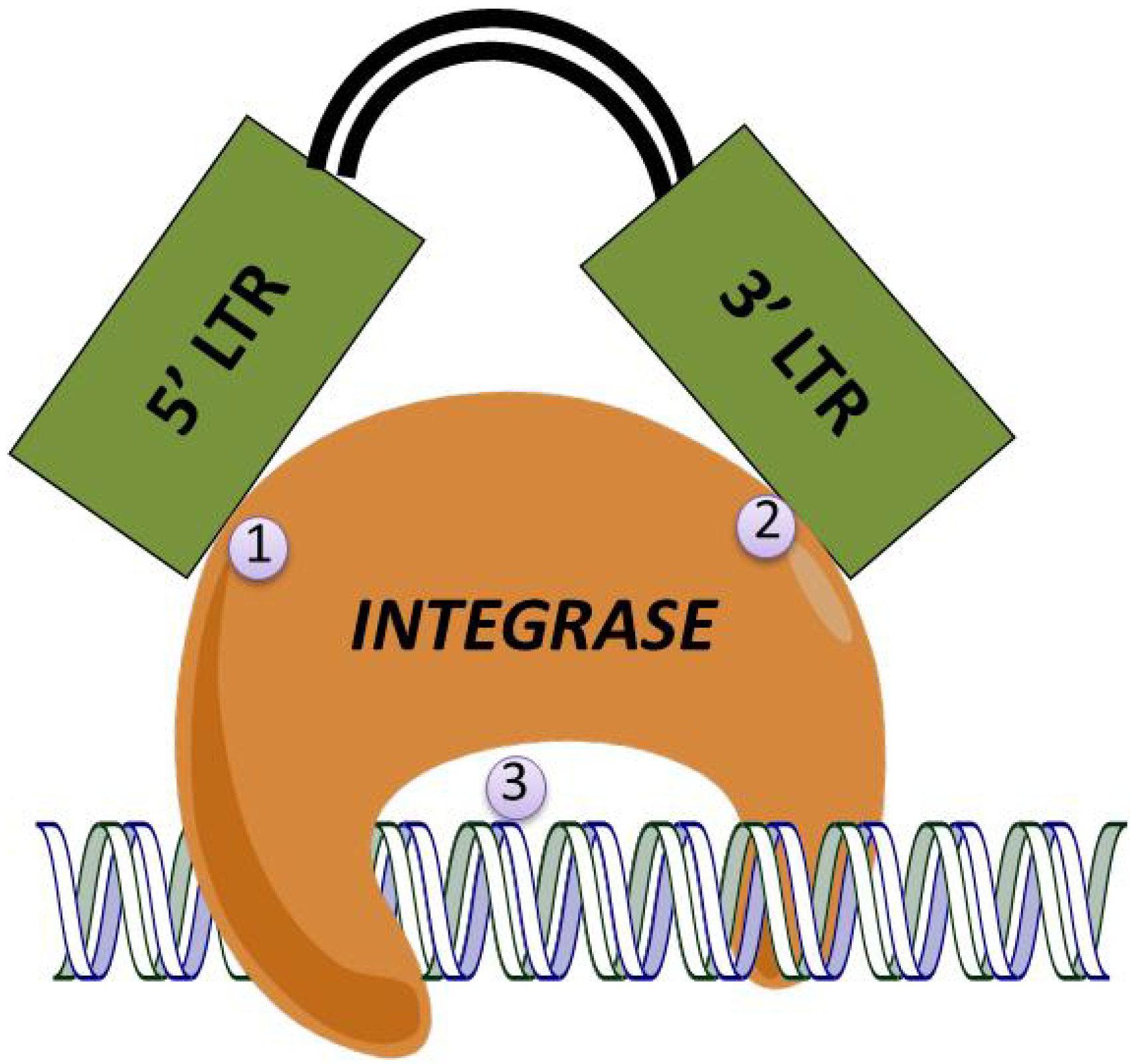
Normally, integration into the target cell’s genome is mediated by the viral integrase. This protein first binds to the viral cDNA at attachment sites located within the U3 region of the 5' LTR and the U5 region of the 3' LTR [65,66,67,68]. Integrase processes the 3' ends of the viral cDNA leaving a CA dinucleotide overhang [69,70] and then attaches the recessed ends to the 5' phosphorylated ends of a double-stranded cut made in the target genome. Integrase then repairs the gaps resulting in a 5 base-pair repeat flanking the inserted vector genome [70,71]. Figure 3 shows the three general points that can be targeted in developing a NILV; mutations in the integrase protein that alter its ability to process the target cell chromosomal DNA or alteration in the vector LTRs that prevent integrase from attaching to the 5' or 3' LTR.
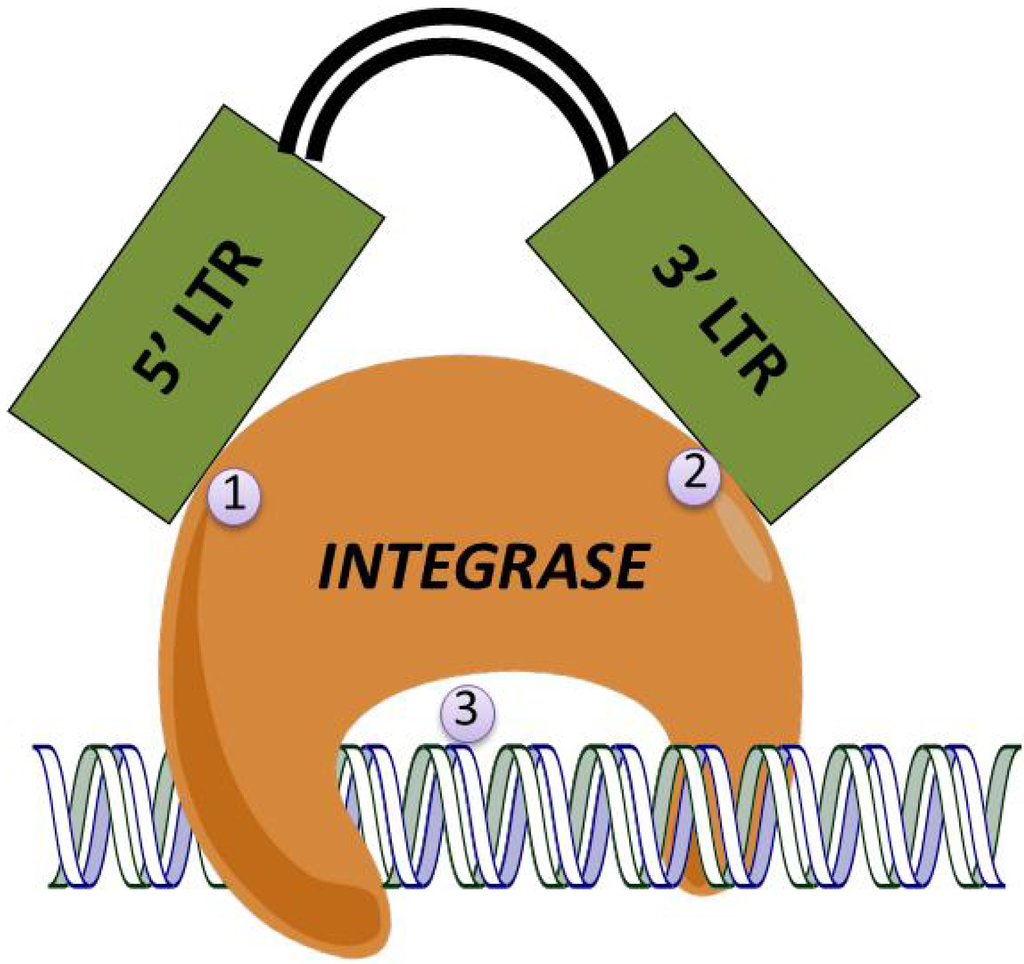
Figure 3.
Targets for Creation of Non-Integrating Lentiviral Vectors. Three strategies have been devised to generate non-integrating vectors. Mutations are generated in (1) a 12 base-pair region of the U3 region of the 5' LTR; (2) an 11 base-pair region of the U5 region of the vector’s 3' LTR; or (3) point mutations in the integrase protein that interfere with processing of the vector DNA. This depiction is simplified as integrase and the vector DNA are part of a complex of proteins.
Figure 3.
Targets for Creation of Non-Integrating Lentiviral Vectors. Three strategies have been devised to generate non-integrating vectors. Mutations are generated in (1) a 12 base-pair region of the U3 region of the 5' LTR; (2) an 11 base-pair region of the U5 region of the vector’s 3' LTR; or (3) point mutations in the integrase protein that interfere with processing of the vector DNA. This depiction is simplified as integrase and the vector DNA are part of a complex of proteins.
The most common target for inhibiting viral integration is mutation of the integrase protein producing integrase-defective lentiviral vectors. LV integrase is coded for by the HIV-1 Pol region and the region cannot be deleted as it encodes other critical activities including reverse transcription, nuclear import, and viral particle assembly [72,73]. Mutations in pol that alter the integrase protein fall into one of two classes: those which selectively affect only integrase activity (Class I); or those that have pleiotropic effects (Class II) [74]. Mutations throughout the N and C terminals and the catalytic core region of the integrase protein generate Class II mutations that affect multiple functions including particle formation and reverse transcription [74,75,76]. However, class II mutations are not suitable when designing NILVs because they disrupt functions that are critical for vector processing and expression.
Class I mutations limit their affect to the catalytic activities, DNA binding, linear episome processing and multimerization of integrase [77]. The most common Class I mutation sites are a triad of residues at the catalytic core of integrase, including D64, D116, and E152 [78,79]. Each mutation has been shown to efficiently inhibit integration with a frequency of integration up to four logs below that of normal integrating vectors while maintaining transgene expression of the NILV [61,80,81].
Another alternative method for inhibiting integration is mutations in the integrase DNA attachment site (LTR att sites) within a 12 base-pair region of the U3 or an 11 base-pair region of the U5 regions at the terminal ends of the 5' and 3' LTRs, respectively [61,68,80,82,83]. These sequences include the conserved terminal CA dinucleotide which is exposed following integrase-mediated end-processing. Single or double mutations at the conserved CA/TG dinucleotide result in up to a three to four log reduction in integration frequency [80]; however, it retains all other necessary functions for efficient viral transduction.
2.2. Minimizing Illegitimate Integration
While NILV can significantly reduce the frequency of integration there still remains a low level of vector integration [61,62,80,81,84,85,86,87,88,89]. Integration associated with NILV has been studied using insertion site analysis and high-throughput sequencing. These analyses indicate that the integration observed is not integrase-mediated as the insertion sites lack the canonical features of LTR end-processing including the five base-pair repeat of genomic DNA flanking at the site of vector insertion [80,85,88,90,91]. The vector inserts also vary with some containing fully intact sequence, truncations at the terminal ends of the LTRs, or insertions/deletions of genomic DNA flanking the vector. A significant number of these illegitimate integrations are occurring at sites of chromosomal breakage and are mediated by non-homologous end-joining mechanisms [90,92]. It may be possible to impede illegitimate integration of NILV by inhibition of cellular factors in the double-strand break (DSB) repair pathway. In a recent study by Koyama and colleagues, introduction of an ataxia telangiectasia mutated specific inhibitor (KU55933) consistently blocked DSB-specific integration in wild-type and integrase deficient LV [90]. Whether or not inhibitors to DNA repair can be used clinically to limit non-integrase mediated integration remains to be determined.
Another method for further reducing the frequency of illegitimate integration is limiting the linear form of the vector DNA. Linear DNA has been shown to integrate much more efficiently than supercoiled DNA [46,47]. The linear form also appears to be the preferred substrate for both integrase and non-integrase-mediated insertion. One approach has been to limit linear 2-LTR episomal forms by inducing the formation of circular episomal forms. For example, Kantor and colleagues have shown that deleting the vectors 3' polypurine tract (PPT) results in aberrant reverse transcription leading to the preferential formation of 1-LTR circular episomes and a reduction in linear forms [58]. Using this strategy they were able to reduce the frequency of integration by 10-fold when using an integrating vector. Of relevance to NILV, this modification reduced the frequency of integration of an integrase deficient LV by another 3-fold over integrase deficient LV without the modification. As newer modifications are developed to reduce integration they will need to be tested experimentally to ensure there is no reduction in the level of transgene expression.
It should be noted that LTR att site mutations have been directly compared to point mutations in integrase. The consensus is that mutations to integrase provide a greater reduction in the frequency of integration. Yanez-Munoz et al. estimated the frequency of reversion mutations in NILV to reach 1/815 [89]. The point mutations to LTR att sites could carry a higher rate of reversions but whether LTR att site mutations with larger deletions will reduce the frequency of illegitimate integration remains to be determined. Interestingly, while mutations to integrase and the LTR att sites independently inhibit integration efficiently, some studies suggest there are no synergistic effects upon combining these mutations to further reduce integration by a vector [61,80].
2.3. Optimization of NILV Expression
NILV are associated with a significantly reduced level of transgene expression as compared to a normal integrating LV [16,58,61,62,64,84,87,93,94,95]. This remains a key issue in developing clinically effective NILV. One approach to improve expression would be the introduction of stronger promoter or enhancer elements; but this approach may alter their safety profile by increasing the chance of insertional mutagenesis for NILV that are incorporated into cellular genomes through illegitimate integration [14,15,96,97,98,99,100]. Several studies now show that vectors with less potent enhancer or promoter elements do have an improved safety profile [101,102,103,104,105,106].
A second approach is removing or reducing inhibitors to episomal transgene expression. Bayer et al. have shown that removal of cis-acting sequences within the U3 region of the vectors LTR improves episomal transgene expression by nearly 3-fold [64]. However, other mechanisms of episomal inhibition may be involved because expression was still below that of the normal, integrating LV control.
A third approach to improved expression is the inhibition of cellular restriction factors. Utilizing the simian immunodeficiency virus auxiliary protein Vpx enabled the inhibition of the myeloid-lineage specific protein SAMHD1. SAMHD1 restricts an early step in the viral life cycle and inhibiting this protein greatly improves the transduction of human and simian myeloid cells [107,108,109,110]. Furthermore, applying this inhibition in conjunction with integrase deficient LV preparations was able to improve episomal expression to levels observed with normal integrating LV [111,112]. Other approaches for improving transgene expression include codon optimization to improve protein production and potency [113,114] and the use of histone deacetylase inhibitors for transgene activation [115].
Combining modifications that increasing transgene expression and reduce integration will be needed to maximize the safety profile of NILV. If expression is low, a higher number of NILV will be required per cell to obtain the therapeutic benefit. The higher numbers of vector episomes will in turn increase the chance of illegitimate integration. For certain gene therapy trials, such as those using ex vivo gene transfer of CD34+ hematopoietic cells, the number of cells treated may exceed 5 × 10⁸ cells for an adult. Even with a four log reduction in integration, a significant number of cells will contain integrated proviruses. Therefore efforts to minimize integration and optimizing expression should be considered for both therapeutic and safety reasons.
3. Prospects and Applications
Several modifications have been researched to improve the safety and utility of NILV for future clinical applications. These improvements facilitate the development of NILV for the treatment of genetic diseases, infectious diseases, and as important mediators of cell reprogramming. NILV are being developed for clinical applications where integration is not required in order to minimize the risk of genotoxicity by insertional mutagenesis. They also are of interest where transient expression is preferred over sustained gene expression. These applications include vaccinations, cell-type and lineage differentiation, as donor templates for homologous recombination in site-directed integration systems, and as delivery systems for cytotoxic cancer therapies. NILV are also being considered for gene transfer into slowly growing or non-dividing tissues where persistent episomal expression can provide a long-lasting therapeutic effect. An overview of vector components for many of these applications is provided in Table 1.

Table 1.
Summary of elements included in non-integrating lentiviral vectors (NILV) design. The far right column categorizes the applications depending on the intended purpose. The column of NILV Modifications provides the integrase mutations or Δatt (LTR integrase attachment site mutation) used to inhibit integration. Other components of the vector systems are provided in subsequent columns. Abbreviations: iPS, induced pluripotent stem (cell); VSV-G, Vesicular Stomatitis Virus glycoprotein (IND and NJ serotypes if specified); HCV-E1E2-G, Hepatitis C Virus E1E2 glycoproteins; SVGmu, Sindbis virus envelope glycoprotein; ampho MLV, amphotrophic murine leukemia virus; GP64, baculoviral-derived glycoprotein; hAAT, liver specific promoter human α1-antitrypsin; PGK, phosphoglycerate kinase; EF1α, eukaryotic translation elongation factor 1 alpha 1; EFS, short; SV40, simian virus 40 promoter; APOA-II, human liver-specific promoter Apolipoprotein A-II; ET, hepatocyte-specific chimeric promoter; SFFV, Spleen Focus-Forming Virus; CMV, Cytomegalovirus.
| NILV Modification | Disease/Application | Envelope | Promoter | Transgene/Effector | Target | Ref. | |
|---|---|---|---|---|---|---|---|
| Vaccinations | D64V | West Nile Virus | VSV-G | CMV | West Nile Virus Envelope | Dendritic Cells | [93] |
| D64V | Malaria | VSV-G IND or NJ & Cocal Virus-G | CMV | Plasmodium yoelii Circumsporozoite Protein codon optimized | Dendritic Cells | [116] | |
| D64E | Hepatitis C Virus | HCV-E1E2-G | CMV | Hepatitis C Virus NS3 gene | Antigen Presenting Cells | [117] | |
| D116N | Human Papillomavirus | VSV-G | CMV | Human Papillomavirus 16 E7-Calreticulin fusion | Antigen Presenting Cells | [118] | |
| D64V | Thymoma | SVGmu | Ubiquitin-C | Ovalbumin, melanoma antigen hgp100 and HIV-1 subtype B gag | Dendritic Cells | [119] | |
| D64V, N120L, W235E & Δatt | Hepatitis B Virus | VSV-G | SFFV | Hepatitis B Virus surface antigen | Dendritic Cells | [120] | |
| D116N | Human Immunodeficiency Virus type 1 | VSV-G | CMV | HIV-1 JR-FL gp120 codon optimized | Antigen Presenting Cells | [114] | |
| Cell-Type Differentiation | D64V | Purification of hESC derived progenitors | VSV-G | APOA-II | Green Fluorescence Protein | Hepatic Progenitors | [121] |
| D64V | iPS Cell production | VSV-G | EF1α | OCT4, SOX2, NANOG, LIN28, n-Myc and SV40 Large T Antigen | Fibroblasts | [122] | |
| D64N & D116N | iPS Cell transgene excision | VSV-G | CMV | Cre recombinase | iPS Cells | [123] | |
| Site-Directed Integration | D64V | Retargetting HIV-1 | ampho MLV | SV40 | Integrase- E. coli LexA repressor fusion protein | E. coli LexA recognition sites | [124] |
| D64V | Directed Integration | VSV-G | SV40 | Integrase-Designed Polydactyl Zinc Finger Protein E2C fusion protein | E2C-recognition sequence | [125] | |
| D64V | Directed Integration | VSV-G | PGK | Yeast Flpx9 recombinase | Flp-recognition sites | [126] | |
| D64V | Transposon mediated random integration | VSV-G | CMV, SFFV & SV40 | Sleeping Beauty Transposase/Transposase Expression Cassette | Random Integration | [127] | |
| D64V | Homologous recombination mediated gene modification | VSV-G | N/A | Calmegin targeting cassette | Calmegin (clgn) gene | [128] | |
| K264E, F185A, D116A, D64A & H12A | Site-directed homologous recombination | VSV-G | CMV | I-SceI Nuclease/Homologous recombination repair matrix | I-SceI nuclease binding site | [84] | |
| D64V | Site-specific integration | VSV-G | PGK & SFFV | Zinc Finger Nuclease/ZFN donor template | ZFN-target site at IL2RG | [129] | |
| D64V | “Safe-site”-specific integration | VSV-G | SFFV, PGK & EF1α | Zinc Finger Nuclease/ZFN donor template-GFP expression cassette | CCR5 and AAVS1 loci | [130] | |
| D64V | Site-specific gene modification | VSV-G | EFS | Zinc Finger Nuclease/ZFN donor template | Adenosine Deaminase Locus | [131] | |
| D64V | Site-specific gene modification | VSV-G | CMV | Transcription Activator-Like Effector Nucleases/TALEN donor template | COL7A1 gene | [132] | |
| Persistent Episomal Expression | D64V, N120L, W235E, Q148A, K264R & Δatt | Stable gene transfer to muscle | VSV-G | SFFV | Green Fluorescence Protein | Muscle Tissue | [61] |
| D64E | Stable gene transfer to liver and brain | VSV-G | CMV & hAAT | Green Fluorescence Protein/Luciferase | Brain & Liver Tissue | [64] | |
| D64V | Stable gene transfer to liver | VSV-G | PGK & ET | Green Fluorescence Protein/Factor IX cDNA | Hepatocytes | [91] | |
| D64V | Stable gene transfer to liver | VSV-G | ET | Hyperfunctional coagulation factor IX | Hepatocytes | [133] | |
| D64V | Stable gene transfer to retina and brain | VSV-G | CMV & SFFV | Green Fluorescence Protein | Ocular & Brain Tissue | [89] | |
| D64E | Stable gene transfer to brain | VSV-G | CMV | Green Fluorescence Protein/Luciferase | Brain Tissue | [58] | |
| N region RRK motif to AAH | Stable gene transfer to brain | VSV-G | CMV | Green Fluorescence Protein | Neural cells | [62] | |
| D64V | Stable gene transfer to central nervous system | VSV-G, GP64 & Rabies-G | SFFV | Green Fluorescence Protein | Brain and Spinal Cord | [63] | |
| D64V | Stable gene transfer to spinal cord | VSV-G & Rabies-G | CMV | Green Fluorescence Protein | Spinal Cord | [134] |
Vaccination is an application where only transient expression is required and NILVs have been shown to stimulate an efficient and sustained immune response [112,119,135,136]. Preclinical studies of NILVs have demonstrated immune responses against human papillomavirus (HPV), malaria, HIV-1 and the hepatitis B and C viruses [93,114,116,117,118,120] thus showing their potential for use in vaccine development.
One application where transient expression is preferred over sustained expression is in cell reprogramming. This includes creation of induced pluripotent stem (iPS) cells and differentiation of iPS or embryonic stem (ES) cells into a lineage of interest. While somatic cells have been successfully reprogrammed into iPS cells using integrating vectors [137], the factors for inducing pluripotency are not necessary beyond initial reprogramming and constitutive expression of the factors has been shown to be harmful [137,138,139,140]. Continued expression can be oncogenic [140] and can also affect differentiation of iPS cells into other lineages [141]. Transgene free iPS cells have been produced using integrating LV followed by excision with NILVs after reprogramming [123] as well as by transient expression using both non-integrating adenoviral vectors [142,143] and NILV [122]. NILV have also been successful in differentiating ES cells into specific progenitors [121].
Another promising application for NILV is their use as templates for site-directed integration systems. A variety of systems are available that can direct integration to genomic “safe loci” or by altering the integration pattern to avoid transcriptional units with the hope of minimizing gene dysregulation. Integration can be directed to sequence-specific motifs in less intragenic regions by combining NILVs with an integrase protein fused to a DNA-binding protein such as the E. coli LexA repressor [124,144,145] or a synthetic polydactyl zinc finger protein E2C [125]. Another approach is combining recombinases or transposases transiently with NILV to facilitate integration at specific sites [126,127,146]. Third, NILVs can be designed to promote site specific homologous recombination (HR) [128]. Taking this a step farther, others have combined NILV with a rare cutting nuclease for targeted recombination at specific sites by HR [84]. Still others have used NILV as templates for HR along with engineered zinc finger nucleases (ZFNs) or transcription activator-like effector nucleases (TALENs) [129,130,131,132]. Increasing clinical utility is expected as these systems are optimized to reduce off-target integrations and increase the efficiency of delivery.
NILV have potential utility in cytotoxic cancer therapies. One approach takes advantage of abnormal expression levels of miRNA which are found in many tumor types [147]. In vitro and in vivo studies have shown miRNAs to have antitumorigenic properties [148]. Recent studies have shown the utility of non-integrating adeno-associated virus in suppressing tumor growth in lung [149,150] and liver cancers [151,152]. Non-integrating vectors offer the advantage of minimizing effects from transgene expression in normal cells. This targeting of miRNA provides the backdrop for developing NILV for similar applications.
While there are many applications for transient expression of NILV, there is also great promise in their utilization for persistent episomal expression in non-proliferating post-mitotic cells. In this regard, NILV have been found to successfully provide long-lasting in vivo expression in several organs. Injections of integrase deficient LV and att site mutant NILV into mouse muscle were found to provide levels of transgene expression similar to wild-type LV for up three months post-transduction [61]. NILV have also been used to transduce the liver resulting in stable transgene expression for up to six months [64] and could provide therapeutic levels of transgene expression [91,133]. The retina transduced with NILVs has been shown to provide transgene expression for up to nine months in mice [89]. NILV were used to successfully transduce the brain and spinal cord allowing for efficient transgene expression from 2 weeks up to 4 months post-transduction [58,62,63,89,134].
4. Conclusions
A growing number of studies are demonstrating the potential utility of NILV in human gene therapy. Point mutations in integrase or the LTR att sites greatly reduce integration, and additional modifications to the vector or the target cell can further decrease illegitimate integration. Importantly, there have been a number of key studies that have optimized the expression of NILV. While further improvements are being evaluated, the current tools available are suitable for clinical use, and human trials could be conducted in the near future.
Acknowledgments
The authors thank Scott Witting for helpful comments on the manuscript. KC is principle investigator of the NCRR National Gene Vector Biorepository (P40 RR024928). Graduate studies for AS are supported by the Joe and Shirley Christian Scholarship Fund.
Conflicts of Interest
KC is the founder of Rimedion Inc. which seeks to develop gene therapy products for clinical use; he is not employed by the company and there is no conflict with this work.
References
- Cronin, J.; Zhang, X.Y.; Reiser, J. Altering the tropism of lentiviral vectors through pseudotyping. Curr. Gene Ther. 2005, 5, 387–398. [Google Scholar] [CrossRef]
- Clapham, P.R.; McKnight, A. Cell surface receptors, virus entry and tropism of primate lentiviruses. J. Gen. Virol. 2002, 83, 1809–1829. [Google Scholar]
- Kumar, M.; Keller, B.; Makalou, N.; Sutton, R.E. Systematic determination of the packaging limit of lentiviral vectors. Hum. Gene Ther. 2001, 12, 1893–1905. [Google Scholar] [CrossRef]
- Sinn, P.L.; Sauter, S.L.; McCray, P.B., Jr. Gene therapy progress and prospects: Development of improved lentiviral and retroviral vectors—Design, biosafety, and production. Gene Ther. 2005, 12, 1089–1098. [Google Scholar] [CrossRef]
- Wanisch, K.; Yanez-Munoz, R.J. Integration-deficient lentiviral vectors: A slow coming of age. Mol. Ther. 2009, 17, 1316–1332. [Google Scholar] [CrossRef]
- Blomer, U.; Naldini, L.; Kafri, T.; Trono, D.; Verma, I.M.; Gage, F.H. Highly efficient and sustained gene transfer in adult neurons with a lentivirus vector. J. Virol. 1997, 71, 6641–6649. [Google Scholar]
- Abordo-Adesida, E.; Follenzi, A.; Barcia, C.; Sciascia, S.; Castro, M.G.; Naldini, L.; Lowenstein, P.R. Stability of lentiviral vector-mediated transgene expression in the brain in the presence of systemic antivector immune responses. Hum. Gene Ther. 2005, 16, 741–751. [Google Scholar] [CrossRef]
- Bischof, D.; Cornetta, K. Detection of replication competent retrovirus and lentivirus. In Methods in Molecular Biology: Genetic Modification of Hematopoietic Stem Cells: Methods and Protocols; Baum, C., Ed.; Humana Press, Inc.: Totowa, NJ, USA, 2008; pp. 243–263. [Google Scholar]
- Cavazzana-Calvo, M.; Payen, E.; Negre, O.; Wang, G.; Hehir, K.; Fusil, F.; Down, J.; Denaro, M.; Brady, T.; Westerman, K.; et al. Transfusion independence and HMGA2 activation after gene therapy of human beta-thalassaemia. Nature 2010, 467, 318–322. [Google Scholar] [CrossRef]
- Aiuti, A.; Biasco, L.; Scaramuzza, S.; Ferrua, F.; Cicalese, M.P.; Baricordi, C.; Dionisio, F.; Calabria, A.; Giannelli, S.; Castiello, M.C.; et al. Lentiviral hematopoietic stem cell gene therapy in patients with Wiskott-Aldrich syndrome. Science 2013, 341. [Google Scholar] [CrossRef]
- Biffi, A.; Montini, E.; Lorioli, L.; Cesani, M.; Fumagalli, F.; Plati, T.; Baldoli, C.; Martino, S.; Calabria, A.; Canale, S.; et al. Lentiviral hematopoietic stem cell gene therapy benefits metachromatic leukodystrophy. Science 2013, 341. [Google Scholar] [CrossRef]
- Cartier, N.; Hacein-Bey-Abina, S.; Bartholomae, C.C.; Veres, G.; Schmidt, M.; Kutschera, I.; Vidaud, M.; Abel, U.; Dal-Cortivo, L.; Caccavelli, L.; et al. Hematopoietic stem cell gene therapy with a lentiviral vector in X-linked adrenoleukodystrophy. Science 2009, 326, 818–823. [Google Scholar] [CrossRef]
- Porter, D.L.; Levine, B.L.; Kalos, M.; Bagg, A.; June, C.H. Chimeric antigen receptor-modified T cells in chronic lymphoid leukemia. N. Engl. J. Med. 2011, 365, 725–733. [Google Scholar] [CrossRef]
- Hacein-Bey-Abina, S.; von Kalle, C.; Schmidt, M.; Le Deist, F.; Wulffraat, N.; McIntyre, E.; Radford, I.; Villeval, J.L.; Fraser, C.C.; Cavazzana-Calvo, M.; et al. A serious adverse event after successful gene therapy for X-linked severe combined immunodeficiency. N. Engl. J. Med. 2003, 348, 255–256. [Google Scholar] [CrossRef]
- Stein, S.; Ott, M.G.; Schultze-Strasser, S.; Jauch, A.; Burwinkel, B.; Kinner, A.; Schmidt, M.; Kramer, A.; Schwable, J.; Glimm, H.; et al. Genomic instability and myelodysplasia with monosomy 7 consequent to EVI1 activation after gene therapy for chronic granulomatous disease. Nat. Med. 2010, 16, 198–204. [Google Scholar] [CrossRef]
- Naldini, L.; Blomer, U.; Gallay, P.; Ory, D.; Mulligan, R.; Gage, F.H.; Verma, I.M.; Trono, D. In vivo gene delivery and stable transduction of nondividing cells by a lentiviral vector. Science 1996, 272, 263–267. [Google Scholar]
- Zufferey, R.; Dull, T.; Mandel, R.J.; Bukovsky, A.; Quiroz, D.; Naldini, L.; Trono, D. Self-inactivating lentivirus vector for safe and efficient in vivo gene delivery. J. Virol. 1998, 72, 9873–9880. [Google Scholar]
- Zufferey, R.; Nagy, D.; Mandel, R.J.; Naldini, L.; Trono, D. Multiply attenuated lentiviral vector achieves efficient gene delivery in vivo. Nat. Biotechnol. 1997, 15, 871–875. [Google Scholar] [CrossRef]
- Dull, T.; Zufferey, R.; Kelly, M.; Mandel, R.J.; Nguyen, M.; Trono, D.; Naldini, L. A third-generation lentivirus vector with a conditional packaging system. J. Virol. 1998, 72, 8463–8471. [Google Scholar]
- Aiken, C. Pseudotyping human immunodeficiency virus type 1 (HIV-1) by the glycoprotein of vesicular stomatitis virus targets HIV-1 entry to an endocytic pathway and suppresses both the requirement for Nef and the sensitivity to cyclosporin A. J. Virol. 1997, 71, 5871–5877. [Google Scholar]
- Braaten, D.; Luban, J. Cyclophilin A regulates HIV-1 infectivity, as demonstrated by gene targeting in human T cells. EMBO J. 2001, 20, 1300–1309. [Google Scholar] [CrossRef]
- Franke, E.K.; Yuan, H.E.; Luban, J. Specific incorporation of cyclophilin A into HIV-1 virions. Nature 1994, 372, 359–362. [Google Scholar] [CrossRef]
- Luban, J. Human immunodeficiency virus type 1 gag protein binds to cyclophilin A and B. Cell 1993, 73, 1067–1078. [Google Scholar] [CrossRef]
- Luban, J. Absconding with the chaperone: Essential cyclophilin-Gag interaction in HIV-1 virions. Cell 1996, 87, 1157–1159. [Google Scholar] [CrossRef]
- Zhang, S.; Joseph, G.; Pollok, K.; Berthoux, L.; Sastry, L.; Luban, J.; Cornetta, K. The role of cyclophilin A and G2 cell cycle arrest in lentiviral gene transfer. Mol. Ther. 2006, 14, 546–554. [Google Scholar] [CrossRef]
- Kalpana, G.V.; Marmon, S.; Wang, W.; Crabtree, G.R.; Goff, S.P. Binding and stimulation of HIV-1 integrase by a human homolog of yeast transcription factor SNF5. Science 1994, 266, 2002–2006. [Google Scholar]
- Yung, E.; Sorin, M.; Pal, A.; Craig, E.; Morozov, A.; Delattre, O.; Kappes, J.; Ott, D.; Kalpana, G.V. Inhibition of HIV-1 virion production by a transdominant mutant of integrase interactor 1. Nat. Med. 2001, 7, 920–926. [Google Scholar] [CrossRef]
- Yung, E.; Sorin, M.; Wang, E.J.; Perumal, S.; Ott, D.; Kalpana, G.V. Specificity of interaction of INI1/hSNF5 with retroviral integrases and its functional significance. J. Virol. 2004, 78, 2222–2231. [Google Scholar] [CrossRef]
- Barry, S.C.; Harder, B.; Brzezinski, M.; Flint, L.Y.; Seppen, J.; Osborne, W.R. Lentivirus vectors encoding both central polypurine tract and posttranscriptional regulatory element provide enhanced transduction and transgene expression. Hum. Gene Ther. 2001, 12, 1103–1108. [Google Scholar] [CrossRef]
- Van Maele, B.; de Rijck, J.; de Clercq, E.; Debyser, Z. Impact of the central polypurine tract on the kinetics of human immunodeficiency virus type 1 vector transduction. J. Virol. 2003, 77, 4685–4694. [Google Scholar] [CrossRef]
- Zufferey, R.; Donello, J.E.; Trono, D.; Hope, T.J. Woodchuck hepatitis virus posttranscriptional regulatory element enhances expression of transgenes delivered by retroviral vectors. J. Virol. 1999, 73, 2886–2892. [Google Scholar]
- Dupuy, F.P.; Mouly, E.; Mesel-Lemoine, M.; Morel, C.; Abriol, J.; Cherai, M.; Baillou, C.; Negre, D.; Cosset, F.L.; Klatzmann, D.; et al. Lentiviral transduction of human hematopoietic cells by HIV-1- and SIV-based vectors containing a bicistronic cassette driven by various internal promoters. J. Gene Med. 2005, 7, 1158–1171. [Google Scholar] [CrossRef]
- Miyoshi, H.; Blomer, U.; Takahashi, M.; Gage, F.H.; Verma, I.M. Development of a self-inactivating lentivirus vector. J. Virol. 1998, 72, 8150–8157. [Google Scholar]
- Leath, A.; Cornetta, K. Developing novel lentiviral vectors into clinical products. Methods Enzymol. 2012, 507, 89–108. [Google Scholar] [CrossRef]
- Slepushkin, V.; Chang, N.; Cohen, R.; Gan, Y.; Jiang, B.; Deausen, E.; Berlinger, D.; Binder, G.; Andre, K.; Humeau, L.; et al. Large-scale purification of a lentiviral vector by size exclusion chromatography or mustang Q ion exchange capsule. Bioprocess. J. 2003, Sept./Oct., 89–95. [Google Scholar]
- Merten, O.; Charrier, S.; Laroudie, N.; Fauchille, S.; Dugue, C.; Jenny, C.; Audit, M.; Zanta-Boussif, M.; Chautard, H.; Radrizzani, M.; et al. Large scale manufacture and characterisation of a lentiviral vector produced for clinical ex vivo gene therapy application. Hum. Gene Ther. 2011, 22, 343–356. [Google Scholar] [CrossRef]
- Fassati, A.; Goff, S.P. Characterization of intracellular reverse transcription complexes of human immunodeficiency virus type 1. J. Virol. 2001, 75, 3626–3635. [Google Scholar] [CrossRef]
- Farnet, C.M.; Haseltine, W.A. Determination of viral proteins present in the human immunodeficiency virus type 1 preintegration complex. J. Virol. 1991, 65, 1910–1915. [Google Scholar]
- Miller, M.D.; Farnet, C.M.; Bushman, F.D. Human immunodeficiency virus type 1 preintegration complexes: Studies of organization and composition. J. Virol. 1997, 71, 5382–5390. [Google Scholar]
- Bukrinsky, M.I.; Sharova, N.; McDonald, T.L.; Pushkarskaya, T.; Tarpley, W.G.; Stevenson, M. Association of integrase, matrix, and reverse transcriptase antigens of human immunodeficiency virus type 1 with viral nucleic acids following acute infection. Proc. Natl. Acad. Sci. USA 1993, 90, 6125–6129. [Google Scholar] [CrossRef]
- Bukrinsky, M.I.; Sharova, N.; Dempsey, M.P.; Stanwick, T.L.; Bukrinskaya, A.G.; Haggerty, S.; Stevenson, M. Active nuclear import of human immunodeficiency virus type 1 preintegration complexes. Proc. Natl. Acad. Sci. USA 1992, 89, 6580–6584. [Google Scholar] [CrossRef]
- De Rijck, J.; Vandekerckhove, L.; Christ, F.; Debyser, Z. Lentiviral nuclear import: A complex interplay between virus and host. BioEssays 2007, 29, 441–451. [Google Scholar] [CrossRef]
- Stevenson, M. Portals of entry: Uncovering HIV nuclear transport pathways. Trends Cell Biol. 1996, 6, 9–15. [Google Scholar] [CrossRef]
- Fassati, A. HIV infection of non-dividing cells: A divisive problem. Retrovirology 2006, 3, 74. [Google Scholar] [CrossRef]
- Chun, T.W.; Carruth, L.; Finzi, D.; Shen, X.; DiGiuseppe, J.A.; Taylor, H.; Hermankova, M.; Chadwick, K.; Margolick, J.; Quinn, T.C.; et al. Quantification of latent tissue reservoirs and total body viral load in HIV-1 infection. Nature 1997, 387, 183–188. [Google Scholar] [CrossRef]
- Li, L.; Olvera, J.M.; Yoder, K.E.; Mitchell, R.S.; Butler, S.L.; Lieber, M.; Martin, S.L.; Bushman, F.D. Role of the non-homologous DNA end joining pathway in the early steps of retroviral infection. EMBO J. 2001, 20, 3272–3281. [Google Scholar] [CrossRef]
- Folger, K.R.; Wong, E.A.; Wahl, G.; Capecchi, M.R. Patterns of integration of DNA microinjected into cultured mammalian cells: Evidence for homologous recombination between injected plasmid DNA molecules. Mol. Cell. Biol. 1982, 2, 1372–1387. [Google Scholar]
- Jeanson, L.; Subra, F.; Vaganay, S.; Hervy, M.; Marangoni, E.; Bourhis, J.; Mouscadet, J.F. Effect of Ku80 depletion on the preintegrative steps of HIV-1 replication in human cells. Virology 2002, 300, 100–108. [Google Scholar] [CrossRef]
- Kilzer, J.M.; Stracker, T.; Beitzel, B.; Meek, K.; Weitzman, M.; Bushman, F.D. Roles of host cell factors in circularization of retroviral dna. Virology 2003, 314, 460–467. [Google Scholar] [CrossRef]
- Farnet, C.M.; Haseltine, W.A. Circularization of human immunodeficiency virus type 1 DNA in vitro. J. Virol. 1991, 65, 6942–6952. [Google Scholar]
- Gianni, A.M.; Smotkin, D.; Weinberg, R.A. Murine leukemia virus: Detection of unintegrated double-stranded DNA forms of the provirus. Proc. Natl. Acad. Sci. USA 1975, 72, 447–451. [Google Scholar] [CrossRef]
- Jacque, J.M.; Stevenson, M. The inner-nuclear-envelope protein emerin regulates HIV-1 infectivity. Nature 2006, 441, 641–645. [Google Scholar] [CrossRef]
- Shank, P.R.; Hughes, S.H.; Kung, H.J.; Majors, J.E.; Quintrell, N.; Guntaka, R.V.; Bishop, J.M.; Varmus, H.E. Mapping unintegrated avian sarcoma virus DNA: Termini of linear DNA bear 300 nucleotides present once or twice in two species of circular DNA. Cell 1978, 15, 1383–1395. [Google Scholar] [CrossRef]
- Gilboa, E.; Mitra, S.W.; Goff, S.; Baltimore, D. A detailed model of reverse transcription and tests of crucial aspects. Cell 1979, 18, 93–100. [Google Scholar] [CrossRef]
- Klarmann, G.J.; Yu, H.; Chen, X.; Dougherty, J.P.; Preston, B.D. Discontinuous plus-strand DNA synthesis in human immunodeficiency virus type 1-infected cells and in a partially reconstituted cell-free system. J. Virol. 1997, 71, 9259–9269. [Google Scholar]
- Dina, D.; Benz, E.W., Jr. Structure of murine sarcoma virus DNA replicative intermediates synthesized in vitro. J. Virol. 1980, 33, 377–389. [Google Scholar]
- Junghans, R.P.; Boone, L.R.; Skalka, A.M. Products of reverse transcription in avian retrovirus analyzed by electron microscopy. J. Virol. 1982, 43, 544–554. [Google Scholar]
- Kantor, B.; Bayer, M.; Ma, H.; Samulski, J.; Li, C.; McCown, T.; Kafri, T. Notable reduction in illegitimate integration mediated by a PPT-deleted, nonintegrating lentiviral vector. Mol. Ther. 2011, 19, 547–556. [Google Scholar] [CrossRef]
- Ringold, G.M.; Yamamoto, K.R.; Shank, P.R.; Varmus, H.E. Mouse mammary tumor virus DNA in infected rat cells: Characterization of unintegrated forms. Cell 1977, 10, 19–26. [Google Scholar] [CrossRef]
- Shoemaker, C.; Goff, S.; Gilboa, E.; Paskind, M.; Mitra, S.W.; Baltimore, D. Structure of a cloned circular Moloney murine leukemia virus DNA molecule containing an inverted segment: Implications for retrovirus integration. Proc. Natl. Acad. Sci. USA 1980, 77, 3932–3936. [Google Scholar] [CrossRef]
- Apolonia, L.; Waddington, S.N.; Fernandes, C.; Ward, N.J.; Bouma, G.; Blundell, M.P.; Thrasher, A.J.; Collins, M.K.; Philpott, N.J. Stable gene transfer to muscle using non-integrating lentiviral vectors. Mol. Ther. 2007, 15, 1947–1954. [Google Scholar] [CrossRef]
- Philippe, S.; Sarkis, C.; Barkats, M.; Mammeri, H.; Ladroue, C.; Petit, C.; Mallet, J.; Serguera, C. Lentiviral vectors with a defective integrase allow efficient and sustained transgene expression in vitro and in vivo. Proc. Natl. Acad. Sci. USA 2006, 103, 17684–17689. [Google Scholar] [CrossRef]
- Rahim, A.A.; Wong, A.M.; Howe, S.J.; Buckley, S.M.; Acosta-Saltos, A.D.; Elston, K.E.; Ward, N.J.; Philpott, N.J.; Cooper, J.D.; Anderson, P.N.; et al. Efficient gene delivery to the adult and fetal CNS using pseudotyped non-integrating lentiviral vectors. Gene Ther. 2009, 16, 509–520. [Google Scholar]
- Bayer, M.; Kantor, B.; Cockrell, A.; Ma, H.; Zeithaml, B.; Li, X.; McCown, T.; Kafri, T. A large U3 deletion causes increased in vivo expression from a nonintegrating lentiviral vector. Mol. Ther. 2008, 16, 1968–1976. [Google Scholar] [CrossRef]
- Zhou, H.; Rainey, G.J.; Wong, S.K.; Coffin, J.M. Substrate sequence selection by retroviral integrase. J. Virol. 2001, 75, 1359–1370. [Google Scholar] [CrossRef]
- Hindmarsh, P.; Leis, J. Retroviral DNA integration. Microbiol. Mol. Biol. Rev. 1999, 63, 836–843. [Google Scholar]
- Kulkosky, J.; Skalka, A.M. Molecular mechanism of retroviral DNA integration. Pharmacol. Ther. 1994, 61, 185–203. [Google Scholar] [CrossRef]
- Masuda, T.; Kuroda, M.J.; Harada, S. Specific and independent recognition of U3 and U5 att sites by human immunodeficiency virus type 1 integrase in vivo. J. Virol. 1998, 72, 8396–8402. [Google Scholar]
- Craigie, R.; Fujiwara, T.; Bushman, F. The IN protein of Moloney murine leukemia virus processes the viral DNA ends and accomplishes their integration in vitro. Cell 1990, 62, 829–837. [Google Scholar] [CrossRef]
- Katz, R.A.; Merkel, G.; Kulkosky, J.; Leis, J.; Skalka, A.M. The avian retroviral IN protein is both necessary and sufficient for integrative recombination in vitro. Cell 1990, 63, 87–95. [Google Scholar] [CrossRef]
- Mizuuchi, K. Polynucleotidyl transfer reactions in transpositional DNA recombination. J. Biol. Chem. 1992, 267, 21273–21276. [Google Scholar]
- Zhu, K.; Dobard, C.; Chow, S.A. Requirement for integrase during reverse transcription of human immunodeficiency virus type 1 and the effect of cysteine mutations of integrase on its interactions with reverse transcriptase. J. Virol. 2004, 78, 5045–5055. [Google Scholar] [CrossRef]
- Gallay, P.; Hope, T.; Chin, D.; Trono, D. HIV-1 infection of nondividing cells through the recognition of integrase by the importin/karyopherin pathway. Proc. Natl. Acad. Sci. USA 1997, 94, 9825–9830. [Google Scholar] [CrossRef]
- Engelman, A. In vivo analysis of retroviral integrase structure and function. Adv. Virus Res. 1999, 52, 411–426. [Google Scholar] [CrossRef]
- Saenz, D.T.; Loewen, N.; Peretz, M.; Whitwam, T.; Barraza, R.; Howell, K.G.; Holmes, J.M.; Good, M.; Poeschla, E.M. Unintegrated lentivirus DNA persistence and accessibility to expression in nondividing cells: Analysis with class I integrase mutants. J. Virol. 2004, 78, 2906–2920. [Google Scholar] [CrossRef]
- Wiskerchen, M.; Muesing, M.A. Human immunodeficiency virus type 1 integrase: Effects of mutations on viral ability to integrate, direct viral gene expression from unintegrated viral DNA templates, and sustain viral propagation in primary cells. J. Virol. 1995, 69, 376–386. [Google Scholar]
- Banasik, M.B.; McCray, P.B., Jr. Integrase-defective lentiviral vectors: Progress and applications. Gene Ther. 2010, 17, 150–157. [Google Scholar] [CrossRef]
- Kulkosky, J.; Jones, K.S.; Katz, R.A.; Mack, J.P.; Skalka, A.M. Residues critical for retroviral integrative recombination in a region that is highly conserved among retroviral/retrotransposon integrases and bacterial insertion sequence transposases. Mol. Cell. Biol. 1992, 12, 2331–2338. [Google Scholar]
- Shibagaki, Y.; Chow, S.A. Central core domain of retroviral integrase is responsible for target site selection. J. Biol. Chem. 1997, 272, 8361–8369. [Google Scholar] [CrossRef]
- Nightingale, S.J.; Hollis, R.P.; Pepper, K.A.; Petersen, D.; Yu, X.J.; Yang, C.; Bahner, I.; Kohn, D.B. Transient gene expression by nonintegrating lentiviral vectors. Mol. Ther. 2006, 13, 1121–1132. [Google Scholar] [CrossRef]
- Leavitt, A.D.; Robles, G.; Alesandro, N.; Varmus, H.E. Human immunodeficiency virus type 1 integrase mutants retain in vitro integrase activity yet fail to integrate viral DNA efficiently during infection. J. Virol. 1996, 70, 721–728. [Google Scholar]
- Brown, H.E.; Chen, H.; Engelman, A. Structure-based mutagenesis of the human immunodeficiency virus type 1 DNA attachment site: Effects on integration and cDNA synthesis. J. Virol. 1999, 73, 9011–9020. [Google Scholar]
- Masuda, T.; Planelles, V.; Krogstad, P.; Chen, I.S. Genetic analysis of human immunodeficiency virus type 1 integrase and the U3 att site: Unusual phenotype of mutants in the zinc finger-like domain. J. Virol. 1995, 69, 6687–6696. [Google Scholar]
- Cornu, T.I.; Cathomen, T. Targeted genome modifications using integrase-deficient lentiviral vectors. Mol. Ther. 2007, 15, 2107–2113. [Google Scholar] [CrossRef]
- Gaur, M.; Leavitt, A.D. Mutations in the human immunodeficiency virus type 1 integrase D,D(35)E motif do not eliminate provirus formation. J. Virol. 1998, 72, 4678–4685. [Google Scholar]
- Leavitt, A.D.; Shiue, L.; Varmus, H.E. Site-directed mutagenesis of HIV-1 integrase demonstrates differential effects on integrase functions in vitro. J. Biol. Chem. 1993, 268, 2113–2119. [Google Scholar]
- Nakajima, N.; Lu, R.; Engelman, A. Human immunodeficiency virus type 1 replication in the absence of integrase-mediated dna recombination: Definition of permissive and nonpermissive T-cell lines. J. Virol. 2001, 75, 7944–7955. [Google Scholar] [CrossRef]
- Matrai, J.; Chuah, M.K.; VandenDriessche, T. Recent advances in lentiviral vector development and applications. Mol. Ther. 2010, 18, 477–490. [Google Scholar] [CrossRef]
- Yanez-Munoz, R.J.; Balaggan, K.S.; MacNeil, A.; Howe, S.J.; Schmidt, M.; Smith, A.J.; Buch, P.; MacLaren, R.E.; Anderson, P.N.; Barker, S.E.; et al. Effective gene therapy with nonintegrating lentiviral vectors. Nat. Med. 2006, 12, 348–353. [Google Scholar]
- Koyama, T.; Sun, B.; Tokunaga, K.; Tatsumi, M.; Ishizaka, Y. DNA damage enhances integration of HIV-1 into macrophages by overcoming integrase inhibition. Retrovirology 2013, 10, 21. [Google Scholar] [CrossRef]
- Matrai, J.; Cantore, A.; Bartholomae, C.C.; Annoni, A.; Wang, W.; Acosta-Sanchez, A.; Samara-Kuko, E.; De Waele, L.; Ma, L.; Genovese, P.; et al. Hepatocyte-targeted expression by integrase-defective lentiviral vectors induces antigen-specific tolerance in mice with low genotoxic risk. Hepatology 2011, 53, 1696–1707. [Google Scholar] [CrossRef]
- Miller, D.G.; Petek, L.M.; Russell, D.W. Adeno-associated virus vectors integrate at chromosome breakage sites. Nat. Genet. 2004, 36, 767–773. [Google Scholar] [CrossRef]
- Coutant, F.; Frenkiel, M.P.; Despres, P.; Charneau, P. Protective antiviral immunity conferred by a nonintegrative lentiviral vector-based vaccine. PLoS One 2008, 3, e3973. [Google Scholar] [CrossRef]
- Vargas, J., Jr.; Gusella, G.L.; Najfeld, V.; Klotman, M.E.; Cara, A. Novel integrase-defective lentiviral episomal vectors for gene transfer. Hum. Gene Ther. 2004, 15, 361–372. [Google Scholar] [CrossRef]
- Vargas, J., Jr.; Klotman, M.E.; Cara, A. Conditionally replicating lentiviral-hybrid episomal vectors for suicide gene therapy. Antivir. Res. 2008, 80, 288–294. [Google Scholar] [CrossRef]
- Hacein-Bey-Abina, S.; Garrigue, A.; Wang, G.P.; Soulier, J.; Lim, A.; Morillon, E.; Clappier, E.; Caccavelli, L.; Delabesse, E.; Beldjord, K.; et al. Insertional oncogenesis in 4 patients after retrovirus-mediated gene therapy of SCID-X1. J. Clin. Investig. 2008, 118, 3132–3142. [Google Scholar] [CrossRef]
- Hacein-Bey-Abina, S.; Von Kalle, C.; Schmidt, M.; McCormack, M.P.; Wulffraat, N.; Leboulch, P.; Lim, A.; Osborne, C.S.; Pawliuk, R.; Morillon, E.; et al. LMO2-associated clonal T cell proliferation in two patients after gene therapy for SCID-X1. Science 2003, 302, 415–419. [Google Scholar] [CrossRef]
- Howe, S.J.; Mansour, M.R.; Schwarzwaelder, K.; Bartholomae, C.; Hubank, M.; Kempski, H.; Brugman, M.H.; Pike-Overzet, K.; Chatters, S.J.; de Ridder, D.; et al. Insertional mutagenesis combined with acquired somatic mutations causes leukemogenesis following gene therapy of SCID-X1 patients. J. Clin. Investig. 2008, 118, 3143–3150. [Google Scholar] [CrossRef]
- Boztug, K.; Schmidt, M.; Schwarzer, A.; Banerjee, P.P.; Diez, I.A.; Dewey, R.A.; Bohm, M.; Nowrouzi, A.; Ball, C.R.; Glimm, H.; et al. Stem-cell gene therapy for the Wiskott-Aldrich syndrome. N. Engl. J. Med. 2010, 363, 1918–1927. [Google Scholar] [CrossRef]
- Persons, D.A.; Baum, C. Solving the problem of gamma-retroviral vectors containing long terminal repeats. Mol. Ther. 2011, 19, 229–231. [Google Scholar] [CrossRef]
- Montini, E.; Cesana, D.; Schmidt, M.; Sanvito, F.; Ponzoni, M.; Bartholomae, C.; Sergi Sergi, L.; Benedicenti, F.; Ambrosi, A.; Di Serio, C.; et al. Hematopoietic stem cell gene transfer in a tumor-prone mouse model uncovers low genotoxicity of lentiviral vector integration. Nat. Biotechnol. 2006, 24, 687–696. [Google Scholar] [CrossRef]
- Ramezani, A.; Hawley, T.S.; Hawley, R.G. Combinatorial incorporation of enhancer-blocking components of the chicken beta-globin 5'HS4 and human T-cell receptor alpha/delta BEAD-1 insulators in self-inactivating retroviral vectors reduces their genotoxic potential. Stem Cells 2008, 26, 3257–3266. [Google Scholar] [CrossRef]
- Ryu, B.Y.; Evans-Galea, M.V.; Gray, J.T.; Bodine, D.M.; Persons, D.A.; Nienhuis, A.W. An experimental system for the evaluation of retroviral vector design to diminish the risk for proto-oncogene activation. Blood 2008, 111, 1866–1875. [Google Scholar] [CrossRef]
- Zychlinski, D.; Schambach, A.; Modlich, U.; Maetzig, T.; Meyer, J.; Grassman, E.; Mishra, A.; Baum, C. Physiological promoters reduce the genotoxic risk of integrating gene vectors. Mol. Ther. 2008, 16, 718–725. [Google Scholar] [CrossRef]
- Zhou, S.; Mody, D.; DeRavin, S.S.; Hauer, J.; Lu, T.; Ma, Z.; Hacein-Bey Abina, S.; Gray, J.T.; Greene, M.R.; Cavazzana-Calvo, M.; et al. A self-inactivating lentiviral vector for SCID-X1 gene therapy that does not activate LMO2 expression in human T cells. Blood 2010, 116, 900–908. [Google Scholar] [CrossRef]
- Schambach, A.; Zychlinski, D.; Ehrnstroem, B.; Baum, C. Biosafety features of lentiviral vectors. Hum. Gene Ther. 2013, 24, 132–142. [Google Scholar] [CrossRef]
- Berger, G.; Turpin, J.; Cordeil, S.; Tartour, K.; Nguyen, X.N.; Mahieux, R.; Cimarelli, A. Functional analysis of the relationship between Vpx and the restriction factor SAMHD1. J. Biol. Chem. 2012, 287, 41210–41217. [Google Scholar] [CrossRef]
- Goldstone, D.C.; Ennis-Adeniran, V.; Hedden, J.J.; Groom, H.C.; Rice, G.I.; Christodoulou, E.; Walker, P.A.; Kelly, G.; Haire, L.F.; Yap, M.W.; et al. HIV-1 restriction factor SAMHD1 is a deoxynucleoside triphosphate triphosphohydrolase. Nature 2011, 480, 379–382. [Google Scholar] [CrossRef]
- Hrecka, K.; Hao, C.; Gierszewska, M.; Swanson, S.K.; Kesik-Brodacka, M.; Srivastava, S.; Florens, L.; Washburn, M.P.; Skowronski, J. Vpx relieves inhibition of HIV-1 infection of macrophages mediated by the SAMHD1 protein. Nature 2011, 474, 658–661. [Google Scholar] [CrossRef]
- Laguette, N.; Sobhian, B.; Casartelli, N.; Ringeard, M.; Chable-Bessia, C.; Segeral, E.; Yatim, A.; Emiliani, S.; Schwartz, O.; Benkirane, M. SAMHD1 is the dendritic- and myeloid-cell-specific HIV-1 restriction factor counteracted by Vpx. Nature 2011, 474, 654–657. [Google Scholar] [CrossRef]
- Berger, G.; Goujon, C.; Darlix, J.L.; Cimarelli, A. SIVMAC Vpx improves the transduction of dendritic cells with nonintegrative HIV-1-derived vectors. Gene Ther. 2009, 16, 159–163. [Google Scholar] [CrossRef]
- Negri, D.R.; Rossi, A.; Blasi, M.; Michelini, Z.; Leone, P.; Chiantore, M.V.; Baroncelli, S.; Perretta, G.; Cimarelli, A.; Klotman, M.E.; et al. Simian immunodeficiency virus-Vpx for improving integrase defective lentiviral vector-based vaccines. Retrovirology 2012, 9, 69. [Google Scholar] [CrossRef]
- Suwanmanee, T.; Hu, G.; Gui, T.; Bartholomae, C.C.; Kutschera, I.; von Kalle, C.; Schmidt, M.; Monahan, P.E.; Kafri, T. Integration-deficient lentiviral vectors expressing codon-optimized R338L human FIX restore normal hemostasis in hemophilia B mice. Mol. Ther. 2013. [Google Scholar] [CrossRef]
- Negri, D.R.; Michelini, Z.; Baroncelli, S.; Spada, M.; Vendetti, S.; Buffa, V.; Bona, R.; Leone, P.; Klotman, M.E.; Cara, A. Successful immunization with a single injection of non-integrating lentiviral vector. Mol. Ther. 2007, 15, 1716–1723. [Google Scholar] [CrossRef]
- Pelascini, L.P.; Janssen, J.M.; Goncalves, M.A. Histone deacetylase inhibition activates transgene expression from integration-defective lentiviral vectors in dividing and non-dividing cells. Hum. Gene Ther. 2013, 24, 78–96. [Google Scholar] [CrossRef]
- Coutant, F.; Sanchez David, R.Y.; Felix, T.; Boulay, A.; Caleechurn, L.; Souque, P.; Thouvenot, C.; Bourgouin, C.; Beignon, A.S.; Charneau, P. A nonintegrative lentiviral vector-based vaccine provides long-term sterile protection against malaria. PLoS One 2012, 7, e48644. [Google Scholar] [CrossRef]
- Deng, Y.; Guan, J.; Wen, B.; Zhu, N.; Chen, H.; Song, J.; Yang, Y.; Wang, Y.; Tan, W. Induction of broadly neutralising HCV antibodies in mice by integration-deficient lentiviral vector-based pseudotyped particles. PLoS One 2013, 8, e62684. [Google Scholar]
- Grasso, F.; Negri, D.R.; Mochi, S.; Rossi, A.; Cesolini, A.; Giovannelli, A.; Chiantore, M.V.; Leone, P.; Giorgi, C.; Cara, A. Successful therapeutic vaccination with integrase defective lentiviral vector expressing nononcogenic human papillomavirus E7 protein. Int. J. Cancer 2012, 132, 335–344. [Google Scholar]
- Hu, B.; Dai, B.; Wang, P. Vaccines delivered by integration-deficient lentiviral vectors targeting dendritic cells induces strong antigen-specific immunity. Vaccine 2010, 28, 6675–6683. [Google Scholar] [CrossRef] [Green Version]
- Karwacz, K.; Mukherjee, S.; Apolonia, L.; Blundell, M.P.; Bouma, G.; Escors, D.; Collins, M.K.; Thrasher, A.J. Nonintegrating lentivector vaccines stimulate prolonged T-cell and antibody responses and are effective in tumor therapy. J. Virol. 2009, 83, 3094–3103. [Google Scholar] [CrossRef]
- Yang, G.; Si-Tayeb, K.; Corbineau, S.; Vernet, R.; Gayon, R.; Dianat, N.; Martinet, C.; Clay, D.; Goulinet-Mainot, S.; Tachdjian, G.; et al. Integration-deficient lentivectors: An effective strategy to purify and differentiate human embryonic stem cell-derived hepatic progenitors. BMC Biol. 2013, 11, 86. [Google Scholar] [CrossRef]
- Mali, P.; Ye, Z.; Hommond, H.H.; Yu, X.; Lin, J.; Chen, G.; Zou, J.; Cheng, L. Improved efficiency and pace of generating induced pluripotent stem cells from human adult and fetal fibroblasts. Stem Cells 2008, 26, 1998–2005. [Google Scholar] [CrossRef]
- Papapetrou, E.P.; Sadelain, M. Generation of transgene-free human induced pluripotent stem cells with an excisable single polycistronic vector. Nat. Protocols 2011, 6, 1251–1273. [Google Scholar] [CrossRef]
- Holmes-Son, M.L.; Chow, S.A. Correct integration mediated by integrase-LexA fusion proteins incorporated into HIV-1. Mol. Ther. 2002, 5, 360–370. [Google Scholar] [CrossRef]
- Tan, W.; Dong, Z.; Wilkinson, T.A.; Barbas, C.F., 3rd; Chow, S.A. Human immunodeficiency virus type 1 incorporated with fusion proteins consisting of integrase and the designed polydactyl zinc finger protein E2C can bias integration of viral DNA into a predetermined chromosomal region in human cells. J. Virol. 2006, 80, 1939–1948. [Google Scholar] [CrossRef]
- Moldt, B.; Staunstrup, N.H.; Jakobsen, M.; Yanez-Munoz, R.J.; Mikkelsen, J.G. Genomic insertion of lentiviral DNA circles directed by the yeast Flp recombinase. BMC Biotechnol. 2008, 8, 60. [Google Scholar] [CrossRef]
- Vink, C.A.; Gaspar, H.B.; Gabriel, R.; Schmidt, M.; McIvor, R.S.; Thrasher, A.J.; Qasim, W. Sleeping beauty transposition from nonintegrating lentivirus. Mol. Ther. 2009, 17, 1197–1204. [Google Scholar] [CrossRef]
- Okada, Y.; Ueshin, Y.; Hasuwa, H.; Takumi, K.; Okabe, M.; Ikawa, M. Targeted gene modification in mouse ES cells using integrase-defective lentiviral vectors. Genesis 2009, 47, 217–223. [Google Scholar] [CrossRef]
- Lombardo, A.; Genovese, P.; Beausejour, C.M.; Colleoni, S.; Lee, Y.L.; Kim, K.A.; Ando, D.; Urnov, F.D.; Galli, C.; Gregory, P.D.; et al. Gene editing in human stem cells using zinc finger nucleases and integrase-defective lentiviral vector delivery. Nat. Biotechnol. 2007, 25, 1298–1306. [Google Scholar] [CrossRef]
- Lombardo, A.; Cesana, D.; Genovese, P.; di Stefano, B.; Provasi, E.; Colombo, D.F.; Neri, M.; Magnani, Z.; Cantore, A.; Lo Riso, P.; et al. Site-specific integration and tailoring of cassette design for sustainable gene transfer. Nat. Methods 2011, 8, 861–869. [Google Scholar] [CrossRef]
- Joglekar, A.V.; Hollis, R.P.; Kuftinec, G.; Senadheera, S.; Chan, R.; Kohn, D.B. Integrase-defective lentiviral vectors as a delivery platform for targeted modification of adenosine deaminase locus. Mol. Ther. 2013, 21, 1705–1717. [Google Scholar] [CrossRef]
- Osborn, M.J.; Starker, C.G.; McElroy, A.N.; Webber, B.R.; Riddle, M.J.; Xia, L.; DeFeo, A.P.; Gabriel, R.; Schmidt, M.; von Kalle, C.; et al. TALEN-based gene correction for epidermolysis bullosa. Mol. Ther. 2013, 21, 1151–1159. [Google Scholar] [CrossRef]
- Cantore, A.; Nair, N.; Della Valle, P.; di Matteo, M.; Matrai, J.; Sanvito, F.; Brombin, C.; di Serio, C.; D’Angelo, A.; Chuah, M.; et al. Hyperfunctional coagulation factor IX improves the efficacy of gene therapy in hemophilic mice. Blood 2012, 120, 4517–4520. [Google Scholar] [CrossRef]
- Peluffo, H.; Foster, E.; Ahmed, S.G.; Lago, N.; Hutson, T.H.; Moon, L.; Yip, P.; Wanisch, K.; Caraballo-Miralles, V.; Olmos, G.; et al. Efficient gene expression from integration-deficient lentiviral vectors in the spinal cord. Gene Ther. 2013, 20, 645–657. [Google Scholar] [CrossRef]
- Michelini, Z.; Negri, D.R.; Baroncelli, S.; Spada, M.; Leone, P.; Bona, R.; Klotman, M.E.; Cara, A. Development and use of SIV-based Integrase defective lentiviral vector for immunization. Vaccine 2009, 27, 4622–4629. [Google Scholar] [CrossRef]
- Daenthanasanmak, A.; Salguero, G.; Borchers, S.; Figueiredo, C.; Jacobs, R.; Sundarasetty, B.S.; Schneider, A.; Schambach, A.; Eiz-Vesper, B.; Blasczyk, R.; et al. Integrase-defective lentiviral vectors encoding cytokines induce differentiation of human dendritic cells and stimulate multivalent immune responses in vitro and in vivo. Vaccine 2012, 30, 5118–5131. [Google Scholar] [CrossRef]
- Papapetrou, E.P.; Tomishima, M.J.; Chambers, S.M.; Mica, Y.; Reed, E.; Menon, J.; Tabar, V.; Mo, Q.; Studer, L.; Sadelain, M. Stoichiometric and temporal requirements of Oct4, Sox2, Klf4, and c-Myc expression for efficient human iPSC induction and differentiation. Proc. Natl. Acad. Sci. USA 2009, 106, 12759–12764. [Google Scholar] [CrossRef]
- Takahashi, K.; Tanabe, K.; Ohnuki, M.; Narita, M.; Ichisaka, T.; Tomoda, K.; Yamanaka, S. Induction of pluripotent stem cells from adult human fibroblasts by defined factors. Cell 2007, 131, 861–872. [Google Scholar] [CrossRef]
- Wernig, M.; Meissner, A.; Foreman, R.; Brambrink, T.; Ku, M.; Hochedlinger, K.; Bernstein, B.E.; Jaenisch, R. In vitro reprogramming of fibroblasts into a pluripotent ES-cell-like state. Nature 2007, 448, 318–324. [Google Scholar] [CrossRef]
- Okita, K.; Ichisaka, T.; Yamanaka, S. Generation of germline-competent induced pluripotent stem cells. Nature 2007, 448, 313–317. [Google Scholar] [CrossRef]
- Soldner, F.; Hockemeyer, D.; Beard, C.; Gao, Q.; Bell, G.W.; Cook, E.G.; Hargus, G.; Blak, A.; Cooper, O.; Mitalipova, M.; et al. Parkinson’s disease patient-derived induced pluripotent stem cells free of viral reprogramming factors. Cell 2009, 136, 964–977. [Google Scholar] [CrossRef]
- Stadtfeld, M.; Nagaya, M.; Utikal, J.; Weir, G.; Hochedlinger, K. Induced pluripotent stem cells generated without viral integration. Science 2008, 322, 945–949. [Google Scholar] [CrossRef]
- Yu, J.; Hu, K.; Smuga-Otto, K.; Tian, S.; Stewart, R.; Sukvin, II; Thomson, J.A. Human induced pluripotent stem cells free of vector and transgene sequences. Science 2009, 324, 797–801. [Google Scholar] [CrossRef]
- Goulaouic, H.; Chow, S.A. Directed integration of viral DNA mediated by fusion proteins consisting of human immunodeficiency virus type 1 integrase and Escherichia coli LexA protein. J. Virol. 1996, 70, 37–46. [Google Scholar]
- Holmes-Son, M.L.; Chow, S.A. Integrase-lexA fusion proteins incorporated into human immunodeficiency virus type 1 that contains a catalytically inactive integrase gene are functional to mediate integration. J. Virol. 2000, 74, 11548–11556. [Google Scholar] [CrossRef]
- Moldt, B.; Miskey, C.; Staunstrup, N.H.; Gogol-Doring, A.; Bak, R.O.; Sharma, N.; Mates, L.; Izsvak, Z.; Chen, W.; Ivics, Z.; et al. Comparative genomic integration profiling of Sleeping Beauty transposons mobilized with high efficacy from integrase-defective lentiviral vectors in primary human cells. Mol. Ther. 2011, 19, 1499–1510. [Google Scholar] [CrossRef]
- Calin, G.A.; Croce, C.M. MicroRNA signatures in human cancers. Nat. Rev. Cancer 2006, 6, 857–866. [Google Scholar] [CrossRef]
- Ventura, A.; Jacks, T. MicroRNAs and cancer: Short RNAs go a long way. Cell 2009, 136, 586–591. [Google Scholar] [CrossRef]
- Esquela-Kerscher, A.; Trang, P.; Wiggins, J.F.; Patrawala, L.; Cheng, A.; Ford, L.; Weidhaas, J.B.; Brown, D.; Bader, A.G.; Slack, F.J. The let-7 microRNA reduces tumor growth in mouse models of lung cancer. Cell Cycle 2008, 7, 759–764. [Google Scholar] [CrossRef]
- Kumar, M.S.; Erkeland, S.J.; Pester, R.E.; Chen, C.Y.; Ebert, M.S.; Sharp, P.A.; Jacks, T. Suppression of non-small cell lung tumor development by the let-7 microRNA family. Proc. Natl. Acad. Sci. USA 2008, 105, 3903–3908. [Google Scholar]
- Hsu, S.H.; Wang, B.; Kota, J.; Yu, J.; Costinean, S.; Kutay, H.; Yu, L.; Bai, S.; La Perle, K.; Chivukula, R.R.; et al. Essential metabolic, anti-inflammatory, and anti-tumorigenic functions of miR-122 in liver. J. Clin. Investig. 2012, 122, 2871–2883. [Google Scholar] [CrossRef]
- Kota, J.; Chivukula, R.R.; O’Donnell, K.A.; Wentzel, E.A.; Montgomery, C.L.; Hwang, H.W.; Chang, T.C.; Vivekanandan, P.; Torbenson, M.; Clark, K.R.; et al. Therapeutic microRNA delivery suppresses tumorigenesis in a murine liver cancer model. Cell 2009, 137, 1005–1017. [Google Scholar] [CrossRef]
© 2014 by the authors. Licensee MDPI, Basel, Switzerland. This article is an open access article distributed under the terms and conditions of the Creative Commons Attribution license ( http://creativecommons.org/licenses/by/3.0/).