The Use of Adjunct Therapies with Surgery for Gastroenteropancreatic Neuroendocrine Tumors: Indications, Timing, and Outcomes

Abstract
1. Introduction
2. Methods
3. Definition and Epidemiology
4. Role of Surgery
4.1. Surgery for Radical Intent
4.2. Metastatic Disease and Palliation
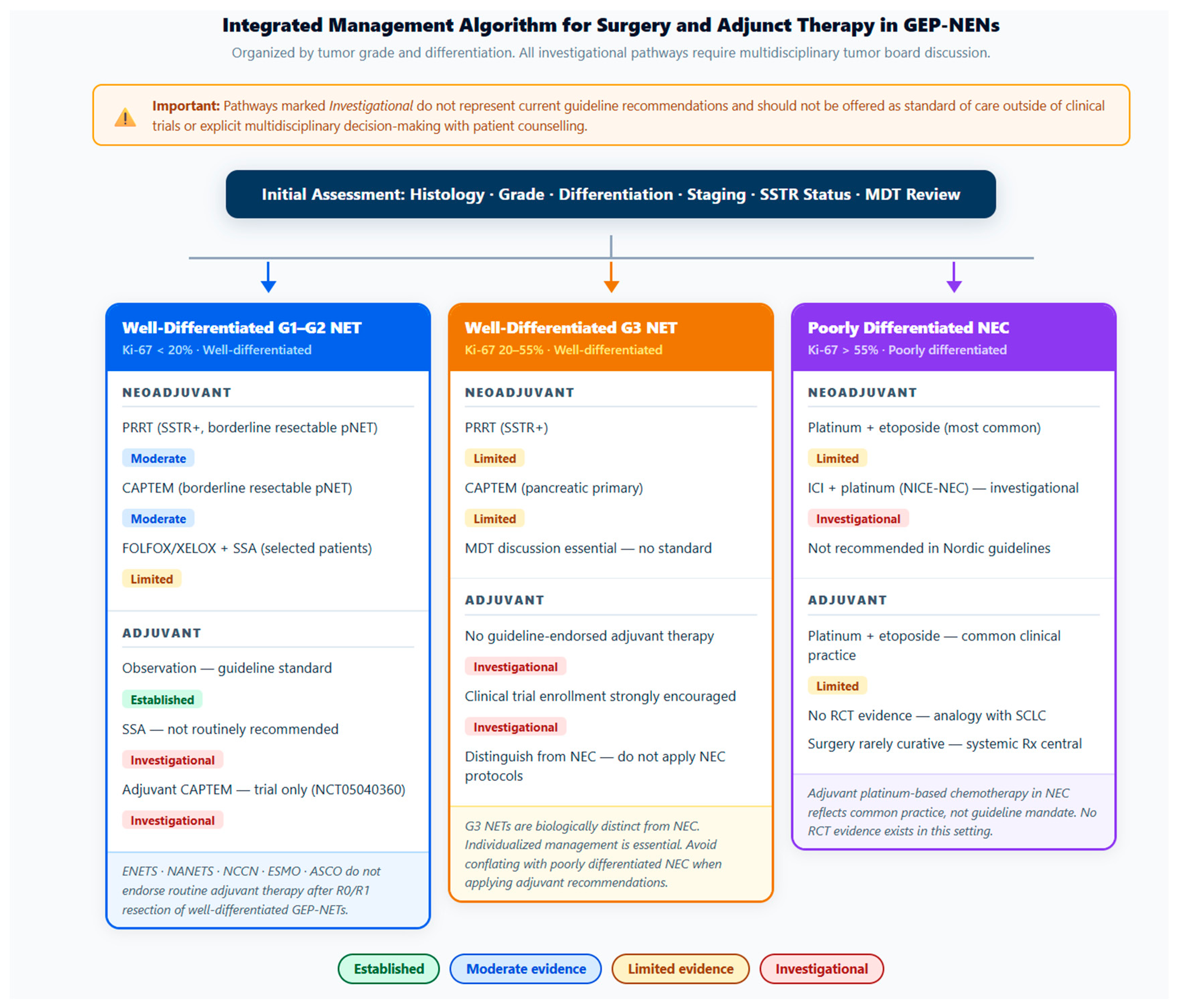
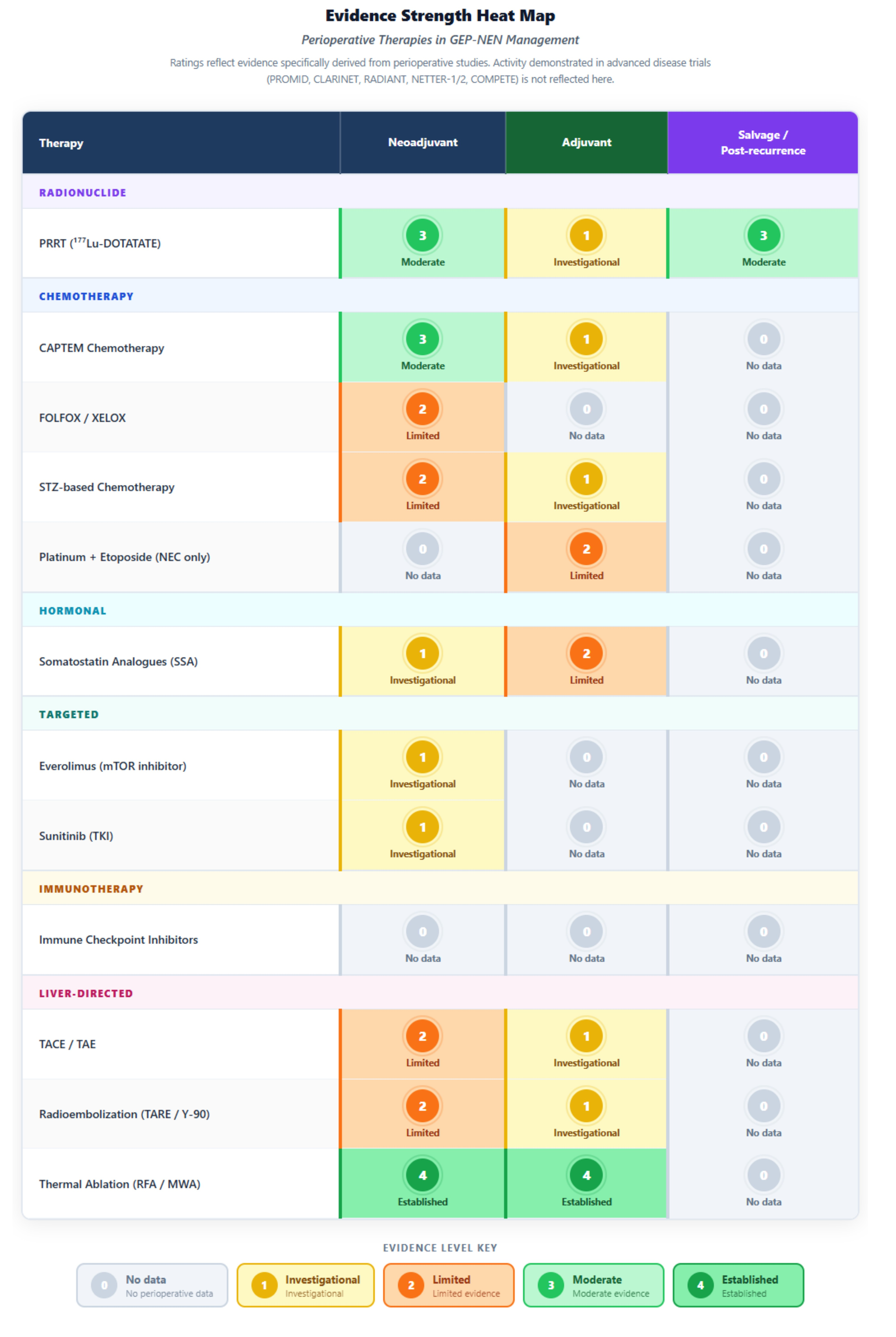
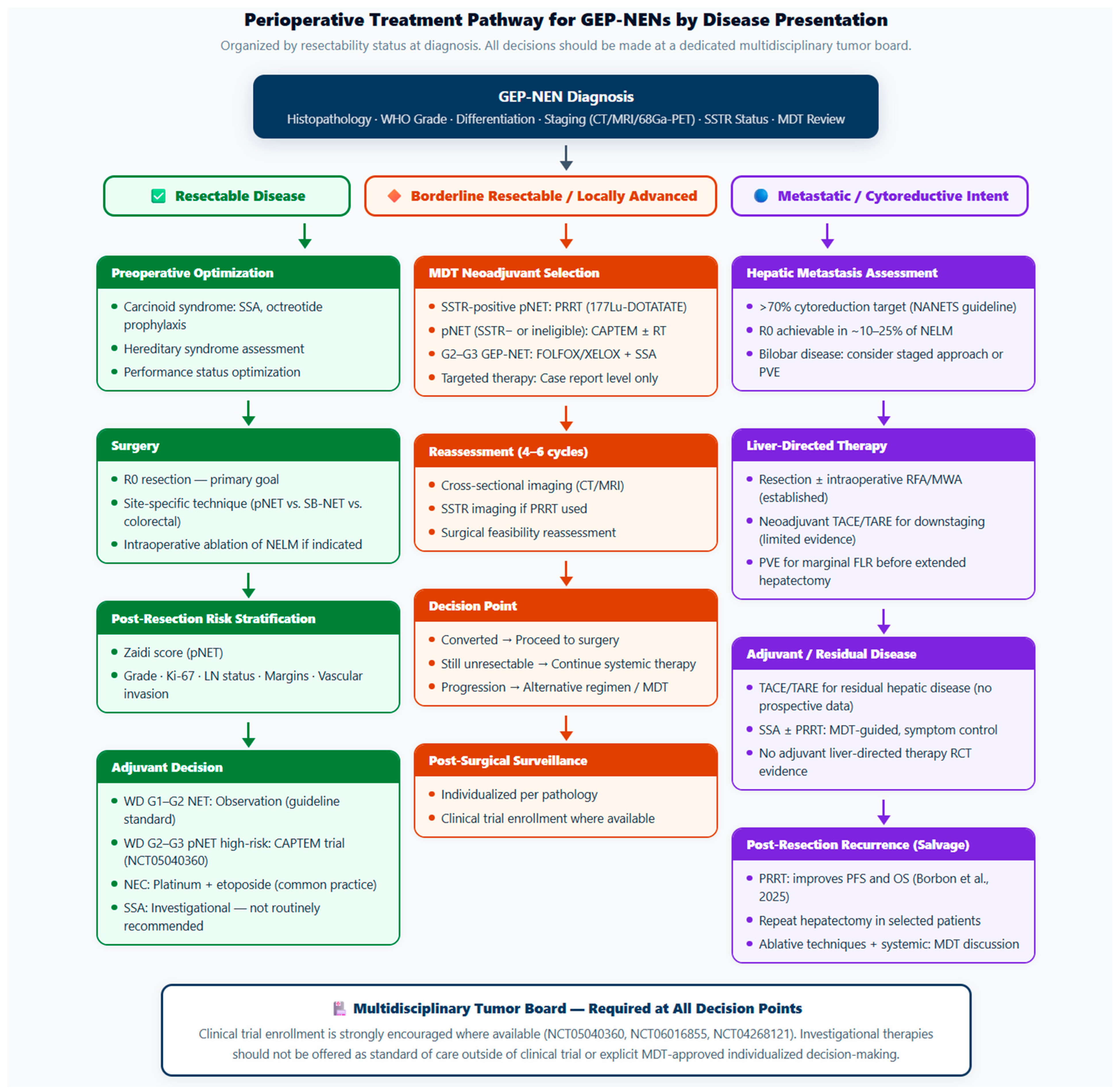
4.3. Neoadjuvant vs. Adjuvant Integration
5. Therapies
5.1. Chemotherapy
5.1.1. Neoadjuvant Chemotherapy
5.1.2. Adjuvant Chemotherapy
5.2. Somatostatin Analogues
5.2.1. Neoadjuvant SSA
5.2.2. Adjuvant SSA
5.3. Targeted Therapies
5.3.1. Neoadjuvant Targeted Therapies
5.3.2. Adjuvant Targeted Therapies
5.4. Peptide Receptor Radionuclide Therapy
5.4.1. Neoadjuvant PRRT
5.4.2. Adjuvant PRRT
5.5. Immune Checkpoint Inhibitors
5.6. Liver-Directed Therapies
5.6.1. Neoadjuvant/Conversion Liver-Directed Therapy
5.6.2. Adjuvant Liver-Directed Therapy
5.6.3. Intraoperative Liver-Directed Therapy

| Study | Design | n | Grade/Differentiation | Disease Setting | Therapy | ORR (%) | DCR (%) | R0/Conversion Rate | Follow-Up | Post-Op Morbidity | Key Conclusion |
|---|---|---|---|---|---|---|---|---|---|---|---|
| Yan et al. 2024 [45] | Systematic review and meta-analysis | NR (pooled) | Mixed G1–G3 | Advanced/locally advanced GEP-NEN | PRRT, chemo, TKI | 42% | — | 60% (vs. 63% upfront; p = NS) | NR | Pooled—acceptable across studies | Safe; effective for downstaging but no significant R0 improvement |
| Lee and Kim 2025 [102] | Meta-analysis | NR (pooled) | Well-differentiated GEP-NET | Locally advanced/borderline resectable | PRRT | 39.1% | 89% | 69% | NR | NR | Supports neoadjuvant PRRT for downstaging; favorable disease control |
| Partelli et al. 2024 [101] (NEOLUPANET) | Phase II prospective multicenter | 31 enrolled; 29 resected | G1–G2 NF-pNET | Resectable/borderline resectable pNET | 177Lu-DOTATATE | 58% PR; 0% PD | 100% | 83% (24/29) | NR | 72% any complication; 24% severe (Clavien–Dindo ≥ III); 0% perioperative mortality | Safe; lower POPF vs. historical upfront resection; supports prospective evaluation |
| Partelli et al. 2018 [103] | Retrospective cohort | NR | G1–G2 pNEN | Resectable/potentially resectable pNEN | PRRT | — | — | 65% | NR | POPF: 25% vs. 65% upfront (p = 0.011); overall morbidity comparable | Safe; significantly lower POPF rate vs. upfront resection |
| Parghane et al. 2021 [119] | Prospective cohort | 57 | Mixed G1–G3 GEP-NET | Locally advanced/unresectable (vascular involvement) | 177Lu-DOTATATE | 40% converted to resectable | — | 40% primary tumors converted to resectable | 2 yr OS 92.1% | Acceptable; no perioperative mortalities reported | Moderate conversion rate; tumor size, LN status, FDG uptake predict conversion |
| van Vliet et al. 2015 [120] | Retrospective cohort | 29 | G1–G2 NF-pNET | Initially unresectable pNET | 177Lu-octreotate | — | — | Selected patients converted | NR | Acceptable; comparable to upfront resection | Valuable option for initially unresectable NF-pNET; supports conversion strategy |
| Squires et al. 2020 [67] | Retrospective cohort | NR | G1–G2 pNET | Locally advanced/resectable metastatic pNET | CAPTEM | 43% PR | 97% | 87% proceeded to resection | Median PFS 28.2 mo; 5 yr OS 63% | Acceptable; no excess perioperative complications reported | Useful in borderline resectable or metastatic pNET; supports CAPTEM neoadjuvant role |
| Ambe et al. 2017 [66] | Retrospective cohort (single center) | NR | G1–G2 pNET | Borderline resectable pNET | CAPTEM ± RT | 67% PR | 100% | 67% | NR | Acceptable; no excess surgical complications | Feasible in borderline resectable pNETs; supports multimodality approach |
| Maratta et al. 2025 [68] | Retrospective cohort | 32 | G1–G2 WD GEP-NET | Advanced (high tumor burden); 28% downstaged to resectability | FOLFOX/XELOX + SSA | — | 87.5% | 28% downstaged to radiographic resectability | NR | NR | Promising disease control; notable downstaging rate supports neoadjuvant role for oxaliplatin regimens |
| Prakash et al. 2017 [59] | Retrospective cohort | NR | G1–G2 pNET | Locoregionally advanced pNET | STZ/5-FU/Doxorubicin | 7% PR | 97% | 64% | NR | NR | Primarily disease stabilization; modest objective response; still achieved surgical resection in majority |
| Study | Design | n | Grade/Differentiation | Disease Setting | Adjuvant Therapy | RFS/DFS vs. No Therapy | OS vs. No Therapy | Follow-Up | Key Conclusion |
|---|---|---|---|---|---|---|---|---|---|
| Barrett et al. 2020 [47] | Retrospective multicenter cohort | 1871 (91 received adjuvant therapy) | Mixed G1–G3 GEP-NET | Curative-intent resection | SSA or cytotoxic chemotherapy | Worse RFS (5 yr RFS 36% vs. 81%) | No difference | Median NR | No benefit; chemotherapy associated with inferior RFS |
| Guo et al. 2024 [77] | Retrospective multicenter cohort | NR | G2 pNET (high recurrence risk) | Radical resection; no metastatic disease | Long-acting octreotide | No difference overall; possible benefit in LN+ or Ki-67 < 10% subgroup | No difference | NR | No benefit in overall cohort; subgroup findings hypothesis-generating only |
| Gao et al. 2020 [76] | Retrospective cohort | 130 | G2 pNET | R0/R1 radical resection | Long-acting octreotide | Improved RFS (24-mo DFS 98.3% vs. 88.7%; p = 0.037) | Not reported | NR | Potential RFS benefit; limited by retrospective design and absence of SSTR data |
| Wang et al. 2021 [78] | Retrospective cohort | NR | pNET (G3, PD dilation, or perineural invasion subgroup) | Resected pNET (high-risk pathological features) | Adjuvant SSA | Lower recurrence rate in high-risk subgroup (p < 0.001) | Not reported | NR | Hypothesis-generating; potential benefit in high-risk pathological subgroups only |
| Maire et al. 2009 [70] | Retrospective cohort | NR | WD GEP-NET | Post-hepatic resection for liver metastases | STZ/5-FU | No difference (5 yr RFS 20% vs. 38%; p = 0.36) | No difference (5 yr OS 96% vs. 76%; p = 0.58) | 5 years | No benefit from adjuvant chemotherapy after hepatic resection |
| Xie et al. 2020 [48] | Retrospective multicenter cohort | NR | WD pNET (G1–G3) | Curative-intent resection of localized pNET | All perioperative systemic therapies (incl. targeted agents) | No difference | No difference | NR | No OS benefit from any perioperative systemic therapy modality in localized pNET |
| Merola et al. 2020 [121] | Retrospective multicenter cohort | NR | G3 NET/NEC | Radical surgery for G3 NEN | Adjuvant chemotherapy | No difference in G3 NET | No significant difference in NEC (40 vs. 19 mo; p = 0.35) | NR | No benefit in G3 NET; numerically improved but nonsignificant OS in NEC subgroup |
| Study | Design | n | Grade/Differentiation | Disease Setting | Salvage Therapy | PFS vs. Comparator | OS vs. Comparator | Follow-Up | Key Conclusion |
|---|---|---|---|---|---|---|---|---|---|
| Borbon et al. 2025 [104] | Retrospective cohort | NR | Mixed GEP-NET (G1–G3) | Recurrent or progressive disease after prior GEP-NET resection | PRRT (177Lu-DOTATATE) | Improved PFS (32.4 vs. 11.0 mo; p < 0.001) | Improved OS (49.8 vs. 38.4 mo; p = 0.009) | NR | PRRT improves survival in post-resection recurrence; supports role as salvage therapy |
| Kiritani et al. 2020 [122] | Retrospective cohort | 44 (28 with recurrence) | Mixed WD-NET | Recurrent NELM after prior curative hepatectomy | Repeat hepatectomy vs. No repeat resection | Not specifically reported | Improved OS with repeat hepatectomy (HR 5.0 for death without repeat hepatectomy p = 0.036) | NR | Repeat hepatectomy is feasible and independently associated with improved survival in selected patients with recurrent NELM |
5.6.4. Surgery and Adjunct Therapy in NET G3 and NEC
6. Ongoing Trials and Future Directions
7. Conclusions
Author Contributions
Funding
Institutional Review Board Statement
Informed Consent Statement
Data Availability Statement
Acknowledgments
Conflicts of Interest
Abbreviations
| GEP-NET | Gastroenteropancreatic neuroendocrine tumor |
| pNET | Pancreatic neuroendocrine tumor |
| PRRT | Peptide receptor radionuclide therapy |
| SSA | Somatostatin analogues |
| NEC | Neuroendocrine carcinoma |
References
- Sultana, Q.; Kar, J.; Verma, A.; Sanghvi, S.; Kaka, N.; Patel, N.; Sethi, Y.; Chopra, H.; Kamal, M.A.; Greig, N.H. A Comprehensive Review on Neuroendocrine Neoplasms: Presentation, Pathophysiology and Management. J. Clin. Med. 2023, 12, 5138. [Google Scholar] [CrossRef] [Scilit] [PubMed]
- Cives, M.; Strosberg, J.R. Gastroenteropancreatic Neuroendocrine Tumors. CA Cancer J. Clin. 2018, 68, 471–487. [Google Scholar] [CrossRef] [Scilit] [PubMed]
- Frilling, A.; Akerstrom, G.; Falconi, M.; Pavel, M.; Ramos, J.; Kidd, M.; Modlin, I.M. Neuroendocrine tumor disease: An evolving landscape. Endocr.-Relat. Cancer 2012, 19, R163–R185. [Google Scholar] [CrossRef] [Scilit] [PubMed]
- Dasari, A.; Shen, C.; Halperin, D.; Zhao, B.; Zhou, S.; Xu, Y.; Shih, T.; Yao, J.C. Trends in the Incidence, Prevalence, and Survival Outcomes in Patients With Neuroendocrine Tumors in the United States. JAMA Oncol. 2017, 3, 1335–1342. [Google Scholar] [CrossRef] [Scilit] [PubMed]
- Ito, T.; Masui, T.; Komoto, I.; Doi, R.; Osamura, R.Y.; Sakurai, A.; Ikeda, M.; Takano, K.; Igarashi, H.; Shimatsu, A.; et al. JNETS clinical practice guidelines for gastroenteropancreatic neuroendocrine neoplasms: Diagnosis, treatment, and follow-up: A synopsis. J. Gastroenterol. 2021, 56, 1033–1044. [Google Scholar] [CrossRef] [Scilit] [PubMed]
- Pavel, M.; Öberg, K.; Falconi, M.; Krenning, E.P.; Sundin, A.; Perren, A.; Berruti, A. Gastroenteropancreatic neuroendocrine neoplasms: ESMO Clinical Practice Guidelines for diagnosis, treatment and follow-up. Ann. Oncol. 2020, 31, 844–860. [Google Scholar] [CrossRef] [Scilit] [PubMed]
- Singh, S.; Chan, D.L.; Moody, L.; Liu, N.; Fischer, H.D.; Austin, P.C.; Segelov, E. Recurrence in Resected Gastroenteropancreatic Neuroendocrine Tumors. JAMA Oncol. 2018, 4, 583–585. [Google Scholar] [CrossRef] [Scilit] [PubMed]
- Larouche, V.; Akirov, A.; Alshehri, S.; Ezzat, S. Management of Small Bowel Neuroendocrine Tumors. Cancers 2019, 11, 1395. [Google Scholar] [CrossRef] [Scilit] [PubMed]
- Howe, J.R.; Cardona, K.; Fraker, D.L.; Kebebew, E.; Untch, B.R.; Wang, Y.-Z.; Law, C.H.; Liu, E.H.; Kim, M.K.; Menda, Y. The surgical management of small bowel neuroendocrine tumors: Consensus guidelines of the North American Neuroendocrine Tumor Society. Pancreas 2017, 46, 715–731. [Google Scholar] [PubMed]
- Howe, J.R.; Merchant, N.B.; Conrad, C.; Keutgen, X.M.; Hallet, J.; Drebin, J.A.; Minter, R.M.; Lairmore, T.C.; Tseng, J.F.; Zeh, H.J.; et al. The North American Neuroendocrine Tumor Society Consensus Paper on the Surgical Management of Pancreatic Neuroendocrine Tumors. Pancreas 2020, 49, 1–33. [Google Scholar] [CrossRef] [Scilit] [PubMed]
- Tsilimigras, D.I.; Pawlik, T.M. Pancreatic neuroendocrine tumours: Conservative versus surgical management. BJS 2021, 108, 1267–1269. [Google Scholar] [CrossRef] [Scilit] [PubMed]
- Jensen, R.T.; Cadiot, G.; Brandi, M.L.; De Herder, W.W.; Kaltsas, G.; Komminoth, P.; Scoazec, J.-Y.; Salazar, R.; Sauvanet, A.; Kianmanesh, R. ENETS consensus guidelines for the management of patients with digestive neuroendocrine neoplasms: Functional pancreatic endocrine tumor syndromes. Neuroendocrinology 2012, 95, 98. [Google Scholar] [CrossRef] [Scilit] [PubMed]
- Shah, M.H.; Goldner, W.S.; Benson, A.B.; Bergsland, E.; Blaszkowsky, L.S.; Brock, P.; Chan, J.; Das, S.; Dickson, P.V.; Fanta, P.; et al. Neuroendocrine and Adrenal Tumors, Version 2.2021, NCCN Clinical Practice Guidelines in Oncology. J. Natl. Compr. Cancer Netw. 2021, 19, 839–868. [Google Scholar] [CrossRef] [Scilit] [PubMed]
- Zhang, X.F.; Wu, Z.; Cloyd, J.; Lopez-Aguiar, A.G.; Poultsides, G.; Makris, E.; Rocha, F.; Kanji, Z.; Weber, S.; Fisher, A.; et al. Margin status and long-term prognosis of primary pancreatic neuroendocrine tumor after curative resection: Results from the US Neuroendocrine Tumor Study Group. Surgery 2019, 165, 548–556. [Google Scholar] [CrossRef] [Scilit] [PubMed]
- Eads, J.R.; Halfdanarson, T.R.; Asmis, T.; Bellizzi, A.M.; Bergsland, E.K.; Dasari, A.; El-Haddad, G.; Frumovitz, M.; Meyer, J.; Mittra, E.; et al. Expert Consensus Practice Recommendations of the North American Neuroendocrine Tumor Society for the management of high grade gastroenteropancreatic and gynecologic neuroendocrine neoplasms. Endocr. Relat. Cancer 2023, 30, e220206. [Google Scholar] [CrossRef] [Scilit] [PubMed]
- Ma, Z.Y.; Gong, Y.F.; Zhuang, H.K.; Zhou, Z.X.; Huang, S.Z.; Zou, Y.P.; Huang, B.W.; Sun, Z.H.; Zhang, C.Z.; Tang, Y.Q.; et al. Pancreatic neuroendocrine tumors: A review of serum biomarkers, staging, and management. World J. Gastroenterol. 2020, 26, 2305–2322. [Google Scholar] [CrossRef] [Scilit] [PubMed]
- Van Beek, D.J.; Van Den Heede, K.; Borel Rinkes, I.; Norlén, O.; Van Slycke, S.; Stålberg, P.; Nordenström, E. Surgery for advanced pancreatic neuroendocrine neoplasms: Recommendations based on a consensus meeting of the European Society of Endocrine Surgeons (ESES). Br. J. Surg. 2024, 111, znae017. [Google Scholar] [CrossRef] [Scilit] [PubMed]
- Kaltsas, G.; Caplin, M.; Davies, P.; Ferone, D.; Garcia-Carbonero, R.; Grozinsky-Glasberg, S.; Hörsch, D.; Tiensuu Janson, E.; Kianmanesh, R.; Kos-Kudla, B.; et al. ENETS Consensus Guidelines for the Standards of Care in Neuroendocrine Tumors: Pre- and Perioperative Therapy in Patients with Neuroendocrine Tumors. Neuroendocrinology 2017, 105, 245–254. [Google Scholar] [CrossRef] [Scilit] [PubMed]
- Shi, M.; Fan, Z.; Xu, J.; Yang, J.; Li, Y.; Gao, C.; Su, P.; Wang, X.; Zhan, H. Gastroenteropancreatic neuroendocrine neoplasms G3: Novel insights and unmet needs. Biochim. Biophys. Acta Rev. Cancer 2021, 1876, 188637. [Google Scholar] [CrossRef] [Scilit] [PubMed]
- Garcia-Carbonero, R.; Sorbye, H.; Baudin, E.; Raymond, E.; Wiedenmann, B.; Niederle, B.; Sedlackova, E.; Toumpanakis, C.; Anlauf, M.; Cwikla, J.B.; et al. ENETS Consensus Guidelines for High-Grade Gastroenteropancreatic Neuroendocrine Tumors and Neuroendocrine Carcinomas. Neuroendocrinology 2016, 103, 186–194. [Google Scholar] [CrossRef] [Scilit] [PubMed]
- Wu, W.; Chen, J.; Bai, C.; Chi, Y.; Du, Y.; Feng, S.; Huo, L.; Jiang, Y.; Li, J.; Lou, W. The Chinese guidelines for the diagnosis and treatment of pancreatic neuroendocrine neoplasms (2020). J. Pancreatol. 2021, 59, 401–421. [Google Scholar] [CrossRef] [Scilit] [PubMed]
- Zaidi, M.Y.; Lopez-Aguiar, A.G.; Switchenko, J.M.; Lipscomb, J.; Andreasi, V.; Partelli, S.; Gamboa, A.C.; Lee, R.M.; Poultsides, G.A.; Dillhoff, M.; et al. A Novel Validated Recurrence Risk Score to Guide a Pragmatic Surveillance Strategy After Resection of Pancreatic Neuroendocrine Tumors: An International Study of 1006 Patients. Ann. Surg. 2019, 270, 422–433. [Google Scholar] [CrossRef] [Scilit] [PubMed]
- Sho, S.; Court, C.M.; Winograd, P.; Toste, P.A.; Pisegna, J.R.; Lewis, M.; Donahue, T.R.; Hines, O.J.; Reber, H.A.; Dawson, D.W.; et al. A Prognostic Scoring System for the Prediction of Metastatic Recurrence Following Curative Resection of Pancreatic Neuroendocrine Tumors. J. Gastrointest. Surg. 2019, 23, 1392–1400. [Google Scholar] [CrossRef] [Scilit] [PubMed]
- Merola, E.; Pascher, A.; Rinke, A.; Bartsch, D.K.; Zerbi, A.; Nappo, G.; Carnaghi, C.; Ciola, M.; McNamara, M.G.; Zandee, W.; et al. Radical Resection in Entero-Pancreatic Neuroendocrine Tumors: Recurrence-Free Survival Rate and Definition of a Risk Score for Recurrence. Ann. Surg. Oncol. 2022, 29, 5568–5577. [Google Scholar] [CrossRef] [Scilit] [PubMed]
- Tong, Z.; Liu, L.; Zheng, Y.; Jiang, W.; Zhao, P.; Fang, W.; Wang, W. Predictive value of preoperative peripheral blood neutrophil/lymphocyte ratio for lymph node metastasis in patients of resectable pancreatic neuroendocrine tumors: A nomogram-based study. World J. Surg. Oncol. 2017, 15, 108. [Google Scholar] [CrossRef] [Scilit] [PubMed]
- Chakedis, J.; Beal, E.W.; Lopez-Aguiar, A.G.; Poultsides, G.; Makris, E.; Rocha, F.G.; Kanji, Z.; Weber, S.; Fisher, A.; Fields, R.; et al. Surgery Provides Long-Term Survival in Patients with Metastatic Neuroendocrine Tumors Undergoing Resection for Non-Hormonal Symptoms. J. Gastrointest. Surg. 2019, 23, 122–134. [Google Scholar] [CrossRef] [Scilit] [PubMed]
- Jilesen, A.P.; van Eijck, C.H.; In’t Hof, K.H.; van Dieren, S.; Gouma, D.J.; van Dijkum, E.J. Postoperative Complications, In-Hospital Mortality and 5-Year Survival After Surgical Resection for Patients with a Pancreatic Neuroendocrine Tumor: A Systematic Review. World J. Surg. 2016, 40, 729–748. [Google Scholar] [CrossRef] [Scilit] [PubMed]
- Kaçmaz, E.; Chen, J.W.; Tanis, P.J.; Nieveen van Dijkum, E.J.M.; Engelsman, A.F. Postoperative morbidity and mortality after surgical resection of small bowel neuroendocrine neoplasms: A systematic review and meta-analysis. J. Neuroendocrinol. 2021, 33, e13008. [Google Scholar] [CrossRef] [Scilit] [PubMed]
- Zhou, Y.; Zhao, M.; Wu, L.; Ye, F.; Si, X. Short- and long-term outcomes after enucleation of pancreatic tumors: An evidence-based assessment. Pancreatology 2016, 16, 1092–1098. [Google Scholar] [CrossRef] [Scilit] [PubMed]
- Hedges, E.A.; Khan, T.M.; Babic, B.; Nilubol, N. Predictors of post-operative pancreatic fistula formation in pancreatic neuroendocrine tumors: A national surgical quality improvement program analysis. Am. J. Surg. 2022, 224, 1256–1261. [Google Scholar] [CrossRef] [Scilit] [PubMed]
- Xu, Z.; Wang, L.; Dai, S.; Chen, M.; Li, F.; Sun, J.; Luo, F. Epidemiologic Trends of and Factors Associated With Overall Survival for Patients With Gastroenteropancreatic Neuroendocrine Tumors in the United States. JAMA Netw. Open 2021, 4, e2124750. [Google Scholar] [CrossRef] [Scilit] [PubMed]
- Fan, J.H.; Zhang, Y.Q.; Shi, S.S.; Chen, Y.J.; Yuan, X.H.; Jiang, L.M.; Wang, S.M.; Ma, L.; He, Y.T.; Feng, C.Y.; et al. A nation-wide retrospective epidemiological study of gastroenteropancreatic neuroendocrine neoplasms in china. Oncotarget 2017, 8, 71699–71708. [Google Scholar] [CrossRef] [Scilit] [PubMed]
- Kahraman, S.; Bardakci, M.; Aykan, M.B.; Yasar, S.; Erol, C.; Hizal, M.; Akinci, M.B.; Kos, F.T.; Kos, T.; Dede, D.S.; et al. Clinicopathological and survival features of neuroendocrine tumors: A retrospective analysis of 153 cases, our current remarks on a heterogeneous tumor group, and still unmet future expectations. J. Cancer Res. Ther. 2023, 19, 347–354. [Google Scholar] [CrossRef] [Scilit] [PubMed]
- Yao, J.C.; Hassan, M.; Phan, A.; Dagohoy, C.; Leary, C.; Mares, J.E.; Abdalla, E.K.; Fleming, J.B.; Vauthey, J.N.; Rashid, A.; et al. One hundred years after “carcinoid”: Epidemiology of and prognostic factors for neuroendocrine tumors in 35,825 cases in the United States. J. Clin. Oncol. 2008, 26, 3063–3072. [Google Scholar] [CrossRef] [Scilit] [PubMed]
- Zhang, X.F.; Beal, E.W.; Chakedis, J.; Lv, Y.; Bagante, F.; Aldrighetti, L.; Poultsides, G.A.; Bauer, T.W.; Fields, R.C.; Maithel, S.K.; et al. Early Recurrence of Neuroendocrine Liver Metastasis After Curative Hepatectomy: Risk Factors, Prognosis, and Treatment. J. Gastrointest. Surg. 2017, 21, 1821–1830. [Google Scholar] [CrossRef] [Scilit] [PubMed]
- Pu, T.; Luberice, K.; Ghabra, S.; Friedman, L.R.; Coleman, K.N.; Larrain, C.M.; Lin, Y.; Akmal, S.R.; Eade, A.V.; Sarvestani, A.L.; et al. Surgery for Gastroenteropancreatic Neuroendocrine Tumors with Synchronous Liver Metastasis. Ann. Surg. Oncol. 2026, 33, 4668–4678. [Google Scholar] [CrossRef] [Scilit] [PubMed]
- Pasricha, G.; Padhi, P.; Daboul, N.; Monga, D.K. Management of Well-differentiated Gastroenteropancreatic Neuroendocrine Tumors (GEPNETs): A Review. Clin. Ther. 2017, 39, 2146–2157. [Google Scholar] [CrossRef] [Scilit] [PubMed][Green Version]
- Yuan, C.H.; Wang, J.; Xiu, D.R.; Tao, M.; Ma, Z.L.; Jiang, B.; Li, Z.F.; Li, L.; Wang, L.; Wang, H.; et al. Meta-analysis of Liver Resection Versus Nonsurgical Treatments for Pancreatic Neuroendocrine Tumors with Liver Metastases. Ann. Surg. Oncol. 2016, 23, 244–249. [Google Scholar] [CrossRef] [Scilit] [PubMed]
- Kaçmaz, E.; Klümpen, H.J.; Bemelman, W.A.; Nieveen van Dijkum, E.J.M.; Engelsman, A.F.; Tanis, P.J. Evaluating Nationwide Application of Minimally Invasive Surgery for Treatment of Small Bowel Neuroendocrine Neoplasms. World J. Surg. 2021, 45, 2463–2470. [Google Scholar] [CrossRef] [Scilit] [PubMed]
- Daskalakis, K.; Karakatsanis, A.; Hessman, O.; Stuart, H.C.; Welin, S.; Tiensuu Janson, E.; Öberg, K.; Hellman, P.; Norlén, O.; Stålberg, P. Association of a Prophylactic Surgical Approach to Stage IV Small Intestinal Neuroendocrine Tumors With Survival. JAMA Oncol. 2018, 4, 183–189. [Google Scholar] [CrossRef] [Scilit] [PubMed]
- Puranik, A.D.; Dev, I.D.; Yadav, S.; Rangarajan, V.; Agrawal, A.; Basu, S.; Chaudhari, V.A.; Ramaswamy, A.; Ostwal, V.; Bhandare, M.S.; et al. PReCedeNT trial: Phase III randomized-controlled trial of Lutetium - 177 DOTATATE Peptide Receptor Radionuclide Therapy (PRRT) plus Chemotherapy versus PRRT alone in FDG-avid, Well-differentiated Gastroenteropancreatic neuroendocrine tumors (GEP-NETs). BMC Cancer 2025, 25, 1659. [Google Scholar] [CrossRef] [Scilit] [PubMed]
- Ryan, C.E.; Saif, A.; Rocha, F.; Philip, P.; Hernandez, J.M.; Ahmad, S.; Soares, H. Testing the Use of Chemotherapy After Surgery for High-Risk Pancreatic Neuroendocrine Tumors. Ann. Surg. Oncol. 2023, 30, 1302–1304. [Google Scholar] [CrossRef] [Scilit] [PubMed]
- Del Rivero, J.; Perez, K.; Kennedy, E.B.; Mittra, E.S.; Vijayvergia, N.; Arshad, J.; Basu, S.; Chauhan, A.; Dasari, A.N.; Bellizzi, A.M.; et al. Systemic Therapy for Tumor Control in Metastatic Well-Differentiated Gastroenteropancreatic Neuroendocrine Tumors: ASCO Guideline. J. Clin. Oncol. 2023, 41, 5049–5067. [Google Scholar] [CrossRef] [Scilit] [PubMed]
- Espinosa-Olarte, P.; La Salvia, A.; Riesco-Martinez, M.C.; Anton-Pascual, B.; Garcia-Carbonero, R. Chemotherapy in NEN: Still has a role? Rev. Endocr. Metab. Disord. 2021, 22, 595–614. [Google Scholar] [CrossRef] [Scilit] [PubMed]
- Yan, Y.; Wu, D.; Wang, W.; Lv, Y.; Yang, L.; Liu, Y.; Dong, P.; Yu, X. Efficacy and safety of neoadjuvant therapy in gastroenteropancreatic neuroendocrine neoplasms: A systematic review and meta-analysis. J. Cancer Res. Ther. 2024, 20, 633–641. [Google Scholar] [CrossRef] [Scilit] [PubMed]
- Schiavo Lena, M.; Partelli, S.; Castelli, P.; Andreasi, V.; Smart, C.E.; Pisa, E.; Bartolomei, M.; Bertani, E.; Zamboni, G.; Falconi, M.; et al. Histopathological and Immunophenotypic Changes of Pancreatic Neuroendocrine Tumors after Neoadjuvant Peptide Receptor Radionuclide Therapy (PRRT). Endocr. Pathol. 2020, 31, 119–131. [Google Scholar] [CrossRef] [Scilit] [PubMed]
- Barrett, J.R.; Rendell, V.; Pokrzywa, C.; Lopez-Aguiar, A.G.; Cannon, J.; Poultsides, G.A.; Rocha, F.; Crown, A.; Beal, E.; Michael Pawlik, T.; et al. Adjuvant therapy following resection of gastroenteropancreatic neuroendocrine tumors provides no recurrence or survival benefit. J. Surg. Oncol. 2020, 121, 1067–1073. [Google Scholar] [CrossRef] [Scilit] [PubMed]
- Xie, H.; Liu, J.; Yadav, S.; Keutgen, X.M.; Hobday, T.J.; Strosberg, J.R.; Halfdanarson, T.R. The Role of Perioperative Systemic Therapy in Localized Pancreatic Neuroendocrine Neoplasms. Neuroendocrinology 2020, 110, 234–245. [Google Scholar] [CrossRef] [Scilit] [PubMed]
- Janson, E.T.; Knigge, U.; Dam, G.; Federspiel, B.; Grønbaek, H.; Stålberg, P.; Langer, S.W.; Kjaer, A.; Arola, J.; Schalin-Jäntti, C. Nordic guidelines 2021 for diagnosis and treatment of gastroenteropancreatic neuroendocrine neoplasms. Acta Oncol. 2021, 60, 931–941. [Google Scholar] [CrossRef] [Scilit] [PubMed]
- Garcia-Carbonero, R.; Anton-Pascual, B.; Modrego, A.; del Carmen Riesco-Martinez, M.; Lens-Pardo, A.; Carretero-Puche, C.; Rubio-Cuesta, B.; Soldevilla, B. Advances in the Treatment of Gastroenteropancreatic Neuroendocrine Carcinomas: Are we Moving Forward? Endocr. Rev. 2023, 44, 724–736. [Google Scholar] [CrossRef] [Scilit] [PubMed]
- Fine, R.; Fogelman, D.; Schreibman, S. Effective treatment of neuroendocrine tumors with temozolomide and capecitabine. J. Clin. Oncol. 2005, 23, 4216. [Google Scholar] [CrossRef] [Scilit]
- Peixoto, R.D.; Noonan, K.L.; Pavlovich, P.; Kennecke, H.F.; Lim, H.J. Outcomes of patients treated with capecitabine and temozolamide for advanced pancreatic neuroendocrine tumors (PNETs) and non-PNETs. J. Gastrointest. Oncol. 2014, 5, 247–252. [Google Scholar] [CrossRef] [Scilit] [PubMed]
- Ostwal, V.; Basu, S.; Bhargava, P.; Shah, M.; Parghane, R.V.; Srinivas, S.; Chaudhari, V.; Bhandare, M.S.; Shrikhande, S.V.; Ramaswamy, A. Capecitabine-Temozolomide in Advanced Grade 2 and Grade 3 Neuroendocrine Neoplasms: Benefits of Chemotherapy in Neuroendocrine Neoplasms with Significant 18FDG Uptake. Neuroendocrinology 2021, 111, 998–1004. [Google Scholar] [CrossRef] [Scilit] [PubMed]
- Kunz, P.L.; Graham, N.T.; Catalano, P.J.; Nimeiri, H.S.; Fisher, G.A.; Longacre, T.A.; Suarez, C.J.; Martin, B.A.; Yao, J.C.; Kulke, M.H.; et al. Randomized Study of Temozolomide or Temozolomide and Capecitabine in Patients With Advanced Pancreatic Neuroendocrine Tumors (ECOG-ACRIN E2211). J. Clin. Oncol. 2023, 41, 1359–1369. [Google Scholar] [CrossRef] [Scilit] [PubMed]
- Fine, R.L.; Gulati, A.P.; Krantz, B.A.; Moss, R.A.; Schreibman, S.; Tsushima, D.A.; Mowatt, K.B.; Dinnen, R.D.; Mao, Y.; Stevens, P.D. Capecitabine and temozolomide (CAPTEM) for metastatic, well-differentiated neuroendocrine cancers: The Pancreas Center at Columbia University experience. Cancer Chemother. Pharmacol. 2013, 71, 663–670. [Google Scholar] [CrossRef] [Scilit] [PubMed]
- de Mestier, L.; Walter, T.; Brixi, H.; Evrard, C.; Legoux, J.L.; de Boissieu, P.; Hentic, O.; Cros, J.; Hammel, P.; Tougeron, D.; et al. Comparison of Temozolomide-Capecitabine to 5-Fluorouracile-Dacarbazine in 247 Patients with Advanced Digestive Neuroendocrine Tumors Using Propensity Score Analyses. Neuroendocrinology 2019, 108, 343–353. [Google Scholar] [CrossRef] [Scilit] [PubMed]
- Kouvaraki, M.A.; Ajani, J.A.; Hoff, P.; Wolff, R.; Evans, D.B.; Lozano, R.; Yao, J.C. Fluorouracil, doxorubicin, and streptozocin in the treatment of patients with locally advanced and metastatic pancreatic endocrine carcinomas. J. Clin. Oncol. 2004, 22, 4762–4771. [Google Scholar] [CrossRef] [Scilit] [PubMed]
- Chan, J.A.; Stuart, K.; Earle, C.C.; Clark, J.W.; Bhargava, P.; Miksad, R.; Blaszkowsky, L.; Enzinger, P.C.; Meyerhardt, J.A.; Zheng, H. Prospective study of bevacizumab plus temozolomide in patients with advanced neuroendocrine tumors. J. Clin. Oncol. 2012, 30, 2963–2968. [Google Scholar] [CrossRef] [Scilit] [PubMed]
- Prakash, L.; Bhosale, P.; Cloyd, J.; Kim, M.; Parker, N.; Yao, J.; Dasari, A.; Halperin, D.; Aloia, T.; Lee, J.E. Role of fluorouracil, doxorubicin, and streptozocin therapy in the preoperative treatment of localized pancreatic neuroendocrine tumors. J. Gastrointest. Surg. 2017, 21, 155–163. [Google Scholar] [CrossRef] [Scilit] [PubMed]
- Merola, E.; Dal Buono, A.; Denecke, T.; Arsenic, R.; Pape, U.F.; Jann, H.; Wiedenmann, B.; Pavel, M.E. Efficacy and Toxicity of 5-Fluorouracil-Oxaliplatin in Gastroenteropancreatic Neuroendocrine Neoplasms. Pancreas 2020, 49, 912–917. [Google Scholar] [CrossRef] [Scilit] [PubMed]
- Al-Toubah, T.; Morse, B.; Pelle, E.; Strosberg, J. Efficacy of FOLFOX in Patients with Aggressive Pancreatic Neuroendocrine Tumors After Prior Capecitabine/Temozolomide. Oncologist 2021, 26, 115–119. [Google Scholar] [CrossRef] [Scilit] [PubMed]
- Moertel, C.G.; Kvols, L.K.; O’Connell, M.J.; Rubin, J. Treatment of neuroendocrine carcinomas with combined etoposide and cisplatin. Evidence of major therapeutic activity in the anaplastic variants of these neoplasms. Cancer 1991, 68, 227–232. [Google Scholar] [CrossRef] [Scilit]
- Mitry, E.; Baudin, E.; Ducreux, M.; Sabourin, J.C.; Rufié, P.; Aparicio, T.; Aparicio, T.; Lasser, P.; Elias, D.; Duvillard, P.; et al. Treatment of poorly differentiated neuroendocrine tumours with etoposide and cisplatin. Br. J. Cancer 1999, 81, 1351–1355. [Google Scholar] [CrossRef] [Scilit] [PubMed]
- Hentic, O.; Hammel, P.; Couvelard, A.; Rebours, V.; Zappa, M.; Palazzo, M.; Maire, F.; Goujon, G.; Gillet, A.; Lévy, P.; et al. FOLFIRI regimen: An effective second-line chemotherapy after failure of etoposide-platinum combination in patients with neuroendocrine carcinomas grade 3. Endocr. Relat. Cancer 2012, 19, 751–757. [Google Scholar] [CrossRef] [Scilit] [PubMed]
- Zhu, J.; Strosberg, J.R.; Dropkin, E.; Strickler, J.H. Treatment of high-grade metastatic pancreatic neuroendocrine carcinoma with FOLFIRINOX. J. Gastrointest. Cancer 2015, 46, 166–169. [Google Scholar] [CrossRef] [Scilit] [PubMed]
- Ambe, C.M.; Nguyen, P.; Centeno, B.A.; Choi, J.; Strosberg, J.; Kvols, L.; Hodul, P.; Hoffe, S.; Malafa, M.P. Multimodality management of “borderline resectable” pancreatic neuroendocrine tumors: Report of a single-institution experience. Cancer Control 2017, 24, 1073274817729076. [Google Scholar] [PubMed]
- Squires, M.H.; Worth, P.J.; Konda, B.; Shah, M.H.; Dillhoff, M.E.; Abdel-Misih, S.; Norton, J.A.; Visser, B.C.; Dua, M.; Pawlik, T.M.; et al. Neoadjuvant Capecitabine/Temozolomide for Locally Advanced or Metastatic Pancreatic Neuroendocrine Tumors. Pancreas 2020, 49, 355–360. [Google Scholar] [CrossRef] [Scilit] [PubMed]
- Maratta, M.G.; Sparagna, I.; Occhipinti, D.; Roca, L.; Sgambato, M.; Raia, S.; Bianchi, A.; Chiloiro, S.; Rossi, E.; Rindi, G.; et al. Upfront Oxaliplatin-Fluoropyrimidine Chemotherapy and Somatostatin Analogues in Advanced Well-Differentiated Gastro-Entero-Pancreatic Neuroendocrine Tumors. Cancers 2025, 17, 1561. [Google Scholar] [CrossRef] [Scilit] [PubMed]
- Garcia-Carbonero, R.; Rinke, A.; Valle, J.W.; Fazio, N.; Caplin, M.; Gorbounova, V.; O’COnnor, J.; Eriksson, B.; Sorbye, H.; Kulke, M.; et al. ENETS Consensus Guidelines for the Standards of Care in Neuroendocrine Neoplasms. Systemic Therapy 2: Chemotherapy. Neuroendocrinology 2017, 105, 281–294. [Google Scholar] [CrossRef] [Scilit] [PubMed]
- Maire, F.; Hammel, P.; Kianmanesh, R.; Hentic, O.; Couvelard, A.; Rebours, V.; Zappa, M.; Raymond, E.; Sauvanet, A.; Louvet, C.; et al. Is adjuvant therapy with streptozotocin and 5-fluorouracil useful after resection of liver metastases from digestive endocrine tumors? Surgery 2009, 145, 69–75. [Google Scholar] [CrossRef] [Scilit] [PubMed]
- Holmager, P.; Langer, S.W.; Kjaer, A.; Ringholm, L.; Garbyal, R.S.; Pommergaard, H.-C.; Hansen, C.P.; Federspiel, B.; Andreassen, M.; Knigge, U. Surgery in patients with gastro-entero-pancreatic neuroendocrine carcinomas, neuroendocrine tumors G3 and high grade mixed neuroendocrine-non-neuroendocrine neoplasms. Curr. Treat. Options Oncol. 2022, 23, 806–817. [Google Scholar] [CrossRef] [Scilit] [PubMed]
- Rinke, A.; Müller, H.-H.; Schade-Brittinger, C.; Klose, K.-J.; Barth, P.; Wied, M.; Mayer, C.; Aminossadati, B.; Pape, U.-F.; Bläker, M. Placebo-controlled, double-blind, prospective, randomized study on the effect of octreotide LAR in the control of tumor growth in patients with metastatic neuroendocrine midgut tumors: A report from the PROMID Study Group. J. Clin. Oncol. 2009, 27, 4656–4663. [Google Scholar] [CrossRef] [Scilit] [PubMed]
- Caplin, M.E.; Pavel, M.; Ćwikła, J.B.; Phan, A.T.; Raderer, M.; Sedláčková, E.; Cadiot, G.; Wolin, E.M.; Capdevila, J.; Wall, L. Lanreotide in metastatic enteropancreatic neuroendocrine tumors. N. Engl. J. Med. 2014, 371, 224–233. [Google Scholar] [CrossRef] [Scilit] [PubMed]
- Merola, E.; Alonso Gordoa, T.; Zhang, P.; Al-Toubah, T.; Pellè, E.; Kolasińska-Ćwikła, A.; Zandee, W.; Laskaratos, F.; Mestier, L.; Lamarca, A. Somatostatin Analogs for Pancreatic Neuroendocrine Tumors: Any Benefit When Ki-67 is ≥ 10%? Oncol. 2021, 26, 294–301. [Google Scholar] [CrossRef] [Scilit] [PubMed]
- McGarrah, P.W.; Hobday, T.J.; Starr, J.S.; Kendi, A.T.; Graham, R.P.; Sonbol, M.B.; Halfdanarson, T.R. Efficacy of somatostatin analog (SSA) monotherapy for well-differentiated grade 3 (G3) gastroenteropancreatic neuroendocrine tumors (NETs). J. Clin. Oncol. 2020, 38, 617. [Google Scholar] [CrossRef] [Scilit]
- Gao, S.; Shi, X.; Ma, H.; Wang, H.; Li, B.; Song, B.; Guo, S.; Jin, G. The effect of using long-acting octreotide as adjuvant therapy for patients with grade 2 pancreatic neuroendocrine tumors after radical resection. J. Pancreatol. 2020, 3, 167–172. [Google Scholar] [CrossRef] [Scilit]
- Guo, S.; Wu, H.; Gao, S.; Hu, W.; Jiang, H.; Bian, Y.; Zhang, Y.; Li, B.; Li, G.; Xu, X.; et al. Real-world effectiveness of adjuvant octreotide therapy in patients with pancreatic neuroendocrine tumors at high recurrence risk: A multicenter retrospective cohort study. J. Neuroendocrinol. 2024, 36, e13442. [Google Scholar] [CrossRef] [Scilit] [PubMed]
- Wang, W.Q.; Zhang, W.H.; Gao, H.L.; Huang, D.; Xu, H.X.; Li, S.; Li, T.J.; Xu, S.S.; Li, H.; Long, J.; et al. A novel risk factor panel predicts early recurrence in resected pancreatic neuroendocrine tumors. J. Gastroenterol. 2021, 56, 395–405. [Google Scholar] [CrossRef] [Scilit] [PubMed]
- Remer, L.F.; Shanker, R.M.; Madigan, J.P.; Sadowski, S.M. Prognostic Implications, Modifications & Therapeutic Strategies Targeting Somatostatin Receptor-2 Expression in Gastroenteropancreatic Neuroendocrine Tumors. Med. Res. Arch. 2025, 13. [Google Scholar] [CrossRef] [Scilit]
- Michelakos, T.; Tobias, J.; Abou Azar, S.; Polite, B.; Millis, J.M.; Liao, C.Y.; Keutgen, X.M. Evaluating the role of postoperative long-acting somatostatin analog therapy in patients with metastatic neuroendocrine tumors undergoing surgical debulking. Surgery 2026, 189, 109762. [Google Scholar] [CrossRef] [Scilit] [PubMed]
- Pavel, M.E.; Baudin, E.; Öberg, K.E.; Hainsworth, J.D.; Voi, M.; Rouyrre, N.; Peeters, M.; Gross, D.J.; Yao, J.C. Efficacy of everolimus plus octreotide LAR in patients with advanced neuroendocrine tumor and carcinoid syndrome: Final overall survival from the randomized, placebo-controlled phase 3 RADIANT-2 study. Ann. Oncol. 2017, 28, 1569–1575. [Google Scholar] [CrossRef] [Scilit] [PubMed]
- Pavel, M.E.; Hainsworth, J.D.; Baudin, E.; Peeters, M.; Hörsch, D.; Winkler, R.E.; Klimovsky, J.; Lebwohl, D.; Jehl, V.; Wolin, E.M.; et al. Everolimus plus octreotide long-acting repeatable for the treatment of advanced neuroendocrine tumours associated with carcinoid syndrome (RADIANT-2): A randomised, placebo-controlled, phase 3 study. Lancet 2011, 378, 2005–2012. [Google Scholar] [CrossRef] [Scilit] [PubMed]
- Yao, J.C.; Shah, M.H.; Ito, T.; Bohas, C.L.; Wolin, E.M.; Van Cutsem, E.; Hobday, T.J.; Okusaka, T.; Capdevila, J.; De Vries, E.G. Everolimus for advanced pancreatic neuroendocrine tumors. N. Engl. J. Med. 2011, 364, 514–523. [Google Scholar] [CrossRef] [Scilit] [PubMed]
- Yao, J.C.; Fazio, N.; Singh, S.; Buzzoni, R.; Carnaghi, C.; Wolin, E.; Tomasek, J.; Raderer, M.; Lahner, H.; Voi, M. Everolimus for the treatment of advanced, non-functional neuroendocrine tumours of the lung or gastrointestinal tract (RADIANT-4): A randomised, placebo-controlled, phase 3 study. Lancet 2016, 387, 968–977. [Google Scholar] [CrossRef] [Scilit] [PubMed]
- Raymond, E.; Dahan, L.; Raoul, J.-L.; Bang, Y.-J.; Borbath, I.; Lombard-Bohas, C.; Valle, J.; Metrakos, P.; Smith, D.; Vinik, A. Sunitinib malate for the treatment of pancreatic neuroendocrine tumors. N. Engl. J. Med. 2011, 364, 501–513. [Google Scholar] [CrossRef] [Scilit] [PubMed]
- Panzuto, F.; Rinzivillo, M.; Spada, F.; Antonuzzo, L.; Ibrahim, T.; Campana, D.; Fazio, N.; Delle Fave, G. Everolimus in pancreatic neuroendocrine carcinomas G3. Pancreas 2017, 46, 302–305. [Google Scholar] [CrossRef] [Scilit] [PubMed]
- Mizuno, Y.; Kudo, A.; Akashi, T.; Akahoshi, K.; Ogura, T.; Ogawa, K.; Ono, H.; Mitsunori, Y.; Ban, D.; Tanaka, S. Sunitinib shrinks NET-G3 pancreatic neuroendocrine neoplasms. J. Cancer Res. Clin. Oncol. 2018, 144, 1155–1163. [Google Scholar] [CrossRef] [Scilit] [PubMed]
- Capdevila, J.; Tafuto, S.; Krogh, M.; Teulé, A.; Garcia-Carbonero, R.; Klümpen, H.J.; Cremer, B.; Sevilla, I.; Eriksson, B.; Tabaksblat, E.; et al. Streptozotocin plus 5-fluorouracil followed by everolimus or the reverse sequence in patients with advanced pancreatic neuroendocrine tumors (SEQTOR-GETNE phase III study): A randomized clinical trial. ESMO Open 2025, 10, 105922. [Google Scholar] [CrossRef] [Scilit] [PubMed]
- Zaimi, A.; Jaouani, L.; Brahmi, S. Sunitinib as neoadjuvant treatment of neuroendocrine pancreatic tumors: Case report. J. Neoplasm 2019, 4, 5. [Google Scholar]
- Sato, A.; Masui, T.; Sankoda, N.; Nakano, K.; Uchida, Y.; Anazawa, T.; Takaori, K.; Kawaguchi, Y.; Uemoto, S. A case of successful conversion from everolimus to surgical resection of a giant pancreatic neuroendocrine tumor. Surg. Case Rep. 2017, 3, 82. [Google Scholar] [CrossRef] [Scilit] [PubMed][Green Version]
- Trials, C. Testing the Use of Chemotherapy After Surgery for High-Risk Pancreatic Neuroendocrine Tumors. Available online: https://clinicaltrials.gov/study/NCT05040360 (accessed on 25 February 2026).
- Strosberg, J.; El-Haddad, G.; Wolin, E.; Hendifar, A.; Yao, J.; Chasen, B.; Mittra, E.; Kunz, P.L.; Kulke, M.H.; Jacene, H.; et al. Phase 3 Trial of (177)Lu-Dotatate for Midgut Neuroendocrine Tumors. N. Engl. J. Med. 2017, 376, 125–135. [Google Scholar] [CrossRef] [Scilit] [PubMed]
- Cives, M.; Strosberg, J. Radionuclide therapy for neuroendocrine tumors. Curr. Oncol. Rep. 2017, 19, 9. [Google Scholar] [CrossRef] [Scilit] [PubMed]
- Singh, S.; Halperin, D.; Myrehaug, S.; Herrmann, K.; Pavel, M.; Kunz, P.L.; Chasen, B.; Tafuto, S.; Lastoria, S.; Capdevila, J.; et al. [(177)Lu]Lu-DOTA-TATE plus long-acting octreotide versus high-dose long-acting octreotide for the treatment of newly diagnosed, advanced grade 2-3, well-differentiated, gastroenteropancreatic neuroendocrine tumours (NETTER-2): An open-label, randomised, phase 3 study. Lancet 2024, 403, 2807–2817. [Google Scholar] [CrossRef] [Scilit] [PubMed]
- Carlsen, E.A.; Fazio, N.; Granberg, D.; Grozinsky-Glasberg, S.; Ahmadzadehfar, H.; Grana, C.M.; Zandee, W.T.; Cwikla, J.; Walter, M.A.; Oturai, P.S. Peptide receptor radionuclide therapy in gastroenteropancreatic NEN G3: A multicenter cohort study. Endocr.-Relat. Cancer 2019, 26, 227–239. [Google Scholar] [CrossRef] [Scilit] [PubMed]
- Thang, S.P.; Lung, M.S.; Kong, G.; Hofman, M.S.; Callahan, J.; Michael, M.; Hicks, R.J. Peptide receptor radionuclide therapy (PRRT) in European Neuroendocrine Tumour Society (ENETS) grade 3 (G3) neuroendocrine neoplasia (NEN)-a single-institution retrospective analysis. Eur. J. Nucl. Med. Mol. Imaging 2018, 45, 262–277. [Google Scholar] [CrossRef] [Scilit] [PubMed]
- Ezziddin, S.; Opitz, M.; Attassi, M.; Biermann, K.; Sabet, A.; Guhlke, S.; Brockmann, H.; Willinek, W.; Wardelmann, E.; Biersack, H.-J. Impact of the Ki-67 proliferation index on response to peptide receptor radionuclide therapy. Eur. J. Nucl. Med. Mol. Imaging 2011, 38, 459–466. [Google Scholar] [CrossRef] [Scilit] [PubMed]
- Sorbye, H.; Kong, G.; Grozinsky-Glasberg, S. PRRT in high-grade gastroenteropancreatic neuroendocrine neoplasms (WHO G3). Endocr.-Relat. Cancer 2020, 27, R67–R77. [Google Scholar] [CrossRef] [Scilit] [PubMed]
- Walter, T.; Jann, H.; Ansquer, C.; Deshayes, E.; Garcia-Carbonero, R.; Teulé, A.; Baum, R.P.; Verberne, H.J.; Ćwikła, J.B.; Srirajaskanthan, R.; et al. [(177)Lu]Lu-edotreotide versus everolimus for gastroenteropancreatic neuroendocrine tumours (COMPETE): A phase 3, multicentre, randomised, open-label, superiority trial. Lancet 2026, 408, 234–247. [Google Scholar] [CrossRef] [Scilit] [PubMed]
- Pavel, M.; Rinke, A.; Baum, R. COMPETE trial: Peptide receptor radionuclide therapy (PRRT) with 177Lu-edotreotide vs. everolimus in progressive GEP-NET. Ann. Oncol. 2018, 29, viii478. [Google Scholar] [CrossRef] [Scilit]
- Partelli, S.; Landoni, L.; Bartolomei, M.; Zerbi, A.; Grana, C.M.; Boggi, U.; Butturini, G.; Casadei, R.; Salvia, R.; Falconi, M. Neoadjuvant 177Lu-DOTATATE for non-functioning pancreatic neuroendocrine tumours (NEOLUPANET): Multicentre phase II study. Br. J. Surg. 2024, 111, znae178. [Google Scholar] [CrossRef] [Scilit] [PubMed]
- Lee, D.Y.; Kim, Y.I. Therapeutic Efficacy of Neoadjuvant Peptide Receptor Radionuclide Therapy in Neuroendocrine Tumors: A Meta-analysis. Clin. Nucl. Med. 2026, 51, 398–405. [Google Scholar] [CrossRef] [Scilit] [PubMed]
- Partelli, S.; Bertani, E.; Bartolomei, M.; Perali, C.; Muffatti, F.; Grana, C.M.; Lena, M.S.; Doglioni, C.; Crippa, S.; Fazio, N. Peptide receptor radionuclide therapy as neoadjuvant therapy for resectable or potentially resectable pancreatic neuroendocrine neoplasms. Surgery 2018, 163, 761–767. [Google Scholar] [CrossRef] [Scilit] [PubMed]
- Borbon, L.C.; Sherman, S.K.; Breheny, P.J.; Chandrasekharan, C.; Menda, Y.; Bushnell, D.; Bellizzi, A.M.; Ear, P.H.; O’Dorisio, M.S.; O’Dorisio, T.M.; et al. Peptide Receptor Radionuclide Therapy Improves Survival in Patients Who Progress After Resection of Gastroenteropancreatic Neuroendocrine Tumors. Ann. Surg. Oncol. 2025, 32, 1136–1148. [Google Scholar] [CrossRef] [Scilit] [PubMed]
- Gubbi, S.; Vijayvergia, N.; Yu, J.Q.; Klubo-Gwiezdzinska, J.; Koch, C.A. Immune Checkpoint Inhibitor Therapy in Neuroendocrine Tumors. Horm. Metab. Res. 2022, 54, 795–812. [Google Scholar] [CrossRef] [Scilit] [PubMed]
- Strosberg, J.; Mizuno, N.; Doi, T.; Grande, E.; Delord, J.P.; Shapira-Frommer, R.; Bergsland, E.; Shah, M.; Fakih, M.; Takahashi, S.; et al. Efficacy and Safety of Pembrolizumab in Previously Treated Advanced Neuroendocrine Tumors: Results From the Phase II KEYNOTE-158 Study. Clin. Cancer Res. 2020, 26, 2124–2130. [Google Scholar] [CrossRef] [Scilit] [PubMed]
- Vijayvergia, N.; Dasari, A.; Deng, M.; Litwin, S.; Al-Toubah, T.; Alpaugh, R.K.; Dotan, E.; Hall, M.J.; Ross, N.M.; Runyen, M.M.; et al. Pembrolizumab monotherapy in patients with previously treated metastatic high-grade neuroendocrine neoplasms: Joint analysis of two prospective, non-randomised trials. Br. J. Cancer 2020, 122, 1309–1314. [Google Scholar] [CrossRef] [Scilit] [PubMed]
- Capdevila, J.; Teule, A.; López, C.; García-Carbonero, R.; Benavent, M.; Custodio, A.; Cubillo, A.; Alonso, V.; Gordoa, T.A.; Carmona-Bayonas, A. 1157O A multi-cohort phase II study of durvalumab plus tremelimumab for the treatment of patients (pts) with advanced neuroendocrine neoplasms (NENs) of gastroenteropancreatic or lung origin: The DUNE trial (GETNE 1601). Ann. Oncol. 2020, 31, S770–S771. [Google Scholar] [CrossRef] [Scilit]
- Riesco-Martinez, M.; Capdevila, J.; Alonso, V.; Jimenez-Fonseca, P.; Teule, A.; Grande, E.; Sevilla, I.; Viñuales, M.B.; Alonso-Gordoa, T.; Custodio, A. 1098O Nivolumab plus platinum-doublet chemotherapy as first-line therapy in unresectable, locally advanced or metastatic G3 neuroendocrine Neoplasms (NENs) of the gastroenteropancreatic (GEP) tract or unknown (UK) origin: Preliminary results from the phase II NICE-NEC trial (GETNE T1913). Ann. Oncol. 2021, 32, S908–S909. [Google Scholar] [CrossRef] [Scilit]
- Martinez, M.R.; Castillon, J.C.; Alonso, V.; Jimenez-Fonseca, P.; Teule, A.; Grande, E.; Sevilla, I.; Benavent, M.; Alonso-Gordoa, T.; Custodio, A. 496MO Final overall survival results from the NICE-NEC trial (GETNE-T1913): A phase II study of nivolumab and platinum-doublet chemotherapy (CT) in untreated advanced G3 neuroendocrine neoplasms (NENs) of gastroenteropancreatic (GEP) or unknown (UK) origin. Ann. Oncol. 2022, 33, S769. [Google Scholar] [CrossRef] [Scilit]
- Saxena, A.; Chua, T.; Bester, L.; Kokandi, A.; Morris, D. Factors predicting response and survival after yttrium-90 radioembolization of unresectable neuroendocrine tumor liver metastases: A critical appraisal of 48 cases. Ann. Surg. 2010, 251, 910–916. [Google Scholar] [PubMed]
- Cloyd, J.M.; Ejaz, A.; Konda, B.; Makary, M.S.; Pawlik, T.M. Neuroendocrine liver metastases: A contemporary review of treatment strategies. Hepatobiliary Surg. Nutr. 2020, 9, 440–451. [Google Scholar] [CrossRef] [Scilit] [PubMed]
- Scott, A.T.; Breheny, P.J.; Keck, K.J.; Bellizzi, A.M.; Dillon, J.S.; O’Dorisio, T.M.; Howe, J.R. Effective cytoreduction can be achieved in patients with numerous neuroendocrine tumor liver metastases (NETLMs). Surgery 2019, 165, 166–175. [Google Scholar] [CrossRef] [Scilit] [PubMed]
- Gudmundsdottir, H.; Habermann, E.B.; Vierkant, R.A.; Starlinger, P.; Thiels, C.A.; Warner, S.G.; Smoot, R.L.; Truty, M.J.; Kendrick, M.L.; Halfdanarson, T.R.; et al. Survival and Symptomatic Relief After Cytoreductive Hepatectomy for Neuroendocrine Tumor Liver Metastases: Long-Term Follow-up Evaluation of More Than 500 Patients. Ann. Surg. Oncol. 2023, 30, 4840–4851. [Google Scholar] [CrossRef] [Scilit] [PubMed]
- Bösch, F.; Ilhan, H.; Pfahler, V.; Thomas, M.; Knösel, T.; Eibl, V.; Pratschke, S.; Bartenstein, P.; Seidensticker, M.; Auernhammer, C.J.; et al. Radioembolization for neuroendocrine liver metastases is safe and effective prior to major hepatic resection. Hepatobiliary Surg. Nutr. 2020, 9, 312–321. [Google Scholar] [CrossRef] [Scilit] [PubMed]
- Kennedy, A.; Bester, L.; Salem, R.; Sharma, R.A.; Parks, R.W.; Ruszniewski, P. Role of hepatic intra-arterial therapies in metastatic neuroendocrine tumours (NET): Guidelines from the NET-Liver-Metastases Consensus Conference. HPB 2015, 17, 29–37. [Google Scholar] [CrossRef] [Scilit] [PubMed]
- Wells, A.; Butano, V.; Phillips, M.; Davis, J.; Baker, E.; Martinie, J.; Iannitti, D. Surgical microwave ablation of 397 neuroendocrine liver metastases: A retrospective cohort analysis of 16 years of experience. Surg. Endosc. 2024, 38, 6743–6752. [Google Scholar] [CrossRef] [Scilit] [PubMed]
- Ostapenko, A.; Stroever, S.; Eyasu, L.; Kim, M.; Aploks, K.; Dong, X.D.; Seshadri, R. Role of ablation therapy in conjunction with surgical resection for neuroendocrine tumors involving the liver. World J. Gastrointest. Surg. 2024, 16, 768–776. [Google Scholar] [CrossRef] [Scilit] [PubMed]
- Parghane, R.V.; Bhandare, M.; Chaudhari, V.; Ostwal, V.; Ramaswamy, A.; Talole, S.; Shrikhande, S.V.; Basu, S. Surgical Feasibility, Determinants, and Overall Efficacy of Neoadjuvant (177)Lu-DOTATATE PRRT for Locally Advanced Unresectable Gastroenteropancreatic Neuroendocrine Tumors. J. Nucl. Med. 2021, 62, 1558–1563. [Google Scholar] [CrossRef] [Scilit] [PubMed]
- van Vliet, E.I.; van Eijck, C.H.; de Krijger, R.R.; Nieveen van Dijkum, E.J.; Teunissen, J.J.; Kam, B.L.; de Herder, W.W.; Feelders, R.A.; Bonsing, B.A.; Brabander, T.; et al. Neoadjuvant Treatment of Nonfunctioning Pancreatic Neuroendocrine Tumors with [177Lu-DOTA0,Tyr3]Octreotate. J. Nucl. Med. 2015, 56, 1647–1653. [Google Scholar] [CrossRef] [Scilit] [PubMed]
- Merola, E.; Rinke, A.; Partelli, S.; Gress, T.M.; Andreasi, V.; Kollár, A.; Perren, A.; Christ, E.; Panzuto, F.; Pascher, A.; et al. Surgery with Radical Intent: Is There an Indication for G3 Neuroendocrine Neoplasms? Ann. Surg. Oncol. 2020, 27, 1348–1355. [Google Scholar] [CrossRef] [Scilit] [PubMed]
- Kiritani, S.; Arita, J.; Matsumura, M.; Nishioka, Y.; Kudo, H.; Ichida, A.; Ishizawa, T.; Akamatsu, N.; Kaneko, J.; Hasegawa, K. Repeat hepatectomy for patients with recurrent neuroendocrine liver metastasis: Comparison with first hepatectomy. Surgery 2020, 167, 404–409. [Google Scholar] [CrossRef] [Scilit] [PubMed]
- GmbH, C.S. Lutetium 177Lu-Edotreotide Versus Best Standard of Care in Well-differentiated Aggressive Grade-2 and Grade-3 GastroEnteroPancreatic NeuroEndocrine Tumors (GEP-NETs)—COMPOSE (COMPOSE). Available online: https://clinicaltrials.gov/study/NCT04919226 (accessed on 3 September 2026).


Disclaimer/Publisher’s Note: The statements, opinions and data contained in all publications are solely those of the individual author(s) and contributor(s) and not of MDPI and/or the editor(s). MDPI and/or the editor(s) disclaim responsibility for any injury to people or property resulting from any ideas, methods, instructions or products referred to in the content. |
© 2026 by the authors. Licensee MDPI, Basel, Switzerland. This article is an open access article distributed under the terms and conditions of the Creative Commons Attribution (CC BY) license.
Share and Cite
Cavallo, K.; Nilubol, N. The Use of Adjunct Therapies with Surgery for Gastroenteropancreatic Neuroendocrine Tumors: Indications, Timing, and Outcomes. Biomedicines 2026, 14, 2105. https://doi.org/10.3390/biomedicines14092105
Cavallo K, Nilubol N. The Use of Adjunct Therapies with Surgery for Gastroenteropancreatic Neuroendocrine Tumors: Indications, Timing, and Outcomes. Biomedicines. 2026; 14(9):2105. https://doi.org/10.3390/biomedicines14092105
Chicago/Turabian StyleCavallo, Kathryn, and Naris Nilubol. 2026. "The Use of Adjunct Therapies with Surgery for Gastroenteropancreatic Neuroendocrine Tumors: Indications, Timing, and Outcomes" Biomedicines 14, no. 9: 2105. https://doi.org/10.3390/biomedicines14092105
APA StyleCavallo, K., & Nilubol, N. (2026). The Use of Adjunct Therapies with Surgery for Gastroenteropancreatic Neuroendocrine Tumors: Indications, Timing, and Outcomes. Biomedicines, 14(9), 2105. https://doi.org/10.3390/biomedicines14092105